The causes of bank failures during the Great Depression remain one of the most important issues scholars face in attempting to explain the severity of the contraction of 1929–1933. Two schools of thought dominate the debate. Milton Friedman and Anna J. Schwartz (Reference Friedman and Schwartz1963), argue that the massive waves of banking panics reflected liquidity crises. As fear spread throughout the country, deposit withdrawals accelerated and bank runs became self-fulfilling panics, forcing many solvent but illiquid institutions to fail or suspend operations. By contrast, advocates of the second school of thought, such as Peter Temin (Reference Temin1976), contend that the banking panics were crises of fundamental solvency. Mounting default rates, deteriorating bank loan portfolios, and a downward trend in the value of bank assets contributed to a decline in the fundamental health of banks, undermining the solvency of financial institutions throughout the country. According to this view, banks failed because they were insolvent, rather than simply illiquid.Footnote 1
Two recent studies have made substantial headway in empirically testing these competing claims. Charles W. Calomiris and Joseph R. Mason (Reference Calomiris and Mason2003) use a disaggregated panel data set of individual bank characteristics to model the determinants of bank failure risk. They conclude that fundamentals describe bank failure risk well and that, as a consequence, Friedman and Schwartz exaggerated the extent to which the banking panics of 1929–1933 were liquidity crises. According to their analysis, efforts by the Federal Reserve to act as a lender of last resort to provide liquidity assistance to struggling banks would have proven ineffective.
Gary Richardson and William Troost (Reference Richardson and Troost2009) analyze the performance of banks in Mississippi during the Depression. The Federal Reserve Act of 1913 separated the southern half of Mississippi from its northern half. The southern half fell under the jurisdiction of the Atlanta Federal Reserve District, whereas the northern half fell under the St. Louis Federal Reserve District. These two districts adopted divergent policies in response to banking panics. The Atlanta Fed aggressively intervened to stabilize its banking system, adhering to a principle known as Bagehot's Rule. This rule dictated that during times of panic, the central bank should act as a lender of last resort, extending credit to banks and rushing cash to ailing financial institutions. By contrast, the St. Louis Fed favored nonintervention in the midst of panics. It was a staunch advocate of the Real Bills doctrine, a principle that called for a contraction of the supply of credit during recessions and limited intervention in the face of banking panics. Richardson and Troost track bank survival rates in Mississippi during the major banking panic of 1930 and conclude that bank performance was far superior in the portion of Mississippi that fell under the jurisdiction of the Atlanta Federal Reserve District. As a consequence, Richardson and Troost conclude that liquidity intervention mitigated banking panics during the Depression.Footnote 2
Both studies provide first-rate analysis. Yet, because these two studies offer contradictory policy implications, it is difficult to determine the extent to which liquidity intervention could have mitigated the banking panics of the Great Depression. Moreover, both studies have limitations. As they acknowledge, Calomiris and Mason confine their analysis to Fed member banks although most failing banks were nonmembers. Due to data deficiencies, they rely on biennial data (available on two dates: Dec 31, 1929 and Dec 31, 1931) in assembling their bank-specific characteristics—a constraint that may render their data unrepresentative of the health of institutions at the timing of failures. Regarding the second study, Richardson and Troost limit their analysis to one state—Mississippi—raising the possibility that some force other than Fed policies could be driving their results and generating concerns about the external validity of their findings.
A NEW TEST
The debate over the nature of the banking panics of the Great Depression continues. Economists remain divided as to whether liquidity intervention could have alleviated the nation's banking panics. A new test—one that could provide additional evidence to evaluate the merits of Friedman and Schwartz's classic claim that the Federal Reserve could have stabilized the country's banking system had it acted as a lender of last resort—would be beneficial for this debate. As a consequence, I propose a new test in this article—one that is similar in nature to that proposed by Richardson and Troost, but more expansive in geographic scope.
Throughout the course of the Depression, the Federal Reserve Bank of Atlanta championed monetary activism and aggressively intervened to support its banking system. In the midst of panics, the Atlanta Fed acted as a lender of last resort, extending credit and rushing money to ailing financial institutions. Richardson and Troost (Reference Richardson and Troost2009) draw on myriad sources to document the policy regime of the Atlanta Fed. They cite memos from Eugene Black, the Governor of the Atlanta Fed, showing that agents rushed large sums of cash to banks during the panic of 1930—a panic that broke out following the collapse of Caldwell and Company, an investment banking firm that controlled the largest financial conglomerate in the South. Richardson and Troost also cite Richard Gamble's History of the Federal Reserve Bank of Atlanta, 1914–1989 to document that such interventionist actions were not isolated instances and that the Atlanta Fed continually responded to banking panics with expansionary measures. Moreover, they document that these policies predated the Great Depression and that the Atlanta Fed adhered to Bagehot's Rule as far back as the early 1920s.
Richardson and Troost (Reference Richardson and Troost2006) and Friedman and Schwartz (Reference Friedman and Schwartz1963) document that, by contrast, the Federal Reserve System as a whole did not intervene to support its banking system. Fed officials from other districts espoused liquidationist ideologies, believing that occasional recessions helped purge economies by removing inefficient firms and institutions from the market. According to this view, expansionary monetary initiatives would impede these healthy market corrections and hinder economic recovery. As a consequence, the Federal Reserve System as a whole did not intervene to support the country's banking system.
Richardson and Troost describe in detail how the St. Louis Fed adhered to the Real Bills doctrine and actively opposed intervention during the banking panic in the fall of 1930. Lyster V. Chandler (Reference Chandler1971) provides a similar account of the St. Louis Fed. Chandler (p. 142) reports a speech by William McC. Martin, Sr., Governor of the St. Louis Federal Reserve Bank, indicating his opposition to monetary intervention:
I cannot see how the situation can be benefited by putting fifty millions of dollars, or, in fact, any other amount, into the general market at this time…The reason that more money is not being used is because it is not needed, and when there is already sufficient money to meet the expressed needs, it seems to me unwise artificially to add to the amount already sufficient in order to encourage a use which because based on a redundancy of money rather than on actual needs may be hazardous.
Chandler extends this characterization to most of the other Federal Reserve Districts, including those that shared a border with Atlanta. For example, Chandler (p. 139) describes Lynn P. Talley, Governor of the Dallas Fed, as “yet another opponent of actively expansionary policies” and George J. Seay, Governor of the Richmond Fed, as espousing views similar to those of Martin.Footnote 3 David Wheelock (Reference Wheelock1991, p. 100) corroborates these accounts, noting that, “Within the Reserve System there remained considerable acceptance of the Real Bills view that the supply of credit should decline during recessions, because lacking ‘productive’ outlets an excess supply would generate speculation or inflation.” Wheelock cites correspondence from the Richmond Fed, indicating its adherence to the Real Bills view, as well as correspondence from other Federal Reserve Districts.Footnote 4
Given this diversity in policy regimes, I propose a new test of the effects of monetary intervention on bank performance during the Depression. Specifically, I analyze the performance of banks in counties located within 50 miles of the Atlanta Federal Reserve District. The Atlanta Fed (District 6) shared a border with four other Federal Reserve Districts: Richmond (District 5), St. Louis (District 8), Cleveland (District 4), and Dallas (District 11).
The logic of my approach is as follows. Due to geographic proximity, neighboring counties should share a similar propensity to suffer from a depositor panic. However, by restricting my analysis to counties straddling the Atlanta Federal Reserve District border, I isolate counties that are geographically close to one another, but that are under the jurisdiction of different Fed policy regimes. The Atlanta Fed aggressively intervened to stabilize its banking system by rushing cash to banks undergoing runs and acting as a lender of last resort. The other districts did not. Consequently, an analysis of bank performance in counties along the Atlanta Federal Reserve District border should shed insights into the effects of monetary intervention on banking panics. For example, if the Atlanta Fed's interventionist policies had no effect on outcomes, then bank suspension rates in counties under the jurisdiction of the Atlanta Federal Reserve District should be similar to bank suspension rates in neighboring counties across the Fed border. On the other hand, if the Atlanta Fed's interventionist policies had substantial effects, then bank suspension rates should be lower in counties under the jurisdiction of the Atlanta Federal Reserve District than bank suspension rates in neighboring counties across the border.
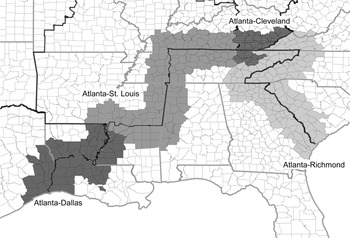
To conduct this test, I construct a panel regression model. The sample includes all counties located within 50 miles of the Atlanta Federal Reserve District border. I index observations by county and year and I divide observations into distinct geographic regions and monetary regimes. Since the Atlanta Federal Reserve District shared its border with four other Federal Reserve Districts, I define four geographical regions: Atlanta-Richmond, Atlanta-St. Louis, Atlanta-Cleveland, and Atlanta-Dallas. Each county is allocated to one geographic region, based on closest proximity. Figure 1 presents these regions. A “monetary regime” includes all of the counties under the jurisdiction of a particular policy regime. One monetary regime—the Atlanta Federal Reserve District—aggressively intervened to stabilize its banking system, whereas the other districts did not. Therefore, I formulate the following linear model:
 \begin{equation}
S_{it} = \sum\limits_{j = 1}^4 {\sum\limits_{t = 1927}^{1933} {\beta _{jt} \left({R_{ij} D_t } \right)} + \sum\limits_{t = 1927}^{1933} {\alpha _t \left({A_i D_t } \right)} + \psi _i + \varepsilon _{it} }
\end{equation}
where Sit represents bank suspension rate in county i in year t, Rj represents geographical region dummies (j = 1 Atlanta-Richmond, j = 2 Atlanta-St. Louis, j = 3 Atlanta-Cleveland, j = 4 Atlanta-Dallas), A represents a dummy variable for the Atlanta Federal Reserve District, Dt represents yearly dummies (t = 1927, 1928, 1929, 1930, 1931, 1932, 1933), and Ψ represents time-invariant county-level controls.Footnote 5
COUNTIES WITHIN FIFTY MILES OF ATLANTA FED DISTRICT BORDER

I interact region and year dummies to capture region-year fixed effects. These interaction terms measure the average level of bank suspension rates among counties in a region in a given year. They reveal the extent to which banking panics gripped a particular region in a given year. Moreover, I interact the Atlanta Fed dummy with year dummies to capture monetary regime-year fixed effects. These interaction terms measure the average effect on bank suspension rates of being in the Atlanta Federal Reserve district in each year. Hence, they provide yearly estimates of the effectiveness of monetary intervention in mitigating banking panics. Lastly, to control for economic, demographic and regulatory differences across counties, I include a set of county-level control variables.Footnote 6
SAMPLE SIZE

Note:
The data come from the Federal Deposit Insurance Corporation (FDIC), available through the Inter-University Consortium for Political Science Research. The table reports the number of counties, the number of banks in operation in 1927, and the number of bank suspensions in each year from 1927 to 1933.
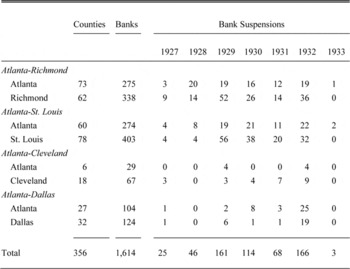
Table 1 presents descriptive data on the sample size. It reports the number of counties, the number of banks in operation on January 1, 1927, and the number of bank suspensions in each year of the contraction, along with the two previous years to identify any potential trends in bank suspensions in the run-up to the Depression. The sample includes 356 counties (166 in Atlanta and 190 in non-Atlanta) and 1614 banks (682 in Atlanta and 932 in non-Atlanta).
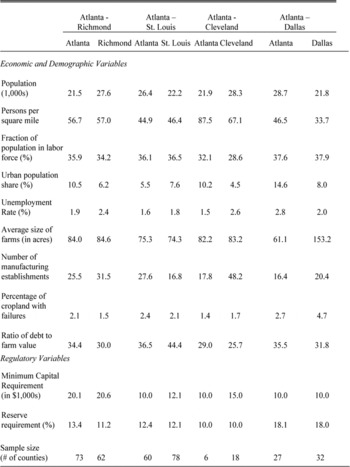
Table 2 reports economic, demographic, and regulatory characteristics of counties for the four geographical regions. The table separates each region into its Atlanta and non-Atlanta component and reports averages across counties. The table reveals a large degree of homogeneity across each region along a variety of dimensions.
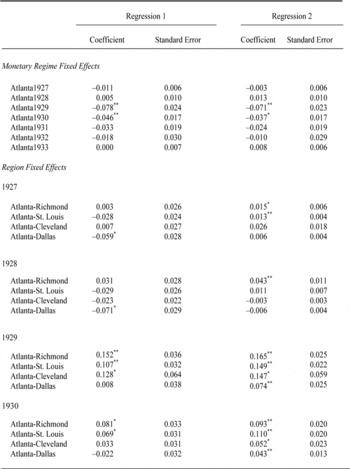
Table 3 presents the regression results. It reports two specifications. Regression 1 presents the full model with county-level economic, demographic, and regulatory control variables. Regression 2 excludes the county controls. The results are similar across the two specifications.
CHARACTERISTICS OF COUNTIES

Note:
The table reports averages across counties.
Sources:
Economic and demographic statistics come from the censuses of population, manufacturing, and agriculture for 1930. The data can be electronically downloaded at NHGIS (http://www.nhgis.org) or ICPSR (http://www.icpsr.umich.edu/icpsrweb/ICPSR). Minimum capital and reserve requirements come from Polk's Bankers’ Encyclopedia, 1929, and the Federal Reserve Bulletin, Nov 1928 and Sep 1930.
PANEL REGRESSION MODEL (dependent variable: county bank suspension rate)


* = Significant at the 5 percent level.
** = Significant at the 1 percent level.
Note:
Robust standard errors, clustered at the county level are in parentheses.
First, consider the results before the start of the Depression—1927 and 1928. In both regressions, the region-year fixed effects are small and in most cases, statistically insignificant, indicating that these regions were not seriously affected by banking panics. The Atlanta Fed fixed effects are also small and statistically insignificant, indicating that bank suspension rates did not differ substantially across opposite sides of the Atlanta Fed border in the run-up to the Depression. These findings suggest that bank performance was relatively homogenous along opposite sides of the Atlanta Fed border before the start of the Depression.
Next, consider the results during the Great Contraction. The region-year fixed effects increase substantially during the contraction. In both regressions, the region-year fixed effects show that during the early stages of the contraction—1929 to 1930, banking panics were most severe in Atlanta-Richmond and Atlanta-St. Louis in 1929 and 1930 and in Atlanta-Cleveland in 1929. In 1931 and 1932 region-year fixed effects are large and significant in most regions, but in 1933, drop to levels that are, in general, insignificantly different from zero.
The main result from the empirical model, however, is the Atlanta Fed fixed effects. In both regressions, in 1929 and 1930, the early stages of the Depression, the Atlanta Fed fixed effects are large, negative, and strongly significant, indicating that being under the jurisdiction of the Atlanta Federal Reserve District reduced the incidence of banking panics. These results support the hypothesis that monetary intervention mitigated banking panics. According to these results, by the end of 1930 the percentage of bank suspensions in counties located in the Atlanta district were, on average, roughly 10 to 12 percentage points lower than the percentage of bank suspensions in neighboring counties across the border in the St. Louis, Richmond, Cleveland, or Dallas district. Moreover, the magnitude of these results is comparable to those of Richardson and Troost (Reference Richardson and Troost2009). Richardson and Troost show that approximately 75 percent of the banks in the St. Louis district of Mississippi were still in operation by mid-1931, whereas approximately 85 percent of the banks in the Atlanta district of Mississippi were still in operation by mid-1931—a difference of roughly 10 percent.Footnote 7
During the later stages of the contraction, in 1931, 1932, and 1933, the Atlanta Fed fixed effects are statistically indistinguishable from zero, indicating that bank suspension rates did not differ substantially across opposite sides of the Atlanta Fed border. Thus, while the results from these regressions suggest that monetary intervention alleviated banking panics during the early stages of the Depression, they also indicate that bank suspension rates began to converge in 1931 and 1932, in spite of high levels of bank suspension rates. What explains this convergence? There are several potential explanations. One explanation is that liquidity intervention became less effective over time. As the severity of the Depression intensified between 1929 and 1933, the nature of the banking panics might have changed. Indeed, as economic conditions and fundamentals deteriorated over the course of the Depression, the banking panics, which initially began as crises of illiquidity, might have transformed into crises of fundamental solvency during the later stages of the Depression. This might—at least in part—reconcile the findings of Richardson and Troost (Reference Richardson and Troost2009) with those of Calomiris and Mason (Reference Calomiris and Mason2003).Footnote 8 However, another explanation is that other organizations—such as the National Credit Corporation and the Reconstruction Finance Corporation, which began lending money to banks in 1931 and 1932, respectively—smoothed out differences in credit lending to banks across Federal Reserve Districts during the later stages of the Depression. Furthermore, a third explanation is that other Federal Reserve Districts, which initially opposed intervention, moved closer to the policies of the Federal Reserve Bank of Atlanta over time. Richardson and Troost (Reference Richardson and Troost2009) document that in response to the successes of the Atlanta Fed, the St. Louis Fed, beginning in the summer of 1931, started to adopt policies similar to those of the Atlanta Fed. Future research is needed to sort out these competing potential explanations.Footnote 9
These results strongly support the hypothesis that monetary intervention mitigated banking panics during the early stages of the Depression. To gauge the magnitude of these effects, consider the following calculation. Dividing the Atlanta Fed fixed effects, which measure the impact on bank suspension rates of being in the Atlanta Federal Reserve District in each year, by the region-year fixed effects, which measure the average level of bank suspension rates among counties in a region in a given year, provides estimates of the extent to which monetary intervention reduced the incidence of bank suspensions. For example, the results from regression 2 indicate that the Atlanta Fed reduced the extent of bank suspensions by approximately 43 percent in 1929 and 40 percent in 1930 in Atlanta-Richmond and by approximately 48 percent in 1929 and 34 percent in 1930 in Atlanta-St. Louis. Using the results from regression 1 yields even stronger statistics: these estimates indicate that after controlling for economic, demographic, and regulatory differences across counties, the Atlanta Fed reduced the extent of bank suspensions by approximately 51 percent in 1929 and 57 percent in 1930 in Atlanta-Richmond and by approximately 72 percent in 1929 and 66 percent in 1930 in Atlanta-St. Louis.
THE IMPACT OF MONETARY INTERVENTION ON THE FED BALANCE SHEET
The results indicate that monetary intervention—on the part of the Atlanta Fed—mitigated banking panics during the early stages of the contraction. This suggests that interventionist policies from the Federal Reserve System as a whole would have alleviated the banking panics of the initial stages of the Depression.
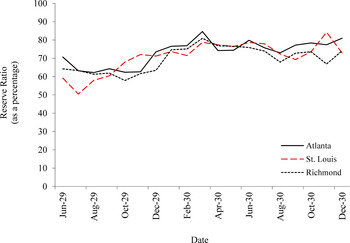
RESERVE POSITION OF ATLANTA, ST. LOUIS, AND RICHMOND FEDERAL RESERVE BANKS

However, this finding poses a related question: would such a concerted system-wide response have been feasible? The United States was on a fixed exchange rate regime, the gold standard, during the Great Contraction. As a consequence, a potential constraint on Fed policy might have been its reserve position. If liquidity intervention expended large resources, then it might be the case that all twelve Federal Reserve Districts would not have been able to extend support to their banking systems without jeopardizing the reserve position of the Federal Reserve System as a whole.Footnote 10
To investigate this issue further, I analyzed the balance sheet of the Atlanta Fed to determine whether its actions impaired its reserve position. Figure 2 displays the reserve position of the Atlanta Fed from July 1, 1929 to December 31, 1930. It shows the ratio of total reserves against note and deposit liabilities—the reserve ratio. For sake of comparison, I include the reserve position of two other Federal Reserve Districts that experienced serious banking panics during the first two years of the Depression, but that did not intervene to support their banking systems—St. Louis and Richmond.Footnote 11
The Federal Reserve Act required each Reserve bank to hold reserves in the form of gold and lawful money equal to at least 35 percent of its deposit liabilities and reserves in the form of gold equal to at least 40 percent of its outstanding Federal Reserve notes; as a consequence, the average reserve requirement against Federal Reserve notes and deposits was between 35 and 40 percent. Figure 2 reveals that the reserve position of the Atlanta Fed remained substantially above this requirement throughout 1929 and 1930. This suggests that monetary intervention did not impair the balance sheet of the Atlanta Fed during the early stages of the Depression.Footnote 12
What explains the strong reserve position of the Atlanta Fed in the midst of such large-scale intervention? To answer this question, I read contemporary newspaper reports that described the banking panics that occurred in the Atlanta Federal Reserve District in 1929 and 1930. In July 1929, during the outbreak of a panic in Florida, aggressive efforts to rush cash to banks undergoing runs and strong declarations from Fed officials restored confidence and quelled the panic. Creed Taylor, Deputy Governor of the Atlanta Federal Reserve Bank, proclaimed, “local bankers could ‘have all the money with which they need to meet the situation’” and The New York Times reported, “confidence had been restored…the arrival of $5,000,000 here today and yesterday from the Atlanta Federal Reserve Bank and the sight of the money in huge stacks in the cages of the bank tellers had a reassuring effect.”Footnote 13 In November 1930, during the panic that coincided with the collapse of Caldwell and Company, the newspaper reports indicate that the actions taken by Atlanta Fed officials—of rushing cash and pledging support to banks—reassured depositors, inducing them to redeposit their money. The New York Times reported, “Many depositors who had withdrawn their money from the East Tennessee National and the City National Banks redeposited it today and business was again almost normal…huge stacks of cash and currency [from the Federal Reserve Bank of Atlanta] reassured the most timid.”Footnote 14 The newspaper accounts indicate that the Atlanta Fed was able to rush cash to banks without impairing its reserve position because its promise to extend aid to banks, coupled with visible displays of rushing cash to banks, had a powerful effect in restoring confidence.
CONCLUSIONS
This article extends the analysis of Richardson and Troost (Reference Richardson and Troost2009) beyond Mississippi to a larger region—the entire border of the Atlanta Federal Reserve District. It directly tests a chief concern of the work of Richardson and Troost—the possibility that the results may be specific to Mississippi and consequently, may be driven by some force other than differences in monetary policy. By analyzing bank performance in counties straddling the border of the Atlanta Federal Reserve District during the Great Depression, this article conducts a new test of the effects of liquidity intervention on bank performance in a more expansive range of regions. According to my empirical estimates, liquidity intervention reduced the incidence of bank suspensions by 34 to 72 percent, depending on the model specification, across a wide array of areas. These findings corroborate those of Richardson and Troost and support the assertion that the Federal Reserve System could have mitigated the banking panics of the early stages of the Depression had it acted as a lender of last resort. They also indicate that the conclusions of Richardson and Troost are not specific to one state, but rather are generalizable to a much larger, more diverse area.Footnote 15
Would monetary intervention during the early stages of the Depression have been sufficient to prevent subsequent panics? According to Friedman and Schwartz (Reference Friedman and Schwartz1963), the banking panics of the Great Depression were liquidity crises. In their view, the Federal Reserve could have contained the banking panics had it rushed cash to banks undergoing runs and injected liquidity into the country's banking system. Unfortunately, because the counterfactual—bank performance between 1929 and 1933 with the Federal Reserve System acting as a lender of last resort—is unobservable, it may be impossible to know with certainty whether monetary intervention would have been sufficient to stop a nationwide banking crisis and avert the worst of the Depression. Nonetheless, the results of this article suggest that monetary intervention was strongly effective during the early stages of the Depression. As a consequence, the failure of the Federal Reserve System to act as a lender of last resort during the initial stages of the Depression was a squandered opportunity.