INTRODUCTION
Film dosimeters offer some clear advantages for being two-dimensional (2D) detectors that provide permanent records of the ionising dose distribution measured at high resolutions. Assessing an ionising photon beam using radiographic film is quite a difficult task as energy absorption and transfer properties of radiographic films do not match those of biological tissues. Moreover, radiographic films are sensitive to room light and demand wet chemical processing. Gel dosimeters are extremely sensitive to atmospheric oxygen and exhibit significant scatter artefacts during optical computed tomography (CT) scanning. Therefore, gel dosimeter introduces some difficulties in usage.Reference Xu, Wuu and Maryanski 1 – Reference Oldham 5
These difficulties can be covered by the introduction of a new Gafchromic® EBT (ISP, Wayne, NJ, USA) dosimeters, a radiation dosimeter with high spatial resolution. In 2004 the first type of radiochromic film, Gafchromic® EBT film was released by International Specialty Products suitable with low radiation doses typically occurring in radiation therapy. In 2009, the Gafchromic® EBT2 film served as a replacement of Gafchromic® EBT film. Several works have been reported evaluating some basic EBT and EBT2 properties, such as film homogeneity,Reference Lynch, Kozelka, Ranade, Li, Simon and Dempsey 6 – Reference Zeidan, Stephenson and Meeks 8 scanning orientation dependence and high-dose dependence,Reference Saur and Frengen 9 , Reference Andres, Del Castillo, Tortosa, Alonso and Barquero 10 energy dependence and ambient light sensitivity,Reference Fuss, Sturtewagen, De Wagter and Georg 11 – Reference Cheung, Butson and Yu 14 absorption spectra, post colouration behaviour,Reference Devic, Aldelaijan and Mohammed 15 temperature dependence.Reference Arjomandy, Tailor and Anand 16 – Reference Iqbal, Gifford, Ibbott, Grant and Buzdar 20 In 2011, ISP released a new robust film generation, the Gafchromic® EBT3 film. The most modern Gafchromic® EBT3 film are similar in construction to its ancestor EBT2 film, with additional features of a symmetric construction, insensitive to visible light and anti-Newton ring artefacts coatings.Reference Iqbal, Gillin, Summers, Dhanesar, Gifford and Buzdar 21
The role of dosimetry films in the measurement and verification of dose distributions is excellent with very high spatial resolution, tissue equivalent behaviour, comparatively low spectral sensitivity variation, and human readable hard copies and insensitive to visible light.Reference Paelinck, De Neve and De Wagter 22 , Reference Todorovic, Fischer, Cremers, Thom and Schmidt 23
An accurate dosimetric measurement before patient treatment is of decisive importance for the usefulness and success of the prescribed treatment planning. Accurate treatment techniques such as intensity-modulated radiotherapy (IMRT) employ irregular fields and abrupt dose gradients to achieve highly conformal doses to the target volumes. The segmentation of an individual treatment field leads to complex patterns of intensity distributions in IMRT. Consequently, dose measuring checks and special quality assurance (QA) procedures have been developed together with increasingly sophisticated treatment techniques to verify the delivered doses. Conventional dosimeters, such as ionisation chambers, semiconductor detectors and thermoluminescent dosimeter frequently fail to meet up the necessities (high spatial resolution, 2D information and determination of absolute doses) demanded by such measurements.
Former researchers have worked on various film dosimetry aspects, film QA procedures, calibration curves and dose profiles were acquired independently using different processing software that were time-consuming and burdensome.Reference Fuss, Sturtewagen, DeWagter and Georg 24 – Reference Stock, Kroupa and Georg 27
The main objective of this study was to evaluate the dosimetric characteristics of Gafchromic® EBT3 film and its feasibility as an IMRT QA treatment plan verification tool. This study employed one scan method-based software ‘film Pro QA 2014’ (Ashland Inc., Wayne, NJ, USA), which contained distinctiveness in itself by eliminating inter-scan variability which may act as an error source.
MATERIALS AND METHODS
Gafchromic® EBT3 film
The Gafchromic® EBT3 films from lot no.: A10171102 with sheet dimension of 20·3×25·4 cm2 were used in this study. The film was handled according to the procedures described in the American association of physicists in medicine task group-55.Reference Arjomandy, Tailor and Anand 28
The film comprises of an active substrate layer of 27 μm thickness embedded between two transparent polyester substrates of 120 μm thick. The active layer consists of active component, marker dye, stabilisers and other additives that provide low-energy dependence. The yellow marker dye decreases ultraviolet or light sensitivity and used in junction with a red, green and blue (RGB) film scanner, enables all the benefits of multichannel dosimetry. The polyester substrate has a special surface treatment containing microscopic silica particles that maintain the gap between the film surface and the glass window in a flatbed scanner. Since the gap is nearly ten times the wavelength of visible light, so formation of Newton’s Rings interference patterns in images acquired using flatbed scanner, is prevented.Reference Borca, Pasquino and Russo 29
Geometric setup
The films were exposed in a tissue equivalent material composed of 30×30 cm2 sheets of solid phantom (PTW, Freiburg, Germany) that were used in acquiring cross-plane dose profiles following the AAPM-TG 142 recommendations.Reference Klein, Hanley and Bayouth 30 The standard geometry used for measurement of three-dimensional (3D) conformal dose distributions was an isocentric. The films were irradiated to 6 and 15 MV photon beams and dose rates of 300 MU/minute produced from a dual energy Varian DHX-S Linac (Varian Medical Systems, Palo Alto, CA, USA) equipped with a millennium 120 multileaf collimators (MLCs).
The experimental conditions were fixed through the following parameters; source-to-detector distance (SSD)=100 cm, depth (d)=10 cm, field size (FS)=5×5, 10×10 and 15×15 cm2, region of interest (ROI) and dose rat=300 MU/minute.
Film scanner
The Epson Expression 10000 XL (Seiko Epson Corporation, Nagano, Japan) is a flatbed colour scanner that was used for scanning radiochromic EBT films. This scanner is equipped with its associated Epson scan V3·4 software and spatial resolution of 72 dpi corresponding to a pixel size of 0·35×0·35 mm2. It can scan opaque and transparent samples. The films were scanned under transmission mode according to the protocol described by Borca et al. and RGB positive images were collected and saved in tagged image file format.Reference Borca, Pasquino and Russo 29 A white fluorescent Xenon lamp was used as a light source. The light detector is a charge-coupled device coated with three optical filters that splits up the incident light spectrum into three specific measureable wavelength bands corresponding to fundamental primary colours red, green and blue. As a result, EBT films were scanned in 48-bits colour mode at 72 dpi resolutions without applying image processing features.Reference Borca, Pasquino and Russo 29 , Reference Ferreira, Lopes and Capela 31
Reference dosimetry
The relative dose measurements were performed with ion chambers PTW 30,001 (PTW, Freiburg, Germany). The ion chamber was positioned at isocentre with a depth of 10 cm as recommended in the TG-51 protocol, above and below in water phantom that essentially provides a reproducible build up and backscatter environment.Reference Almond, Biggs and Course 32 The doses were calculated using an independent calibration curve and compared with doses obtained using the ionisation chamber correction factor. The absorbed dose to film was determined according to the International atomic Energy Agency recommendations absolute dosimetry protocol TRS-398.Reference Andreo, SaifulHuq and Westermark 33
Gafchromic® EBT3 film dosimetry analysis
The scanned image of the films was measured and analysed through Film QA Pro software using triple channel dosimetry to eliminate scanner artifacts. Film QA Pro software is a sophisticated tool designed to streamline the IMRT QA and allows one scan analysis. The film dosimetry protocol takes dose response measurements from the exposed and unexposed calibration films and applies that data to re-scale pre-determined and lot-specific calibration response data. The re-scaled calibration was then used to convert the application film image to a dose image. Comparison between measurement and plan was made through the Film QA Pro software using iso-dose contour plots, dose profiles and gamma index analysis.
RESULTS AND DISCUSSION
Ion chamber data
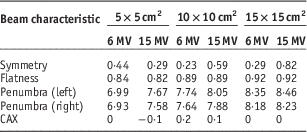
The relative dose measurements for dosimetric properties like symmetry, flatness, penumbra (left), penumbra (right) and central axis (CAX) performed with ion chambers at depth of 10 cm in water phantom are given below:
Table 1 shows that average dose measurements for symmetry, flatness, penumbra (left), penumbra (right) and CAX were 0·32, 0·88% 7·69, 7·58 mm and 0·07% at 6 MV and 0·57, 0·88%, 7·06, 7·89 mm and 0% at 15 MV for selected field sizes, respectively.
Ion chamber reference data for both energies of DHX-S Linac at field sizes of 5×5, 10×10 and 15×15 cm2

Abbreviation: CAX, central axis.
EBT3 film calibration
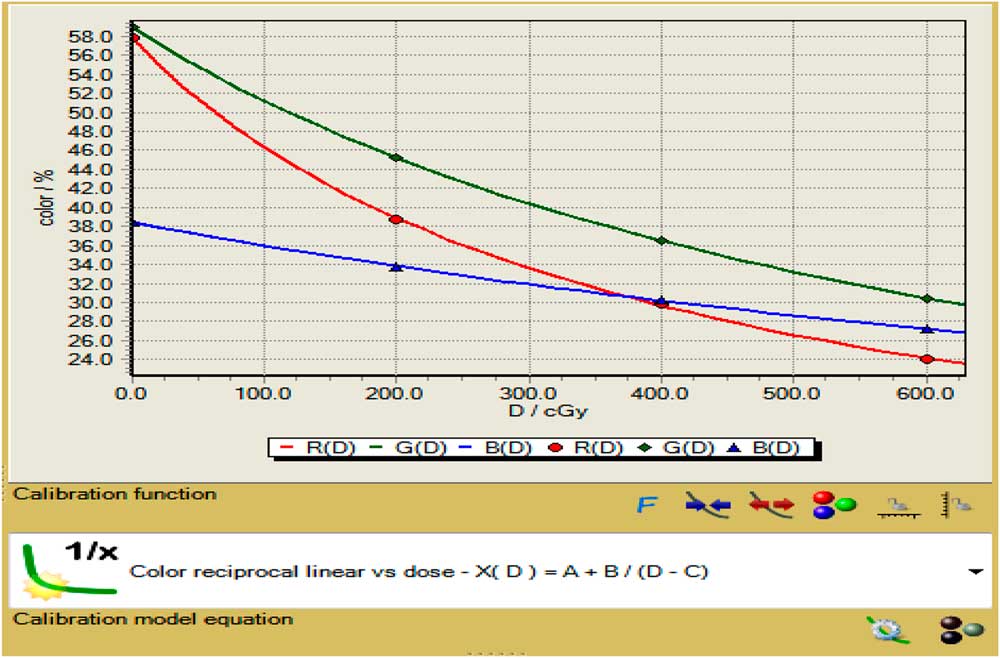
By using only four data points, the calibration curve was drawn in three colour channels, that is, red, green and blue. Figure 1 shows that each response curve is different for each colour channel. By using multichannel dosimetry, each curve comprises dose dependent and dose independent portion, having different ratio in each colour. The blue channel curve is weakly dose dependent whereas the red channel curve is highly dose dependent. The green channel is preferred for very high dose. It was determined that dose response of the film is different for portrait and landscape orientations.Reference Borca, Pasquino and Russo 29
Calibration curve of EBT3 film in the red, blue and green channels along with calibration model equation.

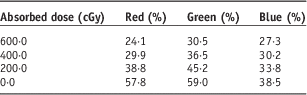
Table 2 shows involvement of noise surrounded by the ROI used for the dose measurement was supposed to be avoidable. Several fitting functions are available but colour reciprocal linear versus dose: X (D)=A+B/(D−C) was used as a fitting function for the calibration curve, where X (D) is the response at dose D and A, B and C were constants. This function was selected as the default. It provides help in selecting the fitting function best suited to the data points. Lower values in the table signify better consistency among the colour channels.
Calibration table representing the response values of the selected region of interests

Comparison of dosimetric properties of EBT3 film with ion chamber
Symmetry
Symmetry of a radiation field can be defined as maximum ratio of dose at two symmetry points relative to the CAX of the field.
 $$Symmetry{\equals}D_{{\left( {x,y} \right)}} /D_{{\left( {{\!\minus\!}x,{\minus}\!y} \right)}} {\times}100\%\,$$
The symmetry of the profile significantly increases as the field size increases. The field sizes 5×5, 10×10 and 15×15 cm2 were used to observe the symmetry for all three channels. The deviation of symmetry for red channel were 0·11, 0·03 and 0·41% at 6 MV and 0·02, 0·04 and 0·25% at 15 MV from ion chamber data. Furthermore, the deviation of symmetry for green channel observed were 4·90, 2·42 and 2·56% at 6 MV and 2·62, 2·56, and 3·05% at 15 MV. The symmetry for blue channel were deviated as 4·25, 4·01 and 3·97% at 6 MV and 3·85, 3·91 and 3·94% at 15 MV as shown in Table 3.
Percentage deviation of dosimetric properties of beam symmetry, homogeneity, penumbra (left, right) and central axis (CAX) from reference ion chamber

Flatness (homogeneity)
It is specified as maximum allowable percentage variation from average dose.
 $$F{\rm {\equals}}{{M{\minus}m} \over {M{\plus}m}}{\times}{\rm 100\,\%\,}$$
where M and m are the maximum and minimum dose values, respectively, in the central 80% of the profile.
It was observed that the value of each scan of flatness profile deviated very little from 1st scan. The change in each scan value of flatness is due to some kind of human error in the analysis of the film with the software used.
However, the flatness of the profile were significantly reduced as the field size increases. The deviation of flatness for 5×5, 10×10 and 15×15 cm2 were 1·64, 1·32 and 1·08% at 6 MV and 2·08, 0·96 and 0·86% at 15 MV from ion chamber data as shown in Table 3.
Penumbra (left and right)
The obtained profile of penumbra, lateral distance between 80 and 20% of maximum dose points of beam profile, showed that the penumbra (left) significantly increases as the field size increases. Analysis show that the deviation of penumbra (left) for 5×5, 10×10 and 15×15 cm2 were 3·59, 3·84 and 3·88 mm at 6 MV and 3·52, 2·54 and 3·62 mm at 15 MV from ion chamber data.
The penumbra (right) is also significantly increases as the field size increases. The deviation of penumbra (right) for 5×5, 10×10 and 15×15 cm2 were 3·41, 3·56 and 3·76 mm at 6 MV and 3·68, 3·72 and 3·94 mm at 15 MV from ion chamber data as shown in Table 3.
CAX
It was investigated that each scan of CAX value deviates very little from scan1 but it was observed that when increases in the number of scans of the film, the CAX was better than the first scan. The change in each scan value of CAX was due to some kind of human error in the analysis of the film with the software used. The CAX of the profile was significantly increases as the field size increases. The deviation of CAX for 5×5, 10×10 and 15×15 cm2 is 0·53, 0·58 and 0·62% at 6 MV and 0·46, 0·47 and 0·49% at 15 MV from ion chamber data as shown in Table 3.
Response of three channels (red, blue and green)
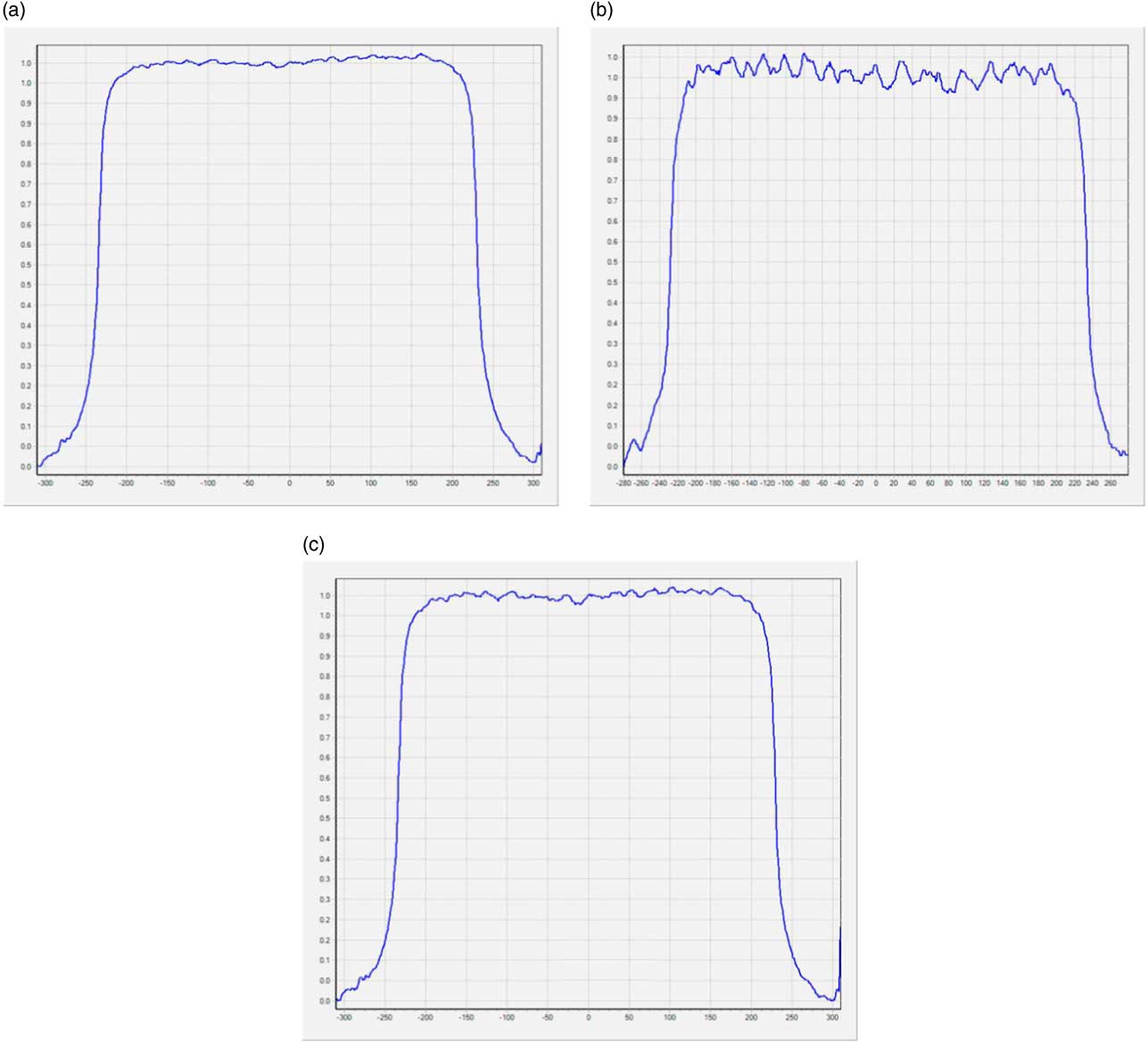
The response curve of each factor for three channels shows that the red channel gives better response for each channel. The response curve for all three channels as red, blue and green channel is shown in Figure 2.
Response curves of the three channels. (a) red channel (b) green channel (c) blue channel.

This blue and green response curve shows that absorbed dose was not same on right and left side of the CAX. The blue channel used for obtaining response of absorbed dose was not sufficient because it does not show proper response of absorbed dose. The response curve of red channel shows that absorbed dose was same on right and left side and also shows proper response of absorbed dose. This means that red channel is sufficient for giving the response of absorbed dose at different field sizes.Reference Liu, Gräfe and Khan 34 , Reference Chang, Ho and Lee 35
Stability
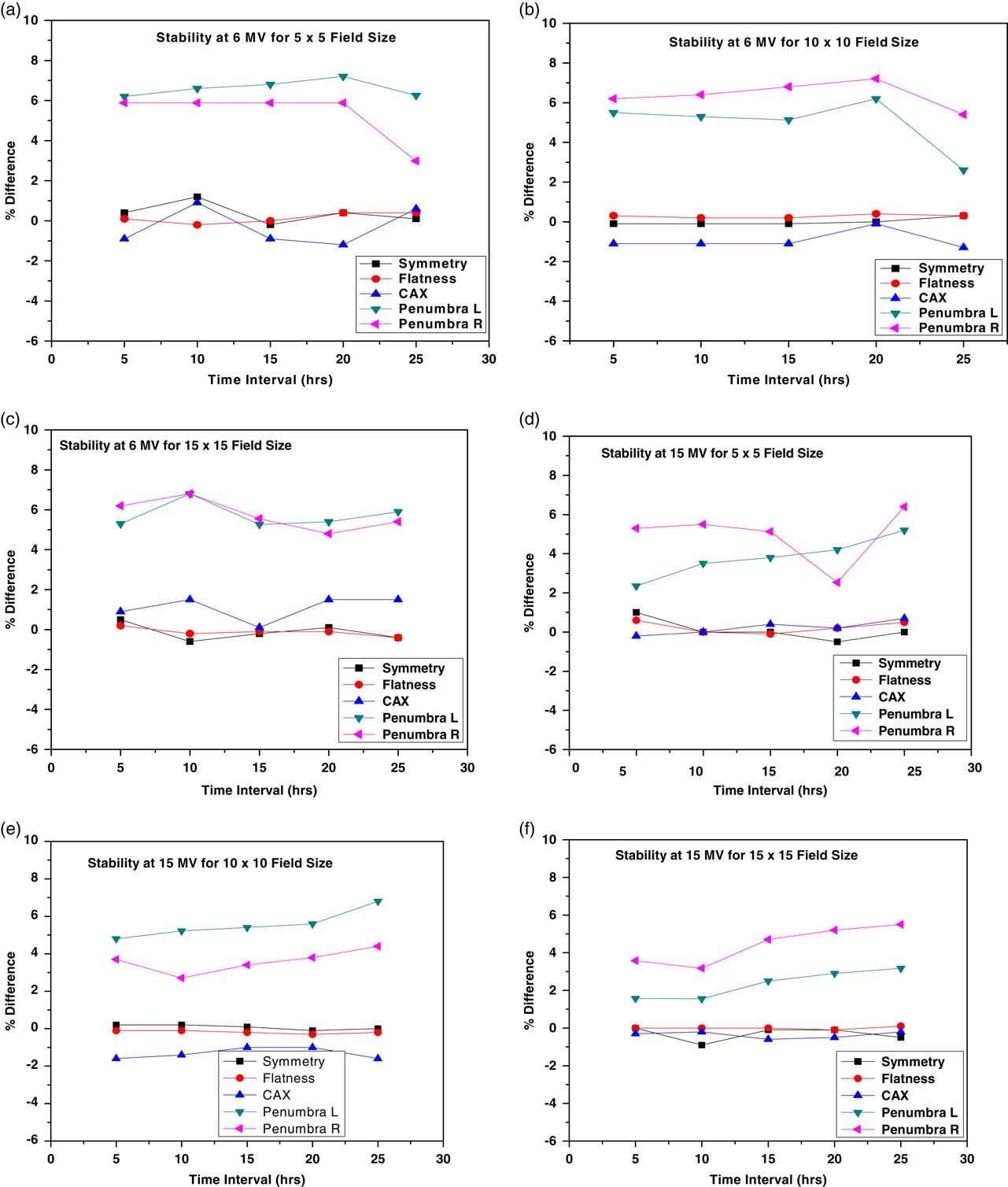
The EBT3 film was scanned every 5 hours and examined in order to assess its stability. The symmetry, flatness, CAX, penumbra (left) and penumbra (right) were analysed to study the stability. The difference ‘D’ of each scan was taken from first scan by using the relation:
 $$D{\rm {\equals}}\left| {S_{n} {\rm {\minus}}S_{{\rm 1}} } \right|$$
where n=2, 3, 4, 5, 6.
The average percentage difference was found to be 0·38, −0·04 and −0·12% for symmetry and 0·14, 0·28 and −0·12% for flatness and −0·3, −0·9 and 1·1% for CAX and 4·9, 6·8 and 3·23% for penumbra (left) and 5·3, 7·8 and 4·13% for penumbra (right) at 6 MV with field sizes 5×5, 10×10 and 15×15 cm2, respectively. For the same respective field sizes and at 15 MV, the average percentage difference was determined as 0·1, 0·08 and −0·32% for symmetry and 0·24, −0·18 and 0% for flatness and 0·22, −1·32 and −0·36% for CAX and 2·47, 4·16 and 3·9% for penumbra (left) and 3·09, 2·6 and 5·62% for penumbra (right) . The Figure 3a–3f describing the stability for both energies 6 and 15 MV are given below.
stability of red channel at: (a) field size of 5×5 cm2; (b) field size of 10×10 cm2; (c) field size of 15×15 cm2 for 6 MV beam energy and (d) field size of 5×5 cm2; (e) field size of 10×10 cm2; (f) field size of 15×15 cm2 for 15 MV energy.

Reproducibility
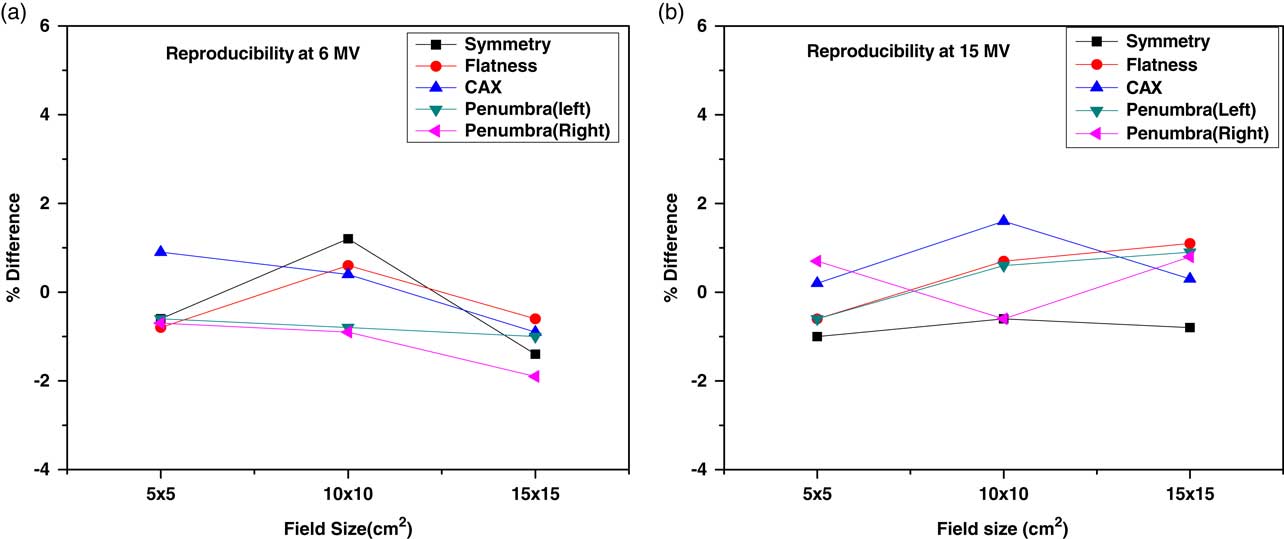
Each film from the same lot was irradiated and scanned to analyse its reproducibility for the same field sizes (5×5, 10×10 and 15×15 cm2) using 6 and 15 MV energies. The Figure 4a and 4b describing the film reproducibility for both energies 6 and 15 MV are given below. The properties such as symmetry, flatness, CAX, penumbra (left) and penumbra (right) were analysed to determine EBT3 film reproducibility. The average percentage difference of symmetry, flatness, CAX, penumbra (left) and penumbra (right) with field sizes 5×5, 10×10 and 15×15 cm2 were found to be −0·26, −0·2, 0·37, −0·6 and −0·8% at 6 MV and −0·4, −0·17, 0·7, 0·03 and 0% at 15 MV, respectively.
Reproducibility of EBT3 film at: (a) 6 MV and (b) 15 MV.

Face orientation
Face orientation was determined by comparing alternate scan report of film with first scan of film at different field sizes for both 6 and 15 MV energies. Statistical analysis showed that the Gafchromic® EBT3 film was independent of face change orientation and face orientation difference of the film was found within 0·6%.
Evaluation of IMRT plan delivery
Gamma analysis
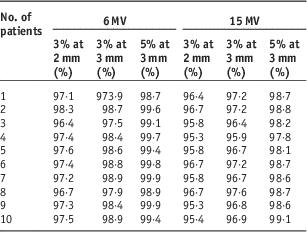
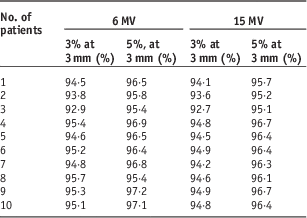
The QA of an IMRT treatment planning system is difficult and lengthy, as for any other 3D planning system.Reference Iqbal, Muhammad, Saeed, Gifford and Afzal 36 , Reference Asgharizadeh, Bekerat and Syme 37 Gafchromic® EBT3 film dosimetry provides significant performance improvements over EBT2 film. Statistical analysis shows that for 3% of 2 mm, 3% of 3 mm and 5% of 3 mm criteria gives the gamma passing rates of 97·3, 98·4 and 99·05% for 6 MV and 95·9, 97·05 and 98·9% for 15 MV, respectively, in brain case as shown in Table 4. While using 3% of 3 mm and 5% of 3 mm criteria gamma passing rates gives 94·8 and 96·8% for 6 MV and 94·45 and 96·05% for 15 MV, respectively, in prostate case as shown in Table 5.
Gamma analysis for the brain patients at 3% at 2 mm, 3% at 3 mm and 5% at 3 mm

Gamma analysis for the prostate patients at 3% at 3 mm and 5% at 3 mm

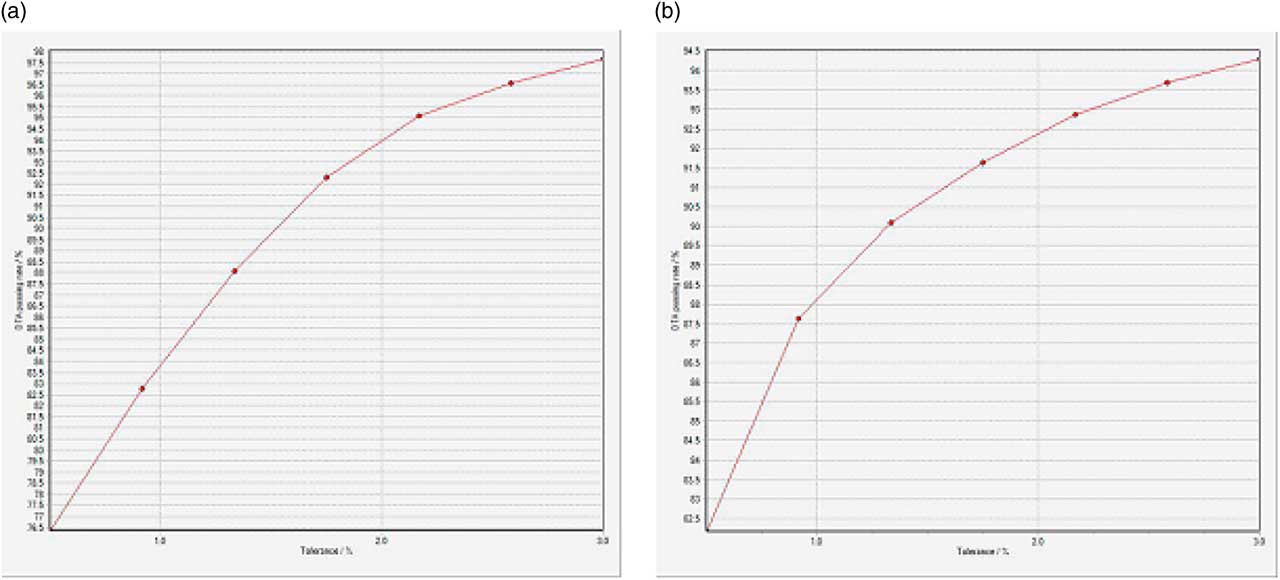
Gamma passing rate versus tolerance
When the difference between calculated and measured dose distribution values were evaluated, gamma index can serve as a good tool for quantitative analysis. In order to estimate the reliability of results of gamma analysis, dependency of achieved passing rates with respect to test parameters were evaluated. A gamma passing rate versus tolerance chart provides much better understanding of the achieved gamma map deviations than a single gamma passing rate at a specific gamma tolerance. Figure 5 clearly illustrates that with the increasing tolerance the gamma passing rate also increases.
Chart of gamma passing rate versus tolerance of brain (left) and prostate (right)

CONCLUSION
In this study, measuring dosimetric characteristics of Gafchromic® EBT3 film in terms of symmetry, flatness, CAX and penumbra (left and right) were investigated in conjunction with the Epson Expression 10000 XL flatbed scanner used in transmission mode. The film stability, reproducibility and face orientation were also examined. All the results of this study indicate that EBT3 film explicit an excellent dosimetric behaviour in measurement of dose distributions and IMRT QA that are challenging due to their complex dose patterns. The additional major feature of this study was the use of one scan method based software, ‘film Pro QA 2014’, which is easy to use, time saving and multi featured as it eliminates inter-scan variability as an error source. Consequently, the findings of this investigation suggest that the EBT3 film can be used reliably in dose assessment and IMRT QA. The new improvements in EBT3 film makes it easier to handle for IMRT verification with the use of Film QA pro 2014 software.
Acknowledgement
The authors are thankful to Andre Micke, Advanced Materials Group, Ashland Inc Alps Road, Wayne, NJ, USA for providing and faclitate IMRT “QA PRO 2014 software”.