Between the 1990 and 2000 Census, the Latino population in the United States increased by 58% to a total of 22.4 million (US Census Bureau, 2001). During this period, the number of individuals who reported that they spoke Spanish grew by 60% (Shin & Bruno, Reference Shin and Bruno2003). These increases in the general population have been observed in the school-age population as well. Between 1993 and 1994 and 2002 and 2003, the number of children who attended public schools in the United States rose by approximately 10%, with Latino children accounting for 64% of the growth (Fry, Reference Fry2006). This means that educational programs are serving a large percentage of children who are primarily Spanish speaking or who are bilingual. According to the US Census Bureau (2003), 22% of the Latino population over 5 years of age speak exclusively English in their homes. Of the remaining 88%, 48% speak English very well and the other 52% report having limited proficiency in English.
This demographic information reflects the variation in language usage that exists within the Latino population in the United States as well as differences in levels of acculturation that exist between and within generations. Acculturation, the process of cultural change that is the result of an interaction between two or more cultures, focuses on changes in beliefs, behaviors, and values to describe within-group cultural differences (Berry, Reference Berry, Chun, Organista and Marin2003). The prevailing model of acculturation, the bidimensional model, recognizes that the two dominant aspects of acculturation, namely, preservation of one's heritage culture and adaptation to the dominant culture, are conceptually distinct and can vary independently (Liebkind, Reference Liebkind, Brown and Gaertner2001; Ryder, Alden, & Paulhaus, Reference Ryder, Alden and Paulhaus2000). Therefore, an individual can simultaneously preserve some features of his/her heritage culture and modify others by integrating characteristics from the dominant culture. Individuals will differ in the extent to which their self-identification includes culturally based values, beliefs, attitudes, and behaviors. Culture may play a central role in an individual's identity, whereas another individual may base his/her identity on other factors such as occupation or religion. Individuals are capable of having multiple identities, each which may independently vary in strength (Ryder et al., Reference Ryder, Alden and Paulhaus2000).
Styles or patterns of acculturation will vary across individuals based upon the extent to which features of the heritage culture are maintained and features of the majority culture are incorporated into their daily lives. Integration, the simultaneous maintenance of heritage cultural integrity and participation in the majority culture, is a style of acculturation resulting in successful adaptation and positive outcomes (cf. LaFromboise, Coleman, & Gerton, Reference LaFromboise, Coleman and Gerton1993).
Language is one key aspect of culture that serves as a key indicator of individuals’ levels of acculturation (Arcia, Skinner, & Bailey, Reference Arcia, Skinner and Bailey2001). Research has shown that first generation Latino families begin using the English language rapidly as they acculturate to their new homeland. In a large cross-sectional study of Latino individuals, a sample that included Puerto Ricans, 7% of the individuals who moved to the US mainland reported using English as their first language within 18 months of their arrival, and an additional 24% reported speaking English often (Veltman, Reference Veltman1988). After living in the United States for 4 years, a large percentage of immigrants reported speaking English on a regular basis, and a majority did so within approximately 9 years, with 10% making English their primary language (Veltman, Reference Veltman1988). Similarly, in a cross-sectional study of Mexican and Puerto Rican individuals who moved to the US mainland, Hakuta (Reference Hakuta, Lamberty and Garcia1994) found that use of English occurred frequently for those who had lived on the mainland for 15 years or more, and that this shift occurred more quickly in children.
In second-generation immigrants, use of English is typically well established (Hurtado & Vega, Reference Hurtado and Vega2004; Portes & Hao, Reference Portes and Hao1998; Zentella, Reference Zentella, McKay and Wong1988). Although individuals have varying degrees of proficiency in their parents’ native languages, Portes and Rumbaut (Reference Portes and Rumbaut2001) demonstrated that in a second-generation sample of adolescents “knowledge of English is near universal, and use and preference for English increases consistently over time” (p. 118). It should be noted, however, that Latinos were more likely to be bilingual than other groups whose parents were foreign born. By the third generation, the shift to English is complete, with Latino immigrants typically using English as their first language (Arrigada, Reference Arriagada2005; Hurtado & Vega, Reference Hurtado and Vega2004; Torres-Guzmán, Reference Torres-Guzmán and Pérez1998; Veltman, Reference Veltman1983).
Within the homes of immigrant families in the United States, females tend to be more proficient in their native language than males (Arriagada, Reference Anderson and Goldstein2005; Portes & Hao, Reference Portes and Hao2002; Portes & Schauffler, Reference Portes and Schauffler1994). In his cross-sectional study, Veltman (Reference Veltman1981) found that 50% of males ages 4 to 17 years had become English monolinguals, whereas only 20% of the females were monolinguals. In addition, females from a variety of language backgrounds were more likely to be fluent bilinguals than males from similar socioeconomic and family backgrounds (Portes & Hao, Reference Portes and Hao2002; Portes & Rumbaut, Reference Portes and Rumbaut2001). In fact, Portes and Rumbaut (Reference Portes and Rumbaut2001) found that gender was one of the strongest predictors of bilingualism in their study investigating the language usage of adolescents who were second-generation immigrants.
Researchers have explained these findings through the differential socialization patterns experienced by male and female children. In the homes of immigrants, “females tend to be more under the influence of their parents, because of the less autonomous and more protective character of their upbringing” (Portes & Rumbaut, Reference Portes and Rumbaut2001, p. 64). In traditional homes, boys are encouraged to engage in activities and excel in areas outside of the home, whereas girls are encouraged to acquire domestic skills and to prepare for motherhood. “Even in less traditional homes, teenage girls are more likely to conform to parental expectations and to experiences the challenges of the external environment differently than their male siblings” (Portes & Rumbaut, Reference Portes and Rumbaut2001, p. 64).
Differences in child-rearing practices based on the gender of the child are well documented in Latino cultures. In more traditional, less acculturated families, men typically hold dominant roles and women are expected to fulfill domestic roles (De Von Figueroa, Ramey, Keltner & Lanzi, Reference De Von Figueroa-Moseley, Ramey, Keltner and Lanzi2006; Flannagan, Baker-Ward, & Graham, Reference Flannagan, Baker-Ward and Graham1995; González, Umana-Taylor & Bamaca, Reference Gonzalez, Umana-Taylor and Bamaca2006; McHale, Updergraff, Shanahan, Crouter, & Killoren, Reference McHale, Updegraff, Shanahan, Crouter and Killoren2005; Sánchez-Ayendez, Reference Sanchez-Ayendez, Mindel, Habenstain and Wright1998). In Puerto Rican families, motherhood is considered to be a woman's primary role, even if she works outside the home or has other responsibilities (Sánchez-Ayéndez, Reference Sanchez-Ayendez, Mindel, Habenstain and Wright1998). These gender roles are established and reinforced early in Puerto Rican children's lives. As small children, girls and boys are often affectionately called “mami” and “papi,” referring to mother and father, respectively. These terms of endearment teach children “the essential nature of their gender roles” and that “they are future mamis and papis in training” (Zentella, Reference Zentella1997, p. 232). Therefore, girls are expected to stay in the house and/or with their mother. Their responsibilities include assisting their mothers with the care of younger children and with domestic chores. In addition, girls are encouraged to play and develop friendships with other females. They often spend more time with older women watching novellas (Spanish soap operas) (Zentella, Reference Zentella1997). Because girls are expected to be with other females in the household, they experience much exposure to Spanish through interactions that they are involved in or that they overhear as part of the daily routine (Portes & Rumbaut, Reference Portes and Rumbaut2001; Portes & Schauffler, Reference Portes and Schauffler1994; Zentella, Reference Zentella1997). This assists girls in maintaining their home culture and language.
In contrast, boys in Puerto Rican families are encouraged to be independent and to spend time outside and “off the block,” which takes them away from Spanish-dominant networks (Arriagada, Reference Anderson and Goldstein2005; Zentella, Reference Zentella1997; Zuniga, Reference Zuniga, Lynch and Hanson2004). They play ball, ride bikes, and play with friends and are not required to engage in household tasks to the degree that girls are. Boys may be told that they are too unruly for mothers to take with them when they go shopping. Parents often hold the attitude that “boys will be boys,” which provides boys with more autonomy than girls (Zentella, Reference Zentella1997). As a result, boys are more commonly immersed in English when interacting with others outside their homes and experience more exposure to the dominant culture.
Differences in child-rearing practices have also been observed in the language behaviors of parents when interacting with their young children. Evidence from research on Anglo-American, English-speaking, middle-class populations reveals differences in the characteristics of maternal talk to young daughters and sons (Cherry & Lewis, Reference Cherry, Lewis, Waterson and Snow1976; Fagot & Hagan, Reference Fagot and Hagan1991; Lanvers, Reference Lanvers2004; Leaper, Anderson, & Sanders, Reference Leaper, Anderson and Sanders1998; Masur, Reference Masur1987; Reese & Fivush, Reference Reese and Fivush1993; Stevens, Blake, Vitale, & MacDonald, Reference Stevens, Blake, Vitale and MacDonald1998). Although few studies of Latina mothers’ talk to their children have been conducted, gender differences have been documented in at least two studies. Zentella (Reference Zentella1997) found that Puerto Rican mothers living in New York were more likely to give young girls directives that were related to household tasks and assistance with child care. Flannagan et al. (Reference Flannagan, Baker-Ward and Graham1995) found that the content of talk that Latina mothers directed to their preschool daughters differed from talk to their sons, with mothers less likely to emphasize learning-related topics with girls. These results may reflect broader child-rearing goals that are aimed at socializing girls and boys about their respective gender roles and communication patterns.
Given the documented gender differences in Latino children's early socialization and the changes in language usage by Spanish-speaking adults and adolescents, the purpose of this longitudinal investigation was to examine Spanish and English language usage between Puerto Rican mothers and their preschool children. Specifically, the investigation studied changes in language usage of mothers and their children over a 4-year period. Mothers were targeted in this study because they have been credited with assuming a primary role in transmitting their culture, traditions, and language to their children (Arriagada, Reference Anderson and Goldstein2005; González, Reference Gonzalez2005; Veltman, Reference Veltman1981). Specifically, González (Reference Gonzalez2005) observed that Mexican American mothers acted as “enforcers of tradition” who purposely retained and used their native language with the apparent goal of transmitting their language and culture to their children. This conclusion is supported by Veltman (Reference Veltman1981), who asserted that mothers play a large role in promoting the native language skills of their children. In his cross-sectional study, Veltman (Reference Veltman1981) found that
. . . English monolingualism varies rather closely with the language characteristics of the mother. Thus, less than 20% of children with a mother who usually speaks a minority language are reported to be English monolinguals. Some 60 to 70 percent of the children with English bilingual mothers are reportedly English monolinguals, while the vast majority of children with an English monolingual mother have the same characteristics. (p. 77)
With regard to the Puerto Rican population living on the US mainland, Zentella (Reference Zentella1997) observed that mothers were more loyal to Spanish and more likely to believe that knowledge of Spanish was critical to a Puerto Rican identity than men. She stated: “The pre-eminent role of females in child-rearing, their immersion in Spanish-linked activities, and the traditional association of the home or ‘we’ language with feelings of personal intimacy, group solidarity, and allegiance to the mother and the mother-land, explain why some females feel more committed to the inseparability of Puerto Rican identity and the Spanish language than males” (pp. 53–54).
Thus, it appears that mothers’ language choice is influenced by their loyalty to their culture and language, which in turn may affect children's language usage. Children, however, may be affected by their experiences outside as well as inside their homes. During their early years, this influence comes from their experiences in preschool and elementary school.
Schools reflect the cultural values of the mainstream society, which favors usage of the majority language. As a result, children receive the message that the language of the majority is the preferred language and that their language has lower status (Anderson, Reference Anderson and Goldstein2004; Howard et al., Reference Howard, Sugarman and Christian2003). “The minority language is the one that is at risk of not being spoken” (DeHouwer, Reference De Houwer2007, p. 419). This is the case even when children attend bilingual programs where both languages are supported. Research conducted in a variety of countries demonstrates that preschool and school-age children use the majority language even in contexts where the minority language is could be employed (Hickey, Reference Hickey2007; Paradis & Nicoladis, Reference Paradis and Nicoladis2007). For example, Latino children living in Miami and receiving instruction in Spanish preferred using English when speaking to each other during side conversations in classrooms and when talking to each other in the hallways (Eilers, Oller, & Cobo-Lewis, Reference Eilers, Oller, Cobo-Lewis, Oller and Eilers2002). As time continues, children's preference for English increases, even when their parents’ English abilities are minimal (Portes & Rumbaut, Reference Portes and Rumbaut2001; Portes & Schauffler, Reference Portes and Schauffler1994; Zentella, 1998).
The children in this study all came from Spanish-speaking homes. The majority of children were exposed to English from birth whereas approximately 30% were not. When the children entered Head Start, they all experienced a significant change in their language learning environment, as English was the language of instruction in their classrooms. This change was likely to have had a larger impact on children who had only been exposed to Spanish in their homes up until this point in their development. These children were now exposed to and expected to communicate in English on a daily basis. This change may have impacted the language usage between mothers and their children, because children were expected to communicate in English and to increase their English proficiency. Researchers have asserted that consideration needs to be given to changes in the language-learning environment that may result when children enter an educational program (Butler & Hakuta, Reference Butler and Hakuta2004; Genesee, Reference Genesee2004; Hammer, Lawrence & Miccio, Reference Hammer, Lawrence and Miccio2007; Hammer & Miccio, Reference Hammer and Miccio2006; Oller & Eilers, Reference Oller and Eilers2002). Therefore, the timing of exposure to English was considered in this investigation.
Specifically, the goals were as follows: (a) to determine whether reported language usage between mothers and their preschoolers changed over time, and (b) if language usage differed, to examine whether the observed changes were based on changes in children's exposure to English at school entry and the children's gender. Based on findings from previous studies, it was predicted that language usage of the mothers and their children would change toward greater use of English and that the timing of exposure to English would impact language change. Specifically, it was hypothesized that mothers who exposed their children to Spanish and English before school entry would move toward English usage at a faster rate than mothers who spoke only Spanish to their children before entrance into Head Start. Similarly, children who were exposed to the two languages before school entry would use increasingly more English than children who were exposed to only Spanish. In addition, it was predicted that gender would influence the language used by mothers and their children, with mothers and daughters using more Spanish when talking to each other than mothers and sons.
METHOD
Participants
Seventy-six mothers of Puerto Rican descent living in urban areas in Central Pennsylvania took part in the study. This study was part of a larger longitudinal investigation of the language and literacy development of 83 bilingual Head Start children during the Head Start and early elementary school grades. Nine mothers declined to participate in the study of the home language environment. The areas in which the mothers lived were established in the 1950s and 1960s when workers moved from Puerto Rico to the area to work on poultry farms. Subsequently, families moved into the urban centers of their communities. Individuals from Puerto Rico have continued to move into these urban centers.
In order to participate, the mothers were required to speak a Puerto Rican dialect of Spanish and have a child who qualified financially for 2 years of Head Start. To participate, the children had to be eligible to attend Head Start for 2 years, pass a developmental screening, and have no teacher or parental concerns about their development.
All children were spoken to in Spanish from birth by their mothers; however, the children differed as to when they were spoken to and expected to communicate in English on a regular basis. Based on maternal report (see the section on the measure), the children were divided into two groups depending when they were exposed to English and expected to communicate in English on a regular basis. Children from bilingual homes who were spoken to in English from birth were considered home English communicators (HEC; N = 44, 21 males, 23 females). Children from Spanish-speaking homes who were not spoken to or expected to communicate in English until age 3 when they entered Head Start were classified as school English communicators (SEC; N = 32, 10 males, 22 females). It is recognized that some of the children may have had incidental exposure to English prior to entry into Head Start through television and experiences in their communities (Hammer, Miccio, & Rodríguez, Reference Hammer, Miccio, Rodríguez and Goldstein2004; Kohnert, Bates, & Hernández, Reference Kohnert, Bates and Hernández1999). Regardless of incidental exposure, the expectation of communication in English did not occur until they entered Head Start.
The children in both groups averaged 3 years, 9 months at the beginning of the study. The mothers of the HEC children were 27 years, 4 months (SD = 4.51) and averaged 11.7 years of education (SD = 1.5). Sixty percent of the mothers of the HEC children were employed outside of the home. The mothers of the SEC children were 28 years, 9 months (SD = 4.51) of age, and averaged 10.9 years of education (SD = 1.9). Forty percent of mothers in this group worked outside the home. Statistically significant differences were not found between the two groups in terms of children's or mothers’ ages, mothers’ educational background or employment status. The groups differed with regard to place of birth (p < .05). Forty-seven percent of the mothers of the HEC children were born in Puerto Rico compared to 88% of the mothers of the SEC children. Only 6% of the HEC children were born in Puerto Rico as opposed to 32% of the SEC children.
The children attended English Immersion Head Start classrooms in which English was the language of instruction. Children from primarily Spanish-speaking homes were often placed in classrooms in which either the teacher or classroom assistant had knowledge of Spanish. Spanish, however, was not used as a language of instruction. English continued to be the language of instruction when the children attended elementary school.
Procedures
Home visits were conducted annually during the 2 years the children were in Head Start, and when the children were in kindergarten and first grade. The home visits, which lasted approximately 45 min, were conducted in the middle of the school year by trained bilingual home visitors. The interviews took place in the language of the mothers’ choice. Home visitors followed a written protocol when gathering the information. Twenty-five multipart questions focusing on language experiences and usage were read verbatim to the mothers and were recorded on the protocol by the home visitors.
The questions were modeled after the demographic survey that was developed by the NIH NICHD Developing English Literacy in Spanish Speakers research group (http://www.cal.org/delss/) of which this project was a part. The first and last authors of this paper participated in the development of the survey. However, instead of sending a survey home for mothers to complete independently, the data collectors for this study interviewed the mothers in their homes.
The questions targeted a number of topics including language(s) spoken by the mothers and other family members, language(s) the mothers and individual family members spoke to the children, language(s) the children spoke their mothers and individual family members, and languages used by the children when engaging in various activities (e.g., looking at books, playing with peers, etc.). In the first year of the study, the mothers were asked to report the ages at which their children were spoken to in English and Spanish on a regular basis by family members and/or individuals who had regular contact with the children. Specifically, the mothers were asked “At what age, did you or other family members begin talking to your child in Spanish?” and “At what age, did you, other family members, or people at school begin talking to your child in English?” Information collected from these questions was used to divide the children into the HEC and SEC groups.
Each year of the study, the mothers were also asked to report the languages they spoke when talking with their children at the current time and the languages their children spoke when talking to them. Specifically, mothers were asked, “What language(s) do you use when speaking to your child?” and “What language(s) does your child use when speaking to you?” The mothers were given five response options: all Spanish, more Spanish than English, equal amounts of Spanish and English, more English than Spanish, and all English.
Analysis
A regression analysis using a generalized linear model was performed to investigate changes in language usage between mothers and children (cf. Dobson, Reference Dobson2002). To effectively perform the modeling, the number of response options was reduced from 5 to 3 to have a minimum of 10 responses per cell. Therefore, the response options of “all Spanish” and “more Spanish than English” were combined into the category, “more or all Spanish.” “All English” and “more English than Spanish” were combined into the category “more or all English.” The response option of “equal Spanish and English” remained its own category. In addition to mother and child language usage, two time-invariant covariates were entered into the equation: gender and bilingual group (i.e., HEC and SEC). To make certain that gender and bilingual group were not confounded, a Pearson chi-square test with a Yates’ continuity correction was performed. The two variables were found to be independent (χ2 = 0.23).
RESULTS
Mother to child language usage
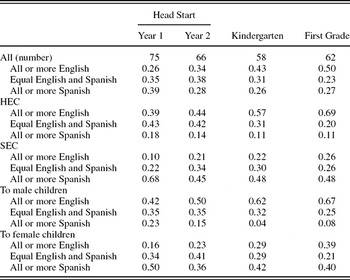
Descriptive statistics. Table 1 displays the proportion of mothers who reported speaking to their children using (a) more or all English, (b) equal amounts of English and Spanish, and (c) more or all Spanish. As shown, the number of participants decreased over the first 3 years of the project, with the number increasing slightly in the final year. This decrease was because of families moving out of the area over the 4-year period, which is common in longitudinal research.
Proportion of mother to child language over time

Note: HEC, home English communicators; SEC, school English communicators.
When examining the results for the entire sample, the percentage of mothers who reported using “more or all English” nearly doubled over the 4-year period. The percentage who reported using “equal amounts of English and Spanish” increased slightly in the second year and then declined over the next 2 years, and the percentage using “more or all Spanish” decreased over 10% by first grade.
MOTHERS’ LANGUAGE TO HEC AND SEC CHILDREN. Inspection of the results for mothers of the HEC children reveals that the percentage of mothers using “more or all English” increased 30% over the children's early education, to a total of 67% in first grade. The percentage who spoke “equal amounts of English and Spanish” to their children decreased by half, and the percentage of mothers speaking “more or all Spanish” decreased as well.
In comparison, few mothers of children in the SEC group spoke “more or all English” to their children during their children's first Head Start year. The percentage of mothers who used “more or all English” doubled in the children's second year and then increased slightly over the next 2 years. The percentage speaking “equal amounts of English and Spanish” increased by 10% in the second year and then decreased slightly over the next 2 years. It was not surprising that the vast majority of mothers of SEC children indicated that they spoke “more or all Spanish” during their children's first Head Start year. The percentage of mothers speaking Spanish to their children decreased by approximately one-third in the second year.
MOTHERS’ LANGUAGE TO MALE AND FEMALE CHILDREN. Mothers of males preferred to use “more or all English” when talking with their children throughout the 4 years. Less than 25% of the mothers used “more or all Spanish” when talking with their sons during the first year in Head Start and this percentage decreased to less than 10% in first grade.
With regard to mothers’ language usage with their daughters, the majority of mothers used “more or all Spanish” during the first year of Head Start; but over time, the percentage of mothers using Spanish diminished by 11%. It was not surprising that the percentage reporting “more or all English” increased over the 4 years.
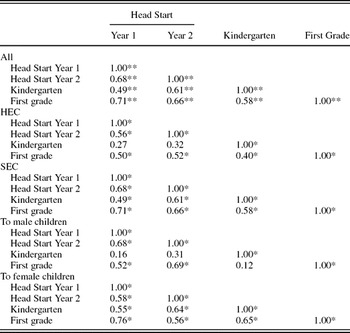
Correlational analyses. The Spearman correlations among the mothers’ responses of all of the mothers over time are shown in Table 2. All correlations were considered strong, positive, and different from zero (p ≤ .001).
Spearman correlations for mother to child language over time

Note: HEC, home English communicators; SEC, school English communicators.
*p ≤ .05. **p ≤ .001.
MOTHERS’ LANGUAGE USAGE BY BILINGUAL GROUP. The correlations among the HEC mothers’ responses are positive, but not as strong as for the entire sample. For example, the correlations between each year of Head Start kindergarten were not significant. The correlations among the responses of mothers of the SEC children were strong and positive over the 4 years. The range of the correlation estimates for mothers of the SEC children was r = .49 to .68, whereas those for the mothers of the HEC group ranged from r = .27 to .56.
MOTHERS’ LANGUAGE USAGE BY CHILDREN'S GENDER. With regard to the relationships among the mother to child language measures across time based on gender of the child, the correlations among mother to child language usage when the child was male ranged from r = .13 to .69. The correlations above r = .50 were significant (p < .05). Correlations among the mother to child language measures across time when the child was female ranged from r = .55 to r = .76. All were statistically significant (p < .05).
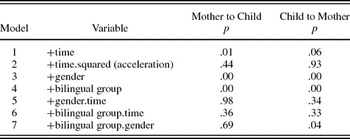
Regression analyses. To investigate the influence of time, acceleration, bilingual group (HEC/SEC), and child gender on mother to child language, a series of regression models were fit to the data to examine the effect of each of these covariates (see Table 3). The baseline model was an intercept only model. The results of the likelihood ratio tests comparing nested models revealed that that the best fitting regression model for these data was the one containing main effects for time, bilingual group, and gender. Models positing an acceleration term, or interactions among the main effects did not increase the model's explanatory power.
Regression models tested for mother to child and child to mother language

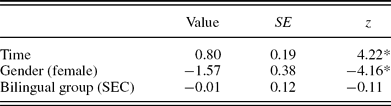
The results contained in Table 4 revealed that changes occurred in the language used by mothers to their children over time (β = 0.8, z = 4.22, p < .05). The associated odds ratio was 2.23:1, meaning that the odds of mothers speaking “more or all English” to their children were 2.23 times greater for each additional year in school. The children's gender also played a role in the language mothers used when talking to their children (βfemale = −1.57, z = −4.16, p < .05). The results indicated that the odds of mothers speaking “more or all English” to their female children during the first year of Head Start were 0.2 to 1. In other words, males were nearly five times (odds ratio = 4.8:1) more likely to have their mother speak “more or all English” to them compared to females. When controlling for child gender, the bilingual group had no discernable effect on changes in mother to child language (βSEC = −0.01, z = −0.11, p > .05).
Regression model for mother to child language
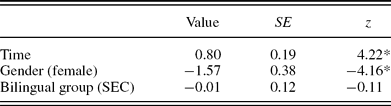
Note: The reference category for the bilingual group was home English communicators, and the reference category for gender was male. SEC, school English communicators.
*p ≤ .05.
Child to mother language usage
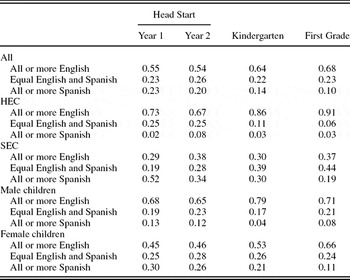
Descriptive statistics. Table 5 displays the proportion of children speaking “all or more Spanish,” “equal amounts of English and Spanish,” and “more or all English” to their mothers. The data showed that children used “more or all English” when talking with their mothers by almost a 2:1 margin in the first year of Head Start, and by first grade, nearly 70% of the children were using “more or all English” when talking to their mothers. The percentage of children who used “equal amounts of English and Spanish” remained stable over time, whereas the percentage of children using “more or all Spanish” declined from 23% to 10%.
Proportion of child to mother language over time

Note: HEC, home English communicators; SEC, school English communicators.
HEC AND SEC CHILDREN'S LANGUAGE USAGE TO THEIR MOTHERS. Table 5 also provides data on the HEC children's language use to their mothers. The vast majority of HEC children communicated with their mothers using “More or All English.” The percentage increased from 73% during the first year in Head Start to 91% in first grade. Approximately one-quarter of the children were reported to use “equal amounts of English and Spanish” during their first Head Start year, but the percentage declined over the 4 years to 6% in first grade. The percentage of children reported to use of “more or all Spanish” when talking with their mothers remained stable over time; however, the percentages were very small.
With regard to the SEC children, the percentage using “more or all English” was much lower compared to the HEC children. At the outset, approximately 30% of the SEC children were using “more or all English;” in first grade, the percentage had increased to 37%. The largest percentage of children spoke “more or all Spanish” during the first Head Start year (50%); however, this percentage decreased dramatically over the 4 years. The percentage of children reported to use “equal amounts of Spanish and English” was relatively small (19%) at the beginning of the study; however, the percentage increased greatly (44%) by first grade.
MALES AND FEMALES LANGUAGE USAGE TO THEIR MOTHERS. The language used by males when talking with their mothers is also provided in Table 5. During the first year of Head Start, approximately two-thirds of the boys used “more or all English.” The proportion of males using “more or all English” increased slightly to 71% in first grade. Approximately 20% of the males used “equal amounts of English and Spanish over the 4-year period. The proportion using “more or all Spanish” during the first Head Start year was small, and the proportion of males preferring to use “more or all Spanish” decreased from 13% to 8% over time.
With regard to the language usage of females, the proportion of females using “more or all English” when talking to their mothers is lower than the proportion of males during the first Head Start year. The proportion of females using “more or all English” increased over time and approached the proportion of males. In contrast, the proportion of females speaking in “more or all Spanish” to their mothers was larger than the proportion of males, nearly two times as large during the first year of Head Start. The proportion of females using “more or all Spanish” decreased over the 4 years, and became similar to the proportion of males in this category in first grade. The proportion of females using “equal amounts of English and Spanish” was slightly higher than that for males, and similar to males, the proportion remained relatively constant over time.
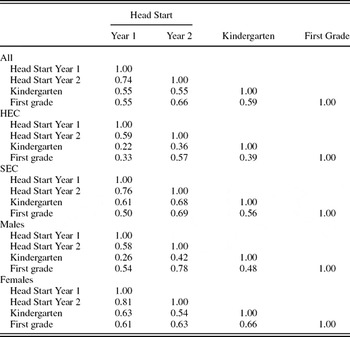
Correlational analyses. The relationships among reported child to mother language usage are shown in Table 6. All correlations for child to mother language were considered strong, positive, and statistically significant (p ≤ .001). The correlations ranged from r = .55 to .74.
Spearman correlations for child to mother language over time

Note: HEC, home English communicators; SEC, school English communicators.
CHILDREN'S LANGUAGE USAGE BY BILINGUAL GROUP. In terms of the two bilingual groups, the correlations among the responses for the HEC children ranged from r = .22 to .59. With the exception of correlations between the first Head Start Year and kindergarten and the first Head Start year and first grade, all the correlations for the HEC children were significant and positive. All of the correlations were for the SEC children were significant and positive as well. Correlations ranged from r = .50 to .76, indicating a stronger relationship among the responses compared to the HEC children.
CHILDREN'S LANGUAGE USAGE BY GENDER. The information in Table 6 also includes the correlations among child to mother language by child gender. The correlations for the males and females ranged from r = .26 to .78 and r = .54 to .81, respectively. All but one of the correlations were positive and significant. The correlation that was not significant was the relationship between language usage during the first and second Head Start years for males.
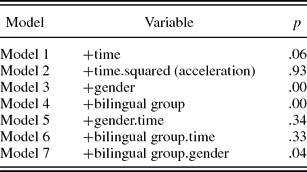
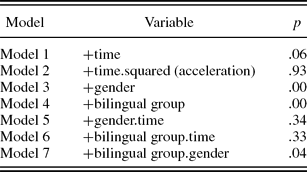
Regression analyses. Similar to the analyses of mother to child language, a model was created to examine the effects of time, bilingual group and gender on child to mother language using a three-part procedure. First, the best fitting regression model was identified. As with the mother to child language models, the baseline model was the intercept only model. As indicated in Table 7, the best-fitting regression model was the one containing main effects for time, bilingual group, gender, and an interaction term for bilingual group with gender. Models positing an acceleration term or other interactions among the main effects did not increase the model's explanatory power.
Regression models tested for child to mother language
Regression model for child to mother language
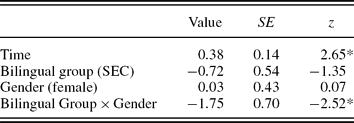
Note: The reference category for the bilingual group was home English communicators, and the reference category for gender was male. SEC, school English communicators.
*p ≤ .05.
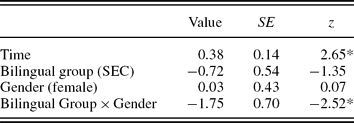
The results revealed that the odds of children speaking “more or all English” increased 1.5 times per each additional measurement occasion. However, an interaction between bilingual group and gender occurred, with the effect of SEC females being significant and negative (β = −1.75, z = −2.52, p < .05). The odds of a female in the SEC group using “more or all “English” was 0.17:1. In other words, a SEC female was nearly six times less likely to speak “more or all English” to her mother compared to other children.
DISCUSSION
Past research has focused on changes in the language usage, a measure of acculturation, between generations of immigrants and in the languages used by adults and older school-age children. Relatively little research has investigated the language usage of mothers and their preschool children. The purpose of this longitudinal study was to investigate whether language change occurred early in children's development and whether the children's gender and/or the timing of exposure to English at school entry affected the change in languages used by mothers and their children.
Changes in language usage from Head Start to first grade
As hypothesized, the results revealed that mothers and children in both the HEC and SEC groups used increasingly more English over a 4-year period, from the children's first year in Head Start to first grade. In fact, mothers were more than two times more likely to speak “more or all English” to their children with each year that their children attended school. Similarly, children were one and one half times as more likely to use “more or all English” when talking to their mothers with each passing year. Although children's rate of change was smaller than that of their mothers, children used more English when talking to their mothers at the beginning of the study.
This relatively rapid change to English is consistent with prior work on acculturation and language change in adults (cf. Hakuta, Reference Hakuta, Lamberty and Garcia1994; Portes & Hao, Reference Portes and Hao1998; Veltman, Reference Veltman1981; Reference Veltman1988). These results, however, add to the knowledge base by demonstrating how early language change between mothers and their children happens in children's lives. It appears that living in an English-speaking country and attending preschool programs in which English was the primary language of instruction impacted children's maintenance of their native language over time. Like their mothers, preschool children acculturated to the dominant culture as evidenced by their decreased usage of Spanish and increased usage of English as they grew older and progressed through the school system.
The effect of gender on language usage
The findings also confirmed the hypothesis that the children's gender affects language usage of mothers to their children, with mothers being more likely to speak to their daughters using “more or all Spanish” than to sons. This result was anticipated, because of the gender differences in parenting practices of Puerto Rican families that have been documented in the literature (De Von Figueroa et al., Reference De Von Figueroa-Moseley, Ramey, Keltner and Lanzi2006; Flannagan et al., Reference Flannagan, Baker-Ward and Graham1995; Gonzalez et al., Reference Gonzalez, Umana-Taylor and Bamaca2006; McHale et al., Reference McHale, Updegraff, Shanahan, Crouter and Killoren2005; Portes & Rumbaut, Reference Portes and Rumbaut2001; Portes & Schauffler, Reference Portes and Schauffler1994; Sanchez-Ayendez, Reference Sanchez-Ayendez, Mindel, Habenstain and Wright1998; Zentella, Reference Zentella1997). The magnitude of the gender difference, however, was not expected. Recall that mothers were five times more likely to use Spanish with daughters than sons. This investigation demonstrates how early these differential socialization practices occur, and how powerful the effect of gender is on the choice of languages used between mothers and daughters and between mothers and sons. This study also provides evidence that mothers employed different acculturation styles when interacting with their daughters and sons. It may be that mothers perceived their daughters, who are future mothers, as the conveyors of language and culture and therefore, spoke Spanish to them. As a result, mothers were assisting their daughters maintain their home language while their daughters acquired English at school.
In contrast, mothers may speak more English to their sons to assist them in fulfilling their traditional gender role expectation of working outside the home. Boys may be thought of as future fathers who need to work to provide for their families as adults. This requires boys to have competency in English as they will most likely be employed in English-speaking environments. Therefore, mothers may have adjusted the languages used with their children in anticipation of their children's future roles. These results provide support for the bidimensionality model of acculturation; that is, core values from the home culture are being preserved while other features are simultaneously being modified (Liebkind, Reference Liebkind, Brown and Gaertner2001; Ryder et al., Reference Ryder, Alden and Paulhaus2000).
The gender differences in mother to child language that were observed at the beginning of the study continued over the 4 years. Given that mothers increased their use of English, it is likely that these trajectories may come together at some point in the future. Further investigation is needed to determine if this hypothesis is correct.
The prediction that gender impacts the language usage of children to their mothers was partially supported, as an interaction between gender and bilingual group occurred. Females who did not communicate in English until school entry (SEC) were six times more likely than females from bilingual homes (HEC) and males in both groups to use “more or all Spanish” when speaking to their mothers. Given that mothers in the SEC group began the study using more Spanish than mothers in the HEC group and that mothers used more Spanish when talking to their daughters than sons, it may be that females in the SEC group received a stronger message from their mothers about the importance of using Spanish than the remaining children. Females in the SEC group responded accordingly by speaking more Spanish to their mothers. As a result, SEC females were maintaining their home language, culture, and identity (Portes & Schauffler, Reference Portes and Schauffler1994; Zentella, Reference Zentella1997). Thus, it appears that the children exhibited different styles of acculturation. SEC females were simultaneously maintaining their home language to assist them in their roles as conveyors of language and culture while acquiring English at school. The other children, however, moved more quickly to using English at home and at school.
The effect of the timing of exposure to English in relation to school entry
The results did not confirm the hypothesis that the timing of exposure to English in relation to school entry affects language usage over time. Although the two groups of mothers and children differed in their language usage at the beginning of the study, with mothers and children in the HEC group using more English than mothers and children of the SEC group, this difference did not explain changes in language usage over time. In other words, knowing what languages the children had been exposed to at the time of school entry provided valuable information about the language usage of mothers and children at that time. That knowledge, however, did not provide information about how language usage would change. In retrospect, the result for the mothers should not be surprising given that the mothers did not experience a major change in their language environment when their children entered school. Although some mothers may have needed to communicate with their children's teachers in English, such interactions entailed a very small portion of the mothers’ daily communicative interactions. In addition, teachers and/or assistants who spoke Spanish often would speak Spanish to the mothers even though English was the language of instruction. As a result, the children's timing of exposure to English had no impact on language change of the mother over time.
Similarly, the change in the language environment for children was expected to have a significant and differential effect on the two groups’ language usage. The results, however, did not support this hypothesis. Similar to the mothers, the language usage of the two groups of children differed when they began Head Start; however, the timing of exposure to English did not predict children's language usage after entered Head Start. It may be that attendance in Head Start programs, which provided instruction primarily in English, had a strong equalizing effect on children's language usage. Research has shown the power the majority language has over the minority language in educational settings (Eilers et al., Reference Eilers, Oller, Cobo-Lewis, Oller and Eilers2002; Hickey, Reference Hickey2007; Paradis & Nicoladis, Reference Paradis and Nicoladis2007).
Limitations and recommendations for future research
The limitations of this study include attrition of participants and use of data reported by the participants. With regard to attrition, approximately 20% of families could not be located as time progressed, despite our best efforts to maintain contact with all of the families in the investigation. Unfortunately, attrition is very common in longitudinal studies of families with low incomes where families are not receiving direct benefits from their participation.
Similar to past studies on language usage (cf. De Houwer, Reference De Houwer2007; Portes & Rumbaut, Reference Portes and Rumbaut2001; Veltman, Reference Veltman1988), the data were based on participant report rather than direct observations of changes in language usage. An observational study with a sufficient number of participants for statistical power would be ideal; however, the cost of such a study was beyond the scope of this project.
In addition, we did not measure acculturation directly. We instead investigated one aspect of acculturation, language usage, as it relates to interactions between mothers and their children. Inclusion of an acculturation measure would enable researchers to identify the stage of acculturation the mothers are in and provide additional information on mothers’ maintenance of the Latino culture and integration of the dominant culture.
In addition to adding a formal measure of acculturation, it is recommended that future research examine language change and changes in acculturation that young children and their mothers experience as children are introduced to contexts outside the home. Currently, considerable research has been devoted to the understanding of acculturation of immigrant adults and school-age children. Fewer studies have considered the changes young children experience as they acculturate to the dominant culture. In particular, studies are needed that consider the characteristics of the families and the communities in which children and their mothers are living, including levels of acculturation and the percentage of Spanish-speaking individuals in the larger area. Such studies would help identify factors that impact language change and acculturation in families. In addition, future studies could identify the features of the home culture that are maintained by mothers and their children and those features that are simultaneously modified through children's participation in the US educational context.
In addition, observational investigations could be embedded within larger studies so that qualitative data could be gathered and used to interpret the data. For example, in addition to observing mother to child language, semistructured interviews could be conducted with the mothers about their child rearing practices to further understand the role of gender in children's language socialization. Subsequent studies are also needed to that investigate mothers’ language usage and change earlier in children's lives and that examine change further into children's educational careers. Given that the mothers who participated in this investigation used more and more English over time, it is likely that differences in mother to daughter and mother to son language usage will disappear at a later point in time.
Implications
As discussed previously, acculturation begins when two cultures interact. Such interactions may result in the preservation of one's own culture and simultaneous adaptation of dominant culture, with language usage being an important indicator of acculturation. Previous work in this area has focused primarily on the experiences of adolescents and adults. As a result, educators and practitioners typically do not consider the acculturation process that mothers and their preschoolers undergo as the children enter preschool and progress through the educational system.
The findings of this study demonstrate that educators need to be aware of this process. Research has consistently shown that Latina mothers value their children's education and have high expectations for their children's academic achievement (Reese, Balzano, Gallimore, & Goldenberg, Reference Reese, Balzano, Gallimore and Goldenberg1994; Relaño Pastor, Reference Relaño Pastor and Zentella2005; Valdés, Reference Valdés1996). They also integrate practices that support their children's academic outcomes while teaching their children the values of the Latino culture (Hammer, Rodríguez, Lawrence & Miccio, Reference Hammer, Rodríguez, Lawrence and Miccio2007; Reese et al., Reference Reese, Balzano, Gallimore and Goldenberg1994). As part of these efforts, mothers recognize that knowledge of English is important for both their children and for them. For example, mothers know that English is typically needed in order to communicate with their children's teachers, principals, and other school personnel as well as to access information about the educational system that exists within English social networks (Relaño Pastor, Reference Relaño Pastor and Zentella2005). However, as mothers learn and use English, they also may try to preserve their native language. Mothers want their children to have a good education while also having a strong grounding in the Latino culture. Educators can support mothers by being aware of their efforts to learn English, the challenges of learning a new language, and their efforts to maintain their home language and culture. Educators’ support of mothers’ decisions around language usage will build mothers’ feelings of being welcomed and accepted in their children's schools (Relaño Pastor, Reference Relaño Pastor and Zentella2005). As stated by Relaño Pastor (Reference Relaño Pastor and Zentella2005), “knowledge and validation of Latina mothers’ experiences . . . can build bridges of understanding between teachers and Latino parents” (p. 161).
In addition, educators need to be cognizant of the fact that young children are developing beliefs, values, and behaviors that are based on both their heritage culture and the dominant culture of the United States. In addition, they need to be aware that their preschool classrooms may be the children's first experience being immersed in the dominant culture on a regular basis (Gay, Reference Gay2000). In other words, it is during this preschool period that children will begin to integrate characteristics of the dominant culture while maintaining features of their heritage culture (Liebkind, Reference Liebkind, Brown and Gaertner2001; Ryder et al., Reference Ryder, Alden and Paulhaus2000). Of course, language is a key component of culture (Arcia et al., Reference Arcia, Skinner and Bailey2001), and as a result, children are faced with the opportunity to learn two languages: their heritage language, which is a minority language, and English, the dominant language of the United States.
Therefore, educators need to keep in mind the fact that children come to preschool having received messages about their culture and language from their mothers at home. As demonstrated by this study, the messages children receive may differ based on their gender. In particular, mothers appear to be giving the message to their daughters that Spanish is a language through which communication occurs. When at school, children are immersed in the dominant culture and language and are given the message that English is the primary language of communication. Children integrate these to messages when communicating with others. This study demonstrates that many children choose to use increasingly more English with their mothers over time. Females from homes that were Spanish-speaking prior to Head Start entry, however, appear to prefer the maintenance of Spanish in the home when communicating with their mothers. Thus, children are differentially maintaining their heritage culture and incorporating aspects of the dominant culture.
Consequently, educators need to learn about children's cultural and language experiences at home. Many times teachers do not inquire about children's home experiences and their usage of their heritage language. It is critical that teachers obtain such information so that the values of the home can be supported as children experience the dominant culture in school. More specifically, educators need to assist children transition into the dominant culture. They can do this by recognizing the bidimensionality of acculturation and incorporating features of children's heritage language and culture into the classrooms while simultaneously introducing children to features of the dominant culture. Educators can build on the language and cultural knowledge that children possess when they enter school. Such knowledge can be used as a foundation from which children can acquire the requisite skills targeted in preschool and beyond (Gay, Reference Gay2000).
In addition, by building on children's heritage language abilities, children's opportunities to become fluent bilinguals may be enhanced. Although some argue that fluency in English is all that is needed to be successful in the United States, research has consistently documented the cognitive, academic, and social benefits of bilingualism. For example, bilingual children with proficiency in two languages experience cognitive and language benefits such as increased sensitivity to semantic relationships, higher phonological awareness (Bialystok, Reference Bialystok1986, Reference Bialystok1988, Reference Bialystok1992, Reference Bialystok1997), improved awareness of linguistic rules and structures, enhanced creativity, higher academic outcomes (Hakuta & Diaz, Reference Hakuta, Diaz and Nelson1985), and higher educational aspirations. In addition, bilingual children achieve better social–emotional outcomes as demonstrated by higher self-esteem, lower rates of depression, and better relationships with their parents (Portes & Rumbaut, Reference Portes and Rumbaut2001). Efforts to build on and support usage of the families’ home languages may promote maintenance of the children's home language and ultimately children's chances of becoming bilingual.
ACKNOWLEDGMENTS
This study was supported by a grant from the NIH NICHD and the United States Department of Education, Institute of Education Sciences (1-R01-HD-39496-05). The authors thank the parents and children who participated in the investigation and the staff of the Head Start programs and kindergartens for their support and assistance with the project.