Introduction
Carbohydrates are the major source of dietary energy for growing pigs. Extensive studies have shown that the digestibility of dietary carbohydrates in swine is largely affected by their source, structure and composition as well as by the activities of digestive enzymes (Cone and Vlot, Reference Cone and Vlot1990; Franco et al., Reference Franco, Preto and Ciacco1992; Leclere et al., Reference Leclere, Lairon, Champ and Cherbut1993; Weurding et al., Reference Weurding, Veklman, Veen, van der Aar and Verstegen2001). Much evidence also showed that the rate of glucose absorption was tested from the portal vein of pigs (Rerat, Reference Rerat1985; Vaugelade et al., Reference Vaugelade, Posho, Darcy-Vrillon, Bernard, Morel and Duee1994; van der Meulen et al., Reference van der Meulen, Bakker, Smiths and Devisser1997).
The portal-drained viscera (PDV; the intestine, pancreas, spleen and stomach) contributes approximately 35% of whole-body energy expenditure and protein synthesis, even though it represents <6% of body weight (BW) (Cant et al., Reference Cant, McBride and Croom1996; Burrin et al., Reference Burrin, Stoll, van Groundcover and Reeds2000). Research over the past 15 years has established that the small intestine of pigs also plays an important role in the metabolism of both essential and non-essential amino acids (Stoll et al., Reference Stoll, Burrin, Yu, Henry, Jahoor and Reeds1998; Burrin et al., Reference Burrin, Stoll, van Groundcover and Reeds2000; Wu et al., Reference Wu, Knabe and Flynn2005). van der Meulen et al. (Reference van der Meulen, Bakker, Smiths and Devisser1997) showed an effect of source of starch (maize v. peas) on amino acid appearance in portal blood. At present, little is known about the effect of various sources of dietary starch, particularly rice starch, on the metabolism of amino acids in the PDV or their appearance in the portal circulation of pigs. Therefore, the objective of this study was to determine the net portal appearance of amino acids and glucose in growing pigs fed diets containing resistant starch (RS), maize, brown rice and sticky rice, respectively.
Material and methods
Animals
The study was approved by the Laboratory Animal Care Advisory Committee at Institute of Subtropical Agriculture, the Chinese Academy of Sciences. Four male pigs (Duroc × Landrace × Yorkshine), with an average initial BW of 22.5 ± 1.1 kg (mean ± SEM), were housed individually in stainless-steel metabolism crates in a temperature-controlled room (23°C to 25°C). Pigs were trained to consume within a 30-min period a meal of daily diet. After a 2-week adjusting period, pigs were fasted for 24 h and surgically fitted with chronic catheters in the portal vein, ileal vein and carotid artery, as described by Yen and Killefer (Reference Yen and Killefer1987) with some modification (Huang et al., Reference Huang, Yin, Li, Gao and Tao2003). Briefly, a 2-cm stainless-steel tube (2.41 mm O.D. × 1.68 mm I.D.), which was made using adapter luerstus-15 g (VWR International Ltd, Mississauga, ON, Canada), was inserted into the top tip of a portal-vein catheter (Micro-Renathane tubing, 2.41 mm O.D. × 1.68 mm I.D.; Braintree Scientific Inc., NY, USA). The portal vein was punctured with a No. 12 needle, and then the portal-vein catheter was inserted, using an introducer, into the portal vein, 4 to 6 cm toward the liver. A catheter (Micro-Renathane tubing, 2.41 mm O.D. × 1.68 mm I.D.) was inserted into the carotid artery and toward the aorta for approximately 12 cm. Finally, a catheter (1.17 mm O.D. × 0.76 mm I.D., RenaPulse Tubing; Braintree Scientific Inc.) was inserted into the ileal vein for about 9 cm. After the surgery, pigs were returned to their metabolic crates for recovery. An antibiotic (penicillin) was administered intravenously to the animal during the first 5 days of the recovery period. The catheters were checked for potency by flushing and filling with heparinized saline solution daily during the 13-day recovery period.
Dietary treatments
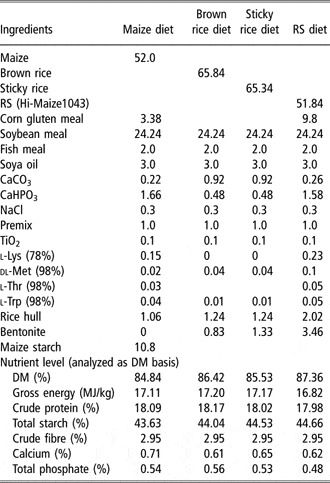
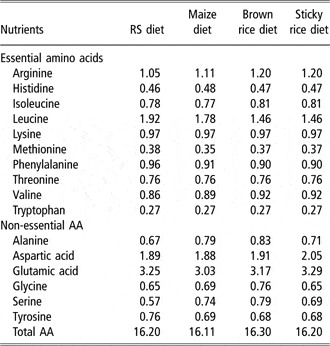
Four diets were formulated with maize (52.0%), brown rice (65.8%), sticky rice (65.3%) and RS (51.8%) as the major source of carbohydrate (Table 1). And their crude protein (CP) contents were 8.50%, 9.86%, 9.68% and 0.81%, respectively. All diets contained the same levels of carbohydrates (Table 1) as well as lysine (0.97% as dry matter (DM) basis), methionine + cysteine (0.66% as DM basis), threonine (0.76% as DM basis) and tryptophan (0.27% as DM basis) (Table 2), and they met or exceeded NRC-recommended nutrient requirements for 20 to 50 kg growing pigs (NRC, 1998). In order to keep the same levels of CP (Table 1) in all diets, the corn gluten meal was added to maize diet (3.38%) and RS diet (9.8%), maize starch was added to maize diet (10.8%). Similarly, bentonite was also used as a filler to balance total starch levels across treatments and it was added to brown rice diet (0.83%), sticky rice diet (1.33%) and RS diet (3.46%). Pigs were fed three times daily (0730, 1530 and 2330 h).
Ingredients and nutrient level of experiment diets (% as fed bases)

RS = resistant starch; DM = dry matter.
Note: Premix supply per kg of diet: Vitamin A, 4000 IU; Vitamin D3, 400 IU; Vitamin E, 16 IU; Vitamin K, 1 mg; choline, 200 mg; pantothenic, 6 mg; Vitamin B2, 2 mg; folic acid, 0.8 mg; niacin, 10 mg; Vitamin B1, 0.6 mg; Vitamin B6, 0.6 mg; biotin, 0.08 mg; Vitamin B12, 0.01 mg; Cu (as copper sulfate), 15 mg; Fe (as ferrous sulfate), 100 mg; Zn (as zinc oxide), 100 mg; Mn (as manganese sulfate), 20 mg; I (as calcium iodate), 0.3 mg; and Se (as sodium selenite), 0.3 mg.
Amino acid composition of experiment diets (% as DM basis, analyzed value)

DM = dry matter; AA = amino acids; RS = resistant starch.
After a 13-day period of recovery from the surgery, pigs were assigned randomly to dietary treatments in a 4 × 4 Latin square experimental design, which involved four diets and four periods. Each period consisted of a 6-day adaptation period and a 1-day collection period. Blood samples were taken simultaneously from the portal vein and carotid artery immediately before feeding (0730 h), and at 1, 2, 3, 4, 5, 6, 7 and 8 h after feeding. During a sample collection period, the pigs were still fed three times daily, but only following the morning feeding (0730 to 1530 h) blood samples were taken for analysis.
Measurements of portal blood flow and nutrient flux
The pigs were weighed and the feed intakes were noted (keeping 300 g/meal per pig) on the day of sampling in each period. Portal blood flow was measured using p-aminohippuric acid (PAH; Sigma, St Louis, MO, USA), as described by Yen and Killefer (Reference Yen and Killefer1987). Briefly, a concentrated PAH solution was prepared with sterile physiological saline solution (9 g NaCl/l) and the pH was adjusted to 7.4 with NaOH, followed by filtration through a 0.2 μm filter. A priming dose of PAH was first administered at 0700 h into the ileal vein catheter at a rate of 3.82 ml/min for 5 min, and then followed by constant infusion (0.2 mg PAH/kg BW per min) at a rate of 1 ml/min for 8 h. Blood samples were collected from the portal vein (3 ml) and carotid artery (6 ml) at 0730 h (before feeding) and hourly thereafter during the 8 h post-feeding period. Immediately after sampling, blood samples were analyzed for packed cell volume, partial pressure of oxygen (pO2) and hematocrit (Huang et al., Reference Huang, Yin, Li, Gao and Tao2003). An aliquot of blood samples was centrifuged at 2500 × g at 4°C for 15 min to obtain plasma. Plasma was stored at −80°C and analyzed for PAH within 12 h after collection, as described by Harvey and Brothers (Reference Harvey and Brothers1962). Amino acids and glucose in plasma were determined using anion-exchange chromatography and an enzymatic method, respectively (Yin et al., Reference Yin, Huang, Zhong, Li, Souffrant and de Lange2002; Huang et al., Reference Huang, Yin, Li, Gao and Tao2003). The net portal appearance of amino acids and glucose was calculated on the basis of their concentrations in plasma, which were unique values for blood flow used for each 1 h period.
Chemical analyses of diets
Dietary dry matter (DM), CP (N × 6.25), crude fibre (CF), calcium (Ca), total phosphorus (TP) and gross energy (GE) contents were determined according to AOAC procedures (AOAC, 1990). Dietary total starch (TS) and free glucose analyses were conducted, as described by Englyst and Hudson (Reference Englyst and Hudson1996). Amino acid composition in diets was determined, as described by Llames and Fontaine (Reference Llames and Fontaine1994).
Statistical analysis
Data were analyzed by ANOVA for a 4 × 4 Latin square design, as described by Steel and Torrie (Reference Steel and Torrie1980). The treatment effect was partitioned and tested according to equally spaced orthogonal polynomial analyses. The ANOVA and the orthogonal polynomial analyses were carried out using the General Linear Procedures of SAS (SAS Institute Inc., Cary, NC, USA). Differences among treatment means were determined by the Tukey multiple comparison test.
Results
Portal vein blood flow (PVBF) rate and oxygen consumption rate
For four pigs in each period, all blood samplings were successful and all pigs readily consumed their feed allowances on sampling days.
Rates of PVBF were similar (P > 0.05) among pigs fed the RS, maize, sticky rice and brown rice diets (Table 3). The values were approximately 30 ml/kg BW per min. Rates of oxygen consumption did not differ (P > 0.05) among pigs fed the maize, sticky rice and brown rice diets (130 to 150 ml/kg BW per 100 g feed intake), which were approximately 35% lower (P < 0.05) than that for pigs fed the RS diet (218 ml/kg BW per 100 g feed intake (Table 3).
Average portal vein blood flow rate and total oxygen consumption in growing pigs during 8 h after feeding

FI = feed intake; RS = resistant starch.
Mean values with different superscript letters in the same row are different (P < 0.05).
Net portal appearance of amino acids after feeding
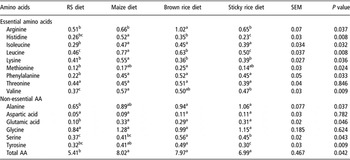
Table 4 summarizes the data on the net cumulative appearance of amino acids into the portal vein of growing pigs up to 8 h after feeding. The net cumulative appearance of several amino acids (Asp, Glu, Gly, Thr, Ala, Met, Ile and Phe) or total amino acids did not differ (P > 0.05) among pigs fed the maize, sticky rice and brown rice diets. The net cumulative appearance of Glu, Val and Phe as well as total amino acids was lower (P < 0.05) in pigs fed the RS diet than in pigs in the other three treatment groups. Notably, the net cumulative appearance of Ser and Arg was higher (P < 0.05) in pigs fed the brown rice diet than in pigs fed the RS, maize and sticky rice diets. In all groups of pigs, the net cumulative appearance of Asp and Gly was the lowest and highest, respectively, among the measured amino acids.
Net cumulative appearence of amino acids into the portal vein up to 8 h after feeding (g/100 g feed intake)

AA = amino acids; RS = resistant starch.
Mean values with different superscript letters in the same row are different (P < 0.05).
Proportions of amino acids appearing in the portal vein after feeding
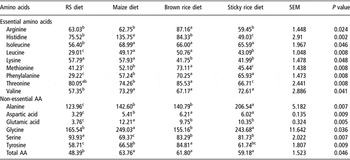
Table 5 summarizes the data on the proportions of amino acids appearing, expressed as proportions of the ingested amino acids, in the portal vein of growing pigs up to 8 h after feeding. The proportions of total amino acids entering the portal vein were similar (P > 0.05) among pigs fed the maize, sticky rice and brown rice diets, which were higher (P < 0.05) than the values for pigs fed the RS diet. However, there were marked differences in individual amino acids among the treatment groups. The proportions of Ser appearing in the portal vein were higher (P < 0.05), but the proportions of acidic amino acids (Asp and Glu) and branched-chain amino acids (Ile, Leu, and Val) were markedly lower (P < 0.05), in pigs fed the RS diet when compared with pigs fed the other three diets. The proportions of amino acids Glu, His and Gly entering the portal vein were the highest (P < 0.05) and that of Ser was the lowest in pigs fed the maize diet among the four treatment groups. Interestingly, the proportion of histidine entering the portal vein was lowest (P < 0.05) in pigs fed the sticky rice diet, while the value was highest for pigs fed the maize diet. In contrast, the PDV of pigs fed the sticky rice diet released more Ala and less Thr than any other group of pigs (P < 0.05). The proportions of Arg, Tyr and Met appearing in the portal vein were higher (P < 0.05) in pigs fed the brown rice diet than in pigs fed the RS, maize and sticky rice diets. In all groups of pigs, the proportions of Asp and Glu appearing in the portal vein were the lowest (<13%) among all amino acids (P < 0.05), whereas the proportion of Ala and Gly were greater than 100%. Except for pigs fed the maize and brown rice diets, approximately 40% to 70% of essential amino acids entered the portal vein in growing pigs, depending on dietary sources of carbohydrates. Approximately 48.39%, 63.76%, 61.80% and 59.18% of total amino acids appeared in the portal circulation of pigs fed the RS, maize, sticky rice and brown rice diets, respectively (Table 5).
Proportion of ingested amino acids entering the portal vein up to 8 h after feeding (%)

AA = amino acids; RS = resistant starch.
Mean values with different superscript letters in the same row are different (P < 0.05).
Net glucose appearing in the portal vein
Table 6 summarizes data on net cumulative glucose appearance into the portal vein of growing pigs. Cumulative glucose appearance in portal blood during the first 2 h after feeding was lower (P < 0.05) in pigs fed the RS diet than in pigs fed the sticky rice or brown rice diet. At 4 to 8 h after feeding, the amount of dietary starch that entered the portal circulation as cumulative glucose was lower (P < 0.05) in pigs fed the RS diet than in any other group of pigs. At all time points of measurement, the amount of glucose appearing in the portal vein did not differ (P > 0.05) among pigs fed the maize, sticky rice and brown rice diets. It accounted for 61.3% of cumulative glucose appearance during the first 4 h after feeding, and 60.4% during 8 h after feeding for pigs fed the sticky rice and brown rice diets, respectively, whereas the corresponding values were 50.8% and 54.3% for pigs fed the RS and maize diets, respectively. Up to 8 h after feeding, the amounts of cumulative glucose appeared in the portal vein, expressed as proportions of the total dietary glucose equivalent were 48.1%, 64.6%, 57.9% and 63.1%, respectively, in pigs fed the RS, maize, brown rice and sticky rice diets. These values among pigs fed the maize, brown rice and sticky rice diets were similar (P > 0.05), but were higher (P < 0.05) than that in pigs fed the RS diet.
Net cumulative appearance of glucose into the portal vein up to 8 h after feeding (g/100 g feed intake)

RS = resistant starch.
Mean values with different superscript letters in the same row are different (P < 0.05).
*The amount of glucose appeared into the portal vein, expressed as proportions of the total dietary glucose.
Discussion
Emerging evidence shows that the small intestine, a highly differentiated and complex organ, is not only responsible for the terminal digestion and absorption of protein but also plays an important role in amino acid metabolism (Stoll et al., Reference Stoll, Burrin, Yu, Henry, Jahoor and Reeds1998; Wu, Reference Wu1998; Shoveller et al., Reference Shoveller, Stoll, Ball and Burrin2005). Almost all of glutamate and aspartate in the diet are catabolized by the small intestinal mucosa in the first pass (Burrin et al., Reference Burrin, Stoll, van Groundcover and Reeds2000). The small intestinal mucosa also degrades enteral Gln, Arg, Pro, branched-chain amino acids (BCAA) and Lys, and perhaps enteral Met, Phe, Thr, Gly and Ser, such that 30% to 50% of these dietary amino acids do not enter the portal circulation (Stoll et al., Reference Stoll, Burrin, Yu, Henry, Jahoor and Reeds1998; Wu, Reference Wu1998; Shoveller et al., Reference Shoveller, Stoll, Ball and Burrin2005). Because dietary amino acids are major fuels for the small intestinal mucosa, and are essential precursors for the intestinal synthesis of proteins, glutathione, polyamines, nitric oxide, purine and pyrimidine nucleotides, intestinal amino acid metabolism is obligatory for maintaining intestinal mucosal mass, function and integrity (Wu et al., Reference Wu, Knabe and Flynn2005). However, the extensive catabolism of enteral amino acids by the small intestine substantially reduces their availability to extraintestinal tissues and selectively alters the patterns of amino acids that enter the systemic circulation (Wu, Reference Wu1998; Burrin et al., Reference Burrin, Stoll, van Groundcover and Reeds2000). This has important practical implications for the utilization efficiency and recommended requirements of dietary protein and amino acids by pigs.
Although much attention has been directed towards defining the effect of dietary factors on glucose absorption into the portal vein of growing pigs (Rerat et al., Reference Rerat, Vaissade and Vaugelade1984; Leclere et al., Reference Leclere, Lairon, Champ and Cherbut1993; van der Meulen et al., Reference van der Meulen, Bakker, Smiths and Devisser1997), little is known about the effect of various sources of dietary starch on intestinal amino acid metabolism. One study reported that the absorption of several amino acids into the portal vein differed between pigs fed the maize and pea starch (van der Meulen et al., Reference van der Meulen, Bakker, Smiths and Devisser1997). The present study is the first to determine the effect of rice starch on the entry of dietary amino acids and glucose into the portal vein of pigs. Our results indicate that starch from the RS diet reduced the net absorption of dietary glucose (Table 6) and total amino acids (Table 4) into the portal vein, when compared with pigs fed the maize, brown rice and sticky rice diets in the same levels of total starch and CP (Table 1). The reason for the different rates of glucose absorption in pigs fed different sources of dietary starch may be related primarily to the hydrolysis of starch in the digestive tract, because starch hydrolysis is the rate-limiting factor for the appearance of glucose in the portal vein (Rerat et al., Reference Rerat, Vaissade and Vaugelade1984; Cummings and Englyst, Reference Cummings and Englyst1995). The net appearance of total amino acids appears to be closely related to that of dietary glucose in growing pigs. There are two possible explanations. First, RS reduced the digestion of dietary protein and the absorption of the resultant amino acids or small peptides. Second, RS increased the catabolism of amino acids by the small intestine. We favor the second explanation on the basis of our finding that oxygen consumption by the PDV was increased in pigs fed the RS diet compared with pigs fed the maize, brown rice and sticky rice diets (Table 3). The underlying mechanisms are not known, but may involve the generation of RS’s microbial fermentation products in the large intestine that serve as signaling or regulatory molecules in intestinal amino acid metabolism. So the mechanisms would be studied on intestinal microbial population and activity for RS-fed pigs in the future.
Each amino acid has its distinct metabolic pathway(s) in the small intestine (Wu et al., Reference Wu, Knabe and Flynn2005). Consistent with this view, dietary starch sources differentially affected the appearance of dietary amino acids in the portal vein of growing pigs (Table 4). Asp/Asn and Glu/Gln were the most abundant amino acids in the diets (Table 2), but only small amounts appeared in the portal vein (Table 4) because of their extensive oxidation by the small-intestinal epithelial cells (Wu, Reference Wu1998). Similarly, although Leu and Phe were the most abundant essential amino acids in diets (Table 2), their appearance in the portal vein of pigs fed the RS diet was among the least ones. Thus, in these pigs, only <30% of the dietary Phe and Leu entered the portal vein (Table 5), indicating that most of these two essential amino acids were either catabolized by the PDV or utilized for the synthesis of proteins rich in Phe and Leu. The ratios of Leu : Val : Ile (1.92% : 0.86% : 0.78% as DM basis) in RS diet were 1 : 0.448 : 0.406 (Table 2), but the corresponding values, Leu (0.46 g per 100 g feed intake), Val (0.37 g per 100 g feed intake) and Ile ( 0.29 g per 100 g feed intake ), in the portal vein of pigs fed the RS diet were 1 : 0.804 : 0.630 (Table 4), suggesting that among BCAA, the rate of Leu utilization in the PDV was the highest, followed by Ile and Val in the descending order. This suggestion is consistent with the rates of their oxidation in pig enterocytes (Chen et al., 2006). Similarly, only 40% to 50% of Thr and Lys entered the portal vein of pigs (Table 5). Extensive catabolism of essential amino acids would be expected to reduce the efficiency of utilization of dietary protein for tissue growth and metabolic functions in pigs fed the RS diet.
In keeping with its important role in nutrition and metabolism (Wu and Morris, Reference Wu and Morris1998), arginine was the fourth most abundant amino acid in diet (Table 2). However, except for pigs fed the brown rice diet, approximately 60% of Arg entered the portal circulation (Table 5). Thus, 40% of Arg was catabolized by the PDV of growing pigs, as reported for humans and rats (Wu, Reference Wu1998). Our previous studies have shown that enterocytes are the major site for Arg degradation via arginase in the small intestine of post-weaning pigs (Wu et al., Reference Wu, Knabe, Flynn, Yan and Flynn1996). Interestingly, in pigs fed the brown rice diet, only 13% of Arg was catabolized by the PDV (Table 5), suggesting reduced catabolism of Arg. These results suggest that intestinal Arg metabolism can be regulated by dietary factors and that brown rice may beneficially increase the availability of Arg in the blood circulation for metabolic utilization.
In general, the starch from sticky rice, brown rice and maize may be almost entirely digested in growing pigs. However, consistent with previous studies (Rerat et al., Reference Rerat, Vaissade and Vaugelade1984; Leclere et al., Reference Leclere, Lairon, Champ and Cherbut1993; Vaugelade et al., Reference Vaugelade, Posho, Darcy-Vrillon, Bernard, Morel and Duee1994; Van der Meulen et al., Reference van der Meulen, Bakker, Smiths and Devisser1997), we found that about 35% to 50% of dietary starch did not enter the portal vein as the glucose moiety in growing pigs (Table 6). The amounts of glucose entering the portal vein were higher in pigs fed the maize, sticky rice and brown rice diets than in pigs fed the RS diet (Table 6), possibly due to reduced catabolism of glucose in the gastrointestinal wall. In support of this view, the rates of oxygen consumption were higher in pigs fed the RS diet than in any other group of pigs (Table 2). By reducing the catabolism of amino acids and glucose, maize, brown rice and sticky rice are superior to RS in nutritional efficiency for growing pigs.
In conclusion, results of the present study indicate that dietary sources of starch profoundly affect the net appearance of amino acids and glucose in the portal vein of growing pigs. Selection of a starch source has important implications for the efficiency of utilization of dietary nutrients in pigs.
Acknowledgment
We thank all personnel of our laboratories for excellent technical assistance and also thank Ms. Frances Mutscher for manuscript preparation.
This study was supported by grants from National Basic Research Program of China (2004CB117502), the NSFC (30771558, 3070058, 30528006, 30671517 and 30371038), The Chinese Academy of Sciences and Knowledge Innovation Project (Kscx2-Yw-N-051, KZCX3-SW-441, YW-N-022 and KSCX2-SW323), National Fund of Agricultural Science and Technology outcome application (2006GB24910468), National Scientific and Technological Supporting Project (2006BAD12B07 and 2006BAD12B02-5-2) and Guang Dong Province Project (2006B200330005); Program for Gangjiang Scholars and Innovative University Research Team (65292 and IRT0540); Hunan Key Project 2007FJ100; K.W. Wong Education Foundation, Hong Kong.
Authors T-JL, Q-ZD and Y-LY made equal contributions to the study.