Background
Although common, epistaxis often resolves spontaneously. Individuals who fail to control the bleeding themselves will often attend an accident and emergency (A&E) department. Should bleeding not stop with simple measures, patients are usually referred to the ENT team for further management. Epistaxis can be an unpleasant and frightening experience for patients. The treatment of epistaxis should aim to be effective with minimal unnecessary discomfort to the patients. A systematic approach to epistaxis management should include the following steps: external digital pressure as first aid; chemical or electrical nasal cautery as first line treatment; nasal packing as second line treatment; and surgery as third line treatment.
Nasal electro-cautery is well described and has good success rates,Reference O'Donnell, Robertson and McGarry1–Reference Quine, Gray, Rudd and von Blumenthal3 although the equipment and expertise are not universally available.Reference Duvvi, Khattab, Khalil and Nunez4 In our experience, nasal chemical cautery with silver nitrate sticks (Bray, Oxon, UK), performed under direct vision with appropriate basic instruments, can also be highly effective. Nasal packing should ideally be used only if nasal cautery fails or is not possible. It should be remembered that nasal cautery represents treatment targeted at the bleeding point, whilst nasal packing relies on a combination of tamponade and pressure through occlusion of the nasal cavity. Furthermore, nasal packing can be uncomfortable for the patient and is not without complications.Reference Hashmi, Gopaul, Prinsley and Sansom5–Reference Hull, Mann, Sands, Gregg and Kaufman7 In a recent study, on a scale of zero to 10, the average pain scores for Merocel nasal tampon (Medtronic Xomed, Jacksonville, Florida, USA) insertion and removal were 6.9 and 4.6, respectively.Reference Badran, Malik, Belloso and Timms8
Over the last few years, we have noticed an increase in the number of patients being admitted for epistaxis. Upon removal of their nasal packs, many patients were found to have anterior bleeding points in Little's area which could have been amenable to simple silver nitrate nasal cautery. It has been noted that some A&E departments have actually banned ENT doctors from assessing epistaxis patients within the A&E department. Increasingly, many A&E departments refer patients only after they have been nasally packed, with ENT doctors being asked to admit the patients under their care. Not infrequently, poorly placed nasal packs are noted.
Many senior ENT surgeons will recall having routinely attended patients with epistaxis in A&E. The possible reasons for this change in practice would include the A&E four-hour waiting time target. Additionally, changes in doctors' working hours and medical career structures mean that the doctor accepting referrals for ENT emergencies may not always be ENT trained.Reference Davis and McDonald9
Aim
We hypothesised that, for many of the patients admitted from A&E with epistaxis, a reasonable attempt at nasal cautery prior to nasal packing had not been made. We decided to conduct a national survey of the management of epistaxis by A&E doctors. In particular, we wanted to investigate epistaxis management protocols, the availability and usage of appropriate instruments, and the provision of training. A copy of the survey proforma is included as Appendix 1.
Method
We conducted a telephone questionnaire of 104 A&E departments that admitted into ENT units within England. In each department, we asked one junior A&E doctor on duty to participate in a short survey, which usually took less than two minutes to complete. We carried out the survey during May 2007, in order to minimise the possibility of the A&E doctors being completely inexperienced in their position.
Results
We achieved a 100 per cent response rate. We spoke to 60 senior house officers, 35 foundation year two doctors, five specialist registrars and four staff grade doctors. Of the 104 A&E units surveyed, 100 had on-site ENT departments. Fifty-one units did not have any dedicated ENT treatment room. Regarding an epistaxis management protocol, 103 A&E units either had none or the A&E doctor was unaware of its existence. Only one unit had a protocol which specified that epistaxis patients be referred directly to the ENT on-call doctor for first line treatment. The other 103 A&E units carried out first line epistaxis management themselves.
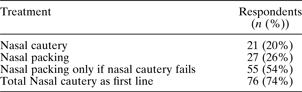
We asked the A&E doctors about their first line management of epistaxis patients, should digital pressure fail. Seventy-four per cent stated that nasal cautery was their first line management (Table I). We then asked what relevant equipment was readily available in A&E, and whether this equipment was routinely used in the management of epistaxis patients (Table II).
Reported First Line Epistaxis Management by A&E Doctors

A&E = accident and emergency department
Reported Availability and Usage of Epistaxis Management Equipment in A&E

* n = 104 respondents; †n = 103 respondents. A&E = accident and emergency department; NA = not asked
Both head lights and head mirrors were universally unavailable and hence were not used in the management of epistaxis. Thudichum nasal speculums (Incus Surgical, Braintree, Essex, UK) were only available in 26 per cent of A&E units, although only 1 per cent of the A&E doctors surveyed would actually use them. Disappointingly, local anaesthetic sprays were available in only 29 per cent of units; moreover, 99 per cent of doctors did not use them. Silver nitrate sticks were almost universally available. We had made the assumption that suction would be universally available in A&E departments, but found that only 8 per cent of A&E doctors used it.
Only 10 per cent of A&E doctors reported management of epistaxis under direct vision. Eighty-one per cent stated that their A&E unit would admit patients under the care of the ENT team if patients were nasally packed. Regarding nasal cautery and nasal packing, only 17 and 16 per cent of A&E doctors, respectively, had received prior training in these techniques.
Discussion
The effective management of epistaxis requires a systematic approach, with prior removal of clots and application of topical anaesthesia to the patient's nose, followed by identification and cautery of bleeding points, all performed under direct vision. The following equipment should be available: head illumination (either light or mirror), Thudichum nasal speculum, suction catheter, Tilleys dressing forceps, topical anaesthesia and silver nitrate sticks. The ability to cauterise a nose has historically been regarded as a basic skill which a doctor at the ENT ‘front line’ should have.
From the authors' own experience, silver nitrate nasal cautery can be effective even in an actively bleeding patient. The cautery field must be kept relatively dry by concurrent use of suction or application of adrenaline-soaked cotton wool applied with Tilleys dressing forceps. The successful concurrent use of a Thudichum nasal speculum, silver nitrate cautery stick and suction catheter often requires an assistant. As head illumination was universally unavailable, we must assume that the 10 per cent of A&E doctors who claimed to manage epistaxis under direct vision did so with the use of a hand-held light such as an auroscope. This would leave only one hand free to deal with the three other ENT instruments.
Whilst it is commendable that a majority of A&E doctors (74 per cent) claimed to perform nasal cautery as first line treatment, their technique (without the appropriate basic equipment) raises many questions. It is highly improbable that inserting a silver nitrate stick blindly into a patient's nose filled with clot will be effective. It would be hardly surprising if many patients, thus treated, ended up with nasal packing. By the same token, it would appear that nasal packing is also being performed blindly, without topical anaesthesia.
We accept that nasal chemical cautery may not always be effective, especially if bleeding points are posterior or if bleeding is too brisk. There is certainly a role for nasal packing in such situations. Even so, the same principles of efficacy and safety should apply. We advocate the application of nasal packs under direct vision, in a nose that has been cleared of clots and anaesthetised beforehand. This should enable manoeuvring around anatomical spurs and deviation, in order to minimise iatrogenic trauma to the nasal cavity. Whilst never completely pain-free, even in experienced hands, inappropriately performed nasal packing can inflict unnecessary pain on patients.
The vast majority of A&E units surveyed (81 per cent) would admit patients with nasal packing under ENT care. We accept that some patients may require admission for other medical or social reasons. It is debatable whether the ENT doctor on duty should remove the recently placed nasal pack and attempt nasal cautery. We do not routinely remove nasal packs ‘early’, unless the patient is bleeding through the pack or the pack is very badly positioned. This is to spare from further intervention patients who have stopped bleeding, and also because of uncertainly over whether a reasonable attempt at nasal cautery has initially been made. It is our practice to keep nasal packs in situ for at least 24 hours.
• Nasal cautery and nasal packing are effective treatment options for epistaxis
• A systematic approach is needed in epistaxis management
• First line treatment of epistaxis by UK accident and emergency units is currently suboptimal
• Deficiencies in equipment and training could lead to patients receiving unnecessary nasal packing
In a 2004 study, 54 per cent of patients receiving nasal packs in one hospital's A&E department subsequently required further intervention. Interestingly, 69 per cent of these patients then responded to nasal cautery; the authors concluded that nasal packing had been used inappropriately as first line treatment for these patients.Reference Evans, Young and Adamson10 Some doctors may advocate discharging patients with nasal packing in situ; however, in one unit which did so, there was a readmission rate of 16 per cent due to rebleeding.Reference Van Wyk, Massey, Worley and Brady11 Furthermore, several complications of nasal packing, such as swallowed packs,Reference Hashmi, Gopaul, Prinsley and Sansom5 nocturnal hypoxiaReference Jensen, Kristensen, Juul and Johannessen6 and toxic shock syndrome,Reference Hull, Mann, Sands, Gregg and Kaufman7 could have serious consequences if occurring at home.
A previous, 1989 survey of 30 A&E units highlighted deficiencies in the management of epistaxis, especially regarding the use of local anaesthetic.Reference Kotecha, Cocks and Rothera12 It is disappointing that the situation has not progressed, 18 years later. Each A&E department, in collaboration with their local ENT unit, needs to develop a practical protocol for the management of epistaxis. However, the reality of waiting time targets and doctors' current work patterns may mean that A&E doctors will continue to be at the front line of epistaxis management.
The crux of the matter is that front-line medical staff dealing with ENT emergencies must be given appropriate training and the right equipment for the job. It would be most unfortunate if any loss of training opportunities for ENT junior doctors was not translated into new ENT training opportunities for A&E doctors. Importantly, patients too would be disadvantaged, by being denied an effective and safe treatment modality. The evaluation data for the West Midlands emergency ENT course, covering 2006 to 2007 (EC Ho, 2007, unpublished data) have demonstrated that training can improve doctors' understanding and confidence in the practical management of epistaxis. Any training cost would easily pay for itself by the resulting reduction in unnecessary in-patient admissions.
Bias and limitations
We recognise the possibility of bias of data gathered via a telephone survey. Of the initial 104 units surveyed, 10 randomly selected units were re-surveyed and no difference in responses was found.
Conclusions
Currently, the first line management of epistaxis in England is almost universally carried out by A&E doctors. This management is suboptimal. Nasal cautery is either not attempted or is performed badly due to lack of equipment and lack of training. This could result in many patients receiving nasal packing and subsequently being admitted unnecessarily. The current situation could serve as an example of how patient treatment, when driven by targets and in the absence of appropriate investment in training and equipment, could lead to adverse patient outcomes, with resulting higher costs to the health service.
Various reports have demonstrated the efficacy of different epistaxis management techniques, using such ‘advanced’ equipment as endoscopes,Reference O'Donnell, Robertson and McGarry1, Reference Ahmed and Woolford2 operating microscopesReference Quine, Gray, Rudd and von Blumenthal3 and electrocautery devices. However, even basic clinical equipment is currently unavailable in many A&E departments. Ultimately, we should never forget that the majority of patients have bleeding points in Little's area which should be amenable to simple cautery using basic equipment (i.e. silver nitrate sticks under direct vision). We advocate the provision of such basic equipment, along with appropriate training for A&E doctors, in order to optimise the management of epistaxis patients.
Appendix 1
Survey questionnaire
1 Hospital _____
2 Onsite ENT cover? Y/N
3 Seniority of A&E doctor: FY1 / FY2 / SHO / SPR / Staff grade / Cons
4 Do you have a separate ENT examination room? Y/N
5 Are the following pieces of equipment readily available within the A&E department?
(i) Head mirror / head light Y/N
(ii) Thudichum nasal speculums Y/N
(iii) Local anaesthetic spray Y/N
(iv) Tongue depressor Y/N
(v) Silver nitrate sticks Y/N
6 Is there a protocol for management of epistaxis? Y/N
If yes, what is the first line management after first aid / resuscitation measures? Nasal cautery / nasal packing
Try to explore the protocol_____
7 How are patients with epistaxis routinely managed?
(a) Referred to ENT on call for treatment (no initial A&E treatment) Y/N
(b) Treated in A&E by A&E doctors initially Y/N
8 If Yes to 7a, are patients:
(i) Treated in A&E by an ENT doctor? Y/N
(ii) Tranferred to another area for treatment by ENT doctor? Y/N
(iii) What would the ENT doctor usually do?
– Nasal cautery as first line
– Nasal packing as first line
– Nasal packing only if nasal cautery fails
9 If Yes to 7b, what is the routine treatment for epistaxis patients?
(i) Initially, digital pressure and ice Y/N
(ii) Nasal cautery as first line / nasal packing as first line / nasal packing only if nasal cautery fails
10 Treatment of epistaxis (either cautery or packing) is carried out:
(i) Under direct vision with head light/mirror Y/N
(ii) With a Thudichum nasal speculum Y/N
(iii) With suction clearance of clots prior to treatment Y/N
(iv) With local anaesthetic spray prior to treatment Y/N
11 If patients have their nose packed, are they routinely admitted? Y/N
12 If No, what sort of follow up?_____
13 Are A&E junior doctors routinely trained to perform nasal cautery? Y/N
14 Are A&E junior doctors routinely trained to pack the nose? Y/N
15 Any comments to make regarding epistaxis management?