INTRODUCTION
Dientamoeba fragilis is a pathogenic intestinal protozoan parasite that has a cosmopolitan distribution worldwide (Barratt et al. Reference Barratt, Harkness, Marriott, Ellis and Stark2011a,Reference Barratt, Harkness, Marriott, Ellis and Starkb). It has a prevalence varying from 0·4% to 17% in patients with diarrhoea (Sawangjaroen et al. Reference Sawangjaroen, Luke and Prociv1993). Dientamoeba fragilis infection may be symptomatic with both acute and chronic infections affecting both children and adults (Stark et al. Reference Stark, Beebe, Marriott, Ellis and Harkness2007). The most common symptoms are abdominal pain and diarrhoea (Stark et al. Reference Stark, Barratt, Roberts, Marriott, Harkness and Ellis2010a,Reference Stark, Barratt, Roberts, Marriott, Harkness and Ellisb; Banik et al. Reference Banik, Barratt, Marriott, Harkness, Ellis and Stark2011; Barratt et al. Reference Barratt, Harkness, Marriott, Ellis and Stark2011a). Treatment of symptomatic patients with effective drug regimens includes diphetarsone, tetracycline, metronidazole, ornidazole, iodoquinol, erythromycin, hydroxychinoline, paromomycin, and secnidazole (Stark et al. Reference Stark, Barratt, Roberts, Marriott, Harkness and Ellis2010b). Although Dientamoeba was first identified nearly 100 years ago, not much information is available regarding the life cycle, mode of transmission, genomics and proteomics of this organism.
The current in vitro culture medium that supports D. fragilis growth has hardly changed over the last 100 years. Previous descriptions of in vitro culture for the xenic cultivation of D. fragilis were reviewed previously (Barratt et al. Reference Barratt, Banik, Harkness, Marriott, Ellis and Stark2010). They include liver infusion medium, inspissated horse serum or egg slopes with an overlay of egg white or serum Ringer's solution supplemented with rice starch. The TYSGM-9 and modified BD medium could be used to culture D. fragilis from stool samples (Stark et al. Reference Stark, Barratt, Roberts, Marriott, Harkness and Ellis2010a). In addition, another recent report confirmed that TYSGM-9 broth, Robinson's, modified BD and Loeffler's medium were able to support the xenic growth of D. fragilis long term and out of these 4 media the Loeffler's slope with a PBS overlay containing rice starch resulted in the highest number of trophozoites (Barratt et al. Reference Barratt, Banik, Harkness, Marriott, Ellis and Stark2010).
The current study was carried out in order to try and improve this biphasic medium by supplementing with essential growth nutrients. There is considerable evidence that cholesterol, iron and lipid supplementation is beneficial for the growth of many anaerobic protozoa such as Giardia lamblia and Trichomonas vaginalis (Gillin et al. Reference Gillin, Gault, Hofmann, Gurantz and Sauch1986; Lehker and Alderete, Reference Lehker and Alderete1992). In the study reported here, growth medium supplements were tested for their ability to enhance the growth of D. fragilis in vitro, so that higher yields of trophozoites can be obtained for future studies.
MATERIALS AND METHODS
Preparation of Loeffler's slopes
The Loeffler's slopes were prepared as described previously (Barratt et al. Reference Barratt, Banik, Harkness, Marriott, Ellis and Stark2010).
Source of D. fragilis trophozoites
Dientamoeba fragilis trophozoites isolated from a previous study were used (Barratt et al. Reference Barratt, Banik, Harkness, Marriott, Ellis and Stark2010). Trophozoites were quantitated by a single cell count taken from each flask as follows: the sediment at the bottom of the culture flasks containing the trophozoites was thoroughly agitated using a Pasteur pipette to make an even cell suspension from the liquid overlay. Raw cell counts were determined from this even cell suspension using a Neubauer chamber.
Comparison of the effect of different liquid overlays with the Loeffler's slope
A standard methodology was used in all the experiments described here. All experiments were performed in triplicate to ensure accuracy of the cell counts. The initial experimental design is described in detail here.
Four different liquid overlays were tested in this experiment namely EBSS, EBSS supplemented with 20 mM HEPES, DPBS and PBS. Earle's balanced salt solution (EBSS) was prepared (formulation: 6·8 g NaCl, 0·4 g KCl, 0·2 g CaCl2, 0·2 g MgSO4.7H2O, 0·14 g NaH2PO4.H2O, 2·2 g NaHCO3 and 1·0 g glucose, pH 7·8) autoclaved and stored in a 1L Schott bottle. EBSS with 20 mM HEPES (4-(2-hydroxyethyl)-1-piperazine ethanesulfonic acid) solution was prepared by adding 4·766 g/L HEPES into the original EBSS formulation. Dulbecco's modified PBS (DPBS) was prepared (formulation: 200 mg/L KCl, 200 mg/L KH2PO4, 8000 mg/L NaCl, 2160 mg/L Na2HPO4.7H2O) with a pH of 7·4 and osmolarity of 280–286mOsm. PBS (Sigma Aldrich, Catalogue No.P-4417) was prepared with a pH of 7·4 according to the manufacturer's recommendations.
An equal number of trophozoites was added to culture flasks, containing Loeffler's slopes overlaid with liquid medium (either EBSS, EBSS with 20 mM HEPES, DPBS and PBS as the negative control), at a final concentration of 1×10⁴ trophozoites/ml. Two mg of rice starch were added to all liquid media as recommended previously (Barratt et al. Reference Barratt, Banik, Harkness, Marriott, Ellis and Stark2010). Each culture flask (n=3 for each overlay evaluated) was then incubated at 37°C under anaerobic conditions and cell counts were performed on each flask each day. Since the increase in trophozoite numbers produced at 42°C is less than 2-fold greater than that produced at 37°C, the flasks were incubated at 37°C under anaerobic conditions and cell counts were performed on each flask each day. The use of 37°C removes the need for a dedicated 42°C incubator. Growth curves were plotted from the means of the cell counts.
Effect of cholesterol and lipid supplementation on the growth of D. fragilis
Three overlay formulations were prepared; EBSS containing either cholesterol (0·01 mg/ml), a commercial lipid mix (5 ml/L EBSS) or both (cholesterol 0·01 mg/ml and lipid mix 5 ml/L of EBSS). A cholesterol stock solution was prepared by dissolving cholesterol powder (10 mg) (Sigma Aldrich, Cat. No.C3045) in 5 ml of absolute ethanol, which was filtered through a 0·2 μm Millipore filter before use. The commercial lipid mix (Sigma Aldrich, Cat No. L0288) contains non-animal derived fatty acids (arachidonic, palmitic, stearic, linoleic and myristic).
Effect of ferric ammonium citrate, ascorbic acid, L-cysteine and alpha-lipoic acid on the growth of D. fragilis
L-cysteine solution (1·1 g/L) (Sigma Aldrich, Cat. No.C7352), ascorbic acid solution (0·2 g/L) (Sigma Aldrich, Cat. No. A4544), ferric ammonium citrate solution (0·23 g/L) (Sigma Aldrich, Cat. No. F5879) and alpha-lipoic acid solution (0·206 g/L) (Sigma Aldrich, Cat. No. T1395) was prepared in EBSS. All these supplements were filter sterilized and added to the culture medium which was further supplemented with 50 mg/L of cholesterol.
Comparison of growth of 4 different D. fragilis isolates in the modified Earle's balanced salt solution supplemented with cholesterol and ferric ammonium citrate
The ability of the 4 isolates described (Barratt et al. Reference Barratt, Banik, Harkness, Marriott, Ellis and Stark2010) to grow on Loeffler's slopes with an EBSS overlay supplemented with 40 mg/L of ferric ammonium citrate and 50 mg/L of cholesterol was evaluated. Loeffler's slopes with a PBS overlay were used as the negative control and cell counts were obtained daily.
Statistical analysis
In order to compare the differences in cell densities in each experiment, the data obtained from all growth curve experiments were analysed using a paired t-test.
RESULTS
Comparison of different overlays
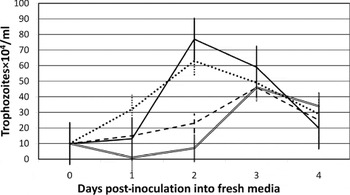
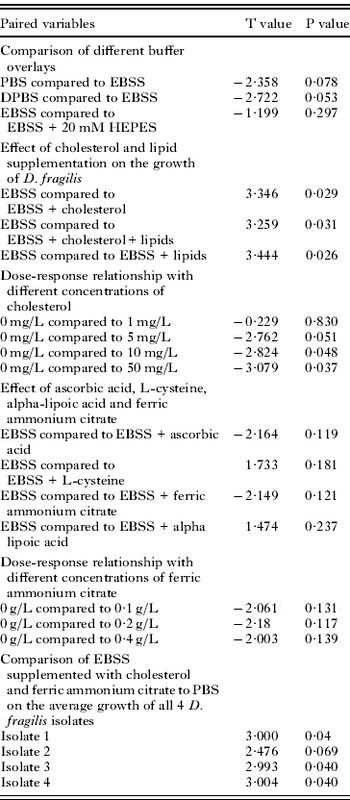
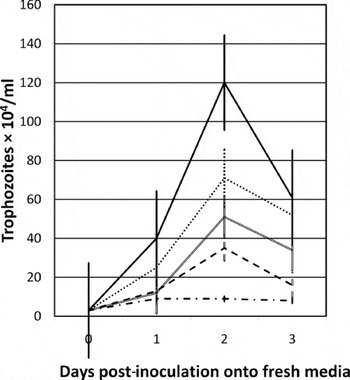
Figure 1 shows a comparison of the average growth of isolate 4 in PBS, EBSS, DPBS and EBSS supplemented with 20 mM HEPES. The highest cell densities of D. fragilis trophozoites were obtained in EBSS (P=0·039) in comparison to other overlays. EBSS supplemented with 20 mM HEPES showed the second best growth of all 4 media (P=0·019) (Fig. 1). In contrast, DPBS showed poor growth of trophozoites compared to PBS (Table 1).
Growth curves showing average growth of Dientamoeba fragilis trophozoites in PBS ( ), Earls balanced solution (
 ), Dulbecco's modified PBS (
 ) and Earls balanced salt solution supplemented with 20 mM Hepes (… .) under anaerobic conditions at 37°C. Initial cell counts on day 0 were 10×104/ml for all culture flasks. The error bars represent standard error of mean cell counts.

Summary of P and T values obtained using a paired t-test to compare the average growth of Dientamoeba fragilis under different culture conditions

Effect of cholesterol and lipid supplementation on the growth of D. fragilis
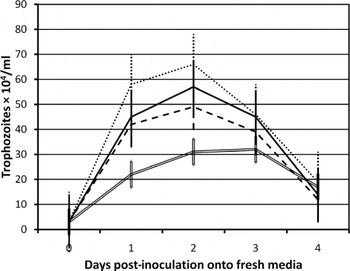
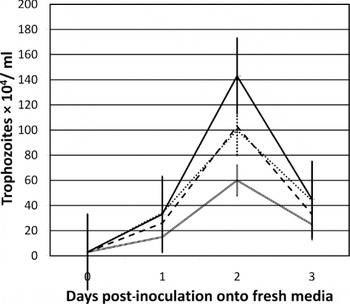
According to Fig. 2 the highest trophozoite numbers were obtained with cholesterol supplementation (P=0·029) followed by cholesterol and lipid supplementation together (P=0·031) and lipid supplementation alone itself (P=0·026). Cholesterol was therefore used in all subsequent experiments.
Growth curves showing average growth of Dientamoeba fragilis trophozoites in cholesterol (… .), cholesterol+ lipid (), lipid supplemented EBSS () and EBSS which is the negative control () under anaerobic conditions at 37°C. Initial cell counts on day 0 were 3× 10⁴/ml for all culture flasks. The error bars represent standard error of mean cell counts.

A cholesterol dose-response curve (Fig. 3) shows that there is a significant increase in the growth of D. fragilis trophozoites with increasing concentrations of cholesterol (Table 1). The highest growth was at a cholesterol concentration of 50 mg/L (which was the highest concentration tested) compared to the negative control (P=0·018). Concentrations of 10 mg/L (P=0·024) and 5 mg/L (P=0·025) also showed significant increase in numbers of D. fragilis trophozoites compared to the control. Therefore a concentration of 50 mg/L cholesterol was incorporated into the growth media of D. fragilis.
Growth curves showing average growth of Dientamoeba fragilis trophozoites in EBSS supplemented with different concentrations of cholesterol under anaerobic conditions at 37°C. The cholesterol concentrations are as follows: 0 mg/L (), 1 mg/L ( ), 5 mg/L (), 10 mg/L (… .) and 50 mg/L (). Initial cell counts on day 0 were 3× 10⁴/ml for all culture flasks. The error bars represent standard error of mean cell counts.

Effect of ferric ammonium citrate, ascorbic acid, L-cysteine and alpha-lipoic acid on the growth of D. fragilis
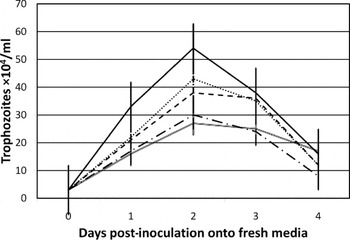
The highest growth of D. fragilis was observed in the EBSS supplemented with ferric ammonium citrate (T=−2·149) even though this result was not significant (P=0·121) (Fig. 4). EBSS supplemented with ascorbic acid also contained higher numbers of trophozoites compared to the control (T=−2·164, P=0·119).
Growth curves showing average growth of Dientamoeba fragilis trophozoites in EBSS supplemented with ferric ammonium citrate (), ascorbic acid (… .), L-cysteine (), alpha lipoic acid () and EBSS as the negative control () under anaerobic conditions at 37°C. Initial cell counts on day 0 were 3× 10⁴/ml for all culture flasks. The error bars represent standard error of mean cell counts.

EBSS supplemented with L-cysteine resulted in very poor growth (T=1·733, P=0·181) and incorporation of alpha-lipoic acid made no difference to the cell numbers observed (T=1·474, P=0·237).
A ferric ammonium citrate dose-response curve (Fig. 5) shows that there is an increase in cell densities with increasing concentrations even though these results were not significant (T=−2·003, P=0·139). The highest cell density observed was with a ferric ammonium citrate concentration of 40 mg/L; therefore this amount was incorporated into the growth media of D. fragilis.
Growth curves showing average growth of Dientamoeba fragilis trophozoites in EBSS supplemented with different concentrations of ferric ammonium citrate under anaerobic conditions at 37°C. The ferric ammonium citrate concentrations were as follows: 0 g/L (), 0·1 g/L (), 0·2 g/L (… .), 0·4 g/L (). Initial cell counts on day 0 were 3× 10⁴/ml for all culture flasks. The error bars represent standard error of mean cell counts.

Comparison of the growth of different isolates of D. fragilis in the new modified EBSS
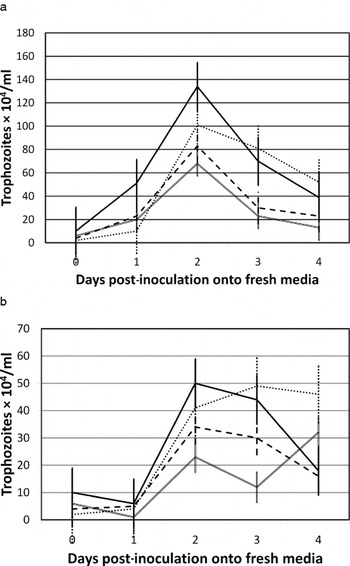
There was a significant increase in the number of trophozoites of D. fragilis in isolate 1 (P=0·04), isolate 3 (P=0·04) and isolate 4 (P=0·04) cultured with modified EBSS containing cholesterol and ferric ammonium citrate (Fig. 6A) when compared to PBS (Fig. 6B) (Table 1). Isolate 2 showed an increase with higher cell densities in EBSS than in PBS but this difference was not significant at P=0·05 (P=0·069).
Growth curves showing average growth of Dientamoeba fragilis trophozoites of isolate 1 (), isolate 2 (… .), isolate 3 () and isolate 4 () under anaerobic conditions at 37°C in (A) modified EBSS supplemented with ferric ammonium citrate and cholesterol or (B) PBS. The error bars represent standard error of mean cell counts.

DISCUSSION
Dientamoeba fragilis is a trichomonad parasite that is commonly associated with gastrointestinal disease in humans with a significant prevalence worldwide (Barratt et al. Reference Barratt, Harkness, Marriott, Ellis and Stark2011b). It is often more prevalent than Giardia in patients with diarrhoea (Barratt et al. Reference Barratt, Harkness, Marriott, Ellis and Stark2011b). However, there is limited knowledge available about the biology, genomics and proteomics of this parasite. One of the limiting factors in the molecular studies of D. fragilis is the production of high cell numbers by in vitro cultivation. Improvements in culture would greatly help advance knowledge in these areas (Barratt et al. Reference Barratt, Banik, Harkness, Marriott, Ellis and Stark2010).
In the first instance the basis of the liquid overlay of D. fragilis in vitro culture was investigated. All 4 overlays PBS, EBSS, DPBS and EBSS supplemented with 20 mM HEPES were able to support growth of D. fragilis. Earle's Balanced Salt Solution gave the highest trophozoite numbers and so was chosen for use in further studies including supplementation with cholesterol and ferric ammonium citrate. EBSS contains a variety of inorganic salts, as well as sodium hydrogen carbonate (NaHCO3) and glucose (Bryant, Reference Bryant1975). The inorganic salts in the medium help to maintain the osmolarity as well as providing a range of divalent cations needed for cell metabolism. NaHCO3 maintains the buffering capacity in the anaerobic in vitro culture and glucose provides an additional energy source in addition to the rice starch.
Since the current in vitro culture of D. fragilis involves a xenic culture which consists of a mix of bacteria, one could argue that the growth enhancement observed in these experiments could be due to an indirect effect through the media enhancing the growth of favourable bacteria; a direct effect on D. fragilis or both of these. The reason for the increase in trophozoite numbers is still unknown; whatever the mechanism, the medium formulation was beneficial in supporting the growth of higher trophozoite numbers.
Even though no information is available on the uptake or need for cholesterol in D. fragilis, there is considerable evidence that highlights the importance of cholesterol in other anaerobic protozoa (Farthing et al. Reference Farthing, Keusch and Carey1985; Gillin et al. Reference Gillin, Gault, Hofmann, Gurantz and Sauch1986; Lujan et al. Reference Lujan, Mowatt and Nash1996). In the experiments reported here, supplementation of culture medium with cholesterol and lipids supported the growth of D. fragilis significantly and cholesterol supplementation alone resulted in the highest growth compared to the control. Consequently cholesterol was used in the culture medium to enhance the growth of D. fragilis.
There is considerable evidence to highlight the beneficial effect of the supplements evaluated in this study. Iron is an important element in the electron transport pathway which increases the activity of hydrogenosomal enzymes which are critical to the energy needs of anaerobic protozoa such as Trichomonas vaginalis (Lehker and Alderete, Reference Lehker and Alderete1992; Amin et al. Reference Amin, Neubauer, Liebhart, Grabensteiner and Hess2010). Still further studies need to be carried out in order to recognize the mode of acquisition of these nutrients by D. fragilis.
Out of all 4 supplements tested, ferric ammonium citrate and ascorbic acid supported the growth of D. fragilis, although the numbers were not statistically significant. Incorporation of ferric ammonium citrate into the medium gave higher numbers of cells than any of the other supplements. Furthermore the presence of a partial dose-response type relationship with increasing concentrations of ferric ammonium citrate suggests that ferric ammonium citrate aids the growth of D. fragilis.
The modified EBSS supplemented with ferric ammonium citrate and cholesterol was able to support growth of all the 4 isolates of D. fragilis tested. The modified EBSS increased the trophozoite numbers in all 4 isolates more than 2-fold. Out of the 4 isolates 3 of them showed a significant increase in growth with higher cell densities when compared to PBS which is the liquid overlay used currently (Barratt et al. Reference Barratt, Banik, Harkness, Marriott, Ellis and Stark2010). Even isolate 2, which did not show a significant increase with EBSS, gave higher cell densities in EBSS than in PBS.
In this study, new advances are described on the in vitro culture of D. fragilis. A modified EBSS containing cholesterol, ferric ammonium citrate and rice starch can be regarded as a superior liquid overlay that can be used along with the Loeffler's serum slope for culture of D. fragilis under anaerobic conditions. Although these xenic cultures are a vast improvement over previous technology used for culture, the presence of bacteria still represents a limitation. The use of our improved culture method, along with antibiotic treatment of the cultures, will hopefully provide the means for generating monoxenic or axenic cultures of D. fragilis.
ACKNOWLEDGEMENTS
Varuni Munasinghe is supported by a Ph.D. Scholarship from UTS. This research was financially supported by grants from UTS, St. Vincent's Hospital and the Australian Research Council.