INTRODUCTION
Polymorphism of the modular unit is present in many hydroid groups. The adjective polymorphic is used for species having morphologically specialized polyps that carry out different functions (Cornelius, Reference Cornelius, Barnes and Crothers1995). Thus, hydroids belonging to several families of the Athecata can be differentiated into specialized polyps for feeding (gastrozooids), reproduction (gonozooids) and defence (dactylozooids). Among the Thecata, similar examples are found, with hydranths for feeding, gonangia for reproduction and nematophores for defence. Such polymorphism is also found in the family Haleciidae, but the absence of nematophores is a diagnostic character for the genus Halecium, which is the most speciose of the family (Naumov, Reference Naumov1960; Cornelius, Reference Cornelius1975; Calder, Reference Calder1991; Bouillon et al., Reference Bouillon, Gravili, Pagès, Gili and Boero2006). Migotto (Reference Migotto1996), however, noticed the presence of nematophores while observing living specimens of the species Halecium bermudense Congdon, 1907 from Brazil and Bermuda. He did not report how different these nematophores were from those observed in other haleciids with nematothecae (such as species of the genus Hydrodendron), but he described them as defensive polyps, not previously reported in that species, which performed coiling movements, were very long and thin, and arose from a theca similar to the hydrotheca of normal hydranths. After Migotto's discovery, similar polyps, differing from the feeding polyps (hydranths) and presumably defensive, were found in two sertulariid species (Gravier-Bonnet, Reference Gravier-Bonnet1998).
Halecium halecinum (Linnaeus, 1758) is a common species along the coasts of the United Kingdom and of north-west Europe (Hincks, Reference Hincks1868; Cornelius, Reference Cornelius, Barnes and Crothers1995), where it forms large populations in shallow waters. Hydranths of H. halecinum were among the first seen by scientists in the eighteenth century (Cornelius, Reference Cornelius1998). They were studied for histology by Bouillon (Reference Bouillon and Grassé1994) and described in detail from living specimens by Cornelius (Reference Cornelius1998): this is exceptional knowledge since haleciids, like other thecates, are usually described according to their skeleton characters only (Cornelius, Reference Cornelius1975, Reference Cornelius, Barnes and Crothers1995). Nevertheless, while examining living colonies during the Hydrozoan Workshop held at Plymouth in June 2007, the author discovered the dimorphism of the polyps. Indeed, as in H. bermudense, besides the normal hydranths there are also very extensible, long, thin, coiling polyps present. But they are not distinguishable from the ordinary hydranths when contracted, which is also usually the case in preserved material. In this short report, these polyps and their behaviour are described for the first time and their characters compared to those of the normal hydranths. Taking into account morphology, structure, behaviour and function, it is argued here that this new type of polyp should not be classified as a nematophore, but as a new kind of polyp named here ‘extensible polyp’.
MATERIALS AND METHODS
Hydroids were gathered from Plymouth Sound at 10–15 m depth. They were collected during the 6th Workshop of the Hydrozoan Society (18–30 June 2007) by SCUBA divers. Immediately after collection the colonies were brought to the Plymouth Marine Biological Laboratory and put into tanks with running seawater. Several colonies bearing a lot of hydranths and extensible polyps were studied from material collected on two different dives. After isolation in smaller dishes, with an amount of water sufficient to provide enough oxygen, they were observed with a Kiowa optical stereomicroscope. Close views were obtained from polyps on pieces of colonies mounted in seawater on slides, observed with a small monocular compound microscope. Microphotographs were taken during two days (25–26 June 2007) with a Sony Cybershot digital camera through the eyepieces of the optical instruments. Identification was achieved on fertile colonies using the literature (Cornelius, Reference Cornelius, Barnes and Crothers1995) and the Plymouth hydrozoan guide recently compiled by Gravili (Reference Gravili2007). No measurements were taken.
RESULTS
The hydranths are distributed regularly over the colony, whereas the extensible polyps are irregularly scattered. Both types of polyps reside in hydrothecae (see Cornelius, Reference Cornelius, Barnes and Crothers1995, Reference Cornelius1998 for description) that show no differences in shape and size (Figure 1). Likewise, hydranths and extensible polyps are indistinguishable when contracted because they are then similar in shape and size. Descriptions of their morphology given below are therefore based on living, undisturbed and well-extended polyps.
Halecium halecinum polyps at a branch tip. A partially contracted extensible polyp showing the characteristic folding and swellings, hypostome extroverted for excretion and diameter of the column thinner than that of the hydrotheca (left); a distal juvenile hydranth with tentacles not still fully grown (middle); an ordinary hydranth fully extended but with tentacles slightly folded towards the centre of the crown: on the column, note the inconspicuous bulge and strong constriction before ‘head’, the distinctive pedal and digestive parts (basal and distal), and the diameter equal to that of the hydrotheca (right).

Hydranths
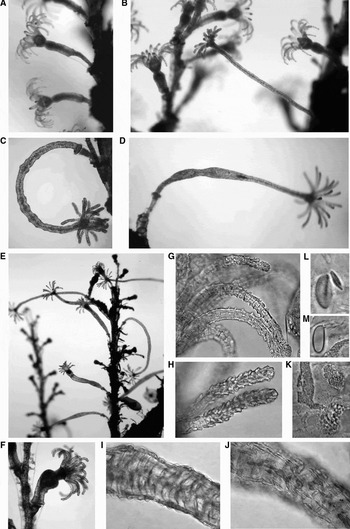
The hydranth is composed of two parts: (i) a long proximal column ending at an obvious constriction; and (ii) a broader apical part (or ‘head’) approximately triangular in profile at its base, which supports a circlet of tentacles, the rounded to conical hypostome and the mouth (Figure 1). It exhibits radial symmetry, and its tentacles are regularly bent outwards in the middle of their length (Figure 2a, b). The tentacles are approximately 24–26 in number, linked at their base, slightly amphicoronate, long, thin and slightly tapering (Figure 2a, b) but appearing untapered and thicker when not fully extended (Figure 2f) as already noticed by Cornelius (Reference Cornelius1998). They are provided, except basally, with two different types of microbasic mastigophores (Figure 2g, l): one being very small, banana shaped, its shaft discharging along the long axis of the capsule, abundant but irregularly distributed (more abundant distally); the second much larger but less abundant, being present on the oral side only, ovoid, with a thick shaft that discharges at an angle of 45° to the capsule. The column of the hydranth has a diameter equal to that of the hydrotheca but is somewhat enlarged proximal to the constriction, forming the bulge, a characteristic described by Cornelius (Reference Cornelius1998) for haleciid hydranths. It is provided with a thick gastrodermis differentiated distally for digestion, and with a thin epidermis having two types of glandular cells, differing in the size of their secreted granules.
Halecium halecinum polyps. (A) Undisturbed extended hydranths; (B) hydranths and the distal part of an extensible polyp well extended; (C) an extensible polyp curved beneath its hydrotheca, partially contracted, with folds and swellings; (D) an extensible polyp with column showing two peristaltic swellings and with digestive residues inside (black); (E) extensible polyps on a branch where hydranths had regressed, showing various states of extension and coiling (with two on right from the next branch); (F) hydranth contracted with obvious pedal and digestive parts and big bulge on column; (G) hydranth tentacles with few big nematocysts on oral side (detail); (H) tentacle tips of an extensible polyp provided with many big nematocysts (detail); (I–J) column of an extensible polyp (details); (I) gastrodermis and folded epidermis, lumen obliterated; (J) epidermis with numerous glandular cells of two types stretched longitudinally; (K) glandular cells with large and small secretory products on a contracted column (close view); (L–M) nematocysts microbasic mastigophores from a hydranth; (L) the two types undischarged; (M) a large one discharged.

The hydranth is able to extend and contract, but not to retract inside the small hydrotheca. Movements of the hydranth are limited. They take place within the space of a virtual inverted cone between the base of the hydrotheca and the orbit of tentacle tips. The hydranth can incline slightly but is not able to bend. During movements linked to the digestive activity, the constriction at the top end of the column may temporarily disappear.
Extensible polyps
The extensible polyp has radial symmetry and is composed of a column and an apical part, a ‘head’ that bears a circlet of tentacles, a hypostome and a mouth, as in the hydranth. When observed with the stereomicroscope, the hypostome and mouth appear no different from those of the hydranths, but the head is not as well separated from the column, as a distal constriction and a bulge are absent. The shape of the extensible polyps is different (Figure 2b). The polyp exhibits 20–22 tentacles, shorter, thicker and only slightly curved, and somewhat swollen at the tip. They are linked at the base and slightly amphicoronate, as in the hydranth. The tentacles are provided with numerous large, ovoid microbasic mastigophores, of the kind found in hydranths. These nematocysts are in approximate whorls and they are more abundant distally, especially at the swollen tentacle tips (Figure 2h). The column is extremely extensible. It has a thick undifferentiated gastrodermis formed by large empty-looking cells, and a thin epidermis (Figure 2i). The epidermis is provided with numerous glandular cells of two types (Figure 2k), as in hydranths. During phases of great extension, these cells become extremely long and thin (Figure 2j). At rest, the polyp column is isodiametric (Figure 2b); proximally its diameter is less than that of the hydrotheca (Figure 1).
Like the hydranth, the extensible polyp is able to extend and contract whilst not able to retract inside its small hydrotheca, but otherwise its behaviour is very different. Its ability to extend is striking and it might reach three to five times the length of a normal hydranth in extension. The amplitude of its movements is considerable. When extended, this polyp is able to coil, even while making quick or slow movements. Secondly, during extension, it is moving in all directions within a relatively large volume of seawater and, due to its bending ability, it is able to explore the space on all sides and below the hydrotheca (Figure 2c, e). While in extension, the polyp is also able to contract the column partially, producing local folding of the epidermis and more or less regular swellings along the column (Figures 1 & 2c, i). The gastrovascular cavity is often not visible because it is empty and the lumen minimized or entirely obliterated (Figure 2i). Sometimes undigested residues can be seen inside (Figure 2d, e), evidently in transit and moving stepwise away from the base before being egested by the mouth after extroversion of the hypostome (Figure 1). During this transit, the column is sometimes enlarged in some places due to gastrovascular flux: these swellings are linked to peristalsis and differ from that described before, induced by the partial contraction of the column. Colonies with numerous regressed hydranths, due to keeping them in the laboratory, exhibited also numerous extensible polyps in the process of excreting (Figure 2e).
Comparison of hydranths and extensible polyps
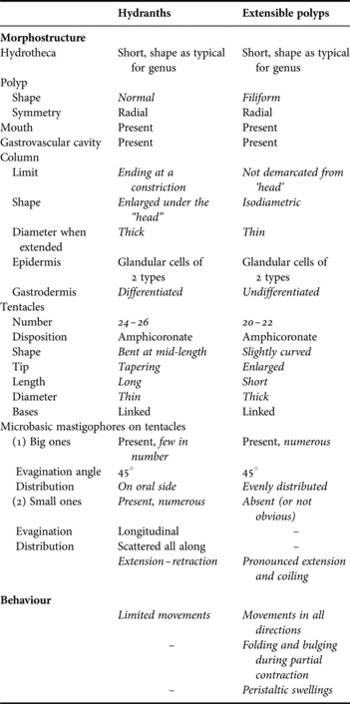
The morphological and behavioural features of the two polyp types are given in Table 1 for comparison. The traits that distinguish the polyps are given in italic.
Comparison between hydranths and extensible polyps (characters shared by both types are given in roman type; diverging characters are given in italic).

DISCUSSION
This study demonstrates that hydranths and extensible polyps are functionally and morphologically different kinds of polyp, although they both possess a column with a gastrovascular cavity, a hypostome and mouth surrounded by a circlet of filiform tentacles. They diverge in morphology and behaviour. Morphological differences are not obvious and concern mostly the tentacles. The extensible polyp has fewer tentacles, which are slightly shorter and thicker, with rounded and not tapering tips, and only one kind of nematocyst. It is not possible to distinguish extensible polyps from normal hydranths because these differences are not visible when polyps are contracted and, moreover, their hydrothecae appear similar, though it is possible that a small difference in diameter might be revealed by a statistical study. It is then not surprising that extensible polyps were not reported before because they are visible only as extensible polyps, and most taxonomists study specimens already fixed with formalin, which have almost always strongly contracted hydranths. They were neither reported by Cornelius (Reference Cornelius1998) though he studied haleciid hydranths from specimens that were still alive, including H. halecinum. This is surprising but could partly be a consequence of the method he used, while isolating single polyps from the colony and putting them into very small dishes where they probably were not able to extend if they were extensible polyps. Moreover, he noted that rapid increase in temperature in these small dishes prevented observing them over a long time. In healthy living colonies kept in a large volume of water, extensible polyps are easily distinguished from hydranths by their ability to extend, despite other less obvious characters described above. Behavioural differences are also distinctive, for unlike hydranths, they are able to coil, bend, fold and swell.
The defensive polyp found by Migotto (Reference Migotto1996) in Halecium bermudense, very similar in shape and behaviour to the ones observed in this study, is considered here to be an extensible polyp. More data are needed to confirm whether it also has a functional gastrovascular cavity and a mouth as described here for H. halecinum. Whereas polymorphism is known within the family Haleciidae (cf. introduction), the presence of extensible polyps in two species is a case of polyp dimorphism unsuspected until now. Hitherto haleciid polyps were described as being uniform hydranths, characteristically monomorphic. Those associated with the female gonophores, known to be present during the growing of the oocytes, and to regress and disappear during maturation, look like normal hydranths (gastrozooids). Besides, haleciid hydranths were thought to be similar in all genera, with the exception of Nemalecium (Bouillon, Reference Bouillon1986) which has modified tentacles (nematodactyls), a feature relevant to a difference in structure and not to a polymorphism.
The presence of very extensible polyps with similar behaviour was discovered previously in the family Sertulariidae in two species of the genus Sertularella (Gravier-Bonnet, Reference Gravier-Bonnet1998; Gravier-Bonnet & Bonnet, Reference Gravier-Bonnet and Bonnet2000; and unpublished results). As in H. halecinum, extensible polyps of Sertularella were not distinguishable from hydranths in preserved material because they have the same shape and size when contracted and identical hydrothecae. In living colonies, their presence is revealed only when they start to be active and extend. They showed the same behaviours as described above for H. halecinum (movements of the polyp and the excretion). Moreover, feeding experiments with Artemia larvae demonstrated that they were able to capture prey. But instead of being swallowed after being caught by the tentacles, the prey were released. They did not function as predatory zooids which pass their prey items for ingestion, as in the athecate Ptilocodiidae. It would be interesting to repeat such experiments with H. halecinum.
Although the extensible polyp has a gastrovascular cavity and a mouth, it is not a gastrozooid (or gastropolyp) like the hydranth because it is not involved in feeding. It was observed to excrete gastrovascular residues, and the numbers of large nematocysts suggests a role also in defence. However, it is not clear whether the observed slow exploring–sweeping movements have a real defensive function, as hydranths also are provided with nematocysts for their own defence, and the extensible polyps are fewer and often situated on stems (Migotto, Reference Migotto1996; Gravier-Bonnet, unpublished results). Such questions were also posed by the tentacle-like nematophores of lafoeids and haleciids for which an additional sensory function was hypothesized (Gravier-Bonnet, Reference Gravier-Bonnet2004). Further data from experimental studies are needed.
The nematophores of thecates are considered to be evolutionary derivatives of normal polyps, strongly specialized for defence (see glossaries: Cornelius, Reference Cornelius, Barnes and Crothers1995; Bouillon et al., Reference Bouillon, Gravili, Pagès, Gili and Boero2006). Among the thecate families, they are not all identical. In a recent review they were classified into three types according to their different shape, behaviour and function (Gravier-Bonnet, Reference Gravier-Bonnet2004). But all lack a gastrovascular cavity and mouth like the dactylozooids of the athecates. With the presence of these elements together with their great resemblance to hydranths, the extensible polyps are not classified as nematophores but are considered to be modified hydranths, differently specialized. Pending additional knowledge on their function, the name ‘extensible polyp’ was chosen since extreme extensibility is the main character which differenciates it from normal hydranths. Among the thecates, this extensibility, together with coiling movements, is shared with the tentacle-like nematophores of the haleciids and lafoeids (Gravier-Bonnet, Reference Gravier-Bonnet2004), and also with the dactylozooids of Clathrozoon wilsoni Spencer, 1891, a filiform zooid devoid of mouth but with capitate tentacles, discovered on living colonies while previously overlooked on preserved ones (Hirohito, Reference Hirohito1971).
Further studies need to be carried out on extensible polyps. As described in this article, they have been reported from four species, two sertularids (Sertularella diaphana and Sertularella sp. nov.) and two haleciids (Halecium bermudense and Halecium halecinum) that were studied as living colonies. As stated by Cornelius (Reference Cornelius1998), such studies are not easy, especially because it is difficult to get optimal conditions that keep the animals not only alive but healthy, and permit good observation. But this paper, like previous papers already cited, demonstrates their interest in respect of knowledge about thecate hydranths. The need for such additional knowledge was pointed out by Vervoort (Reference Vervoort, Bouillon, Boero, Cicogna and Cornelius1987) and still exists. Besides their current use for research on thecates, which bears on reproduction, studies carried out on living animals also have a potential to contribute important details on the behaviour, morphology, and functional aspects of polyps that have to date been neglected by most taxonomists who relied too much on preserved material.
ACKNOWLEDGEMENTS
Thanks a lot to the divers Keith Hiscock, Jeanette Watson, Marta Ronowicz and Carlos Moura for having provided specimens for observation during the workshop of the Hydrozoan Society. Many thanks also to both of the referees and to Chloé Bourmaud for having provided constructive remarks on the manuscript, and to Elaine Robson and one referee for improving the English.