Introduction
Body image is a complex, multidimensional construct that plays an important role in the lives of women (Cash Reference Cash2004). Body-image research, however, has focused on body dissatisfaction, only one aspect of the many facets of body image (Grogan Reference Grogan2008). Thompson (Reference Thompson, Kuh and Hardy2002) argued that this limited conceptualisation results from a disproportionate focus on adolescent and college-aged informants. For younger women and girls, body dissatisfaction is predictive of severe negative outcomes, such as disordered eating, excessive exercise and the abuse of diet pills (Peat, Peyerl and Muehlenkamp Reference Peat, Peyerl and Muehlenkamp2008). Whitbourne and Skultety (Reference Whitbourne, Skultety, Cash and Pruzinsky2002) suggested, however, that for older women functional issues such as health and physical ability are equally relevant components of body image. Indeed, researchers have recently called for the study of older women to broaden its conceptualisation of body image (Ferraro et al. Reference Ferraro, Muehlenkamp, Paintner, Wasson, Hager and Hoverson2008; Hurd Reference Hurd2000; Peat, Peyerl and Muehlenkamp Reference Peat, Peyerl and Muehlenkamp2008). To understand body image for women as they age, researchers must consider how body image develops over the lifecourse and how it is situated in the context of their overall life stories (Clarke and Griffin Reference Clarke and Griffin2007; Grogan Reference Grogan2008). To this end, Thompson (Reference Thompson, Kuh and Hardy2002) argued that the next step in advancing the understanding of body image for mature women is to adopt a lifecourse perspective, because it provides a useful theoretical orientation for framing body-image research among older women and highlights the influence of personal life events, historical changes and the individual's perceptions of and responses to such experiences (Elder Reference Elder, Mortimer and Shanahan2003; McLaren and Wardle Reference McLaren, Wardle, Kuh and Hardy2002; Staudinger and Bluck Reference Staudinger, Bluck and Lachman2001).
For this study, we used a qualitative approach that was designed to elicit narratives of the events and circumstances that had shaped the participants' body image across the lifecourse and that communicated the meanings they associated with those experiences (Warren and Karner Reference Warren and Karner2005). To understand the experience of body image, Pelican et al. (Reference Pelican, Vanden Heede, Holmes, Melcher, Wardlaw, Raidl, Wheeler and Moore2005: 61) suggested that qualitative methods are valuable because they allow researchers to link ‘the person with his or her lived situation, which includes understanding that person's meanings in his or her own terms’. Furthermore, using qualitative methods allows for understanding to be developed inductively rather than deductively from prior assumptions (Patton Reference Patton2002; Strauss and Corbin Reference Strauss and Corbin1998).
Literature review
During the last few decades, researchers have devoted much attention to exploring issues regarding body image and its effects on women (Cash Reference Cash2004), but more research is needed that focuses on body-image changes across the lifecourse and the role of ageing in body image. For example, studies have produced inconsistent findings about the relationship between age and overall body satisfaction. Mangweth-Matzek et al. (Reference Mangweth-Matzek, Rupp, Hausmann, Assmayr, Mariacher, Kemmler, Whitworth and Biebl2006) suggested that body satisfaction declines with age, Webster and Tiggemann (Reference Webster and Tiggemann2003) claimed it is invariant with age, and Feingold and Mazzella (Reference Feingold and Mazzella1998) found improvement with age. Tiggemann and Lynch (Reference Tiggemann and Lynch2001: 243) argued that more research on older women is needed ‘to clarify the processes involved in the changes in body image that occur with age’.
Body image and ageing
As women age, they experience social, environmental and physical changes that influence the ways that they perceive their bodies (Tiggemann Reference Tiggemann2004). Furthermore, older women experience different body-image issues than younger women (Whitbourne and Skultety Reference Whitbourne, Skultety, Cash and Pruzinsky2002). Specifically, appearance is a less important priority for older women, and they are less likely to experience negative body image-related outcomes (Peat, Peyerl and Muehlenkamp Reference Peat, Peyerl and Muehlenkamp2008; Pliner, Chaiken and Flett Reference Pliner, Chaiken and Flett1990). For example, from a cross-sectional study of women aged 20–65 years, Webster and Tiggemann (Reference Webster and Tiggemann2003) found that with greater age, body dissatisfaction was less predictive of low self-esteem. They argued that, for older women, placing a lower priority on physical appearance serves as a protective buffer against negative outcomes such as appearance anxiety or disordered eating. The literature also suggests that not only do body-image perceptions change with age, but that the ageing process itself influences body image (Chrisler and Ghiz Reference Chrisler and Ghiz1993). Western society places great value on beauty and generally equates beauty with youth and thinness (Ferraro et al. Reference Ferraro, Muehlenkamp, Paintner, Wasson, Hager and Hoverson2008; Wolf Reference Wolf2002). Additionally, women in western cultures are often judged by appearance more than other characteristics (Crose Reference Crose, Trotman and Brody2002). The societal emphasis on youth and beauty therefore presents an increasing danger to women's body image as they age (Ferraro et al. Reference Ferraro, Muehlenkamp, Paintner, Wasson, Hager and Hoverson2008). Furthermore, with increasing age, women encounter unique physical situations that are likely to impact body image such as the menopause and declining health (Rostosky and Travis Reference Rostosky, Travis, Travis and White2000).
Although a few researchers have begun to study the body image of older women (e.g. Banister Reference Banister1999; Tunaley, Walsh and Nicolson Reference Tunaley, Walsh and Nicolson1999; Webster and Tiggemann Reference Webster and Tiggemann2003), the overall picture is still incomplete (Peat, Peyerl and Muehlenkamp Reference Peat, Peyerl and Muehlenkamp2008). In a recent study, Ferraro et al. (Reference Ferraro, Muehlenkamp, Paintner, Wasson, Hager and Hoverson2008: 379) found that ‘the endorsement of a thinner body image by many of the older adult female participants appeared to persist into late adulthood’. Their findings supported the notion that body image is a complex phenomenon for older women and raised important questions. For example, they found that when compared with normal-weight older women, overweight older women selected a larger figure as ideal. The authors proposed that a possible interpretation of the finding is that ‘some older women accept their overweight status as a satisfactory lifestyle’ (Ferraro et al. Reference Ferraro, Muehlenkamp, Paintner, Wasson, Hager and Hoverson2008: 380), but that more research is needed to verify this explanation and, if found to be the case, to understand how some women adopt this attitude. Similarly, Clarke (Reference Clarke2002) found that older women preferred larger female bodies and emphasised the importance of internal attributes, and argued that older women are not simply victims of societal definitions of beauty, but actively resist such pressure to attain self-acceptance. In short, additional research is needed to clarify changes in body image as women age (Tiggemann Reference Tiggemann2004).
The lifecourse perspective
The lifecourse perspective was developed as a conceptual orientation for understanding patterns of behaviour, attitudes and individual characteristics as they unfold across the lifecourse (Elder Reference Elder, Moen, Elder and Luscher1995, Reference Elder, Mortimer and Shanahan2003; Moen Reference Moen, Binstock and George2001). According to Bengtson, Burgess and Parrott, ‘the life-course perspective attempts to bridge the macro- and micro-levels of social-structural analyses by incorporating the effects of history, social structure, and individual meaning into theoretical and analytic models’ (1997: S80). This perspective provides a framework for studying participants as complex individuals and for understanding their current psychological or biological status in the context of their socio-cultural environment and personal history (Staudinger and Bluck Reference Staudinger, Bluck and Lachman2001). According to Hatch, ‘the strength of the life-course perspective lies in the explicit recognition of multiple interlocking dimensions of human experience. The perspective locates individuals and groups in time and space, discouraging simple – and simplistic – comparisons and conclusions’ (2000: 28).
From a meta-analysis, Wethington (Reference Wethington2005) outlined seven concepts that are elucidated when a lifecourse perspective is deployed. The first is trajectories, which refer to patterns that develop or persist across time, such as persistent body consciousness. The second is transitions, which are changes in social roles or responsibilities (e.g. with the birth of a child). Third are turning points, which Wethington explained as ‘decision points about future paths and commitments in which (in retrospect) an individual perceived life as having taken a fateful turn that defined all of life that came after it’ (2005: 116); for example, an educational decision that changes a person's career path. The fourth is the influence of cultural and contextual influences such as ethnicity or historical contexts. The fifth concept is timing in lives, which refers to the interaction between age or lifecourse stage and the timing of an event such as marriage. The sixth concept is linked lives. Using the lifecourse perspective enables researchers to understand the influence of one person (e.g. a parent or a spouse) on the development of another. Finally, Wethington asserted that a lifecourse perspective underscores adaptive strategies or ‘conscious decisions’ that people make to improve their adaptation to change (2005: 117).
The lifecourse perspective is of great value in body-image research because it facilitates study of the development and progression of body image across a person's life and of the interactions among the various factors that shape body image. The perspective can both illuminate influences at various life stages (e.g. peer teasing during childhood or an early-adult pregnancy), and elucidate influences that persist across the lifecourse (Thompson Reference Thompson, Kuh and Hardy2002). While McLaren and Wardle (Reference McLaren, Wardle, Kuh and Hardy2002) suggested that the lifecourse perspective is the key to a more advanced understanding of body image, research with the perspective has been scarce. This study was therefore designed explicitly to explore the body image of older women using a lifecourse perspective. The specific research questions were:
1. How do older women perceive that their body image has changed or remained consistent over the course of their lives?
2. What life events, experiences and factors have shaped their body image?
Research design and methods
The sample
We recruited 13 participants through distributing fliers at a senior citizens' centre (one participant), through third parties known to the researcher and the participant (five participants), and through snowball sampling (seven participants). We restricted the sample to women aged 60–70 years to reduce the likelihood of confounding factors such as the menopause (for those in younger categories) or overwhelming health concerns (for those older) (Baltes and Smith Reference Baltes and Smith2003; Bedford and Johnson Reference Bedford and Johnson2006). Furthermore, limiting the participants to a narrow age range created a sample of women likely to have experienced particular historical events at the same lifecourse stages. All the participants resided in the same county (population 135,758 in 2000), eight within the same city (population 38,420 in 2000), and five in smaller surrounding towns. All had lived in the United States of America for more than 30 years, although two were born in Europe (Abigail, aged 66 years, and Kristy, 61) and one in the Middle East (Rosalynn, 60). The sample members had diverse socio-demographic profiles and none were previously acquainted with more than one other participant.
At the beginning of the interview, the women were asked to describe themselves, and most revealed their age, educational level, income and marital status. If not previously disclosed, however, this information was collected at the end of the interview. The participants' ages ranged from 60 to 69 years, with a mean of 62.4. Seven were married, five divorced, and one lived with a female partner. The educational levels varied: five reported high school as their highest level, four had undergraduate degrees, one had a master's degree and three had doctoral degrees. The participants also represented a wide range of annual incomes, from US $20,000–30,000 to more than $100,000, the median category being $50,000–60,000.
Data collection
We collected data through individual interviews and follow-up focus groups. Each interview lasted between one and two hours and each focus group lasted two hours. The interviews were conducted before the focus groups to build rapport and to promote the participants' comfort and their openness during the group discussions (Banister Reference Banister1999). Furthermore, the sequence allowed themes that emerged from the interviews to be clarified and for verification of the researchers' interpretations (Clarke and Griffin Reference Clarke and Griffin2007). We employed a semi-structured schedule along with probe questions to elicit clarification (Charmaz Reference Charmaz2006). With each successive interview, the schedule evolved to include topics introduced by the participants. The interviews took place at the participants' homes or offices, or in a meeting room on the university campus. We digitally recorded all the interviews and transcribed each one verbatim. Analysis of the transcripts proceeded throughout the data collection phase to identify the point at which no new themes emerged from the responses (Patton Reference Patton2002). When coding the 10th and 11th interviews, few new codes were created, so we conducted just two more interviews to ensure theoretical saturation (Ritchie and Lewis Reference Ritchie and Lewis2003).
The focus groups served two purposes. First, they allowed the participants to discuss topics they had reflected on, and second they facilitated social interaction. They were held at the university and each had four participants. Both authors were present at each focus group, allowing one to moderate and the other to take notes, which provided multiple perspectives from which to interpret the data (Ritchie and Lewis Reference Ritchie and Lewis2003). Both researchers were female and dressed discreetly so as not to call attention to their own appearance (Pelican et al. Reference Pelican, Vanden Heede, Holmes, Melcher, Wardlaw, Raidl, Wheeler and Moore2005). We digitally recorded both focus groups, transcribed each one verbatim and were able to identify the speakers of all the relevant quotations. To allow five participants who were unable or unwilling to attend a focus group to respond to the group questions and discussion, we conducted telephone interviews with each one. These lasted from 20 to 45 minutes, and they were digitally recorded and transcribed verbatim.
Data analysis
The lifecourse perspective guided the data collection. The participants were asked to describe the factors or experiences that had shaped their body image and its trajectory across their lives. The data analysis did not follow any predetermined framework or coding structure. We conducted line-by-line open coding using the constant comparison method to generate themes through ‘systematic and explicit coding and analytic procedures’ (Glaser and Holton Reference Glaser and Holton2004: 15). NVivo 7.0 qualitative analysis software was used to organise and analyse the data. The data were coded in the order of collection (Banister Reference Banister1999; Pelican et al. Reference Pelican, Vanden Heede, Holmes, Melcher, Wardlaw, Raidl, Wheeler and Moore2005). After sorting the data into numerous open codes, we used axial coding to identify relationships between the open codes and to create conceptual categories (Charmaz Reference Charmaz2006; Lincoln and Guba Reference Lincoln and Guba1985). We then refined the categories by identifying diversity in the data and disconfirming evidence. Because the participants expressed a great variety of experiences and perspectives, we explicitly looked for categories that produced a continuum of responses. For these categories, we represented the range of experiences within each theme and explored the factors (e.g. education levels, family experiences, personal values) that might have contributed to the various outcomes. Throughout the data collection and analysis, we took notes and wrote memos to generate ideas about possible new codes, the relationships between the codes, disconfirming evidence, and the diversity within different codes (Glaser and Holton Reference Glaser and Holton2004; Warren and Karner Reference Warren and Karner2005).
The data collection process involved frequent exchanges between the researchers about the conceptual categories, theoretical connections and alternative interpretations. The multiple interactions with the participants through the interviews, focus groups and follow-up telephone calls allowed us to triangulate, which has enhanced the rigour of the findings (Glaser and Holton Reference Glaser and Holton2004; Patton Reference Patton2002). In addition, the prolonged engagement with the participants allowed us to explore constructs in various environments, and provided opportunities for the participants who did not comment on a topic during the first round of data collection to agree or disagree with the perspectives of other participants. Finally, after analysing the data, we conducted ‘member checks’ by sending each participant a preliminary version of the manuscript and asking for her reactions. All 13 participants responded through email or telephone calls. Several commented on reported experiences or perspectives that differed from their own. Every one, however, confirmed that the manuscript accurately represented her own perspective, and regarding topics about which she held unique views, affirmed that her perspectives were discussed.
The findings
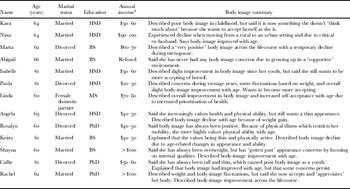
The participants described many and various body-image experiences and attitudes. Eleven expressed some level of dissatisfaction with certain aspects of their bodies, including ‘tummies’, sagging skin, large chests, reduced muscle tone or physical ability, and greying or thinning hair. Interestingly, however, they expressed little desire for change, and generally described themselves as ‘content with’, ‘accepting of’ or ‘positive toward’ their current bodies. They also discussed various factors or experiences that had shaped their body image and how it had fluctuated or remained stable over the course of their lives (see Table 1). Three major themes emerged: key life events that shaped body image; factors influencing body image over the lifecourse; and beliefs about the trajectory of body image over the lifecourse.
The participants' perceptions of their body image

Notes: Pseudonyms are used. 1. Thousands of US dollars over one year. Abbreviations for education level: HSD High school diploma; BS Bachelor's degree; MS Masters degree; PhD Doctor of Philosophy.
Key life events
All the participants identified life events or periods that had shaped their body image by reinforcing their existing perceptions or by acting as a catalyst for body-image change, including physiological changes, cognitive shifts, and changes in the macro-environment. They noted that such events had affected body image in both positive and negative ways.
Physical changes
Nearly all the participants described pivotal life events related to physical change, such as pregnancy, menopause, weight fluctuations, and illnesses. Interestingly, different meanings were attached to similar life events. In regard to pregnancy, for example, Rosalyn (aged 60 years) explained that she had always felt accepting of ‘natural’ bodily changes and viewed pregnancy as an experience that reinforced this value. She reasoned that, ‘it wasn't like my body-image changed. My body changed because I was pregnant and that was normal for a pregnant woman’. In contrast, Rachel (62) described struggling with body image from a young age and found pregnancy a negative experience. During the focus group, which gave her an opportunity to elaborate, she explained that the period was difficult because she felt ‘a lot of pressure’ to ‘get back to [her] former size’. Five of the women identified the menopause as a key period that shaped their body image. In her individual interview, Kristy (61) explained:
There's the fact that your skin dries out and you start to get wrinkles and … hot flashes … but it's even a little deeper … there's something missing now. You're just an old lady (laughs) … you've made a transition from being a fertile woman to being an old woman who's not fertile anymore.
Later, during the focus group, she explained that she viewed the menopause as ‘a real downer’ because she perceived the accompanying physical changes as permanent. Marta (62), whose comments indicated that she had rarely felt body-image concerns in her life, agreed that during the menopause her body image declined, but she used the past tense and described her current body image positively but, in contrast, Kristy, who highly valued physical ability and a youthful appearance, described the concern as ongoing. Seven women described periods of weight gain, which were perceived almost exclusively as negative experiences, and periods of weight loss, almost all of which were perceived as positive experiences. Paula (61) recalled, ‘I lost about 26 pounds two years ago and felt really much better about myself, about the way I looked and felt, (pause) especially the way I looked. I felt more confident about myself, not hiding quite as much’. In contrast, Rachel (62) described an experience of becoming ‘emaciated almost’ through illness and feeling good about a period of weight gain because she associated it with better health. She explained that through this experience she learned to value health more highly than appearance.
Cognitive changes
Nine women described their body image as shaped by changes in attitudes towards their appearance or bodies. Such cognitive changes generally led to a more positive body image and many involved a re-evaluation of the importance of appearance. The cognitive shifts were linked to education, changes in family roles or, as Shayna (60) related, a change in self-perception:
I grew up chubby and … spent a lot of my childhood thinking, ‘oh gee, I'm the biggest one in the class’ … and for some reason, all of a sudden I grew out of it. … I realised there was a lot more to me than being fat. … I started looking at myself as a person and not just a big person … that's what made the difference for me.
Three participants described their cognitive shift as linked to formal education. Linda (60) described her college experience during the 1960s: ‘The women's movement was just getting started … that was pretty critical in my realising how manipulated we all are about … what's desirable in terms of appearance. … I did have a shifting consciousness … there was a dramatic shift’. Marta (62) also described a cognitive shift related to body image as a result of education, but for her the educational experience was influential because of the sense of identity she gained as a result of completing her degree later in life. In her words:
In my younger years … I always lived in the future, thinking about what if and next time … When I got to [age] 50, I was lucky enough to be able to retire and become a student … through that process for me, I thought, ‘This is who I am!’ … In terms of body image, I come from a family of thin people … and my sisters especially would talk to me about my weight. And now I say, ‘Just accept me as I am. I have and I want you to do that too’.
Four others described divorce from a ‘critical’ husband as a catalyst for their change in body image. For instance, when describing her young adulthood, Angela (69) said, ‘I had a husband who was very conscious of my weight. He never wanted me to be heavy … so that was kind of pounded into me’. She later commented that after her divorce ‘there wasn't so much of that constant pressure to keep the weight down’, which allowed her to ‘focus more on just being active and feeling good’. Paula (61) explained that following a divorce she sought professional counselling and by doing so gained confidence, which improved her body image. She said, ‘I used to worry about what other people thought when they looked at me. … I don't so much anymore because it just doesn't matter and I can't change it. I need to feel good about myself, believe in myself’.
Macro-level changes
Three participants identified macro-level changes as key events in shaping their body image. Callie (61), for example, described a change in the media portrayal of beauty as a key life period that positively affected her body image:
When I was in grade school, junior high and into high school … I was tall and skinny, and … I used to get teased. … Then, after Twiggy … in the late sixties, then tall and thin was good. … I could be a little more comfortable in my skin. … I felt very self conscious about being tall the first 30 years. I don't feel self-conscious about being tall anymore.
On the other hand, Nina (64) depicted her lack of concern for appearance in childhood that changed when she moved from a rural farming town to an urban community. For her, the change in environment influenced her awareness of appearance. She became more self-conscious because she wore clothes sewn by her mother, which did not fit the ‘dress code’ in the regional ‘city’. Nina explained that feeling ‘different’ increased her awareness of and her concerns about appearance.
Body-image influences
The participants described a number of influences and experiences that shaped body image over the course of their lives. Although some factors were more salient at particular life stages (e.g. peer teasing in childhood), most seemed to persist throughout life. The influences were identified as coming from inter-personal interactions or from the wider environment.
Inter-personal interactions
Every participant identified inter-personal influences on their body image, whether positive or negative. Eleven related experiences involving family members, such as parents, siblings, or husband. Both Paula (aged 61 years) and Isabelle (61) mentioned the positive influence of interactions with adult daughters on their self-perceptions and acceptance of their own bodies. Paula described a recent improvement in her body image and attributed it partly to the influence of her daughters. She explained, ‘both of them are very much accepting of themselves the way they are, and very encouraging to me. If I say something negative about myself, they usually stop me, and I think just watching their self-confidence helps a lot’. When discussing interactions with other family members, such as mothers and husbands, however, the participants described both positive and negative influences. Five mentioned the negative influence of a spouse. Nina (64), for example, related the following experience:
I think being married to my ex-husband shaped [my body image]. … I remember the day that I brought my first son home from the hospital … his [the husband's] gift to me was a box of … diet candy. … He gave me that and told me to lose the weight, so I think that that sort of brainwashes you.
Five women, however, cited their husbands' acceptance as positive body-image influences. Kara (64) commented, ‘I've been married for 44 years and I have a wonderful marriage. … I think that makes a big difference’.
Many women depicted the influence of their family of origin, five mentioning their mothers, three their fathers, two siblings and two other relatives. Angela (69) stressed the importance of family of origin in shaping her body image. She said, ‘I came from a family where everyone was thin. That was impressed on me at an early age. I have been aware of my weight all my life’. Linda (60), however, described a different reaction to her father, who was very concerned with dieting and maintaining his physical appearance. She commented, ‘it never made me crazy about what I would eat or anything like that, but I think it was just kind of an awareness of [that] “I don't want to be focused on that”’. Five women commented on the role of their mothers, whether positive or negative. Callie (61) described her mother as negatively shaping her body image:
I remember being in early adolescence and coming home from school … my mother had her little bridge club in the living room and one of the women said, ‘Oh, [Callie]'s so lovely, she's so tall’, and my mother said, ‘Yes, it's a shame she's so tall’. (pause) My mother was very embarrassed by how tall I was and that had a profound impact on me … there was a part of me that I felt like a real (pause) like I was cursed.
Three participants, however, described their mothers as positively shaping their body image by providing healthy role models. Marta (62) commented, ‘I never felt bad about my body and I think a lot of that had to do with my mom because she always felt good about her body’. Abigail (66) explicitly described her mother's example as helping her adjust to age-related physical changes, because as she aged she recognised the same physical changes that she had seen in her mother: ‘I see in my body that there is something changed, but … I accept it. I saw this in my mother … and realise I'm following’.
Peer interactions throughout the lifecourse were mentioned, and typified by Kara's (64) description of being teased as a child: ‘I was always overweight as a child, and … kids can be so cruel … elementary school, especially, that was a hard time for me because I was always one of the bigger kids in school’. On similar lines, Kristy described being influenced by her college peers who brought weight concerns to her attention. She explained, ‘I never weighed myself [before college]. I guess I wasn't that conscious of my weight. At one point I remember one of the students saying, “boy, you're really getting chubby!” (laughs) … I started noticing my weight more … so I started weighing myself'. Five women mentioned the role of female friends in adulthood and the importance of their acceptance. Isabelle (61) did not feel judged by her appearance among a group of close female friends, and commented that ‘with girlfriends there is that unconditional love … you don't feel threatened or anything. … You can just be who you want to be’. The participants agreed that close female friendships were valued social groups in which they felt accepted and comfortable with their bodies. Callie (61), however, explained that although she felt comfortable with her friends, she was uneasy in the company of some women because of her tall, thin body. She remarked:
Sometimes I have … older women, women my age or even some [younger] who might be struggling with a lot of weight, and they look at me like they're angry, like this (narrows eyes and mouth). … It makes me very uncomfortable.
Macro-level influences
Ten of the participants perceived macro-level influences as shaping body image throughout their lives. They felt that society shapes body image by dictating an ideal body type and by promoting the importance of appearance. For instance, Callie (61) said, ‘I have this notion that women are in a tough spot because we have, so increasingly as a society, stressed beauty and body, and anti-ageing and that kind of thing, and I think that women are … always making comparisons’. Isabelle (61) described the impact of such appearance-based judgements when she said, ‘I think most women know they are a good person, but … society tells us, you should look this way or that way … there's all these things screaming at you, saying … we should be different [from what we are], and it's hard to accept yourself in this society’. For Abigail (66), however, the macro-environment had encouraged her to accept her body. She described her childhood in Germany in a supportive environment where ‘body shape was no subject of discussion’ and ‘a healthy body was the goal’. Although she left that environment when 30 years-of-age, she maintained that she still accepted her body and age-related changes because of the culture in which she had been raised.
Eight participants explicitly discussed the pervasive influence of the media. Linda (60) identified television portrayals of beauty as influential: ‘The biggest thing is wanting to be thin and look like the stereotypical attractive people you see on TV. … Advertising and the media definitely influence a lot’. Interestingly, several women discussed the media as having a positive or no impact on body image. For example, Marta (62) explained, ‘when I was a teenager, I was … pretty tall and thin and Twiggy was popular and that look of the sixties … and I fit right in with it. So I really didn't think about my body’.
Body image across the lifecourse
The participants were asked to explain whether they believed their body image had changed or remained constant across the lifecourse and how or why they perceived such a path. As with their responses to other prompts, the participants gave diverse and complex descriptions of their body image across the lifecourse. They discussed fluctuations in their thinking about body image and what they valued about their bodies as well as in their self-evaluations.
Perceptions of body image
Eleven of the participants suggested that an important factor in determining body image was their evolving perceptions of what factors comprised body image and the importance they placed on appearance. For example, Linda (60) explained, ‘especially I think for active people … body image … goes from being external to being like, “oh, I've got pain in this joint or this wound that I didn't have before” or “I'm not as mobile as I used to be”’. Many participants perceived that their body image was currently influenced more by health and capability than earlier in their lives. Rosalyn (60) expressed this attitude in regard to dieting saying, ‘now the health issue is there. It's not like, I'm going to [lose 10 pounds], no matter what, and I'm not going to eat anything. We consider [nutrition] and we take the longer road’. Six participants mentioned that with age, they placed less importance on appearance in general and more on character. Shayna (60) said that when she was younger she thought that ‘prettiness and looking feminine … was pretty important’. She went on to say, however, ‘now that I'm older I look more at the wisdom, the inside more than the outside’.
Body-image trajectories
In summarising their body-image trajectories over the lifecourse, the participants revealed disparate experiences. Two described a consistently positive body image and two described decline with age, but the most common perception, shared by nine of the women, was some level of improvement. Five described drastic change and four slight improvements, generally as a result of a cognitive shift regarding their perceptions of appearance or their own bodies. Eight of the participants described fluctuations in their body image through the lifecourse, while the other five described a consistent trend or trajectory. For instance, Kara (64) said that her ‘body image has changed a lot over the years’ in association with weight fluctuations but, in contrast, Rosalyn (60) said that she had ‘felt good about [her] body since childhood’. The women gave diverse accounts of various body-image experiences during their younger years, many of which centred on concerns with weight, height and breasts (some wishing for larger, others for smaller). Paula (61) remarked, ‘I felt very fat in high school at 110 pounds’. In contrast, Rachel (62) recollected being concerned about being small: ‘I was a late maturer [sic] … I remember being really uncomfortable in Junior High School in gym class … wanting to be more developed and not being so and feeling really self-conscious about my body’.
Seven of the women perceived such issues as persistent or still influential on their current body image, while others like Shayna (60), who described weight concerns as a ‘real obstacle’ during her childhood, suggested that they had ‘gotten past them’. Linda (60) explained that ‘in adolescence and especially young adulthood’, she felt ‘very conscious’ of her hips, but that she was no longer concerned about them. Five said that such concerns continued into their later years, but felt that their body image had improved somewhat. For example, Callie (61) explained that although she now has a ‘very positive’ body image and feels comfortable with body, she is still influenced by body-image concerns that developed as an adolescent. She commented, ‘I think that this adolescence image that you have of your body is the one that sticks’.
One aspect of body image across the lifecourse stressed by the participants was that changes had been experienced not only in their physical bodies but also in their cognitive processes. Those who described having overcome body-image concerns did not do so by changing their bodies, but through cognitive change or adaptation. Rachel (62) explained that her body image improved through a process of cognitive adjustment, describing it as a continual process of adaptation with increasing age:
You look at yourself in the mirror and you kind of adjust to who you are as you mature … to who you are in here (points to chest). … You say, ‘Okay, so I'm not where I was, but, I'm okay where I am’. I think you adjust your expectations.
Similarly, for Linda (60), such cognitive adjustments improved body image, not through a change in her self-evaluation but an altered general outlook: ‘[My body image] has gotten better in terms of just being at peace with the body … not like thinking … “oh, I think I look good” or something [like that]. That's just not important; it's more of just an acceptance. … It's just not an issue really’.
Discussion
The views of the women elicited by this study support Ferraro et al.'s (Reference Ferraro, Muehlenkamp, Paintner, Wasson, Hager and Hoverson2008) contention that body-image concerns continue for women as they age, and moreover underline the complexity of lifecourse fluctuations and of the influences on body image for older women. Although previous research has suggested that body dissatisfaction remains relatively stable over the lifespan (Tiggemann Reference Tiggemann2004), the participants in this study related numerous examples of change during their lives. It may be that the in-depth, qualitative methodology enabled the finding to emerge that fluctuations are widely experienced, because it allowed each participant to tell her overall life story and to describe body-image experiences at many life stages (rather than relying on comparisons of the group with women of younger ages). The method also facilitated a broad conceptualisation of body image, which allowed the participants to describe fluctuations in aspects of body image other than overall dissatisfaction. Furthermore, many of the women described processes by which they improved body image or reduced negative outcomes over the lifecourse. These findings have raised our understanding of older women's body image and validate the strengths of a sustained application of the lifecourse perspective.
Ageing and body image
The findings of this study have elucidated the role of ageing in body image and shed light on the inconsistent findings of previous research. Among the participants in this study, the dominant trend in their lives had been improving body image, not through direct evaluations of body size or appearance, but through underlying changes in their attitudes toward appearance and the experiences of body image in their everyday lives. The changes were generally a result of cognitive adjustments and lifecourse events that, we argue, have not been adequately captured by the approaches and instruments used in previous research. The current results support Clarke's (Reference Clarke2002) suggestion that, as women age, they place more value on internal characteristics and gain self-acceptance through attitudinal change. Furthermore, they support the proposition that, as women age, they place less value on appearance, and that this change buffers against negative outcomes such as low self-esteem (Peat, Peyerl and Muehlenkamp Reference Peat, Peyerl and Muehlenkamp2008; Webster and Tiggemann Reference Webster and Tiggemann2003).
A valuable contribution of this study to the body-image literature is the finding that older women have complex conceptions of body image (Whitbourne and Skultety Reference Whitbourne, Skultety, Cash and Pruzinsky2002). Body-image researchers have frequently focused on dissatisfaction with body weight and shape. Weight and age-related changes in appearance were of very real concern to the participants, but their body-image thoughts involved much more than ‘level of satisfaction’ and included evaluations of health and ability, beliefs about the importance of appearance, and feelings about their overall lives. Dissatisfaction with weight has often been seen as synonymous with body image, perhaps because it is easily measured using questionnaire items or silhouette drawing scales (e.g. Thompson and Gray Reference Thompson and Gray1995; Tiggemann and Lynch Reference Tiggemann and Lynch2001). The current findings suggest, however, that older women's body image is conceptually too complex to assess in this way. Many of the women in this study, although expressing concern with certain aspects of their body or appearance, described the rising salience or priority of health and internal attributes. Furthermore, they explained that attitudinal shifts had helped them accept their ageing bodies. Using instruments that were first developed for younger people may not reflect older women's priorities regarding body image, and may therefore undermine the validity of age-group comparisons.
By highlighting cognitive changes, reactions to physical change, and influences of body image across the lifecourse, the presented findings challenge current assumptions about body image and age. Researchers have commonly explored body-image influences during childhood or adolescence (Levine and Smolak Reference Levine, Smolak, Cash and Pruzinsky2002; Smolak Reference Smolak, Cash and Pruzinsky2002), but rarely have they acknowledged the possibility (or probability) that aspects of an individual's body image change throughout adulthood (Whitbourne and Skultety Reference Whitbourne, Skultety, Cash and Pruzinsky2002). For most of the participants in this study, although events from childhood and adolescence influenced body image across the lifecourse, some aspects of body image, particularly attitudes and values, fluctuated and changed in their later years.
The lifecourse perspective
We concur with Thompson (Reference Thompson, Kuh and Hardy2002) that the lifecourse perspective is a valuable framework for understanding the changing experience of body image over time. Our findings also confirm the hermeneutic value of Wethington's (Reference Wethington2005) seven concepts as themes to be addressed when employing a lifecourse perspective, and particularly the returns from a careful examination of ‘linked lives’. It was clear that inter-personal relationships played a major role in body-image concerns and attitudes toward appearance (Pelican et al. Reference Pelican, Vanden Heede, Holmes, Melcher, Wardlaw, Raidl, Wheeler and Moore2005). The most commonly mentioned and most adamantly stressed relationship was that with the spouse. Interestingly, of the five participants who identified their husband as a positive influence, all were still married, but among the five who cited the spouse as a negative influence, all but one had been divorced. While no causal relationship can be inferred, it is clear that the spouse was a vital influence on the participants' constructions of their body image and its development over time. Furthermore, as evidence of the strength of inter-personal influences, some participants perceived that lasting body-image attitudes stemmed from their families of origin.
Wethington's (Reference Wethington2005) concept of transitions or turning points also featured in the results. When asked to identify the factors that had shaped body image, many women described events or periods in their lives that had catalysed changes in the ways they perceived their bodies or in their body-image attitudes. Many of the turning points were physical changes (e.g. pregnancy or menopause) or attitudinal changes (e.g. shifts in self-perception or awareness of societal messages), but biographical, cultural and contextual factors were also prominent. It was evident that, for some participants, the macro-environment in which they were raised was the foundation of their later attitudes toward their appearance and bodies. Although less frequently emphasised, the timing of life events was highlighted clearly by Marta who discussed the change in her body image that came about by attending college later in life. Furthermore, the participants mentioned the influence of historical events and contexts, such as changes in fashion or in societal views of women's roles. Another cultural influence given much emphasis was that of the mass media, which supports the contention that it is a strong purveyor of the ‘thin ideal’ and heavily influences women's own body images (Harper and Tiggemann Reference Harper and Tiggemann2008).
Following Wethington's (Reference Wethington2005) concept of trajectories, our findings clearly portrayed both stable and fluctuating patterns of body-image concerns, attitudes and feelings. Many of the participants described the body-image fluctuations that they had experienced through their lives, and some emphasised continuous changes during adulthood. For example, Rachel (62) described several fluctuations in her adult body image related to weight fluctuations associated with illness and medication. She explained that in her later years, these experiences have caused her to ‘appreciate being healthy more’ and ‘finally to feel happy with who [she] is including [her] body’. Our findings, however, suggest that rather than conceptualising trajectories as simple monotonic trends (in only one direction over time), often there are interruptions and oscillations with successive life stages or life events. Overall, the results support Hatch's contention that adopting a lifecourse perspective can help researchers to avoid drawing ‘simple – and simplistic – comparisons and conclusions’ about a complex social-psychological phenomenon' (2000: 28).
Directions for future research
The findings of this in-depth study have expanded our understanding of older women's body image by identifying those aspects that are most salient to older women and the changes that occur across the lifecourse. An important step for future researchers is to incorporate some of these complexities into future studies and to strive harder to use longitudinal designs and to focus on populations differentiated by gender, ethnicity and age. Among the most interesting findings has been the evidence of the rich diversity of older women's body images. Some of the informants said that they were content with and accepting of their current bodies, while others felt a great deal of concern and the majority expressed intermediate views. Further research is needed to understand why some women ‘get past’ their body-image concerns and others do so only to a lesser extent or not at all. Finally, studies of women who experienced consistent or increasingly positive body image could be valuable for informing therapeutic interventions or eating-disorder prevention programmes.
Acknowledgements
The authors are grateful to Deborah Kerstetter, Andrew Mowen and Patricia Koch for their helpful comments on earlier drafts of this paper.