Introduction
Cincinnatian (Katian, Ordovician) strata of the greater Cincinnati region are well studied, and the facies distribution of this diverse fauna has been documented from the Cincinnatian sequence (Meyer and Davis, Reference Meyer and Davis2009). New crinoid occurrences in a deeper water facies changes current models for the paleoenvironmental distribution of these Ordovician crinoids. Furthermore, it is relatively rare that new taxa or new occurrences are documented. Herein, we describe new stratigraphic occurrences of species of Glyptocrinus and Plicodendrocrinus from the Kope Formation; furthermore, the Glyptocrinus is a new species, G. nodosus, n. sp. These crinoids were discovered as part of a larger excavation for which the entire fauna was collected. Therefore, the paleoecological context of the benthic assemblage associated with this new crinoid is documented.
Geographic and stratigraphic occurrences
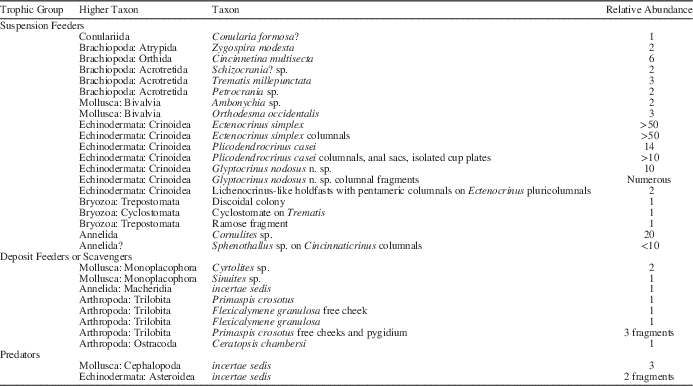
The fauna reported here is from the Pioneer Valley submember, Southgate Member of the Kope Formation along Kentucky Highway 17 in Fort Wright, Kentucky at 39°2′16.9″N; −84°31′53.3″E. All materials were collected by one of the authors (J.W.K). The Kope Formation is Katian (Ordovician) in age. The new glyptocrinid and its associated fauna were excavated from a shale bed that was 1.0 m below bed 10 and 0.5 m above a 10 cm thick weathered siltstone (C.E. Brett, personal communication, 2014; Algeo and Brett, Reference Algeo and Brett2001; Brett and Algeo, Reference Brett and Algeo2001, appendix A, p. 144). Specimens were collected both by screening weathered shale samples from the exposed edge of the bed and by in situ excavation of the unweathered shale bed itself. Associated fauna was recovered from both the in situ beds and the initial screened sample (Table 1). Systematic excavation of the unweathered shale bed followed analysis of the material screened from the weathered shale. The excavated shale bed was 15 to 20 cm thick and rested on a 20-mm thick argillaceous packstone layer. A total of ten crowns of G. nodosus and many pluricolumnals were recovered from the bed along with 14 P. casei crowns and associated fauna (Table 1).
In situ fauna associated with lens containing Glyptocrinus nodosus n. sp.

Unless indicated as columnals, listed crinoids were identified on the basis of complete or partial crowns or calyxes.
In addition to the discovery site for the new G. nodosus, this new species has also been collected by K. Hartshorn from the Remke Market site, Beechmont Avenue, 0.5 mile east of the Little Miami River, Cincinnati, Ohio (N 39°06′28″; W −84°23′45″) (CMCIP 69838). These specimens were collected from float below a large exposure of the Kope Formation. In addition, specimens collected by W. White Sr., S. Felton, D. Cooper and D. Meyer are known from Dry Run Creek along Dry Run Road near U.S Route 50, Milford, Ohio (N 39°08′ 2.5″; W −84°13′19″) (CMCIP 57055, CMCIP 63881, CMCIP 68736). A single specimen of the distal coiled stem of this new species was discovered along Kentucky highway 9 (N 38°57′40.1″; W −84°20′38.5″). This specimen was collected by M. Bonar from float and unlike the other localities, this exposure is higher in the Kope (possibly “Big Shale 5”; ref: outcrop 7, appendix G, p.147, Algeo and Brett, Reference Algeo and Brett2001).
Assemblage paleoecology
The new Glyptocrinus species was preserved in a small shale lens that included much disarticulated crinoid material. Crinoids associated with G. nodosus, include partially complete specimens of Ectenocrinus simplex, Cincinnaticrinus varibrachialus, and Plicodendrocrinus casei (Fig. 1.8). Other faunal elements recovered during the excavation of the shale bed included the inarticulate brachiopod Schizocrania sp., Zygospira modesta (Say in Hall, Reference Hall1847), a conularid, and molluscs (Table 1). In total, 26 taxa (including G. nodosus) were present in this faunal assemblage. This small assemblage was comprised of primarily suspension feeders and deposit feeders, but remains representing both predators and scavengers exist.
Glyptocrinus nodosus n. sp. and Plicodendrocrinus caseyi from the Kope Formation of northern Kentucky. (1–7, 9) Glyptocrinus nodosus n. sp. (1) D-ray view of crown, holotype, CMCIP 71396, ×1.5. (2) Enlargement of Figure 1.1, note nodose sculpturing on interradial plates above the first interradial and on intrabrachial plates, holotype, CMCIP 71396, ×3.0. (3) CD interray view of crown, note strong anitaxial ridge and plate sculpturing, paratype, CMCIP 71397, ×3.0. (4) Partial calyx with column curved back toward crown, paratype, CMCIP 71399, ×1.0. (5) Enlargement of Figure 1.4, note the change in nodosity of the nodals from the proxistele to the mesistele, paratype, CMCIP 71399, ×4.0. (6) Distal-most columnals in holdfast wrapped around the column of a Cincinnaticrinus varibrachialis, note the loss of the characteristic ridge on nodals at the distal-most end (which is upward), paratype, CMCIP 71400, ×4.0. (7) Lateral view of crown with characteristic plate sculpturing and long pinnules, paratype, CMCIP 71398, ×4.0. (9) Distal part of mesistele that is still coiled from the holdfast, paratype, CMCIP 71402, ×4.0. (8) Small individual of Plicodendrocrinus caseyi, CMCIP 71403, ×4.0.
This faunal assemblage occurs immediately above a thin tempestite comprised of argillaceous packstone (interpreted as a time-rich deposit sensu Brett et al., Reference Brett, Algeo and McGlaughlin2003, Reference Brett, Kirchner, Tsujita and Datillo2008a), and it is likely that the initial elements of this assemblage settled on this shell-rich packstone or in muds immediately above the tempestite. The shale interval is interpreted to also represent multiple tempestites as argued by Brett and Algeo (Reference Brett and Algeo2001) and Algeo and Brett (Reference Algeo and Brett2001), which resulted in preservation of crinoid crowns and concentrations of Ectenocrinus pluricolumnals in at least one horizon and the glyptocrinids and dendrocrinids in another horizon above the argillaceous packstone. Regardless, the occurrence of Cincinnaticrinus and Ectenocrinus is regarded as a deep-water crinoid assemblage (Brett and Algeo, Reference Brett and Algeo2001; Algeo and Brett, Reference Algeo and Brett2001; Meyer et al., Reference Meyer, Miller, Holland and Datillo2002; and Brett et al., Reference Brett, Deline and McLaughlin2008b, p. 40). Furthermore, as discussed below, the fact that most of the suspension feeders in this assemblage were secondary tierers (sessile suspension feeders attached to an organism that is attached or otherwise in contact with the substratum, Bottjer and Ausich, Reference Bottjer and Ausich1986) suggests that the assemblage lived on a mud substratum.
The majority of this fauna are either attached suspension feeders or mobile organisms with a variety of feeding styles. The most likely soft-sediment pioneers for this assemblage were mobile bivalves, Ambonychia Hall, Reference Hall1847 and Orthodesma Hall and Whitfield, Reference Hall and Whitfield1875, the brachiopod Cincinnetina Jin, Reference Jin2012, and the crinoid P. casei that had a rhizoid holdfast. Plicodendrocrinus was anchored into the substratum and, therefore, was a primary epifaunally tiered suspension feeder, as was Cincinnetina and probably the conularid. The majority of the remaining suspension-feeding fauna were attached to other organisms and were secondary epifaunally tiered suspension feeders. For example, Zygospira and all of the inarticulate brachiopods were attached to a biological substratum, as were Cornulites von Schlotheim, Reference von Schlotheim1820, Sphenothallus Hall, Reference Hall1847, and bryozoans. Even the three remaining crinoids, G. nodosus, E. simplex, and C. varibrachialis, were secondary tiered suspension feeders. Glyptocrinus nodosus had a holdfast comprised of distal coils that attached around erect Cincinnaticrinus stems (Fig. 1.6); and both Cincinnaticrinus Warn and Strimple, Reference Warn and Strimple1977 and Ectenocrinus Miller, Reference Miller1889 had multiplated Lichenocrinus-type holdfasts that were cemented to hard substrata, such as two specimens collected in this study that were attached to Cincinnaticrinus pluricolumnals. Open, unattached crinoid distal coils are also present. In addition to erect crinoid columns, it is also possible that these coils were attached to an erect bryozoan or to a soft-bodied organism, as suggested by Brett et al. (Reference Brett, Deline and McLaughlin2008b). The remainder of the fauna (cephalopods, annelids, arthropods, and asteroids) were presumably predators, scavengers, or deposit feeders.
The occurrence of Glyptocrinus nodosus in deep-water environments of the bed 9–10 sequence of the Pioneer Valley submember, Southgate Member of the Kope Formation is not typical. Meyer et al. (Reference Meyer, Miller, Holland and Datillo2002) and Brett et al. (Reference Brett, Deline and McLaughlin2008b) recognized a deep-water Cincinnatian crinoid assemblage comprised of Cincinnaticrinus and Ectenocrinus; whereas, they recognized Glyptocrinus to be part of a shallow-water camerate dominated assemblage. In fact, Meyer et al. (Reference Meyer, Miller, Holland and Datillo2002) regarded the occurrence of Glyptocrinus as a proxy indicating shallowing. Previous citations of camerates from the Kope Formation are poorly constrained. Glyptocrinus columnals were reported from the uppermost Kope Formation (indicative of shallowing) (Meyer et al., Reference Meyer, Miller, Holland and Datillo2002), and Pycnocrinus pattersoni (Miller, Reference Miller1882) was reported by Dalvé (Reference Dalvé1948) in the lower Kope (Economy Member) (later workers, Bassler and Moodey, Reference Bassler and Moodey1943 and Webster and Webster, Reference Webster and Webster2014 re-assigned this occurrence of P. pattersoni to the sub-Kope Point Pleasant tongue of the Clays Ferry Formation [formerly Cynthiana Formation]). Although Glyptocrinus had not been reported previously from deep-water facies in the Kope Formation, Brett et al. (Reference Brett, Deline and McLaughlin2008b, p. 46) and Brower (Reference Brower2011) reported glyptocrinids from a relatively deep-water setting in the Rust Formation of New York (Katian).
Co-occurrence of a highly pinnulate camerate in a relatively deep-water setting with the gracile disparids, Ectenocrinus and Cincinnaticrinus, leads to interesting implications for the paleobiology of the glyptocrinids and Cincinnatian crinoid assemblages (Brett et al., Reference Brett, Deline and McLaughlin2008b). Previously, Glyptocrinus and the other Cincinnatian glyptocrinids (Glyptocrinus decadactylus Hall, Reference Hall1847 and Pycnocrinus dyeri Meek, Reference Meek1873) were known from shallower water, high-turbulence facies. Alternatively, the occurrence of G. nodosus in the deeper part of the Kope may be an indication of a subtle paleoenvironmental shift that was too minor to be reflected in the lithology (in the sense of Holland et al., Reference Holland, Miller, Meyer and Dattilo2001). The Kope is a generally swallowing-upward sequence with some degree of variation (Holland et al., Reference Holland, Miller, Meyer and Dattilo2001). Understandably, the more robust Glyptocrinus decadactylus first appears in the upper shallowest portion of the Kope and continues in to the shallow-water sequences in the lower Maysville. The more delicate C. varibrachialus and E. simplex also range into the shallower water lower Maysville (Warn and Strimple, Reference Warn and Strimple1977), possibly indicating a wider tolerance for turbulent conditions than previously thought. However, research by Holterhoff (Reference Holterhoff1997) maintains that the deep quiet-water forms C. varibrachialus and E. simplex survive into the high-energy waters of the Maysville in sheltered habitats that protect them from higher energy waters. While supporting the possibility of low-energy microhabitats existing in generally high energy environments, Holterhoff (Reference Holterhoff1997) maintained that the converse is not likely, i.e., high energy microhabitats are not probable in low-energy deep-water environments. The implication here is that Glyptocrinus may be more tolerant of water depth and current flow than would be indicated by its highly pinnulate form. The gracile form of G. nodosus was simply not suited for the more turbulent conditions of the upper Kope or lower Maysville.
Ordovician crinoids, are thought to have lacked muscles in their arms (Ausich and Baumiller, Reference Ausich and Baumiller1993); therefore, they could not have formed a parabolic filtration fan like modern crinoids (Macurda and Meyer, 1974). The filtration fans of Ectenocrinus, Cincinnaticrinus, and Glyptocrinus could have varied in shape but varied from a narrow to a widely open conical filtration fan. Crinoids with contrasting densities in their filtration fans commonly co-occurred (Kammer and Ausich, Reference Kammer and Ausich1987) and are interpreted to have fed on different-sized food particles, presumably reducing competition for food (Ausich, Reference Ausich1980; Baumiller, Reference Baumiller1993; Kitazawa et al., Reference Kitazawa, Oji and Sunamura2007). However, in general, densely pinnulate arms were more common in settings with higher flow velocities (Ausich, Reference Ausich1980; Kammer and Ausich, Reference Kammer and Ausich1987). As previously known, this was generally the case for Cincinnatian crinoids (Brett et al., Reference Brett, Deline and McLaughlin2008b). Previously, crinoids known from the Kope Formation, Cincinnaticrinus; Ectenocrinus; Dendrocrinus Hall, Reference Hall1852; Iocrinus Hall, Reference Hall1866; Merocrinus Walcott, Reference Walcott1884; and Tenuicrinus Kallmeyer and Donovan, Reference Kallmeyer and Donovan1998 have relatively few arms and would have only been able to create a filtration fan with a low density of branching (Meyer et al., Reference Meyer, Miller, Holland and Datillo2002).
The fact that the densely pinnulate G. nodosus populated a deep-water environment in a wide ranging area confounds the interpretation that Cincinnatian pinnulate forms populated only higher energy environments. Pinnulate crinoids also occurred in this deep-water setting, and the range of filtration fan densities in this Kope community suggestions that even in this deeper setting, crinoids fed on different components of the suspended organics in the water column.
Systematic paleontology
Terminology follows Ubaghs (Reference Ubaghs1978) and Ausich et al. (Reference Ausich, Brett and Simms1999). Repository abbreviations are CMCIP, Geier Collections and Research Center, Cincinnati Museum Center, Cincinnati, Ohio. All measurements are in millimeters; * indicates that the character is incomplete or compressed.
Class Crinoidea Miller, Reference Miller1821
Subclass Camerata Wachsmuth and Springer, Reference Wachsmuth and Springer1885
Order Monobathrida Moore and Laudon, Reference Moore and Laudon1943
Suborder Glyptocrinina Moore, Reference Moore1952
Superfamily Glyptocrinoidea von Zittel, Reference von Zittel1879
Family Glyptocrinidae von Zittel, Reference von Zittel1879
Genus Glyptocrinus Hall, Reference Hall1847
Type species
Glyptocrinus decadactylus Hall, Reference Hall1847; by monotypy.
Remarks
Glyptocrinus and Pycnocrinus, which are superficially similar (see Ausich, Reference Ausich1996 for a discussion of their distinction) are relatively common crinoids from the Katian of the Cincinnati region. Previously, only two species of Glyptocrinus have been recognized, G. decadactylus and G. fornshelli, which are distinctive. Thus, G. nodosus is the third species recognized from the Katian of the Cincinnati region, and it is the seventh species recognized in North America (note that G. quinquepartitus Billings, Reference Billings1859 was defined on the basis of column material and is not included here). Species diagnostic characters for Glyptocrinus are calyx plate sculpturing on the first interradial plate, calyx plate sculpturing on interradial plates above the first interradial plate, presence of a dominant ridge connecting the centers of radial plates, number of primibrachials, number of free arms in each ray, number of secundibrachials, presence of large pinnules if secundibrachials do not branch, brachial type, sinuous ridges on arms, and whether free arms branch.
Glyptocrinus nodosus new species
Types
Holotype: CMCIP 71396; paratypes: CMCIP 71397 to CMCIP 71402 and CMCIP 72700. Additional specimens are CMCIP 57055, CMCIP 63881, CMCIP 68736, CMCIP 69838, and CMCIP 71404. The holotype is from the Pioneer Valley submember, Southgate Member of the Kope Formation in Fort Wright, Kentucky, as noted above.
Diagnosis
Strongly stellate sculpturing on the first interradial plate, finely nodose sculpturing on more distal interradial plates, median ray ridges, the lack of a prominent ridge connecting radial plates in a straight line around the calyx, second primibrachial axillary, second secundibrachial axillary (if branched), each ray has 3 to 4 free arms, on unbranched half-ray a large fixed pinnule is developed, free arms do not branch, lack of a sinuous ridge on arms, column circular, nodals and some internodals with prominent narrow ridge, and downward projecting nodes from nodals.
Occurrence
Kope Formation, Katian (Upper Ordovician); along Kentucky Highway 17 in Fort Wright, Kentucky. It is also known from the Remke Market site on Beechmont Avenue in Cincinnati, Ohio; Dry Run Road, Milford, Ohio near U.S. Route 50; and along Kentucky highway 9 (outcrop 7, Algeo and Brett, Reference Algeo and Brett2001).
Description
Calyx, large in size; medium cone shaped (Fig. 1.1); arms not grouped; calyx plates gently convex, plate sculpturing stellate ridge or finely nodose.
Basal circlet truncate proximally, visible in side view (Fig. 1.2), approximately 10 percent of calyx height; basal plates five, equal in size. Proximal basal circlet expanded into a broad ridge that is indented at plate sutures (Fig. 1.2). One prominent ridge connects to each superjacent radial plate.
Radial circlet averages approximately 20% of calyx height, not interrupted in posterior; radial plates five, heptagonal, approximately 1.2 times wider than high. Strong stellate ridge on each radial plate connecting to basal plates below, adjacent radial plate, ray ridge above, and for C and D radials to anitaxial ridge.
Normal interrays in contact with tegmen (Fig. 1.2), plate sculpturing with strong stellate ridges on the first interradial plate and finely nodose on more distal interradials (Fig. 1.2); first interradial hexagonal, approximately 1.3 times higher than wide, smaller than radial plates, approximately same size as first primibrachials. Second range with two plates and successive ranges with two plates (rarely three). Primanal heptagonal, approximately equal in height and width, as large as radial plates, does not interrupt radial circlet. CD interray plating P-3-3-3-, in contact with tegmen (Fig. 1.3). Anitaxis with antitaxial ridge beginning on primanal; from ridges proximally connecting to the radial plates; strong anitaxial ridge bisects CD interray. Other posterior interradial plates with finely nodose sculpturing (Fig. 1.3).
First primibrachial hexagonal, slightly wider than high, smaller than radial plates and primaxil; second primibrachial axillary, heptagonal if secundibrachitaxis branches. If secundibrachitaxis branched, second secundibrachial axillary, fixed (Fig. 1.2), or secundibrachitaxis unbranched, if unbranched a large fixed pinnule is developed. On branched half-rays, brachials fixed through tertibrachial 5 or 6; if unbranched half-rays, brachials fixed through secundibrachial 5 or 6, which are substantially higher than tertibrachials. Ray ridges occupy one-third of fixed brachial width. Intrabrachial plates medially from the first secundibrachial through fixed tertibrachials and in contact with tegmen (Fig. 1.2); if secundibrachitaxis branches, intrabrachials between half-ray on first tertibrachial, in contact with tegmen. Tegmen unknown.
Free arms 3 to 4 for each ray (Fig. 1.1), atomous. Proximal free brachials moderate cuneate uniserial; aborally very convex. Pinnules very long (Fig. 1.7).
Column circular, holomeric, heteromorphic. In proxistele, nodals very thin, approximately twice as wide as width of secundinternodal, nodals do not have downward projecting nodes (Fig. 1.4, 1.5); and nodals through secundinternodals with progressively narrower central ridge. Mesistele pattern of N-3-2-3-1-3-2-3; columnals higher than in proxistele, with downward directed nodes around periphery of nodals, central ridge only on nodal and secundinternodal (Fig. 1.4, 1.5, 1.9). Columnal facets narrow symplectial articulation (23% of columnal diameter); very narrow areola (14% of columnal diameter); and wide, circular lumen (64% of columnal diameter). Dististele with coiled holdfast, in distal-most end of coiled holdfast nodals lack the prominent ridge (Fig. 1.6).
Etymology
The species name, nodosus, refers to the diagnostic small nodes on interradial plates and the distinctive downward projecting nodes on the nodal columnals.
Remarks
Glyptocrinus nodosus n. sp. is distinct from the more common Glyptocrinus from the Late Ordovician of the Cincinnati region, G. decadactylus, because G. nodosus has strongly stellate sculpturing on the first interradial plate, finely nodose sculpturing on more distal interradial plates, the lack of a prominent ridge connecting radial plates in a straight line around the calyx, second primibrachial axillary, second secundibrachial axillary (if branched), total of 3 to 4 free arms in each ray, on unbranched half-ray a large fixed pinnule is developed, free arms do not branch, brachials uniserial, lack of a sinuous ridge on arms, column circular, nodals and some internodals with prominent narrow ridge, and downward projecting nodes from nodals. Specimens in which some rays have four arms include the holotype (Fig. 1.1–1.3), and a specimen illustrating the condition of three arms in a ray is the paratype CMCIP 72700, which has three arms in the A, B, and E rays. The condition of three arms per ray in the A, B, and E rays is consistent across all specimens examined in this study so that G. nodosus has 17 free arms. In contrast, G. decadactylus has strongly stellate sculpturing on the first interradial plate, strongly stellate sculpturing on more distal interradial plates, the lack of a prominent ridge connecting radial plates in a straight line around the calyx, second primibrachial axillary, second secundibrachial axillary, total of 20 free arms, free arms do not branch, brachials uniserial, lack of a sinuous ridge on arms, column circular, nodals broadly convex, and downward projecting nodes absent on nodals.
Other species currently assigned to Glyptocrinus are distinct, because Glyptocrinus circumcarinatus Parks and Alcock, Reference Parks and Alcock1912 has strongly stellate sculpturing on the first interradial plate, finely nodose sculpturing on more distal interradial plates, a prominent ridge connecting radial plates in a straight line around the calyx, second or third primibrachial axillary, secundibrachial axillary absent, total of 10 free arms, free arms do not branch, brachials uniserial, lack of a sinuous ridge on arms, column circular, nodals with narrow ridge, and downward projecting nodes absent on nodals. Glyptocrinus fornshelli Miller, Reference Miller1874, which also occurs in the Katian of the Cincinnati region, has strongly stellate sculpturing (multiple ridges to adjacent plates) on the first interradial plate, strongly stellate sculpturing (multiple ridges to adjacent plates) on more distal interradial plates, the lack of a prominent ridge connecting radial plates in a straight line around the calyx, second primibrachial axillary, secundibrachial axillary absent, total of 10 free arms, free arms branch, brachials uniserial, lack of a sinuous ridge on arms, column pentagonal, nodals with narrow ridge, and downward projecting nodes absent on nodals. Glyptocrinus ottawaensis Wilson, Reference Wilson1946 has a smooth sculpturing on the first interradial plate, smooth sculpturing on more distal interradial plates, the lack of a prominent ridge connecting radial plates in a straight line around the calyx, second primibrachial axillary, eighth secundibrachial axillary, total of 20 free arms, free arms branch, brachials uniserial, lack of a sinuous ridge on arms, column circular, nodals broadly convex, and downward projecting nodes absent on nodals. Glyptocrinus ramulosus Billings, Reference Billings1856 has a smooth sculpturing on the first interradial plate, smooth sculpturing on more distal interradial plates, the lack of a prominent ridge connecting radial plates in a straight line around the calyx, second primibrachial axillary, sixth secundibrachial axillary, total of 20 free arms, free arms branch, proximal brachials uniserial and distal brachials biserial, lack of a sinuous ridge on arms, column circular, nodals with narrow ridge, and downward projecting nodes absent on nodals. Glyptocrinus tridactylus Brower and Veinus, Reference Brower and Veinus1978 has strongly stellate sculpturing on the first interradial plate, strongly stellate sculpturing on more distal interradial plates, the lack of a prominent ridge connecting radial plates in a straight line around the calyx, second primibrachial axillary, second secundibrachial axillary (if branched), on unbranched half-ray a large fixed pinnule, total of 15 free arms, free arms branch, brachials uniserial but distal brachials biserial, has a sinuous ridge on arms, column circular, and other details of column not known. G. quinquepartitus is based solely on a column, which is pentameric; thus, it is doubtful whether this column fragment represents a species of Glyptocrinus.
Measurements
CMCIP 71396, holotype: crown height, 5.0*; calyx height, 1.2; distal calyx width, 1.4*; column height, 1.1*. CMCIP 71397, paratype: crown height, 2.7*; calyx height, 1.4; distal calyx width, 1.5*; column height, 3.0*. CMCIP 71398, paratype: crown height, 1.7*; distal calyx width, 1.5*; column height, 4.3*.
Subclass Cladida Moore and Laudon, Reference Moore and Laudon1943
Order Dendrocrinida Bather, Reference Bather1899
Superfamily Plicodendrocrinoidea Jell, Reference Jell1999
Family Plicodendrocrinidae Jell, Reference Jell1999
Genus Plicodendrocrinus Brower, Reference Brower1995
Type species
Dendrocrinus casei Meek, Reference Meek1871.
Plicodendrocrinus casei (Meek, Reference Meek1871)
Holotype
Holotype: MCZ 104486.
Description
See Brower (Reference Brower1995, p. 939–941).
Materials
CMCIP 71403 is the new specimen from the Kope Formation.
Remarks
Plicodendrocrinus casei is a relatively common Cincinnatian crinoid, but previously it had only been reported from higher in the Upper Ordovician, Katian (Maysvillian and Richmondian) and Hirnantian strata of North America (Brower, Reference Brower1995). A total of (14) complete and partial cups of this species were collected from the G. nodosus horizon, representing its first occurrence in the Kope Formation. One crown with attached proxistele and partial arms was prone amongst a distal coil and mesistele of G. nodosus on a small plate of shale. The distinctive aboral cup plates and anal sac plates (Fig. 1.8) characterize this species.
Conclusions
Glyptocrinus nodosus n. sp. and Plicodendrocrinus casei are distinctive members of a faunal assemblage unrecognized previously from the Kope Formation. This assemblage was comprised of suspension feeders, predators, scavengers, and deposit feeders. The majority of the suspension feeders were secondary tierers, suggesting the consistency of the substratum was not well suited for settlement by suspension feeders. This is the first documented report of a densely pinnulate camerate crinoid from the relatively deep-water, low turbulence Kope Formation depositional setting; and it is the first occurrence of Plicodendrocrinus casei from the Kope Formation. Thus, this crinoid assemblage is more similar to shallower water Upper Ordovician assemblages.
Acknowledgments
K.L. Hauer, Miami University; D.L. Meyer, University of Cincinnati; and B.R. Hunda and R.M. Fuchs, Cincinnati Museum Center, provided access to collections; C.E. Brett and S.H. Felton helped to understand the stratigraphic occurrence of the primary locality of this study; K.R. Hartshorn donated specimens for this study; and M. Bonar allowed examination of the Kentucky highway 9 specimen in his collection. C.E. Brett and T.W. Kammer provided careful reviews that greatly improved this manuscript.