Introduction
Tomato (Lycopersicon esculentum, Mill.) is the second most consumed vegetable crop worldwide, with a global production of over 160 million tons on 4.7 million hectares (FAOSTAT, 2015). Tomato crops are attacked by a large number of pest species including the tomato borer Tuta absoluta (Meyrick) (Lepidoptera: Gelechiidae), which is spreading over the world and causing serious yield losses (Desneux et al., Reference Desneux, Luna, Guillema and Urbaneja2011; Pfeiffer et al., Reference Pfeiffer, Muniappan, Sall, Diatta, Diongue and Dieng2013; EPPO, 2015; Mohamed et al., Reference Mohamed, Mahmoud, Elhaj, Mohamed and Ekesi2015). Chemical control of T. absoluta is difficult and requires frequent sprays due to its leaf-mining habit and high developmental and reproduction rates. Intensive pesticide use normally results in development of resistance to pesticides by the insect and reduction of natural enemies in the agroecosystem (Guedes & Siqueira, Reference Guedes and Siqueira2012), among other negative environmental and health effects (Pimentel & Burgess, Reference Pimentel, Burgess, Pimentel and Peshin2014). This, together with consumer concern for pesticide residues on tomato fruit necessitates a search for other ways of controlling this pest, such as biological control. In Europe, T. absoluta is now successfully controlled with two natural enemies, the Miridae Macrolophus pygmaeus Rambur and Nesidiocoris tenuis (Reuter) (Hemiptera: Miridae) (Calvo et al., Reference Calvo, Bolckmans and Belda2012a ; van Lenteren, Reference van Lenteren2012; Mollá et al., Reference Mollá, Biondi, Alonso-Valiente and Urbaneja2014). Use of related, native mirid species in South America could decrease insecticide use in tomato and increase uptake of biological control. We therefore initiated a research project aimed at searching and selecting natural enemies native to South America with the characteristics of the above-mentioned European predators. We collected the mirid predators Macrolophus basicornis (Stal), Engytatus varians (Distant) and Campyloneuropsis infumatus (Carvalho) (Hemiptera: Miridae), which appeared to consume large numbers of T. absoluta eggs, and easily establish and develop populations on tomato when feeding on this pest (Bueno et al., Reference Bueno, van Lenteren, Panizzi and Parra2012, Reference Bueno, van Lenteren, Lins, Calixto, Montes, Silva, Santiago and Pérez2013; Silva et al., Reference Silva, Bueno, Montes and van Lenteren2016).
Several mirids are known as efficient predators of a number of tomato pests such as lepidopterans, whiteflies and aphids (Castañé et al., Reference Castañé, Alomar, Goula and Gabarra2004; Albajes et al., Reference Albajes, Castané, Gabarra, Alomar, Bigler, Babendreier and Kuhlmann2006; Urbaneja et al., Reference Urbaneja, Montón and Mollá2009; Calvo et al., Reference Calvo, Bolckmans, Stansly and Urbaneja2009, Reference Calvo, Lorente, Stansly and Belda2012b , Reference Calvo, Soriano, Bolckmans and Belda c ; Bueno et al., Reference Bueno, van Lenteren, Lins, Calixto, Montes, Silva, Santiago and Pérez2013), but unfortunately some mirid species present a potential drawback: they are omnivorous (zoophytophagous) and may cause injury to tomato plants and fruits (El-Dessouki et al., Reference El-Dessouki, El-Kifl and Helal1976; Sanchez, Reference Sanchez2008; Calvo et al., Reference Calvo, Bolckmans, Stansly and Urbaneja2009; Castañé et al., Reference Castañé, Arnó, Gabarra and Alomar2011; Bueno & van Lenteren, Reference Bueno, van Lenteren, Panizzi and Parra2012). Symptoms of plant feeding can be observed on the stems, leaves, flower petioles or fruits, and are characterized by the appearance of necrotic rings on the rachis and petioles of the leaves and flowers, and feeding punctures on the blade of the leaf that turns chlorotic. This reduces the vigour of the plant and may cause flower abortion (Arnó et al., Reference Arnó, Castañe, Riudavets and Gabarra2010; Calvo et al., Reference Calvo, Bolckmans and Belda2011, Reference Calvo, Bolckmans and Belda2012a ). On tomato fruit, injury can be recognized by the appearance of feeding punctures surrounded by whitish halos, blemishes, scars and fruit deformation (Alomar & Albajes, Reference Alomar, Albajes, Alomar and Wiedenmann1996), and it may reduce their quality. Consequently, usage of mirid predators is still considered controversial due to their potential for causing plant damage.
However, besides its possible negative implications in biological control programmes, phytophagy is a feeding strategy which may also provide benefits because it allows these insects to survive by feeding on plants during periods of prey scarcity (Alomar & Wiedenmann, Reference Alomar and Wiedenmann1996; Naranjo & Gibson, Reference Naranjo, Gibson, Alomar and Wiedenmann1996) and may enhance their fitness when they also feed on prey (Naranjo & Gibson, Reference Naranjo, Gibson, Alomar and Wiedenmann1996; Coll & Guershon, Reference Coll and Guershon2002). Interestingly, plant feeding varies a lot in dicyphines depending on ambient conditions, host-plant species and, more strongly, among predator species (Alomar & Albajes, Reference Alomar, Albajes, Alomar and Wiedenmann1996; Castañé et al., Reference Castañé, Alomar and Riudavets2003, Reference Castañé, Arnó, Gabarra and Alomar2011; Gillespie et al., Reference Gillespie, Mcgregor, Sanchez, Van Laerhoven, Quiring, Roitberg, Foottit, Schwartz, Shipp, Vincent, Goettel and Lazarovits2007; Sanchez, Reference Sanchez2008). Actually, whereas serious crop damage has been described for N. tenuis and M. pygmaeus when they occur at high densities (Castañé et al., Reference Castañé, Arnó, Gabarra and Alomar2011; Moerkens et al., Reference Moerkens, Berckmoes, Van Damme, Ortega-Parra, Hanssen, Wuytack and De Vis2016), augmentation of Dicyphus hesperus Knight on tomato is not constrained by fruit or plant damage (Gillespie et al., Reference Gillespie, Mcgregor, Sanchez, Van Laerhoven, Quiring, Roitberg, Foottit, Schwartz, Shipp, Vincent, Goettel and Lazarovits2007; Calvo et al., Reference Calvo, Torres-Ruiz, Velázquez-González, Rodríguez-Leyva and Lomeli-Flores2016). Gillespie & McGregor (Reference Gillespie and Mcgregor2000) proposed three simple models for feeding behaviour in omnivorous Heteroptera: the amount of plant feeding: (1) decreases with increased prey feeding, (2) increases with increased prey feeding, or (3) is independent of the amount of prey feeding. Nesidiocorus tenuis appears to follow the first model because damage to tomato decreased in response to greater availability of Bemisia tabaci (Gennadius) (Hemiptera: Alyrodidae), although its plant damage is also partly related to ambient conditions (Sanchez & Lacasa, Reference Sanchez and Lacasa2008; Calvo et al., Reference Calvo, Bolckmans, Stansly and Urbaneja2009; Sanchez, Reference Sanchez2009). Nesidiocurus tenuis can feed on other pests and on factitious prey like Ephestia kuehniella Zeller (Lepidoptera: Pyralidae) eggs, and the presence of these other suitable food sources reduces plant damage. This knowledge has allowed management of N. tenuis populations in tomato (Calvo et al., Reference Calvo, Bolckmans and Belda2012a ), by maximizing its benefits as a predator and minimizing its disadvantages as an herbivore. Knowing their degree of herbivory and insight in factors or mechanisms which make mirid predators switch between plant and prey food is important before they can be implemented with confidence in practice.
Such information is still lacking for the above-mentioned Neotropical mirids we found, and thus we conducted several experiments designed to answer the following questions: (1) do nymphs and adults of C. infumatus, E. varians and M. basicornis cause injury to tomato seedlings and fruit in the absence of the prey; (2) what type of injury do they cause; and (3) what is the consequence of this injury for the development of seedlings and fruit. Depending on the intensity of injury and economic damage to tomato, decisions can be made to advise one or more of these predators for control of pests in tomato or not.
Material and methods
Plant material
Twenty-day-old tomato seedlings (cv. Santa Clara) with three fully expanded leaves, were used in the experiments. Tomato fruits of the same cultivar were obtained from tomato plants cultivated in a greenhouse under natural light, temperature and humidity. None of the plants were sprayed with pesticides.
Rearing of mirid predators
Stock colonies from field collected material of the three mirids (C. infumatus, E. varians and M. basicornis) were kept on tobacco plants (Nicotiana tabacum L. cv. TNN) at the Laboratory of Entomology, Federal University of Lavras, Minas Gerais, Brazil. For details about collecting field material and starting stock colonies, see Bueno et al. (Reference Bueno, Montes, Pereira, Lins and van Lenteren2012, Reference Bueno, van Lenteren, Lins, Calixto, Montes, Silva, Santiago and Pérez2013). To obtain nymphs for the tests, adult females from the stock colony maintained on tobacco were transferred to cages containing tomato seedlings (cv. Santa Clara) in a climate room at 24 ± 1°C, RH 70 ± 10% and 12-h photophase. After nymphal emergence they were observed daily until they developed to the 3rd or 4th instar and then used in the experiments. Third and 4th instar nymphs were used as these are known to cause most plant and fruit injury in other mirid species (Arnó et al., Reference Arnó, Castañe, Riudavets and Gabarra2006). The same procedure was followed to obtain adult predators, of which individuals of <7 days old were used.
Determination and characterization of injury
For each mirid species, injury to tomato seedlings (i.e. plant feeding) was evaluated by transferring 20 3rd and 4th instar nymphs into a PVC tube (20 × 5 cm2) containing a small plastic cup (8.5 cm diameter × 5.5 cm height) in which a tomato seedling had been planted. The plastic cup and the stem of the seedling were completely surrounded with parafilm to prevent the nymphs from getting water from the substrate. A Petri dish (Ø 9 cm) was placed at the bottom of the PVC tube as a support and the top was sealed with a piece of voile tissue that allowed ventilation. An additional treatment with no mirid nymphs was included. Seedlings were exposed to mirid nymphs for three days, after which nymphs were removed and plant feeding recorded by counting the number of necrotic rings (characteristic symptom of feeding on plant tissue on leaflets, stems and petioles) under a stereomicroscope (magnification 40×, Leica 2000; Arnó et al., Reference Arnó, Castañe, Riudavets and Gabarra2010). Plant feeding was assessed again 3, 6 and 20 days later.
Injury of mirid nymphs of each species to tomato fruit (i.e. fruit feeding) was also studied. The same PVC tubes as mentioned above were used for this test into which one 35–40 mm Ø tomato fruit and four nymphs (two 3rd and two 4th instars) were transferred. An additional treatment with no mirid adults was included. Nymphs were kept inside the tubes for 48 h, after which they were removed. Fruit was maintained at the same conditions thereafter. Three and 6 days later the number of feeding punctures surrounded by small whitish halos (characteristic symptom of feeding on fruit) was counted according to the methodology of Lucas & Alomar (Reference Lucas and Alomar2002) under a stereomicroscope at 40× magnification.
Plant and fruit feeding by adults of each mirid species was evaluated using the same methodology as used for nymphs, with male and females being tested separately. To evaluate plant feeding, 20 adults were introduced into the tubes, and for fruit feeding four adults were put into the tubes.
Survival of nymphs and adults was determined after the 2- or 3-day exposure period to seedlings or fruit.
All treatments (three mirid species, nymphs, male and female adults, seedlings and fruit, and a control without mirids) were randomly distributed in a climate chamber at 24 ± 1°C, RH 70 ± 10% and 12 h photophase. Each treatment was replicated 25 times.
Data analysis
Prior to analysis, the data were tested for normality and homogeneity of variance using the Shapiro–Wilk and Bartlett tests, respectively. Data were log transformed when necessary. Number of necrotic rings on leaflets and the number of feeding punctures on fruits were subjected to a one-way ANOVA (α = 0.05) and contingent on significant differences among treatments, data were analysed with a Tukey's test for mean separation (α = 0.05). Differences between numbers of injury caused by male and female adults were analysed by a χ2 test (α = 0.05). Nymphal and adult survival data were evaluated using a Kaplan–Meier survival analysis, and differences between mirid species were analysed using a log-rank test; differences were considered significant at P < 0.05. All tests were analysed by the statistic software R Development Core Team (2014).
Results
Plant injury
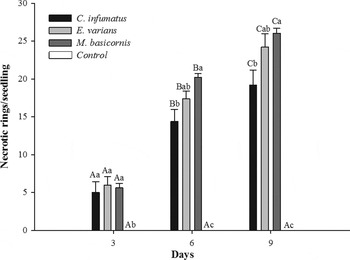
Although little plant injury was recorded on seedlings exposed to mirid nymphs when they were removed (fig. 1), it was significantly greater than on non-exposed plants (F 3,96 = 30.34; P < 0.0001). Three days after removal of all nymphs, injury to seedlings had significantly increased (M. basicornis: F 1,49 = 2.41; P = 0.0015; E. varians: F 1,49 = 1.81; P = 0.0018; C. infumatus: F 1,49 = 3.52; P = 0.0015), with seedlings exposed to M. basicornis nymphs exhibiting significantly more necrotic rings compared with those exposed to C. infumatus (F 2,72 = 4.505; P < 0.0143), while injury caused by E. varians was intermediate. Six days after the removal of nymphs, the numbers of necrotic rings per seedling had again significantly increased and were ca. fivefold greater on plants exposed to M. basicornis and E. varians, and fourfold greater on those exposed to C. infumatus when compared with numbers recorded 3 days earlier (M. basicornis: F 1,49 = 4.50; P = 0.014; E. varians: F 1,49 = 6.54; P = 0.0016; C. infumatus: F 1,49 = 8.22; P = 0.0016). Again, more necrotic rings were observed on seedlings exposed to M. basicornis compared with those on which C. infumatus had been released, with intermediate numbers on plants with E. varians (F 2,72 = 3.81; P = 0.0266). No new necrotic rings were found on the leaflets during the final check 20 days after removal of the nymphs (no detailed results shown). Nymphal exposure to seedlings appeared to have no negative effect on plant growth.
Number of necrotic rings (mean ± SE) on leaflets of tomato seedlings after 72 h exposure to C. infumatus, E. varians and M. basicornis nymphs or without exposure to mirids (control). Different capital letters indicate a significant difference in feeding rings between the same species and the control at days 3, 6 and 9; different lowercase letters indicate a significant difference among the three species and the control on the same day (Tukey's test, P ≤ 0.05).

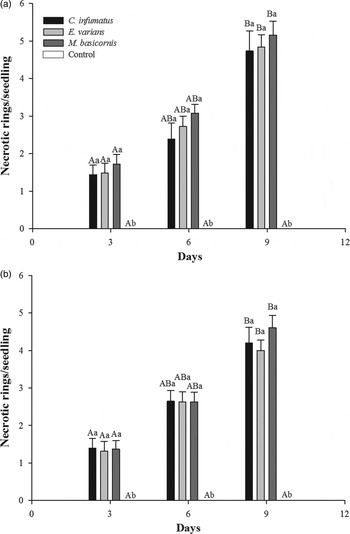
Symptoms of plant feeding by adult males and females of the three mirid species looked like those of nymphs. However, on average fewer necrotic rings were observed on adult-exposed than on nymph-exposed plants at the day when the insects were removed (figs 1 and 2). As expected, more plant injury was recorded on all male and female mirid-exposed than on non-mirid-exposed plants (females: F 3,96 = 23.52; P < 0.0001; males: F 3,96 = 29.30; P < 0.0001), with both males and females producing similar plant injury (M. basicornis: χ2 2 = 4.20; P = 0.538; E. varians: χ2 2 = 6.25; P = 0.522; C. infumatus: χ2 2 = 4.21; P = 0.418) (fig. 2a, b). Three days later, severity of plant injury had not increased significantly over that recorded just after the removal of the adults (M. basicornis: female: F 1,49 = 2.71; P = 0.510; male: F 1,49 = 4.25; P = 0.505; E. varians: female: F 1,49 = 4.18; P = 0.577; male: F 1,49 = 3.15; P = 0.445; C. infumatus: female: F 1,49 = 6.52; P = 0.552; male: F 1,49 = 4.41; P = 0.505), with males and females of the three mirid species producing again similar plant injury (M. basicornis: χ2 2 = 85,56; P = 0.256; E. varians: χ2 2 = 85,56; P = 0.256, C. infumatus: χ2 2 = 85,56; P = 0.256). Contrarily, 6 days after the first evaluation, ca. five times more necrotic rings were found on all adult mirid-exposed plants compared with the day of removal of adults (M. basicornis: females: F 1,49 = 3.81; P = 0.0266; males: F 1,49 = 4.19; P = 0.0347; E. varians; females: F 1,49 = 2.72; P = 0.0241; males: F 1,49 = 3.25; P = 0.0227; C. infumatus: females: F 1,49 = 3.81; P = 0.0141; males: F 1,49 = 4.19; P = 0.0317). Once more, both sexes of the three mirid species produced similar plant injury (M. basicornis: χ2 2 = 81.41; P = 0.124 E. varians; χ2 2 = 81.41; P = 0.124 C. infumatus; χ2 2 = 81.41; P = 0.124). Two weeks after the first inspection, no negative effects were observed on plant growth and no new necrotic rings were found on seedlings (detailed data not shown).
Number of necrotic rings (mean ± SE) on leaflets of tomato seedlings after 72 h exposure to C. infumatus, E. varians and M. basicornis females (a) and males (b), or without exposure to mirids (control). Different capital letters indicate a significant difference in feeding rings between the same species at days 3, 6 and 9 and the control; different lowercase letters indicate a significant difference among the three species and the control on the same day (χ2 test, P < 0.05).

Analysis of data revealed that nymphs of the three mirid species produced more plant injury than adults (M. basicornis: F 1,48 = 9.80; P < 0.0001; E. varians: F 1,48 = 11.54; P < 0.0001; C. infumatus: F 1,48 = 11.22; P < 0.0001).
Fruit injury
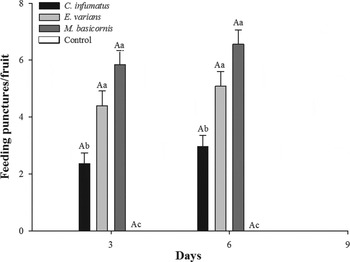
Three days after removal of nymphs, the number of feeding punctures on all mirid-exposed fruits were significantly higher than on non-exposed fruits (F 3,96 = 12.41; P = 0.0012). Macrolophus basicornis and E. varians nymphs caused similar amounts of fruit injury, but twofold greater than C. infumatus nymphs (F 2,72 = 14.07; P < 0.001) (fig. 3). Fruit injury did not increase significantly over the next 3 days on fruits exposed to any of the mirid species (M. basicornis: F 1,48 = 6.11; P = 0.0256; E. varians: F 1,48 = 12.01; P = 0.0301; C. infumatus: F 1,48 = 9.072; P = 0.0141), although again M. basicornis and E. varians nymphs inflicted twofold more fruit injury than C. infumatus (F 2,72 = 14.55; P < 0.001). Ten days after removal of the nymphs, the number of feeding punctures had not increased over the previous evaluation and the fruit still looked fresh, showing no wrinkles. Interestingly, no feeding punctures or any other kind of symptom of fruit feeding were observed on fruits exposed to adult male and females at any of the sampling days.
Number of feeding punctures (mean ± SE) on tomato fruit after 48 h exposure to C. infumatus, E. varians and M. basicornis nymphs, or without exposure to mirids (control). Different capital letters indicate a significant difference in feeding punctures per fruit within the same species 3 and 6 days after the removal of nymphs and the control; different lowercase letters indicate a significant difference among the three species within the same day and the control (Tukey's test, P ≤ 0.05).

Nymphal and adult survival during exposure to seedlings and fruit without prey
The percentage of nymphs surviving after the 3-day exposure period on tomato seedlings was similar for M. basicornis, E. varians and C. infumatus: 62.3, 65.5–65.9%, respectively (χ2 2 = 16.61; P = 0.255). Adult female survival after exposure to seedlings was 75.1, 79.0 and 81.1% for M. basicornis, E. varians and C. infumarus, respectively. Adult male survival after exposure to seedlings was 72.8, 77.3 and 78.5% of M. basicornis, E. varians and C. infumatus, respectively. Survival for males and females was similar (χ2 2 = 21.10; P = 0.715), but higher than nymphal survival (M. basicornis: female: χ2 2 = 42.21; P < 0.023; male: χ2 2 = 42.61; P < 0.023; E. varians: female: χ2 2 = 39.24; P < 0.036; male: χ2 2 = 36.24; P < 0.036 and C. infumatus: female: χ2 2 = 42.55; P < 0.012; male: χ2 2 = 42.55; P < 0.012).
Most nymphs of the three species survived the 2-day exposure to tomato fruits (M. basicornis: 93.4%; E. varians: 95.5%; and C. infumatus: 98.2%). Adult females showed similar survival rates as nymphs: 85.2, 88 and 86% for M. basicornis, E. varians and C. infumatus, respectively. However, a significantly smaller proportion of males than females (χ2 2 = 25.75; P < 0.05) survived the exposure period to fruit (70, 75 and 75% for M. basicornis, C. infumatus and E. varians, respectively).
Discussion
In general, symptoms of plant feeding (necrotic rings) by M. basicornis, E. varians and C. infumatus were similar to those described for other mirid species such as N. tenuis, M. pygmaeus and D. hesperus (McGregor et al., Reference McGregor, Gillespie, Park, Quiring and Foisy2000; Arnó et al., Reference Arnó, Castañe, Riudavets and Gabarra2006, Reference Arnó, Castañe, Riudavets and Gabarra2010; Shipp & Wang, Reference Shipp and Wang2006; Calvo et al., Reference Calvo, Bolckmans, Stansly and Urbaneja2009, Reference Calvo, Lorente, Stansly and Belda2012b , Reference Calvo, Torres-Ruiz, Velázquez-González, Rodríguez-Leyva and Lomeli-Flores2016; Castañé et al., Reference Castañé, Arnó, Gabarra and Alomar2011), though we detected no evidence of plant feeding on stems and leaf petioles. The numbers of necrotic rings per individual mirid for all the mirid nymphs we tested were well above of the ca. 0.5 rings per nymph estimated by Arnó et al. (Reference Arnó, Castañe, Riudavets and Gabarra2010) for N. tenuis nymphs on tomato. Nevertheless, the number of nymphs and adults we used in our test simulated a density much higher than the densities found in commercial fields sampled by Arnó et al. (Reference Arnó, Castañe, Riudavets and Gabarra2006), in which densities of adults and nymphs of N. tenuis together ranged between 0.13 and 5.23 per plant. Consequently, if typical densities for M. basicornis, E. varians and C. infumatus in tomato greenhouses range between similar levels to those reported for N. tenuis, we may expect acceptable plant injury. Even at the high densities we found no negative effects on plant growth in response to plant feeding, which might be due to the capability of seedlings to heal wounds, ultimately resulting in disappearance of necrotic rings. Similarly, Arnó et al. (Reference Arnó, Castañe, Riudavets and Gabarra2006) observed that the majority of the brown rings caused by feeding of N. tenuis adults on plants had disappeared seven days after removal of the predators.
Phytophagy in omnivorous biological control agents may actually be a positive characteristic because these agents may survive periods of prey shortage in the crop by feeding on plant tissue (Naranjo & Gibson, Reference Naranjo, Gibson, Alomar and Wiedenmann1996; Wiedenmann et al., Reference Wiedenmann, Legaspi, O'Neil, Alomar and Wiedenman1996). Additionally, phytophagy also has the potential to stabilize predator pest population dynamics, which contributes to the success of biological control (Lalonde et al., Reference Lalonde, McGregor, Gillespie and Roitberg1999). On the other hand, phytophagy may weaken the plant, cause flower abortion and fruit injury resulting in economic losses. Consequently, when using mirid predators for pest control, managing of plant feeding is crucial to maximize their benefits as predators and minimize their disadvantages as herbivores. Management of plant feeding requires knowledge about mechanisms and factors that make the insects switch between arthropod or plant food. Earlier research on other mirid species suggests that the severity of plant feeding depends for a large part on the mirid species, as well as on extrinsic factors such as plant species/cultivar, location of the feeding site on the plant, physiological status of the host plant, ambient conditions and availability of prey (Castañé et al., Reference Castañé, Alomar and Riudavets2003, Reference Castañé, Arnó, Gabarra and Alomar2011; Gillespie et al., Reference Gillespie, Mcgregor, Sanchez, Van Laerhoven, Quiring, Roitberg, Foottit, Schwartz, Shipp, Vincent, Goettel and Lazarovits2007; Sanchez, Reference Sanchez2008; Calvo et al., Reference Calvo, Bolckmans, Stansly and Urbaneja2009). Some of the intrinsic characteristics that determine the severity of plant feeding are cells or tissues used for feeding (e.g. phloem or xylem), length of a feeding bout, constituents of the predator's saliva such as hydrolytic enzymes, amount of saliva injected into the plant tissue and insect development stage (Cohen, Reference Cohen, Alomar and Wiedenmann1996; Carter, Reference Carter1973 in Wheeler, Reference Wheeler2001; Arnó et al., Reference Arnó, Castañe, Riudavets and Gabarra2010). Unfortunately, our results do not allow us to distinguish among the mechanisms that mediated the feeding behaviour of these mirids, and therefore, more specific research is needed to obtain better understanding about this important aspect. Nevertheless, our findings show that C. infumatus is the safest species among those we tested in terms of fruit feeding, at least under a worst case scenario of high predator density and absence of prey. Fruit and plant feeding data of different species may help in selecting the best candidate species for use in tomato crops. Interestingly, and similarly as reported by Arnó et al. (Reference Arnó, Matas, Marti, Ariño, Roing and Gabarra2005) for N. tenuis, nymphs of M. basicornis, E. varians and C. infumatus caused more plant injury than adult males and females. Moreover, whereas we found feeding punctures on fruits exposed to nymphs, no fruit injury was recorded on fruits exposed to adults of the three mirids.
Mirids, as many herbivores, generally feed on tissues with the highest content of available nitrogen (White, Reference White1978), but nymphs and adults may have different nutritional needs. This could explain why adults did not cause fruit injury in our experiments, whereas nymphs did. Adults of several other mirids, such as M. pygmaeus, N. tenuis and D. tamaninii, may cause more serious injury to tomato fruit than the three mirid species we studied (Lucas & Alomar, Reference Lucas and Alomar2002; Arnó et al., Reference Arnó, Castañe, Riudavets and Gabarra2010; Moerkens et al., Reference Moerkens, Berckmoes, Van Damme, Ortega-Parra, Hanssen, Wuytack and De Vis2016), especially when prey is scarce (Alomar & Albajes, Reference Alomar, Albajes, Alomar and Wiedenmann1996; Sanchez & Lacasa, Reference Sanchez and Lacasa2008; Arnó et al., Reference Arnó, Castañe, Riudavets and Gabarra2010). Additionally, McGregor et al. (Reference McGregor, Gillespie, Park, Quiring and Foisy2000) observed that substantial fruit feeding by D. hesperus females only occurred in absence of tomato leaves. Our study does not allow us to conclude whether M. basicornis, E. varians and C. infumatus prefer leaves to fruit for plant feeding, but in experiments with a tomato crop in large cages simulating greenhouse conditions, none of the three mirids caused substantial fruit injury (van Lenteren et al., Reference van Lenteren, Bueno, Calvo, Calixto, Montes and Soares2016a , Reference van Lenteren, Hemerik, Lins and Bueno b ). Although our results suggest that the three mirids cause limited leaf and fruit injury, situations with very high nymphal densities in absence of animal food might result in some damage. Experience obtained in European tomato crops has taught us that, if plant feeding is caused by the lack of prey, addition of a supplementary food such as E. kuehniella eggs may prevent or mitigate damage: Arnó et al. (Reference Arnó, Castañe, Riudavets and Gabarra2006); Sanchez & Lacasa (Reference Sanchez and Lacasa2008) and Calvo et al. (Reference Calvo, Bolckmans, Stansly and Urbaneja2009) demonstrated that the number of necrotic rings produced by N. tenuis was inversely correlated with the density of prey. Additionally, adaptation of the rate of predator release may also help in reducing the negative effects of plant feeding (Calvo et al., Reference Calvo, Bolckmans and Belda2012a ).
Nymphal mortality of the three mirid species after exposure for 3 days to seedlings (ca. 35%) was considerably higher than the estimated 10% mortality on tomato with T. absoluta eggs (Silva et al., Reference Silva, Bueno, Montes and van Lenteren2016). Also adult mortality after 3-days exposure to seedlings (ca. 20%) and after 2-days exposure to fruit (ca. 13%) was higher than the estimated < 1% mortality during 2–3 days on tomato with T. aboluta eggs (Silva et al., Reference Silva, Bueno, Montes and van Lenteren2016). This indicates that, as found for other mirids on tomato (Sanchez et al., Reference Sanchez, Gillespie and McGregor2003; Urbaneja et al., Reference Urbaneja, Tapia and Stansly2005; Hamdi et al., Reference Hamdi, Chadoeuf and Bonato2013; Moerkens et al., Reference Moerkens, Berckmoes, Van Damme, Ortega-Parra, Hanssen, Wuytack and De Vis2016), these three Neotropical mirids need animal food for optimal development and survival when reared on tomato.
The results of this study indicate for the first time that the 3rd and 4th nymphal instars and adults of three Neotropical mirids cause limited injury to tomato seedlings and fruits. The necrotic rings are small and do not result in deformation of leaves, stems, flowers or fruit. This is a very positive finding, and together with their impressive predation capacities (Bueno et al., Reference Bueno, van Lenteren, Lins, Calixto, Montes, Silva, Santiago and Pérez2013; van Lenteren et al., Reference van Lenteren, Bueno, Calvo, Calixto, Montes and Soares2016a , Reference van Lenteren, Hemerik, Lins and Bueno b ) may make these species interesting candidates for biological control of tomato pests.
Acknowledgements
We thank the Coordination for the Improvement of Higher Education Personnel (CAPES) by CAPES/NUFFIC Project 044/12, the National Council for Scientific and Technology Research (CNPq) and the Foundation for Support of Research of Minas Gerais (FAPEMIG) for financial support.