Introduction
Road traffic collisions (RTC) are currently the eighth most common cause of death across all age groups worldwide, accounting for more than 1.2 million deaths per year, and are the leading cause of death for those 5–29 years old. 1 In addition, RTCs are the leading cause of disability-adjusted life years in developing countries for individuals between 5 and 14 years old. It is predicted that if left unrestrained by 2030, RTCs will surpass diabetes mellitus becoming the seventh most common cause of death worldwide. 2
The United Nations (UN) General Assembly passed a resolution in 2010 to reduce RTC by 50% by the year 2020, dubbed “The Decade of Action for Road Safety.” Member countries were to encourage policy-makers to implement 5 pillars: road safety management, safer roads and mobility, safer vehicles, safer road users, and post-crash response. 3
According to the World Health Organization (WHO), the African continent has the highest rate (26.6/100 000 population) of RTC. Additionally, Nigeria has a rate of 21.4/100 000 population compared to a world average of 18.2/100 000 population. 1 As of 2012, Nigerian vehicle registration data document 46.0 vehicles/1000 population ranking the country as 114 out of 150 globally in vehicle ownership. 4 Nigeria is regarded as a middle income country with a gross national income per capita of US $2450 and a gross domestic product (GDP) of US $397.5 billion in 2018. 5 Low and middle income countries lose an average of 5% of their GDP, while approximately 3% of the yearly total world GDP lost is due to road traffic deaths and injuries. 1
In February 1988, the Federal Government of Nigeria created the Federal Road Safety Commission. However, the National Assembly did not fund the agency until an Act of Establishment in 2007. 6 The “Commission” includes the appointed leaders of the Federal Road Safety Corps (FRSC), while the “Corps” includes the commanders and officers who enact policies in different regions. The mission statement of the FRSC is to “regulate, enforce and coordinate all road traffic and safety management activities through: sustained public enlightenment, promotion of stakeholder’s cooperation, robust data management, improved vehicle administration, prompt rescue services and effective patrol operation.” 7
In 2003, the National Assembly passed mandatory seatbelt use legislation requiring the use of seatbelts for all adult front and rear vehicle passengers. Reference Oluwadiya, Kortor and Denen-Akaa8 Further legislation included prohibitions against the use of mobile phones while driving in 2006. 9 In 2009, the FRSC was authorized to establish “Zebra points,” which are emergency medical stations on highways that responded to road traffic accidents. 10 That same year, the use of helmets while riding a motorcycle became mandatory. Reference Oboh11 The FRSC also established “model driving schools,” an educational program for drivers and pedestrians. 12 In 2010, the FRSC re-evaluated the driving school system, standardizing the national process, and increased training for driving school instructors to improve the quality of driving instruction. 12 In 2017, the FRSC made it a requirement that commercial vehicles (buses, trucks, vans, and tankers) have an electronic speed-limiting device fitted in the vehicle to ensure the vehicle remains within speed limits. 13
The FRSC implemented multiple laws and programs to reduce RTC casualties, but these interventions are not sufficient. The purpose of this trend analysis is to highlight the causes and trends in RTC in Nigeria to suggest interventions that could reduce the rate of RTC and realize the goals of the Decade of Action for Road Safety Initiative.
Materials and Methods
Data Collection
This is a retrospective, observational study of quantitative, longitudinal outcomes of RTC in Nigeria, and their temporal relation to road traffic accidents, and traffic legislation. Outcome data were retrieved from the WHO Global Status Report on Road Safety from 2009–2018. 1,2,14,15 The data on the number of reported RTC over a 10-year period (2007–2017) were obtained from the FRSC of Nigeria. 16 Information obtained from the FRSC included the annual RTC cases, fatalities, injuries, total casualties, number of registered private and commercial motorcycles, and vehicles nationwide from 2007–2017. 16 The classification of vehicles involved as well as the main cause of crashes (as determined by FRSC officers) were also analyzed. Beth Israel Deaconess Medical Center (Boston, MA) Internal Review Board approval was not required for this research, as all data collected were obtained from the publicly available databases of the FRSC and the WHO.
Data Analysis
Data were entered into a Microsoft Excel™ spreadsheet (Microsoft Corporation, Redmond, WA) for Mac version 16.38 for analysis. FRSC data were used to measure the total number of RTC, fatalities, injuries, and casualties for the 10-year period, the yearly percentage change in each of these data, and the percentage change of each data series over the full study period. The percentage changes from the baseline, and from the previous year were calculated for deaths and injuries for each year. The rates of each data series per 100 000 population and per 10 000 registered vehicles (RVs) were calculated based on data from the World Bank census for Nigeria from 2007–2017 and the FRSC annual reports from 2007–2017, respectively. Percentage changes from the baseline and yearly changes for these rates were also calculated. Trends in total casualties (TC), deaths, injuries, rates per 100 000 population, and 10 000 vehicles were graphed and analyzed for each year.
Results
RTC Events, Casualties, Injuries, and Fatalities
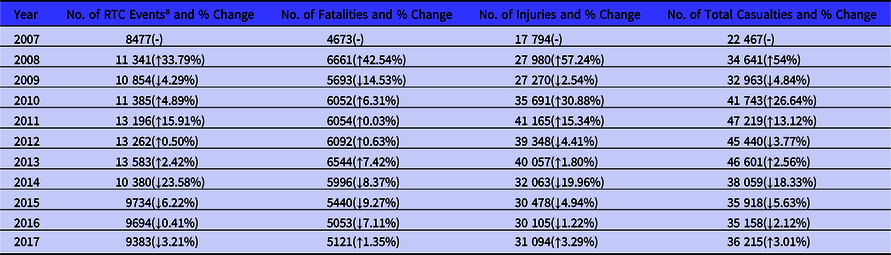
Over the full study period, there was a 10.7% increase in total RTC. There was an initial increase in total RTC from 2007–2008. This was then followed by a general plateau until 2014 when it began trending downward (Table 1).
Road traffic collision events, fatalities, injured, and total casualties from 2007–2017

Notes:
a RTC involving multiple vehicles is regarded as 1 RTC event, hence the difference in numbers.
↓ = Decrease
↑ = Increase
There was also a 9.6% increase in fatalities over the study period. This followed the trends of RTC events. There was wide year-to-year fluctuation in the rates, with swings as wide as 42.54% (see Table 1).
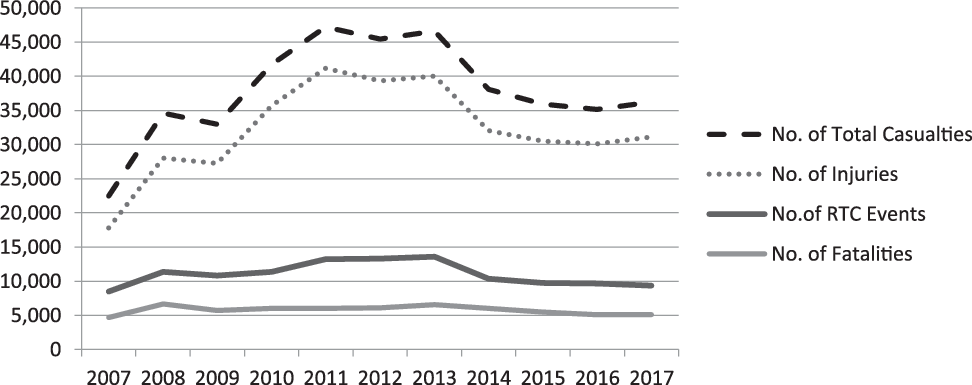
Total injuries rose steeply by 74.7% over the study period. This was fueled by large increases in the first years, with general stabilization in the last years of the study (see Table 1). Table 1 also shows an increase of 61.2% in total casualties over the full study period. This was again due to large increases from 2007 to 2011; subsequent casualties stabilized and began to decline (Figure 1).
Number of RTC events, fatalities, injuries, and total casualties from 2007–2017.

Per Population Rates
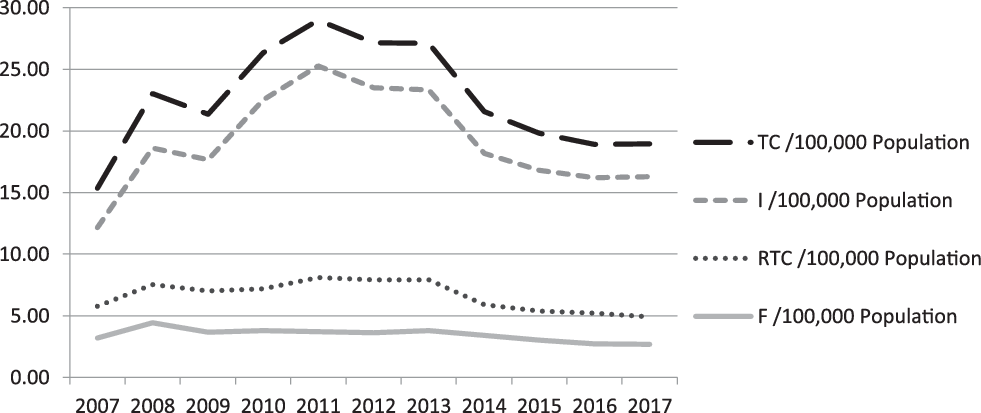
Figure 2 shows casualty rates per 100 000 population increased from 15.3 in 2007 to 18.9 in 2016. Injury rate per 100 000 population more than doubled from 12.2 in 2007 to 25.3 in 2011 and have declined steadily to 16.2 in 2016. Overall, there was an increase in injury rate over the 10-year period. The RTC rate declined over the 10-year period from 5.8 in 2007 to 4.9 in 2017. There were sharp increases in the RTC rate between 2007 and 2011, but, from 2012, the rates declined. Fatality rates also declined over the 10-year period from 3.2 in 2007 to 2.7 in 2017.
Trends in RTC, fatalities, injuries, and total casualties (TC) rate per 100 000 population from 2007–2017.

Per Registered Vehicle Rates
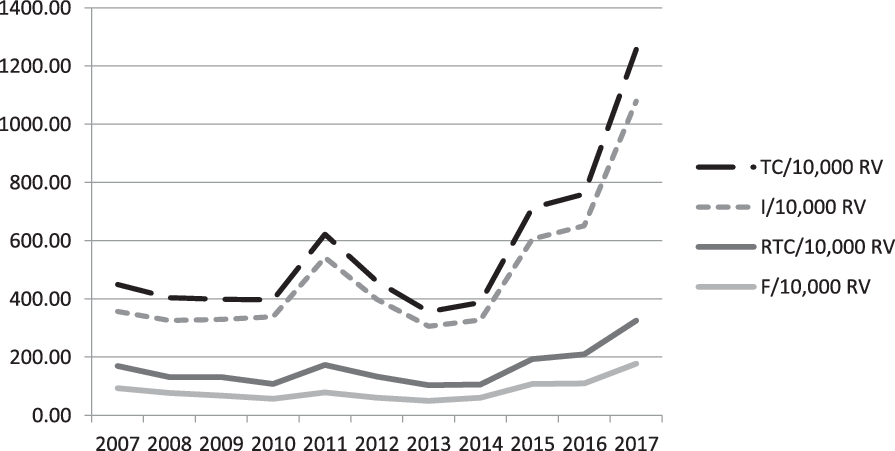
Figure 3 shows rates of total casualties per 10 000 RV, showing an overall increase from 450.7 in 2007 to 1257.6 in 2017. Similar trends were observed in total casualties and injury rates: from 356.6 to 1079.8 over the same period. RTC rates per 10 000 RV showed an overall increase from 170 in 2007 to 325.8 in 2017, the highest figure it reached in the last decade. From 2007–2013, the rate decreased from 170 to 103.8 but rapidly rose from 2013 to 2017. RTC fatalities over the 10-year period exhibited a fluctuating pattern of decrease from 93.7 in 2007 to 50.0 in 2013. However, there was a reversal of the downward trend from 2014–2017. In 2017, the RTC fatality rate was 177.8.
Trends in RTC, fatalities, injuries, and total casualties rate per 10 000 registered vehicles from 2007–2017.

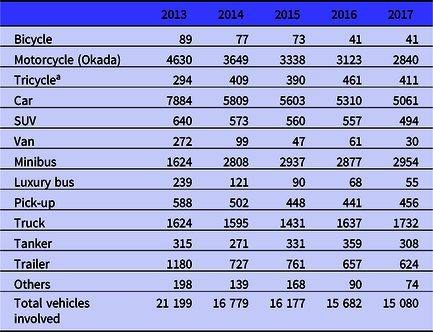
Table 2 illustrates that cars (sedans), motorcycles, and minibuses were the most common types of vehicles involved in RTC. Since data collection was standardized in 2013, there was a drop in the percent of RTC attributed to cars from 37.2% to 33.6%. Motorcycles have also fallen as a percent of total RTC involved vehicles from 21.8% to 18.8%. However, this has been accompanied by a rise in the percent of crashes involving minibuses from 7.7% in 2013 to 19.6% in 2017.
FRSC classification of the vehicle types involved in RTC from 2013–2017

Notes: Data through 2012 is incomplete and not included in analysis.
a Tricycle – also known as auto rickshaw (or keke napep locally) – is a motorized 3-wheeled vehicle with a driver and multiple passenger seats typically used for commercial taxi services.
Main Causes of RTC
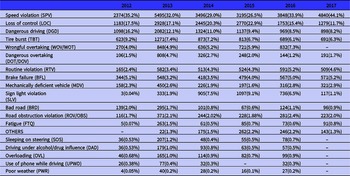
Table 3 shows that speed violations (SPV) have consistently been the leading cause of RTC. There was a steady percentage decrease in SPV from 2012 to 2015, though the drop from 2012 to 2013 was driven more by the overall increase in recorded RTC as opposed to a drop in SPV. However, there was an increase in 2016 and 2017. Loss of control (LOC) was the second most common cause of RTC in Nigeria throughout the study period and initially showed an increase from 2012 to 2015 but began declining afterward. Dangerous driving (DGD), the third most common cause of RTC, showed a steady percentage decline from 2012 to 2017. Tire bursts (TBT) showed a gradual percentage decline of RTC from 2012 to 2016 but a slight increase in 2017.
Probable causative factor of RTC as determined by FRSC personnel

Notes: Probable causative factor of RTC data reporting started in 2012. Missing data were not included in the report for those years.
Parentheses denote the percent of the total for that year.
Discussion
To help countries reduce road traffic fatalities and injuries in 2015, the UN published the “Save LIVES” technical package, which outlines goals for decreasing RTC fatalities, as well as specific, evidence-based expert consensus on interventions that can aid in the accomplishment of these goals. 17 “Save LIVES” is a road safety acronym for speed management, leadership on road safety, infrastructural modifications, vehicle safety standards, enforcement of traffic laws, and survival after a crash.” 17
Nigeria has already established certain elements of this core package, such as establishment of the FRSC, speed limits, laws mandating use of seatbelts, helmets, and banning drunk driving. However, further work is required to achieve the goals. Nigeria will require additional interventions to achieve further reduction of the metrics. The population-based rates of RTC, fatalities, and injuries all peaked in 2011, but the decreases, which had been observed since that time, have now plateaued. These rates remain higher than the world average. Several factors may be keeping these rates higher than desired, including poor infrastructure, lax enforcement, inadequate vehicle safety regulations, and limited road user safety knowledge. Additionally, improper data collection may skew findings, thus preventing the development of appropriate policy and enforcement campaigns. Without proper data collection, it is difficult to find the highest impact factors, which may be reversible to improve road safety education programs, enforcement campaigns, and legislation.
There is a lack of collaboration between the national and state agencies that participate in ensuring road safety, including the FRSC, the Vehicle Inspection Office (VIO) and Motor Vehicle Administration, leading to data discrepancies, as well as incomplete and incorrect data. A preventive program, voluntary advisory-free vehicle checks, was launched by the FRSC in 2009. This program for vehicle owners to correct vehicle defects rather than a punitive measure is also used as a way of determining whether commercial vehicles are compliant with the installation of a speed-limiting device. 13 The reduction in percentage of crashes related to TBT reported in this study may be attributable to this policy. Despite these checks, the percentage of RTC due to brake failures has increased from 3.2% in 2013 to 5.2% in 2017.
The causes of the rapid increase in total casualties and injuries per 10 000 RV have not been well described to date, but they may include poor data collection on the number of registered vehicles by the FRSC, leading to an error in the denominator and thus the skyrocketing rates per RV. According to WHO’s Global status report, 5 791 446 vehicles were registered by 2013 and 11 733 425 by 2016, with a difference of 5 941 979 RVs. Data from the FRSC indicated that there were 3 253 024 RVs between 2013 and 2016. 1,2,13 Discrepancies in data collection extend beyond total RVs. In 2013, the WHO estimated that Nigeria experienced approximately 35 641 road traffic fatalities, while the FRSC tallied 6450. This discrepancy continued in 2016, with the WHO estimating almost 8 times as many fatalities as the FRSC. 1 The data used in the Global status report were obtained from each country answering a questionnaire sent by the WHO regarding RTC fatalities. The number of fatalities is obtained using a country’s death registration information and determining which deaths were caused by road traffic accidents. Nigeria is in a group of countries without eligible death registration data, so the WHO uses “a negative binomial regression model.” 1
Speed violations accounted for the most common cause of RTC over the period of review. Beginning in 2017, commercial vehicles were mandated to install speed limiting devices, but the effect of this new policy has yet to be seen as there is no available data. Developed countries such as the United States have implemented speed limiting strategies such as automated speed monitoring and have adopted a data-driven approach to discourage speeding. 18 Enforcement of speed limit laws and other road traffic laws is essential in reducing SPV but can be implemented specifically to the type of road users.
Mishra et al. theorized that RTC can be divided into 3 categories: human, mechanical (vehicular), and environmental factors. Reference Mishra, Sinha, Sukhla and Sinha19 Atubi found human factors to be the most potent contributor to motor vehicle accidents in Nigeria and also stated that human error accounts for between 64 and 95% of all causes of RTC in developing countries. Reference Atubi20 This is due to humans being involved in all aspects of RTC causation from failing to follow road traffic rules and regulations to law enforcement officers not having proper equipment to enforce traffic laws. Reference Atubi20 Nigeria has the largest road network in West Africa and the second largest south of the Sahara, with 204 000 km of road; however, only 65 000 km is paved. 13 The poor condition of roads could cause people to drive erratically in an effort to avoid hazards such as potholes, 21 which increase the risk of RTCs.
According to the FRSC data in Table 3, driving under alcohol/drug influence (DAD) is one of the major causes of road accidents. Nigeria has the highest per capita alcohol consumption in Africa and is ranked 27th worldwide in adult alcohol drinking by liters/year. Reference Abiona, Oluwasanu and Oladepo22 Alcohol is the sixth leading risk factor driving death and disability incidents in Nigeria. 23 The WHO has outlined policy recommendations for member states to reduce the harmful use of alcohol. Selected recommendations include the following 24 :
-
Developing and implementing multisectoral national policies, formulating public health policies, and interventions
-
Strengthening capacity and empowering health ministries to assume a crucial role in convening other ministries and stakeholders
-
Increasing the capacity of health care services to deliver prevention and treatment interventions
-
Developing effective frameworks for monitoring the harmful use of alcohol
Currently, Nigeria has some key interventions to reduce harmful use of alcohol such as “preventing underage alcohol consumption, discouraging use of alcohol by women in reproductive age-group, preventing driving or operating machinery under the influence of alcohol, discouraging binge drinking, identifying and managing alcohol use disorders, and preventing consumption of illegally brewed and distributed alcoholic beverages.” 25 Trends above on DAD suggest falsely low reported rates as DAD is one of the main causes of RTC in developed and developing countries. The core causes of the low rates of DAD in Nigeria are not stated, but potential limiting factors may include unavailability of blood alcohol content (BAC) testing equipment, lack of workforce needed to enforce the legislation, and inadequate data collection.
Motorcycles are the third most common vehicle type involved in RTC in Nigeria. Motorcyclists worldwide have historically had poor safety records compared with other transportation methods. Reference Johnson and Adebayo26 Poor motorcyclist safety records in Nigeria might be attributed to the lack of knowledge, training, and compliance with road safety rules and regulations. Iribhogbe states that 45% of motorcyclists do not have any formal road safety education. Reference Iribhogbe and Odai27 The majority of victims of motorcycle injuries (MCI) are children and young adults. In 1 study, over a period of 1 year, 20.5% of all MCI involved students who were either passengers or pedestrians. Reference Solagberu, Ofoegbu and Nasir28 In another study, over a 5-year period, 76% of RTCs involved a motorcycle, and 18% of deaths occurred in people less than 18 years old. Reference Osifo, Osagie and Iribhogbe29 In 2020, in an effort to reduce motorcycle involved accidents and death, the Lagos State Government banned the use of commercial motorcycles in 6 Local Government Areas (LGAs), 9 Local Council Development Areas (LCDAs), and 10 major highways across the state. 30 It is noteworthy that the FRSC does not collect sufficient data on pediatric victims of RTCs, despite data from independent research regarding the association between pediatric trauma and motorcycle accidents.
Prior to 1995, emergency medical services (EMS) in Nigeria were used solely as transportation to move fatalities from the scene of an RTC, and typically performed no medical interventions. Beginning in 2001, 7 out of the 36 states established and funded EMS programs that provide medical care for patients. Reference Nwauwa31 In those without a state managed EMS system, non-governmental organizations (NGO) such as the Nigerian Red Cross, as well as private and public hospitals, established EMS programs to provide care for the people in their cities. Reference Jasper, Jasper, Edah and Edah32 The Nigerian Red Cross conducted a series of first responder training programs for locals, villagers, and people living in accident-prone areas in Delta state preparing locals as first responders for RTC. Reference Solagberu, Ofoegbu and Abdur-Rahman33 This program resulted from a study of 2624 emergency room (ER) patients at the University of Ilorin Teaching Hospital, from 2001–2004; 2046 (78%) of the 2624 patients who were brought to the ER by individuals separated into 3 categories: relatives (REL), Police/Federal Road Safety Corps, and bystanders. REL accounted for 52.83% (1081), Police/Federal Road Safety Corps (P/F) 40.42% (827), and bystanders (BS) 6.74% (138). Reference Solagberu, Ofoegbu and Abdur-Rahman33 Remarkably, Solagberu highlighted that 60% of patients were brought by both REL and bystanders, suggesting that providing bystander training to locals in Basic Trauma Life Support (BTLS) could greatly reduce fatalities from RTC. Reference Solagberu, Ofoegbu and Abdur-Rahman33
In 2009, the FRSC established Zebra points in the Federal Capital Territory (FCT), which was the beginning of federally funded pre-hospital care in Nigeria. The Zebra program’s goal is preserving life after an RTC by reducing injuries and fatalities. 34 Currently, there are 41 Zebra points in Nigeria mostly located on highways with high traffic volume and RTC rates. 34
Recommendations that must be implemented to help reduce RTCs in Nigeria and hopefully bring Nigeria close to achieving the goals of the UN Decade of Action include:
-
Prohibiting children under age 18 from riding on motorcycles, restricting passengers to 2 per motorcycle, and increasing enforcement of proper helmet use among motorcycle riders.
-
Relevant federal and regional agencies must collaborate and share information regarding RTC cases. The collaboration will limit discrepancies in data and aid in the establishment of cost-effective strategies aimed at reducing RTCs.
-
Reevaluating the free vehicle check program by encouraging the FRSC to consider adding a mandatory or punitive component until the observed defects are repaired to strengthen compliance.
-
Improving the status of road networks by paving, repairing potholes, establishing proper signage, as well as implementing and monitoring traffic lights.
-
FRSC officers and law enforcement agencies need adequate BAC testing equipment and enhanced rule enforcement.
-
Empowering and training FRSC officers and law enforcement agencies in BTLS to provide care at accident scenes.
-
Developing a federally funded national EMS program with provisions for call centers that citizens can call for medical emergencies.
Limitations
Limitations in this study mostly relate to inconsistent data collection and underreporting of RTCs, fatalities, injuries, and total casualties in the available data. This may originate with federal and regional agencies collecting, yet not collaborating, and sharing data, as well as encountering discrepancies in the way data are recorded. The underreporting of RTC and casualties is common in many parts of the world, and results in a lower priority being given to road safety compared with other public health issues. 2
Conclusions
Nigeria is a developing country with a rapidly growing, urban population. This demographic gives rise to an increase in RTC cases, fatalities, and injuries. While there have been many legislative and public health interventions instituted to date, they have not successfully decreased rates of occurrences to the established UN goal. To achieve the objectives of the UN’s Decade of Action and reduce RTC-related fatalities to 50%, Nigeria needs to establish and enforce further interventions. Some interventions would include those suggested by the UN, such as new legislation, public education programs, and strategies to accurately collect data with an emphasis on pre-hospital emergency care services.
Acknowledgment
We would like to thank the Disaster Medicine Fellowship at Beth Israel Deaconess Medical Center for their academic support.
Conflict(s) of Interest
The authors declared no potential conflicts of interest with respect to the research, authorship, and/or publication of this paper.