In this article, I evaluate the role of Herbert Hoover in encouraging firms to maintain high wages from 1929 to 1931. Scholars have noted at least two explanations for Hoover's effort: Anthony O'Brien describes the rise of an economic theory holding that downturns could be mitigated with the maintenance of purchasing power through high wages, while Lee Ohanian emphasizes a story in which the maintenance of high wages was designed to avoid industrial conflict.Footnote 1 To my knowledge, there has been no serious test of the proposition that Hoover affected the extent of wage rigidity in the onset of the Great Depression, though many scholars of the Great Depression have noted Hoover's role.Footnote 2 The goal of this article is to contribute to the understanding of Hoover's role in implementing an accord for wage maintenance and the success of the effort.
Nominal hourly wages of many American workers remained at 1929 levels well into the onset of the Great Depression, despite widespread unemployment, large declines in other prices, and the decreased profitability of the firms employing those workers. While nominal wage rigidity is not a phenomenon unique to the Depression, its presence in this period is remarkable for its relative length compared to other contractionary periods such as the 1920/21 downturn, and for its juxtaposition with the severity of the contraction occurring simultaneously. Scholarship on the Great Depression has argued that this wage rigidity was a major channel through which the monetary contraction affected the real economy.Footnote 3 Most of this work takes the fact of wage rigidity as a given, but some attention has been paid to understanding its causes, such as Christopher Hanes, Joseph Shister, and John Dunlop.Footnote 4
In late 1929 Hoover convened a series of conferences in Washington, and this article focuses on two in particular. The first was held at the White House on November 21, 1929; Hoover met with two dozen industrial leaders in the morning, and a dozen labor leaders in the afternoon. During these conferences, Hoover asked industrial leaders to foreswear wage cuts during the downturn, among other items of discussion. Similarly, in the afternoon Hoover asked labor leaders to foreswear wage increase proposals. The result, public pledges by both sides to uphold Hoover's requests, was dubbed “Hoover's Truce” by the press. The second conference, held on December 5, 1929, titled the National Business Survey Conference, was held with over four hundred business leaders, mostly firm executives and trade association presidents. This was essentially a larger scale version of the November 21 conference, but targeted at an industry level rather than a firm level, and Hoover again asked those present to maintain high wages.
While the idea of wage maintenance did not originate with Hoover, there is evidence that the conferences he sponsored became publicly identified as the genesis of wage maintenance in the Depression, according to evidence in newspapers, magazines, and trade journals. To quantitatively assess the impact of Hoover's conferences, I first examine in detail the initial conference held on November 21, 1929. I gather information on the dates of cuts in hourly wage scales implemented by these companies in 1921 and 1929, and find that on average they waited longer to cut wage scales in 1929. In addition, when compared to other large firms not attending the conference, those attending Hoover's conferences waited generally until the fall of 1931 to cut wage scales, while many non-attendants cut wages earlier. However, the statistical significance of these results are not robust to the inclusion of controls for industry characteristics or the exclusion of a small number of non-attending firms that cut wages particularly quickly. Regressions of industry-level wages on representation at the December conference sponsored by Hoover and the U.S. Chamber of Commerce suggest that attendance did not affect industry-level hourly wage rigidity.
REVIEW OF AGGREGATE WAGE STATISTICS AND PREVIOUS LITERATURE
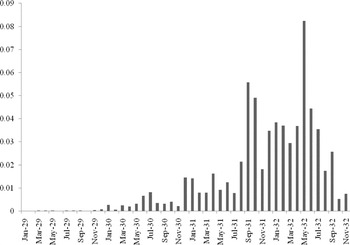
The reports of contemporary sources suggest that significant momentum for cuts in hourly wage scales did not gather until April 1931, and a significant round of cuts occurred in September 1931. Data on hourly earnings in manufacturing industries confirm this. An index of nominal hourly earnings from the National Industrial Conference Board (NICB) indicates that nominal hourly earnings did not fall significantly until the fall of 1931. Given the large deflation during the same time frame, real hourly earnings significantly increased. In comparison, production fell precipitously beginning in the second half of 1929, although with a renewed speed in the spring and summer of 1931.Footnote 5
The same picture emerges with specific data on the timing of cuts in hourly wages. Figure 1 depicts the percentage of employees affected by cuts in individual firm wage rates, in a monthly sample of manufacturing firms beginning in January 1929. While this percentage slowly rose starting in 1930, wage cutting became both more widespread and more sustained over time starting in the fall of 1931.
SHARE OF MANUFACTURING EMPLOYEES AFFECTED BY WAGE CUTS, BY MONTH

It is necessary to note that the path of average hourly earnings may be unrepresentative of individual hourly wage rates. Ben Bernanke provides evidence that there were substantial reductions in hours worked in eight manufacturing industries during the Great Depression.Footnote 6 In addition, firms could fire workers and then rehire them at lower parts of the wage scale. Firms could also fire lesser-skilled workers disproportionately while reducing all wages proportionately, so that every individual's hourly wage rate falls, but the average skill of the employed workers rise and average hourly wage remains the same. Similar results could be achieved if the least productive (and least well remunerated) workers are fired disproportionately, or if the least productive (and lowest paying) plants fail disproportionately.Footnote 7 Thus, this article seeks to use data specifically on hourly wage rates wherever possible.
Others have previously analyzed the causes of wage rigidity in the Great Depression. Bernanke develops a model in which hours are cut more quickly than weekly wages, given the difficulty of finding small amounts of alternative work.Footnote 8 Shister analyzed the relationship between wage rigidity and industry characteristics, such as the degree of competitiveness in product markets, the size of firms, and the size of labor costs.Footnote 9 Dunlop conducts a similar analysis, with particular focus on unions, and finds that they lack power to explain variations in the extent of rigidity across industries.Footnote 10 More recently, Hanes conducts a more formal empirical analysis and tests more modern theories of wage rigidity; the analysis focuses on an industry cross-section to test the explanatory abilities of insider power and efficiency wage theories, and compares their relative explanatory success to other downturns.Footnote 11
These explanations for wage rigidity, such as unionization, competitiveness, and efficiency wages, are not unique to the Great Depression. In the 1930s, however, the rigidity was fairly long-lasting and was juxtaposed against an extraordinary decline in output and rise in unemployment, which helps motivate the study of this case in detail. In this spirit, previous scholars have noted historical particularities of the period. O'Brien focuses on the history of wage-setting practices and ideologies in the decade before the Great Depression.Footnote 12 He describes the development of a doctrine during the 1920s in favor of maintaining high wages during a recession. The doctrine emphasized a demand-centered view of the business cycle, in which aggregate demand was dependent on the purchasing power of workers. The result was a belief that maintaining high wages was essential to maintaining demand and consequently avoiding a contraction in output. The high wages also surely had the additional benefit of avoiding labor agitation.
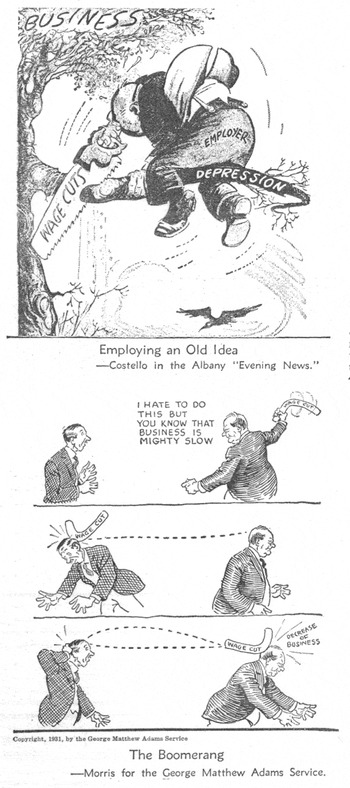
The contemporary press believed the implementation of this theory to be novel, and responsible for the observed rigidity in wages. O'Brien synthesizes an abundance of such narrative evidence, and argues that the theory originated out of the hardship caused by wage cuts during the 1920/21 downturn, a hardship judged ex post to have been beyond the limits of acceptability. Figure 2 contains a sample of editorial cartoons from the time advocating the maintenance of high wages. Murray Rothbard also details (and criticizes) this idea of wage maintenance, as do Charles Calomiris and Hanes briefly as well as George Selgin and Jason Taylor, and Sanford Jacoby places it in context of other personnel policies of the time.Footnote 13
Cartoon wage theory

Finally, a recent examination of Hoover's role in wage rigidity is conducted by Ohanian, another historically sensitive account that emphasizes the history of unionization.Footnote 14 This account pivots on the idea that high wages were used as a method of forestalling incipient labor agitation, rather than simply as a tool for macroeconomic stabilization. Ohanian constructs a model in which unions have the ability to strike and shut down production, and argues that protection from this came through these wage maintenance agreements. In the model, this intervention can account for much of the severity of the Depression, along with other key stylized facts of the onset period.
HOOVER'S CONFERENCES
This article takes as a premise that if wage rigidity at the onset of the Great Depression is to be understood, it is necessary to understand the origins, dissemination, and adoption of the principle of wage maintenance. A central figure in all three stages was President Herbert Hoover.
In late 1929 after the stock market crash, Hoover called business leaders to Washington to discuss economic conditions and coordinate strategies for mitigating the downturn. I highlight two particular conferences held by Hoover, one on November 21, 1929, and the other on December 5, 1929. The purpose of these conferences was to coordinate a common industrial agenda to forestall an economic downturn. A central theme that emerged was the necessity of maintaining high wages.
The first set of conferences was a series of small meetings from November 19–25 with leaders from different segments of the economy, including manufacturing, rail, labor, construction, agriculture, utilities, and the Federal Reserve. These were selective meetings with about two dozen conferees in each. Of this first set of conferences, this article focuses on the most high-profile meeting, which involved executives from 23 of the largest industrial firms in the country, such as U.S. Steel and General Motors. In this conference, the president secured pledges of wage maintenance from the employers. The White House summarized the meeting in a press release the next day:
“The President was authorized by the employers who were present at this morning's conference to state on their individual behalf that they will not initiate any movement for wage reduction, and it was their strong recommendation that this attitude should be pursued by the country as a whole. They considered that aside from the human considerations involved, the consuming power of the country will thereby be maintained.”
The November conference was also a trial balloon for Hoover, and its success encouraged the president to organize a much larger conference on December 5, attended by over 400 leaders representing most segments of the industrial economy. This last conference, known as the National Business Survey Conference, resulted in the formation of a committee with 140 members charged with coordinating and reporting the actions of various industries.
During the December 5th conference, Hoover outlined a broad set of proposals for recovery, of which wage maintenance was a prominent feature. Hoover stated in his opening address that after stabilizing the banking system, “the second action necessary to maintain progress was the standard set by leading employers that so far as they were concerned, there would be no movement to reduce wages.” Hoover stated that his goal for the conference was to take the pledges secured in the first conference from those 23 executives, and “to make this movement systematic in all branches of the industrial world.”Footnote 15
The discussions at these conferences in late 1929 were vague with respect to whether firms ought to keep weekly earnings rigid or simply hourly wage scales. The pledges that were made appear, after the fact, to have been interpreted as applying narrowly to hourly wage scales. It was common knowledge that hours were cut, and given the lack of objection from Hoover, and in fact his encouragement on a few occasions, it is probable that the pledge applied to hourly wages alone. In addition, since the motivation for high wages was to support aggregate demand, it could have been consistent for firms to hold hourly wages constant while letting hours float.
Importance of Hoover: Evidence from the Contemporary Press
The first step in assessing the importance of these conferences is an examination of what contemporaries believed, or at least what they wrote. Such a study reveals that the contemporary press assigned Hoover a central role in propagating the wage maintenance tactic with his conferences.
The conferences were highly publicized, reaching the front page of every newspaper and essentially becoming the most important business news story of each week. After these conferences, the maintenance of wages became known as the “Hoover Truce” between management and labor. In magazines, newspapers, and trade journals, rarely was the theory of wage maintenance mentioned without an immediate reference to Hoover. An issue of The Nation in late 1930 contains a representative contemporary account:
“Our present major Depression finds us pinning our hopes to a radically different economic philosophy … Above all, there is wide acceptance of the theory that the revival of industry will best be furthered by maintaining purchasing power. Since wages form the mainstream of purchasing power, it follows that the proponents of this theory are opposed to wage reduction. In the course of the Chautauqua held in Washington in November 1929, under the personal direction of President Hoover, this theory was first publicly proclaimed, and ever since it has been echoed by the spokesmen of business, finance, labor, and other groups.”Footnote 16
Following the conferences, business groups across the country proceeded to proclaim that they would adhere to Hoover's entreaties. For example, a Massachusetts business group “responded to President Hoover's prosperity plea by pledging maintenance of wages for at least 152,000 employees.”Footnote 17 A similar pledge was made by an association of manufacturing companies in Illinois, and by another association of businesses in Los Angeles.Footnote 18
Hoover himself publicly and repeatedly took credit for the wage maintenance doctrine, noting his happiness that industry leaders were complying with his plan of wage maintenance. In his memoirs, Hoover stressed the importance of his conferences with pride, noting that “many of the leaders were not at first impressed with the gravity of the situation, but became more seriously concerned as the meeting proceeded.”Footnote 19
Other politicians also noted Hoover's central role. Labor leaders, like the head of the American Federation of Labor William Green, repeatedly credited Hoover with leading the wage maintenance movement and held employers to their promise to Hoover. Management leaders, like the head of the U.S. Chamber of Commerce Julius Barnes, repeatedly credited Hoover as well. Academics at the time also noted Hoover's role. R. W. Stone wrote in 1932:
“The opposition of the federal administration was a distinctive feature of the current Depression. President Hoover, in the White House conference of business leaders, pledged them as a plank in his stabilization program to refrain from cutting wages. Fulminations from the executive office continued … The attitude of the administration encouraged the opposition forces, and effectively deterred those business organizations operating under governmental regulation and many others sensitive to the possibilities of adverse opinion on the part of the administration.”
This quote also highlights the important point that, as time passed after the 1929 conferences, Hoover used his office to keep pressure on firms to maintain high wages. The Commercial and Financial Chronicle described Hoover's efforts in the spring of 1931: “President Hoover, if accounts in the daily papers are to be credited, has again strongly taken pains to make it known that he is strongly wedded to the idea that wage schedules should be and must be maintained. For instance, the Washington correspondent of the New York Herald Tribune, in his dispatch printed in the Thursday issue of that paper, states that persons who have talked with President Hoover since his return from his Caribbean trip say that he is carrying on a struggle behind the scenes, as it were, to maintain wages at the present level in the face of a strong movement in financial circles, as alleged, to lower them in proportion to the decline in prices.”Footnote 20
Finally, in late 1931 and 1932, as wage maintenance broke down, the press framed wage cuts as departures from Hoover's policies and a weakening of his power. After well-publicized cuts by the influential U.S. Steel and Bethlehem Steel companies in September 1931, the New York Times noted that “the original experiment urged by the president has been thoroughly tried but has failed.”Footnote 21 The Commercial and Financial Chronicle synthesized the broad stroke of the period, writing that, “In the autumn of 1929 … the 'Administration’ called a conference of industrialists and financiers, and out of that conference grew the policy, even the principle, of maintaining the high wage scales … Now, in the autumn of 1931—after this policy has been adhered to and tried out, there comes a crucial stage when it appears that many manufacturing plants and the railroads can no longer pay these high wages and keep running.”Footnote 22
Judging the Narrative Record
The narrative evidence presented here indicates that many contemporaries believed Hoover to have a central role in propagating wage rigidity. An important question, though, is whether this evidence is an accurate portrayal of all beliefs at the time.
One issue is whether any contemporaries denied that Hoover truly sought to intervene in the wage-setting process. While some writers questioned Hoover's commitment to maintaining high wages, such accusations were rare, and fundamentally his critics and his supporters similarly described his efforts towards compliance for the two years after the 1929 meetings. In fact, critics of the policy, such as the editors of the Commercial and Financial Chronicle or of Barron's, repeatedly urged employers to ignore the president. By the spring of 1932, it is true that Hoover was no longer demanding the same extent of support for wage maintenance, but at that point wage reductions were widespread and so the issue was largely irrelevant.
Another issue is whether any contemporaries denied that Hoover's intervention had an impact on wage policies. The thrust of the disagreement in narrative sources is not concerned with whether a pledge had been made to Hoover, but whether the industry leaders actually upheld their pledge. Some labor leaders, and others with sympathies for labor, accused firms of a variety of indirect wage-cutting mechanisms. These mechanisms included holding the hourly wages for each job constant, but reducing hours worked, changing the skill composition of their workforce, or firing and rehiring a worker to a different job with a lower wage. Alfred Bernheim, writing in The Nation magazine in November 1930, is a good example, writing that an excessive focus on hourly earnings was misleading:
“Conceding that wage reductions have not been as extensive or as sharp in this Depression as in some former ones, and that there is a crystallized public opinion—employers included—against lowering wages, still it is an absurd bit of romancing to assert that wages have been maintained at their 1930 peak, or that the Hoover-inspired wage truce has been kept even substantially inviolate.”Footnote 23
The difference between hourly and weekly earnings reviewed in section 2 further substantiates these patterns, with hourly earnings remaining more rigid than weekly earnings. In truth, there was no real conspiracy per se by employers to engage in earnings reductions by means other than hourly wage rate changes; many firms publicly announced their plans to reduce hours or stagger work across employees. For example, the 1932 annual report of AT&T states the firm's commitment to sharing available work among the employees. In doing so, firms such as AT&T emphasized the humanity of maximizing the number of workers with jobs and encouraged the sharing of work. The relative disingenuousness of the policy has been debated by previous scholars, including Jacoby.Footnote 24
If Hoover was not involved, the idea of industries collectively maintaining wage levels in order to support purchasing power runs into another obstacle, one of collective action, since the wage of any given company is a trivial percentage of the entire nation's consuming power. O'Brien recognizes this free-rider problem and offers a number of responses. First, he suggests that negative public reaction to wage cuts made such wage reductions difficult. This does have some support from the historical record. However, the narrative evidence provided here suggests that Hoover's conference, by bringing the issue of wage maintenance to the front page of newspapers across the country, was the most likely source of the public relations pressure that did exist. Second, O'Brien suggests that coordination occurred among industry leaders, but in a somewhat secret organization known as the Special Conference Committee. This may in fact be an important organization, but secret coordination is still subject to free-riding. It also seems unnecessary to speculate on the importance of secret meetings among industrial leaders, given the very public meetings organized by Hoover to the same end.
O'Brien does note that Hoover provided public support in 1929 for this theory, although this is portrayed more as an example of the extent to which the principle had spread, rather than assigning Hoover any particular role. In fact, after the conferences concluded, Hoover was known to publicly admonish industries that cut wages. For example, in the summer of 1931, in an article titled, “Hoover's Wage Policy in Peril,” Hoover is described as publicly and privately jawboning various industrial leaders, such as northeastern textile firms and U.S. Steel in particular, in an attempt to forestall wage cuts. In addition to confronting industrial leaders who were contemplating individual wage reductions, Hoover also sought to limit the influence of other, nonindustrial voices of those calling for wage reductions. For example, he gave a speech before the American Bankers Association in October 1930 arguing that wages needed to be lowered. Afterwards, on October 3, 1930, Hoover addressed the same group, and the New York Times reported that he changed his speech at the last minute to say that he “emphatically disagrees,” and repeated the argument that wage maintenance was key to maintaining purchasing power. The Los Angeles Times headlined that Hoover rebuked the “cowards.”
Hoover's December 5th conference created its own enforcement mechanism, a body of 140 representatives from various industries, with the purpose of coordinating efforts to implement the agreements reached, and to disseminate information about business conditions. These efforts continued for almost a year and a half. Though the timing is circumstantial, the conference disbanded in May 1931, just as the first large cuts in wages occurred. In addition, the trade associations given so much attention by Hoover were key bodies for organizing across firms and within industries.
An alternative story is presented by Ohanian, with antecedents in Rothbard.Footnote 25 This viewpoint emphasizes the prospect of labor agitation, and the wage maintenance movement as being mainly a preemptive appeasement. Any reading of the primary sources will reveal some evidence of the fear on the part of industrial leaders that increased unionization was a possibility, and Ohanian presents a synthesis of this record. It is not clear that Hoover is necessarily integral to this labor relations story, given that firms presumably had this option of paying high wages regardless, but it is possible that Hoover was in a position to prevent any favorable government action toward labor. Indeed, the conferences of late 1929 were part of a “truce” between management and labor that Hoover sought to achieve. For Hoover, his role as secretary of commerce in the 1926 mediation between railroad firms and their labor unions is an interesting antecedent, as he urged the maintenance of industrial peace both at the time and in retrospect in his memoirs.
NOVEMBER 21 CONFERENCE EFFECT ON WAGES
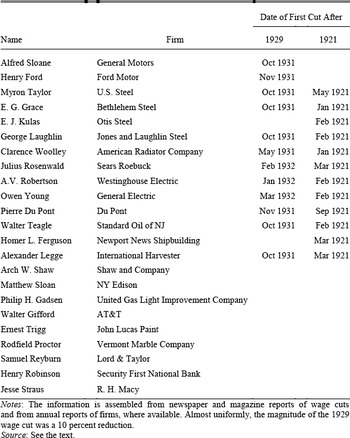
The conference of November 21, 1929 was the initial, smaller conference held by Hoover as a pilot in anticipation of holding a larger conference. Twenty-three industrial leaders attended, representing the largest manufacturing companies in the United States, and pledged to maintain the level of their firms’ wages. The attendees are listed in Table 1. Most are the executives of the largest industrial enterprises in the country. Others are included as representatives of organizations. Rodfield Proctor from the Vermont Marble Company and Henry Robinson from the Security First National Bank were chosen because they also headed important business groups, specifically the New England Council and California Development Board, respectively.
DATES OF WAGE CUTS BY FIRMS WHOSE LEADERS MET WITH HOOVER IN THE NOVEMBER 21 CONFERENCE

Notes:
The information is assembled from newspaper and magazine reports of wage cuts and from annual reports of firms, where available. Almost uniformly, the magnitude of the 1929 wage cut was a 10 percent reduction.
Source:
See the text.
The records from primary sources indicate that the wage policies of these November conference attendees were under particularly intense scrutiny from both the press and Hoover, largely stemming from the particularly explicit pledge against wage maintenance made at that conference. For example, in April 1931, as a round of wage cuts spread through many industries,
“The alert United Press interviewed business leaders who attended the [November] 1929 White House conferences, discovered an agreement among them that industry, by and large, had lived up to its wage pledge. Pierre Samuel Du Pont (I. E. du Pont de Nemours & Co.), Walter Sherman Gifford (American Telephone & Telegraph), and Jesse Isidor Straus (R. H. Macy & Co.) declared their companies had not reduced their wage scales since 1929. Walter Clark Teagle said his Standard Oil of New Jersey had found it necessary to cut workers’ weekly earnings by part-time employment but that the base pay rate had been maintained.” (Time, 13 April 1931)
In October 1931, when there was finally a round of wage cuts among these attendants, initiated by U.S. Steel and Bethlehem Steel, it was as highly publicized as any business news was during this period. In addition, that act was portrayed as an abandonment of these firms’ agreement with Hoover. The New York Times headline was “Hoover shocked at steel wage cut—President's associates recall promise of industrial heads two years ago.”Footnote 26 The cut by the large steel companies precipitated a cut by many other steel companies, though not all.
To evaluate the actions of these firms, the dates reported in the press and in annual reports when hourly wage scales were reduced for the first time by each attendee are reported in Table 1 for 13 of the 23 firms. Essentially, the wage actions of the very large manufacturing firms were treated as major news, and so the information is available in the historical record. Of the firms for which this information is not available, most are nonmanufacturing firms, which received less coverage. Of those firms with wage cut information, the data reveal that, after the November 1929 meeting, only one firm cut wages before October 1931, while industrial production began declining in August 1929.
To check the consistency of the claim that the wages were particularly rigid after 1929, I compare the timing of wage cuts after 1929 with the timing after 1920—a similar period of economic contraction. It should be noted that most firms, not just those on this list, cut wages more quickly during the 1920 downturn than at the end of the 1930s, perhaps due to the unique circumstances following the end of the wartime expansion, and so surely there are other factors underlying the wage rigidity in the both 1920 and during the Great Contraction. In the previous downturn, most firms cut wages in the first quarter of 1921, about 14 months after the NBER business cycle peak. In comparison, October 1931 is about 26 months from the August 1929 NBER business cycle peak. Clearly, these companies cut wages more rapidly after the 1920 peak than after the 1929 peak. Generally, the magnitude of the wage cuts was 10 percent.
The relevant question is what these individuals and their companies would have done in the absence of Hoover's conference. The narrative evidence suggests that the conference was effective at keeping pressure on these firms to not reduce wages, but whether this pledge actually changed the wage policies of these companies from what they would have been is statistically difficult to identify. There are a small number of firms, and firm level wage information is scarce. In addition, the conferees were not randomly selected: Hoover sought to conference with the leaders of the largest companies, which in general waited longer to cut wages during the Depression than smaller companies. According to a National Industrial Conference Board survey of firm wage cuts during the Depression, the average date of the first reduction in wages was either May or June 1931 for companies with less than 10,000 employees, but November 1931 for companies with more than 10,000.
Comparison with 200 Largest Firms
Another way to evaluate the impact of this November conference is to examine the large companies that did not attend the conference. The three largest textile firms, American Woolen, Pacific Mills, and Riverside and Dan River Cotton Mills, cut wages in July 1931, January 1930, and May 1931 respectively, earlier than almost all of Hoover's conference attendees. So, in July and August 1931, while the general program of wage maintenance was still strong and Hoover a vocal advocate, wage cuts nevertheless were occurring in the textile industry, in some cases with much publicity. Hoover may have felt he had no choice but to address the issue, especially after receiving a letter from Representative Condon (D-RI) protesting “that the textile industry in Rhode Island was reducing wages and thereby violating the 'agreement’ made at the White House in the fall of 1929 between capital and labor.” The administration's response came from Secretary Lamont, who “declared the government could not interfere,” and most interestingly, he “pointed out that the textile industry was not represented in the White House conference of 1929.”Footnote 27
To more broadly approach this comparison of firms that attended with those that did not attend, I use a list of the 200 largest industrial firms in 1930, determined by Alfred Chandler on the basis of the firm's assets.Footnote 28 The goal with this data set is that by using an independently constructed list of the largest firms at the time, the non-attending firms can be used as a reasonable comparison group, though this is certainly not a perfect control group. Most of the firms attending Hoover's conference are among the larger firms on this list, including the top three (U.S. Steel, Standard Oil of New Jersey, and General Motors), and seven of the top twenty. Using primary sources for each of the top 200 firms, I obtained information for 56 firms.Footnote 29 This list includes the 13 firms in Table 1. Forty-three of these firms are in the top 100, indicating again that wage information was more likely to be reported and available in the historical record for large firms.
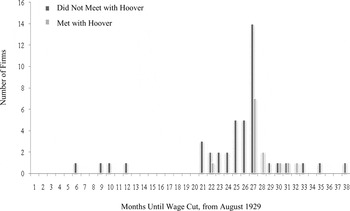
The timing of wage cuts in Figure 3 shows that few firms cut wages before the spring of 1931, and a large number cut them between April and October 1931. This is consistent with the National Industrial Conference Board study mentioned above. Most importantly, the firms whose leaders met with Hoover appear, on average, to have waited longer before cutting wages, with only one firm cutting before October 1931.Footnote 30
DISTRIBUTION IN DELAY UNTIL FIRMS CUT HOURLY WAGE RATES

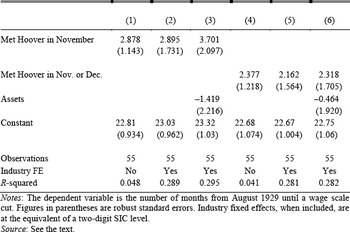
As a more formal test, I regress the number of months until a firm cut its wage rates on a dummy indicating attendance at Hoover's November conference. The results in Table 2 indicate that conference attendees waited nearly three months more on average before cutting wage rates. When two-digit SIC industry fixed effects are included, the coefficient remains roughly the same size but is no longer statistically significant, indicating some degree of multicollinearity between attendance and the industry fixed effects. In the third column, a firm-level control, the assets of the firm, are also included, which does not meaningfully change the estimates. Interestingly, the assets themselves have no relationship with the timing of wage cuts, despite the National Industrial Conference Board finding noted above, though the data do indicate a correlation with attendance at Hoover's conference.Footnote 31 Finally, I repeat the exercise, except with a dummy indicating that a firm met with Hoover either in the November conference or in the December conference of the next section. These results, in columns four to six, are similar, but with a smaller coefficient, indicating an average delay of a little over two months. This indicates that the December conference may have had less of an impact on the attendants than the November conference.
FIRM-LEVEL ESTIMATES OF EFFECT OF NOVEMBER ATTENDANCE

Notes:
The dependent variable is the number of months from August 1929 until a wage scale cut. Figures in parentheses are robust standard errors. Industry fixed effects, when included, are at the equivalent of a two-digit SIC level.
Source:
See the text.
One concern is that four firms cut wages very early in 1930, and none attended either conference, so these four firms may have been driving the estimation results. When I cut them from the sample in Table 3, the effect of conference attendance is cut by more than half and is not statistically significant.
FIRM-LEVEL ESTIMATES OF EFFECT OF NOVEMBER ATTENDANCE, OMITTING EARLY MOVERS

Notes:
The dependent variable is the number of months from August 1929 until a wage scale cut. Figures in parentheses are robust standard errors. Industry fixed effects, when included, are at the equivalent of a two-digit SIC level.
Source:
See the text.
Differences Across Firms of Different Sizes, Within Industries
In the previous subsection, the actions of large firms attending the November conference were compared with the actions of the other large firms from the same time period. An alternative method is to compare the actions of large firms with the actions of smaller firms within the same industry, and examine whether the comparison changes if the industry's large firms were represented at the November conference. This would help address one concern noted in the previous subsection, that large firms on the whole tended to cut wages later, since this test would not rely on simply the difference between large and small firms within an industry, but rather the difference for industries represented at the conference relative to the difference for industries not represented.
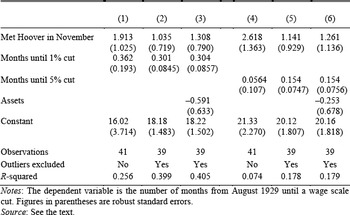
A portion of these firms can be matched to industries covered in a monthly Bureau of Labor Statistics survey reporting the number of employees affected by a cut in hourly wages.Footnote 32 Following Hanes and Shister, wage rigidity can be measured as the number of months between August 1929 and the month in which at least 1 percent of industry employees were affected by a wage cut.Footnote 33Table 4 reports the results when this measure is included as a regressor for the subset of the firms that can be matched to an industry with available data.Footnote 34 The table also includes the results of an estimation that uses the month in which a greater portion—5 percent—of the industry employees were affected by a wage cut. The industry wage rigidity variables generally have strong predictive power for the firm results, especially when the early-mover outliers are excluded. While the point estimates of the Hoover attendance dummy remain positive, they generally fail a one-sided test that they are statistically significantly positive, particularly when the early-mover outliers are excluded. As a result, it is not possible to rule out the possibility that these results reflect the composition of industries represented at the November conference. However, it should be noted that these results are also consistent with a story in which the firms which met with Hoover subsequently formed industry-wide standards for wage practices.
FIRM-LEVEL ESTIMATES OF EFFECT OF NOVEMBER ATTENDANCE, CONTROLLING FOR INDUSTRY-LEVEL DATA

Notes:
The dependent variable is the number of months from August 1929 until a wage scale cut. Figures in parentheses are robust standard errors.
Source:
See the text.
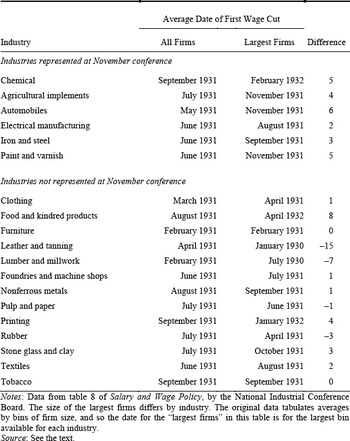
Table 5 lists, for 19 broad industry groups, the date of the average wage cut for all firms, and the date for the largest firms.Footnote 35 The six industries with representatives at the November conference appear to have large firms waiting about four months longer than all firms to cut wages, on average. This is effectively a difference between cutting wages in the fall of 1931 rather than the spring of 1931. In comparison, the 13 other industries had much more mixed results. In four industries, the average cut date for large firms preceded the average cut date for all firms, and in five industries, the difference was one month or less. The remaining confound, of course, would be if the industries with firms invited to the conference had different competitive structures from the other industries, so that large firms perhaps faced different demand shocks than small firms, or otherwise would have been expected to differ from small firms dissimilarly to how large firms in other industries would differ from small firms.
DATE OF WAGE CUTS, BY FIRM SIZE

Notes:
Data from table 8 of Salary and Wage Policy, by the National Industrial Conference Board. The size of the largest firms differs by industry. The original data tabulates averages by bins of firm size, and so the date for the “largest firms” in this table is for the largest bin available for each industry.
Source:
See the text.
DECEMBER 5 CONFERENCE EFFECT ON WAGES
The larger conference of December 5th, the so-called National Business Survey Conference, provides an opportunity to further examine the impact of Hoover on wage policies. This conference was targeted at representatives at the industry level more than at the firm level, and so the analysis in this section is cross-industry. I estimate whether industries whose leaders met with Hoover at the December conference held wages relatively more rigid than other industries.
Attendance information was obtained from the conference's full attendance list found in the archives of the U.S. Chamber of Commerce at the Hagley Library.Footnote 36 The Chamber of Commerce jointly held the December 5th conference with Hoover, and handled many of the administrative duties of the conference.Footnote 37 This archive contains a list of each person who attended the conference, along with the name of the trade group or firm he represented. About one-third of the attendees represented a trade group, one-third was executives of firms, and one-third was both a trade group representative and firm executive. The archive also contains a list of the individuals that were invited to the conference, regardless of attendance.
The archival materials yield some limited information on the invitation process to this conference. Essentially, the invitation process was delegated by Hoover to the Chamber of Commerce, and that organization appears to have compiled an invitations list by using its membership list, along with lists of individuals or organizations that had attended previous conferences during the 1920s. Given that several hundred invitations were issued, it is unlikely that those invited were handpicked for their predisposition to wage maintenance, although possibly those with histories of engaging with the Chamber of Commerce may on average have been more agreeable to the general approach to economic management put forth by Hoover.
Every industry had some representatives at the conference, so the variation in attendance across industries is based on one of three measures: the number of trade associations represented at the conference in each industry, the number of companies represented in each industry, or the gross sum of those two attendance measures. These measures of attendance are somewhat crude and while they capture some sense of the exposure of each industry, it may be subject to some biases, such as if larger industries were mechanically more likely to send more representatives. A more comparable measure across industries would involve exploiting information on the size of each attending trade association, within each industry. I construct the share of firms in an industry represented at the conference, calculated as the sum of the number of firms in an industry represented by the trade associations attending, divided by the number of firms in that industry. Data on membership in each trade association are available from a directory of trade associations published by the Department of Commerce in 1929 and 1931, the Commercial and Industrial Organizations of the United States.Footnote 38 These directories are very comprehensive; of the 314 individuals representing trade associations at the conference, only a handful of those trade associations are not listed in either of these directories. Finally, this data also allow the construction of a control variable, the share of an industry's firms that are covered by a trade association.Footnote 39
The following analysis is conducted on an industry level. It is worth pausing to consider what an industry cross section of this type can reveal. It may not be obvious why attendance when aggregated to an industry level would be related to the aggregate of individual firm wage decisions. This strategy is essentially unavoidable, given the scarcity of wage data even at the industry level. Nevertheless, the aggregation is not as problematic as it may seem. Industry-level attendance naturally relates to the underlying source of variation in both conference attendance and wages. Firms within industries often cut wages simultaneously, such as the round of cuts in the steel industry in October 1931. In addition, Hoover encouraged the coordination across firms to maintain wages, and the agents of this industry-wide coordination were probably trade associations, whose leaders and representatives comprised the majority of the conferees. These organizations existed essentially for the purposes of disseminating information and coordinating action. In fact, many business historians credit Hoover for the growth of trade associations during the 1920s, from relatively unimportant entities to asserting regular and significant roles in cases such as this. Hoover certainly believed that conferring with trade association representatives was worthwhile, having spent much of his time as secretary of commerce doing just that, in many cases dealing with industry-wide wage and labor issues.Footnote 40
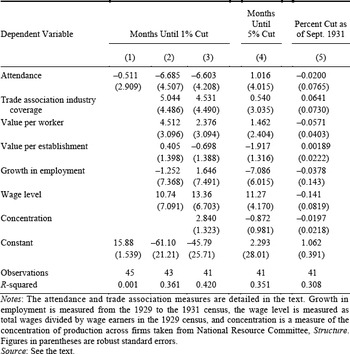
The ideal data on wages would be hourly wages, especially since the pledge for wage maintenance most likely was limited to hourly wages and not weekly earnings. Hourly wages are available from a sample conducted by the National Industrial Conference Board during this period, but only for 25 industries. Instead, following Hanes, I use the Monthly Labor Review survey data described earlier, so that wage rigidity is measured as the number of months between August 1929 and the month in which at least 1 percent of industry employees were affected by a wage cut.Footnote 41 The analysis below also uses two alternative measures; the first is the month in which a greater portion—5 percent— of the industry employees were affected by a wage cut, and the second is the percent of industry employees affected by a wage cut as of September 1931, the last month before widespread cuts took place. Finally, to control for other industry-level determinants of wage cutting, several variables are included based on data from the 1929 Census of Manufactures, and industry concentration is taken from the National Resource Committee 1939 volume.
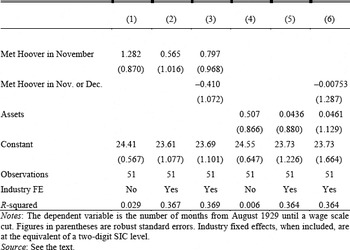
Table 6 reports the results of a series of regressions relating attendance at the December conference with measures of wage rigidity, with and without controls. The first three columns use the number of months until 1 percent of industry employees were affected by wage cuts as the measure of the rigidity, and the last two use the two alternative measures discussed above. In general, these results provide no support for the idea that differences in attendance across industry were related to industry wage practices. The coefficient of the attendance measure is statistically insignificant across all specifications, and the point estimate is negative in the first three columns, which would indicate a faster pace of wage cutting. On a cross-industry basis, it is worth noting that the attendance measure is correlated with value-added per worker and the wage level, as well as employment growth from 1929 to 1931.
DECEMBER CONFERENCE EFFECT, ACROSS INDUSTRIES

Notes:
The attendance and trade association measures are detailed in the text. Growth in employment is measured from the 1929 to the 1931 census, the wage level is measured as total wages divided by wage earners in the 1929 census, and concentration is a measure of the concentration of production across firms taken from National Resource Committee, Structure. Figures in parentheses are robust standard errors.
Source:
See the text.
CONCLUSION
This article takes seriously the question of how a movement to maintain wages during the onset of the Depression could have originated and spread, and to that end examines the role of President Hoover. Novel data on the attendance of firm executives at Hoover's conference in November 1929 reveal that those firms delayed wage cuts longer than other firms of comparable size from the spring of 1931 into the fall of that same year, but the analysis cannot fully rule out that this is due to the characteristics of the particular industries in which these firms operated. In addition, there is no evidence that industries better represented at Hoover's larger December conference subsequently kept hourly wages more rigid.
Of course, the cross-sectional analyses conducted in the latter half of this article can only identify variations in wage outcomes across industries or firms, and not a general shift shared by all industries and firms. It is possible that Hoover caused a general delay in wage cuts until the spring of 1931. Identifying such an effect is more difficult, however, though it may be more significant for macroeconomic outcomes than the cross-sectional effects, which would impact the relative utilization of resources across firms and industries.
Today, conferencing with business leaders is probably not an action that would be treated as a serious tool to promote macroeconomic stimulus. In comparison to more complicated and expensive stimulus techniques, though, Hoover's conferences should not be neglected as the insincere political acts with only ephemeral importance. Hoover's conferences reflected his predisposition toward fostering voluntary cooperation in the private sector rather than more direct means of economic stimulus, an insight into the state of macroeconomic management, and into his limited success in mitigating the contraction.