Introduction
The principles of obtaining informed consent are now an established part of medical education and are central to the duties of a doctor. Many professional bodies, including the General Medical Council (GMC),1 British Medical Association2 and the Clinical Negligence Scheme for Trusts,3 have issued guidelines on consent. In response to such guidance, the historical practice of delegating the consent process to the most junior member of the surgical team has been replaced by the principle that best practice involves the operating surgeon taking responsibility for consent. As the GMC recommends,1 only ‘in exceptional circumstances’ should the task of consent be delegated to a doctor who ‘is suitably trained and qualified, is sufficiently familiar with the procedure, and possesses the appropriate communication skills’.
In 2002, the Department of Health issued model consent forms and recommended consent policy for use throughout the National Health Service (NHS).4 Shortly afterwards, Chadha et al. Reference Chadha, Pratap and Narula5 conducted a survey of consent practice among senior house officers (SHOs) in UK ENT units. This study showed that the responsibility for routine consenting fell to SHOs, junior doctors typically one to four years post-qualification, in 95 per cent of departments. Model NHS consent forms were used in 72.5 per cent of departments and information sheets given to patients in 25 per cent of departments. The specific operative risks mentioned to patients showed great variability.
Since this time, it has been proposed that the grade of the SHO be significantly changed, as per the reforms to the structure of junior doctor training set out in the Modernising Medical Careers document.Reference Donaldson6 These reforms would replace the SHO grade with the second of two ‘foundation years’ which are intended to lead seamlessly into the first year of specialist training in ENT.
The impact of this period of uncertainty on the responsibilities of the current cohort of SHOs is open to speculation. In terms of obtaining consent for elective surgery, the concept that this is the responsibility of the operating surgeon may have become increasingly established, with a resultant drop in the involvement of SHOs in the process. Alternatively, an increase in consultant workload may have led to an increase in delegation of this task to junior staff.
Certainly, time is likely to have allowed greater uptake of the NHS model consent forms, and it is hoped that adjuncts to the consent process, such as the provision of patient information leaflets, have become more common.
The aim of this study was to investigate the impact of changes over the past three years, by repeating the survey carried out by Chadha et al. in 2002.Reference Chadha, Pratap and Narula5
Methods
A telephone questionnaire of SHOs working in 40 units randomly selected from all NHS regions of England and Wales was conducted in 2005, using the same departments and methodology as previously published.Reference Chadha, Pratap and Narula5 A 100 per cent participation rate was achieved. The questionnaire consisted of a series of closed questions about consent practice within the department, followed by an opportunity to list specific complications for five common nose and throat procedures, without prompting by the interviewer. These five procedures were tonsillectomy, septoplasty, microlaryngoscopy, functional endoscopic sinus surgery (FESS) and total thyroidectomy. The results were compared with those from the earlier, 2002 studyReference Chadha, Pratap and Narula5 and differences analysed using Fisher's exact test for two independent proportions.
Results
General questions about consent process
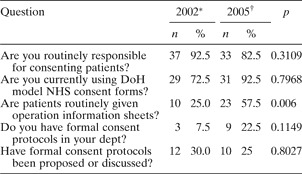
The answers to the closed questions about consent practice are shown in Table I. In both 2002 and 2005, over 80 per cent of SHOs were routinely responsible for consenting patients, although the figure was slightly lower in 2005. In 2005, it was more common for the standard NHS consent form to be used, and significantly more departments had a formal consent protocol and routinely provided patients with information sheets.
SHO “yes” responses for questions on consent procedure

* n = 40 respondents; †n = 40 respondents. SHO = senior house officer; DoH = Department of Health; NHS = National Health Service; dept = department
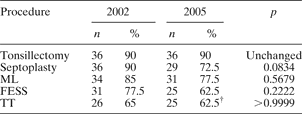
Table II shows that, in 2005, fewer SHOs felt routinely responsible for taking consent for four of the five operations considered. This reduction was significant for two procedures, septoplasty and FESS.
Specific ENT procedures for which SHOs* routinely obtained consent

* n = 40. †Of those respondents who did not routinely obtain consent for this procedure, 40% (6/15) stated the reason was that the procedure was not performed in their department. SHO = senior house officer; ML = microlaryngoscopy; FESS = functional endoscopic sinus surgery; TT = total thyroidectomy
Specific complications discussed
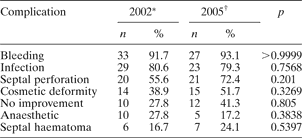
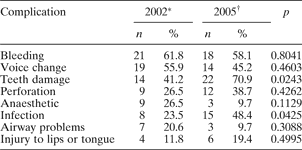
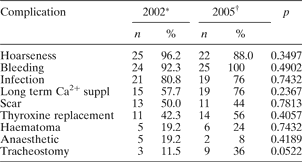
The complications that SHOs said they would mention to patients, in both 2002 and 2005, are displayed below for tonsillectomy (Table III), septal surgery (Table IV), microlaryngoscopy (Table V), FESS (Table VI) and total thyroidectomy (Table VII). Only complications mentioned by four or more SHOs (i.e. 10 per cent of total respondents) are displayed. Percentages relate to the total number of SHOs who were happy to obtain consent for each procedure; this number differs for each procedure and each year.
SHOs citing specific complications or risks: tonsillectomy

* n = 36 respondents; †n = 36. SHO = senior house officer
SHOs citing specific complications or risks: septoplasty

* n = 36 respondents; †n = 29 respondents. SHO = senior house officer
SHOs citing specific complications or risks: microlaryngoscopy

* n = 34 respondents; †n = 31. SHO = senior house officer
SHOs citing specific complications or risks: FESS

* n = 31 respondents; †n = 25 respondents. SHO = senior house officer; FESS = functional endoscopic sinus surgery; CSF = cerebrospinal fluid
SHOs citing specific complications or risks: total thyroidectomy

* n = 26 respondents; †n = 25. SHO = senior house officer; suppl = supplementation
Discussion
Over the past few years, the subject of informed consent has continued to have a high profile. A Medline search at the time of writing showed that nearly 6000 articles listing ‘informed consent’ as a medical subject heading term were published between 2001 and 2005.
This study had the advantage of using the same methodology as a previously published survey.Reference Chadha, Pratap and Narula5 Our telephone survey succeeded in achieving a 100 per cent participation rate, but only gathered information from one SHO from each department, and results may therefore not be fully representative of ENT SHOs nationally.
Overall, the closed questions about routine consent practices (Table I) revealed a trend from 2002 to 2005 towards what the government and the GMC would regard as good practice. There was an increase in the number of units using NHS consent forms and patient information leaflets, and there were more units in which SHOs were aware of a departmental policy about consent. We found a reduction in the number of SHOs who were routinely expected to obtain consent for elective surgery, although the majority still carried out this duty.
The data on specific procedures (Table II) shows a slight reduction in the proportion of SHOs who routinely obtained consent, compared with 2002 data. However, on both occasions, over 60 per cent of SHOs stated that they routinely took consent for each of the five procedures covered.
• Senior house officers (SHOs, i.e. junior trainees) are responsible for the process of obtaining informed consent for routine elective procedures in the majority of UK ENT departments
• This contravenes recommendations on consent practice issued by the General Medical Council and Department of Health
• Since 2002, there has been a minor decrease in the number of departments expecting SHOs to routinely obtain consent for elective surgery
• More departments are using the Department of Health model consent forms and routinely providing patient information leaflets
• Trainee knowledge about specific operative complications remains variable
For the specific operations covered in the survey, there was widespread variation in the complications mentioned. Overall, the most frequently cited complications were bleeding and infection. These were consistently near the top of the list for every operation, despite variation in their probability and importance according to the procedure in question. One interpretation of this finding is that SHOs are not taught about the specific risks of procedures before being expected to obtain informed consent.
A potential solution to this problem would be to prevent SHOs from being involved in the process of obtaining informed consent for elective surgery. However, although it might be a laudable aim for a more senior surgeon to take consent, there is a danger of undermining the responsibilities and duties expected of SHOs. They are the doctors who are most likely to be available to talk to patients on the ward, and it should not be considered beyond their capabilities to obtain high quality informed consent. They are certainly ‘suitably qualified’, and should all have the ‘appropriate communication skills’ considered requisite for the task by the GMC.1 Teaching SHOs the important complications that should be discussed for common operations ought to be a fundamental part of the induction programme of any ENT department.
It is important to acknowledge that mentioning a list of specific complications associated with a procedure is only a small part of the whole process of consent, which also includes a discussion about the aims of the surgery, the likelihood of achieving those aims, and the alternatives to the operation. With adequate training, these skills should be within the capability of all doctors.
This study shows that the higher profile afforded to the issue of informed consent over the past few years has been matched by only minor changes in the consent practices of ENT SHOs in England and Wales. These changes have been in the direction recommended by the Department of Health and the GMC, but still leave much room for improvement.
Conclusion
This telephone survey, carried out in 2002 and 2005, reveals that SHOs remained responsible for obtaining informed consent for elective surgery in the majority of ENT departments. There was considerable variability in the operation-specific risks that SHOs were aware of. Although some improvements in practice have occurred, this remains an area of clinical practice in which further attention would be of benefit in many departments.