Introduction
A growing number of community-dwelling older adults have mild impairments in cognitive ability. The term mild cognitive impairment (MCI) has been used to describe this intermediate state between normal cognitive functioning and dementia. The prevalence of MCI in the community ranges between 0.5% and 42% depending on the definition (Ward et al., Reference Ward, Arrighi, Michels and Cedarbaum2012). Individuals with MCI are at an increased risk of progression to more severe cognitive impairment (Mitchell and Shiri-Feshki, Reference Mitchell and Shiri-Feshki2009), and can have subtle impairments in everyday functioning (Hughes et al., Reference Hughes, Chang, Vander Bilt, Snitz and Ganguli2012), co-occurring depressive symptoms (Byers and Yaffe, Reference Byers and Yaffe2011), and poorer quality of life (Muangpaisan et al., Reference Muangpaisan, Assantachai, Intalapaporn and Pisansalakij2008).
An active and socially integrated life is a key component of well-being in old age. Older adults who are more socially engaged have better cognitive health outcomes – ranging from a slower rate of cognitive decline (Lövdén et al., Reference Lövdén, Ghisletta and Lindenberger2005; James et al., Reference James, Wilson, Barnes and Bennett2011) to a lower risk of incident MCI (Verghese et al., Reference Verghese2006) and dementia (Wang et al., Reference Wang, Karp, Winblad and Fratiglioni2002). With no effective pharmaceuticals available to prevent further cognitive decline in those with MCI, efforts are increasingly aimed at identifying non-pharmacological approaches. An improved understanding of the potentially protective role of social activities on cognition could aid in developing interventions to halt or slow cognitive decline in those with MCI.
The purpose of the present study is to examine the risk of progression from mild to severe cognitive impairment in relation to both level of engagement in social activities when mildly impaired and also subsequent change in social engagement concurrent with progression. Associations found between level of social activity when mildly impaired and cognitive transition over time would suggest that social activity could potentially modify the course of future cognitive decline. Investigating the associations of change in social activities concurrent with cognitive worsening may also shed light on whether maintaining the level of engagement may help to reduce the risk of progression from mild to severe cognitive impairment, or alternatively, whether decreasing engagement in social activity is a symptom of cognitive worsening.
Methods
Sample
Participants were members of the Monongahela–Youghiogheny Healthy Aging Team (MYHAT) study, a prospective cohort study of MCI in the community. Through random selection procedures based on voter registration lists, 2,036 community-dwelling participants aged 65 years or older were recruited and enrolled from geographically defined areas within the greater Pittsburgh region during a period of 2006–2008. Among these, 54 participants with an age–education-adjusted Mini-Mental State Examination score <21/30 (Mungas et al., Reference Mungas, Marshall, Weldon, Haan and Reed1996) were deemed too cognitively impaired for a study of MCI. The remaining 1,982 were assessed in detail and followed annually. Additional details of study sampling, recruitment, and measures have been previously reported (Ganguli et al., Reference Ganguli, Snitz, Vander Bilt and Chang2009). The MYHAT study protocol was reviewed and approved by the Institutional Review Board of the University of Pittsburgh and Informed Consent was obtained from all research participants.
For the present study, data were taken from assessments at study entry (Cycle 1) and up to three years of follow-up (cycles 2–4) (mean = 2.2 (SD = 0.8) years). To be included in the analyses, individuals had to (1) be classified with MCI (see below for classification criteria) at either study entry (Cycle 1) or an annual follow-up assessment (Cycle 2 or 3); (2) have at least one year of follow-up after first MCI classification; and (3) have complete data on the measures of social activity and other covariates described below. The cycle at which a given participant was first classified as having MCI (Cycle 1, 2, or 3) was designated as that participant's “MCI baseline,” and the social activity and covariate measures for these analyses were taken from the MCI baseline for that participant. A total of 816 participants met these inclusion criteria; at their MCI baselines they had a mean age of 78.0 years (SD = 7.38, range 65–96 years), 62.25 % of them were female, and 87.14% had completed high school or higher education.
Measures
Cognitive classification
Normative mean and SD values of the cohort for the composite domains of memory, attention, executive functioning, language, and visuo-spatial ability (Ganguli et al., Reference Ganguli, Chang, Snitz, Saxton, Vanderbilt and Lee2010) were used to classify participants’ cognitive status solely according to their neuropsychological test performance. Participants were classified as (a) cognitively normal: composite scores in all domains within 1.0 SD of the appropriate mean for the individual's demographic reference group; (b) mild cognitive impairment: one or more domain composite scores being 1.0–2.0 SD below the mean, or no more than one domain >2.0 SD below the mean with other domain(s) being 1.0–2.0 SD below the mean; or (c) severe cognitive impairment: composite scores in at least two domains being >2.0 SD below the mean.
Social activity
Social activity was defined by two separate composite scores created to represent the variety and frequency of participation in activities involving social contact. The variety of social activities was based on the total number of activities (possible range 0–4) the participants engaged in over the past year, including (1) going to church or place of worship, (2) attending a special family occasion, (3) attending other social events (visiting friends/family, senior center, clubs, restaurants, lodge, bar), and (4) working/volunteering. Frequency of social activity was based on how often in the past year participants (1) attended organizational activities, (2) visited family and friends, or (3) participated in volunteer work. To create composite scores for the variety and frequency of engagement in social activities, we first standardized each individual item by subtracting the mean and dividing by SD, and then averaged the variables comprising the composite.
Covariates
We considered the following variables as potentially confounding factors, i.e., factors were associated both with the social activity variables and with MCI progression: age (continuous), gender, educational attainment (less than high school (reference group) vs. high school vs. more than high school), marital status (married vs. unmarried), children (yes vs. no), living arrangement (alone vs. not alone), instrumental activities of daily living (IADL) dependency defined as requiring assistance with or unable to perform one or more tasks (Older Americans Resources and Services (OARS) (Fillenbaum, Reference Fillenbaum1988)), depressive symptoms (continuous; mCES-D (Radloff, Reference Radloff1977)), and overall health status measured by subjective health rating (poor/fair/good vs. very good/excellent) and number of prescription medications (continuous).
Statistical analyses
Chi-square tests for categorical variables and t-tests for continuous variables were used to compare the descriptive characteristics and engagement in individual social activities at the MCI baseline of those whose cognition progressed from mild to severe impairment versus those whose MCI did not progress to severe impairment, over up to three waves of annual follow-up.
Change in the variety and frequency of engagement in social activity composites were estimated using linear mixed models (Fitzmaurice et al., Reference Fitzmaurice, Laird and Ware2004). Each participant had up to four repeated longitudinal measurements for each composite, with the baseline set as the time when first classified as MCI. Consequently, participants were treated as clusters to account for the dependence of multiple records for the same person. After model fitting, separate overall change scores for the variety and frequency of engagement in social activities were estimated for each participant.
Univariable models were fit to identify potential confounding factors. Variables were included in the fully adjusted models if they met the definition of confounding, i.e., associated with both composite measures of social activity and progression from mild to severe impairment (p < 0.05).
Discrete time survival analyses (Singer and Willett, Reference Singer and Willett1993) were used to estimate the associations of the social activity composites (the MCI baseline and subsequent change in the variety and frequency of engagement) with the risk of progressing from mild to severe impairment. Separate models were fit for each social activity composite in relation to progression adjusting for age, gender, education, and any potentially confounding factors identified in the univariable models. We also included an interaction term between the MCI baseline and change in the social activity composites to determine whether the associations between change in the social activity composites and progression depended upon the initial level of social activity. All analyses were performed using statistical analysis software (SAS) version 9.2.
Results
Sample characteristics
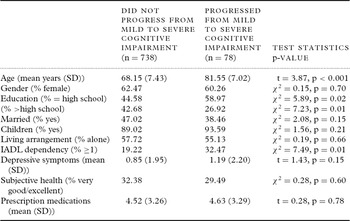
Among the 816 participants who were classified with MCI at Cycles 1, 2, or 3, 78 progressed to severe cognitive impairment, while 738 did not worsen (i.e., either remained mildly impaired or fluctuated between mild impairment and normal cognition). These 78 participants progressed in one (n = 31), two (n = 16), or three (n = 31) years following their individual MCI baselines. Those who progressed were more likely to be older, less likely to have high school or higher education, and less likely to be independent in IADL than those who did not worsen (Table 1).
Characteristics of the study sample when first classified as having mildly impaired cognition (i.e., MCI baseline)

Note: Chi-square test for categorical variables and t-test for continuous variables.
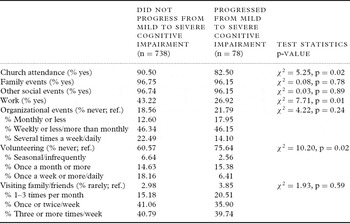
The social activity levels of the participants at the MCI baseline are shown in Table 2. The sample as a whole engaged, on average, in 3.24 (SD = 0.75, range 0–4) social activities. Those who subsequently progressed to severe impairment engaged in fewer activities and were less likely to attend church/worship or to work, compared with those whose cognition did not worsen. Among all participants, 41.32% reported engaging in events or meetings as part of a social organization on a weekly basis. Although not statistically significant, participants who progressed to severe cognitive impairment were less likely to engage in these activities daily or several times a week. While the majority of participants (62.01%) did not report any time spent volunteering, those who did volunteer most often reported doing so at least once a week (17.03%). Those who progressed to severe cognitive impairment volunteered less frequently than those who did not worsen. Most participants (81.25%) reported visiting with family or friends at least once a week, and very few (3.06%) reported only rare visits. There was no significant difference in frequency of visiting with family and friends between participants who did and did not progress from mild to severe cognitive impairment.
MCI baseline level of engagement in each social activity by progression status

Identifying potentially confounding factors
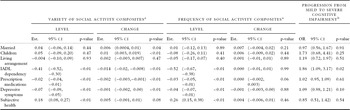
Univariable models were fit to examine the associations of socio-demographic and health variables with the variety and frequency of engagement in social activities at MCI baseline and change over time, and with the odds of progression from mild to severe cognitive impairment (Table 3). Being married and having children was not associated with the variety of activities engaged in at MCI baseline, but was associated with a slower rate of decline in the variety of activities engaged. Difficulty in performing IADLs independently and having more depressive symptoms were associated with a lower level and faster rate of decline in the variety of social activities; however, they were not associated with change in the frequency of engaging in social activities. Better self-rated health (very good/excellent) compared with lower self-rated health (poor/fair/good) was associated with engaging in a greater variety of activities and more frequent engagement at MCI baseline, and with a slower rate of decline in the variety of activities. Also, taking more prescription medications was associated with less variety and less frequent engagement in activities at MCI baseline, and with a faster rate of decline in the variety of, but not change in the frequency of engaging in, social activities. IADL dependency was the only variable that met our definition of a confounding variable since higher IADL dependency was also associated with greater odds of progression. Therefore, we controlled for age, gender, education, and IADL dependency in the multivariable analyses reported below.
Univariable models describing the associations of demographic and health measures with social activity composites (MCI baseline “level” and concurrent “change”) and progression from mild to severe cognitive impairment

Note: aLinear regression models.
bLogistic regression models.
OR = odds ratio, CI = confidence interval.
Social activity and risk of progression from mild to severe cognitive impairment
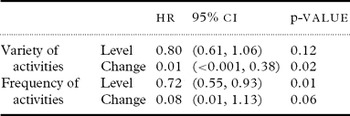
Multivariable models were fit to examine the risk of progression from mild to severe cognitive impairment in relation to the MCI baseline level and subsequent change in the variety and frequency of engagement in social activities (Table 4). Those who engaged more frequently in social activities at their MCI baselines, and those who had a slower rate of subsequent decline in their variety of social activities, had a lower risk of progression from mild to severe cognitive impairment. The variety of social activities engaged in when mildly impaired was not associated with risk of progression. A slower decline in the frequency of engaging in activities over time was marginally associated (p = 0.06) with a lower risk of progression. The associations between change in social activity and risk of progression were not found to depend on the initial levels of social activity at MCI baseline since the interaction term was not statistically significant (results not shown).
Multivariable models describing the associations of the MCI baseline level and concurrent change in the social activity composites with risk of progression from mild to severe cognitive impairment

Note: Discrete time survival analysis models adjusted for age, gender, education, and IADL dependency. HR = hazard ratio, CI = confidence interval.
Discussion
These findings suggest that participation in social activities is associated with a reduced risk of further cognitive decline among those with MCI. Our main analyses showed that a slower rate of decline in the variety of activities engaged in over time among those with MCI was potentially protective against progressing to severe cognitive impairment within the same three-year follow-up period. This association did not depend on the initial variety of activities engaged in when first classified as MCI. We also found that more frequent engagement in social activities in persons with MCI was associated with a lower risk of progressing to severe cognitive impairment over time. These associations suggest that engaging in social activities in late life, even among those already experiencing mild impairment in cognitive abilities, may be an important factor in preserving cognitive abilities and/or reducing further cognitive decline. However, the relationship could also work in reverse or be bi-directional in nature. Decreasing engagement in social activities could be a marker for cognitive decline and the assessment of social activities could potentially be one aspect of screening for cognitive worsening.
Social activities in late life could affect cognitive abilities in several ways. One potential mechanism is through the complexity of the social environment. Environmental complexity is an important contributor to cognitive reserve, presumably by activating and strengthening various neurobiological pathways, allowing individuals with MCI to better compensate for any underlying brain changes (e.g., due to aging, depression, Alzheimer's disease) and thus remaining only mildly impaired (Stern, Reference Stern2009). For example, Bennett and colleagues (Reference Bennett, Schneider, Tang, Arnold and Wilson2006) found that larger social networks modified the association between the level of Alzheimer's disease pathology and cognitive functioning. Although this finding was independent of engagement in social activities, it suggests that social connectedness on some level may contribute to increased cognitive reserve. Evidence is emerging that engaging in cognitively stimulating activities, including activities that can be social (e.g., playing games), can even directly affect deposition of Aβ protein that makes up the amyloid plaques in Alzheimer's disease (Landau et al., Reference Landau2012). This suggests that engaging in social activities that are cognitively and/or socially stimulating may prevent or slow the development of Alzheimer's disease pathology in the brain, which in turn could delay the onset of symptoms.
Engaging in social activities could also benefit cognition by reducing stress levels. Studies have shown detrimental effects of stress on the brain leading to cognitive decline or impairment (Lupien et al., Reference Lupien, McEwen, Gunnar and Heim2009). The activities included in this study are primarily leisure activities that the participants self-select and could potentially be considered restorative or relaxing. Engaging in enjoyable leisure activities has been shown to buffer the effects of stress. Compared to those with lower engagement, those with higher engagement have lower levels of depression and negative moods and higher positive effect in response to stress (Pressman et al., Reference Pressman2009). We did not examine the quality of these social interactions, so it is possible that some social activities could increase stress (e.g., certain family occasions). Social activities could also be related to cognitive functioning by providing the opportunity for expanding the social network, as well as increasing the availability of social support, social influence, additional social engagement, and access to resources and material goods (Berkman et al., Reference Berkman, Glass, Brissette and Seeman2000). These psychosocial mechanisms may impact cognitive health by influencing health-promoting (e.g., exercise) or health-damaging (e.g., poor dietary habits) behaviors, and psychological well-being through increased self-efficacy and self-esteem. These processes in turn affect physiologic functioning such as the stress response, immune function, or cardiovascular reactivity (Berkman et al., Reference Berkman, Glass, Brissette and Seeman2000), which have all been linked to cognitive functioning.
There is considerable variability in the way that engagement in social activities is measured across studies. This is partially related to the lack of a single comprehensive assessment tool. Most studies examining social activities in relation to cognition have used only a few items from a larger assessment of lifestyle activities, and often the activities are merely designated as social in nature by the researchers. This is problematic since there are activities which are typically done with others, but can be performed alone (e.g., playing cards), and vice versa. Also, some studies have included the dimensions of social network, social support, and social activities into the same measure. These different dimensions likely have different functions and associations with cognitive health outcomes (Hughes et al., Reference Hughes, Andel, Small, Borenstein and Mortimer2008). Our goal was to examine the specific role of social activities in the progression of MCI. We included only activities usually done with others, but it is possible that some of these activities could have been done alone, such as working or volunteering. Since engagement in social activities was self-reported, it is possible that participants may have either over- or under-reported their levels of engagement. However, we used data collected when participants were only experiencing mild impairments in cognition, minimizing the likelihood of response bias. Systematic over- or under-reporting of social activity could potentially distort the associations reported here.
Comparisons between those whose mild impairment did and did not progress to severe impairment may provide clues about the types of activities that may help reduce the risk of cognitive worsening. A lower probability of gainful employment among those who progressed from mild to severe impairment could be related to the older age of this group. Others have shown that occupational complexity is protective against cognitive impairment, especially if it requires working with people (Andel et al., Reference Andel2005), raising the possibility that continuing to work when cognitively impaired may help stave off progression to more severe cognitive impairment. A lower level of attendance at church in those who progressed compared with those who did not progress from mild to severe impairment suggests that involvement in church activities may be a source of social stimulation important for cognitive functioning. Finding that those whose cognition did not worsen performed more frequent volunteer work than those whose cognition did worsen is consistent with other studies showing volunteerism to have a positive impact on cognitive functioning (Carlson et al., Reference Carlson2009). Our list of activities was not exhaustive, though, and may have missed other social activities in which study participants engaged.
Understanding determinants of engagement in social activity is also important to consider when examining the association of social activity with cognitive functioning. In our sample, we found that being married and having children were associated with slower decline in the variety social activities. This suggests that family members may help older adults maintain engagement in social activities. This is consistent with Berkman and colleagues’ (Reference Berkman, Glass, Brissette and Seeman2000) conceptual model linking social networks to health and how social network ties (including family members) are an important resource for social activities. Measures of poorer health status (i.e., IADL dependency, higher depressive symptoms, taking more prescription medications, and lower self-rated health) were all associated with less social activity at MCI baseline and faster decline in the variety of activities over time. If engagement in social activities is found to offer protection against cognitive worsening in MCI, it will be vital to identify ways to keep older adults with health problems and physical limitations engaged in social activities.
Enthusiasm for higher engagement in social activities as a potential strategy to prevent or delay cognitive worsening, in those already showing signs of mild impairment in cognition, is mitigated by the reverse explanation. Previous studies have shown a bi-directional relationship between cognitive functioning and engagement in leisure activities (Ghisletta et al., Reference Ghisletta, Bickel and Lövdén2006; Small et al., Reference Small, Dixon, McArdle and Grimm2012). Those with mild impairment in cognition may have reduced their engagement in social activities as a result of their cognitive difficulties (Kaye et al., Reference Kaye2012). By definition, a diagnosis of dementia requires that cognitive impairment be severe enough to interfere with social functioning (American Psychiatric Association, 2000), so on the continuum it is likely that those with progressive forms of MCI are beginning to reduce their engagement in social activities. Therefore, it may be that the lower level of engagement observed in those whose cognition progresses to severe impairment may be a marker, rather than a true risk factor, for declining cognition. Similarly, the finding that a slower rate of decline in the variety of activities engaged in was associated with lower risk for progression could also be explained by those with worsening cognition being more likely to withdraw from social activities. Longer follow-up of this cohort will allow for additional analyses to disentangle the directionality of this association. Intervention studies where older adults are randomized to social activities will provide the most definitive results.
This study is one of the few to examine engagement in social activities as a predictor of progression from mild to severe cognitive impairment. Older adults with mild impairment in cognition are increasingly being targeted for interventions to slow or prevent cognitive decline. There may be different risk/protective factors for incident MCI and incident dementia (i.e., a factor might increase or decrease risk for MCI without necessarily influencing the subsequent rate of progression to more severe impairment). Therefore, our results contribute to our understanding of whether social activities are a risk factor for progression from MCI to dementia.
Our use of data from a population-based study of older adults reduces selection biases and increases the external validity of our results (Kukull and Ganguli, Reference Kukull and Ganguli2012). The results are most generalizable to similar populations of Caucasians from economically disadvantaged regions and should be replicated in more ethnically and economically diverse samples. Our summary cognitive outcome (i.e., non-progressive vs. progressive MCI) was based on a comprehensive neuropsychological test battery. Future work should examine whether different cognitive domains respond differently to engagement in social activities and also the relative amount of change in cognition attributable to social activity engagement.
In conclusion, we found more frequent engagement in social activities and a slower rate of decline in the variety of activities to be associated with a lower risk of progression from mild to severe cognitive impairment. One way to interpret these findings is that older adults with worsening cognition are less engaged than their peers whose cognition does not worsen. This suggests engagement may be an early marker of cognitive worsening. Alternatively, these results could mean that engaging in social activities provides protection against progression from MCI to a more severe cognitive state. Interventions trials to increase social activities among older adults with cognitive impairment are warranted in order to determine the direction of the association.
Conflict of interest
None.
Description of authors' roles
T. F. Hughes designed the study, assisted with data analysis, and wrote the paper. J. D. Flatt assisted in the design of the study and the writing of the paper. B. Fu conducted the data analyses. C-C.H. Chang supervised the data analysis. M. Ganguli designed the MYHAT study, supervised the data collection, and assisted in writing the paper.
Acknowledgments
The authors express their gratitude to Kathryn McMichael and Joni Vander Bilt for project coordination, Lynda Rose and Jennifer Jakubcak for database administration, Jack Doman for academic computing support, and all MYHAT staff for recruitment, data collection, and data management. They also thank the 2,036 senior citizens who participated in the study and made this work possible. The work reported here was supported in part by Grants R01 AG023651 and K24 AG022035 from the National Institute on Aging.