The community's ‘guiding light’: introducing the Khandan-i-Ijtihad
In a small lane in Lucknow's old city, in an attic office in the compound of the landmark Ghufran-i-Ma'ab imambarah, sits the headquarters of a Shi‘i religious organization known as the Noor-i-Hidayat (‘The Guiding Light’). The organization frames itself as a public religious service for the city's Shi‘i community, publishing religious works, and organizing calendrical sermons, ‘Eid functions, and lamentation gatherings during Muharram. Yet, significantly, it simultaneously seeks to preserve the memory of the so-called ‘Khandan-i-Ijtihad’: an extensive historic family or household (khandan, khanwadah) of Shi‘i ‘ulama associated with the city. The organization is presided over by this family's current figureheads and administered by staff who call themselves the family's ‘assistants’ (khadims); it publishes cheap-print Urdu/Hindi biographies of family luminaries and organizes public functions in the family name.Footnote 1 Implicitly, the so-called ‘guiding light’ that this organization provides to South Asia's Shi‘is connects the vitality of the community's religious life with the leadership provided by this particular family of exemplary religious scholars.Footnote 2
The ‘Khandan-i-Ijtihad’ is a wide, incorporative title that refers retrospectively to a celebrated ‘ulama-household of Lucknow. It has produced, over many generations, a number of certified mujtahids (scholar-jurists empowered to practise ijtihad, or independent judicial reasoning) and marja's (exemplars empowered to provide religious guidance), as well as dozens of other ‘ulama, muftis, imams, sermonizers, poets, and other religious specialists spanning many generations. The importance of this clerical household for Shi‘ism across South Asia is difficult to overstate and, while the family has received treatment in a number of Arabic, Farsi, and Urdu biographies as well as some Western scholarship,Footnote 3 it is worth first offering a brief overview of its illustrious history.
The Khandan-i-Ijtihad's influence and reputation grew in tandem, and alliance, with the Nawabi kingdom of Awadh (1722–1856), as the latter evolved from its early status of a provincial monarchy loosely subject to Mughal suzerainty into one of the world's principal seats of Shi‘i-modelled governance. The household's members all share common descent from its founding figurehead, Dildar ‘Ali Nasirabadi (‘Ghufran-i-Ma'ab’, 1753–1820)—an aspiring scholar from a small-scale landowning sayyid family of Nishapuri originsFootnote 4 settled in the Awadhi qasbah (Muslim gentry-town) of Nasirabad.Footnote 5 Having trained in the established Dars-i-Nizamiya curriculum under both Sunni and Shi‘i teachers, he was then funded by Awadh's vizier (chief minister) to embark on a pilgrimage of learning to Najaf in preparation for a career in government service. Having gained certification as a mujtahid, he returned to Lucknow in the early 1780s and, with state patronage, effected major changes in Awadhi Shi‘ism over the next four decades. He consolidated Lucknow as a centre of Shi‘i scholarship and learning (hawza), established the city's Shi‘i namaz-i-jum‘ah (congregational prayers), and fostered the sciences of Shi‘i jurisprudence and anti-Sunni/anti-Sufi polemic.Footnote 6
Dildar ‘Ali's close involvement with Awadh's Shi‘i ruling elite was expanded further after his death by his five sons, in particular his eldest, Sayyid Muhammad (‘Sultan al-‘Ulama’/‘Rizwan-i-Ma'ab’, 1784–1867), and his youngest, Sayyid Husain (‘Sayyid al-‘Ulama’, 1797–1856). With the conditions for Shi‘i state formation greatly bolstered by the pious Amjad ‘Ali Shah's ascent to the throne (r. 1837–47), it was these two mujtahids in particular who helped consolidate Awadh's Shi‘i legal-political administration in the 1830s to 1850s. Sayyid Muhammad and other relatives were recruited into the Awadh judiciary, jointly heading its Supreme Appeals Court and appointing the former's son, Muhammad Baqir (d. 1859) as chief justice (sadr-al-sudur) of the diwani ‘adalat (civil and criminal court).Footnote 7 They founded madrasas (most importantly the Madrasa-i-Shahi, established in 1847) to train more Shi‘i scholars and judges for government service, and they acted as supervisors of religious endowments, as collectors of zakat (religious tax), and as distributers of khums (charitable funds).Footnote 8 Thanks to courtly beneficence, they formalized Lucknow's ties to the ‘atabat-i-‘aliyat, the holy cities of Iraq, and expanded the links of education and pilgrimage between India, Najaf, and Karbala. These roles advanced Dildar ‘Ali's earlier efforts into the new generation, establishing this scholar-household as an efficient hierocratic elite of religious scholars that held heavy influence over the governance of Awadh.
All these endeavours contributed to the creation of what Juan Cole has called a ‘formal religious establishment’ in Awadh, whereby the Khandan-i-Ijtihad ‘ulama worked closely with the ruling Nawabs and courtiers to establish a distinctive model of Shi‘i governance.Footnote 9 The household's key representatives, over these two critical generations, collaborated in a project of Shi‘i statecraft. Drawing from their elite learning and expertise in jurisprudence, they served the administration as educators and advised the state's courts, and, in turn, they bestowed Shi‘i legitimacy upon Awadh's regime, delivering Friday prayers in the king's name, issuing fatwas in support of government interests, and conducting the coronations of incoming monarchs. This symbiotic relationship lasted until Awadh was disbanded at the hands of the British East India Company in 1856.
Unlike these two first golden generations, this household's third and subsequent generations have received almost no academic consideration.Footnote 10 Perhaps the assumption is that the family's reliance on the Awadhi state meant that its members were consigned to irrelevance once this state was dismantled.Footnote 11 Yet, the household's many descendants have remained prominent within India's Shi‘i clerical milieu and community in every generation since. Throughout the colonial period, family figureheads continued to (and still do) hold the role of imam and khatib for the congregational prayer and sermon in the Asafi Masjid, the city's main Shi‘i mosque. They also continued to command great influence over the city's public spaces: biographies record the crowds that gathered for the public sermons and the funerary processions of household figureheads being large enough to bring the city to a standstill, and suggest that these figures were regarded ‘like kings’ by the city's residents.Footnote 12 Moreover, the household's profile has persisted in independent India, right up until the present. Contemporary ‘ulama descended from this family, including figures like Kalb-i-Sadiq (‘Mufakkir-i-Islam’, b. 1939) and Kalb-i-Jawad (‘Aftab-i-Shari‘at’, b. 1966), remain among the most important and influential (not to mention colourful) figures of Shi‘i South Asia and garner considerable media coverage in and beyond the region.Footnote 13
Collectively, the Khandan-i-Ijtihad have comprised perhaps the most influential household of South Asian Shi‘i ‘ulama over the last quarter-millennia, equivalent only to a Sunni scholarly household like that of Farangi Mahal (from the same seat of Lucknow) in the duration and depth of its influence.Footnote 14 We could even argue that the family's presence and influence have become more rather than less ubiquitous over subsequent generations. After the single genealogical line (sanad, silsilah) between Dildar ‘Ali and his sons, it is over later years that the family has broadened into its latter-day form of a household (khanwadah): an extensive interlineal web with several interlinked branches. In terms of the sheer numbers of ‘ulama and other clerics operating under the household name, the Khandan-i-Ijtihad has grown from generation to generation.
Seeking to understand the so-called religious capital, both scholarly and social, that these scholars have managed to retain across a historic longue durée,Footnote 15 this article foregrounds this one ‘ulama-household (a concept upon which I elaborate below) to answer two interlinked questions. First, how has this household of scholars preserved (and, perhaps, perpetually reinvented) its claims to scholarly and pastoral religious leadership over successive generations? Second, how does the reputation of an individual scholar relate to the collective reputation of his household? Drawing from a range of Urdu, Persian, and Arabic life histories (tazkirahs) that trace the stories of the Khandan-i-Ijtihad or its individual members,Footnote 16 this article traces the fate of this family through an eventful spell of several generations after the collapse of Shi‘i Awadh in the 1850s.Footnote 17 Investigating the so-called ‘strategies’ by which this ‘ulama-household has extended its claims to authority,Footnote 18 it asks how this family have managed to secure and transmit their custody of religious leadership over successive generations, calling upon both their achievements and their distinctions of genealogy.
This approach, foregrounding one ‘ulama-household across multiple generations, differs considerably from most studies of the ‘ulama in modern South Asia, which have tended to assess them as a vocational group working in particular historic moments. It is also an exacting enterprise, not least due to the sheer size of this household. I therefore pick out a finite number of scholars from the family's third, fourth, and fifth generations, all of whom were mujtahids and/or marja's: these were the figureheads who carried the household name forwards, just as much as they drew personal distinction from it.Footnote 19 This takes us through an eventful several-decade period marked by the much-discussed ‘shock’ of colonial rule that has influenced much work upon the South Asian ‘ulama.
The article picks moves in several stages. A first section offers a commentary on the ‘ulama-household as a focal point for analysing Islam's learned elite, and establishes a framework for understanding the mingling of the reputation of the individual scholar and the collective household in the making of religious authority. The article then moves on to explore three interwoven devices by which the ‘ulama of this one household have endeavoured to maintain their stature since the demise of Awadh: memorializing the family (through biographical writing); preserving genealogical purity (through regulation of genealogy); and accomplishing vocational excellence (through community leadership). Finally, it turns to internal family dynamics, exploring how the better-known ‘crisis’ of authority prompted by external factors was manifested in even more consequential moments of fragmentation within the household itself.
The scholar and his household: a framework for examining clerical authority
This article joins a long academic conversation regarding the shifting foundations of the ‘ulama’s authority in the contemporary Islamic world.Footnote 20 A large body of work evoking the so-called ‘crisis of authority’ in modern Islam has highlighted the challenges faced by the traditional ‘ulama (scholarly elite) in maintaining their former grandeur amidst an increasingly pluralized and combative public sphere. Studies have analysed how a spectrum of so-called lay ‘religious intellectuals’, including a medley of modernists, Islamists, Sufi shaikhs, public preachers, and politicians, have together undermined the ‘ulama’s exclusive ownership of religious expertise.Footnote 21 As one author has put it: ‘the authority and social functions of the traditional ‘ulama … have declined through the nineteenth and twentieth centuries.’Footnote 22
Fittingly, a number of works have questioned this rather singular narrative of clerical decline, asserting the ‘ulama’s comparative success in sustaining their scholarly and social influence. Some landmark studies have examined how the ‘ulama have maintained custody over Islamic ‘tradition’ by re-emphasizing the ongoing requirement for the expertise of scholars to navigate changing conditions.Footnote 23 Others have narrated how the ‘ulama have broadened their social bases as ‘popular’ community leaders, by preaching, providing pastoral guidance, authoring popular literatures, establishing new schools and religious institutions, and engaging in social and philanthropic enterprises.Footnote 24 Others still have assessed how the ‘ulama have extended their clout through their new social and political involvements, whether working as advisers and/or legal consultants for Muslim governments, as for the ‘ulama-councils and advisory bodies that exist in many Muslim nations,Footnote 25 or taking up visible profiles in political opposition or as protest movements, as they have done under a series of colonial and post-colonial regimes.Footnote 26 Wisely, all these perspectives emphasize the ‘ulama’s collective adaptability to changing socio-political realities; yet, all share an essential framing of the ‘ulama along largely Weberian lines, as a ‘status group’, or a corporate body.Footnote 27 They examine the ‘ulama as ‘experts and specialists’, or as members of a ‘vocation’Footnote 28: a scholarly elite mutually possessed of academic and legal-bureaucratic authority, and characterized (if not always united) by their associational links to educational institutions (for example, madrasas), expertise (for example, Arabic or the Islamic sciences), or agendas (for example, constraining the encroachment of modern ‘secular’ reforms in law, education, or governance).Footnote 29
This vocational characterization, however, may understate other sources from which the modern ‘ulama have derived their religious capital. In particular, it rather overlooks the significance of a scholar's ancestry in the making of his authority. In reality, individual scholars built up their reputation not only as members of a corporate unit or professional class, but also as members of so-called ‘‘ulama-households’.Footnote 30 Family background offered genealogical distinction to some ‘ulama and, very often, it carried with it vital, long-term societal connections, such as a long-established public profile, or critical relationships built up over generations with patron families. Moreover, historically, the ‘ulama have often handed vocational offices such as those of imam (prayer-leader), muhtamim, or mutawalli (respectively, manager or trustee of Islamic institutions such as mosques, religious schools, or endowments) down their own family lines, keeping valuable social influence and revenue within their family's hands.Footnote 31
This focus upon the so-called ‘genealogical pattern of transmitting authority’Footnote 32 among the ‘ulama is one more familiar to, say, studies of the clerical hierocracies and scholar-families of the medieval period, or the early modern Ottoman or Qajar empires, than those of modern South Asia. For the latter, studies have usually emphasized the vocational lives of the ‘ulama as religious professionals, whether as scholar-experts, educationalists, or community leaders, and have given less attention to the status of household as a basis of their authority.Footnote 33
Yet, the South Asian ‘ulama (including the Khandan-i-Ijtihad, but also many other Shi‘i and Sunni ‘ulama alike) did call upon the gravitas vested in their household, whether in terms of its ancestral excellence or its social connections, to authenticate their religious leadership. Francis Robinson's aforementioned work on the Sunni Farangi Mahal household is one of the few examples to have taken the household seriously as a basis for analysing the South Asian ‘ulama, in his exploration of the notion of a distinctive ‘family adab’.Footnote 34 ‘To focus on a family rather than on a profession may seem to be stretching a point’, he suggests, before arguing that the family possessed and nurtured its own distinctive ‘family code’ of character and conduct.Footnote 35 Yet, aside from a few such studies, the amount of capital that the South Asian ‘ulama have drawn from their household as well as their own vocation has often been understated. Scholarship may be right about the widening of the definition of adab to incorporate ideas of moral conduct that are earned as well as inheritedFootnote 36 but, for elite, long-established scholar-families, ensuring the sealed quality of their family adab sometimes felt like the priority.
Even leaving aside the most celebrated Sunni and Shi‘i scholar-families like the Farangi Mahal or Khandan-i-Ijtihad, the South Asian ‘ulama more widely have drawn considerable capital from their household origins, even when they are associated with movements of Islamic renewal that are perceived as discounting the importance of genealogical pedigree.Footnote 37 The Deobandi movement is a case in point. While the movement is often understood to profess individual accountability before God regardless of one's origins or social privileges, its key exemplars have consistently drawn upon the stature of earlier generations within their own households. Biographies (tazkirahs) of the movement's historic luminaries open with declarations of their ‘noble lineage’ and ‘high birth’ (sharif-al-nasab, wiladat-i-sharifah), before offering meticulous tracings of their ancestry down long chains of Central Asian sharif (noble) descent.Footnote 38 The movement found its original social base among North Indian noble and landed elites in the colonial period, while the Deobandi ‘ulama, largely of high birth themselves, fed off the largesse of their family associates and moulded their teachings in accordance with the latter's sharif interests and values.Footnote 39 Nor have these distinctions been downgraded in relevance for contemporary ‘ulama. Recent Deobandi writings and organizations, like those of other ‘ulama-led religious movements, continue to be characterized by allusions to the ancestry of their contemporary leaders. Bonds of social distinction and family association bind these organizations together, while scholar-families sustain their own ties through social ties and family intermarriage.Footnote 40
This article suggests how the ‘ulama have often established their reputation on the basis of their family name, alongside their expertise and professional influence. We could, I speculate, interpret their ‘lines’ of genealogy and familial connections (nasab, shajra) as vectors of Islamic authority parallel to the ‘chains’ (masnad, silsilah) of transmission linking scholar with student, or saint with follower, in imparting religious capital down the generations. The Khandan-i-Ijtihad's scholars, I argue, have routinely invoked the gravitas vested in the household to sustain their authority.
But we must also explore how the family's individual scholars have combined references to their hereditary family distinctions alongside their own personal accomplishments when justifying their claims to authority. A useful framework is developed in Elvire Corboz's recent so-called ‘sociological study of clerical leadership’, focused upon two leading Shi‘i marja‘ families (the al-Hakim and al-Khu‘i) based in modern Iraq. Acknowledging the grasp that these ‘ulama-households have sustained upon global Shi‘i religious leadership, she explores how marja‘s from these households have built their authority upon a specific notion of honour or reputation (hasab-va-nasab), based on twin distinctions: those earned through vocational deeds (hasab) and those inherited through ancestral pedigree (nasab). These two sources of honour, she argues, blend together: the inherited pedigree of a family line bestows value on the actions of its members and, in turn, the achievements of individual family members reinforce the honour carried by the household.Footnote 41 A comparable dynamic of religious leadership, I suggest, is also visible within the Khandan-i-Ijtihad, whose representatives have engaged in perpetual efforts to blend their own individual accomplishments with the wider charisma of the household reputation.Footnote 42 It is to this dynamic of authority within this one family that we now turn.
Religious authority through remembrance: writing life histories of the ‘ulama
While this article explores the intermingling of hereditary distinctions and personal achievement in building and sustaining an ‘ulama-household's claims to scholarly and social leadership, we begin with another device crucial to propagating their reputation: the publication of ‘life histories’ (tazkirahs) to memorialize the individual or collective members of this household. More generally, there has been a growing tendency for Islamic biographers in South Asia to adopt the ‘ulama themselves as worthwhile historical subjects and, throughout the colonial period and particularly through the middle decades of the twentieth century, ‘ulama-biographies were written in particular abundance.Footnote 43 They are examples of what Roy Mottahedeh coined as ‘ulamalogy’—a format for writing history that foregrounds the lives and achievements of Islam's learned men, and uses these characters as a lens to trace the evolution of Islamic learning and culture more broadly.Footnote 44 The history of the ‘ulama, in other words, is construed as the history of Islam.
The stature of the Khandan-i-Ijtihad ensures that this family has been the subject of dedicated biographical writings throughout the modern period. However, while many of these biographies were written by admiring ‘lay’ Shi‘i essayists,Footnote 45 it is striking that several representatives of this household themselves invested considerable efforts in penning life histories of their own ancestors. We are used to thinking of the ‘ulama as scholars in disciplines like tafsir (exegesis), fiqh (jurisprudence), and kalam (theology), but even some of the major mujtahids of this family supplemented their duties as experts of the Islamic sciences with a further calling as prolific family biographers. For them, the family biographies that they penned were almost veiled autobiographies, since they implicitly re-emphasized their authors’ own illustrious family connections to these past figureheads.
Perhaps the most noteworthy of these works is Wārthat al-Anbīyā’ (‘Heirs of the Prophets’), authored by the fifth-generation family mujtahid Sayyid Ahmad and first published in 1918.Footnote 46 This voluminous biography, which focused upon the family's first two generations, was the first in what he intended to be a comprehensive household history.Footnote 47 Later household members also propagated their family's history. Through the mid-twentieth century, the family luminary ‘Ali Naqi Naqvi, a prolific author of popular religious tracts, penned at least four biographies of individual family figureheads.Footnote 48 Subsequently, other more distant relations in both India and Pakistan would do the same, showing how these cheap-print biographies could perpetuate the family's memory across Shi‘i South Asia, regardless of modern political boundaries.Footnote 49
These family life histories draw from two distinct literary genres of Islamic biographical writing, both of which were well established in early modern South Asia: those of the tabaqat (‘class’) and tazkirah (‘remembrance’) literatures. The former, drawn from a long Arabic-Farsi Islamicate biographical tradition, is the classic format for the Arabic ‘ulama-biography, comprising a style of ‘historical narrative which arranges events not through history but through people’.Footnote 50 Applied to the ‘ulama, it catalogues their genealogies of ancestry and descent, as well as their chains of learning, successions of teachers and students, and their subjects’ authorial achievements. Historically, the tabaqat has even become a form of Islamic science itself, since, by recording the interpersonal ‘chains’ of learning between generations of ‘ulama, it authenticates the very expertise that they transmitted.Footnote 51
Al-Hindi's aforementioned work in particular takes this form, offering encyclopaedic records of its subjects. It records their lines of lineage (wiladat), their certifications of scholarly excellence (fazilat), their writings and juristic abilities (tasanif, ijtihad), and inventories of their students (talamzah). It also provides dense accounts of these mujtahids’ perfections of character, attributes, and manners (kamalat-i-nafsani, ausaf, ‘ibadat, akhlaq); and of their historic religious duties, including delivering Friday sermons and Muharram lamentations, running Islamic trusts and foundations, and ‘serving the king’ (masa'ib, waza'if, khidmat-i-irada't-i-sultan).Footnote 52 Moreover, this biographical dictionary clearly affirms the historical importance of these scholars both for Lucknow's own Shi‘i history, but also for those centres in Iraq where they had studied and taught. Echoing the tabaqat form, it was clearly intended for both Indian Shi‘i readers and for the transnational networks of religious scholars across the Shi‘i world, including in Iraq, where al-Hindi built much of his career.
Yet, other biographies of this family, especially later Urdu tracts intended for a chiefly South Asian readership, take a different tone and borrow more from the tazkirah—an Indo-Persian biographical genre more associated with narrating the lives of Sufi saints or poets. The tazkirah’s approach is typically more hagiographical and embroidered, often embellished with lyrical recordings of conversations (malfuzat), moral tales (qaside), and verse (sh‘er), all of which emphasize the spiritual qualities of their subjects.Footnote 53 These tracts situate their subjects less within a global network of Islamic scholarship and more within the local cultural life of their own city. For instance, as well as being religious authorities, these texts portray the Khandan-i-Ijtihad scholars as cultured Lucknawi gentlemen. They talk of their subjects in languages of character resonant of this setting: those of a scholar's temperance, sweetness, patience, honesty, humanity, even one's ‘magical smile’.Footnote 54 They also remind their readers that the family's key members were trained not just in Islamic sciences, but in the finer arts of Awadh; to give a few examples, Muhammad Taqi was an accomplished poet, his son Muhammad Ibrahim was allegedly an expert astrologer, perfume-maker, and apothecary, while Muhammad Husain and Muhammad Mustafa were trained in the Nawabi arts of soldiery (sipah-gari).Footnote 55 These personalities are thus moulded according to an older prototype of the ‘alim as a broadly learned gentlemen-scholar, versed in Islamic knowledge and local noble cultures alike,Footnote 56 rather than the professional scholar-jurist familiar from studies of the modern ‘ulama.
Indeed, part of the appeal of these family tazkirahs to their readership may be that they do not merely recall the mujtahids themselves, but also evoke the seat of Nawabi and colonial-era Lucknow in which their stories unfolded. Marcia Hermansen and Bruce Lawrence have studied the tazkirahs of Sufi saints as ‘mnemonic devices’ for, among other things, sacralizing contemporary religious spaces: by situating their subjects so closely within their own geographical setting, they argue, these life histories re-imbue these contemporary spaces with their presence.Footnote 57 We also see this in the biographies of the Khandan-i-Ijtihad. Replete with references to recognizable events, landmarks, neighbourhoods, and persons of Lucknow, twentieth-century tazkirahs in effect bring the nineteenth-century city to life and place these figures at the heart of its history. Indeed, perhaps the appeal of these biographies to readers may rest in not only their remembrance of these scholars, but also their remembrance of old Lucknow—a city whose memory continues to command nostalgia across Muslim South Asia.Footnote 58
Even more strikingly, the various life histories about this family seem to exude the influence of the Sufi tazkirah-prototype by even implying their subjects to possess a kind of barakah (charismatic power) more resonant of saints. Readers are told that the death of Sayyid Muhammad in 1867 prompted buildings to shake, doors to fly open, and buildings to crack (‘the death of a scholar leaves a crack in Islam’), while he appeared to his sons in their dreams after his death.Footnote 59 Another text portrays a family luminary as steering a hajji steamboat to safety through turbulent weather simply through his presence on board and as ensuring a follower's career promotion simply by his blessing.Footnote 60 We also find typically Sufic imagery implied in images of followers’ deferential behaviour towards their scholar-masters, such as that of a mujtahid’s disciple holding out the skirt (daman) of his garment to receive his words.Footnote 61 It seems somewhat paradoxical that literary remembrances of an ‘ulama-household that, historically, had done so much to strip Indian Shi‘ism of its Sufi inheritancesFootnote 62 might be conjured in such an openly saintly idiom. Yet, simultaneously, it is perhaps a marker of the inadequacy of typologies such as the ‘Sufi-‘ulama paradigm’ to categorize constructions Islamic religious authority that have historically exhibited such intertwining between scholarly and spiritual communications of leadership.
Ultimately, the life histories written about (and often by) the members of this scholar-household serve as a mechanism for authenticating the household's historic and enduring leadership. Ultimately, like the tabaqat and tazkirah works of old, these writings establish its luminaries as the central pivot of a Shi‘i community history, and imbue the family's later representatives with distinctions inherited from their ancestors.Footnote 63 Moreover, these texts reveal how the household's various biographers have had to uphold the family's reputation via references to multifaceted markers of distinction. They refer not just to the scholarly or juristic excellence of their subjects, but to their perfect character, ethical integrity, elite ancestry, their immersion in the cultural world of local nobilities, and even their virtual saintliness and spiritual power. These texts thus illustrate perfectly the multi-polar credentials of authority to which the ‘ulama have had to ascribe in contemporary times, as they seek to establish their importance before an ever more diverse spectrum of clerical and public audiences.
The household's later representatives have also endeavoured to adapt their ancestors’ life histories to move with the demands of changing times. The Noor-i-Hidayat organization's contemporary outputs, like its serialized publications Khandan-i-Ijtihad and Shu‘a-i-‘Amal and even its website, comprise a new format for the ‘ulama-biography. Cherry-picking extracts, anecdotes, and verses from a canon of older tabaqat and tazkirah works, the organization effectively adapts these older prototypes for circulation among a contemporary and increasingly transnational Shi‘i audience, rendering it in simplistic Hindi and Urdu, and removing much of the excess detail and Persianate lyricism.Footnote 64 ‘Ulama life histories may now be conveyed through magazines and websites rather that printed lithographs, but these contemporary, consumable biographical formats, cut-and-pasted from earlier biographies and cheaply printed or digitized, are just the latest incarnation of the family's long-term endeavour to record, propagate, and manage the life histories of its ancestors.
Inheriting religious authority: the importance of genealogy
Another device through which the household has maintained its reputation is the preservation and perpetuation of the family's ancestral pedigree (nasab). The meticulous records of genealogical succession (shajra-i-nasab) preserved in these family biographies indicate just how significant the traceability of the bloodline was in ensuring the family's ongoing prestige. Distinguished ancestry has sometimes been considered more important for the Shi‘i than Sunni ‘ulama, since Shi‘ism has traditionally insisted that only sayyids, as direct descendants of the Prophet and the Imams, can provide clerical leadership.Footnote 65 Nevertheless, the declaration of authentic lineage is prominent even in biographies of Sunni ‘ulama, indicating the importance of so-called ‘genealogical memory’ in constructing the social authority of the modern ‘ulama regardless of the particulars of schools of thought.Footnote 66
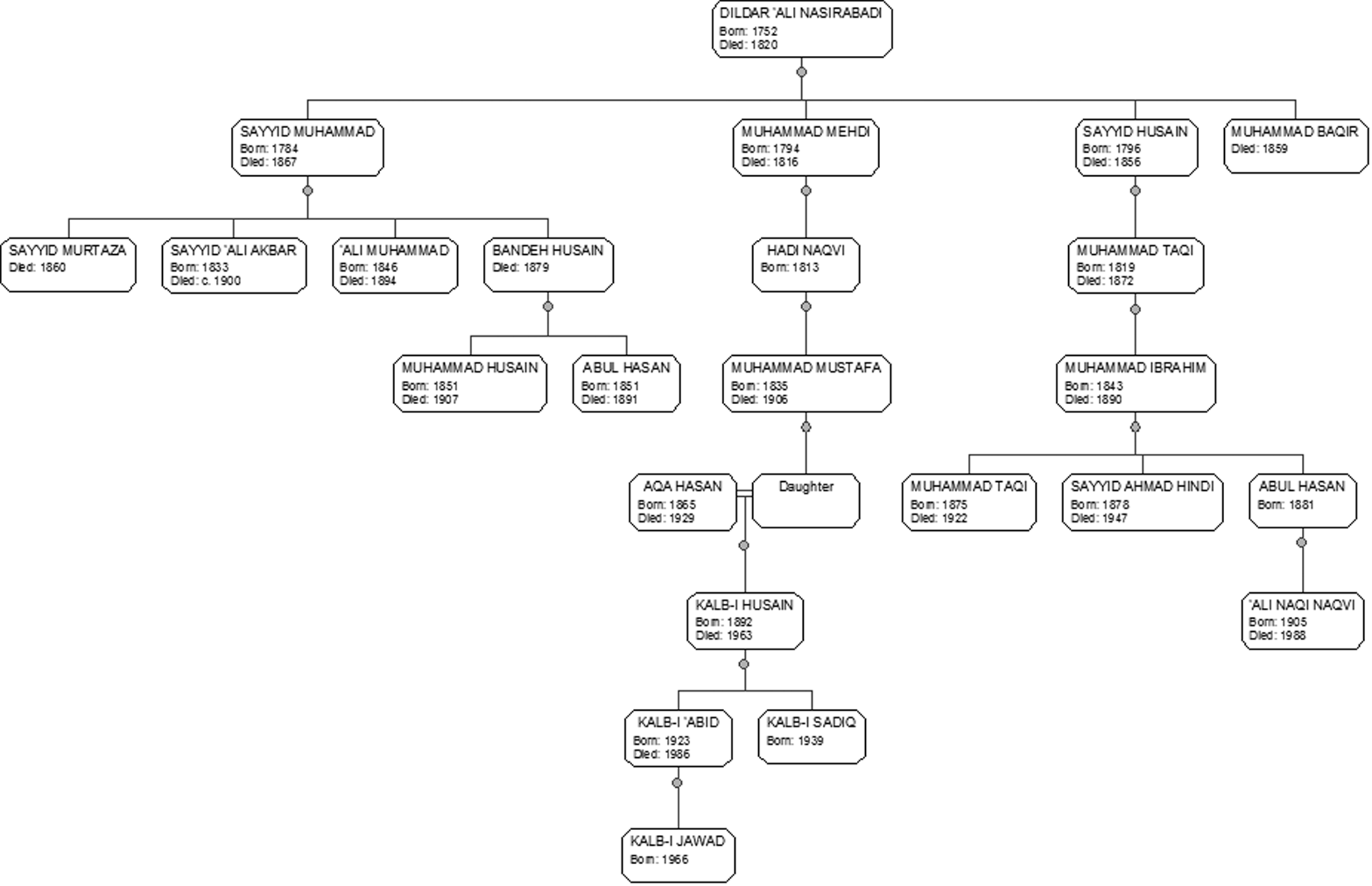
The Khandan-i-Ijtihad's life histories record the household's sayyid lineages back to the tenth Imam and their attention to detail allows us to construct a diagrammatic representation of some of the modern relational ties with this family (Figure 1). The family tree displayed here is far from complete: it only shows the patrilineal descent of a few major family figureheads who feature in this article, and omits most of this voluminous household's members (the mujtahid Aqa Hasan alone, for instance, allegedly had 22 children). Nevertheless, even this incomplete representation offers important glimpses into how this household reaffirmed its collective honour by regulating its shajra through the generations.
Partial genealogical tree (shajra-i-nasab) showing the relational ties between some of the main members of the Khandan-i-Ijtihad.

First, we can see the use of intra-family endogamy, chiefly the established sharif conjugal practice of inter-cousin marriage, both to protect the purity of shajra and to integrate different branches of the household.Footnote 67 A diagram such as this cannot convey the extent of interlinkage between family branches achieved through inter-cousin marriage, but these links were perpetual and meant that a large number of the family's later scholars hold both patrilineal and matrilineal (najib-ut-tarafen) descent from Dildar ‘Ali—a distinction sometimes affirmed in household biographies. Second, we can see examples of tactical intermarriage between different ‘ulama-families active in Lucknow. The household incorporated highly regarded scholars of associated ancestral lines into its own fold through intermarriage, giving itself an even greater dominance within the city's scholarly networks.Footnote 68
Intermarriage between ‘ulama-households has been a widely known custom across the Islamic world. It has been documented, for example, among the ‘ulama in Qajar Iran and among Sanussi Sufis in North AfricaFootnote 69 and it was such a ‘prevailing practice’ in Ottoman-era West Asia that inter-family endogamy turned the high ‘ulama of cities such as Damascus into a virtual ‘closed caste’.Footnote 70 Likewise, this custom clearly played an important role in modern South Asia for families such as the Khandan-i-Ijtihad. Some of the major Shi‘i ‘ulama of North India married into this household and thus became part of it; some, like Aqa Hasan, even became the family's key representatives after being ‘married in’ from cognate lineages.Footnote 71
Third, the household exercised comparably strategic marital alliances with non-clerical noble dynasties (umara’), including descendants of the Awadh royal family.Footnote 72 Prior studies of Awadh have revealed how the royal family and Shi‘i nobility appropriated marriage alliances to bolster hereditary distinctions and uphold important social and political relationshipsFootnote 73 and similar strategies were clearly employed by this ‘ulama-household. Indeed, it resembles similar arrangements within other Islamic royal households (including early modern Ottoman and Qajar and, indeed, contemporary Saudi) who have similarly sometimes employed family intermarriage to engrain their political relationships with the families of other political and societal elites on whose beneficence they rely, including the ‘ulama.Footnote 74
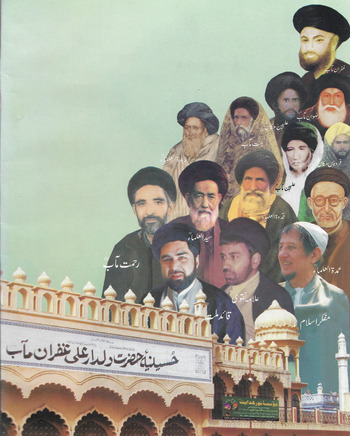
The Khandan-i-Ijtihad has thus utilized the tight regulation of marital practices both to uphold the inherited honour transmitted by nasab and also to shore up the family's social influence among both clerical and courtly elites. Moreover, the way that this family has flaunted its chains of lineage has itself moved presentationally with the times. The long, unbroken listings of names typical of the nineteenth-century tazkirah have been replaced, in magazines and websites, by newer, graphic representations of this lineage, perhaps even ‘neo-calligraphic models’ that appropriate the new technologies of the digital age.Footnote 75 Like the portrait of the family figures reprinted in Figure 2, they can select a small body of carefully chosen household figureheads and depict their links to their illustrious ancestors in a highly simplified image, prime for quick absorption by the casual or online reader.
Graphic image composed by the Noor-i-Hidayat Foundation (circa 2005), depicting some of the household's main members. The image is organized by generation, with family founder Dildar ‘Ali Nasirabadi at the head of the image, and the current figureheads, Kalb-i-Jawad and Kalb-i-Sadiq, at the base.

A final thought might be spared for the family's women. Wives and daughters are themselves silent and nameless figures in household histories, mentioned only as those ‘granted’ (mansub) in marriage to their scholar-husbands (many of whom themselves, it seems, married multiple times).Footnote 76 Yet, despite their consistent anonymity in biographies,Footnote 77 the family's women obviously played an important role as the conduits who transmitted the household's cherished genealogy.
Acquiring religious authority: the importance of vocation
What, then, of the other element of family honour: hasab, or that acquired afresh through the deeds of household scholars, both individually and collectively, in each generation? The Khandan-i-Ijtihad, especially from their third generation onwards, made a pronounced self-transformation from a courtly into a communitarian form of leadership. No longer able to rely on commissions and duties provided by Awadh's Shi‘i rulers, from the 1860s, they turned with increasing clarity towards roles in the social and spiritual guidance of India's Shi‘i population. Clerical biographical dictionaries talk about the family departing their earlier careers in advising the king's administration and instead serving the Shi‘i faithful (mominin). This experience mirrors that of many Sunni ‘ulama in colonial-era South Asia who, we similarly know, turned towards Muslim lay communities as their chief benefactors and clients, by expanding their activities of religious education, sermonizing, and pastoral guidance.Footnote 78 Yet, for the Khandan-i-Ijtihad, who had enjoyed a far more formal, entrenched (and recent) relationship with the Awadhi ruling elites than the Sunni ‘ulama had ever held with the Mughal-led administrations of the Doab and Rohilkhand, the collapse of Muslim power may have felt even more acute, making their ability to make this transition so suddenly especially striking.
Indeed, after 1857, the family showed considerable deftness in reformulating elements of established Shi‘i thought and religious practice to make the necessary adjustment to new political circumstances. Just one striking example is how they revised stipulations concerning practices of religious observance, as in one case centring on the issue of congregational prayers. Almost immediately upon annexation, Sayyid Husain's son, Muhammad Taqi, was asked by his tutoring mujtahid whether it was legitimate for a congregation to elect a peshnamaz who had not received ‘official (‘adalati)’ appointment, if they were unanimous in their support for him. This question was significant, since the role of city peshnamaz had historically been a de facto royal appointment in Lucknow over the lifetimes of its two main previous occupants, Dildar ‘Ali and Sayyid Muhammad. Issuing an istiftah (answer), he answered the question in the affirmative, receiving an ijazah (certification as a mujtahid) from a marja‘ of Najaf for his reasoning.Footnote 79 As well as enabling the ongoing appointment of a peshnamaz despite the fall of the king's court, Muhammad Taqi's juristic revision also legitimized his own succession into this position and meant that, thereafter, the Khandan-i-Ijtihad's key representatives effectively controlled this influential office in conjunction with the mosque's trustees. The household's retention of the office of Lucknow's Shi‘i peshnamaz, which continues until today, remains possibly the single most significant platform for projecting the family's profile and public influence.
There were other means by which the Khandan-i-Ijtihad maintained its grasp over the colonial-era city's key religious life. Especially important was their sustained hold over several large auqaf (religious endowments) that had been set up by the former Shi‘i rulers to support Lucknow's Islamic culture. Under the Awadh court, the Khandan-i-Ijtihad's senior clerics had often been assigned roles of trustee (mutawalli) over such foundations, giving this ‘ulama-household influence control over a substantial amount of revenue and, in turn, over the mosques, imambarahs, and other institutions that they supported. One key example was the Waqf-i-Mumtaz ul-‘Ulama, one of Lucknow's most important Shi‘i waqfs. Established by several Nawabi courtiers soon before British annexation, it drew rental revenue from a number of houses, shops, and kitchens across the old city to finance some of the city's major religious institutions, including the Tehsin ‘Ali Khan mosque and several lodges for the city's itinerant religious scholars, as well as providing a stipend to the trustee (typically the household's current main representative) and his family. After annexation, Muhammad Taqi took up the post of mutawalli (trustee), after which the office stayed in the hands of his descendants.Footnote 80
In other cases, the Khandan-i-Ijtihad's family alliances gave them indirect leverage over the city's religious life. Crucially, their close connections with former royalty gave them ongoing influence over the Husainabad Trust—an enormous endowment that was controlled by a board of royal and courtly descendants, and which supported Lucknow's Shi‘i Friday mosque, the Asafi Masjid, and the Asaf-ud-Daula imambarah, the city's largest Shi‘i congregational space.Footnote 81 Especially important was one component fund of the Husainabad Trust: the Awadh Bequest, which funded religious education and pilgrimage in the holy cities of southern Iraq. The Khandan-i-Ijtihad's simultaneous links with the Bequest's managers in Lucknow and with the marja‘s of Najaf and Karbala (under whom they had often studied) enabled them to position themselves as interlocutors between trustees and beneficiaries, and between Iraqi and Indian Shi‘i centres. Earning the attention of the Husainabad trustees and the colonial administration on this basis, members of the family exacted considerable influence over the fund's dispensation in the holy cities. Most particularly, Sayyid Ahmad Hindi used his influence among the fund's managers to shape the Bequest's management under the tutelage of the British Resident in Iraq in the 1910s to 1920s, leading to the fund's remittances being circulated among a wider range of scholars and causes than simply the cities’ single most senior mujtahids, including a larger number of South Asian ‘ulama.Footnote 82
Simultaneously, many of the household's endeavours after annexation focused upon building up new bases of societal support and influence. A good example was the household's ongoing role in religious tutorship and the building-up of master–student networks. Although Lucknow's main Shi‘i madrasa, the Madrasa-i-Sultaniyah, was closed upon annexation, the family's successors proved remarkably adept at sustaining a family reputation as religious tutors despite the absence of a recognizable institute of learning. One only need look to the tazkirahs of Muhammad Taqi, who, in the 1860s, continued the household legacy into its third generation by developing his own ‘hawzah-i-‘ilmiyah’: a circle of his students who were said to have ‘spread to all corners of India’.Footnote 83 A similar network is attributed to his son, Muhammad Ibrahim, the reach of which created a similar geography of Indian Shi‘i learning in the 1870s to 1880s with Lucknow at its centre.Footnote 84 The exhaustive lists of the students of each mujtahid as preserved in biographies show that many of the most prominent Indian Shi‘i ‘ulama of the late nineteenth and early twentieth centuries were, in one way or another, direct or indirect students of the Khandan-i-Ijtihad.
Strikingly, the main educational enterprise in which the family were involved in the decades after annexation was not in the institutional, collective format of the madrasa, which was being appropriated by the ‘ulama at Deoband and elsewhere. Instead, as presented in these texts, it focused upon the individual family scholar, who built up a circle of students who would subsequently carry the family name farther afield via their own vocations. Strikingly, the tazkirahs’ application of the term hawzah to imply a circle of students tied to an individual master was quite distinct from the meaning of the term as applied to centres such as Najaf or Qom, for which it denotes an integrated network of scholars, educational institutions, and curricula of learning.Footnote 85 In early colonial Lucknow, which lacked a Shi‘i madrasa of note, it seems that the ‘ulama-household, rather than any formal institution, could define itself as the core of the city's hawzah.
Simultaneously, these later generations of mujtahids continued to foster the household's relationships of patronage with influential Shi‘i sharif patrons, drawn from among North India's nobilities, landowners, ex-royals, and subehdars. Without state commissions, private supporters and benefactors seemed all the more important to sustaining influence both socially and economically. So, while, prior to 1857, it was ‘not the practice’ of the senior mujtahids to travel beyond the city to meet their patrons,Footnote 86 household representatives thereafter would more commonly accept invitations to deliver khutbah or majlis sermons on significant dates and would sometimes travel to their patrons’ towns as a regular seasonal commitment.Footnote 87
However, the ‘ulama were also reaching out beyond landlords and noblemen to a wider catchment of the Shi‘i population. Part of their work was made up of answering enquiries regarding Shi‘i beliefs, ritual practices, and stipulations of law, as received from followers. Muhammad Taqi was fielding this kind of correspondence even in the decade after annexation and, as early as the 1870s, at least two of the family's figureheads, Muhammad Ibrahim and Muhammad Mustafa (the latter being the former's student, successor, and son-in-law all at once), were managing offices (daftars) in Lucknow to handle enquiries. They received questions both in person and via post and telegram, to which they formulated and despatched answers in response, even allegedly taking personal responsibility for sealing the envelopes.Footnote 88 These endeavours mirror the trend seen among Sunni Deobandi and other ‘ulama to direct their answers and fatwas (legal decisions) towards the lay population during this period; and, while these mujtahids’ decisions were never compiled systematically (as was latterly done for the letters and fatwas of notable Sunni muftis) and were mostly lost, there seems little reason to doubt their impact: they are said to number in the many thousands and sometimes appeared in the Urdu press.
Given the household's historic training as muftis (jurists) in Iraq, and the employment of its first two generations as jurisconsults by the court of Awadh, it is unsurprising that the dispensation of ‘legal’ advice (fatwas, hukums) to their petitioners became a major aspect of the Khandan-i-Ijtihad's vocational duties. Yet, the change of emphasis between generations is striking. Many of the edicts of Sayyid Muhammad and Sayyid Husain especially, issued at the peak of Shi‘i political power, had essentially been validations of governmental interests and priorities.Footnote 89 Yet, by the third and fourth generations, with Shi‘i rule over, the household ‘ulama’s juristic reasonings and responses refocused to offering direct guidance to Shi‘is, in a new environment in which they had to govern their own religious life rather than relying upon the state to do so.
Muhammad Taqi's revaluation of congregational prayers from a political to a community-regulated issue, described above, is a clear example. But the surviving fatwas of Muhammad Ibrahim and Muhammad Mustafa largely seemed to reflect the trend towards a more disciplined, regulated form of Shi‘i religious practice that followed the perceived excesses of the Nawabi era. One tale tells of Muhammad Ibrahim's scoffing at the giving of dowry (jahez): criticizing an older relative who was planning to provide a dowry for his daughter's marriage so large that it had to be transported on camelback, he urged instead that no dowry be given at all.Footnote 90 Another anecdote relates to a noblewoman who wished to go on hajj but was forbidden from doing so by her husband. Muhammad Ibrahim urged that, since she had the independent financial means, she should not be beholden to him and should follow her own conscience.Footnote 91 Others from among Muhammad Ibrahim's instructions embody a similar ethic of personal accountability. Legal rulings could not be changed for personal gratification, they claimed; proper inheritance laws could not be transgressed; children should obey their elders and women their husbands or male guardians; all those who could afford to travel on ziyarat or hajj were obliged to do so.Footnote 92 He also wrote treatises on the strictures of prayer, of fasting, and the virtues of avoiding personal indulgences like immodest clothes and sitting for portraits.Footnote 93
The household thus placed itself at the centre of the shift towards an ‘ethical’ Islam of personal responsibility quite typical of the era and comparable to the Deobandi, Barelwi, and other movements of renewal. Likewise, these third- and fourth-generation scholars are depicted as embodying these values in their own conduct. Perhaps in contrast to the tales of extravagance that surrounded the family's early generations, these characters are depicted in their tazkirahs in terms of more disciplined virtues like politeness (shaistah), humility (‘ajizi), and piety (diyanat).Footnote 94
Yet, with the marja‘s of Najaf and Karbala by now using telegraph, print, and teaching networks to dispense their own fatwas on an increasingly global scale, these households were simultaneously finding ways to assert their own sustained command of guidance on points of law for the Indian Shi‘i population. A fatwa by Muhammad Taqi offers a lucid example. In the 1860s, a Shi‘i gentleman in India had apparently lost a hand in a fight and, in a bizarre experiment, had grafted a corpse's hand onto himself in replacement. Subsequently, the question of whether this hand could be considered his own for the purposes of ‘ibadat (acts of worship) was dispensed around Shi‘i scholarly circles and reached both Muhammad Taqi in Lucknow and Shaikh Za'in al-‘Abidin Mazandrani (d.1891/92), at this point the highest mujtahid in Karbala (who had, incidentally, conferred ijazahs upon some of the Khandan-i-Ijtihad mujtahids themselves).Footnote 95 These two scholarly luminaries apparently issued different answers. When al-Mazandrani was pressed further, he answered that there was no conflict between the two mujtahids, but that ‘hum rijāl va-nahnu rijāl’: ‘they are men and we are men’, extrapolated here in Urdu to indicate ‘each man to his own place’.Footnote 96
This episode is revealing for its illustration of the Khandan-i-Itjihad asserting its ability to offer different commands from the marja‘s of Iraq. Most Indian ‘ulama acted in deference to such illustrious scholars as al-Mazandrani, and to show such juristic independence was itself a mark of high stature.Footnote 97 Yet, the fact that the family's later tazkirahs have chosen to preserve this tale for posterity is equally revealing. The issuing of fatwas carved out the contours of an ‘Indian’ Shi‘i community whose composition and needs, this tale implied, were not identical to those of Shi‘is in West Asia. This twentieth-century tazkirah thereby marks out the Khandan-i-Ijtihad as the essential guides of an Indian Shi‘i population, regardless of any claims to the increasing centralization of Najaf or Qom as global centres of Shi‘i leadership during this same period.Footnote 98
While all these endeavours of community guidance mirrored similar efforts among the Sunni ‘ulama, there was a major issue on which they often differed: this household's apparent willingness to engage the colonial administration. While many Sunni ‘ulama, including those of Farangi Mahal, Deoband, and Ahmad Reza Khan's ‘Barelwi’ movement, often refused any meaningful political or intellectual cooperation with the colonial state,Footnote 99 the long-established historical links that this particular family held with Awadh's political elites meant that its members were rather more reluctant to surrender the opportunity to engage with British officials. A number of family mujtahids of the third generation onwards, including Bandeh Husain (‘Malik al-‘Ulama’, d.1879), Abul Hasan, and Muhammad Husain (‘Bahr al-‘Ulum’, 1851–1907), accepted seats at the District Commissioner's darbars (public audiences)—an honour shunned by many Sunni and Shi‘i ‘ulama alike.Footnote 100 Some ‘ulama of the household even worked for the British administration, most obviously Sayyid Muhammad's son, Sayyid ‘Ali Akbar (1833–1900), who, after 1856, became a munsif (court judge) and ultimately the Deputy Collector of Bahraich.Footnote 101
This willingness to engage with the state meant that the household's scholars could position themselves as interlocutors, representing the city's Shi‘i community to the colonial administration. In the 1880s, Muhammad Ibrahim reversed his earlier refusal to communicate with the British overlords and made appeals to Lucknow's Municipal Commissioner on two separate Shi‘i confessional issues. The first, in 1884, was a successful appeal for the British to evacuate the Asaf-ud-Daula imambarah and mosque compound, Lucknow's major Shi‘i congregational space, which had been occupied by a British military garrison since 1857. This allowed namaz-i-jum‘ah in the mosque for the first time in almost three decades, with Muhammad Ibrahim himself instated as peshnamaz.Footnote 102 The second, in 1889, was an equally successful attempt to resist government restrictions upon the Shi‘i azan.Footnote 103 According to his tazkirah, Muhammad Ibrahim went over the head of the Municipal Commissioner by writing directly to ‘Queen Victoria’ and praising the ‘British values’ of justice and religious freedom to win the argument.Footnote 104 Both feats were key in these scholars’ self-positioning as community representatives before the state—something that did not yet have wide parallels among the Sunni, or many other Shi‘i, ‘ulama-households.Footnote 105
This array of engagements with the wider population crystallized further from the 1900s, when household members began to set up a range of anjumans: public associations that organized religious functions or offered platforms for discussing community needs. Of these, the most significant was the Anjuman-i-Sadr-al-Sudur, a Shi‘i public organization founded by the young mujtahid, Aqa Hasan. The organization aspired to bring together the city's ‘ulama and umara’ (religious and social leaders) to address the community's needs and, after a few initial sittings, it morphed into the larger All India Shi‘a Conference.Footnote 106 Yet, the organization illustrates much about how this household's figureheads utilized their public involvements to engrain the family name into Shi‘i public life. Carrying the weighty title of ‘Chief Jurist’ familiar from pre-British Awadh—an office that had been controlled by this family's ancestors—the organization's name asserted this household's ongoing community headship. By implication, the contemporary Shi‘i community, much like the legal subjects of the sadr-al-sudur in the judiciary of old Awadh, became a populace over whom the scholarly household sustained command.
Over subsequent decades, this ‘ulama-household set up a plethora of anjumans that also imprinted the family name and ethos within the city's landscape. Around 1910, Sayyid Ahmad al-Hindi and Aqa Hasan set up a publishing organization that they called the Yadgar-i-‘Ulama (literally, ‘Memorial to the ‘Ulama’). Founded explicitly to ‘conserve the memory’ of the household, the organization provided the foundations for Sayyid Ahmad's authorship of the definitive family tazkirah and reprinted some of Dildar ‘Ali's key works.Footnote 107 Other organizations were established in honour of household luminaries, like the Anjuman-i-Jinnat-i-Ma'ab, a popular religious organization formed by ‘Ali Naqi in the honorific title of Muhammad Taqi, soon after India's independence.Footnote 108
In parallel with other ‘ulama in colonial India, the Khandan-i-Ijtihad have, since the late nineteenth century onwards, appropriated the opportunities provided by the evolving public sphere. Their engagements with a purported ‘community’ of followers have included a range of deeds including tuition, sermonizing, publishing, managing religious endowments, and providing advice on religious law, as well as public representation on community social issues. However, we must caution against interpreting all these vocational endeavours as somehow supplanting distinctions of lineage in maintaining the household's authority. To the contrary, many of the key occupational achievements of these ‘ulama—whether their foundations, printed works, or their public associations—have carried the names of family members or of the offices historically associated with the household. Viewed like this, the contemporary Noor-i-Hidayat organization is simply a recent example within a long line of ventures to embed the stature of the ‘ulama-household in the city's public sphere and the Shi‘i community's collective memory.
Family fortunes, family feuds: crises of authority within the household
While these scholars proved relatively adapt at periodically renewing their custody of religion, the household nevertheless felt the impact of the alleged ‘crisis’ of authority that afflicted the ‘ulama more generally in this period. The family's re-stamping of its claims of religious headship was accompanied by considerable resistance. Significantly, this came both from outside the household, from opponents of the ‘ulama, but, significantly, also from inside, as different family branches engaged in damaging, somewhat fratricidal arguments.
While all of South Asia's ‘ulama experienced a combination of indifference or attack from more secular-minded Muslim literati and professionals, the Khandan-i-Ijtihad appeared to be a particular target within the Shi‘i community. Perhaps due to their clear association with the ancien regime of the Awadh Court, they were vulnerable to a wider social critique of Nawabi excess and parochialism.
One of the major issues that brought the household under scrutiny was their attitude to the reformist ‘Aligarh movement’ of the later nineteenth century, which sought to formulate a modernist Islam compatible with Western knowledge and sciences. Compared to some other families of Shi‘i ‘ulama, the Khandan-i-Ijtihad scholars seemed distinctly hostile to the Aligarh programme, whether on account of their scholarly commitment to Islamic learning or their deep ties to the former nobility who shared a similar mistrust of the emerging professional elite that the movement represented. Two family voices were quick to vilify the movement. Bandeh Husain, a highly ranked mujtahid of the household's third generation, produced an edict (circa 1874) critical of the unqualified acceptance of Western education, accusing Sir Sayyid of nechriyat (materialism) and denial of the mi‘raj (ascension of the Prophet).Footnote 109 Aware of the influence of this family, Sayyid Ahmad Khan himself tried to enrol support from Bandeh Husain's half-brother, ‘Ali Muhammad; however, ‘Ali Muhammad not only shunned these overtures, but, as a well-established munazir (debater), subsequently built a reputation as a major opponent of the Aligarh programme, penning several treatises criticizing Aligarh's ‘atheism’ and its collusion with Christianity.Footnote 110
This episode, and several equivalent later sagas, earned the household considerable public criticism. Aqa Hasan was widely condemned in 1904 for organizing an assembly of Shi‘i and Sunni Muslims alike to protest the agenda of the Muhammadan Educational Conference, an organization affiliated to the Aligarh movement. While the meeting established Aqa Hasan as an influential opponent of Aligarh modernism, it also made him a magnet for attack by major Shi‘i Aligarh supporters: Mohsin-ul-Mulk, Sayyid Husain Bilgrami, and Badr-ud-Din Tyabji of Bombay all denounced his intervention.Footnote 111
There were similar squabbles between the Khandan-i-Ijtihad and younger Shi‘i modernists and politicians at various later junctures. They occurred in 1920 when Aqa Hasan put himself at the forefront of efforts to keep the Shi‘i community out of the Khilafat movement, in spite of popular will towards support.Footnote 112 Another controversy was sparked when, in the same decade, Kalb-i-Husain (‘‘Imad al'Ulama’, 1892–1963), one of the family's key younger representatives and Aqa Hasan's successor as the city's prayer-leader, took the novel decision of himself taking out mut‘ah: a temporary marriage. This custom had been well established among the old Nawabi nobility, and indeed several Khandan-i-Ijtihad members had written edicts establishing its legality in Shi‘i law,Footnote 113 but this practice had fallen from general acceptance among Shi‘is after the demise of Nawabi power. Kalb-i-Husain's opponents publicly accused him of dabbling in barely concealed prostitution.Footnote 114
Perhaps even more consequential was a series of feuds that emerged within the family during the same time period and which have inflicted lasting damage upon intra-household relationships ever since. The emphasis on vocation common to studies of the ‘ulama means that the internal conflicts plaguing ‘ulama-households has rarely been considered; nor do tazkirahs, wishing to portray their cherished subjects as representatives of a solid household unit, tend to mention these feuds. They are nevertheless recoverable from other sources, including official archives and ikhtilafat (religious disputation) literature.
Perhaps the most notable of these quarrels, and one worth narrating in detail, was a heated contest between different ‘ulama within the household for appointment as the peshnamaz of the Asafi mosque. As described above, this position has always represented one of the family's key platforms for public influence and respectability, and their hold over the office has been closely guarded. But, when the holding peshnamaz Abul Hasan died in 1895, a dispute over intra-family succession resulted. The branch of the family long in possession of this post supported Muhammad Mustafa, Abul Hasan's chosen deputee and one of Dildar ‘Ali's great grandsons, for the role. However, some members of the ex-royal family of Awadh, who sat on the committee of the powerful Husainabad Trust and claimed responsibility for the mosque's management, tried to appoint a different candidate from within the household: Muhammad Husain, a second-cousin of his opponent and, unlike the former, one descended from Sayyid Muhammad Nasirabadi, Dildar ‘Ali's oldest son.Footnote 115
Both sides sent petitions to the British lieutenant governor, who confirmed that the decision should lay with the peshnamaz and hence confirmed Muhammad Mustafa's succession. But, a decade later, Muhammad Husain tried to secure the position again when Muhammad Mustafa died and the latter's nominated successor (as well as nephew and former pupil), Aqa Hasan, took on the role. Muhammad Husain approached Lucknow's Commissioner, claiming that Aqa Hasan was an unsuitable candidate and that he himself would be a more appropriate choice, on account of his direct descent from Sayyid Muhammad, his greater age, and deeper learning (he even claimed to have been the tutor of the other claimant), as well as the support he held among the ex-royal family and Husainabad trustees.Footnote 116 His claims were bolstered by some other ‘ulama. Sibte Husain (1867–1952), a distant relation, wrote to the lieutenant governor that Aqa Hasan was the lesser of the two scholars and that his ijazat were forged. Evoking Aqa Hasan's anti-Aligarh politics, he went on to claim that he ‘prohibits men and women to learn [sic] English arts and language’ and that he was an opponent of British rule; Muhammad Husain, by contrast, was a ‘well-wisher’ of the government.Footnote 117 He urged the British administration to intervene to demote Aqa Hasan from the position of peshnamaz. Counter-petitions flew in from self-proclaimed representatives of the ‘Shi‘i public’ supporting Aqa Hasan as the rightful successor.Footnote 118 While Muhammad Husain would never wrest this position from the other household line, this damaging feud badly tarnished intra-family relationships for several decades.
An equally damaging dispute within the household broke out later over control of the endowments that the family administered. Key here was the Waqf Mumtaz ul-‘Ulama, the family's most important endowment, which, as discussed above, was created in the mid-nineteenth century, with Muhammad Taqi as its trustee. The trusteeship stayed in the hands of his own descendants, but, in 1918, attempts were made by rivals within the family to have his grandson, Muhammad Taqi bin Muhammad Ibrahim (1875–1922), removed from the position of trustee, on allegations of using the monies for personal ends. As with many Islamic waqfs that sparked court cases, the root of debate lay in the ambiguity of the endowment from its very foundation. The sitting trustee claimed that the waqf had been established as a family trust (waqf-i khass, waqf ‘ala al-aulad), created partly to provide for the trustee's family, which gave the current holder complete discretion over its use. Those relatives who took the case to court claimed instead that it had been founded as a public waqf, the revenues of which must be used only for charitable or religious benefit. In 1919–20, Muhammad Taqi was taken to court and stripped of his trusteeship; the legal wrangles between opposing sections within the family continued for a half-century thereafter.Footnote 119
These episodes, and others, broke the household into several lines and show how little substance sometimes lay behind the appearance of a single, cohesive household that all these scholars simultaneously worked so hard to project. It is equally ironic to observe the descendants of one of the world's foremost Shi'i judiciaries, just two or three generations later, calling up British officials and filing petitions in government courts to handle their intra-family disputes. How can we explain the outbreak of these injurious rivalries, when many family members had so much vested in the household's reputation?
The expansion of the household, as it enlarged and disaggregated from a crisp khandan into a bloated khanwadah over several generations, may underpin the breakout of these feuds. As those claiming the mantle of the household swelled in number, and as the household simultaneously lost much of the wealth and social influence that it previously commanded, it seems that different family branches became locked in increasing competition for ever decreasing funds and social capital. Furthermore, a critical moment seemed to be the decision after 1857 of the family's main representative, Sayyid Muhammad Nasirabadi, to distribute his various posts and functions—as prayer-leader, tutor, and trustee of numerous endowments—among his various sons and nephews.Footnote 120 Sayyid Muhammad himself had relatively few obvious male heirs to whom he might hand these occupations (at least three of his sons died somewhat prematurely before 1860) and so the handover of his duties may have unintentionally pre-empted the shift of influence away from the descendants of Dildar ‘Ali's eldest son towards those of the youngest, Sayyid Husain.Footnote 121 Once the latter's son, Muhammad Taqi, assumed the highly influential appointment of peshnamaz, this office was retained within the latter's own family line; conversely, Sayyid Muhammad's own sons found themselves increasingly estranged from roles of public leadership, despite their scholarly credentials and their father's illustrious reputation.Footnote 122 From the third generation onwards, the family effectively split into separate branches and the incremental shift of command from one to the other almost certainly helps to explain the ferocity of intra-familial arguments like these.Footnote 123
More generally, we may speculate that the collapse of Awadh and the fragmentation of the patronage networks on which the state rested greatly enhanced possibilities for friction within the family. Before the fall of Awadh, the public offices held by the mujtahids (as prayer-leaders, trustees, and so on) were effectively royal appointments, certified by the monarch in consultation with his court. But there was no such singularity of command in British India. Instead, as in the case of the row over the appointment of peshnamaz, various factions claimed the right to make the decision. Without the king, it was unclear whether the power to select the next prayer-leader lay with the incumbent peshnamaz (the usual stipulation under Shi‘i law), the mosque's trustees (the convention written into the deeds of some of the city's endowments), or the British administration (following the precedent of the Awadh king's ultimate control of the appointment). The demise of Awadh clearly eroded the structures of religious leadership and exacerbated possibilities for internecine rivalry within the family.
Conclusions: the Khandan-i-Ijtihad after ijtihad
This article has sought to use the household, rather than vocational qualification and deeds alone, as a window for viewing how clerical authority is designated and transmitted among the South Asian ‘ulama. For the learned men recounted above, the ‘household’ was a holistic source of reputation: it conferred upon them their noble lineage, it authenticated their chains of education and expertise, and it provided the social, financial, and political connections on which their own vocations rested. While the strategies of the Khandan-i-Ijtihad's individual figureheads to sustain their own authority—commanding networks of patronage and learning, providing guidance to followers, cultivating roles as social leaders and political interlocutors, and so on—resemble those familiar from other studies of the South Asian ‘ulama, this article suggests that all these vocational duties were enmeshed with the reputation (hasab-va-nasab) of the whole household, past and present. Individual scholars grounded their works in a form of collective distinction that was ancestrally grounded and genealogically transmitted, while, in turn, their own particular achievements perpetually refreshed the memory of the historic household and renewed its ongoing power.
One could argue that this framework for understanding religious authority may apply more clearly to a household like the Khandan-i-Ijtihad—a family of Shi‘i sayyids unequal in its noble pedigree and long-established socio-political influence—than it might to other ‘ulama-households. Nevertheless, I have indicated throughout this article that this same dynamic may help us to understand the authority of the South Asian ‘ulama more generally. Given the noble ancestries of the dominant proportion of high-ranking Sunni and Shi‘i ‘ulama alike in this same period, the emphasis placed on their family origins and connections in their public profiles, and the sharif social networks through which they have historically operated, there is every reason to reconsider these figures too along similar lines and to revisit the importance of the inherited, alongside the acquired, sources of religious authority in the command of the South Asian ‘ulama.
Much of the above discussion has proceeded along the lines of the apparent success of the Khandan-i-Ijtihad at perpetually renewing itself as India's dominant Shi‘i ‘ulama-household through every generation. Given the household's continuing fame and influence, which is visible through every medium from the nineteenth-century biography to the twenty-first-century website, there is certainly much truth in the longevity of the family name; and this interpretation works in tandem with the many works that have emphasized the ability of the ‘ulama to recalibrate their own roles and significance in each historical moment.Footnote 124
Yet, there is another interpretation here: that the huge investment that this household has put into its own memorialization reflects its temporal decline. This article has hinted at many reasons for this family's deterioration throughout this very same period. Their weakening financial and political influence, increasing challenges from clerical and non-clerical opponents alike, and, just as importantly, the explosion of intra-family conflicts all exerted considerable pressure on the household. This same decline has worsened since India's independence, following the damage wrought by Muslim emigration and zamindari reform on noble Muslim patronage, and the collapse of waqf funding. The increasing inaccessibility of Iraq's scholarly centres since the 1970s has added to the perils, and has meant that this household has become ever more estranged from the hawza of Najaf from which it had once drawn so much of its reputation.Footnote 125 By common consensus, the family luminary ‘Ali Naqi Naqvi, who died in 1988, was the last of the family's confirmed mujtahids.Footnote 126 To read this even more ungenerously, the title of ‘Khandan-i-Ijtihad’, a retrospective designation more commonly heard in the late twentieth and twenty-first centuries than it was in the nineteenth, seems to have become more prevalent alongside the extinction of the family's ijtihad itself.
Could it be, then, both for the Khandan-i-Ijtihad and other comparable ‘ulama-families, that the growth of the ‘ulama-biography as literary genre that we witness in the early to mid-twentieth century is less a reflection of the sustained authority of these scholars, but more a symptom of its decline? Just as the fascination with Islamic history prevalent in late nineteenth and early twentieth-century South Asia accompanied the sense of an urgent Muslim deterioration from former greatness,Footnote 127 as the renewed interests in Islamic poetic and musical traditions in the same period were symptomatic of the erosion of Indo-Persian cultural forms,Footnote 128 and as a fascination with Mughal architecture developed in parallel to the crumbling of its buildings,Footnote 129 then could it be that the project of memorialization undertaken by these ‘ulama-biographies is, in fact, a reaction to the reality of forgetfulness? The Khandan-i-Ijtihad household continues to invest in efforts to renew its own historic reputation across the generations, against the possibility of failure to sustain its own legacy.