




No CrossRef data available.
Article contents
Peer relationship antecedents of delinquent behavior in late adolescence: Is there evidence of demographic group differences in developmental processes?
Published online by Cambridge University Press: 07 April 2005
Abstract
A longitudinal prospective design was used to test the generalizability of low levels of social preference and high levels of antisocial peer involvement as risk factors for delinquent behavior problems to African American (AA) and European American (EA) boys and girls (N = 384). Social preference scores were computed from peer reports in middle childhood (ages 6–9). Parents and adolescents reported antisocial peer involvement in early adolescence (ages 13–16) and adolescents reported on their own delinquent behavior in late adolescence (ages 17 and 18). Analyses tested for differences across four groups (AA boys, EA boys, AA girls, EA girls) in construct measurement, mean levels, and associations among variables. Few measurement differences were found. Mean-level differences were found for social preference and delinquent behavior. AA boys were least accepted by peers and reported the highest level of delinquent behavior. EA girls were most accepted by peers and reported the lowest level of delinquent behavior. Associations among peer experiences and delinquent behavior were equivalent across groups, with lower levels of social preference and higher levels of antisocial peer involvement associated with more delinquent behavior. Person-centered analyses showed the risk associated with low social preference and high antisocial peer involvement to be similar across groups, providing further evidence of the generalizability of the peer relationship experiences as risk factors for subsequent delinquent behavior problems.
This research was supported by grants from the National Institute of Mental Health (MH 42498, MH 57095) and the National Institute of Child Health and Human Development (HD 30572 to G.S.P., K.A.D., and J.E.B.). We are grateful to the Child Development Project families for their participation. Special thanks to Jennifer Burczyk–Brown for her help in managing the analyses and to Michael M. Criss for his comments on an early version of the manuscript. This article has been approved for publication by the Director of the Louisiana Agricultural Experiment Station (manuscript 03-36-104).
Information
- Type
- Research Article
- Information
- Copyright
- © 2005 Cambridge University Press
Children who are rejected by their peer group in childhood are more likely to engage in antisocial and delinquent behaviors at later ages (for reviews, see Kupersmidt, Coie, & Dodge, 1990; Parker & Asher, 1987). Likewise, involvement with antisocial peers in adolescence is a strong and consistent correlate of delinquency, drug use, and a range of other problematic behaviors (e.g., Snyder, Dishion, & Patterson, 1986; Vitaro, Brendgen, & Tremblay, 2000). Patterson and others (e.g., Cairns, Cairns, Neckerman, Gest, & Gariepy, 1988; Patterson, Reid, & Dishion, 1992; Snyder, 2002) have suggested that peer rejected children frequently interact with one another or gravitate to antisocial peers. Thus, there is an expectation that antisocial peer involvement in adolescence should follow peer rejection in middle childhood. According to the early-starter and late-starter conceptualizations of antisocial behavior development (Moffitt, 1993; Patterson, DeBaryshe, & Ramsey, 1989; Patterson & Yoerger, 2002), both peer rejection and antisocial peer involvement would be expected for early starters. Presumably, an ongoing tendency to engage in antisocial behavior results in peer rejection and facilitates establishing a network of antisocial peers. However, peer rejection would not be expected to antecede antisocial peer involvement for late starters because late starters are characterized by the emergence of antisocial behavior during adolescence.
We recently sought to determine whether peer rejection and antisocial peer involvement represent developmentally relevant and successive stages of progression toward delinquent behavior and criminality, whether early and consistent behavior problems underlie developmentally changing expressions of maladjustment, or whether peer rejection and antisocial peer involvement represent different routes to delinquent behavior (Laird, Jordan, Dodge, Pettit, & Bates, 2001). Our findings generally were consistent with the early and late-starter perspectives. The association between peer rejection and antisocial peer involvement was statistically significant but modest. In person-centered analyses, 8% of our sample showed high levels of behavior problems in early childhood, were rejected by their peers in middle childhood, and became involved with antisocial peers as they entered adolescence, all the while maintaining high levels of antisocial behavior. A second group (7% of the sample) exhibited relatively little antisocial behavior before becoming involved with antisocial peers during adolescence at which time their own antisocial behavior increased. These peer experience and behavior problem profiles would be expected of early starters and late starters, respectively.
The purpose of the present study is to return to and extend these data to consider questions of contextual generalizability. The primary issue examined in the present study is whether the associations among early childhood behavior problems, childhood peer relationship experiences, and adolescent delinquent behavior problems are similar for boys and girls and for African American (AA) and European American (EA) individuals. Commentary on the status of research on different demographic groups argues for greater attention to gender and race (e.g., Jones, 1991; McLoyd, 1998). Studying diverse samples helps to ensure that results are generalizable, but additional steps are needed to determine whether the same or similar processes are functioning within selected subsamples. To the extent that gender and race function as contextual organizers, it is appropriate to consider whether experiences previously identified as peer relationship risk factors function in the same manner across the different demographic contexts (Barrera, Castro, & Biglan, 1999). Such information is crucial not only for improving theories of the development of antisocial behavior, but also to the design and implementation of prevention and intervention programs (Steinberg & Fletcher, 1998).
Gender differences, and to a lesser extent race differences, in mean levels of antisocial behavior problems are widely reported. Researchers have consistently reported that boys engage in more aggressive and antisocial behavior than girls from childhood through adulthood (Hyde, 1984; Maccoby & Jacklin, 1980), although some studies have indicated that boys and girls become more similar by late adolescence (Hyde, 1984), or that gender differences in antisocial behavior have been overestimated because of the extensive focus on overt or physical aggression (Crick & Grotpeter, 1995). AA and EA individuals also have been found to show different patterns of involvement in delinquent and risk-taking behaviors. Although AA and EA adolescents self-report similar levels of delinquent behavior, AA adolescents, and AA males in particular, are more likely to be arrested and involved in violent altercations both as perpetrators and victims (Allen & Mitchell, 1998; Gibbs, 1998; Grunbaum, Kann, Kinchen, Williams, Ross, Lowry, & Kolbe, 2002). On the other hand, EA adolescents regularly report higher rates of drug, alcohol, and tobacco use (Grunbaum et al., 2002).
There are many factors that could contribute to mean-level demographic group differences in antisocial and delinquent behavior including variations in biological processes (e.g., group differences in the production of testosterone), contextual risk factors (e.g., differences in neighborhood crime), family experiences (e.g., harsh disciplinary practices), and peer relationship experiences (e.g., peer rejection and antisocial peer involvement; for a review, see Coie & Dodge, 1998). The current study focuses on peer rejection and antisocial peer involvement because these experiences appear to be risk factors for antisocial behavior that transcend racial and gender background differences: almost any child can associate with antisocial peers and/or experience peer rejection.
Tremblay (2000) has proposed that researchers studying risk factors for antisocial behavior should consider factors that promote or facilitate antisocial behavior as well as factors that fail to inhibit antisocial behavior. Peer rejection and antisocial peer involvement may do both. Peer rejection, which is linked to overly aggressive behavior with peers, may promote future antisocial behavior by establishing or reinforcing maladaptive social cognitions (e.g., Dodge, 1986), or by limiting opportunities for interaction with prosocial peers, therefore impeding the development of social skills and competencies. Antisocial peer involvement may facilitate antisocial behavior by providing opportunities for antisocial individuals to learn from one another, by providing willing accomplices, or by providing a context in which antisocial behavior and talk about antisocial behavior is valued and rewarded (e.g., Dishion, Patterson, & Griesler, 1994). In any event, antisocial friends are not likely to discourage antisocial behavior.
Two processes explain how peer relationship experiences may account for group differences in the development of antisocial and delinquent behavior. First, peer relationship processes and risks associated with peer rejection and antisocial peer involvement may be comparable across groups with base-rate differences in antisocial behavior accounting for any group differences in peer relationship experiences. Specifically, peer rejection and antisocial peer involvement may predict adolescent antisocial behavior similarly for boys and girls and for AA and EA adolescents. However, if boys and AA children engage in more antisocial behavior, boys and AA children should experience more peer rejection and report greater antisocial peer involvement. Essentially, the argument is that early starters will be concentrated among boys and AA children, and thus, antisocial behavior problems and peer relationship problems will be more common among boys and AA children.
A second possibility is that mean-level differences may result from group differences in the risk process associated with a given factor. If, for example, peer rejection channels boys to delinquent behavior more so than girls (perhaps because more positive peer interactions are needed for boys to learn appropriate social skills than for girls), then at a given level of exposure, boys would be expected to engage in more delinquent behavior than girls. Analyses presented in this study will determine (a) whether there are group differences in exposure to the two peer relationship experiences, and (b) whether the peer relationship experiences carry the same level of risk for delinquent behavior across different demographic groups.
Gender differences in both exposure and associated risk are expected to be more pronounced for peer rejection than for antisocial peer involvement. Peer rejection is often thought to be a reaction to overt aggressive behavior and/or social skills deficits (Rubin, Bukowski, & Parker, 1998). Therefore, because boys are more likely to show aggressive behavior and related social skills deficits (Coie & Dodge, 1998), boys are expected to experience peer rejection, become involved with antisocial peers, and to engage in delinquent behavior as adolescents more often than girls. Thus, for boys, and particularly for early starting boys, peer rejection is expected to predict both later involvement with antisocial peers and delinquent behavior problems. If girls are absent or underrepresented among early starters as suggested by Silverthorn and Frick (1999), peer rejection should be less frequently experienced by girls and, when experienced, peer rejection should not predict either later antisocial peer involvement or later delinquent behavior for girls as strongly as it does for boys.
In some past studies, both peer rejection and antisocial peer involvement have been found to be stronger predictors of antisocial behavior among boys than among girls (Coie, Terry, Lenox, Lochman, & Hyman, 1995; Ellickson & McGuigan, 2000; Erickson, Crosnoe, & Dornbusch, 2000). Other studies have found no evidence of gender differences in associations between peer relations and substance use and delinquency (Maggs & Hurrelmann, 1998), or in links between antisocial peer involvement and delinquent behavior (Jang & Thornberry, 1998) and gang membership (Hill, Howell, Hawkins, & Battin–Pearson, 1999). It may be that gender differences in the risk associated with peer relationship experiences are not robust or pervasive, but it also may be that gender differences in exposure to peer relationship risk factors influence associations among constructs. For example, boys' higher rates of antisocial behavior may result in more frequent peer rejection. Thus, there may be more variability in both antisocial behavior and peer rejection among boys than among girls. In some instances, the differences in base rates and variability may lead to the conclusion that peer rejection is more strongly associated with antisocial behavior for boys than for girls. The current study will present a more comprehensive test of gender differences in peer relationship risk factors for delinquent behavior by considering both differences in the rates at which boys and girls are exposed to peer rejection and antisocial peer involvement and potential gender differences in the risk for future antisocial behavior associated with the exposure.
Two perspectives suggest that the consequences of specific peer relationship experiences may be different for AA children compared to EA children. First, Ogbu (1993, 1994) argues that the school context is devalued by many AA families. If, in fact, the school context is viewed as less important by AA families, then peer relationship experiences in the school context may be less influential for AA children. Second, research and theory often has focused on the social and economic disadvantages faced by many AA families, particularly those families living in urban areas, as primary contributors to delinquency (e.g., Tolan, Gorman Smith, & Henry, 2003). Experiences resulting from social and economic disadvantage (e.g., neighborhood crime and violence, family stress) may be the primary risk factors for delinquency among AA individuals. Peer relationship experiences may be weak and overshadowed by social and economic disadvantage. In contrast, negative peer relationship experiences may be more influential for AA individuals than EA individuals if peer relationship risks pile up with risk factors encountered in other domains. Extant research suggests that the two peer relationship experiences may carry greater risk for EA individuals than AA individuals, but the difference between groups appears to be modest. Specifically, Lochman and Wayland (1994) found that low peer sociometric status combined with aggression was more strongly linked to self-reported psychopathology among EA boys than among AA boys, but the race differences disappeared when multiinformant measures were used. In a similar vein, Matsueda and Heimer (1987) found that associations between delinquent peer involvement and delinquent behavior were stronger for EA adolescents than for AA adolescents, although the associations were significant for both groups. However, Jang and Thornberry (1998) found that associations between delinquent peers and delinquency generalized across AA and non-AA groups. Again, the current study will test for both mean-level race differences in exposure to peer relationship risk factors and for differences in the risk associated with peer rejection and antisocial peer involvement for AA and EA individuals.
The studies noted above tested race or gender differences, but few considered Race × Gender subgroups. It may be that gender and race differences, if they exist, are additive. That is, boys would be expected to engage in more antisocial behavior than girls, and AA boys would be expected to engage in more antisocial behavior than EA boys. However, it is possible that race and gender interact such that gender differences are more pronounced in one racial group. Kupersmidt, Griesler, DeRosier, Patterson, and Davis (1995) found that among middle-class families Black boys were more aggressive than Black girls but White boys and girls were not found to differ in their aggressive behavior. Alternatively, race differences may be more pronounced in one gender. For example, Grunbaum and colleagues (2002) report that although boys were more likely to reporting being in a physical fight in the last year than girls, AA girls were more likely to report having been in a physical fight than were EA girls. In a similar manner, the risk associated with each peer relationship experience may vary across race and gender subgroups. One notable possibility is that peer rejection and antisocial peer involvement may be more detrimental to AA boys than to any other group given the greater prevalence of violent behavior among AA male adolescents. To more completely evaluate the generalizablity of peer relationship risk factors to different gender and race groups, the present study considered the generaliziblity of peer relationship experiences across four groups: AA boys, AA girls, EA boys, and EA girls.
In sum, mean-level differences in delinquent behavior may or may not signify demographic group differences in developmental processes. Research so far shows inconsistent findings, and there has not been an explicit comparison of two likely mechanisms to explain the group mean-level differences: sheer differences in exposure to peer relationship risk factors versus different developmental processes linking peer experiences and antisocial behavior. Coie and Dodge (1998) noted that variations in the antecedents and correlates of antisocial behavior across race and gender groups may reflect different developmental processes, differences in the validity of measurements, or contextual qualifications on a general process. In line with the possible interpretations offered by Coie and Dodge (1998) and guided by Rowe, Vazsonyi, and Flannery's (1994) recommendations for testing the generalizability of developmental processes, we performed multiple-group modeling procedures within a structural equation modeling (SEM) framework to test for group differences in measurement reliability (i.e., Is antisocial peer involvement defined by the same set of peer behaviors in each group?), mean levels (i.e., Do all groups report similar levels of antisocial peer involvement?), and developmental processes (i.e., Is the correlation between antisocial peer involvement and delinquent behavior similar in all groups?). We then supplemented this variable-centered SEM approach with a set of person-centered analyses. Stattin and Magnusson (1996) argue that variable-centered approaches may make multiple pathways indistinguishable, and thus may make it difficult to determine whether the demographic groups differ in their likelihood of following a particular pathway. The person-centered analyses sought to determine (a) whether profiles of peer relationship risk factor exposure are similar in each group, and (b) whether the risk for delinquent behavior associated with each profile is similar in each group.
Methods
Participants
Participating adolescents and their parents were drawn from the Child Development Project (CDP), a longitudinal study of children's and adolescents' adjustment from kindergarten through high school (see Dodge, Bates, & Pettit, 1990). Two cohorts totaling 585 families were initially recruited from three geographical areas (Nashville and Knoxville, Tennessee, and Bloomington, Indiana) during kindergarten preregistration for the 1987–1988 and 1988–1989 school years. Parents were approached by research staff members as they registered their child and asked to participate in a longitudinal study of child development. Approximately 75% of the parents approached agreed to participate in the study. At the time of recruitment, 26% of the children lived with single (i.e., unmarried and noncohabitating) mothers and 26% of the families were classified into the lowest two of Hollingshead's five socioeconomic classes.
Data used in the current study were collected over a 13-year period beginning the summer before the children began kindergarten (M age = 5 years, 4 months, SD = 4 months) and ending the summer after most participants graduated from high school. As in many longitudinal studies, data were missing at different time points for different participants. Multivariate analyses were conducted using the AMOS 4.0 software package (Arbuckle, 1999), which handles missing data using a full information maximum likelihood approach offering advantages over more traditional listwise and pairwise deletion approaches (Schafer & Graham, 2002). Nonetheless, procedures were employed to limit the amount of missing data included in the analysis. Specifically, only participants with data for at least half of the indicators of each construct of interest were included in the analysis sample. This requirement limited the final sample to 384 adolescents. The 384 participants who provided sufficient data were compared to the remaining 201 CDP participants in terms of Year 1 demographic characteristics and behavior problems. In terms of family demographic background, participants included in the final sample came from slightly higher socioeconomic status (SES) homes (M = 40.68, SD = 14.20) than did participants with incomplete data (M = 37.33, SD = 13.39), t (568) = 2.72, p < .01. Participants in the final sample did not differ significantly from participants with incomplete data in terms of participant gender (50.5 and 54.7% male, respectively), χ2 (1, n = 585) = 1.03, p > .30, race (19.5 and 16.2% AA, respectively), χ2 (1, n = 580) = .94, p > .30, or in terms of prekindergarten parent-reported externalizing behavior problems (Ms = 11.4 and 11.6, SDs = 7.1 and 7.0, respectively), t (565) = 0.27, p > .70. Moreover, participant status (i.e., included or excluded from the final sample) did not significantly interact with gender, race, or SES to predict prekindergarten parent-reported externalizing behavior problems (all ps > .12).
Procedure and measures
Each year, parents were contacted and asked to participate in an interview session or to complete questionnaires. In 4 years of the study (ages 6–9), sociometric interviews were conducted in the participants' classrooms. Beginning at age 12, the participating children were asked to participate in interview sessions or to complete questionnaires each year.
Demographic variables
Nearly half (49.5%, n = 190) of the participants were female. There were sufficient numbers of AA (16%, n = 61) and EA (83%, n = 318) participants to compare these two groups. There were an additional five participants whose parents did not identify them as either AA or EA. These five participants were excluded from the analyses. Parents provided information about their education and job status during nine different interviews over the 13-year period. The information was used to compute an index of SES for each report according to the formula provided by Hollingshead (1975). A composite SES score was computed as the mean of the nine time points (α = .98). The SES composite variable had wide range (10.29–66.0) encompassing primarily middle and working class families. The SES composite variable was confounded with race, t (377) = 8.83, p < .001, with AA participants living, on average, in lower SES homes (M = 27.48, SD = 10.85, range = 10.3–54.8) than EA participants (M = 41.95, SD = 11.89, range = 13.4–66.0). Child gender was independent of SES, t (377) = 0.74, p > .40.
Early childhood externalizing behavior problems (age 5)
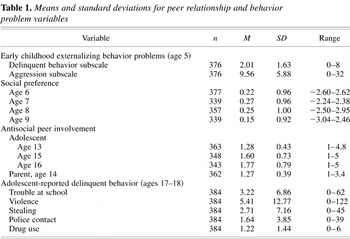
During the summer prior to the child's entry into kindergarten, parents were asked to complete the Child Behavior Checklist (CBCL; Achenbach, 1991). The CBCL has been shown to be a reliable and valid indicator of problem behavior during childhood. The externalizing problems scale of the CBCL combines two subscales. One is a 20-item subscale indexing aggression and the other is a 13-item subscale indexing delinquent behavior. Each item is rated as not true (0), somewhat true (1), or very true (2) for the child. Aggression and delinquent behavior subscale scores were computed by summing across the items. Because the scores were highly skewed, a log transformation was used to normalize the distributions (Tabachnick & Fidell, 1996). Means, standard deviations, and ranges for all peer relationship and behavior problem variables (prior to any transformations) are shown in Table 1.
Means and standard deviations for peer relationship and behavior problem variables

Social preference (ages 6–9)
Sociometric interviews were conducted in the winter of each school year in classrooms where there was parental permission for at least 70% of the children. The protocol generally followed the procedure described by Coie, Dodge, and Coppotelli (1982). In either face to face or classroom wide assessments, each child was shown the names or photographs of all classmates and asked to nominate the three classmates they like to play with the most, and the three classmates they like to play with the least. Frequencies of liking (like most) and disliking (like least) nominations were tabulated for each child. After standardizing nominations within classrooms, a social preference score was computed as the difference between the liking and disliking scores. Liking and disliking nominations can be used to produce sociometric classifications (e.g., popular, rejected), but the continuous distribution of social preference scores is preferred for multivariate analyses.
Antisocial peer involvement (ages 13–16)
At ages 13, 15, and 16, adolescents described the antisocial behavior of their “friends or friendship group.” Parent reports of the antisocial peer involvement of their children were available at age 14. Five items assessing specific peer behaviors (i.e., alcohol use, drug use, smoking, fighting, and theft) were included on both the parent and adolescent instruments. Indicators of antisocial peer involvement were computed as the mean of the five items from parent reports at age 14 (α = .73) and from adolescent reports at ages 13, 15, and 16 (αs = .65, .82, and .82).
Delinquent behavior problems (ages 17–18)
Adolescents described their own delinquent behavior at ages 17 and 18 using the Adolescent Behavior Questionnaire. Three-item index trouble at school (αs = .35 and .50 for age 17 and 18, respectively; suspension/detention, out of school suspension, and expulsion), 11-item index violence (αs = .85 and .55, e.g., physical cruelty to someone, using a weapon to cause harm), 5-item index stealing (αs = .75 and .49, e.g., break into a house/building/car), 3-item index police contact (αs = .74 and .65, questioned by police, brought to police station, arrested), and 7-item index drug use (αs = .70 and .77, e.g., smoked marijuana, tried cocaine or crack). Adolescents reported the frequency of occurrence for all items over the last 12 months, and scores were computed for each type of behavior by summing across the items. Because the scores were highly skewed, a log transformation was used to normalize the distributions. After transforming the scale scores, multiyear composite scores for each domain (i.e., school, violence, stealing, police contact, drug use) were computed by taking the mean of the age 17 and age 18 scores (rs = .49 to .75, all ps < .001, mean r = .63).
Results
Variable-centered analyses employed multigroup invariance testing procedures within the SEM framework as guided by Byrne (2001). First, measurement equivalence was tested by imposing constraints on factor loadings. Second, mean-level group differences were tested by constraining factor means. Third, group differences in associations among the peer relations and behavior problems factors were tested by imposing constraints equating covariances across the demographic groups. Fourth, person-centered analyses compared the relative frequency of risk factor profiles and the risk for delinquent behavior problems associated with each profile across the demographic groups.
One common criticism of studies testing for race differences is that they fail to adequately address the SES–race confound (McLoyd & Randolph, 1985). Although it would have been preferable to test race differences at different SES levels (Steinberg & Fletcher, 1998; Wilson & Williams, 1998), the limited sample size prevented us from doing so. However, we did statistically control for SES when evaluating race effects. To address the SES–race confound, all analyses were performed on the residual variables produced by regressing each variable included in the analyses on SES. This approach removes variance shared between each variable and SES, and therefore controls for SES when testing for race differences. Analyses were performed on both the original variables and on the residual variables. Results led to the same conclusions and were nearly identical; therefore, only the results that statistically controlled for the SES–race confound will be presented.
Variable-centered analyses
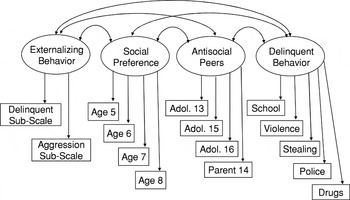
The structural equation model tested in this study specified four latent factors: externalizing problems, social preference, antisocial peer involvement, and delinquent behavior. Each factor had between 2 and 5 indicators as shown in Figure 1. The factor loading for one indicator of each factor was set to 1, with the exception of the early childhood externalizing factor. Because the early childhood externalizing factor had only two indicators, the paths from the two indicators were constrained to be equal and the variance of the early childhood externalizing factor was fixed to 1. This approach is functionally equivalent to fixing the path from one indicator while estimating the path from the other indicator, but this approach eliminated some difficulties fitting the model. Estimated parameters included the remaining factor loadings, the covariances between factors, and the indicator and latent factor intercepts. Error terms were not allowed to covary. The model is equivalent to what are commonly labeled measurement models in SEM jargon.

The structural equation model. The error terms are omitted for clarity.
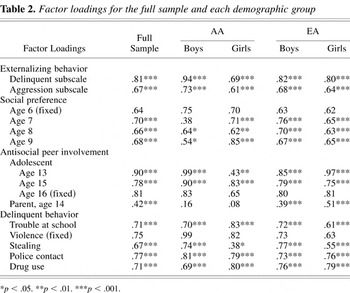
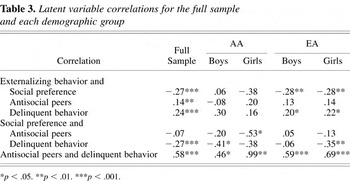
Before conducting the multigroup analyses, the model was fit using the entire sample. The model, χ2 (85) = 228.03, p < .001, comparative fit index (CFI) = .958, root mean square error of approximation (RMSEA) = .066, came close to meeting Hu and Bentler's (1999) criteria for a well-fitting model (i.e., a ns, p > .05, chi-square value, CFI > .95, RMSEA < .06). All factor loadings were significant as shown in the first column of Table 2. The covariance between social preference and antisocial peer involvement was not significant, but all other covariances were significant and in the expected direction (see Table 3).
Factor loadings for the full sample and each demographic group

Latent variable correlations for the full sample and each demographic group

Measurement equivalence
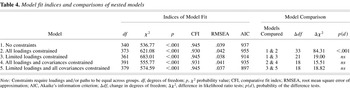
The next task was to test for measurement equivalence. Specifically, it is important to determine whether the indicator variables represent the latent factors in the same way (i.e., have the same factor loadings) across the different groups. If factor loadings vary substantially across groups, it provides evidence that the latent factors are defined differently for each group and that the measures differ in reliability and validity across groups. Moreover, if the latent factors are defined differently across groups, it is challenging to interpret differences in associations among the latent factors. Equality constraints on the factor loadings can be used to identify whether the individual measures represent the constructs in the same way across the different groups. Multigroup invariance testing procedures were used to examine the fit of the factor loadings across the four different groups. A four-group model provided an adequate fit to the data (see Table 4, model 1). Factor loadings and covariances for each group are shown in Tables 2 and 3. Next, the estimated paths from the indicators to the latent factors were constrained to be equal across the four groups to determine whether the factor loadings differed significantly across the four groups (Table 4, model 2). The model with the constraints provided a significantly worse fit (as evidenced by a significant change in chi square (Δχ2) and a higher Akaike's information criteria value) than the model without the constraints indicating that some factor loadings should be freed to vary across groups. To determine which constraints should be removed, the set of loadings were tested for each factor separately. If the test of a set of constraints for a particular factor was significant, the individual indicators for that factor were tested one at a time using the chi-square difference test.
Model fit indices and comparisons of nested models

Group differences in factor loadings were identified for two of the antisocial peers indicators and two of the delinquent behavior indicators. For the antisocial peers factor, loadings for the age 13 adolescent report and the age 14 parent report indicators varied significantly across groups. Specifically, the age 13 adolescent reports were less strongly linked to the other antisocial peer indicators for AA girls compared to the other groups. Similarly, the age 14 parent reports were less strongly linked to the other antisocial peer indicators for AA boys and girls compared to EA boys and girls.
For the delinquent behavior factor, loadings for the stealing and drug use indicators varied across groups. Specifically, stealing was more strongly linked with other delinquent behaviors among boys than among girls. Drug use loaded more strongly on the delinquent behavior factor for EA girls than any other group, but standardized loadings were similar across groups. In sum, although four sets of factor loadings were significantly different across groups, the absolute differences in the standardized factor loadings were, in most cases, quite small, suggesting that the differences probably reflect differences in within group variability that are compounded by differences in sample size across groups.
Because comparisons of factor loadings revealed limited and minor differences across the groups in terms of the strength of the indicators, the models were reestimated with the equality constraints removed for those indicators found to vary across groups (i.e., limited loading constraints, Model 3 in Table 4). The remaining analyses were conducted twice. First, the analyses were conducted with equality constraints on all factor loadings. Next, constraints were removed from the loadings found to differ across group. This limited equality constraints approach allows for the comparison of means and associations among latent factors while taking into account group differences in four of the factor loadings. Conclusions based on the two sets of models were identical. Only results from the models with full loading constraints (i.e., full measurement equivalence) will be described but both sets of results are presented in Table 4 (Models 4 and 5).
Group means
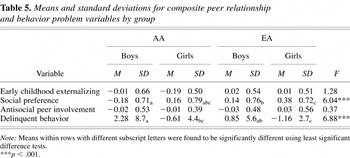
The next step in the analysis was to compare the groups in terms of latent factor means. In this case, comparing the latent factor means is analogous to testing group differences in observed variables using one-way analyses of variance (ANOVAs) and post hoc tests. Guided by Byrne's (2001) instructions, latent means were tested in AMOS. Testing latent means in this manner provides estimates of mean-level deviations from the specified comparison group but does not provide latent mean estimates for each group. Therefore, composite variables were computed for each factor (as the mean of the indicators) to provide observed mean estimates for each group (see Table 5). One-way ANOVAs and least significant difference post hoc tests on the observed means yielded the same pattern of mean differences as the analyses on the latent means. Mean-level differences were identified for social preference and delinquent behavior. Social preference was greatest for EA girls followed by AA girls and EA boys. AA boys were least likely to be accepted by their peers in elementary school. AA boys reported the most delinquent behavior in late adolescence followed by EA boys, AA girls, and EA girls. Note that the groups most likely to experience low levels of social preference in elementary school are the same groups most likely to report high levels of delinquent behavior in late adolescence.
Means and standard deviations for composite peer relationship and behavior problem variables by group

Associations among latent factors
The final step in the variable-centered analyses was to examine the covariances among the latent factors to determine whether the associations were moderated by gender and race. Correlations (standardized covariances) among the latent factors for all groups are shown in Table 3. Correlations among the indicator variables are available from the first author. For the full sample, the correlation between social preference and antisocial peer involvement was not significant, but all other correlations were significant and in the expected direction. Correlations appear to vary somewhat from group to group. For example, externalizing behavior in early childhood is negatively associated with social preference more strongly for EA boys and girls and AA girls than for AA boys. Multigroup tests were conducted to determine whether the set of correlations differed significantly across groups. Equality constraints were imposed on all covariances between factors (Table 4, models 4 and 5). The fit of the models with and without the covariance constraints was compared to determine whether the equality constraints significantly worsened the fit of the model. Comparing models with and without covariance constraints indicated that the difference between models was not statistically significant. Variation among the correlations is not greater than would be expected based on sampling variability. Because the four-sample analysis may have reduced our power to detect race and gender differences, separate two-sample analyses were conducted for race (by combining boys and girls) and for gender (by combining the AA and EA groups). Comparing the two-sample models with and without covariance constraints indicated that the difference between models was not statistically significant for race, Δχ2 (6) = 7.17, ns, or gender, Δχ2 (6) = 5.32, ns. In sum, the correlations among the peer relations and behavior problems variables were not found to differ significantly across demographic groups.
Person-centered analyses
Person-centered analyses were conducted to determine whether specific risk profiles were found at similar rates across groups. In our earlier report in which we relied on a categorical variable to index peer rejection (Laird et al., 2001), approximately 25% of the sample was found to be rejected by peers in 1 or more years during middle childhood. Thus, when identifying the person-centered profiles, we classified individuals with composite social preference scores in the lowest 25% as “low social preference.” Likewise, to maintain comparable predictive power across risk factors, individuals with scores in the top 25% for antisocial peer involvement and delinquent behavior were labeled “high antisocial peers” and “high delinquent,” respectively. To characterize the relative risk, we computed means for the high and low groups for each variable on which the classification was based. The high and low groups differed substantially for social preference (M = 0.32, SD = 0.50 and M = −1.0, SD = 0.39, respectively), antisocial peer involvement (M = 0.73, SD = 0.44, and M = −0.25, SD = 0.22, respectively), and delinquent behavior (M = 0.93, SD = 0.51, and M = −0.31, SD = 0.28, respectively). Next, using the social preference and antisocial peers classification variables we identified four risk profiles: no risk (i.e., high social preference and low antisocial peers), low social preference only, high antisocial peers only, and low social preference and high antisocial peers. The profile (P) column in Table 6 shows the percentage of each demographic group fitting each of the four risk profiles. For example, 10% of AA boys were classified as low social preference and high antisocial peer involvement, whereas 50% of AA boys were classified as no risk. Next, for each risk profile we computed the proportion of individuals classified as highly delinquent. The risk (R) column in Table 6 shows the percentage of individual fitting each risk profile who were classified as highly delinquent. All (100%) of the AA boys who were classified as low social preference and high antisocial peer involvement were also classified as highly delinquent, whereas 27% of the no risk AA boys were classified as highly delinquent.
Peer relationship risk experience profiles and associated risk for delinquent behavior

Table 6 shows that the majority of individuals in each group did not experience low social preference or high levels of antisocial peer involvement and that less than 10% of individuals experienced both of the negative peer relationship experiences. In terms of risk for delinquent behavior, in all groups, individuals experiencing both negative peer relationship experiences were at the greatest risk followed by individuals experiencing only antisocial peer involvement and only low social preference. Two comparisons across demographic groups are of primary interest. The first comparison was done to determine whether the risk experience profiles were equally common across groups. A chi-square test was not significant, χ2 (9) = 14.22, p = .11, indicating that the risk experience profiles were equally common across groups. Second, an analysis was done to determine whether the risk for delinquent behavior was similar across demographic groups for each risk factor profile. The overall test was significant, χ2 (12) = 22.62, p < .05, and follow-up tests indicated that the “no-risk” groups are responsible for the effect, χ2 (3) = 12.13, p < .05. AA boys not experiencing low social preference or high antisocial peer involvement are more likely to report high levels of delinquent behavior than are AA girls or EA boys or girls with the same peer relationship experiences. The risks for delinquent behavior were similar for all groups when individuals experienced low social preference and/or high levels of antisocial peer involvement. In sum, the person-centered analyses reinforce variable-centered findings that peer relationship risk factors function similarly across demographic groups.
Discussion
The anticipated increase in the diversity of the child and adolescent population in the United States over the next several decades will require researchers to continually consider the validity of their models and conclusions to diverse populations (McLoyd, 1998). Therefore, this study provides important evidence on the generalizability of two specific risk factors for delinquent behavior to boys and girls and to AA and EA children. Results indicate that the overall pattern of associations among early childhood externalizing behavior problems, peer relationship experiences in childhood and early adolescence, and delinquent behavior problems in adolescence is very similar across the different demographic groups. Results do identify a small number of group differences in construct measurement and mean levels, but no differences were found in associations among constructs. When differences were found they were primarily a matter of degree (i.e., stronger factor loadings in one group than another). Overall, the differences are not sufficiently strong or widespread to indicate the need for different theories and developmental models of peer relationship influences for boys and girls, or for AA and EA children. Rather, findings suggest modest contextual qualifications on a general process. However, findings do suggest that more substantial group differences may exist outside the peer relationship domain.
Although the results of this study provide evidence of the generalizability of two peer risk factors for delinquent behavior across gender and race groups, several limitations of this study should be recognized. First, the participants were not diverse in terms of language and acculturation. Few families appeared to be first- or second-generation Americans, and all participants, and nearly all parents, are fluent in English. The generalizability of theses findings to more culturally and linguistically diverse populations awaits further study. Likewise, analyses attempted to disentangle SES and race effects, but a more fine-grained analysis of within-group differences would have been more powerful. Another limitation of this study is that a small range of peer experience variables and delinquent behavior problem risk factors were considered. A more comprehensive examination of delinquent behavior risk factors may be more likely to identify group differences. Although multiple sources were used to compute indicators for the peer relations constructs, delinquent behavior problem scores were derived exclusively from adolescent reports. Previous research has found less evidence of group differences in self-reported delinquent behavior than in arrest records or other archival data (Allen & Mitchell, 1998). Often such differences are interpreted as evidence of institutional biases, but it may be that the tendency to underreport delinquent behavior systematically varies across groups in a manner than tends to eliminate group differences (Fleck, 1982; cf. Hirschi, Hindelang, & Weis, 1982; Wills & Cleary, 1997). Although parents and teachers may frequently be unaware of adolescents' delinquent behavior, relying on adolescent reports exclusively may have resulted in the overestimation of the associations with the peer relationship risk factors and made it impossible to test for informant differences in the measurement of delinquent behavior. Finally, the biggest limitation of the study may be the relatively small number of AA participants. Sampling variability, which is greater in smaller samples, may have resulted in the underestimation of group differences. Moreover, it is also possible that the small subsamples produced idiosyncratic results that would not have been found using a larger sample that more accurately reflected the ranges and distributions of the variables of interest. However, although the AA subsample is relatively small in comparison to the EA subsample, the AA subsample is relatively large for currently available longitudinal datasets that include both AA and EA participants.
The results of this study suggest that very similar processes link peer experiences and delinquent behavior problems in the different demographic groups. Nonetheless, there were statistically significant group differences in construct measurement and mean levels. In a comprehensive assessment of construct measurement, more than 25% of the factor loadings tested were found to differ significantly across groups. The significant differences in factor loadings were concentrated among variables indexing two constructs: antisocial peer involvement and delinquent behavior. Differences in factor loadings may reflect differences in the structure of the underlying construct, differences in the reliability of the indicators, or they may reflect group differences in the variance of the indicator variables (Knight & Hill, 1998). Factor loading differences in this study appear to reflect differences in reliability and variance more so than differences in construct structure.
There are differences of opinion as to whether theft, drug use, violence, and other similar behaviors are best conceptualized as indicators of a single maladjustment construct (such as delinquent behavior) or whether these behaviors have sufficiently different etiologies that they should be considered separately (see Farrell, Kung, White, & Valois, 2000). In this study, several adolescent behaviors were used to model a single delinquent behavior construct. Group differences in the composition of this construct may be evidence of different etiologies for each specific behavior. In this study, the measurement of the delinquent behavior construct was found to differ slightly across demographic groups.
Drug use loaded more strongly on the delinquent behavior factor for EA girls than for any other group, and stealing loaded more strongly on the delinquent behavior factor for boys than for girls. Inspection of the drug use distributions revealed that there was a smaller range for drug use among EA girls, but that a greater proportion of EA girls reported using drugs at least once. For stealing, girls reported stealing much less frequently than boys. Moreover, only one AA girl reported stealing, but said she did so quite often (50 times over 2 years). Although it is possible that drug use and stealing are more central elements of delinquent behavior among some demographic groups than others, evidence in this case suggests that differences in subsample variability are responsible for the minor differences in the factor loadings for the drug use and stealing items across demographic groups. Overall, adolescents who steal and use drugs are also likely to have trouble in school, get arrested, and engage in violent behavior regardless of their demographic characteristics.
Parent reports of antisocial peer involvement at age 14 did not converge with adolescent reports for AA boys and girls. This finding may indicate that AA parents are not as aware of the behavior of their early adolescents' friends as are EA parents. Perhaps AA parents have more difficulty monitoring the behavior of their adolescents' friends or the adolescents are providing misleading accounts of their friends' behavior to their parents (see Stattin & Kerr, 2000). However, adolescent reports of antisocial peer involvement at age 13 also converged poorly with age 15 and 16 reports for AA females, suggesting greater discontinuity in antisocial peer involvement over time among AA females. Although antisocial peer involvement is widely regarded as a risk factor for delinquency, there is little information available on the developmental course of antisocial peer involvement, nor on the factors leading to antisocial peer involvement.
In terms of mean levels, findings replicated frequently reported gender differences in antisocial behavior (e.g., Hyde 1984; Maccoby & Jacklin, 1980), with boys reporting more delinquent behavior than girls. Likewise, results indicate that girls are more accepted by their peer group during childhood than are boys. Means also indicated that AA boys and girls reported more delinquent behavior and were less accepted by their peers than their EA counterparts, but race differences were not consistently significant. These mean-level differences are consistent with an exposure-based interpretation of group differences in delinquent behavior. Namely, if social preference functions similarly for boys and girls, then based on the lower level of social preference for boys, we would expect that boys would engage in more delinquent behavior than girls. Indeed, correlations among constructs were not found to vary across groups, indicating that the peer relationship experiences carry the same level of risk for delinquent behavior across different demographic groups. Together, these findings suggest that group differences in delinquent behavior arise either from differences in exposure to peer relationship risk factors or from experiences outside the peer domain. Person-centered analyses lead to similar conclusions. The risk for delinquent behavior problems did not differ across groups when one or more of the peer relationship risk factors were present.
Delinquent and antisocial behavior is multiply determined. For example, in their model of the development of chronic conduct problems in adolescence, Dodge and Pettit (2003) note the importance of biological predispositions, sociocultural context, parenting, peer relationships, and mental processes to the development and maintenance of antisocial behavior. The current study suggests that social preference and antisocial peer involvement function similarly for boys and girls and for AA and EA adolescents. However, group differences in delinquent behavior problems remain and may result from differences in exposure to, or in processes involving, one or more of the other four domains identified by Dodge and Pettit (2003) or possibly, from peer relationship experiences not considered in the current study.
In summary, multigroup modeling procedures provided a consistent and thorough examination of demographic group differences in peer relationship risk factors for delinquent behavior problems. Correlations among constructs were not found to vary across groups and person-centered analyses failed to find evidence of group differences in developmental processes linking peer relationship experiences and delinquent behavior problems. Thus, findings from the current study add to growing evidence that the developmental relevance of peer experiences generalizes across diverse populations (e.g., Fergusson & Horwood, 1999; Jang & Thornberry, 1998; Maggs & Hurrelmann, 1998).
References
REFERENCES
Achenbach, T. M.
(1991).
Manual for the Child Behavior Checklist and 1991 profile.
Burlington, VT:
University of Vermont, Department of Psychiatry.
Allen, L., &
Mitchell, C.
(1998).
Racial and ethnic differences in patterns of problematic and
adaptive development: An epidemiological review.
In
V. C. McLoyd &
L. Steinberg (Eds.),
Studying minority adolescents: Conceptual, methodological, and
theoretical issues
(pp.
29–54).
Mahwah, NJ:
Erlbaum.
Arbuckle, J. L.
(1999).
Amos 4.0
[computer software].
Chicago:
Smallwaters.
Barrera, M., Jr.,
Castro, F. G., &
Biglan, A.
(1999).
Ethnicity, substance use, and development: Exemplars for exploring
group differences and similarities.
Development and Psychopathology
11,
805–822.Google Scholar
Byrne, B. M.
(2001).
Structural equation modeling with AMOS.
Mahwah, NJ:
Erlbaum.
Cairns, R. B.,
Cairns, B. D.,
Neckerman, H. J.,
Gest, S. D., &
Gariepy, J. L.
(1988).
Social networks and aggressive behavior: Peer support or peer
rejection?
Developmental Psychology
24,
815–823.Google Scholar
Coie, J. D., &
Dodge, K. A.
(1998).
Aggression and antisocial behavior. In
W. Damon &
N. Eisenberg (Eds.),
Handbook of child psychology: Vol. 3. Social, emotional, and
personality development
(5th ed., pp.
779–862).
New York:
Wiley.
Coie, J. D.,
Dodge, K. A., &
Coppotelli, H.
(1982).
Dimensions and types of social status: A cross-age
perspective.
Developmental Psychology
18,
557–570.Google Scholar
Coie, J.,
Terry, R.,
Lenox, K.,
Lochman, J., &
Hyman, C.
(1995).
Childhood peer rejection and aggression as predictors of stable
patterns of adolescent disorder.
Development and Psychopathology
7,
697–713.Google Scholar
Crick, N. R., &
Grotpeter, J. K.
(1995).
Relational aggression, gender, and social-psychological
adjustment.
Child Development
66,
710–722.Google Scholar
Dishion, T. J.,
Patterson, G. R., &
Griesler, P. C.
(1994).
Peer adaptations in the development of antisocial behavior: A
confluence model.
In
L. R. Huesmann (Ed.),
Aggressive behavior: Current perspectives. Plenum series in
social/clinical psychology
(pp.
61–95).
New York:
Plenum Press.
Dodge, K. A.
(1986).
A social information processing model of social competence in
children.
In
M. Perlmutter (Ed.),
Minnesota Symposium on Child Psychology
(Vol. 18, pp.
77–125).
Hillsdale, NJ:
Erlbaum.
Dodge, K. A.,
Bates, J. E., &
Pettit, G. S.
(1990).
Mechanisms in the cycle of violence.
Science
250,
1678–1683.Google Scholar
Dodge, K. A., &
Pettit, G. S.
(2003).
A biopsychosocial model of the development of chronic conduct
problems in adolescence.
Developmental Psychology
39,
349–371.Google Scholar
Ellickson, P. L., &
McGuigan, K. A.
(2000).
Early predictors of adolescent violence.
American Journal of Public Health
90,
566–572.Google Scholar
Erickson, K. G.,
Crosnoe, R., &
Dornbusch, S. M.
(2000).
A social process model of adolescent deviance: Combining social
control and differential association perspectives.
Journal of Youth & Adolescence
29,
395–425.Google Scholar
Farrell, A. D.,
Kung, E. M.,
White, K. S., &
Valois, R. F.
(2000).
The structure of self-reported aggression, drug use, and delinquent
behaviors during early adolescence.
Journal of Clinical Child Psychology
29,
282–292.Google Scholar
Fergusson, D. M., &
Horwood, L. J.
(1999).
Prospective childhood predictors of deviant peer affiliations in
adolescence.
Journal of Child Psychology & Psychiatry & Allied
Disciplines
40,
581–592.Google Scholar
Fleck, G.
(1982).
On the use of self-report data to determine the class distribution
of criminal and delinquent behavior.
American Sociological Review
47,
427–432.Google Scholar
Gibbs, J. T.
(1998).
High-risk behaviors in African American youth: Conceptual and
methodological issues in research.
In
V. C. McLoyd &
L. Steinberg (Eds.),
Studying minority adolescents: Conceptual, methodological, and
theoretical issues
(pp.
55–86).
Mahwah, NJ:
Erlbaum.
Grunbaum, J. A.,
Kann, L.,
Kinchen, S. A.,
Williams, B.,
Ross, J. G.,
Lowry, R., &
Kolbe, L.
(2002).
Youth risk behavior surveillance—United States, 2001.
Morbidity and Mortality Weekly Report,
51(June 28, SS-4),
1–21.Google Scholar
Hill, K. G.,
Howell, J. C.,
Hawkins, J. D., &
Battin–Pearson, S. R.
(1999).
Childhood risk factors for adolescent gang membership: Results from
the Seattle Social Development Project.
Journal of Research in Crime & Delinquency
36,
300–322.Google Scholar
Hirschi, T.,
Hindelang, M. J., &
Weis, J.
(1982).
Reply to “On the use of self-report data to determine the
class distribution of criminal and delinquent behavior.”
American Sociological Review
47,
433–435.Google Scholar
Hollingshead, A. B.
(1975).
Four Factor Index of Social Position.
Unpublished manuscript,
Yale University.
Hu, L.-T., &
Bentler, P. M.
(1999).
Cutoff criteria for fit indexes in covariance structure analysis:
Conventional criteria versus new alternatives.
Structural Equation Modeling: A Multidisciplinary Journal
6,
1–55.Google Scholar
Hyde, J. S.
(1984).
How large are gender differences in aggression? A developmental
metanalysis.
Developmental Psychology
20,
722–736.Google Scholar
Jang, S. J., &
Thornberry, T. P.
(1998).
Self-esteem, delinquent peers, and delinquency: A test of the
self-enhancement thesis.
American Sociological Review
63,
586–598.Google Scholar
Jones, J. M.
(1991).
Psychological models of race: What have they been and what should
they be?
In
J. D. Goodchilds (Ed.),
Psychological perspectives on human diversity in America (pp.
7–46).
Washington, DC:
American Psychological Association.
Knight, G. P., &
Hill, N. E.
(1998).
Measurement equivalence in research involving minority
adolescents.
In
V. C. McLoyd &
L. Steinberg (Eds.),
Studying minority adolescents: Conceptual, methodological, and
theoretical issues
(pp.
183–210).
Mahwah, NJ:
Erlbaum.
Kupersmidt, J. B.,
Coie, J. D., &
Dodge, K. A.
(1990).
The role of poor peer relationships in the development of
disorder.
In
S. R. Asher &
J. D. Coie (Eds.),
Peer rejection in childhood. Cambridge studies in social and
emotional development
(pp.
274–305).
New York:
Cambridge University Press.
Kupersmidt, J. B.,
Griesler, P. C.,
DeRosier, M. E.,
Patterson, C. J., &
Davis, P. W.
(1995).
Childhood aggression and peer relations in the context of family and
neighborhood factors.
Child Development
66,
360–375.Google Scholar
Laird, R. D.,
Jordan, K. Y.,
Dodge, K. A.,
Pettit, G. S., &
Bates, J. E.
(2001).
Peer rejection in childhood, involvement with antisocial peers in
early adolescence, and the development of externalizing behavior
problems.
Development and Psychopathology
13,
337–354.Google Scholar
Lochman, J. E., &
Wayland, K. K.
(1994).
Aggression, social acceptance, and race as predictors of negative
adolescent outcomes.
Journal of the American Academy of Child & Adolescent
Psychiatry
33,
1026–1035.Google Scholar
Maccoby, E. E., &
Jacklin, C. N.
(1980).
Sex differences in aggression: A rejoinder and reprise.
Child Development
51,
964–980.Google Scholar
Maggs, J. L., &
Hurrelmann, K.
(1998).
Do substance use and delinquency have differential associations with
adolescents' peer relations?
International Journal of Behavioral Development
22,
367–388.Google Scholar
Matsueda, R. L., &
Heimer, K.
(1987).
Race, family structure, and delinquency: A test of differential
association and social control theories.
American Sociological Review
52,
826–840.Google Scholar
McLoyd, V. C.
(1998).
Changing demographics in the American population: Implications for
research on minority children and adolescents.
In
V. C. McLoyd &
L. Steinberg (Eds.),
Studying minority adolescents: Conceptual, methodological, and
theoretical issues
(pp.
3–28).
Mahwah, NJ:
Erlbaum.
McLoyd, V.C., &
Randolph, S.
(1985).
Secular trends in the study of Afro-American children: A review of
child development, 1936–1980.
Monographs of the Society for Research in Child Development
50(4–5, Serial No. 211),
78–92.Google Scholar
Moffitt, T. E.
(1993).
Adolescence-limited and life-course-persistent antisocial behavior:
A developmental taxonomy.
Psychological Review
100,
674–701.Google Scholar
Ogbu, J. U.
(1993).
Differences in cultural frame of reference.
International Journal of Behavioral Development
16,
483–506.Google Scholar
Ogbu, J. U.
(1994).
From cultural differences to differences in cultural frame of
reference.
In
P. M. Greenfield &
R. D. Cocking (Eds.),
Cross-cultural roots of minority child development (pp.
365–391).
Hillsdale, NJ:
Erlbaum.
Parker, J. G., &
Asher, S. R.
(1987).
Peer relations and later personal adjustment: Are low-accepted
children at risk?
Psychological Bulletin
102,
357–389.Google Scholar
Patterson, G. R.,
DeBaryshe, B. D., &
Ramsey, E.
(1989).
A developmental perspective on antisocial behavior.
American Psychologist
44,
329–335.Google Scholar
Patterson, G. R.,
Reid, J. B., &
Dishion, T. J.
(1992).
A social learning approach: Vol 4. Antisocial boys.
Eugene, OR:
Castalia Press.
Patterson, G. R., &
Yoerger, D.
(2002).
A developmental model for early- and late-onset delinquency.
In
J. B. Reid,
G. R. Patterson, &
J. Snyder (Eds.),
Antisocial behavior in children and adolescents (pp.
147–172).
Washington, DC:
American Psychological Association.
Rowe, D. C.,
Vazsonyi, A. T., &
Flannery, D. J.
(1994).
No more than skin deep: Ethnic and racial similarity in
developmental process.
Psychological Review
101,
396–413.Google Scholar
Rubin, K. H.,
Bukowski, W., &
Parker, J. G.
(1998).
Peer interactions, relationships, and groups. In
W. Damon &
N. Eisenberg (Eds.),
Handbook of child psychology: Vol. 3. Social, emotional, and
personality development
(5th ed., pp.
619–700).
New York:
Wiley.
Schafer, J. L., &
Graham, J. W.
(2002).
Missing data: Our view of the state of the art.
Psychological Methods
7,
147–177.Google Scholar
Silverthorn, P., &
Frick, P. J.
(1999).
Developmental pathways to antisocial behavior: The delayed-onset
pathway in girls.
Development and Psychopathology
11,
101–126.Google Scholar
Snyder, J.
(2002).
Reinforcement and coercion mechanisms in the development of
antisocial behavior: Peer relationships.
In
J. B. Reid,
G. R. Patterson, &
J. Snyder (Eds.),
Antisocial behavior in children and adolescents (pp.
101–122).
Washington, DC:
American Psychological Association.
Snyder, J.,
Dishion, T. J., &
Patterson, G. R.
(1986).
Determinants and consequences of associating with deviant peers
during preadolescence and adolescence.
Journal of Early Adolescence
6,
29–43.Google Scholar
Stattin, H., &
Kerr, M.
(2000).
Parental monitoring: A reinterpretation.
Child Development
71,
1072–1085.Google Scholar
Stattin, H., &
Magnusson, D.
(1996).
Antisocial development: A holistic approach.
Development and Psychopathology
8,
617–645.Google Scholar
Steinberg, L., &
Fletcher, A. C.
(1998).
Data analytic strategies in research on ethnic minority
youth. In
V. C. McLoyd &
L. Steinberg (Eds.),
Studying minority adolescents: Conceptual, methodological, and
theoretical issues
(pp.
279–294).
Mahwah, NJ:
Erlbaum.
Tabachnick, B. G., &
Fidell, L. S.
(1996).
Using multivariate statistics
(3rd ed.).
New York:
Harper Collins.
Tolan, P. H.,
Gorman Smith, D., &
Henry, D. B.
(2003).
The developmental ecology of urban males' youth
violence.
Developmental Psychology
39,
274–291.Google Scholar
Tremblay, R. E.
(2000).
The development of aggressive behavior during childhood: What have
we learned in the past century?
International Journal of Behavioral Development
24,
129–141.Google Scholar
Vitaro, F.,
Brendgen, M., &
Tremblay, R. E.
(2000).
Influence of deviant friends on delinquency: Searching for moderator
variables.
Journal of Abnormal Child Psychology
28,
313–325.Google Scholar
Wilson, L. C., &
Williams, D. R.
(1998).
Issues in the quality of data on minority groups. In
V. C. McLoyd &
L. Steinberg (Eds.),
Studying minority adolescents: Conceptual, methodological, and
theoretical issues
(pp.
237–250).
Mahwah, NJ:
Erlbaum.
Wills, T. A., &
Cleary, S. D.
(1997).
The validity of self-reports of smoking: Analyses by
race/ethnicity in a school sample of urban adolescents.
American Journal of Public Health
87,
56–61.Google Scholar
Means and standard deviations for peer relationship and behavior problem variables
The structural equation model. The error terms are omitted for clarity.
Factor loadings for the full sample and each demographic group
Latent variable correlations for the full sample and each demographic group
Model fit indices and comparisons of nested models
Means and standard deviations for composite peer relationship and behavior problem variables by group

Peer relationship risk experience profiles and associated risk for delinquent behavior
 You have
Access
- 44
- Cited by