Introduction
Secure settings are, in fact, queer spaces. This is not simply because LGBTQ+ (“LGBTQ+” herein refers to people who are lesbian, gay, bisexual, transgender, queer, questioning, Two Spirit, and asexual) people are found, disproportionately at that, in these settings.Reference Mogul, Ritchie and Whitlock 1 Rather, these spaces are implicitly and explicitly domains for non-normative cultures, behaviors, as well as identities. Often that means various antisocial behaviors, those who have committed crimes, or those who live with severe mental illnesses; or a combination therein. In this review, while those may be operative, the case of those who hold minoritized sexualities and genders will be centralized and examined.Reference Stanley and Smith 2 It can be that LGBTQ+ people are in secure settings because they have committed crimes and/or live with severe and persistent mental illnesses. However, there are also structural and social forces that contribute to their disproportionate presence in these settings specifically due to existing as a person with a minoritized sexuality or gender, regardless of criminality or mental health. For this review, secure settings mean those locations that are extensions of justice systems; inherently they restrict liberties and rights and they can intersect with mental health and human service systems. These can include jails, prisons, state hospitals, juvenile detention, and immigration detention facilities, among others. Even more, these settings by their very nature of being secure punctuate the lived existences within them through the persistent specter of policing and discipline. The LGBTQ+ individuals, then, who do enter these spaces have a sharply impacted existence by multiple compounding factors, that is, they bring operating oppressive experiences by being a queer person into these settings and those experiences are compounded and even exacerbated by the oppressive nature of such secure settings. The net effect of this, too often, is that the health and mental health of LGBTQ+ people are negatively affected. This does not have to be the case, however.
The purpose of this review is to increase the competence, that is the knowledge and skills, of multidisciplinary practitioners in secure settings to better serve LGBTQ+ clients, albeit to increase equity and justice. In order to achieve this end, this review brings together archives of theoretical, cultural, and empirical research to architect knowledge and skills that are LGBTQ+ affirmative. The review begins with a discussion of critical terminology imperative for understanding and addressing LGBTQ+ existences. Next, the health, mental health, and social inequities that LGBTQ+ people experience are reviewed. From there, the social science paradigm to explain queer disparities, or the minority stress model, is diagrammed. Then, the review moves into more squarely deconstructing how LGBTQ+ people are criminalized and how their health is implicated in that process, moving from predetainment experiences, to existing in secure settings, and finally to re-entering the community. In response to this knowledge, applied strategies are offered that are LGBTQ+ affirmative for people and organizations, are promotive of wellbeing, and that are in resistance to criminalizing procedures, pathways, and approaches.
Coming to terms
Before entering into the nexus of queer inequities, criminalization, and emancipation, it is important to have an understanding of the nature and implications of terms. In this review, “queer” is a preferred term deployed to both signal an umbrella for the ever-amassing collection of identities under the banner of “LGBTQ+” as well as a critical term that signals a persistent disruption and deconstruction of what is normative; often, queer and LGBTQ+ are interchangeable in this review. “Criminalization” is positioned as the often-unconscious process by which sexualities, genders, and other tangible and ideological material become rendered into criminological and forensic terms. “Mental health” is defined in broad terms, following the lead of the World Health Organization’s 3 definition that signals it is not simply about the absence of disease or pathology rather it is a function of individuals’ attributes in relation with environmental factors.
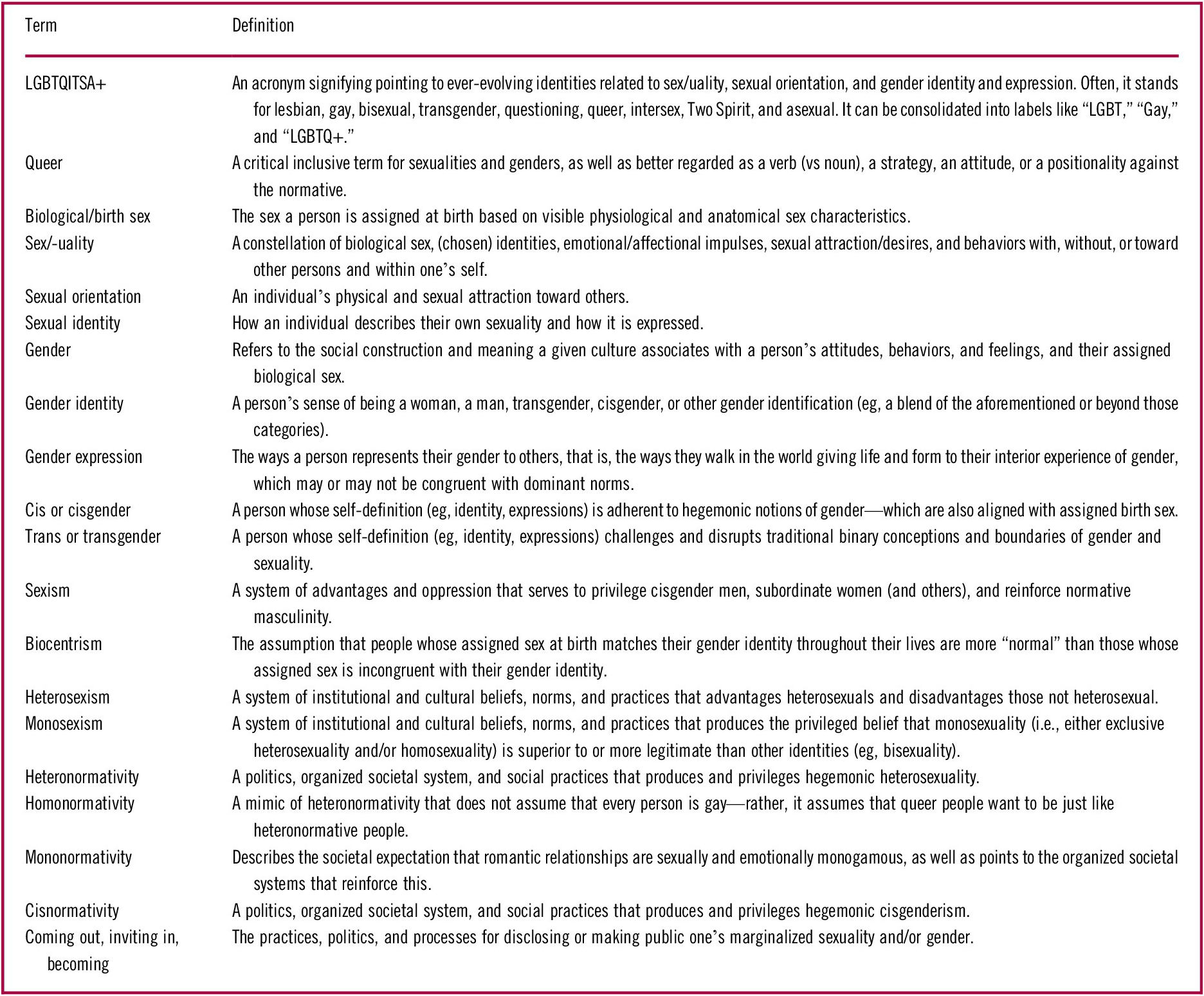
When it comes to terms around sexuality and gender, binarized and medicalized understandings can predominate. Those are one angle on these terms; a deeper, critical understanding can be helpful to not only broaden awareness, knowledge, self-reflection, and interdisciplinarity—but as well to more effectively work with clients and communities. It is important to keep in mind that this list is necessarily incomplete, unstable, evolving, and generally queer. Table 1 provides brief definitions for critical terms when working with LGBTQ+ people; the following provides more expansive and nuanced definitions.
-
▪ LGBTQITSA+—A Western-based acronym signifying a mostly stable set of identities related to sex/uality, sexual orientation, and gender identity and expression. Often, it stands for: Lesbian, Gay, Bisexual, Transgender, Questioning, Queer, Intersex, Two-Spirit (TS or 2), and Asexual (and sometimes contentiously Ally). The plus (“+”) at the end makes a nod to the fact that there are forever evolving and existing identities along this spectrum of human experiences. For the sake of efficiency, this acronym can be consolidated into labels like “LGBT,” “Gay,” or “LGBTQ+.” Whether represented as an acronym or a single word, this set of labels retains residue of positivistic ways of knowing and essentialized notions of identity. In contemporary times, these labels are often deployed in the promulgation of neoliberal discourse and political economy prioritizing individualism, rights-based social and political agendas, homonormative cultural and economic privileges, and consolidated and sanitized notions of desire and partnering (e.g., “gay marriage” debates). Queer and gay are undoubtedly strange bedmates.
-
▪ Queer—An umbrella term used by some LGBTQITSA+ people to refer to themselves, often to avoid binary and static conceptions of sex, gender, and sex/uality, among others. Based in critical, feminist, and poststructural perspectives on language, economy, gender, and sex/uality, queer is an antiessentialist, subject-less critique, necessarily indeterminate and referring more to self-identification rather than empirical observation of other peoples’ characteristics. It is the suspension and denaturalization of identity as something fixed, natural, and coherent. More appropriately, it can be better understood as a verb (vs noun), a strategy, an attitude, and a position/ality set against the normative.Reference Jagose 4 –Reference Eng, Halberstam and Muñoz 7
-
▪ Biological/birth sex—The sex a person is assigned at birth based on visible physiological and anatomical sex characteristics; this is most often, and almost exclusively, conferred by a physician and the State, and is conflated with gender (identity).
-
▪ Sex/-uality—A constellation of biological sex, (chosen) identities, emotional/affectional impulses, sexual attraction/desires, and behaviors with, without, or toward other persons and within one’s self. Sexuality is a central aspect of being human throughout life, and encompasses (to varying degrees) sex, gender identities and roles, sexual orientation, eroticism, pleasure, intimacy, and reproduction. Sexuality is experienced and expressed in thoughts, fantasies, desires, beliefs, attitudes, values, behaviors, practices, roles, and relationships. Although sexuality can include all of these dimensions, not all of them are always experienced or expressed; sexuality is influenced by the interaction of biological, psychological, social, economic, political, cultural, legal, historical, and religious and spiritual factors. 3
-
▪ Sexual orientation—An individual’s physical and sexual attraction toward others. This may be to an individual of the same gender (e.g., gay), the opposite gender (e.g., straight), both (e.g., bisexual), asexual, or various others (e.g., pansexual). Sexual orientation may or may not be reflected in someone’s outward behaviors or appearance; and, their sexual behaviors may or may not be defined singularly by normative understandings of one’s sexual orientation.
-
▪ Sexual identity—How an individual describes their own sexuality and how it is expressed. Often, sexual identity interfaces with one’s sexual orientation, but not always. For example, a person can have a lesbian orientation and express a heterosexual identity.
-
▪ Gender—Refers to the social construction and meaning a given culture associates with a person’s attitudes, behaviors, and feelings, and their assigned biological sex. Gender-normative or -confirming behaviors are those that align with the person’s assigned biological sex at birth. Gender nonconformity (or -variant, -creative) occurs when the behaviors, attitudes, and feelings of a person do not align with that person’s biological sex and/or gender assigned at birth.
-
▪ Gender identity—A person’s sense of being a woman, a man, transgender, cisgender, or other gender identification (e.g., a blend of the aforementioned or beyond those categories). Gender identity includes what a person calls themselves (i.e., “preferred gender pronouns”) and may or may not be the same as their biological sex.
-
▪ Gender expression—The ways a person represents their gender to others, that is, the ways they walk in the world giving life and form to their interior experience of gender, which may or may not be congruent with dominant norms.
-
▪ Cisgender or cis—A person whose self-definition (e.g., identity, expressions) is adherent to hegemonic notions of gender—which are also aligned with assigned birth sex.
-
▪ Transgender or trans—A person whose self-definition (e.g., identity, expressions) challenges and disrupts traditional binary conceptions and boundaries of gender and sexuality; often times, this self-definition is not aligned with assigned birth sex. Related terms include: gender nonconforming, gender creative, gender variant, genderbending, gender fluid.
-
▪ Sexism—A system of advantages and oppression that serves to privilege cisgender men, subordinate women (and others), denigrate women-identified values and practices, enforce male dominance and control, and reinforce forms of masculinity that are dehumanizing and damaging to all men. It operates through individual beliefs, practices, institutions, media, and ideas; and is enforced by economic structures, violence, and homo-/trans-/bi-phobias.
-
▪ Heterosexism—A system of institutional and cultural beliefs, norms, and practices that advantages heterosexuals. In turn, this system produces prejudice against nonheterosexual people.
-
▪ Biocentrism—The assumption that people whose assigned sex at birth matches their gender identity throughout their lives are more “real” and/or more “normal” than are those whose assigned sex at birth is incongruent with their gender identity. It is similar to heterosexism but focuses on gender rather than sexual orientation.
-
▪ Monosexism—A system of institutional and cultural beliefs, norms, and practices that produces the privileged belief that monosexuality (i.e., either exclusive heterosexuality or homosexuality) is superior to or more legitimate than a bisexual or other nonmonosexual orientation (e.g., pansexuality). In turn, this system produces prejudice against bisexual (and other related) people.
-
▪ Heteronormativity—A politics and everyday practice that produces hegemonic heterosexuality; simply put, the commonsense notion (and subsequent organized societal systems and social life) that heterosexuality is the only “normal” sexual identity. This belief system assumes that every person is straight—and that their behavior and sexual orientation are in-line with their gender, which is in-line with their genitalia (e.g., penis = male = acts masculine or likes women). Moreover, heteronormativity reproduces not only heterosexuality—but more importantly the expectations, demands, and constraints produced when heterosexuality is taken as normative within a society. Thus, heteronormativity draws on and reproduces discourses of consumption, class/ism, race/ism, ethnicity/ethnocentrism, nation/ality, ability/ableism, privatized intimacy and politics, and domesticity.Reference Rubin, Parker and Aggleton 8 , Reference Warner 9
-
▪ Homonormativity—A politics that does not contest dominant heteronormative assumptions and institutions, but upholds and sustains them, while promising the possibility of a demobilized gay constituency and a privatized, depoliticized gay culture anchored in domesticity and consumption.Reference Duggan 10 This is to say, it is a mimic of heteronormativity that does not assume that every person is gay—rather, it assumes that LGBTQ+ people want to be “just like” heteronormative people. Furthermore, it rewards homonormative LGBTQ+ people by bestowing rights, privileges, and access.
-
▪ Mononormativity—Describes the societal expectation that romantic relationships are sexually and emotionally monogamous. These norms are often reinforced by social and legal institutions, which contribute to dominant narratives about romantic and sexual relationships. Mononormative assumptions are embedded within the words of infidelity and cheating by way of conflating consensual nonmonogamy and nonconsensual nonmonogamy (i.e., infidelity), and therefore cannot account for the variety of consensual nonmonogamous relationship experiences.
-
▪ Cisnormativity—A politics and everyday practice that produces hegemonic cisgenderism; simply put, the commonsense notion (and subsequent organized societal systems and social life) that cisgender is the only “normal” gender identity. This belief system assumes that every person is assigned gender at/before birth—and that their self-identification, behavior, and general presentation in the world everyday are in-line with this assigned gender, which is in-line with their genitalia. Furthermore, cisnormativity reproduces not only cisgenderism and binarized gender—but more importantly, the expectations, demands, and constraints produced when cisgenderism is taken as normative within a society. Thus, cisnormativity draws on and reproduces discourses of consumption, class/ism, race/ism, ethnicity/ethnocentrism, nation/ality, ability/ableism, privatized intimacy and politics, and domesticity.
-
▪ Coming out/inviting in/becoming—“Coming out” describes voluntarily making public one’s sexual orientation and/or gender identity. It has also been broadened to include other pieces of potentially stigmatized personal information. Inviting in offers a more critical standpoint and locates agency, choice, and consent within the individual; likewise, becoming acknowledges that people are in a continual, lifelong process of coming into their sexuality, gender, and other identities, as well as they are highly contextual. Terms also used that correlate with this action are: “Being out” which means not concealing one’s sexual orientation or gender identity, and “Outing,” a term used for making public the sexual orientation or gender identity of another who would prefer to keep this information private. Related term: Disclosure.
Terminology

Health, mental health, and social inequities
A recent Williams Institute 11 survey estimated that 4.5% of the U.S. population is self-identified LGBT (ranging from 2.7% to 9.8% across the 50 states). Of these LGBT people, 42% are self-identified male and 58% female; 29% are raising children (ranging from 44% to 9% across the states). The majority are White (58%), while 21% are Latino, 12% Black, 5% mixed race, 2% Asian, 1% American-Indian, and 1% are Native Hawaiian or Pacific Islander. The average age is 37.3 years old, as compared to 47.9 years old for non-LGBT people; within this, 30% of LGBT people are 18 to 24 years old (12% non-LGBT are), and only 7% are over 65 years old (compared to 21% non-LGBT). Just under 10% are unemployed (as compared to 5% heterosexual), with also 15% uninsured (compared to 12%), 27% food insecure (compared to 15%), and 25% have an income less than $24,000 annually (compared to 18%). And, 41% have completed high school, 30% have completed some college, 17% hold a bachelor’s degree, and 13% have postgraduate education (as compared to heterosexuals at 39%, 29%, 18%, and 14%, respectively).
What is also known is that LGBTQ+ people bear a disproportionate burden of health, mental health, and social inequities. 12 , 13 LGBTQ+ individuals have increased risks for obesity, chronic illness (e.g., HIV, diabetes, asthma), mental distress,Reference Conron, Mimiaga and Landers 14 sexual risk-taking behaviors and unplanned pregnancy,Reference Saewyc, Poon and Homma 15 substance use disorder, depression,Reference Heiden-Rootes, Salas and Scherrer 16 , Reference Ryan, Huebner and Diaz 17 suicide attempts,Reference Ryan, Huebner and Diaz 17 and smoking.Reference Heiden-Rootes, Salas and Scherrer 16 LGBTQ+ people experience higher rates of HIV infection and tobacco, alcohol, and other drug use.Reference Blosnich, Farmer and Lee 18 They have higher incidence of mental health disordersReference King, Semlyn and Killaspy 19; it is estimated that the 12-month prevalence for depression for LGB people is at least twice that of heterosexual people, almost twice for anxiety, approximately two to three times for alcohol misuse, and just under three times for other drug misuse. Moreover, research indicates that the interaction of multiple marginalized statuses (e.g., sexual orientation and race) increases the odds of developing mental health challenges,Reference Bostwick, Boyd and Hughes 20 parallel to the fact that rates of mental distress, substance misuse, and disability increase for elderly LGBTQ+ people. 21 However, estimations around LGBTQ+ people and mental illnesses are deceiving.Reference Kidd, Howison and Pilling 22 This is in large part due to frequently excluding people known to have a severe and persistent mental illness from studies about sexuality and gender, coupled with the common impulse to regard people living with a mental illness as asexual. As well, there still is a pathologizing of nonheterosexual orientations and nonconforming gender identities. The net result is difficulty in generating representative samples in order to make population-based estimates.
Social stigma, discrimination, and homo- and transphobia against LGBT people negatively affects their quality of life by affecting their employment, income, access to health insurance, and health behavior choices. 23 Social and structural forces may impact LGBTQ+ health and mental health. For example, LGB people living in states with antisame-sex marriage amendments had significant increases in anxiety and substance disorders compared to LGBT people living in states without these amendments.Reference Hatzenbuehler, McLaughlin and Keyes 24 Also, in states that enacted pro-same-sex marriage laws, there were lower levels of psychological distress and reduced medical and mental health care visits.Reference Russ, Stamatakis and Hamer 25 Despite the stereotype that the LGBTQ+ community is predominately affluent, queer people experience poverty at higher rates than their heterosexual and cisgender peers. In particular, LGBT-identified women and men had poverty rates of 21.5% and 20.1%, respectively, compared to heterosexual and cisgender women (19.1%) and men (13.4%).Reference Gates and Newport 26 Children of same-sex couples are twice as likely to be living in poverty compared to married, different-sex couples, with African-American children of gay male parents having the highest poverty rate of 52.3%.Reference Badgett, Durso and Sheneebaum 27
Lesbians have distinct disparities, including higher rates of tobacco use,Reference Nyitray, Corran and Altman 28 higher rates of obesity, and lower rates of exercise compared to heterosexual women.Reference Brittain, Baillargeon and McElroy 29 They also experience higher rates of anxiety and depression, suicidal ideation, nonsuicidal self-injury related to chronic stress and discrimination, which in turn is related to heavy drinking behaviors.Reference Blosnich and Andersen 30 , Reference Poteat 31 They have an heightened risk for reproductive cancers, including breast, ovarian, and endometrial.Reference Zaritsky and Dibble 32 Elder lesbians are more likely to use tobacco, drink excessively, and suffer from obesity, which are due to overall poor health, cardiovascular disease, and diabetes.Reference Fredriksen-Goldsen, Hyun-Jun and Barkan 33
Gay men also experience distinct health and mental health issues, including higher rates of HIV and Hepatitis 34 and higher rates of cancers such as anal, prostate, and colon. 35 They are at increased risk for other sexually transmitted infections: gonorrhea, chlamydia, human papillomavirus (HPV), and syphilis. 34 The ability for gay men to be out about their sexuality and sexual behaviors is essential to receiving comprehensive care. They also experience higher rates of some eating disorders, depression, and anxiety. 36-38 As compared to heterosexual men, gay men are twice as likely to smoke, have higher odds of mental distress and life dissatisfaction, and have more activity limitations due to physical, mental and emotional problems,Reference Blosnich, Farmer and Lee 18 as well as less likely to be overweight or obese; still, they are more likely to be vaccinated for flu and have regular HIV tests than heterosexual men.Reference Blosnich, Farmer and Lee 18 Gay men are more likely to use alcohol and drugs, have higher rates of substance abuse, and are less likely to abstain from use and less likely to continue heavy drinking into later life. 39 , Reference Ostrow, Stall, Wolitski, Stall and Valdiserri 40 Gay men are more likely than bisexual or heterosexual men to report discrimination in the past year, especially in healthcare settings, and public spaces such as sidewalks, stores, and restaurants.Reference Bostwick, Boyd and Hughes 41 And, 32% of gay men reported abuse in present or past romantic relationships.Reference Houston and McKirnan 42
Bisexual people in particular have distinct disparities. Bisexual women are more likely to be uninsured compared to heterosexuals, gays, and lesbians.Reference Diamant, Wold and Spritzer 43 Bisexual men who have male sexual partners report higher rates of colon cancer and HIV, similar to rates of gay men and other men who have sex with men.Reference Winn 44 Generally, bisexual people experience intimate partner violence, which disproportionately impacts bisexual men and women.Reference VanKim and Padilla 45 As well, biphobia can create barriers to community involvement. Resultantly, bisexual people experience greater social isolation (than their gay/lesbian counterparts).Reference Balsam and Mohr 46 Biphobia may mean that bisexual people do not feel comfortable coming out as bisexual.Reference Scherrer 47 And, bisexual people are likely to be misidentified as heterosexual or gay/lesbian, depending on the gender of their partner.Reference Bradford 48 Some common examples of biphobia include the prejudice that bisexual people cannot be monogamous, are sexually promiscuous, or that they do not have a legitimate identity.
Transgender people endure a myriad of health and mental health inequities.Reference Landers and Gilsanz 49 Some (not all) transgender people wish to medically transition (e.g., with hormones or surgeries); not all transgender people have access to or financial means to medically transition in the ways they wish. In this process and generally, transgender people face discrimination, misunderstanding, and at times denial of health care by providers.Reference Grant, Mottet and Tanis 50 As well, trans people experience higher rates of suicide attempts and ideationReference Grossman and D’Augelli 51 and violence.Reference Stotzer 52 Rates of depression and anxiety are significantly higher among transgender and gender nonconforming individuals when compared with their cisgender counterparts. 53-55 In the absence of consistent and trans affirmative care, medical settings can become sites of traumatization for transgender clients. In fact, among transgender individuals accessing health care, 28% were harassed and experienced violence in medical settings, 19% were denied care, and 2% were victims of violence in doctor’s offices.Reference Grant, Mottet and Tanis 50 These prejudices can lead often to a myth of postsurgical “regret” and therefore a denial of gender affirming procedures; in fact, estimates are <1% to 2%. 56-60 Regret is much higher in other medical procedures (e.g., gastric banding); comparatively in the United Kingdom, there is an estimated >65% regret for (nontransgender related) plastic surgery.
In regard to suicide specifically, LGBTQ+ people are at much more risk. 61-63 A meta-analysis of research on LGB mental health showed a two-fold excess risk of suicide attempts in the preceding year in men and women, and four-fold excess in risk in gay and bisexual men over a lifetime.Reference King, Semlyn and Killaspy 19 There is limited data on suicide completions, deriving mostly from adolescent and young gay males; so far, there is little evidence of increased completions. As for attempts, there are higher rates of attempts compared to heterosexuals world-wide.Reference Mathy 64 LGB adolescents are two to seven times more likely to attempt suicide, and they have more lethal means of attempts. The prevalence of suicide attempts in gay or bisexual men is four times that of their heterosexual peers; and, the prevalence for lesbian or bisexual women is twice that of their heterosexual peers. Generally, most attempts tend to occur during adolescence or young adulthood. That said, LGBTQ+ youth who have at least one accepting adult in their life are 40% less likely to report a suicide attempt in the past year. 65 Bisexual people are the most at-risk sexual minority population for poor health outcomes, high risk health behaviors, and suicidal ideation. Alongside this, transgender people continue to have the highest reported rates of suicide attempts, with 41% of transgender adults reporting a suicide attempt.Reference Grant, Mottet and Tanis 50 , Reference Moody and Smith 66 , Reference Olson, Schrager and Belzer 67 Of trans youth, 50% report past suicidal ideation, and 30% report at least one prior suicide attempt. There are increased attempts when trans people have marginal employment (60%) and if they are also of a minority race or ethnicity: Black (45%), Latino (44%), and American-Indian (56%). Similar to LGB data, most attempts are reported in adolescence and young adulthood. Risk also increases for trans people when they are a sexual minority.
In terms of trauma and interpersonal violence, LGBTQ+ people bear both a disproportionate experience of various assaults and the experience of generally walking in the world feeling completely unsafe, rightfully so. LGBTQ+ people are nearly 2.5 times more likely to experience hate crimes than any other group. Hate-motivated LGBTQ+ homicides increased by 86% in 2017, alongside there being a 400-fold increase in cisgender gay/bi/queer male homicides. 68 LGBTQ+ people of color, youth, gay men, and transgender people are the most likely to suffer injuries and require medical attention as a result of interpersonal violence.Reference Rothman, Exner and Baughman 69 In particular, transgender people and LGBTQ+ people of color are most likely to be the victims of antiqueer murders; in the United States in 2017, there were 29 reported trans deaths due to fatal violence, 26 in 2018, and 12 already in 2019 (at the time of writing this review). 70 Often, people resort to violence to “correct” or sensor nonconforming behavior around gender and sexuality.Reference Zou, Andersen and Blosnich 71 Trans survivors are almost twice as likely to experience physical violence, almost four times more likely to experience discrimination within violent relationships, and 2.5 times more likely to encounter incidents of interpersonal violence in public spaces. 68 , Reference Gandy-Guedes, Havig, Natale and Dentato 72
For LGBTQ+ people, sexual traumas especially in early life can lead the victim to struggle to separate out the trauma experience from their sexual orientation or gender identity.Reference Walker, Hernandez and Davey 73 To link sexual trauma as a cause of sexual orientation or gender identity is a discredited assertion, as is linking pedophilia to an LGBTQ+ orientation. Corrective rape, which is more often experienced by sexual minority women, is abuse caused by someone trying to “fix” the victim’s sexual orientation.Reference Walker, Hernandez and Davey 73 Young LGBTQ+ people on average experience 3.8 times more sexual abuse, 1.2 times more parental physical abuse, and 1.7 times more assaults at school.Reference Friedman, Marshal and Guadamuz 74
Religious institutions and belief systems have a longstanding difficult relationship with LGBTQ+ communities. Often, religious-based trauma can occur in conjunction with “reparative therapies,” which have been denounced by professional organizations. 75 It is estimated that 698 000 LGBT adults (18-59 years old) in the Unites States have received conversion therapy, including 350 000 LGBT adults who received it during their teenage years. Twenty thousand LGBT youth (13-17 years old) will receive conversion therapy from a licensed healthcare professional before they reach 18 in the 41 states that do not ban the practice. Related, 57 000 LGBT youth (13-17 years old) across all states will receive conversion therapy from religious or spiritual advisors before they reach 18. As of this review, conversion therapy is banned in 18 states, one territory, and Washington, DC, alongside 32 localities most of which are in Florida. 75
Over the lifespan for LGBTQ+ people, age of coming out is related to the number of victimizations, with the more years a person is publicly out, the more time for the person to be victimized.Reference D’Augelli 76 More generally, traumas can negatively impact an LGBTQ+ person’s sense of self and stigmatize their identity. Shame and isolation due to trauma can compound existing negative beliefs and behaviors that the LGBTQ+ person may already face. This said, it can be that coming out can facilitate or hinder healing from traumatic events. Sometimes coming out is empowering and can facilitate increased pride.Reference Balsam 77 , Reference Balsam 78 Or, sometimes a person my choose not to come out in fear that their sexuality or gender may be conflated with the trauma.Reference Salmon 79
Minority stress
Left under the terms of social epidemiology, the forecast for queer people and their wellbeing is dismal. This focus privileges the scientists, psychiatrists, and other medical and mental health professionals alike. Equally, it maintains attention on incidents or event-based oppression, as well persists the focus on the individuals and individualizes the problems.Reference Das 80 One principal effect of this is the power to define “the problem”; and, queer people have endured this and their problems being defined constantly as “deviant” within medicalized and psychiatric terms. This evacuation of the cultural and the social within the world belies the lived experiences of those who are marginalized and oppressed in society, namely in this instance LGBTQ+ people.
In fact, research and work from the social sciences have developed and applied a model of minority stress that explains the disproportionate rates of illness for LGBTQ+ people.Reference Meyer 81 Whereas the original model was developed around lesbian, gay, and bisexual people, its theoretical and practical implications extend to other minoritized and marginalized sexualities and genders as well as experiences of prejudice and oppression. 82-84 Underlying the concept of minority stress are certain assumptions. First, queer people routinely experience stressful events not usually experienced by heterosexuals.Reference Alessi, Hartman and Dentato 85 Second, stigma and discrimination correlate with poorer health and mental health outcomes.Reference Bostwick, Boyd and Hughes 41 Even perceived discrimination has negative health and mental health outcomes for LGBTQ+ people.Reference Holley, Mendoza and Del-Colle 86 And, third, the stressors are unique (ie, not experienced by nonstigmatized populations), chronic (ie, related to social and cultural structures), and socially based (ie, arising from social process, institutions, structures). The minority stress model, then, is used to explain the connections between group-specific processes and negative mental health outcomes among queer people. The application of the framework of minority stress involves three parts: (1) an analysis of minority stress; (2) a consideration of general stress and coping processes; and (3) LGBTQ+-affirmative practice.
In the first part, the analysis of minority stress examines group-specific processes that are distal and proximal. Distal processes are objective prejudice events; these include understanding acute stressful events that have caused significant changes in a person’s life as well as regarding the chronic stressful events of everyday discrimination and stigma. In this, it would be effective to become aware of the effects of homo-/bi-/transphobia on the person’s development over the life course. Parallel to this, proximal processes involve stigma, internalized negative attitudes, and a concealment of one’s sexuality. In the case of stigma, stigmatized individuals have to constantly discern what people think about them, and in turn develop an expectation of stigma and a hypervigilance in interactions with people of the dominant group. This contributes then to an internalization of negative societal attitudes, that is, internalized homophobia. Resultantly, stigmatized and marginalized people engage in concealment of sexuality as means of protection from a hostile social environment, at persistent threat of their truth becoming public. In addition to these four processes, it is important to consider a fifth process of intersectionality. This is to foreground that holding more than one stigmatized identity can exacerbate minority stress, such as a minoritized race, ethnicity, class, or disability. Thus, in attending to people’s experiences with minority stress, it is necessary to understand how identities of sexuality and gender intersect with other ones of race and ethnicity, for example.
The next step is to consider general psychological processes of stress and coping. Whereas many minority group members cope with stress through developing and maintaining connections with their communities, there certainly exist individual level stress and coping that may not be immediately evident. For the fact that queer people experience chronic excess levels of stress, it is important to understand individual-level affected general psychological processes, while also understanding the group-level processes described above. Building off Meyer’sReference Meyer 81 minority stress model, HatzenbuehlerReference Hatzenbuehler 87 proposed a mediation model linking minority stress with negative mental health outcomes. The general psychological processes encompass affective (i.e., coping abilities and emotion regulation), social (i.e., social supports and interpersonal relationships), and cognitive processes (i.e., maladaptive self-schemas). For example, in the case of concealing one’s sexuality, affected psychological responses can include cognitive (e.g., suspiciousness, preoccupation), affective (e.g., shame, guilt, anxiety), behavioral (e.g., social avoidance, impaired relationships), and negative self-evaluation (e.g., identity ambivalence, diminished self-efficacy).Reference Alessi, Hartman and Dentato 85 , Reference Pachankis 88
The third part in applying a minority stress framework is to engage the person in LGBTQ+-affirmative work. Instead of being a singular evidenced-based clinical intervention or method (such as cognitive behavior therapy or Dialectical Behavioral Therapy), work involves overlaying or imbuing the methods used and the clinical relationship at-large with positivity, validation, multilevel attention and action, and overall affirmation for LGBTQ+ people, their sexuality, gender, and their lived experiences as intersectional people.Reference Alessi, Hartman and Dentato 85 , Reference Argüello89–Reference Tozer and McClanahan93 In a way, this affirmative care enhances existing methods or models being deployed by the practitioner; to that end, however, a crucial element to this work is the reflexivity of the practitioner and their willingness and ability to interrogate their own biases and prejudices.
This affirmative work necessarily begins with analyzing the information gathered from the first two steps above, and then formulating the person’s case from an explicit LGBTQ+-affirmative standpoint, that is, making sense of “what is going on” or “what the problem is” given the person’s experiences of living in this world over their lifetime as a queer person. Such a case formulation accounts for chronic stress, persistent prejudices, coping abilities, traumatic events, as well as a positive regard for the development of sexuality and gender over time. This formulation then links the person into a treatment plan that addresses the problems at hand as well as engages the person in an action plan to affirm their identities. This work involves continual attention to the quality of the therapeutic alliance, cultural competence, strengths of the person, and accounting for the presenting issues within a social context. It involves taking active steps to address or intervene with histories and current experiences of stigma, issues around disclosure, coping and social skills, as well as attending to presenting issues around the person’s intersecting identities. Finally, there needs to be attention and action around connecting into or with community resources, building affirmative interpersonal relationships, and other potentially indicated more macro oriented action like taking part in community organizing efforts. This is one important implication of understanding LGBTQ+ health and mental health inequities within a minority stress framework: given the multilevel experience of chronic stress, persistent discrimination, and overall oppression experienced by queer people, the attendant interventions to redress negative affects must be multilevel as well, not singularly intra- or interpersonal.
How LGBTQ+ risk and inequities are criminalized
Compounding chronic, harmful minority stress, LGBTQ+ people and their health, mental health, and social inequities have been and are still today criminalized in a variety of ways. At baseline, while LGBTQ+ people are a small minority in the context of the entire U.S. population, the incarceration rate of LGB people vs all U.S. adults is 1882 vs 612 per 100,000 people. 94 For transgender people in particular, per a national survey, 2% of trans respondents reported having been incarcerated in the past year, a rate more than twice the general population (0.87%); 95 this rate increased accounting for trans people of color and low-income respondents. In general, it is estimated that one in six trans people—and one in two trans Black people—has been to prison. 96 When taking into account age, LGB young people represent 12% to 20% of those youth in juvenile detention, with 85% of all incarcerated LGB youth being people of color. 95 Male sexual minorities are 6.2% of jail populations and 9.3% of prisons; while female sexual minorities are 35.7% and 42.1%, respectively. The status of being a sexual minority is correlated with negative outcomes in correctional settings, in that, sexual minorities are more likely to receive prison terms over 20 years, more likely to have spent time in solitary confinement or disciplinary segregation, and more likely to be sexually victimized while incarcerated. 94 And, in all, 29.3% of gay and bisexual men have experienced serious psychological distress (as compared to 13.6% straight men), and 24.7% of lesbian and bisexual women have as well (compared to 18.8% straight women).
Although these rates and overall inequities for queer people are both alarming and distressing, to say the least, LGBTQ+ people and their identities are not inherently criminogenic. In fact, queer people are de facto of acute interest to society in so far as their self-identifications around gender and sexuality challenge, disrupt, or reinforce heteronormative ideologies and structures. This is to say that bodies, ways of life, and survival strategies that do not conform to or manifest heteronormativity become subject to both social and formal policing as well as technologies of discipline, corrections, detention, and punishment. 97 This criminalization has occurred through various ways and by various societal systems over time based on the ways in which LGBTQ+ people have been regarded. Historically and contemporaneously, queer people have been subjected to the medicalization of homosexuality (e.g., deviants, infectious, aberrations), the psychiatrization of their mental health (e.g., sick, objects of interventions, insane, pathological sexual interests), and the pathologization of queer socializing and ways of life (e.g., immoral, dangerous, degenerates). There are well known archives interrogating these experiences and histories.Reference Grzanka and Miles98–Reference Terry103 The intention here is not to replicate those works, rather to diagram how these processes that promote criminalization continue to occur by structures and societal systems and in the everyday lives of LGBTQ+ people across the United States. Below, this criminalization is diagrammed from predetainment experiences, through detainment and experiences being in the system, and then through re-entry into the community.
Before entering into the diagram of criminalization, it is imperative to understand that LGBTQ+ people become criminalized through their experience of holding multiple identities. Queer people are not singularly their sexuality or gender, rather they hold multiple identities that intersect; and, from an intersectional perspective,Reference Crenshaw 104 the lived experience of minority stress, oppression, and inequities is a function of how these multiple identities are targeted and/or allowed by social structures and systems. For example, a person is not queer or Black, rather they are queer and Black, and other identities around class, ethnicity, gender, age, and beyond. What is important about using an intersectional analysis is that the more intersecting identities that are operating in people’s lives, the more compounding are the injustices and inequities. Although all queer people are criminalized in various ways that experience of criminalization is only intensified by additional experiences of racism, ethnocentrism, sexism, classism, ageism, and beyond. 97 This is starkly exemplified by the U.S. criminal justice system—a system that is overrepresented by Black people, people of color, immigrants, people living with mental illness and/or addiction, and low-income people. When squared with sexuality and gender in particular, as is discussed in the whole of this review, those LGBTQ+ people who are further disproportionately overrepresented and captured into the system are young queer people and people of color, trans and gender nonconforming people, and those low income and homeless.Reference Mogul, Ritchie and Whitlock 1 , Reference Stanley and Smith 2
Prior to detainment
Before entering the system, LGBTQ+ people face a number of factors that increase the chance of their life trajectory interfacing with law enforcement and ending up in detention: discrimination and stigma, discriminatory enforcement of laws, and negative policing strategies. 97 , Reference O’Brien, Walker and Poteet 105 First, queer people are subjected to discrimination and stigma from early ages and over the life course; minority stress aptly diagrams this experience. Young LGBTQ+ people face family rejection, abuse, neglect, bullying, harassment, and behavioral problems, which can lead to being thrown out of the home, choosing to run away, dropping out of school, or being placed (or ending up) in the child welfare system.Reference Woods 106 For too many, this can lead to experiencing homelessness and barriers to academic success. Generally, for young and older queer people, chronic exposure to discriminatory experiences and policies contribute to difficulties in earning living wages, securing stable housing, meeting basic needs, and accessing medical and mental health care. This puts all queer people, regardless of age, at risk of homelessness as well as turning to survival economies that, in turn, increases encounters with law enforcement. Worsening this situation is that the safety net, or continuum of social services, that should be available to protect and care for vulnerable people like LGBTQ+ people is chronically underfunded.
In terms of discriminatory enforcement of laws, LGBTQ+ continue to face a legal system that effectively targets them and their perceived or real behavior. Regardless of advances in treatment for and prevention of HIV, 82% of LGBTQ+ people live in a state that has HIV-specific criminal law or broader criminal laws related to perceived or potential exposure or transmission of HIV; even more, 15% of queer people live in a state that does not have an HIV-specific law but where general criminal law has been used to prosecute people living with HIV.Reference Hasenbush, Miyashita and Wilson 107 In one survey in California, 99% of those charged under HIV-criminalization statues were convicted and 91% were sentenced to prison or jail; similarly, approximately two-thirds of these people were Black or Latino. 97 Alongside these laws, LGBTQ+ people have been subjected to antisodomy laws that have regulated consensual sex between adults.Reference Mogul, Ritchie and Whitlock 1 , 97 In 2003, the U.S. Supreme Court (in Lawrence v. Texas) ruled that states could not legislate private, consensual behavior between adults. Whereas that ruling should prohibit queer people being targeted, in fact, at least 10 states still have antisodomy laws on the books and gay and bisexual men, in particular, continue to be targeted by police where they congregate or have sexual contact. Young queer people are additionally targeted by laws regulating sex between minors, by which they are held to account for consensual behavior that their straight peers are not and ultimately must too-often register as sex offenders and receive harsher punishments. 97 Related, the current U.S. drug policy has resulted in disproportionately impacting urban communities, people of color, and those living in poverty. Many of these people are also LGBTQ+, as research does show that queer people are more likely to abuse substances, including those that are illegal.
Finally, queer people are subject to harmful policing strategies. Commonly nowadays, local law enforcement agencies have concentrated on quality-of-life and zero-tolerance policing strategies; that is, focusing on minor crimes like littering or not paying public transit fares as well as criminalizing public behaviors like loitering, making too much noise, or public drinking.Reference Mogul, Ritchie and Whitlock 1 , 97 Queer people get caught up in these strategies often due to the broad discretion of officers, for example, young queer people being subject to arrest for congregating outside an LGBT center or engaging in survival sex. Similarly, transgender people in particular, but LGB people more broadly, are targeted by police due to the perception of transgressing gender norms or profiled as being more disorderly. This extends to police also aggressively enforcing antiprostitution statues. Queer people engage in survival sex and sex work due to a number of reasons, including family rejection, discrimination, poverty, and homelessness.Reference Mogul, Ritchie and Whitlock 1 , 97 , Reference O’Brien, Walker and Poteet 105 More than 79% of trans people have reported interactions with the police, and trans people of color trading sex are more than twice as likely to be arrested (as opposed to White counterparts).Reference Fitzgerald, Espeth and Hickey 108 Too often, officers use wide discretion to stop LGBTQ+ people for suspicion of prostitution due to carrying condoms, and when they do charge them they can add additional charges. In a larger frame, queer people are also subject disproportionately to search-and-frisk strategies for any perceived suspicious behavior in public. When queer people experience hate crimes and other interpersonal violence, they are met with discrimination and more violence by police. In one study, 20% of hate crimes were due to sexual orientation and 0.5% due to gender; and, while 54% of survivors reported the crimes, only 6% were later classified as a hate crime.Reference Ahmed and Jindasurat 109 Moreover, when queer people report hate crimes, they can experience more physical violence by police. Trans people are 6.1 times more likely to experience physical violence, and 5.8 times more likely to experience harassment, threats, bullying, and vandalism. Queer and HIV-affected people of color are 2.4 times more likely to experience physical violence, and younger queer and HIV-affected people are 2.2 times more likely. In all, LGBTQ+ people also face abuse and brutality by law enforcement including negative sexual, verbal, and physical contact. 97
Detainment and being in the system
Once queer people are in caught up in the legal system, they face another set of criminalizing experiences. As queer people enter into legal proceedings, they must contend with inadequate access to counsel, discrimination by judges, prosecutors, and court staff, as well as discrimination by juries.Reference Mogul, Ritchie and Whitlock 1 , Reference Stanley and Smith 2 , 97 , Reference O’Brien, Walker and Poteet 105 This can play out by queer people having improper or no representation. They can experience less pretrial release, discrimination during proceedings like the use of a gay “panic” defense or being perceived as having character defects and receiving harsher sentences. Also, LGBTQ+ people can be discriminated against by not being placed on a jury singularly for their perceived or real gender or sexual orientation, or juries may enact anti-LGBTQ+ biases despite being directed to disregard such information.
After these experiences throughout trial and sentencing, LGBTQ+ people face unfair and inhumane treatment in jails, prisons, and detention facilities.Reference Mogul, Ritchie and Whitlock 1 , 97 , Reference O’Brien, Walker and Poteet 105 , Reference Woods 106 Commonly, this abject treatment manifests as improper placements, harassment and sexual assault by staff and inmates, inadequate access to health care, unmet basic needs and services, and a lack of recourse. Still today, there is little federal oversight of detention facilities; yet, in 2003, the federal government enacted the Prison Rape Elimination Act (PREA) to reduce and eliminate sexual assault by both inmates and staff. Significantly, PREA identifies LGBTQ+ people as a vulnerable population and gives guidance for how such inmates should be treated and protected. 97 In terms of placements, too often LGBTQ+ people are placed in segregated units or solitary confinement. One U.S. Bureau of Justice report showed 28% of nonheterosexual inmates were in solitary confinement in prison over the past year (vs 18% heterosexual) and 22% in jail (vs 17%); overall, 85% of LGBTQ+ inmates have ever been in solitary, which has negative mental health effects including increased self-harm and suicidality. 97 , Reference Kaba, Lewis and Glowa-Kollisch 110 Despite PREA directing facilities to provide placement responsive to gender, trans people are still placed almost exclusively by the sex recorded on their birth certificate.
While being in a facility, queer people face harassment and sexual assault by staff and inmates. This manifests as unnecessary searches and strip searches, harsh treatment, and punishment like withholding food. Even more, this occurs as sexual assault. 97 Young LGBTQ+ people are at particular risk, with one in five reporting sexual victimization by another inmate or facility staff. Generally, for queer adults, 24.1% of trans and 12.2% nonheterosexual inmates report sexual assault, as opposed to 1.2% heterosexual and 2% of all inmates.Reference Beck, Harrison and Guerino111–Reference Beck, Berzofsky and Caspar113 Consequently, this can negatively affect the person’s mental health and potential for recidivism. Related, LGBTQ+ inmates can have inadequate healthcare due to lack of funding for such services or their own resources to pay for them, to a lack of competent health care providers, and to an increased need for mental health care. In addition, there can be limited HIV testing and poor access to transgender-related care. LGBTQ+ inmates face their basic needs being left largely unmet, as well. This occurs through a lack of outright respect, a lack of supportive or adjunct services like GED programs, or restricted family visitations. Underscoring these disparities, queer inmates have little recourse against violence, cruel punishment, or denial of basic rights. Despite the act, inmates cannot sue other inmates or staff under PREA.Reference Mogul, Ritchie and Whitlock 1 , Reference Stanley and Smith 2 , 97 More generally, inmates have limited access to legal support while incarcerated, and if they do, they face the discriminatory issues and stigma again in those legal settings as noted above.
Re-entry into the community
Once LGBTQ+ people have served their time and completed their sentence, they face a host of issues after detention that produce risk for recidivism and further an experience of criminalization. At-large, LGBTQ+ people face a lack of competency within prison-based re-entry programs, such as lack of respect and appreciation for the multiple levels of discrimination around accessing housing or jobs. 97 , Reference O’Brien, Walker and Poteet 105 , Reference Woods 106 As well, trans inmates can have extreme difficulty in obtaining documents reflective of their authentic gender. Before release, LGBTQ+ inmates are at increased risk for being detained indefinitely through civil commitment procedures secondary sex-related crimes, as noted earlier, for which queer people are targeted by police and laws disproportionately. Upon probation and parole, there is a lack of queer competency, which can manifest as lack of sensitivity for the difficulties in obtaining work or needing to travel beyond proscribed limits to access competent health care. For those housed in re-entry programs like halfway houses, they can face harassment, discrimination, and violence within the facility. This is only intensified for those in religiously affiliated programs.
As an LGBTQ+ person is working the process of re-entry, they can face numerous challenges. 97 These include difficulty finding housing and employment, inadequate health care after release, being ineligible for public assistance, mis- or over-use of sex offender registries, barriers to education, severed or denied parenting rights, challenges reconnecting with family, difficulty obtaining name changes, and loss of political participation. Re-entry is challenging for any person postincarceration; however, these difficulties layered with additional LGBTQ+ discrimination and prejudice make the path more treacherous for queer people’s health, mental health, and recidivism.
Strategies for LGBTQ+ wellbeing: Decriminalizing safe(r) spaces and operationalizing affirmation
The wellbeing of LGBTQ+ people is a function of the person in environment, drawing on the expansive framework of the World Health Organization regarding health and mental health. 3 Central to this calculus is an appreciation for the maneuvers of chronic minority stress as well as the haphazard incitement to treat bodies, sexualities, and genders as criminogenic when they exceed the confines of heteronormative conceptions and practices. The known inequities that continue to be borne by queer people, while both troubling and preventable, do offer an instructive opportunity to consider how intentional work can be done in order to resist, redress, and repair those inequities. The multilevel nature of the chronic stress both targeting and experienced by LGBTQ+ people points to the fact that the interventions professionals deploy necessarily must be multilevel and multifaceted. In this section on applied practices, it is obvious that an exhaustive list is not provided for all the ways in which institutions and practitioners could operationalize culturally responsive and affirmative practices with LGBTQ+ communities. Rather, these multilevel strategies offered here are ones readily applicable to the work in correctional, forensic, and other detention facilities, as well as to the clients who may be seen in the community at risk for detention or who hold that history therein. And, these practices are ones that can be enacted by individuals, teams, organizations, and institutions. They include provider competence, affirmative case work, indicated interventions, and progressive policies.
Provider competence
It can be common nowadays to hear practitioners talk about having or holding some variant of cultural competence. Unfortunately, this is not a static archive or experience nor is it an intellectual endeavor satisfied by one continuing education course. At baseline, cultural competence is a direct function of building relationships and trust with clients, consciously developing knowledge, and deploying interventions and assessments that are dynamic and consistent with the worldview of clients. Even more, it involves actively engaging with one’s self and one’s own culture and experience. It is an on-going process. And, it appreciates the vulnerabilities and strengths of clients and communities, as well as the experiences of power, privilege, and oppression for both the clients and the practitioner. And, this process does involve an interrogation by the practitioner of their own biases, prejudices, and behaviors.
This is an apt issue for practitioners to take seriously when working with LGBTQ+ people. In considering minority stress, the queer person’s experience of chronic stress is only compounded by the fact that most every health care provider is not receiving adequate education and training to provide culturally competent care to LGBTQ+ people.Reference Schweiger-Whalen, Noe and Lynch 114 In a survey, only 41% of LGBTQ+ patients believed their providers had sufficient knowledge about queer issues.Reference McCann and Sharek 115 When providers were surveyed, over three-quarters of nurses reported they never received any LGBT oriented training, and almost 80% of their employers acknowledged providing no education on the topic.Reference Carabez, Pellegrini and Mankovitz 116 This is consistent in medicine, social work, and mental health.Reference Obedin-Maliver, Goldsmith and Stewart117–Reference Willging, Salvador and Kano121 And, without baseline education or other mandatory training, providers are largely left up to their own experience, prejudices, stigmas, and choice to adhere to their profession’s ethical standards. It is not uncommon that people in general—which includes providers—can have a spectrum of reactions to and engagement with the disclosure of a minority gender or sexual orientation by their clients.Reference O’Brien, Walker and Poteet 105 These typical reactions include pity (i.e., believing heterosexuality is preferred and pitying others who are not), dismissal (i.e., outright denying the client’s identities), romanticizing (i.e., relegating clients to being “special” populations), sensationalizing or objectifying (i.e., viewing clients as parts or less than human), fetishizing (i.e., focusing only on aspects of gender or sexuality), tolerance (i.e., putting parameters down as in one’s sexual orientation is just a phase to grow out of), disgust (i.e., rejection and demoralizing), acceptance (i.e., having to accept the client but in light of their gender or sexuality as problems), and liberal (i.e., generally friendly yet have not engaged in self-reflection about one’s own biases and privilege).
These reactions can direct providers toward various behavior that may or may not be promotive of wellbeing. Along the spectrum of possibilities, providers could actively participate in prejudiced or phobic actions, deny the stress and discrimination experienced by queer people, or recognize there are inequities and harms but take no action. As well, they may educate themselves, educate others, support or advocate for queer people, and even initiate or prevent change in organizations and institutions. Again, while these possibilities do generally exist for any provider, it is known that it is less common for LGBTQ+ clients to encounter providers on the end of the spectrum toward education, advocacy, and promoting organizational change. In fact, heterosexist attitudes among practitioners can reduce their empathy for LGBTQ+ people and even harm them.Reference Love, Smith and Lyall 122 Like the general population, health care providers can and do have subtle (though sometimes active) phobias and practices toward LGBTQ+ people that are left unexamined and therefore appear in their practice. These prejudices coupled with low knowledge and self-awareness create poor service delivery, misdiagnosis, pathologizing, and deprecation. In turn, queer client’s experience of this sort of nonaffirmative practice can result in dissatisfaction with services, avoiding care, or omitting critical information during it.
To this point, it is important for practitioners to engage with an on-going exploration of their own understanding and biases related to sexuality and gender identities, as self-awareness is a crucial part of effective practice. In addition, practitioners should adhere to their profession’s ethics and best practice standards; endemic to current day standards, conversion therapy is never indicated for LGBTQ+ people.123–Reference Lim, Brown and Jones130 Equally important is for organizations, agencies, and institutions to identify and provide adequate trainings for all staff. This would necessarily include an assessment of policies and practices, identifying those not LGBTQ+-affirming and taking action to transform them into more inclusive and affirming ones.
LGBTQ+-affirmative case work
Holding education about or having competence with LGBTQ+ communities and common issues does not equate to the intentional action of conducting queer-affirmative work with individuals, groups, organizations, or institutions. Continuing the discussion on this topic began above, affirmative work (Figure 1) starts at baseline with an explicit validation of and appreciation for the wide spectrum of LGBTQ+ identities and expressions therein. And, sexualities and gender identities and expressions are not incidental demographic variables to check off assessment boxes, rather they are figured at the center of the client’s life experience as well as considered a central part of how they are coping and behaving in detention facilities. Building off an understanding of minority stress and a model for stress and coping,Reference Alessi131–Reference Pachankis134 an affirmative approach is a three-part process that can be overlaid onto whatever intervention or modality with which a team or individual practitioner commonly uses.Reference Argüello 89 , Reference Argüello 135 The first part is to adequately assess the client’s experience of queer stress, accounting for histories with stigmas, phobias (external and internal), chronic stress (both individual and community level), and disclosure and concealment of identities. The second part is to assess for coping, understanding abilities and skills for emotion regulation, social and interpersonal functioning, cognitive schemas, and sexual and intimate relationships. This area also tends to qualities of resilience that the clients hold in these areas and beyond. The third part is to formulate the case within a queer-affirmative perspective parallel to the clinical modality or tradition that the practitioner uses. For example, a DBT-oriented practitioner formulates the case within a tradition of behaviorism as well as one that is queer-affirmative. To this end, alongside the traditional interventions conducted with the client, queer-affirmative action is taken. This would include consistent attention to the therapeutic alliance, cultural competence, strengths, and a person-in-environment understanding of mental health. As well, the interventions offered tend to issues of stigma, disclosure, stress and coping, and intersectional identities. This is all in service of cultivating wellbeing, a positive sense of self, and increased connections with communities. Finally, the work is multilevel, when possible, as chronic minority stress is multilevel; therefore, interventions need to appropriately and adequately address forces that impinge on or facilitate the client’s mental health.
LGBTQ+-affirmative case work.

It can be illusive in practice to see blatant examples of queer-affirmative work; or, practitioners may side-step such an approach to formulating and intervening with cases due to a variety of reasons, one of which may be lack of training and education. Nonetheless, queer-affirmative work can operationalize in an endless number of ways as, ultimately, it is contextually oriented to the setting, population, client, and team of providers.Reference Argüello 89 This is when consultation, supervision, as well as thorough and on-going conversations with clients can be helpful. For example, it can be helpful for organizations to have an LGBTQ+ client advocate on care teams when staffing clients, or to appointment one or more lead clinicians who are obligated to ensure that the advocacy and care for LGBTQ+ clients is responsive and affirmative.
One decided place to start is considering the lines of inquiry utilized in intake paperwork, onboarding clients into new systems, and clinical assessment interviews and initial encounters. A persistent problem and effect of heteronormative and cisnormative systems and institutions is the encouragement toward an uncritical usage of identity categories, an insistence on minority sexualities and genders as deviant or problematic, as well as an individual focus at the expense of an appreciation for client’s experiences interacting with prejudiced systems. Equally, providers may have the best intentions to serve LGBTQ+ clients, but they can at times focus too much or too little on the client’s sexuality or gender identity, either over-associating or under-correlating it with health and mental health issues.Reference O’Brien, Walker and Poteet 105 Accordingly, a queer-affirmative approach would encourage a conversation with clients about how they square their sexuality and gender with the situation or problems at hand.Reference Semp 136 This can be achieved through more narrative oriented lines of inquiry; for example: How do you describe or think about your sexuality and/or gender to yourself? Is your sexuality or gender important to how you see yourself; if so, in what ways? Are there any other important areas of your identity? Have you had concerns about your sexuality or gender? How does your sexuality or gender figure into your health and mental health? From there, it is important for clinicians and staff to consider how is this information documented, recorded, and then used to inform treatment and care.
Indicated interventions: Language
Co-extensive with an affirmative approach as well as increasing provider competence, a series of interventions are indicated that are multilevel focused. The first of which is an attention to the language and communication around sexualities and gender used throughout organizations and institutions, and this occurs in a number of aspects. First, a persistent problem with effectively serving LGBTQ+ communities is the dearth of data about them; either it is not collected, or it is inaccurately collected. 13 Whereas it is helpful to use some standardized categories for sexualities and genders, it is equally helpful to have more dynamic or open-ended response categories throughout the intake, assessment, and termination processes.Reference O’Brien, Walker and Poteet 105 Second, in auditing the affirmative and inclusive climate of any organization or institution, it is helpful to assess for how inclusive as well as neutral language is in clinical, administrative, and interpersonal communication. For example, in the case of transgender clients, this would include utilizing preferred gender pronouns, ensuring use of authentic (vs “dead”) names, creating opportunities for clients to notify about changes to self-identification, and holding colleagues and systems accountable for misuse of pronouns. In this instance, it is known that using preferred gender pronouns and authentic names alone is linked to a reduction in negative mood and suicidality.Reference Semp 136 , Reference Russell, Pollitt and Li 137 Other ways to enact more neutral and inclusive language is to address clients and colleagues with the title “Mx.” (“mix”) instead of Mr. or Ms., or generally to use they/them/theirs pronouns and passive forms of writing, or to defer to more inclusive nouns such as “partner” vs wife or husband. More broadly and third, it is equally helpful to allow for clients to have opportunities over time and relationships with various staff and clinicians to self-identify, but moreover within fluid frameworks, regarding sexuality and gender along a spectrum. This kind of logic resists the tendency to regard sexuality and gender within binaries, which often cannot accommodate the lived experiences, let alone self-identification practices of clients. Fourth, it is important to account for how representation exists across an organization’s built environment that reflects inclusivity, affirmation, validation, as well as accountability. Professional associations continue to give much direction about how this can manifest. 123 –Reference Lim, Brown and Jones 130
Indicated interventions: PrEP
In the U.S., HIV continues to disproportionately affect gay and bisexual men, men who have sex with men, transgender women, and people of color. 138 When doing affirmative work with LGBTQ+ people, assessment and dialogues must include attention to sexual health—in particular HIV prevention and care. This can be part of an initial assessment or incorporated increasingly into the routine interactions with clients.Reference O’Brien, Walker and Poteet 105 Technologies for HIV prevention have evolved; HIV testing and condom use are no longer the only or primary ones. Since 2012, the CDC has published guidelines for Preexposure Prophylaxis, or PrEP. 139 , 140 This is a single daily dose of one antiretroviral medication, which can reduce transmission risk by more than 90%. It is indicated for populations at increased risk, and who adhere to a daily pill regimen along with routine testing and monitoring. And whereas PrEP has been a substantial advance in HIV prevention technologies, its awareness and use lags. A number of the primary barriers to PrEP getting to those most at-risk include the fact that only one in three prescribing providers knows about PrEP, parallel to the problems of homophobia, stigma, and discrimination. It is important to know that any provider with prescriptive authority can prescribe PrEP. 139 , 141
Indicated interventions: Trauma informed care
As discussed previously, LGBTQ+ people are disproportionately at risk for and experience victimization, violence, and trauma. Whether or not an organization or institution provides treatments for traumatic stress, they can organize their culture and programming within a trauma informed approach. 142 Similar to a queer-affirmative approach, this is one that is overlaid onto existing policies, protocols, and interventions commonly used in organizations already. In that, there are a number of core tenants to a trauma informed approach. First, the organization’s culture and work recognize the impacts of violence and victimization for LGBTQ+ people. Second, recovery is a central goal of treatment, which includes an attention to empowerment, choice, having voice, and control when possible. In this, the therapeutic alliance is one of a relational collaboration and it avoids retraumatization. Third, the framing and understanding of trauma for queer people is diagrammed in a way to acknowledge how individual experiences are connected to larger macro forces as well as that marginalized communities have experienced historical traumas over time. Fourth, as interventions are deployed, attention is given to the intersectional identities of clients such that they can see their culture and experience represented and reflected in the work. Finally, a trauma informed approach actively acknowledges and seeks out opportunities to understand and validate the resilience and post-traumatic growth that often can occur after or because of traumatic experiences.Reference Helgeson, Reynolds and Tomich 143
Progressive policies
Organizations and institutions have various capacities to enact policy change that can be responsive to decriminalizing the understanding of and practices around LGBTQ+ health and mental health. Mounting best practice recommendations and progressive guidance has been offered to these ends; however, the deployment of such knowledge and applied practice can too often be left to political will, the negative effects of prejudices and stigmas as discussed previously, or the financial health of organizations. 95 , 97 , Reference O’Brien, Walker and Poteet 105 , Reference Woods 106 , Reference Sequeira, Chakraborti and Panunti 118 , Reference White, Brenman and Paradis 119 , 123–Reference Lim, Brown and Jones130 , 144 Nonetheless, offered here are four policy recommendations that target some of the central ideological mechanisms that contribute to the continued criminalization of LGBTQ+ people and their mental health 97:
-
▪ Modernize HIV criminalization laws. States should repeal laws that criminalize the transmission of HIV and other diseases. In considering revisions to current laws, lawmakers and advocates should take into consideration unique or additional burdens these laws place on individuals living with HIV/AIDS, and the extent to which existing laws do not take into account the most recent science around prevention, transmission of, and care for HIV.
-
▪ End criminalization of consensual sex. State and local law enforcement should not criminalize consensual sex between adults. They should ensure that laws policing sex are not discriminatorily enforced against LGBT people, in particular reduce and cease entrapment scenarios targeting gay, bisexual, and men who have sex with men. States should pass legislation ensuring access to condoms without fear that their possession or presence will be used as evidence to justify stops, arrest, or prosecution for any sex work or lewd conduct-related offense.
-
▪ Increase data collection about LGBTQ+ people’s experiences with law enforcement. Governments, academics, and advocates should strengthen data collection about the experiences of LGBTQ+ individuals with law enforcement through anonymous and other surveys that protect participants. The Bureau of Justice Statistics should add questions concerning sexual harassment of and misconduct toward LGBTQ+ community members by law enforcement. The Centers for Disease Control should add similar questions to the National Intimate Partner and Sexual Violence Survey. And, community-based organizations such as the National Center for Transgender Equality should be fortified in their work on work like the U.S. Transgender Survey.
-
▪ Enact PREA requirements for placement of LGBTQ+ people. Detention facilities should enforce PREA regulations for placement of LGBTQ+ people. In this, queer people should be consulted about their needs and safety concerns in determining the most appropriate housing assignments. In particular, transgender individuals should be housed based on their authentic gender identity, rather than anatomical sex or the sex on their birth certificate. LGBTQ+ individuals should not be placed in solitary confinement based solely on their sexual orientation and/or gender identity.
Conclusion
Ironically, all the while that dominate and heteronormative cultural practices, ideologies, and systems construct and reinforce secure settings, these secure spaces are queer. They are replete with non-normative behaviors and existences, some of which are queer people. The presence of LGBTQ+ people make these spaces something more than what they were originally developed for, that is, discipline, correction, punishment, (social) policing, or rehabilitation, and more. Queer people confound these spaces, as their presence within them starkly represents that society deems minoritized sexualities and genders as abject problems. That said, LGBTQ+ identities continue to expand, transform, gain visibility, challenge language, and receive attention and advocacy. In that attention and analysis, it is increasingly clear that queer people have always been and continue to be criminalized de facto because of their sexuality, gender identity, and/or gender expression—regardless of putative criminal behavior. The stigma, disparate treatment, and policing around this are only compounded when accounting for their other intersecting statuses and identities of mental health, class, race, ethnicity, documentation, and ability, among others.
The effects of this approach as numerous. The multilevel efforts, historically and currently, to sanction, police, detain, and intervene upon LGBTQ+ people for their very existences, in effect, has diverted much attention clinically, socio-politically, and in research from the basic criminality of LGBTQ+ people apart from their sexuality and gender. This is to say that the persistent efforts to criminalize queer people has done the work to obscure a more accurate understanding of LGBTQ+ offenders, victims, and the relationships therein.Reference Woods 106 Another effect has been to reduce attention to the chronic minority stress, disproportionate health and mental health inequities, substantial experiences of victimization and historical traumas, as well as social inequities too often left invisible. Accordingly, systems and interventions have been less focused on recovery, rehabilitation, and prevention; instead, they have been reinforcing that queer people are understood as generally expendableReference Lamble 145 in U.S. society, let alone other parts of the world. Effectively, then, whereas systems may have the preeminent intention to be helpful and rehabilitative, this distressing picture of LGBTQ+ people is one that exacerbates mental health symptoms, contributes to (self-)harm, and fosters problematic relationships with substances, all the while disrupting the relationship between LGBTQ+ people and society.Reference Woods 106
Again, this does not have to be the case. The approach by secure systems and practitioners therein can be different; LGBTQ+ people deserve it to be so. Ultimately, it should be clear that providers need not be LGBTQ+-identified to provide culturally competent and -affirmative services that are responsive to the needs and issues of the queer people they serve.Reference Klein 146 As discussed in this review, that process can begin with attending to language practices, interrogating biases in oneself and the systems under which one works, and challenging normative ideologies, policies, and practices. As well, in a larger effort to decriminalize LGBTQ+ people and their mental health prior to entering the system, there are various moments to target during their stay in a secure setting and while working the process of re-entry into the community. And as the chronic stresses and strains on queer people are multilevel, the effective responses to redress and repair inequities must be multilevel, beginning with a LGBTQ+-affirmative formulation. There is certainly work to be done.
Disclosure
The author has nothing to disclose.