costello: Well then who's on first?
abbott: Yes.
costello: I mean the fellow's name.
abbott: Who.
costello: The guy on first.
abbott: Who.
costello: The first baseman.
abbott: Who.
costello: The guy playing …
abbott: Who is on first!
(Abbott & Castello, Who's on First, 1945)
Abbott and Costello's comical sketch highlights two fundamental aspects of communication (or, more accurately, disruption thereof). First, effective speakers must appreciate and use the perspective of their conversational partner to guide their production of clear language (e.g. Abbot fails to recognize that Costello does not know that ‘Who’ is a person). Second, successful communication rests on the ability to modify statements that have proved to be inadequate (e.g. following miscommunication, Abbott merely repeats the same statement, ‘Who’). Whereas previous research on the development of children's communication has examined these aspects in isolation, we assess how these factors interact. Specifically, does the knowledge state of a listener affect preschoolers' repair strategies following different types of feedback?
To be effective communicators children require sensitivity to the context and the knowledge state of their listener, while they evaluate the specific content required to produce an unambiguous request. Given the many situations and conversational partners children face, it is important they develop the ability to flexibly employ different communicative strategies. For example, ‘the big one’ may be adequate in the context of two differently sized boxes, but would be ambiguous if there were two large boxes.
From an early age, children attempt to match their communicative behaviour and utterances to the knowledge state of their conversational partners (Menig-Peterson, Reference Menig-Peterson1975). For example, one-year-old infants use pointing to ‘help’ unknowledgeable adults more than knowledgeable adults, and can track a communicative partner's knowledge and gesture accordingly (Liszkowski, Carpenter & Tomasello, Reference Liszkowski, Carpenter and Tomasello2007; Reference Liszkowski, Carpenter and Tomasello2008). By two years, children use more verbal labels and gestures to refer to hidden objects' locations with unknowledgeable caregivers (O'Neill, Reference O'Neill1996). Moreover, preschoolers differentiate information they share with their communicative partner from information that is privileged to them, and modify their statements accordingly (i.e. they use an adjective to disambiguate similar objects when required from another's versus their own perspective; Bahtiyar & Kuntay, Reference Bahtiyar and Kuntay2009; Nadig & Sedivy, Reference Nadig and Sedivy2002; Nilsen & Graham, Reference Nilsen and Graham2009). In addition, preschoolers use what a conversational partner says to infer this person's knowledge and modify their language (i.e. provide more specific information when inferring less knowledge; Wittek & Tomasello, Reference Wittek and Tomasello2005).
Despite preschoolers' impressive sensitivity to the communicative needs of partners, communication failures occur at a high frequency. For example, almost half of infant-initiated utterances in conversations result in communication failure (Golinkoff, Reference Golinkoff1986). Furthermore, referential communication studies have demonstrated children's difficulty with providing sufficient information for a listener to identify intended referents (Dickson, Reference Dickson, Brainerd and Pressley1982). That is, children younger than seven years often provide ambiguous descriptions (Deutsch & Pechmann, Reference Deutsch and Pechmann1982; Glucksberg & Krauss, Reference Glucksberg and Krauss1967). This skill shows development between the ages of five and eleven years old (Lloyd, Mann & Peers, Reference Lloyd, Mann and Peers1998). Thus, there will be many communicative breakdowns in preschoolers' interactions where modification of initial attempts is required.
Communicative breakdowns are often highlighted through feedback from conversational partners. Whereas some studies suggest preschoolers fail to recognize the ambiguity of their initial attempts and, following feedback, persist with ineffective strategies (e.g. O'Neill & Topolovec, Reference O'Neill and Topolovec2001), others demonstrate more successful modifications. For example, two-year-olds used a variety of verbal reformulation approaches when an adult queried the child's initial attempt (Tomasello, Anselmi & Farrar, 1984/Reference Tomasello, Anselmi and Farrar1985) and were able to generate more successful subsequent attempts following specific feedback (Matthews, Lieven & Tomasello, Reference Matthews, Lieven and Tomasello2007). The strategy employed by children to repair statements appears to depend on the type of feedback provided (Anselmi, Tomasello & Acunzo, Reference Anselmi, Tomasello and Acunzo1986). Namely, specific feedback elicits more informative repair statements from children than vague feedback (Coon, Lipscomb & Copple, Reference Coon, Lipscomb and Copple1982). Vague feedback (e.g. ‘Huh’ or ‘What?’) leads to increased repetitions of initial statements rather than modifications (Anselmi et al., Reference Anselmi, Tomasello and Acunzo1986). Finally, goal substitution, wherein an examiner provides children with different objects than requested, leads to increased abandonment of attempts (Fagan, Reference Fagan2008).
Thus, past literature provides evidence that young children are sensitive to, and can use, a conversational partner's knowledge to guide their referential statements, albeit not perfectly. Further, children can detect when the recipient of their message has miscomprehended and modify statements (e.g. Anselmi et al., Reference Anselmi, Tomasello and Acunzo1986). What is not clear is whether children's repair strategies themselves show sensitivity to listener knowledge. We ask whether children provide different modifications to listeners who are ignorant (versus knowledgeable) of an intended referent, or whether they disregard this information at the repair stage of the exchange.
Three- and four-year-old children participated in a referential communication task wherein they requested stickers from a listener to complete a card. On half of the trials, the listener receiving the request was knowledgeable about the required sticker (i.e. she could see the complete card) and half the time she was ignorant (i.e. a moveable partition blocked her view). Following initial requests, children were provided with varying feedback from the listener (i.e. goal substitution, explicit statements of misunderstanding, vague feedback). The contribution children's verbal skills made to their repairs was assessed to determine whether better verbal skills enable children to more effectively modify statements to the needs of the listener. Unlike previous studies (e.g. Fagan, Reference Fagan2008; Wilcox & Webster, Reference Wilcox and Webster1980), procedures in the present study were designed so that children would initially provide insufficient information and thus miscommunication feedback from a listener would be valid. Furthermore, given the demands of our task, the recruited participants were older than have been assessed in previous work on preschoolers' repairs (e.g. Anselmi et al., Reference Anselmi, Tomasello and Acunzo1986; Fagan, Reference Fagan2008).
We expected that children would initially provide more information to ignorant listeners. However, of interest was whether the listener's knowledge would affect how children subsequently repaired requests following feedback. Miscomprehension from a knowledgeable listener may be interpreted as not hearing the statement (leading to repetition), whereas miscomprehension from an ignorant listener may be interpreted as lacking sufficient information (leading to additional information). Further, listener knowledge may interact with the feedback type. Specifically, explicit statements of misunderstanding and goal substitution may not elicit differential responses based on the listener's knowledge (as both clearly demonstrate communication breakdown), whereas vague feedback might. That is, vague feedback given by knowledgeable listeners could be interpreted as a request for repetition, whereas from ignorant listeners it could be interpreted as a request for additional information. Alternatively, if children do not incorporate listener knowledge into their repairs, repairs would show little difference between the knowledge conditions. This outcome is plausible given that at this point in the communicative exchange children may be more tuned in to what the listener says, rather than what the listener knows. Furthermore, the high processing demands of holding in mind a listener's knowledge while evaluating statements may lead children to disregard the listener's perspectives.
METHOD
Participants
Participants were forty-five typically developing children (24 females) between the ages of 3 ; 0 and 4 ; 11 (M = 3 years 9·88 months, SD = 6·50 months) recruited from community preschools. Children included in the analyses had age-appropriate language skills as assessed by the picture vocabulary subtest of the Test of Language Development – Primary: 3rd Edition, a standardized measure of receptive vocabulary (Newcomer & Hammill, Reference Newcomer and Hammill1997; children with below average language skills were excluded from analyses, n = 7).
Procedure
Communication task
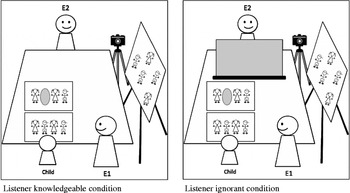
This task assessed children's ability to produce initial requests, and following feedback, repair these requests. Two within-subject parameters were manipulated: (1) listener's knowledge: whether the listener was knowledgeable versus ignorant of the intended sticker; and (2) type of feedback: goal substitution, explicit statement of misunderstanding or vague feedback. Children were tested by two experimenters (E1 and E2) in a laboratory. E1 sat beside the child and administered the task, whilst E2 sat across from the child and was the recipient of his/her requests for stickers (see Figure 1). Children requested stickers in both the listener knowledge conditions. That is, half the trials (i.e. six test trials) were administered when E2 was knowledgeable of the intended sticker and half when she was ignorant. E2's knowledge of the intended sticker was manipulated through the use of a moveable partition that, on half the trials, blocked E2's view of the card set (i.e. complete card and card missing something). Thus, when knowledgeable, E2 could see what was missing and would know the sticker required to complete the card, whereas on ignorant trials she would not.
Layout of study materials and depiction of listener knowledgeable and listener ignorant conditions.

The protocol consisted of twenty-six trials (3 practice, 11 filler, 12 test trials (4 trials in each feedback type)). A new card set (with accompanying stickers) was used for each trial (e.g. circus scene, farm scene, underwater scene, etc.). The order of feedback and listener knowledge conditions (and cards in each condition) was counterbalanced. Children's responses were video-recorded.
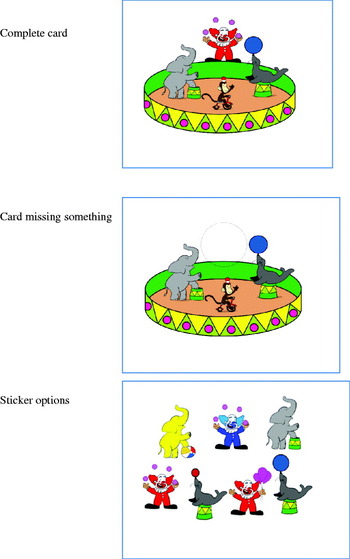
First, children were given three practice trials (where they made a card missing something ‘look the same’ as a complete card using stickers). Subsequently, children were administered the test and filler trials. Test trials consisted of providing children with a complete card depicting four different characters/objects in a scene, and another card with something missing (see Figure 2). Children were told to ask E2 for help in retrieving stickers from an easel to complete the card missing something. The sticker options for all test trials varied in the same way. Options included the target sticker (e.g. red clown juggling balls), two stickers depicting the same object as the target but varying on one dimension (e.g. red clown holding balloons, blue clown juggling balls), four stickers depicting other objects that were identical to those on the complete card (e.g. seal with blue ball, grey elephant on stand) or different (e.g. yellow elephant on ball, seal with red ball). Thus, children needed to provide two descriptors or descriptor phrases in addition to the object name (i.e. three descriptive components) to successfully identify the required object (e.g. ‘red clown juggling balls’) as naming the object alone (e.g. ‘clown’) would not provide adequate information. Children were not required to provide each descriptor in full; credit was given if they highlighted key elements (e.g. ‘red’, ‘juggling’). We anticipated children at this age would initially provide insufficient descriptions (i.e. one or no descriptors, rather than the required two). If children provided a full description in their initial request, the correct sticker was provided and the trial was not included in the repair analyses (this occurred 2% to 7% across conditions). As such, children's initial request for the sticker on test trials was almost always followed by feedback from E2. In the goal substitution condition, E2 provided the child with an incorrect sticker, but one that matched the child's description (e.g. a request for ‘the red clown’ in reference to the red clown juggling balls resulted in E2 giving the red clown holding balloons). In the explicit statement of misunderstanding condition, E2 stated, ‘I don't know which one you mean’. In the vague feedback condition, E2 said ‘Huh?’. Filler trials, administered between each test trial, did not require descriptors to identify the intended sticker (i.e. sticker options were completely different from the required object, so only the name of the object was required, e.g. ‘banana’). These trials were used to minimize any learning effects from repeated exposure to the feedback manipulation.
(Colour online at http://journals.cambridge.org/JCL) Example of test stimuli: complete card (e.g. circus scene), card with something missing (e.g. red clown (light grey in figure here) juggling balls), and sticker options.

Coding
The same coding protocol was used for initial requests and repairs. As children in the study almost never (i.e. 0·6% of trials) requested the incorrect object (e.g. seal instead of clown), relevant descriptors other than object name were coded. As such, measures included: number of relevant descriptors (e.g. ‘the red clown’), pointing to card and to board, and repetition of requests (i.e. repeating their initial description without adding information). Irrelevant and spatial descriptors (e.g. ‘funny clown’; ‘beside the flower’) were coded, but not analyzed due to low rates. To ensure reliability, a second researcher coded ten children (22% of the sample). Intra-class correlation coefficients (ICCs) were used to establish the level of agreement between coders. ICC coefficients for the initial and repair behaviours were: initial descriptors ICC (114) = 0·98, new descriptors ICC (95) = 0·96, pointing behaviour ICC (95) = 0·99, repetitions ICC (95) = 0·95, all p-values <0·001.
RESULTS
Children's initial requests and then repair behaviour following feedback were analyzed and the role that children's age and verbal skills played in children's specific communicative behaviour was assessed. Preliminary analyses, using paired t-tests comparing first and last trials for each condition, suggested that children's responses did not change over the course of trials for initial requests or repairs (p-values >0·05).
Initial requests
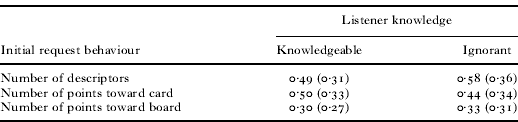
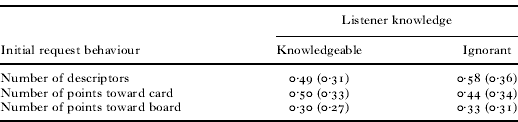
The number of descriptive features included in initial requests was compared between the listener knowledge conditions using a paired t-test. Preschoolers' requests included more descriptive features, such as the adjectives (e.g. ‘red’) and verbs (e.g. ‘juggling’) when the listener was ignorant of the intended referent, compared to when she was knowledgeable (t(44) = 2·05, p = 0·04, d = 0·29) (see Table 1). Thus, preschoolers showed sensitivity to the knowledge state of their communicative partner by providing more descriptive requests when the listener possessed less knowledge. Listener knowledge state did not impact children's pointing behaviour (p-values = 0·08, 0·28, to card and board, respectively).
Mean number (SD) of communicative behaviours during initial requests
Simultaneous regression analyses assessed whether children's initial requests varied as a function of age or verbal skills. Together age and verbal skills did not predict requests towards a knowledgeable listener (p = 0·17), but did predict the number of descriptors included in requests towards an ignorant listener (F(2,42) = 10·54, p < 0·001, Adjusted R 2 = 0·30). An examination of individual predictors revealed that verbal skills (but not age) significantly accounted for variance in the number of descriptor's in children's initial requests towards an ignorant listener (14%, p = 0·005).
Repair behaviours
The number of descriptors provided by children in their first attempts was compared to the number of descriptors in their repairs in a 2 (Attempt: Initial Request versus Repair) × 2 (Listener Knowledge) repeated measures ANOVA. Results revealed a main effect of attempt (F(1,44) = 4·76, p = 0·04, ηp2 = 0·10), and listener knowledge (F(1,44) = 4·05, p = 0·05, ηp2 = 0·08), but the interaction between these variables was not significant (p = 0·5). Thus, across knowledge conditions, children provided more descriptors following feedback (M = 0·64, SD = 0·28) than provided in their initial requests (M = 0·53, SD = 0·30). Furthermore, across both attempt conditions, preschoolers provided more descriptors when listeners were ignorant (M = 0·62, SD = 0·27) relative to when listeners were knowledgeable of the intended referent (M = 0·55, SD = 0·27).
Together, the results suggest that children repaired their requests to provide more descriptors after receiving feedback. However, in their initial and repair attempts, children consistently failed to provide the two unique descriptors necessary to disambiguate sticker choices, in addition to object name (i.e. the above analyses do not account for redundancy across attempts). Namely, in the knowledgeable condition, children provided 0·94 of the two unique descriptors needed (SD = 0·45) and in the ignorant condition they provided 1·07 (SD = 0·46).
In order to assess whether preschoolers' modifications varied as a function of the type of feedback and the listener's knowledge state the following three 2 (Listener Knowledge) × 3 (Feedback Type) repeated measures ANOVAs were conducted. After each ANOVA, simultaneous regression analyses examining the role of age and verbal skills in children's use of that specific repair strategy were conducted.
New descriptors
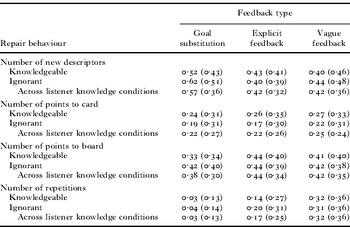
Children's production of new descriptors (i.e. those relevant descriptors not provided in initial requests) was examined to assess the degree to which repairs expanded initial requests (see Table 2). Results revealed a main effect of feedback type (F(2,88) = 3·72, p = 0·03, ηp2 = 0·08), but not listener knowledge state (p = 0·45) and no significant interaction (p = 0·54). Planned comparisons were conducted. Across listener knowledge, children provided more new descriptors following goal substitution relative to both explicit statement of misunderstanding (t(42) = 2·39, p = 0·02, d = 0·44) and vague feedback (t(42) = 2·32, p = 0·03, d = 0·42). Explicit statements of misunderstanding did not elicit more new descriptors than vague feedback (p = 0·93). Results demonstrate that goal substitution elicits repairs with new descriptors more often than vague or explicit statements of misunderstanding. It was rare for children to accept the incorrect card (i.e. <1% of test trials).
Mean number (SD) of repair behaviours following differential feedback from the listener

Three simultaneous regression analyses assessed the degree to which age and verbal skills related to children's use of new descriptors in repairs (i.e. one for each feedback type, all collapsed across knowledge conditions). Together, age and verbal skills significantly predicted the number of new descriptors following explicit statements of misunderstanding (F(2,42) = 6·87, p = 0·003, Adjusted R 2 = 0·21), with only age accounting for a unique portion of the variance (15%, p = 0·006). Children's response to goal substitution was not significantly predicted by age and verbal skills together (p = 0·10). However, when individual predictors were examined it was found that children's verbal skill significantly predicted the number of new descriptors provided (p = 0·03) accounting for 10% of the variance, whereas age did not. Children's response to vague feedback was not predicted by their age and/or verbal skills (p = 0·54).
Pointing behaviour
A repeated measures ANOVA revealed that children's pointing behaviour did not differ significantly between listener knowledge conditions (p = 0·10 for points to card; p = 0·29 for points to board) or feedback types (p = 0·61 for points to card; p = 0·49 for points to board). Regression analyses revealed that pointing was not predicted by age and/or verbal skills (p-values >0·35).
Repetitions
A repeated measures ANOVA revealed that children's repetitions of initial requests did not vary with the listener's knowledge (p = 0·51), but differed according to the feedback type (F(2,88) = 18·11, p < 0·001, ηp2 = 0·29) (see Table 1). Comparisons revealed that, across listener knowledge, children repeated initial requests more often following explicit statements of misunderstanding than following goal substitution (t(44) = 3·67, p = 0·02, d = 0·70). Vague feedback elicited more repetitions than were elicited following explicit statements of misunderstanding and goal substitution (t(44) = 2·58, 6·25, respectively, p-values <0·001, d-values = 0·48, 1·07).
A simultaneous regression analysis revealed that age and verbal skills significantly predicted the degree to which children repeated themselves following explicit statements of misunderstanding (F(2,42) = 5·40, p = 0·008, Adjusted R 2 = 0·17). Children's age accounted for a unique portion of the variance in the number of repetitions following explicit statements (20%, p = 0·002), whilst verbal skills did not (p = 0·14). The number of repetitions following goal substitution was predicted by age and verbal skills together (F(2,42) = 3·14, p = 0·05, Adjusted R 2 = 0·09), with verbal skills (but not age) uniquely predicting the number of repetitions (p = 0·02) accounting for 12% of the variance. The number of times children repeated their initial requests following vague feedback was not predicted by age and verbal skills (p = 0·83).
DISCUSSION
In the present study, an interactive communication task was used to assess how a listener's knowledge state and feedback would affect the repairs made by young children. Findings revealed several insights into children's use of cues from a conversational partner.
First, children's initial requests demonstrated a key component of communication, namely the ability to modulate utterances based on a conversational partner's knowledge. When the listener was ignorant of the intended referent, preschoolers provided more descriptors in their requests than when the listener could see which sticker was required to complete their card. Thus, in addition to providing more gestural behaviour (e.g. Liszkowski et al., Reference Liszkowski, Carpenter and Tomasello2007; Reference Liszkowski, Carpenter and Tomasello2008; O'Neill, Reference O'Neill1996), preschool-age children detect and provide more disambiguating verbal information when required from a listener's perspective. However, similar to previous research (e.g. Lloyd et al., Reference Lloyd, Mann and Peers1998), children almost always provided insufficient information in their initial requests – and as such, were frequently provided with feedback that miscommunication had occurred.
Second, children repaired initial attempts and provided information that would help the listener identify the intended sticker. Furthermore, children's strategy for repairing ineffective requests differed with the type of feedback. Children provided new information most often when the listener provided them with the wrong sticker (goal substitution). It is likely this condition allowed children to develop a greater appreciation of how their initial statements failed. That is, children were provided with an incorrect sticker, but one that matched their description. Thus, there was a clear contrast between what children said and what information was needed. This finding extends previous work demonstrating that children provide better statements after viewing the incorrect choices of communicative partners (Coon et al., Reference Coon, Lipscomb and Copple1982). Contrary to recent findings (e.g. Fagan, Reference Fagan2008), preschoolers did not abandon their attempts when provided with an alternate referent. However, the participants in the present study were one to two years older than those in Fagan's study. In addition, there was a methodological difference that likely resulted in these differential findings. In Fagan's work no specific goal was outlined. Rather, children were involved in a free play wherein requests for toys were spontaneous. When children were presented with a different toy than requested they often did not reformulate their requests and instead accepted the new toy. In the present work, however, there was a specific agenda that was outlined in the instructions. That is, children were asked to make the card with something missing look the same as the complete card. Thus, here, children were motivated to obtain the intended referent, as instructed, and typically did not accept another referent.
Vague feedback elicited the most repetitions, similar to previous work (e.g. Anselmi et al., Reference Anselmi, Tomasello and Acunzo1986). Our findings suggest that children identify the vague feedback as miscomprehension or mishearing (i.e. they realize the need to communicate something), but do not register the need to add extra information, even when the listener was ignorant and would have required disambiguating information.
Third, central to our goal, the listener's knowledge did not affect the amount of added information in the communicative repairs specifically and did not interact with feedback types. Listener knowledge (in terms of visual perspective) may not have played a role in children's repairs as the listener's feedback (e.g. explicitly stating ignorance, providing an incorrect referent, etc.) sends a clear message that she is unknowledgeable. Thus, information about what the listener could/could not see becomes irrelevant at this stage in the communicative task. Alternatively, it may have been the case that children were overburdened by the processing demands of having to integrate the listener's knowledge (in terms of visual perspective) with the cues listeners were providing and then evaluate their initial statement and modify accordingly. Certainly, the task was difficult for children given the multiple components of the required descriptions, as evidenced by their low number of fully unambiguous descriptions.
Fourth, as children's verbal skills increased, so did the number of descriptors provided when requesting stickers from the listener in the ignorant (but not knowledgeable) condition. Thus, children with increased verbal skills show greater recognition of the communicative needs of naive conversational partners. Extending the link between children's verbal skills and their ability to represent the knowledge states of others (e.g. Milligan, Astington & Dack, Reference Milligan, Astington and Dack2007), present results show that children's verbal skills relate to their ability to use their understanding of another's mental state to guide their communicative behaviour.
Children's age and verbal skills related differentially to the repair strategies. As age increased, the children were more likely to provide additional information, and less likely to repeat themselves, following explicit statements of misunderstanding. Preschoolers with better vocabularies were less likely to use repetition following goal substitution. Goal substitution clearly highlighted the need for more descriptors as the sticker provided to children was a match for their statement, but was not the correct sticker. As few children simply accepted the incorrect sticker, it is clear that children recognized the need for more descriptors, but only those with weaker vocabulary skills repeated their initial attempt.
There has been longstanding interest in how children adapt their language to a conversational partner's perspective as well as in children's communicative repairs. We add to this literature by examining the interplay between listener perspective and feedback. Preschoolers show sensitivity to a listener's knowledge in their initial requests. Conversely, repair behaviours were unaffected by listener knowledge, but were affected by the type of feedback provided. Together results reveal preschoolers' differential use of information from a conversational partner at various points during communicative exchanges.