Introduction
The definition of “psychopathy” is quite varied. HareReference Hare 1 describes it as “a constellation of affective, interpersonal, and behavioral characteristics, including egocentricity; impulsivity; irresponsibility; shallow emotions; lack of empathy; guilt, or remorse; pathological lying; manipulativeness; and the persistent violation of social norms and expectations.” Clinical accounts have defined three distinct aspects of psychopathy: interpersonal, affective, and behavioral.Reference Cooke and Michie 2
Similar themes involved in this definition are evident in the Hare Psychopathy Checklist (PCL),Reference Hare and Hans 3 which is now a commonly used semistructured interview employed to assess the traits of psychopathy, initially used in correctional settings. The criteria can be grouped into a two-factor model, where factor 1 relates to interpersonal-affective traits and factor 2 to behavioral traits.
Factor 1 is subdivided into two facets. Facet 1 focuses on four interpersonal traits, including superficial charm, grandiose sense of self-worth, pathological lying, and manipulativeness. Facet 2 highlights four affective traits, including lack of remorse or guilt, shallowness of emotions, callousness, and failure to accept responsibility for one’s actions. Factor 2 is also split into two facets related to social deviance: impulsive lifestyle and antisocial behavior. The facet related to impulsive lifestyle includes five traits: need for stimulation, parasitic lifestyle, lack of realistic long-term goals, impulsivity, and irresponsibility. The five traits included in the antisocial behavior facet include: poor behavioral control, early behavioral problems, juvenile delinquency, revocation of conditional release, and criminal versatility.Reference Hare, Black and Walsh 4 The PCL was developed based on the 16 qualities of psychopathy described by Cleckley in 1941.Reference Cleckley 5
Cleckley’s work on psychopathy was recognized in the DSM–5, where it forms the basis for the diagnostic criteria for antisocial personality disorder (ASPD). Under the diagnostic features of ASPD in the DSM–5, the pattern of “disregard for, and violation of, the rights of others that begins in childhood or early adolescence and continues into adulthood” is also referred to as psychopathy. 6
The two-factor model of psychopathy has received criticism both on theoretical and empirical grounds, and research has shown that alternative assessments may be of increasing value in clinical settings.Reference Crighton 7 For example, in response to insufficiencies of the two-factor model, a three-factor hierarchical model was developed that describes psychopathy as a superordinate factor underpinned by three factors: “arrogant and deceitful interpersonal style, deficient affective experience, and impulsive and irresponsible behavioral style.”Reference Cooke and Michie 2 This revised model arguably assesses psychopathy in a more specific and theoretically coherent manner.Reference Skeem, Mulvey and Grisso 8 While the strengths of these models have been acknowledged, the two-factor model has been found to be the most clinically relevant, as it is largely employed in criminal justice settings and by mental health services, and therefore has been utilized as a basis for the present review.
Only a proportion (40–70%) of those with childhood-onset conduct disorder progress to antisocial personality disorder in adulthood. 9 Epigenetics is an evolving area of research that refers to heritable changes in gene expression that do not involve changes in the underlying DNA sequence. It describes activation or inactivation of genes leading to a change in phenotype without a change in genotype, and these changes can be influenced by external or environmental factors. The complex interaction between genes and environmental influences may play an important role in the future of research into psychopathic behavior.
Although the interpersonal-affective and antisocial behavior traits of psychopathy have been extensively observed, there is a need for associated research exploring their genetic and environmental causes. This may be due to the antisocial trait of psychopathy being preferentially addressed when investigating behavior-based phenotypes, limiting any investigation into the etiology of interpersonal-affective traits.Reference Blonigen, Hicks, Kreuger, Patrick and Iacono 10 The risk to society inherent in antisocial behaviors is a possible reason why these behaviors have been of great interest in the research literature. Half of the most serious crimes are committed by individuals who have psychopathic personality traits, who in turn also have a higher risk for recidivism than other offenders.Reference Neumann and Hare 11 It is therefore important to understand the genetic underpinnings and etiology of psychopathic traits in order to plan appropriate intervention strategies for “at-risk” individuals.
The present review was aimed at examining all accessible data regarding the genetic associations of psychopathic behavior in order to: (1) examine the genetic influences of general psychopathic traits, and (2) determine which specific psychopathic trait shows the strongest genetic link. These traits could be factor 1 interpersonal-affective traits or factor 2 behavioral traits. We could not find any systematic review that addressed the question of which facet of psychopathy has the strongest genetic link. The presence of these at-risk genes has the potential to allow clinicians to identify these traits in individuals and to consider appropriate interventions.
Methods
Literature search
The PsycINFO, Embase, Global Health, and Medline databases were searched using the Ovid SP interface. The keywords used in the search were: “Psychopath* AND Gene* AND Heritability AND Behavioral OR behavioral OR interpersonal-affective OR affective OR interpersonal OR callous-unemotional.”
These keywords were employed in different combinations, with some words being truncated so as to not limit the search (indicated with an asterisk). Duplicates within the Ovid multisource search were removed by combining the sets and selecting the “has abstract” option. PubMed and Web of Science were also used to search the same sets of terms, limited to “title and abstract” and “topic,” respectively. The Scopus database was also examined under “title, abstract, and keywords” in order to search for previously missed papers.
All seven databases were searched in two waves during November of 2014 and December of 2015. All methods were held constant between the waves. Searches were limited to English-language publications dating from January of 1980 through to December of 2015. The searches were enhanced by manual examination through reference tracking and direct recommendations.
Study selection: inclusion and exclusion criteria
The results of the keyword search were filtered by abstract using an inclusion/exclusion process. The inclusion criteria required that studies be concerned with humans subjects, that publications were available in English, and that the design was a twin study involving a specific behavior phenotype. In addition, clear heritability values of the behavioral traits within study results needed to be present.
The following exclusion criteria were applied. Where a full published text and methodology were unavailable, the data were not used from conference publications. Studies with a sample size smaller than 50 participants, metaanalyses, case studies, and literature reviews were also excluded.
Full-text articles were obtained if the abstract was insufficient for the two independent researchers to determine whether the study met our inclusion/exclusion criteria.
Quality appraisal and data extraction
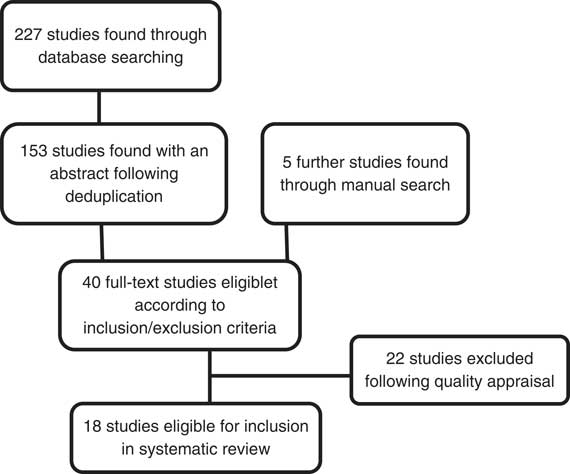
The quality of papers was evaluated by two independent researchers who applied the STROBE criteria for observational studies, which include a 22-item checklist.Reference Vandenbroucke, von Elm and Altman 12 One point was awarded for every criterion that was met, and those studies that scored below 65% were excluded from the review. Most of the excluded papers had insufficient explanations of their methodologies and inadequately reported outcome data. A flowchart of the study selection process is depicted in Figure 1.
Methodology flowchart.

Data were manually extracted from the full text of each of the studies selected for our review that were related to the following variables: study location, sample size, length of study, participant age and gender, diagnostic criteria, study type, and outcome results relevant to the heritability of behavioral traits.
Papers that were eligible for review were then subcategorized into three groups: general psychopathic traits, interpersonal-affective, and behavioral. Those studies that examined psychopathy as a broad construct, or as several different psychopathic traits that could not be exclusively included in the other categories, were grouped together as “general psychopathic traits” studies. Interpersonal-affective studies were those that investigated the heritability of traits in terms of both the interpersonal and affective facets, as outlined above. The traits of the facets related to social deviance and antisocial behavior were categorized under “behavioral traits.”
Results
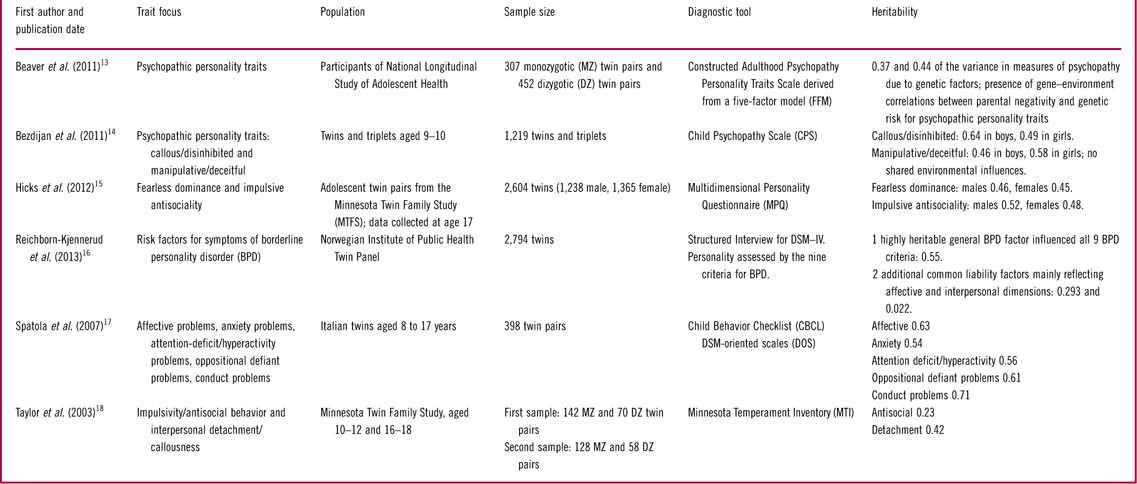
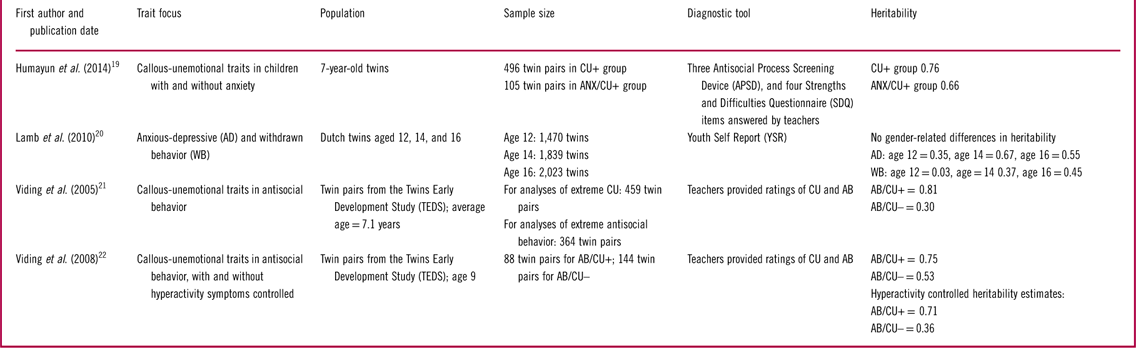
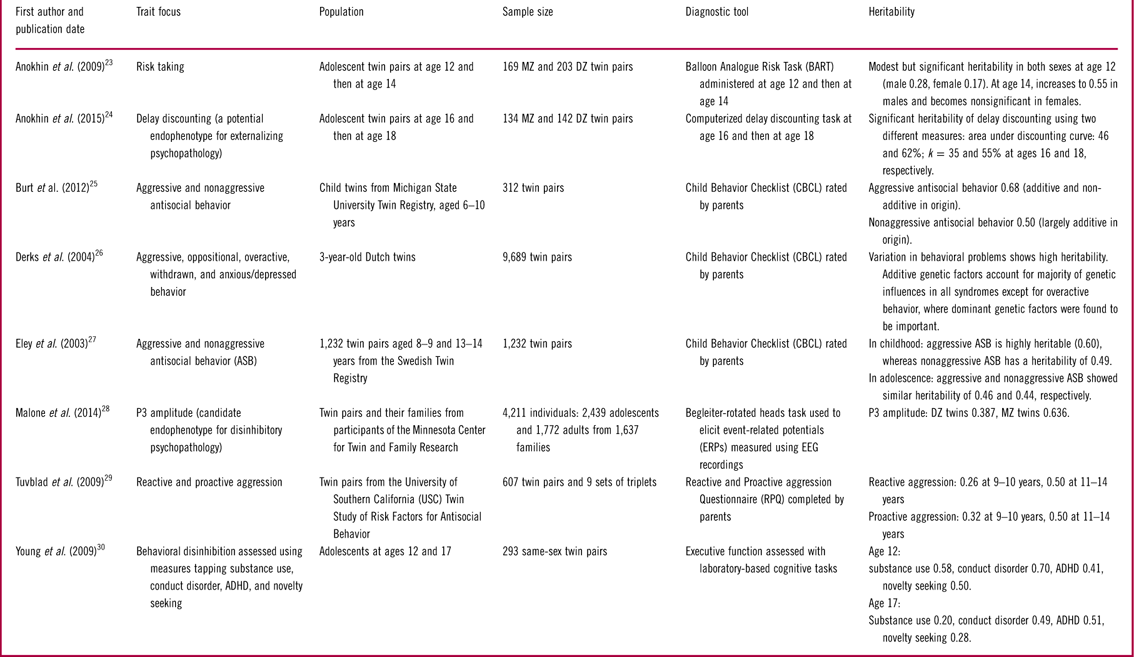
When looking at the results presented in the included papers, heritability estimates were described as moderate or high. Moderate heritability was defined as values that ranged from 0.2 to 0.5, and heritability values >0.5 were considered high or significant (see Tables 1–3).
General psychopathic traits
Interpersonal-affective traits

Behavioral traits

General psychopathic trait studies
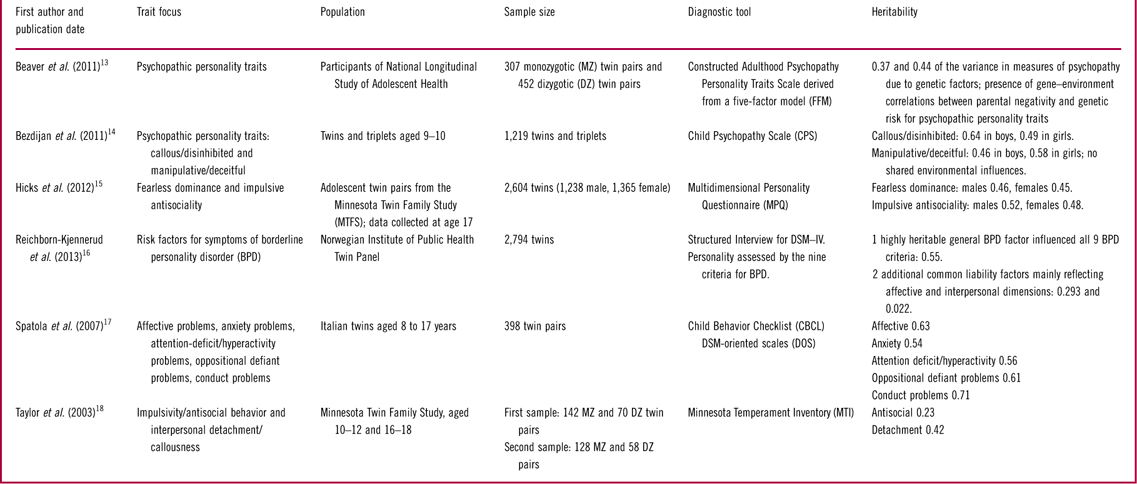
Six studies provided heritability estimates related to psychopathy as a broad construct and were therefore categorized under “general psychopathic traits.”
Using the Multidimensional Personality Questionnaire (MPQ), one studyReference Blonigen, Hicks, Kreuger, Patrick and Iacono 10 found that MPQ “fearless dominance” and “impulsive antisociality” demonstrated comparable heritability, ranging from 0.46 to 0.52 for both males and females. The associations of these behaviors were assessed with such environmental risk factors as family, school, peers, and stressful life events. MPQ impulsive antisociality was strongly associated with each risk factor, with stronger gene–environment associations than for MPQ fearless dominance.
Both the genetic and environmental risk factors for borderline personality disorder (BPD) were investigated in a studyReference Reichborn-Kjennerud, Ystrom and Neale 16 that explored the heritability of the nine criteria for BPD as assessed in the DSM–IV. These criteria were subdivided into the following dimensions: interpersonal, impulsivity, affective, and self-image—thereby covering a number of psychopathic traits. One general factor strongly influenced all nine criteria and had a heritability of 0.55. With the exception of one criterion (unstable and intense relationships), which was categorized under the interpersonal dimension, the other criteria were heavily influenced by environmental factors, with five criteria having genetic effects that were zero or negligible.
The genetic influences of two broad aspects of psychopathy (impulsivity/antisocial behavior and interpersonal detachment/callousness) were investigated in adolescent male twins. Heritability was found to be 0.23 for antisocial behavior and 0.42 for detachment, with no shared environmental influences.Reference Taylor, Loney, Bobadilla, Iacono and McGue 18
Another groupReference Beaver, Barnes, May and Schwartz 13 investigated the gene–environment correlations between psychopathic personality traits and negative parenting and found that between 0.37 and 0.44 of the variance in measures of psychopathy were due to genetic factors.
A further studyReference Bezdijan, Raine, Baker and Lynam 14 found significant heritability for both callous/disinhibited and manipulative/deceitful behavior using the Child Psychopathy Scale (CPS) subscale in both boys and girls aged 9–10 years, ranging from 0.49 to 0.64 and 0.46 to 0.58, respectively.
All studies related to psychopathy as a broad construct demonstrated moderate heritability. However, they all highlighted that such environmental influences as parenting, stressful events, and school also contribute to the variance in measures of psychopathy.
Interpersonal-affective studies
Of the four studies that provided heritability estimates for interpersonal-affective traits, oneReference Lamb, Middeldorp and van Beijsterveldt 20 focused on anxious-depressive (AD) and withdrawn behavior (WB). This study reflected on both interpersonal and affective traits: anxious-depressive traits were categorized under an affective feature of personality, whereas withdrawn behaviors led to deficiencies in interpersonal behavior. The study found heritability estimates of 0.40 for AD and 0.55 for WB, with no gender differences.
Three studiesReference Humayun, Kahn, Frick and Viding 19 , Reference Viding, Blair, Moffitt and Plomin 21 , Reference Viding, Jones, Frick, Moffitt and Plomin 22 focused on the affective aspects of psychopathic traits. All studies except one measured behavior using teacher ratings,Reference Lamb, Middeldorp and van Beijsterveldt 20 , Reference Viding, Blair, Moffitt and Plomin 21 and oneReference Humayun, Kahn, Frick and Viding 19 employed specific questions from the Antisocial Process Screening Device (APSD) and the Strengths and Difficulties Questionnaire (SDQ). These three studies related to callous-unemotional (CU) traits in various contexts, and all demonstrated moderate to significant heritability. OneReference Humayun, Kahn, Frick and Viding 19 examined the heritability of CU traits with and without anxiety and yielded estimates in children with CU traits and anxiety and with CU traits alone of 0.66 and 0.76, respectively.
The other two studies explored CU traits in antisocial behavior (AB) at age 7,Reference Viding, Blair, Moffitt and Plomin 21 and then at age 9.Reference Viding, Jones, Frick, Moffitt and Plomin 22 At age 7, the heritability estimate for AB in those children with CU traits (AB/CU+) was 0.81, and 0.30 in those without (AB/CU–).Reference Viding, Blair, Moffitt and Plomin 21 At age 9, heritability estimates were 0.75 for AB/CU+ and 0.53 for AB/CU– children. The latter study also reported heritability estimates with controlled hyperactivity symptoms that were 0.71 for AB/CU+ and 0.36 for AB/CU– children.Reference Viding, Jones, Frick, Moffitt and Plomin 22
Interpersonal-affective traits were found to have modest to high heritability. These results support the notion of a strong genetic vulnerability for the development of callous-unemotional traits, whether in the presence or absence of anxiety and antisocial behavior.
Behavioral traits
Nine of the studies reviewed dealt with the behavioral facet of psychopathic behavior. Four of themReference Burt and Klump 25 , Reference Derks, Hudziak, van Beijsterveldt, Dolan and Boomsma 26 , Reference Eley, Lichtenstein and Moffitt 27 , Reference Tuvblad, Raine, Zheng and Baker 29 focused on the heritability of aggression as measured using the Child Behavior Checklist (CBCL) or the Reactive and Proactive aggression Questionnaire (RPQ), which were completed by parents.
Aggressive antisocial behavior had a heritability rating of 0.68, both additive and nonadditive in origin, whereas nonaggressive antisocial behavior had a rating of 0.50 that was largely additive in origin.Reference Burt and Klump 25 Aggressive antisocial behavior was found to be a stable heritable trait, as the continuity in aggressive antisocial behavior from childhood to adolescence was largely mediated by genetic influences, whereas continuity in nonaggressive antisocial behavior was mediated by both genetic and shared environment influences. In childhood, heritability values for aggressive and nonaggressive antisocial behavior were 0.60 and 0.49, respectively. In adolescence, genetic and shared environment influences accounted for similar proportions of variances in both forms of antisocial behavior (0.46 and 0.44, respectively).Reference Eley, Lichtenstein and Moffitt 27 Another studyReference Tuvblad, Raine, Zheng and Baker 29 reported that heritability estimates for both types of aggression increased to 0.50 in the 11–14 age group (from 0.26 and 0.32, respectively, in the 9–10 age group).
Other behavioral studies focused on behavioral disinhibition measured using various laboratory-based cognitive tasks.Reference Malone, Vaidyanathan, Basu, Miller, McGue and Iacono 28 , Reference Young, Friedman and Miyake 30 Behavioral disinhibition was assessed using measures that gauged substance abuse, conduct disorder, attention-deficit/hyperactivity disorder (ADHD), and novelty seeking at ages 12 and 18. These results showed that behavioral disinhibition had high heritability and was dominated by ADHD and conduct problems at 12 years of age. At the age of 17 years, the contribution of the four components was more balanced, with a smaller proportion of variance being attributable to genetic influences and additional variance being due to shared environmental influences.Reference Young, Friedman and Miyake 30 Another studyReference Malone, Vaidyanathan, Basu, Miller, McGue and Iacono 28 examined the heritability of P3 amplitude (a possible endophenotype for disinhibitory psychopathology) and reported a heritability estimate of 0.64 in monozygotic (MZ) twins.
Risk-taking behavior was examined using the Balloon Analogue Risk Task (BART), a computerized procedure modeled on the real-world risk of balancing the potential for reward versus loss. One studyReference Anokhin, Golosheykin, Grant and Heath 23 reported modest but significant heritability for both males and females at age 12, while at age 14 this value increased to 0.55 in males and became nonsignificant in females.
Delay discounting, a reduction in the subjective value of reward with increasing delay until its receipt, is an established behavioral model of impulsivity. Greater delay discounting (a tendency to choose smaller immediate over larger delayed rewards) has been implicated as a potential endophenotype for externalizing psychopathology, particularly in adolescence. Two measures were employed to quantify delay discounting, and genetic analyses revealed significant heritability for both: heritability values using the area under the discounting curve method were 0.46 and 0.62, and, using the k coefficient method, 0.35 and 0.55 at ages 16 and 18, respectively.Reference Anokhin, Grant, Mulligan and Heath 24
The heritability values for such behavioral traits as aggression, behavioral disinhibition, risk-taking behavior, and impulsive behavior all ranged from moderate to high, while exhibiting variation by age and gender due to environmental influences.
Discussion
General psychopathic trait studies
The studies in this group highlighted the complexity of the contributions of genetic and environmental influences to various psychopathic traits. Levels of impulsivity were shown to be highly heritable, whereas the interpersonal dimension exhibited a modest genetic influence in a study that looked at the DSM–IV criteria for BPD.Reference Reichborn-Kjennerud, Ystrom and Neale 16 Differences in heritability values were explained by variation in environmental influences, which were also shown to influence the etiology of primary (factor 1 affective-interpersonal features) and secondary (factor 2 social deviance) psychopathy in a studyReference Hicks, Carlson, Blonigen, Patrick, Iacono and Mgue 15 that found similar heritability in both genders for both types. However, the differential environmental correlates of each type of psychopathy in this study were due to gene–environment interactions rather than the direct effect of genes and environmental risk factors.Reference Hicks, Carlson, Blonigen, Patrick, Iacono and Mgue 15
When assessing whether or not different psychopathic traits have mutual genetic etiologies, only half of the genetic variance in detachment/callousness could be attributed to genetic influences that were associated with impulsivity/antisocial behaviors. This suggests that these two dimensions of psychopathy may have independent underlying biological pathways.Reference Taylor, Loney, Bobadilla, Iacono and McGue 18
There is thus evidence of gene–environment correlations, but further research is required to show if these correlations are passive or evocative, or a combination of the two.Reference Beaver, Barnes, May and Schwartz 13 These studies found significant genetic and non-shared, but no significant shared, environmental influences. There was incomplete overlap in the etiology of callous/disinhibited and manipulative/deceitful traits, which indicates that the two traits may be related, but it also distinguishes them as two separate factors.Reference Taylor, Loney, Bobadilla, Iacono and McGue 18
Interpersonal-affective traits
The importance of genetic contributions to interpersonal-affective traits was highlighted in the studies belonging to this group. The majority of studiesReference Humayun, Kahn, Frick and Viding 19 , Reference Viding, Blair, Moffitt and Plomin 21 , Reference Viding, Jones, Frick, Moffitt and Plomin 22 that looked at interpersonal-affective traits focused specifically on CU traits, all of which suggested high heritability and insignificant effects of the shared environment. Children with both anxiety and CU traits showed higher levels of adjustment difficulties at age 7 compared to those with CU traits alone, with no difference with respect to parenting characteristics. These studies supported the notion of a strong genetic vulnerability in the development of CU traits in children with and without high levels of anxiety or antisocial behavior.
The influence of age on heritability was demonstrated in the remaining studyReference Lamb, Middeldorp and van Beijsterveldt 20 that looked at interpersonal-affective traits. The heritability of withdrawn behavior increased with age, peaking at 0.45 at age 16. Similarly, heritability for anxious-depressive behavior peaked at age 14 at a value of 0.67. The influence of age on heritability can be explained by gene expression being influenced by hormonal changes during puberty, which influences the risk of developing these personality traits in those individuals who are genetically susceptible. Shared environmental influences have a diminishing influence after the age of 12 for both anxious-depressive and withdrawn behaviors. Future research will need to identify the age-specific risk factors, either genetic or environmental, something that would aid in facilitating different therapeutic interventions for children of different ages.
Behavioral traits
The contributions of genetic, shared, and non-shared environmental factors to various behavioral traits were examined by all studies in this group. In particular, aggressive behaviors demonstrated varying levels of genetic influence, with genes playing an important role in the aggressive dimensions of antisocial behavior,Reference Burt and Klump 25 and in both reactive and proactive aggression during early adolescence.
The continuity from childhood to adolescence in aggressive antisocial behavior was largely influenced by genetic factors. In comparison, continuity in nonaggressive antisocial behavior resulted from both genetic and shared environmental factors. This suggests that the genetic influences in childhood for aggressive antisocial behavior either set up a series of events that led to similar behavior in adolescence or that these genes continued to have a direct effect on behavior across this age range.Reference Eley, Lichtenstein and Moffitt 27
Both genetic and non-shared environmental factors were attributed to the stability of reactive aggression, whereas the continuity in proactive aggression was mainly attributed to genetic factors. Genetic influences became increasingly important in both types of aggression during early adolescence. The evidence pointed to an etiological distinction between these two types of aggression. This implies that the genetic distinction between the two forms of aggression becomes more important as children develop, and that the environmental effects become more important as children develop from middle childhood to early adolescence. A possible explanation for this observed pattern is the relationship to the gene–environment correlation: as the child grows older, they may actively seek out environmental situations that are more closely matched to their genotype. The design of this studyReference Tuvblad, Raine, Zheng and Baker 29 may lead to active gene–environment correlations ending up as part of the heritability estimate, thereby contributing to increasing genetic influence in adolescence. The existence of gene–environment interactions are highlighted by these studies and indicate an important contribution to the research on behavioral psychopathic traits.
Many studies in this group highlighted that discovering specific endophenotypes may be of great value in understanding the etiology of psychopathic behaviors. An example of such an endophenotype is “response inhibition,” which is more closely related to behavioral disinhibition than other executive functions. This was found to be largely genetic in origin at the ages of 12 and 17, and it may point toward an important endophenotype underpinning the genetic risk for disinhibitory psychopathy.Reference Young, Friedman and Miyake 30 However, there was no significant association between individual single nucleotide polymorphisms (SNPs) and endophenotypes, supporting the findings of a polygenic model, with complex traits reflecting the involvement of numerous individual SNPs.Reference Malone, Vaidyanathan, Basu, Miller, McGue and Iacono 28 Large sample sizes are required to detect traits that conform to this type of model, which may be difficult to obtain due to the expense of collecting psychophysiological data.Reference Malone, Vaidyanathan, Basu, Miller, McGue and Iacono 28 Other promising endophenotypes have been found to be related to risk takingReference Anokhin, Golosheykin, Grant and Heath 23 and impulsivity.Reference Burt and Klump 25 Modest heritability estimates of risk-taking behaviors suggest that the likelihood of risk taking, using BART measures, can be a valuable endophenotype. However, the usefulness of this endophenotype may be restricted to males due to gender differences in heritability.Reference Anokhin, Golosheykin, Grant and Heath 23 The heritability values for two quantitative measures of delay discounting (DD) suggest that it is a promising endophenotype that can be employed in the genetic research of impulsivity in such conditions as conduct disorder. However, the analysis focused on a limited age range (16–18 years), and it is therefore unclear whether genetic influences on DD will change in the transition from adolescence to adulthood.Reference Anokhin, Grant, Mulligan and Heath 24
The potential role for endophenotypes in genetic research for behavioral psychopathic traits has been highlighted by these studies, although there are limitations related to gender and age, which may indicate a direction for future research on endophenotypes.
Limitations
The quality-appraisal process was aimed at minimizing bias. However, as only papers in the English language were selected, our review may have been limited by publication bias. The influences of gender and age were not addressed consistently across the papers, and this might constitute two confounding factors that may have affected our review. Many of the studies focused on children and adolescents, while very few examined similar traits in adults. A lot of the studies employed specific samples, and their findings could not be extended to a more general population. It is recognized that a quantitative metaanalysis would be a highly desirable method for exploring this research question. However, the relative scarcity of papers in this subject area led us to the conclusion that a qualitative review would have been more appropriate for our paper. With further development of this field, a metaanalysis might well be possible in the future, which we would strongly recommend. Overall, a substantial issue was the paucity of studies on the interpersonal and affective domains of psychopathy, as well as a lack of replicated findings using similar diagnostic tools. This is certainly an area for further research.
Conclusions
The etiology of psychopathy can be broken down into different aspects that describe different phenotypes of behavior. The advantage of separating psychopathic traits when studying the etiology of psychopathy is that it allows one to consider phenotype-specific interventions rather than treating psychopathy as a unitary construct. However, there was a scarcity of papers in both the interpersonal and affective domains, so that future research in these areas would enhance our understanding of the etiology of these psychopathic behaviors.
Two areas that were highlighted as important for future research in psychopathic behavior included (1) exploring gene–environment correlations and (2) moving toward an endophenotypic approach. Endophenotypes are hereditary characteristics that are normally associated with a condition but not with a specific symptom. The strength of an endophenotype is in its ability to distinguish between potential diagnoses that present with similar symptoms. Future research should explore the gene–environment interplay associated with these specific traits of psychopathy so that environmental adjustments can be implemented in the most effective way for those who have “at-risk” genes. It is possible that the genetic risk can be moderated by positive environmental influences, which could make up part of a clinical intervention as well as become an important part of prognostic calculations.
The studies in our review suggest evidence for a genetic influence in both the factor 1 (interpersonal-affective) and factor 2 (behavioral) traits of psychopathy. An improved understanding of the etiology of psychopathic traits could assist in the development of interventional programs designed to address psychopathic behaviors.
Conflicts of Interest
The authors report no financial or other relationships relevant to the subject of this review.
Disclosures
Sapna Dhanani, Piyal Sen, Basant Puri, Susan Young, Veena Kumar, and Ian Treasaden hereby state that they have nothing to disclose.