INTRODUCTION
Growing populations and food consumption, coupled with competition between different water use sectors, increase the pressure on water resources (Karimov et al. Reference Karimov, Molden, Khamzina, Platonov and Ivanov2012). Increased food supply cannot be achieved by expanding the area of cultivated land, since that is already a scarce natural resource around the world. Furthermore, it cannot come from any significant expansion of irrigated area because of competition for water by industrial and domestic water demands (Harwood Reference Harwood1998). Water scarcity is a major constraint of agricultural production in arid areas, where rainfall is limited (Umetsu et al. Reference Umetsu, Palanisami, Coşkun, Donma, Nagano, Fujihara and Tanaka2007). Moreover, farmers are under pressure to reduce the use of irrigation (thereby releasing water to other sectors and the ecological environment) and use water more efficiently (Perry Reference Perry2011). Meanwhile, irrigation water availability is highly vulnerable to climate change and irrigation allocation limitation (IPCC 1995; Singh et al. Reference Singh, Mullen and Jayasuriya2005). In the face of future water scarcity, possible means for the agricultural sector to adapt are via changes in cropping patterns and adjustments according to available water resources (Boustani & Mohammadi Reference Boustani and Mohammadi2010). Adjustment of cropping patterns according to irrigation water availability, such as reducing the area of water-intensive crops or changing crop types to ones with more efficient water use, provides a potential means of alleviating irrigation water scarcity (Wang et al. Reference Wang, Chen and Peng2011).
The cropping pattern reflects the proportion of land area under different crops at a particular moment. A change to this pattern implies modification of that proportion, which largely depends on the facilities available to raise crops in a given agro-climatic condition. The cropping pattern also varies as a result of government policies, technological innovations and economic returns (Das Reference Das, Tyagi, Bathla and Sharma2003). As a bio-productive system, agriculture requires research into the regional cropping pattern and diversification, which provides reference information for regional agriculture development. The diversification of crops has been studied by agricultural geographers, agricultural economists and agricultural scientists in their own areas of emphasis and specialization (Singh & Singh Reference Singh and Singh2003). Agricultural geographers attempt to identify the geographic variation of cropping systems as well as crop combinations and crop rotations used in different regions; agricultural economists use the study of agricultural diversification, primarily for selecting crops to maximize agricultural production and economic return and agricultural ecologists have attempted to develop a sustainable agro-ecosystem for ensuring food security and environmental balance. Both subjective and objective criteria are used in the study of cropping patterns (Neena Reference Neena1998; Panda Reference Panda2001; Palmer Reference Palmer2008; Vivekanandan et al. Reference Vivekanandan, Viswanathan and Gupta2009; Fasakhodi et al. Reference Fasakhodi, Nouri and Amini2010). However, there are few studies related to the impact of changing cropping patterns on regional agricultural water consumption. Identifying and quantifying links between those two factors is crucial in addressing the intensified conflicts caused by water scarcity in sustainable agriculture (Huang & Li Reference Huang and Li2010).
The concept of water footprint (WF), introduced by Hoekstra & Hung (Reference Hoekstra and Hung2002) and subsequently elaborated by Hoekstra & Chapagain (Reference Hoekstra and Chapagain2008), provides a framework to assess water resources utilization in agriculture production processes (Hoekstra et al. Reference Hoekstra, Chapagain, Aldaya and Mekonnen2011). The WF of a product is defined as the volume of water used to produce a particular good, measured at the point of production. The WF of a crop is the volume of freshwater both consumed and affected by pollution during crop production, and has three components: (1) green WF (GWF, volume of precipitation consumed in crop production); (2) blue WF (BWF, volume of surface or groundwater consumed in crop production); and (3) grey WF (volume of freshwater required to assimilate the pollutant load during crop production) (Chapagain & Hoekstra Reference Chapagain and Hoekstra2011; Mekonnen & Hoekstra Reference Mekonnen and Hoekstra2011). The WF is not only an indicator of water use that addresses both water consumption and pollution, but it can also broaden water resource evaluation systems and provide water utilization information for decision-making (Ma et al. Reference Ma, Wang, Lai and Wang2005; Ercin et al. Reference Ercin, Aldaya and Hoekstra2011; Sun et al. Reference Sun, Wu, Wang, Zhao, Liu and Zhang2013).
The present paper analysed cropping system patterns and identified how such patterns have changed over a period (1960–2008) in the Hetao Irrigation District (HID) of China. Then, it analysed the impact of changing cropping patterns on agricultural water productivity at regional scale from the WF perspective. Such analysis will aid in taking policy decisions for diversification and specialization of crop production under changing cropping systems within a regional framework, with the objective of achieving greater agricultural water use efficiency under the challenge posed by water scarcity.
MATERIALS AND METHODS
Study area
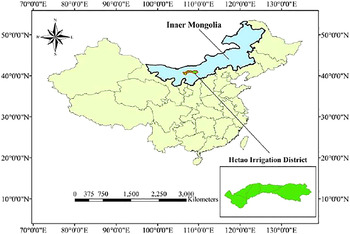
The HID is in western Inner Mongolia, China (40° 19′–41°18′N, 106°20′–109°19′E, 1007–1050 m a.s.l. (Fig. 1) and covers 577·3 × 103 ha. The average annual rainfall here is c. 137–214 mm and most precipitation is during summer and autumn, i.e. from June to September. The average annual temperature is 6–8 °C. The major crops grown are spring wheat (Triticum aestivum), maize (Zea mays) and sunflower (Helianthus annuus) (Bai et al. Reference Bai, Zhang, Geng, Ren, Zhang and Shi2010).
Location of Hetao Irrigation District (colour online).

Data description
Agricultural development is a complex problem; therefore, reliable data and collection are necessary for decision making and future planning. For the present study, data were collected from various sources. The meteorological data (1960–2008) were monthly values measured by the local Weather Bureau, including among others temperature, relative humidity, wind speed and precipitation (CMA 2011). Agricultural data, including crop yield, sowing area and agricultural inputs, were collected from Hetao Irrigation District Statistical data, the Inner Mongolia Statistical yearbook and China agricultural statistics data (MAC 1960–2008; NBSC 1960–2008). Total water diversion from the Yellow River, total outflow and groundwater depth were provided by the HID administration in the Inner Mongolia Autonomous Region (The Administration of Hetao Irrigation District 1960–2008).
Methods
Based on the calculation framework of Hoekstra et al. (Reference Hoekstra, Chapagain, Aldaya and Mekonnen2011) and Montesinos et al. (Reference Montesinos, Camacho, Campos and Rodríguez-Díaz2011), the current paper presents a modified method for quantifying the BWF of a crop. GWF was calculated according to the evapotranspiration of water supplied by rain during the crop growth period, while BWF was determined according to the actual irrigation water consumption at the regional scale (includes field crop evapotranspiration and non-beneficial water depletion in the canal network) using the water balance method. The grey WF of a crop refers to the volume of freshwater required to assimilating the pollutant load, based on existing ambient water quality standards: it is a theoretical value that is not really consumed by the crop. Therefore, the present study was focused on the total water consumption (green plus blue footprint) for crop production (Sun et al. Reference Sun, Wu, Wang, Zhao, Liu and Zhang2013).
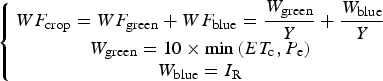 $$\left\{\matrix{WF_{\rm crop} = WF_{\rm green} + WF_{\rm blue} = \displaystyle{W_{\rm green} \over Y} + \displaystyle{W_{\rm blue} \over Y} \cr W_{\rm green} = 10 \times \min \,(ET_{\rm c}, P_{\rm e}) \cr W_{\rm blue} = I_{\rm R}} \right.$$
where WF crop is the WF of crop production, WF green is the green WF and WF blue the BWF at the regional scale (m3/kg); W green and W blue are the green and blue water consumption per unit area (m3/ha); Y is the crop yield per unit area (crop yield for melons, vegetables and tomatoes is fresh matter) in kg/ha; the factor 10 is to convert water depths (mm) into water volumes per land surface in m3/ha; min stands for minimum, such that the WF green equals the number with the lowest value of ET c and P e; ET c is crop evapotranspiration during the growing period (mm); P e is effective precipitation over the crop growth period (mm) and I R is irrigation water consumption of crop per unit area (m3/ha).
The ET c was calculated according to the Penman–Monteith equation, using the CROPWAT model as follows (Allen et al. Reference Allen, Pereira, Raes and Smith1998; FAO 2009):
 $$ET_c = K_c \times ET_0 $$
where K c is the crop coefficient and ET 0 is the reference crop evapotranspiration (mm), calculated as follows (Allen et al. Reference Allen, Pereira, Raes and Smith1998; FAO 2009):
 $$ET_0 = \displaystyle{{0.408\Delta (R_{\rm n} - G) + \gamma \times \displaystyle{{900} \over {(T + 273)}} \times U_2 \times (e_{\rm s} - e_{\rm a} )} \over {\Delta + \gamma (1 + 0.34U_2 )}}$$
where Δ is the slope of the vapour pressure curve (kPa/°C), R n is the net radiation at the crop surface (MJ/m2/day), γ is the psychrometric constant (kPa/°C), T is the average air temperature (°C), U 2 is the wind speed measured at 2 m height (m/s), e s is the saturation vapour pressure (kPa), and e a is the actual vapour pressure (kPa).
Effective precipitation over the growth period was calculated according to the method developed by the US Department of Agriculture (USDA), where effective rainfall can be calculated according to FAO (2009):
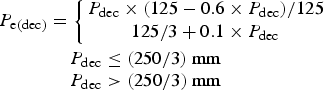 $$\eqalign{P_{{\rm e}({\rm dec})} &= \left\{\matrix{P_{\rm dec} \times (125 - 0.6 \times P_{\rm dec})/125 \cr 125/3 + 0.1 \times P_{\rm dec}} \right. \cr &\quad \matrix{P_{\rm dec} \le (250/3)\;{\rm mm} \cr P_{\rm dec} \gt (250/3) \ {\rm mm} }}$$
where P e(dec) is the effective precipitation and P dec the precipitation, both at decade step (mm).
Irrigation consumption was calculated according to the proportion of irrigation water consumption of crop i to the total irrigation water consumption of the irrigation district:
 $$I_{\rm R}^i = \displaystyle{{W_A \alpha _i} \over {A_i}} $$
where W A is the total irrigation water consumption of the irrigation district (m3), α i is the proportion of irrigation water use of crop i to total irrigation water consumption of that district, and A i is the sown area of crop i (ha). The proportion of irrigation water used (α i) was calculated as follows:
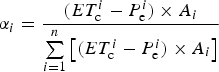 $$\alpha _i = \displaystyle{(ET_{\rm c}^i - P_{\rm e}^i) \times A_i \over \sum\limits_{i = 1}^n \left[(ET_{\rm c}^i - P_{\rm e}^i ) \times A_i \right]} $$
If P ei > ET ci, then α i equals zero.
The total irrigation water consumption of the irrigation district is calculated according to the water balance equation of the irrigation district. Water balance at the irrigation district scale consists of determining its water inputs and outputs for a given period of time (Ridder & Boonstra Reference Ridder, Boonstra and Ritzema1994). There are three essential components of water balance: all inflows and outflows across the boundaries and the change in storage within those boundaries.
The water balance of HID can be expressed as follows (Sun et al. Reference Sun, Wu, Wang, Zhao, Liu and Zhang2013):
 $$\Delta W = W_{\rm D} + W_{\rm P} + W_{\rm G} - W_{\rm Out} - W_{\rm C} $$
where ∆W is the variation of water storage (m3), W D is the volume of water diverted from the Yellow River (m3), W P is the precipitation recharge (m3), W G is the lateral inflow of groundwater (m3), W Out is the volume of outflow from the irrigation district (m3), W C is the water consumption, consisting of: agricultural water consumption (W A), industry water consumption (W 1), domestic water consumption (W L) and ecological water consumption (W E).
Therefore, W A can be calculated as follows (Qin et al. Reference Qin, Yu and Pei2003; Sun et al. Reference Sun, Wu, Wang, Zhao, Liu and Zhang2013):
 $$\hskip-10ptW_{\rm A} = W_{\rm D} + W_{\rm P} + W_{\rm G} - W_{\rm Out} - W_{\rm I} - W_{\rm L} - W_{\rm E} - \Delta W $$
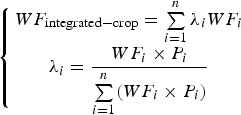
The WF of each crop in HID was computed first: subsequently, according to the production weight for each crop in the study area, the integrated-crop WF was calculated as follows:
 $$ \left \{ \matrix{WF_{{\rm integrated} - {\rm crop}} = \sum\limits_{i = 1}^n \lambda_i WF_i \cr \lambda_i = \displaystyle{WF_i \times P_i \over \sum\limits_{i = 1}^n (WF_i \times P_i)}} \right.$$
where WF integrated-crop is the integrated-crop WF (m3/kg), WF i the WF of crop i, λ i the weight coefficients of WF i, and P i the crop production of crop i (kg).
RESULTS
Change of cropping pattern
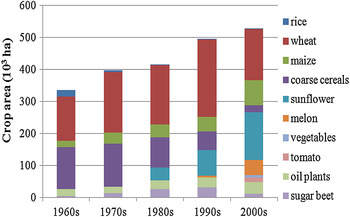
Figure 2 presents the crop sown area and change of cropping pattern over the study period (1960–2008) in HID. The total area sown to crops in HID increased over the study period (1960–2008) from 336·11 × 103 ha in the 1960s to 525·21 × 103 ha in the 2000s (Fig. 2), an increase of 56·26%. Meanwhile, it is evident that the cropping pattern was dominated by grain crops (rice, wheat, maize and coarse cereals, such as barley, millet and sorghum) between the 1960s and 1990s, with wheat constituting the largest area, followed by coarse cereals and maize. Although a major grain crop, rice occupied only a small proportion of total crop sown area because rice cultivation requires an assured water supply, whereas wheat and maize can be cultivated in dry areas. Although the area of grain crops showed a downward trend over the study period, the share of grain crops was still more than 0·50 of total crop area sown. This shows that HID was a major grain producing region.
Crop area sown and proportion in each period (colour online).

The area under cash crops (sunflower, melon, vegetable, tomato, oil plants and sugar beet) increased phenomenally over the study period. The proportion of cash crops increased from 0·08 in the 1960s to 0·51 in the 2000s. This rapid increase began in the 1980s and accelerated during the 1990s. In particular, the proportion of sunflower increased from 0·09 in the 1980s to 0·28 in the 2000s. This indicates that cash crops are becoming a dominant crop type and reflects a tendency toward maximization of income by farmers, who are substituting them for water-intensive crops such as rice and inferior (low economic return) ones like wheat and coarse cereals.
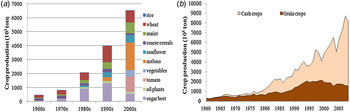
Figure 3 shows the variation of crop production during the study period. Production of grain crops represented the dominant proportion of total crop production during the 1960s and 1970s: 0·84 and 0·75, respectively. However, with the expansion of sown area under cash crops since the 1980s, their production has exceeded that of grain crops, reaching a maximum of 0·73 of total crop production in the 2000s.
Crop production in Hetao Irrigation District (colour online).

Variation of crop WF
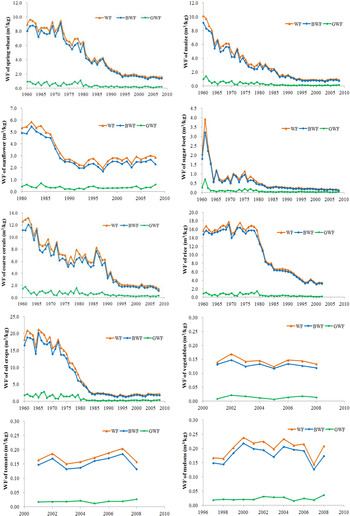
Figure 4 shows the interannual variability of WF of the ten major crops between 1960 and 2008 in HID. The WF of the most crops, including spring wheat, maize, coarse cereals, sugar beet and oil crops, had a downward trend over that period. For instance, the WF of maize decreased from 10·13 m3/kg in 1960 to 0·93 m3/kg in 2008, a rate of reduction of −0·19 m3/kg/year. Since the 1990s, crop WF has shown relatively stable trends. This is largely because the irrigation system and agricultural production level were relatively stable during this period. As a result, crop yield per unit area and irrigation water consumption of these crops did not have large fluctuations and their WFs were relatively steady.
Interannual variability of crop WF in Hetao Irrigation District (colour online).

From the perspective of WF components, the proportions of the BWF in total water consumption were relatively high (>0·8) in most of the ten crops, whereas those of the GWF were relatively small (<0·15). For example, the BWF of spring wheat comprised 0·90 of the total WF, whereas its GWF only represented 0·10.
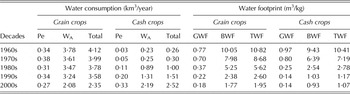
With regard to crop classification, grains usually had a large WF (low water productivity) relative to cash crops (Table 1). For instance, the multi-year average (2001–2008) WF of spring wheat was 1·61 m3/kg, more than ten times that of vegetables at 0·14 m3/kg. The WF of crop production depends on two factors – total water consumption (green and blue water) and crop yield. Cash crops generally have higher crop yields per unit area than grains. Water consumption of cash crops was not always greater than grain crops. Therefore, the cash crops have higher water productivity than that of grain crops.
Water consumption and WF of grain and cash crops

Pe, effective precipitation; WA, irrigation water consumption; GWF, green water footprint; BWF, blue water footprint; TWF, total water footprint; Grain crops includes: rice, spring wheat, maize and coarse cereals. Cash crops includes: sunflower, melon, vegetable, tomato, oil crops and sugar beet.
Impacts of changing cropping pattern on regional water productivity
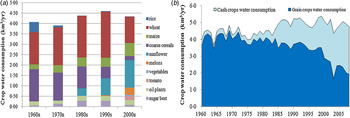
Figure 5 presents the variation of crop water consumption in HID along with the changing cropping pattern. Agriculture is a sector with high water consumption: consequently, changing the cropping pattern will affect regional agricultural water consumption significantly. Figure 5 shows that total agricultural water consumption in HID fluctuated between 3·5 and 5·0 km3/year. The major component of agricultural water consumption was grain crops, which represented >0·9 of agricultural water consumption in the 1960s and 1970s. With the increase of sown area under cash crops, their volume of water consumption increased significantly (P < 0·01) beginning in the 1980s. For instance, the share of water consumed by cash crops was 0·21 in the 1980s, 0·30 in the 1990s and a maximum of 0·52 in the 2000s.
Crop water consumption in Hetao Irrigation District (colour online).

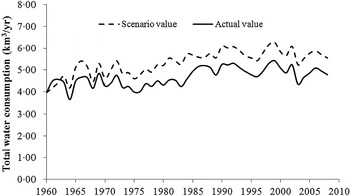
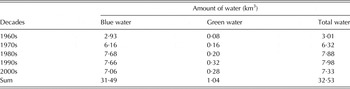
To further explore the impacts of changing cropping patterns on regional water consumption, the present paper compared the actual cropping pattern with a constant cropping pattern (high proportion of grain crops sown area based on the crop pattern of 1960) as a reference. Figure 6 shows that total water consumption of the constant cropping pattern was greater than that of the actual cropping pattern. This revealed that the change of cropping pattern has significant impacts on regional water consumption. Table 2 lists the difference in water consumption between the constant cropping pattern and actual cropping pattern over the study period in HID. The water consumption of the actual cropping pattern was 3·01 km3 less than the constant pattern in the 1960s (Table 2) and this number has exceeded 7·00 km3 since the 1980s. This confirms the major effect of cropping pattern change on regional agricultural water consumption.
Water consumption of different cropping patterns (colour online).

Differences in water consumption between the constant cropping pattern and the actual cropping pattern (km3)

Note: The number is the cumulative volume of water in each decade.
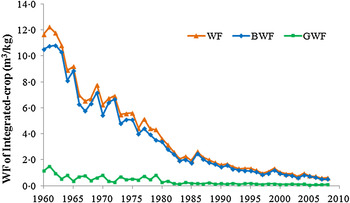
The changing cropping pattern affected both agricultural water consumption and crop water productivity. Figure 7 presents the variation of integrated-crop WF (calculated by the weighted average of WF and production of each crop) of HID, which reflects comprehensive water productivity. According to the WF theory, a larger WF of a crop signifies lower water productivity. It is evident from Fig. 7 that the integrated-crop WF in HID declined over the study period, which reveals that water productivity improved significantly (P < 0·01) between 1960 and 2008.
Variation of integrated-crop water footprint (colour online).

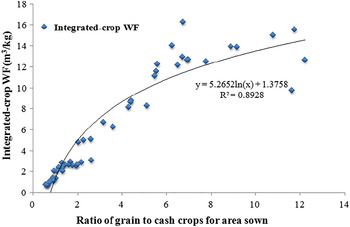
The improvement of crop water productivity could be due to various reasons, including increasing crop yield or irrigation efficiency and cropping pattern change. To analyse the impact of changing the cropping pattern on regional water productivity, regression analysis method was used to identify the relationship between cropping pattern and water productivity (WF). Figure 8 shows that the cropping pattern significantly (P < 0·01) influenced the integrated-crop WF (water productivity). As mentioned above, cash crops usually have a lower WF (high water productivity) than grain crops. Therefore, with the increase of cash crop sown area, water productivity in HID increased substantially. Therefore, changing the cropping pattern had great effect on regional water productivity.
Relationship between integrated-crop water footprint and cropping pattern (colour online).

DISCUSSION
Cropping systems in a region are determined by soil and climatic conditions. Nevertheless, potential productivity and monetary benefits act as guiding principles in the selection of a particular cropping system. These decisions with respect to choice of crops and cropping systems are further constrained by several other forces, related to infrastructure facilities, socioeconomic factors, technological developments and water resources (Iikhmove Reference Iikhmove1998). Changes in cropping patterns are likely to impact on the availability of water resources due to differences in crop water requirements (Fasakhodi et al. Reference Fasakhodi, Nouri and Amini2010). Different crops have different water use characteristics. Categories and quantities of crops planted in a region could influence the total amount of water use for crop production. Therefore, regional cropping pattern adjustment offers the potential to relieve pressure on local water resources and reduce conflict over the limited water resources (Huang et al. Reference Huang, Ridoutt, Xu, Zhang and Chen2012). Analysis of the impact of changing the cropping pattern on water resource consumption can assist policy decisions at the micro-level and regional planning for improvement of regional water productivity.
The WF was introduced herein for the assessment of regional agricultural productivity. The calculations of WF among the ten crops showed that most of the crops had downward trends. This decrease is mainly attributed to a significant decline in the BWF of crops. The WF of a crop is determined by its water consumption and yield per unit area. The irrigation technology used in HID is mainly surface irrigation. Since the irrigation canal lining projects were not fully implemented across the whole irrigation district, there was large volume of irrigation water losses during the transfer and dispatch process from water sources to cropland, so large volumes of irrigation water were lost in the irrigation canal network during transfer process, especially in the earlier decades. With the development of irrigation projects, the agricultural water use efficiency has increased through improving water delivery systems during the study period. With improvement of the irrigation system, irrigation water use efficiency has improved greatly. The irrigation efficiency has increased by c. 40% during the study period. Consequently, the volume of water consumption per unit area in crop production has diminished significantly. Meanwhile, crop yield per unit area has risen considerably because of improvement of agricultural production level. Under the combined influences of decreasing irrigation water consumption and increasing crop yield per unit area, the BWF fell substantially during the study period (Sun et al. Reference Sun, Wu, Wang, Zhao, Liu and Zhang2013). The integrated-crop WF also decreased over the period. In addition to the improvement of crop yield per unit area and water use efficiency, changing the cropping pattern was important for the decrease of integrated-crop WF. During the variation of cropping pattern, regional agricultural water productivity greatly changed in HID. Cash crops with high economic value and water productivity have replaced grain crops, which have lower economic value and water productivity. Therefore, the cropping pattern development in HID has reflected attention to economic returns and water use efficiency.
The WF of the crops has decreased significantly, while the total water consumption of crops in HID has actually not decreased from the 1960s to the 2000s. This is mainly due to the fact that although the irrigation water use efficiency has been increased tremendously, the crop sown area has also been increased significantly due to the increase of crop demand. The expansion of crop sown area has counteracted the increase of water use efficiency. Some studies also indicated that to mitigate water scarcity, water productivity increases are an essential ingredient, but not sufficient. According to van den Berg et al. (Reference Van Den Berg, Bakkes, Bouwman, Jeuken, Kram, Neumann, van Vuuren and Wilting2011) and other studies, blue water efficiency, in all sectors combined and as a global average, could be improved by 25%. However, the efficiency gains in water use will not be sufficient to offset the effects of population growth (Perry et al. Reference Perry, Steduto, Allen and Burt2009; Hoekstra Reference Hoekstra2013). In conservation and energy economics, there is a phenomenon that is called the ‘rebound effect’ (Binswanger Reference Binswanger2001; Barker et al. Reference Barker, Dagoumas and Rubin2009; Sorrell et al. Reference Sorrell, Dimitropoulos and Sommerville2009). Rebound refers to the behavioural or other systemic responses to the introduction of new technologies that increase the efficiency of resource use. For instance, sometimes resource consumption even increases (rather than decreasing) as a result of the efficiency increases (Alcott Reference Alcott2005). This specific case of the rebound effect is known as the Jevons paradox. There are only a few studies that consider the rebound effect in the field of freshwater use, but there is no reason to assume that it does not occur in this sector (Ward & Pulido-Velazquez Reference Ward and Pulido-Velazquez2008; Crase & O'Keefe Reference Crase and O'Keefe2009). The results of the present study showed that the improvements in crop water productivity were not used to save water but to increase crop production. Therefore, the improvement of crop water productivity is one means to achieve the goal for more sustainable use of water resources in agriculture production, but it also needs to be coupled with measures that constrain the continued growth of demand (Hoekstra Reference Hoekstra2013).
The results of the present study show that a change of cropping pattern would have a significant effect on regional agricultural water productivity. However, various agricultural, environmental and socioeconomic criteria should be taken into account, to select appropriate water management and therefore crop planning practices in farming systems. Agricultural production contributes significantly to global carbon emissions from diverse sources such as crop production, transport of materials and direct and indirect soil greenhouse gas emissions. Some differences were found between different types of crops, but again this can largely be explained by their differing requirements for N. Further work is now required in order to refine these calculations to take into account trends over the full crop rotation or cropping sequence and to allow for the impact of soil C balance (Hillier et al. Reference Hillier, Hawes, Squire, Hilton, Wale and Smith2009). Governments should foster agriculture that is inclusive, multifunctional and based on principles of resilience, which are crucial to guaranteeing increased food security, reducing environmental impacts and responding to climate change. This will provide management alternatives that enhance natural resource use and provide stable, high returns to the farmer (Palmer Reference Palmer2008).
Currently, the WF of a crop generally refers to the volume of water used to produce a unit mass of crop (m3/kg). There are some limitations for using such an index to evaluate water consumption for various crops, in terms of food security. For instance, a crop with a large WF may have a high value of energy. Although planting such a crop consumes a large volume of water, it may provide much energy to humans. The energetic value (kJ/kg) varies with the crop. A calculation based on this value, which determines the volume of water required for production per unit energy, would be more favourable for grain crops (Brauman et al. Reference Brauman, Siebert and Foley2013). Consequently, further study is needed to realize the energetic values of different crops and calculations for grain crops. During the WF calculation process, the current paper used the water balance method to quantify the irrigation water consumption at the regional scale. Although this method takes into account the field water consumption and blue water loss during the transmission and distribution process, the results are still approximate estimations for some water balance components where estimation is extremely difficult and some data was unavailable (Sun et al. Reference Sun, Wu, Wang, Zhao, Liu and Zhang2013). Limitations in data availability and the WF calculation method renders this analysis as a first approximation, where the present paper aims to provide an overview of the impact of changing cropping pattern on water productivity at regional level. Further study will be needed both for the WF calculation framework and to reduce the associated uncertainties of the results.
CONCLUSION
This work analysed the impact of changing the cropping pattern on regional agricultural water productivity, using the WF theory enabling the following conclusions to be drawn.
The area under cash crops rose dramatically during the study period, due to increased economic returns pursued by farmers. The cash crops usually had a lower WF (higher water productivity) than grain crops in HID.
The changing cropping pattern affected both agricultural water consumption and regional crop water productivity. To maintain sustainability of the crop system, agricultural water can be effectively used by properly planning crop areas and patterns under irrigation water limitations.
Nevertheless, governments must foster a sustainable and multifunctional cropping pattern that addresses food security, environmental impacts and economic returns in the future.
We would like to thank A. K. Chapagain for his valuable comments on this manuscript. This work is jointly supported by the Special Foundation of National Natural Science Foundation of China (grant no. 51409218), National Science & Technology Supporting Plan (grant no. 2011BAD29B09), 111 Project (no. B12007) and the Supporting Plan of Young Elites and basic operational cost of research from Northwest A&F University. NWAUF Research Project (no. Z109021425).