Introduction
Health care expenditure has usually been seen as a function of the size of the population, its age composition, and age/sex-specific utilization rates. According to this ‘naïve’ approach, health expenditure will increase when the population increases in size or people move from an age group of lower health expenditure to an age group of higher expenditure. This view has been widely challenged. In a seminal study, Zweifel et al. (1999) argued that the main demographic driver of health-care costs might be time to death rather than age. The relationship between age, time to death, and health expenditure has been extensively studied in recent years, using data from different countries (Seshamani and Gray, 2004a and 2004b; Stearns and Norton, 2004; Zweifel et al., 2004; Werblow et al., 2007). However, its precise effects are not clear and due to the different methodologies of data gathering, calculation, and coverage of cost, the results vary significantly (Economic Policy Committee and European Commission, 2006). Most of the earlier studies have not used data on long-term care expenditure. According to two recent descriptive US analyses (Spillman and Lubitz, 2000; Yang et al., 2003), the effect of longevity on expenditure for long-term care differs from its effect on expenditure for acute care, which usually have been used to analyse effects of time to death on health expenditure.
Moreover, it is currently well recognized that health expenditure is not only determined by aging or other demographic factors such as sex distribution, but by a complex series of demand and supply side factors such as the health status of the population, economic growth, new technologies and medical progress, organization and financing of the health care system, and health care resources. For example, two recent projections of health expenditure assumed that income is the main non-demographic driver of future health expenditure (Economic Policy Committee and European Commission, 2006; OECD, 2006). This is based on the results of numerous studies on income elasticity of health care expenditure. But there are concerns with this approach. Income elasticity tends to increase with level of aggregation, i.e. the higher the level of aggregation, the higher the elasticity. In the studies using individual-level data, income elasticities are usually small or even negative. The high positive income elasticities (above unity) found in macro studies may result from a failure to control many important factors such as prices and health status. It can also be assumed that at the aggregate level, income is closely related to the use of new technology and products. For example, in Finland, as in other developed countries, expenditure on pharmaceuticals has increased more rapidly during the last decade than other health expenditure or GDP. The main driver for the increase has been the introduction of new and more expensive medicines.
The relationship between health expenditure and income is important also from a broader perspective. Many developed countries finance the majority of essential health services from public finance sources and endorse the equity principle that these services ought to be allocated on the basis of need, and not on the basis of willingness or ability to pay for services. Willingness or ability to pay is usually measured by income.
This article has two aims. First we revisit the debate originally introduced by Zweifel et al. (1999) on the ‘red herring’, i.e. the claim that population aging will not have a significant impact on health care expenditure (HCE), using a Finnish data set. As in a Swiss study (Werblow et al., 2007), we decompose HCE into several components (including long-term care) and analyse both survivors and deceased individuals. We also compare the predictions of health expenditure based on a model that takes into account the proximity to death with the predictions of a naïve model, which includes only age and gender and their interactions. Thus, we were able to take long-term care cost into account in our expenditure projections as well as to analyse the sensitivity of projections with respect to the probability of using long-term care. Secondly, we extend our analysis to include income as an explanatory variable. This allows us to analyse at the individual level the effect of income on health expenditure and also to relate it to the proximity to death. In addition, for non-institutionalized individuals we have information on need for services (morbidity). Thus, we will evaluate the equity aspects of health care utilization.
The paper is organized as follows. Firstly, we briefly describe aspects of the Finnish health care system that are relevant to these analyses. This is followed by a description of the data and methods. Our results section starts with an analysis of the individual components of health care expenditure and finishes with an analysis of total expenditure. After that we use our results to project the health expenditure. This is followed by an analysis on the effect of income, while the final section discusses the findings and conclusions.
Finnish health care system
In its institutional structure, financing, and goals, the Finnish health care system is closest to those of other Nordic countries and the UK, in that it covers the whole population and its services are mainly produced by the public sector and financed through general taxation. Finland's 432 municipalities (local government authorities) are responsible for providing ‘municipal health services’. Municipal taxes, state subsidies, and user charges finance the municipal health services. Municipally provided services include primary (mostly services produced in health centres) and specialist health care. Municipalities are responsible for other basic services, such as nursing homes and other social services for the elderly, child day care, social assistance, and basic education. In addition, National Health Insurance (NHI) subsidizes the use of specific private health services and outpatient medicines.
In Finland, the hospitals (i.e. university, central, and regional hospitals) owned by hospital districts (federations of municipalities) produce most of the specialized outpatient and inpatient services. However, some municipalities produce some specialist services themselves in their own health centres. In addition, some health centres also provide long-term care services. Municipalities (public hospitals and nursing homes) pay for the drug expenditures of inpatient care, while in outpatient care, both the patients and the NHI contribute to the expenditure.
User charges and cost sharing play a prominent role in funding health services. Cost sharing is lower for municipal services than for the privately provided services and products, particularly prescribed medicines, which are eligible for NHI reimbursement. For example, user charges represent about 10% of the total cost of services provided by health centres, about 5% of the cost of hospital services, but about 35% of the cost of drugs prescribed outside hospitals. If patients need long-term care in a health centre ward or an ‘old peoples home’, up to 80% of their income will be charged for their accommodation, provided a (low) minimum amount is available for their own use. Finland is a Nordic welfare state with one of the lowest income inequalities in the World.
2. Data and methods
Data
As a data source, we used a 40% sample of the Finnish population aged 65 and over at the end of 1997 (N = 285 317). Follow-up for death was until the end of 2002. With an individual-level unique identification code, Statistics Finland linked data from their own Population Registration System, as well as data from Finland's hospital discharge register, Cause of Death statistics, registers of the Social Insurance Institution (SII), and data from the Finnish Hospital Benchmarking Project (Järvelin et al., 2003; Junnila, 2004). The individual-level data included information on all use of inpatient services (both hospital and nursing home), outpatient services for somatic (i.e. non-psychiatric) specialized care, cost and use of outpatient prescribed medicines, socioeconomic status (e.g. family income linked directly from tax files), region (hospital district/hospital area) of the individual, and day of death. In addition, for non-institutionalized persons we had information on morbidity. This is based on SII records of all patients entitled to specially reimbursed, free, or nearly free medicines for certain chronic (in total about 45) diseases.
The utilization information of hospital inpatient care was converted into costs using Finnish standard costs for different types of bed days (Hujanen, 2003). The somatic and other acute hospital inpatient admissions were first grouped according to the Finnish version of the (NordDRG), i.e. Nordic Diagnosis Related Groups. Each admission was then converted into costs using average costs per inpatient day specific to each DRG groups. The outpatient visits in specialist hospitals were converted using average cost per visit specific to each speciality and type (emergency/elective) of visit. Our expenditure measure is a total cost measure, i.e. it also includes the share paid by patients/consumers. In addition, we also include expenditure on long-term services for the elderly.
We divided cost into four categories:
Somatic specialized care:
All inpatient care given in specialized hospitals (except psychiatry)
Outpatient visits in specialized hospital
Acute (i.e. lasting for under 21 days) hospital inpatient care given in health centres
Health centre and psychiatric inpatient care:
Health centre inpatient care (lasting from 21 days to three months), psychiatric inpatient care, and inpatient rehabilitation given in specific institutions
Long-term care (lasting for more than three months)
All long-term care given in health centres, psychiatric institutions, nursing homes, and other institutions giving 24-hour service
Prescribed medicines
All outpatient prescribed medicines fully or partly reimbursed by NHI
Altogether our data included information on about 80% of total expenditure on health care and services for the elderly. The most important excluded categories were visits to primary care as well as home care and home services. For these services we do not have nationwide register data.
Methods
Most of the earlier studies (Zweifel et al., 1999; Seshamani and Gray, 2004a and 2004b; Stearns and Norton, 2004) on the effects of proximity to death on health expenditure have used data in which the explanatory variable has been cost per a specific time interval (i.e. one month, two months, three months, or a year) before the death (or end of follow-up). The data have been based on several cost observations from the same person. The regressions have included many dummy variables representing time to death. This approach has been criticized on methodological grounds as it may suffer from multicolinearity between and endogenity of the explanatory variables (Salas and Raftery, 2001; Seshamani and Gray, 2004b). For example, endogenity arises from the fact that time to death might be influenced by current and previous use of services (expenditure). Much of the methodological critique can be taken into account using an approach applied in two previous studies (Zweifel et al., 2004; Werblow et al., 2007), in which health expenditure in one year is studied and time to death is measured from the end of that year as a single explanatory variable. This approach can also be extended to include patients who survive to the end of the follow-up period, since concern has also been that the effect of age may be different for the survivors than it is for the deceased. In addition, using this approach it is quite easy to make health care expenditure projections, since the explanatory variable (annual health expenditure person years) is the same as that available in routine statistics.
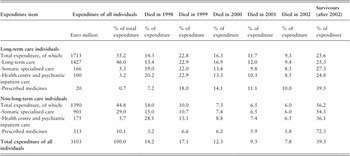
In this study, we calculated health care expenditure for each person for 1998 (Table 1). We followed individuals for death until the end of 2002. Since most of our standard cost information (used for costing the services) was from 2000 or 2001, they were deflated to 1998 prices using the municipal health care price index. The costs of prescribed medicines were based on information on actual reimbursements at prevailing prices.

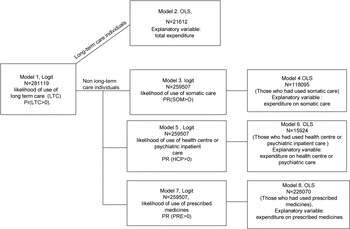
A two-part model (logit/probit + OLS) is a typical way to analyse health expenditure. However, in our case the sample included both long-term care (LTC) and non-long-term care (non-LTC) individuals. It can be assumed that age and time to death affects the expenditure of the two groups in different ways. In addition, we wanted to analyse separately the effect of proximity to death on the main components of health expenditure. This therefore resulted in having to estimate eight different models (Figure 1). The first model analyses the likelihood of being an LTC patient and the rest of the models are estimated separately for LTC patients (model 2) and for non-LTC individuals (models 3–8). For the latter group Footnote 1 (non-LTC) we applied a two-part model, in which the first parts (models 3, 5, and 7) model the likelihood of the use of the three main categories of health expenditure, while the second parts (models 4, 6 and 8) model the expenditure of those individuals who have used the services. We used ordinary least square regression to a linear functional form of expenditure.Footnote 2 In the econometric analysis (N=281 119) we excluded those who died in 1998, since we want to have expenditure data for the whole year. In addition, we also excluded individuals living in the Ahvenanmaa (Åland) region (N=1549), since they to some extent also use hospital services in Sweden, on which we have no information.
The eight part model

We estimated three (basic, naïve, and extended) specifications for each of the eight models. The basic specifications include four independent variables (age, gender (=1, if female), time to death (TTD, a continuous variable describing days from 31 December 1998 to death, maximum 1460 if survived until end of 2002), death (=1, if an individual died prior to the end of 2002)) as well as 25 regional dummy variables (not reported in Appendix tables) describing the hospital district where the individual lived. The regional dummy variables were defined using effect coding, which makes a comparison in relation to the grand mean of all subgroups (i.e. hospital districts) possible.
We do not have complete theoretical guidance on functional forms (square, cubic) of the four variables and their interactions. Thus, we performed a specific-to-general specification search with the aim of finding a model that fits the data well and in which the parameters are significant. We started from a specification using the four variables in their original linear form. This resulted in different specifications for each of the eight models. The naïve specifications use the same variables as the basic specifications, except those that are related to death. The extended specifications use all variables included in the basic model and family income in 1997 (divided by the OECD consumption unit scale) and the significant transformations and interactions with the four factors from the basic specification (age, gender, time to death, and death). In addition, for non-LTC individuals we included 18 dummy variables describing chronic illness.
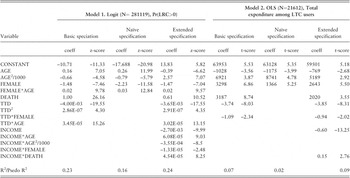
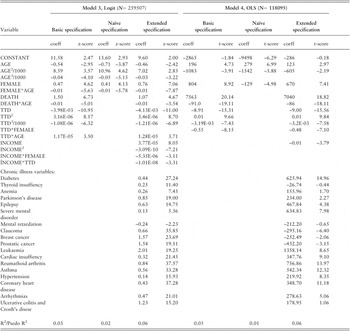
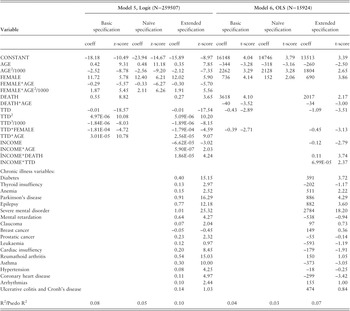
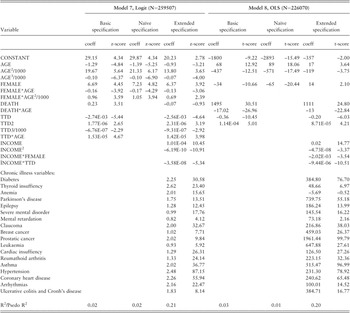
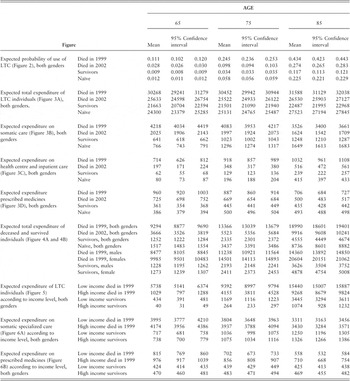
The estimated model coefficients are very difficult to interpret, since the same factor is included in many variables and in different parts of the models (Appendix tables 1–5). Thus, we illustrated the results by calculating the expected probabilities of use of LTC (Figure 2) and the expected expenditure (Figures 3–6) for the individuals that had died in the different years according to age. In these calculations, the time to death was fixed to average time for each year of death (for example to 175 days for those who died in 1999). The expected expenditure for both genders was calculated from gender-specific estimates by using weighting for the share of each gender in each age group. In the appended Table 5, we have determined confidence intervals for expected probabilities and expenditures described in Figures 2–6. They were derived for individuals aged 65, 75, and 85 by replicating the model estimation with 1000 bootstrap samples.
Results
Long-term care (LTC) patients
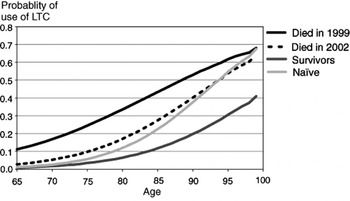
Although the share of LTC patients of the population over 65 was only 7%, they accounted for 55% of total expenditure. Age has an important positive and increasing effect on the probability of being an LTC user (Appendix Table 2). But the share is also related to time to death: those who died in 1999 had a 10 percentage points higher probability to be an LTC user than those who survived. The relative difference between the two groups increases to over 30 percentage points among those aged 85. After the age of 90 the difference reduces slightly. As can be seen from Figure 2, the naïve model overestimates the age relationships: its curve increases considerably faster than the curves where the time of death is fixed. Females had a higher risk of using LTC than males and the difference between genders widens as age increases.
Expected probability of use of LTC of deceased and survived individuals as function of age, both genders. Based on model 1, basic and naïve specifications.

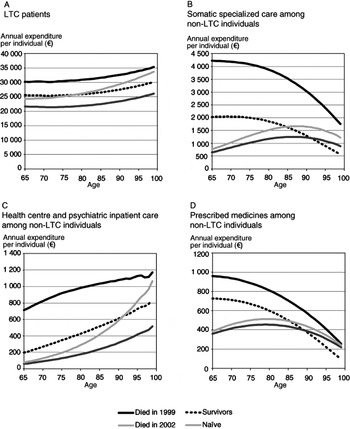
Annual average total health costs of LTC patients were ₠27 000, i.e. ₠2250 per month. When time of death was fixed these costs started to increase after 75 years of age (Figure 3A). For example, annual expenditure of an 85-year-old LTC patient who died in 1999 was about ₠1100 (4%) higher than the expenditure of a 75-year-old LTC patient who died in the same year. The difference was also statistically significant (Appendix Table 5). Our models show that both time to death as well as gender have a greater effect on expenditure than age. The annual expenditure of an LTC patient who died in 1999 was about ₠9000 higher than among those who survived until the end of 2002. According to the results of basic specification, female expenditure was about ₠1700–₠3100 higher than male, i.e. about 7–11% higher, depending on the age and survival status of an LTC patient.
Expected total expenditure of LTC individuals (Figure 3A), and expected expenditure on somatic care (Figure 3B), health centre and inpatient care (Figure 3C) and prescribed medicines of non LTC individuals (Figure 3D) as function of age among deceased and survived individuals. Based on model 2 (Figure 3A), models 3 and 4 (Figure 3B), models 5 and 6 (Figure 3C), models 7 and 8 (Figure 3D); basic and naïve specifications.

Non-long-term care (non-LTC) individuals
In somatic specialized care, the proximity to death determines the relationship between age and expenditure very strongly. The expenditure is highest among persons who died in 1999 (Figure 3B). In this group, the expenditure also most clearly declines with age. The expenditure of individuals who lived four years (died in 2002) is clearly lower than those who died before them, but even among these groups expenditure reduces when age increases. Only among the survivors does expenditure increase with respect to age until the age of 87. The expenditure of a 65-year-old person who died in 1999 is about 6.6 times higher than the expenditure of a person of the same age but who had survived. When age increases, this ratio decreases and is about 2.5 among 90-year-old persons. In somatic specialized care, the naïve model gives a totally different picture on the relationship between age and expenditure than models that take account of proximity to death.
For inpatient care in health centres and psychiatric wards, the expenditure increases with age but again the inclusion of the proximity to death diminishes the relationship (Figure 3C). Age mostly clearly reduces expenditure on prescribed medicines (Figure 3D). This effect is strongest among those who died in the following year (1999). On the other hand, among the survivors, expenditure on prescribed medicines increases along with age until the age of 80 years and after that age it starts to decline.
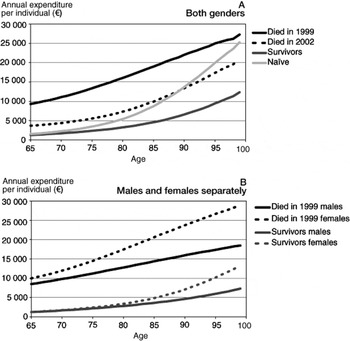
Total expenditure
Figures 4A and 4B show the results of calculations for expected total expenditure including both LTC and non-LTC individuals. They are based on models 1–8 by first estimating gender-specific costs of the expenditure categories for persons who died in different years according to age. We then calculated gender-specific total cost and finally the total cost for both genders by weighting their share in the sample. Since over half of total expenditure is devoted to LTC patients, Figure 4A is quite similar to Figure 2 in describing the probability of use of LTC. The probability for LTC was higher among females and thus their total costs were also higher than male costs. The difference between the genders widens as age increases but also this reflects the gender differences in the probability of being an LTC user. The gender differences are statistically significant in all age groups among those died in 1999 and after age 75 among survivors (Appendix Table 5).

Projections for health expenditure
We combined our gender-specific age-expenditure profiles with a Statistics Finland population forecast (Statistics Finland, 2004) by age and gender to estimate the purely demographic impact of population change on per capita health expenditure in the over 65-year-old population for the years 2016 and 2036. As a first step, we extracted gender-specific expenditure data (expenditure per individual) for each expenditure category according to survival status (i.e. died in first year, second year, third year, fourth year, or survived until the end of forth year) by one-year age group from the previous analyses. The expenditure projection was derived by multiplying the projected number of persons in 2016 and 2036 in each age and gender-specific survival status category by their respective expenditure and then aggregating according to each expenditure category and finally adding all together to obtain total expenditure.
Our previous models were based on an individual who lived in the beginning of 1999, i.e. we excluded those who had died during 1998. However, this latter group consumed about 14% of total expenditure (Table 1). In order to take this into account in our expenditure projections we also calculated health expenditures for these individuals by age, gender, and expenditure categories from our sample. These costs were then included in the overall health expenditure projection in the way described previously.Footnote 3
We made projections using the naïveFootnote 4 approach and the basic specification, which takes into account the proximity to death. In the previous section, we found that our total expenditure is strongly dependent on the probability for the use of long-term care (LTC) services. Thus, we also made a third projection, which (in addition to proximity to death) assumes that the probability of using LTC services will be delayed by three years. We assume, for example, that the probability of a 70-year-old female (in each survival category) being in LTC care in 2016 and 2036 is the same as the respective probability of a 67-year-old female in 1998.
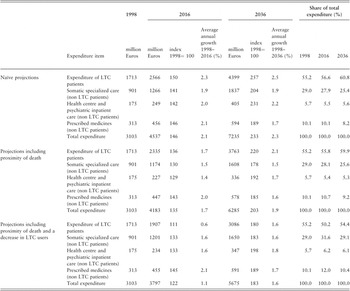
Table 2 shows the results of the three projections for 2016 and 2036. According to the naïve projection, expenditure will increase annually by 2.3% by 2036. The projection based on the basic specification (taking into account the proximity to death) reduces the average annual growth to 1.9% and gives a 13% lower projection for total expenditure than the naïve approach for 2036. The difference between the two projections is largest for expenditure on inpatient care in health centres and psychiatry (17%), in expenditure on LTC patients (14%), and in somatic specialized care (12%), and smallest for prescribed medicines (3%). The assumption concerning the probability of the use of LTC seems to be crucial to the results of the projections. If the use of LTC services can be delayed for three years (for example by decreasing dependency), the projected expenditures will decrease by about 22% as compared to the naïve model. Compared with the basic specification, the assumed change will decrease the expenditure on LTC by ₠677 million (i.e. 18%) and increase the expenditure on other cost categories by ₠67 million (3%).

Effect of income
Family income turned out to be significant in all of the estimated extended models. Also, the coefficients of income were very difficult to interpret, since income was included in many of the estimated variables and in different parts of the models. In order to illustrate income effects we calculated expected expenditures for two types of individuals: (i) for a person whose family income was at the lowest decile of the income distribution and (ii) for a person whose family income was at the 2nd highest decile. The expected expenditures were calculated from expanded specifications in a similar way for persons who died in different years of follow-up and for survivors (as explained earlier in method section) by fixing income to the two alternativeFootnote 5 values. The expected expenditure for both genders was calculated from gender-specific estimates by weighting the share of genders in each age and income group. For non-LTC individuals we fixed all except one (coronary heart disease) morbidity variable as zero, i.e. the expenditures have been calculated for a person with coronary heart disease but no other chronic illness. Coronary heart disease is the most prevalent chronic disease in Finland.
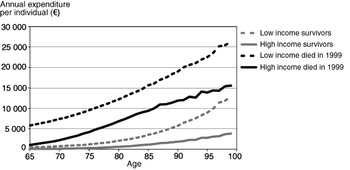
The total expenditure of LTC patients is concentrated in low-income patients. As can be seen from Figure 5 the absolute differences (in terms of euros) between high- and low-income individuals increases as age increases both among surviving individuals as well as those who died in 1999: All differences between the income groups are statistically significant (Appendix Table 5). It should be noted that we did not have the possibility to adjust these figures for need factors (such as functional dependency or health status). Almost all persons who had used LTC services are interpreted as living ‘alone’ and thus their family income equals their own income. Income thus reflects to a great extent their early work position and work history. The poorest group included persons who had been in early retirement (because of disability) and thus it is quite possible that among LTC individuals income is highly and negatively correlated with high dependency and poor health.
Expected total expenditure of deceased in 1999 and survived LTC individuals as a function of age according to income level. Based on models 1 and 2, extended specifications.

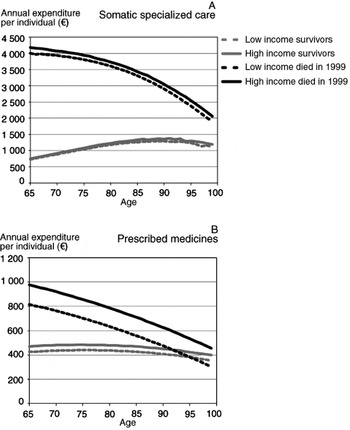
In contrast to LTC, an individual's income had a positive effect on expenditure for somatic specialized care and use of prescribed medicines (Figures 6A and 6B). However, in somatic care the effect is quite small and statistically not significant (Appendix Table 5): for example, expenditure for a 75-year-old high-income person who died in 1999 is about ₠134 (3%) higher than the expenditure for a low-income person of the same age who died in the same year. Among the surviving persons of the same age, the relative difference between the extreme income groups was about the same, but the absolute difference was smaller (₠39). Only for the use of prescribed medicines did we find clear and statistically significant differences in the effect of income among those who had died and those who had survived. For a 75-year-old person, the difference between the two extreme income groups was about ₠154 (22%) among those who had died in 1999 and ₠44 (9%) among those who had survived.Footnote 6 For inpatient care health centres and psychiatric wards, we find a small negative effect of income on expenditure: the corresponding differences for a 75-year-old person were ₠40 (6%) among those who died in 1999 and ₠21 (27%) among those who survived.
Expected total expenditure on somatic specialized care (Figure 6A) and prescribed medicines (Figure 6B) of deceased in 1999 and survived individuals as function of age according to income (estimated for chronic heart disease patients). Based on models 3 and 4 (Figure 6A), models 7 and 8 (Figure 6B); extended specifications.

Conclusion and discussion
In this study, we have analysed the relationship between health expenditure, age, and time before death in a nationally representative and much larger sample than has been available in previous studies. In addition, we were able to analyse expenditure on a whole range of services in health care as well as care of the elderly. According to our results, total expenditure on health care and care of the elderly increases with age but the relationship is not as clear and strong as is usually assumed when a naïve model is used in health expenditure projections. Our conclusion that age still has an effect on expenditure is due to the fact that we have included use of LTC services in our analysis; for LTC services, increasing age is clearly associated with increasing expenditure, although this association is attenuated when proximity to death is accounted for. Among non-LTC persons, we found a clear positive relationship between expenditure and age only for health centre and psychiatric inpatient care. Further, these age relationships are attenuated when proximity to death is taken into account. On the other hand, for somatic care and prescribed drugs the expenditure clearly decreased with age among deceased individuals.
Compared with the naïve approach the projection that takes into account the proximity to death gives a 13% lower projection for total expenditure by 2036. This is a about the same as that found in the previous study in the US of individuals aged 66–77 (Stearns and Norton, 2004) and considerable higher than (about 4%) in the German study (Breyer and Felder, 2006) for the whole population. However, these results are not comparable due to differences in age structure, population projection methods, assumptions on development on longevity between the countries, and also between projections within countries. For example, Breyer and Felder (2006) included also an assumption of ‘technological change’ in medicine (annually 1% growth) in their projection, which decreases relatively the difference of proximity to death and naïve projections. In our projection, the relatively high growth of expenditure can partly be explained by that fact that in Finland annual growth of the population aged 65 and over is projected to be higher than the average for OECD countries (OECD, 2005). During the years 1998–2036, the population over 65 is estimated to increase annually by 1.7%. The growth has been estimated to be highest between the years 2010–2020 (annually 3%).
Both the US and German studies were unable to take long-term care expenditure into account. So far the data on nursing homes have been available only in one Swiss study (Werblow et al., 2007), in which the effect of proximity to death was somewhat higher than in our results. In Finland in 1998, the share of LTC patients of the population aged over 65 was 7% and they accounted for 55% of total expenditure. Our projections clearly indicate that to contain expected increases in expenditure, future health policy should concentrate on actions that maintain the activities of daily living of elderly people and prevent long-term institutional care. It should be noted that since 1998 the relative share of the institutionalized care for the elderly has been decreasing and compensated for with sheltered housing with 24-hour assistance (very rare in 1998) with somewhat lower unit costs. Totally, the share of the population aged 65 and over living in institutional care in 1998 was about the same as the share of those living in institutions and sheltered housing with assistance in 2005 (Stakes, 2007).
From the point of view of public expenditure, the future is not as alarming as is frequently suggested, if the current financing system in long-term care prevails. User charges of LTC patients are income related and richer patients may pay up to about 80% of their income to municipal service providers. This can to some extent explain our results that long-term care is clearly correlated with low income, since there are economic incentives for high-income individuals (and their next of kin) to avoid publicly funded nursing homes. As the income level of future elderly generations is likely to be higher there will be more people for whom it might be cheaper to enter private nursing homes or use private home services (instead of public services) with no public subsidy.
We do not find any strong positive association between income and expenditure for most non-LTC categories of health care utilization, which may imply that equity targets are realized at least satisfactorily. Earlier Finnish studies have found income-related inequity in surgical operations (Hetemaa et al., 2003; Keskimäki, 2003). However, these studies have not concentrated on elderly patients, as has this study. Our results of a slight positive effect of income in specialized care and negative effect on other inpatient care (health centres, psychiatric wards, and long-term care) parallel earlier results that surgical discharges are concentrated in high-income categories and non-surgical discharges in low-income categories. However, income was positively related to expenditure on prescribed medicines, in which cost sharing between the state and the individual is relatively high. This can be seen as an indication of inequity in use, specifically if the higher expenditure is associated with the use of more effective medicines. We also found that income was associated with proximity to death, so that the effect of income was more important among those individual who were close to death.
According to our projection, aging and demographic factors will have less of an increased effect on the use of prescribed medicines than on other expenditure categories. According to a recent Finnish study, during 1993–2004 the expenditure on prescribed medicines has increased annually by on average 7% (at constant prices ), of which only 0.7 percentage points (10%) is related to changes in age and gender structure (Hujanen et al., 2006). Projections on health expenditure typically assume that income is the main driver of future health care costs. In this study we find that income has a significant positive effect only on expenditure on medicines, i.e. on the item in which expenditure increase has been mainly due to the development and use of new products. If the dependency rate and the share of the people in poor health decrease over time due to higher income, this will have a decreasing effect on the rise of health care expenditure in the future. Overall, our results clearly emphasize the fact that future health care expenditure might be driven more by changes in the propensity to move into long-term care and medical technology than age and gender alone as often claimed in public discussion. Thus, the future expenditure is more likely to be determined by health policy actions than inevitable trends in the demographic composition of the population.
Appendix