Introduction
There is an increasing interest in sex work policy internationally as many countries are currently examining policy options for the sex industry. Much of the debate and decision-making about appropriate sex industry policy tends to focus on either abolition or regulation of the sex industry. These two divergent policy options have been critiqued by various sex work organisations and researchers for forcing some sex workers underground to illegal and often unsafe working environments. Decriminalisation of the sex industry has been heralded by many from a public health, harm minimisation and human rights perspective to be the preferred policy option for all sectors of the sex industry. New Zealand was the first country in the world to decriminalise the sex industry when it passed the Prostitution Reform Act (PRA) in 2003. There is much interest in the outcomes of this legislation. Although New Zealand has been applauded for developing policy based on the human rights of sex workers, the privileging of sexual morality common to many other countries has dominated public discourse in New Zealand post-PRA. One issue to gain much media attention and political debate in New Zealand is whether decriminalisation has caused an increase in the numbers of sex workers working in the sex industry. Drawing on a large study examining the impact of the PRA on the health and safety of sex workers, this article examines the impact of decriminalisation on the number of sex workers in New Zealand, estimating the size and scope of the industry.
Background
There are several approaches which have been taken to regulate the sex industry, with most countries seeking to regulate rather than totally eliminate prostitution. Legislation has taken the form of criminalisation (United Kingdom and Canada), criminalisation of the client (Sweden), legalisation (Germany and the Netherlands) or decriminalisation (New South Wales, Australia). New Zealand went down the path of decriminalisation of sex work, and in June 2003 the Prostitution Reform Act (PRA) was passed into legislation. Prior to 2003, sex work itself was not illegal, but all activities associated with sex work – for example, soliciting – were criminalised. These activities were regulated through clauses under a number of existing Acts. Section 26 of the Summary Offences Act 1991 made it an offence for a sex worker to offer sex for money in a public place. However, clients were not criminalised as it was not an offence to pay, or to offer to pay, for sex. This created a double standard in that a sex worker could be convicted of soliciting, incurring a criminal record, while in the eyes of the law the client had committed no offence.
Section 147 of the Crimes Act (1961) made it an offence to keep or manage a brothel. If police raided brothels, the presence of safer-sex literature and condoms could be used to contribute to a pattern of evidence to convict operators of venues and sex workers. As the operation of brothels was illegal, brothel owners ran their businesses as ‘massage parlours’, which were legally permitted enterprises. The Massage Parlours Act 1978 provided for the licensing of massage parlour operators, but did not refer to the provision of commercial sexual services. Sex workers were vulnerable to coercive and exploitative practices by owners or managers of massage parlours and had little recourse. The Massage Parlours Act also prohibited the employment in parlours of individuals under the age of 18 years and people with drug or prostitution-related criminal records.
The Crimes Act (section 148) made it illegal to live off the earnings of the prostitution of another person, which meant that partners or adult children of sex workers could be committing an offence by being supported by their spouse or parent. In addition, section 149 of the Crimes Act made it an offence for any person to procure sexual intercourse for another person.
The recognition of the harm done to sex workers by the existing legislation provided the impetus for law reform (Barnett, Reference Barnett2000). The new legislation represented a shift in policy from a moralistic to a public health and human rights approach. The legislation had been introduced to parliament by a Labour Party MP as a private member's bill rather than as government initiated public policy, and the PRA was only passed into law in Parliament by 60 votes to 59 with one abstention. This close final vote has led to ongoing debate and campaigning generated by groups opposed to it and there have been attempts to have the Act repealed or at the least amended.
Many opponents of the PRA predicted that there would be an increase in numbers of sex workers in the industry following decriminalisation. There were newspaper reports that the number of sex workers had increased by 40 per cent since the industry had been decriminalised. These reports cited post-decriminalisation estimations presented in a report produced by the Prostitution Law Review Committee (PLRC) (Espiner, Reference Espiner2005). However, the media were comparing these estimations with a 2001 survey of police, conducted prior to decriminalisation, which was not carried out nationwide and was, therefore, not directly comparable with the PLRC report (Fitzharris, Reference Fitzharris2005).
Pascoe et al. (Reference Pascoe, Fitzgerald, Abel and Brunton2007), in a critical analysis of print media following decriminalisation, noted that the debate in the media has been moralistic, with associations drawn between sex work and crime, public nuisance and increasing numbers of underage sex workers. No column space was given to debating public health issues, despite the fact that public health concerns were the driver for law reform. The review of 440 articles published in the main daily newspapers between June 2003 and November 2006 found that sources most often cited by the print media were local and central body politicians (41 per cent of articles), who offered opinions on the state of the industry post-decriminalisation, based on anecdote rather than hard evidence. The street sector was especially targeted for recriminalisation by those politicians opposed to the legislation.
In particular, there was much media focus on the Manukau City Council, who attempted to have street sex work recriminalised through the Manukau City Council (Control of Street Prostitution) Bill 2005.Footnote 1 This Bill was introduced to Parliament in December 2005, but ultimately defeated in October 2006. The then Mayor of Manukau, Sir Barry Curtis, was reported in the Christchurch Star as arguing that the decriminalisation of sex work had created problems in controlling sex work for local authorities as councils had to ‘deal with a serious increase in prostitutes soliciting on the street’ (Burt, 3 March Reference Burt2006). Curtis maintained in an interview on Radio New Zealand (12 September 2006) that he was not against the PRA and was supportive of sex workers operating from brothels but ‘not on the street for all to see’. The Bill received support from MPs, such as David Carter from the National Party, who said that he and other MPs had warned that the PRA (2003) would lead to an increase in street sex workers (New Zealand Press Association, 7 December 2005). The New Zealand Herald, in its report with the headline ‘Manukau right on prostitution’ stated that ‘[r]ather than confining prostitution to certified places, the new law appears to have increased the number of street walkers in Manukau City’ (The New Zealand Herald, 10 December 2005).
The United Future Party, whose members all voted against the PRA (2003), led an independent review of the PRA (2003). The 2005 national election saw the Labour Party elected by a small majority, which required them to negotiate with minor parties to vote with them in Parliament on confidence and supply issues. To this end, an agreement was struck, which allowed United Future to conduct an independent review of the PRA (2003), separate from the official review stipulated under sections 42–46 of the Act. A working group was then formed, which heard submissions from community groups, city councils and residents in the major centres of New Zealand. The three areas of interest were street soliciting, underage involvement in sex work and local authority control over brothel zoning (Marian Hobbs, personal communication, October 2006). A United Future MP was cited in the media as saying that the group's main aim was to eradicate street sex work (Chapple, Reference Chapple2007). He argued that, as brothels were legal, there was no need for street sex work. His ‘key recommendation’ was that New Zealand should adopt the Swedish system and criminalise the clients of sex workers (Chapple, Reference Chapple2007).
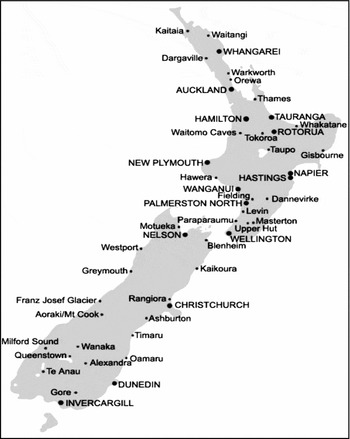
Gaining an accurate estimation of the number of workers in the sex industry is a difficult task, in part because they constitute a marginalised population. Although the industry is now decriminalised in New Zealand, preliminary research with sex workers and staff, volunteers and outreach workers from the New Zealand Prostitutes' Collective (NZPC) found that there were still suggestions of continuing stigmatisation of sex workers, which impacts on the likelihood that they would disclose their occupation (Weir et al., Reference Weir, Abel, Fitzgerald and Brunton2006). Indeed, several previous studies have found that stigma is an important reason why sex workers do not disclose their occupation to health professionals, family and others (Benoit and Millar, Reference Benoit and Millar2001; Plumridge and Abel, Reference Plumridge and Abel2000a; Vanwesenbeeck, Reference Vanwesenbeeck2001; Ward and Day, Reference Ward, Day, Scambler and Scambler1997). Sex work is also a transitory occupation, with sex workers transiting in and out of the industry, some remaining for only a short period of time and others entering and exiting the industry a number of times over a longer period. It is, however, important that best estimates are made; in order to deliver services to this section of the population and cater for their varying needs effectively, there needs to be an understanding of the size and make-up of the industry. The sex worker population is not homogenous and there are issues which are more pertinent to certain sectors than others (O'Connor et al., Reference O'Connor, Berry, Rohrsheim and Donovan1996; Plumridge and Abel, Reference Plumridge and Abel2001). Much attention has been focused by researchers, public commentators, politicians and others on the street sector, as they represent the most visible proportion of the sex industry. However, in most countries, they represent only around a tenth of the industry (Hubbard, Reference Hubbard2004; Scambler, Reference Scambler, Scambler and Scambler1997; Weitzer, Reference Weitzer2005). It is important to have an understanding of the size of the different sectors when undertaking research with this population, as all sectors need to be well represented within the research. As part of our research, looking at the health and safety practices of sex workers following decriminalisation, we began by gaining as accurate an estimation of the size of the sex industry as possible in the five locations in New Zealand in which our research was based: Auckland, Christchurch, Wellington, Hawkes Bay and Nelson. Auckland, Christchurch and Wellington are the three largest cities in New Zealand where the majority of sex workers work (see Figure 1). The decision to include the smaller cities of Napier in the Hawkes Bay and Nelson was so that we could make comparisons between small-city and large-city workers over a range of health-related issues.
Map of New Zealand.
Population sizes: Auckland (1,358,100); Christchurch (360,400); Wellington (464,600); Hawkes Bay (Napier and Hastings - 149,900); and Nelson (46,300).

The estimated size of the sex industry at the time of decriminalisation
The NZPC have estimated that there are around 8,000 sex workers in New Zealand at any one time (Prostitution Law Review Committee, 2005). All NZPC branches collect statistics from parlour, escort and private workers and some branches also routinely collect numbers of workers on the street. NZPC outreach workers worked in partnership with researchers in a study investigating the safer-sex practices of sex workers in Christchurch in 1999 and estimated then that there were 375 sex workers in that city (Plumridge and Abel, Reference Plumridge and Abel2000b).
The Ministry of Justice commissioned research to assess the nature and extent of the sex industry in New Zealand at the time of the PRA (Prostitution Law Review Committee, 2005). They utilised two separate data sources: a telephone survey of police staff in all areas of the 12 New Zealand Police Districts, requesting their information and insight into the industry; and an audit by NZPC of numbers of advertisements for commercial sexual services in Wellington and Auckland.
The estimates from the police identified a total of 3,390 workers in Auckland, 400 workers in Wellington and 528 in Canterbury (Christchurch is the city in the greater Canterbury area) (Prostitution Law Review Committee, 2005). The NZPC found 151 advertisements for commercial sexual services in Wellington and 469 in Auckland. They estimated that 50–70 per cent of sex workers in Auckland and Wellington worked in massage parlours, 20 per cent in escort agencies and 10 per cent on the street or privately.
The Prostitution Law Review Committee (PLRC) highlighted in their report that most existing estimations of the size of the industry have limitations (Prostitution Law Review Committee, 2005). The limitations of the police survey are numerous and were recognised by the PLRC. Massage parlour workers were required under the Massage Parlours Act 1978 to provide their names to the proprietors of a parlour, to be held on a register of names. Police uplifted these names and recorded them on a register. They also gathered other names, including those of private workers and street-based workers. Private workers' names were obtained by imposing requirements on newspapers, requiring their advertising departments to see proof of police registration before accepting advertisements. Some newspapers refused to do this and continued publishing advertisements, while others stopped publishing all adult entertainment advertisements. The police obtained the names of street-based workers by asking them directly. The resultant register was cumulative and names were not removed when workers exited the industry. As the industry is acknowledged to be a particularly transitory one, with frequent exit/entry, the cumulative register would have been large. Any estimates of the size of the industry from that data source would, thus, be an overestimation. The PLRC also identified that police in the different areas canvassed differed in their reported knowledge of the industry in their areas, with some providing more plausible figures than others. Some police respondents maintained that their figures were accurate; others admitted that all they were providing was an ‘intelligent guess’; while others indicated that they had no idea of numbers and would not be able to provide an estimate (Prostitution Law Review Committee, 2005).
The audit of advertisements conducted by NZPC also had its limitations. Advertisements represented both businesses where a number of people might be working, and private workers who also might work collectively from a single premise (Prostitution Law Review Committee, 2005). NZPC stated that such private workers would usually advertise separately, but there is potential in this method of estimation to underestimate the number of workers.
Methods of estimation in 2006
In this study, an estimation of numbers of sex workers was carried out in the February/March period of 2006 in Christchurch, Wellington, Auckland, Nelson and Hawkes Bay. Each count was conducted over a two-week period. The estimation was carried out at a time of the year when the weather was still warm as there had been suggestions that fewer sex workers work in the colder months, especially street-based workers. With seasonal variations in mind, a further estimate of the street-based population in Christchurch was done in May 2006 to allow comparisons with an estimate done in that city in May 1999. Comparisons pre- and post-decriminalisation were possible only in Christchurch as no estimations using comparable methods had been carried out elsewhere in the country prior to decriminalisation.
Different enumeration strategies were adopted for the different sectors of the sex industry. The different strategies had been determined on the basis of NZPC's considerable informal knowledge of the industry. All strategies used in this study had been used previously in the Christchurch-based 1999 study (Plumridge and Abel, Reference Plumridge and Abel2000a, Reference Plumridge and Abel2000b, Reference Plumridge and Abel2001).
NZPC outreach workers visit brothels regularly to distribute safe sex supplies and educational information and to talk to new workers. Numbers of workers within each brothel and escort agency were collected by the outreach workers during these visits. Businesses which had no affiliation with NZPC were contacted and asked to provide information on the number of workers employed in their establishments. In some cases, businesses may have overstated the number of workers in their business, while others may have understated. For example, in Auckland, where there are some comparatively large establishments, these businesses tended to provide the requested information as rounded numbers: such as 50 or 100 workers, rather than a count. It is also possible that some businesses regarded this information as commercially sensitive.
Numbers of workers working privately were estimated through systematic study of advertisements in the ‘Escort’ or ‘Adult Information’ columns of the local daily and community newspapers for a two-week period in February. In addition, recognised commercial sex sites on the internet, where sex workers were known to advertise, were examined for all regions. Some private workers work alone and others work together in small groups from the same premises. They do, however, most often advertise separately using their own phone numbers. Phone numbers and names were entered on to a database and sorted to reduce duplicate counting for people advertising under different names or using multiple phone numbers. These numbers were then called to confirm whether the person was still working or whether they had advertised under different names or numbers. Numerous calls were made at different times of day if there was no response in an attempt to verify that the person was still actively working in the industry.
Street-based worker numbers were estimated by outreach workers from NZPC and other associated organisations through head counts in the field, both before and after midnight on several busy nights over the fortnight. Staff and volunteers from these organisations work solely with street-based workers and know most of them personally, thus reducing the chance of double counting. Some street-based workers advertise on the web and there would be a possibility of double counting them as private workers. When outreach workers were aware of street-based workers who advertised on the web, these names were removed from the list of private workers, and when phone calls were made, workers were asked to identify if they were private or street-based workers.
There is the potential to underestimate street-based workers, as sex workers may vary the times they work and may be working outside the timeframe in which the outreach workers were in the field. The outreach workers did vary their times of fieldwork in all locations where street work is carried out, and Christchurch and Wellington outreach workers also included in the final count street workers whom they knew were working but were not present at any of the estimation times. The Auckland outreach workers did not do this and therefore the estimation of street workers in this city is most likely to be an underestimation.
Results of the estimation
Numbers of workers were estimated for the three different sectors of the industry. Brothel workers and escort workers were grouped together, as both have a system of management in place. This sector will be referred to as the managed sector. Private workers were defined as those workers who either worked privately on their own or who worked with others from shared premises. The street sector was the third group.
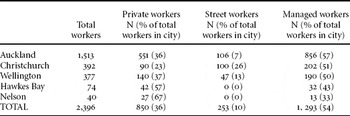
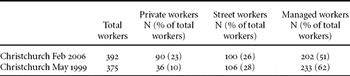
Estimations from the different research locations would suggest that previous figures taken from the PLRC Report (2005) were an overestimate (see Table 1). The number of sex workers in Auckland was half that estimated at the time of decriminalisation (1,513 versus 3,390). Wellington (377 versus 400) and Christchurch (392 versus 528)Footnote 2 also had fewer workers than suggested in the PLRC (2005) report. However, comparisons between the Christchurch estimations done in 1999 and this study suggest that numbers were similar, with 375 sex workers estimated to be working in that city in 1999 compared to 392 sex workers in the 2006 estimation (see Table 2). This is the only city where pre- and post-decriminalisation comparisons are meaningful as the methods of estimation were identical. Hawkes Bay was estimated to have 74 sex workers, with the majority located in Napier, and Nelson was estimated to have 40 sex workers. The NZPC had provided previous rough estimates for these areas as 100 in Hawkes Bay and 50 in Nelson (NZPC, personal communication, October 2005).
Estimation of numbers of sex workers in five areas of New Zealand in February/March 2006

Estimations of sex workers in Christchurch in May 1999 and February 2006

The majority of workers (1,293) in the five centres were working in the managed sector (see Table 1). In Auckland, 57 per cent of sex workers worked in this sector, 51 per cent in Christchurch and 50 per cent in Wellington. The private sector was smaller in Christchurch (23 per cent) than in Auckland (36 per cent) and Wellington (37 per cent). In the two smaller towns, the majority of sex workers worked privately and there were no recorded street workers. In total, only 10 per cent of the sex workers in the five centres worked on the street. As a proportion of sex workers, street-based work represented 7 per cent of the industry in Auckland, 13 per cent in Wellington and 26 per cent in Christchurch.
If the estimates in Christchurch are compared to those made in 1999 using identical methods, it is apparent that there has been little change in numbers of sex workers in that city (see Table 2). Prior to decriminalisation, Christchurch had a higher proportion of street workers than other centres in New Zealand. This remains unchanged following decriminalisation. Street-based workers comprised 28 per cent of the sex industry in Christchurch in 1999 compared to 26 per cent in 2006. The reason why Christchurch has a proportionally larger street-based sector is unknown. Greater community tolerance of street prostitution is unlikely to be an explanation, given persistent negative publicity about street workers in local media (Booker, Reference Booker2003; Claridge, Reference Claridge2004; Scanlon, Reference Scanlon2004).
In February 2006, a total of 77 workers were seen on the streets in Christchurch. A further 23 were included in the count as they were known to outreach workers but had not been seen during the observation period.Footnote 3 In May 2006, 72 street-based workers were seen in the observation period and this only included four of the people not seen but included in the February estimation. Therefore, 19 people included (but not seen) in the estimation of street-based workers in February were still not seen in May. Thirty-four workers were seen in February but not in May, and 29 workers were seen in May but not observed in February. This highlights the transitory nature of street sex work.
Seasonal variations were not apparent and lower temperatures did not have a noticeable influence on the numbers of workers on the street. The temperatures in February/March 2006 ranged from a minimum of 3.5°C to a maximum of 26°C, with the average temperature being 14°C (Burwood Weather Station, 2006) when 77 sex workers were seen on the street. In May, the minimum temperature recorded was –0.6°C and the maximum 18.3°C, with an average of 10°C (Burwood Weather Station, 2006) when 72 street-based workers were seen.
There does appear to have been a trend of movement from the managed sector to the private sector post-decriminalisation. In 1999, the managed sector comprised 62 per cent of the sex worker population in Christchurch and the private sector 10 per cent. The proportions in 2006 were 51 per cent and 23 per cent respectively. These differences were significant, with workers in Christchurch less likely to be working in the managed sector in 2006 (RR: 0.82; 95 per cent CI: 0.72–0.93) and more likely to be working in the private sector (RR: 2.36; 95 per cent CI: 1.64–3.38) than in 1999.
Re-estimation of the sex industry in 2007
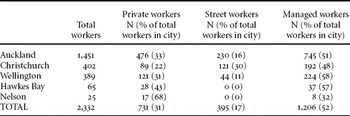
A second estimate of the size of the sex industry in study locations was carried out in 2007 (see Table 3). Following the 2006 estimation, street outreach workers in Auckland, Wellington and Christchurch developed databases listing every record of a sex worker on the streets. In so doing, these cities have now built up a comprehensive list of who is working on the streets and these names are removed only when they confirm that somebody is no longer working or has relocated to another city. Thus, more accurate figures of numbers of street-based workers are now available. Not all are seen on the street every week.
Re-estimation of numbers of sex workers in five areas of New Zealand in June–October 2007

Christchurch's list of street-based workers as at June 2007 had 121 workers, although in any given fortnight only 70–77 workers were noted by outreach workers as working (see Table 3). In June 2007, a two-week period of observation identified 73 workers. In February 2006, 77 street-based workers were seen, and in May 2006 72 street-based workers were seen in the estimation weeks. The numbers of street-based workers in this city are stable, with little difference between summer and winter recording. The number of street-based workers is also comparable to pre-decriminalisation estimations done in May 1999. Although street-based workers may enter and exit the industry periodically, the overall number appears to be constant. Similarly, the number of private and managed workers in Christchurch in October 2007 was comparable to the February 2006 estimation. Eighty-nine private workers and 192 managed workers were counted in 2007 compared to 90 and 202 respectively in 2006.
In June 2007, Wellington had fewer street-based workers than had been recorded in February/March 2006. There were slightly more managed workers recorded in October 2007 than in February 2006 (224 versus 190) and slightly fewer private workers (121 versus 140). The overall number of sex workers in Wellington in 2007 was, however, comparable to that recorded in 2006.
As mentioned previously, the original count done in Auckland in 2006 was an under-estimation of the number of street-based workers in that city. The outreach workers involved in the count did not conduct the count in the same manner as the Wellington and Christchurch workers. They failed to draw up a list of all known street-based workers, including the workers who were not seen but were known to be working, in the final count for the estimation period in February/March 2006. Following this estimation, outreach workers began compiling a list of all street-based workers. In June 2007, this list comprised 230 street-based workers, a considerable increase from the 106 identified in the 2006 estimation period. Twenty-one of the 230 workers on the Auckland list were very rarely seen on the street. Much of this discrepancy can be attributed to the non-inclusion of the street-based workers not seen on the street in the 2006 estimate. The outreach workers, however, noted that they had seen an influx of sex workers on the street in the six to eight months prior to June 2007. Of the 230 street-based workers on the Auckland database, 86 had begun work within the last 12 months and 144 had been working for longer than a year. Numbers of private and managed sex workers changed little from the 2006 estimate, with slightly fewer recorded in each sector in the 2007 estimate.
There were fewer sex workers estimated in October 2007 in both Nelson and the Hawkes Bay compared to February 2006 (25 versus 40 in Nelson; 65 versus 74 in Hawkes Bay). Many private workers who advertise in Nelson travel there to work from either Wellington or Christchurch. The discrepancy in the number of private workers could be that fewer were travelling to Nelson in the period of time in which the 2007 estimation was done and only the local private workers were advertising at that time.
The estimation of 17 per cent street-based workers over the five locations of the study does not reflect the overall percentage of street-based sex workers in New Zealand. According to NZPC and Police, there is little or no street-based sector outside the cities of Auckland, Christchurch and Wellington. As we did not estimate the size of the sex industry in other regions of New Zealand, it is not possible to give an accurate percentage of street-based sex workers in this country. However, if we take the estimation of the total number of sex workers in New Zealand as 5,932 as reported in the PLRC report (2005), which is acknowledged as an overestimation, and a very conservative estimate of 4,000 based on informal knowledge of the industry in the rest of New Zealand, we can infer that street-based workers constitute 7–10 per cent of sex workers in New Zealand.
Gender distribution
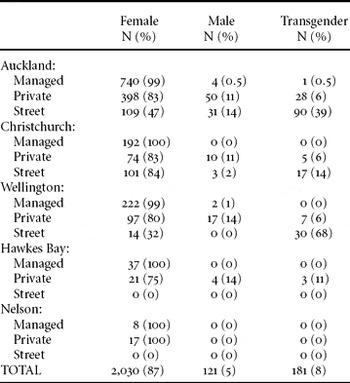
The majority of sex workers (87 per cent) in the five locations of the study were female (see Table 4) and the managed sector consisted almost entirely of female workers. In Christchurch, Nelson and Hawkes Bay there were no male or transgender managed workers and there were very few in Auckland and Wellington. The majority of transgender workers were street-based with a few working privately. Male sex workers worked predominantly in the private sector, with some on the street.
Gender of sex workers in June–October 2007 estimation by city and sector

Conclusions
This research suggests that there has been little impact on the number of people working in the sex industry post-decriminalisation. Identical estimation procedures were used in this study as those used to estimate the size of the Christchurch sex industry in 1999. Our more recent estimates show that there has been little change, with the exception of a trend of movement from the managed to the private sector. More than half the number of sex workers in the areas studied worked within the managed sector of brothels and escort agencies. Over a third of sex workers worked privately, either from their own home or with other private workers from shared premises. Only one tenth of all sex workers worked on the street and this proportion is consistent with previous estimates. Concerns have been expressed by some commentators that numbers of workers on the street has increased post-decriminalisation. Our research would not support this concern. This is the most visible sector of the industry and does attract more attention from the media and others. Yet the three estimates that have been done in Christchurch during the course of our research show that the number of workers on the street has remained stable and consistent with pre-decriminalisation estimations. Almost no difference is apparent between estimates done at different times of the year. There were two estimations done in Wellington and these also showed a stable total number of workers. Unfortunately, the first estimation of street-based workers in Auckland was not comparable to Wellington and Christchurch in that sex workers who were known to be working but who were not seen by outreach workers during the time of the estimation were not included in the count. Subsequent more accurate and inclusive estimations have shown, however, that there are 230 street-based workers in the entire Auckland area, which represents approximately 16 per cent of the industry in that area. The database of street-based workers which NZPC outreach workers have developed will be a very useful tool for monitoring street-based worker numbers over time.
The drive by some in New Zealand to recriminalise the street sector in particular is based on moral outrage, with determination to ignore the wealth of evidence which has been presented. Research has shown that criminalisation of the street sector increases the vulnerability of sex workers by driving them underground, where fear of detection and arrest override concerns for health and safety (Davis and Shaffer, Reference Davis and Shaffer1994; Jordan, Reference Jordan2005). Our research went on to explore health and safety of sex workers under a decriminalised system and will be reported on in other papers. A study carried out in Christchurch prior to decriminalisation reported violence as a common occurrence for street workers (Plumridge and Abel, Reference Plumridge and Abel2001). In the United Kingdom, where street workers are often moved to less visible toleration zones, they have been placed in more vulnerable positions where they are targets for violence (Hubbard, Reference Hubbard2004). In Canada, research has shown that toleration zones have failed to reduce the overall prevalence of street-based prostitution (Canadian HIV/AIDS Legal Network, 2005; Lowman, Reference Lowman1998). Sex workers working on the streets in Canada are comparatively worse off when compared to other workers in their experience of violence and harassment (Benoit and Millar, Reference Benoit and Millar2001). In the state of Victoria, Australia, where legal sex work is limited to licensed brothels and escort agencies, street sex workers have been exposed to greater risk than brothel workers, in large part due to their criminalised status (Pyett and Warr, Reference Pyett and Warr1997). They are afforded no legal protection and are therefore reluctant to report violent crimes to the police (Pyett and Warr, Reference Pyett and Warr1997, Reference Pyett and Warr1999). Commentators on Swedish policy argue that, when clients of sex workers were criminalised, the numbers of workers on the street did not decline (Kilvington et al., Reference Kilvington, Day and Ward2001), they simply went underground, where they were vulnerable to exploitation and abuse, and less easily accessed by health and social workers. It is important to consider the evidence from these research studies when discussing the criminalisation of the street sector. Such evidence-based public health arguments have been noticeably absent from all the public debates in New Zealand following decriminalisation.
Dire predictions by many that decriminalisation would bring a flood of people into the sex industry have also not been realised. Although we cannot claim that decriminalisation will be experienced in the same way in other countries, our study demonstrates that decriminalisation of sex work in New Zealand has not created the unwanted and unintended consequence of increasing either the overall number of sex workers or the size of the street sector. This is not surprising, as research done in many countries with different legislative systems regulating sex work indicates that people enter the sex industry primarily for economic reasons (Benoit and Millar, Reference Benoit and Millar2001; Browne and Minichiello, Reference Browne and Minichiello1996; Davies and Feldman, Reference Davies, Feldman, Scambler and Scambler1997; McKeganey, Reference McKeganey2006; Perkins and Lovejoy, Reference Perkins and Lovejoy2007; Plumridge and Abel, Reference Plumridge and Abel2000a; Prostitution Licensing Authority, 2004; Svanstrom, Reference Svanstrom, Gangoli and Westmarland2006; Vanwesenbeeck, Reference Vanwesenbeeck2001; Ward and Day, Reference Ward and Day2006). Despite a change from a criminalised to a decriminalised system in New Zealand, the incentives to enter the industry remain unchanged (Abel et al., Reference Abel, Fitzgerald and Brunton2007). In any country, structural and personal factors such as health, family, housing, welfare and labour policies play a more important role in the decision individuals make to enter sex work than its legal status (Abel and Fitzgerald, Reference Abel and Fitzgerald2008). This is not to say that the legal status of sex work is unimportant. There is ample evidence that criminalisation of sex work or sectors of the sex industry has profound negative impacts on the lives and health of sex workers. Decriminalisation is an important first step in creating supportive environments for improving the health and safety of sex workers.
Acknowledgement
The research was funded by the Health Research Council of New Zealand and the Ministry of Justice and granted ethical approval by the Multi-Region Ethics Committee. The authors would like to thank their partners in the research, New Zealand Prostitutes' Collective, as well as all the participants who gave so willingly of their time.