The Portable Antiquities Scheme (PAS) was established in 1997 as an initiative to record archaeological objects found by members of the general public. Initially set up in pilot form, in 2003 it was extended to the whole of England and Wales.Footnote 1 Surveys of Roman period finds recorded by the PAS have been published in Britannia from 2004 onwards. This 17th annual report first briefly summarises the general character of Roman finds reported in 2019. From this year we no longer present artefact and record numbers in detail by county, since the regional differences in artefact frequencies documented by the PAS are well-established, with highly consistent patterns having been reported over the last 16 years.Footnote 2 Instead, the general totals are given followed by some examples to illustrate the regional variation in 2019. The majority of this report then comprises the publication of significant individual artefacts recorded by Finds Liaison Officers.
OVERVIEW
In total, 29,571 objects of Roman date were documented in 2019. As a single record may sometimes document more than one item, for example describing a coin hoard, assemblage of ceramics or building materials, the total number of Roman objects documented exceeds the number of records (18,088). The counties with the single largest numbers of records are found in eastern England and, to a lesser degree, central-southern England.Footnote 3 In Wales and northern and south-western England, the number of artefacts documented is much smaller.Footnote 4 This regional variability in the distribution of PAS records for 2019 closely follows the pattern established over the previous 16 years. The key factors that determine this distribution include variable use and deposition of metal objects in antiquity, differences in historic and contemporary agricultural practice and the uneven intensity of metal-detector use.Footnote 5
Discoveries of coins and brooches again vastly outnumber those of all other artefacts. With the addition of the coins recorded in 2019 (21,487) more than 400,000 Roman coins have now been recorded by the PAS, as calculated from these annual totals, the fruit of continuing emphasis on recording large assemblages of Roman coins in toto.Footnote 6 After coins, brooches are the most frequently reported artefact type. A total of 32,492 examples have been documented by the Scheme since 2003 as established in these annual reports, including the 2,067 examples recorded in 2019.Footnote 7 This total includes brooches with date spans across the late Iron Age to Roman transition as well as those dated to the Roman period proper. The outnumbering of brooches by coins once again at a ratio of more than 10:1 indicates that patterns of discovery and documentation in 2019 closely resemble those established annually from 2003 onwards.Footnote 8 The distribution of brooch finds continues to follow well-established patterns, with much larger numbers being documented in 2019 in eastern and some southern counties than in areas further north and west.Footnote 9 Again, however, the ratio of brooches to coins varies regionally. In northern, western and Midland areas of England, this ratio is much higher than the overall average of c. 1:10; for example in Staffordshire, Herefordshire and Shropshire it was 1.2 or lower, records of brooches this year outnumbering coins in the latter county, for example.Footnote 10 The same is true of several Welsh counties, though the numbers of finds are much smaller.
There are no individual findspots that significantly impact on the total number of objects documented from any one site or region. The most important single assemblage from 2019 was documented at Lenham, Kent (LON-E78C8A / 2019T1105), comprising repoussé-decorated copper-alloy bindings for a wooden bucket comparable to those from Aylesford and Marlborough as well as other vessel elements, echoing the contents of high-status cremation graves of first-century BC date.Footnote 11
ARTEFACT DESCRIPTIONS
The following 27 entries publish highlights among the past year's finds recorded by members of the PAS and Treasure Department at the British Museum.Footnote 12 They are selected for their contribution to the study of the material and visual culture of Roman Britain, in particular where object types extend understanding of typological and decorative variability or distributions of object types, or where their preservation allows better understanding of object form. The reference number associated with each record is the unique identifier that can be used to consult individual object records on the PAS website: www.finds.org.uk. Two objects were also treated as Treasure cases and are therefore also designated with their Treasure number in the format of year (20XX) and reference number (TXX).Footnote 13
The artefacts included in this report were made between the late Iron Age and the fifth century a.d., and belong to various functional categories. The four figurines include deities and their attributes (Jupiter, a genius, a wing from a Victory statuette) as well as a fragment from a large bronze statue. Apotropaic and possible ritual objects include an amulet and amulet case in gold, an ithyphallic pendant and a very well-preserved dodecahedron. Objects related to personal ornament and care of the body include two finger-rings, a horse-head pendant, plate and openwork brooches, a chatelaine for a toilet set and a toilet-knife handle. Objects in other functional categories include a sword hilt, vehicle parts (a decorated linchpin and a large leopard mount), a steelyard weight, a furniture fitting, an enamelled vessel fragment and other mounts and fittings from vessels, furniture and sceptres. The decoration of these objects spans the art styles documented in the province, including complex geometric enamelled decoration and anthropomorphic and zoomorphic motifs in both stylised and more naturalistic forms.
CUMBRIA
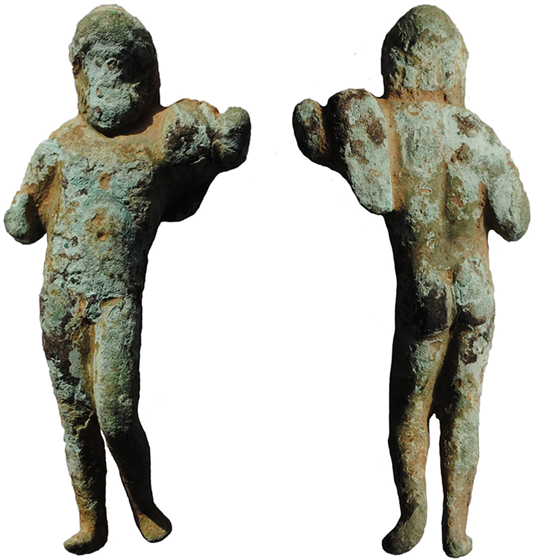
(1) Near Cockermouth (LANCUM-E9D7C4) (fig. 1).Footnote 14 An incomplete copper-alloy figurine of a deity, probably Jupiter, 93.7 mm tall and weighing 103.8 g, heavily worn with a green and blue patina. A standing nude mature male, the figure faces forward in contrapposto pose, right leg straight and left leg bent. The arms have broken off at the elbow; the right arm hangs at the figure's side, while the left is raised above the shoulder, over which a cloak hangs, also mostly broken away. The figure has a full beard and shoulder-length hair, but details of the face and coiffure are lost to wear.
Near Cockermouth, Jupiter figurine (no. 1). Scale 1:2. (Photo: L. Prosser; © L. Prosser)

Despite the wear and loss of attributes, the figure can be identified with confidence as that of Jupiter, typically depicted as a nude, mature, bearded male with a thunderbolt in his right hand, a raised left arm holding a sceptre and a chlamys over his left shoulder.Footnote 15 This is a more likely identification than Hercules, who would more commonly have the right arm raised or sometimes the club held in the crook of the left arm.Footnote 16 This is at least the third figurine of Jupiter to be documented by the PAS, a relatively uncommon deity compared to others. Similar figures recorded on the database include Brompton Regis, Somerset (SOM-B5638E) and a more finely modelled example from Norfolk (WAW-7D0B38).
NORTH YORKSHIRE
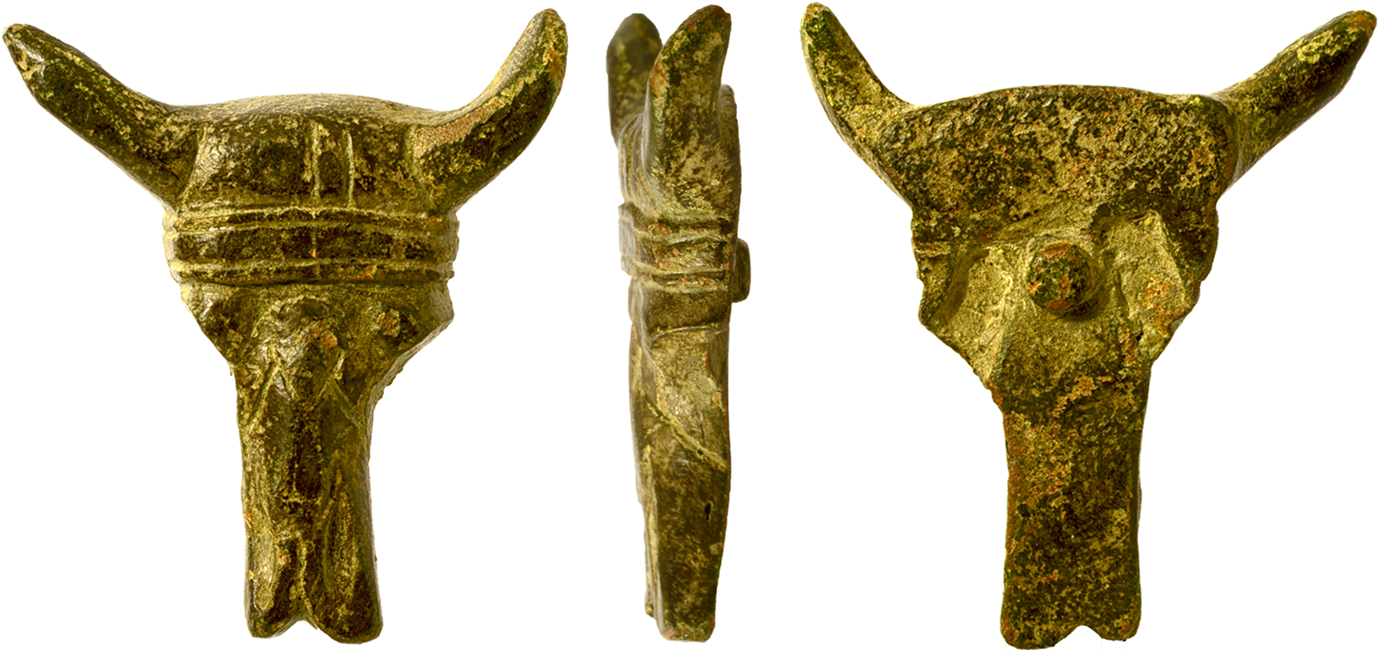
(2) Hambleton (SWYOR-D206A8) (fig. 2).Footnote 17 A cast copper-alloy bull's-head mount, worn with a smooth, dark patina, 53.6 mm long, 48 mm wide and 11 mm thick. It weighs 52.4 g. The mount is rectangular in cross section; one side carries the schematically rendered features of a bovine head, the other is mainly flat, save for remains of a rivet projecting from the space between the eyes, with a shallow recessed area on either side. As for the features of the head and face, asymmetrical horns curve from either side of the cranium. Between these, slightly offset from the centre, two incised lines run to the back of the head, rendering either a hair curl or forelock, or binding. Across the forehead is what looks like a broad band of cloth with a central strip with two thicker edges or hems. Beneath are raised circles for the eyes, from which the nose narrows, grooved on either side, down to a notched terminal.
Hambleton, bull's-head mount (no. 2). Scale 1:1. (Photo: A Downes; © A. Downes)

This may be a vessel mount or similar object. Many examples of bucket mounts in the form of bovine heads have now been documented by the PAS, predominantly in northern and western England, but typically these have a circular loop which projects from the top of the head. Like the Hambleton find, a small number of other mounts lack this loop, for instance those from Chorlton, Cheshire (LVPL-8F38B0), Boroughbridge, North Yorkshire (SWYOR-F97CD7), Telford and Wrekin (HESH-C96C96) and Cleeve Prior, Worcestershire (WAW-7A977C). Bovine-form bucket mounts span the Iron Age and Roman period.Footnote 18 In this case the band across the brows, not paralleled in other examples, recalls the fillets worn by Roman sacrificial animals, for example on the bull and ram heads on an altar recording the offering of a taurobolium at Lyon in a.d. 160.Footnote 19 This makes a Roman rather than late Iron Age date more likely in this case.
EAST YORKSHIRE
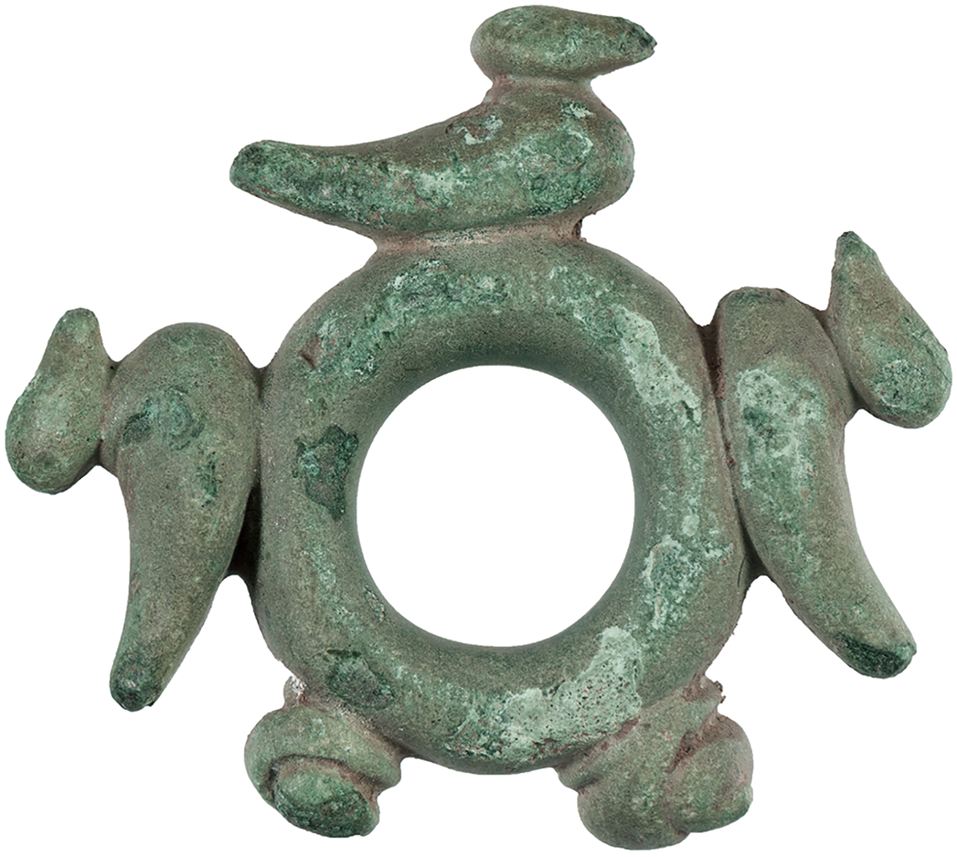
(3) Thwing (YORYM-C37EB7) (fig. 3).Footnote 20 A complete copper-alloy object, perhaps a strap fitting, of late Iron Age or early Roman date, worn with a light-green patina. This circular-sectioned ring, with zoomorphic and other decoration, has a maximum diameter of 45.6 mm, with a hoop 8.9 mm thick, and weighs 39.9 g. Of five motifs projecting from the outer edge, three are in bird form, two facing, spaced at three of the quarter points on the ring's circumference. The two smaller projections take a spiral form. The stylised bird forms have a drop-shaped head and a lightly curving body, tapering to the tail. No detail of head or feather is rendered.
Thwing, ring with zoomorphic decoration (no. 3). Scale 1:1. (Photo: R. Griffiths; © R. Griffiths and York Museums Trust)

The object has a superficial resemblance to a strap fitting but its specific function is difficult to identify, though individual aspects of the decoration can be paralleled. The spiral projections, for example, resemble those on a mount from Braughing, Hertfordshire (BH-B9C0B5), ascribed a late Iron Age date.Footnote 21 The stylised waterbirds recall other examples of Iron Age and Roman date, for example a possible furniture fitting from Cottered, Hertfordshire (LVPL-273BD0), vessel elements including lid handles in duck form, some more stylised, for example Mildenhall, Suffolk (SF-DF4933), others more naturalistic, for example Orford, Suffolk (SF-1D5C52), a mount from Wiltshire (WILT-E1FA22) and a handle fitting from Leigh, Norfolk (NMGW-C46CB4). Other waterbird images of a general similarity include a ring from Old Winteringham, North Lincolnshire (NLM-8A6096), a fitting from Nettleton, Lincolnshire (LIN-3AEB83) and a pestle from a cosmetic grinder of unknown provenance from the British Museum.Footnote 22 The arrangement of the Thwing birds also echoes the configuration of waterbirds on the rim of a fob-dangler from Streatley, Surrey (SUR-8328CA), of likely late Iron Age date. Like the Streatley fob-dangler, the Thwing object sits within the tradition established from the late Bronze Age of pairing waterbirds with solar motifs in northern European pre-Roman art.Footnote 23
NORTH LINCOLNSHIRE
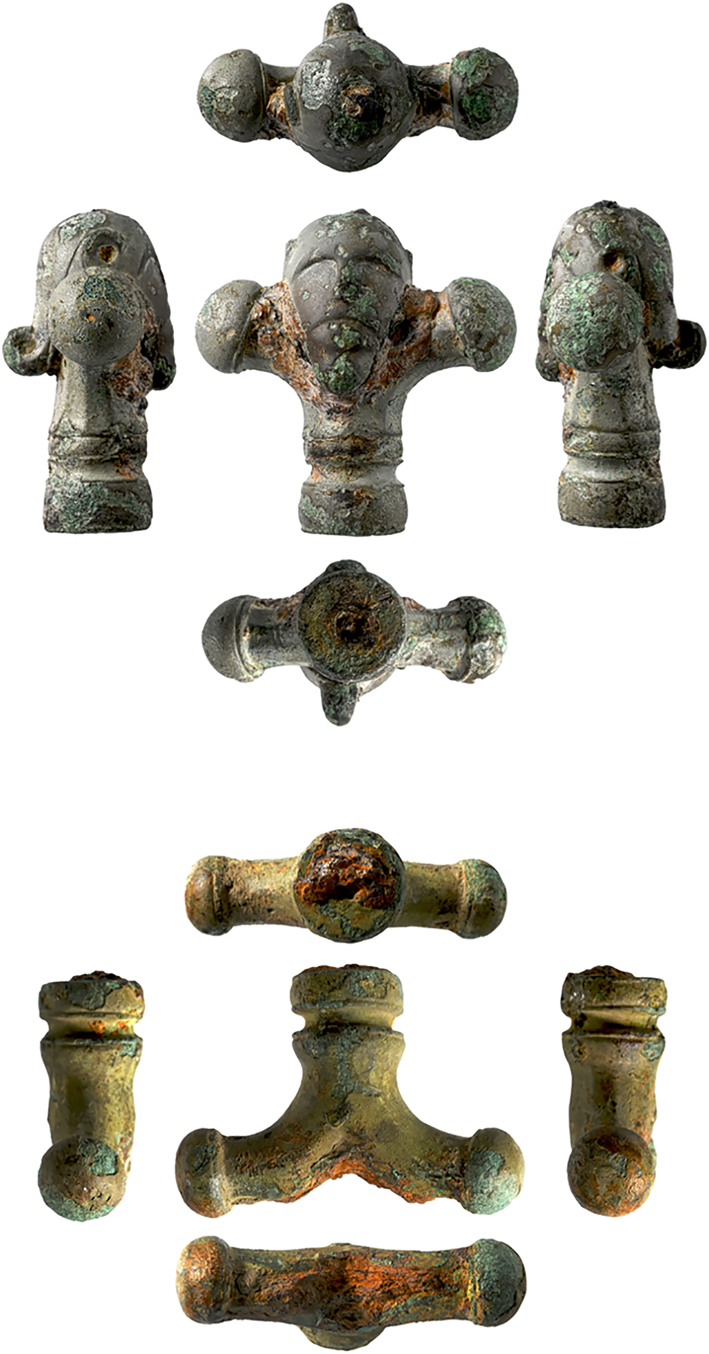
(4) Belton (SWYOR-F6BB91) (fig. 4).Footnote 24
Belton, sword hilt (no. 4). Scale 1:2. (Photo: A. Downes; © A. Downes)

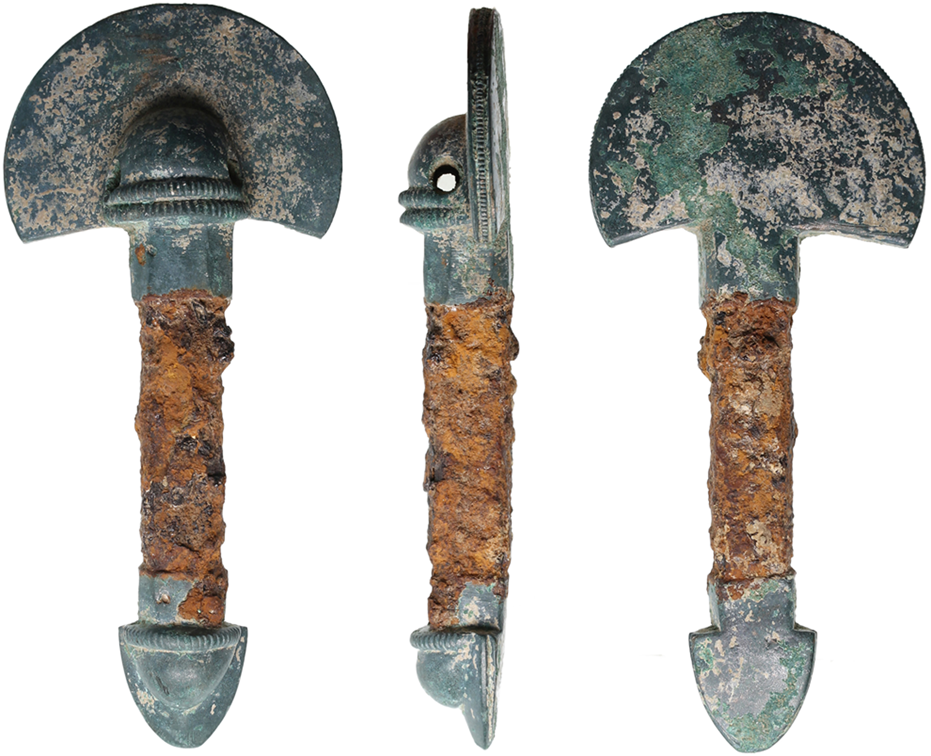
Cast copper-alloy anthropomorphic sword hilt elements dating from the Iron Age or very early Roman period, found about 3 m apart but clearly from the same object. The grip and blade are missing. Both have a grey-green patina, the pommel's more yellowish hue being perhaps due to treatment with a wax coating. The pommel is 55.3 mm long, 54.6 mm wide and 29.5 mm thick. It is cruciform in shape with a circular-sectioned shaft and short arms. The latter are angled slightly upward, with domical terminals, plain save for an incised line round the base. The shaft of the pommel is grooved around its base, flanked by an incised line above and below. The tip is a human head, with a domed cranium and triangular face and cap of hair, stylised details of both being sparingly delineated with light incision. Beneath a high brow are downward-curving eyes and a flaring nose. The lips, running parallel to the brow line, frame a pointed oval for the mouth. The face tapers to a rounded point, either a chin or beard. On each side of the head is a rounded ear, with a circular hollow at the centre of each. Not quite so long as the face, the hair tapers downward and then curls out and back on itself. On either side an incised line runs from the ear to the base. At the top of the cranium the end of the square-sectioned iron tang is visible, standing slightly proud, as it also does at the pommel's base.
The guard, measuring 46 mm long, 62.6 mm wide and 20.6 mm thick, weighs 98.1 g. In form and decoration it is an inverted version of the pommel, without the head. Its shaft too is circular in section, and again the iron tang is visible. A wide groove flanked by incised lines matches that on the pommel. Below this, the shaft tapers before flaring and curving into its arms. These too are circular in cross section and angled slightly downwards, ending in domical terminals. A groove in the base of the guard is filled with iron corrosion where the blade would once have projected.
These pieces are part of a hilt for short sword or dagger and the second anthropomorphic hilt documented by the PAS, the other being from Clipstone, Nottinghamshire (DENO-B364C6). The Belton piece is a little narrower than some examples, for instance swords in the British Museum, one from North Grimston, the other unprovenanced from the Londesborough collection. Swords of this type, Stead's group G (‘short swords in the south and north’), are relatively uncommon in Britain, this being only the 16th example so far documented.Footnote 25 Specifically it is an example of Group G of Hawkes and Clarke's typology of anthropomorphic short swords from Iron Age Europe, dated to the first century BC and first century AD.Footnote 26 Several further mounts in human-head form, also likely to be detached elements from pommels, are documented by the PAS from central and southern Britain.Footnote 27
ANGLESEY
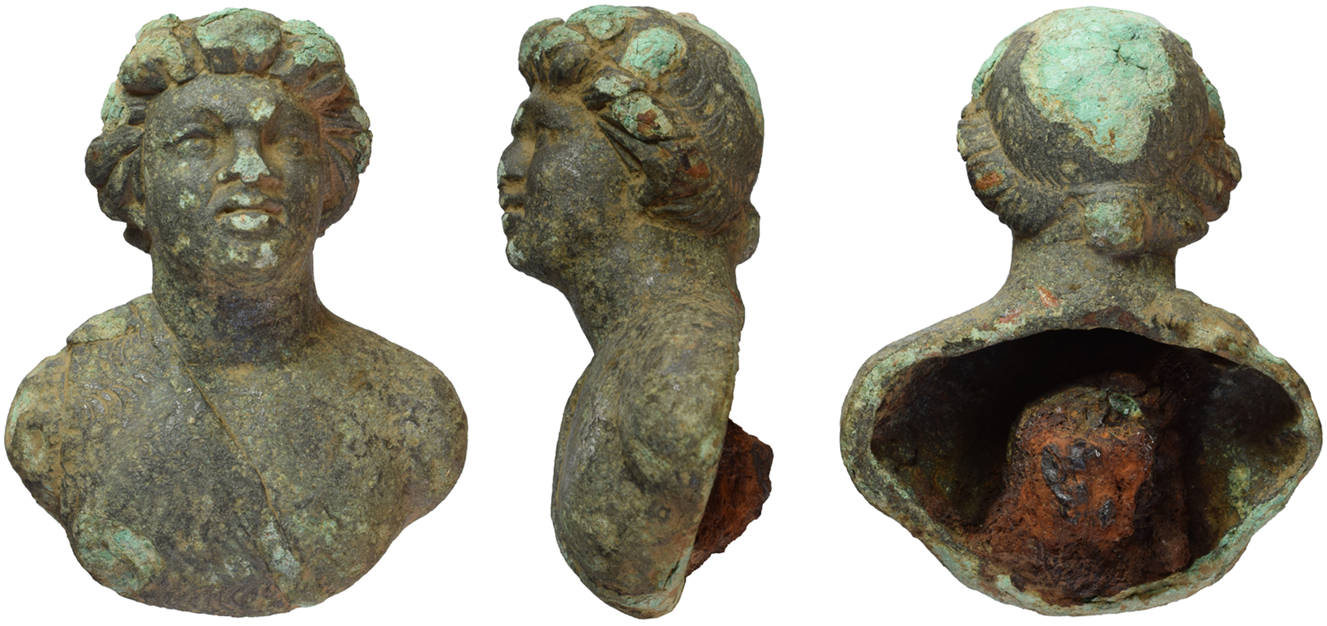
(5) Llangristiolus (WREX-C91A0B) (fig. 5).Footnote 28 A hollow copper-alloy mount, probably an applique from a box or chest, 69.2 mm high, 54 mm wide, 30.8 mm thick and weighing 148.5 g. The mount takes the form of the bust of a young satyr, quite worn and with patches of active corrosion, but enough detail survives to reveal an unusually well-modelled physiognomy. A fringe of thick bunches of curls separates the face from a thinner cap of hair on the crown of the head within which single locks have been differentiated. Ears pointing forward towards the face are visible on either side. The facial features are carefully and proportionately rendered. Over the right shoulder are traces of an animal skin or nebris. In the cavity to the rear are the remains of an iron pin that served to attach the object to an item of furniture or a container such as a chest.
Llangristiolus, mount in satyr form (no. 5). Scale 3:4. (Photo: S. White; © National Museum Cardiff)

Several such objects have been documented by the PAS, this being the first example from Wales. Subjects include Diana, Antinous, or Antinous-like figures, and other Bacchic figures.Footnote 29 For example, another satyr is documented on a smaller mount from Tarrant Hinton, Dorset, with distinctively stylised hair and nebris.Footnote 30 A youthful Bacchus, with luxuriant hair, is documented on a slightly larger mount at Corsley, Wiltshire (WILT-074FD1), and a smaller example from Chilham, Kent (KENT-BD4034) represents Silenus.Footnote 31 As conventional decorative motifs, the Bacchic figures can be bland signifiers of the good life passed in comfortable surroundings. They become more directly apposite at the dining table or symposium, at which the furniture they decorated served as props. Since so few come from excavated contexts, mounts of this type are difficult to date, but the copying of the Antinous portrait on some examples suggests a second-century date.Footnote 32
SHROPSHIRE
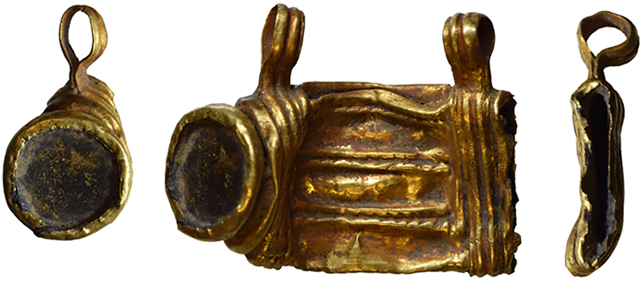
(6) Condover (WREX-1D304C / 2019T863) (fig. 6).Footnote 33 A gold amulet case, squashed and distorted, 29.6 mm long and weighing 7.7 g. The incomplete case, with one terminal broken-off and lost, takes the form of a cylindrical piece of sheet gold. Pairs of notched ribs run the length of the case to meet the narrow strips of metal that are wrapped around it at either end to form loops, enabling it to be suspended as a pendant. The surviving terminal consists of a circular recess with rolled-over edges, likely once to have contained a piece of cut glass or stone. Within the cylinder itself traces of a dark-grey substance can be observed (under magnification). Analysis by pXRF by the University of Liverpool indicates that the object's composition is as follows: 89 per cent gold, 6.4 percent silver, 2.7 per cent copper, 1.3 per cent iron and 0.17 per cent tin.
Condover, amulet case (no. 6). Scale 1:1. (Photo: S. White; © National Museum Cardiff)

Such cases could contain either lamellae, thin metal sheets on which phylacteries and other protective spells were written, or substances with magical properties, as may be the case here.Footnote 34 These late Roman amulet cases are documented in other examples from Britain, including one from the Thetford treasure (still packed with sulphur) and a plainer example from Eaton Constantine 6 km to the east, also documented as a PAS find (HESH-21275B).Footnote 35 Several lamellae have themselves been documented by the Portable Antiquities Scheme, the most complete being one from south Oxfordshire, directed at protection during childbirth (BERK-0B671).Footnote 36
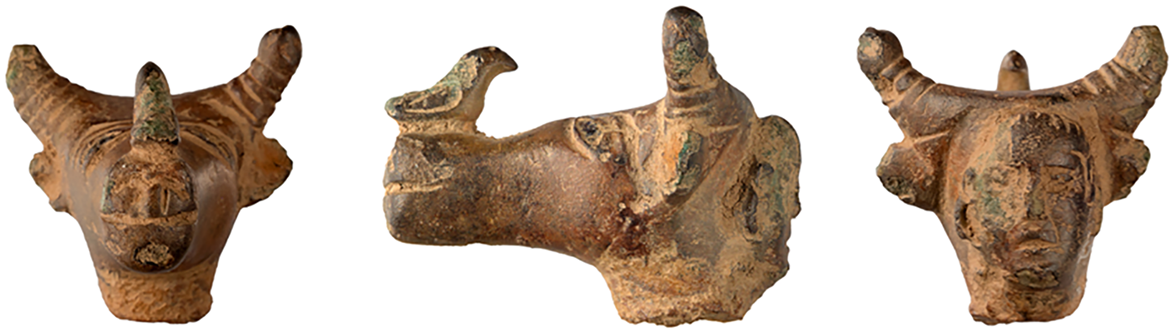
(7) Condon (FAKL-DE7417) (fig. 7).Footnote 37 A copper-alloy mount in the form of a janiform bovine head, broken off at the neck from the staff or rod on which it was likely mounted. The wedge-shaped head is 35.4 mm long, 26.4 mm wide at the horns and weighs 36.4 g. The horns, eyes and muzzle are carefully modelled. The horns curve up from the broad temple, both being encircled by four concentric mouldings. Below the horns the remains of poorly preserved ears can be seen. A double groove above and single below accentuate the almond-shaped eyes, both inlaid with blue glass. The flat muzzle is crossed by a horizontal groove for the mouth and two short V-profile incisions for the nostrils. A bird sits on top of the bull's nose and faces back along its head. Its folded wings are cross-hatched for plumage, and the eye and beak are clearly rendered. The beak tapers but the figure is too schematic to attribute it confidently to a specific family (a corvid, perhaps). At the back of the head a groove separates the bovine cranium from a human face, flat and worn, smooth with almond-shaped eyes, wedge-shaped nose, narrow mouth and hair swept back from the forehead.
Condon, janiform mount (no. 7). Scale 1:1. (Photo: K. Leahy; © K. Leahy)

This object is of a similar size and general form to other zoomorphic mounts identified as sceptre heads or terminals, for example, in avian form from West Stow.Footnote 38 No specific parallel to this example could be identified though occasional examples of birds sitting between bulls’ horns are documented on objects of other kinds.Footnote 39 Its combination of elements puts it generally among the human-animal hybrid images documented in Roman north-western Europe, represented in Britain, for example, by the horned, armed figure carved in stone at Maryport.Footnote 40 However, its janiform nature, a characteristic exploited in images in Celtic and Graeco-Roman artistic tradition, differentiates it from most other hybrid images of this type.Footnote 41
LINCOLNSHIRE
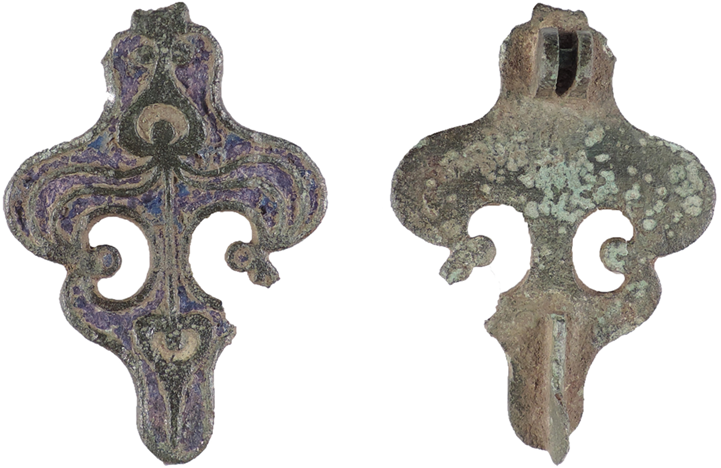
(8) Osbournby area (LIN-9B2F44) (fig. 8).Footnote 42 A near-complete copper-alloy enamelled plate brooch, probably dating to the second to third century a.d. The brooch is 39 mm long and 27 mm at its widest. It weighs 6.8 g. The brooch has reserved metal motifs, set symmetrically against a translucent blue enamel background, the latter reasonably well-preserved, and two opposed kidney-shaped perforations. A small amount of metal is lost from the top, where the brooch likely had a rounded end. Its overall form is leaf-like, flaring at the top and then with gentle curves narrowing to its rounded tip. A central spine of reserved metal runs through the narrow gap between the perforations and terminates at both ends in a leaf-like motif, much more elongated at the bottom than at the top. Within each of these motifs is a crescent-shaped field from which the enamel is now lost.Footnote 43 From the base of the upper motif extend two parallel sinuous lines of reserved metal. Of the hinge, the two lugs survive, the pin is missing and part of the catchplate has broken away.
Osbournby area, plate brooch (no. 8). Scale 1:1. (Photo: L. Brundle; © Portable Antiquities Scheme)

This is an unusual brooch design, very difficult to parallel closely in corpora of British brooches or among continental European examples. Characteristics of the decoration, for example the peltiform perforations and blue enamel inlay, correspond to the general preferences of the time.Footnote 44 Similar decoration is also current on other enamelled objects, the leaf-like motifs also occurring, for example, on the handle of the West Lothian pan and among the vessel moulds from Castleford.Footnote 45
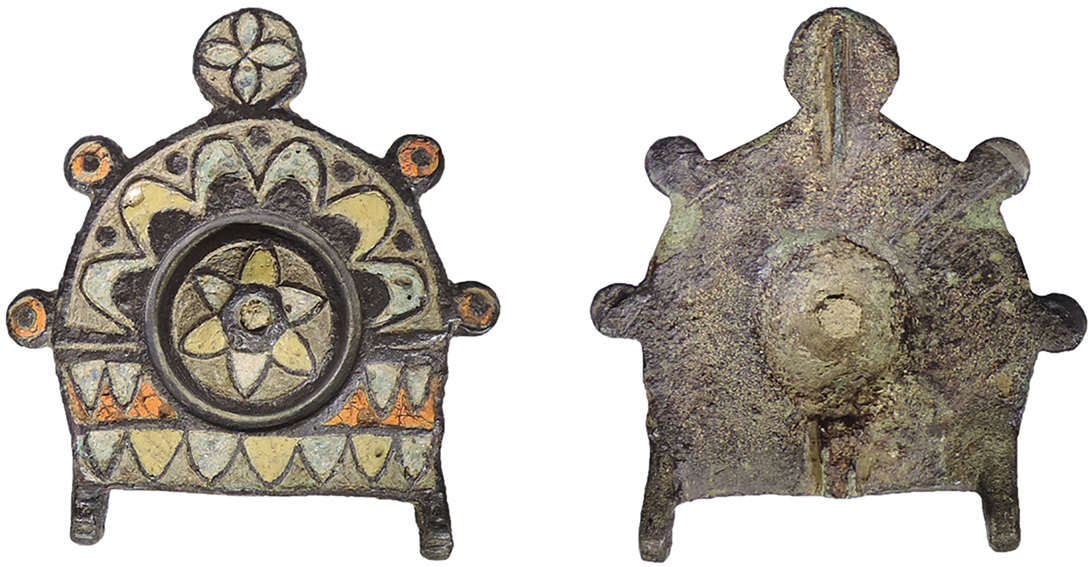
(9) Near Sleaford (LIN-A40146) (fig. 9).Footnote 46 An enamelled copper-alloy plate brooch of chatelaine type, decorated with polychrome enamel. It is 46.7 mm long, 43 mm wide, 2 mm thick and weighs 13.6 g. The brooch is well-preserved, but only two transverse suspension loops survive of the bar from which grooming artefacts (usually a nail cleaner, tweezers and an ear-scoop) would have been suspended.Footnote 47 The brooch has a central circular boss, framed by an arch with rounded projections on one side and squared off on the other. The suspension loops are attached to the squared-off edge. The boss has a central annulus, inlaid with yellow enamel, surrounded by six petals with yellow and pale enamel. The semicircular frame carries further petals, within each of which is an inner space in reserved metal and an outer cell containing yellow and pale enamel. Between each petal is a pellet in reserved metal, set against an enamelled background. The larger projection at the top has a quatrefoil motif surrounded by pale enamel. The smaller projections to either side are decorated with a pellet in reserved metal, set against an orange enamel background. The squared-off space carries two rows of petals, pale above, against an orange background, and alternating yellow and pale below, against an enamelled background. The colour of the pale decayed enamel is difficult to identify, perhaps blue in some cases. On the flat back of the brooch, part of the catchplate (beneath the larger projection) and the lug are preserved.
Near Sleaford, chatelaine (no. 9). Scale 1:1. (Photo: A. Vallee; © Portable Antiquities Scheme)

The chatelaine brooch, very rare outside Britain, is well documented as a late first- to third-century type, both among excavated and metal-detected examples.Footnote 48 In the survey by H. Eckardt and N. Crummy, 28 instances were identified, including five from the PAS; since then, the dataset of PAS chatelaine brooches has grown to c. 50 examples, of which this umbonate form with its central boss and squared-off base is the most common type (Eckardt and Crummy type I). This new dataset also extends the distribution pattern documented for this brooch type from south-east England to eastern England more generally, with many more documented recorded in the East Midlands since Eckardt and Crummy's analysis.Footnote 49 Many other examples have schemes based on petals and triangles coloured with yellow and blue enamels. None is identical to the Sleaford example, but some are similar, for example brooches from Wiltshire and from Upton Grey, Hampshire (SUR-CCE0F4).Footnote 50
LEICESTERSHIRE
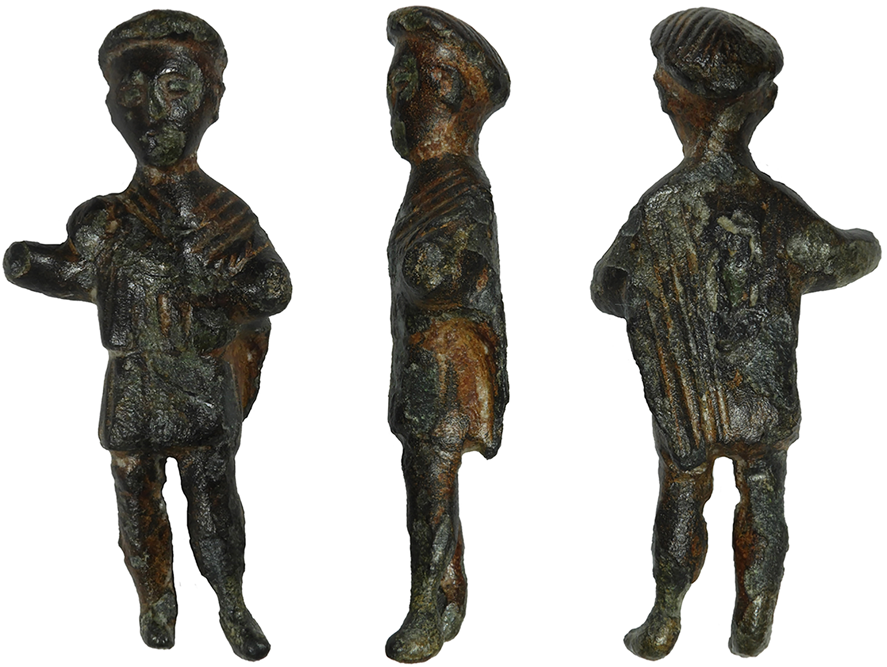
(10) Grimston (LEIC-DD3E91) (fig. 10).Footnote 51 A Roman copper-alloy male figurine, 83 mm tall and weighing 95.5 g. Near complete, but with arms broken below the elbow, the figure stands with light contrapposto (left leg bent, right straight), wearing a short belted tunic beneath a cloak. The latter hangs over the left shoulder and down the back, its folds running in parallel lines. The right arm bends out at the elbow, the left probably also. Legs and feet appear bare. The outsize head is worn but the circular ears and large almond-shaped eyes (with pupils visible) survive better than the nose and mouth. The hair sits as a cap-like topping to the head, with parallel lines rendering a swept back coiffure on both sides.
Grimston, figurine (no. 10). Scale 2:3. (Photo: W. Scott; © W. Scott)

The figure is not easily identified. The lack of conical cap, beard or tunic worn covering one shoulder make it unlikely that this is an image of Vulcan, with which it otherwise has a passing resemblance.Footnote 52 It is perhaps better attributed to the diverse group of human figurines assembled by E. Durham, but the costume of cloak and tunic is too widely documented to allow this to be identified as a specific figure.Footnote 53
NORTHAMPTONSHIRE
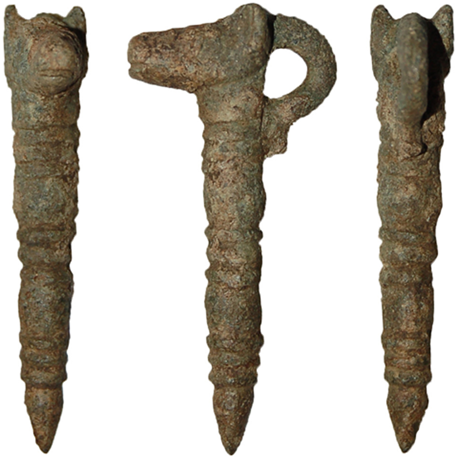
(11) Brigstock (BH-95FD3B) (fig. 11).Footnote 54 A cast copper-alloy pendant, complete but worn and rather corroded, 38 mm long and with a shaft up to 5.5 mm thick. The object weighs 7.2 g. The terminal takes the form of an animal head, perhaps a horse or a dog, with a slit mouth, possible indentations for nostrils and pricked-up ears. At the back of the head is a circular-sectioned attachment loop. No eyes or other features are visible. The circular shaft, decorated with three equally spaced sets of three ribs and grooves, tapers to a point. The object is very similar to at least eight other Roman period pendants recorded on the PAS database, counting only those of which enough survives to be confident of the presence of horse-head terminals.Footnote 55 With the exception of one example from Northmoor, Oxfordshire, these are all documented in the East Midlands and East Anglia. However, in all other cases these have a double head, usually much more naturalistically modelled in equine form. For suspension, these double-headed pendants have either a perforation in the space between the horses’ heads or a loop projecting from it. In the absence of stratigraphic context, it is difficult to date them, but the opposed horse heads of some late fourth- or early fifth-century belt-buckle types may offer parallels in a different dress item.Footnote 56
Brigstock, horse-head pendant (no. 11). Scale 1:1. (Photo: M. Fittock; © Portable Antiquities Scheme)

CAMBRIDGESHIRE
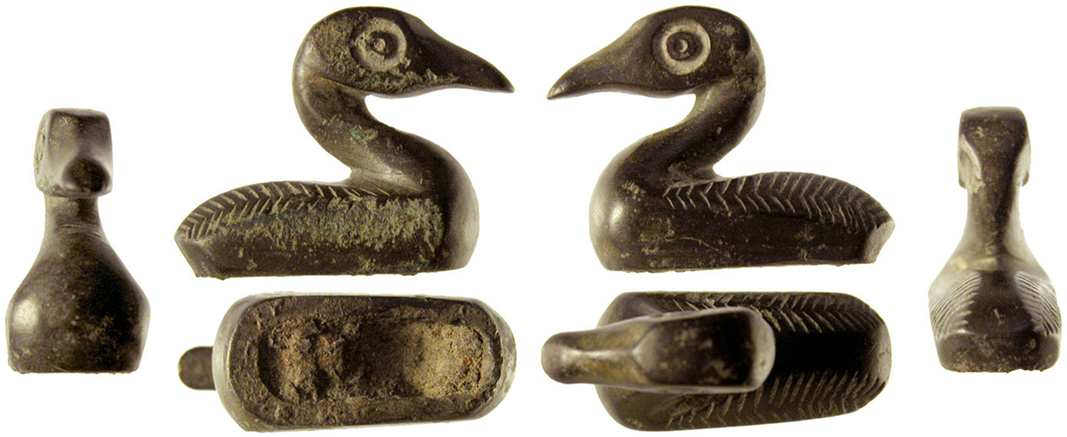
(12) Fen Ditton (SF-2492B7) (fig. 12).Footnote 57 A cast copper-alloy figurine of a stylised waterbird, well preserved with a dark-brown patina, albeit with traces of wear on one side. It is 31 mm long, 12.2 mm wide, 22.3 mm high and weighs 16.2 g. The over-large head, flat on either side with outsized ring-and-dot eyes (with a small recess within the dot), tapers a little from the broad cranium to the tip of the curving beak. The beak has a flat base, but the upper surface is facetted to render the culmen (the beak's dorsal ridge). Its tip is hook-like and widens a little to render the ‘nail’, a hard tissue plate used by waterbirds to grip or dig. Perhaps the groove around the eye or recess within the iris once contained coloured material, but no trace of it was detected. The narrow neck arches forwards from the head to meet the body, with faint toolmarks visible on all faces, especially the back, likely traces of finishing by hand. From a wide rounded breast, the facetted block-like body tapers a little towards the back where it rises at an angle to form the rump and tail. Plumage is rendered by pairs of incised strokes in chevron arrangement, extending from front to back and lengthening in the middle. The overall effect is of a stylised single feather, but these chevrons are likely intended to render the bird's folded wings. They are separated by a smooth band along the back of the bird. The overall form, above all the sinuous neck, suggests that the Little Fitton example is more easily identified as a stylised swan rather than a duck. The flat underside has a large oval concave recess filled with a white substance (metal alloy?) that would likely have enabled attachment of the figure as a mount on a larger object, perhaps a vessel.
Fen Ditton, waterbird mount (no. 12). Scale 1:1. (Photo: A. Brown; © Suffolk County Council)

Similar mounts have been recorded through the PAS: a slightly larger example from Burton upon Stather, North Lincolnshire (SWYOR-329326) and slightly smaller instances from Farndon, Cheshire (HESH-6BDC15), Little Waltham, Essex (ESS-062A46) and Pershore, Worcestershire (WAW-4949B6). None of these closely parallels the decoration or the elegance of the Little Fitton example. All these too may have been attached to vessels, though none is directly paralleled in surviving examples of vessel mounts; the stylised birds on the handles of the mid-first-century a.d. Crownthorpe cups, for example, are not attached in the same way as is indicated by the Little Fitton mount.Footnote 58 This object is difficult to date precisely, especially given the long-established use of waterbird motifs in later prehistoric and Roman art, but perhaps broadly corresponds to the stylised renderings of birds dated to the end of the Iron Age and first century of the Roman period.Footnote 59 The nature of the find seems appropriate to a Fenland findspot in a region where bird representations have a wide currency on Roman objects.Footnote 60
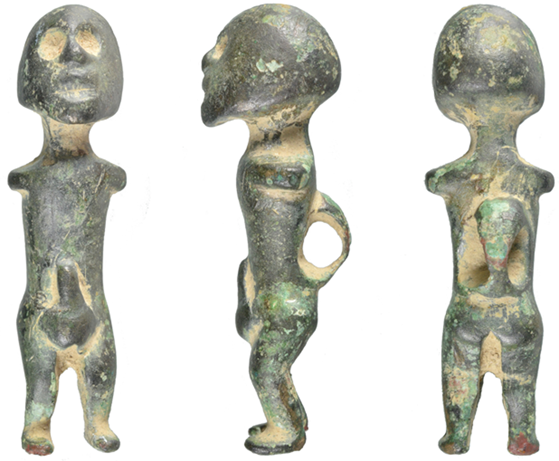
(13) Little Chishill (SF-9B73E9) (fig. 13).Footnote 61 A complete cast copper-alloy ithyphallic anthropomorphic figurine and pendant, well-preserved with an even dark-greenish patina. It stands c. 38 mm high and weighs 13 g. The stylised standing male figurine has an outsize worn head, long body, prominent genitals and short legs. The domed head, set on a thin neck, looks upwards, with two deeply recessed outsize eyes, a worn nose, open mouth and prominent chin. The arms are short stubs, projecting from the shoulder. The elongated torso is smooth at the front, with prominently moulded testicles and erect penis at the groin, and carries a worn suspension loop on the back. The legs are slightly bent.
Little Chishill, pendant (no. 13). Scale 1:1. (Photo: A. Bliss; © Suffolk County Council)

Partial parallels can be identified for this figure. A pendant of similar form and size is documented at Steyning, East Sussex (SUSS-F6B98D), although not ithyphallic. Small schematic ithyphallic figurines without suspension elements are more widely documented by the PAS, for example, from Cawood and Littlethorpe, North Yorkshire, the former in copper alloy, the latter in lead.Footnote 62 The lack of attributes make this figure difficult to identify specifically but the suspension loop suggests that it was worn as an apotropaic object like the phallic pendants widely documented in Roman Britain, including many PAS examples.Footnote 63
SUFFOLK
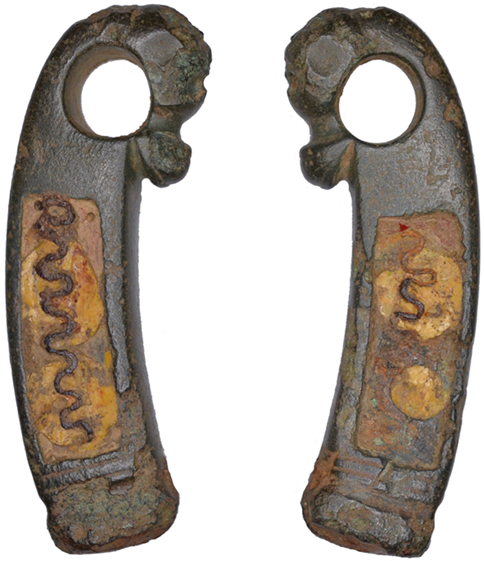
(14) Cotton (SF-B59FE4) (fig. 14).Footnote 64 A complete enamelled copper-alloy knife handle, generally well-preserved with a dark-green patina. It is 46.5 mm long, 14.9 mm wide, 6.9 mm thick and weighs 17.6 g. The handle, rectangular in cross section, is slightly curved with an expanded terminal, where a large perforation is framed by a zoomorphic moulding on its inner edge. This takes the form of a stylised avian head with two small recesses for eyes and an outward-curving beak below. On both faces is a shallow rectangular recess, filled with a yellowish enamel as well as fragments of red; a line of reserved metal snakes down the middle. At the junction with the blade are two narrow mouldings and a broader groove, beyond which is a worn break, covered in iron corrosion from the now lost blade.
Cotton, knife handle (no. 14). Scale 1:1. (Photo: F. Minter; © Suffolk County Council)

Very many examples of these handles for toilet or multi-purpose knives have now been documented by the PAS.Footnote 65 Other examples with a similar perforation to allow suspension include a handle from Rendlesham, Suffolk (SF-04B5EA), with a feline head, and a curving handle from Mashbury, Essex (ESS-04F9E1). Similar handles without holes for suspension but with zoomorphic terminals include examples from Ladderfel, Gwynedd (LVPL-D420F6) and East Knoyle, Wiltshire, the latter having a canine head.Footnote 66 Otherwise the vast majority are folding knife handles taking the form of a hound chasing a hare, but the variety of forms is very wide and each year the repertoire is extended.Footnote 67 Other examples documented in 2019 include a handle in dolphin form from Hibaldstow, Lincolnshire (NLM-420C2C) and a further instance of a handle in the form of three people having sex from Mappleborough Green, Warwickshire (WAW-0A2FF7). Like other examples of this type, one male stands, one male kneels and a female sits on the kneeling male's shoulders, but in detail it does not conform directly to known types.Footnote 68
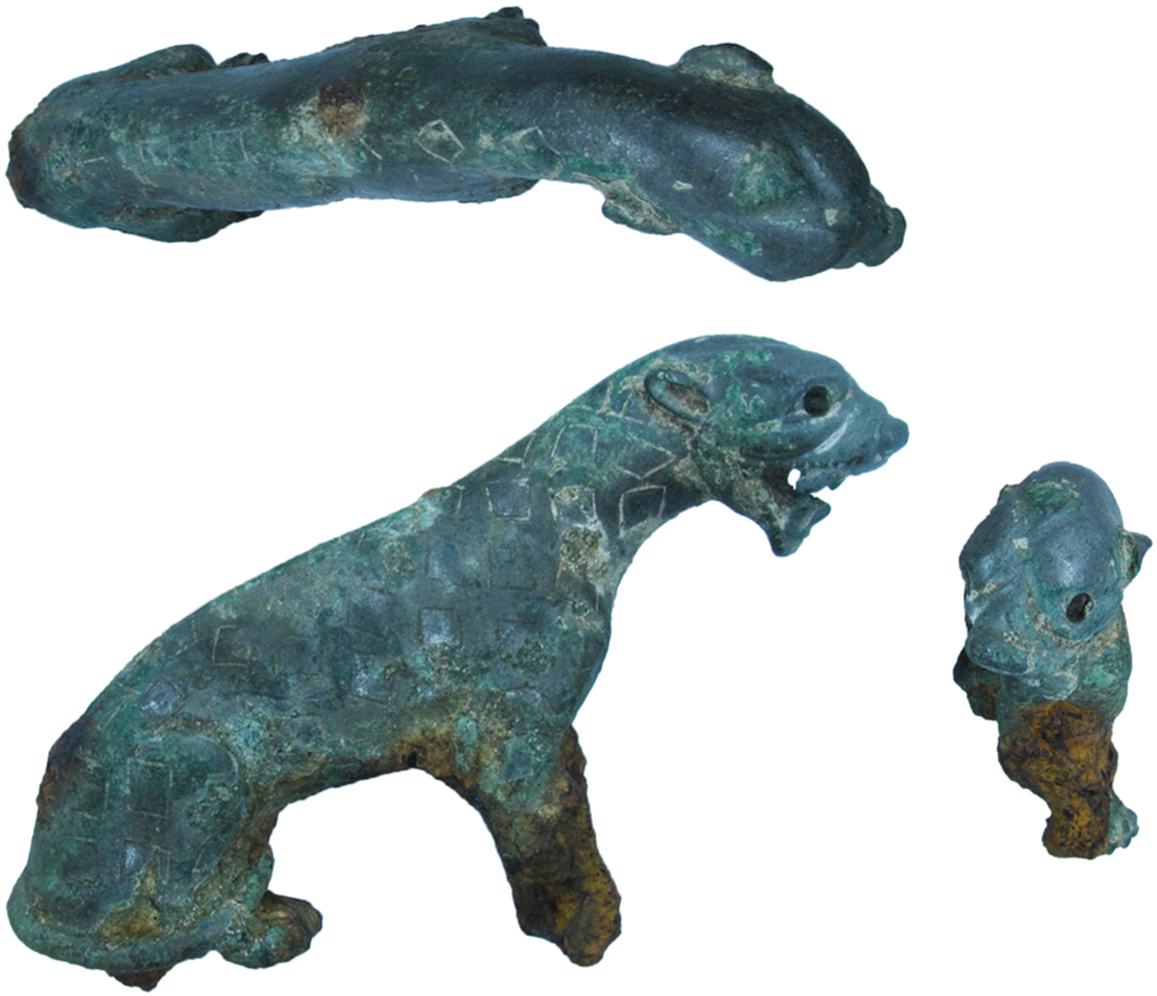
(15) Framlingham (ESS-9049F3) (fig. 15).Footnote 69 Copper-alloy figurine in the shape of a sitting leopard, a likely vehicle fitting, very worn with a dark-grey/green patina and some losses at the extremities. The figurine is 151.7 mm long, 100.1 mm high, 29.8 mm at its widest and weighs 736.3 g. The leopard sits with head twisted to the right. The head is modelled in detail, especially its right side. The ears prick up slightly, the smooth cranium develops into powerful brow ridges above the eyes, the right side shows a drilled recess for the eye to accommodate inlay, facial muscles under tension (growling?) and open jaws revealing teeth on the right and perhaps a tongue lolling, as well as possible iron corrosion traces within the mouth. The front legs are partly preserved, part of one paw being visible while much of the rest is obscured by iron corrosion product extending to the creature's belly. The right side only of the slim body is decorated from neck to rump with incised lozenges, a schematic means of rendering the leopard's spots. The back legs are better preserved, with the muscles of the haunches, details of the paws and of the tail curled around the back legs all clearly visible. A trace of an iron shank can be seen beneath the rump, surrounded by corrosion product.
Framlingham, vehicle fitting (no. 15). Scale 1:2. (Photo: S. Flynn; © Colchester and Ipswich Museums Service)

The object is a vehicle fitting, similar to another example, albeit a tigress rather than leopard, recorded by the PAS in Norfolk.Footnote 70 The two figurines are near identical in their dimensions and similarly posed, the tigress standing with its head also turned to the right. The decoration on the tigress is more complex however, with various metal inlays having been used for stripes. Both figurines were intended to be viewed from one side only and have traces of the iron attachments on their extremities which fixed the figures to the body of the carriage. Similar figurines have been widely documented across the Empire, mostly drawn from the retinue of Bacchus, the feline figures being symmetrically arranged at either side of a central group.Footnote 71 Bacchic imagery was widely used for fittings of all kinds (for example, see no. 5) but especially appropriate in this case given the god's wide travels.
BUCKINGHAMSHIRE
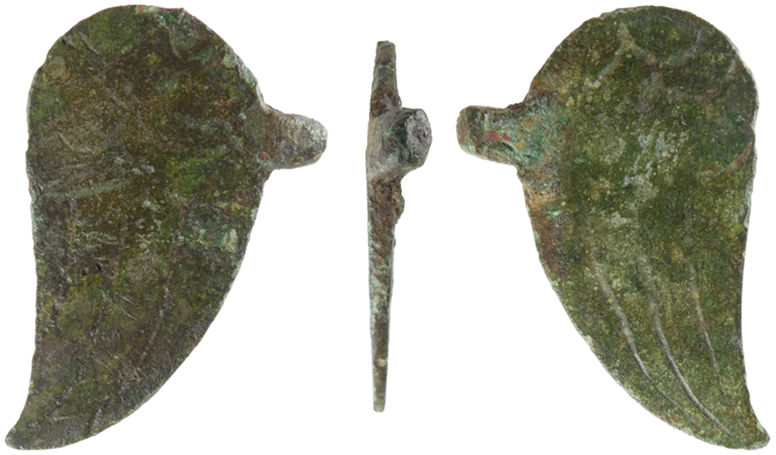
(16) Buckingham (BUC-D3C639) (fig. 16).Footnote 72 A wing from a Roman copper-alloy figurine, with a dark-green patina, being 37.5 mm long, 24.9 mm wide, 1.7 mm thick and weighing 7.2 g. The comma-shaped wing is rounded at the top and curves slightly outwards as it narrows towards a rounded tip. The plumage is indicated schematically by incised half-circles at the top of the wing and lines running parallel to the wing edge down to the tip. A projection from the inner edge of the wing, circular in cross section, indicates where it originally attached to the body.
Buckingham, figurine fragment (no. 16). Scale 1:1. (Photo: A. James; © Portable Antiquities Scheme)

The wing is most plausibly explained as a fragment from a statuette of Victory. This is the second instance to be documented by the PAS, the other being a complete figure from Whilton, Northamptonshire (NARC3058), while six further examples from Britain are recorded by Durham.Footnote 73 On analogy with these other figures, the wings would have extended at an angle from the back. Similar figures and fragments are documented in other provinces.Footnote 74
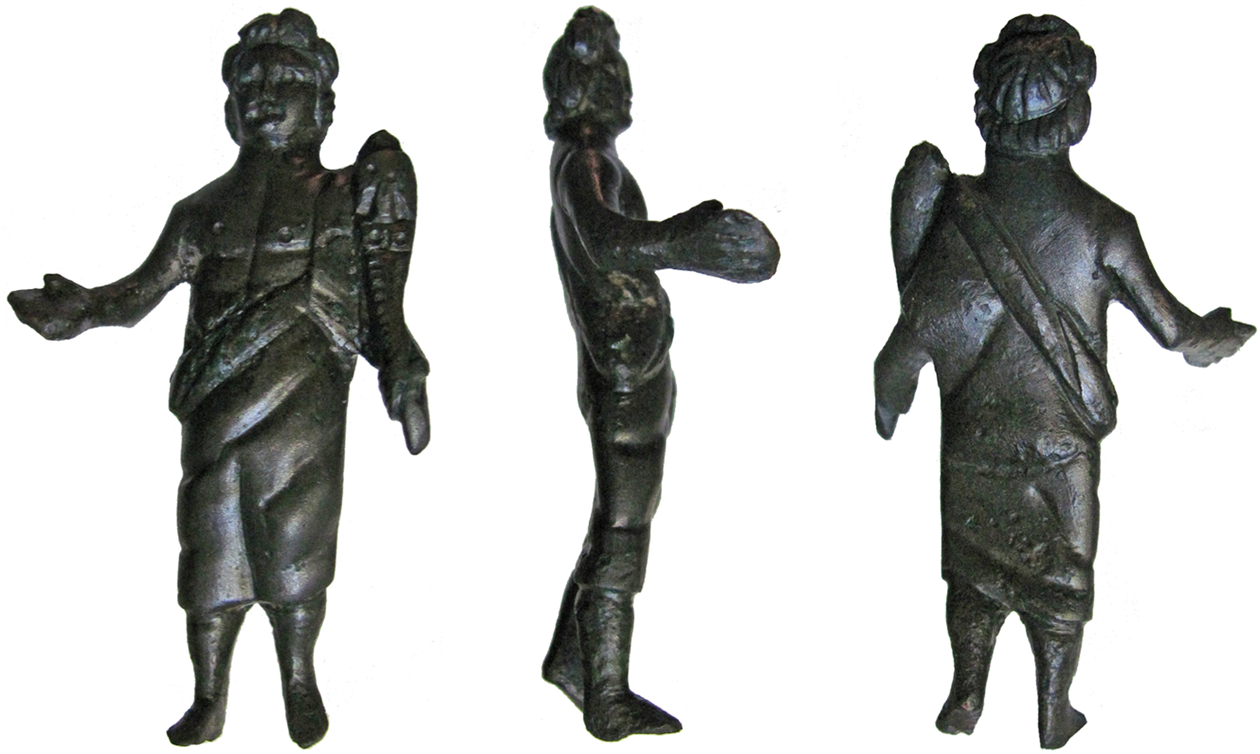
(17) Long Crendon area (OXON-4C4380) (fig. 17).Footnote 75 A complete cast copper-alloy figurine of a standing male, holding a patera in its right hand and cornucopia in its left. Well-preserved, if worn, the statuette stands 62 mm high and weighs 33.4 g. The figure, in contrapposto stance, right leg straight, left leg bent, more successfully models the detail of anatomy and clothing than the overall body shape, being markedly thin in profile. A himation (cloak) is stretched diagonally across the front and back of the figure, with a thicker fold on its upper edge. Leaving the muscular torso bare, it falls to the calves, the fabric partly revealing the shape of the body beneath. The lower left arm is angled outwards to hold the base of the cornucopia. Along the horn of the cornucopia are diagonal mouldings, while highly stylised fruits and blooms spill from its mouth, with detail lost to wear. The right arm bends outwards and forward, angling the patera to pour a libation. The head, supported on a thick neck, is of a clean-shaven youth with a short slot for a mouth, worn nose and deep-set eyes. Lines radiate from the crown of the head, a schematising indication of the strands of the coiffure, separated from the face by a ridge of thicker clumps of hair.
Long Crendon area, Genius figurine (no. 17). Scale 1:1. (Photo: A. Byard; © A. Byard)

This figure is a youthful Genius, the himation rather than toga indicating its affiliation to the ‘Greek’ type derived probably from a prototype perhaps by Praxiteles; other examples in the same tradition from Britain are documented on altars from Cirencester and Bablock Hythe.Footnote 76 Most other Genius figures recorded from Roman Britain are togate, but a small number are draped in a similar fashion, for example the silvered copper-alloy figure from the Shrine of the Nymphs at Carrawburgh.Footnote 77 A double cornucopia found in 2019 at Leafield, Oxfordshire (BERK-C58C49), much more naturalistically modelled, may come from a much larger figure of similar type or from a lar.Footnote 78 The stylisation of the Ickford figure, especially of clothing, musculature and the cornucopia, puts it squarely within a Romano-British tradition, even if this is not as marked as in some other figures.Footnote 79
HERTFORDSHIRE
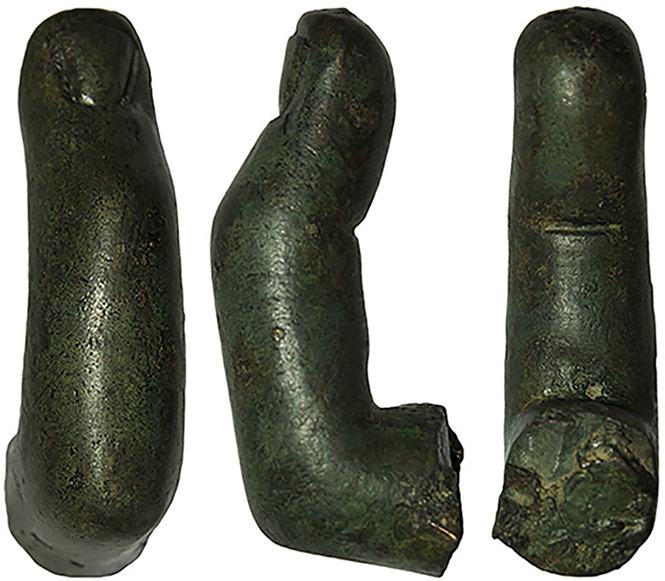
(18) St Michael (BH-0B9D64) (fig. 18).Footnote 80 A cast copper-alloy solid finger, 64.2 mm long, 20.4 mm in diameter at the break, 14.8 mm in diameter at the tip and weighing 125.7 g. These dimensions suggest that it derives from a life-sized statue. Its surfaces are scratched and abraded in places, with a relatively even mid/dark-green patina. The slight widening of the finger at the point of breakage suggests it has broken off near the junction with the palm; the antiquity of the rather uneven break is suggested by its similar patination to the other surfaces. The finger is strongly flexed, bent at 90 degrees at the second joint, more gently at the first. Since the middle section of the finger is significantly longer than the tip, this is more likely to represent the middle or ring finger. The slight overall curvature to the left in dorsal view suggests a tentative identification as the ring finger of the right hand. Surviving detail is limited to a groove marking a wrinkle on the inside of the second joint and a short-cut nail, carefully modelled with a pronounced curve changing the angle of the fingertip. The modest flexing of the finger at the tip suggests that the hand is holding an object of considerable diameter.
St Michael, finger from statue (no. 18). Scale 3:4. (Photo: M. Fittock; © Portable Antiquities Scheme)

This and another 2019 find, comprising a fingertip from a c. life-size statue from Sheepy, Leicestershire (LEIC-8FB8F6), join several other copper-alloy statue fragments documented by the PAS. Like the St Michael and Sheepy finds, these mainly comprise extremities, usually digits and fragments of heads. Cumulatively they represent a substantial addition to the corpus of bronze sculpture from Britain, even if the original form and context cannot always be easily determined because of the small size of fragments and their likely displacement from the original setting in which they were displayed.Footnote 81 In this case, like a recent find from Lincoln, it seems likely that the hand once held an attribute significant for identifying the subject of the statue but the possibilities are too numerous (spear, sceptre shaft, etc) to suggest who this might have been with any confidence. The findspot's proximity to St Albans suggests that this statue once decorated a civic or religious space within the city.
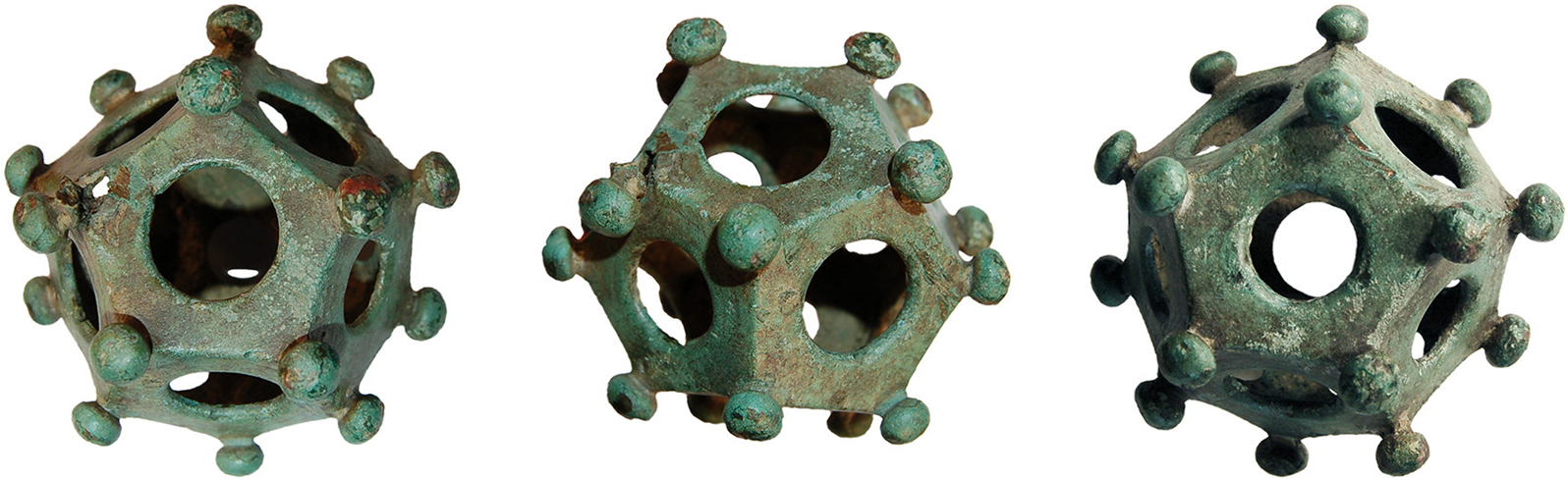
(19) Much Hadham (BH-692011) (fig. 19).Footnote 82 A slightly damaged but otherwise complete cast copper-alloy hollow dodecahedron, with a maximum diameter of 82 mm. Each of its faces is 38 mm in length and width, while the plate is 3 mm thick. The dodecahedron weighs 247.2 g. Its surfaces have a varying mid-green and brown patina, pitted and abraded in places. The object has 12 flat pentagonal faces with spherical knobs at each of the 20 vertices, one partially detached where damage has occurred. Each face has a central circular perforation of a diameter varying between 13.7 and 20 mm. All the apertures have slightly bevelled rounded edges and are circled by two faint engraved lines. This is perhaps the most complete dodecahedron documented from Roman Britain.
Much Hadham, dodecahedron (no. 19). Scale 1:2. (Photo: M. Fittock; © Portable Antiquities Scheme)

Excluding objects reported to the PAS (see below), 116 dodecahedra have been found across the northern Roman Empire, from Wales to Hungary, with the majority documented in Gaul, Germany and Britain.Footnote 83 They are typically dated to the second to fourth century a.d., though only two are documented from excavated contexts, the most recent being a find from a cellar destruction deposit from Jublains, Mayenne, dated to the early third century a.d.Footnote 84 The form of the Much Hadham dodecahedron is typical of this wider body of finds, in terms of the diameter of the whole object (the documented range is between 4 cm and 11 cm) and of the circular perforations on each face (documented examples vary between 6 mm and 40 mm), the weight (documented between 35 g and 580 g) and the decoration on the face.Footnote 85 Since the 18th century more than 50 proposals have been made for their purpose, including measuring instruments (for earth or sky), military standards, sceptre heads and domestic objects including candleholders and toys.Footnote 86 Amongst the British examples found in association with known sites are dodecahedra from South Shields, Corbridge and London, and many of the findspots in continental Europe are military or urban.Footnote 87 However, the examples now documented by the PAS significantly expand the number of dodecahedra from rural settings, documented across England.Footnote 88 On this evidence, their use, whatever it may have been, seems well-established across diverse contexts in northern Europe. The context information for one PAS find, the fragment discovered with the metalwork hoard created from the likely salvage of temple materials from near Gloucester, provides a further hint that their purpose was sometimes connected to religious practice, perhaps divination.Footnote 89
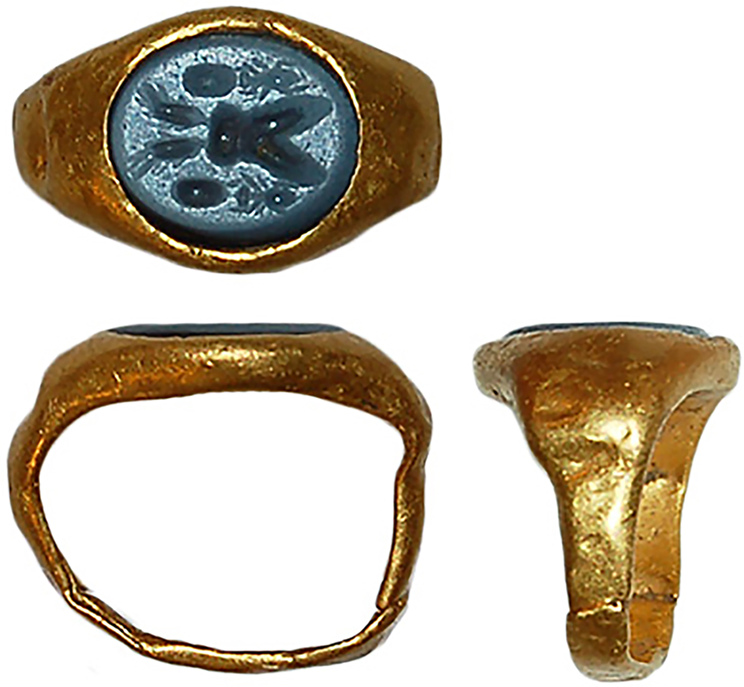
(20) Much Hadham (BH-702ED7 / 2019T979) (fig. 20).Footnote 90 A complete gold finger-ring of Henig Type III or XII, with intaglio (c. a.d. 100–300). Its external diameter is 18.2 mm, while the distance from the bezel (upper surface) to the back of the hoop is 14.9 mm. The intaglio is 10 mm long and 8.9 mm wide, and the bezel is 3.3 mm thick. The hoop is 3 mm wide and 0.8 mm thick. The ring weighs 3.8 g. The hoop, flat and with a rectangular section, appears to have been broken and repaired. Its shoulders widen to a flat oval bezel, within which an intaglio is set flush, probably a nicolo (onyx) with an upper blue layer. In the centre of the intaglio a two-winged insect, probably a bee, holds two cereal ears in its proboscis; on either side is an ant pushing a single cereal grain.
Much Hadham, finger-ring (no. 20). Scale 2:1. (Photo: M. Fittock; © Portable Antiquities Scheme)

Martin Henig comments as follows on parallels to these motifs on other gems.
Ants with their industry were symbols of prosperity and are associated with Ceres,Footnote 91 as indeed are ears of corn also held by the goddess; so are bees, which produce honey. A glass symbol gem incorporating two cornucopiae, a globe and a bee with a caduceus was published by the late Vollenweider as a symbol of prosperity associated with Caesar.Footnote 92 A bee with a caduceus is depicted by itself without other symbols on a cornelian gem from Skradin, Croatia.Footnote 93
Similar ant designs are known across the Empire but none depict the same ant-bee arrangement. A single ant holding a cereal ear in its probiscus is depicted on a cornelian in Copenhagen.Footnote 94 There is also a cornelian now in Leiden that shows an ant with corn ear or glume in its probiscus within a wreath.Footnote 95 A further example in Oxford shows an ant with a glume in its probiscus.Footnote 96 A third cornelian in the British Museum figures an ant with a cereal head.Footnote 97 The collection in Hanover includes two intaglios with ants as subjects: the first a cornelian showing an ear of barley flanked by two ants (no. 1293) and the second an ant approaching an ear of barley – that stone is described as a sard (no. 1294).Footnote 98 Sagiv who publishes an agate (sardonyx) in the Israel Museum depicting an ant with a corn ear in its probiscus, cites Aelian for whom the ant is a symbol of diligence and productivity.Footnote 99 The only other similar insect from Britain is another nicolo from Head Street, Colchester, depicting, in this case, a fly.Footnote 100
KENT
(21) Adisham (KENT-4CB117) (fig. 21).Footnote 101 A complete cast copper-alloy and iron linchpin, with a green-grey patina. The linchpin is 124.8 mm long, with a maximum width of 57 mm; it weighs 202.8 g. The crescent-shaped head, cast in one piece, is plain, but the edge is milled. The socket, D-form in cross section, is also decorated with two raised milled bands and is pierced with a transverse perforation. The heavily corroded square iron shank ends in a U-shaped foot, with the corresponding socket carrying a single raised milled band, matching the decoration on the head. The right rivet of the foot survives in situ, albeit heavily corroded. The edge of the foot is grooved. The rear of the head and foot are plain.
Adisham, linchpin (no. 21). Scale 1:2. (Photo: J. Ahmet; © Kent County Council)

There are no complete examples of this type of linchpin on the PAS database, although another example of a well-preserved and decorated crescent head is recorded from Yoxhall, Staffordshire (WMID2798). The transverse perforation on the socket connecting the head to the shank may have served for threading a leather thong, connected to a mini-terret, to secure the linchpin to the chariot axle. Most linchpins of this type (Spratling Group II) date from the late Iron Age or early Roman period, c.100 b.c. to a.d. 100.Footnote 102
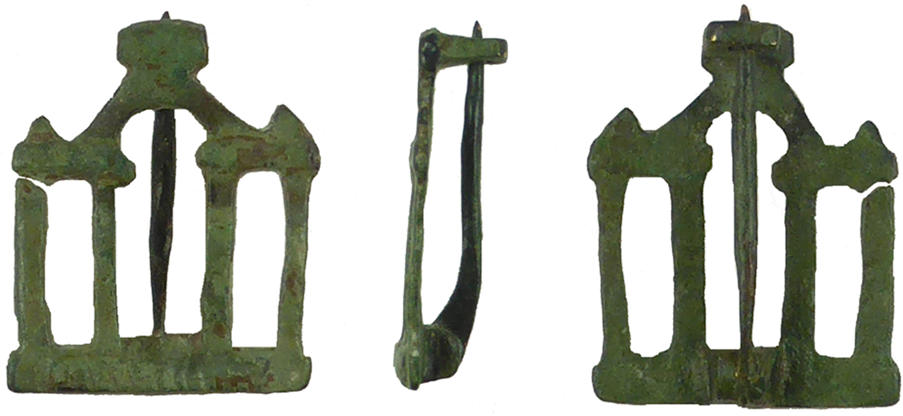
(22) Lenham (PUBLIC-53EF58) (fig. 22).Footnote 103 A near-complete copper-alloy openwork brooch of temple form with an even dark-green patina. The brooch is 32.6 mm high, 24.6 mm wide, is a maximum of 7.3 mm thick at the catchplate and weighs 6 g. The brooch comprises struts linked to represent architectural features. From a horizontal base rise four bars representing the columns of a temple façade, the space between the central two being wider than at the sides. Above is a triangular broken pediment (unless the bar representing the entablature has broken at some point, but this was not visible), with triangular projections at both corners and a rectangular projection at the apex. The brooch reverse is flat with a hooked catchplate beneath the pediment, and the hinged pin is secured between two lugs behind the base.
Lenham, openwork brooch (no. 22). Scale 1:1. (Photo: W. Thompson and J. Ahmet; © W. Thompson and Kent County Council)

The brooch seems easiest to interpret as the façade of a Classical temple, showing the porch and the pediment above, with the projections representing acroteria. An alternative possibility is that this shows the tower and ambulatories of a Romano-Celtic temple, with a double pent-roof for the ambulatories, perhaps explaining the discrepancy in the distances between the columns. There are some resemblances to the aedicula models from the Titelberg and neighbouring areas, one of which appears to have a roof of this type.Footnote 104 However the varying distances between the columns can also be explained by the influence on the brooch of coin representations of temples which typically ‘pull’ the central columns of a porch apart to reveal the deity's statue within.Footnote 105
This brooch belongs to the group of so-called architectural fibulae, a rare form of second-century plate brooch. Other examples, albeit with greater detail showing ashlar masonry, are recorded from continental Europe, including one unprovenanced example showing a gateway and another from Chieming, Bavaria, showing a tower.Footnote 106 Architectural representation on other dress accessories include a belt fitting from Szöny, Hungary, showing a similar tower.Footnote 107
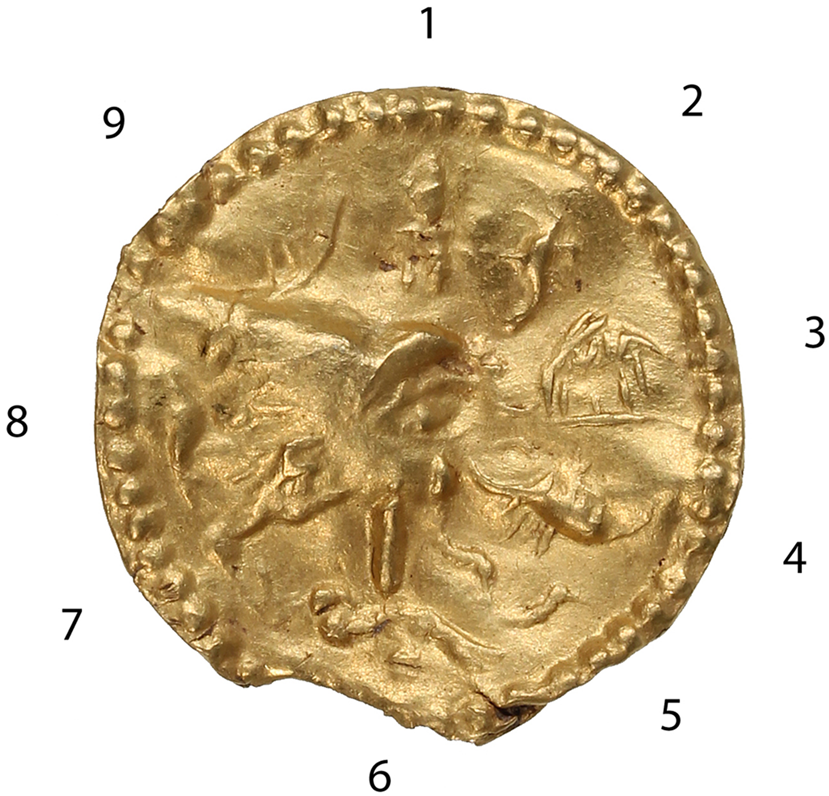
(23) Norton, Buckland and Stone (KENT-DD7BC3 / 2018T734) (fig. 23).Footnote 108 A near-complete gold amulet, 18.3 mm in diameter, 1.2 mm thick and weighing 1.4 g. The amulet is formed from two gold-foil discs, pressed together, with repoussé decoration and set within a beaded border. Damage to the latter may have removed a perforation which allowed the amulet to be suspended, a feature of other examples (see below). In the centre is a lidded open eye, under attack from up to nine animals and weapons which are arranged around it, not all of which are easy to identify. However, on analogy with other amulets of similar form and related images in larger media (mosaics and stone) and on gems, their identity can be suggested with reasonable confidence. We propose the following identifications, working clockwise and noting specific parallels where the motif is not a recurring element:Footnote 109
1 Thunderbolt: recurring, identified from the prongs with sharp right-angled turn;
2 Zoomorphic, long-necked – lizard or bird? (cf. BM Jewellery 2888, Fuveau, Vindobona, Sicily);
3 Elephant? (cf. JHUAM, BM Jewellery 2887);
4 Eight-legged scorpion: recurring, confidently identified from pincers, legs and body shape;
5 Snake: recurring, confidently identified from sinuous form;
6 Winged phallus: testicles to left, wings to right (cf. Fuveau, BM Jewellery 2887, 2888, JHUAM, Sicily);
7 Dog: recurring, identified from pose and body shape;
8 Winged bird?: obscured by distortion, possible spread wings close to beading (cf. BM Jewellery 2888, Vindobona, Sicily);
9 Animal, bow?: limited detail, curving line, from which two short strokes project (for bow, cf. Keswick).
Norton, Buckland and Stone, amulet (no. 23). Scale 3:1. (Photo: J. Ahmet; © Kent County Council)

This is one of a small group of similar foil amulets, the second example to be documented from Britain; the other, rather different in its range of motifs, is also a PAS find, from Keswick, Norfolk (NMS-B9A004 / 2012T142).Footnote 110 In all 16 cases so far collected the eye is beset by diverse creatures and weapons (no doubt more are in museum collections). The same scene appears occasionally in larger media, for example on a mosaic at the entrance to the House of the Evil Eye, Antioch, Syria, and on a marble relief now at Woburn Abbey, and on portable objects, above all gems and lamps.Footnote 111 The number and nature of the attackers vary and, from the first records of these objects by the Comte de Caylus in 1764, have proved sometimes difficult to identify, but the assailants share characteristics enabling them to poke, stab, bite or scratch the eye. The thunderbolt, snake, phallus (sometimes winged) and scorpion appear to be ever-present; weapons, dogs, lions and birds – sometimes identified as ibises and waders, sometimes with wings spread – are common, as are crabs and biting insects. Other motifs are a little less frequent, for example the elephant that links the Kent amulet with two unprovenanced examples in the Johns Hopkins University Archaeological Museum and the British Museum (see above). In general, the nature and configuration of motifs on the Kent amulet are closest to these two, but these amulets are not identical, although the latter two resemble one another closely. Both on the foil discs and related images the motifs are sometimes organised by celestial or solar attackers and man-made weapons placed above or beside the eye, with terrestrial animals and chthonic creatures below.Footnote 112 As R. Chinelli and C.A. Faraone note, the animals chosen correspond to those documented in scenes linked to individual deities, for example the dog, scorpion and snake in Mithraic tauroctonies, or the chthonic creatures that crawl over the hands linked to Sabazios.Footnote 113 The variability suggests that this is a widespread tradition, adapted according to shared principles on the occasion of making individual amulets. The suspension elements on most examples, whether a hole pierced through the border or loops fitted to the object, or both, as in the case of the British Museum Hamilton collection disc, suggest that it may have been worn, presumably close to the body, to fulfil its apotropaic function. The provenance where known is very diverse, including three Italian contexts – Sicily, Herculaneum and Massa Marittima (Grosseto) – Fuveau near Marseille, Vienna and Mainz, as well as the two British examples. Nearby Watling Street, a kilometre's distance from the findspot and linking London to the channel ports, likely brought this amulet to rural Kent. Amulets of this kind are usually dated to the mid- to late Imperial period, but the example from a first-century a.d. burial in Tuscany suggests a longer-established tradition developed from Greek antecedents.Footnote 114
HAMPSHIRE
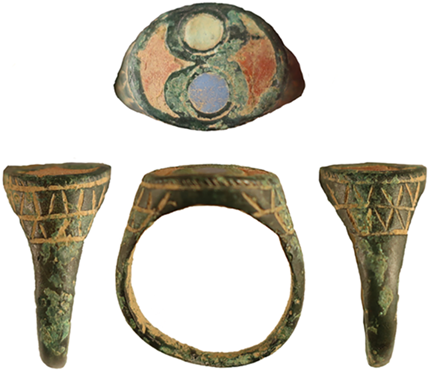
(24) Itchen Valley (BERK-89ED85) (fig. 24).Footnote 115 A complete copper-alloy finger-ring with mid- to dark-green patina. The near-circular hoop is 20.2 mm in diameter and 2.7 mm thick; the ring is 11.4 mm wide at the bezel and weighs 4.3 g. The shoulders carry incised decoration, two bands of short alternating diagonal strokes separated by an incised line. The shoulders broaden to form a flat, oval bezel, framed by short parallel incisions. The bezel is decorated with enamel-inlaid cells separated by reserved metal, two pellets in the centre, one inlaid with blue and the other with the decayed residue of another colour, and two peltiform cells at the ends, inlaid with red enamel.
Itchen Valley, finger-ring (no. 24). Scale 1:1. (Photo: H. Costas; © Portable Antiquities Scheme)

The many enamelled rings now recorded by the PAS allows this example to be associated with others in a previously unnoticed type. More than 25 examples have been documented, their distribution lying mainly in central-southern England, especially Oxfordshire, with smaller numbers in neighbouring counties and outliers in eastern England. The shared characteristics are an oval bezel which carries two or occasionally more circular recesses, inlaid in red and blue enamel, some with lines incised across the bezel and sometimes around its edge.Footnote 116 Occasionally the decoration is more complex, though with no direct parallels to this case; for example further incision creates pelta shapes on a ring from Childrey, Oxfordshire (ASHM-91F6B3), and on rings from Merton, Oxfordshire (BUC-5B8DF4) and Podington, Bedforshire (BH-2F4923) the circles are in reserved metal, leaving peltas recessed to take red enamel inlay. The enamel decoration suggests a second- to third-century a.d. date.Footnote 117
DORSET
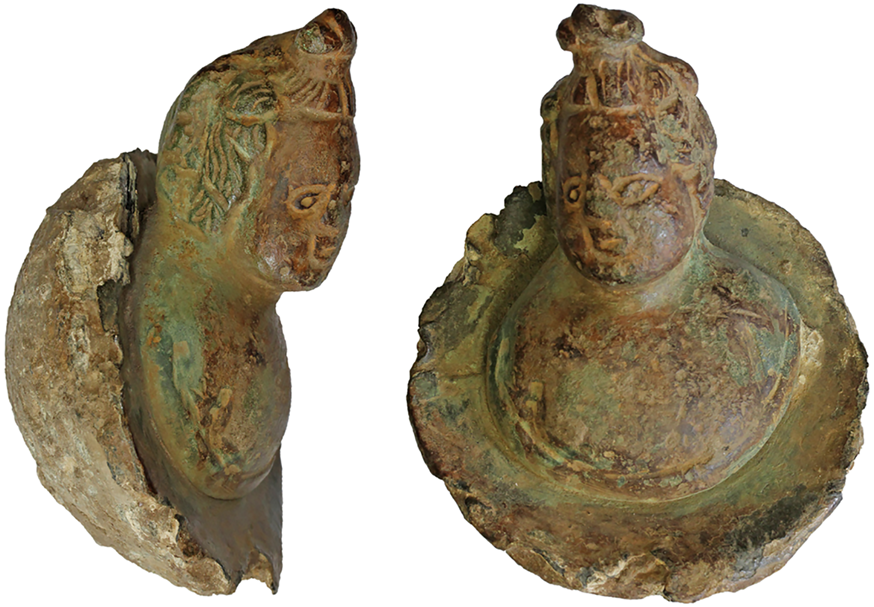
(25) Rampisham (DOR-45611B) (fig. 25).Footnote 118 A lead and copper-alloy steelyard weight in the form of a worn bust, attached to a hemispherical lead mass. The bust is 82.2 mm tall; the lead mass is 78.6 mm at its widest and 35.4 mm thick. The object weighs 1230 g. The bust is of a youthful figure, with head turned to the right, sloping shoulders and chest plain without anatomical detail; the face and especially hair are modelled more fully. The face is rounded with broad cheeks and small chin and slot mouth, worn triangular nose and asymmetrically arranged eyes, with recessed pupils, the left more lentoid than the right, sloping upwards away from the nose. Above a very high forehead the hair is gathered from the temple and crown into a topknot. A thick many-stranded lock falls on either side of the face, while at the back the hair is parted, the parallel strands indicated with incised lines. Iron staining is visible on top of the head. Where the chest meets the lead mass a groove runs around its edge. The lead is cast as a crude hemisphere and has an uneven surface finish.
Rampisham, steelyard weight (no. 25). Scale 1:2. (Photo: C. Hayward Trevarthen; © Somerset County Council)

Two similar steelyard weights have been documented by the PAS, both smaller, one of possible East Anglian provenance (NMS-FE90E7, 862 g) and another from Hambledon, Hampshire (HAMP-079895, 117 g), also taking the form of youthful male faces, albeit with more carefully modelled features, the former very toddler-like, with hair gathered in a topknot. Although associated with some deities (for example Cupid, Harpocrates), the topknot is not sufficiently specific in itself to identify the subject. This find joins a very small number of anthropomorphic weights documented by the PAS; of 530 steelyard weights of Roman date the overwhelming majority are of plain biconical form (over 450).Footnote 119 Twenty-two other figural examples have been documented, the most frequent identifiable type being Minerva.Footnote 120 Most other examples are anthropomorphic, but the subjects are only occasionally identifiable, including gods and Bacchic beings.Footnote 121
This is the heaviest of all steelyard weights of confidently attributed Roman date documented by the PAS, most of which are much lighter. Of the 492 with recorded weights, only three weigh more than a kilogram, and only 29 weigh more than half a kilo.Footnote 122 The weight in this case is quite close to that of four ‘Celtic pounds’, as set out by G. Boon, but, given the general limited correspondence between steelyard weights and ancient units, this is likely to be coincidental.Footnote 123
WILTSHIRE
(26) Codford (DEV-7068D3) (fig. 26).Footnote 124 A cast copper-alloy knife, perhaps, 58.2 mm long, 8.3 mm wide and weighing 5.1 g. The handle ends in a circular attachment loop and carries a spiral groove as decoration. One edge of the blade is slightly curved or keeled, the other is serrated. Part of the tip is broken away, leaving an off-centred triangular point, slightly bent. The blade carries an incised line on both faces and seven ring and ring-and-dot motifs between this line and the curving edge. The object lacks a direct parallel and its purpose is unclear, though its very small size suggests a possible toilet use. The presence of the ring-and-dot motif suggests a fourth- or fifth-century a.d. date.Footnote 125
Codford, toilet instrument? (no. 26). Scale 1:1. (Photo: L. Shipley; © Portable Antiquities Scheme/South West Heritage Trust)

CORNWALL
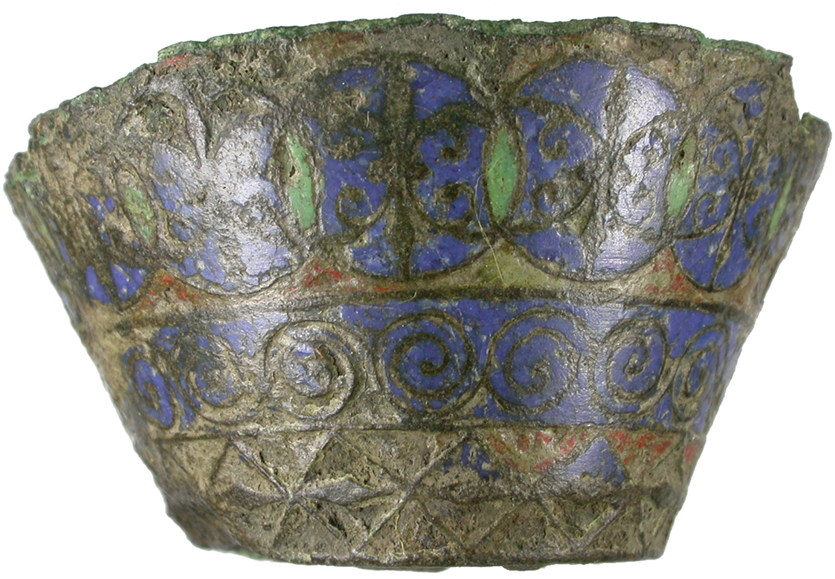
(27) St Levan (CORN-51245B) (fig. 27).Footnote 126 A fragment of a cast copper-alloy enamelled vessel of conical form, 46 mm high, 86 mm in diameter at its widest point, with walls 4 mm thick and weighing 126 g. At the narrower diameter traces survive of one of three likely original flanges to take rivets, enabling a base to be attached and thus identifying which way up the vessel stood. It carries three bands of cast decoration, separated by reserved metal. In the upper band, at the broken edge, roundels overlap against a continuous red enamelled background, of which traces are visible. The intersecting areas of each roundel are inlaid with opaque green enamel, the rest with opaque blue. Reserved metal divides each roundel into six areas, symmetrically organised. It takes the form of two opposed stalks, ending in a small bud, splitting into tendrils on each side and ending in a further leaf and cusp, i.e. a double-ended fleur-de-lis motif. The metal demarcates pairs of wedge-shaped cells at the top and bottom of each roundel and the principal motif of two opposed peltas with oblong extensions adjacent to the green enamel lenses. The middle band comprises spirals alternating clockwise and anticlockwise in raised metal against a blue enamel-inlaid background and the lowest band comprises repeated opposed triangles in blue enamel, set base to base, against a red-enamel background, and separated by lozenges of reserved metal.
St Levan, enamelled vessel fragment (no. 27). Scale 1:1. (Photo: A. Tyacke; © Royal Institution of Cornwall)

Among the diverse enamelled champlevé vessels, the St Levan fragment derives from a straight-sided form. The irregularity of the break at the upper edge suggests that it is not a casting edge, and thus the fragment might be from a tall beaker, but it is not impossible that it derives from one piece of a beaker of bi-conical type, like that from Selborne, Hampshire (106 mm).Footnote 127 If similar to the latter it would connect to a third cast piece through a soldered or stepped join, this multi-piece character also characterises other vessels of this type, for example the bottle from Pressignac, La Guierché (Charente), containing a third-century coin hoard.Footnote 128 The decoration on the St Levan fragment does not closely resemble that on either of these vessels or others where the enamel takes the form of interlocking peltas.Footnote 129 A peltiform motif is present on the St Levan fragment, but subordinated to a scheme based on interlocking roundels. The other motifs can be paralleled on diverse vessels from Germany and Britain. For example the fleur-de-lis motifs from the upper band occur on an enamelled vessel mould from Castleford, the alternating spirals from the middle band on a pan from Bad Pyrmont and bowl from Hockwold-cum-Wilton, while the triangular motifs of the lower band compare with another Castleford mould, albeit with transposition of the reserved metal.Footnote 130 As far as we are aware, however, they are not paralleled in this combination, and this variation on a theme recalls the wider properties of this group, manifesting ‘innovative styles created in the reaction between Celtic and Classical idioms’.Footnote 131