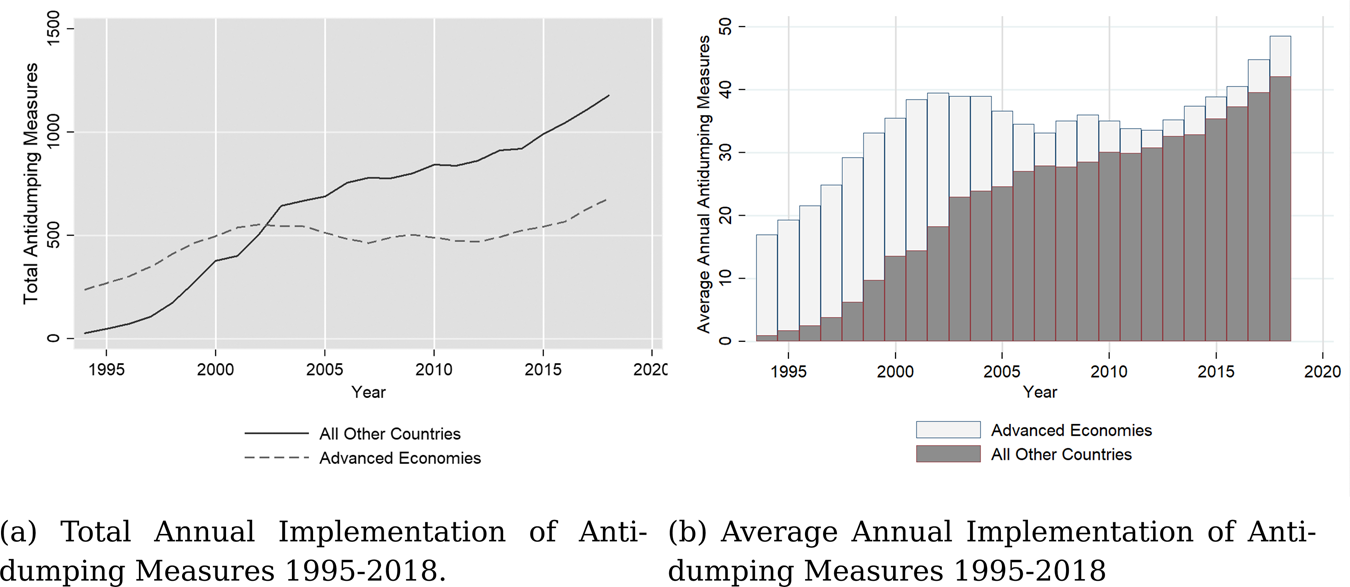


Countries employ antidumping protection measures twice as often today as they did in 1995 (see figure 1). As trade volumes increase, countries apparently resort to antidumping protections more readily. Certainly, governments’ implementation of these tariffs occurs in response to domestic industries’ demand for them. So what factors drive firms to initiate antidumping petitions in the first place? Existing literature focuses on three explanations: real exchange rate appreciations, changes in the business cycle, and retaliation. Empirical evidence for these explanations is based mostly on the experience of advanced economies.Footnote 1 Taken as a whole, however, non-advanced economies now implement more antidumping measures on an annual basis than do high-income economies, and on average implement these measures at the same rate as advanced economies (see figure 1). In this paper, we take up the task of reevaluating existing explanations of demand for antidumping protections against a broader sample of both advanced and middle income countries and develop an alternative theory to explain the demand for antidumping protections that helps account for regional variation in demand.
Total and Average Annual Implementation of Antidumping Measures by Advanced and Other Economies. Source: World Trade Organization.

We argue that the global dynamics of trade liberalization and global production chain integration over the past forty years explain the relatively high average demand for antidumping measures in European, North American, South Asian, and African countries, as compared to the relatively low demand for protection in East Asian countries. Beginning in the mid-to-late 1970s, many advanced economies experienced a period of deindustrialization as corporations shifted their production processes, whether in part or in whole, to developing economies in East Asia. The globalization of consumer product supply chains helped facilitate the development of many countries, especially in East Asia. Additionally, some countries still in the process of developing economically have also experienced the effect of deindustrialization, a phenomenon that Dani Rodrik (Reference Rodrik2016) calls premature deindustrialization. According to Rodrik, the causes of deindustrialization are twofold: economic globalization, which facilitates quicker shifts in corporations’ supply chains depending on the costs of production, and technological innovations, which have made production more efficient and less dependent on human labor. We propose that as countries experience deindustrialization, firms are more likely to demand antidumping protection measures.
We evaluate the effects of deindustrialization, the business cycle, real exchange rate fluctuations, retaliation, and domestic institutions on demand for antidumping protections using a data set on antidumping petitions that covers thirty-four countries from 1978–2015. We find evidence suggesting deindustrialization, real exchange rate movements, and retaliation all motivate demand for antidumping protections.
The macroeconomic determinants of antidumping filings
Despite the dramatic decrease in traditional trade barriers (tariffs and import quotas), the specter of protectionism remains present on the world stage. Many of these trade-stifling policies presently masquerade under a vast array of “fair-trade” (e.g., antidumping) duties and other regulations designed to evade existing trade agreements built on the principle of most-favored nation (MFN) status and treatment.Footnote 2 Antidumping laws have been linked to attempts by rent-seeking firms to cartelize industries and engage in monopolistic pricing.Footnote 3 While traditional trade barriers (e.g., tariffs and import quotas) may have been on the decline globally, antidumping measures appear to be on the rise.
The antidumping filing process has long been characterized by bureaucratic procedures. For example, antidumping petitions in the United States are filed with the Department of Commerce and the International Trade Commission (ITC).Footnote 4 Firms claiming injury due to “unfair” pricing practices (e.g., dumping) may file a petition with the Commerce Department and the ITC. If the petitioner has legal standing, the Commerce Department investigates for evidence that dumping has occurred.Footnote 5 If the department finds that dumping has occurred, it calculates the dumping margin, which is the difference between the export price and the normal value divided by the export price (168). The ITC plays a role in attempting to ascertain whether any “material injuries” were sustained by the firm as a result of foreign dumping. If the ITC affirms that injuries were sustained (alongside an affirmative ruling by the Commerce Department), then the Commerce Department will issue an antidumping duty to offset foreign dumping (or countervailing duties if foreign subsidies are present).Footnote 6 Antidumping filing follows a similar process in the European Union, where the European Commission is charged with investigating allegations of dumping and imposing protective measures.
Previous research has noted and investigated the rapid proliferation of antidumping suits and duties around the globe.Footnote 7 Much of this literature argues that retaliatory motives are the key driving factor underlying the proliferation of antidumping measures.Footnote 8 For example, Vandenbussche and Zanardi (Reference Vandenbussche and Zanardi2008, 93) find that retaliatory motives are “at the heart of the [antidumping] proliferation.” Feinberg and Reynolds (Reference Feinberg and Reynolds2006, 877) find strong evidence suggesting that “retaliation was a significant motive” in explaining the rapid proliferation of antidumping laws and measures. In their 2018 article, they find that:
Only 3 percent of investigations were later challenged under the [WTO's dispute settlement understanding], while countries targeted by these petition filed counter-antidumping petitions in response to as many as 27 percent of the investigations. This suggests that countries find it easier or more effective to retaliate via the [antidumping] process. (Reference Feinberg and Reynolds2018, 1,251)
Retaliatory motives are empirically salient and important, but do not entirely explain firm behavior in filing for antidumping protection. A firm in Country B may file for antidumping protection in retaliation against Country A's antidumping measures, but this does not entirely explain why Country A would have imposed the devices in the first place.Footnote 9 In order to retaliate against another country, antidumping duties must first be imposed by another country. Solely attributing the phenomena to retaliatory motives merely pushes the problem back a step.
Other scholars have found positive associations between antidumping petitions and macroeconomic determinants, giving the greatest attention to the effect of GDP growth, the business cycle, unemployment, and import growth.Footnote 10 According to these explanations, recessions and economic downturns are characterized by higher demands for antidumping duties and protectionist trade barriers. These studies also emphasize that import growth should be the most direct determinant of antidumping petitions, as it signals increased competition from foreign companies, which domestic producers may construe as dumping. Theoretically, these arguments cannot fundamentally explain why firms would only demand antidumping tariffs and duties during economic downturns when they would always benefit from protection.Footnote 11 Empirically, the data in support of the business cycle hypothesis is mixed.Footnote 12 While providing theoretically invaluable contributions to the literature, macroeconomic determinants and business cycles alone do not fully explain the demands for antidumping measures.
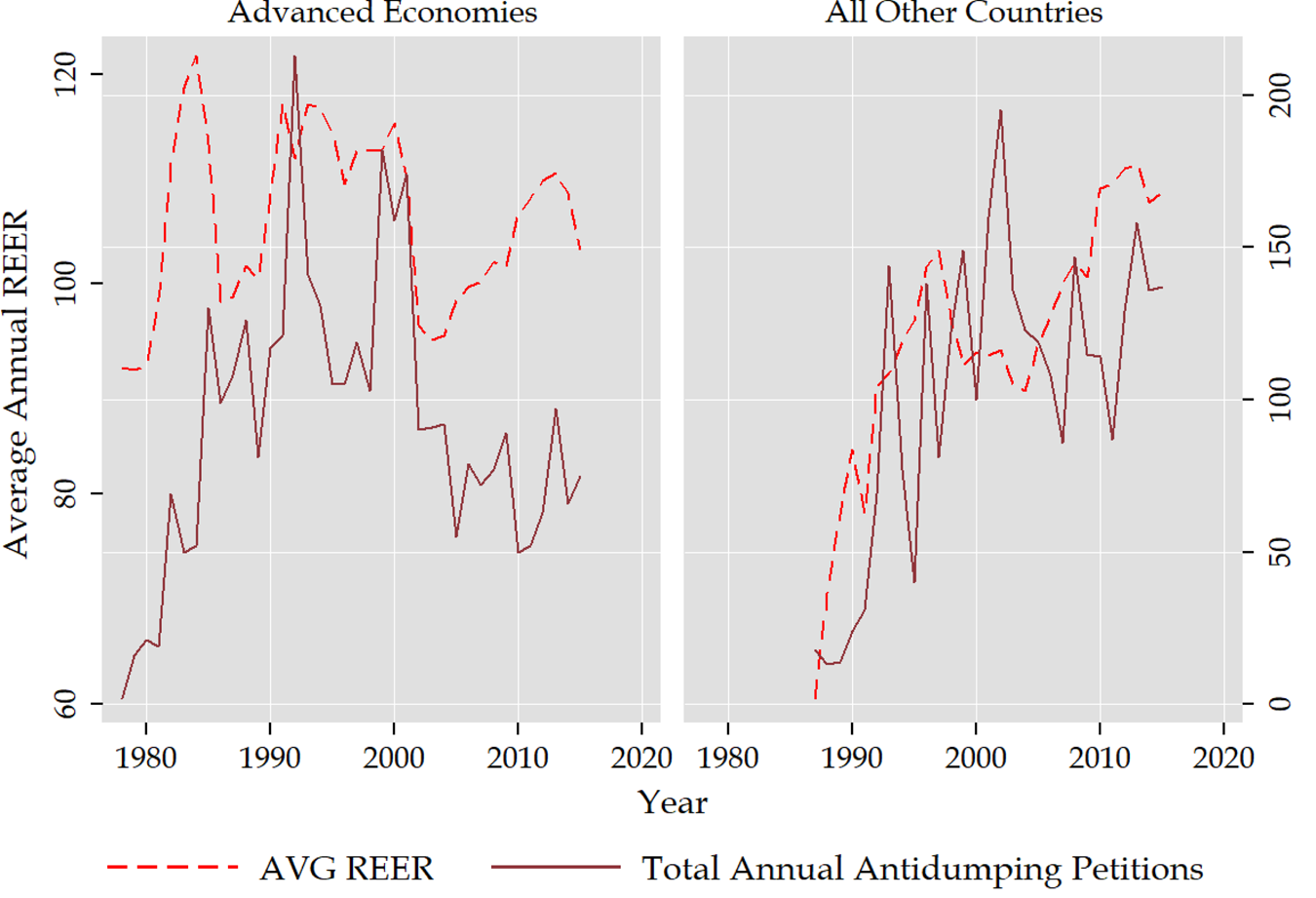
An alternative strand of empirical literature argues that aggregate antidumping petitions vary systematically with movements in exchange rates.Footnote 13 The main proposition of this literature is that industries file antidumping petitions in response to fluctuations in the real exchange rate. Both import-competing firms and export-oriented firms that are harmed by exchange rate appreciations should therefore be more likely to file higher quantities of antidumping petitions to protect themselves from foreign competition, ceteris paribus. The real exchange rate hypothesis has enjoyed robust theoretical and empirical support when tested against alternative arguments advanced in the literature on the political economy of antidumping measures. We find additional empirical evidence suggesting that changes in the real exchange rate correlate with the level of antidumping petitions filed, particularly in developing economies. Figure 2 presents data on the average annual real exchange rate and total annual antidumping petitions filed in advanced and developing countries. Two trends are evident in this figure. First, since 1990, developing economies have experienced more exchange rate appreciation than have advanced economies. Secondly, this difference in the level of exchange rate appreciation roughly tracks the change in the total number of petitions filed in these two groups of countries over the same period.
Antidumping Petitions and the Real Exchange Rate in Advanced and Other Economies. Data on antidumping petitions come from the Global Antidumping Database hosted by the World Bank and compiled by Bown (Reference Bown2016). Data on real exchange rates come from Bruegels real (REER) database.

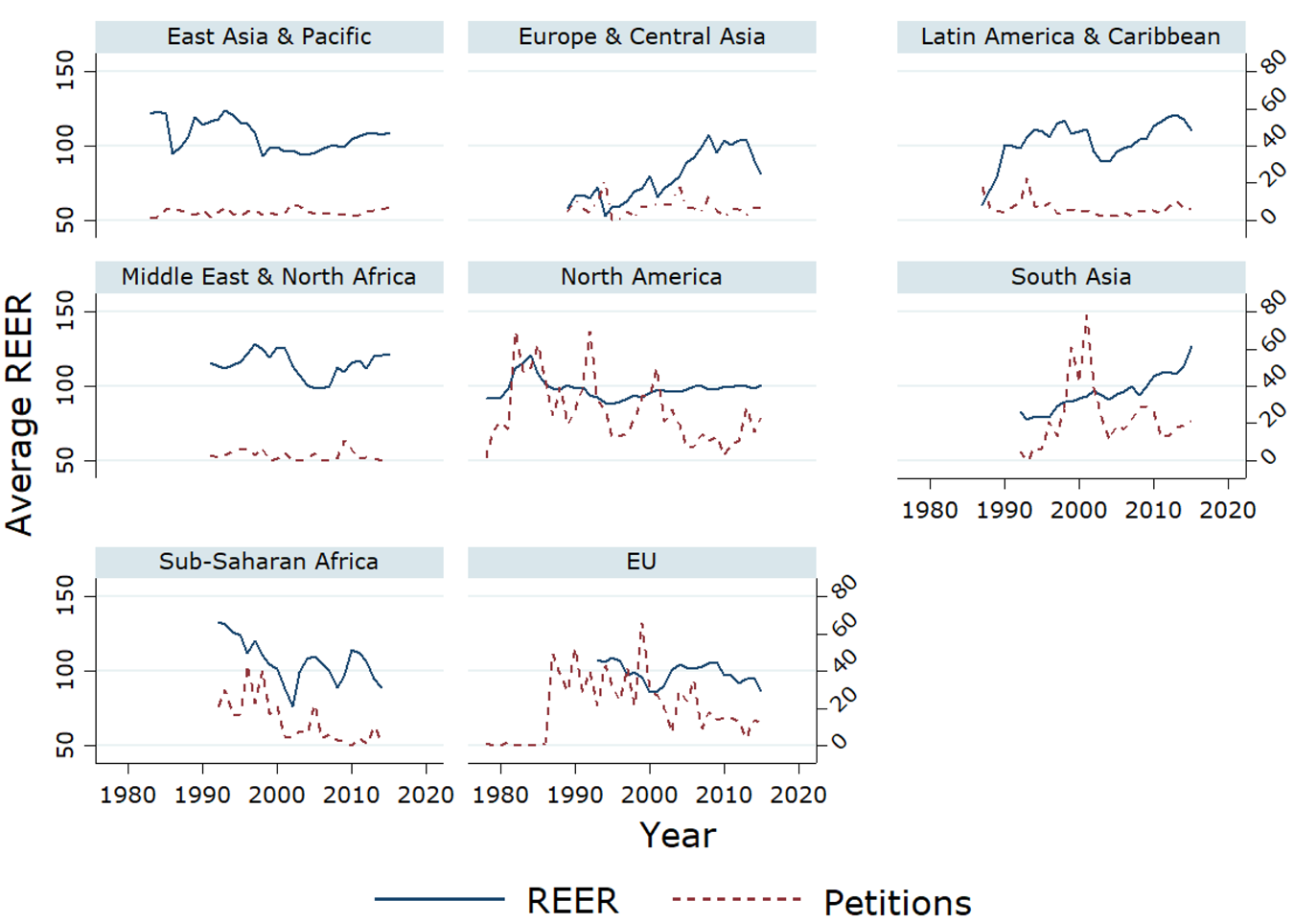
While the robust empirical support of the effect of the real exchange rate is logical and helps to explain the increase in demand for antidumping petitions in developing countries as a whole, a closer examination of regional-specific trends and antidumping petitions reveals some remaining variation in demand for protection yet to be explained. Figure 3 presents the average real exchange rate and the average number of antidumping petitions filed in each year, by region. In this figure, we observe slightly more depreciation than appreciation in the currencies of countries in North America and Europe. Indeed, they have slightly more stable exchange rates. And yet, demand for protection in these regions varies considerably, and even peaks a few times during periods of currency depreciation. Aggregate demand for antidumping petitions in these regions has also remained higher than in other regions despite currency depreciation. Part of the answer to these anomalies is certainly that the advanced economies in these regions started with higher exchange rate values than most of the developing countries in other regions. But we notice anomalous trends in other regions as well.
Average REER and Antidumping Petitions by region. Data on antidumping petitions come from the Global Antidumping Database hosted by the World Bank and compiled by Bown (Reference Bown2016). Data on real exchange rates come from Bruegels real (REER) database.

In East Asian countries, demand for antidumping petitions remained flat even during the period of highest exchange rate appreciation in 1990s. In South Asian countries (e.g., India and Pakistan), whose currencies were not especially appreciated relative to other developing countries, demand for antidumping petitions has been relatively high, and the correlation between exchange rate appreciation and the number of antidumping petitions is least clear. In fact, it appears as though appreciation has been accompanied by a drop in demand for protection. Middle Eastern countries have experienced significant appreciation but have consistently filed a low number of antidumping petitions. The relationship between exchange rates and currency appreciation appears tighter in Sub-Saharan African countries, but demand for protection has tapered off even though appreciation has resumed somewhat. It is therefore likely that additional variables contribute to demand for antidumping protections.
We propose that another contributing factor to demand for antidumping protection is the structure of international trade, particularly the shifts in global supply chain integration that have occurred over the past few decades. As traditional protectionist measures have declined, international corporations have integrated their supply chains and outsourced labor-intensive manufacturing processes to labor-abundant countries. It is not unusual for international corporations to import and export intermediate goods into and out of several countries before delivering final products to market. These changes, along with technological innovation, have facilitated deindustrialization in many economies. In turn, we argue that deindustrialization fuels demand for antidumping protections.
How globalization and deindustrialization create demand for antidumping protections
Beginning in the late 1970s, with the proliferation of the fax machine, the telecommunications revolution facilitated a radical transformation in global supply chains. Prior to the 1970s, global supply chains were concentrated in European countries, America, and, to some extent, Japan. To the extent that other countries participated in international trade, they largely exported raw materials to advanced economies for processing. Over the course of the 1980s, global supply chains shifted dramatically, fragmenting across newly industrializing economies in East Asia. Now, intermediate product inputs constitute a large percentage of international trade and many consumer products are produced in multiple stages across multiple countries. A 2010 World Bank Report explains:
Imported intermediate input content accounts for about one-quarter of OECD economies’ exports, and the European Central Bank (ECB) estimates that such imports accounted for about 44 percent of EU exports (or 20 percent for imports from outside of the EU) in 2000, ranging from about 35 percent in Italy to about 59 percent in the Netherlands. In the United States, imported intermediate input content in exports reached about 10 percent in 2005. Among emerging economies, imported content's share in exports is particularly high in China - about 30 percent, or twice that for India and Brazil. (Reference Oatley2010, 6)
This evolution in the global supply chain has facilitated deindustrialization. Deindustrialization is the decline of manufacturing, usually measured as industry's or manufacturing's value added or share of employment. Technological innovations that have increased automation in manufacturing have likely been the largest driver of deindustrialization worldwide, but changes in the global supply chains have also contributed to the trend.Footnote 14 Deindustrialization has been concentrated in the advanced economies of North America and Europe, which have smaller and more expensive supplies of labor that have gradually been reallocated to the services sector as North-South trade has facilitated increased imports of manufactured goods.Footnote 15
In the United States, for example, manufacturing's share of employment has fallen steadily since the 1950s, from about one quarter to one tenth, as American corporations operating internationally have moved production overseas and invested in manufacturing technologies that require far less human labor.Footnote 16 The 1980s are largely viewed as the hay day of American deindustrialization.Footnote 17 America experienced a recession in the early 1980s that was compounded by stiff competition from Japanese manufacturing. As a result, the United States saw steep declines in manufacturing value added and manufacturing's share of employment throughout the decade. A slew of large factory closings in the United States made headlines in the 1980s—Ford, Chrysler, Firestone, the United States Steel Corporation, and Pabst, to name a few. The trend in factory closings was epitomized by GM's factory closings in and around Flint, Michigan, which devastated the town's economy. A similar deindustrialization trend occurred in Great Britain in the 1970s and ’80s.Footnote 18 Deindustrialization in other advanced economies followed suit.
Interestingly, Rodrik (Reference Rodrik2016) finds significant declines in manufacturing's share of employment for developing economies in two regions of the Global South: Africa and Latin America. In countries in these regions, Rodrik refers to deindustrialization as “premature” because the process of deindustrialization began at income levels that are a small fraction of the income levels at which deindustrialization began in advanced economies. Like deindustrialization in the Global North, the trend in premature deindustrialization may also be explained in part by patterns of international trade that prevailed after trade liberalization. Many Asian countries quickly replaced import substitution industrialization policies with export-oriented growth strategies, while Latin America and Africa experimented with neoliberal reforms without such a replacement strategy. Export-oriented growth policies gave Asian countries an advantage in manufacturing. Combined with export-oriented industrial policies, liberalization in Asian countries succeeded in helping these countries to attract high levels of foreign direct investment that fostered a booming manufacturing sector. Additionally, some Asian countries were able to utilize their comparative advantage in labor to attract foreign direct investment in manufacturing before many African and Latin American countries implemented substantial trade reforms. In contrast, many African and Latin American countries experienced premature deindustrialization as industries that developed behind tariffs were exposed to import competition from Asia upon liberalization. Rodrik (Reference Rodrik2016, 4) supports this narrative:
As developing countries opened up to trade, their manufacturing sectors were hit by a double whammy. Those without a strong comparative advantage in manufacturing became net importers of manufacturing, reversing a long process of “import” substitution. In addition, developing countries “imported” deindustrialization from the advanced countries, because they became exposed to the relative price trends produced in the advanced economies. The decline in the relative price of manufacturing in the advanced countries put a squeeze on manufacturing everywhere, including the countries that may not have experienced much technological progress.
While Latin American countries and African countries (excluding Mauritius and Nigeria) have experienced the worst levels of deindustrialization, Southeast Asian and Pacific countries have largely avoided it. As Rodrik (Reference Rodrik2016) concludes: “Asia has not only bucked the global trend in manufacturing employment, it has managed to maintain stronger manufacturing performance than would be expected on the basis of its income and demography.”Footnote 19
Deindustrialization likely fuels demand for antidumping protections. In advanced countries experiencing deindustrialization, trade liberalization has enabled ambitious corporations to internationalize production and reduce the cost of labor in manufacturing labor-intensive consumer products. However, offshoring and outsourcing have had a major unintended consequence. Once corporations internationalize, outsource, and offshore, their industry-specific knowledge, trade secrets, and intellectual property have become steadily diffused, enabling new foreign competition to emerge and produce cheaper imitations or substitutes for export. These firms have generated intense import competition for firms in advanced economies.Footnote 20 For example, Españ (Reference España2013, 43) explains the effect of offshoring on US consumer tech companies in the 1980s and 1990s:
Many Asian companies that for decades acted as OEMs, Original Equipment Manufacturers, learned to master the technology and became global competitors. In the process, many US corporations lost the ability to design and manufacture products they had invented, such as LCD screens or hard drives, becoming importers, increasingly dependent on Asian manufacturers. Several Asian companies evolved from OEMs to ODMs, Original Design Manufacturers, and finally OBMs, Original Brand Manufacturers, like Samsung, Acer or ASUS, and the path is repeating itself in the electronic industry in the case of smart phones, tablets and notebooks, among other products. In the process, U.S. design capabilities and manufacturing skills disappeared.
As a result of offshoring and outsourcing, established industries in advanced economies, whether they have engaged in outsourcing and offshoring or are just competitors of firms that have, have faced increasing competition from imported goods produced by developing country firms with much lower overhead costs. Foreign imports can be sold through a variety of distribution markets in advanced economies for much lower prices. In response to these dynamics, import competing firms in advanced economies that have undergone deindustrialization have become more likely to file for antidumping protections with their national governments.
In middle-income countries in Latin America and Africa that have experienced deindustrialization at lower levels of income, established manufacturing industries became unable to compete with foreign companies after reform. These foreign companies include large, international corporations that have internationalized and fragmented their production chains to take advantage of cheap labor in labor-abundant Asian countries, as well as younger East Asian companies that developed by participating in global supply chains of consumer goods destined for advanced economies. Many manufacturing firms in middle income countries in Africa and Latin America grew up under a shield of tariff protection during the period of import substitution industrialization. Once these countries embraced liberalization, foreign firms were able to out-compete local industry, drive down prices, and motivate local industry to file antidumping petitions.
While political institutions may play an influential role in the actual levels of protectionism, antidumping protections are created via a bureaucratic process, rather than a legal or institutional process, and antidumping petitions are a reflection of raw economic demand for protectionism. We propose simply that deindustrialization and premature deindustrialization, both driven by trends in trade liberalization and global production chains, will increase the number of import-competing firms in a country and motivate these firms to seek antidumping protections.
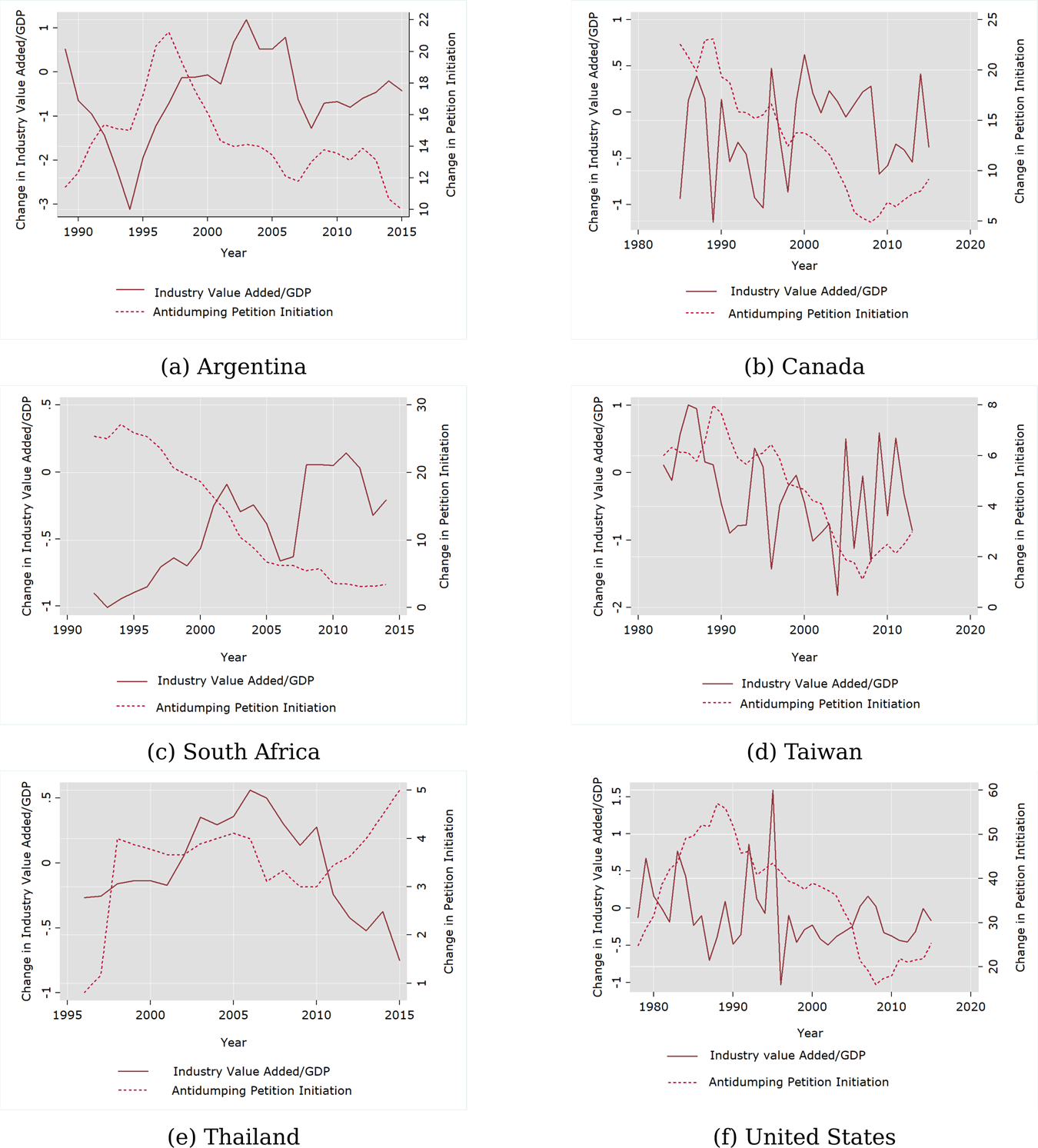
Preliminary evidence suggests that manufacturing strength aligns reasonably well with trends in demand for antidumping protections. Figure 4 plots the five-year moving average of the change in industry value added as a percentage of GDP against the five-year moving average of the change in antidumping petitions filed for six countries. We expect to see the two series move in continuous counterpoint, so that large negative changes in industry value added (the solid line) correspond to large positive changes in antidumping petition initiation (the dotted line). We should note and acknowledge that deindustrialization occurs more often than increases in industry valued added in the country-years in our data sample, which is apparent in these charts. This is an artifact of technological advancements in manufacturing that have reduced the need for human labor. These trends have also heavily contributed to trends in deindustrialization. Despite this broader and more general trend, we can observe the two moving average series moving in counterpoint in all of the subfigures included in 4, to some degree. The empirical relationship is clearest in subfigures a, b, c, and e, which correspond to Argentina, Canada, South Africa, and Thailand. Each of these cases are a good example of the relationship between international trade and deindustrialization affected by trade liberalization, which we have described.
Time series graphs depicting the five-year moving average of industry value added as a percentage of GDP and antidumping petition initiations. Data on industry value added are produced by the World Bank.Data on antidumping petitions are produced by Bown (Reference Bown2016).

Canada and the United States epitomize the deindustrialization experience of the advanced economies. Canada, like the United States, has mostly experienced deindustrialization since 1980, a function of long-term trade liberalization and increased automation in manufacturing. Interestingly, however, there is evidence that changes in industry value added have stabilized over time in both countries. In the 1980s, declines in industry value added corresponded with larger increases in demand for protections. Over time, as the declines in manufacturing have become smaller and more stable, and Canada experienced the occasional minor growth spurt in industry value added, the demand for antidumping protections tapered off. This trend is evident in the US graph as well and, in part, reflects the reality of increasingly complex supply chains. Integrated, complex supply chains have allowed large international corporations that are based in advanced economies and that rely on a multitude of foreign sub-contractors to compete with companies in middle income and new industrialized economies whose labor supply is more abundant and less expensive. New petition initiation has been lower in the United States since the mid-1990s, and this likely reflects the point in time at which many large American corporations embraced outsourcing and their global production chains became so complex and integrated that seeking antidumping protections became less advantageous because doing so could spark retaliatory efforts by foreign companies that could reduce the expected gains from compensatory antidumping tariffs.Footnote 21 Admittedly, one major difference between the experiences of the United States and Canada is that scale of demand for antidumping petitions in Canada has been much smaller than in the United States, but this might be explained by the fact that Canada also experienced less severe declines in industry value added.
South Africa and Latin American epitomize the premature deindustrialization experience of developing countries who embraced neoliberal reforms without an active export-oriented growth strategy to replace former import substitution industrialization (ISI) policies. In South Africa, trade liberalization after the fall of Apartheid created competition between imported products and those produced by formerly protected industries, which initially proved harmful for South African companies. This resulted in a spike in demand for antidumping protections, which slowly eased as South Africa's manufacturing industry recovered somewhat post-2005. Argentina's reforms occurred around the same time as South Africa's and had similar initial effects. Following substantial economic and trade reforms in the 1990s, Argentina's formerly protected industry faced steep international competition, and demand for antidumping protections was high. However, Argentina back-tracked reforms in 2001 and returned to some former ISI policies. This actually slowed deindustrialization (though it was not enough to jump start growth in industry), and had the added effect of reducing demand for antidumping protections.
Finally, Thailand epitomizes the experience of rapid industrialization in East Asian countries, whose exported oriented growth policies succeeded in earning them a secure place in the global supply chains that funnel consumer goods to advanced economies. Thailand experienced increases in industry value added, especially after the Asian financial crisis ended and before international demand fell off following the 2008 financial crisis. Following a series of economic and trade reforms in the early and mid-1980s, including Thailand's accession to the WTO, Thailand became the fastest growing country in the world. Manufacturing sectors performed well thanks to high levels of foreign direct investment from more advanced economies in North America, Europe, and Asia. The government embraced an export-led growth strategy and revised the tax code to favor labor-intensive manufacturing. During the crisis-free interval of time, Thai companies increased demand for antidumping petitions only very slightly. However, demand picked up rapidly when industry value added collapsed after the 2008 financial crisis.
In the next section, we evaluate how well the experiences of these countries generalize to a cross-sectional data set of thirty-four middle and high income countries. Specifically, we evaluate the following hypothesis:
H1. Long-term declines in the strength of a country's industrial and manufacturing sectors increases the demand for antidumping protections, while growth in a country's industrial capacity reduces the demand for protection.
We evaluate the evidence for this hypothesis alongside evidence for existing explanations of antidumping petitions, including exchange rate fluctuations and business cycle changes.
Data and models
To evaluate the empirical evidence for the various explanations of antidumping petitions that we have outlined, we analyze data on antidumping petitions filed in thirty-four countries between 1978 and 2015.Footnote 22 We focus on petitions filed rather than petitions that were approved and implemented because petitions filed is a purer measure of demand on the part of corporations. Petitions filed and those implemented are highly correlated, but on average only six out of nine petitions filed are approved and implemented. To explain which petitions are approved and implemented, we would have to construct a theory of the politics of numerous bureaucratic agencies tasked with evaluating the petitions, which is largely outside of the scope of this paper.Footnote 23
The data on antidumping petitions files are available from the World Bank via the Temporary Trade Barriers Database (TTBD), and include details on over sixty-five hundred antidumping petitions. The database covers 95 percent of all antidumping petitions filed for the period 1978–2015. For a list of country years covered by the data, refer to table 3 in the Appendix. The data range from 0 to 94, with a mean of 9.2 and a standard deviation of 13.7, meaning the count distribution exhibits overdispersion. Overdispersion must be accounted for; not modeling these elements affects the standard errors and undermines the validity of t-statistics in statistical estimates.Footnote 24 We therefore employ cross-sectional negative binomial regression with fixed effects because the number of country-year observations is less than twenty.Footnote 25 We consider logging the dependent variable in order to utilize OLS regression, but the logged data still exhibit qualities of non-normality. Indeed, a Shapiro-Wilkes test confirmed that even the logged dependent variable is not normally distributed.
In order to control for a wide vary of variables, and not induce bias in the regression estimates via case-wide deletion, we impute our data. Table 2 in the Appendix produces statistics on missingness. On average, data for the variables is 11 percent missing. We run thirty imputations using the Amelia package in R. Diagnostic plots for the data imputation are presented in the appendix.
Autocorrelation is present in the antidumping petition data.Footnote 26 However, due to the limitations inherent to count modeling techniques, accounting for both overdispersion and autocorrelation can be difficult, especially when working with imputed data as software options for running autoregressive Poisson or negative binomial models using cross-sectional timeseries and imputed data are nonexistent. Tradeoffs are therefore necessary.Footnote 27 In the Appendix, we employ a Poisson autoregressive model on non-imputed data to demonstrate the robustness of key variables to a model specification that can account for autocorrelation but cannot correct for panel level homoskedasticity or bias induced by case-wise deletion.Footnote 28 The model results are reported in the Appendix.
Main explanatory variables
We focus on two main explanatory variables: industry value added as a percentage of GDP and the percentage of the workforce employed in manufacturing. We expect the primary measure, industry value added, to perform best for two reasons. First, the data for this variable has fewer missing observations. Secondly companies that file antidumping claims are more likely to be sensitive to changes in their own productive capacity than to changes in their level of employment. Indeed some declines in employment might be a positive development if this correlates with an increase in average worker productivity and efficiency.
Industry value added as a percentage of GDP
This is the longest running and most widely available measure of the size of countries’ manufacturing sectors. Industry corresponds to ISIC divisions 10-45 and includes manufacturing (ISIC divisions 15-37). While manufacturing specific measures are available, they are available for less than half of the years for which we have antidumping data for many key countries, including the United States. The World Bank produces the data. To capture the long run change in deindustrialization, we employ the five-year moving average in the annual change of this variable. We expect this variable to be negatively correlated with the number of antidumping petitions.
Percentage of workforce employed in manufacturing
This is a measure of the level of deindustrialization that has occurred in a country. We use this data to demonstrate robustness because the data availability is substantially less than industry value added (approximately 30 percent missing and missing entirely for some countries). The data are taken from the Groningen Growth and Development Center (GGDC).Footnote 29 These data exist for just forty-two countries, both developed and developing, from the 1950s to 2010. To capture the long run change in deindustrialization, we employ the five-year moving average in the annual change of this variable as well as the change in the value of this variable from the five-year lagged value. We expect this variable to be negatively correlated with the number of antidumping petitions.
Economic control variables
Real exchange rate
The real exchange rate is one of our primary explanatory variables. Real exchange rate movements are collected from Bruegel's real effective exchange rate (REER) database.Footnote 30 “Real Exchange Rate” is a CPI-adjusted measure calculated annually for 178 countries and is available from 1960–2018. The measure incorporates time-invariant weights and is constructed against a basket of several countries. The database also includes data unavailable in other datasets. Theoretically, increases or appreciations in real exchange rates should be associated with higher quantities of antidumping petition initiations. We therefore expect a positive association between real exchange rate appreciations and aggregate antidumping petitions filed.
GDP growth
GDP Growth is included as a control variable to account for causal mechanisms linked to business cycles. Data for GDP is collected from the World Bank World Development Indicators. It is specifically operationalized as percent change in annual GDP (current international dollars).Footnote 31 We expect a negative coefficient for this variable.
Unemployment
Some scholars have emphasized the role of business cycles in driving protectionism and antidumping petitions. We include unemployment to account for alternative factors linked to business cycles. It is defined as the percent of the civilian labor force actively seeking employment. Theoretically, higher rates of unemployment should be positively associated with larger quantities of antidumping petitions filed. This data is gathered from the World Bank World Development Indicators database.
Import growth
“Import Growth” is the annual percent change in imports. Omitting import growth would risk wrongly attributing changes in antidumping petition initiations to exchange rate movements when they are in fact a function of greater import competition.Footnote 32 The World Bank World Development Indicators database produces this data.
Total annual imports
We include this variable to control for the fact that countries who conduct a larger volume of trade will, all else equal, have more industries that could file for antidumping protection. The World Bank World Development Indicators database produces this data.
Economic retaliation
To control for the tit-for-tat dynamics that can affect antidumping protectionism, we create a measure of retaliation against each country by summing up the number of antidumping petitions filed against each country by every other country each year in the Global Antidumping Database.Footnote 33
Domestic political controls
Given the evidence for the effect of the real exchange rate regime, three other domestic institutional variables may be consequential for explaining the regional variation in demand for antidumping protection: the exchange rate regime, central bank independence, and the type of political regime. The effect of these variables is under-explored in the literature, but could reasonably affect variation in demand for protection.
Exchange rate regime
Exchange rate regime flexibility may affect the demand for antidumping protections by affecting the probability that an economy faces fluctuations in exchange rates. Fixed exchange rate regimes limit the extent to which exchange rates fluctuate on the foreign exchange market. Fixed exchange rate regimes should therefore be associated with fewer antidumping petitions filed. Also, because exchange rates are more volatile under floating exchange rate regimes, currency fluctuations could increase the propensity of firms harmed by exchange rate appreciations to file antidumping petitions, holding other factors constant. However, exchange rate regime flexibility could potentially have the opposite effect if monetary independence also affects demand for antidumping protections. Countries that fix their exchange rate may be more likely to experience inflation, since they will have less control over domestic monetary policy. Inflation could affect domestic demand, which might negatively affect companies’ profits, which could also motivate companies to lobby for protection. We measure exchange rate flexibility with the database compiled by Ilzetzki, Reinhart, and Rogoff (Reference Ilzetzki, Reinhart and Rogoff2017). We rely on the “fine” index to construct two dummy variables for floating and fixed currencies. The floating dummy equals one if a regime is classified as a 12 or 13 under the fine index. The fixed dummy codes as 1 all regimes with a value of 4 or less according to this index.
Central bank independence
Central bank independence might also affect antidumping petition initiations through monetary policy. Broz (Reference Broz2002, 861) argues that central bank independence is associated with low and stable inflation (in transparent political environments). Low inflation may smooth domestic demand for domestic firms’ product, which may help counteract the effect of exchange rate fluctuations on companies’ bottom lines. Alternatively, central bank independence may indicate that a government is less likely to intervene in managing its currency's value, which may mean that firms lobby the government for protection because they are unable to lobby for exchange rate intervention.Footnote 34, Footnote 35
Political regime type
Because the literature on antidumping largely focuses on the experience of advanced economies, such as the United States, the research may take for granted the effect of regime type. The open economy politics (OEP) literature has made a strong case for the effect of regime type or level of democracy on the level of protectionism.Footnote 36 On the one hand, democracies may be more responsive to corporations’ interests both because corporations are free to lobby democratic governments, but also because democratic governments recognize the role that employment levels play in generating popular and electoral support. Thus, corporations may be more willing to spend time filing antidumping petitions in democratic regimes than other types of regimes. Alternatively, democracies tend to be less protectionist than other types of regimes, as politicians have to take a broad range of interests into account when crafting trade policy.Footnote 37 While corporations may be able to easily lobby for protection, they may also realize that doing so is a losing proposition. We include a country's level of democracy in the model to account for domestic political institutions. Democracy is measured with the Polity IV Project's polity2 variable.Footnote 38 Higher values of this score indicate higher levels of democracy.
Results
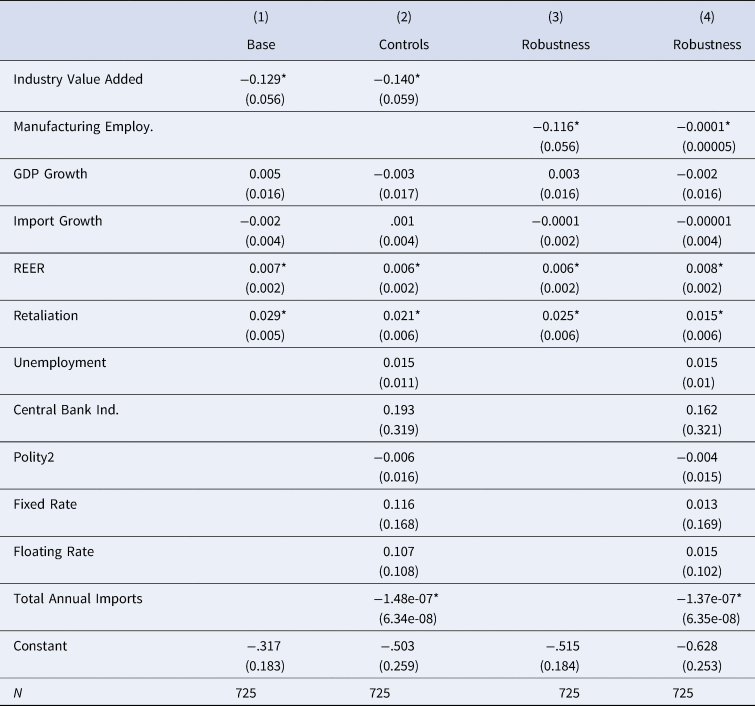
Table 1 presents four models. Model 1 is our base model of petition initiations. It includes variables associated with existing hypotheses we outlined in the literature review: the business cycle hypotheses, the retaliation hypothesis, and the real exchange rate hypothesis. It also includes our main measure of deindustrialization—industry value added as a percentage of GDP. Model 3 presents this model with our secondary measure of deindustrialization—manufacturing employment. Models 2 and 4 include a series of the other control variables. In table 6 in the Appendix, we present autoregressive versions of these models limited to just statistically significant variables to minimize bias induced by case-wide deletion since these models cannot be estimated using imputed data.
Negative binomial regression models of antidumping petition initiation for thirty-four countries from 1978–2014.

Standard errors in parentheses.
* p < 0.05.
Taken as a whole, the models indicate a handful of consistent relationships. First, in line with existing literature that relies on smaller samples of countries, the effect of a country's real exchange rate is very robust. Across all four models, the real exchange rate is positively and significantly correlated with the number of antidumping petitions filed in a country. A one standard deviation increase in the value of the real exchange rate increases the number of antidumping petitions by 12 percent (or about 1 petition). The effect of this variable is not confounded by level of import growth. The coefficient on import growth is never statistically significant and is incorrectly signed in three of the four models. This suggests that real exchange rates are a better determinant of demands for antidumping petitions than are short term increases in import competition.Footnote 39
The effect of retaliation is also robust and statistically significant across all four models, which is also consistent with existing literature. A one standard deviation increase in the number of petitions filed against a countries, increase the number of antidumping petitions filed in that country by approximately 14 percent (or about 1.3 petitions).Footnote 40
Finally, across all models, the level of industry and manufacturing output has a negative and statistically significant effect on the number of antidumping petitions filed. According to the estimates reported in model 1, a one standard deviation increase in industry value added as a percentage of GPD decreases the number of petitions by about 10 percent (or slightly about 0.9 petitions). As well, according to model 3, a one standard deviation increase in manufacturing employment also decreases the number of petitions by about 11 percent (or about 1 petition).Footnote 41
The business cycle hypothesis finds no support in the models in table 1. The sign on the coefficient of GDP growth is inconsistent between the models with and without control variables. The coefficient is correctly signed on unemployment. However, neither the coefficient on GDP growth nor the coefficient on unemployment is statistically significant in any of the four models.
Domestic political institutions also appear to have no effect on demand for antidumping protections. The coefficients on political regime type, central bank independence, and the fixed and floating monetary regime factor variables are all insignificant.
The only control variable that has a statistically significant effect on petition initiation is the size of total annual imports. Predictably, the larger the volume of a nation's imports, the more likely industries will be to file antidumping petitions. The effect of this variable is slightly larger than the other variables. A one standard deviation increase in the volume of a country's imports, increases the number of antidumping petitions by 19 percent (or about 1.67 petitions). This also suggests that industries in countries that have de facto more liberal trade regimes are also more likely to demand antidumping protections.
Overall, the effects of these models confirm existing major hypotheses about the determinants of demand for antidumping petitions. Real exchange rate fluctuations and tit-for-tat dynamics affect national demand for these protections. Additionally, the evidence suggests that long run changes in national comparative advantage in manufacturing, driven by trade liberalization and the globalization of supply chains, also affects national demand for antidumping protections. Domestic political institutions and choice of exchange rate regime appear to do little to mitigate the effect of these global economic changes on industries’ demands. Once a national government embraces trade liberalization, the structure of global trade and production will heavily impact the competitiveness and profitability of a country's industries. In the face of this competitive landscape, industries will pursue every avenue possible to maintain their own survival and the bureaucratic nature of antidumping protections makes these types of protections an appealing prospect.
Implications and conclusion
Our analysis has evaluated the causes of antidumping petition initiations filed by firms in a sample of thirty-five countries. We have juxtaposed several existing hypotheses that have found support using evidence mostly from advanced economies with a new hypothesis about the role of global market dynamics and deindustrialization on demands for antidumping protection. We find a respectable amount of evidence for the main existing hypothesis that exchange rate changes and tit-for-tat retaliatory dynamics create demand for antidumping measures. Appreciations in the real exchange rate incentivize rent-seeking firms to file higher quantities of antidumping petitions. The number of antidumping petitions filed in a country positively correlates with the number of petitions filed against it by other countries in the same year. We also find that in addition to these factors, deindustrialization also shapes demand for antidumping. Limited evidence is offered by the models to support alternative theoretical explanations including the business cycle hypothesis and the role of domestic political institutions.
Future research can improve these findings in a number of ways. First, a dyadic study of antidumping petitions would allow for a more fine-grained evaluation of the hypotheses we've outlined and tested. Such a study would present an improvement over the present study in several ways. First, we would be better able to tease out whether the mechanism that translates exchange rate movements into demands for antidumping measures is import-competition or export competition. If, for example, an increase in a bilateral exchange rate for Country A relative to Country B induces an increase in antidumping petitions filed by companies in Country A against Country B, and this effect is not confounded or accompanied by a significant effect of an increase in imports by Country A from Country B, then we would have reason to believe that firms in Country A that export to B, rather than firms in A that compete with imports from B, may be filing antidumping petitions because of the exchange rate effect.
The dyadic level is also the best level for teasing out the effect of retaliation, which is difficult to control for at the aggregate national level we use because the retaliation measures correlate with values of the lagged dependent variable, increasing the difficulty of adequately modeling autocorrelation. However, current data availability limits researchers’ abilities to pursue these strategies. While long-run data series on bilateral exchange rates exist only for both most developed economies, it is clear from this study that dynamics between developed and developing economies are important dimensions of the increased demand for antidumping protections.
Additionally, innovations in software for estimating autoregressive Poisson models using imputed panel data should facilitate future studies that can more adequately model antidumping petition initiation without bias created by autocorrelation, panel heteroskedasticity, or case-wise deletion. Being able to model all the complexities of this antidumping data would give us more confidence in the relative effect of the different variables we have analyzed.
Lastly, the dynamics that affect antidumping petition initiations may also be different from the dynamics that influence actual antidumping measure implementation. Most notably, the role of domestic politic institutions is likely more substantial in determining the number of petitions are that are successfully granted. Future studies could compare the effect of the variables we have examine on actual antidumping measure initiation. Such studies will have to reconcile data made available by the Global Antidumping DatabaseFootnote 42 and data provided by the WTO on implemented measures.
Despite our data and modeling limitations, this study has replicated the results of existing studies on the determinants of demand for antidumping measures using the broadest cross-sectional time series data available. Additionally, it has proposed and empirically tested another potential causal mechanism: deindustrialization. In conclusion, our analysis suggests that global market dynamics, largely beyond the control of any one particular industry, determine the level of demand for these new forms of protectionism. Whether these protectionist policies ultimately serve to smooth the worst effects of a volatile international economy (as firms who lobby for them hope they might), or instead exacerbate volatility by introducing another variable that can rapidly alter prices remains a pressing question for future studies.
Supplementary material
To view supplementary material for this article, please visit https://doi.org/10.1017/bap.2020.17.