The question of whether parents' physical discipline leads children to become more aggressive, or aggressive children elicit more physical discipline from their parents has long interested developmental scientists (e.g., Lytton, Reference Lytton1990; Patterson, Reid, & Dishion, Reference Patterson, Reid and Dishion1992; Stice & Barrera, Reference Stice and Barrera1995). The research dilemma has been that correlational studies are not well suited to addressing issues of causality. In an observational research design meant to circumvent this problem, children with conduct problems elicited more negative reactions from their own and other mothers than did children without conduct problems, and mothers of children with conduct problems were more coercive with their own children than with other children (Anderson, Lytton, & Romney, Reference Anderson, Lytton and Romney1986; Dumas & LaFreniere, Reference Dumas and LaFreniere1993). Studies such as these suggest the importance of considering reciprocal relations between parents' and children's behavior. Nevertheless, few studies have tested whether such reciprocal effects are ongoing and can be traced over time. Instead, most researchers propose theoretical arguments for one direction of effects (e.g., parenting effects on children), acknowledging as a limitation that the effects may operate in the opposite direction as well. The present study incorporated measures of discipline and child behavior from independent sources at multiple time points to examine reciprocal relations between parents' physical discipline and children's externalizing behavior in two longitudinal studies following children from age 6 to 9 and from age 10 to 15, respectively.
Physical Discipline and Children's Externalizing Behaviors
A large body of research supports the hypothesis that parents' use of physical discipline is related to children's externalizing behaviors (for a review and meta-analysis, see Gershoff, Reference Gershoff2002). Most of this research has treated discipline as the predictor and child externalizing behavior problems as the outcome. Using this framework, physical discipline has been found to predict more child aggression (Eron, Huesmann, & Zelli, Reference Eron, Huesmann, Zelli, Pepler and Rubin1991), delinquency (Farrington & Hawkins, Reference Farrington and Hawkins1991), and criminality (McCord, Reference McCord1991), even controlling for demographic, parenting, and child confounds (Fine, Trentacosta, Izard, Mostow, & Campbell, Reference Fine, Trentacosta, Izard, Mostow and Campbell2004; Weiss, Dodge, Bates, & Pettit, Reference Weiss, Dodge, Bates and Pettit1992).
A smaller body of research has treated child behavior as the predictor and parental behavior as the outcome. This research has shown that children's noncompliance or adverse temperament traits are likely to elicit harsh and punitive discipline from parents (e.g., Campbell, Reference Campbell1990; Catron & Masters, Reference Catron and Masters1993; Flynn, Reference Flynn1998; Larzelere, Reference Larzelere2000; Martin, Reference Martin1981; Scarr & McCartney, Reference Scarr and McCartney1983; Shaw et al., Reference Shaw, Winslow, Owens, Vondra, Cohn and Bell1998; for a review, see Lytton, Reference Lytton1990). Using prospective data from a community sample, Patterson, Bank, and Stoolmiller (Reference Patterson, Bank, Stoolmiller, Montemayor, Adams and Gullotta1990) found that children's antisocial behavior in Grade 4 predicted more problematic parental monitoring and discipline 2 years later, controlling for parenting behaviors in Grade 4. Shaw, Criss, Schonberg, and Beck (Reference Shaw, Criss, Schonberg and Beck2004) reported that high levels of negative child behavior (age 2) were significantly and positively related to parent–child conflict (ages 5 and 6) and poor family hierarchies (age 10). Likewise, Pettit, Laird, Dodge, Bates, and Criss (Reference Pettit, Laird, Bates, Dodge and Criss2001) found that high levels of child externalizing behavior (age 5) were significantly related to subsequent high levels of parental psychological control and low levels of parental monitoring (age 13). In sum, research has documented that harsh and physical discipline practices are linked to later problematic child behavior, and that disruptive child behavior is associated with subsequent parenting.
Reciprocal Effects and Transactional Models
The evidence for both parent and child effects in the literature is consistent with two theoretical perspectives on socialization proposed by Stice and Barrera (Reference Stice and Barrera1995): social mold models and reciprocal effects models. According to social mold models (Hartup, Reference Hartup, Lerner and Spanier1978), socialization processes are like placing a child in a mold, in which parents' behaviors exert their influence on children's development. According to reciprocal effects models (Bell, Reference Bell1968), parents' behaviors influence children's development, but children's behaviors also influence parents' behaviors in a series of cycles over time.
Beginning with Bell's (Reference Bell1968) seminal paper, scholars who have described transactional or reciprocal processes in development have emphasized the bidirectional nature of parent–child relationships (Belsky, Reference Belsky1984; Patterson et al., Reference Patterson, Reid and Dishion1992; Sameroff, Reference Sameroff1975). Bell's early model emphasized reciprocal effects moment by moment, whereas Sameroff's later model focused more heavily on transactions across time. Sameroff's (Reference Sameroff1975) model asserts that children and their parents mutually affect one another when children elicit particular types of responses from their parents and when parents' behavior induces children to behave in particular ways in the future. These ideas are consistent with Patterson's social coercion theory (Patterson, Reference Patterson, Reid, Patterson and Snyder2002; Patterson et al., Reference Patterson, Reid and Dishion1992), which postulates that children often become more hostile, noncompliant, and antisocial in response to parental use of physical discipline, often setting up a cycle of coercion. Specifically, children and parents unwittingly reinforce higher and higher levels of aversive behavior, leading to the use of parental physical discipline and increasing levels of child antisocial behavior. Through these increasingly hostile parent–child interchanges, children may learn that people often acquiesce to their wishes through aggressive and antisocial means, and parents may learn that using physical discipline induces their children's immediate compliance (Gershoff, Reference Gershoff2002), even if the long-term effects are less desirable. Bell's (Reference Bell, Bell and Harper1977) control systems theory proposes that parents and children have particular tolerance levels for one another's behavior. When the parent's or child's behavior exceeds these tolerance levels, the other reacts in a way that can either exacerbate or mitigate the behavior. For example, if a child's aggressive behavior exceeds the parent's upper limit of tolerance, the parent may react through control or punishment. Children may react in a similar manner if parents exceed their tolerance for particular behaviors, responding in an emotionally dysregulated manner. In both cases, parents and children maintain a homeostatic balance by responding in a way to control the partner's behavior when tolerance levels have been exceeded.
Despite several theoretical frameworks suggesting a transactional association between parenting and child behavior, evidence from the literature has been less than consistent. In a two-wave longitudinal study examining reciprocal links between parental discipline and child antisocial behavior among American boys who were 9 to 10 years old at the first assessment, Vuchinich, Bank, and Patterson (Reference Vuchinich, Bank and Patterson1992) reported that antisocial behavior was negatively related to future positive discipline practices, and positive discipline practices were marginally negatively related to subsequent antisocial behavior. In contrast, using data from two longitudinal studies with 6- and 8-year-old boys and girls conducted in different areas of the United States and in four other countries, Eron et al. (Reference Eron, Huesmann, Zelli, Pepler and Rubin1991) found that child aggression was the best predictor of adult aggression toward the child, suggesting that the parent behaviors were likely to be a response to the child's aggression rather than an instigator of the child's aggression. In addition, in a prospective longitudinal design, Stice and Barrera (Reference Stice and Barrera1995) reported reciprocal associations between parenting (i.e., support and control) and adolescent substance use but found stronger evidence for child effects in the link between externalizing behavior and parenting. Using 4 years of data from the Child Development Project (CDP; one of the data sets used in the present study), Laird, Pettit, Bates, and Dodge (Reference Laird, Pettit, Bates and Dodge2003) found reciprocal links between parents' monitoring-related knowledge and adolescents' delinquent behavior such that low parental knowledge predicted increases in youths' delinquent behaviors, and youths' delinquent behaviors predicted decreases in parental knowledge. Sheehan and Watson (Reference Sheehan and Watson2008) used data from four waves of a longitudinal study to find that child aggression at time 1 (child age 7–14) predicted parents' physically and verbally aggressive behavior toward the child at time 2 (child age 8–15), but not at older ages (11–18 or 12–19). In contrast, parents' physically and verbally aggressive behavior toward the child at each time point predicted child aggression at each subsequent time point (through child age 12–19). The discipline measures in the Sheehan and Watson study encompass a range of discipline behaviors, including serious forms of verbal and physical violence that could be considered measures of physical and verbal abuse (e.g., using a knife or firing a gun at the child). Our measures do not include extreme forms of physical abuse. The detrimental effects of physical abuse are widely established; the effects of physical discipline remain more controversial.
Additional evidence for transactional models of socialization was found in a recent special section of the Journal of Abnormal Child Psychology (for a discussion of the themes that emerged from the special section, see Pettit & Arsiwalla, Reference Pettit and Arsiwalla2008). For example, Pardini, Fite, and Burke (Reference Pardini, Fite and Burke2008) examined associations between parents' and teachers' reports of child conduct problems and several parenting behaviors (including the use of physical discipline) for boys followed longitudinally from age 6 to 16 years. They found that the magnitude of parent effects was similar to the magnitude of child effects, even when using different informants for parent and child behaviors and when controlling for several possible confounds; however, they did not simultaneously model bidirectional relations but instead first examined the indicators of parenting as predictors of child behaviors and separately examined child behaviors as predictors of parenting. Pardini et al. also reported some age effects. For example, child conduct problems were associated with decreases in parental monitoring at older ages (13 and 15 years) but not at younger ages (7, 9, and 11 years). Using data from the Pitt Mother–Child Project (PMCP; one of the data sets used in the present study), Gross, Shaw, and Moilanen (Reference Gross, Shaw and Moilanen2008) reported reciprocal associations between boys' externalizing behavior problems and mothers' depressive symptoms, particularly during the transition to formal schooling (ages 5–6) and the transition to adolescence (ages 11–12), with more consistent associations for parent than child effects during both time periods. These studies all provide an important context for the present study, but to our knowledge, ours is the first study to investigate reciprocal relations between parents' use of physical discipline and children's externalizing behavior across several years in a long-term longitudinal study.
Previous research has suggested several factors that may moderate links between parents' use of physical discipline and children's externalizing behaviors. There is some evidence that although more frequent physical discipline is related to more externalizing problems in European American families, this relation may not hold for African American families (Deater-Deckard, Dodge, Bates, & Pettit, Reference Deater-Deckard, Dodge, Bates and Pettit1996; Lansford, Deater-Deckard, Dodge, Bates, & Pettit, Reference Lansford, Deater-Deckard, Dodge, Bates and Pettit2004). Previous research has not found consistent gender differences in links between physical discipline and child externalizing, but examining potential gender differences is important as a test of the generalizability of models reflecting reciprocal relations between parenting and child adjustment. Some studies have found that low socioeconomic status (SES) parents use physical discipline more frequently than do high SES parents (Flynn, Reference Flynn1994); it is not clear whether SES moderates reciprocal associations between physical discipline and child externalizing behaviors. Finally, there is some evidence that although harsh physical discipline is related to child externalizing problems, mild physical discipline may not be (Larzelere, Reference Larzelere2000). Thus, we examined these characteristics of families and discipline severity as potential moderators of the reciprocal relations between physical discipline and child externalizing.
The Present Study
The main question guiding the present study was whether parents' use of physical discipline and children's externalizing behaviors are reciprocally related over the course of children's development from middle childhood to adolescence. We hypothesized a transactional process that develops over time in which child externalizing behavior elicits parents' use of physical discipline, which in turn contributes to an escalation of children's externalizing behavior. Because bidirectional relations between parents' discipline and children's externalizing problems may differ by child age and sociodemographic contexts (see Pettit & Arsiwalla, Reference Pettit and Arsiwalla2008), we included two samples that varied by age and level of socioeconomic adversity. We examined several possible moderators of these relations, including child gender, ethnicity, family SES, and severity of physical discipline. We also sought to address the question of whether child effects were as consistently prevalent as parent effects and whether the strength of these effects differed over the course of development. Given that children's externalizing behaviors (Elliot, Huizinga, & Ageton, Reference Elliott, Huizinga and Ageton1985; Huesmann, Eron, Lefkowitz, & Walder, Reference Huesmann, Eron, Lefkowitz and Walder1984; Loeber & Dishion, Reference Loeber and Dishion1983) and physical discipline (Lansford et al., Reference Lansford, Criss, Dodge, Shaw, Pettit and Bates2009) are often stable over time, we took into account continuity of externalizing behaviors and physical discipline to examine whether physical discipline is related to subsequent externalizing above and beyond initial levels of externalizing and whether externalizing is related to subsequent physical discipline above and beyond initial levels of physical discipline.
Study 1: CDP
Method
Participants
The CDP is a multisite longitudinal study of child development (e.g., Dodge, Bates, & Pettit, Reference Dodge, Bates and Pettit1990). Families with children entering kindergarten were recruited from two cohorts in 1987 and 1988 from three sites: Knoxville and Nashville, Tennessee, and Bloomington, Indiana. During the first assessment at age 5, data were collected from 585 families (52% boys; 81% European American, 17% African American, 2% other ethnic backgrounds; 26% single parent headed families; family SES M = 39.53, SD = 14.01, corresponding to skilled craftsmen, clerical, and sales workers in the Hollingshead, Reference Hollingshead1979, system).
The final CDP subsample used in this study consisted of 562 families (81.7% European American, 16.7% African American, 1.6% other; 51.4% male) who had any mother-reported physical discipline or teacher-reported child externalizing behavior data at ages 6–9. Participating families (n = 562) were compared with nonparticipating families (n = 23) on age 5 demographic variables (child gender, child ethnicity, maternal education, family SES). Out of the four tests performed, significant differences were found only for family SES, F (1, 569) = 4.16, p < .05. Participating families had higher age 5 SES scores (M = 39.76, SD = 13.95) than did nonparticipating families (M = 33.28, SD = 14.70), meaning that attrition from the study was more likely to occur for low SES than high SES families.
Measures
Physical discipline
Physical discipline was assessed annually when the children were ages 6–9 years. During home interviews, mothers reported their own discipline behaviors. They were asked how frequently (0 = never to 4 = about every day) they used various discipline techniques to correct child misbehavior, including two types of physical discipline (i.e., spank with hand, spank with object). The two items were averaged (rs = .28, .30, .44, and .50 for ages 6, 7, 8, and 9 years, respectively, all p < .001; ns = 471 to 499 for ages 6, 7, and 8 when both cohorts provided data, n = 229 at age 9 when only Cohort 1 provided data) to create the physical discipline factor for each year. Physical discipline data at age 9 were collected only from Cohort 1. However, no significant differences were found between Cohorts 1 and 2 on physical discipline at ages 6, 7, and 8 years. Despite the small number of items and relatively low rates of endorsement, the physical discipline scores were approximately normally distributed (skew < 1.54, kurtosis < 1.9).
Externalizing behavior
Child externalizing behavior was assessed annually at ages 6–9 using teacher reports on the 112-item Child Behavior Checklist—Teacher Report Form (Achenbach, Reference Achenbach1991). This scale includes a checklist of behavioral problems, with items such as “gets in many fights” and “disobedient at school.” For each item, teachers rated whether the statement was not true for the child (0), somewhat or sometimes true (1), or very true or often true (2). At each age, the 35 items in the externalizing behavior subscale were summed to create a composite (αs = 0.95, 0.96, 0.96, and 0.96 for ages 6, 7, 8, and 9 years, respectively). To normalize the distributions, a square root transformation was used to reduce modest skew (pretransformation skew = 2.07–2.23, posttransformation skew = 0.79–0.86). The Teacher Report Form means in our CDP sample (see Table 1) were comparable to the Teacher Report Form means reported for a normative sample of nonreferred children of the same age (Achenbach & Rescorla, Reference Achenbach and Rescorla2001).
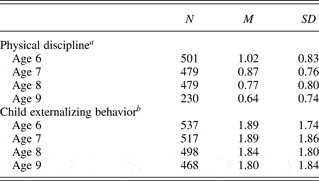
Descriptive statistics for the CDP sample

Note: Physical discipline data at age 9 were available only for Cohort 1. CDP, Child Development Project.
aMother reports.
bTeacher reports.
Results
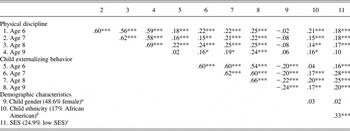
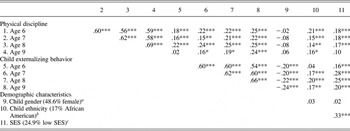
Descriptive statistics and bivariate correlations among the physical discipline and child externalizing variables are shown in Table 1 and Table 2. Mother reports show decreases in the use of physical discipline over time despite correlations showing considerable rank-order stability. Teacher reports show relatively similar levels of child externalizing problems from ages 6 to 9 and considerable rank-order stability. Associations between physical discipline and externalizing problems were positive, with more physical discipline at all ages associated with more externalizing problems at all ages. There were positive bivariate correlations between male gender and teachers' reports of externalizing problems; correlations between gender and physical discipline were not significant. There were positive bivariate correlations between being African American and mothers' reports of physical discipline and teachers' reports of children's externalizing problems at ages 7 through 9. We conducted preliminary analyses to test the relation between physical discipline and behavior problems for linear, quadratic, and cubic effects; no evidence of nonlinear effects was found in the CDP sample.
Bivariate correlations for the CDP sample
Note: CDP, Child Development Project; SES, socioeconomic status.
a0 = male, 1 = female.
b0 = European American, 1 = African American.
c0 = moderate SES, 1 = low SES.
*p < .05. **p < .01. ***p < .001.
Cross-lagged models were fit using MPlus. Missing data were handled using full information maximum likelihood (FIML). All participants with one or more physical discipline or externalizing problem scores were included in the analysis (n = 562). In FIML estimation with missing data, observations are sorted into missing data patterns, and each parameter is estimated using all available data for that particular parameter. Mplus estimates a covariance matrix from raw data and a coverage matrix that describes the extent of missing data. The coverage matrix showed less than 25% missing data for all parameters except those involving physical discipline at age 9. Because physical discipline data at age 9 were only available for the first CDP cohort, missing data ranged from 60% to 61%. Because this was planned missingness (i.e., the whole cohort is missing), the data are missing completely at random and should not bias the estimates (Schafer & Graham, Reference Schafer and Graham2002).
An initial parallel trait autoregressive model was fit to the data. Physical discipline scores at ages 7 through 9 were regressed on physical discipline and externalizing problems 1 year earlier. Likewise, externalizing problems at ages 7 through 9 were regressed on externalizing problems and physical discipline 1 year earlier. The concurrent correlations between physical discipline and externalizing problems also were included in the model. This parallel trait autoregressive model provided a relatively poor fit to the data, χ2 (18) = 215.87, p < .001, comparative fit index (CFI) = 0.867, and root mean square error of approximation (RMSEA) = 0.14.
Inspection of modification indices indicated that model fit could be substantially improved by modeling stability across longer time periods. Therefore, the parallel trait model was modified with additional stability paths so that physical discipline scores at ages 8 and 9 were regressed on physical discipline at all previous time points and externalizing problems at the previous time point. Likewise, externalizing problems at ages 8 and 9 were regressed on externalizing problems at all previous time points and physical discipline at the previous time point. The additional six paths substantially improved the fit of the model to the data, χ2 (12) = 34.95, p < .001, CFI = 0.985, RMSEA = 0.058, Δχ2 (6) = 180.92, p < .001. Next, to test whether stability in physical discipline and externalizing behavior varied across ages, constraints were imposed on the stabilities such that paths modeling stabilities across equal time spans were constrained to be equal within variable. For example, the stability between physical discipline at ages 6 and 8 was constrained to be equal to the stability of physical discipline between ages 7 and 9 because both stabilities are over a 2-year period. The constraints recaptured 6 degrees of freedom. However, the constraints on the stabilities significantly worsened the fit of the model, χ2 (18) = 71.79, p < .001, CFI = 0.964, RMSEA = 0.073, Δχ2 (6) = 36.84, p < .001, and therefore, the constraints were removed. Thus, tests of whether stability varied across ages indicate that stability in physical discipline and externalizing problems does vary significantly from ages 6 to 9.
Next, six cross-lagged paths were added to the model. The addition of the cross-lagged paths improved model fit, χ2 (6) = 7.60, p = .27, CFI = 0.999, RMSEA = 0.02, Δχ2 (6) = 27.35, p < .001, indicating that the transactional model provided a better fit to the data than the parallel trait model. To test whether cross-lagged associations varied across ages, equality constraints were imposed to equate path estimates across the three lags (i.e., age 6 to 7, age 7 to 8, and age 8 to 9). Two separate sets of constraints were imposed. One set constrained the paths from physical discipline to externalizing behavior to be equal across the three lags, and the other set constrained the paths from externalizing behavior to physical discipline to be equal across the three lags. The model specifying temporally invariant cross-lagged paths provided a good fit to the data, χ2 (10) = 11.65, p = .31, CFI = 0.999, RMSEA = 0.017, and model fit did not differ significantly from the model without the temporal invariance constraints, Δχ2 (4) = 4.05, p = .40. Thus, these tests of whether the cross-lagged associations varied across ages indicate that associations do not differ significantly across ages 6 to 9.
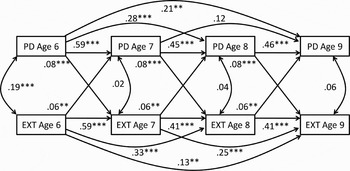
Path values for the transactional model specifying stability over all time lags and temporal invariance in the cross-lagged paths are shown in Figure 1. Parameter values showed considerable stability over both concurrent and distant waves for both physical discipline and externalizing problems with stability appearing to be weaker at older ages as compared to younger ages. The positive association between physical discipline and externalizing problems at age 6 showed that higher initial levels of physical discipline were associated with more initial externalizing problems. The cross-lagged paths showed evidence of a temporal relation between physical discipline at one year and externalizing problems at the next year, such that physical discipline at ages 6, 7, and 8 predicted, albeit modestly, higher levels of externalizing problems at ages 7, 8, and 9, respectively, even when controlling for stability in externalizing problems. The reciprocal relation also held: higher levels of externalizing problems at ages 6, 7, and 8 modestly yet significantly predicted more physical discipline at ages 7, 8, and 9, respectively, even when controlling for stability in physical discipline. The standardized child effects and parent effects were similar in magnitude but an equality constraint imposed on the unstandardized paths significantly worsened model fit Δχ2 (1) = 11.54, p < .001.
The final transactional model fit to Child Development Project data, χ2 (10) = 11.65, p = .31, comparative fit index = 0.999, root mean square error of approximation = 0.017. Error terms are omitted from the figure. PD, mother-reported physical discipline; EXT, teacher-reported child externalizing behavior.

To determine whether the reciprocal relations between physical discipline and externalizing problems were moderated by child gender, ethnicity, or SES, three sets of multigroup models were fit with the reciprocal relations first free and then constrained to be equal for boys and girls, for European American and African American participants, and for low SES and moderate SES participants. Comparison of the free versus constrained path models indicates whether the constrained associations are moderated by group membership. Gender, ethnicity, and SES were tested in separate models to maximize statistical power. SES was dichotomized with membership in Hollingshead's two lowest classes placed into the low SES group (24.9%) and the remaining three classes placed into the moderate SES group.
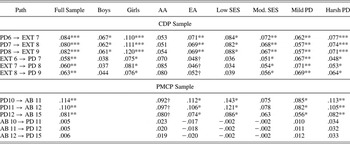
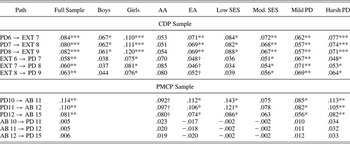
The multigroup model with cross-lagged paths estimated freely for girls and boys provided a good fit to the data, χ2 (20) = 22.69, p = .30, CFI = 0.998, RMSEA = 0.022. As shown in Table 3, all six cross-lagged paths were significant for girls, but only the paths from externalizing problems to physical discipline were marginally significant for boys. When the cross-lagged paths were constrained to be equal for boys and girls, neither the paths from physical discipline to externalizing problems, Δχ2 (1) = 0.97, p = .32, nor the paths from externalizing problems to physical discipline, Δχ2 (1) = 0.86, p = .35, were found to differ significantly across the two groups. Although the cross-lagged paths were not significant for boys, the paths for boys and girls did not differ significantly from one another; thus, we found no evidence that the cross-lagged paths are moderated by gender.
Standardized cross-lag path values for subsample analyses
Note: AA, African American; EA, European American; SES, socioeconomic status; PD, physical discipline; CDP, Child Development Project; EXT, externalizing; PMCP, Pitt Mother–Child Project; AB, antisocial behavior.
†p < .10. *p < .05. **p < .01. ***p < .001.
Likewise, the multigroup model with cross-lagged paths estimated separately for African American and European American participants provided a good fit to the data, χ2 (20) = 15.87, p = .72, CFI = 1.00, RMSEA = 0.000. As shown in Table 3, all six cross-lagged paths were at least marginally significant in the European American group, but none of the cross-lagged paths were significant in the African American group. However, when equality constraints were imposed, neither the paths from physical discipline to externalizing problems, Δχ2 (1) = 0.13, p = .72, nor the paths from externalizing problems to physical discipline, Δχ2 (1) = 0.29, p = .59, were found to differ significantly across the two groups. Again, the cross-lagged paths for the European American and African American groups were not significantly different from one another and thus there is no evidence that the cross-lagged paths are moderated by ethnicity.
Next, the multigroup model with cross-lagged paths estimated separately for low and moderate SES participants provided a good fit to the data, χ2 (20) = 21.26, p = .38, CFI = 0.999, RMSEA = 0.015. As shown in Table 3, all six cross-lagged paths were significant in the moderate SES group, but only the paths from physical discipline to externalizing problems were significant in the low SES group. When equality constraints were imposed, neither the paths from physical discipline to externalizing problems, Δχ2 (1) = 0.05, p = .82, nor the paths from externalizing problems to physical discipline, Δχ2 (1) = 0.03, p = .86, were found to differ significantly across the two groups. Although the paths from externalizing problems to physical discipline were not significant in the low SES group, the cross-lagged paths for the low and moderate SES groups did not differ significantly from one another, thus we found no evidence that the cross-lagged paths are moderated by SES.
Finally, cross-lagged path models were estimated using separate scores from the two physical discipline items to index mild (i.e., “spank with hand”) and harsh (i.e., “spank with object”) physical discipline to determine whether associations were moderated by the severity of physical discipline. Both the mild physical discipline model, χ2 (20) = 16.51, p = .086, CFI = 0.995, RMSEA = 0.034, and the harsh physical discipline model, χ2 (20) = 9.93, p = .45, CFI = 1.00, RMSEA = 0.000, provided a good fit to the data. Because the models were not fit using independent samples, it was not possible to compare the mild and harsh physical discipline models using nested modeling procedures. However, as shown in Table 3, path estimates from the two models are very similar to one another and to the estimates in the original full-sample physical discipline model. Both mild and harsh physical discipline are significantly associated with subsequent externalizing problems, and externalizing problems are significantly associated with subsequent mild and harsh physical discipline indicating that the cross-lagged associations generalize across severity of physical discipline. Additional analyses (available from the first author) tested whether the cross-lagged associations between externalizing problems and mild and harsh physical discipline were moderated by gender, ethnicity, or SES. Consistent with the general physical discipline analyses, all tests failed to find evidence of moderation.
Study 2: PMCP
The CDP findings showed support for the hypothesized reciprocal relations between parents' use of physical discipline and children's externalizing behavior but did not show evidence for change in the relations between physical discipline and child externalizing over time. We sought to extend these findings using a second long-term longitudinal study, the PMCP, which differed from the CDP in several key respects. First, the PMCP sample had physical discipline and child antisocial behavior data available from age 10 to 15, enabling us to examine reciprocal relations and age-related changes in links between physical discipline and externalizing problems during the transition to adolescence, when previous research has suggested there may be changes in the nature of parent versus child effects (Stice & Barrera, Reference Stice and Barrera1995; Vuchinich et al., Reference Vuchinich, Bank and Patterson1992). Second, the PMCP is a higher risk, lower income sample than the CDP, allowing us to examine whether the links between physical discipline and children's externalizing were consistent across different sociodemographic contexts.
Method
Participants
The PMCP is an ongoing longitudinal project examining vulnerability and resilience in low-income boys (e.g., Criss & Shaw, Reference Criss and Shaw2005). The sample was recruited beginning in 1991 from low-income families who were participants in the Allegheny County Women, Infants, and Children Nutritional Supplement Program in the Pittsburgh metropolitan area. The Women, Infants, and Children program provides monetary supplements to purchase food for income-eligible families from pregnancy until children are 5 years old. The first assessment consisted of 310 families with 1.5-year-old children (51% European American, 39% African American, 10% other; 33% single parent headed families; family SES M = 23.32, SD = 9.29, corresponding to machine operators and semiskilled workers in the Hollingshead, Reference Hollingshead1979, system). Because the original intent of the project was to examine precursors of antisocial behavior, and funding did not permit recruitment of a sufficiently large sample of girls who were expected to show serious levels of antisocial activity, the sample was restricted to boys. Subsequent assessments used in the present study were conducted when the children were 10, 11, 12, and 15 years old.
The final PMCP subsample used in this study consisted of 290 families (51.2% European American, 39.8% African American, 9% other) who had any mother-reported physical discipline or teen-reported antisocial behavior data. Participating families (n = 290) were compared with nonparticipating families (n = 20) on age 1.5 demographic variables (child ethnicity, maternal education, family SES); no significant differences were found.
Measures
Physical discipline
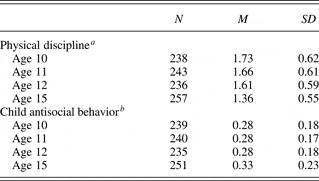
Physical discipline was assessed when the boys were ages 10, 11, 12, and 15. During interviews (home visit at ages 10, 12, and 15, lab visit at age 11), mothers were asked the frequency with which they used certain discipline techniques when the child misbehaved, including two physical discipline items (“spank” and “slap or hit with hand, fist, or object”). Mothers rated each item on a 4-point scale (1 = I never do this to 4 = I do this frequently). The two items were averaged (rs = .50, .52, .60, and .55 for ages 10, 11, 12, and 15, respectively; all p < .001, n = 236–257) to create the physical discipline factor for each year. Despite the small number of items and relatively low rates of endorsement, the physical discipline scores were approximately normally distributed (skew < 1.7, kurtosis < 2.2).
Antisocial behavior
Adolescents completed one of two versions of the Self-Reported Delinquency (SRD) measure (Elliot et al., Reference Elliott, Huizinga and Ageton1985) at ages 10, 11, 12, and 15. The version for younger youths was administered at ages 10, 11, and 12 years, and the version for older youths was given at age 15. The SRD is a questionnaire that assesses overt, covert, destructive, and nondestructive behaviors (e.g., “hit other students or gotten into a physical fight,” “taken something from a store without paying for it”). Because the older youth version of the SRD had more items, including more serious forms of antisocial behavior, the 33 items that were administered at all ages were selected. At each age, the 33 items were summed (αs = 0.79, 0.83, 0.81, and 0.87 for ages 10, 11, 12, and 15 years, respectively) to create the antisocial behavior score. A square root transformation was used to reduce skew (pretransformation skew = 1.69–2.29; posttransformation skew = 0.29–0.35). The means on the SRD measure in the PMCP sample (see Table 4) are higher than means reported for normative samples (Heinrichs, Reference Heinrichs2003), as would be expected on the basis of the relatively high risk of the PMCP sample.
Descriptive statistics for the PMCP sample
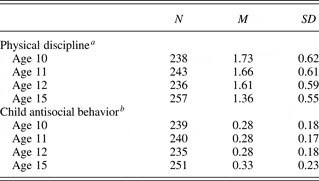
Note: PMCP, Pitt Mother–Child Project.
aMother reports.
bChild reports.
Results
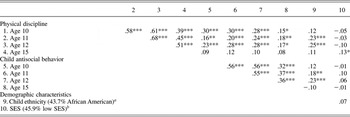
Descriptive statistics and bivariate correlations among the physical discipline and child antisocial behavior variables are shown in Table 4 and Table 5. As in the CDP, mother reports show decreases in the use of physical discipline over time despite correlations showing considerable rank-order stability. Youths' self-reports show relatively similar levels of antisocial behavior from ages 10 to 15, as well as considerable rank-order stability. Concurrent associations between physical discipline and antisocial behavior at ages 10, 11, and 12 were positive with more physical discipline at all ages associated with more antisocial behavior at all ages. Physical discipline at age 15 was not associated with antisocial behavior at ages 11, 12, or 15. There were positive bivariate correlations between being African American and parents' use of physical discipline at ages 11 and 12 and children's reports of antisocial behavior at ages 10, 11, and 12. Preliminary analyses showed a few quadratic and cubic effects in the PMCP sample using the untransformed antisocial behavior scores, but nonlinear effects disappeared or were substantially reduced after we transformed the antisocial behavior scores to normalize the distributions.
Bivariate correlations for the PMCP sample
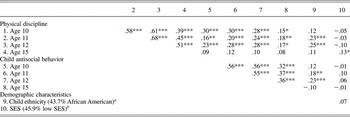
Note: PMCP, Pitt Mother–Child Project; SES, socioeconomic status.
a0 = European American, 1 = African American.
b0 = moderate SES, 1 = low SES.
*p < .05. **p < .01. ***p < .001.
Cross-lagged models were fit using MPlus. As in the CDP analyses, missing data were handled using FIML. All participants with one or more physical discipline or antisocial behavior scores were included in the analysis (n = 290). The coverage matrix showed less than 28% missing data for all parameters.
As with the CDP, the initial parallel trait autoregressive cross-lag model provided a relatively poor fit to the data, χ2 (18) = 103.87, p < .001, CFI = 0.851, RMSEA = 0.13, but the addition of six longitudinal stability paths substantially improved the fit of the model to the data, χ2 (12) =18.80, p = .09, CFI = 0.988, RMSEA = 0.04, Δχ2 (6) = 85.07, p < .001. Again, when stabilities across equal time spans were constrained to be equal within variables, model fit was significantly impacted, χ2 (18) = 45.18, p < .001, CFI = 0.953, RMSEA = 0.072, Δχ2 (6) = 26.38, p < .001, and the constraints were removed. As with the CDP, the addition of the six cross-lagged paths improved the fit of the model, χ2 (6) = 2.57, p = .86, CFI = 1.00, RMSEA = 0.000, Δχ2 (6) = 16.23, p < .01, providing evidence that the transactional model provided a better fit to the data than the parallel trait model. Finally, the model specifying temporally invariant cross-lagged paths provided a good fit to the data, χ2 (10) = 8.81, p = .54, CFI = 1.00, RMSEA = 0.000, and model fit did not differ significantly from the model without the temporal invariance constraints, Δχ2 (4) = 6.24, p = .18. Thus, as in the CDP, these tests of whether the cross-lagged associations varied across ages indicate that associations do not differ significantly across ages 10 to 15.
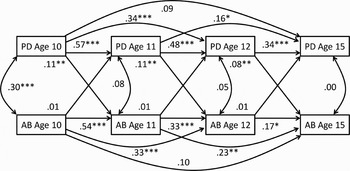
Path values for the model specifying stability over all time lags and temporal invariance in the cross-lagged paths are shown in Figure 2. Parameter values showed considerable stability over both concurrent and distant waves for both physical discipline and antisocial behavior with the exception of associations with scores at age 15. The positive association between physical discipline and antisocial behavior at age 10 showed that higher initial levels of physical discipline were associated with more initial antisocial behavior. The cross-lagged paths showed evidence that physical discipline at ages 10, 11, and 12 predicted, albeit modestly, higher levels of antisocial behavior at ages 11, 12, and 15, respectively, even when controlling for stability in antisocial behavior. However, antisocial behavior at ages 10, 11, and 12 did not predict more physical discipline at ages 11, 12, and 15 after controlling for stability in physical discipline and antisocial behavior.Footnote 1
The final transactional model fit to Pitt Mother–Child Project data, χ2 (10) = 8.81, p = .54, comparative fit index = 1.00, root mean square error of approximation = 0.000. Error terms are omitted from the figure. PD, mother-reported physical discipline; AB, youth-reported antisocial behavior.

To determine whether the reciprocal relations between physical discipline and externalizing problems were moderated by ethnicity, multigroup models were fit with and without constraints equating the reciprocal relations for European American and African American participants. The multigroup model with cross-lagged paths estimated freely for African American and European American participants provided a good fit to the data, χ2 (20) =18.74, p = .31, CFI = 1.00, RMSEA = 0.00. As shown in Table 3, the paths from physical discipline to antisocial behavior were significant for the European American subsample and marginally significant for the African American subsample, whereas the paths from antisocial behavior to physical discipline were not significant for either subsample. When equality constraints were imposed, neither the paths from physical discipline to antisocial behavior, Δχ2 (1) = 0.001, p = .97, nor the paths from antisocial behavior to physical discipline, Δχ2 (1) = 0.35, p = .54, were found to differ across the two groups. Thus, we found no evidence that the cross-lagged paths are moderated by ethnicity.
To determine whether the reciprocal relations between physical discipline and externalizing problems were moderated by SES, multigroup models were fit with and without constraints equating the reciprocal relations for low and moderate SES participants. Age 10 SES (or age 8 SES, if age 10 SES was missing) was dichotomized with membership in Hollingshead's two lowest classes placed into the low SES group (45.9%) and the remaining three classes in Hollingshead's system placed into the moderate SES group, as in the CDP. The multigroup model with cross-lagged paths estimated separately for low and moderate SES participants provided a modest fit to the data, χ2 (20) = 31.84, p = .045, CFI = 0.980, RMSEA = 0.066. As shown in Table 3, the paths from physical discipline to antisocial behavior were significant in the low SES group but not the moderate SES group. The paths from antisocial behavior to physical discipline were not significant for either subsample. When equality constraints were imposed, neither the paths from physical discipline to antisocial behavior, Δχ2 (1) = 0.24, p = .62, nor the paths from antisocial behavior to physical discipline, Δχ2 (1) = 0.00, p = .99, were found to differ significantly across the two groups. Thus, we found no evidence that the cross-lagged paths are moderated by SES.
Finally, cross-lagged path models were estimated using separate scores from the two physical discipline items to index mild (i.e., “spank”) and harsh (i.e., “slap or hit with hand, fist, or another object”) physical discipline to determine whether associations were moderated by the severity of physical discipline. Both the mild physical discipline model, χ2 (20) = 8.10, p = .62, CFI = 1.00, RMSEA = 0.000, and the harsh physical discipline model, χ2 (20) = 8.91, p = .54, CFI = 1.00, RMSEA = 0.000, provided a good fit to the data. Because the models were not fit using independent samples, it was not possible to compare the mild and harsh physical discipline models using nested modeling procedures. However, as shown in Table 3, path estimates from the two models are very similar to one another and to the estimates in the initial full-sample physical discipline model. Both mild and harsh physical discipline are associated positively with subsequent antisocial behavior, but antisocial behavior is not associated with subsequent mild and harsh physical discipline, indicating the cross-lagged associations generalize across the severity of physical discipline. Additional analyses (available from the first author) tested whether the cross-lagged associations between antisocial behavior and mild and harsh physical discipline were moderated by ethnicity or SES. Consistent with the general physical discipline analyses, all tests failed to find evidence of moderation.
Discussion
The present study examined reciprocal relations between parents' use of physical discipline and children's externalizing behavior, accounting for continuity over time in both physical discipline and child externalizing in two long-term longitudinal studies. In the CDP sample of boys and girls aged 6–9, higher levels of child externalizing behaviors in a given year were significantly related to more frequent parental physical discipline in the next year, and more frequent physical discipline in a given year was significantly related to more frequent child externalizing behaviors in the next year. These findings are consistent with overarching theoretical models that have emphasized the transactional, reciprocal nature of parent–child relationships (e.g., Sameroff, Reference Sameroff1975; Stice & Barrera, Reference Stice and Barrera1995) and more specific models (Pardini et al., Reference Pardini, Fite and Burke2008; Patterson et al., Reference Patterson, Bank, Stoolmiller, Montemayor, Adams and Gullotta1990; Shaw & Bell, Reference Shaw and Bell1993) of transactional processes in the development of children's externalizing problems.
In the PMCP of boys aged 10 to 15, the positive relation between early physical discipline and subsequent antisocial behavior was replicated. More frequent physical discipline in a given year was significantly related to more frequent child antisocial behavior in the next year, taking into account continuity in physical discipline and child antisocial behavior over time. These findings are in accord with models suggesting that parental use of physical discipline promotes children's antisocial behavior, moreso than child antisocial behavior affects subsequent parenting. The results are consistent with Sheehan and Watson's (Reference Sheehan and Watson2008) findings using similar models that included severe physical and verbal parental aggression toward children.
In both samples, one of the main take-home messages was that both mild and harsh physical discipline were associated with more subsequent child antisocial behavior. There are several differences between the CDP and PMCP that could account for nuances in the pattern of findings for each sample. The samples differed by child age, gender, SES, and geographic region. In addition, the CDP youths' externalizing behaviors were assessed via teacher reports, whereas in the PMCP youths' antisocial behaviors were assessed via self-reports. Despite these differences the overarching take-home message was the same for both studies: physical discipline was associated with increased transactional risk for child antisocial behavior.
In neither the CDP nor the PMCP was there evidence that the associations between physical discipline and child externalizing changed as the child aged. Previous research has suggested that patterns of bidirectional associations between parenting and children's adjustment may change across developmental periods (Hartup, Reference Hartup, Lerner and Spanier1978; Scarr & McCartney, Reference Scarr and McCartney1983). In particular, some research suggests that parent to child effects may become weaker over time, but child to parent effects may become stronger over time (Stice & Barrera, Reference Stice and Barrera1995; Vuchinich et al., Reference Vuchinich, Bank and Patterson1992), perhaps because children become less dependent on parents over time and relatively more influenced by peers and other adults in their neighborhoods and schools (Ingoldsby & Shaw, Reference Ingoldsby and Shaw2002). It is also possible that both parent effects and child effects will weaken over time as parents and children settle into consistent interaction patterns that may be less responsive to specific behavioral events. It is important to be mindful that the starting point of a given study may not be the starting point of a developmental chain of transaction. Depending on the developmental point at which analyses are started and ended (e.g., infancy through preschool, early to late adolescence), specific studies may vary in their ability to detect parent or child effects. For example, Eron et al. (Reference Eron, Huesmann, Zelli, Pepler and Rubin1991) found that child effects were dominant at the point in the developmental chain that their analysis began (i.e., at age 6), but one cannot draw conclusions about parent effects that may have been dominant earlier in development and that may have contributed to the levels of child aggression that Eron et al. found at the outset of their work. Even a simple chaining of reciprocal associations over time could provide evidence of developmental transactions. Although qualitative shifts in the child or caregiver over time could also be evidence of a transaction, these qualitative shifts would not be necessary to define the transaction.
One strength of the current study is that we were able to test for developmental shifts in reciprocal relations between parents' use of physical discipline and children's externalizing behavior from middle childhood through adolescence. The particular aspect of parenting in question is likely important. In the case of physical discipline, which parents typically use less frequently as their children enter adolescence, it may be that ongoing use of physical discipline is nonnormative enough that it continues to predict subsequent child externalizing problems. By the time children are entering adolescence, parents who are still using physical discipline may be a distinct group from those who are not. At older ages, cycles of coercion between parents and children may play out in parenting behaviors besides physical discipline. Psychological control and parental monitoring are parenting behaviors that may become more developmentally salient as children enter adolescence. For example, poor parental monitoring likely has stronger associations with child conduct problems in adolescence than in childhood (Pardini et al., Reference Pardini, Fite and Burke2008). Examination of multiple aspects of parenting may shed light on how different patterns of child and parent effects may change as children develop.
In sum, the results from studies testing transactional models of socialization have been inconsistent regarding the relative strength of parent effects versus child effects. One possible explanation for the inconsistency in the pattern of findings in this literature is that in lower SES environments, one might expect parenting effects to be more persistent than in higher SES contexts throughout childhood and adolescence because of the reduced number of economic resources and sources of social support that might compromise effective socialization efforts.
A plausible alternative hypothesis that could account for our findings is that genetic factors could contribute both to parents' use of physical discipline and to children's externalizing behaviors. Using a genetically sensitive design, Jaffee et al. (Reference Jaffee, Caspi, Moffitt, Polo-Tomas, Price and Taylor2004) found that the genetic factors related to parents' use of physical discipline were largely the same as the genetic factors related to children's antisocial behaviors. Findings from the Colorado Adoption Project also suggest that both genetic and environmental factors influence links between negative parenting and children's externalizing behaviors (O'Connor, Deater-Deckard, Fulker, Rutter, & Plomin, Reference O'Connor, Deater-Deckard, Fulker, Rutter and Plomin1998). Specifically, children who were at genetic risk for antisocial behavior were more likely to evoke negative parenting from their adoptive parents than were those children who were not at genetic risk for antisocial behavior. However, most of the link between children's externalizing and negative parenting was not accounted for genetically, leaving open the possibility of a parent-related environmental effect (O'Connor et al., Reference O'Connor, Deater-Deckard, Fulker, Rutter and Plomin1998). Similarly, Larsson, Viding, and Rijsdijk (Reference Larsson, Viding and Rijsdijk2008) also found evidence for both genetic and environmental effects in links between child aggression and parents' negativity; effect sizes from parent to child and from child to parent were comparable. Finally, the plausibility of a genetic explanation is weakened by the inclusion of statistical controls for prior behavior.
We did not find evidence for gender, race, or SES differences in reciprocal relations between parents' use of physical discipline and children's externalizing behaviors. This finding is contrary to previous studies with the CDP (Deater-Deckard et al., Reference Deater-Deckard, Dodge, Bates and Pettit1996; Lansford et al., Reference Lansford, Deater-Deckard, Dodge, Bates and Pettit2004) and other samples (e.g., Gunnoe & Mariner, Reference Gunnoe and Mariner1997), which found physical discipline to be significantly related to child problem behavior for European American but not African American children. Although in the present study the cross-lag path values were significant for the European American subsample but not for the smaller African American subsample, the tests for moderation were not significant. One possible reason for the lack of ethnic differences in the current investigation may be that previous studies did not account for stability in discipline and child behavior as was done in the current study. Likewise, whereas previous researchers studying this area have focused more on whether parental discipline predicted later child behavior, we examined reciprocal associations between these two variables at multiple intervals over several years. Indeed, other authors who have analyzed reciprocal relations found little or no evidence for child gender or ethnic differences (Hipwell et al., Reference Hipwell, Keenan, Kasza, Loeber, Stouthamer-Loeber and Bean2008; Larsson et al., Reference Larsson, Viding and Rijsdijk2008; Pardini et al., Reference Pardini, Fite and Burke2008). We also found consistent effects for mild and harsh discipline; severity of the discipline did not moderate the effects in either sample. Finally, in both samples, we found that the overall results were nearly identical for mild and harsh forms of physical discipline. Thus, although some researchers have argued that the effects of physical discipline may vary by their severity (Larzelere, Reference Larzelere2000), we found no evidence of this in the current investigation.
A strength of the present study was that data were available from independent informants. In both samples, mothers reported on physical discipline whereas teachers (CDP sample) and children (PMCP sample) provided information on externalizing behavior. Thus, relations between physical discipline and externalizing behavior were not inflated by shared method variance. Another strength was the availability of data from four time points in each of two longitudinal studies, enabling us to test the associations of interest over long periods of time in two independent samples.
Limitations and Conclusions
The limitations of the study should also be acknowledged. Our measures referred to the frequency with which children were physically disciplined. Future research would benefit from analyzing whether the ongoing reciprocal links between parental discipline and child externalizing results in the escalation in the form or severity of both physical discipline and child antisocial behavior, which would be consistent with Patterson's (Reference Patterson, Reid, Patterson and Snyder2002; Patterson & Yoerger, Reference Patterson, Yoerger, Reid, Patterson and Snyder2002) social coercion theory. Furthermore, we analyzed mothers' reports of their own use of physical discipline; these reports did not reflect physical discipline that fathers and other caregivers may have used. It is possible that some children who were never physically disciplined by their mothers might have been physically disciplined by fathers or other caregivers. For children in single parent families, the mothers' reports may have represented the child's caregiving experience more fully than in two parent families. Future research also would benefit from examining other aspects of the parent–child relationship in which the physical discipline occurs, as contextual factors such as parental warmth or supportiveness (McLoyd & Smith, Reference McLoyd and Smith2002; Pettit et al., 1997) and the normativeness of physical discipline in that family's cultural group (Lansford et al., Reference Lansford, Chang, Dodge, Malone, Oburu and Palmérus2005) may moderate reciprocal relations between physical discipline and children's externalizing behaviors.
Our findings have several implications for theory, methods, measurement, and intervention. First, our findings support theoretical models that posit transactional relations between parents' behavior and children's adjustment (Sameroff, Reference Sameroff1975) and highlight the strengths of using longitudinal methods with measures from multiple informants to be able to model these transactional relations over time. Second, because we found effects of parents' use of physical discipline on children's externalizing behaviors and in the CDP sample, evidence of children's externalizing behaviors being related to parents' subsequent use of physical discipline, this suggests that interventions might be directed toward parents, children, or both to interrupt coercive cycles that may otherwise go unchecked. Social learning and social cognitive learning-based parent and child preventive and treatment interventions have attempted to reduce parents' use of physical discipline, working from the premise that if parents are encouraged to reduce their use of physical discipline and trained in the use of nonphysical forms of discipline, this may help diminish children's future externalizing problems (e.g., Patterson, Reid, Jones, & Conger, Reference Patterson, Reid, Jones and Conger1975; Webster-Stratton & Reid, Reference Webster-Stratton, Reid, Tolan, Szapocznik and Sambrano2007). Using experimental designs, previous research has shown that when interventions are successful at getting parents to use less physical discipline, children's antisocial behavior decreases as well (e.g., DeGarmo & Forgatch, Reference DeGarmo and Forgatch2005; Kazdin, Reference Kazdin1987). Likewise, if interventions are able to reduce children's externalizing behaviors, it may be less challenging for parents to manage their behavior, and parents, therefore, may resort to using less physical punishment. Interventions that include both child and parent components would likely be more successful than interventions focusing on either parents or children alone. However, whether parents, children, or both are targeted in interventions is a complex issue that depends on the child's age, developmental status, and cognitive capacities; the strength of other social influences such as peers; normative transitions involving monitoring and peer exposure; and parents' greater responsibility and power in the parent–child relationship. Therefore, any intervention to interrupt transactional cycles between parents' use of physical discipline and children's antisocial behavior would need to be mindful of these complexities in determining when and with whom to intervene.
The present study builds on theoretical models that hypothesize reciprocal relations between parenting practices and children's adjustment by empirically testing links between parents' use of physical discipline and children's externalizing behaviors in two long-term longitudinal studies. In both samples and regardless of gender, race, SES, and age, we found that parents' use of physical discipline in a given year is related to more child externalizing problems in the next year. In the CDP sample, we also found that child externalizing problems in a given year elicit more parental physical discipline in the next year. These findings contribute to our understanding of reciprocal relations between parents' behavior and children's adjustment from middle childhood through adolescence.