Introduction
Environmental education (EE) aims to change our attitude towards the environment, through developing children’s connection to nature, which is imperative for environmental protection (Bolden, Petrov, & Gosling, Reference Bolden, Petrov and Gosling2008; Ives et al., Reference Ives, Giusti, Fischer, Abson, Klaniecki, Dorninger, Laudan, Barthel, Abernethy, Martín-López, Raymond, Kendal and von Wehrden2017) and encouraging pro-environmental behaviour (Musitu-Ferrer, Esteban-Ibañez, León-Moreno, & García, Reference Musitu-Ferrer, Esteban-Ibañez, León-Moreno and García2019). EE, in the context of human–nature connection, while espousing a positive worldview, does not fear tactics that focus on current and future environmental problems (Meadows, Reference Meadows2014; Stevenson, Reference Stevenson2006; Verdugo, Reference Verdugo2012), which often generate helplessness and inhibit action (Hicks, Reference Hicks2003; Kerret, Orkibi, & Ronen, Reference Kerret, Orkibi and Ronen2016; Ojala, Reference Ojala2012; Stevenson, Reference Stevenson2006). From a positive perspective, it is all but impossible to protect the environment and create a better world without addressing well-being (Kerret et al., Reference Kerret, Orkibi and Ronen2016).
Well-being is being promoted through the human–nature connection (Ives et al., Reference Ives, Giusti, Fischer, Abson, Klaniecki, Dorninger, Laudan, Barthel, Abernethy, Martín-López, Raymond, Kendal and von Wehrden2017; Liefländer, Fröhlich, Bogner, & Schultz, Reference Liefländer, Fröhlich, Bogner and Schultz2013; Musitu-Ferrer et al., Reference Musitu-Ferrer, Esteban-Ibañez, León-Moreno and García2019), so that it should be incorporated into a holistic perception that integrates critical thinking, high-order thinking and processes of value changing, all aimed at enhancing pro-environmental behaviour (Sterling, Reference Sterling2009). As a possible response to the environmental crisis, holistic EE allows us to observe the world as a complex entity (Capra, Reference Capra1996), an observation that should encourage involvement that combines emotional and cognitive relations to the environment (Hicks, Reference Hicks2003) and in fact, integrates the human–nature connection as a conceptual framework (Muhr, Reference Muhr2020). The human–nature connection is a multi-dimensional concept that encompasses several ideas that are being investigated in literature in both quantitative and qualitative methods including the children’s drawings-and-explanations technique (Harvey, Hallam, Richardson, & Wells, Reference Harvey, Hallam, Richardson and Wells2020; Muhr, Reference Muhr2020).
In addressing human–nature connection as part of EE in a holistic approach, it must consider humans and the complexity of their existence and their relationships with nature (Parker & Simpson, Reference Parker and Simpson2020; Sauvé, Reference Sauvé2005). There is limited research about EE that emphasises a holistic positive approach towards environmental crises (Kerret et al., Reference Kerret, Orkibi and Ronen2016) and partial research about the children–nature connection that involves non-verbal tools such as drawings (Kalvaitis & Monhardt, Reference Kalvaitis and Monhardt2012; Muhr, Reference Muhr2020).
Another aspect of holistic EE is based on a positive worldview that enhances well-being and uses imagination (Meadows, Reference Meadows2014; Sterling, Reference Sterling2009). School children’s ability to imagine was examined in studies of the future as it relates to schools (Bland & Sharma-Brymer, Reference Bland and Sharma-Brymer2012; Kangas, Reference Kangas2010) and the environment (Alerby, Reference Alerby2000; Barraza, Reference Barraza1999). In a study conducted in Finland, the students imagined the ideal school in stories they wrote, revealing a need for physical activities and learning that enhances well-being (Bland & Sharma-Brymer, Reference Bland and Sharma-Brymer2012; Kangas, Reference Kangas2010). The physical and well-being dimensions are part of the human–nature connection for promoting pro-environmental behaviour. The human–nature connection is composed of three main dimensions: cognitive, emotional and experiential which includes actions and experiences in nature (Parker & Simpson, Reference Parker and Simpson2020).
It is useful to examine the human–nature connection of the multi-dimensional concept through drawings and explanations, which were also used to refer to imagining EE (Alerby, Reference Alerby2000; Barraza, Reference Barraza1999; Pellier, Wells, Abram, Gaveau, & Meijaard, Reference Pellier, Wells, Abram, Gaveau and Meijaard2014), as they allow children to express their inner view of external processes, their personal ideas, emotions, creativity and environmental attitudes (Chang et al., Reference Chang, Lin, Lee, Lee, Tan, Tsai, Lin, Lee and Lee2020; Ligorio, Schwartz, D’Aprile, & Philhour, Reference Ligorio, Schwartz, D’Aprile and Philhour2017; Muhr, Reference Muhr2020). Drawings include information that can differ from that presented in writing, providing learners the opportunity to describe their perceptions of a specific phenomenon, which is based on real subjective live experiences (Watt & Wakefield, Reference Watt and Wakefield2017). Drawings are an especially important research tool with children who are highly exposed to images, which influence the students to be visual thinkers (Chang et al., Reference Chang, Lin, Lee, Lee, Tan, Tsai, Lin, Lee and Lee2020). Moreover, drawings enable ‘giving a voice’ to children and providing opportunities for children to express their views (Ward, Reference Ward2018). All of the aforementioned reasons make drawings an important research tool with children (Chang et al., Reference Chang, Lin, Lee, Lee, Tan, Tsai, Lin, Lee and Lee2020; Merriman & Guerin, Reference Merriman and Guerin2006). Despite the advantages of drawings, there is a need for validation; written and oral explanations are implemented as complementary methods of expression (Chang et al., Reference Chang, Lin, Lee, Lee, Tan, Tsai, Lin, Lee and Lee2020).
In practice, through this study, the children may influence the design of their school. In research, this study has enabled integrating between the positive approach to EE and children’s drawings and explanations to increase the discourse regarding children’s well-being from their own point of view.
The aim of this study was to examine third- and sixth-grade students’ perceptions of the ideal environmental school, using their drawings and the accompanying written and oral explanations. The research questions were:
-
1. What characterises the features of the ideal environmental school according to the perceptions of students in the third and sixth grades?
-
2. How did the third- and sixth-grade students perceive the ideal environmental school as an entirety?
Methods
We chose a phenomenological hermeneutic approach analysis (Larsson & Holmström, Reference Larsson and Holmström2007; Van Manen, Reference Van Manen2016), as a method directed at explaining the meaning of a phenomenon as the participants experience it in a subjective of individual and groups through their life experiences (Laverty, Reference Laverty2003; Van Manen, Reference Van Manen2016). Hermeneutic phenomenology assumes that humans’ experiences are presented as interpreted and infused with meaning, and the researchers’ role is to uncover the essence of the phenomena and achieving a sense of understanding (Laverty, Reference Laverty2003). Originally intended for the analysis of written texts, in recent decades hermeneutics phenomenology has been widely used with drawings, which are considered visual texts (Alerby, Reference Alerby2000; Avriel-Avni, Spektor-Levy, Zion, & Levi, Reference Avriel-Avni, Spektor-Levy, Zion and Levi2010). According to the hermeneutics phenomenology approach, students’ experiences can be better understood through telling a story (Laverty, Reference Laverty2003), which can be used through drawings and explanations in writings and interviews. In this study, the hermeneutic phenomenological method allows a rich description of the students’ perceptions and lived experience, aiming to expose and interpret their thoughts regarding the research topic selected – the ideal environmental school. This method may help to reveal the individual life experience (in our study the ideal environmental school using drawings and explanations) and connect it to the collective experience (in our study EE in a global perspective and interpretation) (Laverty, Reference Laverty2003).
Research procedure
We followed four phases of research procedure, which is described in the literature (Chang et al., Reference Chang, Lin, Lee, Lee, Tan, Tsai, Lin, Lee and Lee2020): First (a) we decided on the rationales for using drawing as a research tool. Then (b), we decided what parameters to assess in the drawings, which was followed by (c) developing the research instructions. Finally, (d) we decided what to code and how to code it.
-
(a) Rationales for using drawings as a research tool. Drawings were the creative means used to express thoughts, as they reveal ideas, experiences and perceptions (Barraza & Walford, Reference Barraza and Walford2002), in addition to the verbal explanation (Yilmaz, Kubiatko, & Topal, Reference Yilmaz, Kubiatko and Topal2012). Although a popular research tool, some limitations must be noted: Drawing is done in a cultural context and influenced by students’ experiences in nature (Barraza, Reference Barraza1999; Hendri, Rohidi, & Sayuti, Reference Hendri, Rohidi and Sayuti2017), which could make it difficult to understand their meaning and analyse them. The drawing produced depends on the child’s skills (Punch, Reference Punch2002), which may not necessarily express cognitive abilities (Farokhi & Hashemi, Reference Farokhi and Hashemi2011), and then, simply, there are children who do not like to draw (Einarsdóttir, Reference Einarsdóttir2007). To overcome these limitations, we guided the children to write an explanation for their drawing, and we interviewed five children after they had completed their drawing so they could explain their ideas in depth.
-
(b) What to assess – Specifying goals of drawing assessment. We used the drawings, and both written and oral explanation for assessing the image and perception of the ideal environmental school.
The study presented here is part of a broader comparison between environmental schools of various approaches and mainstream schools. In this article, we focused on describing the findings from one rural environmental school located in Israel. We began the research with this school because it has been implementing EE since 1993 in all grades levels (Gal & Gan, Reference Gal and Gan2018). Therefore, it is valuable to get better understanding about students’ perceptions and their own voice regarding their perception of an ideal environmental school in this context. Moreover, as known from the literature, culture influences students’ drawings (Hendri et al., Reference Hendri, Rohidi and Sayuti2017). Contextualisation of children’s drawings in the perspective of shape and adaptation of creation and the model of implementation on learning art at elementary school (Ahmad, Reference Ahmad2018) is important to investigate if EE is presented in students’ drawings. Participants included 97 students: 48 third graders and 49 sixth graders, who were asked to draw their ideal environmental school on an A4 sheet of paper, using crayons, markers or colour pencils.
-
(c) Research instructions – The research instrument. The written instructions were printed, and the children were asked to write an explanation of their drawing: ‘Please imagine, and then draw the type of ideal environmental school you’d like to be in. What does the school look like? What is in it? What is important to include? What activities take place in the ideal [the best you can think of] school? What do you study there? When you are finished, please turn the page over and write at least five to seven sentences about what you have drawn’ To stress the purpose of the drawing, we repeated the instructions orally and emphasised that students should imagine whatever they like in an ideal environmental school. We also highlighted that they can be creative and use a free-form drawing (Chang et al., Reference Chang, Lin, Lee, Lee, Tan, Tsai, Lin, Lee and Lee2020) describing details of whatever they dream about this school. We gave written and oral explanations, since we tried to address the ‘question dependence’ effect (Chang et al., Reference Chang, Lin, Lee, Lee, Tan, Tsai, Lin, Lee and Lee2020). Accordingly, we encouraged the students to present their diverse conceptual thinking of their ideal environmental school. When the task was complete, the drawings were examined, and with the help of the homeroom teachers, five students were selected to be interviewed – 2 third graders and 3 sixth graders.
For validation, we used criterion-related validity including peer validation – each of the researchers in this study is an EE practice and research expert. Moreover, they have expertise in researching children and students’ drawings in the context of the conception and understanding of environmental phenomena. Each of the researchers separately coded inductively the drawings and for reliability we had 90% of inter-rater agreement of codes and categories during several meetings. We also used written and oral explanations of the drawings by the students via interviews, and we observed the students’ while-drawing activity and discussed their drawings about the ideal environmental school.
-
(d) What to code and how to code it – Analysis process
We used an inductive approach for the first and second stages of the analysis process, while categories emerged from drawings, written and oral explanations about the ideal environmental school were examined. The third stage included a deductive and inductive analysis approach.
Stage 1 – Overall look
We first looked at the drawings and the written explanations focusing on the drawing and writing technique, which is considered to be effective to depict children’s conceptions (Horstman, Aldiss, Richardson, & Gibson, Reference Horstman, Aldiss, Richardson and Gibson2008). Then we read the interview transcriptions. We used a naïve reading of the text while simultaneously looking at the drawings, taking note of our first impression without any focused interpretation (Farokhi & Hashemi, Reference Farokhi and Hashemi2011).
Stage 2 – Micro-level inductive analysis of the drawing’s features and of their explanations
After looking at the drawings and reading the collected data from the interviews and written explanations, we created a list of inductive codes and represented features in the drawings, based on themes identified through close reviews of the transcripts and the drawings. After the features were created, we developed definitions and guidelines for usage for each feature. The features were specific activities and components, which were explained in the written and oral explanations, and were not a multiple-theme-oriented approach, which may be a subjective interpretation of the researchers.
The qualitative-based features were quantified and were counted and analysed (Bland & Sharma-Brymer, Reference Bland and Sharma-Brymer2012; Derbentseva, Safayeni, & Can, Reference Derbentseva, Safayeni and Can2007) – the surroundings that the student chose to draw and write explanations for were examined, including the figures and objects depicted. We examined the features (e.g. trees, sports facilities and petting farm), as well as their location and relative size, which could indicate the degree of importance attributed to them. We examined the facial expressions of the features, as they can reveal attitudes towards the issue researched.
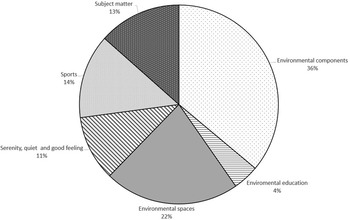
At this stage, we identified 128 different features based on the drawings, and both written and oral explanations, with 424 appearances in the drawings. Some drawings contained several features, so that the number of features was greater than the total number of drawings. We grouped the 128 features into six groups and used the students’ written and oral responses to identify the students’ ideas: environmental components, environmental spaces, sports, subject matter, serenity-quiet and good feeling, and EE, and calculated the percentage of each group’s number of appearances (Figure 1). Additionally, we used the McNemar test to compare the number of appearances of a group in each grade. The McNemar test examines statistical differences between two groups when the dependent variable is dichotomous. In our case, the grades were third graders and sixth graders, and the dependent variable was a feature’s appearance (1) or non-appearance (0).
Distribution of groups in the students’ drawings.

Stage 3 – Macro-level deductive and inductive qualitative analysis
The six groups that were identified in the second stage were integrated based on deductive categories from the conceptual framework, but allowed for additional valid analytical constructs to emerge as data were collected and analysed (Kalvaitis & Monhardt, Reference Kalvaitis and Monhardt2012) in a macro approach. The macro approach (Hay, Reference Hay2007) focused on interpretation of the whole drawing, written explanations and interviews (which complemented the drawings) that reflected the level of thinking and perceiving the concept of the ‘ideal environmental school’ by participants. Based on the literature (Kangas, Reference Kangas2010), we derived three categories. We now viewed the drawings, the interviews and the written explanations as a single entity and analysed into physical, cognitive and emotional categories. Educational category, EE, was found, inductively to be a fourth category.
Findings
From features of the environment to ideal environmental school
We present the findings first according to the micro-level analysis (i.e. second stage of analysis) and then according to the macro-level analysis (i.e. third stage of analysis). The micro-level inductive analysis (Figure 1) yielded six groups that emerged from 128 features based on students’ drawings, explanations and interviews: (1) environmental components – plants, animals and water; (2) environmental spaces – natural areas and outdoor learning areas; (3) subject matter – English, mathematics, circus, art and music; (4) sports – football, basketball and swimming; (5) serenity, quiet and good feeling – relaxation area, meditation space, quiet space and (6) EE – pedagogical aspects such as hikes and solutions to environmental problems.
We found evidence for these six groups in students’ drawings, written and oral explanations. For example, one of the students explained during the interview, ‘in the ideal environmental school we will have vegetation and green spaces…if you are angry you can calm down by the river or play soccer in the field’. In this representative quote, the student mentioned four out of the six groups (e.g. environmental components, environmental space, sports and serenity). The other two groups (i.e. subject matter and EE) frequently mentioned by the students, for example, ‘in the ideal environmental school we will learn about nature… and will preserve it’. Moreover, the students stressed that they need to study core subject matter including ‘math, English, science, language arts… in addition to environmental issues such as biomimicry, lessons focused on awareness of the local environment, and sailing class’. This quote, which was also evident in many drawings and explanations, illustrates that the students described features that they were familiar with and came across in their current school. Most of the examples were recognised by the students and did not represent imaginary ideas.
It is worth noting that among sixth graders, environmental components in their drawings were more prominent, with a statistically significant difference (p = .007), which could be indicative of their longer exposure to EE curricula in school and their understanding of these features as part of the ideal environmental school. This is in line with the literature that shows the relationship between the higher level of connection to nature to longer and more access to the environment (Chawla, Reference Chawla2020). No other significant differences were found between students from sixth grade to students from third grade, so that the drawings and explanations can be seen as a single entity. In all six groups, the students mentioned positive emotions towards nature and the environment, which also reflects the EE programme they experienced. The students did not mention negative emotions such as fear, worry or frustrations regarding climate change or the environmental crisis. This is in line with the positive emotions research stream discussed in Chawla’s (Reference Chawla2020) review about the children–nature connection, which reflects positive experiences.
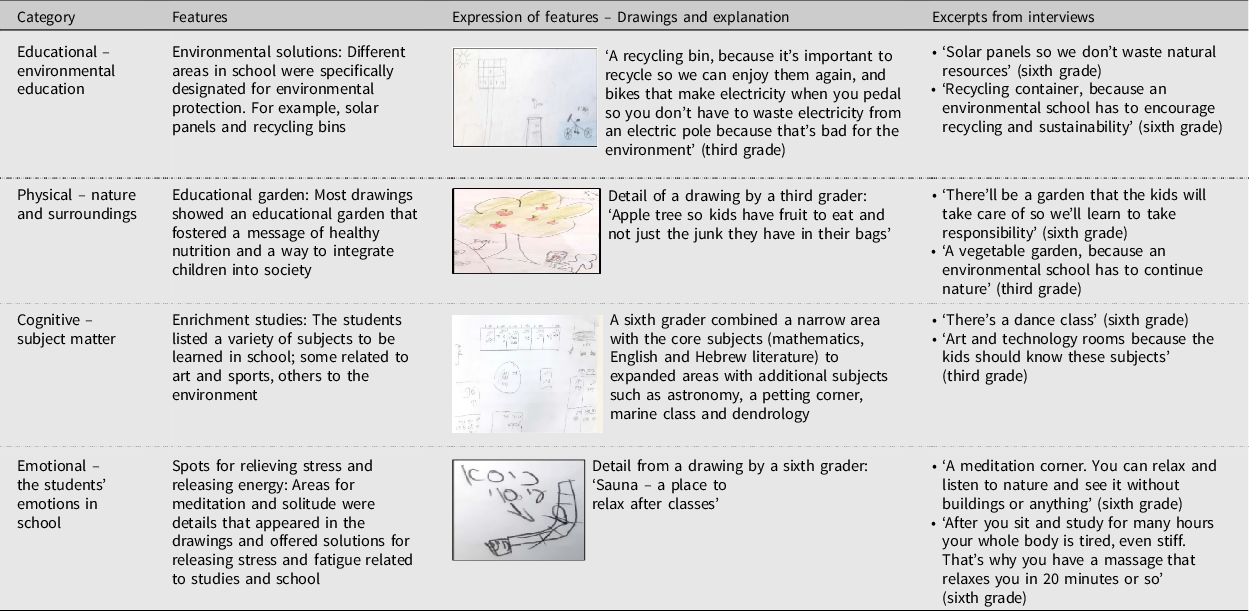
The macro-level deductive analysis yielded three defined categories that reflect the ideal environmental school as it appears in the literature and are compatible with features found in Stage 1 of the analysis: physical (environmental spaces, environmental components and sports-related features), cognitive (subject matter) and emotional (serenity, quiet and good feeling). In the educational category, EE was defined as an additional category (Table 1).
Categories derived from the drawings and interviews – written and oral explanations

Physical category – Nature and surroundings
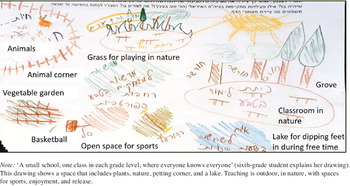
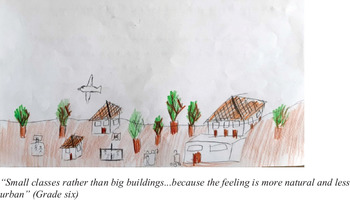
The children expressed their ideal environmental school as a large, varied physical space, with wide nature areas and outdoor learning, a space with natural components such as plants, water and animals (Figure 2). Clearly, the students were aware of the importance of nature, of having a school in a natural environment, echoing findings that being in nature and proximity to water sources affects positively physical and emotional health (Kuo, Reference Kuo2015; Thompson et al., Reference Thompson, Boddy, Stein, Whear, Barton and Depledge2011). The students stressed that ‘the classrooms should be small, and not be in big buildings’ as presented by sixth-grade student (Figure 3), where the atmosphere is positive and where they enjoy being. One sixth-grade student described that ‘if… we have classes outside, it will be much more fun to learn’.
The physical category: A small school with one class in each grade.

The physical category: Rural school.

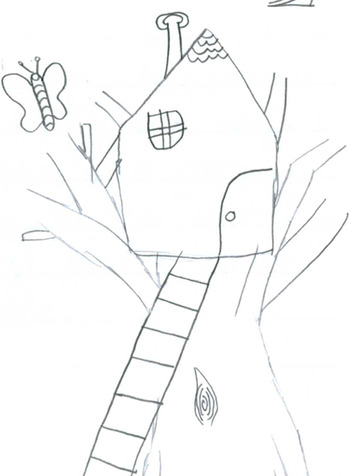
There were suggestions for classes without walls for observing nature. Some depicted the classroom as a home and other drew unique places for the classrooms, for example, in a ‘treehouse classroom so it will be natural’ (sixth grade) (Figure 4). It is important to note that treehouses are a common feature in the school in which the students are learning, which is also evident as an important key feature of the ideal school (Bland & Sharma-Brymer, Reference Bland and Sharma-Brymer2012). The nature-related spaces the children expressed might indicate that the students are familiar with nature in and surrounding their school due to the rural location and the school environmental characteristics. In fact, they have free exploration experiences in formal and non-formal activities, as opposed to the trend discussed in the literature, which emphasises that children’s lives have moved indoors (Chawla, Reference Chawla2020).
The physical category: Treehouse as a classroom.

Moreover, the students expressed a desire for nature activities that would include hikes and outdoor learning, both of which are known to enhance experiential skills (James & Williams, Reference James and Williams2017), and the physical category included classrooms that enable immediate observation of nature and interaction with it. Their desires differ from those of students who study in traditional classrooms and are consistent with the literature that indicates that the mainstream classroom should change and become a learning environment that goes beyond school boundaries and contributes to the students’ physical well-being (Bland & Sharma-Brymer, Reference Bland and Sharma-Brymer2012; Kangas, Reference Kangas2010). The students’ stating the importance of sports fields and natural spaces for sports activities (Figure 2) is consistent with the literature which reports that sports activities in a natural environment allow for better concentration than the same activity conducted in an urban area (Wu et al., Reference Wu, Mcneely, Ceden, Dominici, Lung, Su and Spengler2014).
Cognitive category – Subject matter
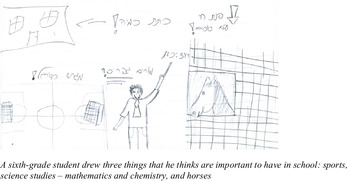
In referring to study subject matter, as mentioned above, students listed the core subjects (Hebrew, mathematics and English) and environmental studies such as biomimicry, seamanship and vegan cooking, as pointed out by one of the sixth-grade students ‘in the environmental ideal school the students will learn the core subject and natural subjects, sustainability and life’. Another student emphasised the integration of ‘science studies, sports, and horses’ (Figure 5). It is worth noting that the students visit the small zoo they have in the school on a regular basis. Furthermore, they have a class in which they look after horses. This is additional evidence of the drawings that represent what the students are familiar with, and does not reflect creative ideas. The importance of animals in the ideal school is also evident in the literature as developing responsibility for animals and nature through their sensitivity towards them (Leshem, Zion, & Friedman, Reference Leshem, Zion and Friedman2015).
Cognitive category: Subject matter.

Corresponding to what they already know, according to the students, ‘environmental learning can take place in nature and the school surroundings’ and includes subjects beyond core subjects. The students interviewed emphasised that ‘learning by rote is meaningless and boring… but learning outside and observing… is meaningful’. These findings are consistent with the literature that defines significant learning as learning that takes place in the student’s close surroundings and in non-standard classes (Bland & Sharma-Brymer, Reference Bland and Sharma-Brymer2012; Sobel, Reference Sobel2004). The students identified the effect of the natural space on their cognitive abilities, saying, ‘Outside I learn more and it’s also easier to remember it later’, corroborating findings that students in schools with a green environment had higher academic achievements and their cognitive skills improved (Wu et al., Reference Wu, Mcneely, Ceden, Dominici, Lung, Su and Spengler2014). Furthermore, the students desired to remain in nature and study there. This probably refelcts that exposure to a natural environment – by being there or observing it – strengthen cognitive awareness and memory and enhance well-being by decreasing boredom, loneliness and anxiety, which presented in the litrature (Chawla, Reference Chawla2020; Kalvaitis & Monhardt, Reference Kalvaitis and Monhardt2012; Kaplan, Reference Kaplan2001).
Emotional category – Student’s emotions in school
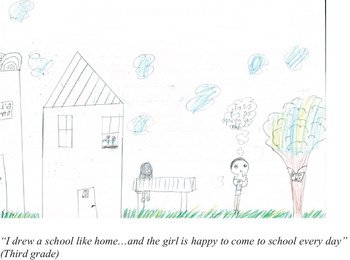
This category included the positive atmosphere and addressed issues of good feeling and emotions felt by students (Figure 6).
Emotion category: School feels like home.

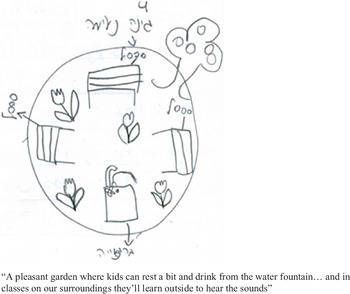
Moreover, the category included the space that allows the children to release stress and energy (Figure 7), such as the meditation and massage areas. The positive atmosphere is achieved by connecting to nature and well-maintained surroundings. Most drawings included trees (Figures 2, 3, 4 and 6), and the students explicitly mentioned trees as part of an optimism in the ideal environment school: ‘When there are trees, more open air… everything flows better…nature helps… it affects the good feeling…connect to nature… and that affects the kids’ (Sixth grade). The importance of nature to the students is consistent with findings on a positive atmosphere in school (Gal & Gan, Reference Gal and Gan2018), and specifically the significance of trees for happiness (Ramanan, Reference Ramanan2019). In addition to recognising the importance of the surroundings, the environmental ideal school should clearly create a positive atmosphere and well-being for the students (Bland & Sharma-Brymer, Reference Bland and Sharma-Brymer2012), unlike the fear-driven worry and pessimism seen in students worldwide regarding the future of planet Earth (Barraza, Reference Barraza1999; Chawla, Reference Chawla2020; Stevenson, Reference Stevenson2006).
Emotion category: Spaces to release stress and energy.

Educational category – Holistic EE in a positive perception
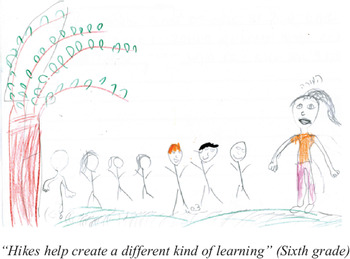
The students related to EE in the various categories – the physical (outdoor learning), cognitive (learning about the environment) and emotional (well-being) in a holistic and positive way. For example, one third-grade student explained in his interview regarding his drawing (Figure 8) ‘It is vital to go on more outings and learn outside… it’s important for me to be outside’. Students view hikes and outdoor learning as very significant. Figure 5a represents an enjoyable feeling. The students said that learn outdoors are affected on a number of levels, including ‘learning about the surroundings… meaningful learning that enhances concentration, memory… and experience that affects the relationships with others’. This is in line with literature which stresses the importance of the holistic EE approach that includes the social level, emotional aspect and physical surroundings (Kluger, Gorris, Romagnoni, Kochalski, & Mueller, Reference Kluger, Gorris, Romagnoni, Kochalski and Mueller2020; Parker & Simpson, Reference Parker and Simpson2020). The drawing (Figure 8), which includes tree, teacher and students hiking in nature, represents (as found in most drawings) the elements and activities, which the students are already familiar with from daily life in their school.
Educational category: Outdoor learning.

Additionally, some children drew environmental solutions such as composting, using solar panels and pro-environment action, indicating students’ perception of the ideal environmental school as one that protects the environment. The integration of categories is consistent with finding that students identify the need for physical, cognitive and emotional well-being (Kangas, Reference Kangas2010) and find the school to be a supportive learning environment, as was found in our study.
Discussion
Four categories were found in this study of students’ perception of an ideal environmental school – physical, cognitive, emotional and educational–EE. The drawings and explanations expressed the school that the students know and did not show creativity or innovation. This finding is in line with another study that was conducted in Israel, which highlighted students’ ideal school, in which they expressed no groundbreaking thinking and presented the school that they already knew (Zur & Eisikovits, Reference Zur and Eisikovits2011). In contrast, other studies in different contexts suggest that students used their imagination to describe their ideal school. For example, in Finland (Kangas, Reference Kangas2010), students mentioned features that do not exist in their school, and in Australia (Bland & Sharma-Brymer, Reference Bland and Sharma-Brymer2012), students’ imaginations were full of fantasy and innovation.
Despite the importance of the drawing research tool as a vehicle for supporting students’ imagination, an opportunity to express their own voice and a way to achieve understanding of their internal world (Bland & Sharma-Brymer, Reference Bland and Sharma-Brymer2012; Kangas, Reference Kangas2010), in our study it did not enable the students to imagine new ideas. Quite possibly, the students’ freedom of imagination was limited because, as described in the literature, they are not sufficiently accustomed to using it (Michalopoulou, Reference Michalopoulou2014; Zur & Eisikovits, Reference Zur and Eisikovits2011), unlike the Finish (Kangas, Reference Kangas2010) and Australian (Bland & Sharma-Brymer, Reference Bland and Sharma-Brymer2012) students. In our study, the students’ school was their model for an ideal environmental school, which might represent their positive perception of school activities and learning environment.
The learning surrounding of the school in this study is characterised by a rural, natural and agricultural environment. This also might be another reason for the students’ drawings and explanations, which focused on natural environment, tree houses and other natural elements, which might point to a high level of nature connectedness. It seems that the students in our study appreciate their natural surroundings. This finding is in line with the literature that emphasises how rural students had a higher level of connection to nature, which was associated with more access and time spent in nature (Chawla, Reference Chawla2020). In our study, we did not focus on student–nature connection, which can be examined by future studies.
The school as part of the education system
The Israeli school system, like other systems worldwide, uses tests as measures of success, rarely encouraging creative thinking (Michalopoulou, Reference Michalopoulou2014). While the school integrates EE in a thorough manner, developing imagination and creativity are not a significant part of these plans (Gal & Gan, Reference Gal and Gan2018), as they require educational processes and not a one-time intervention (Zimmerman, Reference Zimmerman2009). Thus, using drawings which enable the expression of creative thinking (Einarsdóttir, Reference Einarsdóttir2007; Muhr, Reference Muhr2020; Zur & Eisikovits, Reference Zur and Eisikovits2011), such thinking was not fully manifested in the present study. It is possible that based on this limitation, the study could be expanded to examine the perception of the ideal environmental school using drawings after engaging in an educational process that enhances imagination and creativity.
Positive EE
Although the students did not express creativity and innovation in their drawings, they did reveal the positive school atmosphere, one of hope and joy, both essential for EE (Bland & Sharma-Brymer, Reference Bland and Sharma-Brymer2012; Chawla, Reference Chawla2020; Stevenson, Reference Stevenson2006), and an alternative to scare tactics that generate helplessness that could prevent action (Kerret et al., Reference Kerret, Orkibi and Ronen2016; Ojala, Reference Ojala2012; Stevenson, Reference Stevenson2006). The drawings and explanations showed an ideal environmental school, which offered well-being, positive atmosphere and environmental spaces and could serve as an important foundation for developing EE. This foundation, which is not fear based, can allow children to imagine and dream creatively about a world where humans are part of the environment, conserve nature and work towards reducing the environmental crisis (Chawla, Reference Chawla2020; Liefländer et al., Reference Liefländer, Fröhlich, Bogner and Schultz2013).
Holistic EE
The children chose studies that address positive emotional aspects, well-being, a learning environment in nature and a broad range of subject matter – current and desired – as well as the different relationships within the school. These aspects are consistent with the holistic EE approach that includes emphasis on emotion, cognition, empathy towards nature and creativity (Bland & Sharma-Brymer, Reference Bland and Sharma-Brymer2012; Sauvé, Reference Sauvé2005), integrating ecological attitudes in their broad sense (Meadows, Reference Meadows2014; Sauvé, Reference Sauvé2005), where the system is viewed as a whole and not compartmentalised to facilitate comprehension (Capra, Reference Capra1996; Sterling, Reference Sterling2009). While every school aspires to achieve cognitive, social and emotional well-being (Kangas, Reference Kangas2010) as seen in the present study, we suggest implementing EE because it has the capacity to achieve this. Furthermore, nature needs to be an important component in all schools, as was presented in this study and other studies worldwide (see. e.g., Bland & Sharma-Brymer, Reference Bland and Sharma-Brymer2012; Kangas, Reference Kangas2010; Malone & Tranter, Reference Malone and Tranter2003; Zur & Eisikovits, Reference Zur and Eisikovits2011). As Orr (Reference Orr2004) claimed, all education must be EE, so that all schools should integrate the aspects of EE into a holistic perception that enhances cognitive, emotion and physical well-being while enhancing environmental protection.
Conclusions
This study reflects the students’ desire of an environmental school, which consists of a diverse green environment, animals and features of nature, open spaces, achieving well-being through the eco-system services, emotional, physical and cognitive components. The students holistic ideal environmental school was presented using drawings and explanations, which, as seen here, allow students’ voices to be heard (Einarsdóttir, Reference Einarsdóttir2007). The drawings and explanations enabled the students to present a holistic approach focused on the nature environment they are familiar with from their school but did not reflect creativity. The lack of imagination in the children’s drawings indicates the need of developing this important skill for promoting EE. In other words, drawings would be an ideal vehicle to begin to develop children’s skills in the creativity arena, but requires more imagination practice in general.
Furthermore, human interaction with nature was prominent in the drawings and explanations and should be reinforced in the EE curricula. Future studies should examine the human–nature relations in urban schools that are not characterised by wide-open spaces like the school in the present study, and thus address another limitation of this study where data were collected from a single school, in a rural setting, and whose sample size is quite small. Expanding the sample, from diverse contexts locally and globally, will enable researchers to approach the fact that the students drew the space they know, which reflects a narrow portrait of the phenomenon under exploration. Additional studies could expand the image of the ideal environmental school in various locations in Israel and worldwide and examine whether there, too, a positive, holistic approach appears. Moreover, further exploration of creativity in students’ thinking worldwide may shed light on this phenomenon in different cultural, social, environmental and physical contexts.
In conclusion, the environmental crisis and EE as a way to deal with it are major issues in contemporary public discourse. The applicable contribution of the present study is in understanding the impact of holistic EE on generating change in the EE approach in Israel and worldwide. This change should influence educational settings and policy makers, which should abandon fear-tactic instruction and adopt positive thinking explicitly to motivate learning about the environment and acting on its behalf. Moreover, the drawings and explanations may be used as an effective research tool as they represent each learner’s individual approach to the ideal environmental school. Thus, drawings may emphasise the learner’s unique points of view, students’ individual voice and may highlight the creative thinking process. A study using drawings may serve as a particularly sensitive tool for locating these personal authentic voices (Eldén, Reference Eldén2013). As nature connectedness in society decreases, the role of EE in schools is even more important than it was four decades ago. As presented by the students in this study, EE should be integrated into schools in a holistic, positive approach, emphasising well-being and experiencing nature on a daily routine.
Acknowledgements
We give our great thanks to members of the Falcon School, particularly the school’s principal, teachers and students for their participation and openness. Deep thanks to Yael Zibert for her thorough work and great spirit.
Financial Support
The authors received no financial support for the research, authorship and/or publication of this article.
Conflicts of Interest
The authors declared no potential conflicts of interest with respect to the research, authorship and/or publication of this article.
Dr. Adiv Gal is a co-founder of The Center of Education for Environmental Sustainability. He earned a Ph.D. in zoology at the Hebrew University, Jerusalem. Dr. Gal teaches a variety of courses at the undergraduate and master’s degree levels in the science department at Kibbutzim College in the areas of environment and sustainability. He has led environmental education programmes in Israel for more than 20 years and has also taught in elementary schools since 2004. Recently, his research interests include studies of sustainability and environmental education.
Dr. Dafna Gan is a co-founder of The Center of Education for Environmental Sustainability, head of the second degree programme of environmental education, an environmental education researcher and lecturer at the Kibbutzim College, Israel. Dr. Gan’s research interests include environmental education, education for sustainability, multicultural education, transformative learning and leadership in higher education and non-governmental sustainability organisations. Her academic practices in the education field are devoted to sustainability implementation in both the college sector and in Israel.