George Meredith's 1871 three-volume novel, The Adventures of Harry Richmond,Footnote 1 follows the careers of the title character and his flamboyant father Richmond Roy, who perennially expects a court case to prove his claim to royalty. In the course of the narrative, the older Richmond changes from a comical, magical figure of enthusiasms and entertainments to a wreck of instability and loss. Roy's overindulgence, womanizing, and financial extravagance link such damaging and self-destructive behavior to an illness called in Meredith's day “circular insanity” – today known as manic-depression or bipolar disorder. From wild spending sprees to hypersexuality and delusions of grandeur, Roy's symptoms fit many of the major and associated criteria for recognizing manic-depression. Meredith begins the novel with a scene establishing clues about Roy's pathology. Though romanticized by Harry – and often by reviewers and critics as well – Roy's initial appearance reveals not a father coming in the middle of the night despite all obstacles for his five-year-old son; rather, the penniless Roy has walked in manic sleeplessness to coax money from his wealthy, neglected wife. Furious at his father-in-law's refusal to admit him, Richmond Roy then disappears into the darkness with his small son instead. The author's own family history and a character that parallels Roy in an earlier novel suggest that Meredith may have taken a personal interest in examining bipolar behaviors.
While recognition and treatment of manic-depression have changed dramatically since Harry Richmond began installments in the Cornhill Magazine in 1870,Footnote 2 psychiatrists of the nineteenth century provided descriptions of the symptoms of bipolar patients that still parallel, with modifications, criteria in the American Psychiatric Association's Diagnostic and Statistical Manual (DSM-5) in the twenty-first century. Although histories of unipolar mania or depression go back to classical Greece (Jackson 7–9; Healy 3–11), only in the nineteenth century had combining both poles into a single disease entity occurred. In fact, only in the author's lifetime had the field of psychiatry emerged and developed. The Asylum Act of 1828 (the year of Meredith's birth) and the Lunacy Acts of 1845 had established publicly funded asylums where a concentration of inmates drew medical practitioners who would evolve into alienists and psychiatrists. The “mad-doctors” of the eighteenth century gradually disappeared, making way for the “alienists” (Scull)Footnote 3 – so-called because they treated patients who suffered “alienation of mind” (Oppenheim 27).
The condition known later as manic depression did not even appear in the charts of mental disorders before the middle of the nineteenth century. Then, in 1854, two French alienists separately determined that mania and depression could cycle in stages of a single disorder (Jackson 162). The older French neurologist, Jules Baillarger, introduced his ideas on the new classification at a meeting and described several case histories of what he termed folie à double forme. Jean-Pierre Falret had lectured on his concept of folie circulaire and published his findings just before Baillarger's presentation. A dispute ensued over priority (Jackson 262–63; Healy 56–64). In addition to double-form (or dual-form) or circular insanity, the condition was also called “alternating” or “periodic” insanity (Martin 18). In Meredith's day, according to Stanley Jackson, “circular insanity” had become “the common English term for the disease” (267). Regarding the more recent “bipolar” designation, which first appeared in APA's DSM III in 1980 (Healy 147), Kay Redfield Jamison admits that it allows patients to avoid the “stigma” of the earlier labels, but she believes that dividing the illness into two separate poles “flies in the face of everything we know about the cauldronous, fluctuating nature of manic-depressive illness” (182). More recent commentaries also return to the labels of “manic depression” and “madness” (Hermsen 113; Martin xvii, 26–28), while DSM-5 retains the designation of “bipolar disorder.”
When Meredith was writing installments of his seventh novel in 1870, the disorder seldom appeared in classifications of mental illness (Healy 2, 87). Histories of psychiatry by Elaine Showalter and Janet Oppenheim detail the era's favored diagnoses of “nervous diseases” such as neurasthenia, anorexia, depression, and hysteria, documenting the sexism in the treatment of diseases and breakdowns considered due to overwork or worry in men and to constitutional weakness and reproductive systems in women. Studies of nineteenth-century literary depictions of madness and neuroses by such scholars as Helen Small, Jane Wood, and Valerie Pedlar make use of these historians’ findings in their analyses of the ubiquitous nervous ailments.Footnote 4 Their work enriches contexts and informs brief references to deranged women in Harry Richmond: Harry's mother dies insane, abandoned by the man she loved; Mrs. Waddy, according to rumors, has “fits in the upper part of the house” (42; vol. 1, ch. 4); and Jorian DeWitt's wife remains confined in a “madhouse” (244; vol. 1, ch. 21).
Even the scholarly examinations of Victorian mental illnesses seldom if ever refer to manic depression. Only after Emil Kraepelin, a German psychiatrist, established his version of the criteria for manic depression in the 1890s (Healy 64) did the disorder become so familiar that one British alienist was complaining in 1914 about “the fashionable titles of dementia praecox [schizophrenia] and manic-depressive insanity that have of late become so popular” (qtd. in Oppenheim 313). More recently, according to Hermsen, manic depression and schizophrenia have “emerged as the two principal disorders of modern psychiatry” (12).
Despite the infrequent references to bipolar disorders at the time, English specialists did have access to the theories of Wilhelm Griesinger, a German psychiatrist who included criteria for diagnosing mania and depression as stages of insanity in his influential textbook. His descriptions often fit specific symptoms that Meredith presents in the characterization of Richmond Roy. In 1867, three years before the serialization of Harry Richmond began, the second edition of Griesinger's Mental Pathology and Therapeutics was published in London in English translation. In this edition, Griesinger advanced his description of insanity as “different stages of one morbid process” (207). The German specialist retained his separate sections on mania and depression from his 1845 edition (vii), but grafted the newer theories of the French psychiatrists onto his lists of symptoms, explaining that “[m]elancholia often alternates with attacks of mania; occasionally there is a regular . . . alternation of exaltation and depression (folie circulaire of the French writers)” (290). Griesinger's descriptions of an early mild or “incompletely developed mania” (299) and of phases moving toward insanity seem to fit Richmond Roy.
No evidence uncovered establishes a connection between Meredith and Griesinger's work.Footnote 5 However, until Richmond Roy risks a prince's palace and human lives by setting drapes on fire, he exhibits symptoms of what Griesinger called “incompletely developed mania”:
Such patients have always something to do – speculations to enter into, to buy or to sell, to present, to build, &c.; all they see . . . they would have and possess, and very often they thereby spend large sums in a very short time. Ordinarily, they are very vain, show a desire to be considered great and to excite admiration; their demeanour is confident and arrogant: the humor generally changes rapidly from joy and frolick to depression, and again to violent outbreaks of anger, the latter especially when their actions are opposed and their pride hurt. Some show a tendency to cunning and intrigue – others a desire to steal, to drunkenness, erotic tendencies, expansive religious ideas. The patients generally talk a great deal, loud and rapidly. (299)
Except for the “expansive religious ideas,” these general descriptions could apply to Richmond Roy. Some of the same symptoms later appear in the APA's DSM-5, integrated into the general list of signs of mania (124, 128–29).
More extensive discussions in Manic-Depressive Illness by Goodwin and Jamison expand on such positive behaviors as enthusiasm and creative energy, along with the more troublesome problems associated with the disease. While no one person would manifest all the signs and symptoms attributed to the disorder, Richmond Roy exhibits an impressive repertoire of the personality traits, behaviors, and effects of manic depression. As a young man, the admired traits of creativity, sociability, and competent management show Roy at his best. However, his ability to persuade others to agree with his priorities often slides into the negative trait of manipulation. Eventually, the more damaging behaviors gain ascendancy – those connected with extravagant and self-destructive habits. Most obviously perhaps, his grandiose poses and impersonations attempt to match the excesses and grandeur of royalty, without the income; and outrageous overspending engulfs Roy's life and leads to confinements in debtors’ prison. His womanizing continues, and he becomes addicted to alcohol. Meredith even includes in his portrait of Roy comparatively less serious behaviors associated with the illness, such as impulsive travels, unusual dress, insomnia, and pressured, loud speech. As Roy's illness proceeds unchecked, the depressive behaviors assume increasing dominance and leave him diminished and impaired.
While scholars such as Showalter and Small have observed that women of the Victorian period often responded to the oppressions and repressions of their gender by manifesting physical and psychological problems such as neurasthenia, hysteria, or madness, men too would have felt societal pressures. In a patriarchal society that privileges a man as king of his household over women and other dependents, the resultant habits of power and control might cause men to exploit and abuse women and to indulge in self-destructive behavior that could lead to the kind of grandiose egoism in Meredith's works that often precedes failure and/or insanity. As a corollary, Meredith may suggest that a man without rank or legitimacy could nonetheless covet the power and privilege of class or rank and go crazy when he realizes that his pursuit of status and wealth has failed. Or, as Meredith summarizes in the learned opinion of Harry's tutor, Englishmen in the Victorian age are “such slaves to rank, and such tyrants in our own households” (56; vol. 2, ch. 36).
Interpretations of the novel only occasionally note the pathology in Roy's behavior.Footnote 6 Poet and biographer Siegfried Sassoon considers Roy the “hero of the book and the backbone of the organism.” He sees Roy as “a florid charlatan,” “a mixture of nobleness and vulgarity, of superb genius and scheming effrontery” (109), but also suspects that Harry recognizes even as a child that his father is “a mountebank and almost a madman” (114). Walter Wright mentions Roy's “sudden depressions” (174), and Jack Lindsay notes “Roy's madness” at the end of the novel (185). In his fine essay on Harry Richmond, Jerome Buckley sums up Roy's critical career: He “has received good reviews from the beginning.” Roy appears “as grandiloquent as Micawber, as resourceful in evasion as Falstaff, as energetic in deception as Uncle Teddy of Tono-Bungay” (86). Buckley observes, however, that Roy becomes “more and more excitable, increasingly dependent on stimulants, less able to distinguish fact from fantasy” (88). Buckley also notes how Janet has taken charge of Harry's father after finding him “in a state of violent insanity and nursed him through weeks of delirium” (91). Richard Stevenson examines the “outlandish” Roy in a discussion of “disintegrating” subjects in Meredith: toward the end “a pathetic old man whose fabricated personality is in the process of disintegration” (84), and at the close “a half-crazed old man” (86).
In the novel itself, occasionally a character will comment on the instabilities in Roy's frenetic personality. For instance, Dr. Peterborough, Harry's tutor and traveling companion, “had still a difficulty in persuading himself of my father's absolute sanity” (289; vol. 1, ch. 26). As Roy's offenses accumulate, Mr. Goodwin chastises the son for allowing Roy to continue his unrestrained spending: “I thought him a mere buffoon and a spendthrift, flying his bar-sinister story for the sake of distinction” (248; vol. 2, ch. 50). This family friend tells Harry that he must take responsibility for his father. While many people around Roy consider him either a great romantic figure or a clown and a mountebank, young Gus Temple attempts a “scientific” or physiological explanation of Roy's behavior: “He has excess of phosphorus, or he's ultra-electrical; doctors could tell us better than lawyers” (143; vol. 2., ch. 42). While others fall under Roy's magic spell, the wiser observers in the novel question his deviations from the usual norms.
Meredith sprinkles his text with passages suggesting Roy's swings from mania to melancholia and back again. Harry, the narrator, relates his memories of his removal from his mother's family home as a young child and describes his early days with Richmond Roy as a fairy-tale and magic-carpet kind of life (40; vol. 1, ch. 4). Gradually, however, Harry has time and experience to make more mature observations and conclusions. He recalls how the father and very young son often “cried and then laughed together” (45; vol. 1, ch. 4), behavior also described in the 1990 monograph Manic-Depressive Illness: Goodwin and Jamison quote from a source who describes how quickly and “easily” a bipolar subject can change from “merry, exultant” behavior to “lamentation and weeping” (23). At various times, Roy cries easily, is described as “depressed” (1; vol. 2, ch. 33), or admits to “a slight inclination to melancholy” (103; vol. 2, ch. 39). At twenty, defensive of his father's unpredictability and unreliability, Harry explains, “By that time I had gained the knowledge that my father was totally of a different construction from other men” (231; vol. 1, ch. 20). As he further matures, Harry comes to recognize the negative and pathological problems in his father's “construction.” Toward the end of the novel, after Richmond Roy has once again fled the country for unknown destinations, Mrs. Waddy uses imagery underscoring a pattern of depressive withdrawal and manic frenzies: She reminds Harry that it was “the third time that my father had relinquished house and furniture to go into eclipse on the Continent after blazing over London.” She concludes with an apt description when she compares Richmond Roy to a changing chameleon (294; vol. 2, ch. 53).
On the positive side, in his manic states Richmond Roy exhibits the exuberance and creative energy that make him an attractive and winning companion. Goodwin and Jamison detail the ways a bipolar individual in a manic phase may experience a surge of creativity, of exceptional energy and competence (332, 363); and Meredith includes these aspects in Roy's development. For example, when Roy unexpectedly takes custody of his five-year-old son, the father entertains the boy with inventive forms of home schooling. Roy fabricates for the boy stories about “Great Will” Shakespeare and “Slender Billy” Pitt – how, for instance, Great Will killed a deer and “drag[ged] Falstaff all over the park after it by the light of Bardolph's nose,” then how “Lady Macbeth waved a handkerchief for it to be steeped in the blood of the deer.” Young Harry, or Richie as his father calls him, looks forward to games on the floor when his father imitates a “menagerie” of animals – pony, lion, bear, or monkey (15-17; vol. 1, ch. 2). On the night of their reunion in Eppenwelzen, as Harry recalls, “No one was ever so versatile in playfulness” as his father. The man's laughter was “confident, fresh, catching, the outburst of his very self, as laughter should be” (208-09; vol. 1, ch. 18).
Furthermore, Roy can also act competent and businesslike. He serves successfully as political campaign manager when Harry runs for Parliament and wins. Roy also manages a German prince's investments in coal mines. After negotiating with Prince Ernest of Eppenwelzen, Roy acquires for him and oversees the royal mines. Harry observes how well his father performs the work:
In spite of myself, I caught the contagion of his exuberant happiness and faith in his genius. The prince had applauded his energetic management of the affairs of the mine two or three times in my hearing. It struck me that he had really found his vocation, and would turn the sneer on those who had called him volatile and reckless. (337; vol. 1, ch. 32)
Although, in this case, Roy has used his son's funds to make the prince's investments seem more successful (299; vol. 1, ch. 27), a bipolar individual can often achieve and perform admirably and successfully during manic periods (Goodwin 356–60). Roy also skillfully manages to extricate his son from a foolhardy challenge to a duel by setting up a “Jury of Honour Court” that persuades Harry's adversary, the young Marquis of Edbury, to apologize (200; vol. 2, ch. 47). Roy thus occasionally exhibits admirable proactive traits of leadership.
In a manic phase, the bipolar individual, then, can appear cheerful, entertaining, creative, competent – and also charming and sexy. Griesinger observes in his account of manic symptoms: “An increase of the sexual instinct forms” (288). According to the APA's DSM-5, “sexual indiscretions” (124) and “sexual promiscuity” (129) may occur during a manic episode. Jamison, who wrote a memoir of her own manic-depression and co-authored an encyclopedic reference book on the subject, explains that during a manic high, “[s]ensuality is pervasive and the desire to seduce and be seduced irresistible” (67). For Meredith, who had offended delicate Victorian sensibilities in his 1859 novel, The Ordeal of Richard Feveral,Footnote 7 passages about sex still required subtle and circumspect intimations. In Harry Richmond, Dolly Disher, a caterer's wife, talks of knowing Roy “for years” in her younger days and sympathizes with his “sorrows and struggles.” She recalls the “ladies who'd been in love with him.” Harry suspects that she may have been one of them since he senses “the remainder of a passion” for his father (205; vol. 2, ch. 47). That the two Beltham sisters, heiresses to one of the largest fortunes in England, had both fallen in love with the lively singing “master” at Riversley underscores Roy's appeal. He wed Marian, mother of Harry, but deserted his wife and son at her father's estate; his sister-in-law Dorothy never stopped loving him. Early in the novel, Roy lives with Mrs. Waddy who, with the help of a nursemaid, will tend the preschooler during his father's frequent absences. In one scene, before she leaves to visit Harry's father in debtors’ prison, Waddy asks the boy for twenty kisses, which “fresh kisses” she will take directly from Harry's lips to Roy's lips (21; vol. 1, ch. 2). An inventory made by Lawyer Bannerbridge when enumerating the father's transgressions includes Roy's offense against “religious duty” and “the awfulness of the position Mrs. Waddy stood in” (44; vol. 1, ch. 4). Waddy, nevertheless, will remain loyal through high and low periods.
Harry's eventual travels with his father introduce him to other women in Richmond Roy's history. During the search for his father after not seeing him “for years” (185; vol. 1, ch. 15), Harry and his friend Temple at the age of fourteen or fifteen (211-12; vol. 1, ch. 18) eventually find themselves near the lake palace in Eppenwelzen, the small German principality where Harry meets Princess Ottilia. There at Buena Vista among people assembled for the unveiling of an equestrian statue, Harry unexpectedly encounters an Englishwoman who “knew my father, knew him intimately” (190; vol. 1, ch. 16). Just how and when they first met or whether she had introduced him to the court of Prince Ernest, no one says. Later at Ostend and on the yacht, Roy and Fraulein Sibley are often found in conversation and in song (287; vol. 1, ch. 26). Miss Sibley also probably subsequently serves as Roy's personal informant on the activities and whereabouts of Princess Ottilia.
With more experience and maturity, Harry Richmond can comment with increasing insight upon his father's interactions with women. At twenty, Harry observes Roy's “powerful animation, generosity, and grace that won them” (232; vol. 1, ch. 20). Since Harry's mother had died soon after her son's removal from Riversley, Roy has become a free-ranging widower. When Harry finds Roy promenading at Bath, the ladies surround him, competing for his playful attentions. At Bath, Harry also learns that his father has become engaged to a young Welsh heiress, Anna Penrhys, “hopelessly in love” with the aging but “animated” charmer, a man now described as stout and “portly” and past middle age. At the other extreme of the social strata, a focused instance of Roy's “generosity” to women occurs during a conversation with Harry. As father and son walk in London one night, Roy suddenly interrupts his monologue to hand a gold piece to a young woman, presumably a street-walker, as he says, “Here my little one . . . on condition that you go straight home” (103; vol. 2, ch. 39). No one offers further commentary.
For all of Roy's generosity and appeal as a lover, the reader has already learned of a darker, more sinister side of Roy's attractiveness to the opposite sex. In the first scene of the novel, Squire Beltham exclaims that his daughter Marian, Harry's mother, has gone insane because of her husband's mistreatment and desertion of her (7; vol. 1, ch. 1). Later in the narrative, the son mentions Roy's connections to Lady Sampleman, a wealthy widow in London who calls Harry “Fitz-George's son.” In one scene, after Lady Sampleman leaves the opera house in her carriage, people in the crowd gossip about her and “Duke Fitz”; and Harry overhears a bystander spell out her relationship with “the Duke”: “Another victim,” he asserts. During an earlier scene inside the opera house in London, Harry gradually realizes that his father has abandoned the Welsh heiress in favor of a young duchess, Lady Edbury, the stepmother of Harry's nemesis, Lord Destrier, now Marquis of Edbury (98-100; vol. 2, ch. 39). Finally, when Richmond Roy has lost everything and again has to escape creditors, father and son slip off to Vienna, where “upon the close of the aristocratic season there, he [Roy] renewed an acquaintance with a Russian lady, Countess Kornikoff.” Roy and the Countess had “renewed” their “acquaintance” at “a hotel in Vienna” (306; vol. 2, ch. 53). A sentence deleted from the original edition during revisions for subsequent editions adds, “She was middle-aged, rich, laughter-loving, and no stranger to the points of [Roy's] history which he desired to have notorious” (Meredith, Various Readings 211; vol. 27). After Roy meets up with the Russian Countess, father and son go their separate ways. Even when Meredith does not delete passages about Roy's dealings with women, the author entrusts the reader with planned or planted gaps or aporia and leaves the reader to fill in possibly unsavory details of the affairs of a man who makes use of his persuasive energetic charm to win women and their money.
Along with his appeal to women, Roy's exploitation of them fits descriptions of manic individuals as sometimes persuasive and manipulative. According to Griesinger, in his description of individuals with “undeveloped” mania, “[s]ome show a tendency to cunning and intrigue – others a desire to steal” (299). Professionals have noted this aspect of the disorder in observations of “manipulative, exploitative” patients (Goodwin 302). Richmond Roy excels in this category. For example, Janet Ilchester shares the story she had heard of how Roy gained access to Squire Beltham's daughters: Harry's father, she relates, “went to Riversley, pretending he was a singing-master” and a drawing teacher (108; vol. 1, ch. 8). He had presumably courted Marian and Dorothy, playing and preying on proximity and on, for instance, the sentimental serenading so dear to young girls’ sense of romance. Squire Beltham accuses Roy of another kind of manipulation and/or possible suicidal tendencies during his tenure at Riversley: “You threatened to hang yourself, guitar and all,” when Roy could not get his way (283; vol. 2, ch. 52). Mrs. Waddy perpetuates Roy's sob stories when she sympathetically explains his disappearances to Richie: “people were cruel to him, and would never take into account his lovely temper, and that everybody was his enemy, when he ought to be sitting with the highest in the land” (21; vol. 1, ch. 2). When Harry returns to Riversley from Rippenger's school, his aunt Dorothy finally deigns to talk about Richmond Roy: “My father had many faults, she said, but he had been cruelly used, or deceived, and he bore a grievous burden” (112; vol. 1, ch. 9). Furthermore, apparently even with Harry, Roy makes use of his persuasive manner: “He whipped himself up to one of his oratorical frenzies, of which a cheque was the common fruit.” Harry the narrator explains in retrospect: “The power of his persuasiveness in speech, backed by the spectacle of his social accomplishments, continued to subdue me” (128; vol. 2, ch. 41). The plotting to expedite the engagement of Harry to Princess Ottilia requires intricate maneuverings. When that scheme is threatened, Roy resorts to extreme measures to protect his conspiratorial design, and his mania moves into a dangerous stage.
Other major symptoms of bipolar illness involve profligate spending and ensuing debts, among the most obvious indicators of the disease. Goodwin and Jamison describe “the repeated buying sprees, financial extravagances, or financial disasters” common in even milder forms of the illness (303). At one point in Meredith's novel, Harry muses on his father's “purely mechanical power of making money spin, fly, and vanish, like sparks from a fire-engine” (94; vol. 2, ch. 38). When father and son travel to the Continent on one of their early sojourns together, in Brussels, Richie sees his father “with a little beggar-girl in his arms.” Roy directs Richie to give her a coin, for Roy has kissed the girl. His son confesses: “In this manner I also made the discovery that my father had no further supply of money, none whatever. How it had run out without his remarking it, he could not tell” (219; vol. 1, ch. 19). Even without consulting conversion charts, a reader can guess that Roy has spent the equivalent today of millions of dollars in between confinements in debtors’ prison. The opening scene indicates that Roy has, since abandoning his wife Marian, wasted her inheritance and has returned for more money (not for the boy). Revelations in the novel's climactic chapter establish that her sister Dorothy has used £25,000 of her own fortune to make deposits into Roy's account. She has all along provided the funds for a continuing “annuity” that Roy mistakenly attributed to a “government” bribe to drop his claim to royal status. Thus Roy has squandered the inheritance left the Beltham daughters by their mother. On his coming of age, Harry too receives an inheritance from his maternal grandmother. With interest, it amounts to £70,000; and the squire allows Harry £1,000 a year besides (265-67; vol. 1, ch. 24). Richmond Roy now has a new source of income.
Harry's need for love and approval, or his attempts to provide stability for his father may partially explain why Harry simply turns his fortune over to Richmond Roy. Like a good, obedient, generous son, Harry gives his bank book to his prodigal father. In a very short period Roy has spent “the perplexing figures” of £48,000 of his son's funds on the Continent and has drawn £9,000 more since their return to England. Harry also admits, “I knew it all too likely that all debts were not paid.” Harry sorts through stacks of checks written to “Self – self – self” and “for thousands at a time” (87; vol. 2, ch. 38). Throughout the narrative, Roy begs, borrows, or steals to finance, among other extravagances, extensive travels; series of parties, dinners, and balls; expensive wines; flamboyant wardrobes and costumes; a rented chateau; rented mansions; a stable of horses; his own private French troupe of actors; orchestras; the services of a housekeeper, a chef, postilions, a secretary, jewelers, and confectionaries; and long excursions hosting royalty aboard a rented yacht. Though Harry strives to keep his grandfather unaware of the time and money spent in the presence and under the influence of Roy, Squire Beltham realizes their continued close association and accuses Harry of “keeping that fellow in his profligacy and you're keeping him now. Why you're all but a beggar.” The money has disappeared, and Harry's grandfather concludes, “You're beggard – d'ye know that? He's had the two years of you, and sucked you dry” (88; vol. 2, ch. 38). Ultimately, the Squire will make Janet Ilchester, Harry's cousin at least twice removed, the heir of the immense Beltham estate.
Along with financial problems, the manic-depressive may also have to deal with alcohol or substance abuse. Griesinger discusses the symptom of “drunkenness” (299), and Goodwin and Jamison devote a chapter to alcohol and drug abuse (210-26). Compared to the Bulsted brothers, who get drunk at their dinner table while hosting the youths Harry and Temple, Roy early on seems sophisticated in his enjoyment and appreciation of fine wines. Looking forward to his son's twenty-first birthday six or seven years hence, for instance, Roy orders twelve dozen bottles of “splendid Burgundy” for that future occasion (41; vol. 2, ch. 38). Of course, expensive wines add to the festivity of the gala balls and parties that Roy hosts. However, with his dreams dissolving after his plans fall apart, Roy's dependence on alcohol becomes more desperate. At one point, in a “melancholy mood,” Roy confesses to Richie, “I depend just now – I have to avow it to you – slightly upon stimulants . . . of a perfectly innocuous character. Mrs. Waddy will allow me a pint of champagne” in the mornings. He adds, “I am not tired; but I want my wine.” As the son accompanies his father home, Roy repeats his desire for wine so often “as to be almost alarming” (104; vol. 2, ch. 39).
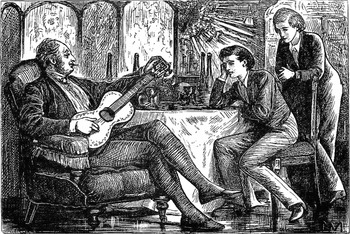
While wine, women, and wildly extravagant spending can signal mania, other symptoms occur in the characterization of Richmond Roy. For instance, the APA DSM-IV-TR includes under “Associated descriptive features and mental disorders” of bipolar illness traits of individuals in the manic phase who, for instance, cannot stay in one place: “They may travel impulsively to other cities, losing contact with relatives and caretakers” (359). Accordingly, Roy disappears for “years” on the Continent before Harry finds him in Germany. Father and son eventually travel to Venice, Brussels, Paris, Cologne, and Vienna, among other destinations. Furthermore, according to the APA's DSM-5, the clothing of patients may indicate mania: “Individuals may change their dress, makeup, or personal appearance to a more sexually suggestive or dramatically flamboyant style” (129). Roy also wears striking costumes. On his first visit to Germany, Harry/Richie finds his father dressed as a bronze statue; after removing that costume, Roy appears in “a black silken jacket and knee-breeches, purple-stockings and pumps” (203; vol. 1, ch. 18) (Figure 18). Later Roy wears a black velvet cap and a Spanish furred cloak (from the wardrobe of a nobleman in a play). On that same first day, he changes yet again for the evening: “Plain velvet was his dress at dinner” (213; vol. 1, ch. 18). At one of his elaborate masquerade parties, Roy wears a Henry III costume of “ruffled lavender silk” (possibly from a royal wardrobe auction) that allows him to show off his “magnificent leg.” A young French actress in his employ critiques the costume favorably, adding though that he is “only one degree too rosy at night for the tone of lavender” (161; vol. 2, ch. 43) – the “rosy” color yet another symptom of mania, described by Griesinger as a “considerable . . . redness of the face” (279, 289).
Illustration by George du Maurier for serial issue of The Adventures of Harry Richmond in the Cornhill Magazine (1870) and reprinted in The Memorial Edition of The Works of George Meredith, Vol. 9 (New York: Scribner's, 1910), facing 208.

Another sign Roy displays involves lack of sleep, which appears as an indication of mania from Griesinger (288) to the fifth edition of the APA diagnostic manual (128). According to Jamison, “[d]ecreased sleep is both a symptom of mania and a cause” (69). In the first chapter, Richmond Roy bangs on the door of the residence at Riversley Grange at two in the morning, awaking family and servants (3; vol. 1, ch. 1). Then for years, Richmond Roy parties often with such company as Jorian DeWitt through the morning hours and into the dawn. However, finally, under the constant watch of Julia Rippenger Bulsted, who has taken charge of Roy after a breakdown, he sleeps. His new keeper notes that he now sleeps eighteen hours a day (291; vol. 2, ch. 53).
Other symptoms of mania also appear in the characterization of Richmond Roy. The APA's DSM-5 describes another obvious sign: “Speech can be rapid, pressured, loud, and difficult to interrupt” (128). Meredith repeatedly refers to Roy's loud aggressive voice. For instance, Harry remarks Roy's “tremendous volubility” aimed at Dr. Ambrose Peterborough, who can make “no head against” Roy's loud jesting at the tutor's expense (288; vol. 1, ch. 26). Harry another time finds his father, dressed in “Hessian boots” and “a voluminous cloak,” dictating a letter rather too early and too loudly to his secretary. Roy interrupts his letter to turn toward Harry “with the whole weight of his sententious volubility which was the force of a river” (105; vol. 2, ch. 39). Back in England, when attempting to hide from his grandfather the presence and proximity of Roy, Harry cringes when he hears his father's “nimble and overwhelming volubility like a flood advancing” (239; vol. 2, ch. 50).
Lists of criteria of the mood disorder also regularly mention as an important characteristic an obvious inflation of self-esteem and a sense of grandiosity, and here especially the descriptions match aspects of Meredith's depiction of Richmond Roy. Goodwin and Jamison state: “Grandiosity of thinking, delusions of power and grandeur occur in the manic state” (27). Roy's inflated sense of self-esteem leads to his making grand productions of his activities while providing the author grand occasions for satire. Breaking the law, Roy impersonates royalty and uses royal insignia (43; vol. 1, ch. 4). At Bath, he makes a Grand Promenade; on the Continent he takes a Grand Tour; in London he stars in a Grand Parade. Roy waxes grandiose as he spins his vision “that the entire course of his life was a grand plot, resembling an unfinished piece of architecture, which might, at a future day, prove the wonder of the world” (215; vol. 1, ch. 19). Once he decides to press the marriage of his son to German royalty, Roy, “sixty if he's a month” (135; vol. 2, ch. 41), talks of his new grand campaign with his friendly hanger-on and parasitic wit, Jorian DeWitt. Roy announces, “I suspect the grand campaign of my life is opening.” DeWitt opines that “if so it would be the tenth” (240; vol. 1, ch. 31). However, Roy's funds again run out; and Harry anticipates the creditors gathering to force Roy's escape – again. So Harry returns to the house in London expecting “silence and gloom.” Instead he finds the lights burning “brilliantly” and a joyous gathering accompanied by a string and woodwind orchestra, all to celebrate the money deposited into Roy's account to cover what he had spent of Harry's funds (175; vol. 2, ch. 44). Roy blithely and mistakenly believes that he has received a bribe from the “Government” to keep him from going forward with his “Case.”
Roy's obsession to prove his royal blood in court appears grandiose and pitiable. With his assumed surname the French word for king and his alleged full Christian name given as “Augustus Fitz-George Frederick William Richmond Guelph” (232; vol. 1, ch. 20), his claim recalls others convinced of their exalted positions during this period.Footnote 8 In this respect, Roy may exemplify Griesinger's descriptions of monomania, one of the last steps toward insanity: “In these cases we frequently meet with the idea of being some distinguished person,” like Napoleon, or like a man “of aristocratic descent” (306).
Unfortunately, a court case must of necessity cast clouds on Roy's mother's reputation and situation, since in the nineteenth century her occupation as an actress would automatically raise questions about her virtue. In London, Roy shows his son a miniature portrait of a young woman, a “Mistress Anastasia Dewbury.” Roy relates that she was a beautiful actress who had married a royal personage on the same night that “masked ruffians” had assisted “mad Lord Beaumaris at the theatre doors” in his obsession to abduct and possess “the beautiful Miss Armett” following Anastasia's “performance of Zamira” (113; vol. 2, ch. 41). The baffling coincidence and confusing events of a kidnapping of one actress and the wedding of another on the same date certainly need further elucidation. In her discussion, Tracy Davis may offer clues to the episode in accounts of scenes at stage doors and elsewhere following suggestive productions featuring provocatively dressed actresses (101-04).
Anastasia's sister Elizabeth had later testified that a marriage ceremony had taken place in Soho that very night, and Roy's calling himself Fitz-George indicates that he presents himself with this name as the illegitimate son of the Regent who became George IV. Graham McMaster suggests the intriguing possibility that Meredith made use in his fiction of an actual claim made by “a certain Lavinia Ryves and her son Henry,” not only to royal blood but to the throne itself (68). Their and Roy's stories contain interesting parallels (68-70). Whatever Meredith's source, Roy's solicitors, Dettermain and Newson, plan to argue Roy's case based on the aunt's testimony and a small collection of such articles as letters, a ring, and monogrammed handkerchiefs. With these items, Roy presumes that his claims to have royal blood will be proven and his grandiose dreams assured. Regrettably for his case, his aunt Elizabeth allegedly bartered off the most corroborative letters and evidence after Anastasia died leaving a four-year-old son for her sister to support. However, even if his questionable lawyers could win the case, Roy could claim recognition only perhaps of rank and possibly a modest pension. George III's third son, the Duke of Clarence, had ten illegitimate FitzClarences by “the brilliant and beautiful actress, Mrs. Jordan,” described by Roger Fulford as “stout with coarse manners” (99). Despite their father's affection and continuing support, the Royal Marriage Act, as Fulford explains, would have made marriage to a commoner “impossible” (96) and their children never eligible to stand in line to the throne. Thus, after the Duke of Clarence became William IV and his marriage with Queen Adelaide produced no living legitimate children, his brother's daughter Victoria became heir presumptive.
In addition to legal impediments, Roy's grand illusions leave him vulnerable to situations embarrassing to him and to his now grown son. For instance, at the expense of Roy's remaining dignity and credibility, the young Marquis of Edbury engineers a meeting of this Englishman who calls himself “duke” with an old man who claims to be the “dauphin” and rightful heir to the French throne. In a satirical scene that predates Mark Twain's Duke and Dauphin in Huckleberry Finn, each pretender states his claims before the audience and shows his “private marks” (132-33; vol. 2, ch. 41). Roy's obsession prevents his realizing that the hoax provokes laughter at his expense. This same intensity and grandiosity motivate Roy's dream and goal of his son's union with a hereditary German princess. His aspirations drive his subsequent manipulations, and his failures precipitate his mad behavior.
When Roy's grandiose schemes run into snags, his melancholy moods occur after disappointments and losses. In her memoir of her illness, Jamison describes her version of a “down phase” in which “early on [her] mind would be drenched in awful sounds and images of decay and dying” (45). In its list of criteria for depression, the APA's DSM-5 includes “[r]ecurrent thoughts of death” (125). For Roy, memories of his mother often seem to trigger the cycling toward melancholy, and then he speaks of seeing “undertakers” and “the tomb.” Returned to London from Bath, Richmond Roy talks of his mother and how she “died early” of a “broken heart.” He and his son walk to her burial place, her grave maybe underneath a marked flat paving stone of a London street (270; vol. 1, ch. 23). In another scene as he and Harry/Richie walk back to the London house, Roy admits that he has a “slight inclination to melancholy.” As they follow their path “between the mansions and the park,” Roy confides to his son that they “resemble a double line of undertakers. The tomb is down there at the end of them.” Then he returns once more to memories of the death of his mother: “At the age of four, on my birthday, I was informed that my mother lay dead in her bed” (103; vol. 2, ch. 39). In other scenes he sheds tears when he talks of his mother or reads letters about her.
As Richmond Roy grows older and shakier in his search for rank, the earlier stages of mania and depression begin to worsen. Roy's increasingly erratic behavior demonstrates his decreased ability to play his roles convincingly and to deal with the realities of his disappointments and setbacks. The turning point in Harry's ongoing appraisal of his father takes place in Prince Ernest's lake palace library. For background commentary, Meredith has prepared for the crucial scene earlier in a chapter titled “News of a Fresh Conquest of My Father's.” The wealthy heiress, Anna Penhrys, younger even than Harry, makes it clear to her audience that no one could accuse Roy “for one moment of having encouraged her by secret addresses” (232; vol. 1, ch. 20). In the subsequent dramatic scene at Prince Ernest's palace, Roy has nevertheless manipulated and conspired to have his son make “secret addresses” to Princess Ottilia at midnight so that they can – on the spot, without her father's knowledge or consent – plight their troth, agree to marry.
However, when his plans are foiled, Roy chooses a dangerous cover-up maneuver. The young lovers in the library have hidden witnesses. In addition to Roy, Ottilia's “dragon” chaperone, Baroness Turckems, has remained literally “undercover” until she suddenly rushes to pull the bell-rope to bring help and witnesses. To conceal the real reasons for the discovery of Ottilia in the library after midnight with Harry Richmond, his father sets the drapes on fire and exclaims, “This will explain the bell!” Only Professor Peterborough has the good sense and presence of mind to pull the burning drapes to the floor and trample out the fire. Harry afterwards admits his apprehensions about his father: “I had, I must confess, a touch of fear of a man who could unhesitatingly go to extremities, as he had done, by summoning fire to the rescue” (50; vol. 2, ch. 36). With the success of his scheming threatened, Roy seems to have moved into acute mania, during which, according to Goodwin and Jamison, “Bizarre, driven, paranoid, impulsive, and grossly inappropriate behavior patterns” occur. Their examples of such behaviors include streaking naked or setting fire to a house (24). Generally, critics ignore the pathology of Roy's using arson to avoid exposure of his designs.
After Roy torches the drapes, the English guests depart the German palace the next morning; and the episode forces Harry to admit fear of his father's excesses and shame at his own dishonorable part in his father's plot. Roy, however, has not finished his campaign to make a German princess his trophy daughter-in-law, even though Harry has wisely begun to reevaluate his father and to rethink his relationships with Ottilia and with Janet Ilchester. Harry returns to Riversley, and one night as he walks across the heath, a gang of gypsies assault and beat him mercilessly (a case of mistaken identity since Harry resembles his friend who had seduced the attackers’ young kinswoman). After Roy hurries to his son's bedside, he again starts plotting to bring Harry and Ottilia together and moves Harry to the Isle of Wight to finish recuperating. As Roy plans a new gambit in his game, Harry observes his father's rapid cycling: “his transient fits of despair after a touch at my pulses” alternate with his “exuberant anticipations, his bursting hopes” (199; vol. 2, ch. 47).
Roy's interference, however, ultimately puts Princess Ottilia's reputation at risk and angers his convalescent son. After Roy sends a message to Ottilia that Harry lies dying, she rushes to the English sea resort. Though she loves Harry, Roy's manipulations and attempted blackmail have placed Ottilia in such an untenable position that she can no longer choose for herself, but feels “obliged to marry a man to protect her father and herself” – to conciliate her father and to save her reputation. She marries Prince Hermann, the middle-aged German prince who pushes himself physically on her and who urges maintaining the “purity of the true race” and taking India away from England (31-32; vol. 2, ch. 34). With Harry's loss of Ottilia, Meredith may indicate concern that Hermann's imperialistic racism may eventually subordinate Ottilia's compassion and wisdom.
As his manic schemes collapse and his dreams disintegrate, Roy's frenzies break out whenever he is crossed or suffers a loss. In the novel's climactic discovery scene, Squire Beltham confronts the man he has known as Richmond and destroys his great expectations. Roy can no longer attribute the anonymous deposits to a guilty royal family using the money as bribes to keep him quiet. Instead, the squire has accidentally discovered that his own daughter Dorothy has been anonymously wasting her money on Roy. Beltham also relishes telling Roy that Prince Ernest had earlier visited to tell the squire that Ottilia will marry Prince Hermann. At these blows to his elaborate plans, Roy breaks down: “I am broken,” he says. His hand shakes like an old man's, and Harry briefly suspects an “acting” performance. Roy repeats, “I am broken,” then uses the kind of death imagery that occurs during his depressive phases: “I am like the ancient figure of mortality entering the mouth of the tomb on a sepulchral monument” (286; vol. 2, ch. 52). Subsequently, after learning that Squire Beltham has willed his estate to Janet Ilchester rather than to Harry, Roy goes into a formidable meltdown: Harry describes his father as “frenzied, . . . turning suddenly from red to pale under what I feared were redoubtable symptoms, physical or mental” (299; vol. 2, ch. 53).
When Roy does not appear ready to explode, he becomes zombie-like. According to DSM-5, in a depressive period, an individual shows “[m]arkedly diminished interest or pleasure in all, or almost all, activities most of the day.” Furthermore, he or she has “Insomnia or hypersomnia nearly every day” (125). Roy's condition resembles depression and dementia at this point, and he can no longer function rationally in society. He descends into stupor and incapacity with only brief recorded transitions out of the depths back into functional activity. He at one point recovers enough to return to the Continent, where Harry this time, instead of Roy, engages in revelry. Back in England once more, Harry's friends in London and at Riversley see that Roy needs special care, but Harry cannot convince his father to consult a doctor though “the symptoms threaten apoplexy or paralysis” (295, 304; vol. 2, ch. 53). William and Julia Bulsted volunteer their home to allow Roy rest and care after Janet has tended him. On the night before Janet Ilchester plans to marry Edbury, Lady Sampleman takes the ailing “Fitz-George” into her London house, for one night only. Harry describes Roy's behavior on that evening: “He was quiet, unlikely to give annoyance to persons not strongly predisposed to hear sentences finished and exclamations fall into their right places.” As Harry remembers the scene, “My father chattered, Lady Sampleman hushed him” (322-24; vol. 2, ch. 55).
When the Bulsteds arrive the next morning to prepare Roy for his move to their home and care, they find him gone. Andrew Saddlebank has unwittingly invited Roy to a great City Banquet. Harry arrives at the gathering to escort his father back, only to find Richmond Roy in the middle of a speech on the failures of princes and peoples. After his son explains to a bystander that he has come for the speaker, the man cautions Harry: “I'm afraid there's danger in interrupting him. I really am.” Roy's adult son suffers a dismaying realization: “They were listening obediently to one whom they dared not interrupt for fear of provoking an outburst of madness” (326-28; vol. 2, ch. 55). Removed to the Bulsteds’, Roy continues his downward trajectory. During his earlier confinement there, hoping to calm her ailing patient, Julia allows a strange old clarinetist described as Roy's “pensioner and singular comforter” – and incidentally once “the humble lover” of Roy's mother – to come to the blue guest room to play his clarinet for Roy (292; vol. 2, ch. 53). Old Bagenhope's music seems to soothe the patient.
Roy's active mania returns only after Janet, unexpectedly and providentially free and available, marries Harry Richmond. In anticipation of their return from their honeymoon trip, Roy supervises preparations at Riversley for a grand homecoming celebration, pathologically over-decorating with lamps and torches, with “devices in paper and muslin” backed by “stores of fireworks, such a display as only he could have dreamed of” (342; vol. 2, ch. 56). The fireworks explode, the decorations feed the fire, and the house at Riversley Grange burns to the ground with Richmond Roy in it. In the final words of the novel, “He was never seen again” (343; vol. 2, ch. 56).
The details in the development of the character and plot suggest that Meredith had knowledge at least of a prototype for Richmond Roy. Lionel Stevenson sees the relationship between Harry Richmond and his father as “essentially that of George Meredith with Augustus,” the writer's father, a well-dressed tailor with “aristocratic bearing,” who spent more than he could afford before he went bankrupt and who married his housekeeper after his wife died leaving a five-year-old son (8-10). Furthermore, Stevenson suggests, Augustus may have tried to take his son's small inheritance left to him by the boy's mother (184).
Roy also bears a family resemblance to the father of another of Meredith's eponymous heroes. Though Melchisedec Harrington operated, as Lindsay notes (181), in a more limited arena than Roy, in Evan Harrington, Meredith's 1860 novel, the Great Mel was known to drink too much, have affairs with women of the upper classes, pile up huge debts, and vaunt his royal blood and “mistaken identity” as a marquis (1-12; vol. 6, chs. 1–2). Moreover, Harrington also inexplicably set drapes on fire (276; vol. 6, ch. 22). The obvious prototype for Melchisedec Harrington is Melchizedek Meredith, also known as “the Great Mel,” the author's grandfather. According to Mervyn Jones, George Meredith's grandfather had socialized with the gentry and “had numerous love affairs, sometimes with ladies of high social ranking.” In addition, “he spent money lavishly and left heavy debts when he died.” One story about the real Mel told of how he was mistaken for a “Marquis in disguise” at Bath (13).
The possible autobiographical elements and the development of two fictional characters with symptoms of manic-depression in Evan Harrington and Harry Richmond suggest Meredith's continued interest in understanding the condition and its effect on fathers and their families. The portrayal of the up-and-down career of Richmond Roy includes criteria of mania and depression as described by Griesinger in the nineteenth century as well as by the APA in the twenty-first. Meredith once observed in a letter: “[M]uch of my strength lies in painting morbid emotion and exceptional positions”; but, he continued, “My love is for epical subjects” (Letters 1: 322–23). In The Adventures of Harry Richmond, Meredith combines his strengths in psychological observation and his love for large-scale adventures.