1. Introduction
The scientific study of pain, one of the most controversial areas in neuroscience, is rife with philosophical problems. The complex physiological nature of pain, when combined with the multi-dimensional phenomenology of pain experience as revealed in clinical studies, presents not only empirical questions but conceptual puzzles as well.
Among the foundational questions raised by scientific pain research, the following are especially relevant from a philosophical point of view: the subjective epistemic nature of the explanandum and the epistemological status of scientific explanations in the study of pain; the ontological nature of pain experience and its relation to underlying physiological processes; the composite nature of the experienced phenomenology of pain (especially its affective dimension); and finally, the striking contrast between pain and other modalities of perception like vision, hearing, and touch. But perhaps the most pressing question of all concerns a fundamental tension between pain as subjectively understood versus pain as objectively characterized, which constitutes the focus of our discussion below.
2. A Fundamental Epistemic Tension in the Study of Pain
The widely accepted “official definition” of pain, as presented in the journal of the International Association for the Study of Pain (IASP), Pain, reads as follows:
Pain: An unpleasant sensory and emotional experience associated with actual or potential tissue damage, or described in terms of such damage.
Note: Pain is always subjective. Each individual learns the application of the word through experiences related to injury in early life … Experiences which resemble pain, e.g., pricking, but are not unpleasant, should not be called pain. Unpleasant abnormal experiences (dysaesthesia) may also be pain but are not necessarily so because, subjectively, they may not have the usual sensory qualities of pain. Many people report pain in the absence of tissue damage or any likely pathological cause; usually this happens for psychological reasons. There is no way to distinguish their experience from that due to tissue damage if we take the subjective report. If they regard their experience as pain and if they report it in the same ways as pain caused by tissue damage, it should be accepted as pain. This definition avoids tying pain to the stimulus. Activity induced in the nociceptor and nociceptive pathways by a noxious stimulus is not pain, which is always a psychological state, even though we may well appreciate that pain most often has a proximate physical cause. (IASP 1986, 250)
Notice the contrast between the one-sentence formulation which associates pain with tissue damage, and the immediate qualification in the subsequent Note about the “subjectivity” of pain. This fundamental tension between what can be quantified as the “objective” measure of pain as characterized in terms of tissue damage and the “subjective” criterion of when to categorize a given experience as pain is in fact prevalent in pain research.Footnote 1 There is a sense in which the definition ultimately takes the objectively observable measures out of the diagnosis process and gives almost full authority to the subjects (even if this authority may at times be overridden in practice). When combined with the appropriate manifested behavior, the patient—if sincere and not confused—appears to have the last word, according to the definition, as to whether she is in pain or not, and what the nature and amount of her pain is. This is so even when no physical disturbance of the relevant sort can be detected in her body or central nervous system.Footnote 2
The IASP definition also seems to have an odd consequence with respect to what counts as causal explanation in the scientific study of pain. One might ask: what is the target of the explanation? Is it pain as subjectively understood, or pain as objectively characterized—as a physical state of the person? The definition seems to give credence to the former conception. But unless these two conceptions are conceptions of one and the same state, the scientists seem to take themselves to be studying or explaining the objectively observable causes of a subjective phenomenon (the introspectively accessible pain experience), but not the pain understood as an objective physical state. Put differently, consider whether it is reasonable, on the face of it, to take the definition as committed (implicitly or otherwise) to a metaphysical claim similar to those often made for conscious states in generalFootnote 3—i.e., that the explanation of pain experiences cannot be reduced to a physiological explanation because pain itself is not a physiological or physical state.Footnote 4 Accepting all subjective (sincere) reports as genuinely indicating real pain, independently of whether they are accompanied by known tissue damage or pathological cause, seems to render all objective measures of neuroscience secondary to the subjective ones.
But we believe the definition doesn't in fact go this far. It is compatible, for instance, with the claim that pain experiences are states of the brain (i.e., supraspinal activity as opposed to peripheral stimulation or spinal activity of a certain sort), and that when we know what states these are, objective measures will carry at least equal epistemic authority. Nevertheless, it is remarkable that the “official” definition seems to leave the ontological issue open, even though it insists that the epistemic authority is subjective as things now stand.
The question of epistemic priority between subjective and objective reports rests on a feature of pain that does not seem to be shared by perception in general: namely, the near-infallibility of pain reports, in contrast to other standard perceptual modalities where we can often be mistaken about what it is that we perceive (but see below). This near-infallibility, combined with the necessities of clinical practice and experience, appears to be the main theoretical factor responsible for the tension between standard causal explanations that the basic scientific research tends to traffic with and the epistemic authority of the patients. But how does pain differ from other perceptual modalities?
3. The Relation of Pain to Perception
The tension between explanations based on objective observation and measurement versus the subjective reports of the person in pain rests, at bottom, on the nature of pain experience itself. The difference seems to stem from the fact that it is much harder to establish, if at all possible, that a person who takes herself to be in pain is in fact mistaken and not in pain, or vice versa. Contrast this with cases of misperception, easy to come by all the time: looking at a piece of bush in the garden and mistaking it for a cat, hearing the alarm clock and mistaking it for the telephone, and so on. There seems to be a big difference between pain experience and perception in general in terms of what constitutes our immediate object of interest and attention.
In the case of perception, such as seeing or touching, it is what we see or touch, viz. the object of our perception, that we are most interested about. For the most part, this is certainly dictated by the fact that under ordinary circumstances, the experience of seeing or touching, apart from what is seen or touched, is largely transparent to the subject, making the content of the perception (rather than the perceptual experience itself) the focus of our attention and epistemic access. In contrast, in the case of pain experience, it is most often the experience itself that we are most immediately “presented with” and concerned about. That is, our immediate epistemic and practical focus is different in ordinary perception and in pain. Notice that this is true even if we construe pain experiences in entirely representational or intentional terms, i.e., even when we take pain experiences to represent some sort of tissue damage or bodily disorder or some kind of physical distress—whatever the intentional objects of pains turn out to be. Our immediate interest remains focused on the experience itself as indicated by the fact that we name the experience itself ‘pain,’ and talk about it when we talk about our pains, rather than apply ‘pain’ to the objects of the pain experience—if it has one.Footnote 5
Wade Savage construes this difference as a difficulty for scientific accounts of pain in his extended discussion of the status of psychophysical explanations:
[C]onsider pains, which are paradigm examples of sensations. There is the strongest kind of inclination to say that psychophysical laws of pain are laws relating sensations to their physical (or physiological) causes, laws of the form, Ψ = f (Φ). It does not seem that the concept of a perceptual ability can be substituted here for the concept of a psychological dimension. What perceptual ability would be measured? It cannot be the ability to perceive some public, physical entity, since pain is not public and not physical. To feel pain is to feel a private, psychological entity. Public entities—a pin, for example—may cause O to feel pain. But to feel the pin is not to feel the pain. It is not the ability to feel pins we wish to measure here, but the ability to feel pains. And this ability cannot be measured without a method for measuring pains, for measuring sensations. (Reference Savage1970, 547)
Savage's point is that unlike what is involved in perception, the object of pain experiences is not publicly observable entities or events. In fact, this way of construing pain often suggests that pain itself is the object of some form of perception. On the basis of the essential difference between things that are seen in vision, e.g., cars, cats, and football games, and “things” felt in “pain perception” (not the pain-causing stimulus but the pain experience itself), usually the following two consequences are held. First, the target of scientific explanation in pain research is a mental state that is subjectively accessible, and thus the scientific explanatory activity essentially has a prominent subjective element (to come back to the observation made previously). Second, perhaps because of this, a genuinely scientific account of pain itself is not possible, which may account for the widespread belief that pain is not a physical phenomenon (as Wade suggests above)—for if it were physical, it would be objective, not subjective, as one is tempted to argue.Footnote 6
We concur with the first consequence, namely that scientific explanation of pain involves subjective elements—when this is understood in an ontologically neutral way—but not with the second. In fact, while we claim that “pain perception” can be construed, strictly speaking, as a form of introspection (and perhaps, to that extent, as a form of “inner perception or sense”), we don't take this to have any undesirable consequence with respect to scientific explanation and a materialist ontology.Footnote 7
The outlined differences between pain and other modalities of perception constitute the basis of the strong epistemic foothold that subjective reports possess in the study of pain. The model of scientific explanation for pain is different from the model of explanation for perception in general because of the asymmetry just mentioned. Ultimately, this difference stems from a difference between the explananda themselves.Footnote 8 However, this point—in the absence of an argument to the effect that no naturalistic explanation can be given for introspection of experiences—cannot be taken as a roadblock to a full scientific account of pain, and of experiences in general. Quite to the contrary, we argue that this particular feature of pain in fact tends to bring with it an advantage for the neuroscientist, which is normally absent in other perceptual phenomena at large: it forces the neuroscientist to pay more attention to the phenomenological information which seems to be available in introspection; it forces the neuroscientist to focus more on attempts to relate neuroscientific findings and mechanisms at the subpersonal level to what appears to be the case in pain reports at the personal level expressing subjectively accessible information.
Giving the subjectively available information almost full epistemic authority is a way of acknowledging the reality of what is subjectively reported, and thus practically forces the neuroscientist to assume that there have to be neural correlates (subpersonal mechanisms) of experiences.Footnote 9 It is these correlates that pain scientists try to discover by paying close attention to the subjective phenomena—after all the scientific study of pain is claimed to be the study of experiences as reported and subjectively described (as the IASP definition points out). What else is there for this scientific study to be the study of? The pressure on the pain scientist to pay close attention to the subjectively available information certainly stems from the subjective epistemic nature of pain and its clinical urgency. It seems clear that this pressure makes the pain scientist especially sensitive to integrative attempts to bridge the gulf between the subpersonal and personal levels. Thus, if the scientific endeavor is successful in this regard, the physicalist would be one step closer to actually identifying, as one and the same, the objects of the subjectively and the objectively accessible, and closing the so-called “explanatory gap” in the study of pain.Footnote 10
4. Dimensions of Pain Experience
Recall that the addendum to the IASP definition of pain makes the following claim:
Experiences which resemble pain, e.g., pricking, but are not unpleasant, should not be called pain. Unpleasant abnormal experiences (dysaesthesia) may also be pain but are not necessarily so because, subjectively, they may not have the usual sensory qualities of pain. (IASP 1986, 250)
The last qualification about “sensory qualities of pain” presupposes that the subjective phenomenology of pain is not simple and homogeneous, but is complex. It has long been noted that pain experiences have at least two major dimensions: the sensory dimension and the affective one—sometimes a separate cognitive dimension is also added.Footnote 11 It is possible to exploit this bi-dimensional characteristic of pain in the service of a tighter integration of the phenomenal and physiological explanatory levels in the study of pain. To that end, we need to first sketch an outline of the relevant subpersonal mechanisms of pain.
4.1. An Outline of Subpersonal Pain Mechanisms
Pain processing starts with specific receptors and pathways, evolved to alert the brain to the presence of harmful stimuli via nociception. Nociceptive receptors and pathways vary in kind and are probably abundant in the human body. They project, like other various somatosensory pathways, from the periphery to the spinal cord, and from there to the cortical and subcortical areas in the brain.
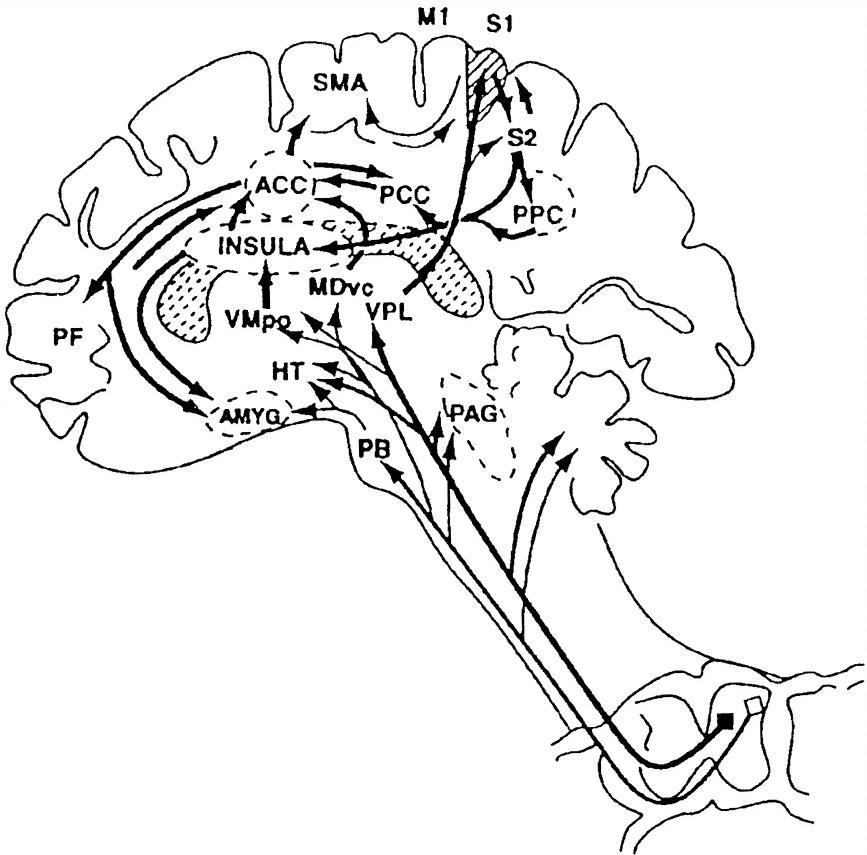
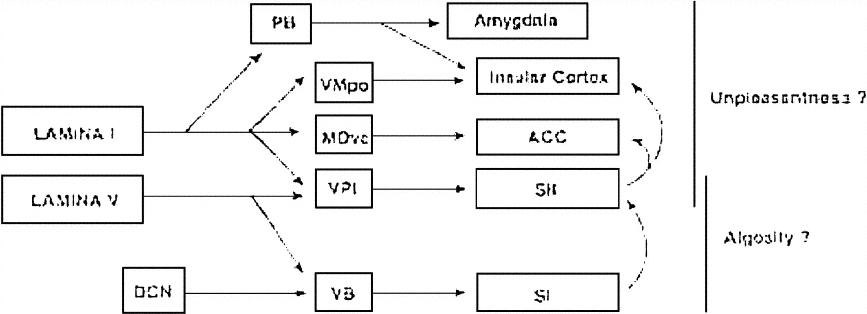
One of the main results in pain research over the past thirty years or so is that there appear to be roughly two distinct central nociceptive pathways—the lateral and the medial. The lateral pathway ascends from the spinal cord to the lateral thalamic nuclei in the brain (the ventrobasal complex (VB), which includes the ventroposterolateral (VPL) and ventroposteromedial (VPM), as well as the ventroposterior inferior nucleus (VPI)), on its way to the primary and secondary somatosensory (S1 and S2) cortices. The medial pathway, in contrast, follows a more central route, stretching from the spinal cord to the medullary and pontine reticular formation (RF) to the medial thalamic nuclei, terminating in the insula and the anterior cingulate cortex (ACC)—there are also connections to pariaqueductal grey (PAG) and to the amygdala (through the brainstem parabrachial nucleus—PB) and the prefrontal cortex (PF) as well as other limbic structures (see Figures 1 and 5 below). The terminating points of these pathways also reveal a functional difference between them.
Schematic illustration of ascending pathways, subcortical and cortical structures involved in processing pain. VMpo, ventromedial part of the posterior nuclear complex; MDvc, ventrocaudal part of the medial dorsal nucleus; PCC, posterior cingulate cortex; HT, hypothalamus; PPC, posterior parietal cortex; SMA, supplementary motor area; AMYG, amygdala. (Adapted from Price Reference Price2000).

The lateral pathways terminating in somatosensory cortical areas (S1, S2) seem to serve the capacity of the pain system to distinguish between different sensory properties of noxious stimuli, such as bodily location, intensity, and quality (thermal, incisive, traction, extension, etc.). In contrast, the medial pathways—due to the connections to insular and cingulate cortices and to limbic structures in general, which are known to play a crucial role in emotional behavior—seems to serve the capacity of the pain to generate the appropriate affect-laden responses (such as unpleasantness, urgent desire for cessation, interruption of attention) to nociception.Footnote 12
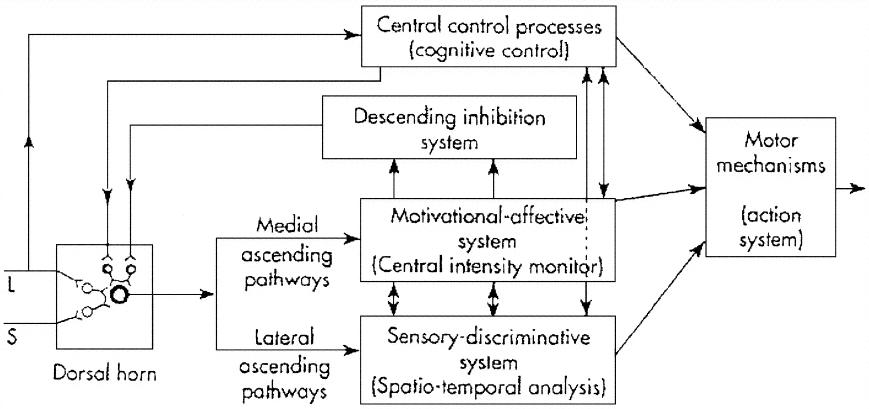
These pathways appear to be anatomically distinct, although they heavily overlap. They are also functionally disassociable. Melzack and Casey (Reference Melzack, Casey and Kenshalo1968), mostly depending on case studies of such pain disassociation and modulation, provided the theoretical groundwork for much of the following scientific research that lead to the identification of some of the anatomic sites. The proposed gross functional organization of the central processing of nociceptive information underlying pain, as Melzack and Casey outlined in their highly influential 1968 paper, is still largely intact at least in so far as it insists on the distinct mechanisms for qualitatively distinct aspects of a pain experience (see Figure 2).
(Adapted from Melzack and Casey Reference Melzack, Casey and Kenshalo1968).

What has initiated and motivated the scientific search for separate subpersonal mechanisms for these distinct components was mainly a set of puzzling clinical data (as well as the introspectable phenomenology of pain), which are now confirmed through several different experiments with different methodologies (anatomical and physiological considerations as well as brain imaging studies). These data typically came from patients who have undergone prefrontal lobotomy (Freeman and Wattz Reference Freeman and Wattz1946, Reference Freeman and Wattz1950; Hardy et al. Reference Hardy, Wolff and Goodell1952; Barber Reference Barber1959; Bouckoms Reference Bouckoms, Wall and Melzack1994) or cingulotomy (Flotz and White Reference Flotz and White1962; White and Sweet Reference White and Sweet1969) as a last resort for their intractable chronic pain (as frequently involved in phantom limb pain, neuralgia, causalgia, severe psychogenic and cancer pains), from patients under the effects of hypnotic suggestion (Rainville et al. Reference Rainville, Duncan, Price, Carrier and Bushnell1997, Reference Rainville, Carrier, Hofbauer, Bushnell and Duncan1999), nitrous oxide (laughing gas), and some opium derivatives like morphine (Barber Reference Barber1959). These patients by and large agreed that when they were in pain, they could recognize and identify it as such, but did not feel or seem bothered or distressed in ways characteristic to pain experience. There are, however, important differences among the phenomena afflicting these patients, which are manifested in patients’ reports and behavior. For instance, pain asymbolia also typically produces a kind of disassociation—a rather strong kind—similar to cingulotomy patients’ but interestingly different from lobotomy patients’ (Rubins and Friedman Reference Rubins and Friedman1948; Weinstein et al. Reference Weinstein, Kahn and Slate1995; Hurt and Ballantyne Reference Hurt and Ballantyne1974; Devinsky et al. Reference Devinsky, Morrell and Vogt1995).
Notice that the data here are obtained mostly on the basis of subjective reports of patients. No objective observations of the causes of their condition, non-verbal behavior, and/or the brain damage involved, would all by themselves be strong enough to force scientists to seek functionally and anatomically separate brain mechanisms.
There is strong evidence that the disassociation between these two components also goes in the other direction: in addition to cases where the intensity of sensory component can be reduced without affecting the unpleasantness of the experience (Gracely et al. Reference Gracely, Dubner and McGrath1979), there is at least one well documented and studied case where the patient experiences something very unpleasant upon receiving nociceptive stimuli without being capable of identifying his experience as pain (Ploner et al. Reference Ploner, Freund and Schnitzler1999).Footnote 13
It was (among others) the accumulation of this sort of (mostly) subjectively obtained abnormal data, indicating disassociable phenomenological components, that ultimately led to the identification of the neural substrates through brain imaging studies: the phenomenology strongly guided what to look for, and where. Melzack and Casey's speculations opened a whole new chapter in modern pain research: more elaborate models unearthed inhibitory and modulatory systems in pain processing along with cognitive control and intervention mechanisms.Footnote 14
4.2. The Phenomenal Complexity of the Affective Dimension of Pain
There is, however, some disagreement among scientists themselves about the nature of the affective dimension and how it relates to the sensory one. We would like to examine this disagreement because of its importance to the philosophical point we have made about the role of phenomenology in scientific research. We also hope to bring some conceptual clarification to the issues at hand in hopes of facilitating agreement.
One of the first pain scientists who pointed out the complexity of what is indiscriminately bundled up under the label “affective-motivational” is Donald Price (Reference Price1988). Melzack and Casey had already changed the landscape of scientific pain research with their insistence that pain is not a single homogeneous phenomenon but consists of at least two dimensions. Price was persistently stressing in the late 1980s that the conceptualization of the affective dimension also need to reflect (at least) two different phenomena. In a recent Science article, he writes:
Part of the affective dimension of pain is the moment-by-moment unpleasantness of pain, made up of emotional feelings that pertain to the present or short-term future, such as distress or fear. Pain unpleasantness is often, although not always, closely linked to the intensity of the painful sensation. Another component of pain affect, “secondary pain affect,” includes emotional feelings directed toward long-term implications of having pain (e.g., “suffering”). (Reference Price2000, 1769)
Earlier, he had called the moment-by-moment unpleasantness, “stage 1 affect” (Reference Price1988, 56–57, 226–227). Unfortunately, despite Price's warning against generating potential confusion, the scientific community, as far as we can tell, has not paid much attention to this further distinction within the affective dimension of pain—until recently. In the abstract of a tribute article for Melzack/Wall/Casey on pain research, Fields summarizes his main discussion this way:
This essay is an attempt to clarify the construct of unpleasantness in the context of the psychophysics of pain. The first critical point is that one aspect of unpleasantness is tightly coupled to stimulus intensity and is therefore a sensory discrimination. Pain has this quality, but so do other somatic sensations such as itch and dysesthesias that are not recognized as painful by most people. A corollary of this is that pain must have a quality other than unpleasantness that allows it to be unequivocally identified. I use the term algosity for that quality. In addition to stimulus bound (primary) unpleasantness, there is an unpleasant experience that reflects a higher level process which has a highly variable relationship to stimulus intensity and is largely determined by memories and contextual features. I have termed this experience secondary unpleasantness. (Reference Fields1999, S61)Footnote 15
Fields then claims that: “[t]he sensory-discriminative/affective motivational dichotomy has outlived its usefulness and is currently more of an impediment than a guide to neurobiological explanation of pain” (Reference Fields1999, S61).
If Fields’ distinction between primary and secondary unpleasantness should be taken as finessing Melzack-Casey's distinction, just like Price's, his suggestion seems puzzling. Given the way the framework is set up, one would think that Fields’ distinction is a distinction within the affective dimension itself—that unpleasantness is an affective affair seems true by definition. So how could he be suggesting that the original sensory-discriminative/affective motivational dichotomy no longer applies?
As far as we can tell on the basis of textual evidence and personal communication, Fields takes the original dichotomy to make a distinction between what he calls algosity and secondary unpleasantness. Secondary unpleasantness is a “high level” processing because it involves heavy cognitive mediation and modulation. It consists of emotional reactionsFootnote 16 produced or heavily influenced by how the patient conceives of her own pain and the consequences of having it. This conception need not be very reflective or self-conscious, but nevertheless taps on the patient's memories, perception/cognition of her context in which the pain occurs, and her general background knowledge and preferences.
We are not sure as to whether Fields’ concept of secondary unpleasantness is the same as Price's concept of secondary pain affect, but at a minimum, they are close (although Fields’ concept seems to be broader and more inclusive than Price's).Footnote 17 If our diagnosis is correct, Fields finds the original Melzack-Casey distinction to be flawed because it does not seem to leave any room for a conception of unpleasantness as a “raw feel,” distinct from algosity but almost equally stimulus-bound, which is still an affective phenomenon but is not cognitively mediated in any way in which secondary unpleasantness is cognitively mediated.
Fields’ way of making this point, however, is a little disorienting. He first suggests that “both [primary] unpleasantness and algosity are primary somatosensory qualities that represent two distinct intensity-based sensory discrimination” (Reference Fields1999, S64). He then says: “The attempt to pigeonhole unpleasantness as either sensation or affect is misguided because it is both” (S64). This analysis seems to us to be misleading because if primary unpleasantness is a form of genuine sensory discrimination distinct from algosity, then there must be some property—some objective feature of the stimulus—that it must discriminate, and this feature must be distinct from what algosity discriminates. But it is hard to see what this property of the stimulus might possibly be.Footnote 18
According to our interpretation, what Fields is after is to isolate an affective component of pain phenomenology (an episodic raw feel) which is distinct from algosity but is nevertheless primarily stimulus-bound (almost as much as algosity is) in that it is largely (but not entirely) impervious to cognitive modulation and penetration. One might characterize this as a “raw hurtfulness” intrinsic to every normal pain experience as an essential component of it, no matter how much the secondary unpleasantness can be modified and mediated by various cognitive factors.
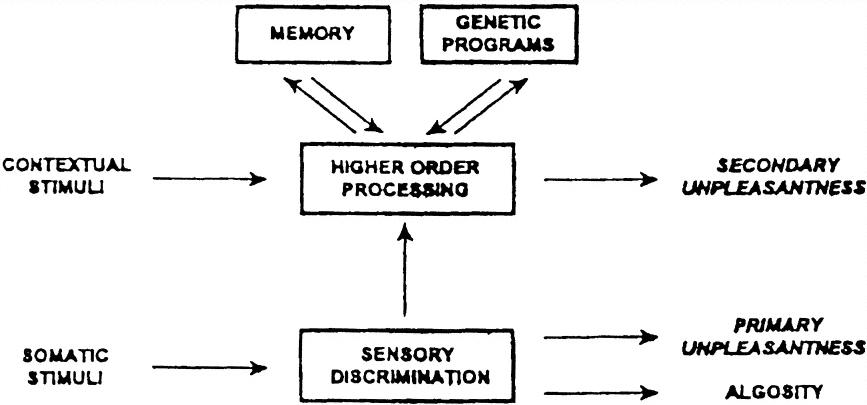
If we are right in this reading, it is also not surprising to find Fields arguing (apparently against Price Reference Price1988, Reference Price1999, Reference Price2000 and Rainville et al. Reference Rainville, Carrier, Hofbauer, Bushnell and Duncan1999, among others) that primary unpleasantness is processed in parallel with algosity. In other words, Fields insists that although it is reasonable to view secondary unpleasantness as a cognitively mediated reaction to algosity, and therefore as causally dependent on it (i.e., in series with it), it is not reasonable to view the primary unpleasantness as a reaction to algosity (see Figure 3). He seems to think that primary unpleasantness is as much a raw feel as algosity is in reaction to stimulus intensity; so it is therefore (largely) in parallel with it. Indeed, he cites the above-mentioned case study by Ploner et al. in support of this view.
Fields’ conception of the relations between algosity and two different kinds of unpleasantness (Figure from Fields Reference Fields1999).

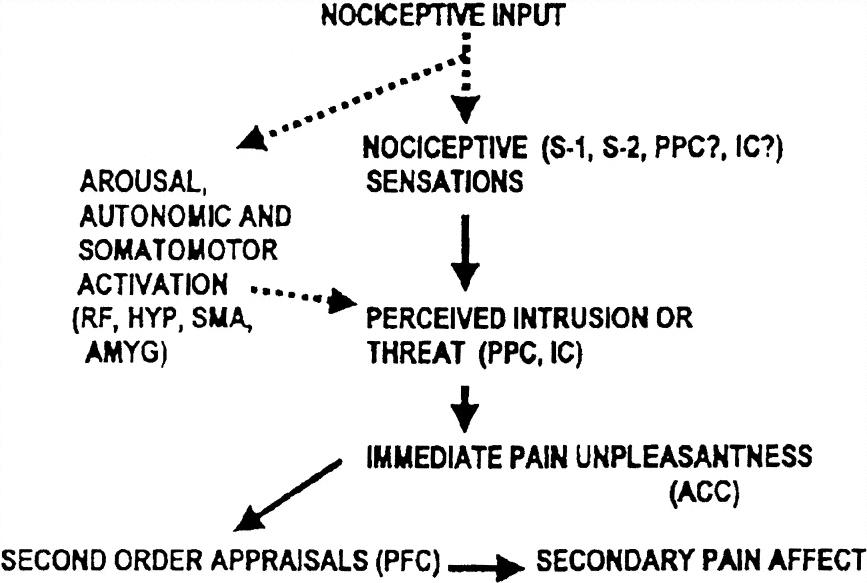
It is natural to think that Fields’ distinction between primary and secondary unpleasantness is influenced by and at least roughly corresponds to Price's (chronologically earlier) distinction between stage 1 affect (or, immediate pain unpleasantness) and secondary pain affect. But the disagreement between Price and Fields about whether the affective-motivational aspect of pain is in parallel or in series with the sensory-discriminatory aspect seems to go deeper. We believe that it can be traced to a more fundamental disagreement as to whether there is an affective quality of pain which is a “raw” phenomenological element intrinsic to normal pain experiences, i.e., not normally cognitively mediated and modulated. It so turns out that Price thinks that even immediate “moment-by-moment” unpleasantness of pain depends on cognitive appraisals—even though they may be quite rudimentary and “automatic.” Price's conception of his distinctions is captured nicely by a diagram he has been using over the years in slightly different forms (see Figure 4). Notice that here immediate pain unpleasantness as a qualitative component of pain phenomenology depends directly on “perceived intrusion or threat.” Indeed, Price (Reference Price1988) labels the latter stage on which the immediate unpleasantness depends “meanings” (58) and (first order) “cognitive appraisals” (227). This stage in turn causally depends on what Price calls “nociceptive sensations”—what Fields would call “algosity.”
A schematic used to illustrate interactions between pain sensation, pain unpleasantness, and secondary pain affect (solid arrows). Neural structures likely to have a role in these dimensions are shown by abbreviations in adjacent parentheses, and their full names are given in the legend of Fig. [1]. Dashed arrows indicate nociceptive or endogenous physiological factors that influence pain sensation and unpleasantness. (Figure and caption from Price Reference Price2000).

Who is right, and how can this disagreement be adjudicated?
5. Conclusion
Trying to answer these questions goes beyond the scope of this paper. However, we would at least like to underscore the conceptual nature of the disagreement and the debate. Like many other scientists in the field, Price and Fields are talking about the qualities of pain experience (i.e., elements of pain phenomenology that are subjectively/introspectively accessible, and conceived as such) in an attempt to correlate them with different brain structures and mechanisms (what is objectively accessible). For instance, right after illustrating his views in Figure 3, Fields speculates on the underlying brain mechanisms corresponding to the relevant phenomenological distinctions (see Figure 5). This is a straightforward attempt to do what is sometimes called “neurophenomenology.”Footnote 19 Indeed, the interest in the integration of these two levels is so strong and natural in the study of pain that sometimes it is not even clear which level drives the investigation at the other level, and which conceptions and commitments at any given level influence the search for elements in the other level.
Nociceptive inputs to Dorsal horn laminae I and V have overlapping but distinct supraspinal projection targets; these include the brainstem parabrachial (PB) and possibly the dorsal column (DCN) nuclei, and, in the thalamus, the ventromedial part of the posterior nucleus (VMpo), the ventrocaudal Mediodorsal nucleus (MDcv), the ventroposterior inferior nucleus (VPI) and the ventrobasal complex (VB). These nuclei, in turn project to somatosensory and limbic forebrain structures as shown. (Figure and caption from Fields Reference Fields1999, S66).

Fields, for instance, voices the following hope in the abstract of his 1999 paper:
In order to increase our understanding of pain we need psychophysical tools designed specifically to differentiate primary unpleasantness from both algosity and secondary unpleasantness. These tools can then be used to determine the neural mechanisms of pain. (Reference Fields1999, S61)
This goes in one direction. But it is very clear that discoveries and theoretical speculations or models built to accommodate the data sometimes force the scientists (as well as philosophers—e.g., Dennett Reference Dennett and Dennett1978) to have a new critical look at the distinctions drawn at the personal level. We think that this is as it should be. Studies and investigations at different levels do not compete against each other. On the contrary, the understanding of each feeds and enriches the understanding of the other. The metaphysical outcome in this process, when combined with the philosophical solutions to conceptual impediments, is to see that we are not dealing with two ontologically distinct levels, but the diversity is due to the different natures of the epistemic access involved—access to one and the same phenomenon.Footnote 20