The fundamental difference hypothesis (FDH; Bley-Vroman Reference Bley-Vroman, Gass and Schachter1989, Reference Bley-Vroman1990) has set the agenda for (adult) nonnative language (L2) research within the generative paradigm. At its most basic, the issue is the type of knowledge that adult L2 learners have, specifically whether adult L2 learners (can come to) have the same type of language representations that native speakers do. In his original 10-point argument for the FDH, Bley-Vroman (Reference Bley-Vroman1990, which was actually written before his 1989 chapter) noted that adult L2 systems virtually never match the target language (TL) but that, in any event, a superficial match to the TL is not sufficient for inferring that the L2 system has necessarily converged on the grammar of the TL.Footnote 1
Whereas many (if not most) adherents to the FDH and proposals of similar ilk (e.g., Clahsen & Muysken, Reference Clahsen and Muysken1986, Reference Clahsen and Muysken1989; Johnson & Newport, Reference Johnson and Newport1989, Reference Johnson and Newport1991)Footnote 2 have focused on differences in attainment between natives and nonnatives, other scholars (e.g., Dekydtspotter, Sprouse, & Thyre, Reference Dekydtspotter, Sprouse and Thyre1999/2000; Hopp, Reference Hopp2005; Kanno, Reference Kanno1998; Marsden, Reference Marsden, Beachly, Brown and Conlin2003; Slabakova, Reference Slabakova2001) have sought to investigate whether adult L2 learners manifest evidence of the type of knowledge that motivates positing the existence of Universal Grammar (UG) in the first place—namely, domain-specific poverty-of-the-stimulus (POS) effects. Even Bley-Vroman conceded (see, e.g., Note 1) that demonstrations of L2 POS effects—phenomena underdetermined by both the L2 learners’ first language (L1) and the TL and not taught in the L2 classroom (e.g., Schwartz & Sprouse, Reference Schwartz, Sprouse and Archibald2000)—are the most convincing way to argue that UG constrains adult SLA and, hence, that L1 acquisition and (adult) SLA are not fundamentally different.
A second way to test the FDH, proposed by Schwartz (Reference Schwartz1987, Reference Schwartz1992, Reference Schwartz, Beachly, Brown and Conlin2003), is to compare adult and child L2 developmental sequences, where the L1 is kept constant. Similarities and differences that child L2 development has with respect to both adult L2 development and child L1 development have the potential to shed light on the nature of all three types of language acquisition (Lakshmanan, Reference Lakshmanan1995; Schwartz, Reference Schwartz, van Kampen and Baauw2004; Unsworth, Reference Unsworth2005). With regard to the FDH in particular, the rationale behind the L2 child - L2 adult comparison—where a child L2 learner is defined as a L2 learner first exposed to the TL between the ages of 4 and 7—is as follows:Footnote 3 Assuming (a) that child SLA is constrained by UG and (b) that domain-general learning is more relevant to adult L2 learners than to child L2 learners (in the domain of language), then comparing developmental sequences of child L2 learners with those of adult L2 learners, while holding their L1 constant, will provide evidence against or for the FDH. Similar developmental sequences would indicate, contra the FDH, that UG constrains adult SLA, whereas dissimilar paths would indicate, in support of the FDH, that adult SLA stems from something other than UG (i.e., domain-general properties of the mind) but that child SLA stems from UG.Footnote 4
The present study makes use of both of these methods to test the FDH, investigating the acquisition of Korean wh-constructions with negative polarity items (NPIs).Footnote 5 Two properties of these constructions are POS phenomena not only for native acquirers of Korean but also for L1 English speakers acquiring Korean. This study also compares three groups of language acquirers—L2 adults, L2 children, and L1 children—in the development of Korean wh-constructions with NPIs, focusing in particular on the L2 child - L2 adult comparison.
We first describe and explain the properties of Korean wh-constructions with NPIs, with reference to the relevant properties of English, and then lay out the learnability issues for L2 learners whose L1 is English. Next, previous SLA research on these constructions is reviewed. We then provide the details of the experiments in the present study, after which we discuss their results, the (inferred) developmental sequences of Korean wh-constructions with NPIs for all three groups, and the import of these findings.
WH-CONSTRUCTIONS WITH NEGATIVE POLARITY ITEMS
Intervention Effects
The Korean wh-object questions in (1a) and (2a) are in the canonical word order—subject (S)-object (O)-verb (V)—with the subject preceding the direct object. In (1b) and (2b), the wh-phrase (mwues-ul “what-acc”) is scrambled, which results in OSV word order.Footnote 6 Although Korean is a wh-in-situ language, the nonscrambled and scrambled options are both acceptable (in the appropriate discourse contexts), both in a positive wh-question, as illustrated in (1), and in a simple negative wh-question, as in (2). The difference is essentially one of focus: In the wh-object questions with OSV word order, the subject is defocused.
(1) a. Nonscrambled SOV word order
Swuna-ka mwues-ul sa-ass-ni?
Swuna-nomwhat-acc buy-past-q
b. Scrambled OSV word order
Mwues-ulSwuna-ka sa-ass-ni?
what-acc Swuna-nom buy-past-q
“What did Swuna buy?”
(2) a. Nonscrambled SOV word order
Swuna-ka mwues-ul sa-ci anh-ass-ni?
Swuna-nomwhat-acc buy-ci neg-past-q
b. Scrambled OSV word order
Mwues-ulSwuna-ka sa-ci anh-ass-ni?
what-acc Swuna-nom buy-ci neg-past-q
“What didn’t Swuna buy?”
However, for negative wh-object questions with a NPI (here, as a subject), scrambling of the object wh-phrase is obligatory, as shown in (3). (The NPI amwuto “anyone” is licensed only when it is in the scope of negation within the same clause.)
(3) a. Nonscrambled SOV word order
*Amwuto mwues-ul sa-ci anh-ass-ni?
anyone what-acc buy-ci neg-past-q
(cannot mean “What didn’t anyone buy?”)
b. Scrambled OSV word order
Mwues-ulamwuto sa-ci anh-ass-ni?
what-acc anyone buy-ci neg-past-q
“What didn’t anyone buy?”
There are several accounts of the contrast exemplified in (3) (e.g., Beck, Reference Beck1996; Beck & Kim, Reference Cheng1997; Choi, Reference Choi2007; Hoji, 1985; Kim, Reference Kim and David2002; Miyagawa, Reference Miyagawa and Karimi2003). Because these works, with minor differences, are all essentially based on Beck’s original minimal quantified structure constraint (MQSC) analysis, this study follows the analysis of Beck and Kim.
Observing the contrast between (3a) and (3b), Beck and Kim (Reference Beck and Kim1997) adopted Beck’s (Reference Beck1996) minimal negative structure constraint in (5)––which itself makes use of Beck’s negation-induced barrier (NIB) in (4)––and argued that the Korean NPI amwuto “anyone” in (3) blocks (covert) wh-movement at the level of logical form (LF)—namely, LF wh-movement.
(4) Negation induced barrier (NIB):
The first node that dominates a negative quantifier, its restriction, and its nuclear scope is a Negative Induced Barrier. (Beck, p. 18)
(5) Minimal Negative Structure Constraint (MNSC):
If a Logical Form (LF) trace β is dominated by an NIB α, then the binder of β must also be dominated by α. (Beck, p. 18)
How this derives the facts of (3a) and (3b) is shown in their respective LF tree diagrams in (6a) and (6b).Footnote 7 In (6a), the NIB that dominates a LF trace tmLF(β) does not dominate the wh-phrase, and this violates the MNSC; thus, wh-movement of the wh-phrase at LF is disallowed, and therefore the negative unscrambled question in (3a) is unacceptable on the wh-question reading. However, the sentence in (3a) can mean “Didn’t anyone buy something?”—in other words, a yes/no-question reading is acceptable (Beck & Kim; Choi, Reference Choi2007; Ha, Reference Song, Bamman, Magnitskaia and Zaller2008; Song, Reference Song, Bamman, Magnitskaia and Zaller2007).Footnote 8
In (6b), by contrast, the object wh-phrase is first scrambled across the subject NPI (amwuto “anyone”) at S-structure (the NIB does not block overt movement, or scrambling, of wh-phrases), and at LF it is subsequently moved to the specifier (Spec) of the complementizer phrase (CP), which derives an acceptable negative wh-question. Here, after the first step of scrambling, the NIB does not dominate the trace of the wh-phrase after the second step of LF wh-movement––that is, tmLF(β)––and it also does not dominate the wh-phrase; there is thus no violation of the MNSC.
The unavailability of LF movement in scenarios like (6a) is referred to as an intervention effect (Beck & Kim, 1997). Assuming that for Korean wh-questions, an in situ wh-phrase has to move from its S-structure position to a LF landing site outside the scope of negation, Beck and Kim generalized that an intervening negative quantifier (e.g., the NPI amwuto “anyone”) blocks LF wh-movement. Thus, interrogative wh-phrases cannot be c-commanded by NPIs in Korean. This generalization of the intervention effect has been formulated from various syntactic, semantic, or pragmatic perspectives in the literature (e.g., Beck, Reference Beck1996; Beck & Kim; Choi, Reference Choi2007; Kim, Reference Kim and David2002; Pesetsky, Reference Pesetsky2000; Sells, Reference Sells, Kuno, Lee, Whitman, Maling, Kang and Kim2001; Tanaka, Reference Tanaka2003; Tomioka, Reference Tomioka2007).
(6a)

(6b)


Beck and Kim (1997) noted that Korean allows scrambling of a wh-phrase to remove it from the scope of a negative quantifier (i.e., a NPI), but English does not. They suggested that if a language has a scrambling process that can obviate intervention effects, that language must use it—and they speculated that the absence of scrambling correlates with the absence of the intervention effect. According to Beck and Kim, Hindi, Turkish, and Urdu, like Korean, do not have obligatory wh-movement but do have scrambling, and these languages exhibit the intervention effect. In contrast, English, the mother tongue of the L2 learners in this study, does have obligatory wh-movement, does not have scrambling, and does not show the intervention effect.Footnote 9 Thus, despite the fact that the wh-element acts as the sentence focus in both English and Korean wh-object questions, (a) only in English is wh-movement of the object obligatory, and (b) only in Korean is wh-object scrambling optional, except in the context of a c-commanding (subject) NPI, in which case scrambling becomes obligatory. For native English speakers acquiring Korean, the intervention effect is not in the TL input and is not a characteristic of their L1 grammar; this phenomenon is also not the topic of TL instruction. Therefore, such L2 learners face a learnability problem in the acquisition of Korean wh-constructions with NPIs.Footnote 10
Two Different Interpretations
The second property of Korean wh-constructions with NPIs is concerned with the interpretation differences between nonscrambled (SOV) and scrambled (OSV) word orders. As mentioned, Beck and Kim (1997) noted that the nonscrambled questions––as in (3a), Amwuto mwues-ul sa-ci anh-ass-ni?––have a yes/no-question reading, and the scrambled questions––as in (3b), Mwues-ul amwuto sa-ci anh-ass-ni?––have a wh-question reading. Although Beck and Kim did not precisely account for why the nonscrambled variant can have the yes/no - question reading, they offered an interesting suggestion––namely, that there is a transparency requirement for Korean S-structure: Scope relations should be made clear at S-structure as far as possible. The MQSC (from which the MNSC is derived) is expected to hold in languages, like Korean, that have the syntactic freedom to do so. Scrambling on such an approach has interpretative effects; it is a means by which S-structure transparency can be achieved in Korean. However, the nature of wh-words in Korean needs to be considered before the Beck and Kim suggestion can be discussed in more detail.
Crosslinguistically, wh-words are not identical in nature. Indeed, a number of researchers (e.g., Aoun & Li, Reference Aoun and Li1993; Cheng, 1997; Nishigauchi, Reference Nishigauchi1990) argue that natural languages differ with regard to the morphological and syntactic properties of wh-expressions. The claim is that wh-words in Chinese, Japanese, and Korean, among others, do not have quantificational force of their own and are like indefinite noun phrases (NPs). This claim is based on the fact that in these languages, wh-words that function as interrogative expressions can also act as universal and existential quantifiers. Hence, the interpretation of a wh-word in languages like Korean must be determined in its sentential context, with the wh-expression’s interpretations depending on the element that binds it and assigns its quantificational force.
We are now in a position to return to the S-structure transparency requirement that Beck and Kim (1997) suggested as a means to explain the yes/no-question reading of (3a). The relevant contrast, adapted from (3), is given in (7). The basic idea is that intended scope relations in Korean can be made visible at S-structure through the presence or absence of scrambling––and because these scope relations can be made S-structure visible, they must be made S-structure visible.
(7) a. amwuto has scope over mwues-ul (→ mwues-ul is a wh-indefinite)
Amwuto mwues-ul sa-ci anh-ass-ni?
anyone something-acc buy-ci neg-past-q
“Didn’t anyone buy something?”
Semantic interpretation:
is it the case that there is no x PERSON(x): for some y THING(y) PAST(x BUY y)
“is it the case that there is no person x such that, for some object y, x bought y?”
b. mwues-ul has scope over amwuto (→ mwues-ul is a wh-interrogative)
Mwues-ulamwuto sa-ci anh-ass-ni?
what-acc anyone buy-ci neg-past-q
“What didn’t anyone buy?”
Semantic interpretation:
which y THING(y): there is no x PERSON(x) & PAST(x BUY y)
“which object is such that there is no person who bought it?”
The wh-phrase in (7b) is scrambled and thus can undergo LF wh-movement without violation of the MNSC, as illustrated in (6b), which shows that the wh-phrase in (7b) has quantificational force; here, the wh-word has wide-scope interpretation (over the NPI) via scrambling. On the other hand, the wh-phrase in (7a) is in situ and cannot undergo LF wh-movement because to do so would violate the MNSC, as illustrated in (6a), which reflects the fact that the wh-word does not have quantificational force; here, it is the NPI that has wide-scope interpretation (over the wh-phrase).
This is how, in brief, S-structure scopal transparency can determine the interpretation of the wh-phrases in (7a) and (7b) as, respectively, a wh-indefinite and a wh-interrogative, which, in turn, gives rise to the yes/no-question reading of (7a) and the wh-question reading of (7b). With typical intonation patterns, neither (7a) nor (7b) is ambiguous. By contrast, both SOV and OSV word orders in a positive wh-construction, as in (1), and in a simple negative wh-construction, as in (2), are ambiguous, in that each can have not only the wh-question interpretation but also the yes/no-question interpretation. What is important to underscore is that, in light of the optionality of scrambling in Korean in general, and in light of the ambiguity between wh-question interpretation and yes/no-question interpretation of both SOV and OSV in both positive wh-constructions and simple negative wh-constructions in particular, the difference in interpretation between (7a) and (7b) makes the learnability problems all the more severe for L1 English speakers acquiring Korean.Footnote 11
In sum, two properties of Korean wh-constructions with NPIs pose learnability problems to L1 English speakers: (a) In wh-object questions, object wh-phrases must scramble across a NPI subject to obviate the intervention effect, as in (7b); and (b) there are two different interpretations that depend on whether the wh-phrase is scrambled (a wh-question reading, as in [7b], and a yes/no-question reading, as in [7a]). In contrast to Korean, English cannot deploy scrambling to remove the intervention effect, and English wh-words are taken to be unambiguously wh-interrogatives. So, if L1 English-speaking (adult) L2 learners of Korean can overcome these two L2 POS problems, it can be argued that UG constrains (adult) SLA.
PRIOR L2 RESEARCH ON KOREAN Wh-CONSTRUCTIONS WITH NPIs
There has been very little experimental work on the SLA of Korean wh-constructions with NPIs. Song (Reference Song, Bamman, Magnitskaia and Zaller2007) investigated the intervention effect in adult English-speaking L2 learners of Korean using an elicited-production task that targeted object wh-questions. (Because the present study builds on that one, the experimental particulars of Song are omitted.) Her results indicated that adult native speakers of Korean tested on three syntactic contexts––positive wh-questions, simple negative wh-questions, and NPI-context wh-questions––clearly differentiated among the three: They virtually always produced scrambled object wh-phrases (i.e., OSV) in only the last of these syntactic contexts. Some adult L2 learners also demonstrated exactly the same contrast, despite the first learnability problem identified here (i.e., the POS of this Korean intervention effect for L1 speakers of English)––thereby providing the first suggestive evidence that in regard to this intervention effect, adult SLA is constrained by UG. Interestingly, many native controls in Song’s study remarked that there were two possible interpretations of negative wh-constructions with NPIs, one for OSV word order and one for SOV word order––which led to the explicit testing of this contrast in the current study.
Another suggestive finding reported in Song (Reference Song, Bamman, Magnitskaia and Zaller2007) concerns the scarcity of wh-constructions with NPIs in Korean natural data. Song searched the Sejong corpus of the 21st-century Sejong project organization in order to investigate the frequency of amwuto “anyone,” mwues-ul “what-acc” or “something-acc,” and nwukwu-lul “who-acc” or “someone-acc.”Footnote 12 Although there are hundreds of tokens of each of the three phrases under investigation, there is not a single occurrence of a scrambled wh-phrase in the context of negative wh-constructions with a NPI subject, amwuto “anyone.” This does not mean that such negative questions never occur in Korean natural data, because native speakers do utter them. Clearly, though, they are extremely rare. Additionally, it should be emphasized that the interpretive restrictions on such NPI-subject wh-constructions (with scrambled vs. in situ object wh-phrases) are, in any case, not in the input at all.
THE PRESENT STUDY
The aim of this study was to test the FDH by providing answers to these questions:
1. Do L1 English-speaking L2 learners of Korean overcome L2 POS problems in the acquisition of wh-constructions with NPIs?
2. Do L1 English-speaking adult and child L2 learners of Korean follow the same developmental sequence for these phenomena, and how does L1 Korean development compare?
Participants
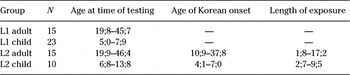
Four groups of participants completed this study: adult (n = 15) and child (n = 10) L1 English-speaking L2 learners of Korean; adult (n = 15) and child (n = 23) Korean native speakers. (The Korean native children were all tested in Korea.) The participants’ relevant details are summarized in Table 1. Participant details All participants’ backgrounds L2 adults L2 children


All of the L2 participants had been exposed to Korean in a classroom setting in Hawai‘i, the adults at university and the children at Korean Saturday schools. They had had varying amounts of naturalistic communication with Korean teachers and friends but not with their families (i.e., although of Korean ethnic descent, they were not heritage language learners). Additionally, some L2 participants reported enjoying Korean dramas and movies on Hawaiian television.
All participants had to be able to read Korean because the experiments required them to use four word or phrase cards to produce sentences and to comprehend sentences presented to them. Therefore, the L1 (and L2) children had to be at least 5 years old. In addition to a picture-narration task (Day 1) given only to the L2 learners to assess their Korean, all participants took part in three tasks, each of which was completed individually in a quiet room (in this order): an elicited-production task (Day 1), an acceptability-judgment task (Day 2), and an interpretation-verification task (Day 2). One week separated the two testing days.
Picture-Narration Task
Determining relative L2 proficiency is necessary for comparing adult and child L2 learners in a cross-sectional design and specifically for ascertaining whether their developmental sequences are similar. Indeed, L2 proficiency turns out to play a crucial role in the analysis and interpretation of the experimental data.
Materials.This task consists of three sets of four pictures that depict a sequence of events. Each series of pictures elicits (semi-)spontaneous data, and all of the actions depicted are considered general enough to happen in everyday life, such as washing one’s face, reading a book, and so on.
Procedure.The L2 participants were presented with the picture sets by means of a PowerPoint presentation and were asked, for each set, to tell a story. If participants seemed nervous or had difficulty starting to speak, the experimenter allowed them to say what they wanted to describe in their native language (English) and then asked these participants to tell the story in Korean.
Data Analysis.In SLA research, L2 proficiency has been defined in numerous ways. Language proficiency is used not only as a general indicator of a L2 learner’s ability in the TL but also as a measure of specific aspects of linguistic competence, such as lexis, morphology, syntax, and discourse. Here, L2 proficiency is defined in terms of the ability to produce lexically and morphosyntactically complex and accurate utterances in the TL, Korean.
Lalleman (Reference Lalleman1986) argued that it is necessary to assess both syntactic complexity and syntactic accuracy because these two aspects of language proficiency closely interact: the more complex an utterance, the more opportunity for errors to be made. If an assessment of L2 proficiency were made of complexity alone, where complexity is measured, for example, by utterance length, L2 learners who produce long yet inaccurate utterances would be considered more proficient than L2 learners who produced shorter but more accurate utterances. It is therefore essential that both complexity and accuracy be incorporated into a proficiency score.
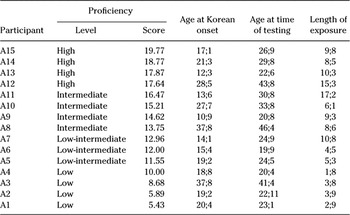
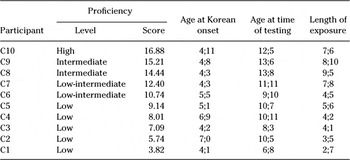
Because it is suitable for children and adults alike, a picture-narration task was adopted to get an independent measure of L2 Korean proficiency (Whong-Barr & Schwartz, Reference Whong-Barr and Schwartz2002). Although Whong-Barr and Schwartz defined a segment in oral data as an utterance, here a T-unit was used instead because the oral data that our picture sequences elicited are not fragmentary or elliptical.Footnote 13 Following Whong-Barr and Schwartz, a complexity measure and an accuracy measure were (weighted equally and) combined to indicate L2 learners’ proficiency level. The Appendix shows the proficiency results, ranking adult and child L2 learners by L2 proficiency scores, and explains how they were calculated.Footnote 14 Note that there seems to be a tendency for proficiency to increase as length of exposure increases (see also Table 1).
Elicited-Production Task
The purpose of the elicited-production task was to test whether participants produce a targetlike word order (SOV or OSV) in the four conditions, which led to the following research questions.
3. Do participants produce either a scrambled (OSV) word order or an in situ (SOV) word order in wh-questions without NPIs?
4. Do participants produce only OSV in negative wh-questions with NPIs?
5 Do participants produce only SOV in negative yes/no-questions with NPIs?
Materials.All three experiments described in this article use the Korean NPI amwuto “anyone” and two wh-words: mwues “what” or “something” and nwukwu “who” or “someone.” There were four experimental conditions: (a) positive wh-questions (PQ), as illustrated in (8), for which the target word order is either SOV or OSV; (b) negative wh-questions without NPI (NQ), as illustrated in (9), for which the target word order is either SOV or OSV; (c) negative wh-questions with NPI (NNQ-WH), as illustrated in (10a), for which the target word order is OSV and not SOV; and (d) negative yes/no-questions with NPI (NNQ-Y/N), as illustrated in (10b), for which the target word order is SOV and not OSV. The symbol √ is used to indicate that the word order is possible, and the symbol * is used to indicate that the word order is not possible.
(8) a. Swuna-ka mwues-ul mek-ess-ni? PQ (√SOV/√OSV)
Swuna-nom what-acc eat-past-q
b. Mwues-ul Swuna-ka mek-ess-ni?
what-acc Swuna-nom eat-past-q
“What did Swuna eat?”
(9) a. Swuna-ka mwues-ul mek-ci anh-ass-ni? NQ (√SOV/√OSV)
Swuna-nom what-acc eat-ci neg-past-q
b. Mwues-ul Swuna-ka mek-ci anh-ass-ni?
what-acc Swuna-nom eat-ci neg-past-q
“What didn’t Swuna eat?”
(10) a. wh-question reading NNQ-WH (*SOV/√OSV)
Mwues-ul amwuto mek-ci anh-ass-ni?
what-acc anyone eat-ci neg-past-q
“What didn’t anyone eat?”
b. yes/no-question reading NNQ-Y/N (√SOV/*OSV)
Amwuto mwues-ul mek-ci anh-ass-ni?
anyone something-acc eat-ci neg-past-q
“Didn’t anyone eat something?”
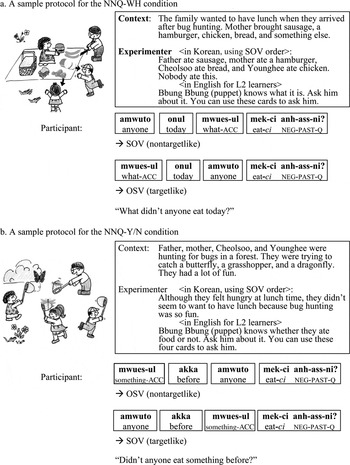
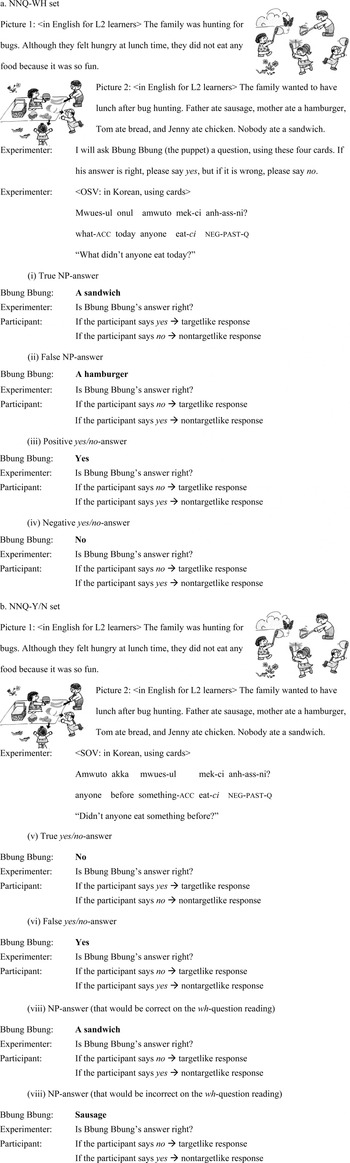
There were 16 experimental items (i.e., four per condition) mixed with 16 fillers to distract participants’ attention. As three of the four experimental conditions were negative questions with mwues “what” or “something” or nwukwu “who” or “someone,” all fillers were simple positive yes/no-questions (e.g., Emma- nomnapi- acccap-ass-ni? “Did mother catch a butterfly?”). Sample protocols for the NNQ-WH and NNQ-Y/N conditions are given in Figure 1.
Sample protocols for the NNQ-WH and NNQ-Y/N conditions in the elicited-production task.

The majority of the background context was presented to the L2 participants in their L1, English, because this procedure ensured that all L2 participants could understand the context clearly and unambiguously. Additionally, restricting use of the TL, Korean, to a few simple sentences enabled the experiment to include L2 learners at low levels of proficiency.
Procedure.Prior to the actual experiment, participants had a training session with three items. (The experimenter first checked whether NPI amwuto “anyone,” interrogative mwues “what,” and interrogative nwukwu “who” were familiar; anyone who did not know all of these meanings was excluded.) While each participant was presented with a picture (on a computer screen), the experimenter told him or her a story about it (each story started in English for the L2 learners––the context in Figure 1––and ended in two or three short [SOV] sentences in Korean). After that, participants were instructed (in their L1) to ask Bbung Bbung, the puppet, a question using cards that had words or phrases on them. For each item, there were four cards: one NP or amwuto “anyone” (for the subject); one wh-word, mwues “what” or “something” or nwukwu “who” or “someone” (for the object); one verb part (with or without negation); and one (locative or temporal) adverbial phrase.Footnote 15 All four cards together were handed to the participant to remove any possible effects from the order in which the cards were presented. Participants used the cards to ask only one question.
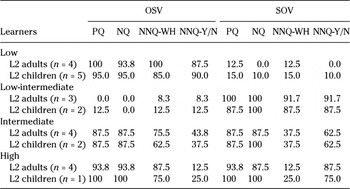
Results.Because of L2 proficiency differences within the L2 child group and the L2 adult group (see the Appendix), it is difficult to determine on the basis of pooled results from these groupings (viz., age of initial exposure) whether L2 learners come to know the two properties of Korean wh-constructions with NPIs. For this reason, we combined the adult and child L2 learners, using their L2 proficiency scores to create four proficiency groups: low, low-intermediate, intermediate, and high. The L2 proficiency ranges of these four groups are as follows: low = 3.82–10.00; low-intermediate = 10.74–12.96; intermediate = 13.75–16.47; high = 16.88–19.77. (The proficiency scores themselves did not provide the criteria for L2 groups; rather, the L2 learners’ patterns exhibited in the experiments were matched to their proficiency scores, and it was on this basis that the L2 learners were grouped.) As a first step in analyzing the data, it is necessary to look at the results by L2 adults and L2 children within each proficiency group, to see whether the response rates of the adult L2 learners are (relatively) parallel to those of the child L2 learners. If this is the case (and, indeed, the intragroup response rates of L2 children and L2 adults are relatively parallel across all three tasks), then the next step is to examine the results from these four proficiency groups and compare them to those from the two native groups.
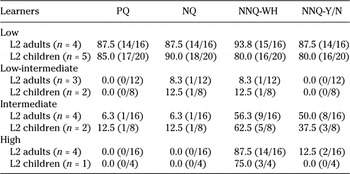
For the elicited-production task, the data are analyzed in terms of the rate of OSV responses, in all conditions (PQ, NQ, NNQ-WH, and NNQ-Y/N), because the purpose of this task is to examine whether participants scramble the object wh-phrase across the subject, especially across a subject NPI, amwuto “anyone,” when required (i.e., in the NNQ-WH condition) but not when prohibited (i.e., in the NNQ-Y/N condition). Note that if not OSV order, the word order produced was always SOV. Table 2 provides the rate of OSV in each of the four conditions from the elicited-production task by adult and child L2 learners in each proficiency group.
OSV response rates (in %) in the elicited-production task by L2 proficiency

Note
Target response: PQ: ✓SOV(/✓OSV); NQ: ✓SOV(/✓OSV); NNQ-WH: *SOV/✓OSV; NNQ-Y/N: ✓SOV/*OSV.
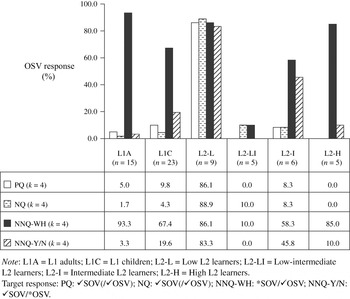
Within each proficiency group, the rates of OSV of L2 adults are parallel to those of L2 children, across all four experimental conditions. Therefore, the results from these four L2 proficiency groups, which combine adult and child L2 learners, will be compared to those from the two native groups. Figure 2 provides the OSV rates in each of the four conditions from the elicited-production task by L2 proficiency group.
OSV response rates in the elicited-production task (by L2 proficiency).

The L1 adults performed as expected. Although they almost never produced (possible but noncanonical) OSV responses in PQ and NQ, they did produce OSV in NNQ-WH at the high rate of 93.3% and almost never produced OSV in NNQ-Y/N (3.3%). The L1 children showed a relatively similar pattern to that of the L1 adults: They produced OSV much more often in NNQ-WH than in any other condition, although not quite as frequently as the L1 adults did.
The L2 learners in the low-proficiency group almost always produced OSV word orders in all four conditions; that is, although they did correctly produce OSV responses in NNQ-WH, it seems not to have been for the right reason. The L2 learners in the low-intermediate-proficiency group, in contrast, almost never produced OSV responses, across all conditions; in other words, they produced SOV utterances in all conditions. The intermediate-proficiency group restricted the OSV word order to the two NNQ conditions, around half the time. However, the high-proficiency L2 participants performed similarly to the L1 adults in all conditions; that is, they correctly reserved the OSV word order for NNQ-WH.
For each trial in the elicited-production task, participants had the opportunity to produce only one response. As such, the results indicate only what the participants’ preferred response is. Thus, to ascertain what participants allow and disallow in each of the four conditions, an acceptability-judgment task was employed.
Acceptability-Judgment Task
The acceptability-judgment task was used to investigate whether the low-proficiency L2 learners fronted wh-phrases because of L1-transfered wh-movement, to test participants’ knowledge of scrambling, and to examine whether participants had acquired the first property of wh-constructions (i.e., the intervention effect). The research questions that guided this task are as follows:
6. Do English-speaking nonnatives show L1 transfer effects (wh-movement)?
7. Do participants accept both scrambled and in situ orders in PQ and NQ?
8. Do participants know scrambling is required in NNQ-WH but prohibited in NNQ-Y/N?
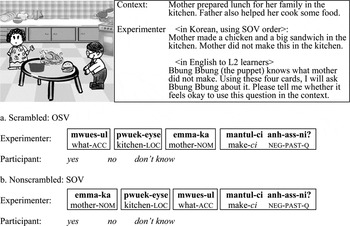
Materials.To reduce experimental time and participant fatigue (especially for the children), the same 16 test items and 16 fillers in the four experimental conditions (PQ, NQ, NNQ-WH, and NNQ-Y/N) used in the elicited-production task (Day 1) were also used in the acceptability-judgment task (Day 2). In this task, there were 32 test items (16 OSV and 16 SOV) and 32 fillers (16 OSV and 16 SOV). A sample protocol for the NQ condition is provided in Figure 3.
A sample protocol for the NQ condition in the acceptability-judgment task.

Procedure.Participants started with a short session to learn how to do the acceptability-judgment task and then proceeded to the main experiment. After listening to each story (again partially in English for L2 learners, as illustrated in Figure 3), participants were presented with the question that the experimenter had asked Bbung Bbung using four Korean word or phrase cards. Given three choices (yes, no, and don’t know), participants were asked to choose yes if it felt okay to use that question in the context but no if it did not feel okay.
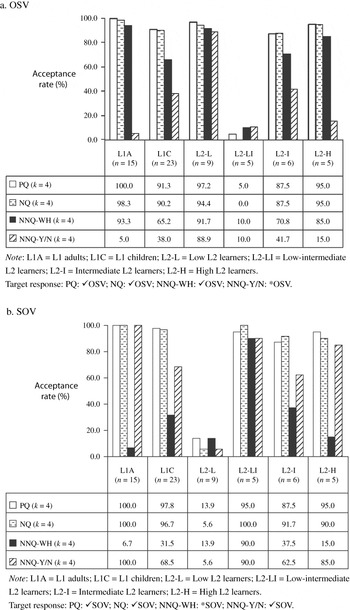
Results.Table 3 shows that within each proficiency group, the acceptance rates (in %) of L2 adults parallel those of L2 children on scrambled and in situ items across all four experimental conditions. The L2 proficiency groups’ acceptance rates are therefore presented in Figure 4 alongside the native speaker groups’ acceptance rates. Note that all answers were yes or no (i.e., there were no don’t know responses).
Acceptance rates of OSV and SOV experimental conditions in the acceptability-judgment task (by L2 proficiency).

Acceptance rates (in %) of OSV and SOV in the acceptability-judgment task by L2 proficiency

Note
Each participant saw four items per condition. Target response: PQ: ✓OSV/✓SOV; NQ: ✓OSV/✓SOV; NNQ-WH: ✓OSV/*SOV; NNQ-Y/N: *OSV/✓SOV.
As expected, the L1 adults accepted both SOV and OSV in PQ and NQ, but in NNQ-WH they strongly accepted OSV and strongly rejected SOV, and in NNQ-Y/N they strongly rejected OSV and strongly accepted SOV. The L1 children showed a similar, although not quite as discrete, pattern to that of the L1 adults.
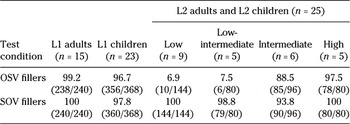
The L2 learners in the low-proficiency group almost always accepted OSV and almost always rejected SOV across all conditions. The observation that the low-proficiency L2 participants almost always produced and accepted OSV across all four conditions (see Figures 2 and 4a) and almost never accepted SOV, even in PQ and NQ (see Figure 4b), indicates that, for them, the fronted object wh-phrase of wh-questions stems not from scrambling but rather from L1-transfered wh-movement. This conclusion is buttressed by their performance on the fillers (i.e., simple yes/no-questions). Table 4 provides the acceptance rates of OSV and SOV orders on the fillers. (Again, no group had any don’t know responses.)
Acceptance rates (in %) of yes/no-questions in the acceptability-judgment task by L2 proficiency

Note
Target response: ✓OSV/✓SOV.
All participants, except for the low- and low-intermediate-proficiency L2 learners, accepted both SOV and OSV orders in the yes/no-question fillers, which shows that they know that Korean allows scrambling. As for the low-proficiency L2 learners, they accepted SOV but rejected OSV in these simple yes/no-questions without a wh-phrase (or a NPI), which suggests that they have not acquired knowledge of scrambling. This is to say, the low-proficiency L2 learners produced and accepted OSV in NNQ-WH for the wrong reason (wh-movement of the object, not scrambling). By contrast, low-intermediate-proficiency L2 learners almost always rejected OSV (Figure 4a and Table 4) and almost always accepted SOV (Figure 4b and Table 4). The fact that the low-intermediate-proficiency L2 learners, across all four experimental conditions and the fillers, almost always produced SOV (Figure 2) and virtually never accepted OSV (Figure 4a and Table 4) indicates that they do not know Korean has scrambling but that they do know that it does not have wh-movement. The intermediate-proficiency L2 learners, like the L1 children, showed a relatively similar pattern to that of the L1 adults. And the high-proficiency L2 learners had the same pattern as the L1 adults: In PQ, NQ, and fillers, they allowed optional scrambling; in NNQ-WH, they almost always accepted OSV but almost always rejected SOV (i.e., obviation of the intervention effect); and in NNQ-Y/N, they almost always rejected OSV but almost always accepted SOV.
We know from the results of the acceptability-judgment task what participants allow and disallow. And we know in particular that high-proficiency L2 participants know to scramble the wh-object to prevent intervention effects; that is, they show evidence of having overcome the first learnability problem. However, we still cannot determine for the experimental conditions with NPIs whether participants know that OSV receives only the wh-question reading and SOV receives only the yes/no-question reading––the second learnability problem. This motivated the interpretation-verification task.
Interpretation-Verification Task
The aim of the interpretation-verification task was to investigate whether participants know that each of the two interpretations of negative questions with NPIs is a function of word order.
9. In negative questions with an object wh-phrase and a subject NPI,
a. do participants assign the scrambled order (OSV) the wh-question reading only?
b. do participants assign the in situ order (SOV) the yes/no-question reading only?
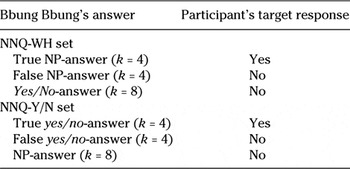
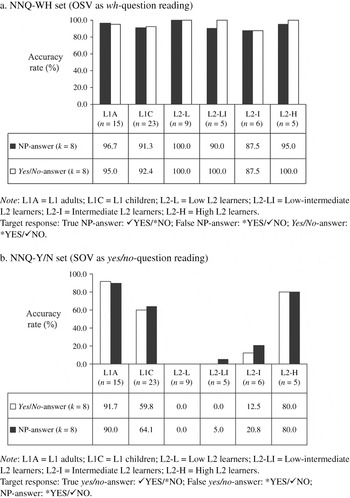
Materials.Two kinds of experimental items were used: (a) Questions in the NNQ-WH set are OSV and have only the wh-question reading, and (b) questions in the NNQ-Y/N set are SOV and have only the yes/no-question reading. Table 5 presents the experimental design for both sets.
Experimental design for the interpretation-verification task

Each set had four conditions in each of four basic story contexts, for a total of 32 experimental items (16 in the NNQ-WH set and 16 in the NNQ-Y/N set). In only one condition is yes the participants’ target response: to the true NP-answer in the NNQ-WH set and to the true yes/no-answer in the NNQ-Y/N set. In the three other conditions of each set, no is the target response: in the NNQ-WH set, to the false NP-answer and to both yes/no-answers; in the NNQ-Y/N set, to the false yes/no-answer and to both NP-answers. For purposes of variation across the four trials, assorted adverbial phrases were used (e.g., Didn’t anyone hit someone before? Didn’t anyone hit someone in the room?), and clothing, colors, and appearances, among others, were likewise altered. The 32 fillers (skewed to yes target responses) were wh-questions without NPIs (PQ and NQ) and yes/no-questions without either a wh-phrase or a NPI. Figure 5 presents a sample protocol for each set.
Sample protocols for the interpretation-verification task: the NNQ-WH set and the NNQ-Y/N set.

Procedure.The interpretation-verification task started with a short training session designed to familiarize participants with the task. The training session included three items similar to the fillers but without scrambling. Participants listened to each context (in English for L2 learners) while viewing two pictures. The experimenter asked Bbung Bbung the questions using four Korean word or phrase cards per item, to which Bbung Bbung provided either a NP-answer or a yes/no-answer. After that, the participants were instructed to give a yes response when Bbung Bbung’s answer was right and a no response when it was wrong, and if participants answered no, they were asked to provide an explanation.
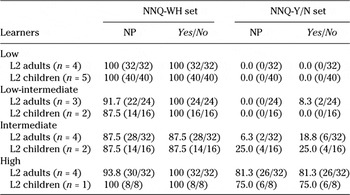
Results.Table 6 shows that within each proficiency group, the accuracy rates (in %) of L2 adults’ responses on the two conditions in both the NNQ-WH set and the NNQ-Y/N set are parallel to those of L2 children. Therefore, the accuracy rates by L2 proficiency group on the NNQ-WH set and the NNQ-Y/N set are provided alongside those of the natives in Figure 6.
Accuracy rates of responses in the interpretation-verification task (by L2 proficiency).

Accuracy rates (in %) on the NNQ-WH set and the NNQ-Y/N set in the interpretation-verification task by L2 proficiency

Note
NNQ-WH set—Target response: true NP-answer: ✓YES/*NO; false NP-answer: *YES/✓NO; yes/no-answer: *YES/✓NO. NNQ-Y/N set—Target response: true yes/no-answer: ✓YES/*NO; false yes/no-answer:*YES/✓NO; NP-answer: *YES/✓NO.
Recall that for the NNQ-WH set, scrambled questions should be assigned a wh-question reading; therefore, when deciding whether Bbung Bbung’s answer is appropriate or not, participants should give a yes response to true NP-answers, but a no response to false NP-answers and, importantly, to all yes/no-answers. Furthermore, it was crucial to know the reason behind no responses. For instance, in Figure 5, for the NNQ-WH set, participants could give a no response for two possible correct reasons: (a) They thought what no one ate was a sandwich, not a hamburger, which suggests they had a correct evaluation of the wh-question (see [ii], the false NP-answer trial in Figure 5); or (b) they thought the puppet’s yes/no-answers were inappropriate because the given OSV sentence was a wh-question (see [iii] and [iv], the yes/no-answer trials in Figure 5). It was thus important to examine the justifications that participants provided after responding no to the puppet’s answers. Only no responses with correct justifications were considered accurate.
As for the NNQ-Y/N set, these SOV questions should be assigned a yes/no-question reading; therefore, when deciding whether Bbung Bbung’s answer is appropriate in this set, participants should give a yes response to true yes/no-answers, but a no response to false yes/no-answers and, importantly, to all NP-answers. Again, it was crucial to know the reason behind no responses. For example, in Figure 5, for the NNQ-Y/N set, participants could give a no response for two possible correct reasons: (a) They thought the given SOV question meant “Is it the case that there is no family member who ate some food?” and so to Bbung Bbung’s yes-answer, the participants’ no response would indicate that they had a correct evaluation of the yes/no-question, because each family member actually did eat (see [vi], the false yes/no-answer trial in Figure 5); or (b) they thought the puppet’s NP-answers were inappropriate because the given sentence was a yes/no-question (see [vii] and [viii], the NP-answer trials in Figure 5). Thus, for no responses to the puppet’s answers, only those with correct justifications were counted as accurate.
Figure 6 shows that the L1 adults performed as predicted: They assigned scrambled OSV orders the wh-question reading exclusively (at rates ≥ 95%) and in situ SOV orders the yes/no-question reading exclusively (at rates ≥ 90%), thus confirming what is indicated in the literature—that is, that the two different interpretations of negative wh-constructions with NPIs are a function of word order. As for the L1 children, as a group, they showed a relatively similar pattern to the L1 adult pattern even though their targetlike rates were lower.
As shown in Figure 6a, all L2 learners performed accurately (at rates ≥ 87.5%) on the NNQ-WH set of the interpretation-verification task, assigning OSV word orders the wh-question reading. The accuracy rates of L2 participants’ responses on the NNQ-Y/N set are presented in Figure 6b. The L2 learners in the low-, low-intermediate-, and intermediate-proficiency groups almost never performed accurately on assigning SOV the yes/no-question reading, which shows that they had only the wh-question reading in negative wh-constructions with a NPI subject. In stark contrast, the accuracy rates of the high-proficiency L2 learners were almost as high as those of the adult L1 controls, which indicates that they know that these nonscrambled orders should be assigned the yes/no-question reading. In other words, these high-proficiency L2 learners know that there are two interpretations of negative wh-constructions with a NPI, depending on whether the wh-phrase is scrambled or left in situ.
GENERAL DISCUSSION
There are two principal motivations for this study, both directly testing the FDH: (a) to examine whether L1 English-speaking adult L2 learners of Korean can overcome L2 POS problems, and (b) to compare the development of L2 adults and L2 children.
First, whether adult L2 learners come to know the two properties of Korean wh-constructions with NPIs is examined. According to the results from all the tasks, the L2 learners in the high-proficiency group—one L2 child and four L2 adults—showed nativelike responses across all test conditions. Therefore, adult L2 learners are indeed able to overcome these two L2 POS problems of Korean wh-constructions with NPIs.Footnote 16
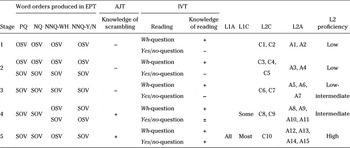
As for the second motivation, it was found that the more proficient the adult or child L2 learners, the more targetlike their performances. Using the L2 proficiency measure as a guideline, we infer the L2 developmental sequence (in five stages), as schematized in Table 7, for all tasks. Individual L2 participants were categorized according to whether they did (+) or did not (–) show knowledge of scrambling in the acceptability-judgment task, and whether they never assigned (–), sometimes assigned (±), or almost always assigned (+) a targetlike reading in the interpretation-verification task. A criterion of ≥ 75% was used as our definition of consistent performance. In the elicited-production task, when both OSV and SOV are listed together in a particular condition at a given stage, this signifies that neither word order was produced at rates of at least 75%. In the acceptability-judgment task, the symbol + indicates that SOV and OSV orders were both accepted at least 75% of the time in PQ, NQ, and fillers. In the interpretation-verification task, the symbol + represents an accuracy rate of at least 75% and a significant difference from the low-proficiency L2 learners’ accuracy rate, and the symbol ± represents an accuracy rate lower than 75% but still significantly different from that of the low-proficiency L2 learners, t(4) = 3.19, p < .05 (despite the low rates). This admittedly gross division is intended to provide a rough indication of the participants’ relative response patterns.
Developmental sequences for Korean wh-constructions with NPIs

Note
EPT = elicited-production task; AJT = acceptability-judgment task; IVT = interpretation-verification task; PQ = positive wh-question; NQ = negative wh-question without NPI; NNQ-WH = negative wh-question with NPI; NNQ-Y/N = negative yes/no-question with NPI; L1A = L1 adults; L1C = L1 children; L2C = L2 children; L2A = L2 adults.
Consistent performance is observed across tasks for all L2 proficiency levels, as illustrated in Table 7. In the low-proficiency group, four L2 learners (C1, C2, A1, and A2) produced OSV, accepted OSV, and rejected SOV for all the wh-constructions, and the five others (C3, C4, C5, A3, and A4) did so for most of the wh-constructions. Given that in English, unlike in Korean, wh-movement in (nonmultiple) nonsubject wh-questions is obligatory, we conclude that this OSV word order of stage 1 and stage 2 is the result not of scrambling but of transfer from the L1 grammar. Therefore, wh-movement, carried over from English, must be part of their L2 initial state.Footnote 17
The low-intermediate-proficiency L2 learners (C6, C7, A5, A6, and A7) did not produce OSV, rejected OSV, and accepted only SOV for all wh-constructions, which indicates that, at stage 3, wh-movement has been relinquished but there is still no scrambling. There is ample evidence in the L2 learners’ input (and instruction) that wh-phrases can remain in situ in Korean wh-questions. What is apparently deduced from the input (and instruction) is that if wh-phrases need not move in wh-questions, they must not move. An analysis that invokes a change in feature strength or feature specification can account for these data; equally compatible is an analysis in terms of (over-)generalizing a simple surface pattern. Nothing in our data can arbitrate; hence, this must be left for future work.
Scrambling comes in next, at stage 4. The intermediate-proficiency L2 learners (C8, C9, A8, A9, A10, and A11) (a) mostly produced OSV for NNQ-WH but both SOV and OSV for NNQ-Y/N; (b) freely accepted OSV in PQ, NQ, fillers, and NNQ-WH, but less so in NNQ-Y/N; and (c) started to differentiate between NNQ-WH’s wh-question reading and NNQ-Y/N’s yes/no-question reading. Interestingly, some of the L1 child group also exhibited this pattern, albeit more robustly.
Finally, the high-proficiency L2 participants (C10, A12, A13, A14, and A15), at stage 5, almost always produced and accepted only OSV in NNQ-WH and almost never produced or accepted OSV in NNQ-Y/N, just like the native controls did. Additionally, again like L1 Korean adults, the high-proficiency L2 learners have targetlike interpretation of scrambled and in situ wh-constructions with NPIs.
Importantly, every stage in this developmental sequence consists of adult L2 learners and child L2 learners (in step with their L2 proficiency scores), which thereby provides evidence against the FDH and for UG involvement in adult SLA. This L2 developmental sequence is, moreover, initially informed by wh-movement from L1 English, which gives rise to generalized OSV—a pattern L1-Korean-acquiring children do not manifest.Footnote 18 In sum, the fact that a single path characterizes the development of both the L2 adults and the L2 children—a path subsuming that of L1 Korean development—strongly argues that there is not merely a superficial match either between the adult and child L2 learners or between the native adult controls and the high-proficiency L2 learners but rather that each of these matches is in terms of underlying representations.
CONCLUSION
The present study investigated the SLA of Korean wh-constructions with NPIs (a) by testing L2 POS phenomena and (b) by comparing three different groups of acquirers—L2 adults, L2 children, and L1 children—to examine whether they exhibit similar or different development sequences. Bley-Vroman’s (Reference Bley-Vroman, Gass and Schachter1989, Reference Bley-Vroman1990) FDH predicts (a) that adult L2 learners should not be able to overcome domain-specific POS problems, because these stem from the deductive consequences of UG, and (b) that the path of development that adult L2 learners follow should be distinct from that of child L2 learners (where the L2 adults and the L2 children share the same L1), because adult L2 learners, but not child L2 learners, rely exclusively (in conjunction with the L1) on domain-general learning for language.
As for the L2 POS problems, the results demonstrate that some adult and child L2 learners came to know the two properties of Korean wh-constructions with NPIs: (a) that in wh-questions, object wh-phrases must scramble across the NPI subject to obviate the intervention effect, and (b) that there are two different interpretations, a wh-question reading and a yes/no-question reading, in the context of, respectively, a scrambled and an in situ object wh-phrase. As such, these targetlike results provide evidence against the FDH and more specifically for the hypothesis that UG constrains adult SLA.
This conclusion is further bolstered by the results of the comparison between the L2 adults and the L2 children in their development of Korean wh-constructions with NPIs. Contra the predictions of the FDH, L2 adults and L2 children were found to evince the same developmental route, and this route aligns perfectly with their independently assessed L2 proficiency scores. The L2 learners who had very low proficiency scores displayed L1 transfer effects from wh-movement (and from NPI licensing) at stages 1 and 2, which resulted in across-the-board OSV word order. Stage 3, with consistent SOV word order, lacks fronting (scrambling and wh-movement) altogether, but at stage 4 scrambling is in place. Last to be acquired, at stage 5, are the interpretive restrictions on scrambled versus in situ wh-phrases in Korean wh-constructions with NPIs.Footnote 19 The (adult and child) L2 learners in the high-proficiency group showed the same patterns as the adult native controls, across all three tasks. This L2 developmental sequence of Korean wh-constructions with NPIs differs from (but subsumes) that of L1 Korean, because, we argued, the adult and child L2 learners in this study have English––with its obligatory wh-movement––as their L1 grammar, and this L1 grammar, we extrapolate, constitutes their L2 initial state.
With these two main findings (i.e., overcoming the POS problems and a single L2 [child and adult] developmental route), this study simultaneously supports the hypothesis that, like child SLA, adult SLA is constrained by UG and challenges the FDH. In particular, the match in inferred developmental sequence between the L2 adults and the L2 children is an especially compelling argument for these learners’ underlying representations being epistemologically equivalent to each other as well as, by extension, to the underlying representations of (developing and final-state) natives.
APPENDIX
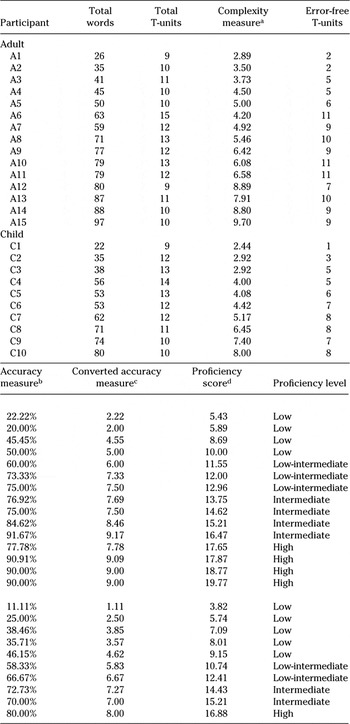
We describe here how the individual L2 proficiency results in the accompanying table were calculated, using C5 as an example. First, to measure complexity, the total number of words was divided by the total number of T-units (for C5: 53 ÷ 13 = 4.08). Second, the accuracy measure exhibits the rate of error-free T-units; any T-unit that contained even one syntactic, morphological, or lexical error was deemed to not be error-free. The number of error-free T-units was divided by the total number of T-units and then multiplied by 100, which provides a percentage of error-free T-units (for C5: [6 ÷ 13] × 100 = 46.2%). Third, the accuracy measure was converted to a decimal figure by multiplying it by 10 (for C5: 46.2% × 10 = 4.62) to make it comparable to the complexity measure. Fourth, the range for the converted accuracy measure and the range for the complexity measure were each calculated across all L2 participants; it was found that the range for the converted accuracy measure (at 8.06) was 1.11 times greater than the range for the complexity measure (at 7.26). Finally, the complexity measure for each participant was multiplied by 1.11 and then added to his or her converted accuracy measure, which resulted in a relative L2 proficiency score (for C5: [4.08 × 1.11] + 4.62 = 9.15).
Proficiency results of all L2 participants

a Complexity measure = average number of words per T-unit.
b Accuracy measure = percentage of error-free T-units.
c Converted accuracy measure = (percentage of error-free T-units) × 10.
d Proficiency score = (complexity measure × 1.11) + converted accuracy measure.