Introduction
Globally, most of the disease has found a cure. AIDS (“Acquired immune deficiency syndrome”) is one of that syndrome, which have not found medication till now. This disease is a global pandemic (Cohen et al. (Reference Cohen, Hellmann, Levy, Decock and Lange2008)). In 2020, about 37.7 million people agonized from this disease, approximately 57% are men infected with HIV (“Human Immunodeficiency Virus”). There were about 680,000 deaths from AIDS in 2020 (UNAIDS (2021)). Global HIV-related deaths peaked in 2006 at 1.95 million (95 percent Confidence Interval (CI) 1.87–2.04), and afterwards it continually fell to 0.95 million (CI 0.91–1.01) in 2017. Global antiretroviral therapy coverage increased from 2.98 million (2.44–3.58) in 2006 to 2.18 million (2.07–2.29) in 2017. The number of new HIV infections peaked in 1999 (3.16 million), and has since been steadily decreasing (Frank et al. (Reference Frank, Carter, Jahagirdar, Biehl, Douwes-Schultz, Larson, Arora, Dwyer-Lindgren, Steuben and Abbastabar2019)).
Discrimination and stigmatization against people living with HIV/AIDS (PLWHA) are caused by a societal misunderstanding of the virus’s transmission mechanisms, as well as an overemphasis on culturally unacceptable behaviors as a means of virus transmission (Klein, Karchner and O’Connell (Reference Klein, Karchner and O’connell2002); Liamputtong (Reference Liamputtong2013); Mugisha (Reference Mugisha2019); Suantari (Reference Suantari2021)). The general public has a number of misconceptions about AIDS. Misconceptions about the disease are growing as a result of a mix of factors, including widespread ignorance and misunderstanding of scientific facts on the infection’s disease. People learn about things, behaviors, and other topics from their surroundings, which mean that patient opinions of their illness are always stigmatized. People are more concerned about the disease’s stigma than the disease itself. Due to the stigma associated with AIDS, people are generally unaware about the primary sources of infection, as well as how the illness spreads or transmits; as a result, patients are more prone to have stigmatizing thoughts (Rehan et al. (Reference Rehan, Waheed, Sarwar, Arshad, Satti and Zaheer2016); Rasool and Javed (Reference Rasool and Javed2016)). The cultural factors such as religious, spiritual, and ethical values influence the spread of the AIDS epidemic as well as efforts to prevent its occurrence and perpetuation (Hare and Villarruel (Reference Hare and Villarruel2007)). The religious leaders’ perspectives on PLWHA vary, they believe they have a responsibility to help in the prevention of AIDS (Abu-Moghli et al. (Reference Abu-Moghli, Nabolsi, Khalaf and Suliman2010))
Numerous studies in both developing and developed nations have been undertaken to investigate the association between various risk factors and accurate HIV transmission knowledge (Letamo (Reference Letamo2007); Rahman, Kabir and Shahidullah (Reference Rahman, Kabir and Shahidullah2009); Rauf et al. (Reference Rauf, Hitchcock, Rauf and Becker2010); Ochako et al. (Reference Ochako, Ulwodi, Njagi, Kimetu and Onyango2011); Mondal et al. (Reference Mondal, Hoque, Chowdhury and Hossain2014); Nasir, Imran and Zaidi (Reference Nasir, Imran and Zaidi2015)).
The number of HIV cases lowers and epidemics are averted when people understand how HIV spreads (Mondal et al. (Reference Mondal, Hoque, Chowdhury and Hossain2014)). The first HIV case in Pakistan reported in 1987, and since then the virus has spread fast, posing a threat to Pakistani citizens. There were 97000 persons with HIV positive in Pakistan by the end of the year 2009 (The World Bank (2012)). The number of positive cases increases from 97000 in 2009 to 132000 in 2015. From 2005 to 2015, 8360 to 45,990 HIV infections were reported, with a 17.6% as an annual increase. Also, the death rate is alarming. Previous research has found that there is a general lack of knowledge about AIDS transmission methods and prevention measures, particularly in Pakistan (Farid-UL-Hasnain, Johansson and Krantz (Reference Farid-Ul-Hasnain, Johansson and Krantz2009); Ali et al. (Reference Ali, Ali, Nasir, Aadil, Waqas, Zil-E-Ali, Anwar and Anjum2018), Iqbal et al. (Reference Iqbal, Maqsood, Zafar, Zakar, Zakar and Fischer2019)).
In this paper statistical exploration of the relationship between HIV/AIDS knowledge and various background characteristics is explored on the male’s respondent using data from 2017-18 Pakistan Demographic and Health Survey.
Data and Methods
In this study secondary data from Pakistan Demographic and Health Survey (PDHS) is used. Information for the current analysis were gathered from the latest (2017-18) fourth round of PDHS. This survey was coordinated by the National Institute of Population Studies (National institute of population studies (NIPS) [Pakistan] and ICF), Islamabad, Pakistan. The Azad Jammu and Kashmir (AJK) and Federally Administered Tribal Areas (FATA) are included in the 2017-18 PDHS. AJK and FATA were not included in the 2012-13 PDHS. The findings of 2017-18 PDHS are typical of the country as a whole, as well as of the country’s urban and rural areas separately. Estimates of this survey also representative of four provinces: Punjab, Sindh, Khyber Pakhtunkhwa, and Balochistan, as well as four regions: Islamabad Capital Territory (ICT), FATA, AJK and Gilgit Baltistan (GB). A two-stage stratified sample was used in 2017-18 PDHS. Further details of sample design can be seen in the report of the PDHS (National institute of population studies (NIPS) [Pakistan] and ICF (2019)).
The factors affecting HIV/AIDS knowledge were grouped into seven categories: demographic (respondent’s age, gender of household head); socioeconomic (education, wealth index, and occupation); geographic (Region, ethnic origin, and place of residence); and media exposure (newspaper, radio and television). In this study the outcome variable is ‘HIV/AIDS Knowledge’. In PDHS ever married men’s questionnaire section 7, the question was posed by asking the male respondent: ‘have you ever heard of HIV or AIDS?’ The response is categorized as “Yes” means having heard of HIV/AIDS and “No” means not having heard of HIV/AIDS. A total of 3634 men aged 15 to 49 years were found eligible for interview in the survey and 3145 were successfully interviewed. After cleaning the sample for statistical modeling a total of 3124 men’s information was used in the present work. In addition, the HIV statuses of 3124 men were unknown in the survey. When the outcome variable is measured at nominal or ordinal level, logistic regression is used to investigate the relationship between the independent and outcome variables. Keeping in view the binary nature of the outcome variable, the binary logistic regression model was used to explore the relationship between the explanatory variables with HIV/AIDS knowledge.
Results
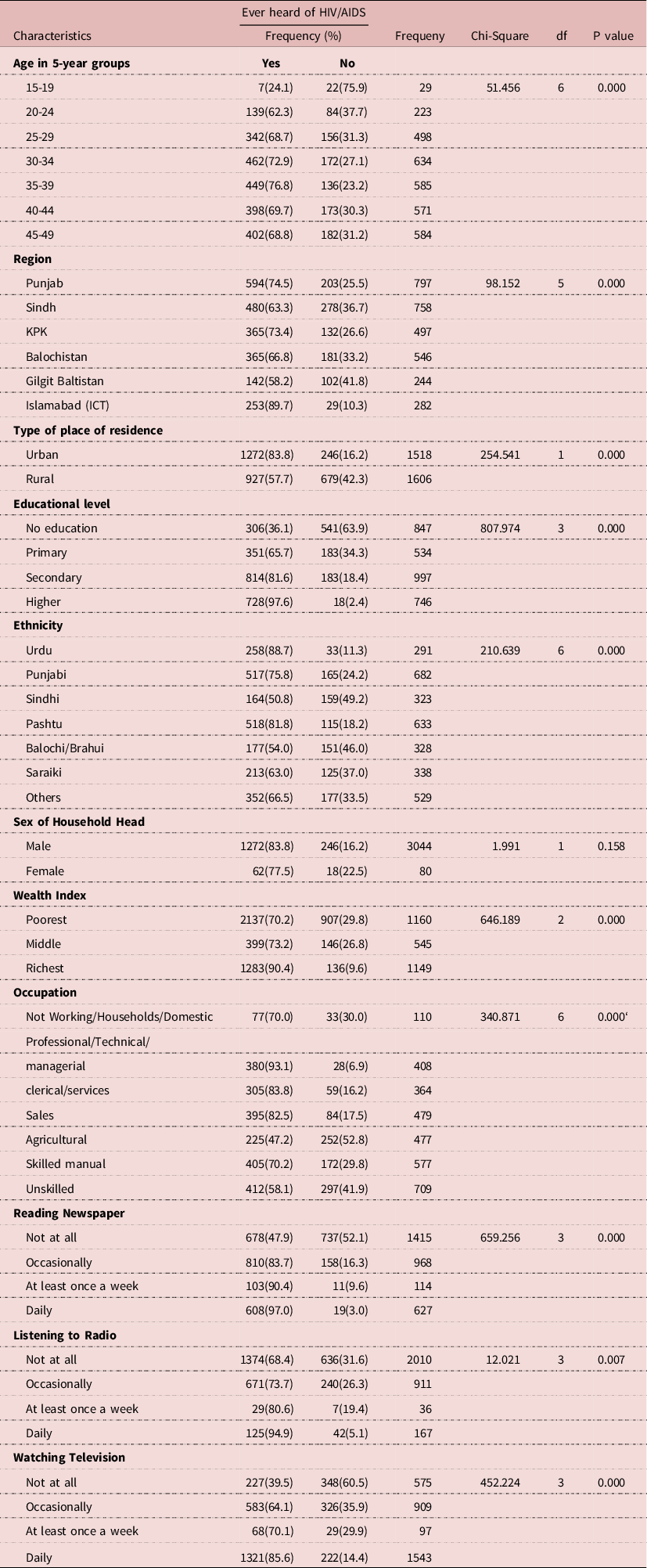
Univariate and bivariate distribution of the study sample is presented in Table 1. The majority of the respondents have heard about HIV/AIDS (70.6%). Most of the men were in the age group of 30-34 (20%) and fewer (0.9%) were from 15-19 years age group. Most of the men were from the Punjab (25.5%) and fewest from Gilgit Baltistan (7.8%). Respondents who were from Rural (51.4%) were more than the Urban (48.6%). More than 27% of the respondents were found to be without education and 45.4% of the respondents were belonging to the richest class of wealth index. Respondents from Urdu speaking families (9.3%) are less than those of Punjabi speaking families (21.8%) in the study. From the total of the respondents only 2.6 percent were those where females were the heads of the households. From the total of the respondent, 3.5% respondent belongs to Not Working/Households/Domestic class of occupation and 22.7% respondent belong to a skilled manual class of occupation. From the total respondents, 45.3% men were not at all read newspapers. Results show that 64.3% of people do not listen radio. The majority of the respondents (49.4%) watch Television on a daily basis.
Responses of Males on HIV/AIDS knowledge in Pakistan, PDHS 2017-18 (n=3124)

In Bivariate analysis, all explanatory variables (age, region, type of Residence, Ethnicity, education, Occupation, wealth index, media factors) are significantly associated (p<0.05) with HIV/AIDS knowledge except sex of household head (p-value = 0.158).
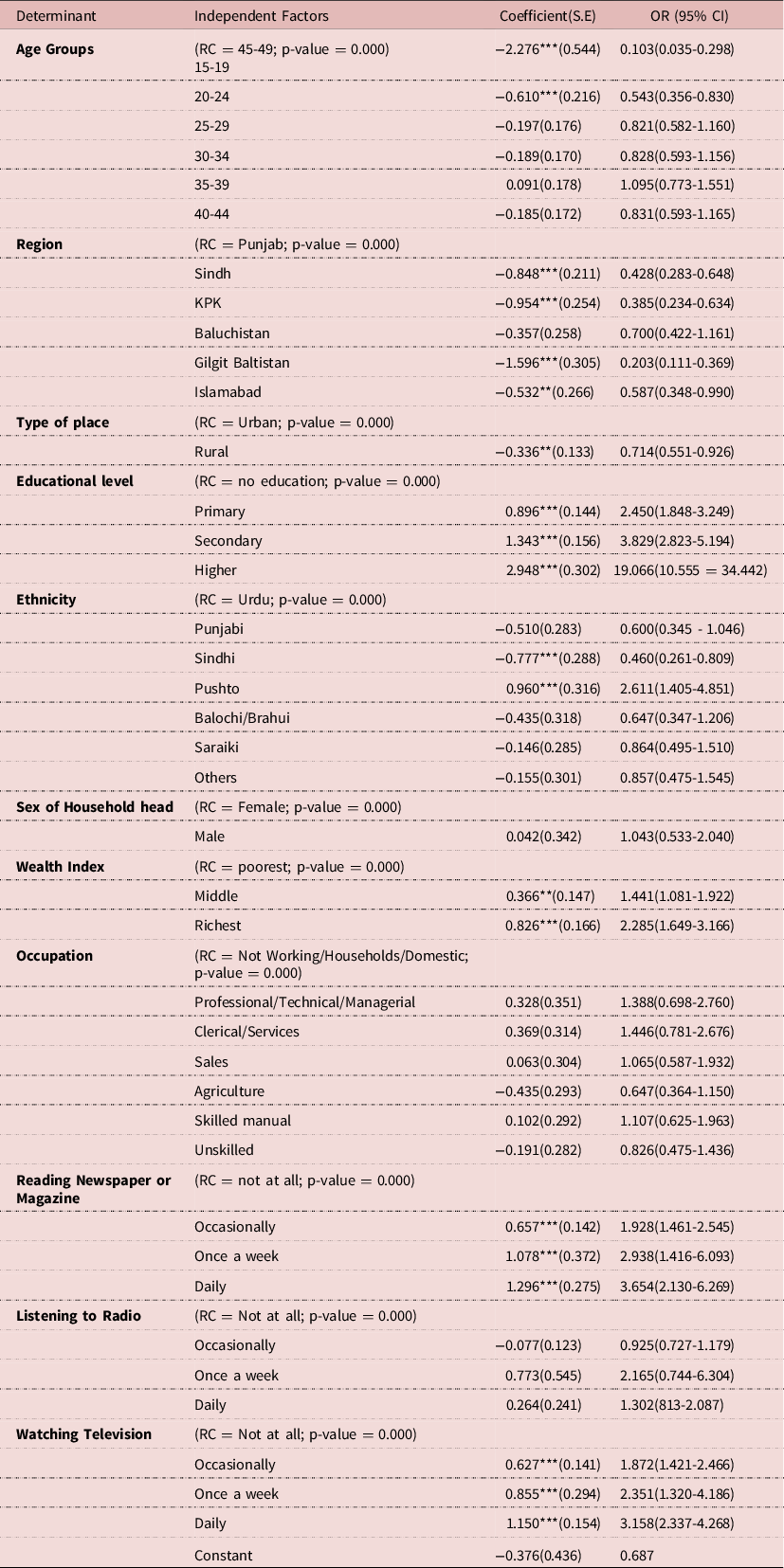
The final estimated logistic regression model is shown in Table 2. An extensive modeling effort resulted in this model. It incorporates all available covariates that have a significant association with the response variable. Results from table 2 reveals that the knowledge of HIV/AIDS in the age group 20-24 is 46% (OR = 0.54, 95% CI: 0.356-0.830) less as compared to age group 45-49 while holding other factors as constant. Knowledge of HIV/AIDS in respondents from Sindh 58% (OR = 0.428, 95% CI: 0.283-0.648), KPK 62% (OR = 0.38, 95%CI: 0.234-0.634), Gilgit Baltistan 80% (OR = 0.203, 95%CI: 0.111-0.369) and Islamabad 42% (OR = 0.58, 0.348-0.990) are less as compare to people living in Punjab while holding other factors as constant. Men living in rural areas have 29% (OR = 0.71, 95%CI 0.551-0.926) less knowledge about HIV/AIDS as compared to Urban. The odds of HIV/AIDS knowledge were high amongst respondents with primary education (OR = 2.450, 95% CI: 1.848-3.249), secondary education (OR = 3.829, 95% CI: 2.823-5.194) and higher education (OR = 19.066, 95% CI: 10.555-34.442) comparing to those respondents having no education. The respondent from the Pashtu Ethnic group (OR = 2.611, 95% CI: 1.405-4.851) was more likely to have two times more knowledge of HIV/AIDS as compare to the Urdu ethnic group. Richest quintile respondents were more likely to have two times more knowledge (OR = 2.285, 95% CI: 1.649-3.166) about HIV/AIDS as compared to any poorest economic status. Findings also revealed that the respondents who have daily exposure to mass media (Newspaper and Television) were more likely to have knowledge about HIV/AIDS than those who are not. Listening to radio is revealed to be an insignificant factor associated with HIV/AIDS knowledge. More specifically, there are 314 respondents with no knowledge of HIV/AIDS and they do not watch Television or read the newspaper paper compared to 636 respondents with no knowledge of HIV/AIDS and they do not listen to the radio. On the other hand, there are only 97 respondents with knowledge of HIV/AIDS and they do not get information from media (TV, Newspaper, radio).
Logistic regression estimates of the factors associated with HIV/AIDS knowledge by males of Pakistan, PDHS 2017-18 (n = 3124)

** P < 0.05; ***p < 0.01 S.E = Standard Error OR = Odds Ratio CI = Confidence Interval RC = Reference category.
Discussion and Conclusion
The purpose of this research was to investigate the relationships between men’s HIV/AIDS knowledge with various background factors in Pakistan. About 70.6% of the study respondents have the knowledge about HIV/AIDS. Similar level of knowledge is observed in Egypt (70.5 %). The main sources of knowledge were media (46.3%), internet (44.6%), school (28%), university educational courses and health education sessions (27.8%), friends (23.9%) and family (23.9%) factors in Egypt (Abd El Aty and Aziz (Reference Abd El Aty and Aziz2019)). Men in Pakistan have higher knowledge of HIV/AIDS as compared to India 68.5% (Mehra et al. (Reference Mehra, Bhattar, Bhalla and Rawat2014)). The internet was identified as one of the key sources of HIV/AIDS information using the study sample of rural youth in India ((Banerjee and Keller, Reference Banerjee and Keller2015).
The findings of this research are consistent with other studies conducted in Pakistan. The knowledge of HIV/AIDS at national level is revealed to be much lower when compared with other studies where sample belong to specific region. One possible reason of this profound gap in knowledge between national study sample and other studies sample is that an urban resident population with high education is selected for regions (Farid-ul-Hasnain, Johansson and Krantz (Reference Farid-Ul-Hasnain, Johansson and Krantz2009);Cheema (Reference Cheema and Masood Cheema Maaz2011); Ali et al. (Reference Ali, Ali, Nasir, Aadil, Waqas, Zil-E-Ali, Anwar and Anjum2018); Rehan et al. (Reference Rehan, Waheed, Sarwar, Arshad, Satti and Zaheer2016); Iqbal et al. (Reference Iqbal, Maqsood, Zafar, Zakar, Zakar and Fischer2019)). For example 264 females studying medical sciences at the time of the survey were selected in Lahore in 2018 (Ali et al. (Reference Ali, Ali, Nasir, Aadil, Waqas, Zil-E-Ali, Anwar and Anjum2018)). Therefore, a high percentage of knowledge is expected. As far as the male’s knowledge of HIV/AIDS is concerned, more than 70% knowledge is observed. Only 42% of ever married women have heard of HIV/AIDS using data from 2012-13 PDHS (Abd El Aty and Aziz (Reference Abd El Aty and Aziz2019)). The knowledge of HIV/AIDS of ever married women is found to be lower when compared with the male’s knowledge (70.6%) in the present study.
The findings of the multivariate model suggest that there are variations in the level of HIV/AIDS knowledge among males in Pakistan. Place of residence, education status of the respondents, with their wealth index and mass media characteristics, including newspaper and watching television are revealed to be the main significant factors associated with HIV/AIDS knowledge in Pakistan. For example, Men between the ages of 35 and 39 from Islamabad who live in urban areas, have higher education, are of Pukhtoon ethnicity, are the head of the household, belong to the richest quintile, work in professional/technical/managerial occupations, and use media exposure factors on a daily basis would have probability of 97% of having knowledge of HIV/AIDS. Similarly, men between the ages of 15 and 19 from Gilgit Baltistan who live in the rural areas, have no-education, are of Sindhi ethnic group, belong to the poorest quintile, not using media exposure factors (Newspaper, Television) and belonging to agricultural occupation would have probability of 13% of having no knowledge about HIV/AIDS. One of the most interesting results is that HIV/AIDS knowledge is not obtained through the radio. This result is not confined to only male respondents. The ever-married women’s knowledge of HIV/AIDS using 2012-13 PDHS is explored recently in Pakistan (Iqbal et al. (Reference Iqbal, Maqsood, Zafar, Zakar, Zakar and Fischer2019)). Listening to radio is revealed to be an insignificant predictor of HIV/AIDS knowledge in females of Pakistan. However, in case of female respondents, the multivariate model predicts that the probability of having knowledge about HIV/AIDS is 92% given that she is more than 35 years of age, she belongs to KPK, an urban resident, have high education, belong to richest quintile of wealth index and have media exposure. Overall, the regression models of these two studies predict that male and female knowledge of HIV/AIDS is more than 90% by considering the significant covariates.
Interestingly, the results of the present study reveal only 3% respondents (97 cases) have knowledge of HIV/AIDS with no exposure to Television, newspaper and radio. This result draws the attention towards other sources for acquiring HIV/AIDS knowledge. Social media or the internet would be the probable ones. Social media are known to be a major source of acquiring HIV/AIDS information in some other study conducted at small scale in Pakistan (Rehan et al. (Reference Rehan, Waheed, Sarwar, Arshad, Satti and Zaheer2016)). The exposure from social media about HIV/AIDS information could be significant in Pakistan, which is different when compared with India
The findings of this study put forward some profound implications: to educate the people as a whole about AIDS, dissemination of information about AIDS through social media, special focus on people living in rural regions and far reach areas including Gilgit Baltistan of Pakistan for AIDS awareness, focus group discussions must be designed for low socioeconomic status groups of people about the dangers of AIDS. The following implication is not based on the present study findings instead the implication is motivated through the author’s observation on the patriarchal male dominated society of Pakistan. Pakistani society follows the opinions of the religious leaders rigorously. The involvement of religious leaders at the community level to share their views on AIDS could increase the awareness among people, particularly living in rural and far reach areas of Pakistan. The present study is limited to males and 2017-18 PDHS data which is three years old. It is recommended that the new wave of the PDHS may ask the role of social media in exploring the knowledge of AIDS in Pakistan as well as the special surveys be planned to explore the level of AIDS knowledge among females in Pakistan.
Disclosure statements
The author(s) received no specific funding for this work. The authors have declared that no competing interests exist. This study utilized the secondary data.
Ethical approval
The study is based on a secondary data analysis based on data from PDHS 2017–18, a publicly available dataset. Therefore, an ethical approval is not required.