


Social media summary
How can institutions advance equity in academia? Our four-pillar framework serves as a blueprint for success.
1. Introduction
From the seventeenth century onwards, European universities and scientific societies played a central role in consolidating a Western knowledge system rooted in colonial expansion and imperial governance. Scientific authority was established that positioned White, European, and male perspectives as objective and universal, while Indigenous and non-Western knowledge systems were appropriated, erased, or reframed as European ‘discovery’ (Grosfoguel, Reference Grosfoguel2013; Schiebinger, Reference Schiebinger2005). Disciplines within the life sciences, such as tropical medicine and ecology, developed in colonial contexts where local populations were treated as research subjects whose expertise was marginalised or deemed unscientific. These practices produced what Grosfoguel (Reference Grosfoguel2013) refers to as epistemic racism: the systematic elevation of Western knowledge as objective and universal, while delegitimising knowledge that lies outside Western scientific frameworks.
These structural legacies continue to shape the institutional cultures and demographic composition of science today. Institutional structures, ranging from universities and research councils to publishers and funding bodies, play a decisive role in shaping who can participate in, benefit from, and lead within scientific spaces (Tilly, Reference Tilly2007). In the UK, universities, as the primary architects of scientific research and education, often reproduce inequalities through mechanisms such as tuition fees, admissions criteria, and narrow definitions of academic excellence (Leathwood, Reference Leathwood2004). These barriers disproportionately exclude individuals from ethnic and/or working-class backgrounds, especially at postgraduate and doctoral levels where ethnic minority students are underrepresented and face high attrition rates (Boliver, Reference Boliver2013; Garrett, Reference Garrett2025).
These inequalities are starkly visible in the environmental sciences, the second least ethnically diverse profession in the UK, with only 3.1–4.5% of professionals identifying as any ethnicity other than White British (Norrie, Reference Norrie2017; The RACE Report, 2025). Similar disparities are observed across the science, technology, engineering, and mathematics (STEM) landscape. The Royal Society (2024) reports that Black scientists face attrition at every stage of the academic pipeline, with few reaching senior research or leadership roles. As of 2023–2024, 0% of the Society’s Fellows or Foreign Members identified as Black, and Black representation on grant committees and editorial boards remained below 3%. In UK academia more broadly, less than 1% of professors are of Black heritage, with Black women almost entirely absent from senior academic leadership (HESAb, 2025). These patterns extend beyond universities into NGOs and public policy bodies, reinforcing long-standing structural and epistemic hierarchies that continue to define who is considered credible within science (Ahmet, Reference Ahmet2021; Bhopal, Reference Bhopal2014). This produces a scientific landscape that continues to be dominated by White, cisgendered, middle- and upper-class individuals, whose cultural values and norms often define institutional leadership and decision-making (Siler et al., Reference Siler, Lee and Bero2015). Resultantly, this contributes to homogenous research cultures that lack the internal diversity of perspective needed to interrogate assumptions.
Such environments, in extreme cases, can lead to racist dogma repackaged as legitimate science, a problem notably faced by disciplines closely adjacent to the evolutionary human sciences. For instance, the secret London Conference on Intelligence, held at University College London on four occasions between 2014 and 2017, brought together researchers promoting race-based hierarchies of intelligence and explicit eugenic arguments under the cover of mainstream institutional credibility (Rawlinson & Adams, Reference Rawlinson and Adams2018). Similarly, a fundamentally flawed national IQ dataset, constructed to argue for genetically determined racial differences in cognitive ability, has continued to circulate in peer-reviewed publications despite extensive methodological critique (Sear, Reference Sear2022). A lack of internal diversity of perspective needed to challenge racist assumptions and to recognise the resultant potential harms may have led to institutional and epistemic conditions which allow scientific racism to persist.
In response to these exclusions, grassroots organisations have emerged as transformative vehicles of equity-focused change. Defined here as community-led, volunteer-driven initiatives that operate largely outside formal institutional structures, grassroots groups within the life sciences seek to expand participation, build support networks, and challenge structural inequities (Dobbelaere et al., Reference Dobbelaere, Heidelberger and Borgermann2022; Eireiner, Reference Eireiner2025). Examples include Minorities in Shark Sciences, BlackAFinSTEM, and the Racial & Ethnic Equality & Diversity (REED) Ecological Network. These organisations draw strength from their capacity to centre lived experience in ways that institutions struggle. In doing so, grassroots initiatives challenge institutional inertia and offer alternative models for scientific participation and leadership.
Yet despite their contributions, grassroots initiatives face significant challenges to sustainability. Reliant largely on voluntary labour, they are frequently constrained by financial precarity, administrative burden, and limited access to decision-making spaces (Dobbelaere et al., Reference Dobbelaere, Heidelberger and Borgermann2022; Thessen & Patterson, Reference Thessen and Patterson2011). In other cases, institutional engagement takes the form of short-term grants or symbolic endorsements that fail to support long-term capacity building (Ahmed, Reference Ahmed2012; Dana et al., Reference Dana, Gurău, Hoy, Ramadani and Alexander2021). Equally, both grassroots initiatives and institutions often lack clearly defined frameworks for collaboration, making it difficult to scale or replicate successful models across sectors (Dana et al., Reference Dana, Gurău, Hoy, Ramadani and Alexander2021; Dobbelaere et al., Reference Dobbelaere, Heidelberger and Borgermann2022; Thessen & Patterson, Reference Thessen and Patterson2011).
This paper seeks to address these shortfalls by examining and extracting key learnings from the REED Ecological Network, a UK-based grassroots organisation committed to improving racial and ethnic inclusion in the ecological and environmental sciences (Fakoya-brooks, Reference Fakoya-Brooks2020).
1.1. Case study – the REED Ecological Network
The REED Ecological Network, originally launched as the Black, Asian, and Minority Ethnic (BAME) Ecological Network, was founded in 2020 by Reuben Fakoya-Brooks, a Black zoology graduate, as a community-led committee-based platform with the goal of building a community for individuals who identified as Black/Black British, Asian/British Asian, or People of Colour within ecology and adjacent disciplines (Fakoya-Brooks, Reference Fakoya-Brooks2020). Run by a volunteer committee drawn from multiple institutions across the UK, whilst receiving support from the British Ecological Society (BES), the REED Ecological Network aimed to address the persistent underrepresentation of marginalised racial and ethnic groups in the UK’s environmental and agricultural sectors, two of the country’s least ethnically diverse professions (Norrie, Reference Norrie2017; The RACE Report, 2025).
The network quickly grew into a broad and dynamic coalition that spans undergraduate students, postgraduate researchers, academics, public and private sector professionals, and nature enthusiasts. Disciplines represented within the network include zoology, marine biology, plant sciences, conservation, agriculture, birdwatching, environmental activism, epidemiology, and natural history filmmaking (British Ecological Society, n.d.). Early efforts by the network focused on community building through seminars, speaker events, informal networking, and spreading awareness through a range of channels via collaborative content partnerships (e.g., Gal-dem magazine; Grant Cumberbatch, Reference Grant Cumberbatch2022) and through an active presence on social media, which serves as a primary channel for community engagement (British Ecological Society, n.d.). The REED Ecological Network’s foundational ethos is that ‘the natural world is for everyone’ (British Ecological Society, n.d.; Fakoya-Brooks, Reference Fakoya-Brooks2020). Informed by this, its mission centres on three core aims: (1) providing culturally relevant ecological training and professional development; (2) creating safer and more inclusive spaces for ecological practice and learning; and (3) challenging exclusionary ideologies embedded in the UK’s environmental discourse (British Ecological Society, n.d.). Underpinning these aims is an explicit commitment to anti-racism: The REED Ecological Network actively works to identify and address instances of racism within the ecological sector (British Ecological Society, n.d.).
As the network matured, it developed into a special interest group of the BES, comprising elected committee members of predominantly early-career individuals, and expanded its scope to include financially compensated institutional consultation and strategic partnerships. At present, REED plays an active role in shaping policy and practice within the wider ecological sector (British Ecological Society, n.d.).
Using a mixed-methods case study design to draw on survey data, organisational records, and qualitative testimonies, we evaluate REED’s impact in the ecological sciences. We extract key principles to propose a four-pillar model to guide institutional support for grassroots-led equity initiatives.
The model includes:
1. Dedicated funding streams
2. Structured mentorship programmes
3. Peer-led training and support to encourage job retention
4. Equitable representation in decision-making spaces.
By articulating a replicable model based on grassroots experience, this paper offers a practical blueprint for advancing inclusion institutionally across the life sciences and beyond.
2. Methods
2.1. Case selection rationale
The REED Ecological Network was selected as a model due to its explicit mission to address racial and ethnic disparities in the environmental and ecological sciences, and its partnerships with multiple scientific institutions across the UK. Since its founding in 2020, the REED Ecological Network has grown into a community of over 100 members, offering a rich sample through which to explore the impact of grassroots movements on institutional change. Additionally, a primary reason for selecting the REED Ecological Network was the privileged access to key organisational evidence granted to the manuscript authors. In part, this was due to their current or past affiliation with the REED Ecological Network.
2.2. Data collection
Data collection occurred over a four-week period beginning in October 2025 in the form of a structured survey, administered through Google Forms (Supplementary material, Figure S1). Survey responses were collected online from adults residing in the UK. Respondents (n = 20) were recruited through voluntary participation after receiving a link to an online Google Forms survey circulated through the REED Ecological Network’s mailing list and across social media platforms. All individuals who responded to the survey were included in the analysis (n = 20). For a meaningful frame of reference, the number of REED members (individuals signed up to the mailing list) at the time of writing this article is approximately 120 people.
Eligibility criteria required that participants were REED current and past members, past/current collaborators, or past REED-organised event attendees based in the UK. Participation in the survey was voluntary and anonymous, and no remuneration was offered for completing the survey. No identifiable personal data were collected. All qualitative contributions are presented in aggregate or anonymised form, and respondents were informed of how their insights would contribute to this study. Furthermore, although the REED Ecological Network is the focus of this study, only co-authors of this article (some of whom happen to be current or past REED committee members) had access to collected data, with no access granted to other REED committee members or BES staff members to comply with General Data Protection Regulation (GDPR) and ethics guidelines. Ethical approval and oversight were granted by the University College London Anthropology Research Ethics Committee.
2.3. Document review
Organisational records, digital content, media features, workshop data, and public-facing materials produced by or in collaboration with the REED Ecological Network were examined to map initiatives, partnerships, and milestones. Sources of information were obtained internally and additionally gathered via open-access website publications.
2.4. Testimonies
Qualitative testimonies were collected through open survey responses and informal communications with the REED Ecological Network committee members and collaborators. These were used to provide first-person perspectives and experiential context to the case study findings and include no information that could identify the individual who left each testimony, something which was verified in the data analysis stage of this project.
A mixed methods approach was adopted to understand the impact that involvement with REED has had for members and professional partners. The creation of a novel survey allowed the authors to collect quantitative data on trends in progression to further education and work in the ecological and environmental sciences among REED members, and to canvass targeted responses about how individuals felt about how the REED Ecological Network had impacted them. The authorship team aimed to combine both qualitative insights with some descriptive quantitative data to inform the lessons learned about the REED Ecological Network and institutional partnerships in this way.
2.5. Analytic strategy
Quantitative data (e.g., PhD completion, mentorship access, workshop participation) were descriptively analysed and summarised using frequencies and basic visualisations. Descriptive analyses and visualisations were performed using R version 4.2.1, using the ggplot2 package (Wickham, Reference Wickham2016).
Qualitative testimonies were subjected to thematic analysis using NVivo software (Lumivero, version 15) to identify common narratives and recurring patterns in experiences. These themes were then used to provide first-person perspectives and experiential context to the case study findings.
3. Results
We examine REED-related outcomes, through both quantitative metrics and qualitative accounts derived from the impact survey responses, reported institutional collaborations, and documented interventions, which have supported career development, racial representation, and institutional adaptations.
While the survey sample is small, this is consistent with qualitative research practice, where depth of insight rather than statistical power is the primary aim. As Hennink and Kaiser (Reference Hennink and Kaiser2022) demonstrate, small samples can achieve informational saturation when participants share relevant experiences, and Malterud et al. (Reference Malterud, Siersma and Guassora2016) argue that sample adequacy in qualitative work is better assessed through information power than sample size alone. The qualitative testimonies gathered here are therefore treated as the primary source of evidence, with quantitative data providing contextual framing rather than generalisable findings.
3.1. Qualitative themes
Open-ended survey responses and member testimonies from survey respondents revealed several recurring themes (see Table 1).
Themes drawn from qualitative survey responses offered by REED members, allies or partners since 2020 (network creation), with corresponding quotes and theoretical underpinnings of each theme

1 Long description
Qualitative survey responses are grouped into seven themes, each paired with a brief theoretical underpinning and an illustrative participant quote. Belonging focuses on feeling accepted, valued, and represented, with a quote about seeing ecologists of colour and feeling increased belonging. Career development highlights access to opportunities and networks, illustrated by presenting and testifying about a PhD journey at a major Canadian ecology and evolution congress. Confidence building reflects overcoming self-doubt through validation and encouragement. Skills acquisition and development describes bridging perceived gaps between agricultural research and ecology by recognising transferable ecological skills and values. Community building emphasises shared learning and holistic support that improves wellbeing among people with similar lived experience. Hope captures motivation to stay in ecology by seeing viable career pathways and not feeling alone. Visibility and representation stresses recognising and celebrating historically excluded voices, including bringing those voices to prominent venues such as conferences; quotes are examples and do not indicate frequency or relative importance across themes.
Belonging in ecology
Primarily, participants described a strong sense of belonging that the network helped them to foster, which had been missing during their undergraduate studies and working careers, noting that the REED Ecological Network provided spaces where they felt recognised and supported in ways that are rare within wider ecological communities. As one respondent explained:
From the very first meeting, I felt a level of empowerment I had never experienced before … it was the first time I didn’t feel alone in science.
Another respondent said:
REED provides a safe space to talk about the issues that we as minorities in Ecology are facing, as well as providing a platform to promote notable individuals and celebrate victories against these barriers.
Both responses outline the perceived importance of a space for individuals to explore their experiences of ecology in a safe space that addresses feelings of loneliness or a lack of empowerment. This theme was prevalent throughout open-ended survey responses, suggesting that the REED Ecological Network’s interventions created an open and non-judgemental space for individuals to be more authentic versions of themselves within Ecology.
Career development and increased opportunities for REED members
A second theme related to career development opportunities emerged. Respondents highlighted support with job applications, access to research networks, public speaking opportunities, and formal mentorship:
REED was instrumental in my journey toward securing the James McCune Smith scholarship. They were the first to inform me about the opportunity and offered me support throughout the application process, from helping with written materials to preparing for the interview.
Taken together with other examples (see Table 1: Career development and Skills acquisition/development), the REED Ecological Network’s involvement in the careers of minority ethnicity ecologists has allowed members to gain new skills and experience that are vital to career progression beyond undergraduate degrees. REED opened new horizons for these ecologists, either through scholarships for further study or to attend conferences and make further connections, an important step for many early career academics.
Visibility and representation of racial minorities in ecology
Respondents frequently cited the REED Ecological Network’s role in increasing visibility and representation of racial and ethnic minorities in ecology, describing how this shifted their own perceptions and ambitions:
It has helped me gain confidence in being a minority in Ecology … and given me recognition in the wider conservation community.
One memorable success was the bringing together of the REED special issue in the NICHE (the BES’s quarterly magazine). It was an amazing opportunity to bring together so many different members and showcase them. It was beautiful to see and really important for us as a community and for representation of ecologists of colour across the world.
External collaborators also affirmed the REED Ecological Network’s institutional impact, with one respondent from a UK university stating:
I’m sure that REED’s contribution to platforming more Black ecologists and ecologists of colour working within the field has been immeasurable – both in public facing ways and behind the scenes support work. Growing up, I had thought of ecology as really the domain of white middle class men as that was what I was used to seeing on television shows about nature, wildlife, gardening and similar – but I’m glad that the picture has been changing in recent years in very tangible ways through the work of REED and its members.
Taken together, these examples demonstrate how the REED Ecological Network has sparked some level of cultural change, both within organisations and individuals. By providing spaces for ecologists from minority backgrounds to take up space in visible places, this has indirectly challenged traditional narratives for who people (including REED members themselves) expect an ecologist to be.
Skills acquisition and development, confidence building
Members also reported development in transferable skills, particularly in science communication, facilitation, and public engagement:
Being given the opportunity to run workshops … gave me valuable insights into explaining myself.
Community building
Network members detailed how the REED Network had built a community for ecologists from marginalised backgrounds that had struggled to find a place where they felt at home:
The REED Network provided me with community, a sense of place and grounded me in ecology when I had finished my undergraduate and struggled to find jobs in ecology.
REED provided me with community and friends which have both encouraged me to remain in ecology, that I too can find a career path in ecology and that I’m not alone. Having so many members and friends that share a similar not so easy journeys, and hearing about these different journeys has been inspiring and has allowed me to keep moving forward.
Reflections on community building also included contributing to the general well-being of the REED Ecological Network members (Table 1). Taken with the above passage, community building can be seen as a central detail of some members’ decision to stay in ecology where they were otherwise considering leaving the field. These effects centred around having a support network, or community, for ecologists from racial minorities to share similar experiences and form a support network, something which is seemingly absent within the field of ecology for many racial minority ecologists.
Hope
The REED Ecological Network members and, in particular, committee members, noted that the REED Ecological Network had a significant impact on perspectives and hope for what viable pathways and desired futures look like:
… I’ve had conversations with several REED members who, after sharing their journeys and challenges, felt inspired to pursue further research and even their own PhDs. Knowing that my story and support have contributed to others believing in their potential is incredibly rewarding; it embodies what REED is all about.
Sentiments of Hope were laden in responses for other narrative sections as an underlying, secondary thread. The importance of the REED Ecological Network’s activities in contributing to a collective sense of hope for both members and partner organisations perhaps most clearly demonstrates the impact of the network’s interventions to date – to challenge and stretch how people imagine the future of ecology to be.
Collectively, these insights illustrate the emotional and professional value of the REED Ecological Network’s work. Taken together, evidence from documented interventions and the qualitative themes drawn out from survey responses would suggest that the REED Ecological Network not only appears to be impacting institutional culture but has also served as a base for individual empowerment and collective support.
3.2. Quantitative outcomes
Online self-report survey
Figure 1 describes survey data from 20 respondents across multiple career stages. These were: postgraduate students (n = 9, 45%), early-career (n = 5, 25%), mid-career (n = 4, 20%), senior professionals (n = 1, 5%), and professionals outside academia (n = 1, 5%). Respondents indicated that the REED Ecological Network had positively influenced their academic and professional development, particularly through skills training, mentorship, and access to institutional networks. More than one-third reported receiving mentorship or job-related support from the REED Ecological Network, with all of those mentees crediting the REED Ecological Network as pivotal to their career progression (Figure 1d). Additionally, eight had attended six or more REED-hosted events, indicating sustained participation and community engagement.
Summary of quantitative outcomes from the REED Ecological Network impact survey (n = 20). Each pie chart illustrates a distinct metric of engagement or influence based on self-reported data from REED-affiliated individuals. (a) PhD Participation – most respondents were either currently enrolled in or had completed a PhD. (b) REED-Linked PhD Opportunities – responses among PhD participants only (n = 12). (c) Mentorship Access – over one-third of respondents reported receiving mentorship or job-related support through REED. (d) Impact of Mentorship on Career Progression – among those who received mentorship, all indicated a positive impact on their academic or professional trajectory. The proportion of total respondents selecting each response is represented by the absolute value and percentage shown in brackets. The ‘No response’ category reflects missing or incomplete survey data.

Descriptive results also show 12 participants had completed or were enrolled in a PhD, with 2 of these opportunities directly linked to REED programming (Figure 1a and b).
Documented interventions
Documented REED-led interventions indicate the range of activities undertaken by the organisation beyond academic and within professional settings. Since creation, the REED Ecological Network has delivered several types of training, collaboration, and support activities:
Key interventions are listed as:
• Equity review and recruitment reform with the Vincent Wildlife Trust and Oxford Scientific Films.
• ‘Effective Allyship’ workshops for the Chartered Institute of Ecology and Environmental Management (CIEEM), Glasgow University, The Rivers Trust, European Human Behaviour & Evolution Association (EHBEA), and the BES.
• 2023 ‘Navigating Nature’ seminar series, targeting students and early career individuals (approximately 40 attendees).
• 2022–2023 REED Lunchtime Series, a monthly internal academic skills and support workshop for REED members (approximately 10 attendees per session).
• 2024 REED Lunchtime Seminar Series, a repurposed and less frequent academic skills and support workshop that ran approximately quarterly (approximately 21 attendees per session).
• 2021–2025 Publishing with the BES-owned quarterly magazine titled ‘The Niche’, featuring nine independent articles or opinion pieces by REED committee or REED members.
The REED Ecological Network’s visibility through the BES and affiliated specialist groups has also inspired similar models across ecological subfields within the BES. Namely, the Socioeconomic Equality and Diversity (SEED) Network, the Ecologists for Neurodiversity and Equality’s Movement for Inclusivity and Change (ENDEMIC) Network, and the Advancing LGBTQIA+ Diversity, Equality & Representation (ALDER) Network. REED has engaged in multiple joint network activities with SEED, ENDEMIC, and ALDER since their inception, aiming to address a lack of intersectionality in diversity and inclusion specialist groups. The majority of collaborations have included social activities, aimed at fostering conversation and bonding over shared experiences across marginalised identities, but more concrete collaborations – such as working together on an intersectional report with the BES, ‘Pride in STEM: Developing collaborative solutions to the intersectional barriers faced by minoritised ecologists’. Whilst these networks were inspired by the REED Ecological Network model, each operates independently.
4. A blueprint for institutional allyship: enabling equity-focused grassroots initiatives
In reference to both quantitative and qualitative data from the case study of the REED Ecological Network and drawing on theories of organisational change (Appelbaum et al., Reference Appelbaum, Habashy, Malo and Shafiq2012; Kotter, Reference Kotter1995) and social inclusion (Ainscow & César, Reference Ainscow and César2006), we synthesise a practical, experience-informed framework for institutional engagement. This blueprint outlines four mutually reinforcing pillars of support that, when implemented in tandem, could foster more inclusive environments across the life sciences.
4.1. Dedicated funding streams: a partner-based model ensuring sustainability
Grassroots initiatives frequently operate without stable financial backing, relying on voluntary labour and time from members of underrepresented groups who are already navigating systemic barriers (Dana et al., Reference Dana, Gurău, Hoy, Ramadani and Alexander2021; Dobbelaere et al., Reference Dobbelaere, Heidelberger and Borgermann2022). Continually, institutions often either try to re-invent already established protocols by developing parallel ‘diversity’ interventions that fail to draw on existing models, or utilise symbolic one-off grants (Besson, Reference Besson2022; Martin, Reference Martin2000). Such practices risk duplicating effort and are often scrutinised for misdirecting resources.
To address this, we propose that established institutions adopt a partnership-based funding model, where long-term resource allocation is directed towards grassroots organisations with demonstrated or potential impact and sector-specific credibility. Such an approach enables financial sustainability for grassroots groups and ensures that institutional interventions adopt the relevant expertise guided by lived experience.
In the REED Ecological Network’s case, this methodology demonstrates this effectiveness. Support from the BES provided administrative resources, visibility, and access to broader networks. REED’s consultation work, such as training and recruitment reform for the Vincent Wildlife Trust and Oxford Scientific Films, also proves that institutional partnerships can be mutually beneficial when seeking shared goals.
4.2. Structured mentorship programmes: connecting talent with opportunity
Mentorship remains a critical intervention for underrepresented groups, especially across early-career transitions (Koch & Zahedi, Reference Koch and Zahedi2019). However, mentorship must be intentional, culturally competent, and adequately resourced (Haywood & Darko, Reference Haywood and Darko2021). Institutions should invest in mentorship programmes that: (i) match mentees with senior professionals within the field, (ii) offer structured guidance and feedback, and (iii) provide visibility and opportunities within professional networks.
The REED Ecological Network has actively supported this model, with over one-third of surveyed members reporting they received mentorship or job-related support that directly improved their career trajectory. This includes guidance on PhD applications and access to decision-makers in ecological and environmental sectors.
Importantly, mentorship within the REED Ecological Network was bi-directional, empowering both mentee and mentor by centring mentees’ needs while honing leadership skills among mentors.
4.3. Peer-led training and professional development
Institutional allyship must also include the development of inclusive skills and practices internally and externally across the professional community.
Key examples include, although not limited to:
• Equity workshops
• Bystander intervention training
• Curriculum decolonisation seminars
• Safe fieldwork protocols.
The REED Ecological Network has delivered a range of peer-led training programmes tailored to the lived experiences of ethnic minorities in science. The ‘Effective Allyship’ workshops, for example, were originally designed in response to a wave of ally enquiries and now serve as a recurring external training offer. The 2023 ‘Navigating Nature’ seminar series and the REED Ecological Network’s Lunchtime Series further exemplify the capacity for grassroots groups to design culturally relevant, skills-based training that benefits both underrepresented groups and wider institutions. These programmes additionally help nurture transferable skills for REED members such as science communication, public speaking, and facilitation; desirable skills used in professional settings.
4.4. Equitable representation in leadership and decision-making
Without meaningful representation in decision-making spaces, well-intentioned initiatives risk becoming performative or tokenistic. Representation should extend beyond visibility to include influence and authority over institutional priorities, funding allocation, recruitment, and policy formation.
The REED Ecological Network’s impact has already begun reshaping the ecological community. Survey respondents reported that participation in the network had directly supported their progression into leadership-adjacent roles and decision-making spaces. These included facilitation of formal training programmes, invitation to present at major international conferences, and access to senior researchers and institutional networks that would otherwise have been inaccessible. One respondent described a direct pathway from attending a REED-hosted BES event to meeting a senior researcher, being introduced to museum collections staff, and ultimately securing a PhD scholarship; illustrating how the REED Ecological Network creates chains of access that substitute for the informal networks that disadvantaged individuals typically lack. Importantly, another described how REED committee membership and the leadership skills developed through the CIEEM facilitator training had become a demonstrable marker of diversity, equity, and inclusion (DEI) commitment that directly supported their career progression.
Institutions must build on these foundations by adopting clear targets for inclusion across all leadership levels, ensuring advisory positions are occupied by individuals from marginalised backgrounds who are adequately supported and compensated.
5. Summary: sustainability and interdependence
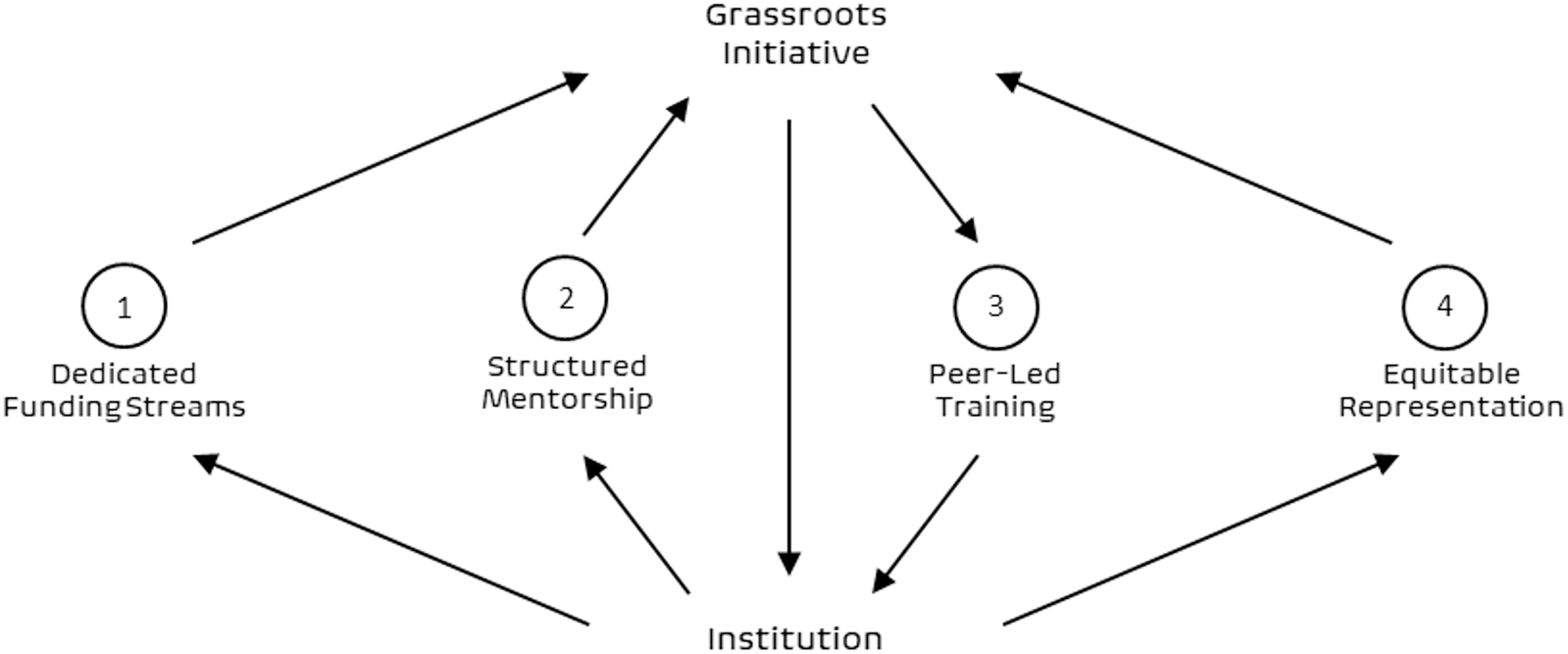
While each of these components offers distinct benefits, they are most effective when implemented as part of a coordinated strategy, illustrated here as a causal diagram depicting the assumed causal relationships between variables (Figure 2). We recommend:
Institutions adopt a dedicated partnership-based funding model which helps facilitate a grassroots initiative (Institution →Dedicated Funding Stream → Grassroots Initiative). Institutions invest in structured mentorship, providing the necessary support for individuals applying for key roles, increasing the likelihood of individuals being employed in key sectors and/or continuing in select fields associated with the institution (Institution → Structured Mentorship → Grassroots Initiative). Peer-led training programmes to be created by the grassroots initiative to develop inclusive skills and practices internally within institutions, and externally across the professional community (Grassroots Initiative → Peer-Led Training → Institution). Institutions encourage meaningful leadership and decision-making opportunities for individuals within, and associated with, the grassroots initiative (Institution → Equitable Representation → Grassroots Initiative). Additionally, the grassroots initiative itself exerts direct influence on the institutional policy and culture, independent of the four pillars (Grassroots Initiative → Institution).
An illustration of the assumed causal relationships between a grassroots initiative, an institution, and the four pillars of institutional allyship. Arrows denote the direction of assumed causal influence. The Institution activates three pillars, each of which supports the Grassroots Initiative directly: (1) Dedicated Funding Streams – established institutions adopt a partnership-based funding model, where long-term resource allocation is directed towards grassroots organisations. (2) Structured Mentorship – institutions should invest in mentorship programmes that support development for all individuals in/associated with the grassroots initiative. (4) Equitable Representation – institutions encourage meaningful representation in decision-making and leadership spaces. The Grassroots initiative in turn generates (3) Peer-Led Training – programmes developed by the grassroots initiative are deployed across the institution and/or professional landscape, which flows back to the Institution and exerts direct influence on institutional policy and culture. This bidirectional relationship forms a sustainable feedback loop, contributing to increasing racial and ethnic representation across the life sciences.

This interdependence forms a sustainable feedback loop of collaboration between grassroots and institutions. Influence is not unidirectional; institutions provide the structural conditions that enable the grassroots organisation to operate and grow. Simultaneously, the grassroots initiative reshapes the institution that supports them. Together, this reciprocal relationship contributes to increasing racial and ethnic representation across academia.
6. Discussion
This study provides conceptual and empirical evidence for the potential of institutional support in amplifying the impact and sustainability of grassroots equity initiatives within the life sciences and beyond. Through a case study of the REED Ecological Network, we examined how grassroots interventions, when embedded within institutional infrastructures, can result in shifts in both individual career pathways and professional practices within the sector.
Descriptive data from a small self-report survey of REED-affiliated individuals suggest a positive association between network participation and academic progression. Of the 20 respondents, 12 had completed or were currently enrolled in PhD programmes, with 2 directly attributing this trajectory to REED interventions such as mentorship support and scholarship partnerships like the James McCune Smith PhD scholarship, a funding award specifically established to support Black students in higher education. One-third (n = 7) of participants reported receiving targeted career support through REED, and over 40% had attended six or more events, indicative of continuous engagement and community integration.
Qualitative testimonies further depicted the network’s value in shaping perceptions of inclusion. Respondents consistently described REED as a space of affirmation, visibility, empowerment and support, alleviating external stresses often experienced by ethnic minorities in science (Smedley et al., Reference Smedley, Myers and Harrell1993). Participants credited REED with fostering confidence, expanding access to research and speaking opportunities, and reframing what leadership and expertise look like in ecology. Institutional partners echoed these accounts, citing successful student recruitment and cultural shifts within departments and organisations as direct outcomes of REED collaboration.
The findings also demonstrate the advantage of grassroots-led training. REED’s peer-designed workshops, such as the ‘Effective Allyship’ and the ‘Navigating Nature’ seminar series, equipped participants with transferable skills in communication, facilitation, and field safety. Likewise, REED’s visibility and influence have inspired the formation of additional affinity networks within the BES, signalling the model’s potential for use within institutional settings.
Crucially, the success of REED’s initiatives appeared to be contingent on four interdependent forms of institutional support: (1) consistent, long-term funding embedded within trusted partnerships; (2) intentional, cross-hierarchical mentorship structures; (3) peer-led training tailored to the lived experience; and (4) meaningful representation in leadership and decision-making processes. Together, these four pillars form a replicable framework for institutional allyship that may help to address deeper structural exclusions.
While the REED Ecological Network is rooted in the UK ecological sciences, its core approach is broadly transferable. Within the BES, the REED Ecological Network’s success has inspired the development of other parallel networks focused on addressing distinct dimensions of equity and inclusion within ecology, such as the SEED Network (focusing on socioeconomic equality), ENDEMIC (supporting neurodivergent ecologists), and ALDER (advancing LGBTQIA+ representation). These offshoots suggest that grassroots-led, institutionally supported models can be meaningfully adapted across varied identity categories and disciplinary niches.
Beyond ecology, the blueprint holds significant promise for other scientific disciplines, particularly the evolutionary human sciences, where issues of racial and class-based exclusion remain persistent but underexamined. While there is a large breadth of disaggregated data on racial representation in this field (Williams et al., Reference Williams, Phillips and Hall2014; Gibney, Reference Gibney2022; see Social Sciences HESA data 2023/2024; HESAa, 2025; HESAb, 2025), anecdotal and sectoral evidence suggests that inclusion remains a challenge, especially at the doctoral and leadership levels (Gibney, Reference Gibney2022). Professional societies such as the Human Behavior and Evolution Society and the EHBEA possess the institutional reach and infrastructure necessary to replicate aspects of the REED four-pillar model, particularly in encouraging recruitment, mentorship, and retention of scholars from historically excluded backgrounds.
A common critique levelled at equity-focused initiatives is that they dilute the meritocratic basis of science by prioritising identity over excellence (Abbot et al., Reference Abbot, Bikfalvi, Bleske-rechek, Bodmer, Boghossian, Carvalho, West, Coyne, Gauss, Gill, Jitomirskaya, Jussim, Krylov, Loury, Maroja, McWhorter, Moosavi, Schwerdtle, Pearl and West2023). However, our findings challenge this assumption. The four-pillar model does not replace merit; it expands access to opportunity by identifying and addressing structural inequities that distort supposedly neutral measures of success. Qualitative testimonies from REED members consistently described a lack of access to networks, guidance, role models, and institutional visibility. As one respondent noted, ‘REED was instrumental in my journey toward securing the James McCune Smith scholarship. They were the first to inform me about the opportunity and offered me support throughout the application process, from helping with written materials to preparing for the interview.’ Another described how mentorship through REED shaped their confidence and decision-making in professional spaces in ways that formal training alone had not. These accounts suggest that the barriers facing racially and ethnically marginalised ecologists are structural rather than meritocratic in origin. Through the four pillars of support, the REED Ecological Network enabled individuals to secure opportunities that existing institutional structures had placed out of reach.
Moreover, critiques that invoke meritocracy frequently overlook the deep-rooted privileges embedded in existing systems. As an illustrative example, the UK’s Natural Environment Research Council was found to have awarded more fellowships to men named David than to all women combined in 2019 (Grove, Reference Grove2020). This outcome is not a reflection of merit but of institutional bias perpetuated by opaque evaluation processes and homogenous leadership structures (Sander et al., Reference Sander, Van Dellen, Hartmann, Burger-kloser and Keller2020; Times Higher Education, 2025). In contrast, equity interventions like the REED Ecological Network serve to widen the gate, not lower the bar.
While institutional support is essential for the sustainability of grassroots organisations, our study also highlights the risks associated with proximity to formal power structures. Several respondents expressed concern that institutional partnerships can, if poorly managed, result in tokenistic engagement or co-optation of grassroots labour without adequate redistribution of credit, resources, or decision-making power. These concerns mirror findings in broader literature on activist–academic partnerships, which point to an asymmetry in labour by those who lead or participate in grassroots initiatives. For example, labour disproportionately falls to those most affected by the themes tackled by grassroots initiatives, incurring emotional and psychological costs (Ahmed, Reference Ahmed2012). Thus, this highlights the need for reciprocal agreements that protect the autonomy and mission of grassroots groups (Ahmed, Reference Ahmed2012; Dana et al., Reference Dana, Gurău, Hoy, Ramadani and Alexander2021). Institutional partners must ensure that grassroots contributors are adequately compensated, that participation is genuinely voluntary rather than implicitly expected, and that well-being support is built into partnership frameworks instead of treated as an afterthought.
Equally, as grassroots organisations scale their activities, the administrative burden of interfacing with institutions can strain volunteer-run models (Dana et al., Reference Dana, Gurău, Hoy, Ramadani and Alexander2021; Dobbelaere et al., Reference Dobbelaere, Heidelberger and Borgermann2022). Balancing community responsiveness with professionalisation is a critical tension that must be addressed through inclusive governance structures and flexible funding models that allow grassroots organisations to evolve without losing their foundational ethos.
Indeed, drawing evidence from this study is not without limitations. Firstly, it is based on a single case study within a specific national and disciplinary context. While this allowed for in-depth analysis, the generalisability of findings must be interpreted with caution. Secondly, the self-report survey relied on a relatively small sample (n = 20) and voluntary self-selection. Although our qualitative testimonies provide the primary evidential contribution, offering rich insights into individual experience often missed by purely descriptive quantitative results (Hennink & Kaiser, Reference Hennink and Kaiser2022; Malterud et al., Reference Malterud, Siersma and Guassora2016), our quantitative findings should be interpreted as illustrative rather than representative and may not capture the full spectrum of the REED Ecological Network’s impact or reach. Similarly, formal evaluation data from REED-led workshops and training events were not systematically collected or retained during the period under review. Future research would benefit from larger, more systematically recruited samples and longitudinal designs that trace career outcomes and the impact of deployed trainings over time.
Additionally, further work is needed to refine the metrics by which improvements in institutional equity are assessed. Koch and Zahedi (Reference Koch and Zahedi2019) find only limited evidence in favour of policies that influence institutional graduation rates amongst minority students. Beyond demographic representation, indicators such as retention rates, leadership progression, and psychological measures such as a ‘perceived sense of belonging’ should be integrated into institutional evaluation frameworks.
While this study focuses on racial and ethnic inclusion, we recognise that class-based exclusion represents an intersecting and underexamined barrier within ecology and the broader life sciences. The financial costs associated with ecological careers disproportionately exclude individuals from working-class backgrounds (Boliver, Reference Boliver2013), compounding the racial barriers documented here. Although socioeconomic background was not systematically measured in this study, future research should examine how grassroots models like the REED Ecological Network address class-based exclusion alongside racial inequity, and whether the four-pillar framework requires adaptation to serve individuals navigating both dimensions simultaneously.
Ultimately, the REED Ecological Network case study illustrates that when institutional allyship is enacted through a coordinated four-pillar framework, comprising: (1) dedicated funding, (2) structured mentorship, (3) peer-led training, and (4) inclusive leadership, grassroots organisations can amplify their impact and sustain their interventions. In this instance, supporting changes in institutional cultures and producing measurable gains in representation, professional development, and community empowerment.
By embedding this partnership-based model across sectors, institutions can begin to redress historic exclusions while strengthening the very foundations of scientific inquiry. This argument carries particular force within the evolutionary human sciences, where scientific racism is an ongoing pressure at the borders of mainstream research (Rawlinson & Adams, Reference Rawlinson and Adams2018; Sear, Reference Sear2022). The same institutional conditions that exclude researchers from racially and ethnically marginalised backgrounds are precisely the conditions that make research cultures vulnerable to the laundering of race science. Diverse research teams are more likely to question dominant assumptions, generate novel hypotheses, and expand the epistemic scope of inquiry (Hofstra et al., Reference Hofstra, Kulkarni, Munoz-najar Galvez, He, Jurafsky and McFarland2020; Page, Reference Page2007). The inclusion of underrepresented voices is critical for mitigating cultural bias in research design and interpretation (Apfelbaum et al., Reference Apfelbaum, Phillips and Richeson2014). Thus, creating mechanisms to support diversity is not a diversion from scientific excellence, but vital to achieving it.
7. Conclusion
Using the REED Ecological Network as a case study, we show that grassroots initiatives through four interdependent forms of support with an institution: (1) dedicated funding, (2) structured mentorship, (3) peer-led training, and (4) inclusive leadership, can enhance the capacity to advance racial and ethnic equity in the life sciences. We argue that the four-pillar framework proposed here offers a replicable model for institutions, which can produce measurable gains in professional development, representation, and institutional culture.
Supplementary material
The supplementary material for this article can be found at https://doi.org/10.1017/ehs.2026.10064.
Acknowledgements
We would like to express our sincere gratitude to all members and collaborators of the REED Ecological Network, without whose participation and support this paper would not have been possible. We thank the University College London Anthropology Research Ethics Committee for their review and approval of our data collection procedures.
Author contributions
Reuben Fakoya-Brooks conceived and designed the study and provided oversight and input at all stages of the article’s development. Dr Jordan Lafayette conducted the qualitative analyses, contributed to data collection, and supported the writing and structuring of the manuscript. Tasmin Alexander contributed to the writing and structuring of the article and supported overall project management. Dr Bushra Abu-Helil helped with data collection and paper review.
Financial support
This work was supported by the University College London, as part of the Research Opportunities Scholarship grant.
Competing interests
All authors are current or former committee members of the REED Ecological Network. Dr Jordan Lafeyette currently serves as the Chair of the REED Ecological Network committee.



 Open access

