Introduction
Behavioral and psychological symptoms of dementia (BPSD) are non-cognitive manifestations of disturbed perception, thought content and mood in persons with dementia (Finkel et al., Reference Finkel, Coste e Silva, Cohen, Miller and Sartorius1996). Behavioral symptoms include physical and verbal aggression, wandering, agitation, sexual disinhibition and sleep disturbances, whilst psychological symptoms include depression, anxiety, delusions and hallucinations. BPSD are common and cause significant distress and reduced quality of life for persons with dementia and their caregivers, resulting in increased caregiver burden and earlier institutionalization (Brodaty et al., Reference Brodaty2001).
The etiology of BPSD is multi-factorial (O'Donnell et al., Reference O'Donnell, Molloy and Rabheru2001), including dementia severity, external environment, unmet needs, drugs, and the premorbid personality of the person with dementia. Culture and ethnicity may also influence BPSD although studies examining BPSD in developing countries and ethnic minority groups are limited by logistical difficulties in conducting research in these populations (Shah et al., Reference Shah, Dalvi and Thompson2005).
The prevalence of BPSD varies according to setting, thresholds of severity and how symptoms are ascertained (Brodaty et al., Reference Brodaty, Draper and Low2003). Between 60% and 90% of people with dementia will experience BPSD at some point during the course of their illness (Tariot and Blazina, Reference Tariot, Blazina and Morris1994). The 10/66 Dementia Research Group (2004) found levels of BPSD in community-dwelling persons with dementia in developing countries, including China, India and Latin America, to be similar to those in developed countries, indicating that BPSD is highly prevalent in developing and developed countries alike.
Cross-cultural comparisons of BPSD may assist in understanding the etiology, pathogenesis and pathoplasty of these symptoms. However, comparisons of studies conducted in different countries are problematic because of differences in sample sizes, settings, diagnostic groups, assessment tools and other methodologies. Studies of nursing home residents and outpatients in Japan, Hong Kong, Taiwan and the U.S.A. suggest that country of residence does not mediate the overall prevalence of dementia-related behavior (Schreiner et al., Reference Schreiner, Yamamoto and Shiotani2000; Chow et al., Reference Chow2002). Analyses of individual symptoms showed significant differences between different population groups in the frequency of certain behaviors, such as delusions, but not others (Chow et al., Reference Chow2002). This implies that while some behaviors were due to a common underlying neuropathology, others may be modulated by cultural or environmental factors (Fuh et al., Reference Fuh, Liu, Mega, Wang and Cummings2001).
Studies exploring differences in BPSD among different ethnic groups within countries have been mostly conducted in the U.S.A. and U.K. (Cohen and Carlin, Reference Cohen and Carlin1993; Sink et al., Reference Sink, Covinsky, Newcomer and Yaffe2004; Haider and Shah, Reference Haider and Shah2004). In the U.S.A., the prevalence and severity of depression, aggression and agitation among African-American nursing home residents were found to be lower than among white Americans (Cohen et al., Reference Cohen, Hyland and Magai1998b; Mintzer et al., Reference Mintzer, Nietert, Costa and Waid1996). Other studies have shown clinical similarities of BPSD in culturally distinct populations with dementia (Cohen et al., Reference Cohen, Hyland and Magai1998a).
There have been no studies exploring BPSD in culturally and linguistically diverse (CALD) minority groups in Australia, although 16% of people aged over 60 years spoke a language other than English at home in 2005, and 33% of people aged over 60 years were born in a country other than Australia (Access Economics, 2006). No studies have attempted to investigate BPSD manifestations in a developing country such as China in comparison to a developed country.
The aim of this study is to understand the effects of culture on BPSD by comparing rates of BPSD among nursing home residents across three residential facilities: mainstream nursing homes in Sydney, ethno-specific Chinese nursing homes in Sydney and a similar high-care facility in Shanghai known as a dementia hospital. Ethno-specific nursing homes are dedicated to persons from an ethnic group with staff from similar backgrounds. The dementia hospital is an equivalent facility providing long-term care as there are no nursing homes that cater specifically for people with dementia in Shanghai. As there have been no previous equivalent studies, we put forward the null hypothesis that there will be equal rates and levels of BPSD in the three groups after controlling for level of dementia severity.
Methods
Participants and recruitment
Participants were recruited from three ethno-specific Chinese nursing homes in Sydney, four mainstream nursing homes in Sydney, and a dementia hospital in Shanghai. The nursing homes in Sydney were matched with each other for number of beds and none was dementia specific. Institutional ethics committee approvals were obtained in Sydney and Shanghai.
The Directors of Nursing of each facility were asked to identify those residents at their facility with a chart diagnosis of dementia or cognitive impairment. Diagnoses as recorded in the facility's files were made previously by the resident's doctor while in the community or following nursing home admission. Residents who did not have an informal caregiver (family member or friend) who could provide information on the resident's dementia history and had been in the facility for less than one month were excluded. For ethno-specific nursing homes, only residents of Chinese (China, Hong Kong or Taiwan) origin were included. For mainstream nursing homes in Sydney, residents from non-English speaking backgrounds were excluded. Facility directors distributed invitations to participate to family caregivers and only after these had been returned were residents asked for their consent or assent. Caregivers were interviewed either at the nursing home or over the telephone. Clinical interviews were conducted with residents wherever possible. For Shanghai and Australian-Chinese participants, interviews were conducted in the participant's preferred language. All interviews were conducted by the lead author (H. Z. Y. Wu), who speaks fluent English, Mandarin and Shanghainese dialect. An interpreter was used during the interviews for Cantonese-speaking participants in Australia. A subsample of 10 Cantonese-speaking residents interviewed with the interpreter was simultaneously rated by two researchers. Inter-rater agreement (using 0- or 1-point discrepancy) was 1.00 for this subsample on the Mini-mental State Examination (MMSE) and Global Deterioration Scale (GDS). The lead author and another researcher simultaneously scored the MMSE and rated the GDS for all subjects in Shanghai, with an inter-rater agreement of 0.96 for the MMSE and 1.00 for the GDS.
Validated translated versions of instruments were used where available; all other questionnaires were translated then independently back-translated to ensure fidelity.
Demographic measures
Demographic information and the residents' dementia history were obtained from nursing home records and interviews with the informal caregivers. Medication charts were reviewed for use of psychotropic medications including nootropics, antipsychotics, antidepressants, cholinesterase inhibitors and sedatives. Nootropics were aniracetam, dihydroergotoxine and piracetam.
Measures of functional ability
Staff members at each facility rated the resident's functional ability using a validated Chinese version of the 14-item Instrumental Activities of Daily Living scale (IADL; range 0–14, higher scores = more independent function; Lawton and Brody, Reference Lawton and Brody1969; Han et al., Reference Han, Feng, Chen, Shang and Li2005).
Measure of BPSD
Residents' BPSD were rated by interviewing staff members with a Chinese version of the Neuropsychiatric Inventory – Nursing Home version (NPI-NH), which enables evaluation of the severity and frequency of 12 neuropsychiatric subscales, namely: delusions, hallucinations, depression/dysphoria, anxiety, agitation/aggression, euphoria, disinhibition, irritability/lability, apathy, aberrant motor behavior, sleep disturbances and appetite changes (Wood et al., Reference Wood2000; Chu and Jia, Reference Chu and Jia2000). Staff members were asked to indicate if a symptom has been present in the past month. If present, the frequency (scores from 1 to 4) and severity (scores from 1 to 3) of each symptom were rated, otherwise a score of zero was recorded.
Measures of cognition and dementia severity
The resident's cognitive function and dementia severity were assessed through clinical interviews using a validated Chinese version of the Mini-mental State Examination (MMSE; range 0–30, higher scores = better cognition; Folstein et al., Reference Folstein, Folstein and McHugh1975; Peng et al., Reference Peng2005) and Global Deterioration Scale (GDS; range 1–7, higher scores = greater deterioration; Reisberg et al., Reference Reisberg, Ferris, DeLeon and Crook1982).
Measure of facility environment
The physical environment of each residential facility was evaluated using the Therapeutic Environmental Screening Survey for Nursing Homes (TESS-NH; Sloane et al., Reference Sloane2002).
Data analysis
Data analysis was conducted using SPSS version 15.0. The sample size of 149 residents allowed 18% power to detect small differences on a continuous measure, 79% to detect medium-size differences and 99% power to detect large differences between groups (Cohen, Reference Cohen1988). Resident characteristics were examined for differences across the three groups of residential facility types. Differences were assessed by χ2 or ANOVA testing, with significance at p = 0.05.
The NPI-NH total scores were compared across the three groups. These scores were transformed by sqr(NPI) to account for skewness before ANOVA analyses. The scores for each NPI subscale were recoded into present (defined as a score ≥ 1), absent (a score of zero) or missing, then analyzed using χ2 analyses. The level of significance of corrected family-wise for multiple comparisons was p = 0.004. Whole sample correlations between NPI-NH total score and other resident variables were performed to detect possible associations with BPSD. Stepwise logistic and linear regression models were used to test factors associated with rates and levels of BPSD.
Results
Facility characteristics
Of 290 families approached, 149 (51.4%) residents and their caregivers participated in this study across the three groups of residential facility types. There were 42 participants from three ethno-specific Chinese nursing homes in Sydney (92 approached), 51 participants from four mainstream nursing homes in Sydney (128 approached), and 56 participants from the dementia hospital in Shanghai (70 approached).
The ethno-specific nursing homes differed from the mainstream nursing homes in Sydney in terms of cultural ambiance, with the use of Chinese ornaments and decorations such as paintings and plants throughout the public areas. There were no other marked physical differences observed between the Sydney nursing homes. The institutional atmosphere in the Shanghai dementia hospital contrasted sharply with the home-like atmosphere in Sydney nursing homes. In Shanghai, the residents' rooms were not personalized, generic hospital beds and linen were used and residents all wore standardized hospital garments. There was a lack of personal space or privacy, rooms were shared and beds were located in close proximity to each other with no curtains or barriers separating them. In terms of maintenance, cleanliness, odors, safety and lighting, all facilities were comparable according to TESS-NH ratings.
The sample: demography and severity
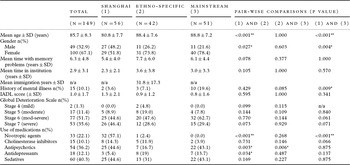
Residents' characteristics are summarized in Table 1. The mean age of residents across the three groups was 85.7 years (SD = 8.3). The mean age of Shanghai residents was significantly lower than the ethno-specific Chinese and mainstream groups (F = 19.0, p < 0.001). A higher percentage of residents were male in Shanghai compared with residents from the ethno-specific Chinese group and mainstream group (χ2 = 4.904, p = 0.027; χ2 = 8.275, p = 0.004 respectively).
Comparison of resident characteristics between groups

* Significant at p = 0.05 level, ** Significant at p = 0.001 level.
IADL = instrumental activities of daily living.
The mean time since nursing home entry was 2.9 years with no significant difference across the groups. The mean years since the Australian-Chinese residents had arrived as immigrants was 31.8 years (SD = 17.3). A significantly higher proportion of mainstream residents had a history of mental or psychiatric illness (χ2 = 6.894, p = 0.009) compared to the Shanghai group, but not when compared to the ethno-specific Chinese group (χ2 = 2.976, p = 0.085).
The MMSE could not be completed in 20.1% (n = 30) of all residents. The mean IADL score for all residents was 1.0 (SD = 1.7) with no significant differences between groups. The majority of residents had high GDS scores, with 51.7% having moderately severe dementia (stage 6), and 35.6% having severe dementia (stage 7). There were no significant differences in GDS scores between groups.
Nootropic agents were prescribed significantly more frequently in the Shanghai group compared with the other two groups (χ2 = 63.801, p < 0.001). Antipsychotic usage was significantly lower in the ethno-specific Chinese group compared with the Shanghai (χ2 = 8.542, p = 0.003) and mainstream (χ2 = 7.521, p = 0.006) groups. Antidepressants were used more frequently in the ethno-specific Chinese group compared to the Shanghai group (χ2 = 4.514, p = 0.034), but not compared to the mainstream group (χ2 = 0.482, p = 0.487). There were no other differences between groups in medication usage.
Comparisons of BPSD
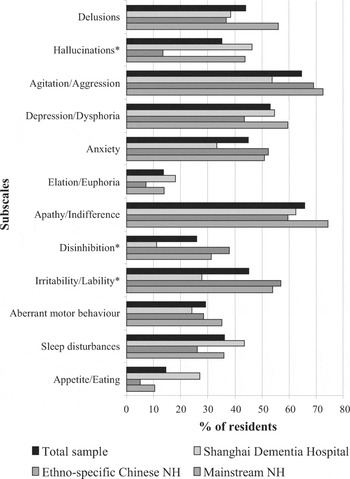
The mean NPI-NH total score for all residents was 28.5 (SD = 17.2) There were no significant differences between the three groups in total NPI-NH scores (F = 0.740, p = 0.479), even after controlling for resident's age and gender, history of mental illness, nootropic use, antipsychotic and antidepressant use (F = 0.299, p = 0.742). Apathy/indifference and agitation/aggression were the two most frequently present symptoms across the three groups, while euphoria and eating disturbances were the least frequent symptoms.
Analysis of NPI-NH subscales showed significant differences in the frequency of several behaviors (Figure 1). As data were incomplete when staff members could not rate items, the number of valid cases for each subscale ranged from 118 to 149. After controlling for the above covariates, significantly fewer ethno-specific Chinese residents exhibited hallucinations than did Shanghai residents (β = 1.710, S.E. = 0.574, p = 0.003). Mainstream residents did not differ significantly from the other two groups. Residents from the Shanghai dementia hospital had lower rates of disinhibition and irritability than residents from the ethno-specific Chinese group (β = 1.594, S.E. = 0.537, p = 0.003; β = 1.243, S.E. = 0.435, p = 0.004 respectively), but not when compared with the mainstream group.
Rates of positive scores for individual NPI-NH subscales by group. *Significant at p = 0.05 level, corrected for family wise comparisons.

Factors associated with BPSD
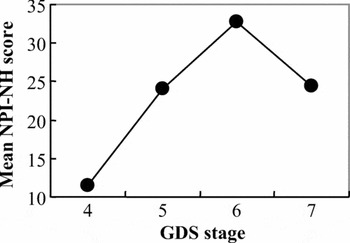
Since there were no significant differences overall between groups in total NPI-NH scores, other factors were examined for associations with BPSD in the whole sample. Analysis of the relationship between dementia severity and NPI-NH scores showed significant differences in the mean NPI-NH total score for residents at different stages on the GDS (F = 3.706, p = 0.013). A curvilinear relationship was found, with the NPI-NH total score rising from a low of 11.5 in residents with a GDS of 4, rising to a peak of 32.7 in residents with GDS scores of 6, then falling to 24.4 in those with scores of 7 (Figure 2).
Relationship between BPSD and dementia severity.

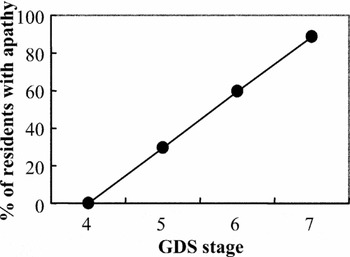
There was a significant correlation between apathy and the resident's GDS score (R = 0.429, p < 0.001). The percentage of residents with apathy/indifference rose steadily as GDS increased, from 0% in those with a GDS score of 4, to 29.4% with GDS scores of 5, 59.7% with GDS scores of 6 and peaking at 88.7% for those with GDS scores of 7 (Figure 3). There were no other significant relationships between NPI-NH subscales and GDS score.
Relationship between dementia severity and presence of apathy.

There was a significant negative relationship between the number of symptoms of depression and the number of years at the institution (R = −0.251, p = 0.003), with those who were admitted to the nursing home more recently having a higher frequency of depressive symptoms. This association remained significant (β = −0.179, S.E. = 0.070, p = 0.011) after controlling for resident's age and gender, history of mental illness, anti-depressant use and dementia severity. A higher proportion of residents (67.2%) who had been at the facility for one year or less had symptoms of depression compared with 47.3% of residents who had been at the facility for longer (χ2 = 7.841, p = 0.005).
There were no significant predictors of levels of NPI-NH total scores using multivariate regression analyses. Independent variables entered were resident's age and gender, history of mental illness, years of institutionalization, years since memory problems began, dementia severity and residential facility type. There was no correlation between years since migration and levels of BPSD in the ethno-specific Chinese group (R = 0.190, p = 0.227).
Discussion
Residents' demographic characteristics varied between groups, which may have impacted on BPSD findings. Residents in Shanghai were younger and more were male compared to residents in the Sydney homes. There was a much lower rate of previous mental or psychiatric illness among Shanghai residents, and to a lesser extent in Australian-Chinese residents, compared to mainstream residents. This may reflect real differences in the prevalence of psychiatric illnesses between cultural groups, differences in treatment seeking behavior or acknowledgement of psychiatric etiology of symptoms because of associated stigma (Liu et al., Reference Liu, Hinton, Tran, Hinton and Barker2008).
Our results indicated that there were no significant differences in the overall prevalence of BPSD among residents from the Shanghai dementia hospital, ethno-specific Chinese nursing homes, and mainstream nursing homes in Sydney, confirming our null hypothesis. These results are consistent with findings in other studies where the prevalence of BPSD was unchanged by influences of culture and ethnicity (Schreiner et al., Reference Schreiner, Yamamoto and Shiotani2000; Cohen et al., Reference Cohen, Hyland and Magai1998a).
Similarly consistent with the literature were different rates for individual NPI subscales (Cohen et al., Reference Cohen, Hyland and Magai1998b; Chow et al., Reference Chow2002). Hallucinations were less frequent in the ethno-specific Chinese group, while there was a lower prevalence of disinhibition and irritability in the Shanghai group, perhaps reflecting greater cultural conformity in China. However, assuming that culture is more similar between Shanghai and Australian-Chinese residents than mainstream Australians, we would expect similar differences between the mainstream and the two Chinese groups. Further, if migration and/or acculturation accounted for the differences, we would expect to see differences between the two Chinese groups and differences between the ethno-specific Chinese and mainstream groups. We found differences between the two Chinese groups and similarities between the Shanghai and mainstream groups, suggesting that differences observed between groups are less likely to be due to the effects of culture and acculturation.
The ability of staff members to recognize BPSD may contribute towards the differences found between groups in hallucinations. Assessment of hallucinations can be difficult in dementia patients, as inferences may need to be drawn from hallucinatory behavior if residents do not report hallucinations (O'Donnell et al., Reference O'Donnell, Molloy and Rabheru2001). We are unable to determine whether these are real differences or ascertainment biases subsequent to differences in reporting of these symptoms.
Differences in care practices at each facility may influence the prevalence of behaviors. The Shanghai dementia hospital had a medical model of care, with in-house doctors, higher staff to resident ratio and less staff turnover compared to the other two facility types. Shanghai residents may have received more individual attention and had their needs addressed more quickly. This may have resulted in fewer unmet needs resulting in less irritability, though if this were the case, lower levels of agitation and aggression would also have been expected. Further, in addition to aforementioned greater cultural conformity, closer staff supervision may limit the opportunity for residents to engage in inappropriate behavior, and hence account for the lower frequency of disinhibition found in the Shanghai group.
Whole sample correlation analyses found a curvilinear relationship between BPSD and dementia severity, with the highest prevalence rates occurring at the moderately-severe level of dementia. This supports similar findings on the relationship between BPSD and cognitive impairment and dementia severity (Lövheim et al., Reference Lövheim, Sandman, Karlsson and Gustafson2008). The prevalence of BPSD declined in those with severe dementia, possibly due to reduced physical and communication abilities as well as the increasing difficulty to recognize and interpret symptoms such as hallucinations and delusions by staff members (Lövheim et al., Reference Lövheim, Sandman, Karlsson and Gustafson2008).
The facilities were similar in that they all had a significant proportion of residents with moderately severe or severe dementia (87.3%), which may account for some of the similarities in BPSD subtype found between groups. We found that apathy was universally common and correlated strongly with the severity of the dementia, consistent with other studies (Lövheim et al., Reference Lövheim, Sandman, Karlsson and Gustafson2008). While aberrant motor activity is one of the most frequently observed behaviors in community-dwelling persons with dementia (Fuh et al., Reference Fuh, Liu, Mega, Wang and Cummings2001; Chow et al., Reference Chow2002), this symptom did not feature significantly in our three groups. In late-stage dementia, motor functions become affected, limiting the capacity of residents to engage in certain behaviors such as wandering.
Residents who were at the residential facility for less than one month were excluded from the study as a change in environment can precipitate BPSD. Nonetheless, our results still showed a significant relationship between duration of residence at the institution and levels of depressive symptoms, with residents admitted more recently having higher levels of depression. This suggests that appropriate care needs to be given to residents to ensure a smooth transition from home care to nursing home care.
The first of several limitations to this study is that culture may not only affect BPSD quantitatively, i.e. prevalence, but also qualitatively, so that the content of delusions and hallucinations and the nature of aggressive behaviors may differ. These latter differences may be more effectively examined through a qualitative study. Secondly, our study was limited to one facility in Shanghai as the dementia hospital was the only high-care residential facility for persons with dementia in Shanghai and other residential care facilities by and large excluded people with dementia. Thirdly, differences in admission policies between the Shanghai and Sydney facilities may have produced selection bias (admission criteria in the mainstream and ethno-specific Chinese homes in Sydney were similar). However, while a diagnosis of dementia was a prerequisite for admission to the Shanghai unit, which, because of limited bed spaces preferred those with severe symptoms of dementia, levels of BPSD were no higher in Shanghai. Fourthly, despite measures to correct differences in dementia severity measured by the GDS and differences in medication usage using statistical methodology, it is difficult to avoid bias caused by different distribution of dementia severity among the three groups and differences in treatment practices between facilities. Nearly half of the Shanghai group had stage 7 dementia, which may show lower frequency of several BPSD compared to those at stage 6, and about two-thirds of the mainstream group had stage 6 dementia. Nonetheless, similar proportions of residents used antipsychotic drugs and sedatives between the Shanghai and mainstream group, whereas Alzheimer's drugs such as cholinesterase inhibitors and nootropics were used significantly more frequently in the Shanghai group. Therefore, residents in the Shanghai group were more actively treated to control BPSD than the mainstream group despite having more residents with stage 7 dementia. Fifthly, this study lacked observational ratings and relied on nursing staff for information to complete the NPI and IADL scales. Nursing staff vary in their knowledge and responses (Brodaty et al., Reference Brodaty2001). Although we attempted to survey nursing staff who had closest daily contact with residents, and supplemented their ratings with information from informal caregivers and care plans, it was difficult to ascertain the reliability of these ratings, especially between different facilities. Finally, we note the absence of information about premorbid personality, education level, acculturation (in the migrant group) and life experiences which may have influenced the manifestations of BPSD.
Conclusion
The prevalence of BPSD did not differ among nursing home populations from different cultural backgrounds, although differences in rates of specific behaviors were found between groups. Newly admitted residents to residential facilities warrant special consideration and attention by staff and family members to ensure a smooth transition from home to institutional environment, as symptoms of depression are more prevalent during the first year of institutionalization. Staff education programs may be beneficial to increase awareness and understanding about the causes of BPSD, so that these behaviors are recognized and measures taken to address their precipitating factors. Further cross-cultural research on BPSD is warranted. Our sample consisted largely of residents with moderately severe and severe dementia. The influence of culture may be more apparent at milder stages of dementia, hence a community study observing BPSD in culturally distinct populations and following them up longitudinally may be beneficial.
Conflict of interest
None.
Description of authors' roles
H. Z. Y. Wu collected the data in Sydney and Shanghai, carried out the statistical analyses, and wrote the paper. L. F. Low helped design the study, supervised the data collection in Sydney, and assisted with data analysis and writing the article. S. Xiao organized and supervised the data collection in Shanghai and reviewed the paper before submission. H. Brodaty designed the study, supervised the data collection in Sydney, and assisted with writing the paper.
Acknowledgments
Special thanks go to Ada Cheng, Dr. Li Xia, Dr. Wang Hai Hong, Ivanna Goh, and Beryl Guo; to the staff of Bernard Chan, Chow Cho Poon, Abrina, Amity at Roseville, Forestview, Chatswood Community, and Clover Lea nursing homes; the staff at Changning District Dementia Hospital; and to the residents and their families. This study was supported by a Contestable Funding for International Strategic Projects grant from the University of New South Wales, NHMRC grant #455377 and as part of the Australian Government's initiative Dementia: A National Health Priority.