Research and policy interest is increasingly focused on the links between financial literacy and household saving, seeking to explain why consumers seem to undersave for retirement, take on too much debt, make poor mortgage decisions, and experience other problems in the modern financial environment.Footnote 1 This paper explores two explanations for why consumers fail to optimize their financial decision making. One is that people suffer from financial illiteracy (Lusardi and Mitchell, Reference Lusardi and Mitchell2007a, Reference Lusardi and Mitchellb, Reference Lusardi and Mitchell2008; Hastings and Tejeda-Ashton, Reference Hastings and Tejeda-Ashton2008, Hastings et al., Reference Hastings, Madrian and Skimmyhorn2013; Lusardi and Mitchell, Reference Lusardi and Mitchell2014). This argument contends that many people lack the knowledge of key economic concepts and skills needed to make financial computations, which may cause them to make suboptimal financial decisions. It is this explanation that motivates the many policymakers who have recently launched campaigns to foster financial literacy around the world (OECD, Nd; PACFL, 2008). A second explanation is that people are impatient or ‘present-biased,’ which implies that they chose current gratification over future, higher payoffs (O'Donahue and Rabin, Reference O'Donahue and Rabin1999; Ashraf et al., Reference Ashraf, Karlan and Yin2006).
While both explanations could be influential in explaining apparently suboptimal saving and investment patterns, thus far there is little evidence that either of these behavioral limitations is at the root of poor financial decision making. This paper uses experimental evidence derived from the 2009 Chilean Encuesta de Protección Social (EPS or Social Protection Survey) to evaluate how financial literacy and impatience predict saving and investment decisions. The EPS is similar to the US Health and Retirement Study, and it is a nationally representative panel of respondents followed every 2 years, fielded by the University of Chile's Microdata Center in cooperation with the University of Pennsylvania (c.f. Arenas et al., Reference Arenas de Mesa, Bravo, Behrman, Mitchell, Todd, Kay and Sinha2008; Mitchell et al., Reference Mitchell, Todd, Bravo and Lusardi2008).Footnote 2 Chile is one of the most developed economies in Latin America, having levels of education and systems of credit similar to those of many developed countries. Also of interest is the fact that Chile converted to a mandatory national defined contribution system in 1981, giving all participating employees a chance to select a pension fund manager (AFP, or Pension Fund Administrator) from a small set of licensed portfolio managers. Two aspects of the 2009 EPS are particularly valuable for the current paper. First, we administered a battery of financial literacy questions (developed by Lusardi and Mitchell, Reference Lusardi and Mitchell2007a, Reference Lusardi and Mitchellb) from which we develop a literacy index which can be used as a predictor of retirement saving and other key outcomes. Second, we designed and implemented a pair of experiments providing the opportunity to measure respondent impatience and respondent ability to carry out expressed intentions regarding financial behaviors, which we then link to outcomes of interest.
Our results show that our measure of impatience is a strong predictor of retirement saving and investment in health. Financial literacy is also correlated with accumulated retirement saving though it appears to be a weaker predictor of sensitivity to framing in investment decisions. These results have implications for policymakers interested in enhancing retirement well-being through addressing shortcomings in behavior and economic decision making that may hinder planning, decision making, and investments for long-run financial and physical health.
Data and experimental methodology
The EPS is a nationally representative bi-annual microeconomic panel of Chileans, fielded by the University of Chile's Microdata Center in cooperation with the University of Pennsylvania (Bravo et al., Reference Bravo, Behrman, Mitchell and Todd2004, Reference Bravo, Behrman, Mitchell and Todd2006; Arenas et al., Reference Arenas de Mesa, Bravo, Behrman, Mitchell, Todd, Kay and Sinha2008; Mitchell et al., Reference Mitchell, Todd, Bravo and Lusardi2008). The 2009 wave of the EPS collected survey data for a little over 14,000 respondents included in the 10-year panel. The survey is similar to the US Health and Retirement Study, and it delves into respondents’ labor history, health, retirement saving, and knowledge of and participation in Chile's defined contribution old-age saving scheme. In addition, the EPS also asks respondents to answer several questions measuring financial literacy and risk preferences (devised by Lusardi and Mitchell, Reference Lusardi and Mitchell2007a, Reference Lusardi and Mitchellb). These questions are as follows:
(1) Chance of Disease: If the chance of catching an illness is 10%, how many people out of 1,000 would get the illness?
(2) Lottery Division: If five people share winning lottery tickets and the total prize is 2 million Chilean pesos, how much would each receive?
(3) Numeracy in Investment Context: Assume that you have $100 in a savings account and the interest rate you earn on this money is 2% a year. If you keep this money in the account for 5 years, how much would you have after 5 years? Choose one: more than $102, exactly $102 or <$102.
(4) Compound Interest: Assume that you have $200 in a savings account, and the interest rate that you earn on these savings is 10% a year. How much would you have in the account after 2 years?
(5) Inflation: Assume that you have $100 in a savings account and the interest rate that you earn on these savings is 1% a year. Inflation is 2% a year. After 1 year, if you withdraw the money from the savings account you could buy more/less/the same?
(6) Risk Diversification: Buying shares in one company is less risky than buying shares from many different companies with the same money. True/False
We use the responses to these questions to generate a financial literacy index – the sum of correct responses to each questionFootnote 3 – which is our measure of an individual's knowledge and capability of performing calculations needed to make wise financial decisions.Footnote 4
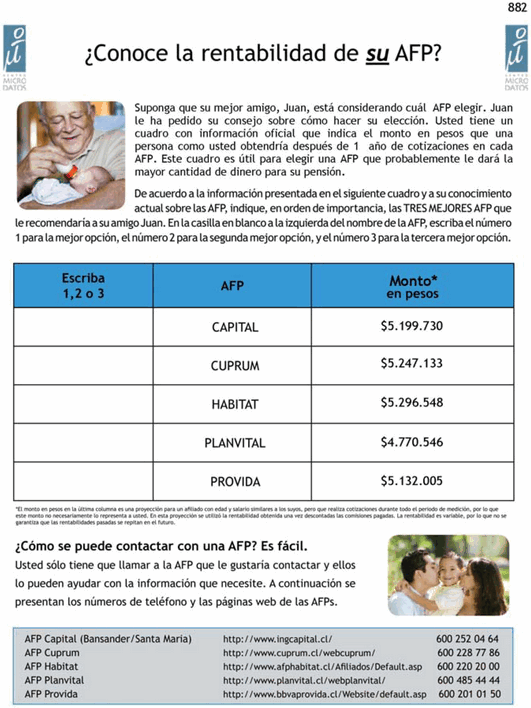
To ascertain whether financial literacy affects how consumers understand financial terminology such as pension fund management fees and interest rates (following Hastings and Tejeda-Ashton, Reference Hastings and Tejeda-Ashton2008), we provide information to individuals on pension investment returns net of fees, in various formats. Specifically, we present the pension fund menu in expected pension fund gains versus pension fund costs over a 10-year period, and we also vary whether these are presented in Chilean pesos or in Annual Percentage Rates. The formats were randomly assigned to EPS respondents, who were then asked to analyze the information and rank the funds on the menu as first, second, and third best, based on the information provided. We then use the financial literacy index discussed above to test whether the financially literate respondents are less strongly influenced by how the pension information is framed.
In a second experiment we investigate whether people subject to impatience – that is, those who overweight current consumption versus the future – are also those who make short-sighted investment decisions. To test this hypothesis, at the end of the survey, each EPS participant was asked to play a ‘Game’ to receive a gift card. In return for filling out a short shopping questionnaire, the interviewer gave each participant a gift card to be used at the largest grocery chain in the nation. If the respondent completed the short questionnaire right away (‘Now’), he would immediately receive a 5,000 peso gift card (about US$8); alternatively, he could elect to do so ‘Later’ – i.e., fill out the questionnaire and mail it back in a pre-paid, addressed envelope within four weeks – at which time the gift card is activated with a higher amount. This higher amount was randomized between 6,000 and 8,000 pesos in 500 peso increments, so respondents who delayed would receive a 20–60% return if they delayed receipt (by up to 4 weeks).Footnote 5 The experiment permits us to identify three different types of respondents: the impatient who took the lower gift-card amount immediately, the efficacious deferrers who chose the later amount and returned the survey for the higher amount, and the inefficacious deferrers who opted for the later higher amount but then failed to send in the questionnaire so as to activate their cards. This provides a real-world decision measure of ability to delay current gratification for future gains, as well as evidence on peoples’ ability to follow through on a plan with financial implications. Then we can determine whether respondents who choose Now at a cost of more money Later are also those who are unable to save for retirement and less likely to invest in their health.
How financial literacy and impatience shape retirement wealth and health
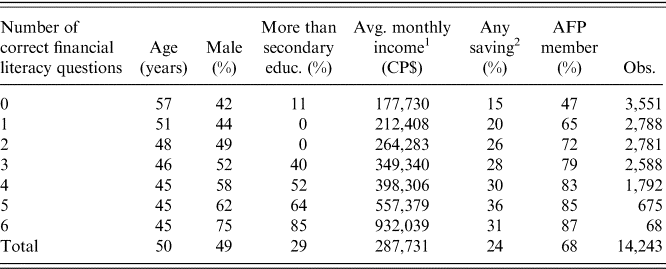
In this section, we explore how financial literacy and impatience are associated with retirement wealth and health. Table 1 reports summary statistics for the total number of financial literacy questions answered correctly, arrayed by respondent characteristics including age, sex, education, income, and whether the respondent indicated he had any saving. On average, younger individuals and men were more likely to give correct answers to more of the financial literacy questions. Similarly, financial literacy rises strongly with education levels, with those getting over half of the questions correct being more likely to have completed at least their secondary schooling. Average monthly income was also strongly positively correlated with financial literacy, as was the propensity to have some form of saving and to be a member of an AFP pension plan (in the past, participation was optional for the self-employed and those not in formal sector jobs).
Financial literacy and other sociodemographic characteristics of EPS respondents (2009)

1 Average monthly income calculation excludes those with zero income.
2 Statistic created from Question D27 in the EPS. Interviewees have savings if they respond they have any of the following: (1) savings for a home (at a bank), (2) AVF savings (housing fund admin.), (3) voluntary pension savings, (4) account two AFP savings, (5) bank savings account, (6) term deposits, (7) mutual fund investments, (8) company shares or bonds, (9) third party loans, (10) other savings (cash, dollars, ‘polla’, etc.).
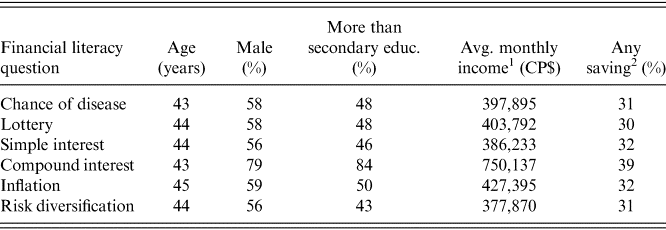
Next we focus only on AFP participants (self-identified) and investigate how respondents performed on specific financial literacy questions. Table 2 shows that those who answered each question correctly were more likely than those who did not know the correct answers to have higher monthly income, more education, and saving. Of particular interest is the Compound Interest question. It asked respondents to calculate the exact amount they would have in a saving account after 2 years if they started with $200 and the account paid 10% interest annually. Very few – only 154 respondents out of more than 8,000 asked the question – answered it correctly by giving a response of $242. This handful of respondents was substantially wealthier and more educated than the sample as a whole.
Financial literacy responses and respondent characteristics of AFP participants

1 Average monthly income calculation excludes those with zero income.
2 Statistic created from Question D27 in the EPS. Interviewees have savings if they respond they have any of the following: (1) savings for a home (at a bank), (2) AVF savings (housing fund admin.), (3) voluntary pension savings, (4) account two AFP savings, (5) bank savings account, (6) term deposits, (7) mutual fund investments, (8) company shares or bonds, (9) third party loans, (10) other savings (cash, dollars, ‘polla’, etc.).
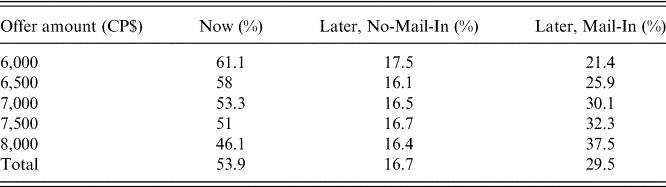
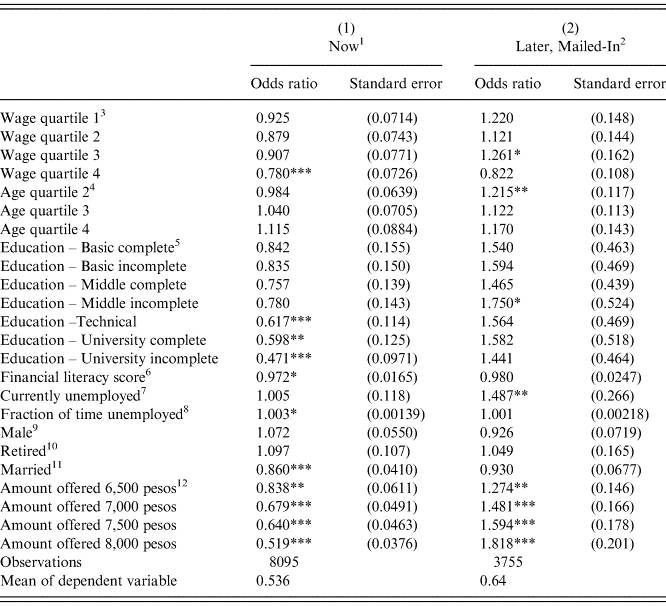
Results from the Game are given in Table 3. Overall, of the 8,850 participants in the Game,Footnote 6 54% chose the Now option, with the remainder electing to turn it in Later for a higher value gift card. Of the latter, 17% failed to return the questionnaire, in effect losing the certain 5,000 pesos offered to begin with; 30% successfully returned the survey and received the higher Later amount. Column 1 of Table 4 reports odds ratios of characteristics influencing the likelihood that a respondent chose Now versus Later for completing the short additional questionnaire. The odds of choosing Now decline with income, and the rate is lowest for those having the highest level of income (the excluded group is those earning 0). In addition, more educated respondents are much less likely to choose Now (the excluded education group is those with incomplete basic education). In fact, among those with post-secondary education at Technical or University levels, the odds of choosing Now decrease by about 40%. Married couples are also less likely to choose Now, conditioning on age. Interestingly a higher financial literacy score also decreases the odds of choosing Now instead of Later. The effect is small, with a one point increase in the score associated with a 2.8% decrease in the odds of choosing Now. However, it suggests that those who choose to defer payment for a greater reward are more likely to possess a basic understanding of simple math and financial concepts necessary to make intertemporal financial decisions. We also find that the probability of selecting Later rises as the amount offered increases, not surprisingly. It is unexpected that a sizable fraction of participants still chose the Now option when the Later choice would pay 8,000 pesos.
Summary statistics for Game decisions

Notes: Offer amount is the amount offered to respondents for choosing to mail in their supplemental survey and receive compensation at a later date. Now is the decision to receive 5,000 pesos at the time of survey rather than a higher amount later. Later, No-Mail-In are those who chose to receive more than 5,000 pesos later but did not mail in the supplemental survey before the offer expired. Later, Mail-In chose to receive more than 5,000 pesos later, mailed in the supplemental survey, and received this higher amount.
Factors affecting Game decision-making

Notes: Estimates from Logit regressions. Asterisks indicate significance (*0.10, **0.05, ***0.01).
1 Indicator for choosing to receive 5,000 pesos at the time of survey rather than a higher amount later.
2 Indicator for choosing to receive more than 5,000 pesos later and mailing in the supplemental survey and receiving this higher amount; sample is limited to respondents who chose to receive the higher amount later.
3 Dummy variables for wage quartile given the participant has a wage; respondents with no wage at the time of survey are given a wage quartile of 0 and make up the omitted group.
4 Dummy variables for age quartile.
5 Dummy variables for highest education level attained. ‘Incomplete’ means either that the schooling was not completed or that it is currently in progress.
6 Number of questions answered correctly out of a set of six questions designed to measure financial literacy.
7 Indicator for being currently unemployed at the time of survey.
8 Fraction of time the respondent was unemployed between January 2006 and the time of survey.
9 Indicator for whether the respondent is male.
10 Indicator for whether the respondent is retired.
11 Indicator for whether the respondent is married.
12 Dummy variables for the amount offered to participants for choosing to mail in their supplemental survey and receive compensation at a later date. Dummy variables for each of the Big Five personality traits are also included in both specifications. These are indicator variables that take a value of 1 if the respondent scores more than a standard deviation above the mean for the trait.
The second column of Table 4 shows the effect that these characteristics have on efficacious deferrals – that is, being able to return the completed questionnaire and receive the higher gift card amount, conditional on choosing to complete the survey later. Interestingly, few of the sociodemographic variables predict this behavior, and the only strong and consistent factor refers to the respondent's unemployment status: being jobless boosts the odds of returning the survey successfully by nearly 50%.
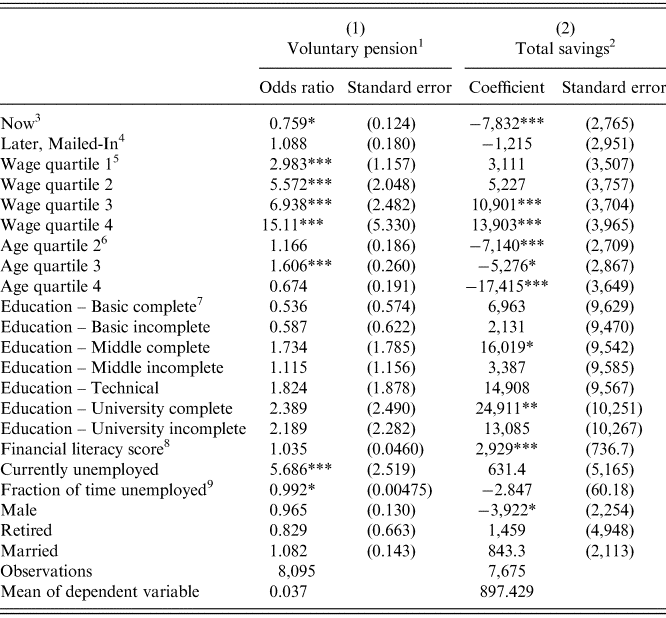
Next, we seek to understand how these factors might influence saving and investment outcomes, and also whether they play a role in addition to the influence of income and education. Accordingly, Table 5 illustrates how these factors influence reported measures of retirement saving. The first column presents odds ratios from a Logit model for self-reported participation in the additional AFP voluntary saving program into which covered workers may contribute if they wish (above and beyond the required 10% contribution they are required to save in their mandatory AFP). Interestingly, choosing the Now option in the Game is a significant predictor of whether the respondent says he contributes additional amounts to his personal pension account, and this estimate is in the expected direction: those who select Now have 25% lower odds of making voluntary contributions. Higher paid workers are more likely to contribute, though more educated participants are not. In addition, those with a higher financial literacy score are not more likely to pay in additional voluntary pension contributions, perhaps because they are saving in other vehicles.
How financial literacy and impatience correlates with any voluntary pension saving and total saving

Notes: Estimates from a Logit regression for having made voluntary pension contributions and a Tobit regression for total savings. Asterisks indicate significance (*0.10, **0.05, ***0.01).
1 Indicator for having made voluntary pension savings between January 2006 and the time of survey.
2 Total amount of savings and investments in thousands of pesos.
3 Indicator for choosing to receive 5,000 pesos at the time of survey rather than a higher amount later.
4 Indicator for choosing to receive more than 5,000 pesos later and mailing in the supplemental survey and receiving this higher amount.
5 Dummy variables for wage quartile given the participant has a wage; respondents with no wage at the time of survey make up the omitted group.
6 Dummy variables for age quartile.
7 Dummy variables for highest education level attained.
8 Number of questions answered correctly out of a set of six questions designed to measure financial literacy.
9 Fraction of time the respondent was unemployed between January 2006 and the time of survey. Dummy variables for the amount offered to participants for choosing the Later option and dummy variables for scoring over a standard deviation above the mean for a Big Five personality trait are also included in all specifications.
The second column of Table 5 provides Tobit estimates of self-reported savings regressed on the same set of variables. Here we see that those who chose Now in the Game also have less saving.Footnote 7 Financial literacy is also significant and positive – those with higher financial literacy scores are more likely to have higher saving accumulations (confirming Behrman et al., Reference Behrman, Mitchell, Soo and Bravo2012). Comparing the impact of financial literacy versus choosing Now versus Later, impatience in the Game lowers saving as much as a 2.5 point reduction in the financial literacy score. In other words, this provides support for the hypothesis that both financial literacy and short-run impatience play important roles in determining retirement saving, even after controlling for education and income.
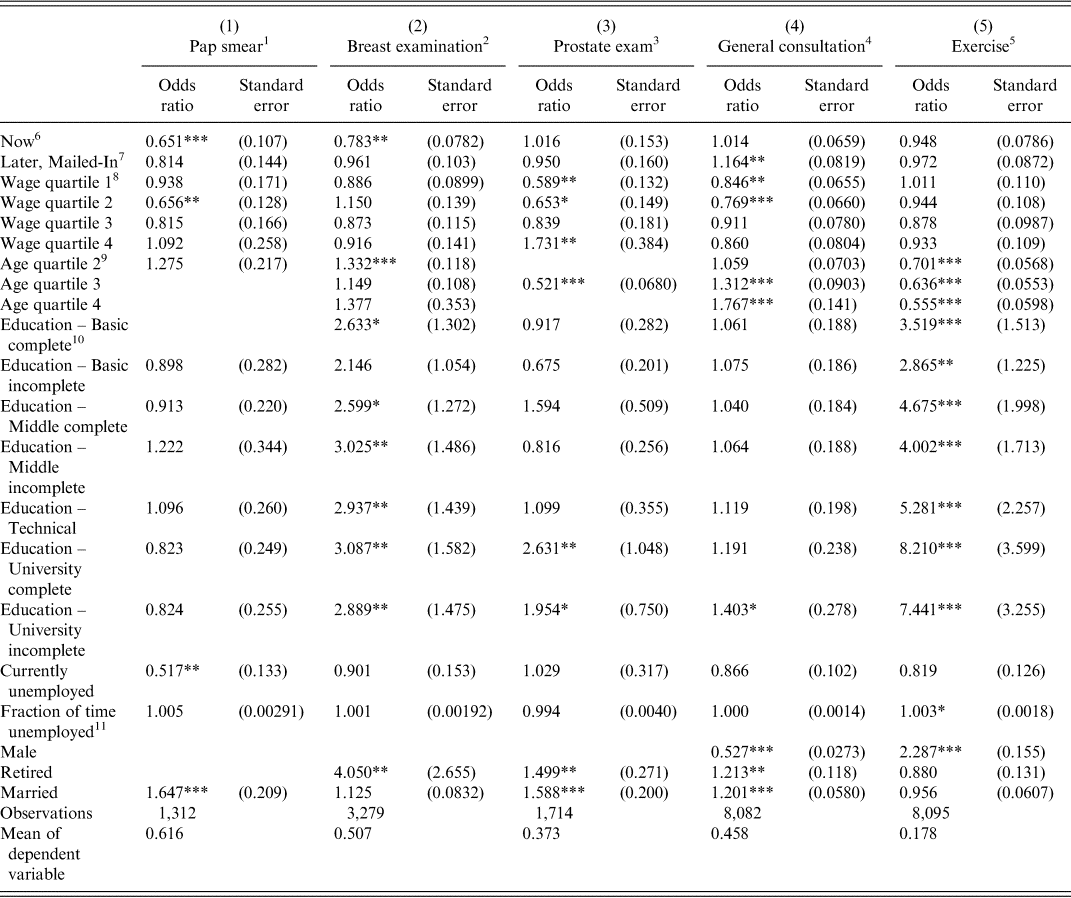
Next we explore other ways in which these two factors shape peoples’ long-term investment patterns. Tables 6 and 7 examine the relationship between measured health investments and behaviors and EPS participant choices in the Game (health behaviors in the EPS are self-reported). One set of outcomes is whether respondents had had any of several preventative exams in the past 2 years (since the last EPS round) including Pap smear, breast exam, prostate exam, and general physicals. The first four columns of Table 6 show that performance in the Game is a very strong predictor of having had preventative health exams for women. For them, people choosing Now are significantly less likely to have had Pap Smears and breast exams (odds fall by 22–35%). Interestingly, higher educated women are much more likely to have breast exams but not Pap Smears, and generally income is not a strong predictor of either exam (perhaps the latter can be explained by the fact that Chile has a national health insurance scheme making the coverage widely available). For men, the likelihood of having had a prostate exam is uncorrelated with Game behavior, though having had a general physical is. Here those who chose Later and followed through were significantly more likely to have had a general physical than either those who chose Now or those who chose Later and did not follow through.
How Game behaviors covary with preventative health behaviors

Notes: Estimates from Logit regressions. Asterisks indicate significance (*0.10, **0.05, ***0.01).
1 Indicator for having had a Pap smear in the last 2 years; sample limited to women 40 and under.
2 Indicator for practicing regular breast self-examination; sample limited to women 60 and under.
3 Indicator for having had a prostate exam in the last 2 years; sample limited to men 50 and older.
4 Indicator for having visited the doctor for a general consultation in the last 2 years.
5 Indicator for exercising more than once a week.
6 Indicator for choosing to receive 5,000 pesos at the time of survey rather than a higher amount later.
7 Indicator for choosing to receive more than 5,000 pesos later and mailing in the supplemental survey and receiving this higher amount.
8 Dummy variables for wage quartile given the participant has a wage; respondents with no wage at the time of survey make up the omitted group.
9 Dummy variables for age quartile.
10 Dummy variables for highest education level attained.
11 Fraction of time the respondent was unemployed between January 2006 and the time of survey. Dummy variables for the amount offered to participants for choosing the Later option and dummy variables for scoring over a standard deviation above the mean for a Big Five personality trait are also included in all specifications.
How Game behavior covaries with overweight

Notes: Estimates from Logit regressions. Asterisks indicate significance (*0.10, **0.05, ***0.01).
1 Indicator for a Body Mass Index (BMI) in the range classified as either overweight or obese; BMI is calculated from respondent reported weight and height.
2 Indicator for choosing to receive 5,000 pesos at the time of survey rather than a higher amount later.
3 Indicator for choosing to receive more than 5,000 pesos later and mailing in the supplemental survey and receiving this higher amount.
4 Dummy variables for wage quartile given the participant has a wage; respondents with no wage at the time of survey make up the omitted group.
5 Dummy variables for age quartile.
6 Dummy variables for highest education level attained.
7 Fraction of time the respondent was unemployed between January 2006 and the time of survey. Dummy variables for the amount offered to participants for choosing the Later option and dummy variables for scoring over a standard deviation above the mean for a Big Five personality trait are also included in all specifications.
Lastly, exercise can be viewed as a preventative health measure that imposes a cost now for health gains in the future. The EPS asks respondents approximately how often they exercise, with response options varying from never, to once or twice a month, to more than five times per week. We use this variable to construct a measure of weekly exercise habits to examine if we find a similar relationship between Game responses and health investments as we did with prior outcomes. We do not find a significant relationship between self-reported exercise and Game responses, even though the exercise measure is strongly influenced by education, age, marital status, and sex with the signs and magnitudes one would expect.
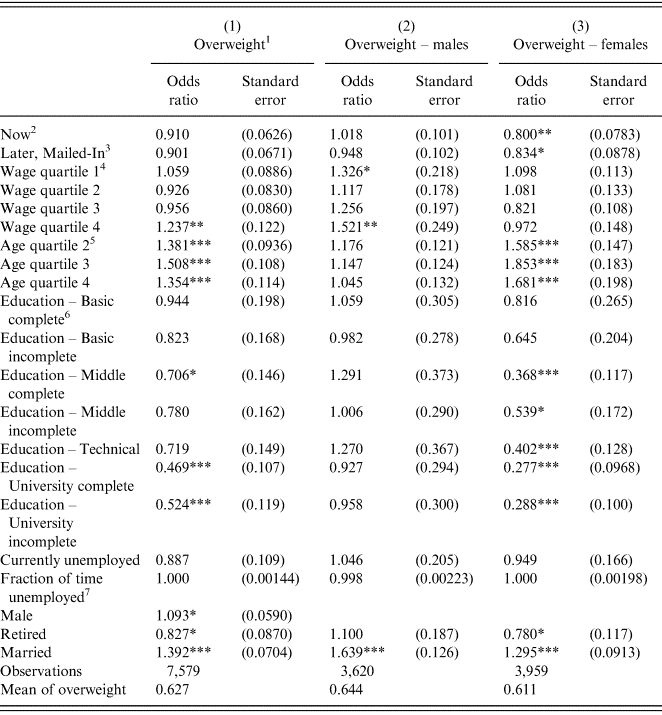
Next we use respondent self-reported height and weight to construct a Body Mass Index to categorize each individual as underweight, normal weight, overweight, or obese. Results are provided in Table 7 for a Logit regression of whether the respondent is overweight or obese is related to performance in the Game. For women, demographic factors and the Investment Gain patterns are strongly associated with weight. Specifically, both those who chose Now and those who chose Later and followed through with their investment are significantly less likely to be overweight – by about 20% – compared with those who naively chose Later but then failed to get their questionnaire in on time. Little except marital status affects weight for men.
For many people, then, behavior in the Game is related to successful outcomes in retirement saving accumulations, as well as in health behaviors and health investments. This suggests that the Game discriminates who is efficaciously patient – those who can make forward-looking financial plans and follow through. We believe that identifying who has difficulty making such commitments may be important for increasing saving and investment behavior.
Financial literacy and sensitivity to information framing
We also undertook a separate experiment to further analyze how financial literacy might influence investment decisions. Since financial literacy is meant to measure the capacity and knowledge base necessary to perform calculations needed to make wise financial decisions, we hypothesize that financially illiterate individuals will be more sensitive to information and how financial information is framed. To examine this further, we provided individually tailored account balance figuresFootnote 8 to respondents receiving the Gain version of the fee information worksheet used in the experiment. To construct the Loss version of worksheets, we computed the difference between the largest 10-year account balance for each individual and each of the other four AFPs in the menu. After fielding these experimental worksheets, we matched each respondent's top three AFPs they would ‘recommend to a friend’ to our own ranking of the AFPs for that individual.
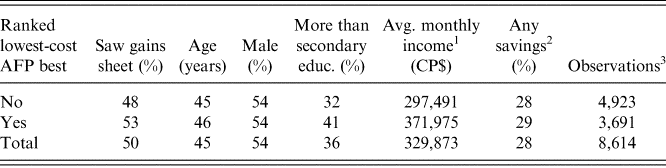
Results are given in Table 8. Of the participants who received this information, 10% more respondents who saw the Gain sheet elected the lowest-cost AFP, versus those receiving the loss sheet (53% versus 48% points). In general, people were more responsive to rewards versus losses. Table 8 also indicates that the more educated, men, and the higher earners were more likely to elect the lowest-cost AFP, particularly when shown the Gain sheet.
Factors associated with respondent ranking lowest-cost AFP as best (AFP participants)

1 Average monthly income calculation excludes those with zero income.
2 Statistic created from question D27 in the EPS. Interviewees have savings if they respond that they have any of the following: (1) savings for a home (at a bank), (2) AVF savings (housing fund admin.), (3) voluntary pension savings, (4) account two AFP savings, (5) bank savings account, (6) term deposits, (7) mutual fund investments, (8) company shares or bonds, (9) third party loans, (10) other savings (cash, dollars, ‘polla’, etc.).
3 Total is less than 9,671 (all self-identified AFP holders) because some interviewees do not receive the experiment.
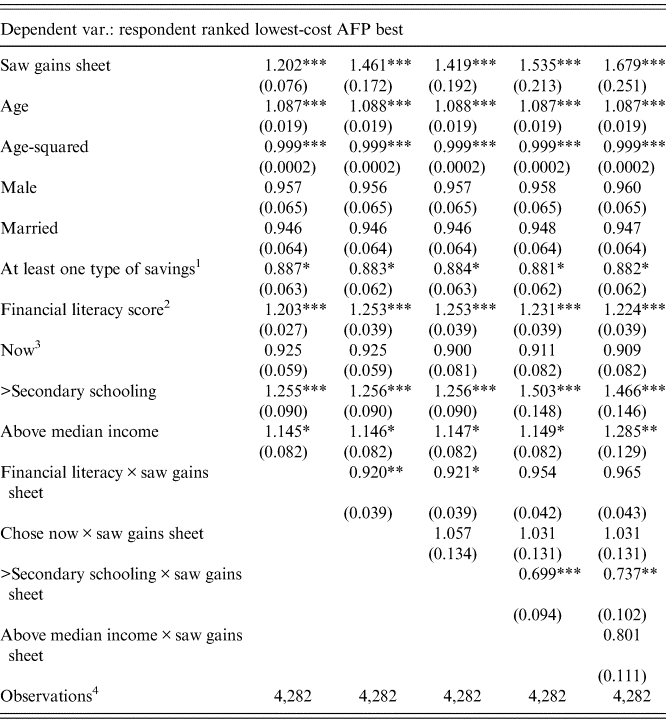
We further examine how information framing and other factors affect fund choice by testing for interaction effects of framing and literacy, so we can evaluate which population subgroups are most sensitive to information framing. Table 9 reports Logit odds ratios from analyses of whether respondents selected their lowest-cost AFPs, as a function of whether they received the Gain or Loss worksheet (controlling on other factors). The first column pools results across respondents given AFP information as either a Gain or a Loss. Here we see that providing the Gain sheet is very powerful, boosting the odds of choosing the most profitable AFP by 26 percentage points. Quantitatively, showing participants a Gain worksheet has an impact as large as the impact of having a post-secondary education and twice as large as the impact of having above-median income. The measured effect is about the same as the impact of a one unit increase in the financial literacy index.
Logit analysis of factors associated with respondent ranking lowest-cost AFP as best (odds ratios reported)

Notes: Standard errors in parentheses. Asterisks indicate significance (*0.10, **0.05, ***0.01).
1 Indicator created from Question D27 in the EPS. Interviewees have savings if they respond they have any of the following: (1) savings for a home (at a bank), (2) AVF savings (housing fund admin.), (3) voluntary pension savings, (4) account two AFP savings, (5) bank savings account, (6) term deposits, (7) mutual fund investments, (8) company shares or bonds, (9) third party loans, (10) other savings (cash, dollars, ‘polla’, etc.).
2 Number of questions answered correctly out of a set of six questions designed to measure financial literacy.
3 Indicator for choosing to receive 5,000 pesos at the time of survey rather than a higher amount later.
4 Observations are only for individuals who have all demographic responses non-missing and are AFP members that received both experiments.
In the second column, we add an interaction between financial literacy and how the information was framed. Now the odds ratio is significant and <1, implying that a one-unit increase in the financial literacy index reduces the impact of information framing by approximately 10 percentage points. Next, we add an interaction between framing and an indicator if the person chose Now in the Game. We do not find a significant impact, as expected. We would expect that choosing Now controlling for financial literacy should not have an impact on how fund information is interpreted across frames, but instead only affect measures of investments as we showed in the prior tables. It is also of interest to ask how framing interacts with both education and income. When we add an interaction for having received a Gain sheet and having post-secondary education, the odds ratio is significantly <1 for the interaction, and the interaction financial literacy and a Gain sheet becomes insignificant. Interestingly, the coefficient on the interaction between information framing and financial literacy is stable across the two specifications. This suggests that financial literacy scores and educational attainment are sufficiently uncorrelated to effectively test their separate influences on the ranking of AFP choices. Our results suggest that education is a stronger determinant of how sensitive respondents are to viewing information in Gains rather than Losses. Lastly, we add yet another interaction term testing for a joint effect of higher income and receiving a gains sheet. Here, the new interaction term is not statistically significant and the reported odds ratio is near 1.
Conclusions and discussion
This paper examines the roles of financial literacy and impatience on retirement saving and investment behavior, using new data we have generated using the Chilean EPS. We measure financial literacy as the ability to understand basic concepts like inflation, compounding, and investment returns, and we measure impatience using a Game designed to elicit preferences for current gratification versus future gain and being able to follow through with it. We find that the impatience measure strongly predicts respondents’ self-reported retirement saving and health investments. Financial literacy is also associated with more retirement saving, but it is less closely associated with sensitivity to framing of investment information. In ongoing work, we are measuring the impact of impatience and financial literacy on actual saving, pension accumulations, and investment in health and health practices.
Our results should interest policymakers seeking to determine how to better shape the environment in which individuals undertake saving and investment choices. Our results imply that it may be useful to facilitate decision making, particularly among the less-educated, as well as to facilitate people committing to and carrying out long-term financial decisions. As individuals are being asked to exert more control over their own retirement accounts (e.g., 401(k)’s) and other household investments, this raises a concern about whether consumers are capable of making optimal investment and saving decisions. Further, the development of ever-more complex financial products makes it difficult for consumers to use these sensibly (Brown et al., Reference Brown, Kapteyn, Luttmer and Mitchell2017). What we have shown is that participant awareness of higher net-return funds can be greatly enhanced when information on fees is simplified in terms of likely gains from selecting higher net return funds. The impact of fund fee framing is largest for the least financially literate and the lowest-educated groups. By contrast, choices made by the financially well-informed tend to be less responsive to the information presentation, since those individuals tend to better understand the financial concepts necessary to translate annual percentage rates into costs and benefits. In the future, a field test of such policies would be the next step towards designing systems that level the playing field across socioeconomic groups and enable participants to commit to take actions now for greater gains later.
Appendix
Example sheets from fee framing experiment
Example 1: Fees framed as a loss versus the AFP with best net returns
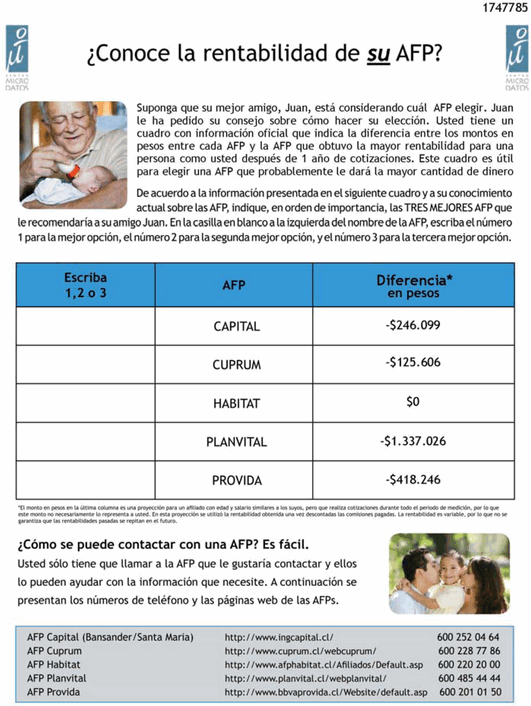
Example 2: Fees framed as a gain in account value