Systemic inflammatory response syndrome is one of the complications after open-heart surgery for CHD.Reference Cavadas, Ribas, Spring, Marcelo and Itiro1 The inflammatory response can be initiated by a number of processes, including blood contact with foreign surface of the cardiopulmonary bypass circuit, development of ischemia reperfusion injury secondary to aortic cross clamping, and presence of endotoxemia.Reference Paparella, Yau and Young2 Almost half of the normal convalescing patients develop fever in the first 24 hours of surgery, which subsides in 48–72 hours in most of patients. During this period, additional studies such as blood count and respiratory secretes or urine culture are rarely justified. But the presence of fever 48 hours after surgery should prompt a diligent search for deep-seated infection.Reference Gupta, Singh and Varma3
Other than fever as a clinical symptom, the search for an objective marker of infection has found that procalcitonin can be useful for predicting sepsis in post-operative cardiac patients after cardiopulmonary bypass usage, especially in those having fever within the first 48 hours. Procalcitonin, which has emerged recently as an early and specific marker for bacterial infection, was elevated in patients after open-heart surgery in the absence of infection.Reference Celebi, Koner and Menda4 Various factors were found to be related to the elevated procalcitonin level, including length of stay in ICU, mechanical ventilation period, aortic cross clamp time, and cardiopulmonary bypass duration.Reference Minami, Ito, Sugiura, Fujita, Sasano and Sobue5 Higher procalcitonin level following open-heart surgery was predictive of major adverse event.Reference Zant, Stocker and Ch6
There are no data available about the comparison of early post-operative procalcitonin level in cyanotic and acyanotic CHD, as well as there is a lack of adequate study about short-term complications of cardiac surgery for acyanotic CHD compared to cyanotic CHD. The mid- and long-term effects of CHD and cardiac surgery, including growth pattern, cognitive function, and cardiac complications (arrhythmia, pericardial effusion, late cardiac death), were found to be better in acyanotic CHD compared to cyanotic CHD. However, there was no difference in quality of life after cardiac surgery between cyanotic and acyanotic CHD.Reference Chowdhury, Hoque, Ali and Hossain7–Reference Weissenfluh, Gahl, Schwerzmann, Carrel and Kadner10
Measuring procalcitonin level in the early post-operative period gives benefits for short-term and long-term complications. Therefore, the study was aimed not only to evaluate serial levels of procalcitonin in children who underwent open-heart surgery for cyanotic and acyanotic CHD, but also to identify factors associated with the elevated level of procalcitonin.
Material and methods
This study was a prospective cohort study, carried out between January 2017 and December 2017. The setting was Cardiac ICU (CICU), Cipto Mangunkusumo General Hospital, Jakarta, Indonesia. We consecutively enrolled infants and children from 1 month to 14 years of age, who had open-heart surgery and showed fever within 6 hours after surgery. Fever was defined as core temperature >38.5°C or axillary temperature >37.9°C.
The sepsis definition used in this study was based on the International Consensus Conference on Pediatric Sepsis in 2005. It defined sepsis as systemic inflammatory response syndrome in the presence of or as a result of suspected or proven infection. Systemic inflammatory response syndrome criteria had to follow at least two criteria out of four: core temperature >38.5°C or <36°C, tachycardia with mean heart rate >2SD above normal for age, mean respiratory rate >2SD above normal for age, and elevated or depressed leucocyte count for age.
The patients were categorised into cyanotic and acyanotic CHD groups. All patients had serial measurements of procalcitonin level on the 1st, 5th, and 8th day after surgery. Procalcitonin value was measured using Brahms PCT Sensitive Kryptor® (Brahms GmBH, Herigsdorf, Germany) with reference range from 0.02 to 5000 μg/L. Serum procalcitonin concentration of a healthy adult measured with this assay was 0.064 μg/L. Other data including diagnosis, age, body weight, axillary temperature, aortic clamp time, bypass time, duration of mechanical ventilation, and length of stay in CICU were recorded. The risk adjustment for congenital heart surgery-1 score was used to stratify the severity of CHD. Leukocyte and platelet count were also measured.
Differences between groups were evaluated using non-parametric Mann–Whitney U-test. Correlations between variables were evaluated using Spearman correlation. The results were considered statistically significant when p value was <0.05. Data were expressed numerically as mean (minimum–maximum value, standard deviation). The commercial statistical software package used was SPSS 22.0 (IBM Corp, Armonk, New York).
Results
Study population
In 2017, 470 children underwent open-heart surgery in Cipto Mangunkusumo National General Hospital, and 235 patients used cardiopulmonary bypass. This study included 56 patients who used cardiopulmonary bypass and showed fever within 6 hours after surgery. The patients then were divided into two groups: those who had surgery for cyanotic CHD (29 patients) and those who had surgery for acyanotic CHD (27 patients). The most common procedure for cyanotic CHD was total correction for tetralogy of Fallot (15 patients, 51.7%). Other procedures for cyanotic CHD were repair for total anomalous pulmonary vein drainage, truncus arteriosus, and arterial switch. Meanwhile, ventricular septal defect closure was the most common procedure for acyanotic CHD (19 patients, 70.3%).
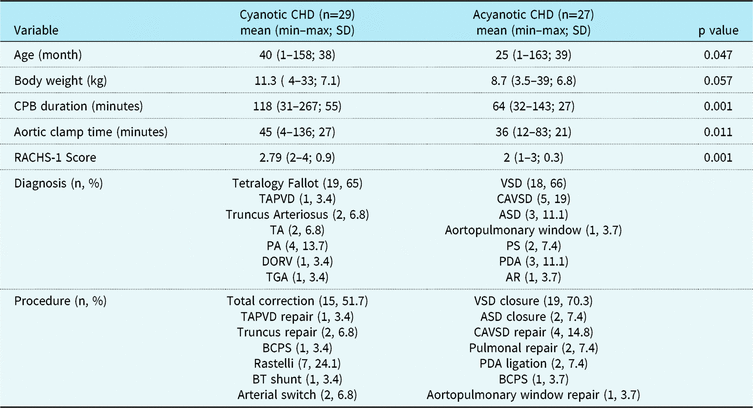
In cyanotic group, mean age was 40 months, and mean body weight was 11.3 kg. In acyanotic group, mean age was 25 months, and mean body weight was 8.7 kg. There were significant differences observed in cardiopulmonary bypass duration, aortic clamp time, and risk adjustment for congenital heart surgery-1 score between cyanotic and acyanotic group as shown in Table 1.
Characteristic of study population.

AR=aortic regurgitation; BCPS=bi-directional Cavo-pulmonary shunt (Glen procedure); BT=Blalock-Taussig; CAVSD=complete atrioventricular septal defect; CHD=congenital heart disease; CPB=cardio pulmonary bypass; DORV=double outlet right ventricle; min=minimal; max=maximal; PA=pulmonary atresia; PDA=patent ductus arteriosus; PS=pulmonary stenosis; RACHS-1 : Risk Adjustment for Congenital Heart Surgery-1; SD=standard deviation; TA=tricuspid atresia; TAPVD=total anomalous pulmonary venous drainage; TGA=transposition of great arteries; ToF=Tetralogy of Fallot; VSD=ventricular septal defect.
Clinical data trend
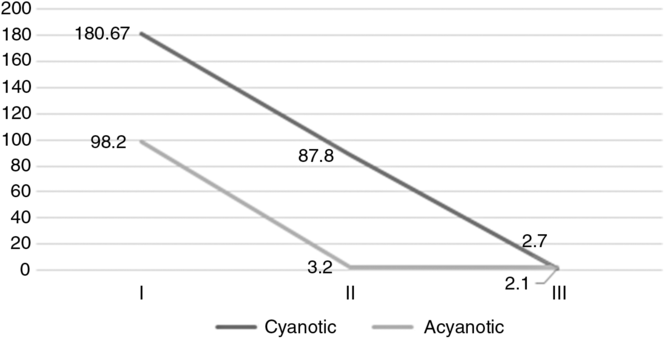
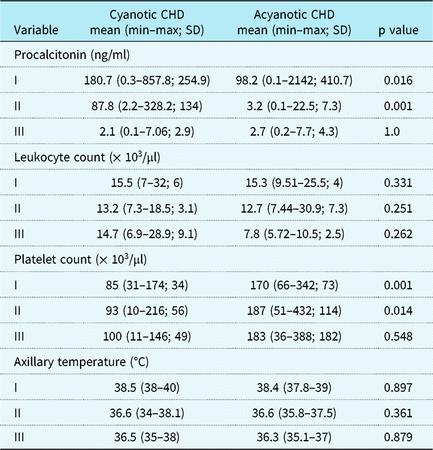
The measurements of procalcitonin level were done on the 1st day after surgery, with measurement of white blood cell and platelet count at the same time. The mean body temperature in the 1st day after surgery was 38.4°C in cyanotic group and 38.5°C in acyanotic group. Both groups showed no significant differences. The highest mean of procalcitonin level was found on the 1st day after surgery, with procalcitonin value in cyanotic group (180.7 ng/ml) near twofold increase compared to acyanotic group (98.2 ng/ml) and p = 0.016. These differences were found to be significant. Procalcitonin level tended to decrease on the 5th day after surgery, at which the fever had subsided. In the cyanotic group, mean procalcitonin level was still in high level (87.8 ng/ml) compared to acyanotic group (3.2 ng/ml). In the third measurement on the 8th day after surgery, the procalcitonin level between the two groups did not differ significantly, as cyanotic group had mean level of procalcitonin at 2.1 ng/ml and acyanotic group had mean level of procalcitonin at 2.7 ng/ml (Fig 1).
Procalcitonin trend.

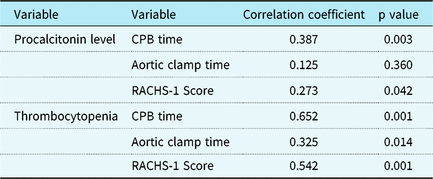
The result of leukocyte and platelet serial measurement fluctuated. In all serial measurements, leukocyte count of cyanotic group was within normal reference (from 15.6 to 14.8 × 10³/μl) for paediatric, while their platelet level tended to increase (range from 85 to 100 × 103/μl). However, acyanotic group had their leukocyte count (from 15.3 to 7.8 × 10³/μl) and platelet count (from 170 to 183 × 103/μl) within normal range. Despite these differences, statistically significant result could only be found in the first two measurements of platelet count (Table 2). Positive significant correlation was found between procalcitonin value and bypass time (p = 0.003), meanwhile platelet count was negatively correlated to bypass time and aortic clamp time (p = 0.001 and p = 0.014) (Table 3). Risk adjustment for congenital heart surgery-1 score was unexpectedly correlated to procalcitonin level and thrombocytopenia (p = 0.042 and p < 0.001).
Clinical data trend of procalcitonin level, leukocyte count, platelet count, and body temperature.

I = 1st day after surgery; II = 5th day after surgery; III = 8th day after surgery; CHD = congenital heart disease; min = minimal; max = maximal; SD = standard deviation.
Correlation between statistically significant variables.

CPB = cardio-pulmonary bypass; RACHS-1 = Risk Adjustment for Congenital Heart Surgery.
Blood and sputum bacterial culture
All patients were given prophylactic intravenous cefazolin 30 minutes prior to skin incision and continued until mediastinal tube drain was removed. Empiric antibiotics were given in all patients soon after they showed clinical symptom of sepsis and after blood and sputum culture had been taken. In our patients, the two most frequent antibiotic classes used were cephalosporin and carbapenem.
All patients had blood and sputum culture. However, only 33 blood specimens and 31 sputum specimens were representative for further examinations. This was due to lack of specimen volume. The sputum culture was taken from tracheal aspirate and considered representative if it had leucocyte count of more than 10 leukocytes per field. They were sent for culture on the second day after surgery. No bacterial growth was observed on the blood specimen, but sputum culture showed bacterial growth on 19 specimens. Bacterial growth on any specimen was considered as positive culture result, and thus in this study 29.6% of culture specimens showed positive result (10 in cyanotic and 9 in acyanotic).
As shown in Table 4, both groups with positive culture result had elevated procalcitonin level though they were not significantly different. However, the patients with negative culture result had statistically significant higher procalcitonin level in cyanotic group compared to acyanotic group (p = 0.003). The most common bacterial findings were Pseudomonas aeruginosa and Klebsiella pneumonia (35%). This was consistent with the sensitivity test study in our hospital which showed that the most common gram-negative bacterial cultures were Pseudomonas aeruginosa and Klebsiella pneumonia. Reference Mansjoer11
Procalcitonin value in culture result.

CHD = congenital heart disease; min = minimal; max = maximal; SD = standard deviation.
Patient outcome
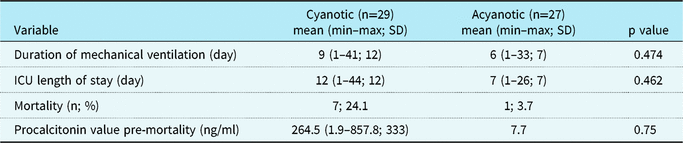
Both groups had their fever improved on the third day. Cyanotic group had longer duration of mechanical ventilation and length of stay in CICU compared to acyanotic group. Both indicators showed no significant differences between the two groups (Table 5). Total mortality rate in this study was eight: seven patients in cyanotic group with mean procalcitonin value at 264.5 ng/ml and one subject in acyanotic group with mean procalcitonin value at 7.7 ng/ml. Despite the distant procalcitonin value gap, it was not statistically significant.
Patient outcome.

CHD = congenital heart disease; min = minimal; max = maximal; SD = standard deviation.
Discussion
Over the past years, several studies have been published to assess the diagnostic value of procalcitonin after open-heart surgery in children. Procalcitonin, a well-known marker for predicting bacterial infection, is present in a higher level than normal in patients undergoing cardiac surgery with cardiopulmonary bypass. In a previous study involving adults and children post cardiac surgery using cardiopulmonary bypass, the cut-off point to discriminate the presence of infection ranges from 1 to 5 ng/ml, and the trends do not return to normal within the first week.Reference Sponholz, Sakr, Reinhart and Brunkhorst12 This cut-off is important for physician to assess whether the patient needs to be treated with antibiotic or not.
Yet, to our knowledge, none of those studies had compared the procalcitonin value based on diagnosis. In this study we tried to observe the difference in procalcitonin level and trend between cyanotic and acyanotic heart disease. In our subject, we observed the elevated level of procalcitonin in both cyanotic and acyanotic CHD. This finding probably indicated the presence of infection rather than the effect of cardiopulmonary bypass usage. The first measurement revealed that procalcitonin level in cyanotic group was almost twice the level of acyanotic group. Then in the next measurement, of which the fever had already subsided, mean procalcitonin level was high only in cyanotic CHD group.
Higher level of procalcitonin in cyanotic heart disease may be related to its susceptibility to ischemic reperfusion injury compared to acyanotic CHD.Reference Modi, Imura and Caputo13 When surgery is performed on cyanotic infants, cardiopulmonary bypass is usually initiated at high oxygen pressure before ischemic cardioplegic arrest.Reference Morita14 During this hyperoxic period, the depleted endogenous antioxidant reserve in myocard worsened due to generation of reactive oxygen species.Reference Morita14 The following period of hypoxia (ischemic) and reoxygenation (reperfusion) interferes the homeostasis inside cardiomyocytes and endothelial cell lining. The increase in vascular permeability, disturbance of ion channel, and production of vasoactive substance such as nitric oxide result in an increased level of free radicals and activation of inflammatory response.Reference Turer and Hill15,Reference Meng, Yiang and Liao16
In this study, significant longer cardiopulmonary bypass duration and aortic clamp time along with higher risk adjustment for congenital heart surgery-1 score were observed in cyanotic group. Thus, we tried to correlate these variables with significant clinical marker trend, which consisted of procalcitonin level and thrombocytopenia. All variables showed significant correlation except for procalcitonin and aortic clamp time (p = 0.360). These results might be different from the previous studies that found that aortic clamp time was associated with elevated procalcitonin.Reference Minami, Ito, Sugiura, Fujita, Sasano and Sobue5,Reference Zant, Stocker and Ch6 Both cardiopulmonary bypass and aorta cross clamping can induce myocardial hypoxia and ischemia, which are pro-inflammatory stimuli.Reference Paparella, Yau and Young2
In this study, we unexpectedly observed positive correlation of risk adjustment for congenital heart surgery-1 score to both procalcitonin level and thrombocytopenia. Though risk adjustment for congenital heart surgery-1 score has a good ability to predict surgical outcome, the analysis of mortality requires the study of other associated clinical factors, as well as structural and technological obstacles.Reference Torres, Bezerra and Maria17
Other than procalcitonin, this study also observed the trend of leukocyte and platelet as systemic inflammatory response markers. Both groups had normal value of leukocyte count, but their platelet count was different. Cyanotic group had thrombocytopenia, while acyanotic group had normal count. It is clear that the use of cardiopulmonary bypass can induce leukocyte activation, mainly monocyte and neutrophil, which cause elevated level of leukocyte.Reference Day and Taylor18 But a paediatric patient has different normal range of leukocyte from that of an adult;Reference Goldstein, Giroir and Randolph19 thus leukocyte count alone may not be sufficient to diagnose systemic inflammatory response.
Low thrombocyte count was correlated positively to cardiopulmonary bypass duration and aortic clamp time. The depletion of platelet following cardiopulmonary bypass use is caused by mechanical disruption and adhesion to the extracorporeal circuit along with sequestration in organ.Reference Day and Taylor18 Moreover, interaction between platelet and activated leukocytes allows platelet to be involved in inflammatory reaction and amplifies the effect of reperfusion injury.Reference Paparella, Yau and Young2 Meanwhile, in sepsis, peripheral platelet destruction by endotoxin resulted in thrombocytopenia.Reference Gupta, Singh and Varma3 Thus, careful judgement is needed to assess systemic inflammatory response.
Besides response markers, we also obtained positive culture results on 29.6% specimens and statistically significant differences of procalcitonin level in negative culture result. These findings might be caused by false negative of the culture result. In our cases, blood sample was taken at one site instead of three different sites due to the vessel collapse in sepsis. Moreover, culture yields positive result in only about 40–60% of cases because of sampling error, previous antimicrobial treatment, or the presence of fastidious or slow-growing pathogen.Reference Lever and Mackenzie20,Reference Prost, Razazi and Brun-buisson21 However, in clinical settings, severity of illness and mortality are not significantly affected by microbiological documentation in sepsis.Reference Lever and Mackenzie20 Moreover, a recent study has found higher level of procalcitonin in patient with infection confirmed by positive culture in any specimen.Reference Chakravarti, Reformina, Lee, Malhotra, Mosca and Bhatla22
Result from cultures usually takes at least 24 hours to become available, and half cases may be false negative; thus early broad-spectrum antibacterial agents are recommended.Reference Lever and Mackenzie20 Based on antibiotic sensitivity pattern test in our hospital, Pseudomonas aeruginosa was 100% sensitive to levofloxacin and cefepime, while Klebsiella pneumonia was sensitive to meropenem (95%) and levofloxacin (94%).Reference Mansjoer11
Procalcitonin level was found to be a good predictor for major adverse event, including organ failure and mortality.Reference Celebi, Koner and Menda4 Procalcitonin level was also positively correlated with duration of mechanical ventilation and length of stay in ICU.Reference Celebi, Koner and Menda4–Reference Zant, Stocker and Ch6 In our study, the differences between the two groups for intubation time and length of stay in CICU were not considered as significant. Therefore, these findings could not support the previously stated studies’ results. We also observed the distant gap in pre-mortality procalcitonin value between cyanotic and acyanotic groups. Though the value was not considered as statistically significant because of limited data, they might be clinically significant. This was in line with another study which used peak procalcitonin level of 5 ng/ml to predict mortality with sensitivity 100% and specificity 65%.Reference Celebi, Koner and Menda4
Conclusion
Post-operative fever in paediatric cardiac patients while fairly common can be quite challenging. The approach needs to be judicious in choosing the timing of when to intervene and also establish a well-defined process to investigate fever. Conventional markers such as leukocyte and platelet count may not be sufficient in identifying systemic inflammatory response. Meanwhile, serial measurement of procalcitonin may be helpful to differentiate fever aetiology after open-heart surgery for CHD. Comparison of the procalcitonin trend between cyanotic and acyanotic CHD group after cardiac surgery and their correlation with poor adverse outcome needs to be further evaluated in future studies.
Study limitation
This study was limited because we did not measure procalcitonin value in the control group, that is, patients who underwent operation with cardiopulmonary bypass and had no clinical sign of sepsis, because of the limited number of patients.
Acknowledgements
None.
Financial support
This research received no specific grant from any funding agency, commercial, or not-for-profit sectors.
Conflict of interest
None.