Introduction
Caring for an older, disabled relative, particularly one with cognitive or mental health problems, may have adverse effects on the caregiver's own physical and mental health (Zarit and Femia, Reference Zarit and Femia2008). Moreover, the demands on the caregiver change over time and the ability to manage the situations varies according to the different contexts and situations.
Caring does not imply burden as an unavoidable consequence, but where present, the experience of burden in caregiving is very complex. In this study we focus our attention on two models of “caregiver burden”: Pearlin et al. (Reference Pearlin1990) and Sorensen et al. (Reference Sorensen, Duberstein, Gill and Pinquart2006). These models assess many facets of burden and, according to them, caregiver burden may fall into four categories – psychological, physical, financial and social – each with distinct outcome measures. To better understand the degree of the strain experienced by caregivers and to compare results from different studies, instruments that assess caregiver burden are needed, and in the past thirty years many instruments have been developed to evaluate this dimension. These instruments have been developed for different contexts, e.g. disability, dementia or cancer, and investigate many different domains of caregiving burden in caregivers of dementia patients.
The Zarit Burden Interview (ZBI; Zarit et al., Reference Zarit, Reever and Bach-Peterson1980; Zarit and Zarit, Reference Zarit and Zarit1987) was specifically designed for the assessment of subjective burden of caregivers and it is widely used to assess burden associated with functional and/or behavioral impairments and home care context. Using commonly agreed measures can facilitate collaboration between sites serving constituents with multiple cultural backgrounds (Mittelman, Reference Mittelman2008) and among two important selections of realistic and complete outcome measures for caregiver intervention (Brodaty et al., Reference Brodaty2002; Moniz-Cook et al., Reference Moniz-Cook2008) we find the ZBI, recognized as the most widely used instrument for assessing family carer burden (Moniz-Cook et al., Reference Moniz-Cook2008) and judged as a recommended measure of psychological outcome in caregiving (Brodaty et al., Reference Brodaty2002). The ZBI has been translated into many languages – Spanish, French, Japanese, Korean, Chinese, Portuguese, German, Hebrew, Hindi, Turkish and Swedish – and has been adopted for assessing caregiver burden in many different patient populations, for example dementia, cancer populations, psychiatric illness, multiple sclerosis, stroke, Parkinson's disease and chronic obstructive pulmonary disease. The ZBI is also used with different aims: for example, assessing the outcomes of interventions with patients and/or caregivers, pharmacological or not; assessing service quality; and observing cultural differences in caregiver burden. Currently, an Italian validation of the ZBI is not available and the present study therefore aims to validate the Italian version of the 22-item ZBI (I-ZBI), evaluating its reliability, calculating its internal consistency and concurrent validity, and exploring its factorial structure.
Methods
Sample and setting
The research was conducted on a sample of 273 voluntary caregivers related to consecutively attending outpatients with a previously established primary diagnosis of dementia, which we classified as Alzheimer's disease (AD) or “other types”, according to DSM-IV criteria. To be included in the study, the patient had to have a primary diagnosis of dementia and the relative had to be the principal caregiver. The sample was thus drawn from family caregivers of elderly outpatients who had a previous diagnosis of dementia and were accompanying the patients for follow-up in two health practices: the Local Health Agency of Modena and the Local Health Agency of Pescara. The caregiver was approached separately from his/her relative by trained research assistants, all of them mental health professionals (psychologists and psychogeriatricians). Exclusion criteria for caregivers were significant cognitive impairment or severe mental illness (acute state), according to the clinical judgment of the research assistant. However, no approached caregiver was excluded due to these criteria in this sample. Assessments were obtained at the outpatient clinics and subjects participated as volunteers.
Measurements and instruments
Sociodemographic data of patients and caregivers were obtained from semi-structured interviews administered face-to-face by the interviewer. Educational level was determined according to the Italian education system: primary school (five years); secondary school (three years); high school (five years), university (from four to six years). Clinical and functional assessment of dementia at the time of the study was made using the Italian version of the Mini-mental State Examination (MMSE; Measso et al., Reference Measso1993) for cognitive status, and Activities of Daily Living (ADL; Katz et al., Reference Katz1963) and Instrumental Activities of Daily Living (IADL; Lawton and Brody, Reference Lawton and Brody1969) for functional status. In particular, the ADL scale concerns the ability of the patient to conduct six basic ADLs, such as feeding or bathing. Scores range from 0 (patient totally unable to conduct the activities) to 6 (fully able). The IADL scale evaluates the ability to carry out instrumental activities necessary to live independently, e.g. using the telephone, cooking, buying something, with scores ranging from 0 (totally unable to do these activities) to 8 (completely able). Clinical data from the patients were gathered from their medical records and linked to the caregiver interviews. These clinical data were obtained no more than a month before the caregiver's interview, and the patient, when possible, gave his/her consent to use these data.
The ZBI is a 22-item scale derived from a 29-item preliminary version (Zarit et al., Reference Zarit, Reever and Bach-Peterson1980) and can either be self-administered or administered by an interviewer. Questions investigate the impact of the patient's disability on the carer's quality of life, psychological suffering, financial difficulties, shame, guilt and difficulties in social and family relationships using a five-point Likert scale with responses from 0 (never) to 4 (nearly always), with total scores ranging from 0 (burden totally absent) to 88 (maximum level of burden). The authors specify that the ZBI should not be taken as the only indicator of the caregiver's emotional state and that clinical observations and other instruments, such as measures of depression, should be used to supplement this measure. In the original version, norms for the ZBI were not computed and some subsequent studies listed below were conducted in order to establish cut-off scores for this instrument. Some authors developed cut-offs by dividing the total possible score into roughly equal parts (Hébert et al., Reference Hébert, Bravo and Préville2000) and obtained a cut-off value of 21/22, but with this method other samples gave very different cut-off values (Arai and Washio, Reference Arai and Washio1999). The authors of the ZBI later indicated some reference values for assessing caregiver burden in AD (Zarit and Zarit, Reference Zarit and Zarit1987): scores below 20 indicate little or no burden, between 21 and 40 a mild to moderate burden, between 41 and 60 a moderate to severe burden and between 61 and 88 a severe burden). A more recent study conducted on a sample of 206 subjects suggests that a ZBI cut-off score which ranges from 24 to 26 would be useful in identifying caregivers in need of further assessment and intervention (Schreiner et al., Reference Schreiner, Morimoto, Arai and Zarit2006). Although the 22-item version of the ZBI is the most widely used, there is also a 12-item version that suits clinical settings (O'Rourke and Tuokko, Reference O'Rouke and Tuokko2003) as well as other versions (i.e. 18-item, 14-item, 12-item, 8-item and 4-item) that have been used both in dementia care and research.
The psychometric properties of the ZBI are illustrated in Zarit and Zarit (Reference Zarit and Zarit1990). The instrument has been shown to have excellent internal consistency with Cronbach's α ranging between 0.85 and 0.93. Validity has been estimated by the authors by correlating the total score with the Brief Symptom Inventory (r = 0.41) and its subscales. In the original version, two scales were derived from the ZBI using exploratory and confirmatory factor analysis. These factors reflect psychological distress (called “Personal Strain”) and the impact on the carer's life in general (called “Role Strain”). The Italian translation of the Zarit Burden Interview (I-ZBI) was developed by the MAPI Institute of Paris (www.mapi-institute.com) and approved by the authors of the instrument. The linguistic validation process that was adopted comprises seven steps: conceptual definition, forward translation; backward translation, pilot testing, international harmonization, proofreading and report. More details on the methods of linguistic validation are available on the Institute's website. In our study, the caregiver completed the I-ZBI and the other assessments listed below, which were used to validate the construct of interest for this work. These instruments have been chosen because psychological distress and emotional and affective status are dimensions often related to the concept of burden.
The 12-item version of the General Health Questionnaire (GHQ-12; Goldberg and Williams, Reference Goldberg and Williams1988) validated for the Italian population by Bellantuono et al. (Reference Bellantuono, Fiorio, Zanotonelli and Tansella1987) is a self-administered questionnaire that explores the presence of four distress elements: depression, anxiety, social deterioration and somatic symptoms. GHQ-12 scores can be computed according to several methods: original, Likert and c-GHQ. We used the Likert scoring method (0-1-2-3) in which scores range from 0 to 36, with higher scores indicating higher distress.
The Symptom Checklist-90-Revised (SCL-90-R; Derogatis et al., 1977) is a 90-item, self-report inventory which measures the current psychological symptom status. The SCL-90-R was introduced as a measure of nine primary symptom dimensions: somatization, obsessive-compulsive, interpersonal sensitivity, depression, anxiety, hostility, phobic anxiety, paranoid ideation and, added later, sleep disturbance. A general index for the psychological symptoms is also calculated: higher scores for this index mean higher psychological symptoms. The Hospital Anxiety and Depression Scale (HADS; Zigmond and Snaith, Reference Zigmond and Snaith1983) is a widely used instrument designed as a brief assessment tool for the distinct dimensions of anxiety and depression in non-psychiatric populations. The HADS is a 14-item self-report questionnaire that consists of two subscales of seven items designed to measure levels of both anxiety and depression. The ease, speed and patient acceptability of the HADS has resulted in it being applied to a wide variety of clinical populations where significant anxiety and depression may be present. A higher score means a higher probability of developing anxiety or depression disturbance. The Italian version of the instrument has been validated by Costantini et al. (Reference Costantini1999). All measures were administered at one time point in random order.
Ethical approval
The Local Ethics Committee approved the research protocol. Written informed consent was obtained from each caregiver and, whenever clinically possible, from the patient.
Data analysis
The Statistical Package for the Social Sciences (SPSS) version 17.0 was used for data analysis. Descriptive statistics were calculated on the characteristics of the sample and are presented as frequencies and percentages for categorical data and as mean and standard deviation (SD) for continuous variables. Sociodemographic data were unknown for some patients. A 95% confidence interval for the mean value was calculated whenever appropriate. One-way ANOVAs and t-tests were performed to compare the I-ZBI with caregivers’ demographic data. An item analysis based on the correlation among the variables composing the set was measured by Cronbach's α and the split half correlation. Cronbach's α coefficient estimates internal consistency based on average correlation among items: the α coefficient should be at least 0.70 to demonstrate internal consistency. Split half correlation is a correlation coefficient calculated between scores on two halves of the test and even in this case a high value (>0.70) means good reliability. Inter-rater reliability was not computed because the I-ZBI is a self-administered tool. Item-total correlations were performed to check whether any item was inconsistent with the rest of the scale, and Spearman correlations between the I-ZBI and GHQ, ZBI and HADS, I-ZBI and SCL-90-R were assessed for construct validity. An Exploratory Factor Analysis with the principal component method was used to detect the factorial structure in observed measurements. The Bartlett Test of Sphericity and the Kaiser-Meyer-Olkin Test (KMO) were used to evaluate the adequacy of the sample: the KMO-test ranges from 0 to 1 and is acceptable if it is higher than 0.5; if the Bartlett test has a very low significance (p < 0.05) the factorial model is good. A significance level of α = 5% was chosen.
Results
Characteristics of the sample
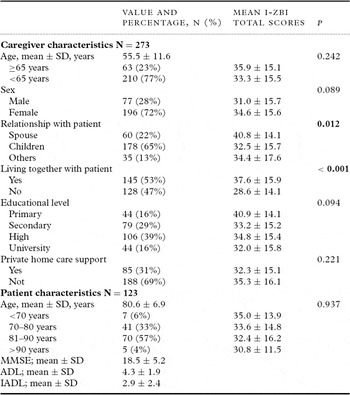
Characteristics of the sample are shown in Table 1. For this study, 273 carers of patients with dementia were recruited. Of these carers, 196 were women (72%), and the mean age was 55.5 years (SD = 11.6), ranging from 30 to 86 years of age. The majority were sons or daughters (65%), living in the same house as the elder (53%) and without private home care support (69%). The carer's educational level was equally distributed among the sample, with the majority having a high school education (39%). Sociodemographic data were known for only 123 patients with dementia. Their mean age was 80.6 years (SD = 6.9); MMSE, ADL and IADL had mean values respectively of 18.5 (SD = 5.2), 4.3 (SD = 1.9) and 2.9 (SD = 2.4). The mean I-ZBI total score was 33.4 (SD = 15.9). The mean I-ZBI scores in the carer's subgroups are shown in Table 1. There were no significant differences in the caregivers’ sociodemographic subgroups of characteristics for the mean I-ZBI total score, except for two characteristics “relationship with patient” and “living with patient”, with significant highest I-ZBI total scores for “spouses” and “living together”.
Demographic characteristics and I-ZBI scores of caregivers of patients with dementia

MMSE = Mini-mental State Examination; ADL = instrumental activities of daily living; ADL = activities of daily living.
Reliability and validity
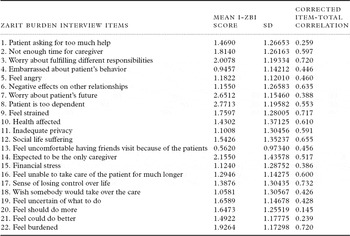
For the reliability analysis, Cronbach's α was 0.90 and the split-half correlation coefficient was 0.78. The mean scores of the individual items in the I-ZBI ranged from 0.56 (item 13) to 2.77 (item 8) (Table 2). The highest inter-item correlation coefficient (0.643) was found between items 3 and 22 and the lowest (−0.006) between items 3 and 20. Item-total (corrected) correlation showed positive correlation (>0.38) for all items except for items 1, 20 and 21.
Mean scores for items and item-total (corrected) correlation reliability of I-ZBI

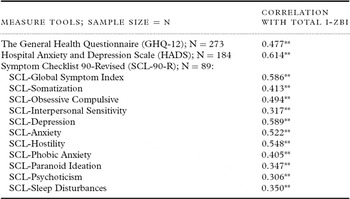
Spearman's correlation (rs) showed that there was a significant positive correlation between the total I-ZBI and GHQ-12 (rs = 0.477, p < 0.01) and between the two I-ZBI subscales and GHQ-12 scores, respectively: Personal Strain and GHQ-12 (rs = 0.435, p < 0.01), Role Strain and GHQ-12 (rs = 0.423, p < 0.01) (Table 3). All 273 subjects completed GHQ-12, with a mean score of 13.1 (SD = 6.4). Two subgroups of caregivers completed the other assessment tools – the HADS and SCL-90-R. The choice of instruments was made by the participating centers on the basis of their needs for timing and internal organization. Sample sizes are indicated in Table 3. The HADS was completed by a subgroup of 184 subjects and significant positive correlation was found between total I-ZBI score and total HADS score (rs = 0.614, p < 0.01). Furthermore, there was a significant positive correlation between the I-ZBI total and subscales and the scores of anxiety and depression of the HADS, respectively: total I-ZBI and HADS-Anxiety, rs = 0.584, p < 0.01; total I-ZBI and HADS-Depression, rs = 0.572, p < 0.01. The mean total score of HADS was 14.6 (SD = 8.2). The SCL-90-R was completed by a subgroup of 89 carers and, even for this sample, significant and positive correlation was found between the total I-ZBI and Global SCL-90-R (rs = 0.586, p < 0.01) and between all SCL-90-R subscales and I-ZBI total and subscales (Table 3).
Correlation of I-ZBI with other assessment tools

**p < 0.01.
Factor analysis
Exploratory factor analysis on the I-ZBI was performed based on the principal component method with a varimax rotation, to detect the factor structure in the observed variables. The Bartlett Test of Sphericity was statistically significant (χ2 = 2301, df = 231, p < 0.001) and the Kaiser-Meyer-Olkin measure of sample adequacy was 0.913. These results provide an excellent justification for the factor analysis. From the exploratory factor analysis five factors comprising all 22 items were extracted with eigenvalues higher than 1.00 accounting for 60% of the total item variance. Ten items (2, 3, 6, 8, 9, 10, 11, 12, 14 and 22) loaded on the first factor accounting for 35% of the total variance in the matrix. The second factor (items 16, 17, 18) accounted for the 9% of the variance; the third (items 4, 5, 13) accounted for 5% of the variance; the fourth factor (items 7, 19, 20, 21) accounted for 5% of the variance; and the fifth (items 1, 15) accounted for 5% of variance.
Discussion
Results of the study indicate that the I-ZBI has satisfactory internal consistency (Cronbach's α = 0.90 and split-half correlation coefficient = 0.78). With regard to inter-item correlation, carers’ worry about fulfilling all responsibilities is highly correlated with a general feeling of burden but there was a low correlation with the feeling that they should be doing more, suggesting that, in this sample, there was a perception of heavy responsibilities in carers who try to do their best. The total mean score of the I-ZBI from our study was 33.40, a little higher than the 31.0 reported by Zarit and Zarit (Reference Zarit, Reever and Bach-Peterson1980) and by other authors (Hébert et al., Reference Hébert, Bravo and Préville2000) in a similar population of caregivers of persons with dementia and considerably higher than the mean total scores of the Asian countries, e.g. the Chinese and Japanese versions. This might indicate that, in our group, relatively higher levels of perceived stress resulted from caring for patients with dementia. However, this does not translate directly to a poorer caregiving situation or to a lower ability to resist caregiver strain among Italians carers compared with carers from other countries because background ethnicity and cultural values may play an important role in psychiatric responses to stress. Moreover, comparisons cannot be made by simply looking at I-ZBI mean scores because different studies had different numbers of subjects and different demographic and social characteristics in the samples, which could significantly influence the caregiving process. A total mean I-ZBI score of 33.40 places our caregivers with a mild-to-moderate burden according to Zarit and Zarit (Reference Zarit and Zarit1987), or even in need of further assessment for intervention (Schreiner, Reference Schreiner, Morimoto, Arai and Zarit2006).
There were no significant differences in the subjects’ sociodemographic subgroups of characteristics for the mean I-ZBI total score, except for two characteristics – “relationship with patient” and “living with patient” – with significant highest I-ZBI total scores for spouses and for situation of living together with the patient. In our sample, spouses themselves are cohabitant with the patients much more than children. Spouses have a level of burden significantly higher, while children have a level of burden lower than other caregivers, which may be due to the fact that spouses are elderly too. It is known that the burden of caring for an older disabled people can be heavy from many points of view – physical, material and affective – and an elderly spouse does not have enough resources to deal adequately with these situations. For similar reasons, the burden of caring for an old person affected by dementia can be heavier in a situation of co-habitation because, especially where the care recipient exhibits behavioral disturbances, the carer lives with this, day and the night, without respite. These issues were not explored in this study and other studies in the future could investigate these factors.
Item analysis showed high scores for items such as “I feel the patient is too dependent” and “I worry about the patient's future”, which is comparable with the results from Zarit et al. (Reference Zarit, Reever and Bach-Peterson1980). It is understandable that caregivers of patients with relatively mild or moderate dementia felt uncertain about the progression and exacerbation of the disease. Other high scores are noted for items such as “I worry about fulfilling different responsibilities” and “I am expected to be the only caregiver”. In this sample, a large majority of the carers were adult children, often juggling different family roles, and they commonly felt guilty about not fulfilling a particular role properly and felt trapped. Stress caused by caring for the patient while trying to meet different responsibilities is common. The positive and significant correlations between I-ZBI and GHQ-12, ZBI and HADS and between I-ZBI and SCL-90-R supported the convergent validity of the I-ZBI. In particular, the highest positive correlation was found between level of burden and screening for anxiety and depression. These data highlight the importance of considering the affective status of carers when high levels of burden are present because they put them at risk for psychological morbidity. Indeed, studies have shown high rates of anxiety and depressive symptoms in family caregivers of persons with AD (Mahoney et al., Reference Mahoney, Regan, Katona and Livingston2005).
Item-analysis showed that among the 22 items of the I-ZBI, three were not very highly correlated with the total score (Table 2), indicating a weak or absent association with the construct. They should be considered for modification or omitted if additional investigations confirm this finding. Recently, using assessment with factor analyses and item-total correlations, several shorter versions of the ZBI have been developed and compared with the full version and the fact of reducing the number of items only minimally influenced the measurement properties of the ZBI (O'Rourke and Tuokko, Reference O'Rouke and Tuokko2003; Kumamoto and Arai, Reference Kumamoto and Arai2004).
Regarding the factorial structure of the instrument, some studies (Knight et al., Reference Knight, Fox and Chou2000; Siegert et al. Reference Siegert, Jackson, Tennant and Turner-Stokes2010) investigated how many dimensions underpin the construct of burden as measured by the ZBI and this issue has been addressed using both exploratory and confirmatory factor analysis in the context of dementia. Although the ZBI has often been identified as a one-dimensional scale (Knight et al., Reference Knight, Fox and Chou2000) the evidence would appear to be mixed. It is widely recognized to have high internal consistency as measured by Cronbach's α, a measurement that is generally interpreted as indicating that the items of a scale measure a single construct. As obtained by others authors (Knight et al., Reference Knight, Fox and Chou2000; Ankri et al., Reference Ankri, Andrieu, Beaufils, Grand and Henrad2005), the factorial structure seems to be composed of more than two factors. Part of this confusion might derive from the fact that different authors have used different factor analytical methods or have included different subsets of the 22 ZBI items. These studies are summarized in Siegert et al. (Reference Siegert, Jackson, Tennant and Turner-Stokes2010). In our study, knowing that eigenvalues have the tendency to generate a maximal number of factors, five factors were obtained by analyzing all of the 22 items of the I-ZBI. Some authors (Knight et al., Reference Knight, Fox and Chou2000), following Zarit and Zarit (Reference Zarit and Zarit1990), undertook factor analysis by deleting the 22nd item because of its global nature and because it is known to correlate highly with all other items, but even so, a five-factor solution is obtained with our sample. The first factor accounts for the majority of the variance and has the majority of the items loading on to it, followed by the second factor. Even if this instrument shows a high internal consistency it seems to have a multi-factorial structure. The reports of high internal consistency and multiple subfactors are not necessarily contradictory, because psychometric theory shows that a multi-factorial scale can achieve high α levels if the items are evenly apportioned across the subscales. It is possible that the I-ZBI shows five factors because in our sample some items are not well related to the entire pattern of the interview, in particular items 1, 20, and 21, which have low item-total correlation and load on the fourth and the fifth factors. Maybe these items in the I-ZBI are not well related to the others and this aspect could be explored in future studies. Several items in the ZBI seem to represent specific aspects of burden not measured by other items. It can be argued that complex constructs may need to be captured by measurement instruments that describe a variety of aspects of the construct, which may not be highly correlated or represent a unified conceptual dimension.
The drawback to using the full scale is that burden continues to be a complex concept, which presents methodological and theoretical difficulties.
Conclusions
This study tested the reliability and validity of the Italian version of the Zarit Burden Interview and established that it is valid, reliable and useful for use in future studies, which could lead to a better understanding of carer burden on dementia. Larger studies involving more caregivers and patients with dementia may help to provide a more complete picture of caregiver burden in an Italian population of patients with dementia. Clarifying the structure of the I-ZBI would help to further the understanding of the large body of research using it and would also help to advance the understanding of subjective burden. The subjective burden of carers is high and an approach that includes support for carers to improve their coping skills and provide respite, as well as modifying aspects of the behavior of patients with dementia, will bring better outcomes.
Conflict of interest
None.
Description of authors' roles
R. Chattat and V. Cortesi designed the study. F. Izzicupo, M. L. Del Re, A. Fabbo, C. Sgarbi and E. Bergonzini coordinated data collection. Statistical analysis was carried out by V. Cortesi and R. Chattat. The paper was written by V. Cortesi and reviewed by all other authors.
Acknowledgments
We thank the patients and caregivers who participated in this study.