INTRODUCTION
Understanding a species’ stock structure is considered a central tenet of modern-day fisheries management. While numerous definitions of a ‘stock’ have been proposed, most generally imply that a stock is a self-reproducing population (Waldman, Reference Waldman, Cadrin, Friedland and Waldman2005). Management regimes depend heavily on biological and ecological characteristics which can vary between stocks. Accordingly, understanding the range of a stock is critical, especially where stocks may straddle state or country borders so that legislation introduced by one entity may affect the catch in the jurisdiction of another.
Stock boundaries are often difficult to determine, and as such a variety of methods have been applied to define stock structures, including larval transport models, tagging approaches, comparisons of life history, morphological or meristic characters, genetic approaches and otolith chemical signatures and shape indices (Begg and Waldman, Reference Begg and Waldman1999). The selection of methodology employed to assess stock structure may vary depending on the type of data available, the life history stage being assessed, or the questions being addressed (Begg and Waldman, Reference Begg and Waldman1999).
There are, however, inherent limitations to each of these methodologies, and their effectiveness in identifying stocks can vary across different spatial and temporal scales, and between species. Larval transport models provide little information on connectivity of non-larval life history stages. Tagging approaches can be compromised by short times at liberty of tagged individuals, patterns of fishing effort and poor tag recovery success as it often depends on fishing practices and industry cooperation (Ward and Caton, Reference Ward and Caton1992). In addition it can be difficult to tag deepwater or delicate species (Lester, Reference Lester1990). Analyses of life history parameters typically do not enable classification of individual fish to a specific population owing to the wide natural variability that occurs within life history parameters between individual fish (Begg et al. Reference Begg, Hare and Sheehan1999). Genetic markers are extremely sensitive to the movement of genes between populations, and just one migrant per generation is sufficient to mask differentiation in some genetic markers (Slatkin, Reference Slatkin1987). Furthermore, historical genetic techniques may be unable to identify differences between recently isolated groups, and frequently do not provide information at demographically relevant spatial and temporal scales required for fisheries management and conservation purposes (Botsford et al. Reference Botsford, Brumbaugh, Grimes, Kellner, Largier, O'Farrell, Ralston, Soulanille and Wespestad2009). Analysis of otolith chemistry, which typically relies on differences in environmental conditions, may be unable to differentiate populations within a homogeneous environment (Thresher, Reference Thresher1999). Nevertheless, each of the methods has provided results of value to fisheries managers. For this reason, many recent Australasian studies have used multiple approaches to discriminate between stocks (e.g. Buckworth et al. Reference Buckworth, Newman, Ovenden, Lester and McPherson2007; Welch et al. Reference Welch, Ballagh, Newman, Lester, Moore, van Herwerden, Horne, Allsop, Broderick, Saunders, Stapley and Gribble2010).
The use of parasites as biological tags offers a powerful approach to determining the stock structure of aquatic organisms. Correctly, parasite data provide information on movements, from which stock structure can be inferred (Lester, Reference Lester1990). The principle of the approach is that where the parasite fauna of fish from two samples is the same, those individuals have either grown in a similar environment or share a common history. Where the parasite faunas are different, the history of the fish is different according to the parasite's residence time in or on the fish, with parasites with short residence times providing information on the fish's recent history, and parasites with long residence times providing information on long-term history (Lester and MacKenzie, Reference Lester and MacKenzie2009).
This paper reviews publications from Australasia, East Asia and Pacific Island countries that have used parasites to seek clues about the stock structure of aquatic organisms. Specifically, we focus on coral reef, pelagic, inshore benthic, offshore bentho-pelagic and diadromous fishes, and invertebrates. We also examine some of the statistical techniques that have been applied to parasite data, including their advantages, limitations and assumptions. In this regard the review is not intended to provide an exhaustive description of each statistical method; rather it merely aims to introduce the reader to some of the various approaches that have been applied to parasite data for the purposes of stock identification. For more detailed accounts of the methods described herein the reader is directed to the many books and individual papers dedicated to the subject (e.g. Day and Quinn, Reference Day and Quinn1989; Clarke, Reference Clarke1993; Sokal and Rohlf, Reference Sokal and Rohlf1995; Underwood, Reference Underwood1997; Anderson, Reference Anderson2001). How many of the parasitological findings have been used by managers is difficult to determine because the bases for management decisions are frequently not published. The results of studies carried out by fisheries bodies are presumably incorporated into the knowledge base for management. Projects funded by fisheries agencies generally conclude with a report to the agency which may be taken into account when the next management decisions are made. Studies independent of fisheries bodies may be ignored by managers if they have little knowledge of marine parasites.
CASE STUDIES FROM AUSTRALASIA, EAST ASIA AND PACIFIC ISLAND COUNTRIES
Reef fish
Rohde (Reference Rohde1976) was probably the first in Australasia to propose using parasites to discriminate between fish populations. From studies of Monogenea on the Great Barrier Reef he concluded that different populations of pomacentrids had different parasites and suggested that parasites could be useful as biological markers.
Since then studies have invariably shown that reef fish are strongly site-attached. On the barrier reef of Moorea, French Polynesia, Rigby et al. (Reference Rigby, Holmes, Cribb and Morand1997) found that the numbers of the hemiurid Lecithochirium sp. A and the nematode Spirocamallanus monotaxis had significantly higher prevalences in honeycomb grouper, Epinephelus merra, than on the fringing reef less than 1 km away. The resident times of these parasites in the serranid are unknown. In cooler climes, lifespans of adult hemiurids can be as short as 8 weeks (Margolis and Boyce, Reference Margolis and Boyce1969). Karlsbakk et al. (Reference Karlsbakk, Skajaa and Nylund2003) and Rahimian (Reference Rahimian2007) found that juvenile herring Clupea harengus lost hemiurids within 7–12 weeks. The hemiurid Elytrophallus coiliae disappeared from migrating Japanese grenadier anchovy, Coilia nasus, over a similar time frame (Li et al. Reference Li, Zou, Wu, Song and Wang2012). On the other hand, Scott (Reference Scott1969) estimated the residence time of Lecithobothrium botryophorum in the greater argentine, Argentina silus, was between 6 and 12 months. No estimates are available for the residence time of spirocamallanids, though Spirocamallanus platycephali is readily lost from whiting Sillago maculata brought into captivity (RJGL, Personal observation). The data of Rigby et al. (Reference Rigby, Holmes, Cribb and Morand1997) thus suggest little mixing of E. merra at least over a period of several weeks.
A similar conclusion is drawn from the data of Lo et al. (Reference Lo, Morand and Galzin1999) from the damselfish Stegastes nigricans (Pomacentridae) in the same area. They found much higher numbers of two hemiurids on the fringing reef than on the barrier reef 100–200 metres away, suggesting the pomacentrids had not mixed for at least 2 months.
Vignon et al. (Reference Vignon, Morat, Galzin and Sasal2008) used both parasite fauna and otolith shape to distinguish between bluestripe snapper, Lutjanus kasmira, from three adjoining reef locations, also on Moorea. Though the nine parasites they used, including two copepods, six monogeneans and the nematode Spirocamallanus istiblenni, had unknown residence times in the fish, the parasite data nevertheless suggested that fish did not move continually between the lagoon, the channel and the outer slope, a conclusion supported by otolith shape analysis.
At Heron Island on the Great Barrier Reef, Australia, Grutter (Reference Grutter1998) observed that the thicklip wrasse Hemigymnus melapterus had more of the monopisthocotylean Benedenia sp. on the reef flat than on the slope, despite these habitats being separated by only a few hundred metres. Monopisthocotyleans can last for several months on fish. Kearn (Reference Kearn1990) found that Entobdella soleae lasted up to 6·5 months on common sole Solea solea. Another monopisthocotylean Anoplodiscus cirrusspiralis lasted up to 6 months on snapper, Pagrus auratus (West and Roubal, Reference West and Roubal1998). Thus it appeared that the wrasse remain separate for at least several months.
On the same reef, Spanish flag snapper, Lutjanus carponotatus, were heavily infected by the acanthocephalan Pomphorhynchus heronensis on the reef flat whereas on the reef slope 300 m away the fish were rarely infected (Cribb et al. Reference Cribb, Anderson and Dove2000). Though acanthocephalans are generally considered to have short residence times in fishes (Moller, Reference Moller1976), P. heronensis had its anterior end embedded in the wall of the host intestine and was considered by the authors to be permanently attached. The results indicated that the adult lutjanid moved very little.
These parasite data, together with observations on smaller fish (Adlard and Lester, Reference Adlard and Lester1994), all support the strong site attachment of reef fish. Whether this extends to commercially important reef species is unknown. The stock structures of many large plectropomids and lutjanids are currently considered to be uncertain and spatially complex (Flood et al. Reference Flood, Stobutzki, Andrews, Begg, Fletcher, Gardner, Kemp, Moore, O'Brien, Quinn, Roach, Rowling, Sainsbury, Saunders, Ward and Winning2012), and warrant further research.
Pelagics
Parasitological studies on pelagic fish have revealed stocks that range over much of an ocean and stocks that form a series of sub-populations along adjacent coasts. In the northwest Pacific, Nagasawa et al. (Reference Nagasawa, Imai and Ishida1985) investigated the copepod Pennella sp. on Pacific saury Cololabis saira. While the residence time of the adult pennellid was unknown, adult pennellids on C. saira off northwest USA were thought to survive for around a year, with infection scars persisting longer (Hughes, Reference Hughes1973). Adult females of another pennellid, Lernaeocera branchialis, are thought to survive for 1–1·5 years on haddock Melanogrammus aeglefinus (Kabata, Reference Kabata1958). Using the parasite data, Nagasawa et al. (Reference Nagasawa, Imai and Ishida1985) concluded that C. saira migrated eastwards to the central North Pacific in the spring and returned to the Japanese waters in the autumn. This agreed with genetic studies that suggested Asian and Aleutian sauries constituted a single stock, although as yet there is no international management programme for this species.
Lester et al. (Reference Lester, Barnes and Habib1985) observed 26 types of parasites in skipjack tuna, Katsuwonus pelamis, from the south-western Pacific. Of these, they considered seven ectoparasites and gut lumen dwellers to be ‘temporary’ i.e. they were thought to have short residence times in the fish. Analysis of their abundances identified at least six different communities across the south-western Pacific (Lester et al. Reference Lester, Barnes and Habib1985). This was interpreted as a reflection of the different habitats which the fish had recently occupied rather than an indication of different stocks. Area differences were greatly reduced when data from four ‘permanent’ parasites, including three juvenile anisakids and metacestodes of the trypanorhynch Tentacularia coryphaenae were analysed. The authors concluded there was little evidence for separate stocks in the south-western Pacific. Tagging studies support this finding (Kleiber et al. Reference Kleiber, Argue and Kearney1987) and K. pelamis in the south-western Pacific are now managed as a large single stock by the Western and Central Pacific Fisheries Commission (Wild and Hampton, Reference Wild and Hampton1994).
Though the residence times of the parasites in K. pelamis were largely unknown, Lester et al. (Reference Lester, Barnes and Habib1985) considered the three juvenile anisakids and T. coryphaenae to be ‘permanent’ because dead worms were not found and their number generally increased with host size. Juvenile Anisakis spp. in the body cavity of other fish are thought to survive for at least several years though dead worms have been found in very long-lived fish such as orange roughy, Hoplostethus atlanticus, which may be 50+ years old (Gauldie and Jones, Reference Gauldie and Jones2000). The numbers of trypanorhynch metacestodes are generally positively correlated with fish age (e.g. Lester et al. Reference Lester, Thompson, Moss and Barker2001; Moore et al. Reference Moore, Stapley, Allsop, Newman, Ballagh, Welch and Lester2011, Reference Moore, Welch, Newman and Lester2012a ) suggesting that long survival of metacestodes in fish may be a common phenomenon. One exception is Hepatoxylon trichiuri in albacore, Thunnus alalunga, which may not survive for the life of the fish (Jones, Reference Jones1991).
Lester et al. (Reference Lester, Barnes and Habib1985) considered the didymozoids in K. pelamis to be ‘semi-permanent’ markers because from the literature it appeared that most adult didymozoids had a lifespan of about a year. Neometadidymozoon helicis, a common didymozoid of dusky flathead Platycephalus fuscus in Australia, was lost once a year in the spawning season (Lester, Reference Lester1980) suggesting parasite development was related to host gonad development as proposed by Self et al. (Reference Self, Peters and Davis1963). In Western Australia, Williams et al. (Reference Williams, Moran, Caputi and Walters1993) calculated that the didymozoid Gonapodasmius williamsoni survived for less than a year in snapper P. auratus. In eastern Australia, Zischke et al. (Reference Zischke, Griffiths, Tibbetts and Lester2013) concluded that Nematobothrium spinneri had a lifespan of between 6 and 12 months in wahoo, Acanthocybium solandri. Didymozoids appear to have persisted for longer than a year in Atlantic bluefin tuna Thunnus thynnus in sea cages. After 1·5–2 years the numbers of six common didymozoids had been reduced by two-thirds but many were still present suggesting that if no reinfection occurred in the pens, one-third of the original specimens had survived over 1.5 years (Mladineo et al. Reference Mladineo, Segvic and Petric2011). The longevity of didymozoids in the penned fish may be linked to the absence of spawning in the pens. Live didymozoids have been and will continue to be useful markers for distinguishing degrees of mixing at least over a time period of 6–12 months of a fish's life (Rodríguez-Marín et al. Reference Rodríguez-Marín, Barreiro, Montero and Carbonell2008).
A few didymozoids such as N. spinneri which are deeply embedded in muscle leave scar tissue when they die and the evidence of past infection remains recognizable in the fish for an extended period, possibly for life (Lester, Reference Lester1980). Williams et al. (Reference Williams, Moran, Caputi and Walters1993) estimated that 86% of scars of G. williamsoni persisted from year to year, though they were eventually lost through the skin. Thus signs of past didymozoid infections can last much longer than a year.
Lester et al. (Reference Lester, Barnes and Habib1985) also used didymozoids to delineate schooling patterns of K. pelamis. Their results, based on the occurrences of didymozoids in fish sampled from different schools in New Zealand, suggested that K. pelamis stayed in the same school for weeks though not for life, a conclusion later supported by tagging data (Bayliff, Reference Bayliff1988).
Didymozoids have proven useful for discerning movement patterns and stock structure of T. alalunga among the tropical Pacific and New Zealand waters. Jones (Reference Jones1991) distinguished 10 species (B, C, D, E, G, I, L, R, S and Z). From their abundance he concluded that juvenile T. alalunga moved south from the tropics to New Zealand and returned north with onset of sexual maturity. An increase in parasite prevalence of didymozoids ‘C’, ‘D’, ‘G’ and ‘Z’ seen in the 80–89 and 90–99 cm size classes fitted the hypothesis that the fish, having returned to the tropics to spawn, became re-infected with tropical/sub-tropical didymozoids before returning to temperate waters. In addition, a decline in prevalence and abundance of two other parasites, Anisakis simplex and H. trichiuri, between New Zealand and the central South Pacific and the presence of only dead H. trichiuri in the central South Pacific suggested that fish were moving along the sub-tropical convergence zone, a conclusion supported by tagging and fishery data. The fishery in the South Pacific is now managed as one stock by the Western and Central Pacific Fisheries Commission (Murray, Reference Murray, Shomura, Majkowski and Langi1994).
In a report on the parasites of black marlin, Istiompax indica, Speare (Reference Speare1994) gave detailed consideration of the possible longevities of the observed parasites and thus how reliable they may be in detecting host movement. Four of the eight species of didymozoids and the copepod Pennella instructa were treated as ‘permanent’ parasites because they could be recognized by remnants remaining after their death. His results suggested a southerly movement of large fish which was supported by catch records. He also found evidence that juveniles remained distinct from adults until they were recruited to the parent stock with the onset of sexual maturity at 50 to 80 kg. The fish is considered highly migratory and its stock structure remains unknown (IUCN, 2013).
The sailfish Istiophorus platypterus is widespread and abundant in the Pacific and Indian Oceans though no stocks have been identified (IUCN, 2013). Off the east coast of Australia with a sample of 52 fish, Speare (Reference Speare1995) was able to distinguish northern from southern fish, and find evidence that the two groups came together to spawn in the Whitsundays.
In the Sea of Okhotsk, Avdeev (Reference Avdeev1996) looked at a 1988 year class of Alaskan pollock Theragra chalcogramma when they were 3 years old and again when they were 4. Anisakis simplex were abundant in both years on the western side and rare on the eastern side. Three-year-old fish from the 1989 year class on the western side, however, had a much lower prevalence leading the author to conclude that low-infested fish from the eastern area had migrated into the western area. Considerable movement of fish within the Sea was further suggested by gradients in two anisakids and two diphyllobothriids (Avdeev, Reference Avdeev1996).
The same fish species was investigated by Konishi and Sakurai (Reference Konishi and Sakurai2002) who compared prevalence and abundance of A. simplex and Contracaecum osculatum from five areas around northern Japan. Their results also suggested considerable homogeneity across the zone apart from two small areas: fish from the Nemuro Strait (northeast Hokkaido) had much higher numbers of C. osculatum than fish from other areas, and southwest Hokkaido fish (Kumaishi) had significantly lower parasite levels by age and grew much more slowly than those further north. Thus there did appear to be at least two groups around Hokkaido that mix little with fish from the other areas sampled. In addition, a small sample (13 fish) of large fish from Eastern Hokkaido contained significantly fewer A. simplex than fish from other areas, suggesting the fish had moved in from a lightly infected but unsampled area.
Sewell and Lester (Reference Sewell and Lester1995) examined parasites in 763 gemfish Rexea solandri around southern Australia and concluded there were two stocks: one restricted to the Great Australian Bight and the other from southern and eastern Australia. Though a meristic study was unable to differentiate any stocks, biochemical genetics indicated two stocks, though in contrast to the parasite analysis the division occurred at the western end of Bass Strait (Colgan and Paxton, Reference Colgan and Paxton1997). The latter division is accepted as the basis for current management under the Commonwealth Government Harvest Strategy Policy (Beeton, Reference Beeton2008).
Jack mackerel or greenback horse mackerel, Trachurus declivis, has been the basis for a seasonal purse-seine fishery off the east coast of Tasmania. The numbers of four parasites, Grillotia angeli, Nybelinia sp., Anisakis type I and encapsulated juveniles of a spirurid, in five samples taken between January and May in 1987 and 1988 were not significantly different using multivariate analysis (Sewell, unpublished data). A sixth sample, taken late in the season (14 May 1987), was significantly different from the others suggesting the fish had come from a different source (Sewell, unpublished data). Its parasite fauna was most similar to a sample taken in November 1988 off the southern coast of NSW (Graham, unpublished data) suggesting the Tasmanian fishery included fish from further north at the end of the season. Smolenski et al. (Reference Smolenski, Ovenden and White1994) found genetic evidence for two distinct groups of jack mackerel off Tasmania and that there was no clear separation of mtDNA haplotypes between the Tasmanian and NSW samples. Trachurus declivis was the dominant small pelagic species off eastern Tasmania but now, following a period of high fishing pressure, it has been replaced with Cape bonnetmouth Emmelichthys nitidus, a change considered consistent with altered zooplankton communities and long-term climate change (McLeod et al. Reference McLeod, Hobday, Lyle and Welsford2012).
Hutson et al. (Reference Hutson, Ernst, Mooney and Whittington2007) observed 43 different species of parasites in yellowtail kingfish, Seriola lalandi, from the east and south coast of Australia and concluded that data on seven shared ectoparasites (Monogenea and Copepoda) supported the idea that S. lalandi in southeastern Australia and New Zealand formed a single stock. Ectoparasites are not usually considered useful indicators of populations but in this case their results closely align with genetic and tagging results which both show that there is exchange in the fish between the two countries (Miller et al. Reference Miller, Fitch, Gardner, Hutson and Mair2011). Hutson et al. (Reference Hutson, Ernst, Mooney and Whittington2007) proposed that the polyopisthocotylean Paramicrocotyloides reticularis and the lernaeopodid copepod Parabrachiella seriolae were the best candidates for population discrimination. The lifespans of these parasites on S. lalandi are unknown. If they remain on the fish for only a short time, finding them on fish in one area may not indicate a long-time resident of the fish as the parasites may be quickly acquired and equally quickly lost. The normal lifespan of the polyopisthocotylean Gastrocotyle trachuri is no longer than one year and possibly less (Llewellyn, Reference Llewellyn1962). Adult female lernaeopodids apparently vary in residence time. Adult Salmincola salmonea possibly survive for up to 2 years (Friend, Reference Friend1940), though most adult female lernaeopodids seem to have lifespans of less than 6 months (e.g. Shotter, Reference Shotter1971; Kabata and Cousins, Reference Kabata and Cousins1973; Hoffman, Reference Hoffman1977; Roubal, Reference Roubal1990). The close agreement of the parasite data of Hutson et al. (Reference Hutson, Ernst, Mooney and Whittington2007) with genetic and tagging results suggests that in this case, unless the infective stages were widely distributed, the parasites used had a residence time in excess of the time required for the fish to mix.
Rohde (Reference Rohde1987) observed that the sclerites, and in particular the hamuli, of the monogenean Kuhnia scombri were larger on blue mackerel, Scomber australasicus, from New Zealand than those from Australia. It is not clear whether this was a genetic or an environmental effect. He concluded that the fish from which the Australian sample was taken were from a different population than the New Zealand fish. In Australia S. australasicus are found mostly inshore and up to the edge of the continental shelf (Kailola et al. Reference Kailola, Williams, Stewart, Reichelt, McNee and Grieve1993) suggesting the likely occurrence of different stocks.
Lester et al. (Reference Lester, Thompson, Moss and Barker2001) used data from parasites to examine the stock structure of Spanish mackerel, Scomberomorus commerson, at widely spaced locations across northern Australia and Indonesia. The abundance of parasites with long residence times in the fish suggested that there was no movement of fish from Australia to Indonesia (Lester et al. Reference Lester, Thompson, Moss and Barker2001) (Fig. 1). This was supported by otolith isotope ratios and even genetic analyses (Buckworth et al. Reference Buckworth, Newman, Ovenden, Lester and McPherson2007). Lester et al. (Reference Lester, Thompson, Moss and Barker2001) also concluded that different stocks occur on the western, northern and eastern coasts of Australia. In a finer scale parasite study Moore et al. (Reference Moore, Buckworth, Moss and Lester2003) recognized six separate stocks across northern Australia. Though no more than three were distinguished by genetic analyses (allozyme frequencies at 10 loci and mtDNA control region sequence data), ratios of carbon 13 and oxygen 18 isotopes in otoliths similarly distinguished a number of spatially discrete adult assemblages, leading Buckworth et al. (Reference Buckworth, Newman, Ovenden, Lester and McPherson2007) to conclude that S. commerson forms a fine-scale mosaic of population units across northern Australia. For management purposes, the fish are managed as if a single stock occurs in each tropical Australian state except for Queensland which distinguishes between East Coast and Gulf of Carpentaria stocks (Flood et al. Reference Flood, Stobutzki, Andrews, Begg, Fletcher, Gardner, Kemp, Moore, O'Brien, Quinn, Roach, Rowling, Sainsbury, Saunders, Ward and Winning2012).
Relative abundances of five ‘permanent’ parasite species among eight areas around Australia and one area from Indonesia (area 6). Parasites from left: Grillotia branchi, Terranova spp., Pterobothrium sp., Callitetrarhynchus gracilis, Anisakis simplex, Otobothrium cysticum. Bar heights represent the abundance of each parasite species relative to the other areas and are independent of other species on the histogram. Only one species counted in areas 3 and 8. (From Lester et al. Reference Lester, Thompson, Moss and Barker2001.)

The stock structure of the congeneric species Scomberomorus semifasciatus was the source of considerable controversy among tourist operators in the north-east of Australia. Charters et al. (Reference Charters, Lester, Buckworth, Newman, Ovenden, Broderick, Kravchuk, Ballagh and Welch2010) sampled widely across northern and eastern Australia, and concluded from the abundances of juveniles of two anisakids and two trypanorhynchs that the species forms at least four distinct stocks along the northern and eastern coastline. This was supported by a genetic study (Broderick et al. Reference Broderick, Ovenden, Buckworth, Newman, Lester and Welch2011). Otolith isotopic analyses indicated an even more complex stock structure suggesting that the spatial scale of management needed to be reviewed (Newman et al. Reference Newman, Wright, Rome, Mackie, Lewis, Buckworth, Ballagh, Garrett, Stapley, Broderick, Ovenden and Welch2010a ).
The scombroid wahoo, A. solandri, is an important recreational fish in the tropics and sub-tropics and also caught as a by-catch in commercial fisheries targeting tuna and billfishes. Zischke et al. (Reference Zischke, Griffiths, Tibbetts and Lester2013) examined the abundances of seven parasites in 304 fish from five sites and concluded that there was probably a single stock in the southwest Pacific which was distinct from fish in the eastern Pacific and the eastern Indian Ocean. Genetic studies did not discriminate between the two sides of the Pacific (Theisen et al. Reference Theisen, Bowen, Lanier and Baldwin2008), though meristic studies suggested that there may be further subdivision in the southwest Pacific (Zischke et al. Reference Zischke, Griffiths, Tibbetts and Lester2013). There is currently no separate management strategy for this species in the western Pacific (WPRFMC, 2009).
Inshore
Analysis of parasite data from inshore fish has revealed unexpected movement generally confirmed by other concurrent or subsequent studies.
Cappo (Reference Cappo1992) used the plerocercoid of the trypanorhynch Callitetrarhynchus speciosus to follow migrations of Australian salmon, Arripis truttaceus, in southern Australia. He found that most young A. truttaceus on the western side of the Spencer Gulf, South Australia, were infected while elsewhere only older fish were infected. These patterns suggested a localized movement of fish that had not been detected by conventional tagging.
Off the Okhotsk coast of Hokkaido, Japan, Nagasawa and Maruyama (Reference Nagasawa and Maruyama1987) examined brown sole, Limanda herzensteini, for the presence of the pennellid copepod Haemobaphes diceraus. Marked differences in infection rates were observed in H. diceraus among northern and southern areas suggesting the existence of separate populations in these areas (Nagasawa and Maruyama, Reference Nagasawa and Maruyama1987).
In southern Australia, parasites of southern garfish, Hyporhamphus melanochir, gave evidence for a series of spatially separated sub-populations with limited levels of intermixing within 300 km (Hutson et al. Reference Hutson, Brock and Steer2011). Though the residence times in the fish of the four parasites used, Lernaeenicus hemirhamphi (Copepoda), Micracanthorhynchina hemirhamphi (Acanthocephala), Mothocya halei (Isopoda) and Philometra sp. (Nematoda), were unknown, their conclusion (from 274 fish) was supported by a concurrent otolith analysis (on 167 fish) which suggested even finer-scale structuring (Steer et al. Reference Steer, Halverson, Fowler and Gillanders2010).
Sea mullet Mugil cephalus in south east Queensland had heavy infections of a sanguinicolid, Plethorchis acanthus, yet the parasite was absent from fish on the coast of New South Wales (Lester et al. Reference Lester, Rawlinson and Weaver2009). The authors concluded that though tagging data show that some fish do move northwards from NSW, the NSW contribution to the Queensland fishery is very small. At present, M. cephalus on the east coast are still managed as a single stock (Flood et al. Reference Flood, Stobutzki, Andrews, Begg, Fletcher, Gardner, Kemp, Moore, O'Brien, Quinn, Roach, Rowling, Sainsbury, Saunders, Ward and Winning2012).
The fishery for large polynemids around northern Australia is based on blue threadfin, Eleutheronema tetradactylum, and king threadfin, Polydactylus macrochir, both caught in estuaries and turbid coastal waters. They are currently treated as single stocks in the waters of Western Australia, the Northern Territory, Queensland's Gulf of Carpentaria and Queensland's east coast. However, Zischke et al. (Reference Zischke, Cribb, Welch, Sawynok and Lester2009) found evidence from four parasites and tagging results that along the east coast of Queensland E. tetradactylum undergo limited mixing and probably constitute a series of separate stocks. In a wider-ranging study Moore et al. (Reference Moore, Stapley, Allsop, Newman, Ballagh, Welch and Lester2011) evaluated the distributions of juveniles of two nematodes, six trypanorhynchs, and an adult acanthocephalan across 14 locations in northern Australia. The parasite assemblages were significantly different between sites at a range of spatial scales, including between sites separated by as little as 100 km. Evidently, following settlement E. tetradactylum were highly resident to a particular location, even when adjacent habitat seemed conducive to longshore movement. Remarkably, in limited studies significant differences were observed in mitochondrial DNA haplotypes and otolith stable isotope ratios between fish 20 km apart (Horne et al. Reference Horne, Momigliano, Welch, Newman and van Herwerden2011; Newman et al. Reference Newman, Allsop, Ballagh, Garrett, Gribble, Horne, Meeuwig, Moore, Pember, Rome, Saunders, Stapley, van Herwerden and Welch2011), suggesting population structuring on an even finer scale than that suggested by the parasite data.
Using many of the same parasite types, Moore et al. (Reference Moore, Welch, Newman and Lester2012a ) examined 990 individual P. macrochir among 18 locations across northern Australia, as part of a multidisciplinary study into the movement and stock structure of the species. They found that while fish from most locations generally harboured different parasite faunas, suggesting the existence of a mosaic of stocks across northern Australia, fish from the south-eastern Gulf of Carpentaria were found to share a similar parasite fauna over spatial scales of up to 500 km. This was in agreement with results from Newman et al. (Reference Newman, Allsop, Ballagh, Garrett, Gribble, Meeuwig, Mitsopoulos, Moore, Pember, Rome, Saunders, Skepper, Stapley, van Herwerden and Welch2010b ), Horne et al. (Reference Horne, Momigliano, Welch, Newman and van Herwerden2012) and Moore et al. (Reference Moore, Simpfendorfer, Newman, Stapley, Allsop, Sellin and Welch2012b ) who found no significant difference in whole otolith stable isotope ratios, mtDNA signatures and life-history parameters, respectively, among fish over a similar range. The presence of a distinct stock in the Gulf of Carpentaria was further emphasized by significant age truncation and reduced length and age at sex change compared with other areas and compared with samples collected at the same location 10–15 years ago, presumably the result of overfishing (Moore, Reference Moore2011).
Offshore bentho-pelagic
Orange roughy, Hoplostethus atlanticus, were discovered in large numbers off the southern coasts of Australia in the 1980s and were immediately subjected to a rapidly developing fishery. These fish, at 800+ metres, are difficult to tag and conventional tagging by various means has proven unsuccessful. Genetic studies found high levels of diversity of microsatellite DNA and there was no significant difference between New Zealand and Australian fish (Varela et al. Reference Varela, Ritchie and Smith2013). Varela et al. (Reference Varela, Ritchie and Smith2013) suggested this arose through a stepping-stone migration, probably mediated by the dispersal of long-lived adults. From the parasite fauna, Lester et al. (Reference Lester, Sewell, Barnes and Evans1988) concluded that fish on individual seamounts were relatively sedentary and that there were probably a number of sub-populations within both Australia and New Zealand. This was supported by the findings of Thresher and Proctor (Reference Thresher and Proctor2007) who used the concentrations of strontium in otoliths to affirm that juveniles and adults were relatively sedentary, and furthermore that the population sub-structuring by age within sites was complex.
Diadromous fishes
Three papers have used parasites as biological tags to examine the movements of diadromous fishes in the region. Awakura et al. (Reference Awakura, Nagasawa and Urawa1995) observed significant variation in the prevalence of two myxozoan species in adult masu salmon, Oncorhynchus masou, from seven rivers in Japan, and from maturing fish in coastal waters. Infections of Myxobolus arcticus and Myxobolus neurobius suggested that O. masou in Japanese coastal waters were a complex mix of individuals originating from various rivers in the region (Awakura et al. Reference Awakura, Nagasawa and Urawa1995).
Li et al. (Reference Li, Song, Wu, Zou, Nie and Wang2011, Reference Li, Zou, Wu, Song and Wang2012) examined parasite faunas to understand seasonal migrations of the anadromous Japanese grenadier anchovy, Coilia nasus, among the Yangtze River estuary and the East China Sea. Infections of six helminth species (the monogeneans Heteromazocraes lingmueni and Helciferus tenuis, the digenean Elytrophallus coiliae, the acanthocephalan Acanthogyrus (Acanthosentis) cheni and the nematodes A. simplex and Contracaecum sp.) suggested that C. nasus prepare for the spawning migration in spring and early summer and return to the estuary after spawning in late summer (Li et al. Reference Li, Song, Wu, Zou, Nie and Wang2011, Reference Li, Zou, Wu, Song and Wang2012).
Invertebrates
Though penaeid prawns are delicate animals to tag, an early tagging programme on banana prawns, Penaeus merguiensis, suggested that they generally moved less than 25 km (Lucas et al. Reference Lucas, Kirkwood and Somers1979). Post-larval and juvenile recruitment patterns suggested to Staples (Reference Staples1979) that there were three major groupings of P. merguiensis in the Gulf of Carpentaria, a conclusion not supported by genetic studies which found no significant differences between areas (Redfield et al. Reference Redfield, Hedgecock, Nelson and Salini1980). Owens (Reference Owens1981) first investigated metacestodes of the trypanorhynch parasite Parachristianella monomegacantha as a possible marker for Gulf P. merguiensis. He concluded that parasite prevalence and abundance were correlated with both size of prawn and estuarine salinity which made comparisons between estuaries inconclusive. He then used the bopyrid Epipenaeon ingens and found that this relatively long-lived parasite (over 6 months and close to the lifespan of a juvenile prawn) was present in southern estuaries but absent from prawns further north, showing that it was indeed a good tag, and that southern prawns mixed little with northern prawns, each estuary supplying prawns to the neighbouring offshore fishery (Owens, Reference Owens1983). In a third study, he used levels of the cestode Polypocephalus sp. and distinguished at least three different sub-populations in the Gulf (Owens, Reference Owens1985). The parasite data thus confirmed the earlier hypothesis from tagging and recruitment patterns that adolescent P. merguiensis did not migrate far from their nursery areas. Nevertheless, the P. merguiensis fishery in northern Australia is currently managed as a single stock (Flood et al. Reference Flood, Stobutzki, Andrews, Begg, Fletcher, Gardner, Kemp, Moore, O'Brien, Quinn, Roach, Rowling, Sainsbury, Saunders, Ward and Winning2012).
Nagasawa et al. (Reference Nagasawa, Mori, Okamura and Okutani1998) used parasites to discern the stock structure of two cohorts of neon flying squid Ommastrephes bartramii in the northern Pacific Ocean. On the basis of differences in the prevalences and mean intensities of three larval helminths, the ascarid Lappetascaris sp., the tetraphyllidean Phyllobothrium sp. and the trypanorhynch Tentacularia sp., they concluded that both the winter–spring and autumn cohorts consisted of two distinct stocks, separated at approximately 170°E and 160°W, respectively (Nagasawa et al. Reference Nagasawa, Mori, Okamura and Okutani1998).
STATISTICAL APPROACHES USED TO EXAMINE PARASITE DATA FOR STOCK IDENTIFICATION PURPOSES
To discriminate fish stocks, the signal from among-stock variation must exceed the noise of within-stock variation, and the more so, the better (Waldman, Reference Waldman1999). In parasite analyses, the objective has been to determine whether two or more samples of fish remained statistically distinct for a known period of time. A short-lived signal only gives information over the short time span of the signal. A persistent signal may reflect much of the lifespan of the fish. Thus, knowledge of the probable residence time of a parasite in or on the fish is critical when interpreting results.
For fisheries management purposes, movement of a few individuals among stocks per generation may be acceptable. This can be a problem when using genetic approaches to differentiate stocks as such movement can prevent genetic differentiation (Slatkin, Reference Slatkin1987). It is less of an issue when analysing parasite or otolith data with appropriate statistical techniques because of the categorical nature of the resulting data and confidence levels that are used to define stocks are typically defined a priori.
Parasite data presents several challenges for use in stock discrimination. Not all fish will be parasitized so, unlike genetic or otolith methods, a signal may not be available for every fish. Thus larger sample sizes than those required in genetic or otolith studies may be necessary. The optimum sample size depends on the relative and absolute numbers of the target parasites in the samples to be compared, and needs to be carefully considered. Examination of too few individuals may result in a lack of power to identify differences, while examination of too many individuals will result in an unnecessary expenditure of time and resources.
Furthermore, parasite data rarely approximate a normal distribution, and can often be highly heteroscedastic, making many analytical approaches of doubtful reliability. To reduce the heterogeneity of variances, the data may be transformed. If a log transformation is done, ‘1’ is often added to each datum point to avoid incurring log of zero (e.g. Lester et al. Reference Lester, Barnes and Habib1985; Moore et al. Reference Moore, Buckworth, Moss and Lester2003).
Young fish may have no parasites. As fish age they accumulate long-lived parasites. Thus comparisons between areas can be misleading unless fish age is taken into account, such as by restricting analysis to fish within a specified age group, or adjusting parasite numbers for fish age or a suitable proxy for age such as otolith weight (e.g. Lester et al. Reference Lester, Thompson, Moss and Barker2001; Moore et al. Reference Moore, Stapley, Allsop, Newman, Ballagh, Welch and Lester2011; Moore et al. Reference Moore, Welch, Newman and Lester2012a ). Due to the asymptotic nature of growth frequently observed in fishes, lengths are generally a poor proxy for age, and should be used only when other types of data are unavailable.
Summary statistics
Perhaps the simplest method of analysing parasite data used in the region has been the examination of basic summary statistics, such as mean abundance (i.e. total number of individuals of a particular parasite divided by the total number of host examined, including uninfected hosts) or prevalence data (i.e. number of hosts infected with a particular parasite divided by number of hosts examined), of sample groups. Mean intensities, i.e. the mean number of individuals of a parasite species in infected fish, appear to be less useful. Such approaches provide useful preliminary information prior to undertaking more in-depth statistical analysis, and frequently provide key information on the movement of fish in their own right. For example, Lester et al. (Reference Lester, Thompson, Moss and Barker2001) compared the mean abundances of parasites in Scomberomorus commerson from areas around Australia and one site in Indonesia (Fig. 1). Five parasites considered to have long residence times in the fish were abundant in samples off the adjacent coast of Australia yet almost absent from Indonesia, suggesting that few if any fish in the Indonesian fishery had come from Australia, a finding supported by later work (Moore et al. Reference Moore, Buckworth, Moss and Lester2003).
Correlations of parasite numbers with ontogenetic proxies have also been used to provide key information on the movements, and hence stock structure, of fishes. If parasite numbers correlate negatively with fish age it may suggest a parasite with a short residence time and therefore one of limited value, though alternatively it could reflect an increased movement of fish with age outside of the natural distribution of the respective parasite. For example, Lester et al. (Reference Lester, Barnes and Habib1985) examined the relationship between the number of the cestode T. coryphaenae and length of skipjack tuna, Katsuwonus pelamis, among samples collected from New Zealand and the tropical Pacific. They observed a consistent increase in T. coryphaenae with fish length in samples collected from the tropics, but not for specimens collected from New Zealand waters. This observation led these researchers to conclude that large skipjack caught in New Zealand waters had not returned to the tropics after the initial southerly migration. In contrast, using the same approach Williams and Lester (Reference Williams and Lester2006) found no difference in the rate of acquisition of two trypanorhynch cestodes in S. commerson, among migratory or non-migratory fish. They concluded that, providing conditions for parasite accumulation were not uniform throughout the range, the southern seasonal fishery was a part of the northern stock and not a separate sub-group.
Univariate (i.e. single-species) comparisons
A variety of univariate analyses have been used across Australasia, East Asia and the Pacific Islands region to explore differences in parasites among samples for the purposes of fish stock identification (Table 1). T-tests and analyses of variance (ANOVA) are most commonly used for comparing abundance data among samples. Both approaches share a common objective: to test whether the means of a single dependent variable from two (t-test) or more sample groups are taken from the same sampling distribution. While t-test and ANOVA methods are considered by some authors to be sensitive to departures of normality and homogeneity of variances, Underwood (Reference Underwood1997) suggests that they are generally robust to issues of non-normality, particularly where sample sizes are large and balanced among groups. Underwood (Reference Underwood1997) additionally suggests that heterogeneity of variances may only be problematic in cases where one of the sampled populations has a considerably larger variance than the others, and are not so much of an issue where there is no exceptionally large variance. Where data do not conform to these requirements, even after transformation, non-parametric univariate methods such as Mann–Whitney U tests (for two sample groups) or Kruskall–Wallis tests may be suitable. Alternatively, some authors recommend proceeding with the test, using caution in the interpretation of results (such as setting a higher alpha value) (e.g. Mapstone, Reference Mapstone1995). A second limitation is that when applied to three or more sample groups, ANOVA does not reveal which groups are significantly different. This however, can be easily resolved by structured post-hoc pairwise ANOVA tests, or other post-hoc comparative approaches, such as Hochberg GT2 tests (e.g. Hutson et al. Reference Hutson, Brock and Steer2011) or Tukey–Kramer pairwise comparisons (e.g. Moore et al. Reference Moore, Buckworth, Moss and Lester2003; Zischke et al. Reference Zischke, Cribb, Welch, Sawynok and Lester2009; Moore et al. Reference Moore, Stapley, Allsop, Newman, Ballagh, Welch and Lester2011) (for a review on the merits of each test see Day and Quinn, Reference Day and Quinn1989).
Examples of studies using parasites as biological tags in Australasia, East Asia and Pacific Islands regions and the types of analyses used

Several tests have been used for comparing species presence, prevalence or categorized intensity data among sample groups, including Fisher's exact test, the G-test and the Chi-squared (χ 2) test (e.g. Grutter, Reference Grutter1998; Cribb et al. Reference Cribb, Anderson and Dove2000). While computationally slightly different, they each use contingency tables to test whether there are non-random associations between categorical variables, through the direct calculation of a P-value (in the case of Fisher's exact test) or calculation of a test statistic from which a P-value is approximated (for Chi-squared and G-tests) (Sokal and Rohlf, Reference Sokal and Rohlf1995). A key strength of these approaches in parasite studies is that as they are non-parametric, they make no assumptions regarding the distribution of the population (Sokal and Rohlf, Reference Sokal and Rohlf1995). However, both Chi-squared and G-tests are sensitive to sample size, and several authors suggest they are inappropriate where expected frequencies are small (typically <5) (McDonald, Reference McDonald2009). In such cases, Fisher's exact test has been recommended (McDonald, Reference McDonald2009). In contrast, where sample sizes or expected values are large, Fisher's exact test may become computationally impractical; in such cases the use of Chi-squared or G-tests are advised (McDonald, Reference McDonald2009).
Multi-species parasite analyses
In recent years there has been an increase in the number of studies in the region that have examined multispecies parasite datasets for the purposes of stock identification through the application of multivariate statistical approaches (e.g. Sewell and Lester, Reference Sewell and Lester1995; Hutson et al. Reference Hutson, Brock and Steer2011; Zischke et al. Reference Zischke, Griffiths, Tibbetts and Lester2013). Multivariate approaches used on parasite data fall into three categories: exploratory approaches, ordination methods and classification techniques.
One of the more routinely applied multivariate techniques has been multivariate analysis of variance (MANOVA) (e.g. Zischke et al. Reference Zischke, Cribb, Welch, Sawynok and Lester2009; Charters et al. Reference Charters, Lester, Buckworth, Newman, Ovenden, Broderick, Kravchuk, Ballagh and Welch2010) (Table 1). Unlike ANOVA, which determines whether the means of a single dependent variable from multiple groups are sampled from the same sampling distribution, MANOVA approaches test whether the vectors of means of two or more dependent variables from two or more sample groups are sampled from the same sampling distribution. As in ANOVA, which assumes homogeneity of variances of the single dependent variable among sample groups, MANOVA assumes that both the variance of each variable and the relationships among variables (i.e. the covariance) are homogeneous across groups (Anderson, Reference Anderson2001); conditions that rarely occur in multi-species parasite datasets. Like ANOVA, MANOVA is extremely sensitive to outliers and, when applied across three or more sample groups, merely provides an indication of whether a difference in multispecies assemblages occurs among sample groups, rather that indicating among which groups the difference(s) occur. However, it is possible to overcome this problem by undertaking structured pairwise MANOVA tests, or by using MANOVA methods as a precursor to additional multivariate analyses (e.g. Moore et al. Reference Moore, Buckworth, Moss and Lester2003).
Another commonly used multivariate approach that has been applied to parasite data is discriminant function analysis (DFA), also commonly referred to as canonical discriminant analysis. DFA is a classification technique and is most commonly used to determine which variables discriminate between two or more groups that were defined a priori. Computationally, the approach is similar to ANOVA, and works by creating a latent variable of one or more linear combinations of predictor variables (i.e. parasite species or species types), termed a canonical or discriminant function.
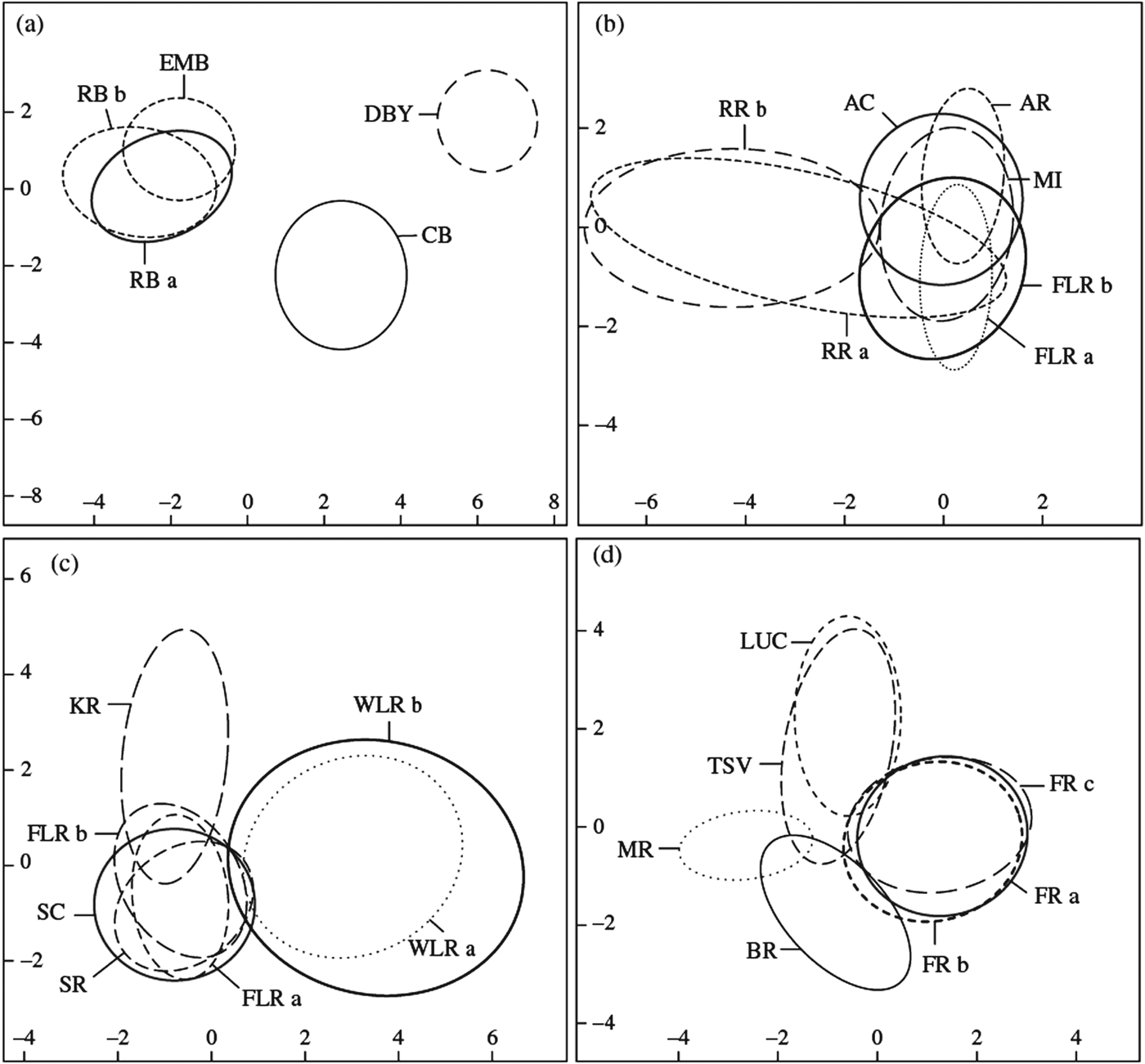
Results from DFA approaches have been interpreted in a number of ways to explore fish stock structure. Several researchers have examined patterns of the mean canonical root outputs to explore stock relationships (e.g. Lester et al. Reference Lester, Sewell, Barnes and Evans1988; Sewell and Lester, Reference Sewell and Lester1995; Moore et al. Reference Moore, Buckworth, Moss and Lester2003). Here, the mean canonical score of each group has been plotted for each canonical function, although typically the results for only the first two or three functions have been plotted, as these generally contain the majority of variation inherent in the data. Confidence limits, historically based on the approach of Mardia et al. (Reference Mardia, Kent and Bibby1979), have then been generated around the mean canonical score of each sample, allowing a matrix of multi-species parasite data to be easily visualized in a limited number of dimensions. A key disadvantage of this particular approach is that the confidence limits of Mardia et al. (Reference Mardia, Kent and Bibby1979) that are used to identify coherent or distinct groupings are only approximations as they are based on sample sizes and do not take into account the within- and among-group variability of the actual parasite data in their formulation. However, given recent advances many statistical packages now provide plots of confidence intervals resulting from the actual multivariate data, rather than the sample sizes (e.g. Moore et al. Reference Moore, Welch, Newman and Lester2012a ; Fig. 2). An additional limitation is that DFA, like MANOVA, is highly sensitive to departures from normality, the presence of outliers, and heterogeneity in variance/covariance matrices of variables; features that often occur in multi-species parasite datasets. Additionally, the size of the smallest group must be larger than the number of predictor variables. Furthermore, if one location has naturally low parasite levels compared with others, classification success may be limited as fish with few parasites by chance from other locations will be assigned to the location with overall low parasite numbers.
An example of 95% confidence ellipses from discriminant function analysis (DFA) based on 10 parasite species infecting king threadfin Polydactylus macrochir in Australian waters. Axes 1 v. 2. RB, Roebuck Bay; EMB, Eighty Mile Beach; DBY, Darby; RR, Roper River; CB, Chambers Bay; AC, Arthurs Creek; AR, Albert River; MI, Morning Inlet; FLR, Flinders River; KR, Kendall River; WLR, Wenlock River; SR, Staaten River; SC, Spring Creek; LUC, Lucinda; TSV, Townsville; FR, Fitzroy River; MR, Mary River; BR, Brisbane River. (From Moore et al. Reference Moore, Welch, Newman and Lester2012a .)

Several authors have used the predictive classification function of DFA to explore movement of individuals and thus infer stock structure of fish populations (e.g. Hutson et al. Reference Hutson, Brock and Steer2011; Moore et al. Reference Moore, Welch, Newman and Lester2012a ). Broadly speaking, this approach examines distances of each individual case (i.e. an individual fish) relative to group mean centroids and classifies cases as belonging to the group to which it is closest (i.e. where the distance is smallest).
In recent years, a growing number of researchers have explored the use of semi-metric or non-parametric multivariate methods to analyse multi-species parasite datasets for purposes of stock identification. These approaches have the advantage that they are not subject to the limitations of homogeneity of variances and normality that typically constrain parametric tests. In one such application, Moore et al. (Reference Moore, Buckworth, Moss and Lester2003) explored the use of Bray–Curtis dissimilarity measures as a means of classifying apparently transient S. commerson to their likely location of origin across northern Australia. In their approach, parasite assemblages of individual fish were compared against group means via a Bray–Curtis similarity matrix to classify fish according to group of ‘best fit’. A similar approach was later used by Moore et al. (Reference Moore, Welch, Newman and Lester2012a ) to examine stock structure of Polydactylus macrochir among estuaries of northern Australia. This method provides a semi-metric approach that is not subject to the limitations of homogeneity of variances and normality, nor constrained by differences in multivariate dispersion that can constrain some non-parametric methods (see below). However, a key limitation of this technique is that greater ‘weighting’ is given to more abundant species in the calculation, while it may be that the less abundant or ‘rarer’ species could be more effective for distinguishing among groups. Furthermore, by comparing individual fish to the group averages, the technique takes little account of the variation in parasites abundances within a group. As with other classification techniques, an additional limitation is that if one sample group has low levels of parasites compared with other groups, fish with few parasites by chance from other groups will be incorrectly classified to the group with overall low parasite numbers.
A number of authors have used non-parametric multi-dimensional (nMDS) scaling techniques to examine multi-species parasite assemblage data among locations (e.g. Speare, Reference Speare1995; Lester et al. Reference Lester, Thompson, Moss and Barker2001; Moore et al. Reference Moore, Stapley, Allsop, Newman, Ballagh, Welch and Lester2011). These tests provide a highly visual means of examining patterns among sample groups by plotting the distances of similarity (or dissimilarity) in two- or three-dimensional space. Being non-parametric and ordination-based, these approaches have the advantage in that they are not subject to the limitations of parametric tests, such as the requirement of normality and homogeneity of variances. However, while visually descriptive, nMDS techniques do not provide a level of significance of differentiation among sample groups. Accordingly, many authors have used the approach as an exploratory method of assessing difference amongst groups, before proceeding with alternate analyses that offer significance testing (e.g. Zischke et al. Reference Zischke, Griffiths, Tibbetts and Lester2013).
Two non-parametric multivariate approaches that offer significance testing are analysis of similarities (ANOSIM) and permutational multivariate analysis of variance (PERMANOVA) routines. Several researchers have applied ANOSIM to parasite data for the purposes of fish stock identification (e.g. Moore et al. Reference Moore, Stapley, Allsop, Newman, Ballagh, Welch and Lester2011; Zischke et al. Reference Zischke, Griffiths, Tibbetts and Lester2013). ANOSIM uses distance measures of similarity to calculate a global ‘R’ statistic that reflects the differences in variability among sample groups compared with that within groups (Clarke, Reference Clarke1993). The R statistic is a difference of average rank dissimilarities among or within groups, scaled from zero, which indicates no difference among groups, over a fixed range up to a maximum of 1, where all dissimilarities between groups exceed any dissimilarity observed within groups (Clarke et al. Reference Clarke, Somerfield and Gorley2008). ANOSIM allows for significance testing by comparing the ranked similarity within and among groups with that which would be generated by random chance. To date, PERMANOVA routines have been less frequently applied. PERMANOVA is a permutational non-parametric multivariate approach which allows direct additive partitioning of variation for complex models. The test statistic is a multivariate analogue to Fisher's F-ratio and is calculated directly from any symmetric distance or dissimilarity matrix (Anderson, Reference Anderson2001). As with most non-parametric approaches, both ANOSIM and PERMANOVA tests are not subject to the requirements of normality and homogeneity of variances and, unlike multi-factorial ANOVA or MANOVA, both approaches are relatively robust to unbalanced designs (Anderson, Reference Anderson2001). ANOSIM and PERMANOVA tests are, however, sensitive to differences in multivariate dispersion, and significant differences may result from differences in dispersion as well as differences in the tested variable(s) among sample groups (or a combination of the two) (Anderson, Reference Anderson2001). Accordingly, it has been recommended that caution be used when interpreting the results of the significance tests (Anderson, Reference Anderson2001).
Another commonly applied non-parametric multivariate method used to examine parasite data for the purposes of stock identification has been cluster analysis. Cluster analysis is an exploratory technique, and aims to sort different samples into groups to discover patterns in data. While a variety of cluster algorithms exist, hierarchical tree clustering has been most commonly used for examining parasite datasets (e.g. Lester et al. Reference Lester, Thompson, Moss and Barker2001). In general terms, clusters are generated based on a dissimilarity (similarity) or distance-based resemblance matrix, with the Bray–Curtis index being the most frequently applied. The majority of studies that have employed cluster analysis on parasite data have been conducted on the mean abundances of parasite species in a priori defined groups (e.g. Speare, Reference Speare1994; Speare, Reference Speare1995; Lester et al. Reference Lester, Thompson, Moss and Barker2001). While this approach provides a highly visual means of exploring patterns among sample groups, it does not take into account the variability of individual fish within each sample group beyond that incorporated in the calculation of group averages. An additional disadvantage of hierarchical tree-based cluster approaches is that being an exploratory technique, such methods do not provide an indication of the significance of the resulting groupings. However, it is possible to overcome this problem by using an a priori defined level of similarity as a significance level, or through the use of post-hoc structuring tests, such as similarity profile (SIMPROF) routines.
In contrast to their use in examining clustering patterns of means of a priori defined groups, few studies have explored the use of cluster analysis for classifying individual fish into coherent groups on the basis of their parasite fauna (although see Vignon et al. Reference Vignon, Morat, Galzin and Sasal2008 for a notable exception). These approaches may be particularly useful for parasite datasets as they make no assumption of the location of collection, an important consideration given that a fish may not have necessarily originated from one of the sampling locations. Such approaches have been used on multivariate datasets from different fields with considerable success (e.g. Moore and Simpfendorfer, in press), and may prove useful for parasite data, although given the overdispersion and high variances commonly observed in parasite data (Lester, Reference Lester2012) it may prove more beneficial to conduct such analyses on presence/absence data rather than abundances.
Potentially the most informative approach is to apply multiple different statistical methodologies, including summary statistics, univariate and multivariate approaches on the same dataset. Such approaches are beneficial in that they not only provide greater confidence in the results of any one technique when consistent results are obtained, but also allow for the limitations of different analytical approaches to be resolved, sensu the advantages of a holistic approach to fish stock identification (Begg and Waldman, Reference Begg and Waldman1999). Such approaches are being used with increasing regularity in the region (Table 1). For example, Moore et al. (Reference Moore, Welch, Newman and Lester2012a ) used summary statistics, one-way ANOVA and Tukey–Kramer post-hoc tests and two multivariate methods: a parametric discriminant function analysis and a semi-metric Bray–Curtis assignment approach in their study into the movement and stock structure of king threadfin, P. macrochir, among estuaries of tropical and sub-tropical northern Australia. The consistent results observed between the various approaches allowed these researchers to conclude that the species occurs as a number of ecologically distinct populations across northern Australia, a result that was harmonious with that of complementary studies into the stock structure of the species (Moore et al. Reference Moore, Welch, Newman and Lester2012a ).
DISCUSSION
Parasite data have provided an important contribution to the understanding of fish movements and stock patterns across Australasia, East Asia and the Pacific Island regions. Results have often been supported by otolith analyses and conventional tagging when available. Genetic studies have sometimes indicated fewer stock divisions because these techniques account for movement and mixing across all life history stages of a species. By contrast, parasite data typically provide information on the movement of post-recruitment life history stages, and commonly do not provide an indication of mixing of eggs and larvae, which may disperse before they become infected (Rohde, Reference Rohde1993; Moore et al. Reference Moore, Stapley, Allsop, Newman, Ballagh, Welch and Lester2011). Parasites, otoliths and tags present detailed information on structuring of fish over similar ontogenetic time frames and until we can be sure of the sources for recruitment, a combination of environmental and genetic investigations appear to give the best indications of stock structure. Many of the parasite studies reported here were commissioned by fisheries agencies and the results incorporated into species reports for managers.
In planning such investigations, examination of the total parasite fauna has rarely been the ideal tool. After examining data from 36 types of parasites of Hoplostethus atlanticus including digeneans and cestodes from the stomach and intestine and myxosporeans from the gall bladder, Gauldie and Jones (Reference Gauldie and Jones2000) concluded that total parasite load was not useful for discriminating stocks. Most of the work discussed above analysed data from parasites chosen to meet a number of criteria so that they were likely to be useful in analysing host movement.
Among the most important criteria is an understanding of the probable residence time of the infection in the fish (Lester and MacKenzie, Reference Lester and MacKenzie2009). There are generally few data on this and it is almost always unknown. As discussed in many examples above, the proposed residence time is generally deduced from the known residence time of a related species or genus, or the likely impact of a change in environment, especially for ectoparasites, or a change in diet for gut parasites. However, there is evidence to suggest our earlier generalizations may not be reliable. For example, monogeneans and copepods have often been excluded because of their short lifespan and susceptibility to changes in the external environment (Lester et al. Reference Lester, Thompson, Moss and Barker2001; Heuch et al. Reference Heuch, Knutsen, Knutsen and Schram2002; Lester and MacKenzie, Reference Lester and MacKenzie2009). Yet Hutson et al. (Reference Hutson, Ernst, Mooney and Whittington2007) used the polyopisthocotylean Paramicrocotyloides reticularis and the lernaeopodid copepod Parabrachiella seriolae to indicate that Seriola lalandi in southeastern Australia and New Zealand formed a single stock, a finding that closely agreed with genetic and tagging results suggesting that these two parasites at least could have a long residence time. Li et al. (Reference Li, Song, Wu, Zou, Nie and Wang2011, Reference Li, Zou, Wu, Song and Wang2012) found that the marine polyopisthocotylean, H. lingmueni, survived in large numbers on Coilia nasus which had migrated 500 km in freshwater to spawn, as indeed did the marine acanthocephalan Acanthosentis cheni, whereas the marine hemiurid E. coiliae was lost during the 2-month migration. Where it is not possible to determine experimentally the residence time of the parasites, clues can be obtained from two sources: evidence of dead parasites and a negative correlation between abundance and host age.
Though parasites with a direct life cycle have been preferred by some authors, most of the parasites found to be successful in this review such as anisakids and trypanorhynchs, are the juvenile stages of parasites with indirect life cycles. Some authors prefer non-pathogenic parasites. The pathogenicity of most of the parasites used here is unknown but providing some infected fish survive for the length of the study, parasite-associated mortality may have little effect on the results. Nagasawa and Maruyama (Reference Nagasawa and Maruyama1987) investigated what appeared to be a very pathogenic parasite yet were still able to distinguish different host populations.
Being able to accurately identify the parasite to species is not necessarily critical, providing the parasite can be distinguished from other species and its residence time can be reasonably assessed. Nevertheless, the better the discrimination between parasites the more sensitive the data are likely to be to detect differences between stocks. Juvenile anisakids have generally not been identified to species. In most collections there were probably at least two species, possibly in different ratios. Umehara et al. (Reference Umehara, Kawakami, Ooi, Uchida, Ohmae and Sugiyama2010) found that of the Anisakis type 1 in Trichiurus spp. in Taiwan, 84% were A. typica, 14% A. pegreffi and 2% A. simplex s.s. In Japan in the same host the proportions were 2%, 33% and 65% respectively. Despite this, unidentified Anisakis juveniles have been frequently used very successfully in the region to discriminate fish stocks. Didymozoids are another group difficult to identify to species. Some authors have resorted to A, B, C etc. and still found them valuable stock markers (Jones, Reference Jones1991; Speare, Reference Speare1994, Reference Speare1995). More of a problem can be the accidental inclusion of data from a different host species, usually as a result of a misidentification in the field, or counts being made by different people.
Annual variation in prevalence and abundance may introduce errors if collections are made over several years. Large changes can occur. For example, Pennella sp. was first recorded on a Japanese saury Cololabis saira in 1981 having been apparently absent for at least 30 years. By 1983 it was on a third of 17 189 fish examined. By 1985 it had virtually disappeared (Nagasawa et al. Reference Nagasawa, Imai and Ishida1988). On the other hand, Moore et al. (Reference Moore, Welch, Newman and Lester2012a ) tested for temporal differences in parasites considered to have long residence times in P. macrochir in their study and observed little variation within individual estuaries over time frames of up to 3 years.
Data collected in stock discrimination studies are likely to be very valuable in the long term. Palm (Reference Palm and Mehlhorn2011) points out that many fish parasites have complex life cycles involving many other hosts, so any change in the environment is likely to cause a major shift in parasite numbers. The effects of fishing pressure or climate change are likely to be reflected in changes in parasite abundance. Researchers may even be able to learn more about the parasites themselves if the data are available. So once collectors have published their conclusions or otherwise finished with the data it may be of long-term benefit to parasitology to make the raw data available through a website, the address of which could be included in the collectors’ publication.
CONCLUSIONS AND FUTURE DIRECTIONS
Examination of parasite faunas has provided many significant insights into the movements and stock structure of fishes and invertebrates across Australasia, East Asia and the Pacific Islands region, and some have become incorporated in fishery management plans.
There remains, however, much work to be done. The stock structure of many important species is still not known. Those that would benefit from parasitological investigation include many species of shallow water Lutjanidae, Lethrinidae and Serranidae which form the basis of many commercial, recreational and subsistence fisheries across the region. Deepwater demersal lutjanids (particularly Etelis and Pristipomoides spp.), lethrinids and serranids also form significant artisanal and subsistence fisheries in many Pacific Island countries and territories, yet currently little is known of their stock structure (Williams et al. Reference Williams, Nicol, Bentley, Starr, Newman, McCoy, Kinch, Williams, Magron, Pilling, Bertram and Batty2012). In temperate waters, sillaginids, platycephalids and Emmelichthys nitidus would all benefit from stock clarification (Flood et al. Reference Flood, Stobutzki, Andrews, Begg, Fletcher, Gardner, Kemp, Moore, O'Brien, Quinn, Roach, Rowling, Sainsbury, Saunders, Ward and Winning2012). Further research into the residence times, life cycles and geographical distributions of individual parasite species would yield much important information to aid the interpretation of results.
ACKNOWLEDGEMENTS
The authors wish to thank J. Abraham, A. Olds and three anonymous reviewers for their constructive comments on earlier drafts of the manuscript.
FINANCIAL SUPPORT
This research received no specific grant from any funding agency, commercial or not-for-profit sectors.