In this paper, we experimentally test three hypotheses about the developmental course of delinquency trajectories in a randomized efficacy trial. We hypothesize that an effective intervention for antisocial behavior introduced during childhood will reduce the subsequent development of adolescent delinquency. We test the synergistic benefit of increased parenting skills and reduced deviant peer association as mechanisms that prevent adolescent delinquency. To evaluate these hypothesized mechanisms of delinquency growth, we use mediational modeling. Finally, we hypothesize that the intervention will significantly delay the timing of a boy's first arrest.
Key components of a rigorously designed study include random assignment with intent-to-treat (ITT) analyses, multiple-method assessments, and mediational models with appropriately timed measurement of variables in the hypothesized sequence. Mediational modeling necessitates that the intervention should alter the hypothetical mechanisms and the outcomes and that the effects on the outcomes be explained by the effects on the mediators (Curran & Muthén, Reference Curran and Muthén1999; Kazdin, Reference Kazdin2002; Kraemer, Wilson, Fairburn, & Agras, Reference Kraemer, Wilson, Fairburn and Agras2002; West, Aiken, & Todd, Reference West, Aiken and Todd1993). It is only recently that parent-management-based efficacy trials have begun to approach this level of sophistication (e.g., Beauchaine, Webster-Stratton, & Reid, Reference Beauchaine, Webster-Stratton and Reid2005; Conduct Problems Prevention Research Group, 2002; Eddy & Chamberlain, Reference Eddy and Chamberlain2000; Forgatch & DeGarmo, Reference Forgatch and DeGarmo1999; Tremblay, Pagani-Kurtz, Mâsse, Vitaro, & Pihl, Reference Tremblay, Pagani-Kurtz, Mâsse, Vitaro and Pihl1995).
Understanding mechanisms of change requires new ideas, costly changes in the kinds of data collected, and employing intervention as an experimental test of theory. Hinshaw, Howe, and other thoughtful observers (Hinshaw, Reference Hinshaw2002; Howe, Reiss, & Yuh, Reference Howe, Reiss and Yuh2002) point out that simply demonstrating that a hypothesized mechanism mediates an intervention's effects on child outcomes does not address the critical question: what are the original causes of the outcome?
The strongest conclusion one can legitimately make from mediational models is that intervention effects on the hypothesized mediating mechanisms explain significant intervention effects on the outcomes.
Mediational models that support parenting interventions have been reported in several studies focused on youngsters at various stages in the developmental process (Beauchaine et al., Reference Beauchaine, Webster-Stratton and Reid2005; Conduct Problems Prevention Research Group, 2002; DeGarmo & Forgatch, Reference DeGarmo and Forgatch2005; Eddy & Chamberlain, Reference Eddy and Chamberlain2000). Rigorous etiological assessment of mediating parenting mechanisms requires studies of at-risk pregnant mothers and their infants, as demonstrated by Olds (Reference Olds2002). Understanding causal status could be further advanced if theoretical horizons were expanded beyond the traditional reach of parenting variables to include integrated models, such as that posed by Snyder and colleagues. Snyder's model includes measures of mothers' attributions and measures of children's anger, anxiety, and executive functioning (Snyder, Cramer, Afrank, & Patterson, Reference Snyder, Cramer, Afrank and Patterson2005; Snyder et al., Reference Snyder, Schrepferman, Oeser, Patterson, Stoolmiller and Johnson2005; Snyder, Schrepferman, Brooker, & Stoolmiller, Reference Snyder, Schrepferman, Brooker, Stoolmiller, Cavell and Malcolm2007; Snyder, Schrepferman, McEachern, & DeLeeuw, in press; Snyder, Stoolmiller, Wilson, & Yamamoto, Reference Snyder, Stoolmiller, Wilson and Yamamoto2003). Recent findings in molecular genetics suggest that including measurements of the biological factors underpinning psychosocial development might benefit future models of child antisocial behavior (Moffitt, Caspi, & Rutter, Reference Moffitt, Caspi and Rutter2005; Rutter, Reference Rutter2006).
Another glaring omission within intervention research is a need to understand mechanisms of enduring change (Hinshaw, Reference Hinshaw2002). Certain data sets cry out for a theory about change that persists following conclusion of parenting interventions (DeGarmo, Patterson, & Forgatch, Reference DeGarmo, Patterson and Forgatch2004; Forehand & Long, Reference Forehand and Long1988; Patterson & Fleischman, Reference Patterson and Fleischman1979; Webster-Stratton, Hollinsworth, & Kolpacoff, Reference Webster-Stratton, Hollinsworth and Kolpacoff1989). How do we explain lasting effects? One simplistic answer, an extended application of escape–avoidance conditioning, might be that the parents find the intervention methods so effective that they continue using them to prevent the return of problems. It could also be that family and friends in the social environment provide support for newly developed parenting skills. Despite these possible explanations, little empirical support for these hypotheses can be found in studies of parenting interventions. When confronted by findings showing increasing effect sizes during follow-up as shown by DeGarmo and Forgatch (Reference DeGarmo and Forgatch2005) and Vitaro, Brendgen, and Tremblay (Reference Vitaro, Brendgen and Tremblay2002), these simple post hoc constructions are stretched beyond recognizable limits.
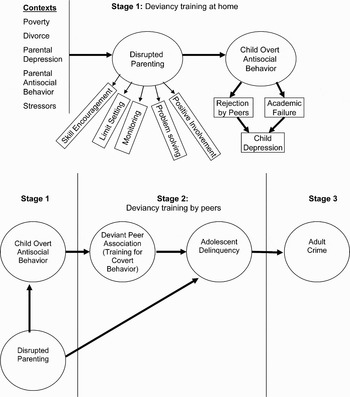
Theories of developmental psychopathology must take into account changes resulting from maturation. Within the present study, deviancy as well as the mechanisms influencing deviancy might change over the course of development. Patterson (Reference Patterson1993) found such changes during the first 6 years of his 20+ year study of boys at risk for antisocial behavior and delinquency. Patterson conceptualized a developmental model of deviancy and described the transition from childhood to adolescent forms of antisocial behavior as a process similar to the development of a chimera, a mythical creature with the head of a lion, the body of a goat, and the tail of a dragon. This metaphor provides a powerful symbol signifying the transformation of a youngster's deviancy from early childish antisocial behaviors at Stage 1 to the more serious problems found at Stage 2 in adolescence, and adult crime at Stage 3. The mechanisms that drive the changes from one stage to another are thought to be disruptions in parenting practices and deviancy training provided by deviant peers.
Some Preventive Interventions With Parenting Practices as Mediators
The Conduct Problems Prevention Research Group (CPPRG, 2002) provides an example of intervention with parenting as a hypothesized mediator in their multifaceted Fast Track intervention. In the Fast Track intervention, the CPPRG randomly assigned 891 boys and girls in kindergarten at risk for conduct problems to either experimental or contrast conditions. Participants in the experimental group received up to 10 years of intervention with training in social skills, social cognitive skills, academic tutoring, consultation for classroom teachers, and parent management training for caregivers. Analyses of the data showed significant improvements in five of the child outcome variables: parent ratings of aggression, peer social preference, association with deviant peers, and teacher-reported social competence and academic performance. The CPPRG explored improvements in parenting, social cognitions, and social skills, as hypothetical mechanisms involved in influencing observed changes in outcome. In exploration of these mechanisms in their sample, the CPPRG determined that change in parenting served as a mediator for child aggression, and furthermore, that changes in hostile attribution served as a mediator for changes in deviant peers and substance abuse. Further analysis with this sample showed that only those youngsters at highest risk at baseline (BL) significantly benefitted from reduction in conduct disorders, externalizing disorders, and antisocial behavior (Bierman et al., Reference Bierman, Coie, Dodge, Foster, Greenberg and Lochman2007).
Beauchaine and colleagues (Reference Beauchaine, Webster-Stratton and Reid2005) summarized findings from a set of six different outcome studies based on Webster-Stratton's (Reference Webster-Stratton, Jensen and Hibbs2003) intervention, The Incredible Years, a program for children aged 3–8. The studies, conducted over a 20-year period, used wait-list control designs to evaluate one or more combinations of parent training, child training, and/or teacher training. The intervention required only a few months of treatment to achieve consistent reductions in measures of maternally reported and directly observed child externalizing behavior. The investigators found support for four hypothesized mediational models in which reductions in harsh and ineffective parenting mechanisms were associated with reductions in externalizing child behavior.
Sandler, Wolchik, Winslow, and Schenck (Reference Sandler, Wolchik, Winslow, Schenck, Beach, Wamboldt, Kaslow, Heyman, First and Underwood2006) provided parent-training procedures for divorced mothers and their youngsters in group sessions and skills training groups. The intervention emphasized rebuilding the mother–child relationship in the aftermath of divorce. At termination and at 6-month follow-up, examination of the data indicated that maternal discipline and warmth significantly mediated the treatment impact on child internalizing and externalizing. It is interesting to note that the mediated effect of maternal warmth on child mental health continued for at least 6 years for the highest risk families.
Forgatch and DeGarmo (Reference Forgatch and DeGarmo1999) have successfully followed the intervention as an experiment strategy for a sample of recently separated single mothers, and they partially replicated those findings in a sample of recently married stepfather families (Forgatch, DeGarmo, & Beldavs, Reference Forgatch, DeGarmo and Beldavs2005). In the first randomized study, Forgatch and DeGarmo (Reference Forgatch and DeGarmo1999) provided the intervention to single mothers in parent groups. The choice to intervene with mothers allows for a clear test, without confounding variables, of the hypothesis that changes in parenting skills operate as mechanisms of child adjustment problems following divorce. During the 3-year follow up, parenting practices were significant mediators for observed noncompliance and aggression; standardized tests of academic achievement; child self-rated internalizing and peer problems; and teacher-rated externalizing, internalizing, and appropriate school behaviors (DeGarmo et al., Reference DeGarmo, Patterson and Forgatch2004; Forgatch & DeGarmo, Reference Forgatch, DeGarmo, Reid, Patterson and Snyder2002; Martinez & Forgatch, Reference Martinez and Forgatch2001). In another study with that sample, changes in parenting practices from BL to 12 months and reductions in deviant peer association from BL to 30 months mediated the intervention effect on teacher-rated delinquency from BL to 36 months (DeGarmo & Forgatch, Reference DeGarmo and Forgatch2005). In all of those reports, the boys were preadolescent. In the present study we follow that sample to 9-year follow-up to test the role of parenting and deviant peer association as mechanisms of adolescent delinquency.
The set of previously described studies tested mediational models in families with young children at risk for externalizing behavior problems. The implicit assumption of most of these prevention studies is that early intervention prevents future involvement in adolescent and adult criminal behavior. At present, only two groups have published analyses of follow-up data in early adolescence, and none has examined change beyond this point (Tremblay et al., Reference Tremblay, Pagani-Kurtz, Mâsse, Vitaro and Pihl1995; Wolchik et al., Reference Wolchik, Sandler, Millsap, Plummer, Greene and Anderson2002). The Montreal study was not successful in identifying mediational models for externalizing or delinquent behavior. The boys in the treated group self-reported less delinquent behavior than those in the comparison group in Years 1 through 6. Despite this, only 3% of the boys in the total sample had a juvenile court record, and the difference between the two groups on this variable was not significant. The Arizona group outcome variables did not include teacher-reported delinquency, child-reported delinquency, or official juvenile court records.
Significant progress is already evident in the application of parent-training procedures to samples of young children at risk for adolescent delinquency. Several important questions remain unanswered. Do programs efficacious for preadolescents prevent adolescent delinquency and crime? Do changes in parenting practices during childhood and changes in deviant peer involvement in transition through adolescence serve as mediators for the later development of delinquent behavior? Does prevention significantly reduce adolescent crime as reflected in both official court records and teacher or child ratings of delinquency? Is it possible to delay, or even completely forestall, a first police arrest? The Oregon delinquency model serves as a theoretical framework for examining these issues.
The Oregon Delinquency Model
The Oregon delinquency model was developed in the context of longitudinal and intervention studies carried out at the Oregon Social Learning Center and the Oregon Child and Family Center (Dishion & Patterson, Reference Dishion, Patterson, Cicchetti and Cohen2006; Forgatch & DeGarmo, Reference Forgatch, DeGarmo, Reid, Patterson and Snyder2002; Forgatch et al., Reference Forgatch, DeGarmo and Beldavs2005; Patterson, Reference Patterson2002b; Patterson, Chamberlain, & Reid, Reference Patterson, Chamberlain and Reid1982; Patterson, Reid, & Eddy, Reference Patterson, Reid, Eddy, Reid, Patterson and Snyder2002). The model specifies that risk contexts lead to disrupted interpersonal interactions between youth and key socializing agents such as parents and peers. Disrupted social interactions include altered contingencies embedded in parent–child, sibling, and child–peer interactions. These disruptions, in turn, increase the likelihood of children developing overt antisocial outcomes such as noncompliance, temper tantrums, and hitting. The increase in overt forms of antisocial behavior and concomitant limitations in prosocial development set in motion a predictable sequence of outcomes. A few months of noncompliance in the classroom leads to academic failure. Normal peers soon reject the coercive child. The reaction of the coercive child to this dual failure is depression (Patterson, Reid, & Dishion, Reference Patterson, Reid and Dishion1992). Even more significant in terms of long-range adjustment is the child's drift into the deviant peer group where deviancy training takes place, as identified in Dishion's programmatic studies (Dishion, Spracklen, Andrews, & Patterson, Reference Dishion, Spracklen, Andrews and Patterson1996). Figure 1 displays three stages in development on the delinquency trajectory from childhood antisocial behavior through adolescent delinquency and into adult crime. It is the combination of family and peer training for deviancy that are presumed to lead to adult crime.
A developmental model for adult crime.

We postulate that ineffective parenting and deviant peer association are the prime mechanisms of changes in forms of deviancy. Early increases in time spent with deviant peers is accompanied by dramatic increases in the rates of delinquent behavior (Patterson & Yoerger, Reference Patterson, Yoerger and Osgood1997a). This pathological trajectory, which begins with high rates of overt antisocial behavior developed in the family and enhanced by early involvement with deviant peers, places the child at risk for early onset arrest (before age 14), possibly the main juvenile path leading to adult crime (Patterson & Yoerger, Reference Patterson, Yoerger, Reid, Patterson and Snyder2002).
The microsocial level of the model specifies that processes provided by parents and peers are quite different. In families, coercion and negative reinforcement are the social interaction learning processes involving parents and siblings that produce antisocial outcomes (Bank, Burraston, & Snyder, Reference Bank, Burraston and Snyder2004; Snyder & Patterson, Reference Snyder and Patterson1995). In contrast, increasing effective parenting practices has been shown to promote prosocial development and reduce deviant peer association (DeGarmo & Forgatch, Reference DeGarmo and Forgatch2005; Forgatch & DeGarmo, Reference Forgatch and DeGarmo1999, Reference Forgatch, DeGarmo, Reid, Patterson and Snyder2002; Martinez & Forgatch, Reference Martinez and Forgatch2001). In peer groups, at a microlevel, deviancy training relies on positive reinforcement for deviant talk (Dishion et al., Reference Dishion, Spracklen, Andrews and Patterson1996; Patterson, Dishion, & Yoerger, Reference Patterson, Dishion and Yoerger2000). Studies by Snyder et al. (Reference Snyder, Schrepferman, Oeser, Patterson, Stoolmiller and Johnson2005) show that this training may begin at school entrance. We hypothesize that both the ineffective parenting practices and peer deviancy training mechanisms make significant and unique contributions to growth in delinquency.
In the present report, we inserted a preventive intervention within the theoretical model to test our hypothesized mechanisms of change in delinquency. The selective risk factor in the current study was recent marital separation with its accompanying stressors, such as downward social mobility, parental distress, disrupted parenting practices, and child externalizing problems. We directed the intervention toward the custodial parent because we consider effective parenting practices and the contingencies they control to be the most proximal factors for childhood development. In earlier studies, we tested and found that enhancing parenting skills prevented and reduced antisocial behavior problems (DeGarmo et al., Reference DeGarmo, Patterson and Forgatch2004; Forgatch & DeGarmo, Reference Forgatch and DeGarmo1999; Martinez & Forgatch, Reference Martinez and Forgatch2001). Furthermore, we assume that reducing child overt antisocial behavior will be accompanied by a decrease in deviant peer association, a hypothesis examined in a forthcoming paper (Forgatch, Patterson, DeGarmo, & Beldavs, Reference Forgatch, Patterson, DeGarmo and Beldavs2009). Here we test the hypothesis that the parenting and the deviant peer mechanisms contribute significantly to reductions in adolescent delinquency. We further examine the hypothesis that measures of parenting practices are significant predictors for involvement with deviant peers and arrests as early as age 14.
Most of the correlational components of the general delinquency model have been replicated in several Oregon and Kansas samples and are summarized in Reid, Patterson, and Snyder (Reference Reid, Patterson and Snyder2002). The Oregon delinquency model specifies multiple paths from children's antisocial behavior to adolescent delinquency but only one path to adult crime. Antisocial boys who are involved with deviant peers are likely to be first arrested by age 14 and are at grave risk for chronic adolescent offending and adult recidivism (Dishion & Patterson, Reference Dishion, Patterson, Cicchetti and Cohen2006; Patterson & Yoerger, Reference Patterson, Yoerger and Osgood1997a, Reference Patterson and Yoerger1999, Reference Patterson, Yoerger, Reid, Patterson and Snyder2002). Early-onset boys more often come from divorced families and socially disadvantaged backgrounds, are significantly more deficient in prosocial skills, and are more antisocial than late-onset boys (Patterson & Yoerger, Reference Patterson, Yoerger and Osgood1997a). An important consideration for timing of intervention is that antisocial behavior may be identified as early as the preschool years (Patterson, Shaw, Snyder, & Yoerger, Reference Patterson, Shaw, Snyder and Yoerger2005; Patterson & Yoerger, Reference Patterson and Yoerger1997b; Reference Patterson, Yoerger, Reid, Patterson and Snyder2002; Tremblay, LeMarquand, & Vitaro, Reference Tremblay, LeMarquand, Vitaro, Quay and Hogan1999).
Late-onset arrest is an alternate path to adolescent crime. It is defined by low rates of antisocial behavior during childhood but extensive deviant peer association during adolescence. These youth are at risk for first arrest after age 14 and their risk for adult crime is lower than early-onset youth (Patterson & Yoerger, Reference Patterson, Yoerger and Hodgins1993, Reference Patterson, Yoerger and Osgood1997a). The late-onset path was once labeled as “adolescent limited” by Moffit (Reference Moffitt1993). The data show these youth to be less socially disadvantaged and more socially skilled than early-onset boys. Despite their advantage over early-onset boys, late-onset boys are still more disadvantaged and less socially skilled than never-arrested boys (Patterson & Yoerger, Reference Patterson, Yoerger and Osgood1997a, Reference Patterson, Yoerger, Reid, Patterson and Snyder2002). Analysis of data from both the Oregon and the New Zealand studies indicates that late-onset delinquents tend to drop out of the adult crime process. Examination of the New Zealand study suggests that the late-onset delinquents might significantly contribute to adult crime but at a lower rate than was the case for the early-onset group (Moffitt, Caspi, Harrington, & Milne, Reference Moffitt, Caspi, Harrington and Milne2002).
Forgatch and colleagues (DeGarmo et al., Reference DeGarmo, Patterson and Forgatch2004; Forgatch & DeGarmo, Reference Forgatch and DeGarmo1999, Reference Forgatch, DeGarmo, Reid, Patterson and Snyder2002) showed that the Oregon model of parent management training (PMTO) intervention produced significant reductions in antisocial behavior prior to adolescence by Years 1 and 3 and teacher-rated delinquency in Year 3. The data presented in this paper extend the findings through adolescence with delinquency measured by teacher ratings and police arrests. We hypothesize that the prevention trial introduced when the boys were aged 5 to 9 will be associated with significant reductions in rates of delinquency, as shown by teacher ratings and official arrest records 9 years following initiation of the study. We test our developmental model in which increased parenting skills during childhood and reduced deviant peer association into adolescence serve as significant mediators for these adolescent outcomes. We use latent growth models to test these two hypothetical mechanisms as mediators for the intervention effects on outcomes. We collected arrest records for all boys and determined that, with the exception of three cases, the first arrests began at the age of 9. We use survival analysis to test the early-onset hypothesis that the intervention will delay time until first arrest. We further hypothesize that improvements in parenting and decreased deviant peer involvement will be associated with reduced risk for early arrest prior to age 14.
Methods
The Oregon Divorce Study (ODS) spans 9 years and comprises two distinct phases. Phase I took place between the years 1992 and 1997 and included assessments at BL and 6, 12, 18, and 30 months. Phase II was the long-term follow-up period between 1999 and 2005, at years 6, 7, 8, and 9 post-BL. The intervention for the experimental group took place during Phase I between completion of the BL assessment and initiation of the 6-month assessment.
Participants
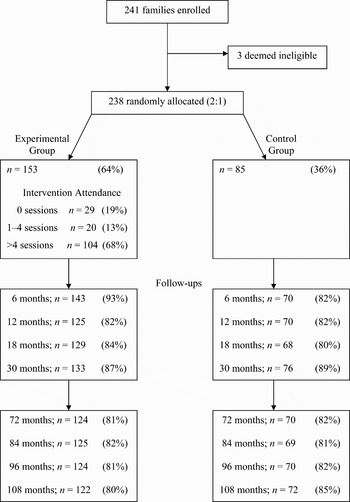
Two hundred thirty-eight recently separated single mothers and their sons residing in a medium-sized city in the Pacific Northwest, recruited through media advertisements, community flyers, and divorce court records, participated in the Oregon Divorce Study. Mothers in eligible families (a) had been separated from their partner within the prior 3 to 24 months, (b) resided with a biological son in Grades 1 through 3, and (c) did not cohabit with a new partner. Mothers at BL had separated from partners an average of 9.2 months prior to recruitment. Families had an average of 2.1 children. The average age of mothers at BL was 34 years (SD = 5.4, range = 21.4–49.6) and for boys 7.8 years (SD = 0.93, range = 6.1–10.4). Although not always possible, to capture their transition to adolescence older boys received priority for early assessment in Phase II. Because of the early assessment protocol, there was an increase in the age range of boys during Phase II.
The racial/ethnic composition of the boys was 86% White, 1% African American, 2% Latino, 2% Native American, and 9% from “other” racial/ethnic groups including those belonging to more than one group. This distribution reflects the racial/ethnic makeup of the community in the study location. The mean annual family income at BL was $14,900; 76% of the families received public assistance.
At BL, 76% of the mothers had some academic or vocational training beyond high school, 17% of whom had completed a 4-year college degree or higher. Approximately 20% completed their education with high school graduation and 4% had not completed high school. Most mothers were classified within the lower and working-class ranges in terms of occupation (Hollingshead, Reference Hollingshead1975): 32% unskilled, 21% semiskilled, 23% clerical/skilled, 22% minor professional to medium business, and 3% major business/major professional.
Of the above BL demographic variables, the experimental and control groups differed significantly on only two variables: number of months since separation and age of boys. Mothers in the experimental group had been separated 2.6 months longer than control group mothers (M = 9.84 and 7.48, respectively, p < .01). Boys in the experimental group were 0.28 years younger than control group boys (M = 7.65 and 7.93, respectively, p < .05). These variables were included as covariates in all relevant analyses.
Design
All families received a study description, agreed to random assignment for intervention, and completed informed consents. We randomly assigned families to the experimental and control group with 153 in the experimental group (E) and 85 in the no-intervention control group (C). Unequal group assignment was used to provide sufficient sample size within the experimental condition to examine potential full implementation intervention effects (Vinokur, Price, & Caplan, Reference Vinokur, Price and Caplan1991). Experimental and control families participated in the same assessment schedules during all phases. Figure 2 displays recruitment, group ns, and participation rates at each assessment. There was no differential attrition between groups at any of the assessments. Comparisons of the groups following attrition showed no significant differences for the variables in the models.
A consort chart of participation rates.

The intervention consisted of a series of 14 sessions of parent group meetings held weekly in the early evening hours. There were 13 groups of parents, ranging in size from 6 to 16 (M = 9.5). Experimental group mothers participated in an average of 8.5 sessions (SD = 5.7). Forgatch and DeGarmo (Reference Forgatch and DeGarmo1999) summarized the intervention and described interventionist training and evaluation of program fidelity. The manual for the program Parenting Through Change (Forgatch, Reference Forgatch1994) contains group leader information and parent materials. The manual incorporates detailed session descriptions for leaders, including agenda, objectives, rationales, procedures, exercises, role plays, and group process suggestions. Parent materials include summaries of principles, home practice assignments, charts, and other necessities. A 30-min videotape, The Divorce Workout (Forgatch & Marquez, Reference Forgatch and Marquez1993), demonstrated families using program principles.
The five parenting practices comprising the foundation of the intervention and the core dimensions of PMTO interventions are skill encouragement, limit setting, monitoring, problem solving, and positive involvement. To meet the needs of divorced families focused on in this study, we added content to address issues related to divorce, including emotion regulation, managing interparental conflict, and addressing children's divorce related concerns. Sessions on emotion regulation emphasized recognizing specific negative emotions for parents and their children, as well as practicing techniques to help regulate these emotions. Managing interparental conflict focused on problem solving and negotiation strategies. Talking with children about divorce combined active listening skills, problem solving, and emotion recognition and management. PMTO parenting components incorporate emotional regulation as an inherent part of the practice. For example, in the discipline component, mothers learned strategies to decrease coercive processes by using mild noncorporal discipline such as time out, extra work chores, and short privilege removal. Simultaneously, they learned ways to use contingent positive reinforcement, including praise, tokens, and incentive charts to promote prosocial behavior. Topics were presented in an integrated step by step approach with new principles building on previously learned skills.
Measures
Multiple-method assessments included structured interviews, laboratory observations, and questionnaires completed by mothers, youth, and teachers. All those who collected data (e.g., interviewers, observers, and teachers) were blind to participant status (E vs. C). In Phase I, teacher data were collected at BL and 12, 24, and 36 months, whereas parent–child data were collected at BL and 6, 12, 18, and 30 months. Phase II began in year 6 post-BL. We collected teacher and family questionnaire data annually and observational data twice on alternate years.
Youth outcomes
Arrest records were collected from official court records by searching the Oregon Circuit Court database, the Oregon State Police criminal database, and, where applicable, out of state databases on all known aliases. For each subject we searched all of these databases for the number, severity, and disposition of arrests. In this report, total arrests reflected those accumulated at each assessment time point. Although we did not examine intervention effects on severity and disposition status in depth for this report, we observed similar trends in growth of severity as found for growth in the number of arrests. Arrest severity ranged from administrative offenses to Class A felonies for both treatment and control groups. We excluded arrests prior to the study from analyses.
Delinquency was evaluated using the delinquency T score from the Teacher Report Form (TRF) of the Child Behavior Checklist (CBCL; Achenbach, Reference Achenbach1991). The T score consisted of nine items rated on a 3-point scale. Teacher data were incomplete at year 6 and so were not included in the analyses. Cronbach alphas (CAs) were .76, .71, .75, .72, .82, .80, and .83 for respective assessments at BL and Years 1, 2, 3, 7, 8, and 9. Teachers were blind to the fact that this was an intervention study and were different at each assessment. Parents identified which teachers would know their children well enough to make the ratings.
Deviant peer association was a summative index of five items scored true or false. The items were the boys' report of their friends' deviant behaviors (e.g., my friends get into fights, clown around, get into trouble, do not like schoolwork, and find schoolwork too hard).
Effective parenting practices
We obtained laboratory observations during 45-min mother–youth structured interaction tasks. The tasks were four problem-solving discussions about current conflicts, a teaching task, an unstructured activity, a forbidden toy situation, and a refreshment break. Microsocial data, which detailed information on respondent, recipient, sequence, content, affect, context, and duration, were scored in real time using the Interpersonal Process Code (Rusby, Estes, & Dishion, Reference Rusby, Estes and Dishion1991). Global ratings (Forgatch, Knutson, & Mayne, Reference Forgatch, Knutson and Mayne1992) were scored by coders following microsocial coding. Coders and interviewers were blind to intervention status and never assessed families more than once. With the exception of monitoring, all parenting practices were measured using coder data from the structured interaction tasks. Monitoring incorporated ratings from coders and interviewers. We randomly selected approximately 15% of the interactions at each wave for blind interrater reliability coding. We provide CAs and intraclass correlation coefficients (ICC) at BL and 12 months respectively below.
Effective parenting was a factor score that demonstrated convergence measured by seven domains: positive involvement, skill encouragement, problem solving, monitoring, negative reinforcement, negative reciprocity, and aversive discipline (Forgatch & DeGarmo, Reference Forgatch, DeGarmo, Reid, Patterson and Snyder2002). Negative reinforcement and negative reciprocity are microsocial measures of coercion. CAs were .73 and .73.
Positive involvement was measured by global ratings using Likert-scale items (e.g., warm, empathetic, and affectionate). CAs were .96 and .97; ICCs were .83, and .82.
Skill encouragement was measured using 11 Likert-scale global ratings of the promotion of skill development through contingent encouragement and scaffolding that was observed during the 10-min teaching task. Sample items were: breaks task into manageable steps, reinforces success, and prompts appropriate behavior. CAs were .69 and .81; ICCs were .73 and .66.
Problem-solving outcome was based on nine Likert-scale global ratings from the three mother-issue problem-solving tasks. Sample items were solution quality, extent of resolution, likelihood of follow through, and apparent satisfaction. Scale scores were averaged across tasks. CAs were .92 and .91; ICCs were .77 and .77.
Monitoring comprised five items rated by coders and parent interviewers. Coders rated skill at supervising the child, tracking the youngster's behavior, and obtaining information from the child. Interviewers rated maternal knowledge of the boy's day to day behavior and antisocial behavior. CAs were .72 and .71.
Negative reinforcement was defined as the frequency of conflict bouts initiated by the mother and terminated by the child. Bouts continued until at least 12 s passed without aversive behavior by either party. ICCs were .78 and .47.
Negative reciprocity was measured with the Haberman binomial z score (Gottman & Roy, Reference Gottman and Roy1990), reflecting the conditional likelihood that the mother reciprocated the child's aversive behavior with an aversive behavior of her own. ICCs were .65 and .54.
Inept discipline was measured as the mean of 13 Likert-scale global ratings. Sample items were overly strict, authoritarian, used nagging or nattering, expressed anger while engaged in, indecisive, and inappropriate discipline. CAs were .91 and .92; ICCs were .70 and .78.
Overview of analysis plan
We evaluated two sources of delinquency outcomes as they represent objective criteria with no parent or self-report. We evaluated TRF delinquency T scores and official arrest records with separate assessors.
The 8-year TRF data were obtained for all youth attending traditional and alternative schools. There was a great deal of missingness in the teacher data, especially in the later years as specified for respective assessments: baseline, 10.8%; Year 1, 19.5%; Year 2, 26.6%; Year 3, 32.8%; Year 7, 45.2%; Year 8, 46.1%; and Year 9, 57.7%. The missing data was due primarily to students aging out. We used full information at maximum likelihood and all available data to estimate growth slopes through the follow-up waves. The data represent growth in teacher-reported delinquency across the assessments from BL, covarying age of the child. This approach is less biased than dropping incomplete cases, especially if missing completely at random (MCAR). Little's MCAR test showed that the data was missing completely at random: χ2 (223) = 233.080, p = .308.
Public arrest records data were collected for all participating youth and parents, regardless of schooling or geographic residence. We obtained court record data for all but 12 boys in the sample. Six were missing from each group: 4% and 7% of the E and C groups, respectively. The MCAR test is not appropriate as the same 12 cases are missing at every wave for arrest records, and all other respondents are completely present. With only 6% of the sample missing, there is little threat to biased results.
We specified tests of mediation in a series of models using age of child as a time-varying covariate and controlling for months since separation. Specifically, we examined average levels and growth rates of delinquency using latent variable growth modeling within a structural equation framework to test hypothesized mediation effects of the intervention on youth outcomes through benefits to parenting practices and deviant peer association (Brown, Reference Brown1993; Cheong, MacKinnon, & Khoo, Reference Cheong, MacKinnon, Khoo, Collins and Sayer2001; West et al., Reference West, Aiken and Todd1993). Growth curve models provide several advantages including: more reliable estimates of change and intervention effects (Kraemer & Thiemann, Reference Kraemer and Thiemann1989), more accurate representation of the time spacing of assessment (Biesanz, Deeb-Sossa, Papadakis, Bollen, & Curran, Reference Biesanz, Deeb-Sossa, Papadakis, Bollen and Curran2004; DeGarmo & Forgatch, Reference DeGarmo and Forgatch2005), and capability to partial out measurement error for the time series data while simultaneously conducting prevention tests of mediation and direct and indirect effects (Cheong et al., Reference Cheong, MacKinnon, Khoo, Collins and Sayer2001; Duncan et al., Reference Duncan, Duncan, Alpert, Hops, Stoolmiller and Muthén1997).
For tests of the hypothesized mechanisms (i.e., parenting practices and deviant peer association), mediation is indicated if the path for the direct effect of the intervention on delinquency is rendered nonsignificant via the mediating mechanisms, and the indirect paths through parenting and deviant peer association are statistically significant. Thus, we first examine the impact of intervention on measures of delinquency and then test for mediation by examining whether intervention-initiated benefits to parenting practices and deviant peer association render the direct effect of the intervention on long-term decreases in delinquency to be nonsignificant.
Our models use the period from BL to 1 year for parenting practices as we previously determined that the largest treatment effect was found during this transition (DeGarmo & Forgatch, Reference DeGarmo and Forgatch2005; DeGarmo et al., Reference DeGarmo, Patterson and Forgatch2004). We measured deviant peer association at Years 1, 1.5, 2.5, 6, 7, and 8 because this interval followed the parenting change score and preceded the final assessment for delinquency measures. To examine the early-onset model, we used survival analysis to test whether the intervention delayed the timing of the first arrest. We evaluated directional hypotheses as this study provides follow-up to prior findings where we found support for regression effects in the directions hypothesized.
Results
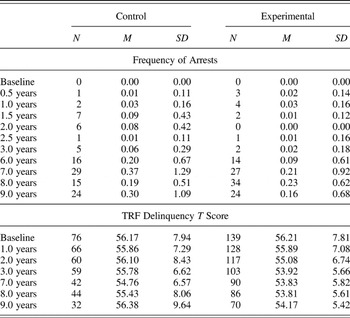
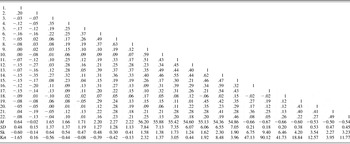
Means, standard deviations, and data collection waves are presented in Table 1 for the key time series delinquency measures (see Appendix A for complete correlation and descriptive statistics for key study variables used in growth models). Number of participants for TRF data and frequency of arrests are provided for E and C at each time point. Because of the skewed and kurtotic nature of the distributions, we log transformed data prior to subsequent multivariate analyses of the continuous level outcomes. In total, there were 11 complete waves of arrest records data available. We separated arrest data into 11 waves by matching the date of offense from the cumulative arrest data to the age of child at each study wave. Complete teacher data were collected annually and were available for 7 full waves.
Descriptive statistics of available Oregon Divorce Study time series delinquency and arrest data

Note: N, number of arrests and number of respondents with TRF scores at each wave.
Latent variable growth models
The primary analyses were conducted in a stepwise fashion. We first tested for significant direct intervention effects by entering ITT group assignment as a predictor of the long-term criterion outcome data. ITT is a conservative estimate of intervention effects because it includes the data from all participants (E and C) regardless of whether they attended any intervention sessions. This conservative strategy can result in underestimating effect sizes (Jo & Muthén, Reference Jo and Muthén1997). In the second step, we included paths from ITT to change in parenting practices and deviant peer association, and from change in these hypothesized mediators to the average level and growth of the long-term outcome. In the first step, growth curve factors were specified with a latent factor for “average levels” of delinquency over 9 years and a latent factor for “rate of growth” using the continuous level teacher-reported data. These factors were specified using appropriate time weights or fixed chronometric factor loadings. For the “9-year average” level latent factor, these weighted time loadings in the unstandardized model were fixed at 1.0 for each of the repeated measures indicators. For the linear growth rate factor, time weights were fixed at −5.0, −4.0, −3.0, −2.0, 2.0, 3.0, and 4.0, representing waves of available data obtained from teachers from BL to the 9-year follow-up. Boys' age was used as a time-varying covariate for both teacher ratings of delinquency and police arrests.
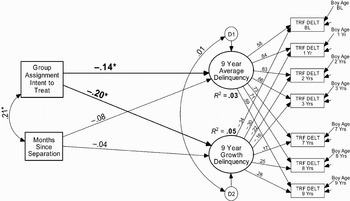
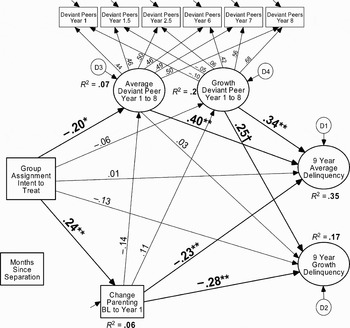
Figures 3 and 4 provide results of the intervention impact on the TRF data using standardized paths. The mediation hypotheses were supported for average levels as well as the rate of growth in delinquency. The model in Figure 3 obtained adequate fit to the data in χ2 (89) = 124.00, p = .01, comparative fit index [CFI] = .99, chi-square ratio (χ2/df) = 1.39, root mean square error of approximation [RMSEA] = .04, and showed a significant direct effect for group on reducing average levels (β = −.14, p < .05) and growth rate (β = −.20, p < .05), explaining 3% to 5% of the variance over 9 years. Although the chi-square minimization p value was less than .05, the average RMSEA was less than .10, χ2/df was less than 3.00 (Arbuckle, Reference Arbuckle1997) and CFI was .95 or above. We next entered change in parenting BL to 1 year and growth in deviant peer association from Years 1.5 to 8 to test for effects of mediation through parenting and deviant peer association. The subsequent figure used the same specification of growth in the dependent variable. For simplicity, growth parameters and the path from months of separation to growth were not displayed although they were included in statistical analyses. Figure 4 provides results of the mediation test.
The latent variable growth model for the test of direct intervention effects on 9-year teacher-rated delinquency. BL, baseline; TRF DELT, Teacher Report Form—Delinquency T score; χ2 (89) = 124.00, p = .01, CFI = .99, χ2/df = 1.39, RMSEA = .04. *p < .05.

The latent variable growth model for the test of mediation on 9-year teacher-rated delinquency. BL, baseline; χ2 (68) = 140.09, p = .01, CFI = .99, χ2/df = 1.37, RMSEA = .03. †p < .10. *p < .05. **p < .01.

The direct effects on delinquency were mediated by change in parenting and deviant peer association. Assignment to experimental group was associated with improvements in parenting (β = .24, p < .01), which in turn, was associated with reductions in average levels of TRF delinquency (β = −.23, p < .01) and reductions in the individual variance in growth rates (β = −.28, p < .01). Group was associated with reductions in average levels of deviant peer association (β = −.20, p < .05) but not growth rates. Both average levels and growth of deviant peer association were significantly associated with average levels of delinquency (β = .40 and .34, p < .01, respectively).
In summary, as hypothesized, random assignment to intervention yielded beneficial effects on average levels and growth of teacher ratings of delinquency. These intervention effects on outcome were mediated when deviant peer association and parenting practices were included in the models. It is interesting to note that change in parenting was not associated with reductions in deviant peer association. Presumably, although not tested here, reductions in child antisocial behaviors mediate the impact of change in parenting on deviant peer involvement. Finally, we estimated effect sizes for the intervention by specifying unconditional growth models by group condition. The Cohen d was .26 for average TRF levels and .41 for the growth rate. Therefore, the PMTO intervention produced a small effect on average levels and growth rate over 9 years.
The next set of models used the same specifications with police arrest records data as the outcome. Inspection of the descriptive data in Table 1 pointed to several waves in which there were 0 to 1 arrests for either the intervention or control groups (e.g., SD = .00 or .11). This minimal variance is appropriate for survival analyses but was not appropriate for estimating continuous growth factors. Attempts at modeling data including waves with one or fewer arrests produced inadequately fitting models. Therefore, growth models for arrest data were modeled at 1.5, 2, 3, 6, 7, 8, and 9 years, all of which included more than one arrest. To estimate average levels and linear growth with these data, the chronometric factor loadings in the unstandardized model were fixed at 1.0 on the average level of arrests and were fixed at −5.0, −4.0, −3.0, −2.0, 2.0, 3.0, and 4.0 for the linear growth rate latent variable. Figures 5 and 6 provide results of the test of mediation.
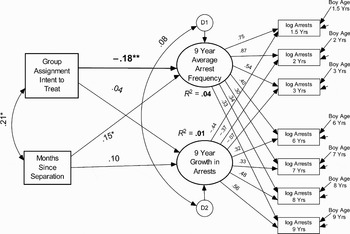
The latent variable growth model for the test of direct intervention effects on 9-year frequency of arrests. χ2 (89) = 257.21, p < .00, CFI = .96, χ2/df = 2.89, RMSEA = .09. *p < .05. **p < .01.

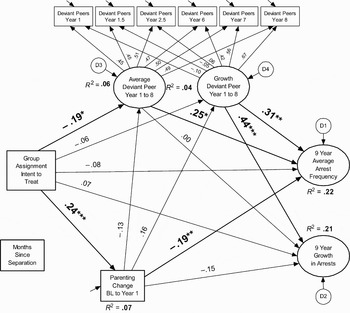
The latent variable growth model for the test of mediation on 9-year arrests. BL, baseline; χ2 (211) = 403.48, p < .00, CFI = .96, χ2/df = 1.91, RMSEA = .06. *p < .05. **p < .01. ***p < .001.

The model in Figure 5 obtained a fit of χ2 (89) = 257.21, p < .00, CFI = .96, χ2/df = 2.89, RMSEA = .09. Although the chi-square minimization p value was less than .05, the average RMSEA was less than .10, χ2/df was less than 3.00 (Arbuckle, Reference Arbuckle1997), and the CFI was .95 or above. The mediational hypotheses were supported for the average number of arrests over time but not for the growth rate in the frequency of arrests over time. The intervention was associated with a lower number of arrests compared to the control group when averaging 9 years of data (β = −.18, p < .01). This represents a significant intervention effect in reducing the number of total arrests by group. There was no significant difference between the groups in the rate of arrests per year.
The direct effect of the intervention on average levels was mediated upon entering deviant peers and change in parenting in Figure 7. The model obtained adequate fit to the data: χ2 (211) = 403.48, p < .00, CFI = .96, χ2/df = 1.91, RMSEA = .06. As shown previously, group assignment was associated with reductions in average deviant peer affiliation and improvements in parenting practices. These factors, in turn, significantly predicted average arrests over time with parenting associated with lower levels (β = −.19, p < .01), and deviant peers associated with higher levels (β = .25, p < .05). Consistent with our developmental model, growth in deviant peer association was predictive of growth in arrest rates (β = .44, p < .001) as well as average levels (β = .31, p < .01). Cohen's d reflecting the effect size of the intervention on average levels of police arrests was small (d = .28).
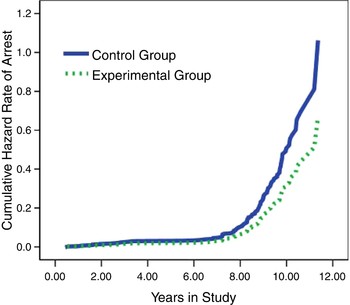
The cumulative hazard rate of survival to first arrest by group assignment. [A color version of this figure can be viewed online at journals.cambridge.org/dpp].

As the arrest data are zero inflated, another approach would be to conduct growth models using linear growth models for Poisson distributed count data in the hierarchical linear modeling (HLM) program. We ran the ITT intervention effect in HLM and found the nonlinear unstandardized coefficient to be −.379 (SE = .16, t = −2.34, p < .02). Although HLM provides the advantage of specifying individual timelines and Poisson modeling, we chose to model arrest data as structural equation modeling (SEM) path models because it more readily lends itself to complex path modeling of direct and indirect effects and tests of mediation in growth models. We note the findings for the SEM, HLM, and survival models below were consistent.
Timing of arrest survival analysis
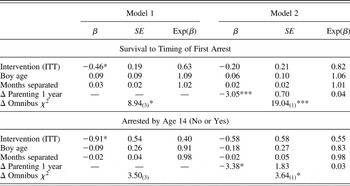
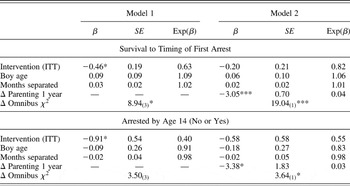
To evaluate timing of arrests we estimated survival models focusing on the likelihood of arrests. More specifically, we estimated Cox-proportional hazards regression for survival data adjusting for right-censored data. At the final 9-year assessment wave, boys ranged in age from 14.06 to 21.78 (M = 17.34, SD = 1.56). Years since a given youth's BL assessment ranged from 7.68 to 12.95 (M = 9.61, SD = 1.05) computed as age at final assessment minus age at BL. The model is semiparametric because although the BL hazard can take any form, the covariates enter the model linearly. We entered covariates in theoretical blocks starting with direct effects of the intervention followed by change in parenting and change in deviant peer association. The survival models provide unstandardized betas, standard errors, and corresponding odds ratios. Those values less than 1.00 for exp(β) indicate decreased likelihood or reduced risk read as percentages [1 − exp(β)]; values greater than 1.00 represent increased likelihood in terms of percentages.
The survival models shown in Table 2 supported the mediational hypotheses for parenting. For the direct effect, ITT assignment was associated with a 37% reduced risk of earlier timing of first arrest in comparison to the control group (β = −.46, p < .05), meaning the ITT group had a greater amount of survival time before the time of arrest onset. In the second model, this effect was mediated by changes in parenting (β = −3.05, p < .001). Interpretation of the coefficients indicates that for any family improving by a unit increase in the effective parenting factor score, there was an increase of 3 years in time to first arrest. To conduct a prevention analysis of the early starter model we tested the intervention effect on preventing first arrest before age 14 using logistic regression also shown in Table 2. The ITT analysis obtained a similar 40% reduction in risk of early starting (β = −.05, p < .05), which was mediated by change in parenting in Model 2 of the logistic regressions (β = −3.38, p < .05). Therefore, the overall timing to first arrest in the survival model and the status of being arrested by age 14 in the logistic regression yielded related similar results mediated by change in parenting. Figure 7 shows the cumulative hazard rate by group condition for survival to arrest.
Analysis for survival to timing of first arrest and early starter logistic regression of being arrested before age 14
Note: ITT, intent to treat.
* p < .05. ***p < .001.
Discussion
Our analyses demonstrate support for the long-term efficacy of a PMTO intervention in decreasing teacher-rated delinquency, police arrests, and delaying age at first arrest. The 9-year randomized controlled trial was conducted with families considered at risk for the development of delinquent behavior in their sons. As recent marital separation is a risk factor for disrupted parenting practices, the early development of antisocial behavior in boys, and subsequent growth into adolescent delinquency, the focus on divorcing families is particularly relevant for a test of our model. In the intervention, we focused on improving maternal parenting with no direct intervention on target children. As a result, this program provides a high degree of clarity with few confounding variables for testing four key hypotheses associated with the Oregon delinquency model. Our analyses provide support for all four hypotheses, which follow:
1. A key prevention assumption is that childhood forms of antisocial behavior can be a prelude to adolescent and adult crime. From this it follows that interventions introduced during childhood that effectively reduce antisocial behavior will reduce the risk for delinquency during adolescence.
2. The Oregon delinquency model postulates that five parenting practices control a set of reinforcing contingencies that govern deviant and prosocial child behavior (Forgatch & DeGarmo, Reference Forgatch and DeGarmo1999, Reference Forgatch, DeGarmo, Reid, Patterson and Snyder2002). In the present report, we hypothesize that changes in the composite measure of parenting practices as assessed during childhood (and found to mediate intervention effects on antisocial behavior in childhood) will predict reduced risk for adolescent delinquency.
3. According to the Oregon delinquency model, early involvement with deviant peers is a necessary but not sufficient precondition for adolescent delinquency and adult crime. Therefore, we hypothesize that increases in involvement with deviant peers will be a significant predictor for increases in adolescent delinquency.
4. In an earlier study, we showed that the PMTO intervention reduced deviant peer association in childhood and increased parenting skills that were both associated with reduced delinquency as rated by teachers (DeGarmo & Forgatch, Reference DeGarmo and Forgatch2005). Because of this relationship, we predict that effective intervention during childhood would lead to reduced risk of arrest before the age of 14. In the present report, we test the hypothesis that benefits to parenting and deviant peer association during childhood lead to delayed timing of first arrest.
The current data make a significant contribution to our understanding of delinquent behavior. Some theories emphasize family variables as causal mechanisms and give only a slight weighting to the contributions of peers (Hirschi, Reference Hirschi1969). Others test for family members and peers as potential predictor variables in straightforward multivariate analyses (Loeber, Farrington, Stouthamer-Loeber, & White, Reference Loeber, Farrington, Stouthamer-Loeber and White2008). We present an alternate developmental perspective that emphasizes timing and changes in the form of antisocial behavior.
The Oregon delinquency model specifies when and how the contributions of parent and peer training arise. As shown in Figure 1, the trajectory begins with adverse environments disrupting parenting practices, which in turn, lead to overt forms of antisocial child behavior. The primary training pattern at home is thought to be negative reinforcement for coercive behavior. Longitudinal data show that what happens during Stage 1 at home is a powerful predictor for what will happen 5 years later at school. Coercive children will be subjected to a predictable pattern of rejection by normal peers, which is followed by a gradual drift into increasing contact with deviant peers. Deviant peers provide training in deviancy with positive reinforcement, as shown in the programmatic studies by Dishion (e.g., Dishion, Bullock, & Granic, Reference Dishion, Bullock and Granic2002) and Snyder et al. (in press). Peer training in covert behaviors can begin as early as Grade 1 (Snyder et al., in press). Thus, with peer training, the socialization process for overt deviancy that begins at home in childhood is transformed into more serious forms of covert antisocial behavior in adolescence. Youngsters trained by both types of social agents are at greatest risk for adult crime. Coercive children who become adolescent delinquents are denied whole arenas of social experience and skill training, and they are unlikely to experience the joys of being appreciated for skills in sports, music, or academic subjects.
Of particular interest is Robins' (Reference Robins, Anthony and Koupernik1974) finding in her longitudinal study that the bulk of children who were antisocial did not become adult criminals. We think that a large portion of these false positive errors in Robins' data set came from a third group of youngsters. Two longitudinal studies suggest candidates. Both the Dunedin (Moffitt et al., Reference Moffitt, Caspi, Harrington and Milne2002) and Oregon (Dishion & Patterson, Reference Dishion, Patterson, Cicchetti and Cohen2006) data sets have identified a group of youngsters that we label “isolates.” For some reason, these antisocial children did not become involved with either prosocial or deviant peers during adolescence. Both of these studies showed that members of the isolate group were at low risk for adult crime.
The analyses in the present report point to a synergistic relationship between deviancy socialization by families and peers. It could be the case that the strength of the interaction is a function of combining two sets of reinforcing contingencies: negative reinforcement for coercion by families and positive reinforcement for covert behavior provided by peers. Given that this is the case, a simplistic application of trait theory will provide little benefit in predicting adult crime. This raises the question: why does this conjunction of two processes increase youngsters' risk for adult crime although either one alone makes a weak contribution?
The general strategy inherent in the use of randomized trials and intervention designs has some interesting implications for developmental theories of socialization. The marriage of intervention and longitudinal research has facilitated the study of change mechanisms. Initially, passive longitudinal research permitted us to study social behaviors and changes related to developmental outcomes. We also advanced our ability to measure the variables associated with hypothetical mechanisms resulting in sociobehavioral changes. Invariably, however, we were left in a position of making relatively weak correlational statements about the relation between change mechanisms and children's social behavior. Early references to SEM inappropriately referred to as “causal modeling” added to the confusion. The seminal paper by Baron and Kenny (Reference Baron and Kenny1986) announced the winds of change. It emerged just when the idea of evidence-based practice was gaining credibility. Longitudinal research with theory-based intervention studies has changed the way we conduct the science of social behavior. We are now in a position to employ intervention as an experimental manipulation to test the assertion that the magnitude of change in X (the hypothesized mechanism) will predict the magnitude of change in Y (the expected outcome). Obviously, the strategy will not provide us with the ultimate mechanism of change. In contrast, it is almost certain to give us a much-needed understanding of potential mechanisms for change.
Within our model, the family is assumed to operate as a dynamic system. We employ the theory-based intervention as an experimental test of the impact of socialization mechanisms within this system. For example, in a series of studies we have tested hypotheses that collateral changes in family members' perceptions and feelings about themselves and others will accompany changes in parenting practices and concomitant changes in child outcomes. Our earlier analyses indicated that reductions in child externalizing behavior were highly correlated (R = .51) with reductions in maternal depression and served as a mediator of the intervention's effect on mothers' depression (DeGarmo et al., Reference DeGarmo, Patterson and Forgatch2004; Patterson, DeGarmo, & Forgatch, Reference Patterson, DeGarmo and Forgatch2004). Some mothers showed an immediate drop in depression resulting from their enrollment in the intervention. These mothers were most likely to show continued improvements in their parenting practices three years later (Patterson et al., Reference Patterson, DeGarmo and Forgatch2004).
Possibly successful application of PMTO initiates a complex process involving changes in the mother's feelings and perceptions, such as in reduced maternal depression. As a result, the entire family system may become altered in ways that are maintained and enhanced over long periods. In another analysis, we examined the order of changes in parenting and their impact on child outcomes using mediational analyses. Intervention effects on reducing coercive parenting from BL to 1 year predicted growth in positive parenting from BL to 3 years. Growth in positive parenting was found to mediate the impact of coercive parenting on teacher-rated delinquency over 9 years (Forgatch, Beldavs, Patterson, & DeGarmo, Reference Forgatch, Beldavs, Patterson, DeGarmo, Kerr, Stattin and Engels2008). This suggests that coercive parenting signals the demise of positive parenting for prosocial child behavior (Forgatch et al., Reference Forgatch, Beldavs, Patterson, DeGarmo, Kerr, Stattin and Engels2008). The entire socialization process may be held captive by negative reinforcement traps.
These kinds of speculations force us to conceptualize change in one member of the family as initiating changes within a complex system. Such a perspective is further enhanced by findings showing that a breakdown in parenting may reflect a breakdown in emotional regulation between family members. For example, the study by Forgatch and Stoolmiller (Reference Forgatch and Stoolmiller1994) showed that mother–adolescent dyads characterized by high levels of mutual contempt were more likely to be accompanied by poor monitoring. Poor monitoring, in turn, mediated the relationship between mutual negative affect and adolescent delinquency. Work by Snyder and colleagues (in press) suggests yet another dimension that should be considered. Their integrated model shows that child covert antisocial behavior is related to higher levels of child anxiety in families. The anxiety might result from association with parents who show high levels of harsh discipline. Effective reduction in antisocial child behavior might result from a variety of potential mechanisms, including reduction in harsh or coercive discipline, increases in positive parenting, changes in child self-perceptions or anxiety, and reduction in deviant peer association. These speculations are entirely in line with the PMTO model, which integrates emotional regulation in most of its sessions.
One of the strengths of this report is that data for each construct in the models are based on measures that differed by agent (i.e., teacher and youth report) and by method (i.e., records, questionnaire, and observation). The overall rates for both teacher delinquency ratings and official arrest records showed significantly greater reductions for boys in the experimental group in comparison to the control group. The mediational models strengthen support of the theoretical model: improved parenting practices observed during childhood and reduced deviant peer association from childhood into adolescence significantly predicted long-term reductions in adolescent delinquency rates.
The study was designed to intervene with only the mothers, with no direct intervention for the children, to provide a clean test of the hypothesis that improving parenting practices would benefit child and adolescent outcomes. The effects from this study discount the claim put forth by Harris (Reference Harris1998) that parents contribute little beyond genes to the socialization of their children. Her claim rested upon a half-century of findings from twin study designs and their concomitant methodological flaws including the assumptions of equal environments, restricted samples, and nongeneralizability of measures (Stoolmiller, Reference Stoolmiller1999; Patterson, Reference Patterson, Reid, Patterson and Snyder2002a). The most egregious omission lies in the continued failure to find significant Environment × Gene interactions. Alternatively, modern adoption studies and molecular genetic analyses do find Environment × Gene interactions and a significant role for parenting practices (Moffitt et al., Reference Moffitt, Caspi and Rutter2005).
Evidence for the generalizability of the delinquency model is bolstered by the fact that the effects were similar in models using teacher ratings and police arrest records, two distinct outcome measures of delinquency. In this, our first attempt to provide a partial experimental test of the early onset model, analyses of the data suggest that successful intervention for mothers of school-aged boys delays the onset of first arrest and whether boys were arrested before age 14. Contrary to expectation, deviant peer association did not contribute to arrests before age 14. The theoretical model indicates that late-onset boys may be less prone to adult arrests. Unfortunately, we do not have adult data for a significant portion of the sample that would enable us to test that hypothesis.
Two studies using PMTO strategies suggest that interventions introduced in early childhood produce larger effect sizes in clinical samples (Dishion & Patterson, Reference Dishion and Patterson1992; Ogden & Amlund-Hagen, Reference Ogden and Amlund-Hagen2008). Findings from the present study reiterate that theme with a prevention sample. Single mothers should be selected for support with evidence-based parenting programs. Given the modest albeit long-lasting effect sizes for delinquency, booster sessions may be warranted to enhance the outcomes. One broad range policy implication is that parenting skills should be taught in high school as a means of enhancing the adjustment of children in our society at large.
The limitations of the current design are obvious enough. The small sample drawn from an ethnically restricted pool emphasizes the need both for replication and for studies of ethnically diverse families. The hiatus between Phase I and II in the study meant we missed the transition into adolescence for some youngsters. The small sample made us vulnerable to the loss of subjects incurred when attempting to combine teacher with arrest data to form a multiple-method outcome construct. Further assessments should include family members' perception of self and others. Samples should be expanded to include girls and assessments extended to evaluate adult crime. Two replication studies are underway that employ randomized designs with Parenting Through Change in Latino families, which will provide additional data to begin to address how PMTO functions in communities with diverse ethnic backgrounds: M. Domenech Rodriguez' 2003–2008 NIMH study Parenting Intervention for Spanish-Speaking Latinos, E. A. Wieling's 2003–2008 NIMH study Implementing the PTC Program With Latina Single Mothers. A replication is also being conducted within battered women's shelters in A. Gewirtz' 2005–2009 Minnesota Child Response Center study Integration of Evidence-Based Treatment Into Community Systems of Care for Traumatized Children. We await findings from these PMTO adaptations.
Clearly, we are only in the initial stages of understanding the impact of PMTO on family processes. Despite the limitations, this study constitutes one of the first efforts to provide an experimental test for a theory-driven model of adolescent delinquent behavior.
Correlations, means, standard deviations, skew, and kurtosis for key model variables
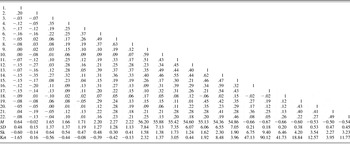
Note: Y, year; TRF, Teacher Report Form; Sk, skewness; Krt, kurtosis. Variables: 1. assigned to intervention, 2. change in parenting, 3. deviant peers Y1, 4. deviant peers Y1.5, 5. deviant peers 2.5, 6. deviant peers Y6, 7. deviant peers Y7, 8. deviant peers Y8, 9. TRF delinquency T BL, 10. TRF delinquency T Y1, 11. TRF delinquency T Y2, 12. TRF delinquency T Y3, 13. TRF delinquency T Y7, 14. TRF delinquency T Y8, 15. TRF delinquency T Y9, 16. log arrests Y1.5, 17. log arrests Y2, 18. log arrests Y3, 19. log arrests Y6, 20. log arrests Y7, 21. log arrests Y8, 22. log arrests Y9.