Introduction
Most Mexican analysts date Mexico's electoral democracy from the 2000 presidential election, which witnessed the victory of an opposition party candidate for the first time since the Partido Revolucionario Institucional (Institutional Revolutionary Party, PRI) established control over the presidency in 1929. Three presidential elections have taken place since that year, during which time Mexico has effectively become a three-party system. The Partido Acción Nacional (National Action Party, PAN) won the 2000 and 2006 presidential contests, and the PRI returned to power in 2012. In the first of those elections, the PAN defeated the PRI; in the second, the PAN barely eked out a victory against the Partido de la Revolución Democrática (Party of the Democratic Revolution, PRD), and in 2012, the PRI successfully held off a strong comeback from the PRD. Moreover, during each election, a different party came in a distant third place. In short, the case can be made that each of the three parties has performed well in two out of three presidential races, suggesting that voter preferences appear to have shifted significantly in just 12 years.
To what degree do traditional demographic variables explain the shifts in voter behaviour and voters' preferences for ideologically distinctive political parties? Have significant changes occurred among these variables which impact on voting behaviour? Are the patterns short- or long-term? Have these demographic variables been affected by institutional or technological alterations? This essay sheds light on where these voting patterns are headed during the next decade and what is likely to be their impact on the future of the three major parties. It examines voter behaviour in the 2000 and 2006 presidential elections, highlighting previous voter trends and examining differences and similarities with voting patterns occurring in 2012.Footnote 1 The following analysis reveals important continuities among the three elections, but perhaps surprisingly in such a short period of time, equally important differences, suggesting that it may be difficult to predict which voter behaviours will remain consistent and leading to a deeper understanding of Mexican presidential elections.
In spite of this caveat, we can point to several important conclusions from the two prior Mexican presidential campaigns and their impact on electoral outcomes. The most comprehensive and valuable information available from the 2000 and 2006 races is based on two extensive Mexico Panel Surveys funded by the National Science Foundation (NSF). These are surveys which evaluate the same respondents over time. Led by Chappell Lawson, Jorge Domínguez and Alejandro Moreno, and including other leading scholars from Mexico and the United States, these surveys provided detailed information on how likely voters changed their opinions through the course of the two respective campaigns, and why. Alejandro Moreno's own work, relying on both surveys, should also be consulted, as well as individual articles by other participants cited throughout the essay.Footnote 2 As Jorge Domínguez aptly concluded from his recent analysis of these campaigns,
In both elections, the principal effect of the campaign was to steer voters to the underlying factors that shape who they are and what they wish. Their experiences, preferences, networks of friends, and hopes for the future predispose them toward a political party. These sentiments and views are activated during campaigns. That is why parties and campaigns matter: the first shape the standing decisions of the electorate, and the second induce the electorate to remember those standing decisions and act accordingly.Footnote 3
The two edited volumes which present much of the data from these campaigns provide dozens of valuable insights about Mexican voters; at least four such observations can be considered relevant to the 2012 presidential race.Footnote 4
Firstly, and most importantly, campaigns do change outcomes in Mexican presidential races. For example, Vicente Fox, the PAN candidate, was behind the entire campaign in 2000 and tied the PRI candidate in the last opinion poll before the campaign terminated.Footnote 5 Insider polls revealed an important shift among voters immediately after the termination of the campaign but before Mexicans went to vote.Footnote 6 Felipe Calderón was also behind his leading opponent, Andrés Manuel López Obrador of the PRD, for most of the campaign, narrowly defeating him by a half per cent of the vote. Mexicans who indicate that they always vote for the same party have declined from 47 per cent of the electorate in 2000 to 44 per cent in 2006, and again to only 37 per cent in 2012, paving the way for candidates in presidential races to convert nearly two-thirds of voters to their cause. In 2006, slightly more than one-third of voters made their decision during the campaign or on the day of the election. In 2012, that figure increased to almost four out of ten Mexicans. López Obrador, who finished in second place, benefited most from the campaign, commanding the largest share of voters who made up their minds during the race.Footnote 7
Secondly, during campaigns, independent voters accounted for anywhere from 35 to 45 per cent of the potential voters (typically only one-fourth of Mexicans express strong partisan allegiances). Although the majority of Mexican voters express some degree of partisan allegiance, the percentage of independent voters has increased substantially in recent years, from only 19 per cent in 1994, to 31 per cent in 2000, to 36 per cent in 2006.Footnote 8 Independents form a large proportion of the undecided voters during the actual race.Footnote 9 Thirdly, negative attitudes toward a candidate tend to increase over time and produce significant shifts in voter loyalties. Negative views are extremely resistant to being altered. Fourthly, party loyalties are highly fluid in Mexican presidential races; all parties draw support from partisans of all other parties by the end of the campaign. Equally important is the fact that a large percentage of partisans at the beginning of the race have only recently joined partisan ranks.Footnote 10 In short, most voters are not wedded to any specific party beyond individual presidential campaigns.Footnote 11
Traditional Variables: What's New, What's Old
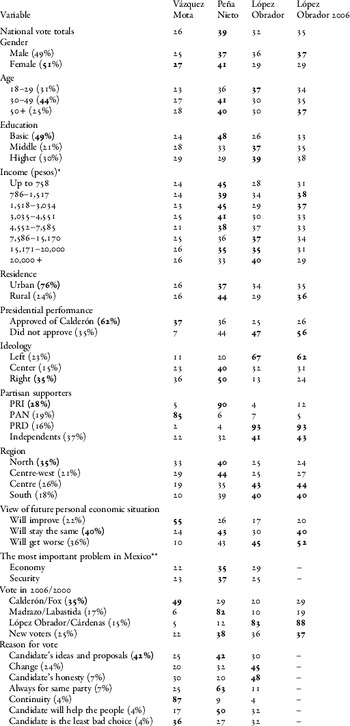
Past voter behaviour suggested that traditional demographic variables would play a significant role in the outcome of the 2012 race. The most influential variables in the Mexican case have been age, income, education and region, all of which will be analysed here (see Table 1). Gender, a variable which is often analysed in electoral contexts elsewhere and played a significant role in the outcome of the US presidential election in 2012, has essentially been ignored in analyses of Mexican presidential elections, but changes have taken place since 2009 which suggest that it should be considered along with the other four variables.
Variables and the Presidential Vote in 2012 (%)

* This question and the answers came from Parametría's exit poll, ‘Cambios de perfil en los votantes de 2006 y 2012’, 6,026 respondents, +/–1.3 per cent margin of error, 1 July 2012. Alejandro Moreno, Reforma's pollster, was not permitted to ask the standard income question.
** This question and the answers came from Consulta Mitofsky's exit poll, ‘México: 1 de julio 2012, perfil del votante’, more than 20,000 voters interviewed in 520 balloting stations, +/–1.2 per cent margin of error, 94 per cent level of confidence, 1 July 2012, p. 14.
Source: Reforma, exit poll, 3,096 voters in 80 balloting stations from 32 states and entities, +/–1.8 per cent margin of error, 95 per cent level of confidence, 1 July 2012. Courtesy of Alejandro Moreno. ‘Don't know’ answers are excluded.
For the first time in Mexican political history, one of the three major parties (ironically the most socially conservative), the PAN, chose a female candidate after a fiercely fought primary; this is a gender benchmark which has not yet been achieved in the United States. Moreover, one of the leading candidates for the PRI nomination, former party president Beatriz Paredes, was also a strong early contender until 2011. This suggests a possible shift in voter attitudes in a popular culture known for its machismo. Such attitudes toward gender also indicated the potential for affecting the election outcome.
Since 2000, gender preferences typically have not been significant on a partisan basis for the winning presidential candidate. However, gender differences have played a role in the votes cast for the losing candidates. For example, in the 2000 presidential election, women favoured the PRI candidate by 40 per cent compared to 32 per cent for men, while they were less likely to support the PRD candidate Cuauhtémoc Cárdenas, with 14 per cent compared to 20 per cent for men, on election day.Footnote 12 The comparative lack of female support for the PRD candidate continued in the 2006 election. The gender difference among male and female voters for Felipe Calderón, the winning candidate, was less than 2 percentage points. For López Obrador, however, the difference was 5 percentage points (37.3 from men compared to only 32.3 from women).Footnote 13 There is no question that if López Obrador had been even slightly more attractive to female voters compared to male voters, he could have defeated Calderón for the presidency.Footnote 14 Yet, in gubernatorial races in Coahuila and México state in 2011, shortly before the 2012 elections, women and men gave PAN, PRD and PRI candidates equal support. At the beginning of the 2012 presidential race, it appeared that women voters might play as significant a role as they did in the 2006 election, since polls indicated that Josefina Vázquez Mota, the incumbent PAN party's candidate, was attracting 20 per cent more women, while 20 per cent fewer women preferred López Obrador.Footnote 15
Two important gender voting patterns have emerged since 2000. The broadest and potentially most significant but inconsistent trend is the percentage of women compared to men who participate in national elections. In the 2009 congressional elections women accounted for 56 per cent of all actual voters, compared to 48 per cent in the 2006 presidential election and 54 per cent in the 2003 congressional elections.Footnote 16 In some states in the 2009 elections, such as Campeche, Coahuila, México and Querétaro, the difference between male and female voting reached 10 per cent!Footnote 17 Only among voters older than 64 in 2009 did men outnumber women. A fascinating historical explanation for women beginning to vote in larger percentages below the age of 64 is associated with girls growing up during the years immediately following the granting of voting rights to women at the federal level in 1953. However, in the 2012 presidential election, according to the Reforma newspaper exit poll, women voters only slighted exceeded men, in contrast to the major differences in their participation levels in the 2003 and 2009 congressional races. No explanations have been offered in the current Mexican literature as to why women would participate in far greater numbers in recent congressional, compared to presidential, elections.
The second pattern that has begun to emerge is the extent of the impact of gender on partisan preferences during a national election. The exit polls do not offer such clear patterns in female/male preferences for the candidates. Whereas the Reforma survey reveals a striking difference in support for López Obrador in 2012 between women and men – 7 percentage points, similar to his lower appeal to women in 2006 – it suggests a much smaller favourable bias among women toward Vázquez Mota and Peña Nieto. On the other hand, the Consulta Mitofsky polling firm reported a 5.9 percentage point difference in the preference of women for the female PAN candidate, and a 5.1 percentage point difference in the preference of men over women for López Obrador.Footnote 18 While the difference between male and female preferences for López Obrador was considerable in 2012, it would not have been sufficient by itself to alter the outcome in favour of the PRD. Nevertheless, gender is definitely a variable which deserves far greater attention in the future, both because women may increase their participation levels in presidential races similar to their levels of involvement in congressional elections (an issue that we need to explore much more thoroughly and accurately), and because women not only may disproportionately strongly favour a female presidential candidate in the future, but on three occasions have demonstrated a strong unfavourable reaction to a PRD presidential candidate.Footnote 19
Recent studies confirm that some biases against female political leadership continue in Mexico, but that these attitudes are on the decline. When Mexicans were asked if men in general were better political leaders than women, only one in four respondents agreed that they were. When asked in which political offices women would to a better job than men, of those who expressed an opinion, nearly half (47 per cent) agreed that women would make a better president, by far the most positive response of any political office listed. Two-thirds or more Mexicans believe a female president would improve Mexico's image, the representation of women in politics, and equality between men and women.Footnote 20 But the most important policy information we have about current gender attitudes and their potential influence on a presidential race is that Mexicans consider political corruption to be the number one explanation for the country's drug policy failures and violence, while at the same time six out of ten Mexicans believe a female president would be more effective at reducing corruption.Footnote 21
Generational differences have often played an influential role in presidential outcomes. This has been especially true of younger adults, many of them first-time voters. In the 2000 election, the 18–24 age group consisted entirely of first-time voters, accounting for 18 per cent of all voters. Half of this age group voted for Vicente Fox, who performed well among all age groups except people of 55 years of age or older, who voted disproportionately for the PRI candidate.Footnote 22 In 2006, the 18–29 age cohort accounted for 30 per cent of all voters; Calderón was able to obtain 38 per cent of this group's support. In the 2012 campaign, López Obrador beat Peña Nieto within the 18–29 age group, but only by 1 percentage point. However, similar to the 2006 race, this group accounted for only 31 per cent of the electorate, whereas the 30–49 age group represented 44 per cent of the voters, and Peña Nieto easily captured their vote compared to his two leading opponents. It is apparent from multiple Reforma surveys that the student-dominated Yo Soy 132 movement, which aggressively opposed Peña Nieto's campaign late in the election, affected the candidate's support among younger Mexicans, specifically those who were college students.Footnote 23 This movement might well have exerted a decisive influence on the outcome of the election if half of all adult Mexicans surveyed did not believe that the students were manipulated by other political actors, a party or candidate (likely those sympathetic to the PRD, though this was unexpressed), compared to only a third of respondents who considered it to be a ‘genuine’ student demonstration.Footnote 24
It is also important to consider that 12 years earlier, younger voters were particularly taken with Vicente Fox largely because, in their view and that of many other Mexicans, he represented change, specifically change from a semi-authoritarian to a democratic political model.Footnote 25 Thus Fox earned the overwhelming support of most Mexicans who considered this dramatic form of change to be what the 2000 election was all about. By contrast, the 2012 election was not about basic structural change in the political model, but rather a change in leadership from two administrations led by the PAN to an administration led by the PRI, or late in the campaign, by the PRD. Yet, despite this less radical notion of change, Peña Nieto did well among all three age groups, besting his rivals in the middle and older age cohorts, essentially tying with López Obrador for support among the youngest voters. López Obrador performed less well among the two older groups than he had done six years previously. Nevertheless, one can view Fox in 2000 and López Obrador in 2012 as representing change to college-educated younger Mexicans, who supported both candidates at levels higher than those of young voters generally.
Traditionally, one of the most influential demographic variables in presidential elections anywhere, but particularly in Mexico, is income.Footnote 26 In the 2006 presidential race, the results were strongly biased on the basis of income. Not surprisingly, Calderón, representing a right-of-centre party ideologically and a macro-economic strategy of neoliberalism, won the lion's share of support from the two highest income categories. López Obrador, representing the only left-of-centre option, the PRD – which was viewed by most Mexicans as being far to the left compared to their own personal ideological beliefs – did well among the three lower income categories, but his range of support did not vary widely among the five income categories and he split the lowest income category relatively equally among the other two candidates (see Table 2). Furthermore, Calderón was equally strong among voters in the middle income category. The PRI candidate represents extreme differences in support among wealthier Mexicans compared to those with modest incomes, who are the most likely to cast votes for his party.
Voter Support by Income for the Leading Candidates, 2006 (%)

Source: Reforma, exit poll, 5,803 voters, +/–1.3 per cent margin of error, 2 July 2006.
If we compare voter preferences by income from 2006 with those from 2012, several striking comparisons emerge from the data. Most surprisingly, the PAN candidate in 2012 essentially produced a flat response among voters based on their incomes. There was little variation in preferences for Vázquez Mota; she performed almost as well among modest income-earners as she did among the wealthiest. Equally striking is the fact that López Obrador attracted the support of the three wealthiest income groups, but even more unexpected is that he captured the wealthiest voters by a large margin – 40 per cent of this group supported his candidacy compared to only 32 per cent of all voters. Indeed, López Obrador received more support proportionately from the highest four income groups. Peña Nieto, who received 38 per cent of the national vote, received proportionately more support from the lowest four income categories, but especially from the poorest and the third-lowest of the eight income categories in Table 1. This widespread support for the PRI among lower-income Mexicans corresponds with the overwhelming preference among those voters who chose their candidate on the basis of whether he or she would ‘help people’. Apparently, higher-income Mexicans were attracted to López Obrador for reasons other than his economic proposals, probably because he was perceived as honest and as representing change.
Voters' income levels also played a crucial role in the 2006 election, but in a different fashion. It is not well-known that poor Mexicans who were beneficiaries of government anti-poverty programmes were a critical determinant of the PAN victory. In spite of the fact that López Obrador made anti-poverty policies the number one issue of his campaign in 2006, Calderón received 41 and 44 per cent support respectively from the beneficiaries of the Oportunidades and Seguro Popular programmes, compared to only 29 and 26 per cent support respectively for the PRD candidate. In the 2009 congressional elections, those Mexicans did not continue to vote in such numbers for the PAN, declining from one-third (33 per cent) of all voters in 2006 to only one-fifth (20 per cent) in 2009. Among those lower-income Mexicans who were not beneficiaries in 2009, two-fifths (38 per cent) voted for PRI candidates, nearly one-third (31 per cent) for the PAN, and only 16 per cent for the PRD (which received more than double that figure, 38 per cent, in 2006).Footnote 27 In 2012, 29 per cent of voters said they were beneficiaries of Oportunidades, and half (50 per cent) were beneficiaries of Seguro Popular, a health programme. During the 2012 campaign, when asked early in April about their attitudes toward Oportunidades and Seguro Popular, 86 and 85 per cent of likely voters respectively gave them positive ratings. Vázquez Mota should have campaigned much more strongly on Calderón's anti-poverty record given the overwhelming percentage of voters tied to these two programmes.Footnote 28 Such voters did not link her candidacy to these government programmes, and consequently, while Calderón benefited significantly from Fox's anti-poverty policies, and Francisco Labastida benefited from President Zedillo's efforts (capturing 56 per cent of programme beneficiaries, who then only accounted for 15 per cent of the electorate), income data for poorer Mexicans in Table 1 reflect no such impact on her candidacy.Footnote 29
The demographic variable most associated with income is a voter's level of education. Historically, PRI presidential candidates have done well among voters with elementary school educations. For example, such individuals accounted for 42 per cent of voters in 2000, and Francisco Labastida won 46 per cent of their votes, far ahead of the numbers Fox managed to obtain. This is a critical group because it made up half of the voters in 2012. What is striking about the results in this category is that the PRI candidate received exactly the same percentage of support (49 per cent) from this group as he did from the total electorate. The PAN and PRD candidates, on the other hand, essentially split their support from such voters. This lower educational category is also important because levels of formal education tend to impact importantly and negatively on Mexican voters’ levels of interest and knowledge in Mexico. On the other hand, voters with higher levels of interest and correspondingly higher levels of education are more likely to participate in elections. Those Mexicans who were most interested in the campaign in 2000 voted disproportionately in favour of Fox. Moreover, six out of ten students overwhelmingly supported Fox in 2000, demonstrating that he appealed not only to the youngest age group, but also to those young people who were enrolled in college or preparatory schools. Although data are not available on student preferences for the 2012 candidates, López Obrador most closely approximates Fox's appeal, performing strongest among younger voters and among the most well-educated Mexicans, just not comparatively as strongly as did the PAN candidate 12 years earlier.
Finally, region played a significant role in the voting preferences of Mexicans in 2006.Footnote 30 Both of the leading candidates performed better in each of two regions. The PAN received 43 and 47 per cent of the vote in the north and centre-west, its traditional strongholds, with figures well above its overall national support, but did especially poorly in the south. López Obrador, on the other hand, performed extremely well in the centre and the south, with 44 and 40 per cent support respectively, but did quite poorly in the north and centre-west. The regional distribution of the vote in 2012 establishes a significant pattern in that the PRD continued to underperform in the same two regions, while achieving almost exactly the same percentage of the vote from the centre and south, at 43 and 40 per cent respectively, as was the case six years earlier.Footnote 31 Initially, during 2012, the PRI candidate, Enrique Peña Nieto, essentially received equal support from intended voters in all four regions of Mexico, with slightly stronger support in the north. By election day, however, he equalled or exceeded his national vote total in three of the four regions – performing best in the PAN's traditional base, the centre-west, with 44 per cent of the vote – but was unable to achieve a comparable level of support from the centre, largely because of López Obrador's overwhelming level of support from the Federal District, which distorts centre vote totals (see Table 1). Yet, it is important to keep in mind that 56 per cent of the actual voters in 2012 came from just two regions (north and centre-west), from which Peña Nieto earned more than 40 per cent of the vote. The north, which accounts for more than one-third of all Mexican voters, is the decisive region. No winning presidential candidate has lost this region since 2000 (Fox captured a whopping 50 per cent of the vote from the north).
A variable which played a critical role in the 2006 elections, and might be viewed partially as a variation on the traditional region variable, was the performance of state governors. Mexican presidential elections are affected by what can be described as a reverse of the ‘coattails effect’ found in US politics (in which a popular party leader attracts votes for other candidates in the same party).Footnote 32 In other words, the better the performance of a Mexican state's governor, the more likely it is that a resident of that state will consider voting for a leading presidential candidate from that party. Mexican governors generally receive high approval from their residents, stronger than that of the president. In 2006, the PAN controlled nine states; on the day of the election, Calderón received 53 per cent of the vote from those states in contrast to only 36 per cent of the vote nationally. Two-fifths (41 per cent) of voters who approved of a PRI governors’ performance voted for the PRI nationally in 2006, and in 2009 that figure increased to almost half of those voters (47 per cent).Footnote 33 This is an extraordinary difference. The impact of a governor's performance, in combination with other demographic factors prevailing in the composition of voters in those states or regions where the party has historically been strongest, reinforces strong partisan biases.Footnote 34 These gubernatorial ratings reinforce regional biases already existing in the partisan distribution of regional support. Data support the importance of gubernatorial ratings as distinct from existing regional strongholds, which were a critical contributor because the PRI controlled 20 of the 32 states in 2012. In 2009, all PRI governors averaged a 70 per cent approval rating. Unfortunately, no figures for 2012 approval ratings exist, so it is impossible to calculate the precise outcome of the vote on that basis, but according to an analysis by Héctor Ibarra-Rueda, the majority of voters in 22 of the states, accounting for 69 per cent of the electorate, voted for their incumbent governor's party.Footnote 35
Non-Traditional Variables
A comparative analysis of the five traditional demographic variables offers a number of valuable insights into Mexican voting behaviour in the last 12 years. During this short period since achieving an electoral democracy, voter trends have evolved. It is readily apparent that some of these patterns are linked to all three presidential elections while others have emerged only in 2006 or 2012. The impact of poverty programmes on voter preferences according to level of income, or the influence of state governors’ popularity on regional vote distributions, suggests the importance of additional, qualitative factors on those typically more static variables. In Mexico, and in some cases elsewhere, other influences may modify or enhance the impact of the traditional demographic variables. The most influential or potentially influential factors have been social media, policy issues, presidential debates and absentee voters.
By far the most interesting contribution to the 2012 campaign was the widespread use of social media. This may have exerted a profound influence in the final weeks of the campaign, dramatically erasing the PRI candidate's runaway lead over both of his competitors and significantly increasing support for López Obrador, who moved from a distant third place in the polls early in the campaign, replacing Vázquez Mota as a stiff competitor against Peña Nieto. As suggested previously, the Yo Soy 132 movement, led by college students, exerted less influence on other voters than many pundits expected because of Mexican voters' general lack of trust in the origins of politically motivated activities.Footnote 36 What is more significant is the extent to which social media was used to communicate political ideas and interpretations to fellow citizens, and the extent to which Mexicans have access to and are currently using social media. Moreover, for the first time, we have information about social media users, whose characteristics make them a much more potentially powerful force in future elections.Footnote 37
The volume of social media users in Mexico is impressive. As the data in Table 3 demonstrate, Peña Nieto and his advisers, far from behaving like his traditional PRI presidential candidate predecessors Francisco Labastida and Roberto Madrazo, understood the importance of both Facebook and Twitter. Peña Nieto maintained a huge lead over his opponents in the category of Facebook ‘likes’, achieving more than three million just weeks before the election – nearly twice that of Vázquez Mota and six times that of López Obrador. All three candidates made equal use of Twitter, although Vázquez Mota attracted the most followers. In 2012 there were 33 million members of Facebook in Mexico, and 12 million Twitter accounts, 26 per cent of which were active. Not surprisingly, account users tend to be young and overwhelmingly urban, and have high levels of education and comparable incomes.
Social Media Followers in the 2012 Presidential Election

Note: Vázquez Mota was still a primary candidate in January 2012.
Sources: author's calculations from candidates’ accounts – exact dates were 16 Jan., 1 April, 29 May and 10 June; Eric L. Olson and Diana Murray Watts, ‘Social Media in the 2012 Presidential Elections: A Testing Ground’, Mexico Institute, Woodrow Wilson International Center for Scholars, 30 April 2012; and Alejandro Moreno, Reforma, 16 Jan. 2012.
Far more interesting than their predictable demographic qualities are the politically oriented attitudes of social media users. One of the most valuable measurements of likely voters in Mexico is their level of interest in politics. Interest in politics is generally quite low, and has been so for years. Mexico is an outlier compared to most other Latin American countries, where interest has increased in the last decade.Footnote 38 In 2011, of those who do not use social media – the vast majority of Mexicans and more than half of registered voters – only 8 per cent expressed a strong interest in politics.Footnote 39 Among Facebook members, however, half again as many were very interested in politics (12 per cent), while among Twitter users, twice as many (16 per cent) expressed that intensity of political interest. Both groups are composed of an educated elite, with 32 per cent of Twitter users and 24 per cent of Facebook members boasting a college education. On average, only 5 per cent of non-users are college-educated. Not only is their political interest much higher than that of the average Mexican, but the fact that they are far less trusting of Mexican institutions also makes them more receptive to critical interpretations of Mexican politics and electoral institutions. Strikingly, less than 1 per cent of Twitter users expressed strong confidence in labour unions, senators, police, political parties or members of Congress. Even with regard to the most respected institutions in Mexico, the universities, the armed forces and the Church, fewer than 7 per cent expressed a great deal of trust in those organisations compared to three out of ten non-users. A similar pattern can be found among Facebook users, but the gap between users’ and non-users’ trust was not as wide.Footnote 40
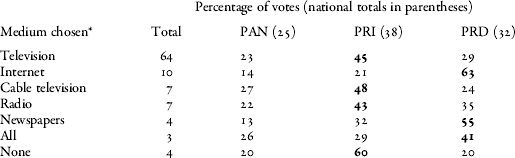
The effect that a small group of activist college students using social media can have is noteworthy, but it overshadows the more important trend characterising the dramatic growth of that medium's political use in the short period of the elections. In May, during the early phase of the election, of the 30 per cent of Mexicans who used the internet, only 12 per cent of voters used it to obtain information about the election. Less than two months later, on 1 July, 39 per cent of Mexicans were using the internet and a whopping 64 per cent of those individuals, a fivefold increase, admitted using it to obtain political information. Equally significant was the fact that Facebook, Twitter and MySpace users increased their frequency of use at an extraordinary rate, from only 7 per cent to 40 per cent daily by election day. The actual impact of internet users and other media users is reflected in the data in Table 4. Not surprisingly, Mexicans who selected the internet as the most reliable, objective source of information on the election voted overwhelmingly for López Obrador, who benefited significantly from the Yo Soy 132 movement. Although the internet turned out to be the second most influential media source of information among 10 per cent of Mexicans who voted, 64 per cent of voters chose television as their most objective source of election information (see Table 4). This overwhelming figure corresponds to prior surveys in which both Americans and Mexicans have indicated that their primary source of information about politics is television.Footnote 41 Given their proportion of the electorate, television viewers were by far the most influential group of voters that a candidate would want to attract, and Peña Nieto captured nearly half of those individuals while his opponents split the remainder. Peña Nieto also out-competed his two opponents by a sizeable margin for the next two largest trusted media sources, cable television and radio, selected by 14 per cent of voters. While López Obrador did extremely well among newspaper readers, only 4 per cent of voters relied on that medium.
How Mexican Media Users Voted in 2012 (%)
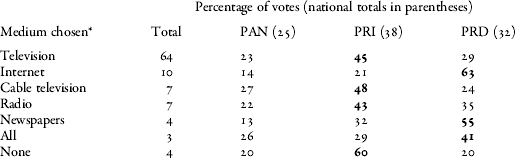
* Question: ‘Which medium provided the most objective information about the presidential election?’
Source: Parametría, ‘Uso de internet y redes sociales en la elección presidencial’, 1,474 respondents, 95 per cent level of confidence, +/– 2.6 per cent margin of error, 1 July 2012.
Regardless of where voters obtained their political information, the fact that 63 per cent of Mexicans voted in this election, the highest turnout for a presidential election since 1994, suggests that an increasing percentage of Mexicans are taking their civic responsibilities seriously even though interest in politics generally remains low. The level of participation is linked to the fact that more citizens knew the date of this election at the beginning of the race than in any previous election, and that their knowledge of that date increased 40 percentage points from February to April.Footnote 42
Analysts of electoral politics are typically most interested in how voters view the major issues during a campaign, and how those views affected their choices. Perhaps the most interesting quality that firmly links the last three Mexican presidential elections is that the central issues have, remarkably, remained the same in 2000, 2006 and 2012 (indeed, most were the central issues in 1994). Three major issues in Mexican politics exist today, just as they did in 2006: one's personal economic situation, insecurity, and unemployment. In 2012, half of all Mexicans selected these three issues combined as most important in the last 11 years. If one adds inflation, low salaries and poverty to one's personal economic situation and unemployment, economic issues alone account for almost half (47 per cent) of all responses in 2011. Today, Mexicans are nearly evenly divided between economic issues and security issues.
If we look at individual responses, insecurity was the number one response in 2012, chosen by one-third of Mexicans; this was the highest response ever given to that single issue (it was also the number one choice in 2005 and 2006).Footnote 43 This issue has become dominant because of the level of drug-related homicides since Calderón took office, exceeding 50,000 deaths during his term. In the war against drugs, citizens viewed the government's chances of winning or losing the battle against the cartels as equal as late as March 2010; by the election, however, a sizable majority (six out of ten) viewed organised crime as winning this conflict. Half or more of Mexicans perceived the government's policy direction on this issue to be mistaken in 2012, a consistent figure since 2002. The data in Table 1 indicate that Peña Nieto, not surprisingly, easily captured the votes of those Mexicans who considered the security situation in a negative light on election day. Neither of the other two candidates were competitive with the PRI candidate among voters who were oriented toward this single issue.Footnote 44
The Calderón government's perceived performance on other policy issues is also a critical variable in determining voter attitudes. For example, more Mexicans believed his administration performed badly or very badly on increasing jobs, helping rural Mexicans and combating poverty, as well as combating crime and drug traffickers. On people's personal economic situation, voter responses were more complex. In 2006, López Obrador attracted more than half of the voters who thought their personal economic situation would become worse after Fox left office. Importantly, he also received the strongest support from those Mexicans who believed their situation would remain unchanged. Six years later, however, although he continued to better his opponents among those Mexicans who thought economic conditions would worsen, he did not perform well among those who thought their situation would remain the same. Instead, Peña Nieto did extremely well among this sector of the voting population, and almost as well as López Obrador among the most economically disenchanted citizens. The PAN candidate, predictably, received strong support from those who believed their situation would continue to improve after Calderón left office.Footnote 45 Interestingly, given the criticism that Peña Nieto generated among some sources in the media for his lack of intellectual depth, he attracted significantly more voters than the other two candidates for his ideas and proposals. In contrast, López Obrador was a preferred choice among voters who wanted a change, which could have meant from PAN to PRD or, as suggested earlier, a version of the Fox voter's notion of change, in this case preventing a return of the PRI, as was the case 12 years earlier. Perhaps most surprisingly, half of all voters cast their ballot for the PRI candidate because they believed he would help people, which surely included economic improvement too; this was much higher than the number of López Obrador voters who cited this reason.
The most important group of Mexicans whose attitudes toward policy issues would be translated into more definitive voting patterns in 2012 are what Alejandro Moreno aptly labelled ‘indignant citizens’ – that is, those individuals who have been directly affected by these same three policy issues: having a reduced income, having been a victim of crime, and having lost a job. They account for between one-sixth and two-fifths (13 and 38 per cent) of the population depending on which issue one examines. More significantly, Moreno has discovered that this group's attitude has serious implications for the legitimacy of the democratic model. Specifically, only one in four Mexicans who have lost a job, who have been affected by violence or whose personal economic situation has declined is satisfied with democracy (see Table 5).
‘Indignant’ Citizens' Responses to Policy Issues (%)

Source: Alejandro Moreno, ‘Radiografía de los indignados’, Enfoque, Reforma, 7 Aug. 2011.
Democratic Consolidation, Partisanship, Electoral Processes and Institutional Legitimacy
Each presidential election since 2000 provides a critical test of Mexican attitudes toward the electoral process, and fundamentally their democratic polity. Voter surveys have also helped to explain the extent to which Mexico has or has not moved from achieving an electoral democracy to the fundamentally more complex and difficult achievement of a consolidated democracy. What is most striking after 12 years of efforts toward democratic consolidation is that Mexicans remain highly sceptical about their elections. In 2011, less than a year before the presidential election began, two-fifths (39 per cent) of citizens believed that elections in their state were not free, clean or fair, versus only half (49 per cent) who believed they were. Expressed differently, only half of all Mexicans believed that the winning candidate actually received the majority of votes. In terms of the conduct of elections, a quarter of Mexicans (24 per cent) reported that they personally, or someone they trusted, had witnessed a fraudulent action during a recent election.Footnote 46 Allegations of such behaviour, specifically that the PRI had engaged in various forms of ‘vote buying’ in 2012, became the centrepiece of López Obrador's unsuccessful formal complaint to the Federal Electoral Court to overturn the election results.Footnote 47 In the same year, 4 to 13 per cent of Mexicans indicated that a party or candidate offered them one of seven different forms of services, food or supplies, and one- to two-thirds accepted these ‘bribes’.Footnote 48 When asked if their state Electoral Institute consisted of impartial counsellors, half (49 per cent) said yes, versus a third (34 per cent) who believed it was composed of partisan members. Only half of Mexicans believed that their state Electoral Court, which rules on electoral controversies over the outcome, was composed of impartial judges. Finally, more than half of all Mexicans, the second-highest response among all Latin Americans, believe that a lot of corruption would justify a military coup in their country – a view that is seriously dangerous to the health of Mexico's democratic institutions.Footnote 49
An argument can be made that while Mexicans view corruption as a serious obstacle to Mexico's political and economic development, a significant portion of Mexicans expect elections to be corrupt whether or not that is actually the case. This belief stems in part from older Mexicans' personal experience with fraudulent elections before the late 1990s. Such attitudes are reflected in the data on honesty in Table 1. While half of all voters who on election day considered honesty the most important issue in determining their presidential choice selected López Obrador, only one in five chose Peña Nieto. Second, voting results and surveys from the two previous elections clearly indicate that those Mexicans whose candidate lost the election, specifically the PRI candidate in 2000 and the PRD candidate in 2006, believed that the election was fraudulent. A large minority of voters who fall into this category have not matured in their civic attitudes in rejecting the notion that elections can only be fair if their candidate wins. A 2012 poll by BGC Ulises Beltrán and Associates, published in Excélsior, points to a more mature electorate in that 54 per cent of all voters viewed the voting as clean, versus 20 per cent who thought it was dirty. Among those voters supporting López Obrador, half again as many (29 per cent) thought the voting was tainted, proportionately similar to 2006. Moreover, among the general population in 2012, 43 per cent still believed there was fraud in the 2006 presidential election.Footnote 50 Nevertheless, in spite of the greater level of satisfaction with the electoral process, 53 per cent expressed little or no satisfaction with democracy on 1 July.Footnote 51
Three additional conditions contributed to explaining the outcome of the 2012 election. The PRI continued to maintain, in spite of its dramatic losses in the two previous presidential races, the largest percentage of partisan supporters of the three leading parties. Among those voters who strongly identified with a political party, 25 per cent chose the PRI, 15 per cent the PAN, and only 10 per cent the PRD. Mexicans are among the least declared partisans of political parties in Latin America.Footnote 52 A miniscule number of Mexicans, 3 per cent, are formally members of any political party; they are nine times more likely to be members of religious organisations or churches.Footnote 53 Consequently, in 2012 Mexicans ranked near the bottom, only above Uruguayans and Peruvians, of those citizens in Latin America who work for a party or candidate during an election.Footnote 54
In presidential races in Mexico, where the winning percentage has been determined by only a 35 and 39 per cent plurality in the last two elections respectively, any party boasting a strong allegiance among a quarter of potential voters is in an enviable position given that it has to persuade a much smaller percentage of additional voters to support its candidate.Footnote 55 Importantly, the PRI's image changed dramatically between the 2006 and 2012 elections: from being a party with a highly negative image in the 2000 and 2006 elections, it became the only party for much of the 2012 race with a significant positive ranking if you subtracted voters' negative opinions from their positive opinions. This was a remarkable turnaround for a party that most Mexicans despised in 2000. Several months before the 2012 campaign began, the PRI led with a 14 per cent positive rating, compared to just 3 per cent for the PAN and a negative 19 per cent for the PRD.Footnote 56 When voters went to the polls they demonstrated just how important core partisanship can be in an election, since 90 per cent of PRI party partisans voted for their candidate. Only 9 per cent of PRI partisans voted for the other two candidates. López Obrador drew an even stronger turnout among hardcore PRD partisans, equal to his 2006 performance, but they were a much smaller percentage of the electorate. Such high loyalty rates among core partisans on election day have been true in the past. López Obrador did much better among PRI partisans who left the fold in 2006 than in 2012, obtaining 12 and 4 per cent of their votes in those two elections respectively. López Obrador was able to close the gap with Peña Nieto, in part because together they essentially split 84 per cent of the independent voters who accounted for 37 per cent of the electorate on 1 July (see Table 1).
Had the election timeframe been longer, López Obrador might well have been able to overcome an intensely negative image at the beginning of the race. In March 2012, nearly two-thirds of Mexicans recalled the phrase from the 2006 election, ‘López Obrador is a danger for Mexico’.Footnote 57 More importantly, a third of Mexicans continued to believe that this statement was true. At that time 45 per cent of Mexicans expressed a positive opinion of López Obrador, while an equal number, 44 per cent, viewed him negatively, leaving him with just a 1 per cent effective positive opinion.Footnote 58 By the election, López Obrador had increased that to 14 per cent. By contrast, Peña Nieto in March boasted a 50 per cent effective positive rating, which declined to only 12 per cent positive on 1 July. Interestingly, in 2006, López Obrador also began with a relatively strong 31 per cent positive perception in March, dropping drastically to only 9 per cent positive on election day. Calderón, who was viewed positively by only 12 per cent, declined to 10 per cent, almost even with López Obrador.Footnote 59 Throughout the entire 2012 campaign, López Obrador was challenged by having to overcome a hugely negative view of his candidacy. It is relevant to point out here that core PRI partisans tend to stick to their party's candidate more strongly over time. As voters indicated in exit polls in 2012, nearly two-thirds of voters who always voted for the same party cast their vote for Peña Nieto, compared to just 11 per cent of such voters who favoured his PRD opponent.
Secondly, observers who were willing to write off a return of the PRI after each of these earlier elections ignored the fact that at the local and regional level the PRI continued to dominate state legislative elections and local elections with pluralities ranging in the high 30 to low 40 percentages, thus providing the party with a strong grassroots base. Thirdly, although Mexican ideological preferences continue to be fluid, the PRI and PAN are both the likely beneficiaries of any potential linkage between ideology and voting. On a 1–7 ideological scale (with 1 being Left and 7 being Right), the average voter ranks 4.7. If we ask voters to describe the ideological placement of the three parties, the PAN averages 4.8, the PRI 5.1 and the PRD, 2.9, suggesting just how far the PRD is ideologically from the typical voter compared to the other two parties. Indeed, only 35 per cent of Mexicans described themselves as somewhere on the left or the centre ideologically in 2011, corresponding quite closely to the vote totals received by the PRD presidential candidate in 2006 and 2012.Footnote 60
Three potential contributors to the outcome of the 2012 election were the televised presidential debates, the role of absentee voters (largely residing in the United States), and the application of a new electoral law since the 2006 race. In 2000, there was ‘no question that the televised presidential debates significantly helped shift voter interest to Fox, who was viewed as a clear winner of the debates’.Footnote 61 In 2006, López Obrador made the fateful decision to skip one of the debates. As Kathleen Bruhn has argued, ‘The decision to skip the debate was a mistake. Calderón appeared statesmanlike and sensible, winning the debate handily.’Footnote 62 The NSF Mexico Panel Survey revealed that López Obrador's absence tended to confirm the PAN's portrayal of him as high-handed and autocratic. In 2012, two debates were held, one in May and the other in June. A poll in late April determined not only that there was significantly less knowledge as to when the first debate would be held compared to that stage of the campaign six years earlier, but also that citizens expressed less intense interest in the 2012 debate.Footnote 63 The only candidate who benefited significantly from the debate was Gabriel Quadri of the small New Alliance Party.Footnote 64 A month later, in the second debate, Peña Nieto held his position in the polls before and after the event, and was seen by likely voters as the overwhelming winner in that debate.Footnote 65
Scholars originally believed that absentee voters living in the United States, given the millions of Mexicans residing there, would take advantage of the implementation of a new law allowing Mexicans to vote from abroad. Since the 1990s, Mexicans have requested the right to vote by absentee ballot.Footnote 66 Surveys from the 2000 presidential race reveal that if the law had gone into effect for that election, such voters would have opted overwhelmingly for Fox. Instead, Mexicans residing outside of Mexico were not allowed to vote until 2005, just in time for the 2006 presidential race. Some predictions suggested that potentially up to a million such Mexicans might participate. Instead, only 56,749 Mexicans who were registered voters requested ballots (45,478 resided in the United States), and only 33,000 actually voted, the majority for Calderón.Footnote 67 In 2012 only 62,000 requested ballots, a minimal increase from 2006, and the majority voted for Josefina Vázquez Mota, suggesting that absentee ballots have not played an important role in Mexican presidential elections, nor will they in the foreseeable future.Footnote 68
The 2012 election was the first presidential election since 2000 where major alterations in the electoral laws were implemented. They included numerous controversial changes based on electoral experiences and complaints dating from that era. The most influential changes included: substantial cuts in public funding for elections and a significant alteration in the funding formula for each party, of which 30 per cent is an equal amount assigned to all parties and the other 70 per cent is determined by the vote totals that each party received in the previous election; parties may contribute from private sources no more than 10 per cent of the total amount that they received from the Instituto Federal Electoral (Federal Electoral Institute, IFE) in the previous campaign; parties must present regular financial and campaign reports to the IFE; and candidates may not use language in their statements about their opponents which slanders or denigrates those individuals.Footnote 69 A number of analysts have viewed some of these changes as impinging on democratic behaviour rather than encouraging it. For example, terms like ‘slander’ and ‘denigrate’ have not been well-defined, thus preventing candidates in the 2012 race from making more critical comments about their opponents’ past performance or public policy positions. This latter provision contributed to a rather bland campaign compared to the tone of the 2000 and 2006 races. It could also be argued that it may have devalued the importance of some policy positions among the candidates. While voter perceptions of policy issues (both pro and con) in the previous two elections were sharpened by the intensity with which presidential candidates were able to criticise their opponents, in 2012 such perceptions were significantly tempered.
Perhaps the most significant change imposed by the new electoral law was the 90-day campaign limit, which confined the campaign to April, May and June and was strictly enforced. Typically, the longer the campaign, the greater the opportunity for voters to alter their opinions about each candidate. The only significant alternation in the tone of the campaign occurred through the independent actions of the Yo Soy 132 movement, largely through social media (which were not affected by the new law). For example, by election day, of the 39 per cent of voters who use social media, two-fifths were posting questions daily about politics, and an additional fifth did so at least three times a week.Footnote 70 During the last two weeks of June, many voters began switching their preferences from Peña Nieto to López Obrador. There is no way to know for sure whether López Obrador might have eked out a victory if the pace at which those voters were changing their preferences had continued and the length of the campaign had been extended by as little as two additional weeks. What we do know for sure, as pointed out in the introduction to this essay, is that a significant decline occurred between 2006 and 2012 among those voters who always vote for the same party (from 44 to 37 per cent). More than one-fifth in both elections (21 and 23 per cent respectively) had already made their choice when they learned the names of the parties' candidates. During the 2012 presidential campaign, however, 38 per cent made their choice during the 90-day campaign, and one-fourth did so on the day of the election, the highest figure since 2003.Footnote 71
Conclusions
An examination of voting patterns in state and local elections since 2000 provides a preview of some of the persisting patterns in voter behaviour during the three Mexican democratic presidential elections. The most influential conclusion that can be drawn from a comparative assessment of these three elections, mirrored in hundreds of local and state election results, is the fluidity of preferences among Mexican voters. Before the late 1990s, party incumbency, dominated by the PRI, was a typical predictor of electoral outcomes, often at a level of 90 per cent victories. Mexican voters since 2000, at all levels, can be viewed as pragmatic. Only a small number can be described as expressing decisive, partisan loyalty over time to a specific party. The fluidity with which voters shift from one party to another in presidential races, and in races for other executive posts in Mexico, reflects Mexicans' desire to identify and vote for candidates who meet their expectations regardless of political party affiliation, as well as their ability since 1994 to actually influence the outcome of an election, thus ensuring that they can achieve, in sufficient numbers, their political and economic goals. Interestingly, however, it is questionable, based on case studies, that elections have affected governmental performance in Mexico, thus suggesting the possibility that the pragmatic voter may decline in the long term.Footnote 72
Over time, our analysis of demographic variables demonstrates some influential, repeated patterns, either in the importance of a given variable or, in some cases, specific longer-term tendencies occurring within each of those variables. It is clear that if women translate their disproportionate participation in Mexican congressional elections to presidential elections, they could exert a decisive influence on the outcome given the relatively narrow margins between the winning and the second-place party. Female voters harmed the candidacy of López Obrador in both elections. On the one hand, this outcome is surprising because, despite the fact that analysts of elections elsewhere have long viewed women generally as more conservative than men in their choices of candidates, a recent in-depth examination of how women conceptualize democracy in Mexico concluded that:
when gender views of democracy are compared across cultures, including a hybrid culture of Mexican Americans, based on procedural versus non-procedural conceptualizations, women were more likely than men to choose equality, progress, and respect/lawfulness over the procedural response regarding expectations of democracy … One could speculate that women, in terms of these issues specifically, feel inadequately served by democratic procedures.Footnote 73
Given the fact that in both elections the PRD stressed integrity, social justice and anti-poverty issues as the leading themes in López Obrador's campaign, one might logically expect a higher level of support from women voters. On the other hand, because he was viewed by both men and women as the most ‘radical’ or non-traditional candidate, he would likely elicit less support from female voters generally. However, his deficit in female support might well have been greater if the perceptual differences of democracy between women and men did not exist.
An analysis of voters' incomes reveals important divisions in support for presidential candidates. Unlike the gender factor, however, income levels did not produce consistent outcomes in 2006 and 2012. To no one's surprise, in 2006, López Obrador received more support from low-income Mexicans and Calderón captured high-income voters. Six years later, as has been demonstrated, López Obrador won support among two out of three high income categories, while his PRI opponent performed more strongly in the lower and middle income categories.Footnote 74 This sharp difference in voter preferences suggests that many wealthier voters were willing to place less emphasis on their own economic interests and instead likely chose a candidate on the basis of his perceived integrity and his ability to change the governing process. If this is truly the case, it suggests, similarly to 2000, that well-educated Mexicans, who make up the majority of higher-income voters, saw the PRD candidate in the same light as they saw Fox – as the candidate symbolising change – although each represented wildly different macro-economic views. It is important to emphasize that better-educated and higher-income voters will continue to increase their importance, largely because they express a higher interest in politics, and that interest is translated to higher levels of voter participation.Footnote 75
The regional distribution of the vote continues to be an influential but inconsistent variable. Fox won overwhelmingly in all four regions, but especially in the north, exceeding his PRI opponent by 13 percentage points. No other candidate since has been able to sweep all four regions so strongly. Further, Fox's performance regionally was not translated into support for the PAN nationally in 2006. Instead, what emerged regionally in 2006 was a bifurcated distribution among the two leading parties in each presidential race, with Calderón over-performing in the north and centre-west and López Obrador doing so in the centre and south. Six years later, the PRD candidate continued to do well in the centre and the south, but Peña Nieto received support above his national vote total in three of the four regions, while underperforming in the south. The only consistent regional pattern existing in all three elections is that of Peña Nieto, similar to the two previous winning candidates, capturing the north, which typically accounts for one-third of the national vote. Unlike Calderón, however, his overall regional vote was well distributed, giving the PRI broader regional strengths compared to any other party. That solid regional distribution will be helpful to the PRI in strengthening its voter allegiances in the future, leaving the party with the broadest grassroots support.
Political parties, and the partisan preferences they engender, naturally play an essential role in electoral politics. However, in Mexico, and elsewhere in the region, large numbers of citizens believe that democracy can exist without political parties. Indeed, Mexicans who hold such a belief rank at the top with Haitians, Panamanians and Hondurans, representing countries that are not identified strongly with democratic political roots.Footnote 76 Despite three competitive democratic elections, parties have not registered an increasing level of interest in becoming active members among citizens. As noted above, only a miniscule percentage of citizens are members, and only half express strong partisan preferences during elections. The distribution of those preferences among the three leading parties, despite ups and downs since 2000, remains remarkably stable, with the PRI leading the pack, the PRD at the bottom, and the PAN in the middle. Presidential elections demonstrate three long-term patterns with regard to parties and partisanship among voters. First, typically the candidates are more important than the parties in turning out voters and winning elections. In the first two elections, both Fox and Calderón more than doubled their existing partisan support, with Fox establishing a historic benchmark for the margin of voters he attracted personally beyond those who identified with the PAN. Second, López Obrador demonstrated an extraordinary ability to duplicate Fox's electoral impact, at least tripling his limited partisan support for the PRD in both 2006 and 2012. His announced decision in September 2012 to leave the PRD and create his own party introduces serious, unpredictable consequences for the PRD's future electoral influence. Third, Peña Nieto is the first candidate in three presidential races to win the election by attracting fewer voters personally and instead relying heavily on citizens who were associated with the PRI. This fact may also explain why some of Peña Nieto's demographic support is comparatively balanced; it relies more heavily on long-term, grassroots party affiliations than on the personality or attractiveness of a given candidate.
The newest and likely the most interesting and unpredictable yet persistent variable in future elections is sure to be the role of social media. The rapid growth of social media usage and the extreme levels of differentiation in attitudes toward institutions and interest in politics among such groups as Twitter and Facebook users make this a slice of the voter demographics that deserves far more attention and careful analysis. While the Yo Soy 132 movement demonstrates the potential for altering electoral outcomes in a condensed period of time, what may actually be more valuable to assess is how candidates can reach those voters and motivate them to become involved in their campaigns.Footnote 77 Because social media users are overwhelmingly college-educated and typically in a higher income category, and therefore participate in higher percentages in presidential races, they increase the importance of income and education demographics for understanding the outcomes of Mexican elections.
Policy issues provide the greatest consistency of any potential variable which might influence presidential outcomes. There is little disagreement that economic and security issues are paramount, and as suggested, together they have accounted for nearly half of the most important issues in the eyes of voters since 1994. What is more difficult to assess, however, is what characteristics among voters most drive their responses to these issues. Alejandro Moreno's efforts to shed fresh light on issue-oriented responses and their consequences demonstrate just how significant policy perceptions can become when there is a personal experience associated with economic or security issues. His conclusions are supported by the extensive surveys from the Latin American Public Opinion Project of Vanderbilt University, which reveal that statistically the most telling impact on citizens’ political attitudes regarding their willingness to dispense with democratic political models and embark on authoritarian or militarily dominated regimes is related to personal experiences with corruption and crime.Footnote 78
An analysis of traditional demographic variables in Mexican presidential elections reveals that traditional demographic variables remain significant, if not consistently so, from one election to the other. Specific demographic variables such as education, income and age are likely to become more influential in determining the outcomes of presidential races as increasing numbers of Mexicans adopt behaviours found in other, more economically advanced democracies, including the widespread use of internet technologies and social media. Given the legal setting of Mexican presidential elections, characterized by strict controls over tone and language on the campaign trail but no controls over individual internet users, and the truncated campaign calendar, social media have become a new, influential variable in the campaign that operates effectively within condensed time parameters. Their increasing use will enhance the importance of specific, traditional demographic variables, including age, education, income and urban residence. Not only have social media become a powerful tool among presidential candidates who wish to reach a large percentage of voters on a daily basis, but they have also created a newly important political actor in the campaign process, the voters, who are becoming equally adept at campaigning and therefore influencing each other.