Introduction
The family Miridae is a large group of bugs with over 11,000 species (Cassis and Schuh, Reference Cassis and Schuh2012). Several mirid species are highly polyphagous herbivores (Allen et al., Reference Allen, Luttrell, Sappington, Hesler and Papiernik2018), and these tend to be agricultural pests (Wheeler, Reference Wheeler, Schaefer and Panizzi2000; Allen et al., Reference Allen, Luttrell, Sappington, Hesler and Papiernik2018). Their ability to feed on multiple host species makes predicting invasions difficult (Kennedy and Storer, Reference Kennedy and Storer2000). Nevertheless, effective pest management requires the species-specific behavioural mechanisms that underpin their host associations, and drive their movement, to be understood (Walter, Reference Walter2003).
The most important functional aspect of host use by herbivorous insects, in general, is the way in which the insects recognize and localize plants upon which to feed and oviposit. Host recognition not only is likely to influence the movement of insects across crops, but is crucial to understanding the use of multiple host species by generalists (Bernays, Reference Bernays2001; Walter, Reference Walter2003). Despite the generally acknowledged importance of host recognition, the functional aspects of the foraging ecology of many mirid species (and polyphagous pests in general) remain elusive (Walter, Reference Walter2003).
One challenge for testing the ability of insects to recognize and process information is interpreting what information is detected as the insect approaches a plant (Bernays, Reference Bernays2001). Some stimuli may encourage insects to move towards hosts (attraction), whereas other stimuli encourage individuals to stay near hosts after they chance upon host plants (arrestment) (Kennedy, Reference Kennedy1978). These responses are not mutually exclusive, so each needs to be investigated for the relative role of these behavioural processes.
The role of particular stimuli in the host localization process is influenced by the way they are recognized by insects (e.g. visual and olfactory cues), and the distance across which they can be recognized (Bernays and Chapman, Reference Bernays and Chapman1994). Visual stimuli provide information about the location of plants that attract insects towards hosts (Kennedy, Reference Kennedy1978; Bernays and Chapman, Reference Bernays and Chapman1994), but several insect species, however, will land on either host or non-host substrates in equal frequencies when substrates are of similar colour (Finch and Collier, Reference Finch and Collier2000). This suggests that visual cues alone are not used to discriminate among host species.
Blends of volatiles from plants provide olfactory stimuli that insects can use in the recognition and localization of appropriate hosts (Bernays and Chapman, Reference Bernays and Chapman1994; Rajapakse et al., Reference Rajapakse, Walter, Moore, Hull and Cribb2006; Bruce and Pickett, Reference Bruce and Pickett2011), but in the field, turbulent airflow may make it difficult for insects to achieve this successfully (Cardé and Willis, Reference Cardé and Willis2008). It is likely that the influence of olfactory cues may increase in relative importance after insects arrive within several centimetres of a host (e.g. Döring and Chittka, Reference Döring and Chittka2007; Döring Reference Döring2014), at which point olfactory stimuli may arrest insects before they leave the vicinity of the plant (Kennedy, Reference Kennedy1978).
The design of experiments that examine behavioural responses to olfactory stimuli must be able to discriminate among behaviours that result in the attraction of insects towards the source of an odour cue and the arrestment of insects within the odour field (Kennedy, Reference Kennedy1978). The most frequently used tests of olfactory responses by insects to airborne odours involve pumping odour-laden air past insects confined in an olfactometer apparatus or wind tunnel, but these techniques alone may not be well suited to measure arrestment responses (Kennedy, Reference Kennedy1978; Barbosa-Cornelio et al., Reference Barbosa-Cornelio, Cantor, Coy-Barrera and Rodriguez2019).
The behaviours through which bugs evaluate hosts after alighting on them are relatively far better understood than those relating to arrestment. With respect to mirids, Lygus individuals evaluate the chemical composition of substrate surfaces by repeatedly tapping their antennae briefly onto the surface where they stand (Hatfield et al., Reference Hatfield, Ferreira and Frazier1983; Backus, Reference Backus1988). They also ‘dab’ their mouthparts onto substrates to apply saliva that breaks down plant cells (Backus, Reference Backus1988). When they imbibe the resulting saliva-plant slurry, they are able to evaluate the internal chemical composition of host tissues (Miles, Reference Miles1972; Avé et al., Reference Avé, Frazier and Hatfield1978; Sharma et al., Reference Sharma, Khan, Subrahmanyam, Raman, Taylor and Fletcher2014). Once a potential feeding site has been identified in this way, the Lygus individuals conduct a series of test probes with their stylets into the plant tissue before settling into feeding (Miles, Reference Miles1972; Backus et al., Reference Backus, Cline, Ellerseick and Serrano2007). These relatively stereotyped responses have been observed across several studies for several Lygus species (Hatfield et al., Reference Hatfield, Ferreira and Frazier1983; Backus, Reference Backus1988), which suggests that chemosensory mechanisms are central to the host evaluation process. How universal this process is across mirid species in their host acceptance behaviours after their arrival at plants remains unclear.
Creontiades dilutus is an endemic Australian mirid that is hosted by several crops, including cotton (Gossypium hirsutum) and pigeon pea (Cajanus cajan) (Lawrence et al., Reference Lawrence, Tann and Baker2007; Wilson et al., Reference Wilson, Whitehouse and Herron2018). The bugs typically feed on soft terminals and reproductive tissues (flowers and young bolls), and even low numbers of these bugs on cotton can cause substantial crop loss (Bishop, Reference Bishop1980; Chinajariyawong, Reference Chinajariyawong1988). Most cotton-growers in Australia now also plant pigeon pea as a refuge crop as part of an insecticide resistance management strategy targeting lepidopteran pests (Doyle and Coleman, Reference Doyle and Coleman2007; Wilson et al., Reference Wilson, Downes, Khan, Whitehouse, Baker, Grundy and Maas2013). These refuges are required to be planted within 2 km of transgenic cotton (CRDC, 2019), and cotton and pigeon pea on the edge of fields can be within 1 m of each other.
The movement of C. dilutus adults back-and-forth across cotton and pigeon pea is often inferred (e.g. Lawrence et al., Reference Lawrence, Tann and Baker2007), but the degree to which they do so and the mechanisms by which they recognize and settle on host plants have not been investigated. When evaluating insect movement patterns and their associated host localization behaviour, assessments should be made at the time of day during which the subject insects are typically active. However, reports about the typical activity period of C. dilutus adults in the field are contradictory. Active surveys for C. dilutus are typically conducted during the day, with most bugs collected from hosts during mid-morning and mid-afternoon (Bodnaruk, Reference Bodnaruk1992). Traps that intercept flying individuals, by contrast, catch most bugs at night (Lowor et al., Reference Lowor, Del Socorro and Gregg2009; Hill, Reference Hill2013). Therefore, any assessment of movement patterns must first clarify the diel period during which C. dilutus adults move about the environment.
The general objectives of this study were, therefore, to identify the activity period of C. dilutus adults, for this is when host localization would typically take place, and then to determine the degree to which they are attracted to, and arrested by, olfactory stimuli from cotton and pigeon pea hosts. The specific hypotheses tested, based on what is known about the host-associated behaviour of these bugs (as reviewed above), are as follows: (i) individuals are most active at night, and (ii) attraction and arrestment olfactory cues are used to recognize and localize host plants.
Materials and methods
The behavioural responses of C. dilutus individuals to cotton and pigeon pea hosts were evaluated in three related experiments. The first experiment evaluated the temporal activity of bugs in relation to the presence of potted host plants. The second evaluated the attraction to, and arrestment of, bugs by olfactory cues, when visual stimuli associated with potted host plants were obscured. These bugs had unrestricted movement within a cage, and were given enough room to fly or walk to host substrates. The third experiment evaluated the attraction and arrestment of bugs, at close range, to leaf discs of each host within Petri dish arenas. The size of these arenas limited the distance available for flight, but the walking path of individuals could be monitored in detail (see below). Also, C. dilutus populations typically have a 50:50 sex ratio and both sexes feed on plants (Khan et al., Reference Khan, Gregg and Mensah2009), so no attempt was made to assess sex-specific response differences. These last two experiments were conducted during the period of peak bug activity identified in the first experiment.
The aims of these experiments were to evaluate the temporal activity patterns, response types (attraction and arrestment), as well as the spatial scale over which bugs respond to stimuli. Examining the relative strength of attraction and arrestment across cotton and pigeon pea by C. dilutus individuals was beyond the scope of this study.
Insect collection and maintenance
Adult bugs were collected from lucerne (Medicago sativa) crops planted in Gatton (Queensland) using a sweep net. Insects were reared in a laboratory maintained at 25°C in 47.5 × 47.5 × 93 cm cages. They were fed green beans (Phaseolus vulgaris) and ears of sweet corn (Zea mays). Adult females also laid eggs in these plant tissues, so the beans and corn were transferred to separate cages every 2 days. After hatching, bugs were reared into adults. Only the first generation of adult bugs were used in experiments (see below).
Temporal activity and host associations
Adult bugs were introduced, individually, into cages (47.5 × 47.5 × 93 cm) containing either cotton, pigeon pea (both flowering) or control treatments (without hosts, see below). Host treatments included a potted plant placed in the middle of the cage. The plants touched the top of the cage, but not the sides. Each plant was enclosed by nylon mesh netting (Diamond Econetting, Melbourne, Victoria, Australia) (4 mm2 aperture) to prevent the bugs from entering the foliage, and becoming hidden to the observer. Bugs could, nevertheless, feed on leaves by inserting their stylets through the apertures in the mesh, and they readily did so. For an individual to be judged as feeding, the insertion of their mouthparts into the plant tissue had to be directly observable. Control treatments did not contain host plants. Instead, steel ring stands enclosed in netting were included to provide bugs with a substrate about the size of the net-covered hosts, to assess their behaviour in response to the physical structure alone. In all treatments, individuals could stand either on the cage itself or on the central netting that enclosed the hosts or ring stand.
Creontiades dilutus individuals to be used in experiments were collected from lucerne crops, because these insects cannot yet be reared continuously in large numbers in the laboratory. They were fed sweet corn prior to the start of experiments. Ten C. dilutus adults were introduced per cage for each trial, with three trials per treatment, and bugs were used only once. They were introduced at 1400 h, and monitored hourly from 1500 h (10 min observation periods) until 2400 h (inclusive). This monitoring period (1500–2400 h) was chosen because it encompassed periods associated with published reports of high capture rates of C. dilutus adults in the afternoon (Bodnaruk, Reference Bodnaruk1992) and evening (Lowor et al., Reference Lowor, Del Socorro and Gregg2009).
Cages were located within a laboratory maintained at room temperature (about 20°C) and illuminated by natural light from windows. Cages were set up away from walls, which allowed the observer to view all sides of the plant without disturbing the bugs. The cage was lit by ambient sunlight through a window during the day, and the room darkened naturally as the sun set (between the 1800 and 1900 h observations). The lights in the room were not used at all.
At each observation period, the location of each bug (on the cage or central netting) and activity (motionless, walking or flying) were recorded. Walking was scored only if they covered more than 1 cm at the time of assessment, because this amount of adjustment in the location of individual bugs was unambiguous across the hourly observation periods, and it was similar to the scale used for the Petri dish observations (see below). Flight was infrequent and lasted <1 s when it occurred, so was not included in the analysis. For bugs on hosts, any insertion of their stylets into plant tissues through the mesh, which was readily observable, was also recorded. At night, observations were aided by a handheld red LED lamp. Preliminary observations detected no changes in bug behaviour in the presence of red light.
The numbers of bugs walking on the cage were statistically evaluated using a generalized linear mixed model (GLMM) using binomial errors. Binomial responses were recorded as either 1 (walking) or 0 (not walking), and statistically evaluated using the R statistical software (R Core Team, 2017) following the guidelines of Crawley (Reference Crawley2013). Host treatments (cotton, pigeon pea and control), time of day and their interactions were all included as fixed effects. To account for multiple observations of the same individuals (repeated measures), the specific trial was included as a random effect. Similar GLMM evaluations were conducted for the number of individuals on the central netting.
Additional post hoc evaluations were conducted to assess if the observed bug behaviours were associated with the daytime periods of observations or those at night. Observations conducted prior to sunset (1500 through 1800 h) were illuminated by natural sunlight, whereas after sunset (1900 through 2400 h), the bugs were in near darkness. To help assess if C. dilutus adults were more active in the dark, a secondary GLMM evaluation was conducted in which the ‘time’ factors were replaced with ‘darkness’. Post hoc multiple comparisons (Tukey's honest significance tests, in the ‘multcomp’ library (Hothorn et al., Reference Hothorn, Bretz and Westfall2008)) were used for pairwise evaluations of each host treatment.
Host attraction and post-alightment behaviours
Creontiades dilutus adults were individually introduced into cages (475 × 475 × 475 mm) containing either a single cotton or pigeon pea plant, or cages with both plant species (one plant of each). Each flowering potted plant touched the top of the cage, but not the sides. No netting was placed around the host plants. A single bug was gently released, from an aspirator tube, onto the bottom of the cage (n = 30 per treatment). For individuals to reach the foliage, they would have to fly or walk upwards. Alternatively, they could walk upwards on the sides of the cage or up the plant stem.
The observation room was in complete darkness, except for a red LED lamp. Each individual was observed continuously for 20 min after release. Observations occurred from 1900 through 2400 h, because the results of experiment 1 (above) indicated that this is when the bugs were most active. It was not possible to take a video recording of such small bugs in the large cages in the dark, but the specific behaviours (e.g. antennal waving, walking) of each bug, as well as its position relative to the host plants, were noted by the observer. When two plants were present, the identity of the plant species with which it made physical contact was also noted.
To test if bugs physically touched the plant (e.g. landed on a leaf) more than expected by chance, independent statistical evaluations were completed for each of the three treatments. The first two treatments in which bugs were introduced to a single host plant were evaluated by Exact Binomial Tests (with one-directional hypothesis testing). These evaluations tested the prediction that there would be a greater proportion of bugs that initially touched host plants, relative to those that did not physically contact the plants. The third treatment, with both cotton and pigeon pea plants, was evaluated by a χ2 goodness-of-fit test (with a Yates's correction for continuity). This tested if there were differences in the proportions of bugs that touched cotton, pigeon pea or that did not contact either host.
Behaviour in the close vicinity of hosts
The previous experiment qualitatively assessed bug responses to cotton and pigeon pea, but the large size of the arena made it difficult to quantify the movement path of each bug when it was near the host plant. Therefore, bug responses to host leaf discs were observed in smaller arenas, so that movement patterns could be evaluated at a spatial scale appropriate for assessing whether: (1) C. dilutus individuals respond to plant leaves by changing the orientation of their movement when they are near different host species, and (2) the bugs remain longer near leaves of particular host species.
Responses to host plant leaf discs by C. dilutus adults were evaluated by introducing one individual per observation period into arenas. The top of the arena consisted of a large inverted Petri dish (14 cm diameter, 2 cm height). The bottom comprised fiberglass fly screen (5 mm aperture) overlaying a laminated grid (2 × 2 cm cells on white paper) to help record the precise location of the bug as it moved about the arena. A host treatment consisted of two leaf discs (one cotton, one pigeon pea, each 1.8 cm diameter) placed 5.5 cm apart between the fly screen and the laminated grid beneath it.
Leaf discs were cut from mature (but non-senescent) leaves, immediately prior to the start of observations. The fly screen separating bugs from leaves allowed for the transmission of olfactory cues, but obscured visual and tactile cues. Individuals could touch the leaf discs by inserting their mouthparts through the screen. Control treatments did not contain plant material. Responses in control treatments were evaluated in relation to ‘focal cells’, which were defined as the same grid cells as those with leaf discs in host treatments.
Individual bugs were released into an arena and observed continuously for 20 min. All trials were conducted in the dark between 1900 and 2400 h, with observations aided by a red LED lamp. It was not possible to capture bug responses with video because they moved from its field of view (e.g. when they moved from the bottom to the top of the arena). Bug responses were therefore recorded in real time by quietly dictating behavioural observations, as well as the location of each bug on the grid, into a voice recorder with a built-in timer.
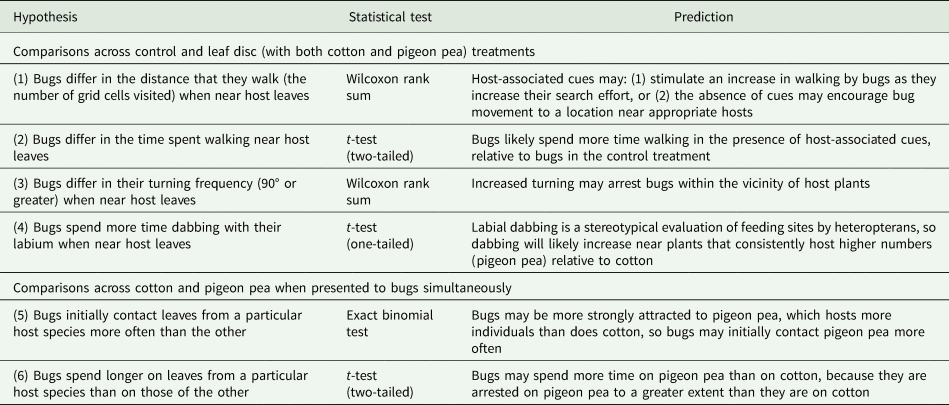
Several hypotheses were independently evaluated in this experiment (table 1). Hypotheses 1 through 4 addressed differences in behaviours of C. dilutus individuals across host and control treatments (i.e. leaf discs and the corresponding control focal cells). The exact distances walked by individuals could not be measured, so the extent of exploration was measured as the number of grid cells visited and the time spent at each cell. The term ‘walking’ was preferred over ‘host searching’, because walking implies movement to new locations without attributing motives to the insects. Hypotheses 5 and 6 evaluated the relative differences in behavioural responses to each host when cotton and pigeon pea leaf discs were presented simultaneously. The number of bugs that made physical contact with leaf discs was relatively low, so Hypothesis 5 was further examined by evaluating whether bugs initially arrived within 1 cm of cotton or pigeon pea (using an exact binomial test), even if they did not initiate feeding.
Comparisons of Creontiades dilutus behaviour in the presence of cotton (which hosts relatively low bug numbers in the field), pigeon pea (which hosts relatively high bug numbers) and a control treatment (without hosts)

The specific statistical evaluations used are also included in table 1. All hypotheses except number 4 (labial dabbing) evaluated differences in responses across treatments regardless of the relative direction of change in the magnitude of responses. In contrast, labial dabbing is how several mirid species evaluate the gustatory cues of host plants (Backus, Reference Backus1988), so there was no a priori reason to expect an increase in labial dabbing when host stimuli were absent. Each treatment used to test Hypotheses 1–4 had 30 replicates. Not all bugs made physical contact with leaf discs, so Hypotheses 5 and 6 had 20 replicates.
Leaf discs likely release a different suite of volatiles than do intact plants, and the volatiles may saturate the relatively small Petri dish arenas to a greater extent than the larger mesh cages. To help overcome the limitations of leaf disc trials, the proposed conceptual model of host localization by C. dilutus bugs (in the discussion) will integrate the observations from all three experiments described above (which include whole plants covered in netting, whole plants without netting and leaf discs only).
Results
Temporal activity and host associations
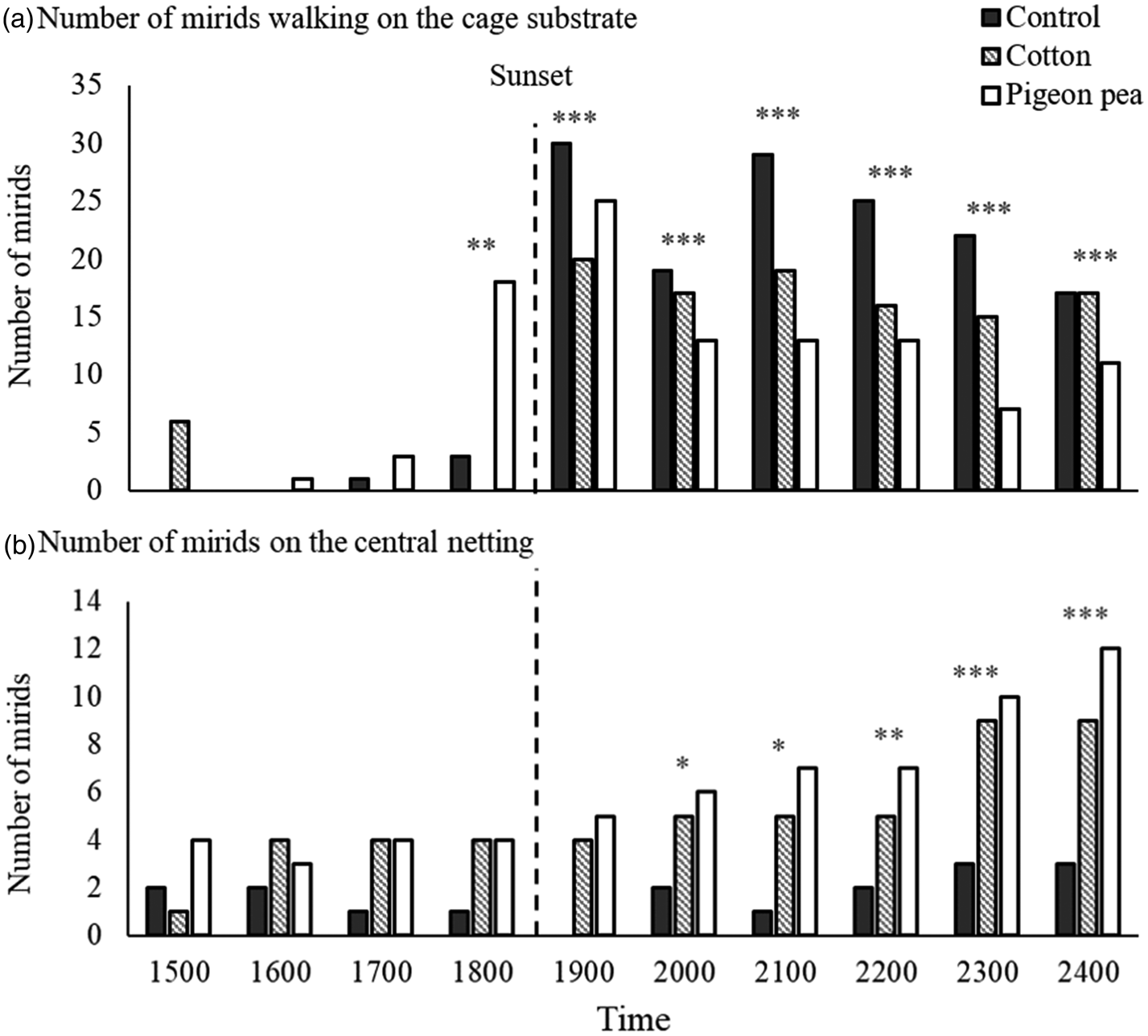
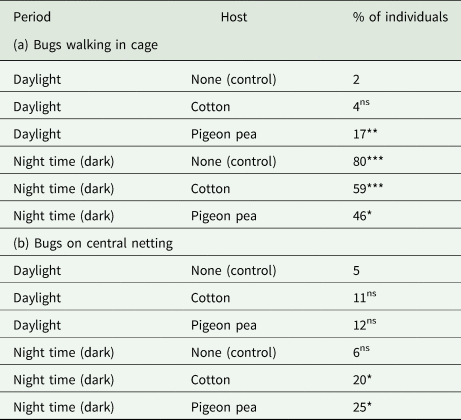
Creontiades dilutus individuals monitored between 1500 and 2400 h (inclusive) were clearly and consistently most active after sunset, and were significantly more active in control treatments (across all time periods) relative to either host plant species (fig. 1a, table 2). When data from the day and night periods were pooled, no statistically significant interaction effects with host treatments were detected (table 2). Diurnal bug activity was low overall with relatively high bug activity only in the pigeon pea treatment (table 2), and reflects an increase in the number of bugs walking immediately before sunset (fig. 1a).
(a) Hourly observations of the number of Creontiades dilutus individuals walking on substrates (cage surfaces, central netting) in control, cotton and pigeon pea treatments. (b) The number of individuals landing on central netting around the host plants or the steel stand (in the control treatment). Cages were exposed to natural light with the dashed vertical line indicating the time of sunset (1820–1840 h). No additional light was provided after sunset. Asterisks represent statistical significance for time periods compared against the initial number of individuals responding (walking or on netting) at 1500 h (P-values: *** = 0.001, ** = 0.01, * = 0.05; GLMMs (described in the text); n = 30 per host treatment).

Proportions of Creontiades dilutus individuals responding to host plant treatments (blank control, cotton and pigeon pea) in relation to daylight (1500–1800 h) or night time (1900–2400 h) periods

Statistical significance was independently evaluated for: (a) the number of bugs walking in the cage, and (b) the number of bugs retained on the central netting by using a GLMM for repeated measures (glmer (bug response ~ host treatment × time period + (1 sample), family = binomial)). Differential responses by bugs were judged against values from control treatments run during daylight. There were three trials per host plant treatment, each with ten bugs (a total of 30 bugs per treatment). Statistical significance: P-value <0.05 (*), P-value <0.01 (**), P-value < 0.001 (***) and non-significant (ns).
Relatively few bugs arrived on the central netting that covered host plants or the control structures (fig. 1b) (compare against fig. 1a). The numbers of bugs that landed, and remained on the netting, continued to increase from 2000 h until the end of the observation period at 2400 h. There were significantly more bugs on the netting with host plants than on the control structures when the time period data were pooled for statistical evaluations (table 2).
Individuals that landed fed on cotton and pigeon pea leaves through the netting. Bugs were inferred to have remained on the central netting if they were found within 1 cm of the same location on the netting during successive checks. Two bugs were even observed at their same feeding sites after 9 h, until dislodged at the end of that night's trial. In contrast, the bugs on control netting were usually walking slowly, and were almost never observed at the same location during the following observation period.
Host attraction and post-alightment behaviours
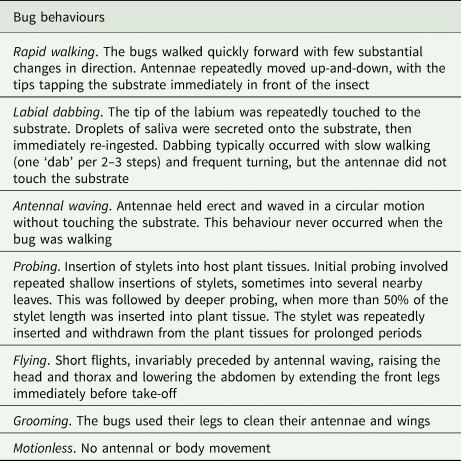
Creontiades dilutus adults displayed seven distinct behaviours when introduced to cages containing cotton and pigeon pea (when plants were not covered by netting) (table 3). The duration of specific behaviours was not recorded, but most movement to new locations involved the insects walking rapidly, or intermittently taking a few steps, and then dabbing their labium on the substrate. When dabbing behaviours were viewed in profile, the reingestion of the droplet of saliva was clearly visible. Flying was relatively rare.
Behaviour of Creontiades dilutus individuals in cages containing either cotton, pigeon pea or both plants together

There was no evidence that bugs were actively attracted by olfactory stimuli to either host species. In single-host treatments, only 27% of bugs touched cotton plants, and 13% touched pigeon pea (both Exact Binomial Tests were non-significant, cotton: P = 0.997, pigeon pea: P = 0.999, n = 30 per treatment). Only 40% of individuals introduced to treatments that had both host species in the same cage made physical contact with plant substrates. Bugs in the two-host treatment did not touch either host more frequently than expected (n = 30, cotton: 23%, pigeon pea: 17%, Yates's χ2 = 4.48, df = 2, P = 0.774). The experiment that simultaneously presented both host plant species to bugs was designed to test if one host was relatively more attractive than the other host, so no attempt was made to compare treatments statistically with a single host (cotton or pigeon pea only) against the treatment with two hosts. All individuals continuously tapped their antennae on cage substrates while walking rapidly, and dabbed their labium when walking in broad zig-zag trajectories. When bugs did arrive within 2 cm of leaves, they paused momentarily, reoriented towards leaves, then almost immediately stepped onto the plant. Across all treatments (cotton, pigeon pea, both hosts simultaneously), each individual dabbed its leaf substrates, then inserted their stylets into the plant tissue (27%, n = 90). Most individuals remained on the leaf with which they initially made contact, but on two occasions bugs moved to a nearby leaf. All individuals on leaves began pumping their bodies up-and-down, while their stylets remained inserted into hosts.
Behaviour in the close vicinity of hosts
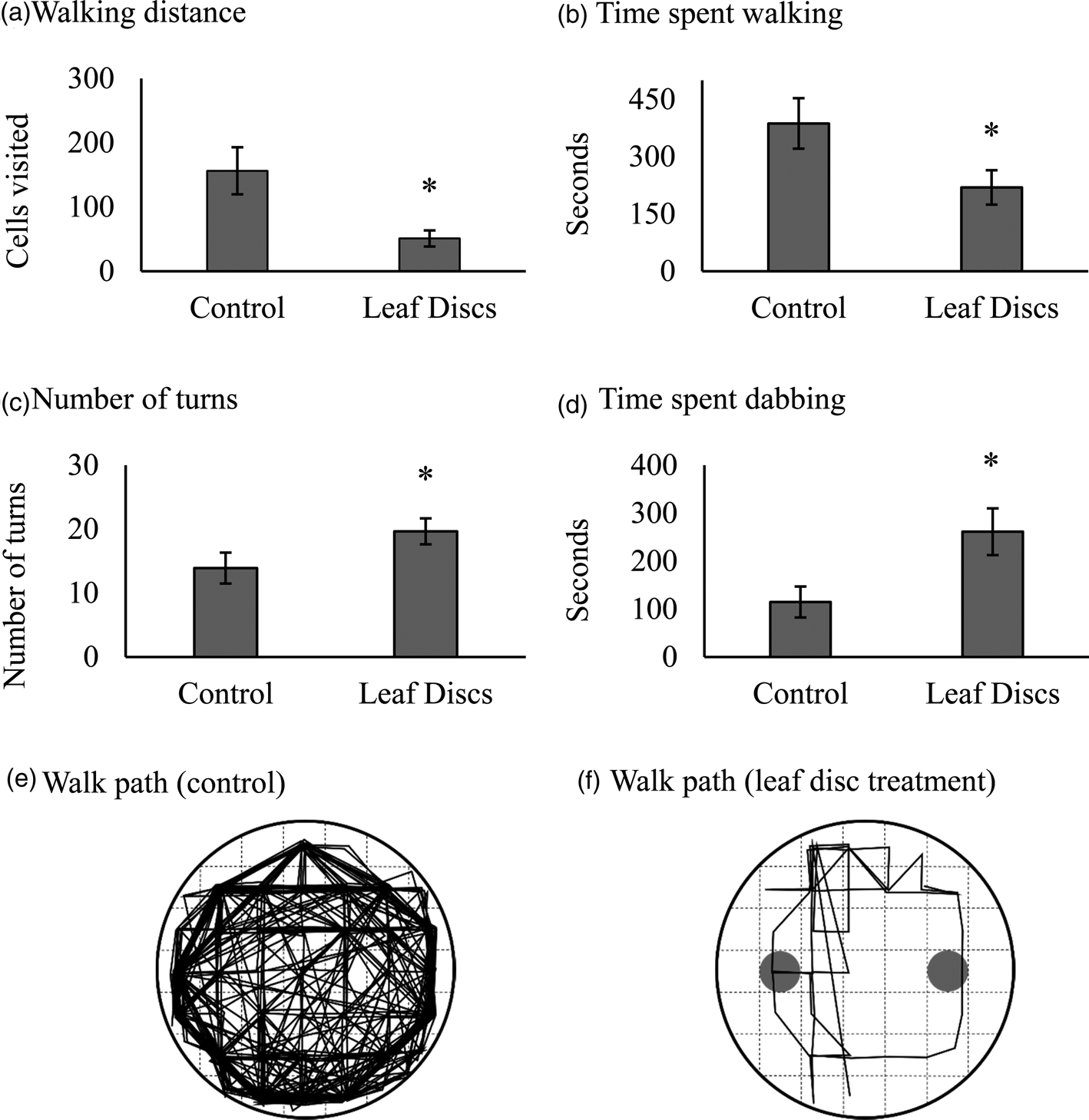
In respect to the hypotheses described in table 1, substantial differences were evident in the behaviours of C. dilutus individuals exposed to leaf discs relative to those in control treatments without leaf discs. Bugs exposed to cotton and pigeon pea walked shorter distances (W = 203.5, P < 0.05, Wilcoxon rank-sum test) (Hypothesis 1) and spent less time walking (t = 2.10, df = 1, P = 0.044, two-tailed t-test) (Hypothesis 2) than those bugs in control treatments (fig. 2a, b) (see Supplementary material for walking path of all bugs). In general, bugs in control treatments tended to continue walking in the same direction, with only slight turns as they approached the vertical side of the Petri dish. Individuals in leaf disc treatments, in contrast, would turn at least 90°, and change their direction of travel relatively frequently (W = 303.5, P < 0.05, Wilcoxon rank-sum test, fig. 2c) (Hypothesis 3). The presence of leaf discs was also associated with an increase in the time spent labial dabbing by bugs, relative to those in control treatments (t = −1.90, df = 1, P = 0.039, one-tailed t-test, fig. 2d) (Hypothesis 4). This relative increase in dabbing was even observed for individuals that never touched leaf substrates.
Mean measures of behaviours ( $ \bar{ x}$ ± 1 SE) of Creontiades dilutus individuals within Petri dish arenas containing leaf discs (cotton and pigeon pea) or a control treatment (without leaf discs) within a 20 min observation period. The behaviours evaluated included: (a) walking distance (number of cells covered, see text), (b) time spent walking, (c) turning frequency (changes in body orientation of at least 90°), and (d) time spent dabbing at the surface of the dish. Each behaviour was statistically evaluated separately with a Wilcoxon rank-sum test (a, c), a two-tailed t-test (b), and a one-tailed t-test (d) (n = 30, P-value <0.05 (*)). Typical examples of the walking paths of individual bugs (solid line) were included for the control (e) and leaf disc treatments (f) (where the grey circles are the locations of the leaf iscs (see text)).

Stylet insertion into leaf tissues was rare (three individuals for pigeon pea, two for cotton), so no statistical evaluations comparing the relative number of bugs probing each host were possible (Hypothesis 5). The low frequency of physical contact between bugs and hosts was similar to the results of the experiment that evaluated bug responses to whole plants (see previous section). Twenty bugs, including those that probed hosts, came within 1 cm of cotton or pigeon pea leaf discs. There was a statistically significant difference in the identity of host species that bugs initially approached, with 90% of individuals first arriving within 1 cm of pigeon pea leaf discs (χ2 = 11.25, P < 0.001, exact binomial test). There was no evidence that bugs spent more time at either cotton or pigeon pea leaf discs (Hypothesis 6).
Discussion
Experiments that included either whole plants or leaf discs each had fewer bugs walking around their enclosure, relative to the corresponding control treatments without plants (figs 1 and 2, table 2). In contrast to the observations of non-oriented movements by bugs, there was no evidence that olfactory cues attracted bugs to whole plants under netting, whole plants without netting or leaf discs until bugs were within 2 mm of the plants. The results presented above provide the basis for developing an initial conceptual model for the host localization behaviour by C. dilutus bugs for subsequent testing. Core to this model is that: (1) bugs are more likely to respond to host plants during the diel period in which they are typically active, (2) host-associated attraction (insect movement towards plants) using olfactory cues, which may be typical of most herbivorous insects, may play relatively little role in the localization of particular host plants by C. dilutus individuals, and (3) the responses of individuals with respect to their host associations may include non-oriented movement (arrestment) in respect to specific plants.
Conceptual model of host localization by Creontiades dilutus
The readiness with which insects respond to visual and olfactory cues is also influenced by their circadian rhythms (Hardie et al., Reference Hardie, Gibson, Wyatt, Woiwod, Reynolds and Thomas2001; Saunders et al., Reference Saunders, Steel and Lewis2002). The time of day and night influences the internal physiological state of individuals, which, in turn, restricts host localization behaviours (and movement, in general) to specific periods (Hardie et al., Reference Hardie, Gibson, Wyatt, Woiwod, Reynolds and Thomas2001). The results presented in this study reflect behavioural experiments conducted at night when C. dilutus individuals are most active in the field (fig. 1, table 2), while minimizing the influence of visual stimuli (experiments conducted in the dark and/or with mesh netting covering plant substrates). This allowed interpretations of movement patterns by C. dilutus individuals that distinguished between non-directional arrestment responses and directional responses that lead to the attraction towards host plants.
Creontiades dilutus bugs frequently moved about their cages and Petri dish arenas at night, but there was no evidence of oriented movement beyond 2 cm towards whole flowering plants (fig. 1, table 2), host attraction and post-alightment experiments, or leaf discs (fig. 2). The lack of oriented movement towards whole cotton plants by C. dilutus bugs has also been reported by Khan (Reference Khan1999), who noted that it took 2–3 h for caged individuals to land on potted cotton hosts before laying eggs. In the results presented above, bugs walked farther and for a longer time in treatments without plants (the control treatment) relative to host treatments (with cotton and pigeon pea). They also turned more frequently and dabbed at substrates with their mouthparts more often in host treatments than in the control treatment. The host plants in each experiment were visually obscured by netting and/or dark conditions, so the behavioural differences observed across control and host plant treatments were likely a response to olfactory cues by the bugs.
Creontiades dilutus bugs are found across arid Australia (Hereward and Walter, Reference Hereward and Walter2012; Hereward et al., Reference Hereward, Walter, Debarro, Lowe and Riginos2013b) where vegetation is sparse for much of the year (Nano and Pavey, Reference Nano and Pavey2013). The increased movement of bugs in the absence of plant volatiles (fig. 2) likely contributes to the dispersal of bugs across the landscape when hosts begin to senesce. These bugs are also found in cotton crops, usually in relatively low numbers, but often in higher densities when these plants have developing fruits (Cappadonna et al., Reference Cappadonna, Miles, Hereward and Walter2018; CRDC, 2019). The relative increase in their turning frequencies in the presence of plant volatiles may arrest bugs near specific host plants at appropriate phenological stages. This may, in part, explain why C. dilutus bugs are clustered at particular locations across farms with abundant host species (e.g. cotton) (CRDC 2019). The role of arrestment cues on their dispersal patterns, however, has not yet been directly tested in the field.
Typically, short movements (within 1 m) that are not clearly oriented towards a specific target are called trivial flights, but this terminology has been criticized for implying that these ‘trivial’ movements are unimportant (Hardie et al., Reference Hardie, Gibson, Wyatt, Woiwod, Reynolds and Thomas2001). Individuals of some bug species are known to undertake short flights at intervals, and these may result in bugs landing on multiple plants in the nearby vicinity of one another (Kennedy, Reference Kennedy1965; Finch, Reference Finch, Miller and Miller1984; Bernays and Chapman, Reference Bernays and Chapman1994). That mirids do the same comes from observations on Lygus spp. (Miridae) frequently take flights that last <5 s (Blackmer et al., Reference Blackmer, Naranjo and Williams2004), and remain within 1.5 m of plant foliage (Muller and Stern, Reference Muller and Stern1973; Rancourt et al., Reference Rancourt, Vincent and Oliveira2000), but again further tests are required.
Also, diet analysis has shown that C. dilutus bugs in the field routinely move back-and-forth across different hosts growing several meters apart (Hereward and Walter, Reference Hereward and Walter2012; Hereward et al., Reference Hereward, DeBarro and Walter2013a). Direct observations in the field are not available, but in laboratory settings, their movement is arrested when exposed to host volatiles within 47 cm of host plants (i.e. the width of the cage), but only directly approached leaf substrates without turning away when within 2 cm. Collectively, this suggests that the ‘trivial flights’ of C. dilutus bugs that bring individuals near multiple plants are commonly occurring components of their host localization process, and likely function in association with their arrestment by plant volatiles.
Once C. dilutus individuals touch a surface of a plant or cage, they evaluate substrates in a similar manner to that of Lygus spp., which includes tapping their antennae and dabbing their mouthparts onto substrates (Cervantes et al., Reference Cervantes, Backus, Godfrey, Akbar and Clark2016). These behaviours are associated with the evaluation of feeding sites after mirids alight onto host substrates. Touching substrates with their antennae allows individuals to assess chemical cues associated with the surface of plants (Chapman and Bernays, Reference Chapman and Bernays1989; Chapman, Reference Chapman2003), and re-ingesting saliva that has broken down plant cell walls evaluates the internal chemistry of host tissues (Sharma et al., Reference Sharma, Khan, Subrahmanyam, Raman, Taylor and Fletcher2014). The clearest evidence of discrimination among different host tissues by Lygus bugs has been demonstrated with observations of them once bugs touch plants with their mouthparts (Avé et al., Reference Avé, Frazier and Hatfield1978), but the evaluation of hosts is a multi-stage process that begins before physical contact between insects and plants (Bernays and Chapman, Reference Bernays and Chapman1994; Hardie et al., Reference Hardie, Gibson, Wyatt, Woiwod, Reynolds and Thomas2001). It is notable that C. dilutus individuals increase the time spent dabbing in treatments with host plants, relative to the control treatment without plants (fig. 2d), which suggests that host evaluation by means of dabbing behaviour is stimulated by the presence of plant volatiles.
Conclusions and research directions
In summary, C. dilutus individuals are most active at night, and are not attracted by olfactory cues to pigeon pea or cotton beyond 2 cm. In contrast to the relatively short distance that C. dilutus bugs use olfactory cues to orient their movement towards host plants, olfactory cues arrest the movement of these bugs across distances of several centimetres. The arrestment of movement, and the subsequent retention of bugs to the area near host plants, may stimulate bugs to further evaluation of feeding sites at that location. There was no evidence of bugs discriminating between cotton and pigeon pea hosts using olfactory cues prior to alighting on hosts. The recognition of olfactory cues that change the movement patterns of insects without leading to the oriented movement towards specific plants appears to be characteristic of other phytophagous mirids (particularly with Lygus spp.) (Blackmer and Cañas, Reference Blackmer and Cañas2005; Backus et al., Reference Backus, Cline, Ellerseick and Serrano2007; Cervantes et al., Reference Cervantes, Backus, Godfrey, Akbar and Clark2016). If mirid species, in general, recognize suitable hosts only after arriving at specific plants, this may explain why many mirid species have a relatively large taxonomic host breadth (Wheeler, Reference Wheeler, Schaefer and Panizzi2000; Allen et al., Reference Allen, Luttrell, Sappington, Hesler and Papiernik2018) despite being found in high densities only on a relatively few host plant species (Cappadonna et al., Reference Cappadonna, Hereward and Walter2019).
Supplementary material
The supplementary material for this article can be found at https://doi.org/10.1017/S0007485320000322.