

INTRODUCTION
As Donald Black (Reference Black2018:4–5) wrote, the spousal relationship – domestic structure – can be divided into four categories: close democracy with the least social distance and the most intimacy between the partners, cold patriarchy with so much inequality and social distance, and, between these two extremes, we can see loose anarchy and soft hierarchy.
In Iran, like anywhere else in the world, this classification can somehow be seen. The highest level of domestic violence would be found in familial relationships with cold patriarchy. In most cases, these marriages occur without previous dating or love between the couple. The community, economic or social problems have an important role in such marriages. The husband dominates his wife, and he is the leader of the family. He assigns his spouse’s tasks, and he is the “law” that his wife and children must obey. Violence is one of the common means of exercising power in the family and forcing a woman to follow the husband.
Surely, a question arises as to why a woman enters a relationship characterized by bullying and violence? A look at the family, social and economic status of this woman before marriage simplifies the answer. This is mostly because her family has been economically, socially and culturally weak and unable to support her, and, hence, she has married to obtain social and economic support. Moreover, sometimes, her family itself has chosen her husband as well.
When violence reaches a saturation point, and the woman commits murder to get rid of it, she has done what any person in the community may do if she were in her position. However, the only words that describe her condition are: “the unluckiest killer” and “the most rejected victim.” When her husband was torturing her, the law and community attitudes were also influential in its repetition. When the law punishes her, the community attitude is also influential in her punishment. Therefore, it can be stated that in the victim–husband–power dynamics, society and the law contribute subtly to her victimization and then to committing the homicide.
DATA AND METHODS
This study was conducted by the qualitative method. The complexity and multifaceted nature of the phenomenon under study and the cultural context, and the consistency of the nature of the subject and method with the research objectives and questions, allowed adopting a qualitative and also a grounded theory approach.
Data were collected by studying 20 judicial documents and deep interviews with 20 female victims of domestic violence who committed domestic homicide and were convicted and sentenced to the death penalty (upon request of the victims’ families) by the courts in the Fars (Persia) province from 2010 to 2017. This province, located in the south-west of the country, is one of the five biggest and oldest metropolitan areas of Iran. Its capital is Shiraz.
The average age of female homicide perpetrators was 33 years old. One of them had a bachelor’s degree and was a teacher when committing the homicide. Three had a diploma degree and were housewives. Others had primary education and were housewives as well. None of them had a strong, educated, rich, or socially influential family. They were coming from families with traditional habits and behaviors, mostly from rural or small urban areas. The average marital relationship period was 15 years. Two of the homicide victims – husbands – had a diploma; one had an associate’s degree, and others had a primary education degree. Three were low-ranking employees, and others were workers or did not have any specific job.
REASONS FOR DOMESTIC HOMICIDE
A Persian proverb says: The fate of a girl lies in her mother’s lap. That is, the role she accepts as a girl from her childhood time builds or destroys her future life. Some researchers express this in the language of sociology: “studies of gender stereotypes in young children show that they attribute greater power to males and helplessness to females” (Martin and Ruble Reference Martin and Ruble2010:358). Others pay attention to the role of social context, degrees of modernity and religious view on gender development (Gerhards, Schafer, and Kampfer Reference Gerhards, Schafer and Kampfer2009:526–7).
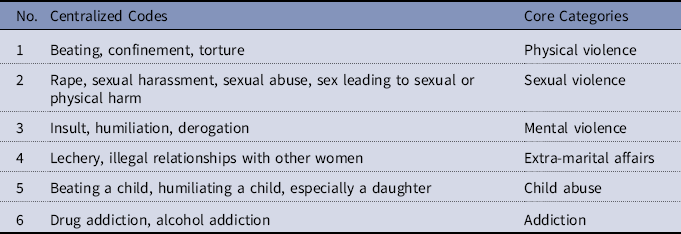
Gender socialization – role – may make a man permanently domineering and a woman submissive because it makes women’s personality calm, sensitive, emotional and dependent, and makes men determined, independent, firm and violent. Therefore, male aggression and violence against women seem normal. However, the aggression and violence by a man against his wife can reach its limit, and, if exceeded, the most difficult situation will exist. In other words, the threshold of tolerance for the victim of violence – a woman – is predetermined. Each of the women in this study experienced several types of violence, such as sexual, physical, mental, and other types of violence, all of which will be discussed below (see Table 1).
Centralized Codes and Core Categories of Reasons for Domestic Homicide by Interviewees

Physical Violence
All of these women had repeatedly experienced physical violence in their marital life. It can be stated that physical violence had been an aspect of their marital relationships; in other words, physical violence, beating and torture had been the tools of the man’s conversation with his wife. Roque, a convicted woman, said: “Whenever he got in trouble at work or out of the house or quarreled with neighbors, he would beat me hard when he came home. He was just looking for an excuse to beat me.”
Fatima said: “I was used to beating. It was part of the routine of my life. If he was, sometimes, kind to me, I was sure he had made a terrifying plan for me.”
Sexual Violence
Although talking about sexual violence is not easy for most women, the findings show that when a woman speaks of this type of violence by her husband, she does not mean merely sexual violence but sexual violence that has resulted in psychological, mental or physical harm.
Rubab said: “From the beginning of our marital relationship, in the sexual relationship, he never treated me like a human being. He never took my emotional and sexual interests into consideration and had sex with me whenever he wanted, even with severe force. I always cried during sexual intercourse. He also had sex with me regularly during my menstrual period, so that I had colon cancer due to the repeated anal sex.”
Samira said: “Sometimes, when I disagreed with him, he would harshly harass me sexually.”
Addiction
Addiction, whether it is drug or alcohol dependence, disrupts the life of both the addicted person and his or her family. It results in economic deprivation for the family, the abandonment of the job by the addict, and failure to find a job again. Above all, addiction isolates the addict, and even his family. Data show that all of these issues are observed in the studied cases.
Shore said: “His addiction caused financial problems for my children and me. I had worked hard to provide the home furnishings, and he sold them all to provide for his drugs. Because of extreme poverty, I used to do people’s household chores to make ends meet, and he would take it from me by force.”
Farinas said: “As a result of the addiction, he was very malevolent and constantly argued with our neighbors and relatives. This caused others to turn away from us. We were really isolated. Of course, if we did not pay for the drugs, he did fight and beat us.”
Tahirih said: “He was over-consuming drugs and alcohol. As a result, we did not have any prestige in the neighborhood. My children could not find a marriage partner for themselves, because when the other party heard about their father, the relationship broke off.”
Illegal Sexual Relationships With Other Women
Another cause of domestic homicide by wives is the illicit sexual intercourse of men with other women. As the data show, this relationship is not limited to a love affair. The man has sex with many women and brings them home. Sometimes, the wife has also witnessed this relationship.
Roque said: “My husband had sex with many women, phoned them and set up appointments, and then, he brought them home when I was not there. Several times, when I came home unexpectedly, I saw him having sex with a woman. In response to my protest, he beat me severely.”
Halima said: “He brought them home after he realized that I was aware of his sex with other women, and, in response to my protest, he beat and threatened me severely.”
Mental and Emotional Violence
This type of violence involves the husband insulting, humiliating and showing distrust of his wife. It also includes ignoring, deliberately and consciously, her emotional and psychological needs. The men not only did not want to concentrate on the needs of their wives, but also deliberately humiliated and rejected them.
Hadis said: “He always said: ‘You are miserable and defenseless. So, I can easily kill you.’ He was always controlling my behavior and locking me in the house. Even though he had sex with other women, he suspected me. Once, I was speaking with a seller at the market. He came over and then insulted me and also the seller.”
Samira said: “He was mistreating my mother. When I warned him, he insulted and threatened to imprison us – my children and me – at the house.”
Child Abuse
The physical, mental and emotional health of a child is very important to her/his mother. Children are one of the couple’s common points, making both of them responsible for the family. In the case of abused women, their children were among the reasons for their responsibility, despite the husband’s repeated violence. Child abuse includes physical, sexual, emotional, and psychological abuse. However, in this study, there is gender abuse rather than sexual abuse.
Rubab said: “He beat my daughters so much and fought with them, so that they threatened me to commit suicide. ‘If you do not kill him, I will kill myself,’ my older daughter said.”
Roque said: “Once, he beat my daughter so much that she lost control of her urine and self-esteem. He hated our daughters as if he did not want to have a daughter.”
CORE CATEGORY OF REASONS FOR DOMESTIC HOMICIDE: LACK OF LEGAL AND SOCIAL PROTECTION OF FEMALE VICTIMS OF DOMESTIC VIOLENCE
At the selective coding stage, the goal is to find the core category and then create a network of major categories of reasons for homicide by female victims of domestic violence, and there must be an acceptable theoretical order. By studying the subjective and objective reasons, it can be concluded that the main reason for the murder, in this study, is the lack of legal and social protection for the women.
Reasons such as insulting, beating, sexual abuse, addiction and so on all fall under the main reason of lacking legal and social support for the female victims of domestic violence. They could not get divorced from their husbands due to strict divorce regulations and the lack of family and social support. Under Article 1133 of the current Iranian civil code, divorce is divided into three types:
-
(1) A man has a right to get divorced from his wife by submitting a divorce petition to the court whenever he wants, but he has to give her the half of his property;
-
(2) Agreed divorce: when a couple finds that they cannot continue living together, they agree to get separated. The female victims of violence cannot get divorced by this method because their husbands do not want to recognize the problem. Samira said: “When I spoke about the necessity of separation, he was angry and told me: You have to be in this house until your death.” It seems that in these cases, while the man as such gives himself the right to do whatever he wants with his wife, he does not consider her right to a good choice, and finds it impossible to agree with his wife;
-
(3) Divorce at the request of the woman: the wife retains the right to divorce in the marriage contract. If she cannot live with her husband for several reasons, including the husband’s addiction and violence, she must submit her petition for divorce to a court for a judicial divorce.
These women were from the weak or completely traditional classes of society. They could not insert the right to divorce as a stipulation in the marriage contract because of their lower status, as they did not have any evidence that the court recognized as supporting filing a divorce lawsuit against their husbands. Sometimes, courts rejected their lawsuit, ruling that they did not have any definite evidence. This is because a lawyer in the divorce procedure did not represent them either due to a lack of financial independence or lack of knowledge about the right to legal aid.
Salma said: “My divorce case was under review in the court for about a year, but eventually, my petition was rejected because I supposedly did not provide any convincing evidence.” She continued: “During this time, I was always under pressure from my husband. I had only an old mother who could not help me.”
Rubab said: “I had little education and no knowledge of the divorce process. On the other hand, I could not get a lawyer because I did not have enough money. I could not ask for help because my husband was hurting me. During the divorce process, he broke my hand and discouraged me from going to court. The court eventually dismissed my case because I did not provide any evidence. My husband destroyed the evidence. He would lock me up at home until the marks of the beating disappeared on my body.”
As Donald Black wrote (Reference Black1976:29), the weaker the people, the less they can use the law. A woman without social support cannot get help from the law. If she is in a good situation, or has a strong family or protector, she gets separated from the abusing man. She can provide evidence against him. However, if she is completely dependent on him and has no shelter, except for her husband’s house, how can she be independent of her only sponsor and file a lawsuit against him? Here, Black’s point (Reference Black and Black1990:74–6; Reference Black, Zahn, Brownstein and Jackson2004:145–9) applies that, even in today’s society, the abuser ultimately acts as if he is the law when there is no law.
NATURE OF DOMESTIC HOMICIDE COMMITTED BY FEMALE VICTIMS OF DOMESTIC VIOLENCE
The study of these women’s cases shows that they were convicted of murder, and they must be sentenced to the death penalty as the retaliation. However, the avengers of blood (the victim’s family) cannot kill, i.e. retaliate against, the killer but must file a complaint to punish her. After sentencing the killer to retaliation, the death sentence is execution by hanging.
Article 381 of the Penal Code of Iran (2013) prescribes: “The main punishment for murder is a death sentence as a retaliation – Qisas [an Islamic term interpreted to mean ‘retaliation in kind,’ ‘eye for an eye,’ or retributive justice] – if the victim’s family requests so, and with the existence of other conditions prescribed by law.” As it is obvious, the crime of murder and other crimes against physical integrity originally had a private aspect under this law. If the victim or his family does not request retaliation against the offender, the death penalty will not be exercised. Article 347 requires: “The avengers of blood may pardon the killer freely or compromise with him by getting a property or any other thing at any stage of the prosecution, adjudication or enforcement of the sentence.” In this case, the killer will be sentenced up to 10 years in prison by the court for the public aspect of the crime under Article 612.
These rules came into existence after the Islamic Revolution (1979). The Penal Code was last amended in 2013, but it included a very small amount of amendments to the religious regulations.
The Penal Code is rooted in Islamic jurisprudence, which, after the 1979 Islamic Revolution, replaced the penal code of 1918, a code amended in 1974 during the Pahlavi 57 years’ rule. Article 170 of the code provided that: “In a murder case, the perpetrator shall be sentenced to the death penalty, unless otherwise provided by the law.” The comparison between these two laws shows that the post-revolutionary legislator regarded human physical integrity as a private value, while the former law considered it a public value.
This has led to different types of responses in the legal systems before and after the revolution. In the Pahlavi period, the response to murder was the state response by sentencing the convict to the death penalty. In the Islamic Republic, instead, the response to this crime is for the victim or his family to take revenge with the judiciary’s involvement.
The initial question is, did these women really commit murder? Their legal case and the contents of the interviews show that they intended to kill the abuser and had long thought of the tools, such as poison or rope, to kill him. For example, one of them says: “To kill him, I put a sleeping pill in his coffee. When he fell asleep, I threw a rope around his neck. Then, I told him: ‘Today is the day that I have to take revenge on you,’ and I strangled him.”
Therefore, the killing appears to be consistent with the definition of murder in Article 290, section (a), that provides: “A person commits murder whenever the perpetrator intends to kill a certain person or persons or a person or persons from a certain group or community by doing something, and the desired or similar result will be achieved.”
POSSIBLE DEFENSES
The next question is why these women cannot invoke a defense. Duress is one of the defenses in the code, but this defense is not acceptable for murder. Article 375 provides: “In murder cases, duress cannot be invoked as a defense.” On the other hand, under Article 149, mental disorder must completely undermine the will of the defendant, so that she cannot be held responsible. Thus, the concept of diminished responsibility has not been recognized in current Iranian criminal law.
The only defense that can be reviewed in these cases is self-defense. It appears that some of the legal requirements for self-defense are common in many legal systems. For example: to successfully claim self-defense, the defendant must prove four elements: first, with exceptions, that he or she was confronted with an unprovoked attack; second, that the threat of injury or death was imminent; third, that the degree of force used in self-defense was objectively reasonable under the circumstances; fourth, that he or she had an objectively reasonable fear that he or she was going to be injured or killed unless he or she used self-defense. Article 156 of the code requires the defendant to prove these terms to invoke self-defense, but, it has also emphasized that, for a self-defense to be accepted, it should be proved that the defendant did not have access to or assistance from the police.
These conditions have precluded proving or even raising the claim of self-defense in the cases of killing husbands by female victims of violence and rape. The first criticism is that the killing is accepted as a legitimate defense if it simultaneously occurs as a response to an attack. What makes this condition impossible to accept is whether a woman is physically capable of resisting an aggressive man, or, at least, whether average women have the same physical strength as men to defend themselves. Confirming this, one of the killers, Roque, said: “Once, I was breastfeeding my baby, my husband came, and after stabbing me in the neck, he violently raped me; then, he went away. I did not have any reaction. I was never able to defend myself.”
As others said: “In cases of female homicide of an abusive partner, the killing does not necessarily occur at the moment of greatest threat, mainly because women are generally not physically strong enough to overcome male assailants. The killing may occur minutes later, when the woman has recovered from the immediate attack enough to equip herself defensively with a weapon. It can even take place weeks or months later, in the face of less serious assault or argument that triggers the fatal attack” (Motz Reference Motz2008:217). Confirming this belief, Shaina says: “In the last violence occurred, my husband grabbed my throat and pressed it hard for a long time, so that I could no longer breathe. Then, I decided to kill him at a suitable time, and a month later, I killed him.”
Therefore, it seems that the immediacy requirement in self-defense means that there should be equality of weapons: physical and psychological equality or, ultimately, being equipped with a weapon or firearms. However, in the absence of physical equality, which woman is always armed in her home? How does she know if and when the abusive husband will attack her, immediately or moments later?
Another critical issue regarding the terms of legitimate defense is that killing someone in self-defense must be the only way out. Here, to better understand this issue, the story of three women must be told. Amine told the first story: “During the ten years that my husband abused me, I repeatedly tried to leave him. The court rejected the divorce request, because it believed that I had not provided strong reasons. My husband also did not agree with our separation. I did not have parents with whom to take refuge. No person or entity helped me either because they were afraid that my husband would sue them for interfering with others’ privacy or, at least, assault them.” The second story was told by Hora: “When I talked to him about divorce, he beat me severely and kept me in the house so that no one would see the effects of the beating on my body. My parents were unable to help, and I did not have any evidence that he had abused me.” The third story is Samira’s: “I only have an old mother. To get rid of the constant violence and abuse, I decided to get divorced, but the court held that I did not have sufficient evidence. When I got home, my husband burned my hands and feet with a car lighter.”
As these stories show, although the women repeatedly tried to end the relationship, they could not do it, neither socially nor legally. What can be done when an abusive husband forcibly keeps his wife in the spousal relationship, and the law does not adequately protect her? What other solutions does this woman have? As stated, the decision to break up and end a relationship is sometimes even more dangerous than staying (Mahoney Reference Mahoney, Fineman and Mykituk1994:60).
It should not be forgotten that private and family relationships are of particular value in all societies, and that the concept of “family” and “privacy” can be seen as a barrier to law, police and law enforcement intervention and assistance. Thus, the victim and her family are usually reluctant to seek help from the police, and, sometimes, the police are unwilling to intervene (Amini and Farajiha Reference Amini and Farajiha2016b:83–5; Dugan and Apel Reference Dugan and Apel2005:719–20; Felson, Messner, and Hoskin Reference Felson, Messner and Hoskin1999:942). Previous research in Iran also confirms this (Amini Reference Amini2015; Amini and Farajiha Reference Amini, Farajiha and Farajiha2016a).
Although only a minority of people in a community have a sense of sympathy, compassion and support for a woman who has committed a domestic homicide, claiming to have been abused, tortured, or injured for a long time, the claim of self-defense is an exceptional situation. There is no legal white card that includes people who are in harmful relationships that have caused them to engage in designated and predictable homicide (Parliament of New South Wales 2012:12). It seems that, in all of these cases, we are faced with an ordinary person who first thinks of herself. Hence, in a dangerous relationship, she thinks of saving herself. As women’s life stories show, this ordinary person will examine all the methods to end the spousal relationship, but in the last step, she chooses the “killing option” as the “last resort.”
Several questions may arise in these women’s cases. Is only the life or limb (physical health) of a human being to be respected? Or is his/her mental state to be respected and protected as well? Can a mother kill her abusive husband to prevent further harm to her children? Hatred and fear are extremely strong in a woman who has been repeatedly abused by her husband throughout her marital relationship. Her physical and emotional pain evokes bitter memories of being in a marital relationship with an abusive man – as their life stories say – and fearing that, whenever possible, her husband would inflict greater harm on her and her children. An Iranian proverb says: “A burnt child dreads the fire.” These two feelings are human instincts to protect oneself. Reason or logic does not erase them. Here, we are faced with fear and hatred of a “reasonable woman” with all the physiological and psychological characteristics of women, not of a “reasonable man” with all the men’s physiological and psychological characteristics.
Some writers accurately state that the legal standards for self-defense were constructed from a male perspective and kept men in mind. Thus, the immediacy principle makes no sense when the provocation takes the form of long-term abuse (Priestly Reference Priestly1994:148–9). Thus, one of the important points that the law neglects in the context of legitimate defense is that the defendant killed the violent husband (attacker/aggressor) to prevent further psychological and spiritual harm to herself. Thus, the notion of psychological self-defense proposed by Charles Ewing (Ewing Reference Ewing1990:582–4; Motz Reference Motz2008:218–19) may be considered. He believes that battered women who kill are very worn out; they are struggling to survive. However, in fully patriarchal or semi-patriarchal cultures, women are part of a man’s belongings and possessions under the male dominion. Hence, it is very difficult to apply criminal law defenses to domestic homicide by women unless we completely change the judges’ masculine minds into neutral minds.
EVALUATION OF FORMAL AND INFORMAL RESTORATIVE APPROACHES AS RESPONSES TO DOMESTIC HOMICIDE
It can be argued that peaceful coexistence must be one of the essential elements of a plural society. Iran is a country of ethnic, linguistic and religious diversity. Since ancient times, this diversity has led to a peaceful coexistence of individuals and groups. One of its most important tools is to seek a peaceful resolution for disputes and criminal cases. This culture has its roots in ancient Iranian history.
Zoroastrian teachings sought to spread rationalism in Iranian society. According to these teachings, one must exercise peace and justice, and Iranians shall behave with tolerance and reconciliation in their relationships with each other, other nationalities and religions (Elahi Reference Elahi2009:52–6). Also, “In the pursuit of worldly bliss and paradise on earth, a man, a family, a nation, and a country cannot reach it alone, because people from all parts of the world are interconnected like the chains” (Doustkhah Reference Doustkhah2006:46). This strong tendency of the Iranian people to philosophical rationality helped them grasp the idea of pantheism slowly (Iqbal Lahoori Reference Iqbal Lahoori and Aryan Poor1999:15). Based on these ideas, Iranians would solve their problems and those of others (Fry Reference Fry and Rajabian1979:450). These ideas were repeatedly expressed in different Zoroastrian scriptures as if it is the people’s first duty to hold public peace and avoid conflict. “Every person must accept a rule/etiquette that advocates disarmament and public peace in the world and must abide by his acceptance and avoid harm, aggression and pugnacity” (Doustkhah Reference Doustkhah2006:12).
Although Iran’s social and cultural system was destroyed and suffered greatly after the Arab invasion and subsequent numerous foreign invasions and wars, these ideas are still largely used for resolving disputes and issues on crime (Elahi Reference Elahi2009:66). In ancient Iran, until the end of the Sassanid Empire (224–651 CE), which coincided with Iran’s Arab occupation and the imposition of Arab and Islamic culture on Iranians, murder was a public crime punished by the government. However, replacing the Iranian legal system with a fledgling Arab–Islamic legal culture that was the product of primitive Arab tribal customs and Islamic thought, homicide came to be considered a private crime that was responded to by the victim’s family, with the permission of the ruler of Islamic society.
Since the Koran advises Muslims to pardon the killer in a murder case, the Iranians got this opportunity, and in order to prevent vengeance and future killings, they applied the culture of peace and reconciliation in most murder cases.
Under the current penal code, homicide is a crime that, in addition to being against public order, is also against a private right. Thus, the victim’s family has the right to seek the death penalty or reconcile with or forgive the offender. Then, most of the people, groups, or communities try to help the parties reach reconciliation in order to prevent the death of the offender. So, we must first review the role of this culture in the informal restorative responses, and then its role in the formal and governmental restorative responses in domestic homicide cases.
This culture has certain rituals and practices among Iranian sub-cultures and ethnicities. For instance, in Kurdish provinces such as Kermanshah, it is called “peace on blood” or “peace on killing” (Khoon Solh); among Lor ethnics, “stop of killing” or “stop of blood” (Khoon Bass; Razavifard, Moradgholi, and Zarghami Reference Razavifard, Moradgholi and Zarghami2010:229–30), and among Arab ethnics and tribes, “ending antagonism or hostility” (Fasl) (Atashene and Irani Reference Atashene, Irani and Frajiha2016:555). These terms are rooted in a time when groups and communities advocated for collective responsibility and sought to repair damaged relationships (Gavrielides Reference Gavrielides and Gavrielides2012:17–19). Therefore, the above groups, due to their very simple and close relationships and common practices among themselves, still largely adhere to their practices.
Mediation (practiced by the head of a village or a family) and reconciliation in even the most severe criminal cases such as murder have been seen in other provinces of Iran (Amini Reference Amini2015; Mousavi and Aliabadi Reference Mousavi, Aliabadi and Farajiha2016:783–5). Some studies show that, even in large provinces like Fars, there has been a great deal of reconciliation in murder cases (Amini Reference Amini2015). The author’s research (Amini Reference Amini2015) shows that the status of reconciliation and mediation differs in the case of killing husbands by women from other killing cases. The first cause appears to be related to the nature of the perpetrator’s behavior, previously planned murder, and intent like in cold-blooded homicide.
Usually, in murder cases committed with a previous plan (cold-blooded homicide), neither the victim’s family tends to confront the killer or his/her relatives, nor do the mediators tend to mediate. While most casual and emotional killings (hot-blooded homicides) are easily resolved and end in reconciliation, sometimes, even the judges and judicial officials postpone and delay proceedings, hearings or executions to give the killer more time to reconcile with or satisfy the victim’s family (Amini Reference Amini2015).
As mentioned in the previous section, these women killed their husbands according to previous plans. Such a murder generally shows the brutality and cruelty of the perpetrator and makes the victim’s family much more wretched. Also, the role of cultural stereotypes cannot be denied. These cultural stereotypes can also be seen in the commission of a crime. In popular culture, the female is regarded as a delicate, sensitive, beautiful, and weak gender expected to be tolerant and kind. The woman must be very patient to show her ability to become a mother and always maintain the sanctity of a mother’s word.
As Fatima said: “Before committing murder, when my husband was abusing me, everyone knew this and admired me for being patient, but when I killed my husband, they described me as an evil, vicious and dangerous person.” It can be argued that the intensity of the emotions and grudges of the victim’s family at the hearings of the murder perpetrated by his wife are related to this issue.
Moreover, in the more traditional cultures these women are coming from, women are subordinate and obedient. Thus, a woman who kills her husband may not be less guilty than the slave who kills her master. Hence, the victim’s family is reluctant to compromise with the killer. They even reject the mediator’s request for a mediation hearing. If they are satisfied to forgive the killer, it is simply because the killer and the victim have had children in common and because a parent or guardian should take care of them. This, of course, also happens a long time after the murder. For example, Roque was the only woman so far to be forgiven. She was pardoned eight years after the murder.
Although there is much less reconciliation in the cases of husbands killed by women, while having useful results in many cases, this method has some disadvantages. For example, the victim or his/her family – in the murder cases – may not be convinced, or the offender may be humiliated by the victim or others (Amini Reference Amini2015). When a party has more power, the process’s fairness will be more difficult, especially if the other side is a woman (Mollaparvari and Afzali Reference Mollaparvari, Afzali and Farajiha2016:750).
Since mediation and restoration play an important role in Iranian society, lawmakers have always had to pay attention to them. Therefore, they have always tried to provide a legal framework for resolving disputes and crimes through them. During the Pahlavi era (1925–1979) under Reza Shah and Mohammad Reza Shah, this mechanism was used to resolve legal disputes, misdemeanors, and infractions. For example, parts of them enacted during the first Pahlavi era (Reza Shah) are as follows: Code of Peace Officers (1933) for urban communities; Code of Judicial and Administrative Affairs of Lorestan Province (1933), a more traditional province of Iran with the same ethnicity; Code of Judicial Affairs on Tribes and Nomads (1956). These codes had been adopted, taking into account the individual, cultural, and social characteristics of urban, rural, and tribal communities.
During the Second Pahlavi period (Mohammad Reza Shah), in 1963, the legislator adopted a participatory approach in order to solve judicial cases through local, rural, and urban approaches in criminal justice within the framework of the general policy of political, civil, legal, and judicial reforms called the White Revolution. The result was the creation of “arbitration councils” for urban areas and “houses of equity” for rural areas. Both institutions were intended to deal with infractions and misdemeanors, and the members were selected by the inhabitants of rural or urban areas among themselves, depending on the case. In 1977, under the reforms on the procedural laws, judges and lawyers were encouraged to seek reconciliation and mediation in all criminal and civil cases.
Mohammad Reza Shah Pahlavi (Pahlavi Reference Pahlavi1966:162) wrote about the houses of equity: “By applying the ninth principle of the citizens and Shah’s revolution, we tried to adjust the situation in general. The peasants and farmers enjoyed justice like other groups.” Although the benefits of Pahlavi laws were manifold, including the election of intermediary members by the people, and their complete acquaintance with the customs and habits of the people, under the customary and conscientious judgment, no solution was specifically defined for a party who was not satisfied with the outcome of his/her case.
In the Islamic Republic, the reconciliation and mediation adapted from the Pahlavi era were incorporated into legal and criminal law. The law of the “Dispute Resolution Council” was adopted in the early 21st century. According to the law, members of the “Dispute Resolution Council” have the duty to seek reconciliation between the parties in all criminal cases of private nature.
As such, a branch of the Dispute Resolution Council has been renamed the “Branch of Conciliation in Murder Records.” According to Article 3 of this law, the members are appointed by the government, and their membership is voluntary (unless rewarded). This may be an issue. Although being a voluntary member is important, the protection of restorative approaches needs investment, and creating a healthy society requires spending time and investment (Zellerer Reference Zellerer and Farajiha2016:428).
Various studies have shown that dispute resolution councils in criminal cases, especially in murder cases, have not been successful (Amini Reference Amini2015; Mollaparvari and Afzali Reference Mollaparvari, Afzali and Farajiha2016). One of the important reasons for this is the appointment of members by the state or governmental institutions; certainly, the members elected by the citizens are more trusted by the parties. On the other hand, in urban areas, the council members are not familiar with the parties and their values and habits and, because they are not well versed in psychology, sociology or anthropology, this causes further bias (Amini Reference Amini2015; Mollaparvari and Afzali Reference Mollaparvari, Afzali and Farajiha2016). Moreover, because of the high urbanization and migration to cities over the last three decades, the neighborhood identities that increased dependency, cooperation and participation are weakening (Moeidfar and Moghadam Reference Moeidfar and Moghadam2010:136).
As women participate in social activities more than in the past, they are more likely to be involved in criminal cases than ever before. Thus, in addition to the fact that the current non-specialist composition of the Council does not have a restorative function, it cannot succeed in advancing the restorative approach until the female experts in the field of psychology, sociology and others will be used to mediate in criminal cases with women being an offender or a victim.
The legislator accepted mediation as one of the manifestations of restorative justice by amending the Criminal Procedure Code in 2013, and adopted its by-laws in 2015. However, it has limited the process to minor offenses, Grades 6, 7 and 8, with a maximum sentence of one year in prison. This has prevented the restorative approach from being applied to the perpetrator of homicide who may receive the death sentence in retaliation on the private aspect of the crime. So, mediation has a cultural, historical and legal root and background in Iran. Although its application to murder cases avoids imposing the death penalty, imprisonment is then imposed; thus, it is not unfair. Under the current penal code, the murder crime requires the death penalty, whether it is premeditated (cold-blooded murder) or accidental killing (hot-blooded murder) and the punishment is always the same. No defense can reduce it to manslaughter. Only reconciliation or a restorative approach can reduce death sentence to imprisonment and keep the convict alive.
In murder cases committed by female victims of domestic violence, the legislature has not accepted any defense, and the judges have not interpreted the current general legal defenses to apply in these cases. Therefore, using a restorative approach could help the convicted survive only if the restorative justice professionals are not selected by the government or judiciary system, and they do not depend on the state and judiciary, which is not the case.
Finally, it should be emphasized that unlike the retributive justice that focuses on social order, restorative justice’s goal is to restore social relations, and, thus, it should not be confined to specific crimes. What relationship is more important than family relationships? What priority is more important than a woman’s position in a family? As Christie (Reference Christie1977:4–6) said, governments have stolen the people’s disputes, but today that they have been somewhat returned, the answers must be retrieved as far as possible. Human history has shown that restorative justice has been a prominent model for the world (Braithwaite Reference Braithwaite2002:5). Thus, it has passed the examination. It shall save the world from violence, and even death; because it has been vital enough to come back again.
CONCLUSION
Intimate partner violence can have the most important role in domestic homicide. This study shows that the lack of sufficient legal and social protection of female victims of domestic violence has placed them in a situation leading them at times to kill their husbands. In other words, they took the law in their hands and exercised the law by themselves. This type of killing is defined as “murder” under the current Iranian Penal Code (2013). The convicted women would first be sentenced to the death penalty at the request of the victim’s family.
No criminal defense is available for cases of domestic homicide by the female victims of partner violence. As judicial interpreters of the law, judges do not allow current general defenses, such as self-defense, to apply in the cases of accused women.
In addition to the death sentence (a retributive response) as a primary response to murder, soft responses like reconciliation and forgiveness can be used in murder cases to remove the death penalty. However, the perpetrator is sentenced to imprisonment for the public aspect of murder. As to the soft responses, reconciliation and forgiveness have a background in the historical culture of Iran. This approach has benefits like the mediator’s familiarity with the parties’ values and habits. However, since it pays more attention to the structure of relationships, it may be criticized as lacking due fairness and being susceptible to the influence of a powerful party in the process, especially if one of the parties is a woman.
However, before and after the revolution, legislators have tried to use the restorative culture and make it a formal process by enacting laws. Before the revolution, the legislator was more successful than after the revolution. Citizens selected the members of rural and urban councils of crime mediation. Both men and women could be selected as a member. Under the current regulations, members are not familiar with the demands and values of parties, especially in big cities. This is contrary to the fairness of process and neutrality. Also, the selection of women as mediators is much less than men. Thus, the voice of women perpetrators may not be heard. Therefore, people do not completely trust the process, especially for crimes with a private aspect such as murder.
On the other hand, mediation as a manifestation of the restorative justice process was adopted by law in 2015, but it suffers from criticism and is restricted to less serious crimes. This complicates the situation of women committing domestic homicide while victims of partner violence. Because of the nature of their crime and their gender, applying the traditional process of mediation and reconciliation to their cases is much more difficult than for men.
The government plans to enact a code of restorative justice soon. To do it right, it is necessary to pay attention to society’s structure, the culture of mediation, and restorative justice and its principles. The legislator should try to do so, especially to help women, until legal defenses applicable to domestic homicide committed by female victims of domestic violence are recognized by law.
Acknowledgements
The author gratefully acknowledges the support of the editorial office of the International Annals of Criminology in preparing this article for publication and especially thanks Professor Emilio C. Viano for his valuable comments on the various drafts.
Mahbube Amini is an Assistant Professor of Criminal Law and Criminology at Yazd University, Iran. She is also a lawyer and a member of the Iranian and Fars Bar association. Her field of research includes: domestic violence, the social structure of judicial cases, juvenile delinquency and restorative justice.