The number of women holding prestigious elective office in the United States has changed dramatically over the last 30 years. For example, 25 women contested seats for the U.S. Senate in the 1980s. However, only two of the 25 women (8%) were successful: Senator Barbara Mikulski, who ran against another woman in an open seat, and Senator Nancy Kassebaum, who won reelection. In the following decade, the number of women contesting U.S. Senate seats almost doubled to 47 women candidates. Moreover, the success rate more than tripled, with 14 women winning Senate elections (30%). In the most recent elections, from 2000 to 2008, 42 women ran for the U.S. Senate, with 27 running successful campaigns (64%).Footnote 1 Women are clearly more viable candidates today, and a number of scholars have examined the role a candidate's gender plays in capturing high elective office (e.g., Burrell Reference Burrell1994; Carroll Reference Carroll1985; Darcy, Welch, and Clark Reference Darcy, Welch and Clark1987; Dolan Reference Dolan2004; Lawless and Fox Reference Lawless and Fox2005; Mandel Reference Mandel1981; Sanbonmatsu Reference Sanbonmatsu2006). However, as more women win U.S. Senate elections, a new question emerges: Do citizens consider a senator's gender when an incumbent runs for reelection?
We know from a vast and expanding literature that voters use gender as a cue when evaluating competing candidates for electoral office (for a review, see Dolan Reference Dolan, Wolbrecht, Beckwith and Baldez2008). Voters hold distinct gender stereotypes about candidates' ideological leanings (Alexander and Anderson 1993; King and Matland 2003; McDermott Reference McDermott1998), character traits (e.g., Huddy and Terkildsen Reference Huddy and Terkildsen1993; Kahn Reference Kahn1992; Leeper Reference Leeper1991), and ability to deal with issues (Alexander and Anderson 1993; Huddy and Terkildsen Reference Huddy and Terkildsen1993; Kahn Reference Kahn1992; Koch Reference Koch2000; Lawless Reference Lawless2004; Leeper Reference Leeper1991). For example, citizens see women as more liberal, more honest, and better able to deal with “compassion” issues such as poverty, health care, and education, when compared to men.Footnote 2 These general findings are consistent across numerous studies and have endured for nearly 20 years (e.g., Koch Reference Koch2000; Leeper Reference Leeper1991; Sanbonmatsu Reference Sanbonmatsu2002; Sapiro Reference Sapiro1981/82).
There are important gaps in the literature studying gender stereotypes in elections, however. First, we know little about how gender stereotypes influence evaluations of incumbent senators who are seeking reelection.Footnote 3 Are gender stereotypes enhanced or diminished by the incumbency advantage in the U.S. Congress? Congressional scholars have identified a long list of resources available for incumbents seeking reelection, including the franking privilege, the ability to perform constituent service (i.e., nonpartisan casework), fund-raising advantages, higher name recognition, and the ability to discourage quality opposition (see Jacobson Reference Jacobson2009 for a review). It is important to examine the role that gender plays in shaping citizens' evaluations of senators when coupled with incumbent resources.
A second gap—or limitation—regarding the gender stereotype literature is the heavy reliance on experiments. In an experimental setting, with limited information about the candidates, the impact of gender as a cue is likely to be exaggerated. Therefore, it is important to examine the impact of gender in a real world setting where citizens have preexisting attitudes about the competing candidates. Given the growing number of women holding high elective office, it is critical to move outside the laboratory to improve our understanding of the role of gender stereotypes in actual campaigns.
Third, when scholars have examined the impact of gender in actual elections, they have not had access to survey questions necessary for adequate measurement of the role of gender stereotypes (e.g., Burrell Reference Burrell1994; Dolan Reference Dolan2004; Fox Reference Fox1997; Herrnson, Lay, Stokes Reference Herrnson, Lay and Stokes2003; Seltzer, Newman, and Leighton Reference Seltzer, Newman and Leighton1997). In particular, to assess how a candidate's gender influences the impressions of potential voters, it is essential to measure people's impressions of the candidates' personality characteristics and their views of the candidates' expertise on different issues. According to the literature, the bulk of gender stereotyping occurs along these trait and issue dimensions.
In this article, we seek to fill these important gaps. In particular, we explore whether gender plays a role when citizens evaluate incumbent senators seeking reelection. In other words, do stereotypes influence citizens' evaluations of women and men senators during campaigns? In this article, we begin by offering a theoretical framework to explain why we expect an incumbent's gender to influence how citizens evaluate politicians. Second, we present empirical evidence showing that people develop distinct impressions of men and women incumbents during actual campaigns. In particular, we compare respondents' impressions of U.S. senators running for reelection in 2006. We examine evaluations of men and women senators along a number of dimensions, including assessments of the candidates' personality traits, evaluations of the candidates' abilities to deal with different issues, and overall evaluations of the incumbent senators.
WHY SHOULD THE SENATOR'S GENDER MATTER?
We expect that the incumbent's gender will influence people's impressions of men and women senators running for reelection because of the prevalence of gender stereotypes among citizens. A wealth of research in psychology demonstrates that stereotypes are energy-saving devices that serve the important cognitive function of simplifying information processing (e.g., Macrae and Bodenhausen Reference Macrae and Bodenhausen2001). Susan T. Fiske and Steve L. Neuberg (Reference Fiske and Neuberg1990, 14) explain that “we are exposed to so much information that we must in some matter simplify our social environment—for reasons of cognitive economy, we categorize others as members of particular groups—groups about which we often have a great deal of generalized, or stereotypic, knowledge.”
Like any cognitive process, stereotypes provide specific expectations that can bias the processing and use of new information. These stereotypes provide a “theme” around which the perceiver organizes incoming information (Bodenhausen Reference Bodenhausen1988). In the area of stereotype research, the study of gender stereotypes has held a prominent place; it is one of the most common and most studied group stereotypes (e.g., Diekman and Eagly Reference Diekman and Eagly2000; Krueger et al. Reference Krueger, Hasman, Acevedo and Villano2003). Gender stereotypes are pervasive, widely shared, and have proved to be resistant to change (e.g., Heilman Reference Heilman2001). These stereotypes lead people to view men as aggressive, forceful, and independent, whereas women are seen as kind, helpful, sympathetic, and passive (Banaji, Hardin and Rothman Reference Banaji, Hardin and Rothman1993; Diekman and Eagly Reference Diekman and Eagly2000; Sczesny et al. Reference Sczesny, Bosak, Neff and Schyns2004).
Directly relevant for this project is the finding that people transfer gender stereotypes to their expectations about men and women candidates. Scholars employing a variety of different methodological approaches demonstrate that female candidates are seen as “sensitive,” “compassionate,” and “honest,” whereas, male candidates are viewed as “strong,” “experienced,” and “competent” (Brown, Heighberger, and Shocket Reference Brown, Heighberger and Shocket1993; Huddy and Terkildsen Reference Huddy and Terkildsen1993; Kahn Reference Kahn1992; Lawless Reference Lawless2004; Leeper Reference Leeper1991; Rosenwasser and Seale Reference Rosenwasser and Seale1988; Sapiro 1981/82; for a review see McGraw Reference McGraw, Sears, Huddy and Jervis2003).
In addition to these gender differences in personality assessments, research shows that citizens view women candidates as better able to deal with “compassion” issues, such as poverty, health care, the elderly, education, children, family issues, and the environment. In contrast, men are seen as more concerned and better able to deal with the economy, defense, foreign policy, and agriculture issues (Alexander and Andersen Reference Alexander and Andersen1993; Huddy and Terkildsen Reference Huddy and Terkildsen1993; Kahn Reference Kahn1992; Koch Reference Koch2000; Lawless Reference Lawless2004; Leeper Reference Leeper1991).
While this literature is based on candidates and not incumbents, we expect that citizens' gender stereotypes will be relevant when people are assessing incumbent senators. However, stereotypes may be less powerful for senators, compared to nonincumbents, since people have more information about sitting senators. Senators have six years between elections to shape, develop, and deliver their messages to constituents. Across this time frame, they build connections and establish relationships in their states (Fenno Reference Fenno1996).
Senators may act in ways that reinforce gender stereotypes. For example, we know from studies of state legislators and the U.S. Congress that women and men legislators pursue distinct policy agendas that often coincide with citizens' stereotypical impressions (e.g., women legislators are more likely to push legislation linked to health care or education).Footnote 4 Moreover, there is new evidence that women incumbents in the U.S. House and U.S. Senate emphasize their stereotypical strengths in their communications with constituents via their Websites and press releases (Fridkin and Woodall Reference Fridkin, Woodall, Thomas and Wilcox2005; Gershon Reference Gershon2008). Put simply, senators have resources and time to emphasize their strengths, including strengths that reinforce traditional gender stereotypes.
Even though we expect gender stereotypes to influence people's overall evaluations of men and women incumbents for electoral office, the impact of these stereotypes is likely to be less powerful in an actual campaign than in a simulated campaign.Footnote 5 In particular, when scholars have relied on experiments to investigate the role of gender stereotypes in political campaigns, subjects receive little information about the candidates beyond the candidate's gender (e.g., Huddy and Terkildsen Reference Huddy and Terkildsen1993; Leeper Reference Leeper1991; Sapiro 1981/82). In such a setting, it is not surprising that subjects rely on gender stereotypes to “fill in” information gaps. However, in an authentic election, people will have access to more details about the competing candidates, including the candidate's party identification. In elections to higher political office, such as campaigns for U.S. senator, attention by the news media and campaign activities by the candidates (e.g., campaign advertising, direct mail, campaign appearances) are likely to provide a plethora of information about the candidates' background, personality, issue, and ideological positions (e.g., Kahn and Kenney Reference Kahn and Kenney1999; Westlye Reference Westlye1991).
To be sure, recent survey and aggregate studies have located few systematic differences in the support for men and women candidates (Dolan Reference Dolan2004; Seltzer, Newman, and Leighton Reference Seltzer, Newman and Leighton1997). Nonetheless, we believe that these studies have been plagued by data constraints. In particular, gender differences in evaluations of candidates will be difficult to uncover when looking at final vote totals or overall evaluations of candidates. For example, if scholars find that men and women incumbents receive the same number of votes, we cannot conclude that gender stereotypes did not influence views of these candidates. Perhaps the women incumbents were stronger candidates (e.g., more experienced, less controversial, better funded) and, given objective standards, the women candidates should have received more votes than their male counterparts, not similar levels of support.
Similarly, gender stereotypes may not directly influence overall impressions or final vote totals. Instead, gender stereotypes may influence assessments of the candidates' traits or ability to deal with specific issues. These trait and issue evaluations may influence overall impressions of men and women candidates. In other words, gender stereotypes may not directly influence overall evaluations of men and women candidates, but they may indirectly influence people's views of these candidates. Prior survey work, because of data limitations, could not look at the impact of gender on impressions of candidates' issue and trait characteristics. In this article, we intend to explore how the senator's gender influences not only citizens' views of the incumbent's issue and trait characteristics but also their overall assessments of their representative.
We now turn to a discussion of our design and explain how our data allow us to examine more authoritatively the role of candidate gender in contemporary campaigns.
RESEARCH DESIGN
This study uses data from the 2006 Cooperative Congressional Election Study (CCES) to investigate the role of gender in U.S. Senate elections involving incumbents. The CCES is a preelection/postelection Internet survey, conducted by Polimetrix, Inc, on behalf of a consortium of scholars at 37 colleges and universities. Each group of scholars in the consortium designed a “module” with unique survey questions asked of 1,000 respondents. In other words, each group of scholars controlled the content of questions for 1,000 citizens. In addition, respondents completed a “common content” survey. The common content survey included 30,000 respondents.
Polimetrix uses a sample-matching methodology to produce a sample that is representative of the overall U.S. electorate (Rivers n.d.). Comparisons of the CCES sample with census data suggest that the CCES data reflects a somewhat more educated and younger population than the population at large. However, the CCES sample matches census data in terms of gender, race, and ethnicity composition (Hill et al. Reference Hill, Lo, Vavreck and Zaller2007). And analysis by Seth J. Hill and his colleagues (2007) suggests that the 2006 CCES produces an Internet sample that looks similar to existing RDD (Random Digit Dialing) phone surveys.
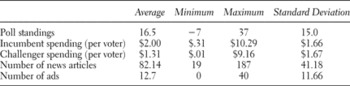
For our “module,” Polimetrix sampled approximately 75 respondents in 21 of the 28 U.S. senate races featuring a majority party incumbent and a majority party challenger, for a total of 1,045 respondents.Footnote 6 The data in Table 1 indicate that the races in our sample varied dramatically in terms of competition, in the amount of money spent, and in the amount of media attention given to the contests.Footnote 7 For example, in Ohio, preelection polls showed Senator Mike DeWine running seven points behind his challenger, U.S. House member Sheldon Whitehouse. In contrast, Senator Orin Hatch was 37 points ahead of his challenger, businessman Pete Ashdown.
Description of U.S. Senate races

Notes: Preelection polling data, as well as incumbent and challenger spending data, were taken from the 2006 New York Times Election Guide. The authors collected newspaper data from Access World News, formerly Newsbank, in each state's largest circulating newspaper, from October to Election day (see Appendix A). We collected advertisements from the National Journal Website. The National Journal Website included downloadable links to almost all Senate advertisements publicly available (Grose and Globetti Reference Grose and Globetti2007). When advertisements were not listed on the National Journal Website, we searched the candidates' own Websites, as well as other Internet sites, to increase the completeness of the candidate advertisement sample.
Similarly, Senator Dianne Feinstein spent only 31 cents per potential voter in her reelection campaign, while her opponent, former state Senator Richard Mountjoy spent, on average, one penny per potential voter in his uphill challenge. Senator Conrad Burns spent more than $10 per potential voter in his contest against Jon Tester in Montana. The highest spending challenger was Pete Ricketts of Nebraska, who spent more than $9 per potential voter trying to upset Senator Ben Nelson.
The amount of media attention also varied dramatically across these contests. Among the largest circulating newspapers in each of the 21 states, the Virginia contest between Senator George Allen and former Navy secretary James Webb generated the most attention, with the Richmond Times-Dispatch publishing 187 news articles between October 1 and Election Day. The least covered contest was in Wyoming, where the Cheyenne Tribune-Eagle published a mere 19 articles about the race between Senator Craig Thomas and engineer Dale Groutage. Similarly, a great number of political advertisements aired repeatedly over the months preceding Election Day in some Senate contests, while advertisements were completely absent from others. For example, 40 different advertisements peppered the airways in Montana, while no advertisements were aired during the Maine and Wyoming Senate campaigns.
Our portion of the 2006 CCES questionnaire explored, among other topics, how citizens evaluated men and women senators along trait and issue dimensions. Included in our sample were 15 male U.S. senators and six female U.S. senators. We analyzed trait evaluations of the senators for four traits: honesty, caring, experience, and leadership. We include these four traits because previous research finds that these trait dimensions influence overall evaluations of candidates in presidential elections (e.g., Bartels Reference Bartels and Anthony2002; Funk Reference Funk1996; Kinder Reference Kinder, Lau and Sears1986; Markus Reference Markus1982; McGraw Reference McGraw, Sears, Huddy and Jervis2003; Pierce Reference Pierce1993). And according to prior research, gender stereotypes lead people to view men as more experienced and strong leaders, whereas women are viewed as more caring and more honest than men (e.g., Alexander and Andersen Reference Alexander and Andersen1993; Huddy and Terkildsen Reference Huddy and Terkildsen1993; Rosenwasser and Seale Reference Rosenwasser and Seale1988). We rely on the measure of personality traits developed and employed by the American National Election Study (ANES) in examining impressions of presidential candidates.
We also measured respondents' assessments of the Senate incumbents' ability to deal with two issues: the economy and health care. We include these two issues because prior studies suggest that gender stereotypes lead people to view women candidates as more competent at dealing with health-care issues, while male candidates are seen as better able to deal with economic issues (e.g., Huddy and Capelos Reference Huddy, Capelos, Ottati, Scott Tindale, Edwards, Bryant, Heath, O'Connell, Suarez-Balcazar and Posavac2002; Kahn Reference Kahn1996; Sapiro 1981/82). In addition, health care and the economy were prominent issues in the 2006 campaign (Fridkin and Kenney Reference Fridkin and Kenney2007). We rely on the issue competence measure developed and employed by political scientists studying gender stereotypes (e.g., Sapiro 1981/82).
In addition, we included a series of measures assessing forces known to influence people's evaluations of senatorial candidates. These variables include party identification (e.g., Abramowitz and Segal Reference Abramowitz and Segal1990; Kahn and Kenney Reference Kahn and Kenney1997), ideology (e.g., Wright and Berkman Reference Wright and Berkman1986), and national political conditions (e.g., Heatherington Reference Hetherington1996; Jacobson and Kernell Reference Jacobson and Kernell1983).Footnote 8
RESULTS AND DISCUSSION
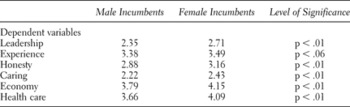
Given the paucity of survey data examining people's impressions of women senators seeking reelection, we begin with a one-way analysis of variance examining citizens' evaluations of men and women senators on the four trait and two issue dimensions (see Table 2).
The means for men and women incumbents by traits and issues

Notes: The level of significance (two-tailed test) is based on a series of one-way ANOVAs (Analysis of Variance). See Appendix B for measurement information about the dependent variables.
Respondents, on average, score the women incumbents significantly higher than the male incumbents on each of the six items.Footnote 9 The more positive evaluations of women candidates, compared to male candidates, on the traits of “honesty” and “caring” and the issue of “health care” are consistent with the gender stereotyping literature. However, and more surprisingly, women senators are viewed more positively on the traits of “leadership” and “experience,” and they are also viewed as better able to deal with “economic” issues.
These findings suggest that women senators competing to hold their seats are viewed more positively than male senators on a range of issue and trait dimensions. However, does this advantage for women senators persist when we control for characteristics of the respondents (e.g., party and ideological dispositions), the quality of the candidates, the characteristics of the campaign, and the mood of the electorate? For example, women senators may be viewed more favorably than male senators because these particular women senators may have been more likely than their male counterparts to run in noncompetitive races against weak challengers. We turn next to a multivariate model explaining people's evaluations of men and women senators, controlling for a host of factors known to influence voters' views of candidates.
Does a Senator's Gender Influence Trait Assessments? A Multivariate Analysis
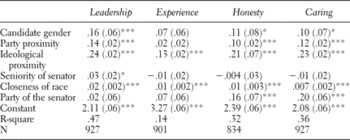
We develop four ordinary least squares models predicting respondents' assessments of the incumbents' leadership, experience, honesty, and caring. We are most interested in determining whether the incumbent's gender continues to significantly influence people's trait evaluations, in the face of stiff controls.Footnote 10 We control for three important forces known to shape respondents' assessments of candidates running for the U.S. Senate: 1) the partisan and ideological proclivity of respondents, 2) the characteristics of the candidates and the campaign (i.e., we measure the senators' tenure in office and the competitiveness of the race), and 3) the party of the senator (i.e., we expect Democrats to be advantaged in 2006 given the prevailing political climate). In particular, Democratic senators are coded 1, while Republican senators are coded 0. If the party of the senator is positive and statistically significant, then being a Democrat in 2006 produces more positive evaluations of incumbents, holding all rival hypotheses constant (e.g., respondent party and ideological attachments, seniority of the senator, level of competition in the race).Footnote 11
We present the results of our multivariate analysis in Table 3; our findings show that gender matters. In three of the four equations, the gender of the incumbent continues to be statistically significant and positively related to citizens' assessments of the senators' traits. Specifically, respondents weighed the gender of the candidate while evaluating the senatorial incumbents in terms of leadership, honesty, and caring. In addition, the positive sign of the coefficients suggest that women incumbents are scored higher than the male incumbents on each of these three traits. Even in the face of stiff controls, women senators are viewed as more honest, more caring, and as stronger leaders than their male counterparts. With regard to experience, respondents do not distinguish between men and women senators, once we control for the characteristics of the respondents, the candidates, the campaigns, and the party of the senator.Footnote 12
Predicting respondents' trait assessments for U.S. Senate candidates (OLS regression coefficients with standard errors in parentheses)

Notes: See the text and Appendix B for information about the measurement of the independent and dependent variables.
Level of significance (one-tail tests): *p < .10; **p < .05; ***p < .01.
The remaining variables in the models behave as expected. Respondents' partisan and ideological leanings strongly influence their impressions of the incumbents' traits. Put simply, Democrats and liberals scored Democratic incumbents more favorably on the four trait dimensions, compared to their evaluations of Republican incumbents. And Republicans and conservatives believe Republican senators have stronger leadership qualities and are more honest and more caring, compared to Democratic senators.
In addition, Democratic incumbents were scored higher in terms of “honesty” and “caring” in 2006, compared to Republican incumbents, during this “Democratic year” (Klarner and Buchanan Reference Klarner and Buchanan2006), all things being equal. In addition, senior senators are viewed as stronger leaders than more junior senators. And, as races become less competitive, candidates are viewed as stronger leaders, more experienced, more honest, and more caring. In these noncompetitive races, the candidates receive little media attention and senators can control the messages of the campaigns, promoting positive views of their own candidacies, without having to deal with quality challengers who are more effective at presenting an alternative picture of the sitting senators (see Kahn and Kenney Reference Kahn and Kenney1999). But beyond traits, what about issues? Does the gender of the candidate shape issue assessments as well?
Does a Senator's Gender Influence Issue Assessments? A Multivariate Analysis
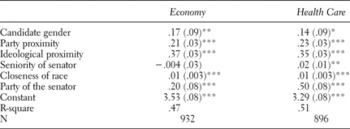
We explore whether the gender of the incumbent influences respondents' impressions of the senators' ability to deal with two salient issues: the economy and health care. As discussed earlier, both issues were central to many senatorial campaigns in 2006, and the economy is often stereotyped as a “male” issue, while health care is viewed as a “female” issue (e.g., Huddy and Terkildsen Reference Huddy and Terkildsen1993). As in the analysis in Table 3, we control for the respondents' political characteristics (ideological and party proximity), the context of the campaign (e.g., seniority of the senator and the closeness of the race), and the party of the U.S. senator.
The findings are presented in Table 4. The gender of the senator is statistically significant in both models. Even after controlling for a set of rival factors, people rate female senators as better able to deal with economic and health care issues, compared to their evaluations of male senators. These findings are consistent with the existing literature for health care; but in terms of handling economic matters, they run counter to the findings that emerge from experimental evidence.
Predicting respondents' attitudes concerning issue competence for U.S. Senate candidates (OLS regression coefficients with standard errors in parentheses)

Notes: See the text and Appendix B for information about the measurement of the independent and dependent variables.
Level of significance (one-tail tests): *p < .10; **p < .05; ***p < .01.
In addition to the gender of the candidate, the party and ideological proximity influence issue assessments, with respondents viewing senators with similar party and ideological profiles as more competent at dealing with the economy and health care. Similarly, Democratic senators are viewed more favorably on both of these two issues, compared to Republican senators, in 2006. In addition, competition is related to issue evaluations. As races become less competitive, people are more apt to view their senators as more competent at dealing with health care and the economy. Again, the lack of a competitive challenger and the presence of inattentive media is probably producing more favorable assessments of senators in these lopsided contests (Kahn and Kenney Reference Kahn and Kenney1999; Weslye 1991). Finally, as the seniority of the senator increases, people are more likely to see that senator as better able to deal with health-care issues.
Our results, thus far, show that being a woman senator is a positive attribute in races for the U.S. Senate in 2006. Specifically, respondents see women senators as having stronger leadership qualities, as being more honest and caring, and as more capable of managing economic and health-care issues, when compared to male senators. We know that the gender of the incumbent influences trait and issue assessments, but does the candidate's gender influence overall impressions of U.S. senators? We turn to this question in the next section.
The Influence of Gender for Respondents' Overall Assessment of Incumbent Senators
In this section, we examine whether trait and issue assessments influence people's overall impressions of men and women senators. If trait and issue evaluations do not influence overall impressions of candidates, then women's advantage on these dimensions are unlikely to pay electoral dividends. However, if trait and issue assessments influence overall impressions of the senators, then women senators may be advantaged at the ballot box.
In addition, we examine whether the senator's gender exerts an independent effect on overall evaluations of the senators, once we control for rival factors, including trait evaluations and issue assessments. Is it the case that the gender of the incumbent only influences candidate evaluations indirectly, through trait and issue impression? Or does the gender of the incumbent directly influence people's views of the senators?
To examine these questions, we rely on a 10-point favorability scale to measure people's overall evaluations of the U.S. senators.Footnote 13 To measure people's views of the senators, we include the four trait measures (i.e., leadership, honesty, caring, and experience), as well as the two issue competence measures (i.e., economy and health care) introduced earlier.
We control for additional factors known to influence candidate evaluations, including the measures of party attachment and ideological proximity introduced earlier (Abramowitz Reference Abramowitz1988; Abramowitz and Segal Reference Abramowitz and Segal1992; Kahn and Kenney Reference Kahn and Kenney1999; Wright and Berkman Reference Wright and Berkman1986). The candidates' issue positions can also be important in Senate elections (e.g., Abramowitz Reference Abramowitz1988; Krasno Reference Krasno1994; Wright and Berkman Reference Wright and Berkman1986). And in the 2006 election, it is essential to take stock of voters' attitudes toward the Iraq War (Jacobson Reference Jacobson2007). When respondents in the CCES survey were asked to name the most important problem facing the nation, more people mentioned the Iraq War (22%) than any other issue. We developed a measure linking the respondents' view of the Iraq War with their perceptions of their senator's position on the war.Footnote 14 We also included a measure assessing respondents' views about the national economy, since assessments of the nation's economy often influence evaluations of candidates (Stein Reference Stein1990; Westlye Reference Westlye1991; Wright and Berkman Reference Wright and Berkman1986).Footnote 15 Finally, we control for the party of the senator. With these control variables in place, we employ OLS regression to estimate the model predicting favorability toward the incumbent senator.
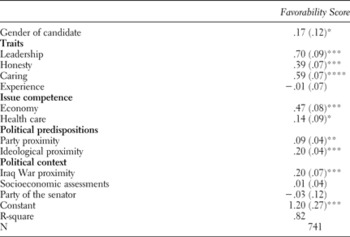
The data in Table 5 indicate that the gender of the senator continues to have a significant and positive effect on overall favorability scores, even after controlling for factors known to influence voters' views of candidates. In addition, three of the four trait assessments (i.e., leadership, honesty, and caring) and both of the issue competence measures (i.e., economy and health care) powerfully influence people's views of incumbent senators. These findings suggest that being a woman senator in the 2006 campaign cycle was a distinct advantage. Women senators were viewed more favorably on a series of trait and issue dimensions, and each of these dimensions influenced people's views of senators.Footnote 16
Predicting respondents' favorability score for U.S. Senators (OLS regression coefficients with standard errors in parentheses)

Notes: See the text and Appendix B for information about the measurement of the independent and dependent variables.
Level of significance (one-tail tests): *p < .10; **p < .05; ***p < .01.
Turning to the control variables, party and ideological proximity influenced evaluations of the incumbents, with people viewing senators who were closer to their own political positions in a more positive light. Similarly, people evaluated senators more positively if they shared the same position on the Iraq War. Assessments of the nation's economy failed to significantly influence people's views of sitting senators, and being a Democratic senator did not influence overall favorability scores, once rival factors were included.Footnote 17
CONCLUSIONS
In the 2006 election cycle, women senators were viewed more positively than their male counterparts. Some of the advantages women senators enjoyed were consistent with established gender stereotypes. In particular, women senators were viewed as more honest and more caring than male senators. Moreover, women senators were viewed as more competent at dealing with health-care issues. However, we did not find evidence for gender stereotypes that traditionally produce more positive views of male senators. For example, we did not find that male senators were viewed as stronger leaders or more experienced than women senators. People did not view male senators as better able to deal with economic issues. Instead, and contrary to these established stereotypes, women senators were viewed more positively in terms of their leadership and ability to handle economic issues.
In the end, being a woman senator mattered in people's assessment of incumbents. The gender of the candidate had a direct influence on overall evaluations of the sitting senators, producing more favorable views of women senators. These results are based on a survey that included 1,000 respondents in 21 U.S. Senates races and employed an extensive battery of survey questions that controlled for a host of rival explanations.
Why are women senators viewed more favorably on dimensions that reinforce common gender stereotypes and on dimensions running contrary to these same stereotypes? We can only speculate, but women senators may have been advantaged by the context of the 2006 campaign cycle. Corruption and scandal were important issues in the 2006 campaign. A string of ethics scandals, including one involving disgraced lobbyist Jack Abramoff and one centering on Representative Mark Foley's relationships with congressional pages, rocked the Republican Party. According to a poll reported on CBS News following the election, 41% of voters named corruption as an important factor in their vote in congressional races (Best Reference Best2006).Footnote 18 Women incumbents, who are viewed as more honest, may have been advantaged by the “year of scandal.”Footnote 19
Our findings are based on one election cycle, however, and our results may not be generalizable to other electoral settings. We do not know, for example, if women senators, because of preexisting gender stereotypes (e.g., women politicians are more honest, more caring, more conciliatory) enjoy a built-in advantage over male senators once in office. These types of traits may always be preferred by voters, irrespective of the election year. On the other hand, the impact of gender in campaigns may be dynamic, changing with the political climate (Kahn Reference Kahn1996; Lawless Reference Lawless2004; Sanbonmatsu Reference Sanbonmatsu2002). Therefore, we encourage researchers to explore how gender influences voters’ evaluations across several electoral cycles. In addition, future work should explore variations in the impact of gender for different types of candidates (challengers, incumbents, candidates in open races) and different types of electoral office (e.g., U.S. Senate, U.S. House, governor, president).
APPENDIX A. SAMPLE OF U.S. SENATE RACES

APPENDIX B. SURVEY QUESTION WORDING (WITH DISTRIBUTION OF RESPONSES IN PARENTHESES)
Personality Trait Assessments
In your opinion, does the phrase DISHONEST describe (Senate Incumbent Up for Reelection—Insert Name) extremely well, quite well, not too well or not well at all?
Extremely Well (11%)
Quite Well (15%)
Not Too Well (17%)
Not Well at All (35%)
Don't Know (20%)
In your opinion, does the phrase REALLY CARES ABOUT PEOPLE LIKE YOU describe (Senate Incumbent Up for Reelection—Insert Name) extremely well, quite well, not too well or not well at all?
Extremely Well (14%)
Quite Well (27%)
Not Too Well (19%)
Not Well at All (29%)
Don't Know (11%)
In your opinion, does the phrase INEXPERIENCED describe (Senate Incumbent Up for Reelection—Insert Name) extremely well, quite well, not too well or not well at all?
Extremely Well (3%)
Quite Well (11%)
Not Too Well (18%)
Not Well at All (54%)
Don't Know (13%)
In your opinion, does the phrase PROVIDES STRONG LEADERSHIP describe (Senate Incumbent Up for Reelection—Insert Name) extremely well, quite well, not too well or not well at all?
Extremely Well (20%)
Quite Well (26%)
Not Too Well (20%)
Not Well at All (22%)
Don't Know (11%)
Issue Competence Questions
What is your best guess about [senate incumbent up for reelection—insert name]'s competence in dealing with health care issues?
Very Competent (13%)
Competent (20%)
Somewhat Competent (20%)
Somewhat Incompetent (11%)
Incompetent (12%)
Very Incompetent (9%)
Don't Know (13%)
What is your best guess about [senate incumbent up for reelection—insert name]'s competence in dealing with economic issues?
Competent (16%)
Somewhat Competent (23%)
Somewhat Incompetent (20%)
Incompetent (10%)
Very Incompetent (10%)
Don't Know (9%)
Candidate Favorability Scales
Using a scale from 1 to 10, where 10 means you feel very favorable toward the person and 1 means you feel very unfavorable toward the person, where would you rank [senate incumbent up for reelection—insert name] on this scale. Please give a number between 1 and 10.
1 (18%)
2 (10%)
3 (6%)
4 (7%)
5 (5%)
6 (7%)
7 (10%)
8 (11%)
9 (7%)
10 (13%)
Don't Know (6%)
Party Proximity
In general, do you think of yourself as a Democrat, a Republican or Independent?
If Democrat or Republican, how strongly do you feel about your party?
If Independent, do you lean toward one of the parties? If so, which one? (−3 = 14%, −2 = 10%, −1 = 17%, 0 = 13%, 1 = 17%, 2 = 13%, 3 = 17%)
Ideological Proximity
One way that people talk about politics in the United States is in terms of liberal, conservative, and moderate. We would like to know how you view the parties and candidates using these terms. The scale below represents the ideological spectrum from very liberal to very conservative. Where would you place yourself on this line? Where would you place the incumbent senator? (–4 = 3%, –3 = 6%, –2 = 15%, –1 = 14%, 0 = 28%, 1 = 11%, 2 = 12%, 3 = 6%, 4 = 4%)
Iraq Proximity
Some politicians argue that setting out a plan to withdraw would make Iraqis take responsibility for their country and become more independent of the U.S. Others argue that it is too early to start withdrawing, and that doing so would make terrorists grow bolder. What do you think? If you were faced with this decision, would you vote for or against a plan to start withdrawing troops this year? How about the incumbent senator? Do you think [he/she] voted for or against this plan? (–1 = 43%, 0 = 19%, 1 = 38%)
Sociotropic Assessments
Would you say that OVER THE PAST YEAR the nation's economy has gotten worse, stayed about the same, or gotten better?
Much better (18%)
Better (19%)
About Same (21%)
Worse (31%)
Much Worse (10%)
Not Sure (1%)