Introduction
Informal care plays a significant role in the care system for older people in the United Kingdom (UK). It is estimated that in England, approximately two million people with functional disability aged 65 and over live in private households, and 85 per cent of them receive informal care provided by families, neighbours or friends (Pickard et al. Reference Pickard, Wittenberg, Comas-Herrera, King and Malley2007). Further, the significance of informal care is projected to increase considerably in the next two to three decades as an ageing population leads to an increase in the demand for informal care (Karlsson et al. Reference Karlsson, Mayhew, Plumb and Rickayzen2006; Pickard et al. Reference Pickard, Wittenberg, Comas-Herrera, King and Malley2012). Developments in welfare policy, and particularly cuts in public expenditure, place an increasing emphasis on care for older people delivered at home. The introduction of formal care at home has led to changes in the types of care provided by informal carers (Bell, Bowes and Heitmueller Reference Bell, Bowes and Heitmueller2007). Measuring the distribution of unpaid care helps us to capture better both the subjective and objective burdens (Montgomery, Gonyea and Hooyman Reference Montgomery, Gonyea and Hooyman1985) on carers. Developments in the type of care provided, how it is funded, and the balance of responsibilities between formal and informal carers only increase the importance of understanding the nature of informal care. While we focus here on the survey questions that identify carers, this is of broader importance as unidentified carers will otherwise be excluded from more detailed measurement of care intensity and burden.
There has been a growing academic interest in informal care from different disciplinary perspectives, such as health, economics, sociology and social work (e.g. Bell and Rutherford Reference Bell and Rutherford2012; Ekwall, Sivberg and Hallberg Reference Ekwall, Sivberg and Hallberg2004; Ermisch Reference Ermisch2014; Rutherford and Bowes Reference Rutherford and Bowes2014; Van den Berg and Spauwen Reference Van den Berg and Spauwen2006). This has led to greater attempts to gather statistical data on informal caring activities. The term ‘care’ is used quite broadly across disciplines, and one of the challenges in the literature is ensuring that there is a clear definition of what activities constitute care. Care can be generally defined as ‘doing things for people that they cannot do for themselves’ (Twigg and Atkin Reference Twigg and Atkin1994: 8). This is often straightforward for formal care as it is typically well confined by its institutional setting or the professional roles of its care providers. In an informal setting, however, the term ‘care’ can in fact be very ambiguous where it is often difficult to distinguish between caring and personal tending routines within families. For example, one of the caring tasks defined by surveys is to prepare a hot meal, which is traditionally undertaken by females as a family routine. Thus, it might not be treated as care-providing (either by care recipients or providers themselves) if performed by females. Most studies of informal care rely on self-reported data collected from either care providers or recipients. The self-identification of the caring role depends on survey questions and how these questions are interpreted by different respondents. Care providers and recipients may perceive their shared caring relationship differently. For example, in a care provider–recipient dyad, the provider may not identify himself (or herself) as a carer, whereas the care recipient may report receiving care from him (or her), or vice versa.
Studying this potential discrepancy in the statistical measurement of informal care offers valuable implications for interpreting and comparing empirical results using data where different definitions of care might be implied. In this paper, we examine the discrepancy of care providers’ responses to different survey questions on care providing, using data from the English Longitudinal Study of Ageing (ELSA). We also analyse the comparability of two perspectives of informal care, from care providers and recipients. We have found a striking discrepancy between care providers’ and recipients’ reports of spousal care. In the ELSA data, there is a clear tendency for care providers to ‘under-report’ their caring role for their spouses, compared to the recipients’ report of care received. We have shown that while it could be attributed in part to questionnaire design, it is also related to care intensity and the nature of caring tasks. We argue that researchers should be aware of the conceptualisation of informal care implicit in the data they are using, and the validity of their measurements.
Measuring informal care
The motivations for measurement include estimating the scale of informal caring; describing the patterns and trends in activity; and modelling the provision or receipt of informal care. This requires good data on the individuals providing and receiving informal care and the activities they undertake. First, we discuss what it is we are trying to measure. Secondly, we describe some of the more commonly used data sources where this information is captured. Lastly, we discuss how measurements of informal care have typically been operationalised in these datasets.
At its simplest, informal care is the provision of help and support to others without contractual obligation. However, families and households include all sorts of altruistic and reciprocal helping behaviour that, while forming a routine part of family life, would not typically constitute ‘informal care’. Care is also not just a set of activities; care should be an ‘extra’ activity, beyond the ‘normal’ duties within the household (Arber and Ginn Reference Arber and Ginn1990). This immediately highlights the gendered dimension, as what constitutes ‘normal’ household duties may vary by the gender of the actor. Arber and Ginn (Reference Arber and Ginn1990) further suggest that in order to constitute care, the activities should address a need or dependency of the recipient. Van den Berg and Spauwen (Reference Van den Berg and Spauwen2006) distinguish between support with activities of daily living (ADLs), instrumental activities of daily living (IADLs) and housework activities, while advocating a diary-based time-use approach to measure the provision of informal care. Again, they emphasise that there are difficulties in separating ‘normal housework’ from caring activity. While much of the focus for measuring informal care is on assistance with ‘activities of daily living’ in one form or another, it is also recognised that care can extend beyond those forms of help. The typology developed by Bowers (Reference Bowers1987) includes additional ‘levels’ of care such as anticipatory care (being available in an emergency), preventive care-giving (checking up on people), and supervisory care-giving (helping to co-ordinate formal care). This broad definition makes measurement and categorisation very challenging. Van den Berg, Brouwer and Koopmanschap (Reference Van den Berg, Brouwer and Koopmanschap2004) discuss many of the difficulties in measuring informal care: heterogeneity in the number, type and intensity of tasks; sharing of tasks with others; additionality of activity; benefits of activity shared with others; and the voluntary or obligatory nature of tasks. However, they do offer a working definition of informal care as ‘a nonmarket composite commodity consisting of heterogeneous parts produced (paid or unpaid) by one or more members of the social environment of the care recipient as a result of the care demands of the care recipient’ (Van den Berg, Brouwer and Koopmanschap Reference Van den Berg, Brouwer and Koopmanschap2004: 38).
The consensus from the literature is that measures of informal care should be broad to reflect this heterogeneity, they should capture measures of a range of activities, they should demonstrate additionality of the activity, and they should measure the intensity of the activity, e.g. through capturing the number of hours spent caring. In practice, survey questions on informal caring are often relatively simple, forming part of a broader set of socio-demographic interview questions in large social surveys. The surveys usually ask a participation question, often a question about the number of hours spent caring, and only occasionally questions about specific caring tasks. Data on informal caring are collected routinely in several social surveys. Prominent examples include the UK Census, the British Household Panel Survey (BHPS), Understanding Society (UKHLS), the General Household Survey (GHS), the Family Resources Survey (FRS) and the English Longitudinal Study of Ageing (ELSA). The two main practical issues in gathering data on informal care in a social survey are the question wording (how the question is asked) and the questionnaire routing (to whom the question is asked).
Informal care is operationalised through asking a yes or no question about whether an individual has provided care for others. Often this uses language such as ‘help’, ‘support’ or ‘look after’. While the language used is similar, the different questions focus more on different aspects of the activities and needs. Usually the person receiving the care is identified, if resident within the household. Supplementary questions may ask about the frequency of support, or the number of hours spent providing care. Most commonly, the question is asked of carers rather than recipients. Some surveys do ask care recipients about the support they receive, and this usually focuses around support with specific activities. In most cases, the question is asked of all respondents to the survey, although there may be some routing for eligibility.
A binary measure of care provision can seem simplistic, and it is the supplementary questions that are better able to capture the rich variation in caring intensity, burden and activities. But without a good informal care question respondents may never be asked these more detailed survey questions. It is therefore important to understand who is (and is not) being invited by the survey design to describe their caring activities.
In this paper, we explore discrepancies between different reports of care activity. None of the survey questions can lay claim to being a gold standard, and so we do not have an absolute measure against which to compare care reports. However, we do use the term ‘under-reporting’, and we do this for a specific reason. We are exploring caring activity that would not be captured in the simple use of the informal care questions. These carers are therefore under-reported when the survey data are conventionally analysed. We are not able to judge whether it is the carer or recipient who is mistaken when care reports do not match. Rather, we identify cases where individuals would not be classed as carers if the survey question was taken as given, despite evidence that they do indeed provide support.
The practicalities of survey design and data collection mean that predominantly the population-level estimates of the scale and intensity of informal care provision are captured through broad ‘catch-all’ questions rather than the activity- and additionality-focused methods suggested by the literature. Broad survey questions like this rely on the interpretations of the respondents in determining what they actually capture. While users of these secondary data sources are restricted to dichotomous variables of care receipt or provision based on general questions, a deeper understanding of what is and is not included in the broad terms by respondents would aid the interpretation of both levels and trends in informal care. It is critical to understand how the interpretation of care questions might vary across the characteristics of individual respondents, particularly where these same characteristics might later be used in modelling the outcome variable in question.
We ask: what are the systematic differences in care reporting between carers and recipients, and what are the implications for our use of social survey data to analyse informal care?
Survey data that capture the reports of both carers and care recipients have the potential to help us to understand what sorts of activities are included in the minds of respondents when asked a generic informal caring question. For spousal care, the ELSA data provide this opportunity, and we now discuss in more depth the data available from that study.
Data
The data used in our analysis come from ELSA as it allows us compare the responses of informal care derived from different survey questions and from different perspectives. ELSA is a large-scale panel study of people aged 50 and over and their spouses (regardless of age), living in private households in England. It was launched in 2002. The sample was drawn from households that had previously responded to the Health Survey for England (HSE) between 1998 and 2011. ELSA respondents are followed up at a two-year interval. As the survey progresses, its respondents naturally get older and the sample ages. It also suffers sample loss due to attrition. Consequently, its representativeness may deteriorate over time. To deal with this problem, ELSA refreshed its sample at Waves 4, 5 and 6 by including new respondents from the HSE. At present, six waves of data have been released. In this study, we use the most recent wave, Wave 6, for reasons which will become clear below.
ELSA asks questions about care providing in every wave, but only in Wave 6 can carers be identified in two ways by using different questions as followsFootnote 1:
WPACT: Did you do any of these activities during the last month, that is since [date one month ago]? If yes, probe: Which ones?
• 1 Paid work
• 2 Self-employed
• 3 Voluntary work
• 4 Cared for someone
• 5 Looked after home or family
• 6 Attended a formal educational or training course
• 96 None of these.
ERCAA: Did you look after anyone in the past week? This could be your partner or other people in your household or someone in another household. [By ‘look after’ we mean the active provision of care.]
• 1 Yes
• 2 No.
[If reports that they looked after anyone in the past week: ERCAA = 1]
ERCAB: What relation is this person or people to you?
• 1 Spouse or partner
• 2 Child
• 3 Grandchild
• 4 Parent
• 5 Parent in law
• 6 Other relative
• 7 Friend or neighbour
• 95 Other.
These two questions are asked in different sections of the ELSA questionnaire. This allows us to explore the influence of question wording on the self-reporting of informal carer roles. It should be pointed out that the question WPACT is also included in Waves 4 and 5 where, however, it is used as a filtering question for question ERCAA and ERCAB. More specifically, in these two waves only respondents who said they ‘cared for someone’ were eligible to answer the question about whether they looked after anyone in the past week.
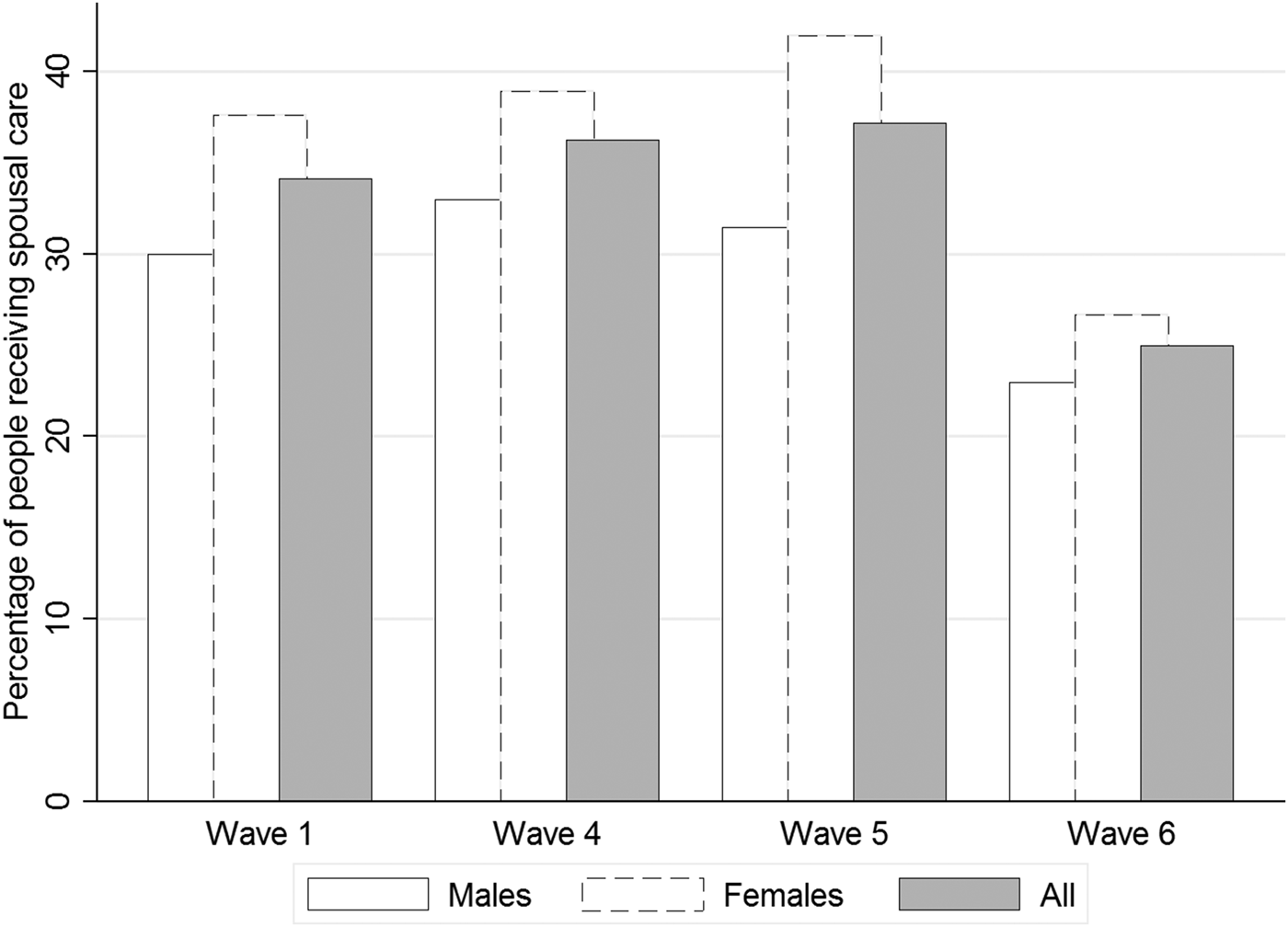
ELSA also asks questions about receiving help from others, providing an opportunity to compare care relationships drawn from two different perspectives. The questions about receiving help were asked in Waves 1, 4, 5 and 6, and they were applicable only to respondents having reported any difficulty in mobility, ADL or IADL. It is important to note that the questions about receiving help are also not identical across waves. For instance, in Wave 1 respondents were asked ‘who helps you with these activities?’ This is a general question without referring to specific forms of help. In Waves 4–6, there is a series of questions asking whether there is anyone that helps respondents with specific activities, which arguably makes it easier for respondents to recall by providing memory cues, resulting in more accurate responses (Bradburn, Sudman and Wansink Reference Bradburn, Sudman and Wansink2004). To make things even more complicated, the list of specific caring activities has been shortened in Wave 6, which is likely to influence care recipients’ reports of caring relationships. Figure 1 shows how the percentage of people who reported receiving care from their spouses changes across different waves. Despite an upward trend from Waves 1 to 5, there is a significant drop in the percentage of people who reported spousal care from Waves 5 to 6. This is likely due to the shortening of the activity list. It is important to note, however, it is difficult to make rigorous comparisons across time as the differences could be driven by other factors (e.g. genuine change or the change in sample composition) other than the change in questionnaire design. In this study, we will focus on cross-sectional comparison only, using the sixth wave of ELSA.
Care recipients’ reports of spousal care across waves.

Given that ELSA interviews only people aged 50 or over and their spouses, we can only make direct comparisons of care reporting between couples. We firstly restrict our sample to couples both of whom have provided full interviews. We will compare the attributes of carers defined from the perspectives of carers and care recipients, respectively. We will examine the extent to which carers’ reports of caring relationships are in line with the care recipients’ reports, and what variables are related to the resulting discrepancies.
One important explanatory variable that we consider is care intensity measured by care hours per week. The question about care hours is asked if survey respondents have reported ‘looking after’ someone. This is a general question without being specified to different recipients. This information could also be obtained from the care recipient's report. Respondents who have reported receiving care from specific types of providers, including their spouse, are further asked about the number of care hours they have received. Another variable to consider is the nature of care activities, which is reported by care recipients. In addition, we will also examine whether the social relation between the carer and recipient influences the carer's report. Other variables that are included in our models are care-givers’ gender, age, ethnicity, educational level, employment status, wealth, cognition, disability and care recipients’ health condition.
Discrepancies in care providers’ responses to different questions
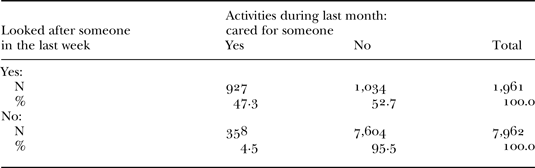
We start by describing the discrepancies in individuals’ responses to two different care-providing questions in the same questionnaire, shown in Table 1. We notice that there are some individuals who ‘cared for’ someone in the past month, but did not ‘look after’ anyone in the past week. Although we cannot rule out the influence of question wording, this is a reasonable situation given the latter question has a much shorter recall period. It is the other type of discrepancy that concerns us. Among those who reported looking after someone in the past week, only around 47 per cent of them gave consistent responses to the activity question; whereas more than half of them did not identify themselves as having provided care for someone in the last month. This, we argue, reflects the influence of question design on the reporting of informal care by providers. Although the ‘looked-after’ question has a tighter recall period, it seems that respondents perceive it in a less restricted way.
Comparison of individuals’ responses to different care-providing questions

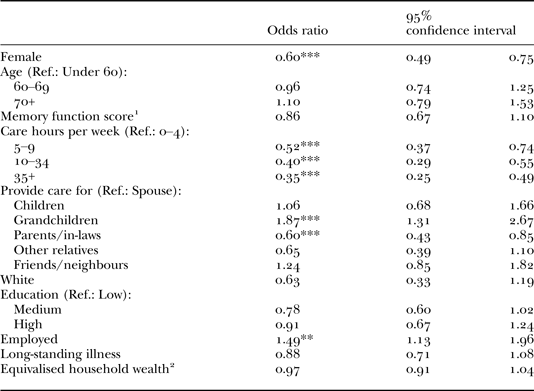
As mentioned in the last section, in Waves 4 and 5 routing to the ‘looked-after’ question and other related successive questions is reliant on the response to the activity question. It is possible, therefore, that anyone who uses the measures of care providing from Waves 4 and 5 would end up with a selected sample. To test this and to get a better understanding of what influences respondents’ perceptions of informal care, we have fitted a logistic regression model, using ‘under-reporting’ as the dependent variable. This is defined as an individual who ‘looked after’ but did not ‘care for’ anyone; or, to say it in another way, an individual who would not be identified as a care provider if the same principle were used as in Waves 4 or 5. Our analysis is restricted to a sample of individuals who have reported that they looked after someone in the past week (see Table 1). To distinguish the effect of care recipients, we have further limited our sample to individuals who looked after one type of recipient exclusively, leaving us a total number of 1,710 cases. A few cases (less than 5%) are excluded due to missing data on some of the explanatory variables. The results are presented in Table 2.
Parameter estimates of binary logit regression of under-reporting informal care

Notes: N = 1,631. Ref.: reference category. 1. Memory function score is derived by using factor analysis. It ranges from −1.8 to 1.2, with a mean of 0 and standard deviation of 0.5. 2. Equalivalised household wealth is the total household wealth that has been adjusted by using the Organisation for Economic Co-operation and Development-modified scale. This is to take into account differences in household size and composition. It ranges from −0.6 to 23, with a mean of 0 and standard deviation of 1.
Significance levels: ** p < 0.01, *** p < 0.001.
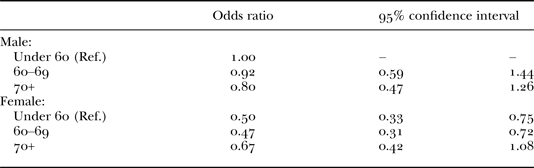
We see that women are significantly less likely to under-report their roles as informal carers than men. We have further tested possible interaction effects between gender and other control variables, finding only a significant interaction between gender and age. The gender effect is only significant for the ‘under 60’ and ‘60–69’ age groups, not for the ‘over 70’ age group (see Table 3). We find no evidence that the probability of under-reporting is related to age or memory function. In other words, under-reporting has little to do with whether an individual could remember providing care for someone or not. A possible explanation is that ‘caring activities’ that happen only occasionally, making them forgettable, tend not be perceived as ‘care’ by respondents in any case. However, under-reporting is associated with care intensity measured by weekly care hours. As might be expected, individuals spending longer hours are less likely to under-report. Thus, care providers with low care intensity are likely to be under-represented if data from Waves 4 or 5 were used. Moreover, our results show that under-reporting is related to who the care recipients are. Compared with individuals who provide spousal care, people who look after their grandchildren are significantly more likely to under-report; whereas people who care for their parents or in-laws are less likely to under-report. This suggests that respondents are more likely to identify themselves as informal carers if their caring activities are associated with the older generation; and less so when they care for their spouses or children. People who are most likely to be missed out are those who look after their grandchildren as they tend not to interpret ‘looking after’ in the same ways as ‘providing care’. Of the control variables, only employment status is significantly and positively related to the under-reporting of informal care.
The interaction effect between gender and age groups: logit model estimates

Notes: N = 1631. Ref.: reference category. Other control variables were included in the model, but omitted in the table.
In summary, we advise caution in using informal care questions in social surveys, especially in comparing findings based on different datasets where any inconsistency could be driven by the differences in measurements. For those who use the ELSA data longitudinally, we suggest that researchers should consider applying the same routing rule across waves when doing their analyses.
Discrepancies between care providers’ and recipients’ reports of care
Descriptives
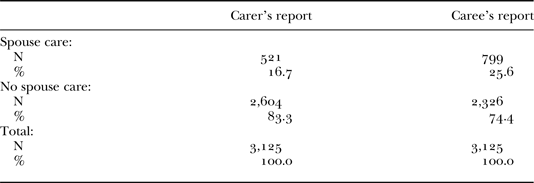
In this section, we will examine the discrepancies between the perspectives of spousal care providers and recipients. Table 4 presents the prevalence of spousal care reported by potential care providers and recipients, respectively. We see that around 17 per cent of individuals with spouses having disabilitiesFootnote 2 reported that they ‘looked after’ their spouses. From the perspective of individuals with disabilities, by contrast, about 26 per cent of them reported receiving help from their spouses. This seems to indicate that there are some discrepancies between carers’ and care recipients’ reports on spousal care.
The prevalence of spouse care reported by potential care providers and recipients in Wave 6 of the English Longitudinal Study of Ageing

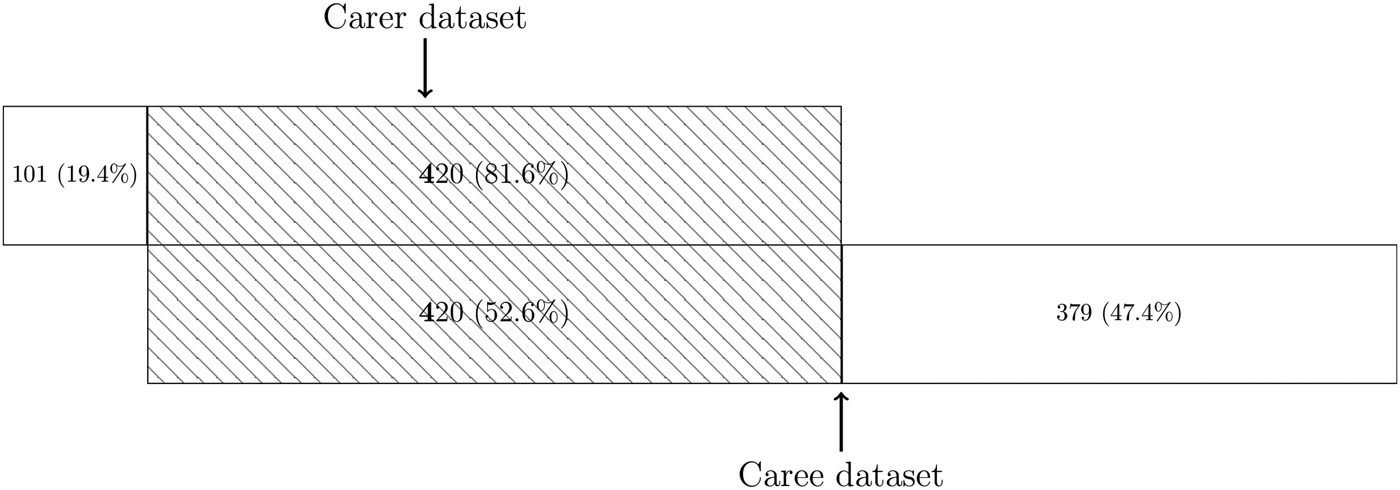
Now we will investigate to what extent they can be matched with each other. We firstly construct a carer dataset including respondents having spouses with disabilities and having reported providing care for them. Then we create a care recipient dataset containing those who reported receiving help from their spouses, to be matched with the carer dataset using spouse identifiers. The results are presented in Figure 2. Among those who reported looking after their spouses, approximately 82 per cent of them are matched with their spouses’ responses. As for those who reported receiving help from their spouses, however, only around 53 per cent are matched. What we can draw from these results is that in ELSA, care from the providers’ perspective is conceptualised or perceived in a far more restrictive way than if approached from the angle of the recipients. It is advised that researchers should be aware of the definition of care implied by the survey questions, and the subjective interpretations imposed by respondents, whichever perspective they choose to adopt.
Matching results of the carer and caree datasets (English Longitudinal Study of Ageing, Wave 6).

What influences the reporting of spouse care
In this section, we define ‘under-reporting’ as an individual who did not report providing care for his or her spouse, given that their spouse said that she or he was receiving spousal care. We will try to answer the questions: Who is more likely to under-report providing spousal care? What influences the care providers’ perceptions of care? To this end, we fit a logistic regression model using ‘under-reporting’ by carers as the outcome variable. The sub-sample here consists of individuals who were identified as carers by their spouses.
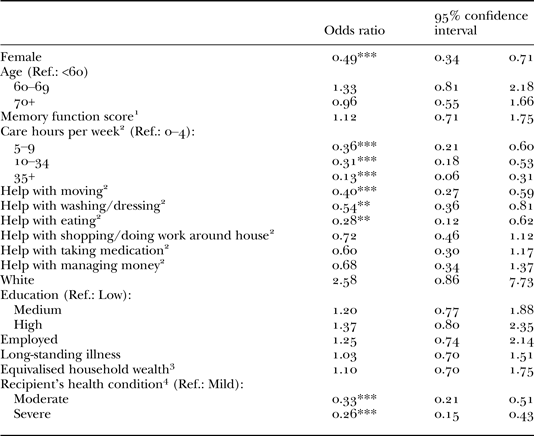
Table 5 reports the parameter estimates from our model. We see that females are less likely to under-report caring for their spouses. There is no evidence that age or memory function is related to the probability of under-reporting. Again, unsurprisingly people who spend longer hours on caring are less likely to under-report as carers. These findings are consistent with what we find in the previous section about reporting of the caring role in general. Moreover, our results reveal that a number of activities have large and statistically significant associations with under-reporting by spousal carers. More specifically, people who help their spouses with moving, washing or dressing, eating, shopping or domestic work are significantly less likely to under-report than if they do not undertake these activities. Under-reporting is also related to the health condition of care recipients independent of care hours. People who care for a spouse with worse health conditions are less likely to under-report even after accounting for the time that they spent in providing care.
Parameter estimates of binary logit regression of under-reporting spouse care

Notes: N = 786. Ref.: reference category. 1. Memory function score is derived by using factor analysis. It ranges from −1.8 to 1.1, with a mean of 0 and standard deviation of 0.5. 2. The care hour and activity measures are taken from the recipient's report. 3. Equalivalised household wealth is the total household wealth that has been adjusted by using the Organisation for Economic Co-operation and Development-modified scale. This is to take into account differences in household size and composition. It ranges from −0.6 to 5.7, with a mean of −0.2 and standard deviation of 0.5. 4. Recipients’ health condition is defined based on the number of mobility, activities of daily living and instrumental activities of daily living problems.
Significance levels: ** p < 0.01, *** p < 0.001.
Discrepancies in reports of care hours
Unfortunately, the data available do not allow us to analyse directly discrepancies in the reporting of care hours given and received between spouses. For a sub-sample, restricted to cases where both spouses identified the carer and provided some information on care hours (N = 279), we found that 10 per cent of carers reported fewer hours than the recipient, while 46 per cent of carers reported a greater number of hours provided than the recipient. If we rely on the care recipient's report of care hours, and use these as an estimate of the care hours provided by carers who do not identify as such, then we find that 13 per cent of the total care hours reported by recipients are undertaken by spouses who do not identify as carers. Consistent with our model results, these hours are concentrated amongst carers spending fewer than nine hours per week. Where the focus is on carers providing intense support (20 hours or more), there is very little under-reporting. While this needs further exploration with more detailed data, it suggests that the under-identification of informal carers in survey data could lead to significant under-estimates of the care hours provided.
Discussion and conclusion
Informal care is a complicated phenomenon, intimately tied up in the relationships between individuals. Care within families takes place within a context of a wide range of informal help and support at different life stages that may or may not be conceived of as ‘care’ by either the carer or recipient. We argue that the challenges of an ageing population mean that we need to understand informal care: its distribution, intensity and burden on carers. In order to do so at a population level, we need to be able to identify carers in social surveys. While we focus primarily on understanding patterns in discrepancies in identifying carers in reports between care-givers and recipients, this has implications for the wider measurement of the characteristics of care. If some groups of people are systematically less likely to identify as carers then we will also correspondingly under-estimate the time, effort and burden of care for those groups.
Measuring informal caring is not a trivial undertaking. Attempts to study these phenomena at the population level – critical to understanding how care policy must develop as our population ages – rely on standardised survey questions about informal care activity which often leave open to the interpretation of the respondent exactly what sort of activity constitutes care. The designers of survey questions must make decisions about who to ask – care-giver or recipient – and must address issues of terminology, using phrases like ‘care’, ‘help’, ‘support’ and ‘looking after’. The variation from wave to wave of the informal care questions in ELSA reflects different decisions about who, when and how to ask about informal care. We have shown that some of this variation in questioning can be exploited to understand what constitutes informal care as measured in the survey. It also serves as a cautionary note to researchers wishing to use the informal care data collected; it is absolutely critical to understand the questionnaire wording, routing and question dependencies in order to interpret the results.
The data in Wave 6 of ELSA provide an ideal opportunity to understand this match (or mismatch) in the reporting of informal care by spouses. The questionnaire design allows us to analyse two forms of discrepancy: within-carer under-reporting as measured by the difference between ‘caring’ and ‘looking after’; and between-caring under-reporting as measured by asking both partners questions about care-giving and receiving. The descriptive data show that there is extensive mismatching in both cases. More than half of the spouses reporting ‘looking after’ their partner did not report ‘providing care’ to anyone. This large discrepancy is likely driven by question wording and by the framing of the question. While different terms are used (‘caring for someone’ versus ‘looking after anyone’), the second question does clarify ‘looking after’ as the ‘active provision of care’. The context in framing the question may be important: the first question provides an option for care alongside economic activities such as paid employment, self-employment and voluntary work; while the second question is clearly focused on care provision. The choice of which question to use in operationalising informal care for analysis is therefore important. The use in earlier waves of the first question as a filtering question for the second suggests that those waves are likely to underestimate the numbers of informal carers significantly. Importantly, the under-reporting also does not appear random, and there are significant gender differences in the patterns of responses.
In the second discrepancy, a fifth of carers reported looking after their spouses, without their spouse reporting any corresponding help received. While this may reflect different perceptions of the caring relationship, it seems more likely that this captures the broader caring activities (e.g. Bowers Reference Bowers1987; Ekwall, Sivberg and Hallberg Reference Ekwall, Sivberg and Hallberg2004; Van den Berg, Brouwer and Koopmanschap Reference Bradburn, Sudman and Wansink2004) that are not directly associated with activities of daily living and so are missed in the care recipients’ responses. The data do not allow us to capture the detailed nature or intensity of these activities, but it does provide an indication of the likely scale of the informal care missed by the focus of the care recipients’ questions. A much greater proportion of spouses do not report providing care, despite their partner recognising help received with specific tasks. These are activities associated with daily living that we likely would want to classify as informal care, although we do not have data on the extent to which this help is ‘additional’. While this can in part be attributed to the greater prompting that care recipients receive from listing potential activities, it also suggests that some types of activity are more likely to be seen as caring activities than others. The regression modelling shows that it is more personal care activities such as help with eating, moving and washing/dressing that were the strongest predictors of mutual reporting of spousal care.
While data limitations mean that it is not possible to conduct a full analysis of discrepancies in caring hours reported by carers and recipients, our analysis suggests that under-reporting by carers is concentrated amongst those providing fewer than nine hours per week of support to a spouse. In the aggregate, this means that relying only on carer reports will significantly under-estimate both the scale and intensity of care providing. Correspondingly, missing a significant amount of lower-level care provision will mean that estimates of average carer burden are likely to be over-estimated in survey data. More reassuringly, studies that seek to study only carers providing intense support can be confident that under-reporting of care provision by carers undertaking significant numbers of hours of support is low.
Our analysis is not without its limitations. We are only able to consider spousal care, as the household-based survey design only provides matched interviews for spouses. There may be additional issues with the measurement of care for parents or other family members that we are not able to analyse within this paper. Our sample is restricted to full interviews by both spouses, as proxy interviews would not give us the two perspectives on the provision and receipt of care required for comparison. This means that we are likely examining care dyads that exclude those with greatest need, for example where one partner is in hospital, or is unable to give informed consent to participate. However, the strong association of care intensity and care reporting in our models suggests that it is unlikely that the intense informal care provided to those with greatest need will be under-estimated.
Combined, this analysis highlights two issues in the statistical measurement of informal care through broad participation questions. Firstly, the survey context and wording of the question can have a significant effect on the rate of reporting of informal care provision. Secondly, both carers and care recipients are likely to under-report activities that would be included within the theoretical definitions of informal care provision. Both of these issues are likely to lead to under-estimation of the scale and scope of informal care. Furthermore, under-reporting is non-random, with factors such as gender and employment status predictive of the problem. This creates additional challenges for attempts to model the provision or receipt of informal care, where many of the factors likely to be important in predicting the activity are also significant predictors of whether the activity is actually reported or not.
Our highlighting a measurement problem is only really useful if it is possible to make some suggestions about how to address it. The literature on measuring informal care through time-use diaries already goes a long way to addressing these issues (Van den Berg, Brouwer and Koopmanschap Reference Van den Berg, Brouwer and Koopmanschap2004), as the classification of activities as informal care can be undertaken by the researcher in the analysis of the time-use data. But for many social surveys such an in-depth procedure will not be feasible, and we do not want simply to lose the data sources we currently have on informal care. Our results suggest that broadly defined survey questions, set in a context focused on care, and asked of both carer and care recipient, are likely to produce the most reliable estimates of the scale of informal care provision. The problem of ‘missing carers’ in the data is most likely to affect analyses that seek to explore both low- and high-intensity caring together. While our recommendation for joint reports does create potential issues where the care recipient is not able to participate in a survey, studies focusing on analysing the characteristics of high-intensity carers can be more confident that under-reporting of care provision is low. Furthermore, where sample size allows, researchers should consider modelling informal care separately for different groups (e.g. male and female) to reflect the different processes driving reporting of informal care activity. But most importantly, researchers using secondary data must have a really deep understanding of how the data have been collected and how the key measures have been operationalised in order to interpret their findings robustly.
Acknowledgements
The authors would like to thank members of the Social Statistics & Social Surveys research group at the University of Stirling, as well as the anonymous referees, for valuable feedback on earlier versions of this work. This paper was partly supported by the Abbeyfield Research Foundation. Ethical approval for this study was granted by the Faculty of Social Sciences Research & Ethics Committee at the University of Stirling.