





1 Introduction
In the last 20 years, the properties of different kinds of operators and function spaces under nondoubling measures, which satisfy the polynomial growth condition, that is, there exists a positive constant
 $C_{0}$
such that, for all
 $r\in (0,\infty )$
and
 $x\in \mathbb {R}^{d}$
,
 $$ \begin{align} \mu(B(x,r))\leq C_{0}r^{n}, \end{align} $$
where
 $n\in (0,d]$
and
 $B(x,r):=\{y\in \mathbb {R}^{d}: |x-y|<r\}$
, are widely focused by many papers, for example, Nazarov et al. in [Reference Sawano and Tanaka23] and Tolsa in [Reference Tolsa29] obtained the
 $L^{p}$
-boundedness of the Cauchy integral operator on nonhomogeneous space. But, these results cannot be embedded into the spaces of homogeneous type—metric spaces equipped with a so-called doubling measure—and were introduced by Coifman and Weiss in [Reference Coifman and Weiss6]. In fact, the typical setting there consists of
 $\mathbb {R}^{d}$
with the measure
 $\mu $
satisfying (1.1), which is not an analysis on metric spaces and even on
 $\mathbb {R}^{d}$
; in addition, it deals with a class of measures being different from the doubling measures. In 2001, Tolsa [Reference Tolsa30] introduced the regularized
 $\mathrm {BMO}$
space, and also obtained the boundedness of Calderón–Zygmund operator and its commutator on space
 $L^{p}(\mu )$
. In 2003, Tolsa in [Reference Tolsa31] obtained the solution of the Painlevé problem. These results indicate that the doubling condition in the sense of Coifman and Weiss is superfluous. Moreover, for more development on the operators and function spaces over nonhomogeneous space, the readers can see [Reference Chen, Meng and Yang5], [Reference Hu, Wang and Yang11]–[Reference Hytönen13], [Reference Sawano and Yabuta24]–[Reference Tolsa26] and the references therein.
On the other hand, [Reference Hu, Lin and Yang11] the absence of doubling condition on the measure
 $\mu $
causes many difficulties. It is known that the translation and dilation invariance with respect to the underlying measure are the basic and most frequently used properties in the classical theory. However, the measure
 $\mu $
satisfying (1.1) may behave bad under translation and dilation.
To overcome the technical difficulties caused by the lack of doubling condition, some new ideas and more subtle ways may be needed.
To unify both spaces of homogeneous type and nondoubling measure spaces, Hytönen in [Reference Hytönen, Yang and Yang14] introduced a new class of metric measure spaces satisfying the upper doubling and geometrically doubling conditions (resp. see Definitions 1.1 and 1.3 below). For convenience, the new spaces are now called nonhomogeneous metric measure spaces and denoted by
 $(\mathcal {X},d,\mu )$
. Recently, a lot of classical results have been proved valid if the underlying spaces are replaced by the
 $(\mathcal {X},d,\mu )$
. For example, Fu et al. in [Reference Fu, Yang and Yuan9] established some equivalent characterizations for the boundedness of fractional integrals over
 $(\mathcal {X},d,\mu )$
, and also proved that multilinear commutators of fractional integrals with
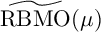
 $\mathrm {RBMO}(\mu )$
functions are bounded on Orlicz spaces. In 2014, Fu et al. [Reference Fu, Yang and Yang8] obtained a version of the atomic Hardy space
 $\widetilde {H}^{1}(\mu )$
with the discrete coefficients
 $\widetilde {K}^{(\kappa )}_{B,S}$
, and proved that its dual space is the space
 $\widetilde {\mathrm {RBMO}}(\mu )$
. In 2017, Lin et al. [Reference Lu16] proved that the commutator
 $T_{b}$
, which is generated by Calderón–Zygmund operator T and
 $b\in \widetilde {\mathrm {RBMO}}(\mu )$
, is bounded from space
 $\widetilde {H}^{1}(\mu )$
to space
 $L^{1,\infty }(\mu )$
, and also bounded on space
 $L^{p}(\mu )$
for all
 $p\in (1,\infty )$
. For more progresses on the properties of function spaces and the boundedness of operators on
 $(\mathcal {X},d,\mu )$
, we can see [Reference Cao and Zhou2], [Reference Chen and Lin4], [Reference Fu, Lin, Yang and Yang7], [Reference Lin, Wu and Yang15], [Reference Lu and Tao17]–[Reference Nazarov, Treil and Volberg21] and so on.
Motivated by the above results, in this paper, the author considers the boundedness of fractional type Marcinkiewicz operator, which is slightly modified from [Reference Tolsa27], [Reference Tolsa28], and its commutator with function
 $\widetilde {\mathrm {RBMO}}(\mu )$
on generalized Morrey space and on Morrey space over
 $(\mathcal {X},d,\mu )$
. Before stating the main theorems of this paper, we should recall some necessary notions and notation. The definition of the upper doubling condition is from [Reference Hytönen, Yang and Yang14].
Definition 1.1. A metric measure space
 $(\mathcal {X},d,\mu )$
is said to be upper doubling if
 $\mu $
is a Borel measure on
 $\mathcal {X}$
and there exist a dominating function
 $\lambda :\ \mathcal {X}\times (0,\infty )\rightarrow (0,\infty )$
and a constant
 $C_{(\lambda )}>0$
, depending on
 $\lambda $
, for each
 $x\in \mathcal {X}$
,
 $r\rightarrow \lambda (x,r)$
is nondecreasing, and, for all
 $x\in \mathcal {X}$
and
 $r\in (0,\infty )$
,
 $$ \begin{align} \mu(B(x,r))\leq\lambda(x,r)\leq C_{(\lambda)}\lambda(x,r/2). \end{align} $$
Remark 1.2. If take the
 $\lambda (x,r):=\mu (B(x,r))$
in (1.2), then it is easy to see that the space of homogeneous type is a special case of upper doubling space. Furthermore, for all
 $x\in \mathbb {R}^{d}$
and
 $r\in (0,\infty )$
, if we replace
 $\lambda (x,r)$
by
 $C_{0}r^{n}$
in (1.2), then the space
 $\mathbb {R}^{d}$
with the measure
 $\mu $
satisfying (1.1) is also an upper doubling space. Moreover, Hytönen et al. in [Reference Lin, Wu and Yang15] showed that there exists another dominating function
 $\tilde {\lambda }$
such that
 $\tilde {\lambda }\leq \lambda $
,
 $C_{(\tilde {\lambda })}\leq C_{(\lambda )}$
, and, for all
 $x,y\in \mathcal {X}$
with
 $d(x,y)\leq r$
,
 $$ \begin{align} \tilde{\lambda}(x,r)\leq C_{(\tilde{\lambda})}\tilde{\lambda}(y,r). \end{align} $$
Here and in what follows, we always assume that the
 $\lambda $
as in (1.2) satisfies (1.3).
The following definition of geometrically doubling condition, which is known as metrically doubling (see [Reference Hytönen, Yang and Yang14]), is introduced by Coifman and Weiss in [Reference Coifman and Weiss6].
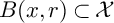
Definition 1.3. A metric space
 $(\mathcal {X},d)$
is said to be geometrically doubling if there exist some
 $N_{0}\in \mathbb {N}$
such that, for any ball
 $B(x,r)\subset \mathcal {X}$
with
 $x\in \mathcal {X}$
and
 $r\in (0,\infty )$
, there exists a finite ball covering
 $\{B(x_{i},r/2)\}_{i}$
of
 $B(x,r)$
such that the cardinality of this covering is at most
 $N_{0}$
.
Remark 1.4. Let
 $(\mathcal {X},d)$
be a metric measure space. Hytönen in [Reference Hytönen, Yang and Yang14] showed that the following statements are mutually equivalent:
 $(\mathrm {i}) (\mathcal {X},d)$
is geometrically doubling;
 $(\mathrm {ii})$
for any
 $\varepsilon \in (0,1)$
and any ball
 $B(x,r)\subset \mathcal {X}$
with
 $x\in \mathcal {X}$
and
 $r\in (0,\infty )$
, there exists a finite ball covering
 $\{B(x_{i},\varepsilon r)\}_{i}$
of
 $B(x,r)$
such that the cardinality of this covering is at most
 $N_{0}\varepsilon ^{-n_{0}}$
, where
 $n_{0}:=\log _{2}N_{0}$
.
 $(\mathrm {iii})$
for every
 $\varepsilon \in (0,1)$
, any ball
 $B(x,r)\subset \mathcal {X}$
with
 $x\in \mathcal {X}$
and
 $r\in (0,\infty )$
contains at most
 $N_{0}\varepsilon ^{-n_{0}}$
centers of disjoint balls
 $\{B(x_{i},\varepsilon r)\}_{i}$
;
 $(\mathrm {iv})$
there is
 $M\in \mathbb {N}$
such that any ball
 $B(x,r)\subset \mathcal {X}$
with
 $x\in \mathcal {X}$
and
 $r\in (0,\infty )$
contains at most M centers
 $\{x_{i}\}_{i}$
of disjoint balls
 $\{B(x_{i},r/4)\}^{M}_{i=1}$
.
In [Reference Hytönen, Yang and Yang14], Hytönen showed that there exist many balls with
 $(\alpha ,\beta )$
-doubling properties. Namely, for all
 $\alpha ,\beta \in (1,\infty )$
, a ball
 $B\subset \mathcal {X}$
is said to be
 $(\alpha ,\beta )$
-doubling if
 $\mu (\alpha B)\leq \beta \mu (B)$
. To be precise, Hytönen [Reference Hytönen, Yang and Yang14] also explained that, if a metric measure space
 $(\mathcal {X},d,\mu )$
is upper doubling and
 $\alpha , \beta \in (1,\infty )$
with
 $\beta>[C_{(\lambda )}]^{\log _{2}\alpha }=:\alpha ^{\nu }$
, then there exists some
 $j\in \mathbb {N}$
such that
 $\alpha ^{j}B$
is
 $(\alpha ,\beta )$
-doubling, where B is an arbitrary ball. Moreover, let
 $(\mathcal {X},d)$
be a geometrically doubling,
 $\beta>\alpha ^{n_{0}}$
, and
 $\mu $
be a Borel measure on
 $\mathcal {X}$
being finite on bounded sets. Furthermore, the radii of these balls may be chosen to be of the form
 $\alpha ^{-j}r$
for
 $j\in \mathbb {N}$
and any preassigned number
 $r\in (0,\infty )$
. Throughout this paper, for any
 $\alpha \in (1,\infty )$
and ball B, the smallest
 $(\alpha ,\beta _{\alpha })$
-doubling ball of the form
 $\alpha ^{j}B$
with
 $j\in \mathbb {N}$
is simply denoted by
 $\widetilde {B}^{\alpha }$
, where
 $$ \begin{align} \beta_{\alpha}:=\alpha^{3\max\{n_{0},\mu\}}+[\max\{5\alpha,30\}]^{n_{0}}+[\max\{3\alpha,30\}]^{\nu}. \end{align} $$
In what follows, we always set
 $\alpha =6$
and denote by
 $\tilde {B}$
the smallest
 $(6,\beta _{6})$
-doubling ball.
In 2013, Bui and Duong [Reference Bui and Duong1] introduced the following discrete coefficient
 $\widetilde {K}^{(\kappa )}_{B,S}$
, which is analogous to the quantity
 $K_{Q,R}$
introduced by Tolsa in [Reference Tolsa29]. Before stating the definition of
 $\widetilde {K}^{(\kappa )}_{B,S}$
, we recall some basic assumption from [Reference Heinonen10]: when we say that a ball is in
 $(\mathcal {X},d,\mu )$
, we can understand that it has a fixed center and radius, although these are not uniquely determined by B as a set. In other words, for any two balls
 $B, S\subset \mathcal {X}$
, if
 $B\subset S$
, or
 $B=S$
, then the center
 $c_{B}$
and radius
 $r_{B}$
of ball B coincide with S, respectively. From this, we can obtain that, if
 $B\subset S$
, then
 $r_{B}\leq 2r_{S}$
, which plays a key role in the definition of
 $\widetilde {K}^{(\kappa )}_{B,S}$
.
Definition 1.5. For any
 $\kappa \in (1,\infty )$
and two balls
 $B\subset S\subset \mathcal {X}$
, define
 $$ \begin{align*}\widetilde{K}^{(\kappa)}_{B,S}:=1+\mathop{\sum}\limits^{N^{(\kappa)}_{B,S}}_{l=-\lfloor\log_{\kappa}2\rfloor}\frac{\mu(\kappa^{l}B)} {\lambda(c_{B},\kappa^{l}r_{B})}, \end{align*} $$
where
 $N^{(\kappa )}_{B,S}$
represents the smallest integer satisfying
 $\kappa ^{N^{(\kappa )}_{B,S}}r_{B}\geq r_{S}$
. Moreover, for any
 $a\in \mathbb {R}$
,
 $\lfloor a\rfloor $
denotes the largest integer which is smaller than or equal to a.
Remark 1.6. (i) By the definition of
 $N^{(\kappa )}_{B,S}$
and the fact
 $r_{B}\leq 2r_{S}$
, we can deduce that
 $N^{(\kappa )}_{B,S}\geq =-\lfloor \log _{\kappa }2\rfloor $
, which guarantees the definition of
 $\widetilde {K}^{(\kappa )}_{B,S}$
to make sense.
(ii) Via a change of variables and (1.1), it is not difficult to obtain that
 $$ \begin{align*}\widetilde{K}^{(\kappa)}_{B,S}\sim 1+\mathop{\sum}\limits^{N^{(\kappa)}_{B,S}+\lfloor\log_{\kappa}2\rfloor+1}_{l=1} \frac{\mu(\kappa^{l}B)}{\lambda(c_{B},\kappa^{l}r_{B})}, \end{align*} $$
where the implicit equivalent positive constants only rely on the choice of parameter
 $\kappa>1$
.
(iii) Hytönen [Reference Hytönen, Yang and Yang14] introduced a continuous version
 $K_{B,S}$
(see also [Reference Lin, Wu and Yang15]). That is, for any two balls
 $B\subset S\subset \mathcal {X}$
, set
 $$ \begin{align}K_{B,S}:=1+\int_{(2S)\setminus B}\frac{\mathrm{d}\mu(x)}{\lambda(c_{B},d(x,c_{B}))}. \end{align} $$
By simply computing, it is easy to find that
 $K_{B,S}\leq C\widetilde {K}^{(\kappa )}_{B,S}$
. In general,
 $K_{B,S}$
and
 $\widetilde {K}^{(\kappa )}_{B,S}$
are not equivalent, but, in the setting of nonhomogeneous space, that is, for
 $(\mathbb {R}^{d},|\cdot |,\mu )$
with measure
 $\mu $
satisfying (1.1), the following equation
 $$ \begin{align}K_{B,S}\sim\widetilde{K}^{(\kappa)}_{B,S} \end{align} $$
holds, where the implicit equivalent positive constants are independent of B and S.
Now, we recall the following definition of regularized
 $\mathrm {BMO}$
space with discrete coefficient
 $(=\widetilde {\mathrm {RBMO}}(\mu ))$
introduced by Fu et al. in [Reference Fu, Yang and Yang8] as follows.
Definition 1.7. Let
 $\kappa \in (1,\infty )$
and
 $\gamma \in [1,\infty )$
. A function
 $f\in L^{1}_{\mathrm {loc}}(\mu )$
is said to be in the space
 $\widetilde {\mathrm {RBMO}}_{\kappa ,\gamma }(\mu )$
if there exist a positive constant C and, for any ball
 $B\subset \mathcal {X}$
, a number
 $f_{B}$
such that
 $$ \begin{align} \frac{1}{\mu(\kappa B)}\int_{B}|f(x)-f_{B}|\mathrm{d}\mu(x)\leq C \end{align} $$
and, for any two balls B and S such that
 $B\subset S$
,
 $$ \begin{align} |f_{B}-f_{S}|\leq C[\widetilde{K}^{(\kappa)}_{B,S}]^{\gamma}. \end{align} $$
The infimum of the constant C satisfying (1.7) and (1.8) is defined to be the
 $\widetilde {\mathrm {RBMO}}_{\kappa ,\gamma }(\mu )$
norm of f and denoted by
 $\|f\|_{\widetilde {\mathrm {RBMO}}_{\kappa ,\gamma }(\mu )}$
.
Remark 1.8. From [Reference Fu, Yang and Yang8], Fu et al. showed that the space
 $\widetilde {\mathrm {RBMO}}_{\kappa ,\gamma }(\mu )$
does not rely on the choices of parameters
 $\kappa \in (1,\infty )$
and
 $\gamma \in [1,\infty )$
; thus, the space
 $\widetilde {\mathrm {RBMO}}_{\kappa ,\gamma }(\mu )$
is simply denoted by space
 $\widetilde {\mathrm {RBMO}}(\mu )$
.
Next, we recall the definition of fractional type Marcinkiewicz integral (see [Reference Nakai20]).
Definition 1.9. Let
 $\Delta =\{(x,x):\ x\in \mathcal {X}\}$
and
 $\iota \geq 0$
. A function
 $K\in L^{1}_{\mathrm {loc}}(\mathcal {X}\times \mathcal {X}\setminus \Delta )$
is called a modified kernel if there exists a positive constant C, such that
(1) for any
 $x,\ y\in \mathcal {X}$
with
 $x\neq y$
,
 $$ \begin{align} |K(x,y)|\leq C\frac{[d(x,y)]^{1+\iota}}{\lambda(x,d(x,y))}; \end{align} $$
(2) there exist positive constants
 $\delta \in (0,1]$
and C such that, for any
 $x, \tilde {x}, y\in \mathcal {X}$
with
 $d(x,y)\geq 2d(x,\tilde {x})$
,
 $$ \begin{align} |K(x,y)-K(\tilde{x},y)|+|K(y,x)-K(y,\tilde{x})|\leq C\frac{[d(x,y)]^{\delta+1+\iota}}{[d(x,y)]^{\delta}\lambda(x,d(x,y))}. \end{align} $$
Let
 $L^{\infty }_{b}(\mu )$
be the space of all
 $L^{\infty }(\mu )$
functions with bounded support. The fractional type Marcinkiewicz integral
 $\mathcal {M}_{\iota ,\rho ,m}$
associated with the above kernel K is defined by, for any
 $f\in L^{\infty }_{b}(\mu )$
,
 $$ \begin{align} \mathcal{M}_{\iota,\rho,m}(f)(x):=\bigg(\int^{\infty}_{0}\bigg|\int_{d(x,y)\leq t}\frac{K(x,y)} {[d(x,y)]^{1-\rho}}f(y)\mathrm{d}\mu(y)\bigg|^{m}\frac{\mathrm{d}t}{t^{1+m(\iota+\rho)}}\bigg)^{\frac{1}{m}}, \end{align} $$
where
 $\rho>0$
,
 $\iota \geq 0$
, and
 $m>1$
.
Given a function
 $b\in \widetilde {\mathrm {RBMO}}(\mu )$
, the commutator
 $\mathcal {M}_{\iota ,\rho ,m,b}$
generated by b and
 $\mathcal {M}_{\iota ,\rho ,m}$
is defined by
 $$ \begin{align}\mathcal{M}_{\iota,\rho,m,b}(f)(x):=\bigg(\int^{\infty}_{0}\bigg|\int_{d(x,y)\leq t}\frac{K(x,y)} {[d(x,y)]^{1-\rho}}[b(x)-b(y)]f(y)\mathrm{d}\mu(y)\bigg|^{m} \frac{\mathrm{d}t}{t^{1+m(\iota+\rho)}}\bigg)^{\frac{1}{m}}. \end{align} $$
The following notion of generalized Morrey space is from [Reference Lu and Tao18].
Definition 1.10. Let
 $\eta>1$
and
 $p\in (1,\infty )$
. Suppose that
 $\phi :\ (0,\infty )\rightarrow (0,\infty )$
is an increasing function. Then generalized Morrey space
 $L^{p,\phi }(\mu )$
is defined by
 $$ \begin{align*}L^{p,\phi}(\mu):=\{f\in L^{p}_{\mathrm{loc}}(\mu):\ \|f\|_{L^{p,\phi}(\mu)}<\infty\}, \end{align*} $$
where
 $$ \begin{align} \|f\|_{L^{p,\phi}(\mu)}:=\mathop{\mathrm{sup}}\limits_{B}\bigg(\frac{1}{\phi(\mu(\eta B))}\int_{B}|f(x)|^{p} \mathrm{d}\mu(x)\bigg)^{\frac{1}{p}}. \end{align} $$
Remark 1.11. For any
 $t>0$
and
 $1<p\leq q<\infty $
, if we take
 $\phi (t)=t^{1-\frac {p}{q}}$
in (1.13), then generalized Morrey space
 $L^{p,\phi }(\mu )$
is just the Morrey space
 $M^{p}_{q}(\mu )$
introduced by Cao and Zhou in [Reference Cao and Zhou2]. For any
 $\eta>1$
and
 $1<p\leq q<\infty $
, the Morrey space
 $M^{p}_{q}(\mu )$
is defined by
 $$ \begin{align*}M^{p}_{q}(\mu):=\{f\in L^{p}_{\mathrm{loc}}(\mu):\ \|f\|_{M^{p}_{q}(\mu)}<\infty\}, \end{align*} $$
where
 $$ \begin{align} \|f\|_{M^{p}_{q}(\mu)}:=\mathop{\mathrm{sup}}\limits_{B}[\mu(\eta B)]^{\frac{1}{p}-\frac{1}{q}}\bigg(\int_{B}|f(x)|^{q} \mathrm{d}\mu(x)\bigg)^{\frac{1}{q}}. \end{align} $$
The following definition of the
 $\epsilon $
-weak reverse doubling condition is from [Reference Fu, Yang and Yuan9].
Definition 1.12. Let
 $\epsilon \in (0,\infty )$
. A dominating function
 $\lambda $
is said to satisfy the
 $\epsilon $
-weak reverse doubling condition if, for all
 $s\in (0,2\mathrm {diam}(\mathcal {X}))$
and
 $a\in (1,2\mathrm {diam}(\mathcal {X})/s)$
, there exists a number
 $C(a)\in [1,\infty )$
, depending only on a and
 $\mathcal {X}$
, such that, for all
 $x\in \mathcal {X}$
,
 $$ \begin{align*}\lambda(x,as)\geq C(a)\lambda(a,s) \end{align*} $$
and, moreover,
 $$ \begin{align}\mathop{\sum}\limits^{\infty}_{k=1}\frac{1}{[C(a^{k})]^{\epsilon}}<\infty. \end{align} $$
For some properties on the
 $\epsilon $
-weak reverse doubling condition, we can see Remark 4.2 in [Reference Fu, Yang and Yuan9].
It is position to state the main results as follows.
Theorem 1.13. Let
 $\iota \geq 0,\ \rho>0$
,
 $m>1$
,
 $p>1$
, and
 $\phi $
be an increasing function defined on
 $(0,\infty )$
. Suppose that
 $\mathcal {M}_{\iota ,\rho ,m}$
defined as in (1.11) is bounded on space
 $L^{2}(\mu )$
, and the mapping
 $t\rightarrow \frac {\phi (t)}{t}$
is almost decreasing: there exists a constant
 $C>0$
such that
 $$ \begin{align} \frac{\phi(t)}{t}\leq C\frac{\phi(s)}{s} \end{align} $$
for
 $s\leq t$
. In addition, the function
 $\phi $
also satisfies
 $$ \begin{align} \int^{\infty}_{s}\frac{\phi(t)}{t}\frac{\mathrm{d}t}{t}\leq c\frac{\phi(s)}{s}. \end{align} $$
Then, there exists a constant
 $C>0$
such that, for all
 $f\in L^{p,\phi }(\mu )$
,
 $$ \begin{align*}\|\mathcal{M}_{\iota,\rho,m}(f)\|_{L^{p,\phi}(\mu)}\leq C\|f\|_{L^{p,\phi}(\mu)}. \end{align*} $$
Theorem 1.14. Let
 $p\in (1,\infty )$
,
 $b\in \widetilde {\mathrm {RBMO}}(\mu )$
, and
 $\phi $
satisfy (1.16) and (1.17). Suppose that
 $\mathcal {M}_{\iota ,\rho ,m}$
defined as in (1.11) is bounded on space
 $L^{2}(\mu )$
, and
 $\lambda $
satisfies the
 $\frac {1}{p}$
-we- ak reverse doubling condition. Then, there exists a constant
 $C>0$
such that, for all
 $f\in L^{p,\phi }(\mu )$
,
 $$ \begin{align*}\|\mathcal{M}_{\iota,\rho,m,b}(f)\|_{L^{p,\phi}(\mu)}\leq C\|b\|_{\widetilde{\mathrm{RBMO}}(\mu)}\|f\|_{L^{p,\phi}(\mu)}. \end{align*} $$
Theorem 1.15. Let
 $\iota \geq 0,\ \rho>0$
,
 $m>1$
, and
 $1<p\leq q<\infty $
. Suppose that
 $\mathcal {M}_{\iota ,\rho ,m}$
defined as in (1.11) is bounded on space
 $L^{2}(\mu )$
, and
 $\lambda $
satisfies the
 $\frac {1}{p}$
-weak reverse doubling condition. Then, there exists a constant
 $C>0$
such that, for all
 $f\in M^{p}_{q}(\mu )$
,
 $$ \begin{align*}\|\mathcal{M}_{\iota,\rho,m}(f)\|_{M^{p}_{q}(\mu)}\leq C\|f\|_{M^{p}_{q}(\mu)}. \end{align*} $$
Theorem 1.16. Let
 $\iota \geq 0,\ \rho>0$
,
 $m>1$
,
 $1<p\leq q<\infty $
, and
 $b\in \widetilde {\mathrm {RBMO}}(\mu )$
. Suppose that
 $\mathcal {M}_{\iota ,\rho ,m}$
defined as in (1.11) is bounded on space
 $L^{2}(\mu )$
, and
 $\lambda $
satisfies the
 $\frac {1}{p}$
-weak reverse doubling condition. Then, there exists a constant
 $C>0$
such that, for all
 $f\in M^{p}_{q}(\mu )$
,
 $$ \begin{align*}\|\mathcal{M}_{\iota,\rho,m,b}(f)\|_{M^{p}_{q}(\mu)}\leq C\|b\|_{\widetilde{\mathrm{RBMO}}(\mu)}\|f\|_{M^{p}_{q}(\mu)}. \end{align*} $$
Now, we make some conventions on notation. Throughout the paper, C represents a positive constant which is independent of the main parameters involved, but may be different from line to line. Moreover, we use
 $C_{\alpha }$
,
 $c_{\alpha }$
, or
 $\widetilde {c}_{\alpha }$
to denote a positive constant depending on the parameter
 $\alpha $
. For a
 $\mu $
-measurable set
 $E\subset \mathcal {X}$
,
 $\chi _{E}$
denotes its characteristic function. For any
 $p\in [1,\infty ]$
, we denote by
 $p'$
its conjugate index, that is,
 $1/p+1/p'=1$
.
2 Preliminaries
To prove the main theorems of this paper, we should recall some necessary results in this section. First, we recall some useful properties on the coefficient
 $\widetilde {K}^{(\kappa )}_{B,S}$
(see [Reference Fu, Lin, Yang and Yang7]).
Lemma 2.1. Let
 $(\mathcal {X},d,\mu )$
be a metric measure space of nonhomogeneous type.
 $\mathrm {(i)}$
For any
 $\kappa \in (1,\infty )$
, there exists a positive constant
 $C_{(\kappa )}$
, depending on
 $\kappa $
, such that, for all balls
 $B\subset R\subset S$
,
 $\widetilde {K}^{(\kappa )}_{B,R}\leq C_{(\kappa )}\widetilde {K}^{(\kappa )}_{B, S}$
.
 $\mathrm {(ii)}$
For any
 $\varrho \in [1,\infty )$
and
 $\kappa \in (1,\infty )$
, there exists a positive constant
 $C_{(\varrho , \kappa )}$
, depending on
 $\varrho $
and
 $\kappa $
, such that, for all balls
 $B\subset S$
with
 $r_{S}\leq \varrho r_{B}$
,
 $\widetilde {K}^{(\kappa )}_{B, S}\leq C_{(\varrho , \kappa )}$
.
 $\mathrm {(iii)}$
For any
 $\kappa \in (1,\infty )$
, there exists a positive constant
 $C_{(\kappa ,\nu )}$
, depending on
 $\kappa $
and
 $\nu $
, such that, for all balls B,
 $\widetilde {K}^{(\kappa )}_{B, S}\leq C_{(\kappa , \nu )}$
. In addition, letting
 $\alpha ,\beta \in (1,\infty )$
,
 $B\subset S$
be any two concentric balls such that there exists no
 $(\alpha ,\beta )$
-doubling ball in the form of
 $\alpha ^{k}B$
with
 $k\in \mathbb {N}$
, satisfying
 $B\subset \alpha ^{k}B\subset S$
, then there exists a positive constant
 $C_{(\alpha ,\beta ,\nu )}$
, such that
 $\widetilde {K}^{(\kappa )}_{B, S}\leq C_{(\alpha , \beta , \nu )}$
.
 $\mathrm {(iv)}$
For any
 $\kappa \in (1,\infty )$
, there exists a positive constant
 $C_{(\kappa , \nu )}$
, depending on
 $\kappa $
and
 $\nu $
, such that, for all balls
 $B\subset R\subset S$
,
 $$ \begin{align*}\widetilde{K}^{(\kappa)}_{B, S}\leq\widetilde{K}^{(\kappa)}_{B,R}+c_{(\kappa, \nu)}\widetilde{K}^{(\kappa)}_{R, S}. \end{align*} $$
 $\mathrm {(v)}$
For any
 $\kappa \in (1,\infty )$
, there exists a positive constant
 $\widetilde {c}_{(\rho , \nu )}$
, depending on
 $\kappa $
and
 $\nu $
, such that, for all balls
 $B\subset R\subset S$
,
 $\widetilde {K}^{(\kappa )}_{R, S}\leq \widetilde {c}_{(\rho ,\nu )}\widetilde {K}^{(\kappa )}_{B, S}$
.
The following equivalent characterizations of space
 $\widetilde {\mathrm {RBMO}}(\mu )$
is from [Reference Lu16].
Lemma 2.2. Let
 $\eta , \kappa \in (1,\infty )$
, and let
 $\beta _{\kappa }$
be defined as in (1.4). For all
 $f\in L^{1}_{\mathrm {loc}}(\mu )$
, the following statements are mutually equivalent:
 $\mathrm {(i)} f\in \widetilde {\mathrm {RBMO}}(\mu )$
;
 $\mathrm {(ii)}$
there exists a positive constant C such that, for all balls B,
 $$ \begin{align}\frac{1}{\mu(\eta B)}\int_{B}|f(x)-m_{\widetilde{B}^{\kappa}}(f)|\mathrm{d}\mu(x)\leq C \end{align} $$
and, for all
 $(\kappa ,\beta _{\kappa })$
-doubling balls
 $B\subset S$
,
 $$ \begin{align}|m_{B}(f)-m_{S}(f)|\leq C\widetilde{K}^{(\kappa)}_{B, S}, \end{align} $$
where
 $m_{B}(f)$
represents the mean value of f on ball B, that is,
 $$ \begin{align*}m_{B}(f):=\frac{1}{\mu(B)}\int_{B}f(x)\mathrm{d}\mu(x). \end{align*} $$
Moreover, the infimum of the above constant C is equivalent to
 $\|f\|_{\widetilde {\mathrm {RBMO}}(\mu )}$
.
We also need the following corollary (see [Reference Lu16]).
Corollary 2.3. If
 $f\in \widetilde {\mathrm {RBMO}}(\mu )$
, then there exists a constant
 $C>0$
such that, for any ball B,
 $\tau \in (1,\infty )$
and
 $r\in (1,\infty )$
,
 $$ \begin{align} \bigg(\frac{1}{\mu(\tau B)}\int_{B}|f(x)-f_{B}|^{r}\mathrm{d}\mu(x)\bigg)^{\frac{1}{r}}\leq C\|f\|_{\widetilde{\mathrm{RBMO}}(\mu)}. \end{align} $$
The following John–Nirenberg inequality for the space
 $\widetilde {\mathrm {RBMO}}(\mu )$
is from [Reference Lu16].
Proposition 2.4. Let
 $(\mathcal {X},d,\mu )$
be a metric measure space of nonhomogeneous. Then, for any
 $\varpi \in (1,\infty )$
, there exists a constant
 $c>0$
such that, for all
 $f\in \widetilde {\mathrm {RBMO}}(\mu )$
, ball
 $B_{0}$
, and
 $t\in (0,\infty )$
,
 $$ \begin{align}\mu(\{x\in B_{0}:\ |f(x)-f_{B_{0}}|>t\})\leq 2\mu(\varpi B_{0})e^{-ct/\|f\|_{\widetilde{\mathrm{RBMO}}(\mu)}}. \end{align} $$
Now, we recall some results about the maximal operators (see [Reference Bui and Duong1]).
Lemma 2.5.
 $\mathrm {(i)}$
Let
 $p\in (1,\infty )$
,
 $r\in (1,p)$
, and
 $\varsigma \in [5,\infty )$
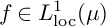
. The following maximal operators defined, respectively, by setting, for all
 $f\in L^{1}_{\mathrm {loc}}(\mu )$
and
 $x\in \mathcal {X}$
,
 $$ \begin{align*}M_{r,\varsigma}f(x):=\mathop{\mathrm{sup}}\limits_{B\ni x}\bigg(\frac{1}{\mu(\varsigma B)}\int_{B}|f(y)|^{r}\mathrm{d}\mu(y)\bigg)^{\frac{1}{r}}, \end{align*} $$
 $$ \begin{align*}Nf(x):=\mathop{\mathrm{sup}}\limits_{B\ni x\atop {B\ \mathrm{doubling}}}\frac{1}{\mu(B)}\int_{B}|f(y)|\mathrm{d}\mu(y), \end{align*} $$
and
 $$ \begin{align*}M_{(\varsigma)}f(x):=\mathop{\mathrm{sup}}\limits_{B\ni x}\frac{1}{\mu(\varsigma B)}\int_{B}|f(y)|\mathrm{d}\mu(y) \end{align*} $$
are bounded on space
 $L^{p}(\mu )$
and also bounded from space
 $L^{1}(\mu )$
into space
 $L^{1,\infty }(\mu )$
.
 $\mathrm {(ii)}$
For all
 $f\in L^{1}_{\mathrm {loc}}(\mu )$
, it holds true that
 $|f(x)|\leq Nf(x)$
for
 $\mu $
-almost everywhere
 $x\in \mathcal {X}$
.
Now, we recall the Calderón–Zygmund decomposition theorem established by Bui and Duong in [Reference Bui and Duong1]. Assume
 $\gamma _{0}$
is a fixed positive constant satisfying that
 $\gamma _{0}>\max \{C^{3\log _{2}6}_{\lambda },6^{3n_{0}}\}$
, where
 $C_{(\lambda )}$
is as in (1.2) and
 $n_{0}$
as in Remark 1.4
Lemma 2.6. Let
 $1\leq p<\infty $
,
 $f\in L^{p}(\mu )$
, and
 $t\in (0,\infty )$
 $$ \begin{align*}\bigg(t>(\gamma_{0})^{\frac{1}{p}}\|f\|_{L^{p}(\mu)}/[\mu(\mathcal{X})]^{\frac{1}{p}} \mbox{ when } \mu(\mathcal{X})<\infty\bigg). \end{align*} $$
Then the following statements hold true:
 $\mathrm {(i)}$
There exists an almost disjoint family
 $\{6B_{j}\}_{j}$
of balls such that
 $\{B_{j}\}_{j}$
is pairwise disjoint,
 $$ \begin{align}\frac{1}{\mu(6^{2}B_{j})}\int_{B_{j}}|f(x)|^{p}\mathrm{d}\mu(x)>\frac{t^{p}}{\gamma_{0}} \mbox{ for all } j, \end{align} $$
 $$ \begin{align*}\frac{1}{\mu(6^{2}\upsilon B_{j})}\int_{\upsilon B_{j}}|f(x)|^{p}\mathrm{d}\mu(x)\leq\frac{t^{p}}{\gamma_{0}} \mbox{ for all } j \mbox{ and all }\upsilon\in(2,\infty), \end{align*} $$
and
 $$ \begin{align}|f(x)|\leq t \mbox{ for }\mu-\mbox{almost everywhere}\ x\in\mathcal{X}\setminus(\mathop{\cup}\limits_{j}6B_{j}). \end{align} $$
 $\mathrm {(ii)}$
For each j, let
 $S_{j}$
be a
 $(3\times 6^{2},C^{\log _{2}(3\times 6^{2})+1}_{(\lambda )})$
-doubling ball of the family
 $\{(3\times 6^{2})^{k}B_{j}\}_{k\in \mathbb {N}}$
and
 $\omega _{j}:=\frac {\chi _{6B_{j}}}{\sum _{k}\chi _{6B_{k}}}$
. Then there exists a family
 $\{\varphi _{j}\}_{j}$
of functions such that, for each j,
 $\mathrm {supp}(\varphi _{j})\subset S_{j}$
,
 $\varphi _{j}$
has a constant sign on
 $S_{j}$
,
 $$ \begin{align}\int_{\mathcal{X}}\varphi_{j}(x)\mathrm{d}\mu(x)=\int_{6B_{j}}f(x)\omega_{j}(x)\mathrm{d}\mu(x), \end{align} $$
 $$ \begin{align}\mathop{\sum}\limits_{j}|\varphi_{j}(x)|\leq \gamma t~~\mbox{ for }~\mu-\mbox{almost everywhere}~x\in\mathcal{X}, \end{align} $$
where
 $\gamma $
is some positive constant, depending only on
 $(\mathcal {X},\mu )$
, and there exists a constant
 $C>0$
, independent of
 $f,~t$
, and j, such that, if
 $p=1$
, then
 $$ \begin{align}\|\varphi_{j}\|_{L^{\infty}(\mu)}\mu(S_{j})\leq C\int_{X}|f(x)\omega_{j}(x)|\mathrm{d}\mu(x), \end{align} $$
and, when
 $1<p<\infty $
, it holds true that
 $$ \begin{align}\bigg(\int_{S_{j}}|\varphi_{j}(x)|^{p}\mathrm{d}\mu(x)\bigg)^{\frac{1}{p}}[\mu(S_{j})]^{\frac{1}{p'}} \leq\frac{C}{t^{p}}\int_{\mathcal{X}}|f(x)\omega_{j}(x)|^{p}\mathrm{d}\mu(x). \end{align} $$
Finally, we recall the lemma which can ensure the integrability of the functions in [Reference Sawano22].
Lemma 2.7. Assume that
 $\psi :(0,\infty )\rightarrow (0,\infty )$
be a function satisfying
 $$ \begin{align*}\int^{\infty}_{s}\psi(t)\frac{\mathrm{d}t}{t}\leq C\psi(s)~~\mbox{ for all }~~r>0. \end{align*} $$
Then there exists
 $\varepsilon>0$
such that
 $\int ^{\infty }_{s}\psi (s)s^{\varepsilon }\frac {\mathrm {d}s}{s}\leq C\psi (s)s^{\varepsilon }$
for all
 $s>0$
. In particular, for every
 $\sigma \leq 1$
, there exists
 $C>0$
such that
 $\int ^{\infty }_{s}[\psi (t)]^{\sigma }\frac {\mathrm {d}t}{t}\leq C[\psi (s)]^{\sigma }$
for all
 $s>0$
.
3 Proof of Theorems 1.13 and 1.15
Before providing the proof of Theorems 1.13 and 1.15, we need to recall the following lemma from [Reference Nakai20].
Lemma 3.1. Let
 $p\in (1,\infty )$
, and let K satisfy (1.9) and (1.10). Suppose that
 $\mathcal {M}_{\iota ,\rho ,m}$
defined as in (1.10) is bounded on space
 $L^{2}(\mu )$
. Then there exists a constant
 $C>0$
such that, for all
 $f\in L^{p}(\mu )$
,
 $$ \begin{align*}\|\mathcal{M}_{\iota,\rho,m}(f)\|_{L^{p}(\mu)}\leq C\|f\|_{L^{p}(\mu)}. \end{align*} $$
Now, let us provide the proof of Theorems 1.13 and 1.15 as follows.
Proof of Theorem 1.13
Without loss of generality, we may assume that
 $\eta =8$
in (1.13). And decompose f as
 $$ \begin{align*}f=f\chi_{6B}+f\chi_{\mathcal{X}\setminus6B}=:f_{1}+f_{2}, \end{align*} $$
where B is a
 $(6,\beta _{6})$
-doubling ball B. Then, write
 $$ \begin{align}\|\mathcal{M}_{\iota,\rho,m}(f)\|_{L^{p,\phi}(\mu)}\leq\|\mathcal{M}_{\iota,\rho,m}(f_{1})\|_{L^{p,\phi}(\mu)} +\|\mathcal{M}_{\iota,\rho,m}(f_{2})\|_{L^{p,\phi}(\mu)}=:\mathrm{I}+\mathrm{II}. \end{align} $$
By applying Lemma 3.1 and Definition 1.10, we have
 $$ \begin{align*} \mathrm{I} &\leq C\mathop{\mathrm{sup}}\limits_{B}\frac{1}{[\phi(\mu(8B))]^{\frac{1}{p}}}\bigg(\int_{6B}|f(x)|^{p}\mathrm{d}\mu(x)\bigg)^{\frac{1}{p}}\\ &\leq C\|f\|_{L^{p,\phi}(\mu)}. \end{align*} $$
For any
 $x\in B$
, from the Minkowski inequality, (1.2), (1.9), the Hölder inequality, and Definition 1.10, it then follows that
 $$ \begin{align*} \mathcal{M}_{\iota,\rho,m}(f_{2})(x) &\leq C\int_{\mathcal{X}\setminus6B}\frac{[d(x,y)]^{1+\iota}}{\lambda(x,d(x,y))}\frac{1}{[d(x,y)]^{1-\rho}} \frac{|f(y)|}{[d(x,y)]^{\iota+\rho}}\mathrm{d}\mu(y)\\ &\leq C\int_{\mathcal{X}\setminus6B}\frac{|f(y)|}{\lambda(x,d(x,y))}\mathrm{d}\mu(y)\\ &\leq C\mathop{\sum}\limits^{\infty}_{k=1}\int_{6^{k+1}B\setminus6^{k}B}\frac{|f(y)|}{\lambda(c_{B},d(c_{B},y))}\mathrm{d}\mu(y)\\ &\leq C\mathop{\sum}\limits^{\infty}_{k=1}\frac{1}{\lambda(c_{B},6^{k}r_{B})} \bigg(\int_{6^{k+1}B}|f(y)|^{p}\mathrm{d}\mu(y)\bigg)^{\frac{1}{p}}[\mu(6^{k+1}B)]^{1-\frac{1}{p}}\\ &\leq C\|f\|_{L^{p,\phi}(\mu)}\mathop{\sum}\limits^{\infty}_{k=1}\frac{[\phi(\mu(8\times6^{k+1}B))]^{\frac{1}{p}}}{\lambda(c_{B},6^{k}r_{B})} [\mu(6^{k+1}B)]^{1-\frac{1}{p}}\\ &\leq C\|f\|_{L^{p,\phi}(\mu)}\mathop{\sum}\limits^{\infty}_{k=1}\bigg[\frac{\phi(\mu(8\times6^{k+1}B))}{\mu(6^{k+1}B)}\bigg]^{\frac{1}{p}}; \end{align*} $$
furthermore, by applying (1.17) and Lemma 2.7, it is east to see that
 $$ \begin{align*}\mathop{\sum}\limits^{\infty}_{k=1}\bigg[\frac{\phi(\mu(8\times6^{k+1}B))}{\mu(6^{k+1}B)}\bigg]^{\frac{1}{p}}\leq C\bigg[\frac{\phi(\mu(8\times6^{2}B))}{\mu(6^{2}B)}\bigg]^{\frac{1}{p}}. \end{align*} $$
Thus, combing the above estimate and (1.16), we have
 $$ \begin{align*} \mathrm{II}&\leq C\mathop{\mathrm{sup}}\limits_{B}\frac{1}{[\phi(\mu(8B))]^{\frac{1}{p}}} \bigg(\int_{B}|\mathcal{M}_{\iota,\rho,m}(f_{2})(x)|^{p}\mathrm{d}\mu(x)\bigg)^{\frac{1}{p}}\\ &\leq C\|f\|_{L^{p,\phi}(\mu)}\bigg[\frac{\mu(B)}{\phi(\mu(8B))}\bigg]^{\frac{1}{p}} \bigg[\frac{\phi(\mu(8\times6^{2}B))}{\mu(6^{2}B)}\bigg]^{\frac{1}{p}}\\ &\leq C\|f\|_{L^{p,\phi}(\mu)}. \end{align*} $$
Hence, the proof of Theorem 1.13 is completed.
Proof of Theorem 1.15
We decompose
 $f=f_{1}+f_{2}$
as in the proof of Theorem 1.13, where
 $f_{1}(x)=f(x)\chi _{6B}(x)$
. And also assume
 $\eta =8$
in (1.14). Write
 $$ \begin{align}\|\mathcal{M}_{\iota,\rho,m}(f)\|_{M^{p}_{q}(\mu)}\leq\|\mathcal{M}_{\iota,\rho,m}(f_{1})\|_{M^{p}_{q}(\mu)} +\|\mathcal{M}_{\iota,\rho,m}(f_{2})\|_{M^{p}_{q}(\mu)}=:\mathrm{I'}+\mathrm{II'}. \end{align} $$
By Lemma 3.1 and (1.16), it is easy to obtain that
 $$ \begin{align*} \mathrm{I'} &\leq C\mathop{\mathrm{sup}}\limits_{B}[\mu(8B)]^{\frac{1}{p}-\frac{1}{q}}\|f_{1}\|_{L^{q}(\mu)}\\ &\leq C\|f\|_{M^{p}_{q}(\mu)}. \end{align*} $$
To estimate
 $\mathrm {II'}$
, we first consider
 $\mathcal {M}_{\iota ,\rho ,m}(f_{2})(x)$
with
 $x\in B$
. By applying the Minkowski inequality, (1.11), the Hölder inequality, (1.4), and Definition 1.12, we have
 $$ \begin{align*} \mathcal{M}_{\iota,\rho,m}(f_{2})(x) &\leq C\int_{\mathcal{X}\setminus6B}\frac{[d(x,y)]^{1+\iota}}{\lambda(x,d(x,y))}\frac{1}{[d(x,y)]^{1-\rho}} \frac{|f(y)|}{[d(x,y)]^{\iota+\rho}}\mathrm{d}\mu(y)\\[3pt] &\leq C\mathop{\sum}\limits^{\infty}_{k=1}\int_{6^{k+1}B\setminus6^{k}B}\frac{|f(y)|}{\lambda(c_{B},d(c_{B},y))}\mathrm{d}\mu(y)\\[3pt] &\leq C\mathop{\sum}\limits^{\infty}_{k=1}\frac{1}{\lambda(c_{B},6^{k}r_{B})} \bigg(\int_{6^{k+1}B}|f(y)|^{q}\mathrm{d}\mu(y)\bigg)^{\frac{1}{q}}[\mu(6^{k+1}B)]^{1-\frac{1}{q}}\\[3pt] &\leq C\|f\|_{M^{p}_{q}(\mu)}\mathop{\sum}\limits^{\infty}_{k=1}\frac{[\lambda(c_{B},6^{k+1}r_{B})]^{1-\frac{1}{p}}}{\lambda(c_{B},6^{k}r_{B})}\\[3pt] &\leq C\|f\|_{M^{p}_{q}(\mu)}\mathop{\sum}\limits^{\infty}_{k=1} \frac{1}{[C(6^{k})]^{\frac{1}{p}}[\lambda(c_{B},r_{B})]^{\frac{1}{p}}}\\[3pt] &\leq C\|f\|_{M^{p}_{q}(\mu)}[\lambda(c_{B},r_{B})]^{-\frac{1}{p}}; \end{align*} $$
furthermore, by (1.2) and (1.14), it is easy to obtain that
 $$ \begin{align*} \mathrm{II'}&= \mathop{\mathrm{sup}}\limits_{B}[\mu(8B)]^{\frac{1}{p}-\frac{1}{q}}\bigg(\int_{B}|\mathcal{M}_{\iota,\rho,m}(f_{2})(x)(x)|^{q} \mathrm{d}\mu(x)\bigg)^{\frac{1}{q}}\\ &\leq C\|f\|_{M^{p}_{q}(\mu)}\mathop{\mathrm{sup}}\limits_{B}\frac{[\mu(8B)]^{\frac{1}{p}}}{[\lambda(c_{B},r_{B})]^{\frac{1}{p}}} \leq C\|f\|_{M^{p}_{q}(\mu)}, \end{align*} $$
which is our desired result.
4 Proof of Theorem 1.14
Before providing the proof of Theorem 1.14, we should recall the notion of the sharp maximal function
 $M^{\sharp }$
(see [Reference Fu, Yang and Yuan9]). That is, for any
 $f\in L^{1}_{\mathrm {loc}}(\mu )$
, the sharp maximal function
 $M^{\sharp }$
is defined by setting, for all
 $x\in \mathcal {X}$
,
 $$ \begin{align*}M^{\sharp}f(x):=\mathop{\mathrm{sup}}\limits_{B\ni x}\frac{1}{\mu(6B)}\int_{B}|f(y)-m_{\widetilde{B}}(f)|\mathrm{d}\mu(y) +\mathop{\mathrm{sup}}\limits_{x\in B\subset S\atop {B, S~(6,\beta_{6})-\mathrm{doubling}}}\frac{|m_{B}(f)-m_{S}(f)|}{\widetilde{K}^{(6)}_{B, S}}. \end{align*} $$
In addition, for any
 $|f|^{r}\in L^{1}_{\mathrm {loc}}(\mu )$
, let
 $M^{\sharp }_{r}f:=[M^{\sharp }(|f|^{r})]^{\frac {1}{r}}$
. A simple computation shows that if
 $r\in (0,1)$
, the following equation
 $$ \begin{align}M^{\sharp}_{r}f\leq C_{(r)}M^{\sharp}f \end{align} $$
holds, where
 $C_{(r)}>0$
only depends on r.
Furthermore, we need to establish the following lemmas.
Lemma 4.1. Let
 $\zeta \in (1,\infty )$
,
 $b\in L^{\infty }(\mu )$
, and K satisfy (1.9) and (1.10). Suppose that
 $\mathcal {M}_{\iota ,\rho ,m}$
defined as in (1.11) is bounded on space
 $L^{2}(\mu )$
. Then there exists a positive constant
 $C_{(\zeta )}$
, depending on
 $\zeta $
, such that, for all
 $f\in L^{\infty }_{b}(\mu )$
,
 $$ \begin{align*}M^{\sharp}(\mathcal{M}_{\iota,\rho,m,b}(f))(x)\leq C_{(\zeta)}\|b\|_{\widetilde{\mathrm{RBMO}}(\mu)}\bigg[\|f\|_{L^{\infty}(\mu)}+ M_{\zeta,(6)}(\mathcal{M}_{\iota,\rho,m}(f))(x)\bigg]. \end{align*} $$
Lemma 4.2. Let
 $p\in (1,\infty )$
,
 $b\in \widetilde {\mathrm {RBMO}}(\mu )$
, and K satisfy (1.9) and (1.10). Suppose that
 $\mathcal {M}_{\iota ,\rho ,m}$
defined as in (1.11) is bounded on space
 $L^{2}(\mu )$
. Then there exists a positive constant C such that, for all
 $f\in L^{p}(\mu )$
,
 $$ \begin{align*}\|\mathcal{M}_{\iota,\rho,m,b}(f)\|_{L^{p}(\mu)}\leq C\|b\|_{\widetilde{\mathrm{RBMO}}(\mu)}\|f\|_{L^{p}(\mu)}. \end{align*} $$
Proof of Lemma 4.1
Without loss of generality, we may assume that
 $\|b\|_{\widetilde {\mathrm {RBMO}}(\mu )}=1$
. Thus, it only suffices to show that, for all x and balls B with
 $B\ni x$
,
 $$ \begin{align} \frac{1}{\mu(6B)}\int_{B}|\mathcal{M}_{\iota,\rho,m,b}(f)(y)-h_{B}|\mathrm{d}\mu(y)\leq C\bigg[ \|f\|_{L^{\infty}(\mu)}+M_{\zeta,(6)}(\mathcal{M}_{\iota,\rho,m}(f))(x)\bigg], \end{align} $$
and, for all balls
 $B\subset S$
with
 $B\ni x$
,
 $$ \begin{align} |h_{B}-h_{S}|\leq C[\widetilde{K}^{(6)}_{B,S}]^{2}\bigg[ \|f\|_{L^{\infty}(\mu)}+M_{\zeta,(6)}(\mathcal{M}_{\iota,\rho,m}(f))(x)\bigg], \end{align} $$
where
 $$ \begin{align*}h_{B}:=m_{B}[\mathcal{M}_{\iota,\rho,m}((b-m_{\widetilde{B}}(b))f\chi_{\mathcal{X}\setminus\frac{6}{5}B})] \end{align*} $$
and
 $$ \begin{align*}h_{S}:=m_{B}[\mathcal{M}_{\iota,\rho,m}((b-m_{\widetilde{S}}(b))f\chi_{\mathcal{X}\setminus\frac{6}{5}S})]. \end{align*} $$
Based on the assumption
 $b\in L^{\infty }(\mu )$
and
 $f\in L^{\infty }_{b}(\mu )$
, it is not difficult to see that
 $h_{B}$
and
 $h_{S}$
are both finite.
To estimate (4.2), decompose
 $$ \begin{align*}f(y)=f_{1}(y)+f_{2}(y):=f(y)\chi_{\frac{6}{5}B}(y)+f(y)\chi_{\mathcal{X}\setminus\frac{6}{5}B}(y), \end{align*} $$
where B is a fixed ball and
 $f\in L^{\infty }_{b}(\mu )$
. Furthermore, write
 $$ \begin{align*} &\frac{1}{\mu(6B)}\int_{B}|\mathcal{M}_{\iota,\rho,m,b}(f)(y)-h_{B}|\mathrm{d}\mu(y)\\ &\quad\leq\frac{1}{\mu(6B)}\int_{B}|b(y)-m_{\widetilde{B}}(b)|\mathcal{M}_{\iota,\rho,m}(f)(y)\mathrm{d}\mu(y)\\ &\quad\quad+\frac{1}{\mu(6B)}\int_{B}\mathcal{M}_{\iota,\rho,m}((b-m_{\widetilde{B}}(b))f_{1})(y)\mathrm{d}\mu(y)\\ &\quad\quad+ \frac{1}{\mu(6B)}\int_{B}|\mathcal{M}_{\iota,\rho,m}((b-m_{\widetilde{B}}(b))f_{2})(y)-h_{B}|\mathrm{d}\mu(y)\\ &\quad=\mathrm{D}_{1}+\mathrm{D}_{2}+\mathrm{D}_{3}. \end{align*} $$
By the Hölder inequality and (2.3), we have
 $$ \begin{align*} \mathrm{D}_{1}&\leq\frac{1}{\mu(6B)}\bigg(\int_{B}|b(y)-m_{\widetilde{B}}(b)|^{\zeta'}\mathrm{d}\mu(y)\bigg)^{\frac{1}{\zeta'}} \bigg(\int_{B}|\mathcal{M}_{\iota,\rho,m}(f)(y)|^{\zeta}\mathrm{d}\mu(y)\bigg)^{\frac{1}{\zeta}}\\ &\leq\bigg(\frac{1}{\mu(6B)}\int_{B}|b(y)-m_{\widetilde{B}}(b)|^{\zeta'}\mathrm{d}\mu(y)\bigg)^{\frac{1}{\zeta'}} \bigg(\frac{1}{\mu(6B)}\int_{B}|\mathcal{M}_{\iota,\rho,m}(f)(y)|^{\zeta}\mathrm{d}\mu(y)\bigg)^{\frac{1}{\zeta}}\\ &\leq CM_{\zeta,(6)}(\mathcal{M}_{\iota,\rho,m}(f))(x). \end{align*} $$
Applying the
 $(L^{2}(\mu ),L^{2}(\mu ))$
-boundedness of
 $\mathcal {M}_{\iota ,\rho ,m}$
and (2.3), we obtain that
 $$ \begin{align*} \mathrm{D}_{2}&\leq\frac{1}{\mu(6B)}\bigg(\int_{B} |\mathcal{M}_{\iota,\rho,m}((b-m_{\widetilde{B}}(b))f_{1})(y)|^{2}\mathrm{d}\mu(y)\bigg)^{\frac{1}{2}}[\mu(B)]^{\frac{1}{2}}\\[3pt] &\leq\frac{1}{[\mu(6B)]^{\frac{1}{2}}}\bigg(\int_{\mathcal{X}} |\mathcal{M}_{\iota,\rho,m}((b-m_{\widetilde{B}}(b))f_{1})(y)|^{2}\mathrm{d}\mu(y)\bigg)^{\frac{1}{2}}\\[3pt] &\leq\frac{C}{[\mu(6B)]^{\frac{1}{2}}}\bigg(\int_{\frac{6}{5}B} |b(y)-m_{\widetilde{B}}(b)|^{2}|f(y)|^{2}\mathrm{d}\mu(y)\bigg)^{\frac{1}{2}}\\[3pt] &\leq C\|f\|_{L^{\infty}(\mu)}\bigg(\frac{1}{\mu(6B)}\int_{\frac{6}{5}B} |b(y)-m_{\widetilde{B}}(b)|^{2}\mathrm{d}\mu(y)\bigg)^{\frac{1}{2}}\\[3pt] &\leq C\|f\|_{L^{\infty}(\mu)}\bigg[\frac{1}{\mu(6B)}\int_{\frac{6}{5}B} \bigg(|b(y)-m_{\widetilde{\frac{6}{5}B}}(b)|+ |m_{\widetilde{B}}(b)-m_{\widetilde{\frac{6}{5}B}}(b)|\bigg)^{2}\mathrm{d}\mu(y)\bigg]^{\frac{1}{2}}\\[3pt] &\leq C\|f\|_{L^{\infty}(\mu)}. \end{align*} $$
Because of
 $$ \begin{align*} \mathrm{D}_{3}&=\frac{1}{\mu(6B)}\int_{B}|\mathcal{M}_{\iota,\rho,m}((b-m_{\widetilde{B}}(b))f_{2})(y)-h_{B}|\mathrm{d}\mu(y)\\[3pt] &\leq\frac{1}{\mu(6B)}\frac{1}{\mu(B)}\int_{B}\int_{B}|\mathcal{M}_{\iota,\rho,m}((b-m_{\widetilde{B}}(b))f_{2})(y)\\[3pt] &\quad-\mathcal{M}_{\iota,\rho,m}((b-m_{\widetilde{B}}(b))f_{2})(z)| \mathrm{d}\mu(y)\mathrm{d}\mu(z), \end{align*} $$
thus, we only estimate
 $|\mathcal {M}_{\iota ,\rho ,m}((b-m_{\widetilde {B}}(b))f_{2})(y) -\mathcal {M}_{\iota ,\rho ,m}((b-m_{\widetilde {B}}(b))f_{2})(z)|$
. For any
 $y, z\in B$
, write
 $$ \begin{align*} &|\mathcal{M}_{\iota,\rho,m}((b-m_{\widetilde{B}}(b))f_{2})(y) -\mathcal{M}_{\iota,\rho,m}((b-m_{\widetilde{B}}(b))f_{2})(z)|\\[3pt] &\quad\leq\bigg(\int^{\infty}_{0}\bigg|\int_{d(y,w)<t}\frac{K(y,w)}{[d(y,w)]^{1-\rho}}(b(w)-m_{\widetilde{B}}(b))f_{2}(w)\mathrm{d}\mu(w)\\[3pt] &\quad\quad-\int_{d(z,w)<t}\frac{K(z,w)}{[d(z,w)]^{1-\rho}}(b(w)-m_{\widetilde{B}}(b))f_{2}(w)\mathrm{d}\mu(w)\bigg|^{m}\frac{\mathrm{d}t}{t^{1+m(\iota+\rho)}}\bigg)^{\frac{1}{m}}\\[3pt] &\quad\leq\bigg(\int^{\infty}_{0}\bigg|\int_{d(y,w)<t\leq d(z,w)}\frac{K(y,w)}{[d(y,w)]^{1-\rho}}(b(w)-m_{\widetilde{B}}(b))f_{2}(w)\mathrm{d}\mu(w)\bigg|^{m}\frac{\mathrm{d}t}{t^{1+m(\iota+\rho)}}\bigg)^{\frac{1}{m}}\\[3pt] &\quad\quad+\bigg(\int^{\infty}_{0}\bigg|\int_{d(z,w)<t\leq d(y,w)}\frac{K(z,w)}{[d(z,w)]^{1-\rho}}(b(w)-m_{\widetilde{B}}(b))f_{2}(w)\mathrm{d}\mu(w)\bigg|^{m} \frac{\mathrm{d}t}{t^{1+m(\iota+\rho)}}\bigg)^{\frac{1}{m}}\\[3pt] &\quad\quad+\bigg(\int^{\infty}_{0}\bigg|\int_{d(z,w)<t}\frac{K(y,w)}{[d(y,w)]^{1-\rho}}(b(w)-m_{\widetilde{B}}(b))f_{2}(w)\mathrm{d}\mu(w)\\[3pt] &\quad\quad\quad-\int_{d(y,w)<t}\frac{K(z,w)}{[d(z,w)]^{1-\rho}}(b(w)-m_{\widetilde{B}}(b))f_{2}(w)\mathrm{d}\mu(w)\bigg|^{m} \frac{\mathrm{d}t}{t^{1+m(\iota+\rho)}}\bigg)^{\frac{1}{m}}\\[3pt] &\quad=:\mathrm{D}_{31}+\mathrm{D}_{32}+\mathrm{D}_{33}. \end{align*} $$
By applying the Minkowski inequality, (1.4), (1.11), and Corollary 2.3, we have
 $$ \begin{align*} \mathrm{D}_{31}&\leq\int_{\mathcal{X}}\frac{|K(y,w)|}{[d(y,w)]^{1-\rho}}|b(w)-m_{\widetilde{B}}(b)||f_{2}(w)| \bigg(\int^{d(z,w)}_{d(y,w)}\frac{\mathrm{d}t}{t^{1+m(\iota+\rho)}}\bigg)^{\frac{1}{m}}\mathrm{d}\mu(w)\\ &\leq C\int_{\mathcal{X}\setminus\frac{6}{5}B}\frac{[d(y,w)]^{\iota+\rho}}{\lambda(y,d(y,w))}|b(w)-m_{\widetilde{B}}(b)||f(w)|\\ &\quad\quad\times \bigg(\frac{1}{[d(y,w)]^{m(\iota+\rho)}}-\frac{1}{[d(z,w)]^{m(\iota+\rho)}}\bigg)^{\frac{1}{m}}\mathrm{d}\mu(w)\\ &\leq C\int_{\mathcal{X}\setminus\frac{6}{5}B}\frac{[d(y,w)]^{\iota+\rho}}{\lambda(y,d(y,w))}|b(w)-m_{\widetilde{B}}(b)||f(w)|\\ &\quad\quad\times \bigg\{\frac{[d(z,w)]^{m(\iota+\rho)}-[d(y,w)]^{m(\iota+\rho)}}{[d(z,w)]^{m(\iota+\rho)}[d(y,w)]^{m(\iota+\rho)}} \bigg\}^{\frac{1}{m}}\mathrm{d}\mu(w)\\ &\leq C\int_{\mathcal{X}\setminus\frac{6}{5}B}\frac{[d(y,w)]^{\iota+\rho}}{\lambda(y,d(y,w))}|b(w)-m_{\widetilde{B}}(b)||f(w)| \bigg\{\frac{d(z,y)}{[d(y,w)]^{m(\iota+\rho)+1}} \bigg\}^{\frac{1}{m}}\mathrm{d}\mu(w)\\ &\leq C\int_{\mathcal{X}\setminus\frac{6}{5}B}\frac{|f(w)|}{\lambda(y,d(y,w))}|b(w)-m_{\widetilde{B}}(b)| \bigg(\frac{d(z,y)}{d(y,w)}\bigg)^{\frac{1}{m}}\mathrm{d}\mu(w)\\ &\leq C\|f\|_{L^{\infty}(\mu)}\mathop{\sum}\limits^{\infty}_{k=1}\int_{(\frac{6}{5})^{k+1}B\setminus(\frac{6}{5})^{k}B} \frac{|b(w)-m_{\widetilde{B}}(b)|}{\lambda(y,d(y,w))} \bigg(\frac{d(z,y)}{d(y,w)}\bigg)^{\frac{1}{m}}\mathrm{d}\mu(w)\\ &\leq C\|f\|_{L^{\infty}(\mu)}\mathop{\sum}\limits^{\infty}_{k=1}\bigg(\frac{r_{B}}{(\frac{6}{5})^{k}r_{B}}\bigg)^{\frac{1}{m}} \frac{1}{\lambda(c_{B},(\frac{6}{5})^{k}r_{B})}\int_{(\frac{6}{5})^{k+1}B}|b(w)-m_{\widetilde{B}}(b)|\mathrm{d}\mu(w)\\ &\leq C\|f\|_{L^{\infty}(\mu)}\mathop{\sum}\limits^{\infty}_{k=1}\frac{1}{(\frac{6}{5})^{\frac{k}{m}}} \frac{1}{\lambda(c_{B},(\frac{6}{5})^{k}r_{B})}\bigg[\int_{(\frac{6}{5})^{k+1}B} |b(w)-m_{\widetilde{(\frac{6}{5})^{k+1}B}}(b)|\mathrm{d}\mu(w)\\ &\quad\quad\quad+\mu((\frac{6}{5})^{k+1}B)|m_{\widetilde{(\frac{6}{5})^{k+1}B}}(b)-m_{\widetilde{B}}(b)|\bigg]\\ &\leq C\|f\|_{L^{\infty}(\mu)}\mathop{\sum}\limits^{\infty}_{k=1}\frac{k+1}{(\frac{6}{5})^{\frac{k}{m}}}\\ &\leq C\|f\|_{L^{\infty}(\mu)}, \end{align*} $$
where we have used the following fact (see [Reference Fu, Yang and Yuan9]):
 $$ \begin{align*}|m_{\widetilde{(\frac{6}{5})^{k+1}B}}(b)-m_{\widetilde{\frac{6}{5}B}}(b)|\leq Ck. \end{align*} $$
For an argument similar to that used in the estimate of
 $\mathrm {D}_{31}$
, it is easy to see that
 $$ \begin{align*}\mathrm{D}_{32}\leq C\|f\|_{L^{\infty}(\mu)}. \end{align*} $$
To estimate
 $\mathrm {D}_{33}$
, decompose
 $$ \begin{align*} \mathrm{D}_{33}&=\bigg(\int^{\infty}_{0}\bigg|\int_{d(z,w)<t}\frac{K(y,w)}{[d(y,w)]^{1-\rho}}(b(w)-m_{\widetilde{B}}(b))f_{2}(w)\mathrm{d}\mu(w)\\ &\quad\quad\quad-\int_{d(y,w)<t}\frac{K(z,w)}{[d(z,w)]^{1-\rho}}(b(w)-m_{\widetilde{B}}(b))f_{2}(w)\mathrm{d}\mu(w)\bigg|^{m} \frac{\mathrm{d}t}{t^{1+m(\iota+\rho)}}\bigg)^{\frac{1}{m}}\\ &\leq\bigg(\int^{\infty}_{0}\bigg|\int_{d(z,w)<t\atop{d(y,w)<t}}\bigg[\frac{K(y,w)}{[d(y,w)]^{1-\rho}}- \frac{K(z,w)}{[d(y,w)]^{1-\rho}}\bigg](b(w)-m_{\widetilde{B}}(b))\\ &\quad\quad\quad\times f_{2}(w)\mathrm{d}\mu(w)\bigg|^{m} \frac{\mathrm{d}t}{t^{1+m(\iota+\rho)}}\bigg)^{\frac{1}{m}}\\ &\quad+\bigg(\int^{\infty}_{0}\bigg|\int_{d(z,w)<t\atop{d(y,w)<t}}\bigg[\frac{K(z,w)}{[d(y,w)]^{1-\rho}}- \frac{K(z,w)}{[d(z,w)]^{1-\rho}}\bigg](b(w)-m_{\widetilde{B}}(b))\\ &\quad\quad\quad\times f_{2}(w)\mathrm{d}\mu(w)\bigg|^{m} \frac{\mathrm{d}t}{t^{1+m(\iota+\rho)}}\bigg)^{\frac{1}{m}}\\ &=:\mathrm{D}^{\prime}_{33}+\mathrm{D}^{\prime\prime}_{33}. \end{align*} $$
For any
 $y,\ z\in B$
, from the Minkowski inequality, (1.2), (1.10), and (2.3), it follows that
 $$ \begin{align*} \mathrm{D}^{\prime}_{33}&\leq\int_{\mathcal{X}}\frac{|K(y,w)-K(z,w)|}{[d(y,w)]^{1-\rho}}|b(w)-m_{\widetilde{B}}(b)||f_{2}(w)| \bigg(\int^{\infty}_{d(y,w)}\frac{\mathrm{d}t}{t^{1+m(\iota+\rho)}}\bigg)^{\frac{1}{m}}\mathrm{d}\mu(w)\\ &\leq C\int_{\mathcal{X}\setminus(\frac{6}{5}B)}\frac{[d(y,z)]^{1+\iota+\delta}}{[d(y,w)]^{\delta}\lambda(y,d(y,w))} \frac{|f(w)|}{[d(y,w)]^{1-\rho}}\frac{|b(w)-m_{\widetilde{B}}(b)|}{[d(y,w)]^{\iota+\rho}}\mathrm{d}\mu(w)\\ &\leq C\|f\|_{L^{\infty}(\mu)}\int_{\mathcal{X}\setminus(\frac{6}{5}B)}\frac{[d(y,z)]^{1+\iota+\delta}}{[d(y,w)]^{1+\iota+\delta}} \frac{|b(w)-m_{\widetilde{B}}(b)|}{\lambda(y,d(y,w))}\mathrm{d}\mu(w)\\ &\leq C\|f\|_{L^{\infty}(\mu)}\mathop{\sum}\limits^{\infty}_{k=1}\int_{(\frac{6}{5})^{k+1}B\setminus(\frac{6}{5})^{k}B}\frac{[d(y,z)]^{1+\iota+\delta}}{[d(y,w)]^{1+\iota+\delta}} \frac{|b(w)-m_{\widetilde{B}}(b)|}{\lambda(y,d(y,w))}\mathrm{d}\mu(w)\\ &\leq C\|f\|_{L^{\infty}(\mu)}\mathop{\sum}\limits^{\infty}_{k=1}\frac{1}{(\frac{6}{5})^{k(1+\iota+\delta)}} \frac{1}{\lambda(c_{B},(\frac{6}{5})^{k}r_{B})}\int_{(\frac{6}{5})^{k+1}B} |b(w)-m_{\widetilde{B}}(b)|\mathrm{d}\mu(w)\\ &\leq C\|f\|_{L^{\infty}(\mu)}\mathop{\sum}\limits^{\infty}_{k=1}\frac{1}{(\frac{6}{5})^{k(1+\iota+\delta)}} \frac{1}{\lambda(c_{B},(\frac{6}{5})^{k}r_{B})}\bigg(\int_{(\frac{6}{5})^{k+1}B} |b(w)-m_{\widetilde{(\frac{6}{5})^{k+1}B}}(b)|\mathrm{d}\mu(w)\\ &\quad\quad\quad\quad+\mu((\frac{6}{5})^{k+1}B)|m_{\widetilde{(\frac{6}{5})^{k+1}B}}(b)-m_{\widetilde{B}}(b)|\bigg)\\ &\leq C\|f\|_{L^{\infty}(\mu)}\mathop{\sum}\limits^{\infty}_{k=1}\frac{k+1}{(\frac{6}{5})^{k(1+\iota+\delta)}} \frac{\mu((\frac{6}{5})^{k+1}B)}{\lambda(c_{B},(\frac{6}{5})^{k}r_{B})}\\ &\leq C\|f\|_{L^{\infty}(\mu)}. \end{align*} $$
For any
 $y, z\in B$
, by the Minkowski inequality, (1.2), (1.9), and (2.3), we have
 $$ \begin{align*} \mathrm{D}^{\prime\prime}_{33}&\leq \int_{\mathcal{X}\setminus(\frac{6}{5}B)}|K(z,w)|\bigg|\frac{1}{[d(y,w)]^{1-\rho}}- \frac{1}{[d(z,w)]^{1-\rho}}\bigg||b(w)-m_{\widetilde{B}}(b)||f(w)|\\ &\quad\quad\quad\times\bigg(\int^{\infty}_{d(z,w)}\frac{\mathrm{d}t}{t^{1+m(\iota+\rho)}}\bigg)^{\frac{1}{m}}\mathrm{d}\mu(w)\\ &\leq C\int_{\mathcal{X}\setminus(\frac{6}{5}B)}\frac{[d(z,w)]^{1+\iota}}{\lambda(z,d(z,w))}\bigg|\frac{1}{[d(y,w)]^{1-\rho}}- \frac{1}{[d(z,w)]^{1-\rho}}\bigg||b(w)-m_{\widetilde{B}}(b)|\\ &\quad\quad\quad\times\frac{|f(w)|}{[d(z,w)]^{\iota+\rho}}\mathrm{d}\mu(w)\\ &\leq C\int_{\mathcal{X}\setminus(\frac{6}{5}B)}\frac{[d(z,w)]^{1+\iota}}{\lambda(z,d(z,w))} \frac{d(y,z)[d(z,w)]^{-\rho}}{[d(z,w)]^{1-\rho}[d(y,w)]^{1-\rho}} |b(w)-m_{\widetilde{B}}(b)|\\ &\quad\quad\quad\times\frac{|f(w)|}{[d(z,w)]^{\iota+\rho}}\mathrm{d}\mu(w)\\ &\leq C\mathop{\sum}\limits^{\infty}_{k=1}\int_{(\frac{6}{5})^{k+1}B\setminus(\frac{6}{5})^{k}B}\frac{|f(w)|}{\lambda(z,d(z,w))} \frac{d(y,z)}{d(z,w)} |b(w)-m_{\widetilde{B}}(b)|\mathrm{d}\mu(w)\\ &\leq C\|f\|_{L^{\infty}(\mu)}\mathop{\sum}\limits^{\infty}_{k=1}(\frac{6}{5})^{-k} \frac{1}{\lambda(c_{B},(\frac{6}{5})^{k}r_{B})}\int_{(\frac{6}{5})^{k+1}B} |b(w)-m_{\widetilde{B}}(b)|\mathrm{d}\mu(w)\\ &\leq C\|f\|_{L^{\infty}(\mu)}\mathop{\sum}\limits^{\infty}_{k=1}(\frac{6}{5})^{-k} \frac{1}{\lambda(c_{B},(\frac{6}{5})^{k}r_{B})}\bigg(\int_{(\frac{6}{5})^{k+1}B} |b(w)-m_{\widetilde{(\frac{6}{5})^{k+1}B}}(b)|\mathrm{d}\mu(w)\\ &\quad\quad\quad+\mu((\frac{6}{5})^{k+1}B)|m_{\widetilde{B}}(b)-m_{\widetilde{(\frac{6}{5})^{k+1}B}}(b)|\bigg)\\ &\leq C\|f\|_{L^{\infty}(\mu)}\mathop{\sum}\limits^{\infty}_{k=1}(k+1)(\frac{6}{5})^{-k} \frac{\mu((\frac{6}{5})^{k+1}B)}{\lambda(c_{B},(\frac{6}{5})^{k}r_{B})}\\ &\leq C\|f\|_{L^{\infty}(\mu)}. \end{align*} $$
Combining the above estimates, we show that (4.2) holds.
Next, let us show (4.3). For any two balls
 $B, S$
with
 $B\ni x$
, let
 $N:=N^{(6)}_{B,S}+\lfloor \log _{\kappa }2\rfloor +1$
. Write
 $$ \begin{align*} &|h_{B}-h_{S}|\\ &\quad=\bigg|m_{B}[\mathcal{M}_{\iota,\rho,m}((b-m_{\widetilde{B}}(b))f\chi_{\mathcal{X}\setminus\frac{6}{5}B})]- m_{S}[\mathcal{M}_{\iota,\rho,m}((b-m_{\widetilde{S}}(b))f\chi_{\mathcal{X}\setminus\frac{6}{5}S})]\bigg|\\ &\quad\leq\bigg|m_{B}[\mathcal{M}_{\iota,\rho,m}((b-m_{\widetilde{B}}(b))f\chi_{\mathcal{X}\setminus6^{N}B})]- m_{S}[\mathcal{M}_{\iota,\rho,m}((b-m_{\widetilde{B}}(b))f\chi_{\mathcal{X}\setminus6^{N}B})]\bigg|\\ &\quad\quad+\bigg|m_{S}[\mathcal{M}_{\iota,\rho,m}((b-m_{\widetilde{B}}(b))f\chi_{\mathcal{X}\setminus6^{N}B})]- m_{S}[\mathcal{M}_{\iota,\rho,m}((b-m_{\widetilde{S}}(b))f\chi_{\mathcal{X}\setminus6^{N}B})]\bigg|\\ &\quad\quad+\bigg|m_{B}[\mathcal{M}_{\iota,\rho,m}((b-m_{\widetilde{B}}(b))f\chi_{6^{N}B\setminus\frac{6}{5}B})]\bigg|+ \bigg|m_{S}[\mathcal{M}_{\iota,\rho,m}((b-m_{\widetilde{S}}(b))f\chi_{6^{N}B\setminus\frac{6}{5}S})]\bigg|\\ &\quad=:\mathrm{E}_{1}+\mathrm{E}_{2}+\mathrm{E}_{3}+\mathrm{E}_{4}. \end{align*} $$
With a way similar to that used in the proof of
 $\mathrm {D}_{3}$
, it is not difficult to obtain that
 $$ \begin{align*}\mathrm{E}_{1}\leq C\|f\|_{L^{\infty}(\mu)}. \end{align*} $$
For
 $\mathrm {E}_{2}$
, by applying the Hölder inequality and Lemma 2.5, we have
 $$ \begin{align*} \mathrm{E}_{2} &\leq\bigg|m_{S}[\mathcal{M}_{\iota,\rho,m}((b-m_{\widetilde{S}}(b))f\chi_{\mathcal{X}\setminus6^{N}B})]+ m_{S}[\mathcal{M}_{\iota,\rho,m}((m_{\widetilde{S}}(b)-m_{\widetilde{B}}(b))f\chi_{\mathcal{X}\setminus6^{N}B})]\\ &\quad\quad-m_{S}[\mathcal{M}_{\iota,\rho,m}((b-m_{\widetilde{S}}(b))f\chi_{\mathcal{X}\setminus6^{N}B})]\bigg|\\ &\leq|m_{\widetilde{S}}(b)-m_{\widetilde{B}}(b)||m_{S}[\mathcal{M}_{\iota,\rho,m}(f\chi_{\mathcal{X}\setminus6^{N}B})]|\\ &\leq|m_{\widetilde{S}}(b)-m_{\widetilde{B}}(b)|\frac{1}{\mu(S)}\int_{S} \mathcal{M}_{\iota,\rho,m}(f\chi_{\mathcal{X}\setminus6^{N}B})(z)\mathrm{d}\mu(z)\\ &\leq C\widetilde{K}^{(6)}_{B,S}\frac{1}{\mu(S)}\bigg(\int_{S} [\mathcal{M}_{\iota,\rho,m}(f\chi_{\mathcal{X}\setminus6^{N}B})(z)]^{\zeta}\mathrm{d}\mu(z)\bigg)^{\frac{1}{\zeta}} [\mu(S)]^{1-\frac{1}{\zeta}}\\ &\leq C\widetilde{K}^{(6)}_{B,S}M_{\zeta,(6)}(\mathcal{M}_{\iota,\rho,m}(f))(x). \end{align*} $$
Since the methods of
 $\mathrm {E}_{3}$
and
 $\mathrm {E}_{4}$
are the same, hence, we only give the estimate of
 $\mathrm {E}_{3}$
. For any
 $y\in B$
, by the Minkowski inequality, (1.9), Definition 1.5, and (2.3), we obtain that
 $$ \begin{align*} &\mathcal{M}_{\iota,\rho,m}((b-m_{\widetilde{B}}(b))f\chi_{6^{N}B\setminus\frac{6}{5}B})(y)\\ &\quad\leq\int_{\mathcal{X}}\frac{|K(y,w)|}{[d(y,w)]^{1-\rho}}|b(w)-m_{\widetilde{B}}(b)| |f\chi_{6^{N}B\setminus(\frac{6}{5}B)}(w)|\bigg(\int^{\infty}_{d(y,w)}\frac{\mathrm{d}t}{t^{1+m(\iota+\rho)}}\bigg)^{\frac{1}{m}} \mathrm{d}\mu(w)\\ &\quad\leq C\int_{6^{N}B\setminus(\frac{6}{5}B)}\frac{[d(y,w)]^{1+\iota}}{\lambda(y,d(y,w))}\frac{|f(w)|}{[d(y,w)]^{1-\rho}} \frac{|b(w)-m_{\widetilde{B}}(b)|}{[d(y,w)]^{\iota+\rho}}\mathrm{d}\mu(w)\\ &\quad\leq C\|f\|_{L^{\infty}(\mu)} \int_{6^{N}B\setminus6B}\frac{|b(w)-m_{\widetilde{B}}(b)|}{\lambda(y,d(y,w))}\mathrm{d}\mu(w)\\ &\quad\quad+C\|f\|_{L^{\infty}(\mu)} \int_{6B\setminus(\frac{6}{5}B)}\frac{|b(w)-m_{\widetilde{B}}(b)|}{\lambda(y,d(y,w))}\mathrm{d}\mu(w)\\ &\quad\leq C\|f\|_{L^{\infty}(\mu)}\mathop{\sum}\limits^{N-1}_{k=1} \int_{6^{k+1}B\setminus6^{k}B}\frac{|b(w)-m_{\widetilde{B}}(b)|}{\lambda(y,d(y,w))}\mathrm{d}\mu(w)\\ &\quad\quad+C\|f\|_{L^{\infty}(\mu)}\frac{1}{\lambda(c_{B},\frac{6}{5}r_{B})} \int_{6B}|b(w)-m_{\widetilde{B}}(b)|\mathrm{d}\mu(w)\\ &\quad\leq C\|f\|_{L^{\infty}(\mu)}+C\|f\|_{L^{\infty}(\mu)}\mathop{\sum}\limits^{N-1}_{k=1}\frac{1}{\lambda(c_{B},6^{k}r_{B})} \int_{6^{k+1}B}|b(w)-m_{\widetilde{6^{k+1}B}}(b)|\mathrm{d}\mu(w)\\ &\quad\quad+C\|f\|_{L^{\infty}(\mu)}\mathop{\sum}\limits^{N-1}_{k=1}\frac{1}{\lambda(c_{B},6^{k}r_{B})} \int_{6^{k+1}B}|m_{\widetilde{6^{k+1}B}}(b)-m_{\widetilde{B}}(b)|\mathrm{d}\mu(w)\\ &\quad\leq C\|f\|_{L^{\infty}(\mu)}+C\|f\|_{L^{\infty}(\mu)}\mathop{\sum}\limits^{N-1}_{k=1}\frac{\mu(6^{k+2}B)}{\lambda(c_{B},6^{k}r_{B})}\bigg[ C\widetilde{K}^{(6)}_{B,6^{k+1}B}+1\bigg]\\ &\quad\leq C\|f\|_{L^{\infty}(\mu)}+C\|f\|_{L^{\infty}(\mu)}\bigg[\widetilde{K}^{(6)}_{B,S}\bigg]^{2}; \end{align*} $$
thus, we have
 $\mathrm {E}_{3}\leq C\|f\|_{L^{\infty }(\mu )}+C\|f\|_{L^{\infty }(\mu )}[\widetilde {K}^{(6)}_{B,S}]^{2}$
.
Combining the estimates of
 $\mathrm {E}_{1}$
–
 $\mathrm {E}_{4}$
and (4.2), the proof of Lemma 4.1 is completed.
Proof of Lemma 4.2
By applying Lemmas 2.6 and 4.1 and a slight modified argument similar to that used in the proof of Theorem 1.10 in [Reference Cao and Zhou3], it is not difficult to show that Lemma 4.2 holds. Hence, we do not provide the process of proof here.
Proof of Theorem 1.14
Decompose f as
 $f=f_{1}+f_{2}=f\chi _{6B}+f\chi _{\mathcal {X}\setminus 6B}$
, and set
 $\eta =8$
in (1.13). Then write
 $$ \begin{align*}\|\mathcal{M}_{\iota,\rho,m,b}(f)\|_{L^{p,\phi}(\mu)}\leq\|\mathcal{M}_{\iota,\rho,m,b}(f_{1})\|_{L^{p,\phi}(\mu)} +\|\mathcal{M}_{\iota,\rho,m,b}(f_{2})\|_{L^{p,\phi}(\mu)}=:\mathrm{F}_{1}+\mathrm{F}_{2}. \end{align*} $$
By Definition 1.10 and Lemma 4.2, we obtain that
 $$ \begin{align*} \mathrm{F}_{1} &\leq C\|b\|_{\widetilde{\mathrm{RBMO}}(\mu)}\mathop{\mathrm{sup}}\limits_{B}[\phi(\mu(8B))]^{-\frac{1}{p}} \bigg(\int_{6B}|f(x)|^{p}\mathrm{d}\mu(x)\bigg)^{\frac{1}{p}}\\ &\leq C\|b\|_{\widetilde{\mathrm{RBMO}}(\mu)}\|f\|_{L^{p,\phi}(\mu)}. \end{align*} $$
To estimate
 $\mathrm {F}_{2}$
, decompose
 $$ \begin{align*}\mathrm{F}_{2} \leq\|(b-m_{\widetilde{B}}(b))\mathcal{M}_{\iota,\rho,m}(f_{2})\|_{L^{p,\phi}(\mu)}+ \|\mathcal{M}_{\iota,\rho,m}((b-m_{\widetilde{B}}(b))f_{2})\|_{L^{p,\phi}(\mu)}=:\mathrm{F}^{\prime}_{2}+\mathrm{F}^{\prime\prime}_{2}. \end{align*} $$
By applying Corollary 2.3 and the estimate for
 $\mathrm {II}$
in Theorem 1.13, we have
 $$ \begin{align*} \mathrm{F}^{\prime}_{2} &\leq C\|f\|_{L^{p,\phi}(\mu)}\mathop{\mathrm{sup}}\limits_{B}\bigg(\frac{1}{\phi(\mu(8B))}\int_{B} |b(x)-m_{\widetilde{B}}(b)|^{p}\mathrm{d}\mu(x)\bigg)^{\frac{1}{p}} \bigg[\frac{\phi(\mu(6^{2}B))}{\mu(6^{2}B)}\bigg]^{\frac{1}{p}}\\ &\leq C\|b\|_{\widetilde{\mathrm{RBMO}}(\mu)}\|f\|_{L^{p,\phi}(\mu)}\mathop{\mathrm{sup}}\limits_{B}\bigg[\frac{\mu(8B)}{\phi(\mu(8B))} \bigg]^{\frac{1}{p}}\bigg[\frac{\phi(\mu(6^{2}B))}{\mu(6^{2}B)}\bigg]^{\frac{1}{p}}\\ &\leq C\|b\|_{\widetilde{\mathrm{RBMO}}(\mu)}\|f\|_{L^{p,\phi}(\mu)}. \end{align*} $$
For any
 $x\in B$
, by applying the Minkowski inequality, (1.2), (1.9), Definition 1.12, and (2.3), we can deduce that
 $$ \begin{align*} &\mathcal{M}_{\iota,\rho,m}((b-m_{\widetilde{B}}(b))f_{2})(x)\\ &\quad\leq C\int_{\mathcal{X}\setminus6B}\frac{[d(x,w)]^{1+\iota}}{\lambda(x,d(x,w))}\frac{|b(w)-m_{\widetilde{B}}(b)|}{[d(x,w)]^{1-\rho}} \frac{|f(w)|}{[d(x,w)]^{\iota+\rho}}\mathrm{d}\mu(w)\\ &\quad\leq C\mathop{\sum}\limits^{\infty}_{k=1}\int_{6^{k+1}B\setminus6^{k}B}\frac{|b(w)-m_{\widetilde{B}}(b)|}{\lambda(x,d(x,w))} |f(w)|\mathrm{d}\mu(w)\\ &\quad\leq C\mathop{\sum}\limits^{\infty}_{k=1}\frac{1}{\lambda(c_{B},6^{k}r_{B})}\bigg(\int_{6^{k+1}B}|b(w)-m_{\widetilde{6^{k+1}B}}(b)| |f(w)|\mathrm{d}\mu(w)\\ &\quad\quad\quad\quad\quad+|m_{\widetilde{6^{k+1}B}}(b)-m_{\widetilde{B}}(b)|\int_{6^{k+1}B} |f(w)|\mathrm{d}\mu(w)\bigg)\\ &\quad\leq C\|b\|_{\widetilde{\mathrm{RBMO}}(\mu)}\|f\|_{L^{p,\phi}(\mu)} \bigg\{\mathop{\sum}\limits^{\infty}_{k=1}\frac{\mu(6^{k+2}B)}{\lambda(c_{B},6^{k}r_{B})}\bigg[\frac{\phi(\mu(6^{k+2}B))}{\mu(6^{k+2}B)} \bigg]^{\frac{1}{p}}\\ &\quad\quad\quad\quad\quad+C\mathop{\sum}\limits^{\infty}_{k=1}\frac{k\mu(6^{k+2}B)}{\lambda(c_{B},6^{k}r_{B})}\bigg[\frac{\phi(\mu(6^{k+2}B))}{\mu(6^{k+2}B)} \bigg]^{\frac{1}{p}}\bigg\}\\ &\quad\leq C\|b\|_{\widetilde{\mathrm{RBMO}}(\mu)}\|f\|_{L^{p,\phi}(\mu)} \bigg\{\mathop{\sum}\limits^{\infty}_{k=1}\bigg[\frac{\phi(\mu(6^{k+2}B))}{\mu(6^{k+2}B)} \bigg]^{\frac{1}{p}}\\ &\quad\quad\quad\quad\quad+\mathop{\sum}\limits^{\infty}_{k=1}\frac{k\mu(6^{k+2}B)}{[C(6^{k})]\lambda(c_{B},r_{B})}\bigg[\frac{\phi(\mu(6^{k+2}B))}{\mu(6^{k+2}B)} \bigg]^{\frac{1}{p}}\bigg\}\\ &\quad\leq C\|b\|_{\widetilde{\mathrm{RBMO}}(\mu)}\|f\|_{L^{p,\phi}(\mu)} \bigg\{\mathop{\sum}\limits^{\infty}_{k=1}\frac{k}{[C(6^{k})]}\bigg[\frac{\phi(\mu(6^{k+2}B))}{\mu(6^{k+2}B)} \bigg]^{\frac{1}{p}}+\bigg[\frac{\phi(\mu(6^{3}B))}{\mu(6^{3}B)} \bigg]^{\frac{1}{p}}\bigg\}; \end{align*} $$
furthermore, by Definition 1.10, we have
 $$ \begin{align*} \mathrm{F}^{\prime\prime}_{2}&\leq C\|b\|_{\widetilde{\mathrm{RBMO}}(\mu)}\|f\|_{L^{p,\phi}(\mu)}\bigg[\frac{\mu(8B)}{\phi(\mu(8B))} \bigg]^{\frac{1}{p}}\\ &\quad\quad\times\bigg\{\mathop{\sum}\limits^{\infty}_{k=1}\frac{k}{[C(6^{k})]}\bigg[\frac{\phi(\mu(6^{k+2}B))}{\mu(6^{k+2}B)} \bigg]^{\frac{1}{p}}+\bigg[\frac{\phi(\mu(6^{3}B))}{\mu(6^{3}B)}\bigg]^{\frac{1}{p}}\bigg\}\\ &\leq C\|b\|_{\widetilde{\mathrm{RBMO}}(\mu)}\|f\|_{L^{p,\phi}(\mu)}, \end{align*} $$
which, together with the estimates of
 $\mathrm {F}^{\prime }_{2}$
and
 $\mathrm {F}_{1}$
, yields the proof of Theorem 1.14.
5 Proof of Theorem 1.16
Proof of Theorem 1.16
Let
 $\eta =8$
in (1.14), and decompose f as
 $$ \begin{align*}f=f_{1}+f_{2}, \end{align*} $$
where
 $f_{1}=f\chi _{6B}$
. Write
 $$ \begin{align}\|\mathcal{M}_{\iota,\rho,m,b}(f)\|_{M^{p}_{q}(\mu)}\leq\|\mathcal{M}_{\iota,\rho,m,b}(f_{1})\|_{M^{p}_{q}(\mu)} +\|\mathcal{M}_{\iota,\rho,m,b}(f_{2})\|_{M^{p}_{q}(\mu)}=:\mathrm{G}_{1}+\mathrm{G}_{2}. \end{align} $$
From (1.14) and Lemma 4.2, it then follows that
 $$ \begin{align*} \mathrm{G}_{1}&\leq\mathop{\mathrm{sup}}\limits_{B}[\mu(8B)]^{\frac{1}{p}-\frac{1}{q}}\bigg( \int_{\mathcal{X}}|\mathcal{M}_{\iota,\rho,m,b}(f_{1})|^{q}\mathrm{d}\mu(x)\bigg)^{\frac{1}{q}}\\ &\leq C\|b\|_{\widetilde{\mathrm{RBMO}}(\mu)}\mathop{\mathrm{sup}}\limits_{B}[\mu(8B)]^{\frac{1}{p}-\frac{1}{q}} \bigg(\int_{6B}|f(x)|^{q}\mathrm{d}\mu(x)\bigg)^{\frac{1}{q}}\\ &\leq C\|b\|_{\widetilde{\mathrm{RBMO}}(\mu)}\|f\|_{M^{p}_{q}(\mu)}. \end{align*} $$
To estimate
 $\mathrm {G}_{2}$
, we first consider
 $\mathcal {M}_{\iota ,\rho ,m,b}(f_{2})(x)$
with
 $x\in B$
. By the Minkowski inequality and (1.9), we have
 $$ \begin{align*} \mathcal{M}_{\iota,\rho,m,b}(f_{2})(x) &\leq\int_{\mathcal{X}}\frac{|K(x,w)|}{[d(x,w)]^{1-\rho}}|b(x)-b(w)||f_{2}(w)| \bigg(\int^{\infty}_{d(x,w)}\frac{\mathrm{d}t}{t^{1+m(\iota+\rho)}}\bigg)^{\frac{1}{m}}\mathrm{d}\mu(w)\\ &\leq C\int_{\mathcal{X}\setminus6B}\frac{[d(x,w)]^{\iota+\rho}}{\lambda(x,d(x,w))}|b(x)-b(w)| \frac{|f(w)|}{[d(x,w)]^{\iota+\rho}}\mathrm{d}\mu(w)\\ &\leq C|b(x)-m_{\widetilde{B}}(b)|\int_{\mathcal{X}\setminus6B}\frac{|f(w)|}{\lambda(x,d(x,w))}\mathrm{d}\mu(w)\\ &\quad\quad+C\int_{\mathcal{X}\setminus6B}\frac{|f(w)|}{\lambda(x,d(x,w))}|m_{\widetilde{B}}(b)-b(w)|\mathrm{d}\mu(w)\\ &=:\mathrm{H}_{1}+\mathrm{H}_{2}. \end{align*} $$
With an argument similar to that used in the estimate of
 $\mathrm {II}'$
in Theorem 1.15, it is easy to obtain that
 $$ \begin{align*}\mathrm{H}_{1}\leq C\|f\|_{M^{p}_{q}(\mu)}|b(x)-m_{\widetilde{B}}(b)|[\lambda(c_{B},r_{B})]^{-\frac{1}{p}}. \end{align*} $$
By applying the Hölder inequality, Definition 1.12, and (2.3), we have
 $$ \begin{align*} \mathrm{H}_{2}&\leq C\mathop{\sum}\limits^{\infty}_{k=1}\int_{6^{k+1}B\setminus6^{k}B}\frac{|f(w)|}{\lambda(x,d(x,w))} |m_{\widetilde{B}}(b)-b(w)|\mathrm{d}\mu(w)\\ &\leq C\mathop{\sum}\limits^{\infty}_{k=1}\frac{1}{\lambda(c_{B},6^{k}r_{B})}\int_{6^{k+1}B}|f(w)| |m_{\widetilde{B}}(b)-b(w)|\mathrm{d}\mu(w)\\ &\leq C\mathop{\sum}\limits^{\infty}_{k=1}\frac{1}{\lambda(c_{B},6^{k}r_{B})}\bigg(\int_{6^{k+1}B}|f(w)| |m_{\widetilde{6^{k+1}B}}(b)-b(w)|\mathrm{d}\mu(w)\\ &\quad\quad\quad+|m_{\widetilde{B}}(b)-m_{\widetilde{6^{k+1}B}}(b)|\int_{6^{k+1}B}|f(w)| \mathrm{d}\mu(w)\bigg)\\ &\leq C\mathop{\sum}\limits^{\infty}_{k=1}\frac{1}{\lambda(c_{B},6^{k}r_{B})}\bigg\{ \bigg(\int_{6^{k+1}B}|f(w)|^{q}\mathrm{d}\mu(w)\bigg)^{\frac{1}{q}} \bigg(\int_{6^{k+1}B}|m_{\widetilde{6^{k+1}B}}(b)-b(w)|^{q'}\mathrm{d}\mu(w)\bigg)^{\frac{1}{q'}}\\ &\quad\quad\quad+|m_{\widetilde{B}}(b)-m_{\widetilde{6^{k+1}B}}(b)|\bigg(\int_{6^{k+1}B}|f(w)|^{q} \mathrm{d}\mu(w)\bigg)^{\frac{1}{q}}[\mu(6^{k+1}B)]^{1-\frac{1}{q}}\bigg\}\\ &\leq C\mathop{\sum}\limits^{\infty}_{k=1}\frac{1}{\lambda(c_{B},6^{k}r_{B})}\bigg\{ \|b\|_{\widetilde{\mathrm{RBMO}}(\mu)}\|f\|_{M^{p}_{q}(\mu)}[\mu(6^{k+2}B)]^{1-\frac{1}{p}}\\ &\leq C\|b\|_{\widetilde{\mathrm{RBMO}}(\mu)}\|f\|_{M^{p}_{q}(\mu)}\mathop{\sum}\limits^{\infty}_{k=1} \frac{1}{[\lambda(c_{B},6^{k}r_{B})]^{\frac{1}{p}}}(k+1)\\ &\leq C\|b\|_{\widetilde{\mathrm{RBMO}}(\mu)}\|f\|_{M^{p}_{q}(\mu)}\frac{1}{[\lambda(c_{B},r_{B})]^{\frac{1}{p}}} \mathop{\sum}\limits^{\infty}_{k=1}\frac{(k+1)}{[C(6^{k})]^{\frac{1}{p}}}\\ &\leq C\|b\|_{\widetilde{\mathrm{RBMO}}(\mu)}\|f\|_{M^{p}_{q}(\mu)}\frac{1}{[\lambda(c_{B},r_{B})]^{\frac{1}{p}}}, \end{align*} $$
which, combining the estimate of
 $\mathrm {H}_{1}$
, we obtain that
 $$ \begin{align*} \mathrm{G}_{2}&\leq\mathop{\mathrm{sup}}\limits_{B}[\mu(8B)]^{\frac{1}{p}-\frac{1}{q}} \bigg(\int_{\mathcal{X}}|\mathcal{M}_{\iota,\rho,m,b}(f_{2})(x)|^{q}\mathrm{d}\mu(x)\bigg)^{\frac{1}{q}}\\ &\leq C\|f\|_{M^{p}_{q}(\mu)}\|b\|_{\widetilde{\mathrm{RBMO}}(\mu)}\mathop{\mathrm{sup}}\limits_{B}[\mu(8B)]^{\frac{1}{p}-\frac{1}{q}} \frac{[\mu(B)]^{\frac{1}{q}}}{[\lambda(c_{B},r_{B})]^{\frac{1}{p}}}\\ &\leq C\|f\|_{M^{p}_{q}(\mu)}\|b\|_{\widetilde{\mathrm{RBMO}}(\mu)}. \end{align*} $$
Thus, 1.16



