Throughout the colonial period Spanish American elites from New Spain to the Rio de la Plata consisted of a disproportionate number of Spanish-born immigrants. Despite their negligible share of the colonial population, peninsulares predominated in the upper classes as high-ranking officials, such as judges and archbishops, and as wealthy entrepreneurs, particularly in commerce and the production of export goods.Footnote 1 Whether as administrators or businessmen, Spanish immigrants captured the highest positions in colonial society. But unlike officials appointed to a bureaucratic post in the Indies, ‘independent’ entrepreneurial immigrants did not arrive with a fixed status, nor was their prosperity guaranteed. For these immigrants, entry into the elite depended on gradual accumulation of enormous wealth, a fortune that befell only a handful among them.Footnote 2
Despite the common association between peninsular birth and elite status, which provoked anti-peninsular sentiments as much as it conferred prestige upon immigrants, the peninsular-born population was far from homogeneous, from both cultural and economic viewpoints. Culturally, immigrants brought over regional identities rather than an all-Spanish one.Footnote 3 Basques, for example, saw themselves as different from Asturians or Galicians, sometimes forming distinct communities in colonial society. But beyond ethnic identities, regional groups of immigrants varied conspicuously in their economic performance. In terms of wealth accumulation, a discernible gap formed between northern and southern Spaniards. By the middle of the eighteenth century, immigrants from a minuscule area in the north of the Iberian peninsula – mostly Basques and montañeses Footnote 4 as well as smaller contingents of Riojans, Asturians and Navarrese – predominated in the most lucrative enterprises, making them the richest people in the Indies.Footnote 5 Ironically then, a large component of the colonial elites did not share the Castilian culture, hegemonic in Spain and its empire.
This article is concerned with the regional disparities among peninsular immigrants in terms of wealth accumulation and entry into the economic elite: why did immigrants from some regions become extremely wealthy while those from other regions did not? To address this question we will consider only independent immigrants, thus excluding official immigrants, those who left Spain with a designated post that ensured their social status. Facing a competitive environment, the economic mobility of independent immigrants, which sometimes led to phenomenal enrichment, poses a complex problem.
Scholarly views on economic elites in Spanish America, as in other historical settings, have usually related economic success to social capital, that is, networks based on kinship ties, face-to-face familiarity, or paisano communality.Footnote 6 I argue, in contrast, that regional disparities within the peninsular-born population resulted from the human capital – personal skills and competencies – which immigrants brought from Spain, rather than their social ties, whether transatlantic or local. In other words, immigrants' economic mobility and success was determined by who they were, rather than whom they knew.
The focus here is on late colonial Mexico City, destination for approximately one-tenth of Spanish transatlantic emigration. Ever since the Spanish conquest, many of the wealthiest families in the Indies had resided in this major administrative and economic centre. By the turn of the nineteenth century the largest city in the New World was home to over 3,000 peninsulares, the largest Spanish-born community in the New World.Footnote 7
The article begins by charting the main features of peninsular emigration in colonial times. The second section describes the economic disparity across regional groups. The third and fourth sections offer a critical discussion of the concept of networks with particular attention to its application to Spanish immigration and colonial elites. The fifth section looks at the immigrants' social background in the peninsula, focusing on human capital as a key explanatory factor. It concludes with some historical and theoretical implications, especially in regard to Atlantic history, a field fond of networks.
The Contours of Emigration to Colonial Spanish America
Small in scale throughout the colonial period, Spanish emigration had little quantitative impact on the population of either the sending or the receiving side. As a rough estimate, during 300 years of colonial rule around half a million emigrants left for the Indies, in other words, fewer than 2,000 a year. The low magnitude of overseas emigration was a consequence of a conjunction of factors: backward transportation technology, artificial barriers erected by a jealous mercantilistic crown, and social and economic forces on both sides of the Atlantic, all of which acted as formidable constraints.Footnote 8
A highly restrictive policy that had already been launched in the sixteenth century created tangible obstacles to emigration. Established to control all transatlantic traffic, the Casa de Contratación's restrictions allowed emigration only for officials dispatched there or people with personal ties in the Indies.Footnote 9 Economic obstacles, such as a costly journey, lost work days, the high risk inherent in oceanic navigation, and the costs of obtaining a passenger licence, made the transatlantic flow all the more select and small.Footnote 10 High costs excluded the poor, whereas the high risk level of transatlantic crossing and New World business volatility discouraged Spain's upper classes.Footnote 11 As a consequence, the immigrant population was by and large composed of a middling sort.
The typical immigrant was a single young male in his late teens or early twenties seeking to ‘make America’. Women formed only a tenth of the overall flow, their share further falling towards the eighteenth century. Family migration was quite uncommon.Footnote 12 By the eighteenth century, natives of the mountainous regions north of the River Duero provided over half of the flow, replacing their Andalusian, Extremaduran and Castilian compatriots, who had made up over 80 per cent of the flow in the sixteenth century.Footnote 13 Immigrants could take advantage of networks linking them to relatives and paisanos in the New World as well as in Cadiz, the main port of departure.Footnote 14 The single young men who ventured to cross the Atlantic composed the pool of entrepreneurial aspirants, the most successful of whom would constitute the economic elites of Spanish America. While many entered colonial society as protégés of wealthy relatives or compatriots, their own attainment of elite status, dependent upon wealth, was anything but guaranteed.Footnote 15 Starting from below, usually as an employee, the peninsular newcomer competed with compatriots as much as his creole cousins, all seeking advancement and enrichment.Footnote 16 The issue at stake then, is to explain varying patterns of accumulation, emerging most strikingly across regional origins.
The Wealth of Immigrants
How was wealth distributed according to the regional origins of immigrants? We know that in the eighteenth century Basques and montañeses predominated in wholesale commerce and silver mining, the main channels of large-scale enrichment in colonial society. However, the prevalent focus on occupational groups in the historical literature provides a rather limited picture of wealth distribution for two reasons. First, occupational categories obfuscate important wealth disparity between, say, wholesale merchants and minor ones.Footnote 17 More importantly, a full understanding of relative economic success requires the context of the entire immigrant population, from which some stood out.
To overcome these limitations, this article examines the entire peninsular-born population using two types of evidence: a dataset of immigrants culled from marriage applications submitted to the church in late colonial Mexico City, and the 1811 census of Mexico City, employed here to analyse wealth distribution.Footnote 18
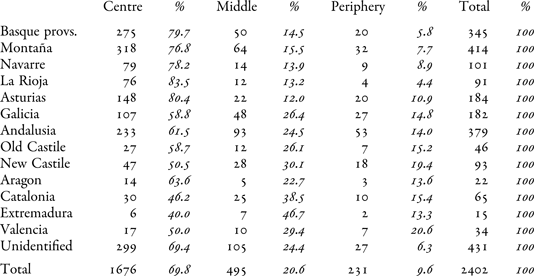
Following the well-known pattern of urban residence – a wealthy centre and a poor outskirts – the city's cuarteles (neighbourhoods) were classified into three categories: centre, middle and periphery. Given this pattern, the spatial distribution of the peninsulares suggests significant regional variation. On the whole, peninsulares were heavily concentrated in the city's centre, but some regional groups more so than others. Table 1 suggests that wealth as reflected by residence accrued to northern immigrants more than to their southern compatriots. Each of the northern groups, except Galicia, had over three-quarters of its members residing in the centre. All other groups, notably the large Andalusian community, maintained a smaller presence (about half) in the central neighbourhoods and a more sizeable one in the periphery, attesting to their relative absence from the upper classes. Worse off than other groups from the Cantabrian seaboard, Galicians were the only northern group that resembled southerners.
Residential Distribution of Peninsulares (men and women) in Mexico City, 1811

The figures are based on the extant census manuscripts, capturing approximately two-thirds of the city population.
Centre: cuarteles 1, 5, 9, 13; Middle: 10, 11, 14; Periphery: 4, 15, 16, 18, 21, 22, 23, 26, 28, 29, 31
Source: AGN, Padrones, volumes 53–58, 60–72 (Census of Mexico City, 1811).
While residential patterns indicate overall disparity across regional groups, they are not sufficiently sensitive to indicate elite membership, attained only by the wealthiest.Footnote 19 To complement the description of wealth distribution a pool of well-to-do immigrants was devised by locating all heads-of-primary-household in the 1811 census manuscripts of neighbourhoods 1, 5 and 9, the wealthiest ones in the city. This pool included all those who appeared as heads of the primary household in each building and who were not salaried bureaucrats. The residence of the primary household, especially in the central areas, was typically defined as casa or vivienda principal, the type of housing considered most prestigious and invariably headed by an español (peninsular or creole). As an opulent household, it included a large number of family members, employees and servants. Taking residence and status (head-of-primary-household) as indicative of economic standing, this pool heuristically represents an ‘economic elite’ within the peninsular-born population.
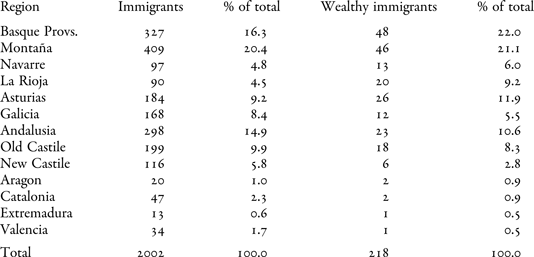
Table 2 illustrates the regional composition of this economic elite. Northerners, particularly Basques and montañeses, predominated as the largest groups among the Mexico City's wealthiest. In terms of regional rates of elite membership, other northern groups were equally, if not more, upwardly mobile than the Basques. While their neighbours from the mountainous north – Riojans, Asturians and Navarreses – did not form sizeable communities in the city, they all maintained a noticeable foothold in the upper classes. Here too, Galicia resembled the centre and south of Spain. Andalusians and Old Castilians did maintain a large contingent of wealthy people but only thanks to their large communities in Mexico City. Notably, their share in the economic elite was significantly smaller than their share in the peninsular-born population. Finally, Old and New Castilians differed significantly in their economic standing, reflecting a localised north-south variation.Footnote 20 The emerging pattern also confirms the well-known notion that wealth accumulation was underwritten by export-oriented enterprises, in which northern immigrants predominated in the eighteenth century. Not surprisingly, nearly four-fifths of the heads-of-primary-household were merchants, the rest being mainly miners and some landowners. Our inquiry now turns to analysing why northern immigrants should stand out in the lucrative export-oriented sectors of commerce and mining, starting with an examination of the factor that might be regarded as the ‘usual suspect’ – networks.Footnote 21
Peninsular Immigrants and Membership in the Economic Elite, 1811
* In the census of 1811 many immigrants gave ‘Castilla’ as their birthplace, concealing whether they were from Old or New Castile, or elsewhere in the kingdom. I extrapolated their relative numbers using the Marriage Application dataset (see Appendix) where registered birthplace was usually more specific. Despite this limitation, figures of the two relative to one another are more reliable, showing the north-south divergence.
Source: Census of 1811 (see Table 1).
Networks
Since most immigrants were active in commercial enterprises operating on a global scale, it would seem reasonable to assume that kinship and ethnic-regional networks, whether stretched across the ocean or within New Spain, explain success in business, and hence, economic disparity. It is therefore crucial to address the concept of networks, one that historians frequently use to explain various economic phenomena, notably in the Atlantic world.
In its broadest sense, a social network refers to face-to-face relations or informal relations, diametrically opposed to institutionalised, impersonal relations, commonly associated with modernity. In the sociological structure-agency dichotomy, networks are but structures linking agents.Footnote 22 As far as economic activity is concerned, the concept of networks relates implicitly to its social embeddedness, whereby economic considerations are framed by, or subordinate to, non-economic ones.Footnote 23 The network is understood as a community, even if geographically dispersed. It may develop around a specialised economic activity – long-distance commerce is an emblematic example – and usually involves the personal immediacy of kinship relations or ethnic solidarity. It is assumed that networks provided a valuable mechanism for doing business. Under conditions of limited information and enforceability, transactions involved risk, which could be reduced by interacting with people of social proximity and greater accountability.Footnote 24
Networks wedded immigration to transatlantic commerce, for the ships that carried goods also brought immigrants who would engage in commerce after their arrival. Immigrants reached the Indies with information and assistance obtained through transatlantic networks largely controlled by merchants. Commerce, in turn, created the demand and incentive for further immigration.
A host of studies has stressed the centrality of networks in explaining commercial activity across the Spanish Atlantic, implicitly drawing a causal link between access to networks and wealth accumulation. Research on merchants in the Spanish empire has been set in two frameworks: networks within colonial society and those that crossed the Atlantic, both based on the premise that commercial enterprises were grounded in personal ties. As peninsulares dominated commercial networks, their prevalence in the economic elite becomes comprehensible.Footnote 25
Despite the omnipresence of networks in their various forms, we must be cautious with ascribing them a causal role they did not necessarily play. The argument here is that networks may tell us how Spanish immigrants amassed wealth, but they do not tell us why some succeeded more than others.Footnote 26 Rather than being an initial condition for success, networks may well have emerged whenever economic opportunities appeared. The idea presented here is that networks formed and persisted when wealth was accumulated, but not necessarily the other way around. An examination of various types of networks will illustrate the limits of this concept for understanding economic mobility, at least in the case of transatlantic immigrants. To do so, the discussion focuses first on networks confined to the New World, and then on transatlantic ones. In both cases the conclusion is the same: networks do not explain wealth accumulation.
Networks within the New World
One of the principal channels of integration into colonial society was marriage into a local family, the wealthier the better for the immigrant's future prospects. Marriage has also been considered a useful institution for forming business alliances between families, a strategy for vertical or horizontal economic integration. As the argument goes, romantic considerations were pushed aside by cold business interests, making marriage an instrument for economic enterprise. For immigrants marriage presented an opportunity to gain a foothold in colonial business and resources, providing them with social capital, readily translatable into enrichment.Footnote 27
Yet evidence and logic suggest that the argument that immigrants got rich thanks to entry into wealthy families rests on shaky foundations. If anything, the causal relationship was the reverse: good marriage was the consequence rather than the cause of wealth accumulation. Local families and daughters were rather selective in their choice of mates. Mexico City merchants tended to marry late in their careers, suggesting that they first had to amass enough wealth to make themselves desirable partners for daughters of elite families.Footnote 28 Additionally, a large proportion of merchants never married at all, rendering the institution of marriage entirely irrelevant to their success.Footnote 29
To overcome the bias towards the elite inherent in the focus on merchants, the marriage-application dataset used in this research offers a more inclusive view, which also shows remarkable regional variation. The median age at marriage was 31 for southerners and 29 for northerners. But more importantly, northerners spent nine years on average after their arrival in the capital until contracting marriage, while their incontinent compatriots from the south waited for only five years.Footnote 30 Considering that careers started upon arrival, and regardless of class and occupation, marriage seems to have occurred closer to the culmination of economic mobility than to its initiation. If marriage was an important institution for entering or creating networks, then these networks were the product, not the origin of enrichment.
A related type of network, based on transatlantic family ties, formed around a well-known pattern of recruitment and integration, which David Brading called the ‘nephew syndrome’.Footnote 31 According to this pattern, prosperous businessmen in the New World recruited their nephews and other young paisanos valued as trustable employees. As a consequence, young relatives could gradually ascend the business ladder to become wealthy entrepreneurs themselves, perpetuating peninsular dominance. However, while the ‘nephew syndrome’ might help to explain who would cross the Atlantic, it does not account for who would become wealthy. It is inconsistent with the shift in the origins of immigrants and the northerners' economic success in the eighteenth century. If transatlantic ties determined recruitment and integration, given that they were geographically confined in sending regions, then we should expect the continuity of Andalusian and Castilian merchant families, predominant in sixteenth-century Spanish America.
Furthermore, the immigrant starting a career in his relative's business had to compete with other employees, fellow immigrants and creoles alike, all aspiring to advancement.Footnote 32 Despite northerners' predominance in commerce, as employers and employees alike, none of the large regional groups abstained from participating in this sector. Out of the 81 peninsular employees working for a Basque merchant that could be identified in the 1811 census only half were Basque compatriots, though montañés and Asturian merchants did exhibit more ‘exclusivist’ behaviour, co-regionals forming two-thirds of their Spanish-born employees.Footnote 33
One may argue that, even if initial employment was meritocratic, nepotism still cannot be ruled out fully, for within a single business the owner's kin employees enjoyed a certain advantage over non-kin ones. Indeed, another aspect of the ‘nephew syndrome’ was inheritance, whereby the young immigrant received his uncle's business, thus benefiting him over other potential successors. However, there is little evidence to support this argument. In fact, merchants' estates rarely went to their nephews. In a systematic study of merchant wills from eighteenth-century Mexico City, Juan Carlos Sola-Corbacho showed that nephews formed only 5 per cent of all designated heirs, while wives and children formed half of the fortunate group.Footnote 34 Furthermore, even if merchants practised nepotism, high turnover in the merchant elite, in addition to various obstacles to transferring the estate intact to a single heir, pre-empted its potential impact in the long run.Footnote 35 We may conclude that the economic gap between immigrants probably opened during their early years of residence in Mexico. Marriage, inheritance and other forms of social capital indeed signalled success and probably provided increments to wealth, but did not determine economic mobility in any fundamental way.
Finally, since immigrants also predominated in the colonial bureaucracy, especially following the Bourbon reforms, as judges, intendants and fiscal officials from Spain arrived in greater numbers against the protests of excluded creoles, we should also consider ties between entrepreneurs and bureaucrats.Footnote 36 Personal connections in the administration could obviously create a tangible advantage. In the mercantilistic environment of the transatlantic economy, factors such as market information, access to the royal mint or to ecclesiastical credit, and outright corruption, all seemed to have made personal ties to the administration highly useful. However, Bourbon fiscal centralisation and the struggle against corruption attenuated any clear-cut advantage for well-connected immigrants. More significantly, regardless of policy, little regional affinity existed between the economic and administrative branches of the colonial elite, making such connections less likely. As Andalusians and Castilians arrived in greater numbers as officials, while northerners went mostly as independent immigrants, this regional ‘division of labour’ made regionally based entrepreneur-bureaucrat networks less likely.Footnote 37 If at all, one would expect such connections to benefit southerners, due to paisano ties in the bureaucracy, yet evidently they were worse off.
Transatlantic networks
Another type of social capital potentially available for immigrants was formed by connections with kin and paisanos in Spain. If trade operated through personal connections across the Atlantic, it would seem plausible that immigrants had an important advantage.
The economic success of Armenian, Jewish and Indian global merchant networks, to name but a few well-known examples, has usually been attributed to the ethnic solidarity of these diasporas. Emotional ties and social pressure fostered commitment and trust, which in turn, reduced risk, making long-distance transactions more efficient.Footnote 38 In that sense, ethnicity acquired the same function as kinship.Footnote 39
However, several reasons cast doubt on the significance of diasporic solidarity. First, litigation among co-regionals suggests that networks were not always necessary for enforcement. As exemplified by the following Basque court case, formal institutions were not completely ineffective. Juan Bautista de Gogenechea, a Bilbao merchant, sued Ignacio Mena de Ugarte, a Mexico City merchant, originally from Orozco, Vizcaya. Juan Bautista never saw the 10,000 pesos sent by his brother-in-law, Lucas de Careaga, a sea-captain residing in Mexico City, which Ignacio was supposed to deliver when sent on a business trip back to Spain. A counter-lawsuit was initiated by Ignacio, together with business partners in Bilbao and Cadiz, against Juan Bautista and his wife, suing them for a debt of 8,349 escudos.Footnote 40 The case illustrates that resort to judicial institutions was possible even in long-distance conflicts. Furthermore, the transatlantic dimensions of litigation, as much as the less quarrelsome testaments, power deeds and donations, attest to a degree of judicial effectiveness, so that formal institutions complemented diasporic networks in enforcing discipline.
Second, structural conflict between old and new consulados, all dominated by the same regional groups of immigrants, meant that economic interests paid little regard to paisano solidarity.Footnote 41 The establishment of new consulados in Veracruz and Guadalajara in the late eighteenth century encroached on the traditional monopoly of the consulado of Mexico City. These new consulados articulated the interests of northern peninsulares who sought commercial independence from their co-regionals in Mexico City. That economic interests, when conflictive, could override ethnic solidarity, suggests that diasporic identity did not suffice to make networks work. Networks of ethnic solidarity could at times require economic ‘harmony’ among their members but they did not necessarily create it.Footnote 42
Finally, transatlantic connections may appear crucial for economic success because the same regional groups dominant in the New World were also dominant in Cadiz, the funnel for trade in the eighteenth century. However, social ties between Cadiz and the New World did not necessarily play a causal role. If we attribute the success of Basques and montañeses in the Indies to their connections in Cadiz, we are still left with the puzzle of explaining why their compatriots had become prominent in Cadiz in the first place, a crucial point to which we shall later return.
As for the role played by transatlantic networks, we must initially distinguish between explaining transatlantic migration and explaining immigrants' economic mobility in the New World. We are asking two separate questions: who would migrate, and who would become rich?
As far as access to transatlantic immigration is concerned, two types of connections may have played a role: ties in Cadiz and ties in the New World. Since moving to the Indies was costly and complicated, immigrants depended on the assistance of kin and friends strategically positioned on both sides of the Carrera de Indias. Merchants in Cadiz, as the port monopolising transatlantic traffic, were perfectly placed to facilitate emigration. In addition to valuable information pertinent to the Carrera, they possessed political and economic resources to secure passage for their protégés.Footnote 43 Yet connections to merchants in Mexico City appear to have been more significant. After all, those who had already ‘made America’ were the very ones who needed young blood for their thriving businesses. Cadiz merchants could provide assistance to emigrants, but Mexican merchants actually needed them.
As one might expect, regional presence in the consulado of Cadiz and the migratory flow to the New World were strongly correlated, as the same regions dominated commerce both in Cadiz and Mexico City.Footnote 44 The Basques, for example, who maintained a substantial representation in the consulado of Cadiz, also dispatched a sizeable contingent of compatriots overseas. By contrast, a region such as Extremadura, a major sending region in the sixteenth century, became ‘immobile’ by the eighteenth, paralleling the absence of its natives from commerce in Cadiz.
When it comes to economic mobility and success, we do not have any systematic examination of transatlantic networks, partly due to a methodological difficulty: networks tend to correlate with commercial success.Footnote 45 One way to overcome this problem is to look at a type of evidence that would allow us to measure the extent of ties by separating them from commercial activity. Grounded in the marriage applications dataset from Mexico City our analysis measures the ‘strength’ of transatlantic networks by using as a proxy variable the length of time immigrants spent in Cadiz prior to departure. Before embarking for the Indies, many immigrants moved around in Spain or, more often, spent some time in Cadiz. Going directly to the New World without roaming in Spain meant prior planning and thus, better connections. The following examples illustrate various types of the migratory process, some smoother than others.
In 1777, aged 16, Ventura Gallinas left his home in Cervatos de la Cueta, a town in Old Castile, going to the town of Llerena, Extremadura, where he lived for eight years. He then left for Cadiz, where he resided for four months until boarding a ship for Veracruz. After two days, he then went to Mexico City, where he was living at the time of his marriage in 1791.Footnote 46
Some immigrants stayed longer in Cadiz before crossing the Atlantic. At the age of ten, Francisco Cruces left his hometown, La Seira, in Galicia, going to Cadiz where he lived for 12 years before departing for Veracruz in 1756. Despite living away from home for so long, he maintained his ties. José Conde, his witness, was from Seira too, but arrived in Cadiz eight years after Francisco. Four years later both left for Mexico City.Footnote 47
Others, however, enjoyed a smoother process, arriving in Cadiz straight from their hometown and departing for the New World without any significant delay, presumably thanks to networks that helped to arrange the move starting from their hometowns. It was highly unlikely any would board a ship upon arrival in Cadiz without previous arrangements. In 1759 Antonio González Pavia, a montañés from the village of Secadura, left at the age of 22 directly for Cadiz and immediately embarked for Mexico City, where he had been a vecino for three years when he married.Footnote 48 In the same vein, in 1755, aged 16, Tomás de Urizar left his Basque village of Larrabezua for Cadiz, where he immediately boarded a ship to Veracruz, continuing directly to Mexico City.Footnote 49 These immigrants avoided any ‘stopovers’ in Cadiz or elsewhere in Spain before embarking.
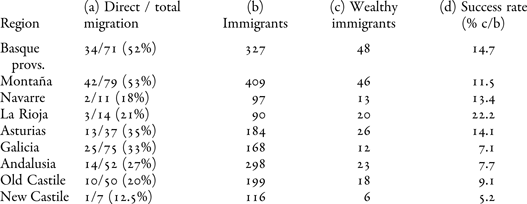
To make sense of the various types of migratory experience, Table 3 illustrates important differences across regional patterns, looking at various possible relationships between transatlantic networks and economic mobility. Half of the Basque and montañés immigrants, the very groups dominant in the economic elite, secured swift passage. Most Galicians and Asturians spent some time in Cadiz, only a third of them embarking promptly. And ironically enough, Andalusians hardly benefited from their proximity to the port of departure, with only a quarter passing through without delay.
Transatlantic Connections and the Peninsular Population in Mexico City
Sources: column a: Marriage Application dataset (see Appendix); columns b, c, d: Census of 1811 (see Tables 1 and 2).
* The figure of direct migration for Andalusia excludes natives of Cadiz due to inapplicability. Other regional groups were excluded due to a large error margin.
Statistics: Pearson correlation between a and b: r = 0.81
Pearson correlation between a and c: r = 0.91
Pearson correlation between a and d: r = 0.15
How were transatlantic networks related to regional communities of immigrants in Mexico City? Attaching the population data from Mexico City to the figures of time in Cadiz, Table 3 shows that swift migration was related to regional presence in Mexico (column b). Yet the mere size of regional communities did not entirely suffice to engender networks that would facilitate the arrival of new immigrants. Andalusians, for instance, formed one of the largest communities in Mexico City, but they did not command strong links to the peninsula.
Speedy migration was even more closely related to the presence of co-regionals in the economic elite (column c). Wealthy immigrants indeed had a greater leverage in calling over for young blood. They also needed them more than their less prosperous compatriots. Our quantitative data confirms the idea that overseas migration depended to a great extent on recruitment by thriving entrepreneurs already established in the Indies.
However, using strong connections in the Americas to emigrate and get started in the New World was one thing. Getting rich was quite another. While expedited migration and the number of wealthy co-regionals were strongly correlated, there was no correlation between speedy migration and the rate of economic success (column d). If swift migration was indeed an indication of access to networks, that access had little to do with the chances of entering the economic elite. A clear example is presented by Riojans and Navarrese. Going in small numbers, they did not particularly benefit from extensive networks facilitating their move to Mexico, as only about a fifth of each group left Cadiz without any delay. Yet, they became wealthy on a disproportionate scale, no less than the large communities of Basques and montañeses.Footnote 50
Although networks played a role in determining who would cross the Atlantic they did not determine who would become wealthy. We know that new immigrants started off as employees, yet only a handful later achieved phenomenal wealth. The crucial point is that those who did succeeded largely regardless of networks, whether transatlantic or local ones, whether based on paisanaje or kinship. Networks certainly were important for business but they expanded or contracted according to economic success, not the other way around. For the same reason, northerners could ‘take over’ colonial enterprises to become dominant in the eighteenth century. In short, networks appear to have been the consequence of wealth accumulation. As such they describe but do not explain immigrants' economic mobility. They tell us how peninsulares became wealthy but they do not tell us why. To explain economic mobility a different approach is required, one that searches for its causes in the personal characteristics that immigrants brought from home.
Immigration and Human Capital
If networks did not play a causal role in wealth accumulation, how do we account for the economic disparities among regional groups? The insufficiency of networks leads us to examine social group characteristics instead of social ties or interactions. By so doing, we focus on the aggregate characteristics of the individual members of a given population, instead of their relations within the social structure. The notion of social group characteristics steers away from ties to nodes, to use the jargon of network theory. My findings show that immigrants possessed an important asset, a remarkably high level of human capital. Being a highly select group, the immigrant population was endowed with human capital on a level unmatched by either the sending or receiving society. But more importantly, a conspicuous disparity in human capital existed across regions of origins, and notably, between northerners and southerners. This was the key factor behind the economic disparity among immigrants from different regions.
Conceptually, human capital stands in opposition to social capital. Economists and economic historians view human capital as a form of capital defined by the acquisition of skills and education, an investment reflected in increasing returns to labour. Embodied in personal ability, human capital represents a qualitative improvement in productive input resulting in greater output. The accumulation of human capital has been considered a source of economic growth affecting the entire economy. Likewise, it may account for variation in productivity between social groups within a single economy – why some are richer than others.Footnote 51
To measure human capital I used literacy rates derived from the marriage applications, as applicants – both bride and groom – and their witnesses were required to sign their statement. The marriage applications are particularly useful for two reasons. First, they provide the most complete source for examining literacy along with other variables. Second, their scope is the entire peninsular population rather than a narrow elite or an economic sector.
The use of signatures in research on historical literacy is famously problematic, as signatures are blunt enough to conceal the qualitative aspects and quantitative gradations of reading and writing skills.Footnote 52 Nevertheless, across large populations name-signing provides a most reliable proxy for literacy. It is also a useful indicator of human capital, for a chasm separated the literate few from the illiterate many. In pre-modern times, the gap proved all the more remarkable.Footnote 53 Additional types of human capital like numeracy and bookkeeping, though important for business, could not be measured. At any rate, these skills were grounded in literacy, the more rudimentary type of human capital, which is readily measurable.Footnote 54 We may further speculate that the growing use of libranzas and large merchants' financial role in credit transactions, both related to the late colonial liquidity shortage, may have made literacy all the more significant for economic mobility.Footnote 55
Peninsulares in late colonial Mexico City indeed demonstrated an extremely high rate of literacy: 90 per cent of them could sign their name. Considering their selective recruitment through networks linked to their hometowns, this figure is not entirely surprising.Footnote 56 Immigrants' literacy was remarkable in comparative perspective, surpassing the contemporary highly literate ‘islands’ in Scandinavia and North America which possessed a male literacy rate surpassing 80 per cent, or European urban enclaves led by Amsterdam with 85 per cent. Spain and other Southern European countries lagged behind, falling below 50 per cent.Footnote 57 Ironically, immigrants' literacy and commercial inclinations belie the idea of Catholic aversion to capitalistic rationality, all the more so because Basques were famous for their religious conservatism.
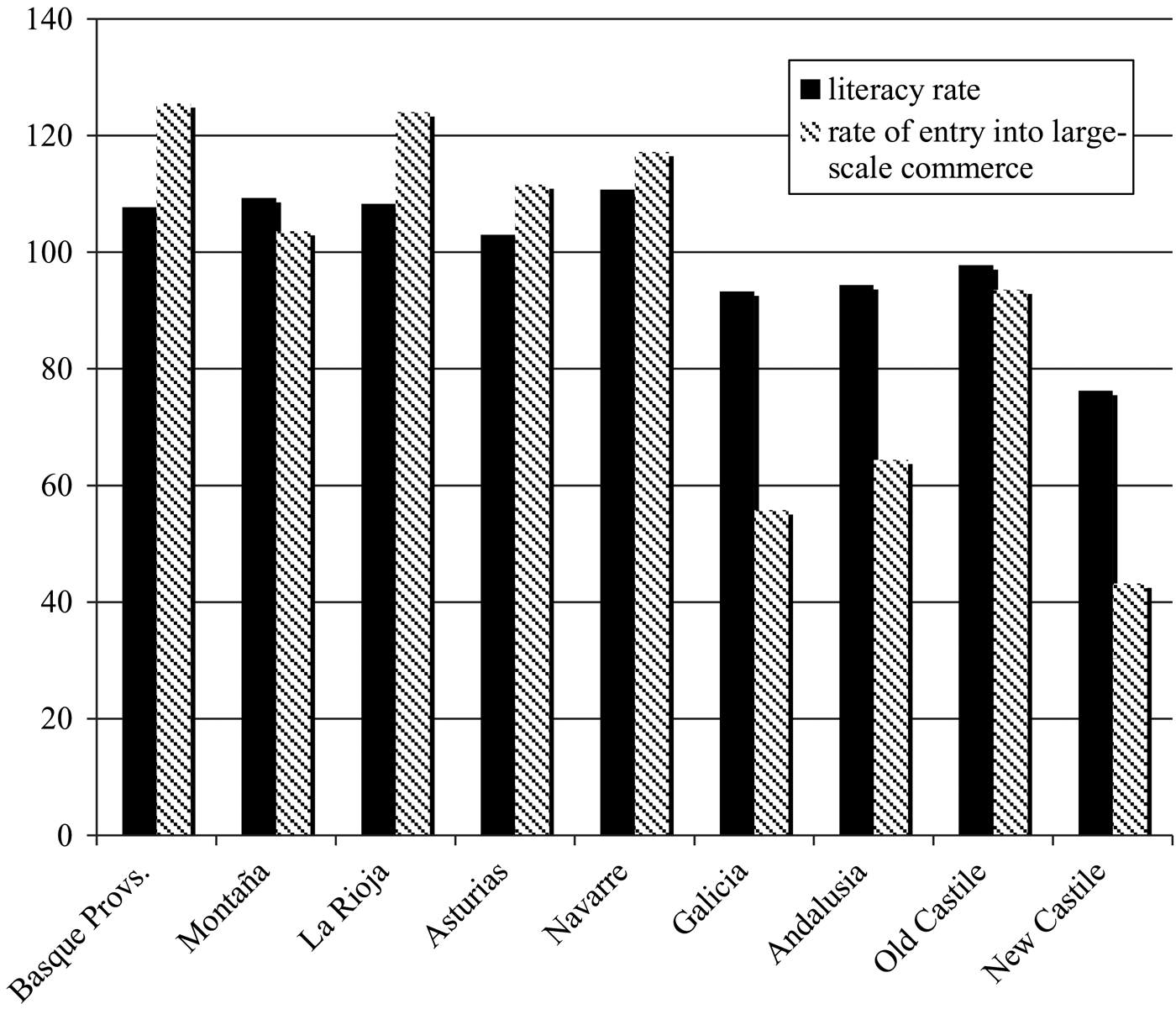
Considering commerce as the principal channel for enrichment, how was literacy related to immigrants' mobility in commerce? Figure 1 illustrates the participation of peninsulares in large-scale commerce. Relying on the 1811 census, it goes beyond the limited category of consulado merchants to include all men engaged in commerce. I created two analytical categories, the first one of affluent merchants, defined as heads of a household with three employees or more, and the second one of commercial employees and small-scale merchants. The more literate regional groups tended to succeed more in commerce. Regions with above-average literacy also entered into large-scale commerce more frequently than the average. In terms of both literacy and representation in large-scale commerce, the disparity between the northern regions and central and southern Spain is unequivocal. Galician immigrants were the only northern group whose performance in commerce was similar to the less successful southerners, reflecting their relatively low literacy.
Literacy and Commerce by Region of Origin
Literacy seemed to matter more than close-knit networks. Immigrants from all regions engaged in commercial enterprises, small as well as large ones. Andalusians, for example, were not barred from entry, some even becoming extremely wealthy merchants. However, they did not move up on a scale comparable to their northern compatriots, as southerners were significantly less literate than northerners, and accordingly, fewer of them succeeded. Furthermore, although the share of Navarreses and Riojans in the merchant population remained minor, they displayed a high rate of entry into large-scale commerce. The data suggests, once again, that networks influenced transatlantic movement but did not guarantee economic mobility, at least not in commerce. The relatively large number of Basques and montañeses in entry-level positions may well have been the result of social capital, networks that facilitated immigration, but their economic success depended largely on human capital brought over from Spain.
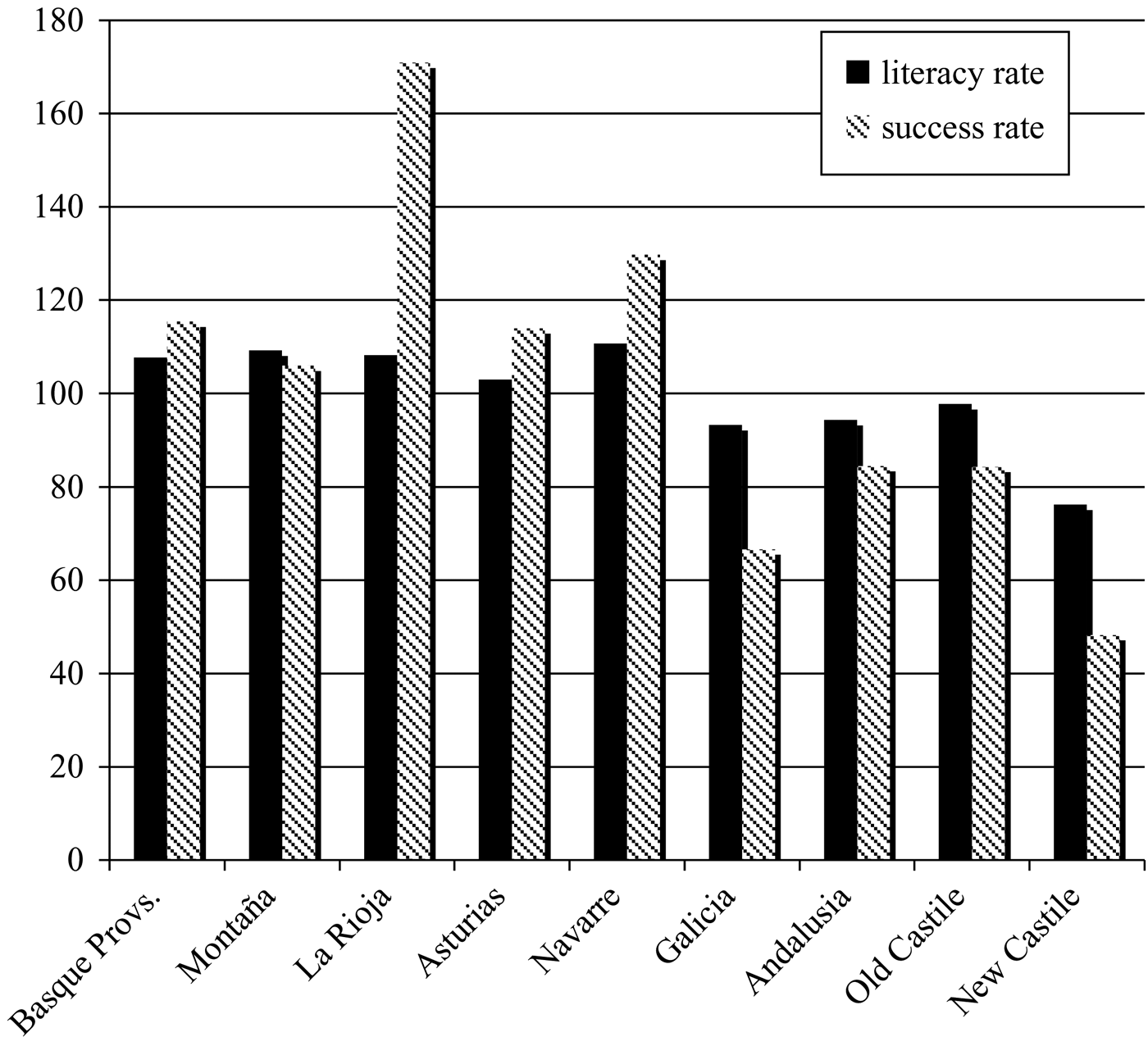
Yet, a focus on commerce may contain unwarranted biases regarding immigrants' mobility and enrichment. To overcome those, I juxtaposed literacy rates with a narrow, occupation-blind pool of wealthy immigrants, defined as heads-of-primary-household of houses in the central neighbourhoods of Mexico City but only those with an annual rent of 600 pesos or above.Footnote 58 The results show that economic success, in terms of entry into the economic elite, was positively related with literacy (Figure 2).Footnote 59 Regions with an above-average literacy rate were the same ones whose presence in the narrow elite was above average. Small regional communities, such as Riojans and Navarreses, might have been overshadowed by the sheer numerical visibility of Basques and montañeses, yet, they demonstrated an economic success rate on a similar level or even higher. By contrast, immigrants from central and southern Spain, regardless of their numerical presence, experienced a lower degree of entry into the elite than their northern compatriots. While the evidence does not tell how other factors, such as networks, affected regional success rates, the overall pattern shows that greater literacy itself resulted in greater chances of entry into the economic elite.Footnote 60
Literacy and Economic Success by Region of Origin
If, as previously shown, the ‘usual suspects’ controlled all profitable large-scale enterprises, not only commerce but silver-mining and the less risky agriculture as well, then we may infer that those endowed with greater human capital entered and predominated in any sector where returns were high. Immigrants were initially attracted to these sectors because of opportunities for enrichment rather than connections. Networks may have ensued but importantly they did not condition any occupational specialisation, often typical of ethnic immigrant communities. Regardless of clannish nepotism or bureaucratic favouritism immigrants accumulated wealth in any sector they entered, thanks to their crucial asset of human capital. Any form of social capital at work seemed to derive from economic success, which was primarily conditioned by human capital.
Despite the strong correlation between literacy rates and regional origins, it remains uncertain how human capital was distributed within the literate population of each regional group, simply because the measure of literacy is not sensitive enough to gradations of human capital. Yet, there are two indications that aggregate regional figures for literacy also reflect a qualitative variation. In other words, we may argue that the average literate Basque had a higher level of human capital than the average literate Galician or Andalusian.
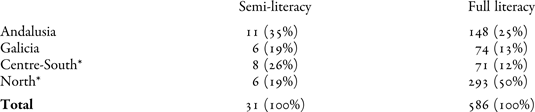
The first indication is based on the quality of signatures. I distinguished between coherent, smooth, legible handwriting, and broken, shaky, illegible writing, analytically defining the former as full literacy and the latter as semi-literacy. We can reasonably assume that those with a bad signature had relatively limited writing skills and possibly reading skills as well. Of course, good writing skills do not necessarily signify overall business expertise, but insofar as they reflect long-term gains of primary education they seem indicative. Table 4 shows the relation between signature quality and regional origins. Narrowing the target population to literate immigrants only, signature quality successfully predicts relative wealth. The same regions prominent in the economic elite showed a greater proportion of fully literate immigrants. Southerners and Galicians expectedly had a larger representation of semi-literates, on top of their already large share of illiterates. It is worth noting that out of 33 semi-literates whose occupation is known, 20 worked in commercial jobs, implying that they were not excluded from employment in commerce.Footnote 61
Semi-Literacy vs. Full Literacy by Region of Origin
Source: Marriage Applications dataset.
* Due to the small number of observations in the semi-literate category, I grouped the two Castiles and Extremadura into what I define as ‘Centre-South’. I also grouped the following contiguous regions into ‘North’: Asturias, Montaña, La Rioja, the Basque provinces and Navarre.
The second indication involves two aspects of the immigrants' origins in Spain: social circumstances in the sending regions and the filtering process by which immigrants were selected. Both aspects are crucial for understanding the skewed distribution of human capital across regional groups of immigrants.
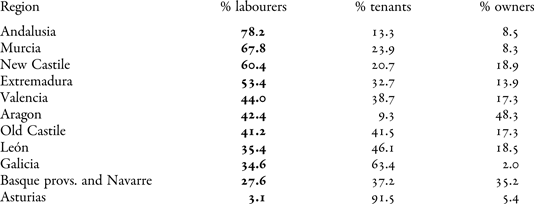
Spain presented a mosaic of regions, each with its own institutions, social structure and culture, which by the eighteenth century followed divergent patterns of economic development.Footnote 62 Crossing the peninsula from north to south, the prevalence of landowning peasants became less and less frequent, replaced by the landless rural workers on the infamous latifundias (Table 5). Three regions with different structures are relevant for our discussion, especially because all three participated in the flow of immigration. A patchwork of tiny plots of land, Galicia suffered from a Malthusian curse of overpopulation, whereby perennial subdivision of land among heirs resulted in general poverty. Formally tenants, in practice peasants, owned the land plots they worked. Yet, the problem was the low productivity of the Galician minifundios, partly a result of partible inheritance. In Andalusia, latifundism engendered a highly unequal society of a few wealthy landlords and the poor landless masses, a pattern also typical of Extremadura and New Castile. The Basque provinces and Cantabria (montaña) presented a unique model of small family landholding, a yeomanry of sorts, which perhaps thanks to impartible inheritance practised Malthusian preventive checks, allowing for modest accumulation by many families. It is perhaps not surprising that the initial stages of Spanish industrialisation took place in these more affluent regions.Footnote 63 In contrast to Galicia's poor tenants or Andalusia's peons, Basque and montañés peasants formed a rural middle class, backbone of relatively egalitarian societies.
Land Ownership in Spain, 1787–97
Based on Jordi Nadal, La población española: siglos XVI a XX (Barcelona: Ariel, 1976), p. 102.
* Under the administrative division of the Old Regime, the Montaña (Cantabria) and La Rioja were provinces within Old Castile. Other indicators, such as crop mix and family structure, suggest that they followed a pattern similar to the Basque provinces.
Under such circumstances, Basque and montañés families were best situated to accumulate human capital translatable to economic success. In these regions the predominance of the stem family structure coupled with widespread landownership acted propitiously to stimulate investment in children's upbringing. Frederic Le Play, father of family sociology, regarded the Basque stem family as a model of social stability and benign development to inspire reformist policies, as he considered partible inheritance a threat to the institution of the family and to a healthy society in general.Footnote 64 Travellers such as the Englishman, Henry Swinburne, praised the idyllic Basque countryside, describing its ‘rich studied culture, a clean-looking smiling people, good furniture, neat houses, fine woods, good roads and safe bridges’. For Castile and Andalusia, Swinburne reserved a stark view, commenting on their discouraging poverty, backwardness and banditry.Footnote 65
Historical literacy rates across Spain corroborate these impressionistic accounts.Footnote 66 By 1860, for which comparable data is available, the northern regions of Old Castile (which included Cantabria), the Basque provinces and Navarre were more literate than the national average, while the southern half of the country was placed below the national average. The latifundia created conditions that precluded any potential accumulation by the masses. Peasants did not have the means to do so. Landlords did not have the incentive to improve the lot of their workers through wages or skills. By contrast, Basque and montañés rural folk presented an irrevocable counterpoint to Marx's disparaging comment on ‘the idiocy of rural life’. In these regions, human capital accumulation contributed to local economic progress and to the prosperity of their diasporas.
An important source of human capital formation – schooling – started to expand in the north as early as the eighteenth century, if not earlier. Before the onset of urbanisation, schools of primeras letras operated across the hamlets of the Cantabrian and Pyrenean mountains.Footnote 67 Qualitative evidence from the Mexican marriage applications suggests that northern immigrants, despite their rustic background, had received primary education. In some cases applicants and their witnesses recounted how they had known each other since a very young age, as they had attended school together. For instance, Francisco Javier del Pino, a witness for his montañés compatriot, Domingo de Gandarillas, in 1777, recounted how as children they went to school together. The two friends grew up in different villages but met at school in Santillana, a town located two leagues away from their homes.Footnote 68 Eighty-five per cent of marriage-application testimonies mentioning school attendance were given by immigrants from the rural areas of central-northern Spain, attesting to their unique background.
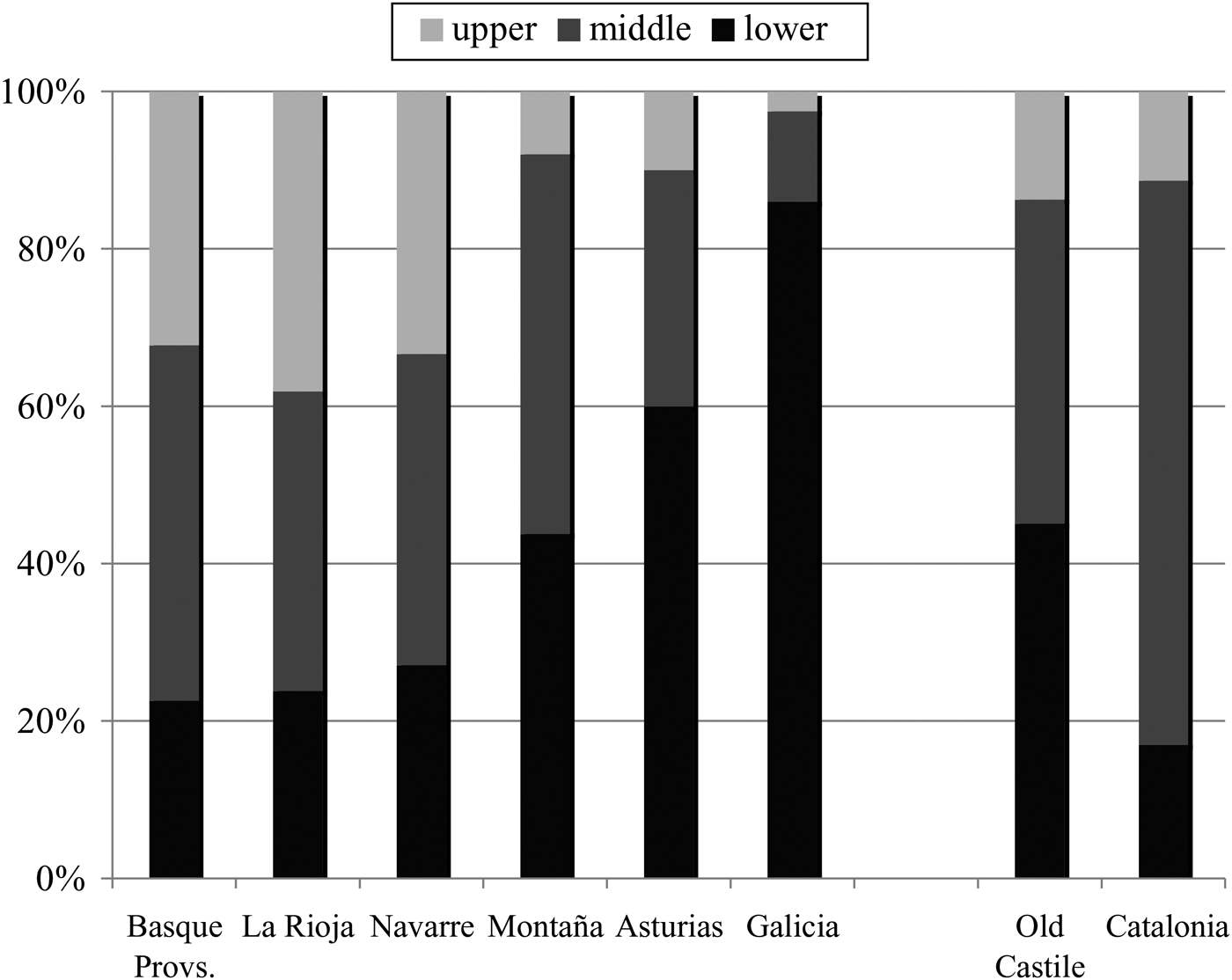
Regional social structures resonated in regional communities in Cadiz, a magnet for internal migration, illustrating the selection process of immigrants. We have already seen that the usual groups – Basques and montañeses – became prominent in the city's consulado. Based on the municipal census of 1773, Figure 3 lays out the northern immigrant population resident in Cadiz by three levels of occupational status.Footnote 69 Galician newcomers presented a typical case of labour migration, overrepresented in such occupations as domestic service and menial jobs. By contrast, Basques tended to crowd in high-status occupations, notably commerce. Schematically then, the further west a migrant's birthplace was along the northern seaboard, the lower his social class in Cadiz would be.Footnote 70
Social Status of Spanish Migrants in Cadiz, 1773
The regional ‘division of labour’ in Cadiz reflects how immigrants from regions rich in human capital outperformed others, not only in the New World, but also in Spain itself. This similarity between Cadiz and Mexico City provides further support for an emphasis on regional conditions manifest to some extent in the diaspora. Transatlantic and intra-peninsular networks need not be completely dismissed, as they certainly made the migratory flow highly selective, but since the selection process depended on conditions at home, some regions supplied an immigrant population better endowed with human capital than others.
Taken as two extremes along the northern seaboard, Galicia and the Basque provinces represent contrasting types of home conditions, shedding light on immigrant selection. Impartible inheritance in the Basque provinces may have encouraged non-inheriting children to seek their fortune elsewhere. While Basque children could rely on their extended stem family for economic security, Galicians did not have an equivalent recourse due to the notorious subdivision of the land among many impoverished heirs.
The Basque-Galician contrast in Cadiz also sheds light on its counterpart in Mexico City. Admittedly, high costs and other factors had a levelling effect on transatlantic migration. If Basque and Galician migrants in Cadiz presented two disparate socio-economic classes, then in Mexico City the gap narrowed, though it did not completely disappear.Footnote 71 Certainly, the immigrant population in both cities was not dichotomously split between aspiring entrepreneurs and destitute subsistence seekers. An array of motivations ranging from necessity to ambition governed immigrants' decisions to leave home. On that scale, Galicians were relatively more motivated by poverty, Basques more by business opportunities. Migrating to Cadiz, Basques left behind a rural middle class of extended families to become merchants, while Galicians escaped impoverished nuclear families to become servants. Leaving a cushioned home, Basques had more to lose, and therefore, more likely to have greater expectations in the destination city, all the more so in the New World due to high migration costs. It is therefore hardly surprising that Basques in Mexico City possessed a very high level of human capital. We may further conclude that even among literate peninsulares in Mexico City, Basques possessed a greater level of human capital than Galicians, and by extension, northerners more than southerners.
Conclusions
Modern historians as much as colonial intellectuals have tended to identify colonial elites with peninsulares. Looking at the entire Spanish-born population in Mexico City reveals a great deal of variation in terms of wealth accumulation, which calls for an explanation. Our analysis shows that the usual explanatory suspect – networks – does not account for immigrants' economic mobility. Networks indeed help to explain who would emigrate. But once in the New World immigrants' economic mobility, usually in commerce, depended largely on human capital, a product of circumstances at home. This is why northern Spaniards formed the wealthiest families in eighteenth-century Mexico, as elsewhere in the Spanish empire. To be sure, networks were not irrelevant as they presented the framework of business organisation. However, networks are better viewed as a symptom of economic prosperity, not its cause.
Viewed in that light, we may better understand the shift in emigrants' origins during the colonial period. In the early period, geographical proximity to Seville, along with a strong presence in the conquest, made southerners dominate the flow, endowing them with booty and encomienda grants. As the colonial era progressed, their transatlantic networks succumbed to economic forces. Equipped with greater human capital, northerners proved more successful in business and gradually outnumbered southerners in the flow.Footnote 72
We may further speculate that human capital was an important factor behind the overall peninsular-creole disparity. Social filters in the Cadiz bottleneck led to a highly selective flow of emigrants, but once in the New World, political and social connections did not seem to privilege these independent immigrants over creoles in any tangible way. Although further inquiry is necessary, it seems that the peninsular-creole economic gap was not simply a consequence of discriminatory practices or institutions.Footnote 73
By highlighting the nature of Spanish immigration we may also speculate on the question of long-term inequality. Research on comparative development in the Americas has traced the origins of Latin America's relative inequality vis-à-vis British America to its colonial institutions, which favoured small European elites, excluding mostly non-white populations.Footnote 74 Though addressing a tiny privileged population, the findings here suggest that immigration restrictions, which made the Spanish flow highly selective, may have contributed to the ensuing colonial inequality. There was no Spanish equivalent to British indentured servitude, which enabled immigration from more humble origins, thus attenuating colonial inequality. Although further investigation is necessary, it seems that mechanisms operating within Europe – immigration policy and networks – could affect colonial society in surprising ways.
Finally, this article has tackled a common confusion, prevalent in Atlantic history, between description and explanation.Footnote 75 The Atlantic ‘system’ is sometimes attributed with an explanatory power that it does not necessarily have. A rigorous investigation shows that some phenomena had little or nothing to do with transatlantic ties, entanglements or systems. The migratory process indeed depended on transatlantic ties, but immigrants' fortune in the New World had little to do with such ties. It is one thing to show that transatlantic interaction of various kinds took place. It is quite another to argue that this very interaction explains everything happening within the system. This study produces a new understanding of immigration in the Spanish empire in a way that overcomes the premise of transatlantic interconnectedness.
Appendix: Marriage Applications Dataset
The dataset was culled from the informaciones matrimoniales (marriage applications) submitted to the church by couples wishing to get married. I located all application files (337 in total) where the male applicant (groom) was a peninsular residing in the capital from the Matrimonios branch of the Archivo General de la Nación (AGN) for the years between 1750 and 1824. In most cases the bride was a creole. The dataset consists of 1,037 immigrants, one-third applicants and two-thirds witnesses.
Each file contains a wealth of readily quantifiable information, as the applicant was required to recount his life prior to departure in order to prove his legitimate status for marriage. The same was expected of the witnesses presented to testify on their behalf. Whenever possible, applicants would prefer a witness they had known since an early age, many times from the same village or province.
The population observed in the marriage records is largely representative of the peninsular-born population in Mexico City. Even if some regional groups married more frequently than others, the dataset agrees with other variables, such as residence and occupation. Social categories of those who did not contract marriage (clerics and bachelors) appear in the dataset as witnesses.
The dataset may overestimate immigrant literacy due to the relative absence of illegal immigrants, who tended to enter the lower tiers of colonial society and were therefore less inclined to marry in the church. However, since these lower-class immigrants came mostly from Andalusia, their absence from the applications may downplay the gap between northern and southern immigrants. Their inclusion would have made the findings and argument concerning regional disparity all the more pronounced.