INTRODUCTION
Increasing evidence has highlighted the urgency to identify individuals at greater risk for developing Alzheimer’s disease (AD), as AD-related pathology (i.e., amyloid beta and tau tangles) begins to accumulate in the brain many years before dementia onset (Benzinger et al., Reference Benzinger, Blazey, Jack, Koeppe, Su, Xiong and Morris2013; Fleisher et al., Reference Fleisher, Chen, Quiroz, Jakimovich, Gomez, Langois and Reiman2012; Fagan et al., Reference Fagan, Xiong, Jasielec, Bateman, Goate, Benzinger and Holtzman2014). Greater Subjective Cognitive Decline (SCD), defined as “subjectively reported change in cognitive performance” (Jessen et al., 2014), has been shown to be an early indicator of subtle cognitive decline and to be associated with higher levels of amyloid beta and tau in the entorhinal cortex in cognitively normal older adults at risk for AD (Buckley et al., Reference Buckley, Hanseeuw, Schultz, Vannini, Aghjayan, Properzi and Amariglio2017, Reference Buckley, Sikkes, Villemagne, Mormino, Rabin, Burnham and Amariglio2019). As such, measuring SCD may be useful for identifying individuals at increased risk to develop dementia (Buckley et al., Reference Buckley, Sikkes, Villemagne, Mormino, Rabin, Burnham and Amariglio2019). However, while evidence supports that SCD is associated with early disease progression, it is not well understood how SCD may vary with other factors such as biological sex in the preclinical stage of AD.
Sex differences in AD have been understudied despite data showing that there are more women than men diagnosed with the disease (Plassman et al., Reference Plassman, Langa, Fisher, Heeringa, Weir, Ofstedal and Wallace2007; Mielke, Reference Mielke2018; Alzheimer’s Association, 2020). While some studies suggest that this may be largely due to women living longer than men on average (Fiest et al., Reference Fiest, Roberts, Maxwell, Hogan, Smith, Frolkis and Jetté2016), other studies have reported that there are sex differences in cognitive performance and AD-related pathology burden after controlling for age or survival (Sundermann et al., Reference Sundermann, Edmonds, Delano-Wood, Galasko, Salmon, Rubin and Bondi2018; Buckley et al., Reference Buckley, Mormino, Amariglio, Properzi, Rabin, Lim and Sperling2018, Reference Buckley, Sikkes, Villemagne, Mormino, Rabin, Burnham and Amariglio2019; Vila-Castelar et al., Reference Vila-Castelar, Guzmán-Vélez, Pardilla-Delgado, Buckley, Bocanegra, Baena and Quiroz2020). For instance, recent studies showed that cognitively normal older women exhibited a steeper objective cognitive decline and higher levels of entorhinal tau burden compared to men with similar amyloid levels (Buckley et al., Reference Buckley, Mormino, Amariglio, Properzi, Rabin, Lim and Sperling2018; Buckley et al., Reference Buckley, Sikkes, Villemagne, Mormino, Rabin, Burnham and Amariglio2019).
Studies examining sex differences in SCD in AD have reported inconsistent findings. Some studies in cognitively unimpaired individuals found that SCD is more frequently reported in males (Holmen et al., Reference Holmen, Langballe, Midthjell, Holmen, Fikseaunet, Saltvedt and Tambs2013; Paradise et al., Reference Paradise, Glozier, Naismith, Davenport and Hickie2011), others that SCD is more frequently reported in females (Heser et al., Reference Heser, Kleineidam, Wiese, Oey, Roehr, Pabst and Wagner2019), and others found no difference between males and females (Sundermann et al., Reference Sundermann, Edmonds, Delano-Wood, Galasko, Salmon, Rubin and Bondi2018). These discrepancies may be related to differences in methods or the age of the cognitively unimpaired participants being studied (Heser et al., Reference Heser, Kleineidam, Wiese, Oey, Roehr, Pabst and Wagner2019). In studies with younger individuals, males tended to report greater SCD than females (Holmen et al., Reference Holmen, Langballe, Midthjell, Holmen, Fikseaunet, Saltvedt and Tambs2013; Paradise et al., Reference Paradise, Glozier, Naismith, Davenport and Hickie2011), whereas in studies with older individuals, females tended to report greater SCD than males (Heser et al., Reference Heser, Kleineidam, Wiese, Oey, Roehr, Pabst and Wagner2019). Other possible explanations that have been posited for why males may have higher SCD than females in some of these studies include possible selection bias caused by lower participation rates in men compared to women, thus having participating men more likely to report memory concerns than nonparticipating men, as well as lower education or greater cardiovascular risk factors which may be more present in males than females (Holmen et al., Reference Holmen, Langballe, Midthjell, Holmen, Fikseaunet, Saltvedt and Tambs2013; Paradise et al., Reference Paradise, Glozier, Naismith, Davenport and Hickie2011).
On the other hand, it has been suggested that females may be more sensitive to subtle pathological changes and more likely to report cognitive problems than males (Heser et al., Reference Heser, Kleineidam, Wiese, Oey, Roehr, Pabst and Wagner2019; Pérès et al., Reference Pérès, Helmer, Amieva, Matharan, Carcaillon, Jacqmin-Gadda and Dartigues2011; Sundermann et al., Reference Sundermann, Edmonds, Delano-Wood, Galasko, Salmon, Rubin and Bondi2018). Sundermann and colleagues showed that both cognitively unimpaired males and females exhibited an association between greater SCD and poorer verbal memory performance. It was only once the groups were further along in the disease progression that females with amnestic mild cognitive impairment (aMCI) showed a stronger association than males with aMCI (Sundermann et al., Reference Sundermann, Edmonds, Delano-Wood, Galasko, Salmon, Rubin and Bondi2018).
Studies examining SCD in cognitively unimpaired individuals with autosomal-dominant AD (ADAD), who have a well-characterized disease progression (Fuller et al., Reference Fuller, Cronin-Golomb, Gatchel, Norton, Guzmán-Vélez, Jacobs and Quiroz2019), have provided great insight into the role of SCD in preclinical AD (Gatchel et al., Reference Gatchel, Lopera, Norton, Baena, Guzman-Velez, Sanchez and Quiroz2020; Norton et al., Reference Norton, Amariglio, Protas, Chen and Aguirre2017). Our group previously examined a sample of cognitively unimpaired individuals from the world’s largest kindred with ADAD from Colombia, due to the E280A mutation in the Presenilin-1 (PSEN-1) gene. Carriers within the kindred have a median age of mild cognitive impairment (MCI) onset at 44 years [95% confidence interval (CI) 43–45] and 49 years (95% CI 49–50) for dementia onset. Mutation carriers reported greater self-reported SCD than noncarriers who are from the same families and have the same risk to carry the mutation, but not the study partners (Norton et al., Reference Norton, Amariglio, Protas, Chen and Aguirre2017). Further, both self-reported and study partner-reported SCD in carriers were associated with older age (Norton et al., Reference Norton, Amariglio, Protas, Chen and Aguirre2017; Gatchel et al., Reference Gatchel, Lopera, Norton, Baena, Guzman-Velez, Sanchez and Quiroz2020), a proxy for disease progression, such that those who were closer to dementia onset had greater concerns. Study partner-reported SCD began to differ from noncarriers 5.7 years before the age of expected MCI onset and 10.7 years before the age of expected dementia onset (Norton et al., Reference Norton, Amariglio, Protas, Chen and Aguirre2017). Within carriers, study partner-reported SCD was related to amyloid beta and tau in the entorhinal cortex and in the inferior temporal lobe, while self-reported SCD was only related to amyloid burden (Gatchel et al., Reference Gatchel, Lopera, Norton, Baena, Guzman-Velez, Sanchez and Quiroz2020). However, the role of sex differences in relation to SCD within this preclinical AD cohort remains to be elucidated.
The primary aim of the current study was to examine the relation between SCD and sex in a large sample of cognitively unimpaired PSEN-1 E280A mutation carriers. We specifically sought to examine if male and female mutation carriers differed in self-reported and study partner-reported SCD, and if there was a different association between SCD and verbal memory performance in male and female carriers. We hypothesized that: (1) Between PSEN-1 E280A carriers and noncarriers, there would be no sex difference in self-reported or study partner-reported SCD; (2) within mutation carriers, males and females would not differ in self-reported SCD or study partner-reported SCD; and (3) female carriers would have a stronger association between self- and study partner-reported SCD and verbal memory performance than males.
METHODS
Participants
A total of 310 PSEN-1 E280A mutation carriers (51% females) and 1998 noncarrier family members (56% females) from the Colombian kindred participated in this study. Participants were cognitively unimpaired, as defined by a Functional Assessment Staging Test (FAST; Sclan & Reisberg, Reference Sclan and Reisberg1992) score of 2 or lower and a Global Deterioration Scale (Reisberg et al., Reference Reisberg, Ferris, de Leon and Crook1982) score of 2 or lower. For both the FAST and the Global Deterioration Scale, a score of 2 denotes subjective memory complaints, but no objective impairments and a score of 1 denotes no objective or subjective difficulties. In addition, in order to be classified as cognitively unimpaired, participants had to have a Mini-Mental State Examination (MMSE) score of at least 26/30 (Folstein et al., Reference Folstein, Robins and Helzer1983) and a score greater than 1.5 standard deviations below the mean on the Spanish version of the Consortium to Establish a Registry for Alzheimer’s Disease neuropsychological battery (CERAD) word list delayed recall test (Aguirre-Acevedo et al., Reference Aguirre-Acevedo, Gómez, Moreno, Henao-Arboleda, Motta, Muñoz and Lopera2007). Exclusion criteria included current major neurologic or psychiatric disorders. The cognitive tests were administered by trained staff that was blind to the participants’ genetic status. Participants were also blind to their genetic status.
Subjective Cognitive Decline and Cognitive Measures
Clinical assessments were administered by trained bilingual clinical staff at the University of Antioquia in Colombia. Self-reported and study partner-reported SCD was assessed using the Memory Complaint Scale in Spanish, a 15-item questionnaire that uses a Likert scale from 0 (no complaints) to 3 (maximal complaints), for a total score that ranges from 0 to 45 (Ardila et al., Reference Ardila, Lopera, Rosselli, Moreno, Madrigal, Arango-Lasprilla and Kosik2000; Acosta-Baena et al., Reference Acosta-Baena, Sepulveda-Falla, Lopera-Gómez, Jaramillo-Elorza, Moreno and Lopera2011; Vannini et al., Reference Vannini, Hanseeuw, Gatchel, Sikkes, Alzate, Zuluaga and Quiroz2020). This scale conforms to the recommendations made by Rabin and colleagues (Rabin et al., Reference Rabin, Smart, Crane, Amariglio, Berman, Boada and Sikkes2015), which includes being appropriate for the demographic characteristics of this sample, focusing on a single cognitive construct, and combining specific items versus general items (Norton et al., Reference Norton, Amariglio, Protas, Chen and Aguirre2017). The Spanish version of the CERAD word list delayed recall test was administered to all of the participants as a measure of verbal memory.
Statistical Analysis
We compared age, education, MMSE score, and CERAD word list delayed recall performance between carriers and noncarriers and between males and females using independent two-tailed t tests, and the ratio of males and females using a chi-squared test. We conducted partial correlations controlling for education to test the association between SCD, age, and verbal memory performance in male and female carriers. We then conducted partial correlations controlling for education and depression, as measured by the Geriatric Depression Scale, as there was an association between scores on this test and SCD. We conducted two-way ANCOVAs, covarying for education to assess group*sex interactions when comparing SCD after confirming that all assumptions were satisfied. The two-way ANCOVA was then repeated covarying for education and depression. Effect sizes were measured using Hedges’ g (small effect = 0.2, medium effect = 0.5, large effect = 0.8) and partial eta squared (η 2 p ; small effect = 0.01, medium effect = 0.06, large effect = 0.14). Analyses were conducted using IBM SPSS Statistics Version 24.
RESULTS
Group Demographic and Neuropsychological Characteristics
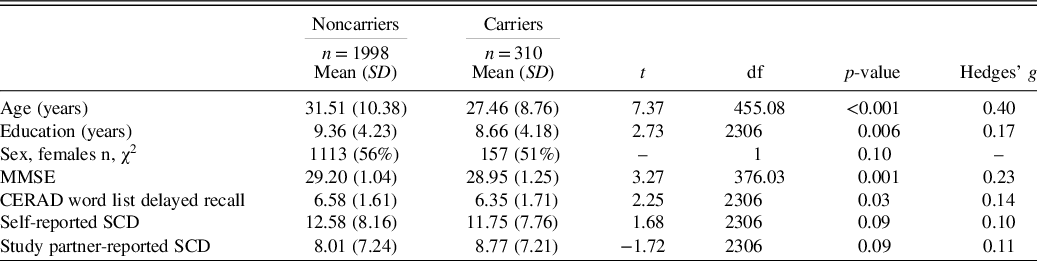
Participant characteristics are presented in Table 1. Cognitively unimpaired mutation carriers were younger [t (455.08) = 7.37, p < 0.001, Hedges’ g = 0.40] and had less years of education [t (2306) = 2.73, p = 0.006, Hedges’ g = 0.17] than noncarriers (Table 1). Carriers performed worse than noncarriers on the MMSE [t (376.03) = 3.27, p = 0.001, Hedges’ g = 0.23] as well as the CERAD word list delayed recall test [t (2306) = 2.25, p = 0.03, Hedges’ g = 0.14].
Demographic and cognitive data for cognitively unimpaired PSEN-1 carriers and noncarriers

Group differences for continuous variables were tested using independent t test and chi square for categorical variables.
MMSE = Mini-Mental State Examination; SCD = Subjective Cognitive Decline.
SCD in Mutation Noncarriers and Carriers
Noncarriers and carriers did not differ in self-reported SCD [t (2306) = 1.68, p = 0.09, Hedges’ g = 0.10] or study partner-reported SCD [t (2306) = −1.72, p = 0.09, Hedges’ g = 0.11]. In both noncarriers and carriers, greater age was associated with greater self-reported SCD (r = 0.09, p < 0.001; r = 0.13, p = 0.02, respectively) and study partner-reported SCD (r = 0.10, p < 0.001; r = 0.30, p < 0.001, respectively).
Male and Female Characteristics within Groups
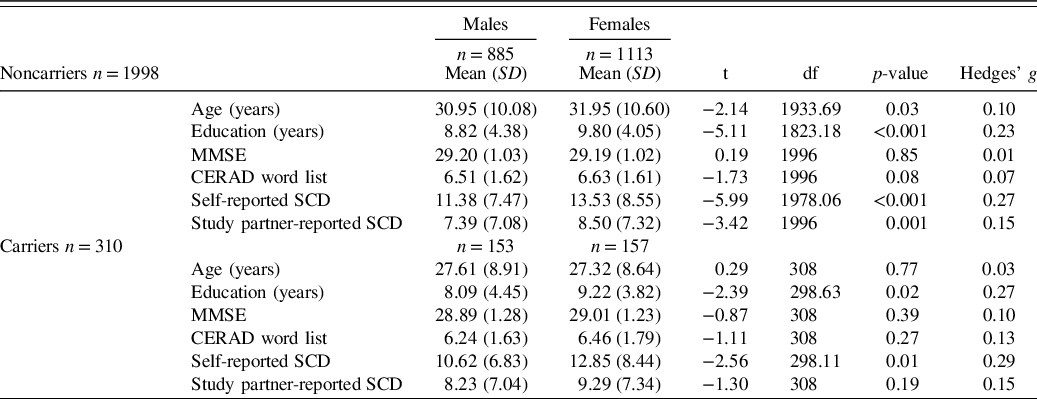
Females noncarriers were older [t (1933.69) = −2.14, p = 0.03, Hedges’ g = 0.10], had higher levels of education [t (1823.18) = −5.11, p < 0.001, Hedges’ g = 0.23], and greater self-reported [t (1978.06) = −5.99, p < 0.001, Hedges’ g = 0.27] and study partner-reported SCD [t (1996) = −3.42, p = 0.001, Hedges’ g = 0.15] than males (Table 2). There were no differences between MMSE [t (1996) = 0.19, p = 0.85, Hedges’ g = 0.01] and CERAD word list delayed recall performance [t (1996) = −1.73, p = 0.08, Hedges’ g = 0.07] and between male and female noncarriers. Female noncarriers showed an association between greater age and greater self-reported (r = 0.11, p < 0.001) as well as study partner-reported SCD (r = 0.12, p < 0.001), but not male noncarriers (r = 0.03, p = 0.33; r = 0.06, p = 0.10, respectively). In carriers, females had higher levels of education [t (298.63) = −2.39, p = 0.02, Hedges’ g = 0.27; Table 2] and self-reported SCD [t (298.11) = −2.56, p = 0.01, Hedges’ g = 0.29] than males, but there were no differences between males and females in age [t (308) = 0.29, p = 0.77, Hedges’ g = 0.03], MMSE performance [t (308) = −0.87, p = 0.39, Hedges’ g = 0.10], CERAD word list delayed recall performance [t (308) = −1.11, p = 0.27, Hedges’ g = 0.13], or study partner-reported SCD [t (308) = –1.30, p = 0.19, Hedges’ g = 0.15]. Carrier males and females exhibited a positive correlation between age and study partner-reported SCD (r = 0.27, p = 0.001; r = 0.31, p < 0.001, respectively), but not self-reported SCD (r = 0.10, p = 0.21; r = 0.13, p = 0.10, respectively).
Demographic and cognitive data comparing cognitively unimpaired male and female PSEN-1 noncarriers and male and female carriers

Group differences for continuous variables were tested using independent t test and chi square for categorical variables. MMSE = Mini-Mental State Examination; CERAD Word List = Consortium to Establish a Registry for Alzheimer’s Disease word list delayed recall test; SCD = Subjective Cognitive Decline.
Group and Sex Differences in SCD
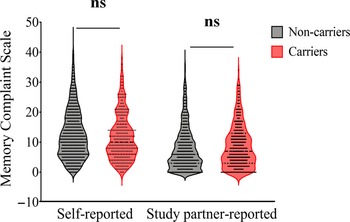
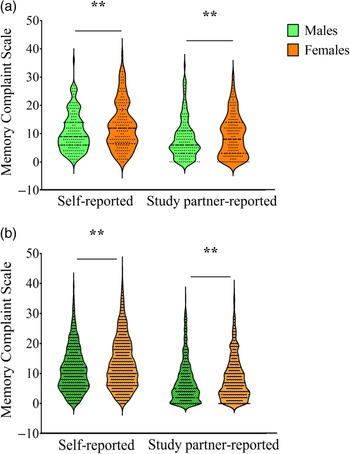
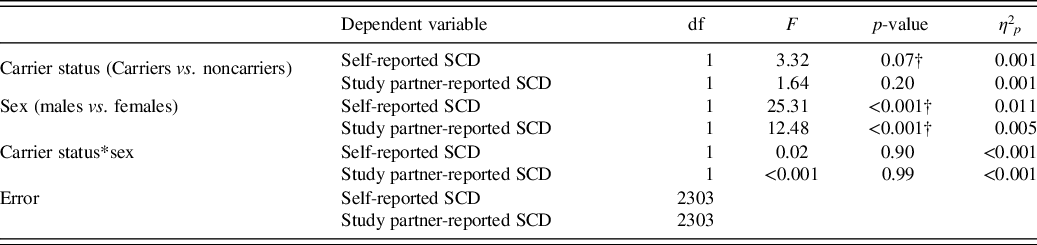
Carriers and noncarriers did not differ in self-reported SCD [F (1, 2303) = 3.32, p = 0.07, η 2 p = 0.001] or study partner-reported SCD [F (1, 2303) = 1.64, p = 0.20, η 2 p = 0.001; Figure 1]. Regarding sex differences, female participants self-reported more SCD compared to males [sex main effect, F (1, 2303) = 25.31, p < 0.001, η 2 p = 0.011] and had study partners that reported greater SCD compared to male participants [F (1, 2303) = 12.48, p < 0.001, η 2 p = 0.005; Figure 2(a) and Figure 2(b)], regardless of carrier status. There was no group*sex interaction between carriers and noncarriers for self-reported SCD [F (1, 2303) = 0.02, p = 0.90, η 2 p < 0.001] or study partner-reported SCD [F (1, 2303) <0.001, p = 0.99, η 2 p < 0.001]. The results of the two-way ANCOVA are summarized in Table 3.
Violin plot displaying the distribution of self-reported and study partner-reported SCD in mutation carriers and noncarriers. There were no differences between mutation carriers and noncarriers in self-reported SCD [two-way ANCOVA covarying for education, (F(1, 2303)=3.32, p = 0.07, η 2 p = 0.00)] and study partner-reported SCD [F(1, 2303)=1.64, p = 0.20, η 2p = 0.001]. There was also no group*sex interaction for self-reported SCD [F(1, 2303)=0.02, p = 0.90, η 2p < 0.001] or study partner-reported SCD [F(1, 2303) <0.001, p = 0.99, η 2p < 0.001]. ns = not significant.

Violin plots displaying the distribution of self-reported and study partner-reported SCD. Figure 2(a) displays female versus male mutation carriers. Figure 2(b) shows female versus male mutation noncarriers. Females had greater self-reported SCD [F(1, 2303)=25.31, p < 0.001, η 2p = 0.011] and greater study partner-reported SCD [F(1, 2303)=12.48, p < 0.001, η 2p = 0.005] compared to males regardless of carrier status. ** p < .005.

ANCOVA summary data covarying for education and comparing cognitively unimpaired male and female PSEN-1 noncarriers and male and female carriers.

†p < 0.05 (covarying for depression and education). SCD = Subjective cognitive decline.
These analyses were repeated covarying for education and depression. Noncarriers displayed greater self-reported SCD than carriers [F (1, 2299) = 7.63, p = 0.006, η 2 p = 0.003], but there was still no difference between carriers and noncarriers in study partner-reported SCD [F (1, 2299) = 1.08, p = 0.30, η 2 p < 0.001]. Consistent with our previous findings, females had greater self-reported SCD [F (1, 2299) = 7.05, p = 0.008, η 2 p = 0.003] and study partner-reported SCD [F (1, 2299) = 5.23, p = 0.02, η 2 p = 0.002] than males regardless of carrier status. There was no group*sex interaction between carriers and noncarriers for self-reported SCD [F (1, 2299) = 0.16, p = 0.69, η 2 p < 0.001] or study partner-reported SCD [F (1, 2299) = 0.06, p = 0.81, η 2 p < 0.001].
Sex Differences in the Association between Verbal Memory and SCD
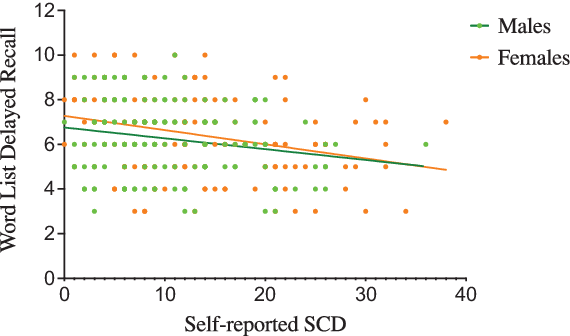
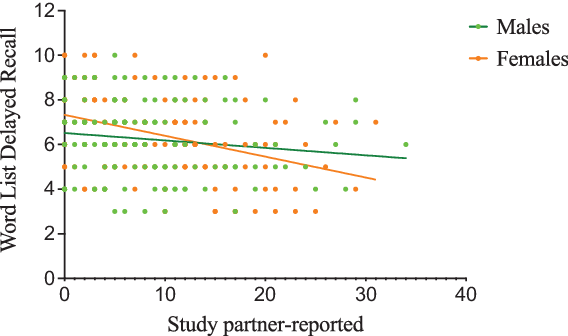
Within noncarriers, males and females displayed an association with worse CERAD word list delayed recall performance and greater self-reported (r = −0.11, p = 0.001; r = −0.10, p = 0.001, respectively) as well as study partner-reported SCD (r = −0.13, p < 0.001; r = −0.18, p < 0.001, respectively). In female carriers, worse CERAD word list delayed recall performance was associated with greater self-reported (r = −0.19, p = 0.02; Figure 3) and study partner-reported SCD (r = −0.28, p < 0.001; Figure 4). Male carriers displayed an association between worse CERAD word list delayed recall performance and greater self-reported (r = −0.17, p = 0.03; Figure 3), but not study partner-reported SCD (r = −0.13, p = 0.11; Figure 4).
Association between word list delayed recall and self-reported SCD in mutation carriers. Greater self-reported SCD was associated with worse memory performance in both male (CERAD word list mean = 6.24, SD = 1.63; self-reported SCD mean = 10.62, SD = 6.84, r = −0.17, p = 0.03) and female mutation carriers (CERAD word list mean = 6.46, SD = 1.79; self-reported SCD mean = 12.85, SD = 8.44; r = −0.19, p = 0.02).

Association between word list delayed recall and study partner-reported SCD in mutation carriers. In female carriers, greater study partner-reported SCD was associated with worse memory performance after covarying for education (CERAD word list mean = 6.46, SD = 1.79; study partner-reported SCD mean = 9.29, SD = 7.34; r = −0.28, p < 0.001). Male carriers did not display an association between study partner-reported SCD and worse memory performance after covarying for education (CERAD word list mean = 6.24, SD = 1.63; study partner-reported SCD mean = 8.23, SD = 7.04; r = −0.13, p = 0.11).

When controlling for depression and education, both male and female noncarriers exhibited associations between worse CERAD word list delayed recall performance and greater self-reported (r = −0.10, p = 0.002; r = −0.09, p = 0.004, respectively) as well as study partner-reported SCD (r = −0.13, p < 0.001; r = −0.17, p < 0.001, respectively). In mutation carriers, females had a negative association between CERAD word list performance and self-reported (r = −0.16, p = 0.05) as well as study partner-reported SCD in females (r = −0.26, p = 0.001). In male carriers, there was a negative association between CERAD word list delayed recall performance and self-reported SCD (r = −0.17, p = 0.04), but not study partner-reported SCD (r = −0.13, p = 0.12).
DISCUSSION
Previous studies examining sex differences in SCD in individuals at risk for sporadic AD have yielded mixed results, likely due to various confounding factors such as age and cardiovascular risk factors (Heser et al., Reference Heser, Kleineidam, Wiese, Oey, Roehr, Pabst and Wagner2019; Holmen et al., Reference Holmen, Langballe, Midthjell, Holmen, Fikseaunet, Saltvedt and Tambs2013). In this study, we leveraged our access to a large sample of cognitively unimpaired individuals from the largest single-mutation ADAD cohort to test whether there were sex differences in SCD in mutation carriers and noncarriers during the preclinical stage of the disease. Our findings showed that PSEN-1 mutation carriers did not differ from noncarriers in self-reported or study partner-reported SCD when accounting for education. However, when accounting for education and depression symptoms, noncarriers self-reported more SCD than carriers. This finding suggests that the self-reported SCD within carriers, but not in noncarriers, may be driven by symptoms of depression, which has been suggested to be an early clinical marker of AD (Gatchel et al., Reference Gatchel, Rabin, Buckley, Locascio, Quiroz and Yang2019). Sex did not play a role in this observed outcome between carriers and noncarriers in the study partner-reported SCD or self-reported SCD. These findings do not support previous studies reporting sex differences in SCD in the preclinical stage of AD. Perhaps sex differences within SCD may not manifest until later in the AD trajectory. Sundermann and colleagues, for instance, found that the sex differences in SCD within their overall sample were driven by their aMCI group. Once their sample was stratified by group, there were no sex differences in the mean of self-reported or study partner-reported SCD in their normal control group (Sundermann et al., Reference Sundermann, Edmonds, Delano-Wood, Galasko, Salmon, Rubin and Bondi2018).
In both carriers and noncarriers, greater age was associated with self- and study partner-reported SCD, suggesting that SCD increases as a normal part of aging within the kindred. Alternatively, it may suggest a heightened sensitivity to memory changes particular to this cohort of noncarriers and carriers, as individuals in both groups have at least one parent with the mutation and therefore, the same likelihood of having the mutation themselves. As such, they may be more sensitive to subtle cognitive changes that occur with age, particularly those who are closer to the estimated age of onset of objective memory decline and MCI (i.e., age 44) (Fuller et al., Reference Fuller, Cronin-Golomb, Gatchel, Norton, Guzmán-Vélez, Jacobs and Quiroz2019). This sensitivity could be driven by sex in noncarriers given that female noncarriers had an association with greater age and greater self- and study partner-reported SCD, but male noncarriers did not. Conversely, both male and female carriers had positive associations with age and study partner-reported SCD, but not self-reported SCD. Within carriers, it may only be the study partners who exhibit greater sensitivity to memory changes as the carrier’s age.
Contrary to what we hypothesized, females had greater self-reported and study partner-reported SCD than males in both carriers and noncarriers. The difference in self-reported SCD found between males and females may be explained by a gender bias in endorsing health concerns. Females have been shown to be more likely to report and seek out care for physical and mental health concerns than males (Thompson et al., Reference Thompson, Anisimowicz, Miedema, Hogg, Wodchis and Aubrey-Bassler2016; Wool and Barsky, Reference Wool and Barsky1994). This may reflect a discomfort in males in reporting possible health conditions perhaps due to social or cultural factors, which is not unique to those with a family history of AD. Mood disorders like depression have been shown to be associated with SCD in both males and females of various ages (Brown, Hill, & Haider, Reference Brown, Hill and Haider2020) and may often account for observed differences in SCD between males and females. However, our results remained consistent even when accounting for depression in addition to education.
Although a greater propensity for females to endorse health problems may help explain our findings for self-reported SCD, it may not reasonably explain the higher levels of study partner-reported SCD for female participants compared to male participants. This is because both male and female participants could have had either male or female study partners that reported their concerns (i.e., spouses, children, other family members, or friends). Since the sex of the study partners was unavailable to us in this study, we were unable to examine if study partner sex may have influenced the study partner-reported SCD of the participants (i.e., greater SCD reported by female study partners than male study partners or vice versa).
The study partner’s perception of the severity of cognitive issues may also be influenced by cultural factors and their own understanding of ADAD. Individuals within our cohort may have a hyperawareness of, or even a bias toward, memory decline as they typically know a parent or family member with the disease. Our findings suggest that study partners may have a particular acuity toward the potential cognitive decline of females within our cohort even when accounting for depression and education.
Consistent with prior findings, greater SCD was associated with worse verbal memory performance (Sundermann et al., Reference Sundermann, Edmonds, Delano-Wood, Galasko, Salmon, Rubin and Bondi2018) in both male and female mutation carriers. Female carriers displayed an association between worse verbal memory performance and greater self-reported, as well as study partner-reported SCD, while male carriers showed an association between worse verbal memory performance and greater self-reported SCD, but not study partner-reported SCD. This finding suggests that study partner-reported SCD may be more sensitive to early cognitive changes in female carriers than in male carriers. These negative associations between verbal memory performance and self-reported as well as study partner-reported SCD were also found in male and female noncarriers suggesting that while SCD may be a good indicator of early memory changes, this may not be particular to mutation carriers. Previous studies have suggested that the correlation between SCD and objective memory performance may be influenced by reported anxiety, depression, and emotional distress (Buckley et al., Reference Buckley, Saling, Ames, Rowe, Lautenschlager and Macaulay2013; Pearman and Storandt, Reference Pearman and Storandt2004). However, our findings in both carriers and noncarriers remained consistent after controlling for depression and education.
This study has several limitations. The cross-sectional design of this study prevented us from measuring sex differences in changes within SCD and objective verbal memory decline over time. Further, there was a large difference in sample size between carriers and noncarriers and there were more female noncarriers than male noncarriers. Differences in sample size can lead to unequal variance, which can decrease statistical power and increase type 1 error rates (Rusticus & Lovato, 2014), but were corrected within our SPSS software automatically using Welch’s Test for Unequal Variances (Welch, Reference Welch1947). Although we previously examined the relation between SCD and AD biomarkers (i.e., amyloid beta and tau deposition; Gatchel et al., Reference Gatchel, Lopera, Norton, Baena, Guzman-Velez, Sanchez and Quiroz2020) as well as the effect of lifestyle factors on the onset and rate of cognitive decline within carriers (Aguirre-Acevedo et al., Reference Aguirre-Acevedo, Lopera, Henao, Tirado, Muñoz, Giraldo and Jaimes2016) in smaller cohorts, in this larger cohort, we did not have access to AD biomarker data, neurodegenerative markers, lifestyle factors, or subjective complaints beyond the domain of memory (e.g., executive function, language, etc.). There is still uncertainty regarding the generalizability of our findings in ADAD to late-onset AD even when they are consistent with data from studies in older adults at risk for AD (Pérès et al., Reference Pérès, Helmer, Amieva, Matharan, Carcaillon, Jacqmin-Gadda and Dartigues2011; Sundermann et al., Reference Sundermann, Edmonds, Delano-Wood, Galasko, Salmon, Rubin and Bondi2018; Heser et al., Reference Heser, Kleineidam, Wiese, Oey, Roehr, Pabst and Wagner2019; Buckley et al., Reference Buckley, Sikkes, Villemagne, Mormino, Rabin, Burnham and Amariglio2019). Thus, the generalizability of our findings to late-onset AD should be interpreted with caution. Future studies should also consider examining sex differences within SCD and AD biomarkers in addition to other cognitive domains in a larger sample. Additionally, the relationship between SCD, depression, and AD biomarkers should be further studied. It may also be helpful to explore the relation between the sex of the study partner and their reporting of SCD in male and female participants. As previously mentioned, this may provide greater insight into the difference found between males and females in study partner-reported SCD.
In summary, examining sex differences within SCD in PSEN-1 E280A carriers gives us the unique opportunity to study individuals in the preclinical stages who do not have comorbidities associated with aging, such as cardiovascular risk or differences in survival bias or mortality between males and females. Our findings support the body of literature suggesting that females may have more SCD than males, and that SCD is strongly associated with objective memory performance, including in the preclinical stage of AD. The results of this study highlight the value of considering sex when assessing SCD in future investigations.
ACKNOWLEDGMENTS
The authors would like to thank the PSEN-1 Colombian families for contributing their valuable time and effort, without which this study would not have been possible.
FINANCIAL SUPPORT
This research was supported by the NIH National Institute of Aging [RO1AG054671 (YTQ)], and Office of the Director [DP5OD019833 (YTQ)], MGH ECOR Clafin Distinguished Scholar Award [YTQ], MGH Physician/Scientist Development Award [YTQ], and the Alzheimer’s Association [YTQ]. Dr. Guzmán-Vélez was supported by the NIA K23AG061276. Dr. Vila-Castelar received funding from the Alzheimer’s Association (2019-AARF-644631). Dr. Pardilla-Delgado was supported by a training grant from the NHLBI (5T32HL007901-22). Dr. Lopera received funding from the National Institutes of Health, Comite para el Desarrollo de la Investigacion (CODI-UdeA) and COLCIENCIAS.
CONFLICTS OF INTEREST
The authors have nothing to disclose.
ETHICAL STANDARDS
This research was completed in accordance with the Helsinki Declaration and was approved by the Ethical Research Committee of the University of Antioquia in Colombia and Massachusetts General Hospital in Boston, MA. Participants provided signed consent forms before any procedures were administered.