Introduction
Aging is associated with decline in cognitive processes such as processing speed, executive functions, and episodic memory (Park & Reuter-Lorenz, Reference Park and Reuter-Lorenz2009). Decline in these basic processes may cause a reduction in higher-order everyday problem solving, jeopardizing the sustained functional independence of older adults. Sternberg and colleagues differentiate well-defined problems, for which the problem parameters and route to solution are relatively clear, and ill-defined problems, for which the nature of the problem and its solution are less obvious and more open-ended (Pretz, Naples, Sternberg, Davidson, & Sternberg, Reference Pretz, Naples, Sternberg, Davidson and Sternberg2003). Although problem solving is typically associated with executive functioning processesFootnote 1, recent work on the uses to which episodic memory is put has identified a role for MTL-mediated episodic memory processes in supporting effective solution of open-ended, or ill-defined problems (for review see Buckner, Reference Buckner2010). The present study provides evidence for a hypothesized dissociation of relative executive and memory contributions to well-defined versus ill-defined problem solving tasks and explores evidence for a proposed episodic simulation mechanism underlying reduced ill-defined problem solving in aging.
Relative Executive and Episodic Memory Contributions to Well-Defined and Ill-Defined Problem Solving
There is strong evidence to suggest that both types of problem solving recruit frontally mediated executive systems inasmuch as a problem solving task emphasizes higher-level cognitive processes (Barbey & Barsalou, Reference Barbey and Barsalou2009). Most theoretical treatments of the nature of executive functions articulate their role in higher-order problem solving on conceptual as opposed to empirical grounds. Empirical evidence, however, is obtained from several lesion studies (e.g., Channon, Reference Channon2004; Colvin, Dunbar, & Grafman, Reference Colvin, Dunbar and Grafman2001; Goel, Grafman, Tajik, Gana, & Danto, Reference Goel, Grafman, Tajik, Gana and Danto1997; Unterrainer & Owen, Reference Unterrainer and Owen2006). For example, when given ill-structured financial problems, patients with frontal lobe lesions were impaired at providing adequate solutions due to difficulties organizing and structuring information in the problem space (Goel et al., Reference Goel, Grafman, Tajik, Gana and Danto1997). Similarly, patients with frontal lesions show impairments on well-defined problem solving tasks, such as the water jug problem in which one has to construct unique series of actions to transfer water between jugs of different sizes (Colvin et al., Reference Colvin, Dunbar and Grafman2001). These findings have been corroborated by functional neuroimaging studies (for review, see Unterrainer & Owen, Reference Unterrainer and Owen2006). Ill-defined problem solving recruits the frontal lobes, preferentially the right dorsolateral prefrontal cortex (Gilbert, Zamenopoulos, Alexiou, & Johnson, Reference Gilbert, Zamenopoulos, Alexiou and Johnson2010; also see Goel & Vartanian, Reference Goel and Vartanian2005) as do well-structured planning and problem solving tasks, such as the Tower of London task which recruits bilateral prefrontal regions (Schall et al., Reference Schall, Johnston, Lagopoulos, Jüptner, Jentzen, Thienel and Ward2003).
Although the role of memory processes in problem solving has received less attention, there is evidence that these processes play a role in both types of problem solving. Facility with generating solutions to well-defined problems is enhanced by the skilled application of domain-specific knowledge (e.g., expertise in physics enhances mathematical problem solving, Chi, Feltovich, & Glaser, Reference Chi, Feltovich and Glaser1981). Solving ill-defined problems may also depend on memory processes, specifically MTL-mediated episodic memory processes. Reduced ill-defined problem solving has been reported in individuals with mood disorders, whose conditions are often associated with cognitive deficits including difficulty retrieving autobiographical episodic memories (Evans, Williams, O'Loughlin, & Howells, Reference Evans, Williams, O'Loughlin and Howells1992; Goddard, Dritschel, & Burton, Reference Goddard, Dritschel and Burton1996; Sidley, Whitaker, Calam, & Wells, Reference Sidley, Whitaker, Calam and Wells1997).
More direct evidence for the MTL involvement in ill-defined problem solving comes from a reliable association between hippocampally mediated autobiographical memory processes and ill-defined social problem solving in patients with MTL epilepsy and healthy old adults (Sheldon, McAndrews, & Moscovitch, Reference Sheldon, McAndrews and Moscovitch2011). These authors speculated that two aspects of hippocampally mediated episodic memory processes may support problem solving. The first, occurring when the problem is initially identified, involves pattern completion to activate past memories that share elements with the present problem. The second involves flexible recombination of relevant memories into a goal-oriented episodic simulation that supports effective resolution of the novel problem (Addis & Schacter, Reference Addis and Schacter2008). Consistent with this notion, recent functional neuroimaging findings have demonstrated hippocampal activation in healthy younger adults during a self-referential simulated real-world problem solving task (Gerlach, Spreng, Gilmore, & Schacter, Reference Gerlach, Spreng, Gilmore and Schacter2011).
Few studies have examined the precise role of executive and episodic memory processes in problem solving simultaneously (but see Allaire & Marsiske, Reference Allaire and Marsiske2002). Given the normative age-related changes to executive and episodic memory function in older adults, and the critical role of effective problem solving in sustaining functional independence in this population, a more complete understanding of the differential contributions of executive and memory function to well-defined and ill-defined problem solving is needed. Although it is clear that executive processes play a key role, it is likely that episodic memory processes, particularly those that support the reconstruction or simulation of real life autobiographical events, contribute to problem solving. This may be especially evident for problems which do not have immediately obvious boundaries or solution paths. That is, the relative contribution of executive and episodic memory processes to problem solving in healthy adults may depend on the type of problem to be solved. As such, the present study addresses a gap in the existing literature by directly and simultaneously examining the relative contribution of executive and episodic memory processes to well-defined and ill-defined problem solving across multiple measures in a behavioral paradigm.
Episodic Simulation as a Mechanism to Support Ill-Defined Problem Solving
It is well established that the MTL, especially the hippocampus, play a key role in supporting episodic memory function (Milner, Squire, & Kandel, Reference Milner, Squire and Kandel1998; Squire, Reference Squire1992; Winocur & Moscovitch, Reference Winocur and Moscovitch2011). An important feature of MTL-mediated episodic memory processes is the capacity to flexibly recombine stored items, details, and experiences (e.g., Eichenbaum, Yonelinas, & Rangath, Reference Eichenbaum, Yonelinas and Ranganath2007; Schacter & Addis, Reference Schacter and Addis2007; Zeithamova, Schlichting, & Preston, Reference Zeithamova, Schlichting and Preston2012). This capacity for flexible recombination, critical for episodic re-experiencing, may be important for tasks other than recollection.
Recent studies support the notion that MTL and related structures that are involved in episodic memory may also be involved in episodic simulation by allowing the novel recombination of details from different events/experiences (Addis, Moscovitch, & McAndrews, Reference Addis, Moscovitch and McAndrews2007; Schacter, Addis, & Buckner, Reference Schacter, Addis and Buckner2008; Szpunar, Watson, & McDermott, Reference Szpunar, Watson and McDermott2007). Neuropsychological and functional neuroimaging studies have associated MTL network activity and episodic memory processes in episodic simulation tasks such as construction of novel scenes (Hassabis & Maguire, Reference Hassabis and Maguire2009), imagining the future (Schacter & Addis, Reference Schacter and Addis2007), goal-directed mental simulation (Gerlach et al., Reference Gerlach, Spreng, Gilmore and Schacter2011; Race, Keane, & Verfaellie, Reference Race, Keane and Verfaellie2013), and open-ended problem solving (Sheldon et al., Reference Sheldon, McAndrews and Moscovitch2011). The present study sought to extend this line of work by replicating these latter behavioral findings and evaluating the extent to which the predicted associations would generalize to a second measure of ill-defined problem solving with relevance to the everyday problem solving tasks critical for independent living in older adults.
Study Aims and Hypotheses
The present study examined neuropsychological correlates and cognitive mechanisms of well-defined and ill-defined problem solving ability. Healthy young and old adults were tested on a battery of neuropsychological tests of executive and memory functioning, as well as experimental measures of well-defined and ill-defined problem solving. The memory tests included traditional standardized memory tests and an autobiographical memory test, performance on which depends on integrating episodic elements to reconstruct detailed representations of past events.
The primary aim was to evaluate the proposed differential contributions of executive and episodic memory function to well-defined and ill-defined problem solving. To this end, a series of zero-order and partial correlation analyses were completed. It was hypothesized that executive tasks would correlate preferentially with tasks of well-defined problem solving and episodic memory tasks, particularly those that weigh heavily on reconstruction, would correlate preferentially with tasks of ill-defined problem solving.
A secondary aim was to explore evidence for a proposed episodic simulation mechanism underlying reduced ill-defined problem solving in aging. To this end, the ill-defined problem solving measures were scored according to procedures adapted from the Autobiographical Interview (Levine, Svoboda, Hay, Winocur, & Moscovitch, Reference Levine, Svoboda, Hay, Winocur and Moscovitch2002) to quantify the episodic (internal) versus nonepisodic (external) quality of the problem solving narratives (see Methods, below). It was hypothesized that young adults’ ill-defined problem solving narratives would contain a higher proportion of episodic details, suggesting episodic simulation, compared to old adults. Furthermore, across both groups, episodic but not nonepisodic details were expected to correlate with measures of solution efficacy.
Methods
Participants and Procedures
Participants were recruited from volunteer pools at the University of Toronto (young adults) and the Rotman Research Institute (old adults). Procedures were approved by relevant Institutional Review Boards. Exclusion criteria included self-reported neurological, psychiatric, or health conditions affecting cognitive function. A total of 19 young adults were enrolled in the study; one participant was excluded for minimal engagement in the cognitive tasks, including an outlier score on the MEPS (Means-End Problem Solving Procedure) (i.e., >3.0 SD below group mean; final N = 18). A total of 20 old adults were enrolled; two were excluded as outliers on the AI and the MEPS tasks (i.e., >3.0 SD above or below the group mean; final N = 18). Young adults (age M = 19; SD = 1.3) had fewer years of education (M = 13; SD = 1.3) than the old adults (age M = 73; SD = 5.0; education M = 16; SD = 2.2) and lower estimated premorbid verbal intelligence scores (NART; Blair & Spreen, Reference Blair and Spreen1989) than the old adults (young M = 109; SD = 6.0; old M = 117; SD = 4.8).Footnote 2 Old adults had MMSE (Folstein, Folstein, & McHugh, Reference Folstein, Folstein and McHugh1975) scores above established cutoffs for cognitive impairment (M = 28.8; SD = 1.6).
Neuropsychological Measures of Executive Functions and Episodic Memory
Participants were tested individually on a series of neuropsychological tests of executive functions and episodic memory. Executive measures included the Trail Making Test Part B (Trails B; Reitan & Wolfson, Reference Reitan and Wolfson1985) and the Stroop test – Victoria version (Spreen & Strauss, Reference Spreen and Strauss1998). Clinical episodic memory measures included the Hopkins Verbal Learning Test – Revised (HVLT-R; Benedict, Schretlen, Groninger, & Brandt, Reference Benedict, Schretlen, Groninger and Brandt1998), and the Wechsler Memory Test – Revised Logical Memory test (WMS-R LM; Wechsler, Reference Wechsler1987). Episodic memory was also assessed using the Autobiographical Interview (Levine et al., Reference Levine, Svoboda, Hay, Winocur and Moscovitch2002), a test of autobiographical episodic memory which enables quantification of recalled internal (episodic) and external (non-episodic) details. To minimize testing time, an abbreviated version of this measure was used in which participants were asked to provide narratives for two time periods (i.e., before age 11, in the last year), and were not later probed according to the prescribed specific cueing procedure (Levine et al., Reference Levine, Svoboda, Hay, Winocur and Moscovitch2002)Footnote 3. Two independent raters completed each scoring procedure according to manualized procedures; the primary rater was blind to group membership and study hypotheses. Inter-rater reliability was within acceptable limits (r's > 0.8).
Experimental Measures of Well-Defined and Ill-Defined Problem Solving
Participants were tested on two well-defined problem solving measures. The first, the Tower of London test (Krikorian, Bartok, & Gay, Reference Krikorian, Bartok and Gay1994), consists of colored beads on vertical rods which must be re-arranged according to specific rules to match a target configuration. To maximize variance in the data, a performance score indexing both accuracy and latency was created by dividing the total latency of all solutions by the number of problems solved correctly. The second well-defined problem solving measure was the Brixton task (Burgess & Shallice, Reference Burgess and Shallice1997). In this test, a blue dot changes location, sometimes unpredictably, across a series of presentations and this knowledge is used to predict where the blue dot will appear next. Performance scores are the sum of errors across all trials.
Two measures of ill-defined problem solving were selected based on previous use in the literature, face validity evidence for real-world problem solving, and ill-defined problem solving structure (i.e., open-ended, multiple valid paths to solution). The first, the Means-End Problem Solving Procedure (MEPS; Platt & Spivack, Reference Platt and Spivack1975) was used by Sheldon and colleagues (2011) in their investigation of memory and ill-defined problem solving. In this task, participants are presented with a series of incomplete vignettes, each containing some type of problem for the protagonist. Participants are asked to “solve” each vignette by generating a narrative which best connects the beginning of the story to an ending in which the presented problem has been resolved successfully. For example, one item asks participants to generate a narrative in which an individual who moves into a new neighborhood eventually ends up feeling at home and having many friends in her new neighborhood. An abbreviated version was used in the present study (i.e., the first 4 of 10 items; c.f., Goddard et al., Reference Goddard, Dritschel and Burton1996, Raes et al., Reference Raes, Hermans, Williams, Demyttenaere, Sabbe, Pieters and Eelen2005).
In the second task, the Everyday Descriptions Task (EDT; Dritschel, Kogan, Burton, Burton, & Goddard, Reference Dritschel, Kogan, Burton, Burton and Goddard1998), participants are asked to outline, in detail, the steps they would take to complete a series of daily living challenges which vary in frequency and complexity (e.g., clean your teeth, organize a move to a new place to live). Like the MEPS, all 12 items have multiple valid paths to solution. However, compared to the MEPS, this task relates more closely to everyday tasks critical for independent living in older adults, which has important implications for the generalizability of the hypothesized findings.
For each task, scoring was completed in two ways. First, the MEPS and EDT transcribed responses were scored according to procedures outlined in the respective source publications. Key outcome measures were the number of relevant and irrelevant means (MEPS) or steps (EDT) generated by the participant. These relevant means/steps, which represent discrete, logical, steps along the path from problem to effective solution, were used to quantify problem solving efficacy. Second, transcribed responses were scored according to procedures adapted from the Autobiographical Interview manual (Levine et al., Reference Levine, Svoboda, Hay, Winocur and Moscovitch2002; Sheldon et al., Reference Sheldon, McAndrews and Moscovitch2011) to quantify internal (episodic) versus external (non-episodic) details. Internal detail scores were used to quantify the richness of episodic simulation. Two independent raters completed each scoring procedure; the primary rater was blind to group membership and study hypotheses. For all measures, inter-rater reliability was within acceptable limits (r's > 0.8).
Results
Preliminary Analyses: Age Differences
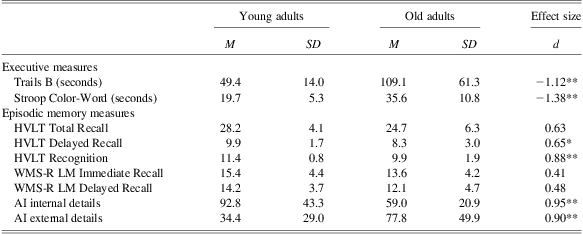
The two age groups differed significantly across several measures within the neuropsychological test battery with an expected overall pattern of stronger performance in the young compared to old adults (see Table 1). Group differences on the autobiographical episodic memory measure (Autobiographical Interview) followed well-established patterns (Addis et al., Reference Addis, Wong and Schacter2008; Levine et al., Reference Levine, Svoboda, Hay, Winocur and Moscovitch2002; Sheldon et al., Reference Sheldon, McAndrews and Moscovitch2011). The two age groups did not significantly differ in terms of number of words produced on the task. A 2(age) by 2(detail type) repeated measures ANOVA revealed a main effect for detail type (F(1,34) = 8.48; p < .01; η 2 = .20), and an interaction of age by detail type (F(1,34) = 32.23; p < .001; η 2 = .49). Follow up simple contrasts showed that the young adults produced significantly more internal (episodic) details (d = .90) and significantly fewer external (non-episodic) details (d = .95) than the old adults. There was no main effect of age, indicating that the groups did not significantly differ in terms of the total number of details generated.
Group differences on neuropsychological measures
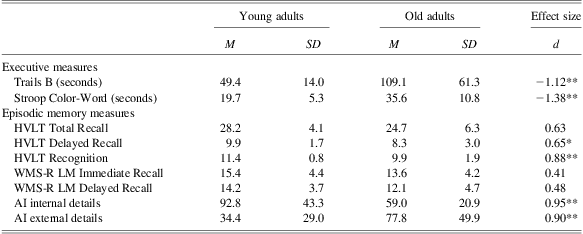
Note. **p < .01, *p < .05. Units of measure are raw scores scored according to relevant source manuals, except where indicated.
HVLT = Hopkins Verbal Learning Test – 2nd edition. WMS-R = Wechsler Memory Scale – Revised Logical Memory subtest. AI = Autobiographical Interview.
A series of analyses were completed to investigate age differences in the problem solving measures. A MANOVA was completed to compare the two age groups on the two well-defined problem solving measures. The main effect of age was significant (F(2,33) = 7.42; p < .01); the young adults performed significantly better than the old adults on both the Tower of London (F(1,34) = 11.48; p < .01; d = .99) and the Brixton task (F(1,34) = 9.17; p < .01; d = .91).
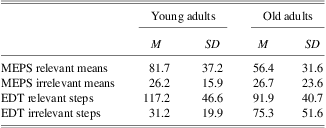
On the first of the two ill-defined problem solving measures (see Table 2), the Means-End Problem Solving task (MEPS), a 2(age) by 2(means type: relevant versus other) repeated measures ANOVA revealed main effects for age (F(1,34) = 12.09; p < .01; η 2 = .26) and means type (F(1,34) = 30.11; p < .001; η 2 = .47), and an interaction of age by means type (F(1,34) = 9.54; p < .01; η 2 = .22). Simple contrasts showed that the young adults produced significantly more relevant means (d = 1.07) than the old adults. The responses of young adults contained a significantly higher percentage of relevant means compared to the old adults (young M = 48.5; SD = 9.3; old M = 39.3; SD = 15.2; d = .69). The two groups did not differ significantly in terms of number of words produced on the task.
Group performances on the ill-defined problem solving measures
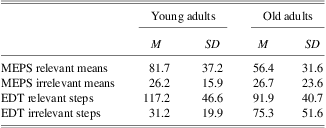
Note. Units of measure are raw scores scored according to relevant source manuals. MEPS = Means End Problem Solving Procedure.
EDT = Everyday Descriptions Test. Observed score ranges were: AI internal: 21-212, AI external: 5-217, MEPS relevant: 0-36, MEPS irrelevant: 0-12, EDT relevant: 39-154, EDT irrelevant: 0-23.
On the second of two ill-defined problem solving measures, Everyday Descriptions Task (EDT), a 2(age) by 2(steps type: relevant versus other) repeated measures ANOVA revealed a main effect for steps type (F(1,30) = 117.20; p < .001; η 2 = .80), and an interaction of age by steps type (F(1,30) = 4.72; p < .05; η 2 = .14). Simple contrasts showed that the young adults produced marginally more relevant steps (p = .08; d = .62) and significantly fewer other steps (d = .69) than the old adults. There was no main effect of age, indicating that the groups did not significantly differ in terms of the total number of steps generated. The two groups did not significantly differ in terms of number of words produced on the task.
Relative Executive and Episodic Memory Contributions to Well-Defined and Ill-Defined Problem Solving
Preliminary steps
Composite scores indexing performance on each of the constructs of interest were created by computing Z scores for each individual measure, standardized within each group. This was computed by subtracting each individual's observed score from the group mean, and dividing the result by the group standard deviation. This preliminary step serves the dual purpose of (a) data reduction, and (b) standardizing measures within each group, thereby facilitating examination of whole-sample correlations independent of the influence of age group.
All Z scores were coded such that higher scores indicate stronger performance. For example, the scale for the Trails B score, wherein higher raw scores typically represent poorer performance, was reversed during the Z score computation procedure, such that higher Z scores represent better performance. These Z scores were then averaged within construct to create a single composite score for each construct. The well-defined (problem solving) composite was derived from performance on the Tower of London and the Brixton task (r = .50). The ill-defined (problem solving) composite was derived from the relevant means score for the Means-End Problem Solving and the relevant steps score from the Everyday Descriptions Task (r = .54). The executive composite was derived from performance on the Trails B and Stroop tasks (r = .64).Footnote 4
The data collected did not support the combination of the three measures of episodic memory into a single composite. That is, correlations within primary scores of the HVLT-R and WMS-R logical memory ranged from .42 to .70, while correlations with the AI internal score and these measures ranged from .25 to .38. Given the inadequate internal consistency of a composite indexing the three measures, we computed two indices of episodic memory. The first, the autobiographical episodic memory score was generated from the Autobiographical Interview total internal (episodic) detail score across the two items within the task. The second, a clinical episodic memory composite was derived from the delayed recall scores of the HVLT-R and the WMS-R.Footnote 5
Zero-order correlations
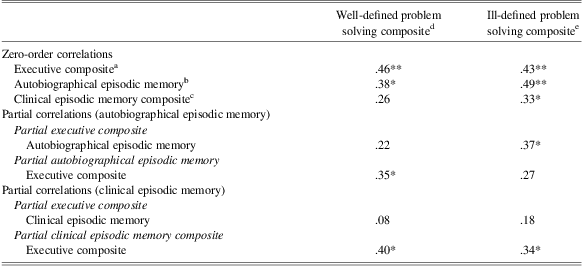
As shown in Table 3, whole sample zero order correlation analyses revealed positive associations as predicted between the executive composite and the well-defined composite (r = .46; p < .01). Similarly, predicted positive associations were observed between the autobiographical episodic memory score and the ill-defined composite (r = .49; p < .01). The executive composite was also correlated with the ill-defined composite (r = .43; p < .01) and the autobiographical episodic memory score was correlated with the well-defined composite (r = .38; p < .05). The clinical episodic memory composite was not significantly correlated with the well-defined composite (r = .26; p = .13), but was significantly correlated with the ill-defined composite (r = .33; p < .05). The overall pattern of zero-order correlations showed a significant amount of shared variance between all four constructs of interest.Footnote 6
Whole sample zero-order and partial correlations

Note. **p < .01, *p < .05. Composite scores indexing performance on each of the key constructs of interest were created by computing Z scores for each individual measure, standardized within each group, then averaging these scores within person and construct. Partial correlations support the hypothesized dissociation of relative executive and autobiographical memory contributions to well-defined and ill-defined problem solving.
aIndexes performance on Stroop Color-Word and Trails B tasks.
bIndexes total internal details provided across two item Autobiographical Interview.
cIndexes performance on HVLT-R and WMS-R delayed recall trials.
dIndexes performance on Brixton and Tower of London Tasks.
eIndexes relevant details scores on Means-End Problem Solving Procedure and Everyday Descriptions Test.
Partial correlations
To test the hypotheses of interest, we ran partial correlation analyses, shown in Table 3. Partial correlations associated with the autobiographical episodic memory score supported the hypothesized dissociation of relative executive and episodic memory contributions to well-defined and ill-defined problem solving. Specifically, the significant positive correlation between the autobiographical episodic memory score and the ill-defined composite persisted after controlling for the executive composite (partial r = .37; p < .05). The correlation between autobiographical episodic memory score and the well-defined composite no longer reached statistical significance (partial r = .22; p = .21). The correlation between the executive composite and the well-defined composite persisted (partial r = .35; p < .05), while the correlation between the executive composite and the ill-defined composite no longer reached statistical significance (partial r = .27; p = .12).
Partial correlations associated with the clinical episodic memory composite did not reveal clear evidence for the predicted dissociation of relative executive and episodic memory contributions to well-defined and ill-defined problem solving. The correlations between the executive composite and both types of problem solving measures persisted after controlling for the clinical episodic memory composite (Well-defined partial r = .40; p > .05; Ill-defined partial r = .34; p > .05). The significant correlation between the clinical episodic memory composite and the ill-defined problem solving composite no longer reached statistical significance (r = .18; p = .30).
Episodic Simulation as a Mechanism to Support Ill-Defined Problem Solving
For the MEPS data scored according to the adapted Autobiographical Interview scoring procedure, a 2(age) by 2(detail type: internal vs. external) repeated measures ANOVA revealed a main effect for detail type (F(1,34) = 60.72; p < .001; η 2 = .64), and an interaction of age by detail type (F(1,34) = 5.54; p < .05; η 2 = .14). Follow-up simple contrasts showed that the young adults produced significantly more internal details (d = .72) than the old adults (see Figure 1). There was no main effect of age, indicating that the groups did not differ significantly in terms of the total number of details generated.
Group differences in episodic quality of ill-defined problem solutions. Raw score is the total number of internal (episodic) and external (non-episodic) details across all items. Results were generally consistent with the hypothesis that young adults’ ill-defined problem solving narratives would contain a higher proportion of internal (episodic) details compared to old adults. For the MEPS data scored according to the adapted Autobiographical Interview procedure, the young adults produced significantly more internal details (d = .72) than the old adults. For the EDT data scored according to the adapted Autobiographical Interview procedure, the young adults produced marginally more internal details (p = .11; d = .59) and significantly fewer external details (d = .99) than the old adults. Error bars show SEM. MEPS = Means-End Problem Solving Procedure; EDT = Everyday Descriptions Task.
For the EDT data scored according to the adapted Autobiographical Interview scoring procedure, a 2(age) by 2(detail type: internal versus external) repeated measures ANOVA revealed a main effect for detail type (F(1,30) = 31.87; p < .001; η 2 = .51), and an interaction of age by detail type (F(1,30) = 14.52; p < .01; η 2 = .33). Follow-up simple contrasts showed that the young adults produced marginally more internal details (p = .11; d = .59) and significantly fewer external details (d = .99) than the old adults (see Figure 1). There was no main effect of age, indicating that the groups did not significantly differ in terms of the total number of details generated.
Correlations between the MEPS internal details and relevant means were large and statistically significant in both the young (r = .81; p < .001) and the old adults (r = .80; p < .001). Similarly, correlations between the EDT internal details and relevant steps were large and statistically significant in both the young (r = .95; p < .001) and the old adults (r = .89; p < .001). By contrast, correlations between the MEPS external details and relevant means were not significant (young r = .22; p = .39; old r = –.14; p = .61). Similarly correlations between the EDT external details and relevant steps were not significant (young r = .41; p = .11; old r = −.02; p = .94).
Discussion
The present study was designed to investigate the neuropsychological processes that support higher-order problem solving in young and old adults. Replicating and extending recent work that has implicated MTL-mediated episodic memory processes in supporting effective solution of ill-defined problems (Sheldon et al., Reference Sheldon, McAndrews and Moscovitch2011), the results demonstrated a dissociation of relative executive and autobiographical episodic memory contributions to well-defined and ill-defined problem solving and provided evidence for a proposed mechanism of episodic simulation supporting ill-defined problem solving.
Our primary aim was to investigate the basic neuropsychological correlates of two types of higher-order problem solving. Findings at the zero-order correlation level were consistent with the well-established notion that executive processes are involved in both types of problem solving (Barbey & Barsalou, Reference Barbey and Barsalou2009). However, pre-planned partial correlation analyses demonstrated the hypothesized dissociation of executive and autobiographical episodic memory associations with well-defined and ill-defined problem solving. The important and novel aspect of these findings is that controlling for the executive composite did not eliminate the statistically significant correlation between autobiographical episodic memory score and the ill-defined composite. This is consistent with the notion that the contribution of episodic memory processes to certain types of problem solving may have been overlooked.
Interestingly, the hypothesized dissociation of executive and memory contributions to problem solving was not shown when memory was indexed using a composite from traditional clinical episodic memory measures (i.e., HVLT-R and WMS-R LM). An avenue of future study is to probe further into the relation between Autobiographical Interview as a measure of autobiographical episodic memory versus clinical neuropsychological measures of recent episodic memory. Although we used different clinical measures in our study, these data are consistent with previous findings (Sheldon et al., Reference Sheldon, McAndrews and Moscovitch2011) and suggest that the AI, compared to clinical measures, may capture a related, but distinct construct. It is possible that the clinical measures, though sensitive to hippocampal damage, may not be sufficiently sensitive to the recollection and reconstructive aspect of hippocampal processing that may be the chief episodic component underlying effective simulation and problem solving. Indeed, neuroimaging studies have shown differential patterns of activity in hippocampal and prefrontal regions during performance of laboratory-based episodic memory measures (analogous to clinical measures) versus autobiographical episodic measures (Cabeza et al., Reference Cabeza, Prince, Daselaar, Greenberg, Budde, Dolcos and Rubin2004; Gilboa, Reference Gilboa2004). Future study is needed to examine this hypothesis.
As previously noted, this is not to dispute the central role of frontal-lobe mediated executive processes in problem solving. Findings from our healthy adult sample may not generalize to cases of frank neurological damage, especially frontal damage which may affect social behavior, problem appreciation, planning, inhibition, etc. It remains an open question, however, how the present findings will generalize to cases of more subtle neurologic change. One particularly relevant patient population for which the present findings may have implications are older adults with mild cognitive impairment (MCI), a condition associated with elevated risk of functional decline and consequent conversion to a dementia syndrome. It is possible that individuals with the amnestic MCI subtype and poor autobiographical episodic memory (Murphy, Troyer, Levine, & Moscovitch, Reference Murphy, Troyer, Levine and Moscovitch2008), may display a different pattern of subtle changes in everyday problem solving than those with the dysexecutive MCI subtype (Pa et al., Reference Pa, Boxer, Chao, Gazzaley, Freeman, Kramer and Johnson2009), and this may have important prognostic and rehabilitative implications.
One potential confoundFootnote 7 that should be considered in interpreting these findings relates to the shared role of language proficiency in the autobiographical memory and ill-defined problem solving tasks, that may inflate estimates of shared variance. However, if language proficiency were the sole source of observed results, we might expect to see significant correlations between scores generated from these measures that were not considered in the planned analyses. Review of these data show that this was not the case (i.e., AI external details was not significantly correlated with MEPS irrelevant means: r = 0.20; p = .24; or EDT irrelevant steps: r = 0.03; p = .86). Indeed, although the old adults produced more external details in the AI than the young adults, this linguistic output did not significantly correlate with either measure of problem solving efficacy (MEPS relevant: r = 0.19; p = .27; EDT relevant r = 0.23; p = .20). Results of our preliminary age group comparisons also argue against a common factor of language proficiency underlying observed findings as observed age differences in hypothesized aspects of performance on the AI, MEPS, and EDT tasks were found despite an absence of age differences in total word output on each of the tasks.
A secondary aim of the study was to explore a proposed mechanism by which episodic memory processes that support reconstruction and simulation also support ill-defined problem solving efficacy. To evaluate this, narrative responses from the two ill-defined measures were coded using procedures adapted from the Autobiographical Interview to quantify episodic (internal) and nonepisodic (external) details. Age group comparisons across both ill-defined measures demonstrated a smaller proportion of episodic details in the old group and correlation analyses demonstrated large associations between measures of episodic detail and solution efficacy. These results replicate prior work (Sheldon et al., Reference Sheldon, McAndrews and Moscovitch2011),Footnote 8 and extend this by demonstrating the observed effect with abbreviated, more efficient versions of the same measures used in the previous study (i.e., AI, MEPS) and providing a novel demonstration of the effect using a brief measure with increased generalizability to the everyday problem solving challenges of older adults (i.e., EDT). Furthermore, our results provide objective validation of the prior observation that healthy younger adult controls’ self-reported use of specific autobiographical memories in solving problems on the EDT is correlated with enhanced problem solving efficacy across items (Dritschel, Kogan, Burton, Burton, & Goddard, Reference Dritschel, Kogan, Burton, Burton and Goddard1998).
Reconciling our findings with prior observations in the aging literature showing enhanced performance in at least some types of ill-defined, “real-world” problem solving (Blanchard-Fields, Mienaltowski, & Seay, Reference Blanchard-Fields, Mienaltowski and Seay2007), we suggest that there may be cases wherein preserved acquired knowledge, or semantic memory, can support effective solution of certain problems, but this mechanism may fail when problem solving challenges require novel or more specific solutions or when solutions are not available from a pre-existing knowledge set. Consistent with this, Channon and Crawford (Reference Channon and Crawford1999), using an ill-defined social problem solving task, showed that old adults generated equally effective optimal solutions to socially awkward problems, but showed reduced fluency in generating multiple alternate solutions compared to young adults. Our study suggests that although reduced executive generativity and flexibility may contribute to reduced fluency in old adults, poorer episodic simulation likely also plays a role that is over and above that of executive function (Sheldon & Moscovitch, Reference Sheldon and Moscovitch2012).
To summarize, the present study demonstrated a novel dissociation of relative executive and autobiographical episodic memory contributions to well-defined and ill-defined problem solving and evidence for a proposed MTL-mediated episodic simulation mechanism underlying reduced ill-defined problem solving in aging. These findings have important implications for the development of intervention strategies targeting preservation of functional independence in older adults as understanding the basic cognitive processes that support problem solving is critical for such applications.
Acknowledgments
This work was supported by grants from the Alzheimer Society of Canada and the Alzheimer Society of British Columbia to Susan Vandermorris, the Canadian Institutes of Health Research to Morris Moscovitch and Gordon Winocur. The authors have no conflicts to disclose. We thank Nick Hoang, Nipuna Perera, and Jordana Wynn for assistance with testing and scoring and Mohamed Al-Haj and Anusha Sabanayagam for assistance with manuscript preparation.