I. INTRODUCTION
Changes are afoot in the art world. Governments of market nations used to treat the antiquities market with the same laissez-faire attitude as they would any other commodity market. A booming art market for cultural property arose after World War II, when Japan and the Western countries amassed the wealth that enabled these nations to begin avidly collecting.Footnote 1 Rampant looting has since provoked source nations to take action to protect their heritage. Source countries have attempted to control the export of their cultural goods by enacting patrimony laws, prosecuting black market dealers, and filing lawsuits to repatriate stolen works in domestic and foreign courts. These domestic legal decisions, treaties, statutes, and cases abroad have caused a “shift in American public opinion toward frowning on practices that were merely shrugged at not too long ago.”Footnote 2 Aside from changing public opinion, the new legal environment has an impact on the riskiness of purchasing antiquities.
The legal environment affects the behavior of buyers in import countries, who are most affected by source countries' export-related legal activities. The threat of criminal or civil prosecution and seizure of an object makes buyers weary of purchasing antiquities that will subject them to legal liability. Echoing many dealers' concerns, an art lawyer who often represents collectors, dealers, and museums asks, “Does this mean that anyone who purchases an antiquity in the U.S. has to hire a lawyer first, to make sure the purchase doesn't violate a foreign country's patrimony laws? What's the state of these laws around the world? Which ones apply, which ones don't?”Footnote 3Risky antiquities are those that are without complete provenance information because provenance establishes when the object was initially exported from its country of origin, and antiquities exported after a certain date are considered to be illegally acquired. The terms risky or illicit when applied to antiquities in this article in no way characterize the authenticity or cultural value of the piece, but are merely used to refer to works that may have been exported illegally from their countries of origin. This article analyzes the effect of the legal environment on aspects of the antiquities market, such as the number of objects with provenance and the price of these works sold at auction. I will demonstrate that there is a direct correlation between legal developments increasing the threat of prosecution for illicit cultural objects and the price of licit objects at auction.
II. HYPOTHESES
I have four main hypotheses in this study:
1. The average sale price for Italian antiquities sold in the United States has increased dramatically.
2. The number of antiquities sold at auction with provenance information has risen, particularly after 1970.
3. There is a correlation between an object's sale price and whether or not the object has provenance information; specifically, objects with complete provenance information will sell for higher prices at auction than those without such information.
4. The occurrence of a legal event affects the average sale price of antiquities.
III. METHODOLOGY
A. Auction Data
Examining all of the antiquities sold in every country would be an insurmountable task, and thus I limited the scope of my inquiry to antiquities from one particular country of origin sold in auction houses in one country. In an attempt to homogenize the data as much as possible, I analyzed only antiquities from Italy to both reduce the sheer volume of data and eliminate any price variances attributed to differences in source country. The Italian government has been the most proactive source nation in pursuing the return of its cultural property, through litigation, the threat of legal action, the negotiation of treaties with other nations to return cultural property to Italy, and the drafting of a strict patrimony law. Considering the foregoing, the effects of legal action will be most apparent in the buying behavior of purchasers of Italian antiquities. Only antiquities sold in American auction houses are present in the dataset because it is necessary that the buyer be both aware of U.S. jurisprudence and also be subject to jurisdiction in American courts.
I selected objects from periods or styles known to have been created or found in Italy because of ancient trading practices or the expansion of empires. The U.S. agreement to restrict the importation of Italian antiquities lists categories of works that are prohibited from importation, and I referred to the designated list to inform my data selection (see “Import Controls on Italian Antiquities (2001)” later in this article). Included in this selection are Etruscan, Greek, Roman, Greco-Roman, Mycenaean, Romano-Egyptian, Cypriot, Alexandrian, Hellenistic, Attic, Apulian, Early Christian, Archaic, Villanovan, Campanian, and South Italian works. Although an object's country of manufacture or origin is important from the prospective of looking at individual objects, what is important for the purposes of this analysis is whether the object may have been excavated or otherwise taken from within Italy's modern-day geopolitical boundaries. In other words, could the Italian government claim ownership of the work? Therefore, the dataset analyzed in this article includes not only objects made and circulated within Italy, but also objects made outside Italy and commonly found within the Italian borders. It is crucial to this analysis of buyer behavior, however, that the buyer believe that the object may have come from Italy because it is the buyer's perception of risk that drives the sale price for this inquiry. Statuary, vases, mosaics, bronzes, and terracotta figures are part of this study, but jewelry and glass have been excluded in an effort to further homogenize the data because these categories of objects are not sold at every auction.
The majority of the auction data was compiled from the individual sale catalogs found in print form at the Metropolitan Museum's Thomas J. Watson Library, the New York Public Library, and the North Carolina Museum of Art. Whereas these institutions have complete collections of auction catalogs for the sale of paintings, prints, and sculpture, some of the antiquities catalog collections are sparse, unorganized, and poorly maintained. These libraries' digital card catalogs rarely include separate entries for each sale catalog with information as to that sale's date, type of works included, and whether or not the catalog is annotated with sale prices. Many catalogs are either missing from the libraries entirely, lost and uncataloged in the libraries' stacks, or have not been annotated with the prices for which the objects sold. Such difficulties account for missing years in the dataset and the exclusion of data prior to 1953. The database of antiquities includes sales from April 1953 to December 2007 and contains sale information for over 3500 objects. I have intentionally omitted data from 2008 through present day because of the so-called 2008 stock market crash and resulting economic recession and credit freeze, which have all affected the price of commodities, as well as art and antiquities, in ways that are difficult to isolate and attribute in analyses such as this one. Consequently, legal developments and market reaction to the Medici conspiracy from that time period are not discussed herein.
For each record, I created data fields within four general categories: lot demographic information, provenance information, estimate and sale price information, and legal events correlation data. Lot demographic information includes the sale date, the auction house at which the sale took place, the sale's location, the object's lot number in the sale, the object's title, and the date the object was thought to have been created.
Authors in different disciplines ascribe different definitions to the term provenance. For the purposes of this article, provenance is used to refer to an object's historical record of ownership or other information as to who discovered or possessed the object subsequent to discovery. When dealing with antiquities, provenance information is distinct from country of origin, artist, or qualities of manufacture; it tracks the movement of the object ideally from excavation to its present ownership. For legal purposes, provenance information is an indication of when the object was exported from its source country or imported into another. If a statue's provenance says “X Collection, New York, 1952,” the buyer knows that the object entered the United States by at least 1952, which predates the UNESCO Convention.Footnote 4 Therefore, the buyer would not likely face legal liability for purchasing the statue because it was exported from a source country prior to 1970. For the purposes of this article, I assumed that the provenance information was not falsified and was correct as written in the auction catalogs because (1) performing independent due diligence on over 3500 objects to verify provenance information would be an impractical undertaking and (2) the focus of this analysis is on buyer behavior and the value a buyer ascribes to the provenance information he or she is provided, so it would be illogical to assess an object's provenance using data to which the buyer may not have had access. Provenance information is an essential factor in determining an antiquity's price because it can assure buyers that the object is less risky by being immune from judicial process.
Determining whether an object's provenance information indemnifies the owner from legal liability is no easy task, however, because the various laws and treaties that have been created at different times establish different benchmark dates by which a work needs to have been exported from its country of origin. The Italian government enacted the Law of June 1, 1939, Regarding the Protection of Objects of Artistic and Historic Interest, which declared that all cultural objects, including antiquities, found in Italy were property of the state.Footnote 5 Therefore, exportation of such works is prohibited. In other words, if the statue discussed above was excavated and exported from Italy in 1952, the Italian government would deem the work an illicit object. But other nations are not required to help the Italian government enforce their national law and need not prohibit the importation of such goods unless they choose to do so through their own domestic legislation. The UNESCO Convention of 1970 changed many nations' laissez-faire attitude toward illegally excavated antiquities.Footnote 6 This international treaty, which will be discussed in greater detail later, established 1970 as the date after which nations could neither import nor export illicit antiquities.Footnote 7 To sum up, the cutoff date in the minds of the Italian government is 1939, but 1970 for the U.S. government.
Rather than record the presence of any provenance information, I created four distinct categories for types of provenance. First, I asked if the object had pre-1939 provenance. This is the strictest of the provenance categories because it requires a long history of documentation but also satisfies the Italian government's legal requirement. Next, I created a category for pre-1970 provenance, to satisfy the UNESCO Convention deadline. This is the most common date used by art museums and scrupulous art collectors. Only a small portion of the objects on the market belong to these two categories, and many more have post-1970 dated provenance information, undated provenance, or no provenance information at all. Because I felt that the existence of any provenance information would affect buyer behavior, I created categories for both post-1970 and undated provenance. For example, “X Collection, 1984,” or “X Collection.” Even if the listed information would not indemnify a buyer, it could be a way to deflect liability to previous owners, to recoup losses by suing others in the chain of ownership, or to establish a research lead.
The third main data category is for the objects' economic information, including estimates and sale prices. An auction estimate is an essential piece of information that auction houses calculate, publish, and use to inform prospective buyers. Art experts create sale estimates from a variety of information sources, including the work's medium, condition, subject matter, theme, the artist's reputation, the auction house's reputation, and the market for the work's style or period.Footnote 8 I included each object's high and low estimate in the database for those sold after 1973 because the auction houses did not include estimates in the sale catalogs until 1974. The sale price of each object is recorded and adjusted for inflation. Then the difference between the price estimate and actual sale price is calculated. Last, the fourth category consists of variables used to calculate the correlation between the sale prices and legal events.
B. Selection Biases and Limited Scope
It is necessary to note that data collection is a process riddled with imperfections, inconsistencies, and limitations caused by the nature of the data and its sources. There are several selection biases in this study, including missing data and missing sale prices. First, there are missing data for several years during the 54-year period because of incomplete catalog records. Second, auction data necessarily contain a selection bias because it is a secondary market, and thus objects that have been sold by art dealers will not be included in the data. Additionally, objects from the extreme top and bottom ends of the market are often excluded because museums and other high-clout buyers may purchase the masterpieces before they hit the block, and the least desirable objects frequently do not sell. Objects that did not sell or were withdrawn were excluded from the analyses.
This inquiry is limited only to the correlation between legal events and the price of antiquities from Italy, and the regression models may not be applicable to works from other source nations. Obviously, a variety of factors affect the price of antiquities, which are not addressed in this article. A strong correlation between price and pre-1970 and pre-1939 provenance demonstrates the influence of such information on the price of the antiquity sold at auction, as discussed in Section IV(C) in this article, irrespective of other factors affecting price. I will not address other social or economic factors that may have contributed to the change in the antiquities market over the relevant time period, but I will compare the average sale price of antiquities to the performance of the Dow Jones Industrial Average to demonstrate that the antiquities market is not simply reacting to the economy. Additionally, the validity of the arguments for or against the repatriation of cultural property is outside the scope of this article.
C. Legal Events
There are a variety of types of legal events that may affect buyer behavior, including legal decisions, legislation, and treaties. Essentially, relevant legal events are those that art buyers and sellers could reasonably know about that make the acquisition of antiquities either more or less risky. In the database of legal events, I included court cases involving American parties where an art dealer, collector, auction house, or art organization has been sued for any claim involving stolen art, repatriation of antiquities, or the sale of stolen cultural property, from Italy or any other source nation. Any large cases litigated in Italy against art dealers or buyers are included, such as the criminal case against Marion True, the previous antiquities curator at the J. Paul Getty Museum. Patrimony laws, export restrictions, and other legislation affecting the movement of cultural property also qualify as relevant legal events. As does any United States legislation giving effect to foreign states' patrimony laws, legislation concerning criminal penalties for dealers or buyers, and import regulations. Treaties are included in the data, such as the UNESCO Convention of 1970, any multilateral international treaties dealing with cultural property, or any bilateral treaties in which the United States agrees to place an embargo on a foreign state's antiquities. Events between the Italian government and American institutions are relevant, even though they do not have legitimate legal effect in the traditional sense, such as the Metropolitan Museum's agreement with Italy to return the Euphronios Krater.
To these categorical entries, I assigned a numerical value for the weight of the event as it affects the buyer's perception of risk. It is important to rank the legal events for their relative importance or effects in respect to their significance in the law. Treaties and federal statutes are given a 4; appellate court cases, 3; district court cases and Italian court cases both receive 2; and events with no legal significance but are well-known in the art world are given a value of 1. For example, a decision from the United States Court of Appeals would weigh more heavily than a contract between a museum and the Italian government to return looted works. Many of these hierarchical decisions are dependent on the structure of our judicial system, which dictates which courts have precedent over one another. For other entries, I used my subjective judgment to determine where the event fit on the spectrum of importance.
To more fully develop the basis for my hypotheses, I will briefly summarize the legal events, which I believe have affected the buyer's perception of risk and consequently, the price of antiquities.
National Stolen Property Act (1948)
The National Stolen Property Act (NSPA) is a federal statute that was originally drafted to cover other types of goods and was not applied to antiquities until 1977. (See US v. McClain, 545 F.2d 988 (5th Cir. 1977), discussed later.) The NSPA states that “whoever receives, possesses, conceals, stores, barters, sells, or disposes of any goods … which have crossed a State or United States boundary after being stolen, unlawfully converted, or taken, knowing the same to have been stolen,” is criminally liable.Footnote 9 The NSPA also prohibits the transportation of such goods.Footnote 10 As case law suggests, goods that are considered to be stolen in their countries of origin are also defined as stolen in U.S. courts.
Hague Convention (1954)
The Convention for the Protection of Cultural Property in the Event of Armed Conflict was designed to protect cultural property from destruction or theft in times of war.Footnote 11 The member states must “undertake to prepare in time of peace for the safeguarding of cultural property situated within their own territory against the foreseeable effects of an armed conflict,” by enacting necessary precautions.Footnote 12 They must respect cultural property within their own borders as well as in other member countries by “refraining from any use of the property [and surrounding areas] … for purposes which are likely to expose it to destruction or damage in the event of armed conflict,” and must not target cultural property for destruction.Footnote 13 The Hague Convention was the first successful multilateral international treaty to address the importance of cultural property.
UNESCO Convention (1970)
The Convention on the Means of Prohibiting and Preventing the Illicit Import, Export and Transfer of Ownership of Cultural Property declares that the “the import, export or transfer of ownership of cultural property effected contrary to the provisions adopted under this Convention by the States Parties thereto, shall be illicit.”Footnote 14 The Convention also obligates the ratifying parties to remove the cause of illicit trade in cultural property, stop the activity, and return cultural property to its source country.Footnote 15 The Convention sets forth ways in which states may accomplish this goal, including establishing departments to handle procedures, education, and regulation. Because the Convention was drafted in 1970, objects that have been imported illegally prior to this date do not come under the purview of the treaty.Footnote 16 Thus, it is important that objects have complete pre-1970 provenance information to demonstrate their compliance with the UNESCO Convention.
US v. McClain, (1977)
McClain was the first case in which an American court applied the NSPA to the interstate transportation of artworks, and it unnerved the art dealing and collecting communities. In US v. McClain, art dealers were indicted and convicted for conspiring to transport, receive, or sell works they knew to be stolen property.Footnote 17 Patty McClain and other dealers were engaged in the sale of pre-Columbian artifacts from Mexico that the government allegedly claimed ownership of through various patrimony laws enacted by the Mexican government.Footnote 18 The court held that the NSPA's scope should be interpreted to include foreign laws that define when its own property is defined as “stolen,” and that such an expansion is not an overly broad enforcement of foreign laws.Footnote 19 Therefore, because the Republic of Mexico had established ownership of all works of this kind, they were stolen from their rightful possessors. On appeal, the court overturned the substantive convictions on the grounds that the Mexican patrimony laws were too vague to put the dealers on notice that the pre-Columbian works were indeed government property.Footnote 20
Cultural Properties Implementation Act (1983)
The United States enacted the Cultural Properties Implementation Act (CPIA) to give legal effect to the UNESCO Convention of 1970.Footnote 21 It provides source countries a way to elicit the U.S. government's assistance in curbing illegal exportation of their cultural goods. The CPIA allows a source country to petition for the U.S. government to impose importation restrictions on their works. For this protection, they are required to document the seriousness of instances of looting, the source country's efforts to stop it, categories of endangered objects, and the specific sites affected by the illicit activity.Footnote 22
UNIDROIT Convention on Stolen or Illegally Exported Cultural Objects (1995)
The UNIDROIT Convention bluntly requires that “the possessor of a cultural object which has been stolen shall return it.”Footnote 23 It then defines a stolen cultural object as “a cultural object which has been unlawfully excavated or lawfully excavated but unlawfully retained … when consistent with the law of the State where the excavation took place.”Footnote 24 A nation that is party to the treaty has the ability to require another nation's court to restitute the cultural object, if that nation is also a treaty member.Footnote 25 Note that this treaty is young and gaining members, but the United States is not yet a party.
Raid on Medici's Warehouse (1995)
Police raided antiquities dealer Giacomo Medici's warehouse in the Geneva Freeport, where they discovered over 10,000 antiquities.Footnote 26 The warehouse not only contained Medici's illegally acquired antiquities but also photographs showing the sites from which he illicitly excavated other antiquities in the past, as well as photographs of recently unearthed objects, some of which are now housed in American museums and museums in other countries.Footnote 27 The Italian government used this evidence to convict Medici for illegal trafficking in 2003 and sentence him to 10 years in prison.Footnote 28
United States v. An Antique Platter of Gold (1997)
US v. An Antique Platter of Gold was a forfeiture action initiated by the U.S. government at the Italian government's request.Footnote 29 The object is a Sicilian Phiale, or platter, from the 4th century bce that was purchased by a dealer who fraudulently stated on customs forms that the platter originated in Switzerland and was worth only $250,000.Footnote 30 These material misstatements about the Phiale's price and source country rendered it liable for seizure because it was a stolen good and should not have been imported.Footnote 31 The buyer, who was unaware of the fraud, was nonetheless stripped of his $1 million investment.
Import Controls on Italian Antiquities (2001)
The bilateral agreement between Italy and the United States was created in accordance with the CPIA to protect Italy's antiquities.Footnote 32 Essentially, the import restrictions prohibit the importation of certain enumerated Italian antiquities into the United States unless the transporter has a valid export license from the Italian government or can prove that the object was exported from Italy prior to the import control.Footnote 33 The U.S. government agreed to this restriction because it believed that the pillaging of Italian antiquities was “widespread, definitive, systematic, ongoing, and frequently associated with criminal activity.”Footnote 34 The antiquities prohibited are those from the pre-Classical, Classical, and Imperial Roman periods, which span from c. 9th century bce to c. 4th century ce.Footnote 35 Restricted objects include:
Stone sculpture [architectural elements, relief sculpture, monuments, sepulchers, and statuary], metal sculpture, metal vessels, metal ornaments, weapons/armor, inscribed/decorated sheet metal, ceramic sculpture[architectural elements, monuments, large statuary, and objects with relief decoration], and vessels [local: Etruscan, South Italian, Italic and imported: Attic and Corinthian], glass architectural elements and sculpture [intarsia and small statuary], and wall paintings [domestic, public, and tomb paintings].Footnote 36
These objects are protected because they are thought to best represent the glory of Italian history, achievement, and aesthetics. The import restrictions were amended and extended for a five-year period on 19 January 2006 and again on 19 January 2011.Footnote 37
United States v. Schultz (2003)
For the first time, the court held an art dealer criminally liable for violating the NSPA because he illegally exported Egyptian antiquities from Egypt.Footnote 38 The appellate court upheld the lower court's decision that the Egyptian patrimony law did establish ownership of the antiquities in question, and they were considered to be “stolen goods” covered by the NSPA.Footnote 39
Italy Charges Hecht and True (2005)
The Italian government charged former J. Paul Getty Museum curator Marion True and dealer Robert E. Hecht with criminal charges for conspiring to import illicit Italian antiquities for the Getty museum.Footnote 40 The Italian authorities began investigating True, Hecht, and the Getty after the raid on Medici's warehouse in 1995 and the discovery of his photographs showing objects being clandestinely excavated and later hanging in the museum after restoration.Footnote 41 The severity of the charges and the defendants' inability to escape the Italian courts' jurisdiction frightened large American museums, whose collecting behaviors do not differ much from the Getty's. The former Italian Culture Minister, Rocco Buttiglione, believed that the case would set an example and demonstrate that “Italy is no longer open to illegal digs, and it will not stand for its rights to be trampled.”Footnote 42 And the case has indeed set an example for museums, as exemplified by the subsequent actions taken by the Getty Museum and the Metropolitan Museum, discussed later in this article. Both cases have since been dismissed because the statutes of limitations on their charges had run.Footnote 43
United States Extends Import Controls (2006)
Because import controls created through the CPIA have a five-year duration, the United States extended the restrictions for another five years because government agencies determined “that the cultural heritage of Italy continues to be in jeopardy from pillage of archaeological material representing the pre-Classical, Classical, and Imperial Roman periods.”Footnote 44 The Memorandum of Understanding (MOU) between the United States and Italy lists some of Italy's responsibilities: to prosecute looters, to stop the use of metal detectors in archaeological sites, enhance training for the Carabinieri, and to collaborate with other Mediterranean nations.Footnote 45 Most importantly, the MOU sets forth Italy's agreement to provide America with access to its antiquities and cultural heritage by providing for long-term loans, encouraging U.S. museums and universities to undertake excavation projects in Italy with ministry approval, and create joint academic exchange and study programs.Footnote 46
Met Agrees to Return Hot Pot (2006)
The Metropolitan Museum agreed to return 20 antiquities, including the infamous Euphronios Krater and a 15-piece set of Hellenistic silver, to Italy in February 2006.Footnote 47 The Euphronios Krater, or “Hot Pot,” is a fifth-century bce Greek vase that the Metropolitan purchased for $1 million in 1972 from Robert Hecht.Footnote 48 Hecht, on trial in Italy, falsified the Hot Pot's provenance by saying that it had been in a Lebanese family's possession since World War I, when Hecht may have actually purchased it from Giacomo Medici in 1971.Footnote 49 The battle over the Krater lasted for decades, and the museum agreed to return it only after the Italian government furnished the Metropolitan with substantial evidence that the vase had been illegally excavated.Footnote 50 For the disputed antiquities, Italy would give the Metropolitan Museum long-term loans for works “of equivalent beauty and importance.”Footnote 51 This agreement stunned the art world because the Metropolitan lost its most valuable antiquities, including the Hot Pot, which was one of the museum's most prominent pieces. The Euphronios Krater was returned to Italy in January 2008.Footnote 52
The Getty Agrees to Return Stolen Antiquities to Italy (2007)
The J. Paul Getty Museum agreed to return 40 antiquities to Italy in response to the Italian government's allegations that the works had been illicitly excavated and/or illegally exported from the country.Footnote 53 Some of the works returning were involved in the True case, as she was the antiquities curator from 1986 to 2005, and her prosecution in Italian courts cast aspersions on the works' collecting histories.Footnote 54 In exchange for the return of the disputed objects, the Italian government will loan “extraordinary” objects to the museum on a rotating basis.Footnote 55 The accord between Italy and the Getty is the largest that the country has been able to secure with any institution.
As demonstrated by the preceding summaries, these legal events have had significant effects on the nature of the antiquities market. All of the events, laws, or cases have had a broadening effect for the protection of source nations which seek to repatriate objects that have been illegally exported from their countries. In other words, each of the events is trending toward making it more difficult for purchasers to buy illegal antiquities and, consequently, reducing the number of antiquities that one may legally acquire without threat of civil or criminal penalties.
D. Data Analysis
For this inquiry, it was more appropriate to use the average sale method rather than the resale method to create an accurate index of the auction market for antiquities. The resale, or double-sale method, creates an art index by tracking only the objects that have been sold at auction more than once and calculating the change between the two or more sales.Footnote 56 This method takes into account the unique nature of art; no vase can be substituted for another because there are many variables affecting the work's value such as size, period, condition, aesthetic appeal, and so forth. However, this method drastically reduces the number of objects that are included in the dataset, and the base becomes so small that the index no longer accurately represents the market.Footnote 57 But more importantly, the resale method is inadequate for representing changes over time because there is no way to allocate a change in value to a particular point in time when the price is only known at point A and point B.Footnote 58 For example, if a statue was sold in Year 1 for $1 and resold in Year 5 for $5, it is easy to ascertain that there was a $4 increase in the object's value, but no way to determine the year in which the increase occurred. Therefore, “impact questions, like the issue of business cycle influences or fashion trends with respect to style and techniques, cannot be answered satisfactorily.”Footnote 59 The average sale method is, simply, an average of the sale prices for objects sold each year. Its main shortcoming is that the average sale method compares heterogeneous objects whereas the resale method charts the change in value of the same object.Footnote 60 However, because the average sale method best displays the change in price over time, it is the most appropriate methodology for this study.
After collecting the auction data, I sent the database to a Ph.D. student in Systems and Information Engineering at the University of Virginia, for analysis. The analyst prepared the data, created graphs according to my specifications, produced an accurate regression model for the data, and provided a correlation table that shows the connection between provenance and sale price. To prepare the data, he first removed the entries with missing price information because there is no way to discern if the object did not sell because it was withdrawn or simply undesirable. Next, the analyst adjusted the high and low estimates and sale prices for inflation. Looking at all the sale prices together, he eliminated the outliers, which are rare objects that sell for extraordinary amounts but are not indicative of or related to the market. They simply skew the years' averages. To create a correlation table, he applied a Box-Cox transformation to the sale prices to make them Gaussian so they could be used in statistical analysis. Finally, in certain instances where he was graphing two sets of information on different scales, he standardized the prices by subtracting the mean and dividing by the standard deviation to set the data on the same scale.
IV. RESULTS
A. Prices
My first hypothesis is that the price of Italian antiquities sold at auction in the United States has increased over the relevant time period, from 1953 to 2007. The simple mechanics of supply and demand have informed my hypothesis. Adam Smith enunciated the principle that market price is a function of the good's supply and the public's demand for it within the market place.Footnote 61 Consequently, when the demand is sufficiently higher than the supply of the good, the market price rises.Footnote 62 Legal events have made it risky for art dealers to place blatantly illegal antiquities on the auction market, and therefore the supply of antiquities sold at auction has decreased. Although it is possible to discover that certain objects have been illicitly looted, many licit objects have been taken off the market because proof of legitimate provenance cannot be given.Footnote 63 This is not to say that only objects with reliable provenance information are being sold, but the number of objects without provenance has decreased, as I will demonstrate later. The supply is at an all-time low because some antiquities have been taken off the market as a result of legal issues, some have been donated to public institutions, and the flow of antiquities out of source countries has been restricted by stringent export laws.Footnote 64 The number of antiquities available for sale is ever-shrinking, and the high prices for antiquities reinforce this idea.
Despite the negative publicity surrounding antiquities' collecting, the demand for antiquities is not decreasing and may even be growing because of the influx of new private buyers. Previously, the whole portion of the antiquities market could satiate the demand. Now, because of a hostile legal environment, the entire demand seeks a small segment of the market. Figure 1 shows that, in fact, the average sale price for Italian antiquities has risen drastically over the relevant period.
Mean sale price by year.

On the first sale date, 9 April 1953, Italian antiquities sold for an average price of $657.00 and on the last date, 5 December 2007, the average price for an object in this dataset was $82,117.40. This is a 12,398.84% change in the average price of antiquities over a 54-year period. To demonstrate that the market increase for Italian antiquities was not a response to the performance of the economy, I compared my data to the performance of the Dow Jones Industrial Average (DJIA). In figure 2, it is obvious that both markets have experienced significant increases since 1953, but the placement of the spikes and valleys is evidence that the two do not exactly correlate. Upon close examination, it appears that the Dow's behavior is much more regular than that of the antiquities market. Large spikes in the antiquities market in 1981 and 1992, for example, are not mimicked in the DJIA. And conversely, the Dow's success in the late 1990s through early 2000 is not present in the antiquities market. Therefore, the behavior of one does not appear to affect the other's performance.
Mean sale price versus Dow Jones Industrial Average.

B. Provenance Information
In addition to a change in prices, I hypothesized that the legal environment would induce an increase in the number of objects with provenance information sold at auction. Whereas such information was unnecessary prior to the UNESCO Convention of 1970, it is now essential for all but the riskiest collectors and, at the least, undoubtedly makes an object more valuable. To analyze the number of objects sold with provenance information, I created four categories of provenance information, as already discussed, and classified each object as having one of these types of provenance or none at all. Objects with more than one type of provenance information listed have both types assigned to them in the database; this is why the sum of all types of provenance for one year may exceed 100%. Figure 3 shows the percent of objects with each type of provenance information sold every year. Figures 4–7 show each of these categories graphed separately.
Percent of objects with provenance by year.

The graph of all four types of provenance best shows how they compare to one another, and the four regression lines are useful indications of how the percentage changes over time. Regression lines are linear functions that best fit the various data points, and take the form y = mx + b, where m is the slope of the line and b is the point where the line intercepts the y-axis. The regression functions for the graphs are as follows:


The functions indicate that the objects with post-1970 provenance information begin at the lowest point of all four, with an intercept of −0.6810. At the starting year, there is a greater percentage of objects with undated provenance than any other type, as evidenced by its intercept of −0.1100. The functions' slopes represent the percentages' rate of increase, so the post-1970 provenance category has increased the most; followed by the pre-1970 provenance objects; then the undated provenance works; and finally the pre-1939 category, which has increased the least.
Examining each graph in isolation, it is apparent that each type of provenance information changes by year independent of all the others; they grow at different speeds, increase at different points, and reach different maximum percentages. Pre-1939 provenance information is difficult to obtain for any object because detailed records must have been kept during periods in which collectors did not typically retain or research such information. It is therefore unsurprising to see that in figure 4 the percent of objects with this most stringent category of provenance never exceeds 20%. There is little growth and little fluctuation in the trend line, possibly because it is impossible for owners to elect to preserve the pre-1939 provenance in the late 1990s, when such information became valuable, if they did not maintain their records throughout the century.
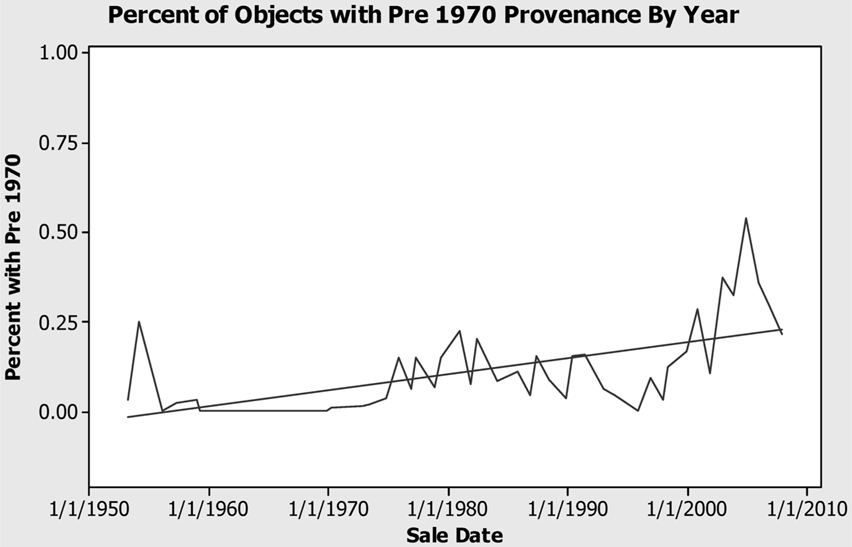
Percent of objects with pre-1939 provenance.

The UNESCO Convention of 1970 and many American museum guidelines consider the year 1970 to be the universal cutoff date after which no antiquities shall be illegally exported from their source countries. Because of the overwhelming acceptance of this date, the pre-1970 provenance type would theoretically be most affected by legal developments and show the greatest amount of increase. As stated previously, the pre-1970 category saw the second greatest increase of the four, but it is apparent from figure 5 that the number of objects with pre-1970 provenance has been steadily increasing since the UNESCO Convention in 1970. It is important to note that the graph prior to 1970 should show that 100% of the objects had pre-1970 provenance, but I only included objects with specifically listed and dated provenance to better illustrate how many sellers took care to publish such information. This provenance category saw its greatest spike around 2005–2006, while the art world was entrenched in the True/Hecht scandal and America's major art museums were hastily returning antiquities to avoid litigation.
Percent of objects with pre-1970 provenance.

The post-1970 provenance category represents antiquities with dated provenance information, albeit dated after the year 1970. Surprisingly, figure 6 shows that this is the fastest-growing category out of the four, and nearly 80% of the Italian antiquities sold at the last sale in 2007 possess this kind of information. The pervasiveness of post-1970 provenance gives credence to the belief that any provenance is good provenance. Perhaps sellers believe that establishing any trail of ownership, regardless of whether it is legally indemnifying, is valuable to the buyer.
Percent of objects with post-1970 provenance.

Antiquities are often published in auction catalogs as being previously owned by a party but the date the work was acquired by the previous owner is often omitted, either because the date information is not available, the date information is privileged, or the seller does not want the buyer to have the date. Figure 7 illustrates that although nearly 75% of a recent year's objects have possessed undated provenance, the increases in annual percentages are irregular, sporadic, and seemingly unrelated to the market factors at issue. The two largest spikes, in the mid-1950s and 2006, cannot be explained with a cause that is common to both years. Therefore, these data demonstrate, first, that much provenance information is undated, but, second, that its trends are unrelated to the legal environment.
Percent of objects with undated provenance.

C. Relationship Between Provenance and Price
The presence of provenance information gives the buyer varying levels of assurance depending on which types of provenance the object possesses, from complete legal indemnity to notifying the buyer that there was a previous owner. Its ability to alleviate risk makes provenance a valuable commodity in itself and radically affects the price of antiquities with such information. Antiquities dealer Robert Haber has perceived this market effect as well, stating that “within the complex world of the ancient art market it is becoming more apparent that a good provenance has a very positive effect on the value of a work of ancient art.”Footnote 65 This change appears to be worldwide as evidenced by an anonymous dealer in London, who says that he will “actually pay more if there's a provenance for the piece…. I think that it's fair to say that the prices are higher if something has a provenance—it seems to be reflected in the price that people are willing to pay.”Footnote 66 My third hypothesis echoes the comments of the two dealers: The price of antiquities with provenance information will be higher than that of objects with no provenance. Figures 8 through 11 confirm this belief
The first comparison, in figure 8, shows the sale prices for objects with and without pre-1939 provenance information and indicates that although few were sold, the objects that possessed this type of information sold at staggeringly high prices. In many of the sales where pre-1939 provenanced objects were sold, they garnered the highest prices of all the lots. Note, however, that the increase in value for these works did not begin until around 1977, the year in which US v. McClain was decided. Recall that McClain was the first case to acknowledge that the NSPA could punish collectors whose objects were exported in violation of a source country's patrimony laws.Footnote 67 In essence, McClain gave Italy's patrimony law of 1939 strength within the United States. McClain is the likely cause of the price increase for objects with pre-1939 provenance information.
Sale price of objects with and without pre-1939 provenance.

An examination of figure 9 reveals that objects with pre-1970 provenance have fared even better on the market than pre-1939 objects. Antiquities with such information have outsold all other lots in 16 of the years after 1970 and have sold for the second highest prices in four of the years. For the years in which pre-1970 provenanced objects are the most expensive, the price difference between them and the second most expensive objects, which do not have pre-1970 provenance, can be staggering. Some of the most pronounced price differences were $378,000 in 1987, $391,000 in 1988, $275,000 in 1990, $315,000 in 2004, $151,000 in 2006, and $148,000 in 2007. The correlation between price and the existence of pre-1970 provenance information is clearly demonstrated by these data.
Sale prices of objects with and without pre-1970 provenance.

The value-enhancing nature of pre-1939 and pre-1970 provenance types is not present in objects with post-1970 provenance information. Post-1970 provenanced objects were not the highest priced objects in any of the years except for 2001, and even then, the most expensive lot surpassed other objects by a narrow margin of only $13,076. The data analysis illustrated by figure 10 indicates that the presence of post-1970 provenance does not affect the price of those antiquities.
Sale prices of objects with and without post-1970 provenance.

Much like the underperformance of objects in the post-1970 category, objects with undated provenance do not garner high sale prices (see figure 11). Although these objects' prices surpass others' in four of the years, it is only by extremely thin margins. The analysis proves that because undated provenance does not indemnify the buyer from legal liability, buyers do not assign a high value to the presence of such information.
Sale prices of objects with and without undated provenance.

Table 1 is a correlation table, which assigns a numerical value to the correlation between two or more valuables in a dataset and can quantify the relationships the graphs above illustrate. The correlation coefficient indicates both the nature and the strength of the correlation by its placement on the spectrum from −1 to 1. If the number is negative, the variables are inversely proportional to one another, and the variables are directly correlated if the coefficient is positive. The closer to −1 or +1, the greater the connection between the two. To determine the correlation between price and provenance, it is necessary to calculate the coefficients between the inflated sale price and pre-1939, pre-1970, post-1970, and undated provenance types. From the data table, it is clear that the pre-1939 is most directly correlated to price with a coefficient of .25. This means that there is a fairly significant positive correlation between the two. Pre-1970 provenance follows closely behind with a correlation of .23. The low correlations of .11 for post-1970 provenance and .07 for undated provenance confirm my conclusion that these two categories do not significantly affect the prices for antiquities. The correlation table, like the scatter-plot graphs above, proves that only the two legally-significant categories are statistically related to sale prices.
Correlation Table

* = p < 0.05;
** = p < 0.01;
*** = p < 0.001.
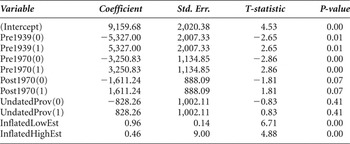
After establishing that provenance is statistically correlated to price, and therefore a significant factor in determining an object's sale price, I endeavored to calculate the value that may be attributed to the presence of provenance. In other words, how much is provenance worth? To estimate these values, the data analyst created a regression model based on the data from sales occurring after 1970, which used variables such as provenance type and auction estimates to predict the dependent variable, price. He used data from post-1970 auctions, instead of all the data, because only after 1970 does provenance become statistically relevant. The regression model is very accurate, with a multiple R-squared value of 0.79. Table 2 shows the coefficients for each variable.
Regression Model from Post-1970 Data

The regression model takes the traditional form of y = mx + b, where y is the sale price of a single object, m is the coefficient, x is an independent variable, and b is the y-intercept. Because the provenance variables are categorical, they are given a value of either 0 for no or 1 for yes, and then multiplied by the coefficient. Focusing only on the provenance types, Table 2 provides estimates of how much value the market ascribes to provenance information. If an object has pre-1939 provenance information, its sale price increases by $5,327.00. But because objects with pre-1939 provenance will necessarily have pre-1970 provenance as well, the value increases from $5,327 to $8,577.83.Footnote 68 If it does not possess this information, the price decreases by the same amount, showing that a work with pre-1939 provenance will be sold for $17,155.66 more than an identical object without pre-1939 provenance. This regression model, including the coefficients for high and low estimates not listed below, allow for an accurate prediction of what price an object will sell for at auction if provenance type and estimates are entered by the user. For example, an object with 1928 provenance, estimated to sell for $20,000 to $30,000 is predicted to sell for $48,298.01. There is no limit to the usefulness of this model, but for now it will merely serve as an indicator of the high value buyers ascribe to provenance.
D. Relationship Between Legal Event and Price
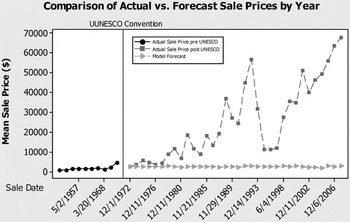
The final and arguably most important inquiry is whether relevant legal events have had an effect on the price of Italian antiquities sold at auction. Despite the straightforward nature of the question, the answer is not easily ascertainable because of the numerous fluctuations in the average sale price over time. First, however, it is necessary to establish that when the legal environment began to change, the market changed in response. The first significant and relevant legal event was the UNESCO Convention in 1970, and this event appears to have fundamentally altered the behavior of the antiquities market. Figure 12 is a graph of the actual market compared to the predicted performance based on pre-1970 data. I built a regression model based on the sales from before 1970, and the model predicted that the market would behave as shown by the line demarcated by triangles.
Comparison of actual sale prices versus forecasted sale prices.

The pre-1970 model did not find that the market for antiquities would grow much in the coming years because it did not yet account for the importance of provenance information after 1970. The vertical line, at 1970, shows that at that date, the market began to be influenced by the plethora of legal events incited by the UNESCO Convention. After the legal environment started to shift, the pre-1970 severely underestimated the performance of the market.
Figure 13 compares the average sale price of Italian antiquities per year with a timeline of legal events that affect the legal treatment of antiquities. Beginning at the earlier sales, the average sale price does not begin to noticeably increase until after US v. McClain in 1977. Even though the UNESCO Convention was ratified in 1970, there is little effect on the market, presumably because the United States had not yet enacted the CPIA, which obligated the government to comply. Indeed, the CPIA in 1983 ushered in a drastic rise in the prices of Italian antiquities, likely because UNESCO now had force domestically and the CPIA's publicity put buyers on notice of potential legal ramifications for purchasing illicit works. The market for antiquities increased consistently from 1953 through 1992 demonstrating that the early legal events, which make up the foundation of repatriation laws, all have the effect of making antiquities more expensive.
Average sale price versus legal events.

Beginning in 1993, the relationship between the occurrence of legal events and the price of antiquities is no longer uniform and vacillates between being directly and inversely proportionate. The attitude toward antiquities collecting had begun to change in the early 1990s, when archaeologists, historians, and nationalists in source countries allied to reform repatriation laws. In 1992, the European Union (EU) issued a directive aimed at creating harmonized export controls for member countries' cultural goods, which alerted the American public to the changing tide of antiquities collecting.Footnote 69 Similar EU and British directives followed in 1993.Footnote 70 Soon after, the UNIDROIT Convention was drafted and signed by many powerful source nations, and in the same year, authorities raided Giacomo Medici's cache of illegally excavated antiquities. Rather than force a rise in prices, these events actually chilled the market for antiquities that spanned from 1992 until 1997. It is possible that the laws and directives created such uncertainty about their application in the courts that buyers were unsure of how to calculate the riskiness of the objects for sale at auctions during this period.
The market quickly rebounded in 1997, contemporaneously with US v. Antique Platter of Gold because the case reiterated the importance of accurate provenance information. In this case, the U.S. government was able to seize the antiquity because its import papers had been falsified with a fake provenance thus demonstrating that a legitimate provenance will indemnify the buyer.Footnote 71 Objects with provenance information thus fared well at auction, driving up the average sale prices. This market trend continued when the United States implemented new import restrictions on Italian antiquities, which applied to objects without provenance. There was a steep decrease in the average sale price around 2003, when the Schultz case was being filed, litigated, and decided. This downtrend was short-lived, however, and the market quickly returned to normal levels.
In recent years, the repatriation debate has been acted out dramatically on an international stage, causing an initial dip in the market and subsequent rebound. Beginning in 2005 with Italy's case against Marion True and Robert E. Hecht, the powerful source nation has prevailed in most of its crusades for repatriation of its cultural property. The heavily publicized charges against the curator and dealer demonstrated Italy's perseverance and persuaded the Metropolitan and Getty Museums to return disputed antiquities. The market's behavior in the last months of the study indicate that the average sale prices for Italian antiquities are again rising, despite the source nation's success in reclaiming its cultural property.
At a glance, the relationships between each of the events and the average sale prices do not indicate an overall pattern of causation. But the market seems to be behaving in a similar manner to each of the legal events from McClain onward. First there is an event, and then the prices decrease because the uncertain legal environment that results from a new law or case decision chills the market. During this period of low prices, buyers are unable to make accurate risk assessments, and they assume that buying is extremely risky. As time passes, scholarly, political, or legal interpretation of the recent legal event helps clarify the new rule and helps identify the risk. Although buyers are wary of the legal environment surrounding the antiquities market, they and assign a high value to reliable provenance information. As a result, the average sale price of antiquities rises once again. This pattern of cause and effect can be seen after almost every significant legal event in the dataset after 1977.
V. CONCLUSION
For antiquities collectors, museums, and educational institutions, the battle has just begun. Recent victories have emboldened the Italian government, and it continues to launch investigations into American institutions' acquisitions. An art exhibition of Italy's recently repatriated antiquities, Nostoi, was held in Rome's Quirinal Palace from December 2007 through March 2008 and went on to the Palazzo Poli a Fontana di Trevi to flaunt Italy's success and revitalize its citizens' nationalism.Footnote 72 Inspired by Italy's campaign, nations such as Greece, Guatemala, El Salvador, Peru, Turkey, China, and Cambodia have taken steps to repatriate their cultural property.Footnote 73 The exhibition Nóστοι-Nostoi was organized at the New Acropolis Museum by the Greek Ministry of Culture, which combined Italy's Nostoi with 10 artifacts that had been repatriated to Greece, celebrating the joint efforts of the two source nations to repatriate their cultural property.Footnote 74 The repatriation debate will only continue to affect the antiquities market and do so in stronger ways as purchasing these objects gets even riskier. The results contained in this article can enable parties to predict how the antiquities market will react to future legal developments or to help collectors assign a monetary value to their objects' provenance information. My ultimate aim was to shift a traditional market analysis to a more interdisciplinary mode of inquiry, where legal, economic, political, and artistic factors are examined together.
The preceding data analyses reveal important conclusions about the relationship between the legal world and the art world. While practitioners of either industry have traditionally believed their business to be utterly independent of the other, the escalating battle over the repatriation of cultural property teaches otherwise. The antiquities market has flourished despite the threatening litigious atmosphere surrounding many works, making an interdisciplinary study of the market more relevant and necessary than ever. This study has established that the number of antiquities sold with legally significant provenance information is steadily increasing as a result of the legal environment. Also, these objects are less risky and therefore, sell for higher prices than their unprovenanced counterparts. Finally, evidence indicates that the occurrence of a legal event causes a slight, short drop in the market, followed by a significant rise in prices for the objects with reliable provenance information. In the end, the auction market for Italian antiquities is inexorably linked with activities that have ramifications for the legality of collecting these works.