


Introduction
Germany has a long-standing tradition in the breeding, keeping, and use of horses and is widely regarded as one of the leading ‘horse nations’ in Europe. Horses play an important cultural, economic, and sporting role in German society, reflected in the large number of privately owned horses, a well-established equestrian infrastructure, and the strong presence of equestrian sports and breeding organisations (Horse Competence Centre Germany [HCCG] undated). This close relationship between humans and horses has historically been accompanied by a high degree of professionalisation in equine husbandry and veterinary care.
Despite this evident passion for horses, recent developments have raised new challenges for equine welfare. Over the past few years, the economic conditions for German horse owners have changed significantly (Harms Reference Harms2024; Frank Reference Frank2025), a trend reflected in a decline in breeding numbers and lower participation in equestrian competitions (Deutsche Reiterliche Vereinigung e.V. [FN] 2025). In addition to the amendment of the German Veterinary Fee Schedule (Gebührenordnung für Tierärztinnen und Tierärzte; GOT) on 22 November 2022 (Bundesministerium für Ernährung und Landwirtschaft [BMEL] 2022), which led to an increase in average treatment costs, rising inflation contributed to an increase in the cost of living (Federal Statistical Office 2025a,b). As a result, it has become increasingly difficult for many horse owners to cover the costs of veterinary treatment (Rhein et al. Reference Rhein, Raimann and Krämer2025). In the wake of these developments, it was assumed that not only would fewer veterinary consultations be carried out, but also, as Brennan et al. (Reference Brennan, Chambers, Christley and Penfold2018) had already shown, that costs may also have an impact on the use of non-veterinary therapies. Under such circumstances, horse owners might also turn to alternative treatment methods that are considered more accessible, more affordable, or better aligned with their personal beliefs about animal health and care.
Parallel to these trends, the integration of traditional healing methods and complementary medicine has gained considerable popularity in equine practice (Lange et al. Reference Lange, Axiak Flammer, Gerber, Kindt and Koch2017; Keller et al. Reference Keller, Vanwesenbeeck, Hudders and Decloedt2021). Some veterinarians incorporate complementary and alternative veterinary medicine (CAVM) into their practice alongside conventional veterinary approaches. While beneficial effects have been demonstrated for specific CAVM methods and indications (e.g. Laves et al. Reference Laves, Wergin, Bauer, Müller, Failing, Büttner, Hagen, Melzer and Röcken2024), the scientific evidence supporting the efficacy of many CAVM methods in horses remains limited or is lacking, and the level of evidence varies considerably between individual therapeutic approaches. Consequently, the increasing use and diversity of complementary therapeutic services raise important questions. In Germany, in particular, the absence of comprehensive legal regulation for many non-veterinary therapeutic professions allows a wide range of practitioners with varying levels of qualification to provide treatments for horses. Animal welfare-related problems can arise when non-veterinarians make medical diagnoses or carry out therapies for which they lack the specialist knowledge or legal authority. In addition, the treatment of horses without prior veterinary diagnosis may pose particular animal welfare risks. Clinical signs may be associated with an underlying condition requiring veterinary diagnosis and treatment. In such cases, treatment without appropriate veterinary assessment may delay the identification of the condition and consequently postpone appropriate treatment, potentially prolonging discomfort, pain or disease. Furthermore, if clinical signs are caused by an infectious disease that remains undiagnosed, appropriate biosecurity measures may not be implemented, potentially increasing the risk of disease transmission to other animals.
To the authors’ knowledge, there have been no studies to date on the consultation of alternative therapists in the equine sector and the resulting implications in Germany. Against this background, greater attention must be paid to the regulatory framework governing non-veterinary therapeutic professions in the equine sector. In particular, the lack of clearly defined qualification requirements raises concerns regarding professional standards and the protection of animal welfare.
The present study therefore aims to provide an overview of the use of non-veterinary therapeutic services in Germany and to identify potential implications for equine welfare. Particular attention is paid to the lack of regulation governing the provision of alternative or complementary treatment methods, as well as to the associated risk of delayed conventional veterinary care. Focusing on Germany as a prominent horse nation with a large and diverse equine population, the study seeks to contribute empirical evidence to the ongoing debate on appropriate regulation and qualification standards in equine healthcare.
Materials and methods
Ethical considerations
This study was conducted in accordance with the General Data Protection Regulation of the European Union. Participation in the survey was voluntary, and participants were informed that non-participation would not result in any disadvantages. All participants had given consent prior to participation. Participants were informed about the purpose of the study, how their data would be used and stored. They could withdraw from participation at any time before submitting the survey. As the survey responses were anonymised, participants were not able to withdraw their individual data after submission. The survey data were stored on local, university-owned servers of the University’s Computing Centre (HRZ) in Giessen and remained within the IT infrastructure of Justus Liebig University Giessen. All data were anonymised, and the ethical standards of the German Association of Sociology were followed. Formal ethical approval was not required for this study.
Study outline
This investigation formed part of a broader project examining how changes to the Fees Regulation for Veterinarians (GOT) affect horse management and veterinary treatment in Germany. It was initiated after equine veterinarians reported, in personal communications, a perceived rise in cost-driven treatment decisions — including cases in which euthanasia was chosen due to financial constraints. Such developments may conflict with the principles of the German Animal Welfare Act (TierSchG 1998), which prohibits the killing of animals solely for economic reasons. With the intention of quantifying the initial case reports over a large sample, an online survey was chosen as data collection method. The survey underwent multi-stage pre-testing, which included both quantitative and cognitive testing procedures (Lenzner et al. Reference Lenzner, Neuert and Otto2015). The subsequent revisions mainly involved linguistic revisions and led to the deletion of two questions, which proved difficult to understand and were not essential to the central research objective.
The three target groups included equine veterinarians, veterinarians from non-equine fields who own a horse, and horse owners. Based on target group affiliation, the survey was divided into two different paths using automatic filters. In one pathway, equine professionals were invited to reflect on their perceptions of various phenomena encountered in their daily practice. In parallel, veterinarians working outside equine medicine who own a horse, as well as horse owners without a veterinary background, were presented with analogous questions relating to their horse ownership. These groups were analysed separately, as it was assumed that formal veterinary training could shape responses to certain items. The present study focuses on the consultation of alternative therapists by horse owners with and without a veterinary background as well as the observations of practising equine veterinarians regarding consultations with other therapists by their clients.
Besides being asked about demographic data and the number of horses they own, horse owners were also asked whether they have other therapists for their horse(s) in addition to their veterinarian (see Figure S1; Supplementary material). The question assessed whether horse owners generally consulted other equine therapists for their horses besides a veterinarian; it did not assess whether these practitioners were consulted for the same condition, injury or treatment occasion.
In the following question, participants were asked which of the selected type of therapist is also a veterinarian (see Figure S2; Supplementary material). In both Figures S1 and S2 participants were able to select multiple answers and the “other” option allowed users to enter their own information in a text field.
In addition, practising equine veterinarians were asked about their observations regarding their clients’ consultations with non-veterinary therapists over the course of a period of time (see Table S1; Supplementary material).
The survey was distributed via the newsletter of the German Veterinary Medical Society’s ‘Horse Diseases’ section, as well as through equestrian magazines and the German Equestrian Federation (FN) and was available between July and November 2024. It was administered using LimeSurvey Version 6.5.17 (LimeSurvey GmbH, Hamburg, Germany), and the resulting data were analysed upon completion with IBM SPSS® Statistics Version 29.0.2.0 (20) (IBM Statistics GmbH, Böblingen, Germany).
Results
The survey was accessed 10,722 times and completed a total of 8,054 times. After data cleansing, a total of 7,723 evaluable datasets remained. Of these, 341 were from practising equine veterinarians, 148 were from veterinarians whose field of activity was outside equine medicine, but who owned horses, and 7,234 were completed questionnaires from non-veterinary horse owners. The results show that supplementing conventional medical care with additional therapists is widespread. In the survey, 82.8% of the responding non-veterinary horse owners stated that they consult additional therapists for their horses in addition to their veterinary care. Among veterinary horse owners, this proportion was just under 60% (see Table 1). As described above, this question referred to the general consultation of other equine therapists and not necessarily to their use for the same condition or treatment occasion as veterinary care.
Consultation of other equine therapists besides a veterinarian by non-veterinarian horse owners (n = 7,234) and veterinarian horse owners (n = 148) in Germany

Table 1. Long description
The table is organized into three main categories of horse owners: Non-veterinarian (n = 7,234), Veterinarian (n = 148), and Total (n = 7,382). For each group, data is provided for n, percentage, and valid percentage.
* Non-veterinarian horse owners: 5,891 (82.8 valid percent) consulted at least one other therapist, while 1,224 (17.2 valid percent) did not. 119 responses were missing.
* Veterinarian horse owners: 83 (58.5 valid percent) consulted at least one other therapist, while 59 (41.5 valid percent) did not. 6 responses were missing.
* Total: 5,974 (82.3 valid percent) of the combined group consulted at least one other therapist, while 1,283 (17.7 valid percent) did not. Total missing responses across both groups were 125 (1.7 percent).
This results in less than one-fifth of all horse owners surveyed relying exclusively on conventional veterinary care.
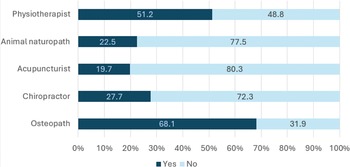
Of the slightly more than 80% of non-veterinary horse owners who stated that they used at least one other form of therapeutic care (n = 5,891), just under 70% consult an osteopath, slightly more than half consult a physiotherapist, and around 30% consult a chiropractor. Slightly more than one-fifth of respondents have their horses treated by an animal naturopath, while just under one-fifth have their horses receive acupuncture (see Figure 1).
Consultation of different equine therapeutic professions by non-veterinarian horse owners who reported consulting at least one other equine therapist for their horses (n = 5,891). Multiple responses were possible.

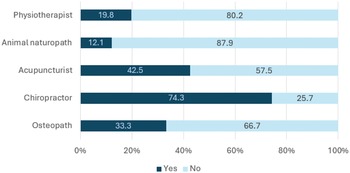
When asked whether the consulted therapists were also veterinarians, chiropractors had the highest proportion of veterinarians, followed by acupuncturists, osteopaths, and physical therapists (see Figure 2). According to the participants, 12% of the consulted animal naturopaths were also veterinarians (see Figure 2).
Percentage of equine therapists consulted by non-veterinarian horse owners who were reported to also be veterinarians, according to therapeutic profession. Multiple responses were possible.

The evaluation of the same question for veterinary horse owners shows a similar consultation pattern: Here, too, osteopaths were consulted most frequently (63.9%), followed by chiropractors (39.8%), physiotherapists (32.5%), and acupuncturists (20.5%). The proportion consulting physiotherapists was lower among veterinarian horse owners than among non-veterinarian horse owners (32.5 vs 51.2%). Animal naturopaths account for the smallest proportion: only approximately 10% of veterinary horse owners who stated to consult other therapists stated that they also involve animal naturopaths (n = 8) (see Figure 3).
Consultation of different equine therapeutic professions by veterinarian horse owners who reported consulting at least one other equine therapist for their horses (n = 83). Multiple responses were possible.

The group of veterinary horse owners showed a higher overall proportion of therapists with veterinary qualifications — with the exception of the consulted animal naturopaths, who had no veterinary qualifications (see Figure 4).
Percentage of equine therapists consulted by veterinarian horse owners who were reported to also be veterinarians, according to therapeutic profession. Multiple responses were possible.

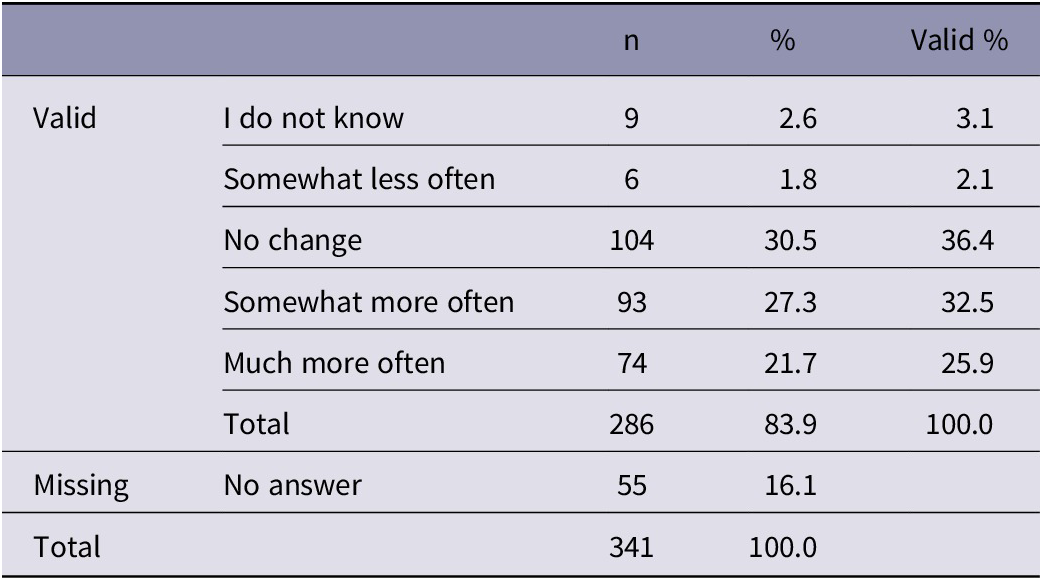
In addition, practising equine veterinarians were asked about their observations regarding consultations with other therapists. Among valid responses, 58.4% of practising equine veterinarians reported that, since the amendment of the German Veterinary Fee Schedule (GOT) in 2022, they more frequently encounter cases in which other therapists have treated the horse prior to the veterinarian’s consultation (see Table 2).
Reported change in the frequency with which non-veterinary equine therapists were consulted before veterinary care was sought following the amendment of the German Veterinary Fee Schedule (GOT) in 2022, according to practising equine veterinarians (n = 341)
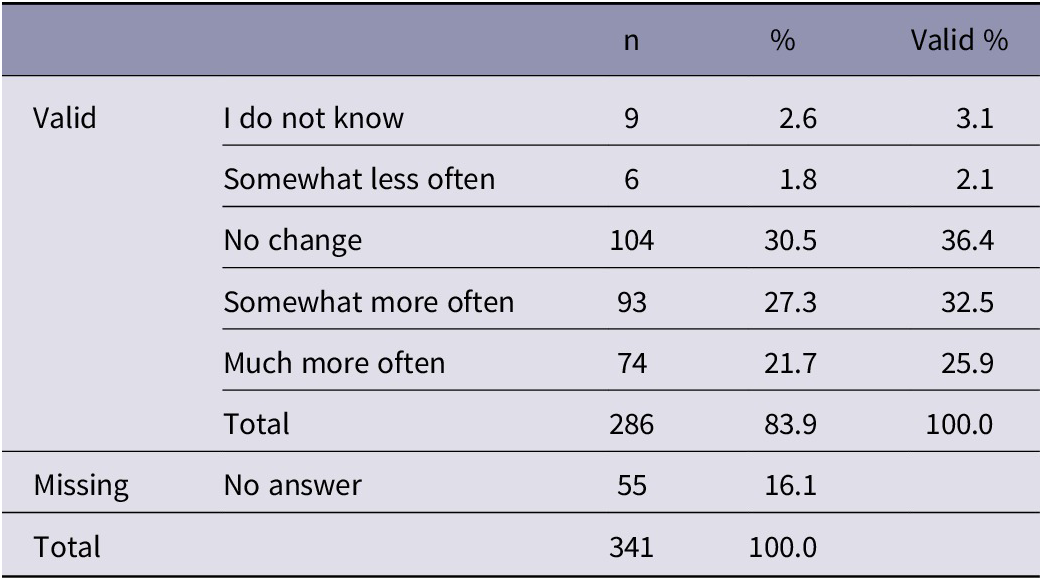
Table 2. Long description
The table presents data from 341 equine veterinarians. It is structured with columns for category, frequency n, percentage, and valid percentage.
Valid responses (n = 286):
* I do not know: n = 9, 2.6 percent, 3.1 valid percent.
* Somewhat less often: n = 6, 1.8 percent, 2.1 valid percent.
* No change: n = 104, 30.5 percent, 36.4 valid percent.
* Somewhat more often: n = 93, 27.3 percent, 32.5 valid percent.
* Much more often: n = 74, 21.7 percent, 25.9 valid percent.
* Total valid: n = 286, 83.9 percent, 100.0 valid percent.
Missing data:
* No answer: n = 55, 16.1 percent.
Grand Total: n = 341, 100.0 percent.
Discussion
Use of non-veterinary equine therapists and potential influencing factors
The study generated empirical data on the consultation of other therapists in addition to veterinary care. The data show, that supplementing conventional medical care with other, non-veterinarian therapists is widespread. In summary, it can be stated that the vast majority of horse owners questioned (over 80%) consult at least one other therapeutic specialist in addition to veterinary care. These figures are comparable, but slightly higher than those for Belgium reported by Keller et al. (Reference Keller, Vanwesenbeeck, Hudders and Decloedt2021) with 72.5% of participants stating that they use complementary and alternative veterinary medicine.
Among the additional services used, osteopathy is the most frequently used form of therapy, followed by physiotherapy and chiropractic treatment. The finding that osteopathy is the most frequently used form aligns with observations made by Lange et al. (Reference Lange, Axiak Flammer, Gerber, Kindt and Koch2017) who conducted a study on complementary and alternative medicine for the management of orthopaedic problems in Swiss Warmblood horses.
For physiotherapy and chiropractic, there are group-specific differences in the ranking: non-veterinary horse owners use physiotherapy services comparatively more often, while veterinary horse owners tend to use chiropractic services. Acupuncture and treatments by animal naturopaths follow with a lower but still relevant frequency. As regards the qualifications of the therapists consulted, it is clear that, chiropractors notwithstanding, the majority of complementary practitioners in the field of non-veterinary horse owners have no veterinary training (see Figure 2). Chiropractors had the highest proportion of veterinarians, followed by acupuncturists, osteopaths, and physical therapists (see Figure 2).
However, according to non-veterinary horse owners, 12.1% of the animal naturopaths consulted were also veterinarians (see Figure 2), a statement that should be viewed with scepticism given, to the authors’ knowledge, the presumably very limited number of dual qualifications of this kind in Germany. It can be assumed that either veterinarians working in naturopathy were classified in this category or that animal naturopaths were mistakenly perceived as having attained veterinary qualifications.
The group of veterinary horse owners showed a higher overall proportion of therapists with veterinary qualifications — with the exception of animal naturopaths, whose assessment by respondents can be considered realistic and consistent with actual professional practice (see Figure 4). One possible explanation for the fact that veterinary horse owners have a higher proportion of therapists with veterinary training could be that, compared to non-veterinary horse owners, veterinary horse owners place greater value on higher qualifications due to their own training and expertise.
In addition to the widespread use of complementary therapies alongside conventional medical care, the participating equine veterinarians stated that following the amendment of the German Veterinary Fee Schedule (GOT) in 2022 (BMEL 2022), (alternative therapists are being consulted more often before a veterinarian is called. This necessitates a discussion of the resulting implications and may be influenced by several factors that have increasingly overlapped in recent years. One factor is the economic pressure that some horse owners are facing. Rising treatment costs and general economic uncertainty could lead to decisions about veterinary consultations being delayed more often or avoided altogether (Rhein et al. Reference Rhein, Raimann and Krämer2025). As a result, attempts may be made more frequently to solve health problems in ways that are perceived as cheaper and non-veterinary therapies are preferred to veterinary treatment for cost reasons. (Brennan et al. Reference Brennan, Chambers, Christley and Penfold2018). In addition, the high availability of information can be another factor. (e.g. Kogan et al. Reference Kogan, Schoenfeld-Tacher, Simon and Viera2009). The use of the internet can give the impression that medical knowledge is easily accessible and can also be applied by people without extensive training. Online forums, social media, and diagnostic apps convey a sense of self-efficacy and encourage owners to assess illnesses themselves and seek seemingly low-threshold treatment. The discrepancy between self-assessment and actual knowledge about alternative therapies is also reflected in the study by Keller et al. (Reference Keller, Vanwesenbeeck, Hudders and Decloedt2021), which showed that although most horse owners claimed to have moderate to high knowledge of complementary and alternative veterinary medicine, a knowledge test indicated that their actual knowledge was rather low.
Legal and professional framework for non-veterinary equine therapies
Another important implication of the data emerges from the currently inadequate legal framework in Germany. In contrast to human medicine, no clear distinction exists in the veterinary field in Germany as to who exactly is allowed to practice veterinary medicine (Wissenschaftliche Dienste des Deutschen Bundestages 2019). While alternative practitioners for humans in Germany are subject to licensing requirements, veterinary activities are not yet subject to approval under Section 11 of the Animal Welfare Act. This leads to a largely unregulated market in which conventional and alternative services often overlap — and in which decisions are increasingly influenced by availability and costs. The variety of service providers and offerings is impossible to keep track of, and the competencies and credentials of individual providers are often unclear. Since the profession of animal naturopath is not subject to state regulation in Germany, there are neither binding curricula nor uniform training requirements. The training courses offered by private schools usually last around two years, and up to three years with some providers, depending on the chosen teaching format, like weekend or distance learning courses (Paracelsus Heilpraktikerschulen undated, ATM Akademie undated, Freie Tierheilpraktiker e. V. undated). The lack of regulations means that it is entirely possible to offer services as an animal naturopath after completing a weekend course, as neither the term nor the profession is protected or is it recognised by the state in Germany. When applied to the data, this means that more than 80% of the horses owned by the respondents are at risk in terms of animal welfare due to treatment by non-veterinarians, as they are treated by individuals who have not necessarily undergone standardised and certified training.
Many of Germany’s neighbouring countries adhere to significantly stricter guidelines. By contrast, veterinary medicine in the UK is subject to strict regulations under the Veterinary Surgeons Act 1966 (Statute Law Database 2025). Only registered veterinarians are legally authorised to perform “veterinary procedures,” including the diagnosis of diseases, consultation, medical or surgical treatment, and surgical procedures on animals. Non-veterinarians may only perform certain treatments, such as physiotherapy, osteopathy, and chiropractic, under direct veterinary supervision. Trained musculoskeletal therapists may perform maintenance treatments (e.g. massage) without veterinary supervision. Acupuncture and aromatherapy are expressly excluded from the exemptions (Statute Law Database 2015; RCVS 2025). In Austria, the Veterinary Act (RIS 2023) stipulates that all diagnostic, therapeutic, and surgical procedures, as well as preventive measures and the prescription of medication, are reserved exclusively for veterinarians. Non-veterinarians may only work as trained assistants under the constant supervision of a veterinarian. Treatments such as physiotherapy, chiropractic, and osteopathy are considered veterinary procedures. Non-veterinarians may only work as trained assistants under constant veterinary supervision. France also strictly protects veterinary practice: according to the Code Rural (Légifrance 2025), veterinary acts include all procedures for the diagnosis, prevention, or treatment of diseases or functional disorders in animals. Diagnosis, therapy, surgical procedures, and the administration of medication are reserved for veterinarians. Alternative or manual therapies, such as physiotherapy and osteopathy, are permitted under very strict conditions, but only for functional and not for medical purposes.
In addition, it is crucial to raise awareness among animal owners about situations in which veterinary care is absolutely necessary: According to Section 2 of the Animal Welfare Act (TierSchG 1998), anyone who keeps or cares for an animal is not only obliged to feed and care for it appropriately and to provide medical care when necessary. As an animal owner in Germany, one is also legally obliged to have the necessary knowledge and skills to ensure proper care; this includes knowing when to seek veterinary expertise (Section 2 Animal Welfare Act). In order to promote this competence, mandatory competence courses should be introduced immediately. At the same time, economic models for financial assistance could be considered — for example, in the form of insurance, instalment payments, or initial telemedical assessments. These could help lower financial barriers and thus enable veterinary care to be requested more quickly. In a world of information overload, where social media allows anyone to present themselves as an expert, it can be difficult for horse owners to assess the quality of therapeutic services. Here, too, mandatory training courses could help animal owners identify qualified practitioners. For veterinarians working in an integrative manner, the overwhelming range of services and procedures available could be a motivation to further strengthen the evidential basis of traditional healing methods and complementary medicine (e.g. Stanossek & Wehrend Reference Stanossek and Wehrend2022).
Study limitations
A limitation of the study is the use of a convenience sampling approach instead of a randomised controlled design, which may introduce selection bias and restrict the generalisability of the findings. However, this limitation is partly offset by the exceptionally large number of respondents, which enhances the robustness of the dataset and reduces concerns about limited representativeness.
Another limitation concerns the way alternative therapists were captured in the survey. Respondents were asked about different types of therapists, although individual practitioners may offer multiple therapeutic modalities or combine them in practice. As a result, the survey reflects the number of consulted professions rather than the actual number of distinct therapists involved. However, this limitation is not critical for the research aim, as the study focuses on the types of therapeutic approaches sought by horse owners and the extent to which these interventions are performed by non-veterinarians, rather than quantifying the exact number of individual therapists involved. As such, the categorisation provides meaningful insights into consultation patterns and therapeutic preferences.
Animal welfare implications
Between the aforementioned economic pressure, the increasing therapeutic diversity and the currently inadequate legal regulations in Germany, animal welfare may be at risk. Our findings indicate that non-veterinary equine therapists are frequently consulted by horse owners in Germany, with more than 80% of non-veterinary horse owners reporting that their horses had received treatment from non-veterinary practitioners. The use of non-veterinary therapeutic services may have implications for equine welfare, particularly when such treatments are sought for health problems that require veterinary assessment. Delayed veterinary examination, or treatment, could prolong pain, discomfort or other health problems and may increase the risk that underlying conditions remain undiagnosed. In cases of undiagnosed infectious disease, delayed veterinary assessment may also result in appropriate biosecurity measures not being implemented, potentially increasing the risk of disease transmission to other animals. Our findings therefore highlight the importance of ensuring that horse owners are able to recognise situations requiring veterinary assessment and that non-veterinary therapeutic interventions are provided within clearly defined professional and legal boundaries that safeguard equine welfare.
The practice of the neighbouring countries referred to above shows that it is possible to implement uniform and clear regulations for non-veterinary therapeutic interventions. In order to ensure animal welfare, treatment quality, and legal certainty in the long term, it is imperative that clear legal regulations be developed and implemented in Germany that define who is allowed to treat animals therapeutically, what qualifications are required, and how compliance with these standards is monitored. When training non-veterinary therapists, special attention must be paid to teaching the criteria for determining when treatment should be withheld until a conventional medical examination has been carried out. Only with a regulated licensing requirement is it possible to prevent unqualified or inadequately trained individuals from performing procedures that pose health risks to animals.
It will be crucial to think integratively rather than contrasting conventional medicine and complementary medicine: both can complement each other in a meaningful way if they are applied professionally and combined responsibly. Only through clear legal structures and partnership-based cooperation between all parties involved can animal-friendly, sustainable, and future-oriented care be guaranteed.
Conclusion
Over 80% of the participating non-veterinary horse owners consult at least one other therapeutic specialist in addition to veterinary care. This high percentage is concerning given the lack of legal regulations, as there is no guarantee that the horses are being treated by professionally trained individuals. Due to a lack of expertise on the part of alternative therapists and owners, medically necessary treatments may be delayed or, in the worst case, not carried out at all. In addition, the decision-making behaviour of horse owners in Germany appears to be changing: Since the amendment to the GOT, the equine veterinarians surveyed have reported an increase in preliminary consultations before they are consulted. The lack of legal regulations, an increasing variety of therapeutic offerings and rising costs are creating a complex area of tension that can have a negative impact on animal welfare.
Complementary or supportive procedures may have a role in equine healthcare when applied appropriately and within the limits of the available scientific evidence, but they should not replace necessary veterinary diagnostics or treatment. Violating owner obligations under Section 2 of the Animal Welfare Act and failing to seek professional help in a timely manner can have legal consequences.
In practice, some veterinarians adopt an integrative approach, combining conventional veterinary diagnostics and treatment with complementary methods such as acupuncture, homeopathy, laser therapy, or phytotherapy. While the scientific evidence varies considerably between individual methods and indications, such approaches may be incorporated into veterinary care where appropriate. The professional competence to recognise indications, evaluate the available evidence, and identify the limitations of individual therapeutic approaches is therefore essential. In order to ensure this across the board, all veterinary activities must be subject to authorisation in accordance with Section 11 of the Animal Welfare Act.
In the interests of the animals, the aim should not be to restrict complementary medicine, but to ensure its responsible use – within a clear legal framework.
Supplementary material
The supplementary material for this article can be found at http://doi.org/10.1017/awf.2026.10120.
Acknowledgements
During the preparation of this manuscript, the authors used ChatGPT (OpenAI) Version GPT-5.3 to assist with translation from German to English and to improve the clarity of selected sentences and phrases. No AI tools were used to generate scientific content, analyse data, or draw conclusions.
Competing interests
None.





 Open access

