Globally, CHD represents one-third of all major congenital anomalies, with a reported European prevalence of 8.2 per 1000 live births [95% confidence interval: 8.1 to 8.3].Reference van der Linde, Konings and Slager 1 Infants with CHD often have persistent malnutrition during the first few years of life,Reference Medoff-Cooper and Ravishankar 2 which has an impact on clinical outcomes post surgery, length of hospital stay, and long-term health.Reference Marino and Magee 3
Gastrointestinal manifestations and feed intolerance are common features among infants with CHD, with symptoms including vomiting, diarrhoea, bloating, constipation, and gastro-oesophageal reflux.Reference Blasquez, Clouzeau and Fayon 4 Many of these, often severe but nonspecific gastrointestinal symptoms, are associated with cow’s milk protein allergy/intolerance and as a result infants are often prescribed an amino acid infant formula with the aim of improving feeding tolerance and symptom resolution, without a definitive diagnosis of cow’s milk protein allergy. Although feeding tolerance for some may improve, growth among infants with CHD and cow’s milk protein allergy has been found to be significantly worse compared with infants with CHD but without a cow’s milk protein allergy,Reference Luo, Xu, Hong, Wu and Zhang 5 the causality of which is not currently known. The composition of amino acid formulas developed for otherwise healthy infants is based upon strict international and European regulations intended to ensure safe and appropriate growth among infants with cow’s milk protein allergy consuming varying amounts of infant formula.Reference Muraro, Werfel and Hoffmann-Sommergruber 6 Despite the variability in micronutrient intake among healthy infants during the 1st year of life, mineral deficiencies are rare. 7 In addition, the nutritional composition of amino acid infant formula is comparable to that of standard infant formula or breast milk (Supplementary Table 1).
There is a paucity of information relating to the micronutrient and electrolyte requirements in infants with CHD, particularly among those requiring multiple medications. Poor growth among infants with CHD is multifactorial.Reference Medoff-Cooper and Ravishankar 2 , Reference Medoff-Cooper, Naim, Torowicz and Mott 8 With respect to phosphate, hypophosphataemia occurs with inadequate dietary intake, malabsorption, increased renal excretion, or shifts between intracellular and extracellular compartments. Gonzalez Ballesteros et al Reference Gonzalez Ballesteros, Ma and Gordon 9 recently reported the association of idiopathic hypophosphataemia and bone disease among infants and children following the exclusive use of an amino acid infant formula. Of note, 91% of the cohort were also prescribed proton pump inhibitors. The use of anti-reflux medication is associated with decreased intestinal absorption of phosphate. In addition, the use of diuretics is associated with extra losses of electrolytes and minerals through the urine, which includes phosphate.Reference Berne, Carias, Cioccia, Gonzalez and Hevia 10 As a result, the use of amino acid infant formula in infants with CHD may represent a significant nutritional risk. Following on from the review by Gonzalez Ballesteros et alReference Gonzalez Ballesteros, Ma and Gordon 9 , the aim of this study was therefore to complete a retrospective exploratory analysis to investigate the incidence of hypophosphataemia among infants – ≤12 months of age – with CHD prescribed an amino acid infant formula for the management of gastrointestinal symptoms and presumed CMPA.
Methods and materials
The University Hospital Southampton NHS Foundation Trust electronic patient records system (Electronic Medical Record; MedSphere; Salt Lake City, Utah, United States of America) has an in-built functionality allowing for word terms to be used to identify cases within the patient electronic record. For the purpose of this audit, the terms “cardiac”, “congenital heart disease”, and “amino acid infant formula” were used. The search engine identified all infants during a 15-year period: 2002–2017 across all paediatric specialities with these words in their electronic patient record, which included General Surgery, General Paediatrics, Paediatric Gastroenterology, Neonatology, Paediatric Oncology, and Paediatric Cardiology. This time period was chosen as it represented the time when electronic patient records were first introduced to present day. Only those infants who were identified within the Paediatric Cardiology domain were included in the audit. The search was completed by two of the study investigators independently to verify patient numbers and cross-check results. Study patients were prescribed amino acid infant feeds on the basis of feed intolerance or cow’s milk protein allergy – either presumed on the basis of clinical symptoms or confirmed through Immunoglobulin-E allergy testing.
Inclusion criteria for infants with CHD were defined as those with a significant shunt leading to ventricular dilatation, with a moderate or severe valvar lesion, a cyanotic cardiac lesion, or palliated complex cardiac lesion, which were unrepaired, or had partial palliated lesions at the time of initiation of amino acid infant formula. Exclusion criteria included preterm infants defined as birth at <37 weeks of gestation and those with otherwise structurally normal hearts, as this infant population is known to have higher phosphate requirements arising from their prematurity and have increased risk of metabolic bone disease. Infants were also excluded if they had consumed amino acid infant formula for <2 weeks, were older than 12 months of age, and, finally, if they had significant genetic comorbidity, such as Down’s syndrome or 22.q11.2 deletion, which could independently lead to growth perturbation.
Patient electronic and paper medical records were accessed, and data were extracted for available clinical information, anthropometry, and biochemistry relating to diagnosis and duration of amino acid infant formula as the sole source of nutrition in infants ≤6 months of age and the predominant source of nutrition in infants ≥6 months of age. Individual results were evaluated against age-specific global reference ranges with hypophosphataemia defined as ≤1.25 mmol/L, high total (unfractionated) alkaline phosphatase as ≥420 ul, hypocalcaemia as corrected calcium ≤2.2 mmol/L, and vitamin D insufficiency as ≤50 nmol/L and deficiency as 30 nmol/L, all of which were at the lower end of the age-specific reference ranges.Reference Kliegman and Nelson 11 Blood results and anthropometric data ≤12 months of age were downloaded into Microsoft Excel (Microsoft Corp., Redmond, Washington, United States of America). z Scores were calculated using WHO Anthro software version 3.3.3 2011. 12 WHO growth reference interpretation of cut-offs for malnutrition were used. Moderate malnutrition was defined as a weight-for-age z score ≤−2 , which is below the mean of the WHO child growth standards. 13
The primary outcome measures were weight-for-age z scores ≤−2 and markers of bone health, specifically serum phosphate, total (unfractionated) alkaline phosphatase, Vitamin D, and serum-corrected calcium. Statistical analyses were performed in R version 3.4.3 (R foundation for statistical computing, Vienna, Austria) and RStudio (RStudio Inc., Boston, Massachusetts, United States of America). Results are expressed as median values for continuous variables and number for binary or categorical data. χ2 and Fisher’s exact tests were used to compare (categorical) variables and means. Comparisons between pairs of groups were performed with both unpaired and paired t-tests and multiple groups with analysis of variance using Walsh’s correction or Kruskal–Wallis tests for unequal variances. Differences in categorical variables were analysed using the χ2 test with Yate’s correction. Where values were found to be normally distributed, they are shown as mean and standard deviation or otherwise as median and inter-quartile range.
Statistical significance was established as p value <0.05. This retrospective case note review was registered with the University Hospital of Southampton NHS Foundation Trust as a clinical audit (audit number 5682).
Results
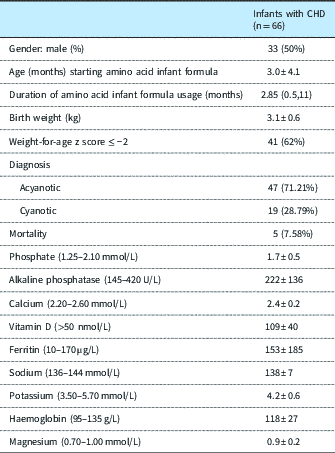
The record search yielded 136 patients. Cases excluded were preterm infants with self-resolving cardiac lesions (n=24), chromosomal / genetic abnormalities (n=4), those started on amino acid infant formula after 1 year of age (n=11), and infants on an amino acid infant formula found to have a structurally normal heart following a paediatric cardiology review (n=31). A total of 66 infants with a CHD diagnosis, confirmed at the time of cardiology review, were included, all of whom were prescribed an amino acid infant formula for either presumed cow’s milk protein allergy or feed intolerance (Table 1).
Baseline demographics of infants with CHD (n=66).

Mean±standard deviation.
Anthropometry – overall
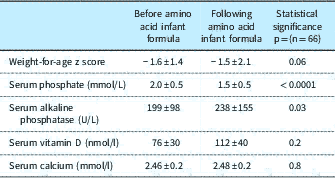
Following the introduction of amino acid infant formula, the mean weight-for-age z score in infants with CHD remains unchanged: −1.61±1.4 to −1.5±2.1 (p=0.06) (Table 1).
Serum phosphate
In all, 1044 serum phosphate measures were completed in the cardiac group with a median number of measures of n=3 (interquartile range:1, 42).
Serum phosphate levels significantly declined among infants with CHD following the introduction of amino acid infant formula, decreasing from 2.0±0.5 to 1.5±0.4 mmol/L (p<0.0001) (Table 1).
Serum vitamin D and calcium
In all, 819 serum-corrected calcium measures were completed, with a median number of measures of n=3 (interquartile range 1, 42). There was no significant difference in serum calcium levels among infants with CHD before or after commencing amino acid infant formula: 2.46±0.2 versus 2.48±0.2 nmol/L (p=0.9).
Vitamin D levels were within normal range. There was no significant difference in vitamin D levels among infants with CHD before or after commencing amino acid infant formula: 76±30 versus 112±40 nmol/L (p=0.2).
Serum alkaline phosphatase
Serum alkaline phosphatase significantly increased in term infants with CHD following the introduction of amino acid infant formula: 199±98 to 230±157 U/L (p=0.03) (Table 2).
Comparison of changes in clinical variables of infants with CHD and non-cardiac infants before and after amino acid infant formula treatment.

Relationship between phosphate and weight gain before and after amino acid infant formula use
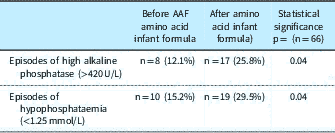
Infants with CHD who experienced hypophosphataemia had significantly lower mean weight-for-age z scores, −2.1±1.3, compared with infants with CHD who had normal phosphate levels, −0.9.0±1.5 (p<0.0001). Following the introduction of amino acid infant formula, the prevalence of hypophosphataemia episodes was increased among infants with CHD had 15% (n=10/66) pre-treatment versus 29% (n=19/66) post-treatment (p=0.049).
High alkaline phosphatase was not significantly associated with weight-for-age z scores among infants with CHD (Table 3).
Episodes of hypophosphataemia and high alkaline phosphatase levels within the CHD group before and after the commencement of amino acid infant formula.

Comparison between phosphate levels over time
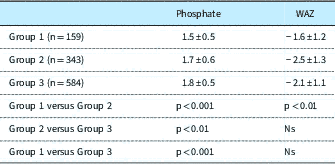
Changes to amino acid formulation have occurred during the past 15 years, and thus we compared phosphate levels in three 5-year periods: Group 1 (2002–2006), Group 2 (2007–2011), and Group 3 (2012–2017); there were statistically significant differences between the three groups. There was a statistically significant difference between weight for age z scores (WAZ) Group 1 (2002–2006) and Group 2 (2007–2011), p<0.01, but not between the other time points when comparing WAZ during the three time periods (Table 4).
Comparison between phosphate levels over time.

Discussion
There have been significant improvements in the medical and surgical management of CHD, with more children now reaching adulthood;Reference van der Linde, Konings and Slager 1 however, with improved survival comes an increasing burden of morbidity. In particular, growth failure during the first 2 years of life is considered to be a significant concern in infants with CHD.Reference Marino and Magee 3 Growth failure is multifactorial, arising from feeding intolerance owing to gastrointestinal dysmotility, delayed gastric emptying, and a low intake of a range of macronutrients and micronutrients such as phosphate, zinc, sodium, magnesium, and potassium,Reference Medoff-Cooper, Naim, Torowicz and Mott 8 , Reference Blasquez, Clouzeau and Fayon 14 arising from feeding difficulties that are often associated with feeding intolerance.Reference Medoff-Cooper, Irving and Hanlon 15 The use of anti-reflux medication to manage reflux and associated feeding intolerance is associated with decreased intestinal absorption of phosphate.Reference Gonzalez Ballesteros, Ma and Gordon 9 In addition, the use of diuretics is associated with extra losses via the urine of electrolytes and minerals, which includes phosphate.Reference Berne, Carias, Cioccia, Gonzalez and Hevia 10 As a result, the use of amino acid infant formula in infants with CHD may represent a significant nutritional risk owing to the complex physiological and nutritional needs of these infants.
We have shown that serum phosphate levels decrease in infants with CHD following the introduction of amino acid infant formula, although there was no change to vitamin D or calcium levels. Although the source of phosphate within amino acid infant formulas varies, with levels ranging from 35 to 47 mg/100 ml, the amounts are similar to those available in term infant formula – ranging from 28 to 39 mg/100 ml. Phosphate is not only required for bone mineralisation but also as a co-factor for rapidly dividing cells, cellular growth, and energy metabolism including adenosine triphosphate. There are a number of hormones and negative feedback loops that also play a role, including parathyroid hormone, 1,25-dihydroxyvitamin D, and fibroblast growth factor 23, which serve to regulate serum phosphate through the modulation of intestinal phosphate absorption, renal phosphate reabsorption, or bone metabolism. Gonzalez Ballesteros et al. have previously shown similar biochemical features of decreased serum phosphate and alkaline phosphate levels, but with calcium and vitamin D levels within the normal range,Reference Gonzalez Ballesteros, Ma and Gordon 9 which may suggest limited intestinal absorption and relative deprivation.Reference Fukumoto 16 Other factors that may play a role are higher levels of free amino acids inducing a type of refeeding syndrome with hyphosphataemia, which has been described in preterm infants receiving parenteral nutrition,Reference Bonsante, Iacobelli and Latorre 17 with a similar negative effect on growth.
Infants with CHD who had hypophosphataemia while on amino acid infant formula had significantly lower weight-for-age z scores than those with normal phosphate levels; however, it is important to note that there may be other factors contributing to poor growth among this cohort, particularly in relation to the severity of the congenital heart lesion. Although this finding does not demonstrate causality, it does warrant further future investigation. Optimal growth and development among otherwise healthy infants with food allergy/ intolerance has been demonstrated when using amino acid formulas.Reference Harvey, Langford and Harthoorn 18 However, in those infants born preterm or with other co-morbidities, the challenge is to ensure that the nutritional composition of amino acid infant formulas is also appropriate for infants with increased macronutrient and micronutrient requirements. Until such time we would concur with the recommendations arising from Gonzalez Ballesteros et al., suggesting that routine monitoring of mineral metabolism should be completed in those infants with CHD requiring amino acids infant formula as a sole source of nutrition,Reference Gonzalez Ballesteros, Ma and Gordon 9 providing additional mineral supplements where required. It is also important to note that, to our knowledge, the amino acid formulation changes during the past 15 years may have also partly influenced the results. There were statistically significant differences in phosphate levels between each of the groups, with phosphate levels during the first 5 years being the lowest. Our results would also suggest that compositional changes to phosphate and calcium sources may have resulted in higher phosphate levels at subsequent time points. There were significant differences in WAZ between Group 1 (2002–2006) and Group 2 (2007–2011) (p<0.01), but not in the other time periods. Owing to the exploratory nature of this retrospective review, these results should be interpreted with caution.
There is a paucity of published papers relating to the use of amino acid infant feeds among infants with CHD and the impact on growth. There are also no published in vitro models, which the authors are aware of, regarding the intestinal absorption of phosphate salts in specialist infant formula, and how this may be affected through the use of anti-reflux medication – e.g. normal acid gastric acidity versus an alkaline environment and diuretic use. As a way forward, and in order to better understand the potential limitations of specialist infant formula of being able to meet the nutritional requirements of infants with complex medical needs, health care professionals, food scientists, and industry should work together to be better informed regarding the nutritional composition of these specialist infant formula to better support growth in this population.
There are a number of limitations to this study, the primary one being the retrospective nature and the heterogeneity of the infants included. As this was an electronic medical record search, we may have missed the records of some infants. Amino acid formulation changes during the past 15 years may have also partly influenced the results, which is difficult to account for in this exploratory analysis. As such these results should be interpreted with caution. We also did not have parathyroid measures to investigate the effect of low phosphate on bone health. Although we have described a possible relationship between amino acid infant formula use and poor weight gain among infants with CHD, this does not represent causality, and a prospective study with age-matched controls would be required to investigate these relationships further. However, we have identified some interesting findings, which partly corroborate previous published findings, and a larger prospective cohort would be required to confirm or refute our results.
Conclusion
Infants with CHD are already susceptible to poor weight gain, which is likely to be multifactorial in nature; therefore, it is crucial that the nutritional status and bone health of infants with CHD consuming amino acid infant formula are regularly monitored to support adequate growth and optimal bone health. In addition, nutritional health care experts and industry should work together to ensure that the formulations of these specialist feeds is more able to meet the nutritional needs of this vulnerable population group.
Supplementary material
To view supplementary material for this article, please visit https://doi.org/1017/S1047951118001324
Acknowledgements
None. Authorship: All authors have made substantial contributions to all areas of this manuscript data collection and statistical analyses. All authors edited, read, and approved the final manuscript.
Financial Support
This work is also part of independent research completed by LVM arising from a Health Education England/NIHR Clinical Lectureship (ICA-CL-2016-02-001) supported by the National Institute for Health Research. The views expressed in this publication are those of the author(s) and not necessarily those of the NHS, the National Institute for Health Research, Health Education England, or the Department of Health.
Conflicts of Interest
None.