1. Introduction
A large corpus of literature demonstrates that precarious work (Kalleberg, Reference Kalleberg2009), such as part-time work, temporary employment, low-skilled jobs in the service sector, or solo self-employment, has become increasingly dominant in the labour market since the late 20th century (Allmendinger, et al., Reference Allmendinger, Hipp and Stuth2013; Schulze Buschoff and Protsch, Reference Schulze Buschoff and Protsch2008; Kalleberg, Reference Kalleberg2000; Standing, Reference Standing2011). Social security programs designed and established during the period of industrialization in advanced welfare states assume that most workers have full-time permanent positions, and therefore, these programs focus on managing the so-called old social risks that such workers or their families are expected to face. However, while the proportion of workers who are not in full-time permanent employment positions has gradually increased in the post-industrial economy, existing social policy programs have often failed to provide them with adequate social security coverage (Bonoli, Reference Bonoli2005; Schulze Buschoff and Protsch, Reference Schulze Buschoff and Protsch2008; Rueda, Reference Rueda2014). Moreover, such workers tend to suffer from job insecurity and relatively low incomes (Barbieri, Reference Barbieri2009; Giesecke, Reference Giesecke2009; Halleröd, et al., Reference Halleröd, Ekbrand and Bengtsson2015). In addition, technological advancements and automation may further increase atypical work and unemployment in the future (OECD, 2016).
In this scenario, the role of UBI schemes as a new social policy program for the post-industrial society has attracted attention and stirred up debates. For example, the Swiss basic income referendum of 2016 and the Finnish basic income experiment of 2017-2018 have attracted considerable attention worldwide. UBI schemes are occasionally considered possible alternatives to alleviate the risks faced by workers in precarious jobs (Standing, Reference Standing2013; Van Parijs, Reference Van Parijs2004). Basic Income Earth Network (2019) defines a UBI as “a periodic cash payment unconditionally delivered to all on an individual basis, without means-test or work requirement”, and the concept is used interchangeably with basic income, citizen’s income, citizen’s basic income, social dividend, or universal grant (Citizen’s Basic Income Trust, 2019).
A considerable part of the political economy literature approaches atypical work from the perspective of labour market segmentation and focuses on the differences in political preferences and welfare attitudes between the insiders with stable, full-time, and fully insured employment and the outsiders with unstable and insecure employment (Guillaud and Marx, Reference Guillaud and Marx2014; Garritzmann et al., Reference Garritzmann, Busemeyer and Neimanns2018; Häusermann et al., Reference Häusermann, Kurer and Schwander2016; Lindvall and Rueda, Reference Lindvall and Rueda2014). However, there is a scarcity of research on UBI preferences, and we are unaware of precarious workers’ attitudes towards UBI schemes. Because UBI differs from the existing welfare programs, in that it intends to provide everyone with a specific amount of income unconditionally, it is necessary to explore the UBI preferences of precarious workers by considering this difference. Therefore, by studying the opinions of precarious workers on UBI, we expect to gain novel insights into the dynamics of contemporary labour markets and social policy institutions.
Furthermore, to contribute to the discussion on the relationship between institutions and policy preferences, we examine whether the generosity of unemployment benefit influences the UBI preferences of workers. It is likely that the introduction of UBI schemes will increase the degree of decommodification, which means “the degree to which individuals, or families, can uphold a socially acceptable standard of living independently of market participation” (Esping-Andersen, Reference Esping-Andersen1990, p. 37), unless the level of benefit from the scheme is lower than that provided by previous programs before its introduction. We argue that the workers who have experienced high degrees of decommodification are unlikely to consider UBI schemes necessary. Thus, the level of unemployment benefit generosity has a negative effect on workers’ UBI preferences.
Our study fills these gaps by studying whether precarious workers are more likely to support UBI schemes than non-precarious workers and whether unemployment benefit generosity negatively influences the UBI preferences of workers. To answer these research questions, we estimate multilevel logistic models by merging country-level data obtained from multiple international organizations with individual-level data from the European Social Survey (ESS) Round 8, which was dedicated to the theme of welfare attitudes. Before statistical analysis, in the second section, we review the relevant literature, introduce our theoretical framework, and set up our hypotheses. Section 3 introduces the data and the methods, and section 4 presents the results. In the last section, we conclude the study by discussing the implications of our findings and the limitations of this study, as well as by outlining the key future directions to be studied.
2. Background and hypotheses
2.1. Surveys on attitudes towards basic income
High-quality evidence on attitudes towards basic income is limited. In the 2000s, a few surveys investigated public opinion on basic income in Nordic countries.Footnote 1 Nationwide and representative opinion surveys on basic income were conducted in Finland and Sweden based on the same questions in 2002 (Andersson and Kangas, Reference Andersson, Kangas, Kildal and Kuhnle2005). The item on attitudes towards basic income was as follows: “What do you think about a system that would automatically guarantee a certain basic income to all permanent residents?” Approximately two-thirds of the Finnish respondents responded in favour of basic income compared to only 46% of Swedish respondents. The authors interpreted this difference in terms of political power of the social democratic party, which is generally against basic income and was stronger in Sweden, and Swedish people’s belief that the Swedish welfare state is the best example of a universalistic welfare regime. A Norwegian study conducted in 2003 included the same question to collect opinions on basic income (Bay and Pedersen, Reference Bay and Pedersen2006). The survey revealed that two-thirds of the Norwegian electorate favoured a basic income system, although approximately 30% of the electorate exhibited negative attitudes towards it, which the authors ascribed to the Norwegian oil economy, strong culture of solidarity in the country, and social policy traditions of Norway that emphasise flat-rate benefits and general taxation.
Recently, multiple public opinion surveys on UBI have been conducted in European countries.Footnote 2 Most of these surveys, however, have not yielded data suitable for in-depth analysis, but the ESS Round 8 Data (2016) are suitable for exploring various factors associated with individual UBI preferences. The survey asked respondents in 21 European countries, as well as in Israel and Russia, about their attitudes towards UBI by explaining the concept, which is based on the definitions provided by Basic Income Earth Network (2019) and Citizen’s Basic Income Trust (2019). The survey results indicated that, on average, almost half of the respondents supported the introduction of a UBI scheme in the 21 European countries, although there were distinct differences in approval ratings across countries (Lee, Reference Lee2018). A limitation of the questionnaire items was that they did not specify the quantum of monthly basic income and the extent to which existing welfare benefits will be replaced with UBI. This ambiguity made it difficult for the respondents to expect who would benefit under the new system. Nevertheless, the question clearly indicated that the mentioned UBI scheme is a new social security scheme based on universality, unconditionality, and individuality and that it aims to improve poor people’s standard of living and enhance income redistribution.
2.2. Expected effects and simulations of UBI schemes
Haagh and Rohregger (Reference Haagh and Rohregger2019) reported that UBI schemes can commonly be expected to reduce economic inequality, increase self-motivation for labour market participation, improve administrative efficiency, and strengthen social protections for workers vulnerable to labour market transformations. These expected effects can attract the attention of the precarious workers addressed in this study. First, given that most people in precarious work face economic inequality, they would, at the very least, be likely to favour the potential redistributive effect of UBI. Second, many people could more voluntarily take up part-time jobs while relying on UBI. Third, if UBI schemes can increase administrative efficiency, every person can experience reduced bureaucratic red tape when receiving welfare benefits. Last, because a considerable proportion of non-standard workers are not entitled to social security benefits (Matsaganis et al., Reference Matsaganis, Özdemir, Ward and Zavakou2016), UBI schemes can be considered a possible alternative to protect workers who are outside the social security net in terms of welfare reform. Therefore, we examine the relationship between each type of precarious work and UBI preferences by considering the extents of interest of various groups of precarious workers in the expected effects.
Although UBI experiments have been conducted in many countries, it is difficult to find reliable scientific evidence to prove any of the reported effects. However, multiple microsimulation studies on diverse types of UBI schemes have demonstrated that such schemes are expected to have a stronger redistributive effect than existing income security systems.Footnote 3 Kela’s (2016) microsimulation in Finland demonstrated that full UBI models with generous payment levels, such as €1,000 and €1,500 per month, can substantially reduce income inequality and the number of low-income households, and partial UBI models can be effective for narrowing income gaps, unless the level of payment is lower than the current basic social transfers. Especially, it was predicted that the introduction of UBI schemes can benefit low-income wage earners in Finland (Kela, 2016). Torry (2014; Reference Torry2017) and Martinelli (Reference Martinelli2019) estimated the distributional effects of UBI models, which can be considered in the UK, by employing EUROMOD, a tax-benefit microsimulation model for the European Union. Torry (Reference Torry2017) revealed that partial UBI schemes with modest payments have a stronger positive effect on income redistribution than the existing benefits system.Footnote 4 In another study, Torry (Reference Torry2014) demonstrated that full schemes with relatively low payment levels could encourage people to additionally participate in employment by reducing means-tested benefits, although low-income households would incur losses. Martinelli (Reference Martinelli2019), who explored three UBI models—a full scheme with a moderate payment level, a generous full scheme, and a partial scheme with a modest payment level—found that all of these schemes could potentially reduce the poverty rate and income inequality. Moreover, the microsimulation indicated that all the three models would improve working-age poverty rate on average, although a majority of working-age households without children would likely experience income loss (Martinelli, Reference Martinelli2019). As a result, microsimulation studies are in line with public expectations on the redistributive effect of UBI schemes (Haagh and Rohregger, Reference Haagh and Rohregger2019).
It would be very difficult for ordinary people to anticipate the specific and extensive results calculated using these microsimulation models and to precisely estimate their personal benefits without the specifications of UBI schemes. Nevertheless, survey participants can decide whether they are for or against UBI without such precise information by relying on the aims and features of the new system provided by survey items.
2.3. Precarious workers’ preferences for UBI schemes
Both part-time positions and temporary employment tend to increase income and job insecurity and poverty risks (Burgoon and Dekker, Reference Burgoon and Dekker2010; Horemans and Marx, Reference Horemans, Marx, Fritz and Koch2013; Van Lancker, Reference Van Lancker, Fritz and Koch2013). In addition, people in these types of work are likely to face difficulties when accessing social security benefits, such as unemployment benefits and pension, in most EU member states owing to frequent marginalisation from the labour market or very few working hours (Matsaganis et al., Reference Matsaganis, Özdemir, Ward and Zavakou2016). Schulze Buschoff and Protsch (Reference Schulze Buschoff and Protsch2008) pointed out that social insurance systems protect atypical workers to a lesser extent than they protect standard employees. Because of such economic insecurity, part-time workers and temporary workers can express stronger tendencies towards the expansion of redistribution, and exclusion from the social safety net can motivate their desire for restructuring the existing social security systems. Although UBI is not the only alternative for realising their demands, overall, the factors would cause these workers to take a positive view of UBI. Especially because temporary employees are more likely to become unemployed than permanent workers, they may regard unconditional and periodic UBI payments as a reliable support system that can support their uncertain future. Part-time employees, who usually earn relatively low hourly wages, have shorter job tenures, and have access to limited job opportunities (Horemans and Marx, Reference Horemans, Marx, Fritz and Koch2013), could experience lower levels of stress and worry because of not having full-time jobs by relying on the additional income provided by UBI schemes. In consideration of all these points, our hypotheses related to part-time workers and temporary employees are as follows:
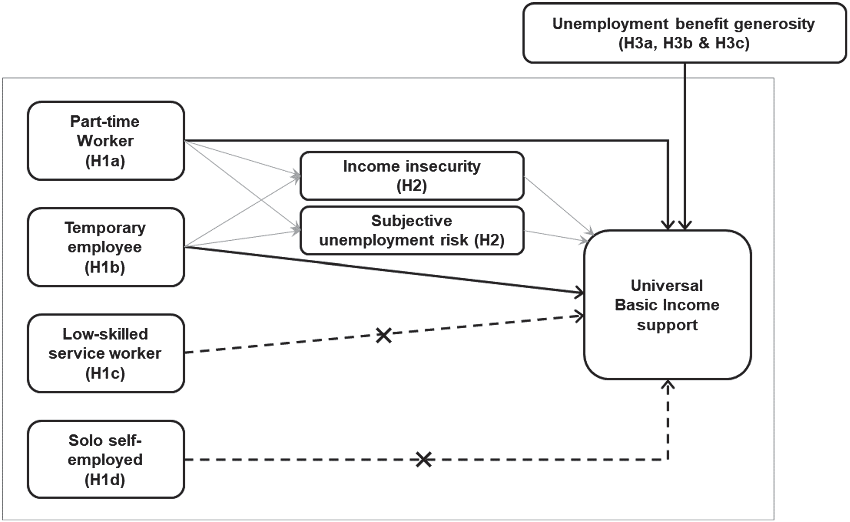
H1a: Part-time workers are more likely to favour UBI schemes than full-time workers.
H1b: Temporary employees are more likely to favour UBI schemes than permanent employees.
The literature indicates that unskilled or low-skilled workers tend to be more supportive of government redistribution and welfare policies than highly skilled or administrative workers (Jæger, Reference Jæger2006; Linos and West, Reference Linos and West2003; Svallfors, Reference Svallfors2004; Wren and Rehm, Reference Wren, Rehm and Wren2013). This trend is understandable because these groups of employees are the most vulnerable in all countries (Häusermann et al., Reference Häusermann, Kurer and Schwander2016). Furthermore, as jobs in the service sector that require lower skill levels become increasingly vulnerable to labour market transformations (Oesch, Reference Oesch2013), low-skilled service employees are likely to earn low wages and experience poor working conditions. This could incentivise low-skilled service workers to support UBI given its potential for redistribution. In terms of the demand for welfare reforms, however, low-skilled service workers would be less likely to demand the reorganisation of social protection than other types of precarious workers because they can generally qualify for all welfare benefits as other standard workers, unless they are on a fixed-term contract or in a part-time position. Considering that there are many alternative redistribution measures other than UBI and that the desire of this group of workers for the overall restructuring of social security is not strong, they are unlikely to support UBI more actively than other workers. Therefore, the hypothesis regarding low-skilled service employees is as follows:
H1c: The attitudes of low-skilled service sector employees towards UBI schemes do not differ significantly from those of other workers.
Studies have demonstrated that a substantial proportion of solo self-employed workers have suffered from financial hardships. Halleröd et al. (Reference Halleröd, Ekbrand and Bengtsson2015) revealed that considerable numbers of the working poor in Europe are self-employed, and most of them do not have other employees. Schulze Buschoff and Protsch (Reference Schulze Buschoff and Protsch2008) demonstrated that solo self-employed workers tend to change their employment status frequently and are at a high risk of becoming unemployed. Contrary to self-employed individuals running stable businesses, solo entrepreneurs tend to start their businesses involuntarily; often rely on more irregular, potentially lower income; and are less likely to be adequately covered and protected by earnings-related social insurance or pension schemes (Schulze Buschoff and Protsch, Reference Schulze Buschoff and Protsch2008; Dekker, Reference Dekker2010; Jansen, Reference Jansen2016; Pedersini and Coletto, Reference Pedersini and Coletto2009). These characteristics of solo self-employment, which seem similar to those of temporary employment, can induce favourable attitudes towards UBI. However, Jansen (Reference Jansen2016) revealed a stark contrast in pro-welfare attitudes between solo self-employed workers and temporary workers. This may be ascribed to the fact that self-employed workers are assumed to prefer “free markets and a low level of social protection because they depend on flexible labour markets and often on relatively low-paid workers” (Iversen and Soskice, Reference Iversen and Soskice2001, p. 883). Jansen (Reference Jansen2016) argued that because solo self-employed workers are potential employers, they would consider temporary workers as an important source of employment for their businesses and be reluctant to extend social security. Consequently, their negative attitudes towards welfare policies may neutralise their favourable impressions towards UBI, which can be ascribed to their economic vulnerability and low level of social protection. Hence, the hypothesis for solo self-employed workers is as follows:
H1d: The attitudes of solo self-employed workers towards UBI schemes do not differ significantly from those of permanent employees.
We expect that part-time workers’ and temporary employees’ income insecurity and job uncertainty would play an important role in making them support UBI. This means that these two factors would function as intermediate variables between those types of precarious work and UBI preferences. Thus, the following hypothesis is formulated to verify whether income and job insecurity are parts of the mechanism in the relationships between the dependent and independent variables:
H2: Being a part-time worker or temporary employee increases income insecurity and subjective unemployment risk, which, in turn, positively influence support for UBI schemes.
2.4. Unemployment benefit generosity and UBI preferences
Nowadays most welfare states operate unemployment insurance schemes to protect workers from income insecurity in the event of unemployment, but the introduction of a UBI scheme could probably transform unemployment insurance systems. Because most workers—even the self-employed in some countries—have unemployment insurance, whether voluntary or compulsory, they are likely to be approximately aware of the possible unemployment benefits that they could receive. Thus, the characteristics of existing unemployment insurance schemes might affect their UBI preferences.
Importantly, information about the specifications of UBI schemes is vague, and debates on the topic are still underway in all European countries. In other words, the situation is uncertain in this regard. Kahneman and Tversky (Reference Kahneman and Tversky1984) showed that people tend to favour stability over change and try to avoid losses over acquiring possible gains. It seems likely that workers would be reluctant to support the introduction of UBI schemes if they feel that the current level of unemployment benefit is satisfactory. Otherwise, it is possible that they would be in favour of the new system. In addition, Jæger (Reference Jæger2006) demonstrated the relative level of unemployment benefits to be negatively associated with individual preferences for redistribution. This can be interpreted to mean that generous unemployment benefits would undermine people’s support for the expansion of a redistributive policy. Therefore, we predict that the more generous an unemployment benefit scheme, the less supportive would workers be about the introduction of a UBI scheme.
When measuring the generosity of unemployment benefits, focusing only on the level of benefits in terms of their income replacement rate is inadequate, although many economic analyses of the generosity of such benefits tend to concentrate only on this indicator. The conditions of the entitlement, duration of benefit payments, and, especially, the qualifying period, are powerful indicators as well (Kuitto, Reference Kuitto2018; Scruggs, Reference Scruggs, Siegal and Clasen2007). First, the replacement rate refers to the extent to which unemployment benefits replace recipients’ income from employment. Thus, the higher the replacement rate, the more generous is the unemployment benefit. Next, the payment duration indicates the period for which unemployment benefit is paid to an unemployed person. This duration varies substantially across countries, even when their unemployment insurance systems exhibit similar income replacement rates. The longer the payment duration, the more generous is the unemployment benefit. Lastly, the qualifying period for unemployment benefit is the period of employment or the contribution required to gain entitlement. This implies that the longer the qualifying period, the less generous is the benefit. Consequently, the hypotheses associated with the generosity of unemployment benefits are as follows:
H3a: The higher a country’s net replacement rate of unemployment benefit, the less supportive of UBI schemes are workers.
H3b: The longer a country’s unemployment benefit payment duration, the less supportive of UBI schemes are workers
H3c: The longer a country’s qualifying period for unemployment benefit, the more supportive of UBI schemes are workers.
To sum up, Figure 1 displays our study framework.
Analytical framework: individual- and country-level determinants of universal basic income preferences.

3. Methodology
The main data source for our analysis is the ESS Round 8 Data (2016), which were collected by administering a biennial cross-sectional survey through face-to-face interviews in 2016. We only analysed the cases of respondents who are in paid work and are between the ages of 15 and 64 years to focus on how precarious workers’ opinions on UBI differ from those of other workers. When estimating statistical models, we applied population and post-stratification weight values to reflect the characteristics of the populations in the individual countries and to account for the effects of varying inclusion probabilities and unit non-response. The population weight values corresponding to each country were newly calculated based on data about the size of employed populations, and the post-stratification weight values came from the ESS data. In addition, our analysis targeted the cases from 21 countries that participated in the survey, excluding Israel and Russia. Finally, we combined these data with other data, including country-level variables from multiple official statistical sources.
The ESS data provide the variables to display respondents’ opinions about the introduction of UBI schemes, which we used as the dependent variable in our analysis. The item originally has four values (strongly against = 1, against = 2, in favour = 3, strongly in favour = 4), but we recoded the variable into a dichotomous one (strongly in favour or in favour = 1, strongly against or against = 0) and employed logistic models with a binomial dependent variable. We estimated the fixed-effects models with clustered standard errors and country dummies to test the hypotheses related to precarious workers and mediation. In this part of the study, we focused on the individual level, which is why we used the most powerful controls at the country level, which are country fixed effects. In terms of the second part of the study, where we focus on the country-level institutional factors, we employed random intercept models and random slope models to obtain correct variance estimates of the higher-level variables. The number of countries is 21, because of which the analytical power at the higher level could be limited. Thus, we check the robustness of random intercept models by applying the two-step approach described by Bryan and Jenkins (Reference Bryan and Jenkins2016).
The individual-level main explanatory variables in our analysis are four precarious worker groups: part-time workers, temporary employees, low-skilled service sector employees, and solo self-employed workers. We operationally defined these groups as follows: first, a part-time worker is a person in paid work with fewer than 35 hours per week. Second, a temporary employee is a person who has a fixed-term employment contract. Third, a low-skilled service sector employee is an employee who works in the service industry and whose highest level of education is the European Survey Version of International Standard Classification of Education (ES-ISCED) I or II. Finally, a solo self-employed worker is a self-employed person who does not have employees. Moreover, to capture individual countries’ unemployment benefit generosity, we included the unemployment benefit net replacement rate, unemployment benefit payment duration, and the qualifying period for unemployment benefit as country-level explanatory variables. The data on those variables were obtained from the Organisation for Economic Co-operation and Development (OECD, 2019a; 2019b).Footnote 5
The control variables are divided into individual- and country-level variables. The individual-level control variables are gender (male = 0, female = 1), age (in years), household type (six categories: two-earner couple with children, two-earner couple without children, one-earner couple with children, one-earner couple without children, single with children, and single without children), education (five categories; ES-ISCED I or II, ES-ISCED IIIb, ES-ISCED IIIa, ES-ISCED IV, and ES-ISCED V1 or V2), public sector employment (public sector worker = 1, otherwise = 0), and frequency of attendance at religious services (ranging from never = 0, through to everyday = 6). A considerable number of studies demonstrate that those demographic features tend to make difference in individual welfare attitudes. Regarding family composition, whether to have children and whether to live with spouse or partner are usually employed, but we created the more elaborate household type variable because the number of earners and child co-residence could affect respondents’ expected benefits related to the introduction of UBI schemes. Because public sector employment and attendance at religious services tend to positively and negatively influence support for welfare policies, respectively (Burgoon and Dekker, Reference Burgoon and Dekker2010; Häusermann et al., Reference Häusermann, Kurer and Schwander2016; Rehm, Reference Rehm2009; Svallfors, Reference Svallfors2004), we include them as control variables.
The country-level control variables are averages of public social expenditure as a percentage of gross domestic product (GDP) between 2010 and 2015, log of nominal GDP per capita in 2015, and log of population on 1 January, 2016.Footnote 6 Given that GDP per capita and public social expenditure are significantly associated with redistributive preferences and affect the associations of other country-level variables with them (Jæger, Reference Jæger2006; Pittau et al., Reference Pittau, Massari and Zelli2013), we consider them possible confounders. Population size is meaningful in comparative welfare state research because social democratic welfare states that provide generous cash benefits mostly have small populations (Ragin, Reference Ragin, Janoski and Hicks1994). Especially, when it comes to UBI schemes, it is probable that people in countries with large populations are more likely to feel that paying everyone in the country a UBI would be too demanding compared to those in countries with small populations.
In order to test the hypotheses regarding mediation, we employ household income (the bottom decile = 1, through to the top decile = 10) and the subjective likelihood of unemployment (likely to be unemployed during the next 12 months = 1, otherwise = 0) variables. We follow the basic steps for mediation analysis suggested by Baron and Kenny (Reference Baron and Kenny1986) by estimating regression models among independent, dependent, and mediator variables.
4. Findings
4.1. Descriptive findings
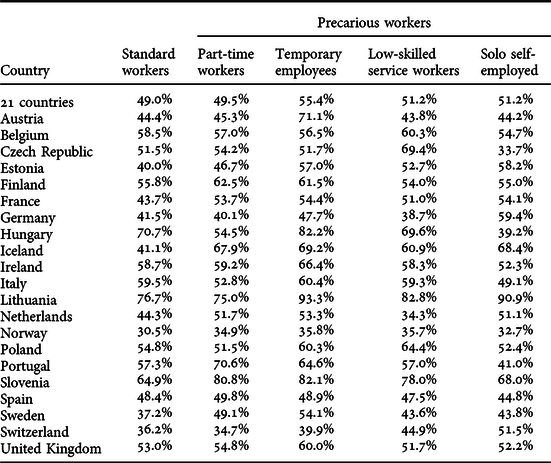
Table 1 demonstrates standard and precarious workers’ approval ratings by country. European standard workers’ opinion on the debate about the introduction of UBI schemes is very strained because, in the 21 countries, their average approval rating for UBI is 49%. The proportion of part-time workers who are in favour of UBI is 49.5%, which is only marginally different from that of standard workers, although a higher proportion of part-timers are supportive of the scheme than standard employees in Finland, France, Iceland, the Netherlands, Portugal, Slovenia, and Sweden. By contrast, in all countries except Belgium, temporary employees’ approval ratings for UBI are higher than those of standard employees, and the average number across countries is 55.4%, which is higher than the figure for standard workers. Low-skilled service employees’ and solo self-employed workers’ average approval ratings are the same at 51.2%, which is only 2.2 p.p. higher than that of standard employees. A comparison of the public opinion in each country reveals that low-skilled service workers have considerably higher approval ratings for UBI in the Czech Republic, Estonia, Iceland, and Slovenia and the solo self-employed in Estonia, Germany, Iceland, Lithuania, and Switzerland. In addition, the results demonstrate that in 10 of the 21 countries, a higher proportion of solo self-employed workers were in favour of UBI schemes than standard workers, while the opposite is true in the other 11 countries.
Standard and precarious workers’ approval ratings for UBI by country, 2016

Source: Authors’ calculations by using data from the ESS round 8 (2016)
Note: The calculations were conducted with only the samples in paid work for the 21 countries from the data. Post-stratification and country weights were applied to the calculation and the values that correspond to “Don”t know” and “Refuse to answer” were excluded from the calculation. Standard workers mean employees who have a permanent full-time contract.
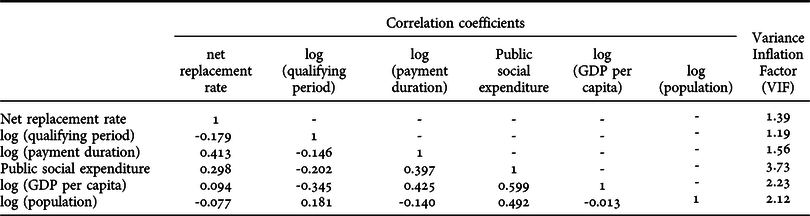
Table 2 displays the correlation coefficients between country-level variables and their variance inflation factors (VIFs) in the multilevel logistic model including all individual-level variables. The highest correlation is found between the log of GDP per capita and public social expenditure and its coefficient is approximately 0.6, whereas most other correlations are considerably low. Moreover, since all the VIFs are lower than 5, it is found that country-level items are not highly correlated to each other in the model. Thus, it does not seem that multicollinearity between them would be problematic.
Correlation coefficients between and VIFs of country-level variables

Note: The VIFs were calculated based on the final logistic model including all individual-level variables.
4.2. Regression findings
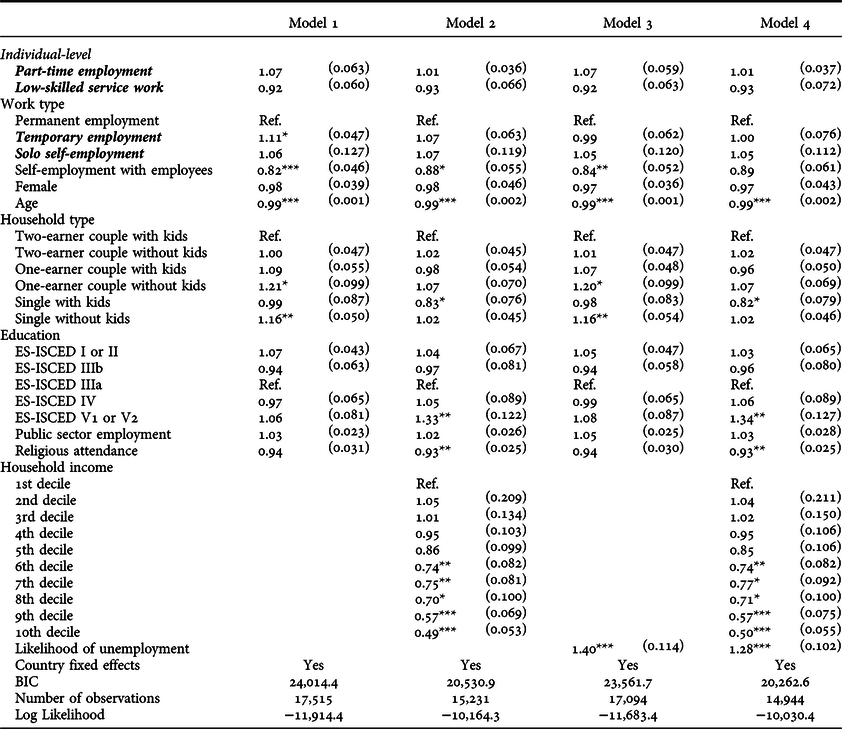
Table 3 displays the results of our logistic models with country fixed effects. Model 1, which includes only the explanatory and control variables, provides a statistical basis for testing the hypotheses related to the effects of different forms of precarious work (H1a, H1b, H1c, and H1d). For the hypothesis on mediation (H2), Models 2 and 3, which include household income and the likelihood of unemployment variables, respectively, in addition to the variables in the first model, and Model 4, which includes both aforementioned variables in addition to the variables in the first model, were estimated. The hypotheses associated with unemployment benefit generosity (H3a, H3b and H3c) are tested using the full model summarised in Table 4.
Logistic regression on UBI preferences with country fixed effects

Note: The results in Models 2 and 4 are robust, when the models include no response category to household income variable.
Ref. = reference category; BIC: Bayesian Information Criterion.
Odds ratios and robust standard errors (in parentheses).
*p < 0.05; **p < 0.01; ***p < 0.001.
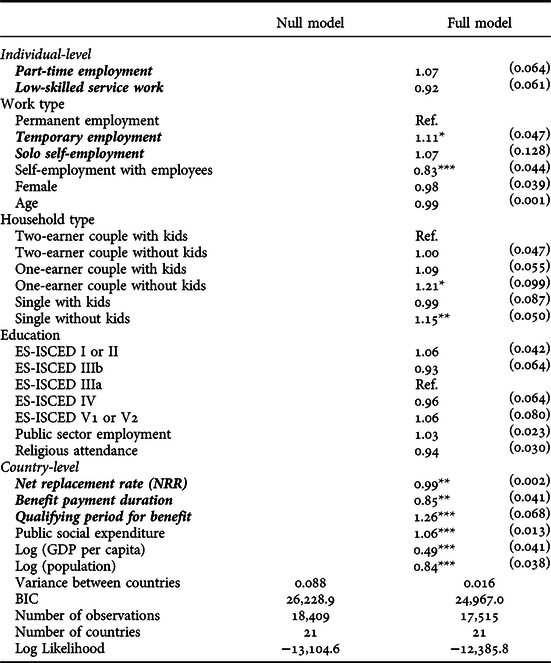
Random intercept model on UBI preferences: null and full models

Ref. = reference category; BIC: Bayesian Information Criterion.
Odds ratios and robust standard errors (in parentheses).
*p < 0.05; **p < 0.01; ***p < 0.001.
Model 1 indicates that among the four types of precarious work, only temporary employment is significantly positively associated with UBI preferences, while the other precarious positions do not have a significant impact. Therefore, H1b (i.e. temporary employees are more likely to favour UBI schemes than permanent employees), H1c (i.e. low-skilled service sector employees do not show significant differences in attitudes towards UBI schemes from other workers.) and H1d (i.e. solo self-employed workers do not show significant differences in attitudes towards UBI schemes from permanent employees) are supported by the findings, but H1a (i.e. part-time workers are more likely to favour UBI schemes than full-time workers) does not receive support. These results are robust when we fit ordered logistic models and linear probability models with the original ordinal variable of basic income preferences. However, logistic models without weights indicate that both part-time employment and temporary work have significantly positive effects on UBI preferences, thus lending weak support for hypothesis H1a.
Models 2 and 3 demonstrate that the mediating variables, household income and the subjective likelihood of unemployment, are significantly associated with UBI preferences and attenuate the coefficient of temporary employment.Footnote 7 Consequently, H2 (i.e. being a part-time worker or temporary employee increases income insecurity and subjective unemployment risk, which, in turn, positively influence support for UBI schemes) is supported only for temporary employees. Model 4 indicates that household income and the likelihood of unemployment are significantly associated with UBI preferences even when they control for each other: the higher the household income, the weaker is the support for UBI, and the higher the subjective unemployment risk, the stronger is the support for UBI. Moreover, being an employer and of a higher age are found to be associated with a negative opinion about UBI. A comparison between the coefficients of temporary employment in Models 2 and 3 reveal the mediating impact of employment insecurity to be stronger than that of income insecurity.
Table 4 displays the estimates of random intercept models. The full model reveals the net replacement rate and payment duration to be significantly negatively associated with UBI preferences and qualifying period to significantly positively influence the dependent variable. In addition, the estimates based on the two-step approach confirm the findings (see Appendix Table A5). Consequently, the three hypotheses pertaining to the generosity of unemployment benefits are supported by the findings. Multilevel models, including random slopes on the individual-level explanatory variables, do not differ substantially from the random intercept models. Especially, the variances of random slopes on part-time work and temporary employment are nearly zero.Footnote 8
In addition to the hypothesis tests, country-level control variables throw up a few interesting results: the findings demonstrate that public social expenditure is significantly positively related to workers’ UBI preferences, whereas GDP per capita and population size are significantly negatively related to workers’ UBI preferences.
5. Discussion
In this study, we examined the social dynamics of post-industrial labour markets by analysing precarious workers’ social policy preferences. More specifically, we studied their opinions on UBI schemes, a hotly debated policy measure that some consider a desirable solution in the changed societal reality. In this way, we attempted to determine the extent to which those who face new social risks in the labour market would prefer a new policy solution.
Our study found, first, that among different types of precarious workers, only temporary employees tend to be more supportive of the introduction of UBI schemes, whereas part-time workers, low-skilled service employees, and solo self-employed workers do not exhibit significantly different preferences for UBI than those of standard employees. Next, as assumed, income and unemployment insecurity serve as mediators between temporary employment and UBI preferences. Finally, the generosity of unemployment benefit has a negative effect on individual workers’ attitudes towards UBI in terms of income replacement rate, payment duration, and qualifying period.
Our findings indicate that employment insecurity is an important factor that shapes the opinions of precarious workers towards UBI schemes. Temporary employees who are simultaneously vulnerable to income and employment insecurity tend to be more supportive of UBI. However, part-time workers and solo self-employed workers, who do not experience subjective employment insecurity despite having low household income levels, are not more supportive of UBI than full-time workers and permanent employees, respectively (see Appendix Table A3). This means that merely having a low level of earnings does not sufficiently motivate precarious workers to support UBI. Temporary employees’ support for UBI can be explained considering their specific situation, in which they tend to experience both income and job insecurity and are likely to be excluded from social security systems (Matsaganis et al., Reference Matsaganis, Özdemir, Ward and Zavakou2016). Considering these findings, it seems that UBI is not more welcomed by low-skilled people working in the service sector, unless they are temporary employees. However, unemployed low-skilled people might be more supportive of the introduction of UBI schemes. This should be investigated in future studies. In addition, given that newly emerging types of work such as platform work and zero-hour contracts have been categorised as precarious work in recent years, their effects on UBI preferences should be examined in future studies.
Regarding the non-deviant preferences of part-timers, there could be another possible explanation. Part-time jobs are mainly dominated by women, who are less likely to be the main breadwinners in their households and may be working part-time voluntarily to achieve a better balance between work and family. Therefore, they might worry that receiving a UBI could lead to counterproductive tax effects, resulting in a lower net household income. As expected, the preferences of solo self-employed workers for UBI do not differ significantly from those of permanent employees. However, they are clearly distinguishable from those of self-employed individuals with employees, who are found to be more likely to oppose the introduction of UBI schemes. This possibly indicates that the UBI preferences of solo self-employed workers reflect their mixed socioeconomic status of potential employer and precarious worker (Jansen, Reference Jansen2016).
In terms of institutional factors, interestingly, all the three features explaining the generosity of unemployment benefits significantly influence UBI preferences. Thus, it seems difficult for UBI schemes to receive widespread support in countries that provide more generous unemployment benefit. As mentioned above, this pattern can be explained by using the prospect theory of Kahneman and Tversky (Reference Kahneman and Tversky1984). That is to say, workers who can receive generous unemployment benefits are likely to be reluctant to support an uncertain UBI scheme because of the risk that it would curtail their potential benefits. Apart from those variables, activation policy can be a topical issue related to generosity. Because unemployment benefits recently becoming more conditional on active job-seeking in many countries may influence people’s UBI preferences, future studies should further investigate the effects of such reforms on UBI preferences.
The findings of our study demonstrate that temporary employees, who are faced with job uncertainty and income insecurity but are not adequately protected by existing social security systems, could become powerful proponents of UBI schemes, and workers in countries that provide less generous unemployment benefits are more likely to favour UBI. Therefore, we can expect that as fixed-term employment becomes more dominant in the post-industrial labour market, the demand for UBI would increase, unless social security systems are improved to protect temporary workers and the unemployed. Welfare states should proactively attempt to respond to such a demand.
Funding
This research was funded by Kone Foundation.
Supplementary material
To view supplementary material for this article, please visit https://doi.org/10.1017/S0047279420000185